FULL ENDING I Thought My Forest Was the One Thing No Neighbor Could Take From Me.
𝗙𝗨𝗟𝗟 𝗦𝗧𝗢𝗥𝗬
I opened the envelope at the kitchen counter.
Inside was a formal notice of violation.
At first, I assumed they’d mailed it to the wrong address.
Then I saw my name.
My property address.
And a list of alleged offenses.
The first violation concerned my barn.
According to the notice, the traditional red paint did not conform to the community’s approved earth-tone color palette.
It described the building as an eyesore that negatively affected the appearance of neighboring properties.
I read that sentence twice.
My grandfather’s barn.
On my grandfather’s land.
Was apparently an eyesore to people who had moved into the neighborhood less than two years earlier.
The second violation was even more ridiculous.
I was ordered to immediately stop discharging firearms on my property.
The notice claimed my private shooting range violated community noise restrictions and disturbed the peaceful enjoyment of the subdivision.
For these two supposed violations, the HOA had imposed a fine of five hundred dollars per day.
Five hundred.
Every single day.
And attached to the back was another invoice.
Twelve hundred dollars for overdue HOA membership dues and initiation fees.
I stood there holding the papers while my wife looked up from the table.
“What’s wrong?”
I handed her the letter.
She read it in silence.
Then she looked at me.
“Are they serious?”
“I hope not.”
“They’re trying to charge us membership dues?”
“Apparently.”
“But we’re not members.”
“Exactly.”
She shook her head.
“What are you going to do?”
I took the papers, folded them, and dropped them into the trash.
“Nothing.”
She raised an eyebrow.
“Nothing?”
“It’s a mistake. Somebody at their management company probably got the property lines wrong.”
“What if it isn’t?”
I smiled.
“Then somebody is about to learn how property ownership works.”
At the time, I genuinely believed that would be the end of it.
I couldn’t imagine a rational person thinking an HOA could simply claim jurisdiction over a neighboring farm because it happened to sit beside a subdivision.
I was wrong about one thing.
I assumed Karen was rational.
About a week later, I was leaving the farm to pick up equipment supplies.
I’d barely started down the driveway when a shiny SUV suddenly swung across the gravel entrance and stopped directly in front of my truck.
I hit the brakes.
Dust rolled past my windshield.
For a moment, I thought the driver had lost control.
Then the door opened.
Karen climbed out carrying a clipboard.
She wore expensive sunglasses and an expression that suggested I’d personally ruined her morning.
She marched straight toward my driver’s window.
I rolled it down.
“Can I help you?”
“You have not responded to my notices.”
No greeting.
No introduction.
Just an accusation.
I looked at her.
“Excuse me?”
“The violation notices. You were given adequate time to respond, and you have failed to do so. Your fines are increasing daily.”
I put the truck in park.
“Ma’am, I think you’ve got the wrong property.”
She tightened her grip on the clipboard.
“I know exactly which property this is.”
“Then you should know it’s a private farm.”
“That does not exempt you from community regulations.”
I stared at her.
“My family has owned this land since the 1940s. I am not a member of your HOA.”
Karen gave a sharp, dismissive laugh.
“That doesn’t matter anymore.”
I remember those exact words.
That doesn’t matter anymore.
As if seventy or eighty years of property ownership could be erased by a woman with a clipboard.
She explained that when the developer purchased the adjoining dairy farm, county zoning maps had supposedly been redrawn to incorporate the surrounding area into the new development’s jurisdiction.
According to Karen, my farm was now legally subject to the HOA.
Whether I had signed an agreement or not.
I waited until she finished.
Then I asked, “Are you telling me that somebody bought the property next door and somehow that made my land part of their homeowners association?”
“Correct.”
“No, ma’am. That’s not how it works.”
Her face hardened.
“You may believe you’re exempt, but our attorneys disagree.”
“Then your attorneys need to look at my deed.”
“You are required to pay your outstanding fees.”
“I’m not paying you anything.”
“And the barn must be repainted.”
“No.”
“The shooting range must be shut down.”
“No.”
Every refusal seemed to make her angrier.
Her voice grew louder.
She informed me that continued noncompliance would result in additional penalties and possible legal action.
Finally, I’d had enough.
“Listen carefully,” I said. “You don’t have any authority over this property. You need to move your vehicle and leave before I call the sheriff.”
For a moment, she looked genuinely stunned.
I don’t think many people had spoken to her that directly in a long time.
Then her expression changed.
A smug little smile appeared.
“If you refuse to cooperate, the board will revoke your access to the community nature preserve.”
I blinked.
“The what?”
“The forest,” she said impatiently.
She pointed toward the massive wall of trees along my eastern property line.
“The community nature preserve. Residents who refuse to comply with association rules can be legally barred from using it.”
I followed her finger.
Then I looked back at her.
For several seconds, I couldn’t speak.
Not because I was frightened.
Because I finally understood.
The developer had advertised beautiful woodland views.
Residents had been walking through the trees.
Nobody had bothered to explain that the entire forest belonged to the farmer next door.
Karen apparently believed those three hundred acres were community property.
She was threatening to ban me from my own woods.
“Ma’am,” I said slowly, “that is not a community preserve.”
She folded her arms.
“Of course it is.”
“No. It isn’t.”
“I know what the developer advertised.”
“And I know what I own.”
Her smile disappeared.
I pointed toward the tree line.
“I own that forest. All three hundred acres. I own these fields. I own the barn. I own the shooting range. And right now, you’re standing on my land, blocking my driveway.”
She stared at me.
Then she actually laughed.
“You’re lying.”
I felt the last of my patience disappear.
“Get off my property.”
She stepped closer.
“If you continue this behavior, I’ll have the association place a lien against your house.”
“You’re welcome to try. But the next time you come here threatening me, the sheriff will be involved.”
She pointed a finger through my open window.
“You have no idea who you’re dealing with.”
I looked at her hand.
Then back at her.
“And you have no idea whose forest you’ve been walking through.”
For a second, neither of us moved.
Then Karen turned sharply, climbed into her SUV, and backed away so aggressively that gravel sprayed across the driveway.
She drove off without another word.
I sat there watching the dust settle.
I should have felt satisfied.
Instead, I felt unsettled.
There had been something in her face when I refused her.
Not just anger.
Humiliation.
The kind of humiliation some people carry around until they find a way to make somebody else pay for it.
When I told my wife what had happened, she didn’t laugh.
She listened quietly.
Then she asked, “Do you think she’ll come back?”
“I don’t know.”
“What are you going to do?”
I looked toward the forest.
For years, I’d allowed those residents to use my land because I wanted to be a good neighbor.
Now their HOA president was threatening to fine me, control my farm, and ban me from property she didn’t even know belonged to me.
Something had to change.
“I’m closing the woods,” I said.
My wife studied my face.
“All of them?”
“Every trail.”
She looked disappointed.
“Some of those families haven’t done anything wrong.”
“I know.”
“Then why punish them?”
I didn’t have a perfect answer.
Because she was right.
Most of the homeowners weren’t responsible for Karen’s behavior.
But their association had attempted to claim rights over my property, and continued public access was becoming a liability I could no longer ignore.
“I let people use the woods because I trusted them to respect our property,” I said. “That trust is gone.”
My wife sighed.
“Grandpa would’ve hated this.”
I looked down.
“Yeah.”
That was the part that hurt.
The following morning, I drove into town and visited the farm supply store.
I spent roughly eight hundred dollars on heavy logging chains, hardened steel padlocks, posts, and a large supply of bright orange private-property signs.
Then I spent the entire weekend driving the perimeter of the forest.
It was exhausting work.
The eastern boundary alone stretched through thick brush, uneven ground, and sections of old logging road that hadn’t been maintained in years.
I located every footpath connecting the subdivision to my woods.
Every ATV entrance.
Every clearing that residents had been using as an unofficial access point.
Where there were existing gates, I chained and locked them.
At other entry points, I installed posts and fencing, marking the boundary clearly.
By Sunday evening, my shoulders ached, my hands were scraped, and I’d used nearly every sign I’d purchased.
At the main trail entrance, I hung the largest notice.
It explained that the forest was private property and that, because of the East Germany Estates HOA’s harassment and attempts to impose illegal fines, permission for subdivision residents to enter had been permanently withdrawn.
No hiking.
No ATVs.
No recreational access.
No trespassing.
I stood there for a long time after hanging that sign.
The trail beyond the gate disappeared beneath the trees.
I’d walked that road with my grandfather when I was a little boy.
I’d walked it with my father.
I’d walked it with my wife on evenings when we wanted to escape the heat.
I hated the idea of putting a barrier between the woods and people who might have loved them the way I did.
But I hated the idea of losing control over my family’s property even more.
By Monday, the neighborhood had noticed.
By Monday evening, my phone was ringing constantly.
Some people were furious.
They accused me of being selfish.
Others argued that they’d purchased their homes specifically because of the surrounding natural landscape.
One woman told me that denying residents access to the trails was ruining her children’s quality of life.
I listened.
Then I explained that the woods were private property and that I’d been allowing access voluntarily.
A few people understood.
Most didn’t.
Several residents came directly to the gate.
One older couple brought their golden retriever and asked whether I could make an exception.
Their dog had grown accustomed to his daily walks along the creek.
The woman looked genuinely heartbroken.
“We never caused any trouble,” she said.
“I know you didn’t.”
“Then why can’t we keep walking?”
I looked at the dog sitting patiently beside her.
“Because your HOA president is trying to exercise control over property that doesn’t belong to the association.”
The man’s jaw tightened.
“We didn’t vote for that.”
“Then you need to tell your board.”
He glanced toward the subdivision.
“We have.”
I felt bad for them.
I really did.
But I held my ground.
The trouble wasn’t simply Karen’s personality anymore.
The HOA had sent formal documents asserting authority over my land.
Until that stopped, I wasn’t comfortable continuing to treat the forest like a public park.
Word spread quickly.
People who had barely paid attention to their HOA suddenly wanted to know why their president was fighting with the farmer next door.
And Karen, who apparently hadn’t expected me to revoke access, found herself answering questions she couldn’t control.
For the first time since the subdivision was built, residents were openly blaming her for something they had lost.
I hoped that would force her to reconsider.
Maybe she’d apologize.
Maybe the board would withdraw its ridiculous demands.
Maybe we could eventually find a way for respectful neighbors to enjoy the trails again.
Instead, Karen became more aggressive.
Additional notices arrived.
I kept them this time.
Every envelope.
Every invoice.
Every threat.
I put them in a folder and documented the dates.
I also made copies of my property records and the permits for the shooting range.
I was prepared to defend my rights if the association actually tried taking me to court.
What I wasn’t prepared for was what happened three weeks after I locked the gates.
It was just after two in the morning when the dogs started barking.
Not their normal barking.
We lived on a farm.
Dogs barked at deer, raccoons, delivery trucks, and sometimes things that existed only in their imaginations.
This was different.
Frantic.
Desperate.
I woke to the sound of claws scrambling against the floor and one of the dogs howling near the back door.
Then I smelled smoke.
For a second, my mind refused to understand.
I sat up.
The bedroom was dark.
My wife stirred beside me.
“What’s wrong?”
I got out of bed and moved toward the window.
That was when I saw the orange glow.
It was coming from the barn.
I remember the exact feeling in my stomach.
A cold, sickening drop.
Like standing on solid ground and suddenly discovering there was nothing beneath your feet.
“Oh, God.”
My wife sat upright.
“What?”
“The barn.”
I was already reaching for my phone.
By the time I got outside, flames were climbing the eastern wall.
The old boards were burning so fiercely that sparks rose into the night sky.
Heat rolled across the yard.
Smoke poured from beneath the roof.
For one terrible moment, all I could think about was my grandfather.
His hands.
His tools.
His voice echoing inside that building.
Everything he had built.
Everything my father had maintained.
Burning.
I called 911 and grabbed the extinguishers we kept near the workshop.
My wife followed me outside, barefoot and frightened.
“Stay back!” I shouted.
She stopped near the porch.
“Are there animals inside?”
“Not in that section!”
“Are you sure?”
“Yes!”
Thankfully, we’d moved the tractors outside earlier that evening, and the eastern section didn’t contain livestock.
But knowing nobody was trapped didn’t make watching the building burn any easier.
I tried using the extinguishers from a safe position, but the fire was already too large.
There was nothing I could do.
I stood helplessly in the yard while flames swallowed the wall.
The volunteer fire department arrived as quickly as they could.
Men I’d known for years climbed from trucks and pulled hoses across my property.
They fought the fire for hours.
I watched from a distance with my arm around my wife.
At one point, part of the roof collapsed.
The sound was enormous.
Heavy timber breaking.
Metal twisting.
A lifetime of memories crashing into a burning pile.
My wife gripped my hand.
“I’m so sorry,” she whispered.
I couldn’t answer.
By dawn, the eastern half of the barn was gutted.
The rest stood blackened and soaked.
The air smelled of wet ash, burned wood, and ruined machinery.
I walked toward the wreckage after the firefighters declared it safe.
The barn I’d known my entire life looked like a skeleton.
Something inside me felt just as hollow.
At first, I tried to tell myself it might have been an electrical problem.
Old buildings have old wiring.
Accidents happen.
But the fire marshal’s investigation destroyed that hope.
He found evidence of an accelerant near the rear wall.
The area where the fire appeared to have started was close to the eastern side of my property, toward the subdivision.
The fire had been deliberately set.
Arson.
That word changed everything.
I remember standing beside the blackened barn while the investigator explained his findings.
My wife had one hand pressed against her mouth.
“Someone did this on purpose?” she asked.
The investigator’s expression was grim.
“That’s what the evidence indicates.”
“Who would do something like that?”
Neither of us answered.
But we were both thinking about the same person.
Karen.
I called the sheriff’s office and explained the dispute.
The fines.
The threats.
The confrontation in my driveway.
The trail closures.
The anger from the subdivision.
I told them I suspected the HOA president might be involved.
The deputies listened carefully.
They took notes.
They asked questions.
But suspicion wasn’t evidence.
Without surveillance footage, eyewitness testimony, or something directly connecting Karen to the fire, there wasn’t enough to arrest her.
I understood that.
At least intellectually.
Emotionally, it was another story.
Every time I looked at the ruins of the barn, I felt a rage I couldn’t describe.
I had worked for years maintaining that building.
My father had spent thousands repairing it.
My grandfather had raised it with the help of neighbors whose names were now carved into old family photographs.
Somebody had taken a match to all of that.
And gotten away with it.
For the next several nights, I barely slept.
Every noise outside made me sit upright.
Every time a dog barked, I reached for the window.
My wife tried to reassure me.
“The sheriff knows what’s happening.”
“I know.”
“They’re investigating.”
“I know.”
But knowing didn’t help.
The farm no longer felt like the safe place I’d grown up in.
And that frightened me more than I wanted to admit.
Then, a week after the fire, something happened that made the loss of the barn feel almost bearable by comparison.
Our oldest dog became violently ill.
He was a Border Collie mix who had spent most of his life working beside me.
He wasn’t a purebred show dog.
His coat was a little uneven, one ear never stood quite right, and he had a habit of nudging people’s hands until they gave him attention.
But he was one of the smartest, gentlest animals I’d ever known.
He had watched over our farm for years.
He knew the sound of my truck.
He knew when I was heading toward the pasture.
And somehow, he always knew when my wife was having a difficult day.
On those days, he’d follow her into the garden and lie nearby, quietly keeping her company.
That morning, I found him trembling near the porch.
At first, I thought he had eaten something that upset his stomach.
Then he started vomiting.
Within minutes, his legs gave out.
His body began convulsing.
My wife screamed for me.
I ran to him and dropped to my knees.
He looked up at me, frightened and confused.
I can still remember his eyes.
He didn’t understand what was happening.
And I couldn’t explain it.
“Hey, buddy,” I whispered. “Stay with me.”
Another seizure struck.
I picked him up and carried him toward the truck.
My wife grabbed her keys.
“I’ll drive.”
We raced to the emergency veterinary hospital.
I sat in the passenger seat with him wrapped in a blanket across my lap.
His breathing was uneven.
His body kept trembling.
I held his head against my chest and talked to him the entire way.
“You’re okay.”
“We’re almost there.”
“Just hang on.”
I don’t know whether he understood my words.
I just needed him to hear my voice.
The veterinary staff rushed him into treatment.
My wife and I waited in a small room that smelled of disinfectant and coffee.
Minutes passed.
Then more minutes.
Every time someone walked through the door, I stood up.
Finally, the veterinarian came to speak with us.
She explained that our dog had ingested a dangerous amount of rat poison.
The clinical findings and treatment pointed to deliberate poisoning rather than an ordinary illness.
My wife started crying.
I felt numb.
“Will he live?” I asked.
“We’re doing everything we can.”
“Please.”
My voice cracked.
“He’s been with us a long time.”
The veterinarian nodded gently.
“I understand.”
We stayed there until the staff assured us he was stable enough for continued treatment.
I had spent years dealing with injured livestock, sick animals, and the unavoidable heartbreak that comes with farming.
But this was different.
He hadn’t been hurt by an accident.
Somebody had apparently put poison where a harmless old dog could find it.
Someone wanted to cause suffering.
Whether the target was the dog or the people who loved him, the cruelty was unmistakable.
By the time we got home, my wife was exhausted.
She sat at the kitchen table and stared into the garden.
“We can’t keep living like this,” she said.
I sat across from her.
“I know.”
“The barn was bad enough.”
I nodded.
“But now the dogs?”
Her eyes filled again.
“What happens next?”
That question stayed with me.
What happens next?
I had thought closing the trails would protect our property.
Instead, the barn had burned.
I had thought reporting the fire would make the threats stop.
Instead, our dog had nearly died.
Every attempt to establish a boundary seemed to bring something worse.
I called the sheriff again.
This time, I told him everything from the beginning.
The absurd HOA notices.
Karen’s threats.
The forest.
The fire.
The poisoning.
Deputies went to Karen’s house and questioned her.
She denied any involvement.
According to what I was told, she claimed that I was the one harassing her.
That I had been intimidating residents.
That I was deliberately provoking the neighborhood with my shooting range and the closed trails.
I remember hearing that and laughing bitterly.
My barn was in ruins.
My dog was fighting for his life.
And she was presenting herself as the victim.
The sheriff explained that the evidence was still circumstantial.
I had a strong reason to suspect Karen.
But suspicion, even reasonable suspicion, wasn’t enough to support an arrest for crimes as serious as arson and animal cruelty.
“We need something we can prove,” he told me.
I knew he was right.
That didn’t make it easier.
“Do you understand what this is doing to my family?” I asked.
He looked tired.
“I do.”
“My wife is afraid to walk around our own property.”
“I understand.”
“My dog almost died.”
“We’re working on it.”
I leaned forward.
“And if whoever did this comes back?”
His expression hardened.
“Call us immediately. Don’t confront anyone yourself.”
I left that conversation feeling frustrated, helpless, and angry.
For the first time in my life, I started wondering whether protecting the farm was going to cost more than I could afford.
Not financially.
Emotionally.
My wife was afraid.
Our animals weren’t safe.
A building that had stood for generations was gone.
And the woman I believed responsible was still sitting in her expensive house, issuing demands as if nothing had happened.
I wanted revenge.
I won’t pretend otherwise.
There were nights when I stood on the porch staring toward the subdivision and imagined confronting Karen face-to-face.
But I knew where that road could lead.
One terrible decision could destroy everything I was trying to protect.
I wasn’t going to let anger turn me into someone my grandfather would have been ashamed of.
If I was going to respond, it would have to be legal.
And it would have to be something Karen couldn’t control.
That’s when I started thinking about the farm itself.
My land had been zoned for agricultural use since the 1940s.
Long before East Germany Estates existed.
Long before the developer purchased the adjoining pasture.
Long before Karen imagined she could regulate my barn or shooting range.
Our established agricultural operations benefited from right-to-farm protections, and the property’s permitted uses were not subject to the HOA’s private architectural rules.
The county still had applicable health, environmental, and setback requirements, of course.
But Karen couldn’t simply declare that my land had to function like a suburban backyard.
I knew people who understood those regulations far better than she did.
Two of my closest friends operated a large commercial livestock business on the other side of the county.
They were experienced farmers.
The kind of men who could look at a pasture and immediately tell you what it needed, how much fencing it would require, and whether the animals would be comfortable there.
I called them.
We sat around my kitchen table while I explained the entire situation.
One of them had already heard about the fire.
The other knew about the poisoned dog.
Neither looked amused.
When I finished, one asked, “What exactly are you thinking?”
I spread a property map across the table.
Then I pointed to a long, narrow strip of land running parallel to the subdivision’s backyards.
“Fifty feet wide,” I said.
He leaned closer.
“All the way along that boundary?”
“Exactly.”
“And?”
“I want to lease it to you.”
He frowned.
“For what?”
“Livestock.”
There was a moment of silence.
Then both men understood.
One slowly leaned back.
“You’re thinking pigs.”
I nodded.
The other looked at me for a long moment.
Then he started laughing.
Not a polite chuckle.
A deep, disbelieving laugh.
“You’ve got to be kidding.”
“I’m not.”
“You want us to put hogs beside a luxury subdivision?”
“I want you to run a legal agricultural operation on land that’s already zoned for agriculture.”
He looked down at the map again.
“Those people aren’t going to enjoy that.”
“I imagine not.”
The first man stopped laughing.
“Are you sure you want to do this?”
I thought about my grandfather’s barn.
I thought about our dog trembling in my arms.
I thought about my wife looking over her shoulder every time she went outside.
“No,” I said.
That surprised them.
I continued.
“I’m not sure about any of this anymore. But I’m tired of being told that people who bought houses next door get to decide how I use land my family has owned for generations.”
We discussed the practical details.
The lease.
The fencing.
Water access.
Animal care.
Sanitation.
County setback requirements.
We weren’t going to do anything that endangered the animals or violated the law.
The operation had to be legitimate.
My friends were professional livestock farmers, and they weren’t interested in risking their business for a neighborhood dispute.
But the more we talked, the more practical the arrangement became.
I offered them a lease for one dollar per year.
They agreed.
Within days, the paperwork was prepared.
And within two weeks, trucks began arriving at the farm.
Flatbeds carried heavy temporary hog panels.
Workers installed fencing and portable shelters.
Water lines were arranged.
Feeding areas and mud wallows were established within the permitted portions of the leased strip.
The setup complied with the required county setback distances.
The closest permitted areas were roughly ten feet from the HOA property boundary.
Ten feet.
On one side of that line stood beautifully landscaped backyards, expensive patios, swimming pools, and outdoor kitchens.
On the other side stood a perfectly legal livestock operation.
Then the trailers arrived.
Sixty adult pigs.
If you’ve never spent time around a large group of hogs, it’s difficult to explain what sixty pigs can do to the atmosphere around them.
They’re intelligent animals.
They’re curious.
They’re constantly moving, rooting, eating, and communicating.
And they produce an extraordinary amount of noise.
Especially when feeding time arrives.
The first morning after the pigs settled in, I stood near the fence with one of my friends.
We watched them hurry toward the feeding area.
The squealing was enormous.
I looked toward the subdivision.
Rows of expensive houses sat behind perfectly trimmed lawns.
Several back doors were already open.
A man stepped onto his patio holding a coffee mug.
He stopped.
Looked toward the fence.
Then slowly lowered his mug.
My friend glanced at me.
“Think he knows what those are?”
“I suspect he’s figuring it out.”
We didn’t stay long.
The animals had experienced handlers, proper feed, water, and shelter.
My friends were responsible for their care.
The operation was legitimate, and that mattered to me.
But I won’t lie about why I had offered the lease.
I wanted the HOA to understand something it had refused to accept.
Living beside a working farm means living beside a working farm.
You don’t get to enjoy the scenery while demanding that every agricultural activity disappear because it interferes with your preferred lifestyle.
And I knew the pigs would make that lesson impossible to ignore.
As the summer heat intensified, the smell became powerful.
Anyone who has lived near livestock knows that farm odors don’t politely stop at property lines.
Warm air carried the scent across fences, through open windows, and over backyard patios.
Residents who had spent fortunes creating luxurious outdoor living spaces suddenly discovered they didn’t want to sit outside.
Pools went unused.
Patio furniture sat empty.
People closed their windows and complained that even their air-conditioning systems couldn’t keep every trace of the odor away.
And then there was the noise.
At feeding time, the pigs announced their excitement to the entire subdivision.
You could hear them from a considerable distance.
What had once been marketed as a peaceful country retreat now sounded and smelled very much like the agricultural community it had replaced.
Complaints poured in.
My phone rang.
My mailbox filled.
Some residents demanded that I remove the animals immediately.
Others accused me of deliberately trying to destroy their property values.
I didn’t deny that the arrangement was motivated by the conflict.
But I pointed out that the livestock operation was lawful and professionally managed.
And I reminded them that my farm existed long before their subdivision.
One homeowner came to my gate and shouted that he’d paid more than a million dollars for his house.
I looked at him through the fence.
“I’m sorry you’re unhappy.”
“You can’t do this!”
“I’m operating within the agricultural zoning rules.”
“This is a residential neighborhood!”
I looked past him toward the houses.
“It is now.”
He opened his mouth.
Then closed it.
I continued.
“When my grandfather bought this land, everything east of here was farmland. You moved next to a farm. The farm didn’t move next to you.”
He walked away furious.
But I knew the situation was becoming miserable for people who had done nothing wrong.
That bothered me.
More than I wanted to admit.
I hadn’t forgotten the older couple with the golden retriever.
Or the families who had enjoyed walking through the forest.
They were suffering because of a conflict they hadn’t started.
My wife reminded me of that regularly.
One evening, we stood beside the garden while the sounds of the hogs carried across the property.
“Do you feel better?” she asked.
I looked toward the subdivision.
“About what?”
“All of this.”
I didn’t answer immediately.
Finally, I said, “I feel like they can’t push us around anymore.”
“That’s not what I asked.”
I turned toward her.
She wasn’t angry.
She just looked tired.
I took a slow breath.
“No,” I admitted. “Not really.”
She stepped closer.
“I know why you’re doing it.”
“I know you do.”
“But I miss how things used to be.”
I looked toward the blackened remains of the barn.
“So do I.”
That was the truth.
I didn’t enjoy the conflict.
I enjoyed farming.
I enjoyed taking care of my property.
I enjoyed spending weekends with my friends at the shooting range.
And I enjoyed coming home to a wife who felt safe.
I wanted those things back.
But I didn’t know how to get them without surrendering to someone who seemed determined to control our lives.
Karen, meanwhile, was losing her mind.
She contacted the sheriff’s office.
Then the county health department.
Then the zoning board.
She reportedly complained to environmental authorities and demanded that someone shut the livestock operation down.
Inspectors eventually came to the farm.
One of the county officials was a man I’d known for approximately ten years.
He wasn’t there to do me a favor.
He was there to make sure the operation complied with applicable regulations.
My friends provided the lease agreement.
The inspector checked the fencing, reviewed the animal setup, confirmed the distances from the property boundary, and examined the conditions.
Everything met the requirements that applied.
When he finished, he looked at me.
“Well,” he said, “I don’t see a violation.”
I nodded.
“That’s what we thought.”
He glanced toward the expensive homes.
“I imagine they’re not happy.”
“That’s putting it mildly.”
He shook his head.
“People keep moving into agricultural areas and acting surprised when agriculture happens.”
He completed his inspection and left.
Later, the HOA residents were informed that the livestock operation was lawful.
The county had no basis to shut it down simply because the neighbors disliked the smell and noise.
Karen had spent weeks insisting that government authorities would force me to comply.
Now those same authorities were telling her she didn’t have the power she claimed.
And the residents were beginning to understand the full consequences of their HOA president’s behavior.
The backlash was immediate.
I heard that two houses already under contract had lost their buyers after final walkthroughs.
The prospective buyers apparently encountered the smell and decided they no longer wanted the properties.
Homeowners worried about declining property values.
Residents who had once defended Karen began openly criticizing her.
Her name came up in nearly every neighborhood conversation.
The questions became harder for her to answer.
Why had she sent fines to a farmer who wasn’t part of the HOA?
Why had she claimed the forest belonged to the subdivision?
Why had she threatened someone over a legally permitted shooting range?
Why hadn’t she simply apologized when the property records proved she was wrong?
And why was the entire community now paying the price for her refusal to back down?
An emergency HOA meeting was called.
From what residents later told me, it was ugly.
People shouted.
Neighbors accused Karen of destroying the neighborhood’s reputation.
Others demanded that she stop communicating with me entirely.
A petition circulated calling for her immediate resignation and a formal apology.
For someone who had built her entire identity around controlling that association, the humiliation must have been unbearable.
I didn’t attend.
I wasn’t a member.
And frankly, I had no desire to sit through a meeting where people argued about the mess their own leadership had created.
I thought the pressure might finally end the dispute.
Maybe Karen would resign.
Maybe she’d move away.
Maybe the board would apologize, and eventually we’d all be able to put the nightmare behind us.
I was wrong again.
By that point, Karen seemed to have stopped thinking about the dispute as a disagreement over property rights.
In her mind, I had become the reason her life was falling apart.
She couldn’t accept that her own choices had created the situation.
She couldn’t accept that trying to control a neighbor’s farm had backfired.
And she certainly couldn’t accept that the residents who once listened to her were now demanding her removal.
Someone had to be blamed.
That someone was me.
The confrontation happened on a Tuesday evening.
I remember the weather because it had been one of those warm, quiet evenings when the farm almost seemed normal again.
The sun was low.
The air smelled faintly of dry grass and the last heat of summer.
I had finished working outside and was sitting on the porch cleaning mud from my boots.
My wife was about fifty yards away near the vegetable garden.
She was picking tomatoes.
It was one of her favorite things to do.
She could spend an hour out there, moving slowly between the plants, inspecting leaves, pulling weeds, and talking quietly to the dogs.
Our old Border Collie mix had recovered from the poisoning, though the ordeal had left us far more protective of him.
He was resting closer to the house that evening.
For a few minutes, everything felt peaceful.
I could hear insects in the grass.
A bird called from the trees.
My wife straightened up from the tomato plants and brushed dirt from her hands.
Then I heard rustling near the eastern tree line.
At first, I assumed it was a deer.
We had plenty of them.
But the sound grew louder.
Branches snapped.
Leaves moved.
I looked up.
A figure emerged from the brush.
A woman.
Her hair was disheveled.
Her clothes looked as though she’d pushed through the undergrowth without caring where she stepped.
She was moving quickly toward the garden.
Then I recognized her.
Karen.
For one second, I simply stared.
She wasn’t supposed to be on my property.
The boundary was clearly marked.
The trails were closed.
And after everything that had happened, there was absolutely no innocent reason for her to be approaching my wife through the woods.
I stood.
“Karen!”
She didn’t look at me.
She kept walking toward my wife.
My wife turned at the sound of my voice.
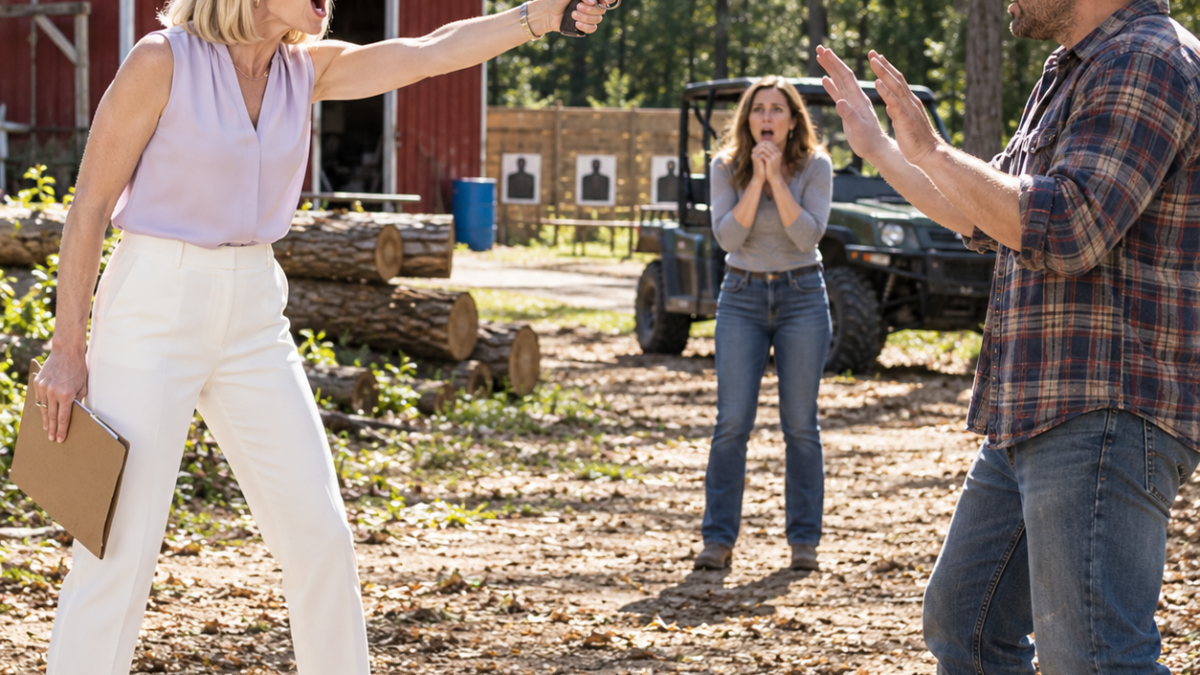
And then I saw Karen’s right hand.
She was holding a small revolver.
I remember the world seeming to narrow.
The farmhouse.
The garden.
The trees.
The sounds of the evening.
Everything faded except that little piece of metal.
My heart began pounding.
I stepped off the porch.
“Karen, put the gun down!”
She ignored me.
Her face was streaked with tears.
She looked furious and completely unstable.
My wife stood frozen beside the tomato plants.
Karen stopped several yards away.
“You ruined my life!”
Her voice broke into a scream.
My wife raised both hands slowly.
“Karen, please.”
“You ruined everything!”
My wife tried to remain calm.
“We can talk about this.”
“No!”
Karen’s voice became almost unrecognizable.
“My neighbors hate me! They’re trying to throw me out! I’m going to lose my house!”
I moved toward them.
Slowly at first.
I didn’t want to startle her.
“Karen,” I called, “look at me.”
She turned her head slightly.
I saw the gun shift.
“Stay away!”
I stopped.
My wife kept her hands raised.
“Please put the gun down,” she said.
Karen’s expression twisted.
“You think you can destroy my neighborhood and just walk away?”
My wife swallowed.
“Nobody wants anybody hurt.”
“That’s easy for you to say!”
“Karen—”
“You took everything from me!”
Then Karen raised the revolver.
It happened so quickly that my mind barely registered the movement.
One moment, the gun was pointed toward the ground.
The next, it was aimed at my wife.
I shouted.
And Karen fired.
The gunshot cracked across the farm.
A sharp, violent sound that echoed off the damaged barn and disappeared into the trees.
My wife screamed.
For an instant, I thought she’d been hit.
That was the worst moment of my life.
Not the fire.
Not the poisoning.
Not watching my grandfather’s barn burn.
That single fraction of a second when I believed I might have just watched my wife die.
Everything inside me seemed to stop.
Then she moved.
She was still standing.
Still alive.
The bullet had missed.
I didn’t think about what I was doing next.
I ran.
Karen was staring at the revolver in her hand, seemingly shocked that she’d actually fired it.
That hesitation was the only opportunity I had.
I covered the distance as fast as I could.
I remember the dirt beneath my boots.
The rush of air in my lungs.
My wife backing away from the garden.
Then I hit Karen.
I tackled her hard enough to knock both of us into the ground.
The revolver flew from her hand.
We landed in the dirt.
She screamed and struggled.
I forced her onto her stomach and held her there.
“Don’t move!”
She thrashed beneath me.
“Get off me!”
“Don’t move!”
Her voice was shrill.
“You’re hurting me!”
I couldn’t believe what I was hearing.
My wife had just been shot at.
And Karen was complaining about being restrained.
I looked toward my wife.
She stood several feet away, shaking.
“Call 911!”
For a moment, she didn’t move.
I shouted again.
“Call the sheriff! Now!”
That broke through the shock.
She ran toward the house, grabbed her phone, and made the call.
Karen kept struggling.
She cried.
She cursed.
She accused me of ruining her life.
I held her down until the deputies arrived.
I don’t remember exactly how long it took.
It felt like forever.
Every second stretched.
My heart was hammering.
My arms were trembling from the effort of keeping her restrained.
And all I wanted was to know that my wife was safe.
Eventually, I heard sirens.
Then tires on gravel.
Deputies rushed into the yard.
I told them about the gun and pointed to where it had landed.
They secured the weapon and took control of Karen.
She was handcuffed and escorted toward a patrol car.
Even then, she kept shouting.
She claimed we had provoked her.
She accused us of destroying her home.
She screamed that none of this would have happened if I’d simply obeyed the HOA.
I stood in the yard trying to catch my breath.
My hands were covered in dirt.
My knees hurt.
My entire body felt cold despite the warm evening.
An ambulance arrived.
Paramedics examined my wife.
She hadn’t been struck by the bullet, but she was badly shaken.
When they told me she was physically unharmed, something inside me finally broke.
I walked toward her.
She looked at me.
And then we held each other.
Neither of us spoke for a long time.
I could feel her shaking against my chest.
“I’m okay,” she whispered.
I nodded.
But I couldn’t stop holding her.
“I thought she shot you.”
Her arms tightened around me.
“I know.”
“I thought—”
My voice failed.
She pressed her face into my shoulder.
“I know.”
That night, Karen was arrested.
The allegations included aggravated assault with a deadly weapon, trespassing, and attempted murder.
The shooting changed the investigation completely.
There was now a serious violent felony involving the same woman who had been at the center of the earlier dispute.
Investigators began looking more closely at the previous incidents.
The fire.
The dog poisoning.
The threats.
The history of escalating conflict.
With the evidence they developed, authorities obtained a warrant to search Karen’s property.
And that’s when the situation finally began to unravel.
Inside her garage, investigators discovered a red plastic gasoline container tucked behind gardening supplies.
It was examined as part of the arson investigation.
The authorities found evidence linking the container and its contents to the accelerant associated with the barn fire.
They also examined financial records.
According to what I later learned, Karen’s credit card history showed a purchase of rat poison at a hardware store shortly before my dog became sick.
Two days before.
After everything we’d been through, those details were both horrifying and strangely relieving.
Horrifying because they supported the possibility that the attacks had been deliberate.
Relieving because we finally had something more substantial than suspicion.
For weeks, I’d been living with the feeling that someone was hurting my family while the law couldn’t reach them.
Now investigators had evidence they could present.
The sheriff’s office continued building the case.
And the more information emerged, the harder it became to dismiss the earlier incidents as unrelated accidents.
I wish I could say that discovering the evidence made me feel victorious.
It didn’t.
I felt sick.
When I thought about Karen standing beside the back wall of my barn, I imagined the flames spreading while my family slept.
When I thought about her buying poison, I remembered holding our old dog in my lap as his body shook uncontrollably.
And when I remembered the revolver pointed at my wife, I felt a kind of fear that seemed to live permanently beneath my ribs.
I had wanted to win a property dispute.
I had never wanted to survive a campaign of violence.
For several weeks after the shooting, my wife struggled to feel comfortable outside.
She still went to the garden.
Still checked the tomatoes.
Still tended the flowers.
But she glanced toward the tree line more often.
Sometimes, she’d stop in the middle of a task because a branch snapped somewhere in the woods.
At night, she made sure every door was locked.
Our dogs followed her everywhere.
I tried not to hover.
But I found myself checking on her constantly.
If she was outside longer than expected, I went looking.
If I heard a car slow near the driveway, I walked to the window.
I knew Karen was in custody.
I knew the immediate threat was gone.
But fear doesn’t always disappear just because the person who caused it has been arrested.
One evening, my wife found me standing beside the ruined barn.
The insurance process was underway, and we’d started discussing how to rebuild.
But I couldn’t stop looking at what remained.
She came to stand beside me.
“What are you thinking?”
I looked at the blackened timber.
“That none of this should have happened.”
She nodded.
“I know.”
“I keep wondering if I should’ve handled things differently.”
She turned toward me.
“What do you mean?”
“The trails. The pigs. All of it.”
She was quiet.
I continued.
“Maybe if I’d ignored her long enough, she would’ve gotten bored.”
My wife shook her head.
“She burned our barn.”
“We don’t know exactly what would’ve happened if I’d done something else.”
“No,” she said softly. “We don’t.”
I looked at her.
She took my hand.
“But she was the one who threatened us. She was the one who came here with a gun. Whatever arguments happened before that, those were her decisions.”
I stared toward the forest.
“I just wanted her to leave us alone.”
My wife squeezed my hand.
“So did I.”
That conversation stayed with me.
It would have been easy to pretend I had enjoyed every moment of the retaliation.
That I’d planned everything perfectly and watched Karen walk into a trap of her own making.
But life doesn’t feel that simple when the person you love has nearly been killed.
I understood why I’d closed the trails.
I understood why I’d leased the land.
And I understood why I’d refused to let an HOA dictate what happened on my farm.
But I also knew that every escalation had made the world around us uglier.
The pigs were legal.
The shooting range was legal.
The forest was mine.
None of those facts erased the fear my wife had experienced.
None of them rebuilt the barn.
None of them gave back the nights we’d spent worrying about our dog.
I began to understand something my grandfather had tried to teach me.
Owning land gives you rights.
But protecting a home requires more than defending those rights.
It requires protecting the people who make the place worth living in.
The criminal case eventually went to court.
Karen hired an expensive defense attorney.
From what I understood, her legal team attempted to challenge the evidence and minimize her responsibility.
But there was a substantial case against her.
The shooting incident.
The earlier threats.
The arson evidence.
The poison purchase.
The documented dispute.
The fact that she’d entered private property with a firearm and fired toward my wife.
The evidence told a story that was difficult to explain away.
I attended the proceedings.
So did my wife.
Sitting in that courtroom was one of the strangest experiences of my life.
I had spent months seeing Karen as the woman who appeared at my driveway with a clipboard and threatened to fine me.
Then as the woman I suspected of burning my barn.
Then as the person who had pointed a gun at my wife.
But in court, she was simply a defendant sitting beside her attorney.
No golf cart.
No clipboard.
No neighborhood board.
No authority to threaten anybody with fines.
Just a woman facing the consequences of what she’d done.
I watched her carefully.
Part of me wanted to see remorse.
A sign that she finally understood the damage she’d caused.
An apology.
Anything.
But I never heard the kind of apology I had hoped for.
At one point, I found myself remembering the first conversation in my driveway.
Her telling me that my family’s ownership of the farm didn’t matter anymore.
Her threatening to bar me from the forest.
Her insisting that I had no idea who I was dealing with.
I wondered whether she’d replayed that conversation as often as I had.
Whether she ever thought about how easily things could have ended differently.
One apology.
One decision to respect a boundary.
One moment of accepting that another person could say no.
That was all it would have taken to avoid the nightmare.
Instead, we were sitting in a courtroom while prosecutors presented evidence of serious crimes.
Karen was ultimately convicted of aggravated assault, arson, and felony animal cruelty.
She received a sentence of several years in state prison.
When the sentence was announced, I didn’t smile.
I didn’t celebrate.
I just sat beside my wife and felt an enormous weight begin to lift.
Not all at once.
Not completely.
But enough that I could finally imagine a future where Karen wasn’t the center of our lives.
Outside the courthouse, my wife took my arm.
“It’s over,” she whispered.
I looked at her.
“Almost.”
She understood.
There were still things to repair.
Physical things.
Emotional things.
And parts of our lives that would never return to exactly the way they’d been.
But the immediate danger was gone.
Karen couldn’t come marching onto our property with a clipboard.
She couldn’t threaten our home.
She couldn’t intimidate my wife.
And she couldn’t use an HOA board position as an excuse to invade our lives.
For the first time in months, I felt like I could breathe.
The fallout in East Germany Estates was enormous.
By then, the residents were exhausted.
What had started as a dispute over HOA authority had turned into a scandal involving property damage, animal cruelty, and an armed attack.
People no longer wanted to be associated with the board that had allowed the conflict to spiral.
Residents held another major vote.
This time, the decision went beyond replacing the president.
They voted to dissolve the homeowners association entirely.
The subdivision would continue to exist, of course.
The houses weren’t going anywhere.
The streets and landscaping remained.
But the governing organization that had become such a source of conflict was formally disbanded.
I heard the news from a resident who had once walked his dog through my forest.
He stopped near the farm gate one afternoon.
“Thought you’d want to know,” he said. “The HOA is gone.”
I looked at him.
“Gone?”
“Officially dissolved.”
I nodded slowly.
He looked embarrassed.
“A lot of us should’ve spoken up sooner.”
I didn’t know what to say.
He glanced toward the rebuilt sections of fencing along the boundary.
“We never wanted any of this.”
“I know.”
He hesitated.
Then said, “I’m sorry about your barn. And your dog. And what happened to your wife.”
His voice was sincere.
I could see that.
“Thank you,” I said.
He nodded and began walking away.
Then he turned.
“Do you think you’ll ever reopen the trails?”
I looked toward the trees.
The same trees he’d enjoyed walking beneath before everything went wrong.
“I don’t know,” I told him.
He accepted that answer.
And for once, nobody argued.
Financially, the situation turned out better than I’d expected.
Our property insurance covered the rebuilding of the barn.
The process involved paperwork, inspections, estimates, and more frustration than I care to remember.
But eventually, we had the resources to rebuild properly.
I decided that if we were going to replace the old structure, we’d make it larger and more useful.
The new barn ended up roughly twice the size of the original.
It had better storage.
Improved work areas.
More room for equipment.
And features that made everyday farm operations easier.
When construction was finished, I stood outside and looked at the enormous red building gleaming in the sunlight.
Same color.
Barn red.
I couldn’t help smiling.
My grandfather would’ve approved of that part.
The insurance company also pursued recovery of its payout through legal action against Karen’s remaining assets.
From what I understood, the financial consequences for her were likely to be severe.
Between the criminal proceedings, the damage claims, and the loss of her position in the community, the life she had been so desperate to control had largely collapsed.
There was a time when I might have found satisfaction in hearing that.
By then, I mostly felt tired.
I’d spent too much energy thinking about Karen.
I wanted to spend that energy on things that mattered.
The farm.
My wife.
Our animals.
The future.
Once the HOA was officially dissolved, I called my friends who operated the livestock business.
They knew why I was calling.
One of them answered with a laugh.
“Well, I guess the neighborhood finally got the message.”
“I’d say so.”
“You want us to move the hogs?”
“Yeah.”
He was quiet for a second.
“Are you sure?”
I looked out toward the forest.
“I’m sure.”
A few days later, they arrived with their livestock trailers.
The pigs were loaded and transported back to their commercial operation.
The temporary fencing came down.
The portable shelters were removed.
The water connections were secured.
And the narrow strip of land along the subdivision gradually returned to ordinary farmland.
The smell faded.
The noise disappeared.
People in East Germany Estates could open their windows again.
They could sit beside their pools.
They could cook outside without worrying about the wind.
I imagine most of them were extremely relieved.
So was I.
Not because I regretted defending my rights.
But because I was finally able to stop fighting.
There is a difference.
For months, every morning had felt like the beginning of another confrontation.
Every envelope might contain a threat.
Every strange vehicle might mean trouble.
Every unexpected noise might signal another emergency.
Now, when I woke before sunrise, the biggest question was usually whether the weather would hold long enough for us to finish the day’s work.
And that felt wonderful.
Our old Border Collie mix recovered from the poisoning.
It took time.
For a while, he seemed slower and more tired than he had been before.
But he gradually returned to his familiar routines.
He followed me to the equipment shed.
He slept near the porch.
He stood beside my wife when she worked in the garden.
Sometimes he would look toward the pasture and give a little bark, as though reminding us that he was still the one responsible for keeping everything in order.
He lived another three years.
Three years I wasn’t sure we’d have.
Three more summers of watching him sleep in the shade.
Three more winters of seeing his paw prints in the frost.
Three more years of feeling his nose press against my hand when he wanted attention.
Eventually, age took him.
Not poison.
Not violence.
Just the quiet passage of time.
The way it should have been.
When we buried him on the farm, my wife cried.
So did I.
We chose a peaceful spot where he used to rest during the warm afternoons.
Sometimes I still walk past it.
And every time I do, I remember holding him in that truck, begging him to stay alive.
I’m grateful he did.
My wife recovered, too.
The emotional healing took longer than either of us expected.
For months, she avoided the exact spot in the garden where Karen had stood with the revolver.
I never pushed her.
One spring morning, I looked out the kitchen window and saw her planting tomatoes there again.
She was kneeling in the dirt, working carefully, sunlight falling across her shoulders.
I watched her for a while.
Then I walked outside.
She looked up.
“What?”
I shook my head.
“Nothing.”
She smiled.
“Then why are you staring?”
I looked around at the garden.
At the trees.
At the farmhouse.
At the woman I’d nearly lost.
“Just glad you’re here.”
Her expression softened.
She reached up and took my hand.
For a moment, neither of us said anything.
We didn’t need to.
That’s the thing about surviving something terrible.
People expect the ending to be dramatic.
They imagine a triumphant speech.
A celebration.
A moment when everything suddenly makes sense.
But some of the best endings are quiet.
A wife planting tomatoes.
A dog sleeping on the porch.
A familiar red barn standing against a blue sky.
The freedom to walk across your own land without being afraid.
Those are the victories that matter.
I still own the forest.
Every acre.
The old logging trails are still there.
So are the giant oaks, the winding creek, and the hidden clearings where my grandfather taught me about the land.
Sometimes I walk those paths alone.
Other times, my wife comes with me.
The woods feel different now.
Not because the trees have changed.
Because I have.
I used to believe that owning land meant nothing could take it away from you.
I know better now.
Someone doesn’t have to steal your property to steal your peace.
They can do it through threats.
Through fear.
Through making you question whether the people you love will be safe when they step outside.
Karen never succeeded in taking an inch of my forest.
But for a while, she made my own home feel like unfamiliar territory.
That was the damage I hadn’t expected.
And it was the hardest thing to repair.
People occasionally ask whether I regret closing the trails.
I think about that question more often than they probably realize.
I remember the families who enjoyed walking their dogs.
The children exploring the creek.
The older couple with their golden retriever.
I remember how proud I used to feel knowing other people could appreciate the woods my grandfather had protected.
I didn’t want those relationships to end.
But I also remember the formal fines.
The false claims of authority.
The burned barn.
The poisoned dog.
And my wife standing in the garden while a gunshot shattered the evening.
So no.
I don’t regret establishing boundaries.
I regret that someone made those boundaries necessary.
The forest trails remain closed to subdivision residents.
Maybe that seems harsh to some people.
Maybe they believe the innocent homeowners shouldn’t have lost access because of one woman’s behavior.
I understand that argument.
I really do.
But after everything that happened, I no longer feel comfortable treating private land as an unofficial public recreation area.
I don’t want another dispute about who has the right to be there.
I don’t want another person mistaking generosity for permission to control what belongs to me.
And I don’t want my wife worrying about strangers appearing from the trees.
Our gates are locked.
The signs remain.
The boundaries are clear.
As for the shooting range, it’s still operating.
Every weekend, when the weather allows, a few friends come out to practice.
We follow the same safety procedures.
Use the same properly constructed range.
And enjoy the same hobby we enjoyed long before East Germany Estates existed.
Sometimes, when the last targets have been put away, we sit together beneath the trees and talk.
About farming.
About family.
About how quickly the world changes.
Occasionally, somebody brings up Karen.
Usually, the conversation ends with everyone shaking their heads.
One afternoon, a friend asked whether I ever thought about how differently things could have turned out.
I looked toward the distant berm.
“Every day,” I told him.
He nodded.
Then he asked, “You think she ever understood what she did wrong?”
I considered that.
For a moment, I pictured Karen standing beside my truck on that first afternoon.
Her clipboard pressed against her chest.
Her face full of confidence.
Her voice insisting that she could ban me from my own forest.
“I don’t know,” I said.
And that’s the truth.
I don’t know whether Karen ever understood.
Maybe she still believes I ruined her life.
Maybe she tells herself that everything happened because I refused to obey.
Maybe even sitting in prison, she continues to think of herself as the victim of an unreasonable farmer who wouldn’t paint his barn and shut down his gun range.
I can’t control what she believes.
I spent far too long dealing with someone who couldn’t accept that simple fact.
What I do know is that my grandfather’s land is still here.
The forest is still standing.
The barn is red.
My wife still grows tomatoes.
And when I wake before dawn, I can hear the wind moving through the trees instead of lying awake wondering what terrible thing might happen next.
I used to think the greatest threat to this farm would be rising taxes, falling crop prices, or developers offering enough money to tempt the next generation to sell.
I never imagined it would come from a woman who moved into a luxury subdivision and decided that her position as HOA president gave her authority over land that had never belonged to her.
But I learned something through all of it.
Some people mistake kindness for weakness.
Some mistake patience for surrender.
And some become so obsessed with controlling others that they destroy the very things they’re trying to protect.
I was willing to share my forest.
I was willing to live peacefully beside people whose idea of country life was different from mine.
I was even willing to overlook the occasional trespasser because I remembered what my grandfather had taught me about generosity.
But I was never willing to let someone threaten my family and dictate what I could do with my own property.
Karen never understood the difference.
And in the end, that failure cost her nearly everything.
I don’t celebrate what happened to her.
There’s nothing joyful about watching another human being ruin her life through arrogance, cruelty, and violence.
But I am grateful that my family survived.
I’m grateful my wife came home from that garden unharmed.
I’m grateful our dog had three more good years.
And I’m grateful that the forest my grandfather loved is still standing exactly where he left it.
Sometimes, just before sunset, I walk out past the rebuilt barn and stop where the eastern field meets the tree line.
The subdivision is still visible in the distance.
Sixty backyards.
Sixty houses.
A whole neighborhood that once believed those woods were theirs to enjoy whenever they pleased.
Beyond the fence, the trees stand tall and quiet.
I can hear the wind passing through their branches.
And every now and then, I remember something my grandfather told me when I was young.
“Take care of the land, and it’ll take care of you.”
For most of my life, I thought he was talking about farming.
About planting at the right time.
Protecting the soil.
Maintaining the fences.
Keeping the barns standing.
Now I understand he meant something more.
He meant responsibility.
The kind you carry even when nobody is watching.
The kind that sometimes requires you to make difficult decisions.
The kind that reminds you a home isn’t valuable because of how much money somebody might pay for it.
It’s valuable because of the lives lived there.
The memories made there.
And the people waiting for you when the workday ends.
I turn toward the farmhouse.
The porch light is on.
My wife is inside.
Dinner is probably getting cold.
Behind me, the forest stretches into the evening, as quiet and beautiful as it was when my grandfather first walked through it.
And for the first time in a long time, I don’t feel the need to look over my shoulder.
The gates are locked.
The farm is safe.
And the only person who gets to decide what happens on this land is the one who has spent his life caring for it.
That’s all I ever wanted.
Not revenge.
Not a war.
Just the right to live peacefully on my family’s farm.
And after everything we endured, that peace is worth more to me than all the money in the world.