𝙍𝙚𝙖𝙙𝙈𝙤𝙧𝙚👉 I Should Have Taken My Neighbor’s Warning About Justice More Seriously.
𝗣𝗔𝗥𝗧 𝟮
I never imagined it.
For a while, her behavior seemed to confirm my assumption.
She started contacting local authorities.
The first time an officer came to ask about my fishing activities, I was surprised.
He explained that someone had reported concerns about illegal fishing.
I knew immediately who had made the complaint.
Still, I didn’t make a scene.
I showed him my licenses and answered his questions.
He looked through the information, checked what he needed to check, and found nothing wrong.
Before leaving, he thanked me for cooperating.
I thought that would settle the matter.
A few days later, another complaint brought another visit.
This time, the accusation involved illegal bait.
Again, everything checked out.
Then came allegations that I was exceeding catch limits and harming local wildlife.
I found myself explaining ordinary fishing practices to people who had better things to do than investigate a neighbor’s personal vendetta.
Every visit ended essentially the same way.
No violations.
No evidence of illegal activity.
No reason for enforcement action.
And yet the complaints continued.
What frustrated me most wasn’t having to show my paperwork.
I understood why the authorities followed up on reports. That was their job.
What bothered me was knowing that someone could repeatedly make baseless accusations while I had to keep defending activities that were perfectly lawful.
One afternoon, after another visit, I saw my neighbor standing outside her house.
She was watching the officer drive away.
I walked toward my fence.
“Are you satisfied now?”
She looked at me without any embarrassment.
“I don’t know what you’re talking about.”
“You keep reporting me, and they keep telling you I’m not breaking the law.”
“Maybe they’re not looking hard enough.”
“They’ve checked everything.”
“Then I’ll keep calling until somebody does their job.”
I felt my patience thinning.
“You’re wasting their time.”
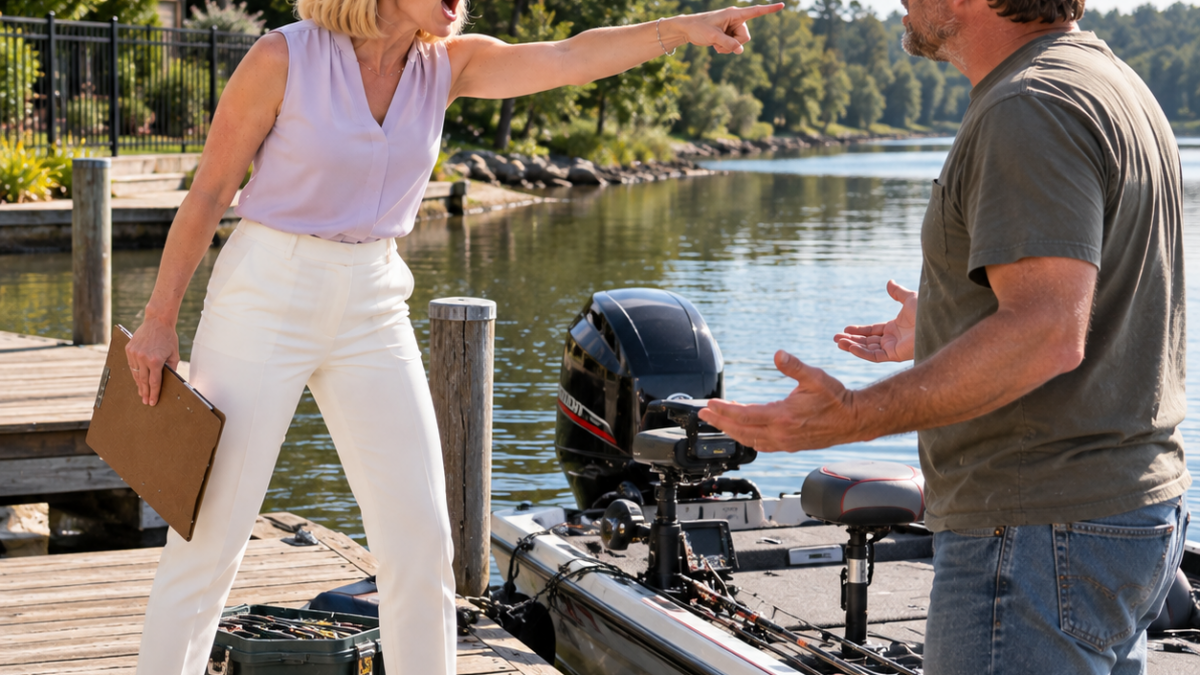
She pointed toward the river.
“You’re the one causing harm.”
“No. I’m fishing.”
She shook her head.
“That’s what people like you always say. You hide behind paperwork because you don’t have a conscience.”
For a moment, I considered arguing.
Then I realized there was absolutely nothing I could say that she would accept.
I walked away.
Behind me, she called out, “This isn’t over.”
She was right.
It wasn’t.
The notes appeared shortly afterward.
The first one was tucked beneath a rope on my boat.
It was a small piece of paper with a handwritten warning.
JUSTICE IS COMING.
I stood on the dock reading those three words.
There was something unpleasant about finding a message like that on my own property.
It meant somebody had come close enough to touch my boat when I wasn’t there.
And considering the ongoing dispute, I had a pretty good idea who it was.
Still, a threatening note wasn’t the same as physical violence.
I told myself she was trying to intimidate me.
I threw the paper away and went about my day.
Then another appeared.
This time it was tucked near the area where I kept my dock lines.
The wording was different, but the message was the same.
I was supposedly hurting innocent animals.
I would be held accountable.
People who ignored justice would eventually face it.
I remember looking toward her house and wondering how much time she spent thinking about me.
I was trying to work, maintain my property, and enjoy a hobby.
She seemed to be building her entire routine around watching mine.
I began feeling uncomfortable whenever I went outside.
Not frightened exactly.
More like I was constantly being observed.
There is a peculiar kind of frustration that comes from losing the ability to relax in a place that is supposed to belong to you.
You start noticing things you previously ignored.
A figure moving behind a curtain.
A door opening when you walk toward the dock.
The sound of footsteps near a fence.
I hated that she had managed to make me feel that way.
Sometimes I thought about confronting her again.
Other times I wondered whether I should make a formal complaint about the harassment.
But then several quiet days would pass, and I would convince myself that she had finally gotten bored.
I wanted to believe the problem would disappear if I stopped giving it attention.
That was my mistake.
I confused her silence with surrender.
As winter began giving way to spring, the river started looking inviting again.
The mornings were getting warmer, the light was lasting longer, and I began planning the first really good fishing trip of the season.
I had spent weeks thinking about a few promising spots where I hoped to catch bass.
There were also areas farther along the river that I wanted to revisit once the conditions improved.
The boat had been maintained.
My tackle was organized.
My licenses were current.
And after months of listening to my neighbor complain, I was eager to get back to the part of fishing that actually mattered.
The water.
The quiet.
The feeling of being somewhere that didn’t require defending myself.
Then came that Saturday morning.
It was one of those beautiful spring days that seem almost too perfect to waste indoors.
The sky was clear.
The air was cool without being cold.
The river was calm enough that its surface reflected long stretches of pale blue between the shadows of the trees.
I woke up early, made breakfast, and started preparing my equipment.
I packed my rods, checked my tackle, and filled a cooler with drinks and snacks.
I went over the boat the way I normally did before heading out.
Nothing seemed unusual.
The ropes were secure.
My equipment was where it belonged.
The motor appeared ready.
I looked over the visible areas of the hull and saw nothing that concerned me.
In hindsight, that brief inspection is something I’ve replayed in my mind more times than I can count.
I’ve wondered whether I could have noticed something.
Whether a different angle, a closer look, or another few minutes might have changed everything.
But the truth is that the damage had been placed where it wasn’t easily visible during an ordinary check.
And on that beautiful morning, I had no reason to believe somebody had deliberately tried to compromise my boat.
I untied the lines and pushed away from the dock.
The engine started without trouble.
As I eased out into the river, I felt that familiar sense of relief.
For the first time in a while, my mind wasn’t occupied by complaints, paperwork, or angry accusations.
I was thinking about fish.
I was thinking about where the current might be carrying food.
I was thinking about the cooler sitting nearby and whether I had remembered to pack enough snacks.
Ordinary things.
Good things.
The kind of thoughts I had always associated with being on the water.
For a while, everything felt normal.
The boat moved smoothly.
The sunlight grew brighter.
I passed familiar sections of shoreline and headed toward a stretch of water where I had enjoyed good fishing in previous seasons.
There was no storm coming.
No obvious mechanical problem.
No warning that anything was wrong.
Then I noticed a little water where it shouldn’t have been.
At first, I wasn’t particularly alarmed.
Boats get wet.
Water gets splashed around.
Small leaks can develop around aging seals or fittings, and I had dealt with minor maintenance problems before.
I assumed something needed attention.
I made a mental note to inspect the boat carefully when I returned.
Then I continued toward my fishing spot.
A little later, I checked again.
There was more water.
Not a dramatic amount, but enough to make me stop what I was doing.
I looked around, trying to identify where it was coming from.
Nothing obvious.
I checked the areas I could reach.
I wondered whether a seal had failed.
Maybe there was a crack I hadn’t noticed.
Maybe something had loosened during the winter.
I told myself not to overreact.
But I also knew that water inside a boat was never something to dismiss without understanding the cause.
I began dealing with it while keeping an eye on the level.
For several minutes, I thought I had the situation under control.
Then the water rose again.
Faster this time.
I remember staring down at it and feeling the first sharp edge of genuine fear.
Something wasn’t right.
This wasn’t the small, manageable leak I had initially imagined.
The boat was taking on water at a rate that was becoming increasingly difficult to manage.
I abandoned every thought of fishing.
My rods might as well not have existed.
The only thing that mattered was getting back safely.
I turned the boat toward home.
While I worked to keep the water from accumulating, my mind started racing through possibilities.
Could I make it all the way back?
Was the pump keeping up?
Would I lose power?
How quickly could things get worse?
I had spent enough time around boats to know that panic was dangerous.
But knowing that didn’t make me immune to it.
Every time I looked down, I saw water where I expected dry space.
And every time I looked toward shore, it seemed farther away than it should have been.
I tried to remain methodical.
Keep the boat stable.
Keep moving toward safety.
Don’t waste time.
Don’t do anything reckless.
But the water continued coming in.
I began bailing it out, working as quickly as I could.
At first, I was annoyed.
Then worried.
Then genuinely frightened.
There is a moment in an emergency when your mind finally stops treating the problem like an inconvenience.
You realize that the outcome is no longer guaranteed.
That moment came when I looked at the water level and understood that I might not be able to manage it alone.
The river suddenly felt very different.
The same calm surface I had admired earlier now seemed impossibly wide.
I looked toward the shoreline.
The distance wasn’t unimaginable, but it was farther than I wanted to be from safety in a compromised boat.
And the current wasn’t going to stop moving simply because I needed more time.
I reached for my radio and contacted a friend.
I tried to keep my voice steady.
“Hey, I’ve got a problem out here.”
He asked what was happening.
“My boat’s taking on water. More than it should. I’m trying to get back, but I could use some help.”
His tone changed immediately.
“How bad?”
“Bad enough that I’m calling you.”
There was a short pause.
Then he told me he was coming.
I gave him my location and explained what I was doing.
He told me to stay calm, keep him updated, and avoid taking unnecessary risks.
I remember being absurdly relieved just to hear another human voice.
For the next stretch of time, everything seemed to happen both too quickly and too slowly.
I kept working to control the water.
I watched the boat.
I listened to the engine.
I looked repeatedly in the direction my friend would be coming from.
My arms started aching from the effort.
My clothes were getting wet.
The cooler had shifted, and some of my equipment was no longer where I had left it.
I barely noticed.
I was focused on getting home.
Then, at last, I heard my friend over the radio again.
He was close.
When I finally saw him approaching, I felt a wave of relief so powerful that I nearly had to stop and collect myself.
I had never been so happy to see another boat.
He came alongside carefully and helped me manage the situation.
With his assistance, we were able to make our way back toward my dock.
It wasn’t a pleasant trip.
I was soaked, exhausted, and still worried about how much damage might already have been done.
But with every bit of distance we covered, the danger felt a little less immediate.
When we finally reached the dock, I secured the boat and climbed out.
My legs felt strangely unsteady.
My friend looked at me.
“You all right?”
I nodded.
“Yeah.”
He glanced toward the boat.
“That was a lot of water.”
“I know.”
“What happened?”
I shook my head.
“I don’t know.”
And I meant it.
At that point, I was thinking about mechanical failure.
An old seal.
A crack.
Something that had worn out without giving me any warning.
The idea that somebody might have deliberately damaged the boat still hadn’t fully entered my mind.
I was too relieved to be standing on solid ground.
We began inspecting the boat.
I wanted to know exactly what had failed before I even considered taking it out again.
The first things we checked didn’t explain the problem.
The motor had been functioning.
Nothing obvious had struck the boat.
I couldn’t remember hitting a submerged object or hearing the kind of impact that would explain a sudden breach.
As we examined more of the hull, I started feeling uneasy.
Then we found the first hole.
I stared at it.
It was small.
Clean.
Unnaturally neat.
My friend leaned closer.
“What’s that?”
I didn’t answer immediately.
I was trying to make sense of what I was seeing.
We continued the inspection.
Then we found another.
And another.
The holes were located in places that made them difficult to notice during a quick visual check.
They weren’t random tears or jagged damage from an impact.
They were clean openings in the hull.
The kind of openings left by a drill.
I remember running my fingers near one of them, careful not to catch myself on the edge.
My stomach dropped.
This wasn’t ordinary wear.
It wasn’t bad luck.
It wasn’t a mysterious mechanical failure.
Somebody had intentionally put holes in my boat.
For several seconds, neither of us said anything.
Then my friend looked at me.
“Did somebody do this?”
I swallowed.
“Looks that way.”
He stared at the damage.
“Who would do something like that?”
I didn’t answer.
Because a name had already appeared in my mind.
My neighbor.
The woman who had spent months accusing me of cruelty.
The woman who kept reporting me to authorities.
The woman who had left threatening notes on my boat.
The woman who had promised that justice was coming.
Suddenly, those words didn’t sound like empty threats anymore.
I felt cold despite the mild weather.
I looked back at the river.
Only a short time earlier, I had been out there struggling to keep my boat afloat.
I had been concentrating on getting home, believing some piece of equipment had failed.
Now I was standing beside evidence that the emergency might have been planned.
That realization frightened me more than the leak itself.
A damaged boat can often be repaired.
But how do you prepare yourself for the knowledge that someone may have deliberately put your life in danger?
I thought about what might have happened if my friend hadn’t answered the radio.
What if I had been farther downstream?
What if the water had entered more quickly?
What if I had panicked and made a terrible decision?
What if the boat had gone down before anybody could reach me?
The possibilities crowded into my head.
And underneath all of them was one question.
How could anyone believe this was acceptable?
My friend was furious.
He kept looking at the holes and shaking his head.
“That’s not a prank,” he said.
“I know.”
“Somebody could have gotten you killed.”
I looked toward the river again.
“I know.”
There was no satisfaction in realizing he was right.
Only anger.
And a fear I didn’t know what to do with.
For a while, I stood there trying to sort through what I knew.
I had a strong suspicion.
But suspicion wasn’t proof.
I couldn’t simply accuse somebody of sabotaging my boat because we had argued about fishing.
I needed to find out whether anyone had seen something.
I needed facts.
So I began asking around the neighborhood.
I approached the conversations carefully.
I didn’t want to start a rumor or turn the entire community into an audience for another argument.
I explained that my boat had been damaged and asked whether anyone had noticed unusual activity around the dock.
At first, the answers were ordinary.
People hadn’t been paying attention.
They had been busy.
They assumed everything was normal.
That made sense.
Our neighborhood wasn’t the kind of place where everyone monitored everyone else’s movements.
Then one neighbor mentioned seeing my difficult neighbor near the dock late one night during the previous week.
I felt my attention sharpen.
“Near my dock?”
“Yeah. I remember seeing her down that way.”
“What was she doing?”
The neighbor hesitated.
“Hard to say. She looked like she was messing around with something.”
“Did she go onto the dock?”
“I couldn’t tell exactly. It was dark.”
“Why didn’t you say anything?”
The neighbor looked uncomfortable.
“I figured she had a reason to be there. Maybe you asked her to help with something.”
I wanted to laugh at the idea of my neighbor voluntarily helping me maintain the boat.
Instead, I thanked the person for telling me.
Then I spoke with someone else.
That conversation was even more disturbing.
The second neighbor remembered seeing her carrying a tool.
Something that looked like a power drill, or at least a heavy piece of equipment.
I felt a tightening sensation in my chest.
“Are you sure?”
“I’m not saying I know what she was doing,” the neighbor told me. “But I remember thinking it was odd for her to be carrying that thing around so late.”
“Why didn’t you mention it?”
The answer was nearly identical to the first.
They assumed it wasn’t their business.
They assumed she had permission.
They assumed that if something were wrong, someone else would notice.
I couldn’t blame them.
That was how we normally treated one another.
Nobody wanted to be the person inventing problems out of ordinary neighborhood activity.
But now the assumptions that usually helped us live peacefully together had allowed something dangerous to happen without attracting attention.
I went home and stood beside the damaged boat.
The pieces were fitting together in a way I desperately wanted to reject.
The warnings.
The notes.
The late-night activity.
The tool.
The holes.
I felt anger rising in me, but it was mixed with something else.
Disbelief.
I still struggled to accept that a grown adult could look at another person’s boat and decide that secretly damaging it was a reasonable response to a disagreement.
This wasn’t somebody cutting a rope or leaving an insulting message.
These holes had turned a fishing trip into an emergency.
The more I thought about it, the angrier I became.
But I also knew that barging across the property line and shouting accusations would accomplish very little.
I needed to keep my head.
I spent some time collecting my thoughts.
Then I decided to confront her.
Not because I expected a meaningful apology.
Not because I believed she would suddenly become reasonable.
I wanted to hear what she had to say when I asked her directly.
And if there was even a small chance that I was wrong, I wanted to know before taking the matter further.
I walked toward her property.
She was outside near the fence.
When she noticed me approaching, she didn’t look surprised.
She leaned against the fence and folded her arms.
That familiar expression appeared on her face.
The one that suggested she was already annoyed before a conversation had begun.
“What do you want?”
I stopped a comfortable distance away.
“I need to ask you something.”
She raised her eyebrows.
“About what?”
“My boat.”
Her expression barely changed.
“What about it?”
“Somebody damaged it.”
She shrugged.
“That’s unfortunate.”
I watched her carefully.
“There are holes drilled through the hull.”
For the first time, something flickered in her eyes.
It wasn’t surprise.
At least, it didn’t look like surprise to me.
It looked almost like recognition.
I took a breath.
“Do you know anything about that?”
She smiled.
That smile is one of the things I remember most clearly.
Not because it was particularly dramatic.
Because it was so completely inappropriate.
I was standing there telling her that somebody had damaged a boat badly enough to put me in danger, and she looked pleased.
Then she said something that made the entire conversation feel unreal.
“I did what needed to be done.”
I stared at her.
“What?”
She straightened.
“Somebody had to do something.”
I felt my heartbeat quicken.
“Are you telling me you damaged my boat?”
She gave a short laugh.
“You’re out there taking those poor fish, breaking the law, and nobody cares. Everybody just lets you get away with it.”
I couldn’t believe what I was hearing.
“I’ve shown you my licenses.”
“That doesn’t make it right.”
“The police have checked everything.”
“Because they don’t care.”
I looked at her.
“Did you drill holes in my boat?”
She didn’t hesitate.
“Someone had to make a stand.”
For a moment, I couldn’t speak.
I had spent the previous hours trying to determine who had damaged my property.
I had been prepared for denial.
Anger.
Accusations.
Maybe a complicated explanation about why I was wrong to suspect her.
What I wasn’t prepared for was a confession delivered with the confidence of someone accepting an award.
I stared at her.
“You drilled holes in my boat?”
She folded her arms again.
“I wasn’t going to keep sitting around while you hurt innocent animals.”
I felt heat rush into my face.
“Do you have any idea what happened out there?”
She tilted her head.
“What are you talking about?”
“My boat started filling with water.”
She said nothing.
“I was on the river. I was taking on water so fast I had to call a friend to help me get back.”
Her expression changed slightly, but not into remorse.
More like irritation at being confronted with an inconvenient detail.
“Well, maybe you shouldn’t have gone fishing.”
I honestly thought I had misheard her.
“What did you just say?”
She lifted her chin.
“You wouldn’t have been in that situation if you weren’t out there killing fish.”
Something inside me went very still.
I had been angry before.
But this was different.
I was looking at someone who appeared to understand that she had interfered with a vessel on the water and still believed the entire situation was my fault.
“You could have killed me.”
She rolled her eyes.
“Don’t be so dramatic.”
“I’m not being dramatic. My boat was sinking.”
“It obviously didn’t sink. You’re standing right here.”
I stared at her.
I don’t think I have ever felt so close to completely losing my temper.
Not because she disliked fishing.
Not because she had insulted me.
Because she seemed incapable of recognizing the difference between protesting an activity and deliberately putting another human being in danger.
She had transformed my legal hobby into a moral offense in her own mind.
And once she had decided I was guilty, apparently anything she did to me could be justified as justice.
I tried once more.
“Listen carefully. You damaged my property. I could have drowned. Somebody could have been seriously hurt.”
She shook her head.
“You’re just trying to make me feel guilty.”
“No. I’m trying to make you understand what you did.”
“I understand perfectly.”
Her smile returned.
“Maybe now you’ll think twice before going back out there.”
That was the moment I knew the conversation was over.
There was nothing left to explain.
Nothing I could say would make her suddenly recognize the consequences.
I took a step backward.
She watched me with an expression that almost seemed triumphant.
I turned and walked away.
Behind me, she called something about protecting animals.
I didn’t respond.
I kept walking because I knew I was too angry to say anything useful.
By the time I reached my house, my hands were trembling.
I stood inside for a moment, trying to steady my breathing.
I had wanted confirmation.
Now I had it.
And somehow, knowing the truth made everything worse.
The danger on the river had been frightening when I believed it was an accident.
Knowing that another person had intentionally created that danger made me feel violated in a way I hadn’t expected.
My property had been entered.
My boat had been damaged.
My safety had been compromised.
And the person responsible had smiled while explaining why she thought I deserved it.
I called the police.
I explained the situation as clearly as I could.
There had been ongoing harassment.
There had been repeated complaints about my legal fishing activities.
There had been threatening notes.
My boat had begun taking on water during a trip.
I had discovered holes that appeared to have been drilled deliberately.
Neighbors had seen suspicious activity.
And when I confronted the woman I suspected, she admitted to damaging the boat.
Once I said everything out loud, the seriousness of it became impossible to ignore.
What had started as a ridiculous neighborhood argument had become a criminal matter.
The police responded and began looking into the damage.
They examined the boat.
They asked about the holes.
They wanted to understand when I had last used the vessel safely and when I had first noticed the problem.
I explained the events of that Saturday morning.
The initial leak.
The increasing amount of water.
The decision to head back.
The radio call to my friend.
The effort required to reach the dock.
Then I showed them the damage we had found.
Seeing the officers examine those holes brought back the fear I’d felt on the river.
I watched them study the hull and realized that the damage probably looked even more deliberate to someone approaching it without all the emotions I was carrying.
The holes were not ordinary scratches.
They weren’t the irregular marks left by striking an object.
They were clean, intentional openings.
The placement made them difficult to spot during routine checks.
I explained how those hidden openings had allowed water to enter once I was underway.
I didn’t need to exaggerate anything.
The facts were disturbing enough.
The investigation also brought another round of questions about my fishing practices.
Normally, I would have been irritated by that.
After months of false reports, the last thing I wanted was to go through my licenses and equipment yet again.
But this time I understood why it mattered.
My neighbor had repeatedly claimed that she was acting against illegal activity.
The authorities needed to establish whether there was any truth to her accusations.
So I cooperated.
I provided my licenses.
I explained where I fished, what methods I used, and how I followed the applicable regulations.
I answered questions about catch limits and ordinary fishing procedures.
Everything was in order.
There was no evidence that I had been illegally fishing.
No hidden violation.
No reason to believe that my neighbor’s allegations had any factual basis.
I remember an odd feeling of relief when the officers finished reviewing everything.
Not because I had doubted my own compliance.
I knew I had followed the rules.
But after being treated like a criminal for so long, it was reassuring to have the facts examined and confirmed by people who were actually responsible for enforcing the law.
It also made the situation painfully clear.
I had been accused of hurting wildlife while lawfully fishing.
Meanwhile, the person making those accusations had apparently committed deliberate property damage that endangered a human life.
The contradiction was almost unbelievable.
The officers continued gathering information.
They spoke with neighbors.
The people who had seen suspicious activity near my dock shared what they remembered.
The late-night presence.
The strange movements.
The tool that resembled a drill.
Other information, including surveillance evidence, helped establish the timeline.
Piece by piece, the investigation began supporting what I had already heard directly from her.
I found myself thinking about how narrowly things might have gone differently.
What if no neighbors had seen anything?
What if the holes had gone unnoticed until the boat was repaired?
What if I had simply assumed the damage was accidental?
She might have continued standing behind her fence, lecturing me about the environment, while knowing exactly what she had done.
That thought bothered me more than I wanted to admit.
I had trusted that our ordinary neighborhood boundaries meant something.
That people might argue, complain, or dislike each other without crossing certain lines.
She had crossed those lines with almost no apparent hesitation.
And she seemed to believe that her personal convictions excused it.
Eventually, the police went to question her.
I saw part of that interaction from a distance.
I had no desire to get involved in another shouting match, and I certainly wasn’t going to interfere with the officers.
But I couldn’t help watching.
For months, she had been the loudest person in our neighborhood whenever the subject of fishing came up.
She had spoken with absolute certainty about what I was supposedly doing wrong.
Now she was being asked to account for her own behavior.
At first, she denied responsibility.
That didn’t surprise me as much as I might have expected.
People sometimes become very confident when they believe they are in control of a situation.
A conversation beside a fence is different from answering questions during a police investigation.
I could see her gesturing as she spoke.
At several points, she appeared angry.
The officers remained there for quite some time.
They weren’t simply accepting her version of events and leaving.
They had evidence to consider.
They had witness statements.
They had information from the investigation.
And they continued asking questions.
I watched the exchange continue, feeling a complicated mixture of emotions.
Part of me wanted her to admit everything immediately.
Another part of me wanted some sign that she understood what she had done.
An apology.
A moment of embarrassment.
Some indication that she had finally realized how dangerous her actions had been.
But that wasn’t what happened.
Eventually, she acknowledged what she had done.
She admitted damaging the boat.
Yet even then, according to what emerged from the investigation, she continued trying to frame her behavior as a moral necessity.
She had been standing up for animals.
She had been protecting the environment.
She had been doing what nobody else was brave enough to do.
I could hardly believe it.
Even when faced with the consequences, she seemed determined to play the hero.
There was no meaningful apology.
No acceptance that damaging a boat could have cost someone their life.
Only the same arguments I had heard across the fence for months.
By then, I had stopped expecting anything different.
Still, it was sobering to see how deeply she believed her own justification.
I had always assumed that most people, when confronted with clear evidence that they had endangered another person, would eventually acknowledge the seriousness of it.
Maybe they would deny it at first.
Maybe they would be defensive.
But surely, at some point, the reality would sink in.
Not with her.
She seemed to believe that because she considered my fishing morally wrong, my safety was somehow less important.
That realization stayed with me.
There is something deeply unsettling about a person who has convinced themselves that their anger is the same thing as righteousness.
Ordinary disagreements leave room for compromise.
You can discuss rules.
You can explain your position.
You can decide to avoid each other.
But when someone becomes convinced that they alone represent justice, disagreement stops being a difference of opinion.
It becomes an offense that must be punished.
And that was exactly what had happened.
The legal consequences followed.
She faced multiple charges connected to the damage and the danger her actions had created, including property damage, criminal mischief, and reckless endangerment.
I won’t pretend that watching the process unfold made me happy in some simple, uncomplicated way.
I was relieved that the situation was being taken seriously.
I was grateful that the evidence had supported my account.
And yes, there was satisfaction in knowing that she could no longer hide behind accusations while refusing to answer for her own conduct.
But I also knew how easily the entire situation could have ended far worse.
The damage to my boat had turned an ordinary Saturday morning into something I would remember for the rest of my life.
I didn’t need her to suffer for entertainment.
I needed accountability.
I needed my property restored.
And most importantly, I needed to know that she wasn’t going to be allowed to keep threatening me simply because she disliked something I did legally.
The financial consequences were substantial.
She was required to pay restitution for the damage.
There were fines and court costs as well.
By the time everything was added together, the amount was enormous compared with the petty dispute that had started the whole thing.
I sometimes wondered whether she had understood how much trouble she was creating for herself when she first picked up that drill.
Did she think I would never notice?
Did she believe the boat would simply become unusable and that I would give up fishing?
Or had she genuinely been so consumed by her anger that she never considered what could happen once I took the boat onto the water?
I still don’t know.
Perhaps she hadn’t thought beyond the satisfaction of believing she was punishing me.
Whatever the explanation, the consequences were no longer theoretical.
She had to face them.
And for the first time since the harassment began, I felt that the situation was moving toward an actual ending.
My boat, however, remained a problem.
The hull damage was serious, and repairing everything properly was not something I could treat casually.
I had always taken care of the boat.
I had maintained it because I understood the risks of being on the water with unreliable equipment.
Now, even though the damage had been deliberately inflicted by somebody else, I found myself questioning whether I could ever trust the same setup again.
I could still remember that Saturday morning.
The growing water level.
The effort required to keep it under control.
The sound of my friend’s voice over the radio.
The relief of finally reaching the dock.
Those memories didn’t disappear simply because the person responsible had been identified.
For a while, I found myself looking at the river without wanting to go out.
That bothered me.
Fishing had always been the place where my worries became quieter.
Now the thought of getting into a boat brought back one of the most frightening experiences I had ever had on the water.
I hated that.
I hated the idea that someone else’s bitterness might permanently change my relationship with something I loved.
So I made a decision.
I wasn’t going to let her take fishing away from me.
I would handle the damage properly.
I would make sure the boat was safe.
And I would return to the river.
But I also decided that if I was going through the trouble of restoring my setup, I might as well make it better than before.
That became my own quiet form of revenge.
Not another argument.
Not harassment.
Not some elaborate scheme to embarrass her.
I was going to improve the very thing she had tried to destroy.
I invested in a new hull.
I upgraded the pumping system.
I installed a better motor.
I went over every part of the setup carefully, choosing improvements that would make the boat more dependable and enjoyable to use.
It wasn’t an impulsive decision.
I spent time thinking about what I wanted.
I considered how I normally fished, which stretches of river I visited, and what equipment would give me greater confidence on the water.
The new hull was the most important part.
I wanted a boat I could trust again.
The improved pump gave me additional reassurance.
And the upgraded motor was something I had wanted for quite a while, even before all the trouble started.
Putting the setup together gave me something positive to focus on.
For months, so much of my attention had been consumed by what my neighbor was doing.
Her complaints.
Her accusations.
Her threats.
The investigation.
The damage.
Now I was spending my time planning future fishing trips.
I could think about ordinary things again.
How the boat would handle.
What gear I wanted within easy reach.
Which sections of the river I would explore when everything was ready.
There was something deeply satisfying about that change.
She had wanted to make my life smaller.
Instead, I was rebuilding a part of it.
And I was doing it without needing anything from her.
No permission.
No approval.
No agreement about whether she thought fishing was acceptable.
Just a safe boat, valid licenses, and the right to enjoy my own hobby.
When the upgraded boat was finally ready, I spent a long time inspecting it before taking it out.
Probably longer than necessary.
I checked everything I could reasonably check.
I examined the hull.
I made sure the equipment was in order.
I paid particular attention to the pumping system.
I knew I was being more cautious than I had been before.
But after what had happened, I didn’t consider that a bad thing.
A little extra care seemed like a reasonable price for peace of mind.
Then, one morning, I returned to the water.
The weather was pleasant.
The river was calm.
I stood at the dock for a moment before getting into the boat.
I remember looking across the water and feeling something tighten in my chest.
For a brief moment, I was back on that terrible Saturday.
I could almost feel the dampness of my clothes and the ache in my arms from trying to keep the boat stable.
I took a slow breath.
Then I stepped aboard.
I started the engine.
It responded smoothly.
I untied the lines and eased away from the dock.
For the first few minutes, I was intensely aware of every sound.
Every vibration.
Every little change in the way the boat moved.
I checked the interior more often than I needed to.
I paid attention to the water level.
I listened carefully to the motor.
I knew the fear wasn’t entirely rational anymore.
The boat was safe.
The equipment had been checked.
The person responsible for the previous damage had faced legal consequences.
But emotions don’t always follow the same timeline as facts.
It took a little while for my mind to catch up with what I knew.
Then something changed.
I reached a familiar stretch of river.
The shoreline opened up.
Sunlight moved across the water.
And for the first time in what felt like forever, I stopped thinking about my neighbor.
I was thinking about where the fish might be.
That simple moment nearly made me laugh.
After everything that had happened, after all the anger and fear and paperwork and uncertainty, I was finally back to worrying about whether a bass might take my lure.
It felt wonderful.
I found a spot I liked, settled in, and began fishing.
I don’t remember whether that first cast produced anything.
What I remember is the sound of the line moving through the air.
The small splash as the lure hit the surface.
The quiet afterward.
Those familiar details brought something back to me.
Not just enjoyment.
A sense that I had reclaimed a part of my life.
As the summer continued, the fishing turned out to be some of the best I had experienced in years.
I caught bass.
I caught trout.
I finally landed a couple of catfish I had been hoping to catch for months.
Some trips were productive.
Others were slow.
There were days when the fish seemed determined to ignore everything I offered.
I loved those days too.
Because once again, the success of a fishing trip wasn’t measured entirely by what I brought home.
I could spend a morning enjoying the current, the birds along the shoreline, and the quiet movement of the boat.
I could work through problems in my head without somebody shouting accusations from behind a fence.
I could appreciate a good day without wondering whether it would become another argument.
Occasionally, when I caught a particularly nice fish, I thought about my neighbor.
I imagined how furious she would be if she knew I was still fishing.
Not merely fishing, but enjoying it more than ever.
There was a certain dark humor in that.
She had apparently believed that damaging my boat would somehow force me to abandon the hobby.
Instead, the whole experience had strengthened my determination not to let her control my choices.
Whenever the thought crossed my mind, I usually found myself smiling.
Then I went back to fishing.
I wasn’t about to waste a good morning thinking about her.
Back in the neighborhood, things were changing too.
Before the incident, most people had treated her behavior as something unpleasant but manageable.
She was loud.
She complained.
She gave unsolicited lectures.
People found her annoying, but they mostly avoided confrontations.
That changed after the truth about my boat became known.
There is a considerable difference between being the neighbor who lectures people about their hobbies and being the neighbor who secretly damages someone’s property in a way that could endanger their life.
People understood that difference.
The same residents who had once tolerated her long speeches began keeping their distance.
Conversations ended more quickly when she approached.
People found reasons to be elsewhere.
She could still talk about fishing and animal rights, but the audience that once listened out of politeness had become much smaller.
And I didn’t have to encourage any of it.
I wasn’t going door to door asking people to take sides.
I wasn’t organizing some neighborhood campaign against her.
The facts spoke for themselves.
People had seen the investigation.
They knew there had been criminal charges.
They understood that she had deliberately damaged a boat.
There wasn’t much I could add to that.
Apparently, she continued trying to justify herself.
She told anyone willing to listen that she had been defending innocent animals.
She spoke about environmental responsibility and standing up against cruelty.
But her arguments no longer carried the same weight.
People had learned what her version of standing up for a cause could involve.
At least one neighbor openly challenged her reasoning, pointing out that putting a person in danger wasn’t a responsible form of environmental activism.
From what I heard, she didn’t appreciate that criticism.
I wasn’t surprised.
She had never responded well to the idea that someone might disagree with her.
But now disagreement was no longer something she could overcome simply by shouting louder.
The people around her had started making their own decisions about whether they wanted to listen.
And most of them didn’t.
She became increasingly isolated.
I would occasionally see her outside, walking through the neighborhood or standing near her property.
Sometimes she still gave me that familiar glare.
But the expression had changed.
Before, there had been a sense of confidence behind it.
She seemed to enjoy the belief that she could make my life difficult whenever she wanted.
Now the look was mostly resentment.
She had tried to establish control through intimidation, and the attempt had cost her far more than it cost me.
The legal expenses and restitution had clearly taken a financial toll.
I couldn’t know every detail of her finances, but it was obvious that the consequences had been severe.
I sometimes wondered whether she would eventually move away.
Maybe she wanted to.
Maybe the cost of everything made that difficult.
Maybe she was simply too proud to leave.
Whatever the reason, she stayed.
And life continued around her.
At first, seeing her still annoyed me.
I would remember the boat.
The holes.
The conversation at the fence.
The way she had smiled when I asked whether she knew anything about the damage.
Sometimes I wanted to ask her whether she had learned anything.
Whether she ever thought about what might have happened if my friend hadn’t come to help.
Whether she understood that a person’s life was worth more than winning an argument about fishing.
But I never did.
I had already learned what happened when I tried to make her see another point of view.
There was little reason to repeat the experience.
Over time, the anger became less immediate.
I didn’t forget.
I don’t think I ever will.
But I stopped carrying the incident into every part of my day.
That change surprised me.
For months, my neighbor had occupied far too much space in my thoughts.
I would think about her while preparing the boat.
While walking through the yard.
While hearing a car pull into the neighborhood.
Even when I was doing something unrelated, I would sometimes find myself remembering one of her accusations or wondering what she might do next.
After the legal consequences and the return to fishing, that constant tension gradually faded.
I no longer felt that every ordinary activity might become another confrontation.
I could work on my equipment without checking the fence every few minutes.
I could head toward the dock without feeling that I was being judged.
And when I saw her in the neighborhood, I no longer felt an automatic need to respond.
Sometimes she would stare.
I would keep walking.
Sometimes she looked as though she wanted to say something.
I didn’t give her an opportunity to start.
There was a freedom in that which I hadn’t expected.
She had spent so much time trying to force me into arguments.
Now she no longer had that power.
I could simply refuse to participate.
Not because I was afraid of her.
Because I had nothing left to prove.
The authorities had investigated.
The evidence had been examined.
The facts had been established.
Her actions had consequences.
And I had returned to the river.
That was enough.
Occasionally, I did feel something close to pity.
I would see her standing alone while other neighbors talked across their driveways.
I would notice how quickly conversations ended when she approached.
I would hear that she had launched into another speech about animal rights, only for the person listening to find an excuse to leave.
There was something sad about watching a person become so consumed by resentment that they pushed away nearly everyone around them.
I wondered whether she had always been like that.
Whether there had been a time when she could disagree with someone without seeing them as an enemy.
Whether she had friends or family who recognized what was happening and tried to get through to her.
I didn’t know.
And I wasn’t going to pretend that understanding her loneliness made what she did any less serious.
She had choices.
She could have disagreed with fishing.
She could have spoken to local officials.
She could have supported conservation efforts or spent her time helping the causes she believed in.
She could have avoided me entirely.
Instead, she chose harassment.
Then threats.
Then deliberate damage that turned an ordinary fishing trip into a dangerous emergency.
Those decisions were hers.
And the isolation that followed was part of the life she had built through them.
I didn’t celebrate her unhappiness.
But I also didn’t feel responsible for fixing it.
Sometimes people mistake forgiveness for an obligation to make everything comfortable again.
I don’t see it that way.
I can choose not to hate someone without pretending they haven’t hurt me.
I can move forward without inviting them back into my life.
And I can recognize that a person may someday change while still protecting myself from who they are today.
If my neighbor ever approached me with a genuine apology, I would listen.
Not another speech about how she had been right all along.
Not a justification disguised as regret.
An actual acknowledgment that she had endangered me and that what she did was wrong.
If that day came, perhaps I could offer some kindness.
Perhaps we could eventually exist as ordinary neighbors who exchanged a polite greeting and then went about their business.
I don’t know.
But until she demonstrates that she understands what happened, I have no reason to take that risk.
The lesson I took from the entire ordeal wasn’t that people who disagree with me are dangerous.
I still know plenty of people who don’t fish.
Some think the sport is boring.
Others don’t like the idea of catching animals.
That’s fine.
We can disagree and still respect each other.
The real lesson was that there are people who become so attached to their own moral certainty that they stop considering the humanity of anyone who disagrees.
They begin to see ordinary people as symbols of everything they oppose.
And once that happens, actions that should be obviously unacceptable can start looking justified in their minds.
My neighbor didn’t seem to see a person trying to enjoy a peaceful morning on the river.
She saw someone she had decided deserved punishment.
And because she believed she was acting for a good cause, she apparently stopped questioning whether her methods were wrong.
That is a dangerous way to see the world.
It turns personal conviction into permission.
It makes consequences seem like somebody else’s problem.
And it allows cruelty to hide behind language about justice.
I thought about that often during the months after the incident.
Especially when I was alone on the water.
The river has a way of making certain things feel clearer.
Out there, away from houses and arguments, it becomes easier to distinguish between what matters and what doesn’t.
A person can spend an incredible amount of energy trying to control how others think.
They can argue.
They can threaten.
They can try to turn neighbors against one another.
But none of that changes the basic reality that other people are entitled to live lawful lives without being terrorized for making different choices.
I had never demanded that my neighbor approve of fishing.
I had only wanted her to leave me alone.
And ultimately, that was what the law had helped make possible.
The whole experience also changed how I thought about safety.
Before the sabotage, I considered myself a careful boat owner.
I checked equipment.
I maintained the hull.
I paid attention to conditions.
I understood that rivers could be unpredictable.
But I had always focused on the dangers that naturally came with being on the water.
Weather.
Mechanical failures.
Submerged objects.
Unexpected currents.
I hadn’t seriously considered the possibility that someone living nearby might intentionally damage the boat while it was tied to my own dock.
Now I did.
I became more thorough with my inspections.
I paid closer attention to the security of my equipment.
I learned to take threatening behavior more seriously, even when the person making the threats seemed ridiculous.
That last part was perhaps the most important.
My neighbor had spent months behaving in ways that were so unreasonable I stopped seeing her as a credible threat.
I treated her as a nuisance.
An irritating voice behind a fence.
Someone whose accusations were too absurd to deserve serious attention.
And because I didn’t believe a reasonable person would ever do something as dangerous as sabotaging a boat, I assumed she wouldn’t either.
But she wasn’t behaving reasonably.
The evidence had been there all along.
The escalating complaints.
The increasingly aggressive language.
The notes left on my property.
The fixation on punishing me for something I was legally permitted to do.
None of those things proved she would drill holes in a boat.
But together, they should have told me that the situation was becoming more serious than an ordinary disagreement.
I understand that now.
That doesn’t mean I blame myself for her actions.
She was responsible for what she chose to do.
But it does mean I no longer automatically dismiss threatening behavior just because the person making the threats sounds foolish.
Sometimes the most dangerous person isn’t the one who appears intimidating.
Sometimes it’s the person who believes so completely in their own righteousness that they cannot imagine being wrong.
And I had lived next to one.
Still, I refuse to let that realization turn me into somebody who expects the worst from everyone.
Most of my neighbors were good people.
When I needed information, they told me what they had seen.
When the facts became clear, they understood the seriousness of what had happened.
And when the situation was finally over, they allowed life to return to normal without demanding that every conversation become another discussion about the incident.
My friend had come to help when I called from the river.
That mattered more than I can express.
I don’t know exactly how dangerous things would have become without him.
Maybe I would have made it back on my own.
Maybe the water would have remained manageable.
Maybe I would have been forced to abandon the boat.
There is no way to know for certain.
What I do know is that when I reached out for help, he responded.
And because of that, I made it back to my dock safely.
I think about his help whenever I remember that day.
It would be easy to let the story become entirely about the woman who damaged my boat.
But the reason I was able to move forward wasn’t just that she faced consequences.
It was also that other people behaved the way decent people should.
They helped.
They told the truth.
They took the danger seriously.
They reminded me that one person’s cruelty didn’t define the entire neighborhood.
Eventually, the incident became something people mentioned less often.
At first, everybody seemed to know about it.
There were conversations about the investigation, the charges, and the money she had to pay.
People shook their heads when they heard the details.
Some seemed fascinated by how bizarre the whole thing was.
Others were simply disturbed that someone would go that far over fishing.
But neighborhoods move on.
People have jobs.
Families.
Bills.
Lawns to mow.
Cars to repair.
Children to take care of.
There are only so many times you can talk about a neighbor drilling holes in a boat before everyone wants to return to ordinary life.
And I was grateful for that.
I didn’t want the incident to become my identity.
I didn’t want to spend the next several years introducing myself as the person whose neighbor tried to sink a fishing boat.
I wanted to be the same person I’d been before.
Someone who worked hard, maintained a small dock, and enjoyed quiet mornings on the river.
The difference was that I now appreciated those mornings more than I had before.
I had come close enough to losing them to understand their value.
There is one particular morning from later that summer that I still remember clearly.
Nothing extraordinary happened.
There wasn’t a dramatic catch.
No confrontation.
No unexpected problem.
I went out early, while the air was still cool and the river lay beneath a thin layer of morning haze.
The upgraded motor ran smoothly.
The boat felt solid beneath me.
I reached a familiar spot and settled in.
For a while, the fish weren’t interested.
I adjusted my tackle.
Tried another presentation.
Moved a little farther along the water.
Then I sat quietly, waiting.
Somewhere along the shoreline, a bird called from the trees.
The sunlight began breaking through the haze.
I could hear water moving gently against the hull.
I looked down.
Everything was dry.
Everything was secure.
The boat was exactly where it should be.
And for the first time in months, I realized I hadn’t thought about my neighbor once since leaving the dock.
That realization made me smile.
I had spent so much time worrying about what she might do that simply being able to forget her felt like a victory.
I leaned back and looked across the river.
There was no audience.
No one to impress.
No argument to win.
No angry voice coming from the other side of a fence.
Just me, the boat, and a stretch of water I had loved for most of my life.
I thought about how different things could have been.
I thought about the fear of watching water rise inside the old boat.
I thought about the moment I discovered the drilled holes.
I thought about her smile when she admitted what she had done.
Those memories were still there.
But they no longer controlled the morning.
I picked up my rod, checked the line, and made another cast.
A few moments later, I felt a tug.
Then another.
I lifted the rod and felt the familiar pull of a fish on the other end.
I couldn’t help laughing.
There it was.
The ordinary excitement I had been looking forward to on that first beautiful Saturday of spring.
The simple pleasure that had somehow caused months of conflict.
I brought the fish in, handled it carefully, and followed the rules that had always guided the way I fished.
Then I got ready to cast again.
I didn’t need to think about my neighbor.
I didn’t need to imagine how angry she would be.
I didn’t need to prove that I had won.
I was already doing the thing I loved.
And that was enough.
These days, I still see her occasionally.
Sometimes she walks past with that same unhappy expression.
Sometimes she looks in my direction as though she has something to say.
I don’t know whether she still thinks she was right.
Maybe she does.
Maybe she tells herself the whole situation was unfair.
Maybe she still believes she was punished for protecting animals rather than for deliberately creating a dangerous situation.
I can’t control the story she tells herself.
And I don’t intend to spend the rest of my life trying.
What happened is part of the past now.
The legal consequences were real.
The damage was addressed.
My boat was replaced and improved.
My fishing trips resumed.
And the neighborhood eventually found its way back to the quiet routine I had valued from the beginning.
There is still something strange about living near a person who once put you in danger.
I won’t pretend otherwise.
Trust, once destroyed that thoroughly, doesn’t come back simply because time passes.
But fear doesn’t have to last forever either.
I take sensible precautions.
I pay attention to my property.
I maintain my equipment.
And I no longer ignore threats just because I hope the person making them isn’t serious.
Beyond that, I live my life.
I haven’t abandoned the river.
I haven’t stopped fishing.
I haven’t allowed someone else’s hatred to determine how I spend my weekends.
If anything, the experience reminded me why those quiet mornings mattered so much in the first place.
The world can be noisy.
People can be cruel.
Sometimes a peaceful life is interrupted by someone else’s need for control.
But peace isn’t always something that survives by being left untouched.
Sometimes you have to protect it.
Sometimes you have to stand up for your right to enjoy it.
And sometimes you have to refuse to let another person’s worst behavior become the defining event of your life.
My neighbor believed she was teaching me a lesson.
She wanted me to feel powerless.
She wanted me to stop doing something I loved.
She wanted her opinion to matter more than my rights, my property, and even my safety.
Instead, she ended up facing the consequences of her own choices.
I didn’t have to retaliate.
I didn’t have to threaten her.
I didn’t have to become the kind of person she had been to me.
I called the authorities, provided the evidence, cooperated with the investigation, and allowed the legal process to address what she had done.
Then I rebuilt what had been damaged.
I made my boat better.
I returned to the water.
And I stopped giving her the attention she had demanded for so long.
I suppose that’s the part she never understood.
Fishing was never about hurting anything.
For me, it was about finding a little peace in a world that doesn’t always make peace easy.
She tried to turn that peace into fear.
For a while, she succeeded.
But she couldn’t make that fear permanent.
Not once I understood what had happened.
Not once the truth came out.
And certainly not once I decided that I wasn’t going to surrender something I loved because another person couldn’t tolerate it.
Every now and then, while I’m heading back to the dock after a good day on the river, I pass the stretch of water where I first realized my old boat was in trouble.
I remember how frightened I was.
I remember the sound of the radio.
I remember trying to stay calm while water collected around my feet.
Then I look around at the boat I’m in now.
The hull is sound.
The pump is ready.
The motor runs beautifully.
And the river stretches ahead of me, quiet and familiar.
I make my way home, tie the boat securely to the dock, and check everything before heading inside.
Sometimes I can see my neighbor’s house in the distance.
I rarely give it more than a passing glance.
Because the most important thing about that day isn’t where she lives or whether she still resents me.
It’s that I came home.
I found out what had happened.
I refused to let it happen again.
And I got my life back.
She can keep her anger.
She can keep her excuses.
She can keep telling herself whatever story makes her feel better.
As for me, I have a boat that doesn’t leak, a river full of fish, and the quiet mornings I almost lost.
After everything that happened, I don’t take any of those things for granted.
And when the sun comes up over the water, I don’t hear her threats anymore.
I hear the engine start.
I hear the river moving against the hull.
I hear the fishing line cutting through the air.
And for the first time in a long time, that’s all I need to hear.