𝙍𝙚𝙖𝙙𝙈𝙤𝙧𝙚👉 I Paid Off Their House, Then They Forged My Name to Steal My Company
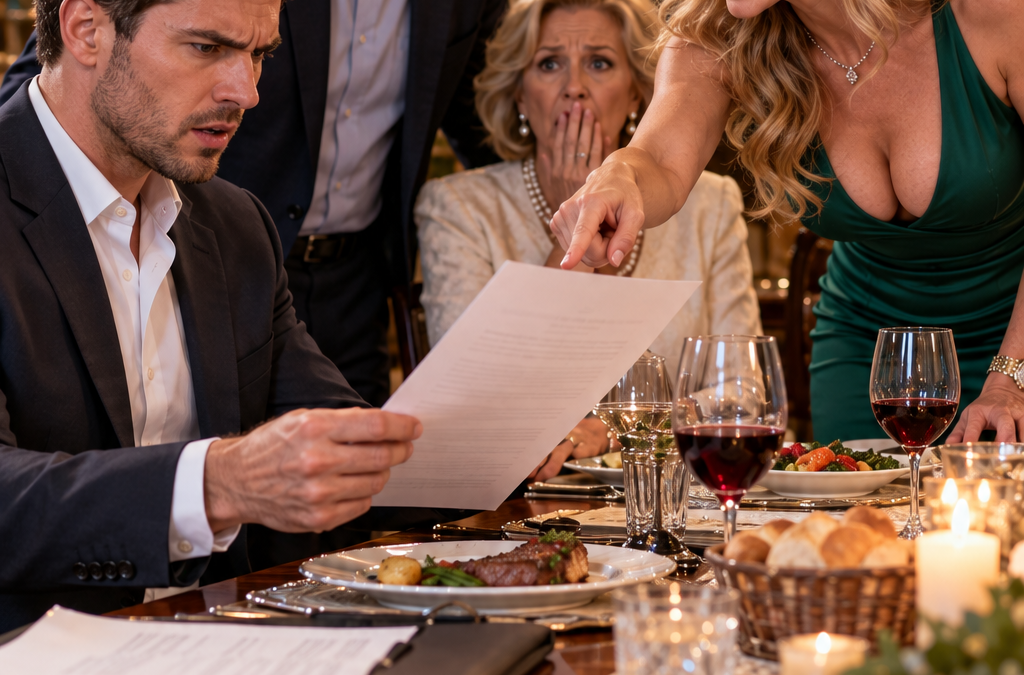
𝗙𝗨𝗟𝗟 𝗦𝗧𝗢𝗥𝗬 My stomach sank before he slid the paper across the table.
The top line was handwritten in blue ink.
FAMILY SUPPORT AGREEMENT.
I stared at it.
The text below claimed that, in exchange for emotional support, housing, guidance, encouragement, and “substantial familial contributions” provided by my parents and my sister during my formative years, I agreed to transfer 50% equity in my company to Karen.
Fifty percent.
Half of everything I had built.
At the bottom was a signature.
My signature.
Or something trying very hard to look like it.
For a second, I genuinely thought it was a joke. A cruel one, maybe, but still a joke.
I laughed once.
Nobody else laughed.
My father’s face remained flat.
“What is this?” I asked.
“A contract,” he said.
“No, Dad. What is this?”
Karen swirled her wine slowly. “It’s time to honor your promises.”
“My promises?”
My mother’s eyes were already wet. She had tears ready before the conversation even began.
“You signed it,” she said softly. “At Christmas. Three years ago.”
“No, I didn’t.”
My father tapped the paper. “You were emotional. You’d had too much eggnog. You said you wanted to make sure Evelyn was taken care of because she supported your dreams.”
Karen’s mouth curved slightly.
There it was.
The lie.
Not just a lie, but a stupid lie.
I pushed my chair back a few inches.
“I don’t drink.”
Karen sighed dramatically.
“Oh, please.”
“I don’t drink,” I repeated. “You all know this.”
My father looked annoyed. “You had eggnog.”
“I have ALDH2 deficiency. I have not touched alcohol since I was twenty-one and ended up in the ER because two beers made my heart rate spike and my face turn purple. If I drank spiked eggnog, I wouldn’t be writing contracts. I’d be vomiting in the bathroom or on the way to urgent care.”
My mother wiped under one eye.
“You don’t have to be cruel.”
“Cruel?” I looked at the fake contract again. “You’re accusing me of signing away half my company while drunk, and I’m cruel?”
Karen set down her glass.
Her expression changed in that subtle way I knew too well. The beautiful wounded sister mask came down over the predator.
“You told me you wanted me to be safe,” she said. “You said I deserved security too.”
“I never said that.”
“You did.”
“I did not.”
Her eyes shone with instant tears. Oscar-worthy. Perfectly timed.
“You always do this,” she whispered. “You make promises when you want to look generous, then you act like everyone else is greedy for believing you.”
My father nodded as if she had just explained gravity.
“You owe your sister,” he said.
“I owe her?”
“She was there for us while you were off building your company.”
“I was building the company that just paid off your house.”
My mother flinched, but my father’s face hardened.
“That was a good start.”
The room went silent.
A good start.
Not thank you.
Not son, we’re sorry.
A good start.
Karen reached across the table and touched my mother’s hand.
“Mom and Dad sacrificed everything for you,” she said. “I sacrificed too. I encouraged you. I believed in you.”
I stared at her.
“You mocked me for years.”
“That is not true.”
“You told Dad my company was a phase.”
“I was concerned.”
“You told Mom I was laundering money because no one makes that much from software.”
Karen’s lips tightened.
My father leaned forward.
“Enough. You have two choices. You honor the agreement quietly, or we take this to court.”
I felt something inside me crack.
Not break.
Crack.
Like ice under pressure.
“You are threatening me?”
“We are holding you accountable.”
“You’re trying to steal my company.”
My mother let out a sob.
“There it is,” Karen said. “This is who he really is.”
I pulled out my phone and took a picture of the paper.
My father snatched it back, but he was too late.
“What the hell are you doing?” he barked.
“Documenting extortion.”
My mother stood. “How dare you?”
I looked at each of them, one by one.
My mother, crying because tears had always worked.
My father, furious because intimidation had always worked.
Karen, beautiful and smug because manipulation had always worked.
Not this time.
“The mortgage was a gift,” I said, my voice shaking. “The house was a gift. This is fraud.”
Karen laughed softly.
“Careful. False accusations can be expensive.”
“So can forged contracts.”
Her eyes sharpened.
For the first time that night, I saw fear.
Tiny.
Brief.
Real.
Then my father stood too.
“You walk out that door, we sue.”
I picked up my coat.
“Then sue.”
The social media campaign started before I reached home.
By midnight, my phone was vibrating nonstop.
My mother posted about “children who forget where they came from.” My father wrote something about honor, family, and greed. Karen posted a photo of herself with swollen eyes and the caption: “Some betrayals hurt because they come from the people you protected.”
Protected.
That word made me laugh so hard I almost threw my phone.
My aunts messaged me. Cousins I had not heard from in years called me selfish. One uncle told me I should be ashamed for abandoning my parents after all they had done. Another relative said Karen deserved stability because she had “a more fragile spirit.”
Not one person asked me if the contract was real.
That was when I understood how well Karen had prepared the ground.
She had spent years making herself soft in other people’s eyes and me hard. She was the emotional one. I was the cold one. She was struggling. I was successful. She needed help. I had too much.
People do not need much evidence to believe a story they already want to believe.
The next morning, I called Robert Hale.
Robert was the kind of attorney who did not waste words. He specialized in commercial litigation and fraud. His office overlooked downtown from the thirty-fourth floor, and his conference room table probably cost more than my first car.
I showed him the photo of the handwritten agreement.
He did not laugh.
That scared me more than if he had.
He leaned closer, studied the image, and went quiet.
“They are actually going to try this,” he said.
“You think?”
“I know.”
“It’s handwritten on yellow legal paper.”
“Yes.”
“And fake.”
“Also yes.”
“Then why aren’t you laughing?”
“Because even a fake ownership claim can damage a company if handled badly. Investors hate uncertainty. Banks hate uncertainty. Boards hate uncertainty. If they file suit, this becomes a dispute over your equity, and that creates noise.”
I sat back.
Noise.
That was such a clean word for a bomb under my life.
“What do we do?”
Robert looked up.
“We do not wait for them to control the story. We prepare. We preserve everything. We lock down corporate records. We notify the board in controlled language. We get ahead of this before your sister tries to turn a forged paper into leverage.”
Three weeks later, they sued me.
Breach of contract.
Specific performance.
Damages for emotional distress.
Loss of future income.
They wanted the court to force me to transfer 50% of my company to Karen.
Half.
Based on a handwritten family support agreement they claimed I wrote and signed while drunk on Christmas four years earlier.
When I received the complaint, I stood alone in my office after everyone had gone home, staring at the papers under the white fluorescent lights. Outside the glass walls, desks sat empty. Monitors slept. The company hummed quietly around me like a living thing.
I thought about the dorm room.
The broken laptop.
The nights I cried from exhaustion where no one could see me.
The employees who depended on me.
The contracts I had fought for.
The years I had spent building something real while Karen floated from fantasy to fantasy on my parents’ money.
And now she wanted half.
Not because she earned it.
Because she believed being loved more at home entitled her to what I had built outside it.
Robert was almost pleased when I called.
“Good,” he said.
“Good?”
“They filed. Now we get discovery.”
Discovery was not glamorous.
It was months of requests, delays, objections, motions, and legal bills so high they made even me wince. My family’s lawyer, a contingency guy with a cheap suit and an oily smile, played games from the beginning. They sent photocopies of the agreement but refused to produce the original. They claimed it was in a safe place. Then they claimed moving it could damage it. Then they claimed we were trying to intimidate elderly parents.
Robert filed a motion to compel.
The judge ordered them to produce the original.
That was their first real mistake.
Their second was thinking paper could not testify.
Robert hired Dr. Alan Pierce, a forensic document examiner whose résumé included federal criminal cases, banking fraud, and art forgery disputes involving people with more money than conscience. He was not a handwriting hobbyist. He arrived with equipment cases, microscopes, light sources, and a calm academic manner that made him seem harmless until he started destroying lies molecule by molecule.
His report was devastating.
First, the paper.
The sheet came from a yellow legal pad. Ordinary enough, or so my family thought. But Dr. Pierce noticed the ruling lines and margin width. The blue lines had a specific opacity. The left margin had a specific measurement. The cardboard backing, which Karen or my father had stupidly kept attached to the pad, identified the manufacturer.
Dr. Pierce contacted the company.
They confirmed that this exact paper design had not entered production until early 2021.
My family claimed I signed it on Christmas Day 2019.
The paper literally did not exist yet.
Second, the signature.
It was not traced, which would have been easier to catch in one way. It was simulated freehand by someone trying to draw my name. Dr. Pierce found hesitation tremors, uneven pressure, microscopic stops where the pen paused, and indentations from practice attempts on sheets above it.
Someone had practiced signing my name before forging it.
Third, the handwriting.
The body of the agreement was compared to samples we obtained through discovery: old birthday cards Karen had written, notes attached to checks, a handwritten business pitch she once sent my parents, and a ridiculous planner page full of affirmations about “wealth energy.”
High probability of common authorship.
That was the phrase.
Karen wrote the agreement.
Karen forged my name.
Karen sat across from me at dinner in her emerald dress and watched my parents try to use her fake document to gut my company.
When Robert told me, I did not feel triumph.
I felt cold.
There is a special kind of grief in proving what you already knew.
The depositions came next.
Robert warned me before they started.
“They are going to lie,” he said. “The goal is not to stop them. The goal is to let them commit to the lie.”
Karen went first.
She came dressed in ivory, with soft curls and pearl earrings, looking less like a defendant’s co-conspirator and more like a grieving heiress in a courtroom drama. She smiled at Robert like she expected him to underestimate her.
He did not.
“Walk me through the night the agreement was signed,” he said.
Karen leaned back.
“It was Christmas. We were all together. There was a fire in the fireplace. Mom made eggnog. He had several glasses.”
Robert nodded. “My client?”
“Yes.”
“You saw him drinking alcohol?”
“Yes.”
“Did he appear intoxicated?”
“A little emotional, but lucid.”
“What happened next?”
She sighed delicately.
“He started talking about how much family meant to him. How I had always supported him. How he wanted to make sure I was taken care of.”
My hands curled under the conference table.
Robert’s voice remained smooth.
“Then what?”
“He got a legal pad and wrote the agreement.”
“He wrote every word?”
“Yes.”
“In front of you?”
“Yes.”
“And signed it?”
“Yes.”
“And this happened on December 25, 2019?”
“Absolutely. I remember it perfectly.”
Perfectly.
That word would come back later like a blade.
My parents told the same story.
My mother said she remembered the eggnog.
My father said he tried to talk me out of signing because fifty percent was “too generous,” but I insisted because I knew Karen deserved it.
They locked themselves inside the lie so completely that there was no door left.
The hearing happened months later.
By then, I had aged in a way no mirror could explain. My company was stable, but the lawsuit hung over everything. Investors were calm because Robert controlled the message, but calm is not the same as comfortable. I had security review my accounts. I changed passwords. I stopped answering unknown numbers. I slept badly. I started therapy and then pretended I had started it for stress, not because my entire childhood had returned wearing a legal caption.
On the morning of the hearing, my parents arrived dressed like victims.
My mother wore an old threadbare coat I had not seen since high school, even though I knew she owned newer ones. My father used a cane he did not need. Karen wore a navy dress, simple makeup, and no jewelry except a small cross necklace she had never worn in her life.
She looked beautiful.
Fragile.
Wronged.
If I had not known her, I might have believed her.
Their lawyer opened with a speech about family promises, gratitude, and the importance of honoring obligations made in moments of vulnerability. He painted me as a wealthy son trying to crush his struggling family with corporate technicalities. He said the agreement reflected love, sacrifice, and moral debt.
Then Robert stood.
He did not raise his voice.
He did not insult anyone.
He simply began.
First, Dr. Pierce took the stand.
He explained the paper analysis with enlarged images projected on a screen. Blue ruling opacity. Margin width. Manufacturer records. Production dates. The affidavit from the paper company confirming the sheet could not have existed in 2019.
I watched my father’s face lose color.
Then came the signature analysis.
The hesitation marks. Pressure changes. Practice indentations.
Karen stopped looking at the screen.
Then the handwriting comparison.
Dr. Pierce overlaid Karen’s known handwriting with the contract text. The loops, the slants, the crossed T’s, the way she formed certain capital letters. Not identical in the dramatic TV sense, but close in the scientific sense. Controlled. Explained. Damning.
Finally, Robert submitted my medical records.
ALDH2 deficiency. Emergency room visit at twenty-one. Physician notes warning against alcohol consumption. Documentation showing that the intoxicated Christmas story was medically absurd.
“If my client consumed multiple glasses of alcoholic eggnog,” Robert said, “he would not be drafting equity agreements. He would be experiencing tachycardia, flushing, vomiting, and severe physical distress.”
Karen’s lawyer shifted in his seat.
Robert was not finished.
He played deposition clips.
Karen, calm and certain: “I watched him write it.”
My mother: “He was drinking eggnog.”
My father: “He signed it in front of all of us.”
Karen: “Christmas Day, 2019. Absolutely.”
The courtroom was silent.
The judge looked at their lawyer.
“Counsel,” she said, “were you aware of the origin issues with this document?”
Their lawyer stood slowly.
His face was gray.
“Your Honor, I relied on representations made by my clients.”
“I see.”
He asked for a recess to confer with them.
The judge denied it.
Then she looked at my parents and Karen.
I will never forget her voice.
“You came into this court seeking enforcement of a document that, based on the evidence before me, could not have existed on the date you claim it was signed. You gave sworn testimony contradicted by forensic evidence, medical records, and manufacturer documentation. This court views that not as a misunderstanding, but as a fraud upon the court.”
Karen’s mask broke first.
“No,” she whispered.
My mother began crying for real this time.
My father stared straight ahead.
The judge dismissed the case with prejudice.
Then she sanctioned them.
Then she directed the clerk to forward the transcript and evidence to the district attorney’s fraud unit.
That was when Karen stood up and screamed.
“It was Dad’s idea!”
The courtroom froze.
My father turned on her. “Shut your mouth.”
“No!” Karen shrieked, pointing at him. “He said he owed us! He said he had too much money! He said he’d settle because he was too scared of bad publicity!”
The bailiff moved fast.
My mother wailed.
Their lawyer looked like he wanted the floor to open and swallow him whole.
I sat there feeling nothing and everything at once.
The fantasy was finally dead.
Not wounded.
Dead.
There would be no repaired holiday dinner. No tearful apology that made it all better. No moment where my parents realized they had gone too far and chose me over Karen.
They had chosen.
Years ago, probably.
The court only put it on record.
But I was not done.
Because lawsuits cost money, and Robert had never intended merely to defend.
We countersued for legal fees and sanctions tied to their malicious fraudulent claim. My legal bills were obscene: forensic experts, depositions, motions, corporate counsel coordination, Robert’s hours, document review, emergency investor communications. More than $140,000.
The judge awarded my legal costs.
My parents did not have $140,000 in cash.
What they had was a mortgage-free house.
The house I had paid off.
We filed a judgment lien.
That part hurt in a way I did not expect.
Not because they deserved mercy.
Because I remembered being a kid in that house. I remembered lying on the carpet building Lego spaceships while Karen practiced dance routines in the living room and my mother clapped for her. I remembered eating cereal at the kitchen counter before school. I remembered snow against the windows. I remembered wanting to leave, then wanting to be invited back, then paying nearly half a million dollars so the place would not be taken.
In the end, it was taken anyway.
Not by a bank.
By consequences.
The district attorney took the case.
I had assumed they might not. Family disputes often become messy civil matters, and prosecutors do not always want to wade into them. But the value of the attempted theft was enormous. Half of an eight-figure company. A forged document. Perjury under oath. Fraud on the court.
Karen cracked in custody.
Of course she did.
Karen was brave only when someone else absorbed the impact.
She admitted she wrote the agreement. She admitted she practiced my signature. She admitted my father suggested the plan because he was angry that after paying off the mortgage, I had not also bought him a new car. She admitted they believed I would settle quietly to protect the company from public drama.
They knew exactly what they were doing.
My parents took plea deals.
Conspiracy. Perjury. Massive fines. Five years of probation. No prison because of their age and because prosecutors often weigh optics when elderly defendants stand beside their adult daughter and pretend to be confused.
Karen was not so lucky.
During the investigation, a prior check fraud incident surfaced. I had never known about it. My parents had hidden it, paid it off, explained it away, protected her again.
This time they could not.
Forgery in the first degree.
Attempted grand larceny.
Perjury exposure folded into the larger case.
Three years in state prison.
At sentencing, Karen turned around and looked at me.
For once, there was no glamour left. No red lipstick power. No perfect smile. Her hair was dull. Her face looked smaller. Fear had stripped her down to the person she had always been underneath: selfish, panicked, and furious that consequences had finally found her.
“I’m your sister,” she said. “Do something.”
All my life, those words would have moved me.
I’m your sister.
Family is family.
Blood matters.
Be the bigger person.
I looked at her and saw every version of myself that had believed those phrases. The boy with the A-minus. The college kid eating noodles. The young founder refreshing his inbox for a message from his father. The grown man wiring $480,000 and waiting for love to arrive.
I said nothing.
Karen stared at me until the bailiff led her away.
My parents had to sell the house.
After fines, their own legal fees, and the judgment they owed me, they walked away with almost nothing. They moved into a one-bedroom apartment in a neighborhood my mother would once have described with pity and locked car doors.
The relatives who had called me greedy went silent.
One aunt tried to “bridge the gap” three weeks later with a message that began, “I think everyone made mistakes.”
Everyone.
I forwarded it to Robert.
He sent a cease-and-desist letter.
Then I changed my phone number.
I moved to a house with a security gate.
I blocked every relative who had participated in the smear campaign, every cousin who had called me cold, every uncle who had told me I owed my parents forgiveness, every aunt who had treated fraud like an awkward misunderstanding.
For a while, the silence was terrifying.
I had spent my entire life orbiting their approval. Even resentment is a kind of attachment. Even anger keeps you facing the people who hurt you.
No contact felt like stepping into space.
Then, slowly, it began to feel like air.
Therapy helped.
I hated it at first. I hated sitting in a clean office while a calm woman asked me why I thought love had to be earned through usefulness. I hated the word narcissistic because it sounded too simple for something that had shaped every room I ever entered. I hated realizing that I did not miss my family as much as I missed the family I kept imagining they might become.
That was the hardest grief.
Not losing them.
Losing the fantasy.
The company survived.
Better than survived, actually. The board appreciated that I handled the threat aggressively and transparently. Investors respected that Robert crushed the claim before it could metastasize. My employees never knew the full emotional story, only that a fraudulent ownership claim had been defeated.
Business moved on.
That is the brutal beauty of business.
It does not care who failed to love you.
Invoices still go out. Software still updates. Trucks still need routes. Clients still need answers. Payroll still runs.
At first, that felt cruel.
Then it became comforting.
One morning, months after Karen went to prison, I arrived at the office early. The sun had just started to rise over the city, turning the windows gold. The desks were empty, the lights low, the server room humming softly behind glass.
I stood there with coffee in my hand and remembered the dorm room.
The missing E key.
The instant noodles.
The lonely hunger driving all of it.
For years, I thought I had built the company to prove something to my parents.
Maybe, in the beginning, I had.
But standing there in the quiet, I realized the company had become mine long ago. Not theirs to validate. Not Karen’s to steal. Not a bargaining chip in some sick family drama.
Mine.
Built by my work.
Protected by my choices.
Saved, in the end, by the part of me that finally stopped begging.
People sometimes say revenge is empty.
Maybe it is, if revenge is all you want.
But accountability is not empty.
Justice is not empty.
A locked door between you and people who would burn your life for warmth is not empty.
It is peace.
My parents wanted me to treat them like family while they behaved like criminals.
Karen wanted the court to treat her fake contract like business.
So I gave them exactly what they demanded.
No special treatment.
No emotional discount.
No quiet family settlement.
Business rules.
Legal rules.
Evidence.
Consequences.
They wanted half my company.
They lost the house I paid for.
They wanted to expose me as greedy.
They exposed themselves as frauds.
They wanted a signed agreement to define what family owed them.
In the end, the only document that mattered was the court order.
I do not feel happy about any of it.
That surprises people when I say it.
They expect me to enjoy the downfall. To savor Karen’s sentence. To laugh about my parents’ apartment. To feel some cinematic satisfaction every time I remember the judge’s words.
Sometimes, yes, there is a flash of satisfaction.
I am human.
But mostly I feel relief.
Relief that the leech finally detached.
Relief that I no longer answer the phone hoping this time my mother will sound proud.
Relief that my father’s disappointment is no longer a weather system in my life.
Relief that Karen’s beauty, tears, and manipulation no longer bend the room around her.
Relief that I found out the truth before they found a way to take more.
I paid $480,000 for a fantasy.
It was an expensive lesson.
But at least I learned it before the price became half of everything I built.
My grandfather used to say people show you who they are when money enters the room.
I think that is only half true.
Money does not change people as much as it gives their real selves permission to speak.
My parents’ love had always been conditional.
Karen’s helplessness had always been a weapon.
And my success had always been tolerated only as long as they could imagine spending it.
The night they slid that forged agreement across the dinner table, they thought they were finally cashing in on me.
They did not realize they were signing themselves out of my life.
No more checks.
No more calls.
No more holidays.
No more trying.
No more little boy waiting to be chosen.
They asked the court to enforce a family support agreement.
The court did.
It supported me by showing me exactly who my family was.
𝗧𝗛𝗘 𝗘𝗡𝗗
I Paid Off Their House, Then They Forged My Name to Steal My Company
I thought wiring $480,000 to save my parents’ home would finally make them proud of me.
Instead, my sister smiled across the dinner table and watched them slide a forged contract toward me demanding half my company.
By the time they realized I was done begging for love, the lie they built had already become evidence.
For most of my life, I believed there was a number.
I never said it out loud because saying it would have made it sound pathetic, but somewhere in the back of my mind, I believed there had to be a number big enough to buy my parents’ approval. A grade high enough. A scholarship impressive enough. A company valuable enough. A bank balance large enough that one day my father would look at me the way he looked at my older sister and say, without irony, without conditions, without immediately changing the subject, “I’m proud of you.”
I was thirty-two years old before I understood that number did not exist.
My older sister’s name was Evelyn, but in my head, long before the lawsuit, I started calling her Karen.
She was forty, beautiful in the polished American way that made strangers forgive her before she even asked, with glossy dark-blonde hair, a perfect gym body, bright lipstick, and the kind of smile that could soften a banker, a cop, or a married man at a Christmas party. She dressed like every sidewalk was a runway and every room was waiting for her entrance. Silk blouses, fitted dresses, gold jewelry, heels just high enough to make her look powerful but not desperate. She had mastered that little laugh women use when they want a man to feel chosen and a woman to feel dismissed.
But underneath all that charm was rot.
Karen never asked for anything directly when manipulation would work better. She cried when challenged. She flirted when useful. She played helpless around my father, wounded around my mother, and superior around me. She was the golden child in our family, not because she was kind or responsible or talented, but because my parents had decided early that her failures were tragedies and mine were character flaws.
If Karen lost a job, her boss was threatened by her confidence.
If she crashed a car, the road was unsafe.
If one of her business ideas collapsed, the market wasn’t ready for her vision.
If I came home with an A-minus, my father wanted to know why it wasn’t an A. If I won a coding competition, my mother said I should not get arrogant. If I built something from nothing, Karen called me lucky.
Luck.
That was her favorite word for my life.
I started my company in college from a dorm room that smelled like burnt coffee, soldering wire, and instant noodles. My laptop had a missing E key. My first server was built from used parts I bought online and prayed would survive finals week. I missed parties, dates, sleep, birthdays, and entire seasons of my twenties. I ate cheap food until I hated the sight of it. I put every dollar back into infrastructure, then staff, then software, then contracts.
It nearly broke me.
Then it worked.
By thirty-two, I owned a logistics and software company valued in the eight figures. We handled routing, freight coordination, and predictive scheduling for major regional carriers. I had investors, employees, lawyers, board obligations, security protocols, and more stress than I knew what to do with.
What I did not have was a family who saw me clearly.
Two years before everything exploded, my parents started calling more often.
At first, I was stupid enough to think they missed me.
Then every conversation turned into money.
Their mortgage had ballooned after years of refinancing. They had borrowed against the house again and again, mostly to fund Karen’s disasters: a dog-walking app that never became an app, a boutique jewelry line that stained people’s skin green, a drop-shipping store that sold defective kitchen gadgets and somehow lost money during the pandemic boom.
My parents were drowning.
The house I grew up in was facing foreclosure.
The balance was roughly $480,000.
For a normal person, that number is life-changing. For me, by then, it was painful but possible. It would not destroy me. It would not endanger the company. It would just hurt enough to feel meaningful.
And some sick, lonely part of me thought, This is it.
This would be the gesture.
This would make them understand.
So I paid it.
Directly to the bank. One wire transfer. No conditions. No repayment plan. No lien. No agreement. Just a son saving the family home because, even after everything, he still wanted to be loved by the people who should have loved him first.
My mother cried when I told her.
My father hugged me stiffly, then shook my hand like we were closing a business deal. Karen stood nearby in a cream-colored dress, arms crossed, smiling with red lips and cold eyes.
For three weeks, I lived inside a fantasy.
My mother called me sweetheart. My father asked about the company with something almost like interest. Karen posted a family photo online with the caption, “Blessed when family shows up for family.”
I should have known.
Karen never posted gratitude unless she was setting a stage.
PART 2
The holiday dinner was framed as a celebration.
My mother called it “financial freedom dinner,” which should have made me cringe, but I wanted so badly to believe the best that I brought wine I could not drink and a dessert from the expensive bakery my mother liked. The house looked exactly the same from the outside: white siding, brick steps, wreath on the door, porch light flickering the way it had since I was a teenager.
Inside, everything felt wrong.
Too formal.
Too arranged.
The dining room table was set with the good plates we almost never used when I was growing up because my mother was always saving them for people who mattered. My father wore a button-down shirt. My mother had pearls on. Karen sat across from my usual chair wearing a fitted emerald dress and diamond earrings I was fairly certain my parents had helped pay for before I cleared their debt.
She smiled when I walked in.
Not warmly.
Triumphantly.
“Little brother,” she said, lifting her wineglass. “Our hero finally arrived.”
There was something in her voice that made the back of my neck tighten.
Dinner started normally enough. My mother asked about work, but not in a way that suggested she cared about the answer. My father talked about property taxes. Karen complained about how hard it was to find “serious investors” for her next venture, which involved luxury pet wellness boxes and a subscription model she described like she had invented both pets and boxes.
Halfway through the pot roast, my father cleared his throat.
It was a performance sound. Heavy. Important.
My mother put down her fork.
Karen leaned back and watched me.
My father reached under his placemat and pulled out a yellow legal pad sheet folded in thirds.
“Son,” he said, “we need to discuss something as a family.”
My stomach sank before he slid the paper across the table.
The top line was handwritten in blue ink.
FAMILY SUPPORT AGREEMENT.
I stared at it.
The text below claimed that, in exchange for emotional support, housing, guidance, encouragement, and “substantial familial contributions” provided by my parents and my sister during my formative years, I agreed to transfer 50% equity in my company to Karen.
Fifty percent.
Half of everything I had built.
At the bottom was a signature.
My signature.
Or something trying very hard to look like it.
For a second, I genuinely thought it was a joke. A cruel one, maybe, but still a joke.
I laughed once.
Nobody else laughed.
My father’s face remained flat.
“What is this?” I asked.
“A contract,” he said.
“No, Dad. What is this?”
Karen swirled her wine slowly. “It’s time to honor your promises.”
“My promises?”
My mother’s eyes were already wet. She had tears ready before the conversation even began.
“You signed it,” she said softly. “At Christmas. Three years ago.”
“No, I didn’t.”
My father tapped the paper. “You were emotional. You’d had too much eggnog. You said you wanted to make sure Evelyn was taken care of because she supported your dreams.”
Karen’s mouth curved slightly.
There it was.
The lie.
Not just a lie, but a stupid lie.
I pushed my chair back a few inches.
“I don’t drink.”
Karen sighed dramatically.
“Oh, please.”
“I don’t drink,” I repeated. “You all know this.”
My father looked annoyed. “You had eggnog.”
“I have ALDH2 deficiency. I have not touched alcohol since I was twenty-one and ended up in the ER because two beers made my heart rate spike and my face turn purple. If I drank spiked eggnog, I wouldn’t be writing contracts. I’d be vomiting in the bathroom or on the way to urgent care.”
My mother wiped under one eye.
“You don’t have to be cruel.”
“Cruel?” I looked at the fake contract again. “You’re accusing me of signing away half my company while drunk, and I’m cruel?”
Karen set down her glass.
Her expression changed in that subtle way I knew too well. The beautiful wounded sister mask came down over the predator.
“You told me you wanted me to be safe,” she said. “You said I deserved security too.”
“I never said that.”
“You did.”
“I did not.”
Her eyes shone with instant tears. Oscar-worthy. Perfectly timed.
“You always do this,” she whispered. “You make promises when you want to look generous, then you act like everyone else is greedy for believing you.”
My father nodded as if she had just explained gravity.
“You owe your sister,” he said.
“I owe her?”
“She was there for us while you were off building your company.”
“I was building the company that just paid off your house.”
My mother flinched, but my father’s face hardened.
“That was a good start.”
The room went silent.
A good start.
Not thank you.
Not son, we’re sorry.
A good start.
Karen reached across the table and touched my mother’s hand.
“Mom and Dad sacrificed everything for you,” she said. “I sacrificed too. I encouraged you. I believed in you.”
I stared at her.
“You mocked me for years.”
“That is not true.”
“You told Dad my company was a phase.”
“I was concerned.”
“You told Mom I was laundering money because no one makes that much from software.”
Karen’s lips tightened.
My father leaned forward.
“Enough. You have two choices. You honor the agreement quietly, or we take this to court.”
I felt something inside me crack.
Not break.
Crack.
Like ice under pressure.
“You are threatening me?”
“We are holding you accountable.”
“You’re trying to steal my company.”
My mother let out a sob.
“There it is,” Karen said. “This is who he really is.”
I pulled out my phone and took a picture of the paper.
My father snatched it back, but he was too late.
“What the hell are you doing?” he barked.
“Documenting extortion.”
My mother stood. “How dare you?”
I looked at each of them, one by one.
My mother, crying because tears had always worked.
My father, furious because intimidation had always worked.
Karen, beautiful and smug because manipulation had always worked.
Not this time.
“The mortgage was a gift,” I said, my voice shaking. “The house was a gift. This is fraud.”
Karen laughed softly.
“Careful. False accusations can be expensive.”
“So can forged contracts.”
Her eyes sharpened.
For the first time that night, I saw fear.
Tiny.
Brief.
Real.
Then my father stood too.
“You walk out that door, we sue.”
I picked up my coat.
“Then sue.”
The social media campaign started before I reached home.
By midnight, my phone was vibrating nonstop.
My mother posted about “children who forget where they came from.” My father wrote something about honor, family, and greed. Karen posted a photo of herself with swollen eyes and the caption: “Some betrayals hurt because they come from the people you protected.”
Protected.
That word made me laugh so hard I almost threw my phone.
My aunts messaged me. Cousins I had not heard from in years called me selfish. One uncle told me I should be ashamed for abandoning my parents after all they had done. Another relative said Karen deserved stability because she had “a more fragile spirit.”
Not one person asked me if the contract was real.
That was when I understood how well Karen had prepared the ground.
She had spent years making herself soft in other people’s eyes and me hard. She was the emotional one. I was the cold one. She was struggling. I was successful. She needed help. I had too much.
People do not need much evidence to believe a story they already want to believe.
The next morning, I called Robert Hale.
Robert was the kind of attorney who did not waste words. He specialized in commercial litigation and fraud. His office overlooked downtown from the thirty-fourth floor, and his conference room table probably cost more than my first car.
I showed him the photo of the handwritten agreement.
He did not laugh.
That scared me more than if he had.
He leaned closer, studied the image, and went quiet.
“They are actually going to try this,” he said.
“You think?”
“I know.”
“It’s handwritten on yellow legal paper.”
“Yes.”
“And fake.”
“Also yes.”
“Then why aren’t you laughing?”
“Because even a fake ownership claim can damage a company if handled badly. Investors hate uncertainty. Banks hate uncertainty. Boards hate uncertainty. If they file suit, this becomes a dispute over your equity, and that creates noise.”
I sat back.
Noise.
That was such a clean word for a bomb under my life.
“What do we do?”
Robert looked up.
“We do not wait for them to control the story. We prepare. We preserve everything. We lock down corporate records. We notify the board in controlled language. We get ahead of this before your sister tries to turn a forged paper into leverage.”
Three weeks later, they sued me.
Breach of contract.
Specific performance.
Damages for emotional distress.
Loss of future income.
They wanted the court to force me to transfer 50% of my company to Karen.
Half.
Based on a handwritten family support agreement they claimed I wrote and signed while drunk on Christmas four years earlier.
When I received the complaint, I stood alone in my office after everyone had gone home, staring at the papers under the white fluorescent lights. Outside the glass walls, desks sat empty. Monitors slept. The company hummed quietly around me like a living thing.
I thought about the dorm room.
The broken laptop.
The nights I cried from exhaustion where no one could see me.
The employees who depended on me.
The contracts I had fought for.
The years I had spent building something real while Karen floated from fantasy to fantasy on my parents’ money.
And now she wanted half.
Not because she earned it.
Because she believed being loved more at home entitled her to what I had built outside it.
Robert was almost pleased when I called.
“Good,” he said.
“Good?”
“They filed. Now we get discovery.”
Discovery was not glamorous.
It was months of requests, delays, objections, motions, and legal bills so high they made even me wince. My family’s lawyer, a contingency guy with a cheap suit and an oily smile, played games from the beginning. They sent photocopies of the agreement but refused to produce the original. They claimed it was in a safe place. Then they claimed moving it could damage it. Then they claimed we were trying to intimidate elderly parents.
Robert filed a motion to compel.
The judge ordered them to produce the original.
That was their first real mistake.
Their second was thinking paper could not testify.
Robert hired Dr. Alan Pierce, a forensic document examiner whose résumé included federal criminal cases, banking fraud, and art forgery disputes involving people with more money than conscience. He was not a handwriting hobbyist. He arrived with equipment cases, microscopes, light sources, and a calm academic manner that made him seem harmless until he started destroying lies molecule by molecule.
His report was devastating.
First, the paper.
The sheet came from a yellow legal pad. Ordinary enough, or so my family thought. But Dr. Pierce noticed the ruling lines and margin width. The blue lines had a specific opacity. The left margin had a specific measurement. The cardboard backing, which Karen or my father had stupidly kept attached to the pad, identified the manufacturer.
Dr. Pierce contacted the company.
They confirmed that this exact paper design had not entered production until early 2021.
My family claimed I signed it on Christmas Day 2019.
The paper literally did not exist yet.
Second, the signature.
It was not traced, which would have been easier to catch in one way. It was simulated freehand by someone trying to draw my name. Dr. Pierce found hesitation tremors, uneven pressure, microscopic stops where the pen paused, and indentations from practice attempts on sheets above it.
Someone had practiced signing my name before forging it.
Third, the handwriting.
The body of the agreement was compared to samples we obtained through discovery: old birthday cards Karen had written, notes attached to checks, a handwritten business pitch she once sent my parents, and a ridiculous planner page full of affirmations about “wealth energy.”
High probability of common authorship.
That was the phrase.
Karen wrote the agreement.
Karen forged my name.
Karen sat across from me at dinner in her emerald dress and watched my parents try to use her fake document to gut my company.
When Robert told me, I did not feel triumph.
I felt cold.
There is a special kind of grief in proving what you already knew.
The depositions came next.
Robert warned me before they started.
“They are going to lie,” he said. “The goal is not to stop them. The goal is to let them commit to the lie.”
Karen went first.
She came dressed in ivory, with soft curls and pearl earrings, looking less like a defendant’s co-conspirator and more like a grieving heiress in a courtroom drama. She smiled at Robert like she expected him to underestimate her.
He did not.
“Walk me through the night the agreement was signed,” he said.
Karen leaned back.
“It was Christmas. We were all together. There was a fire in the fireplace. Mom made eggnog. He had several glasses.”
Robert nodded. “My client?”
“Yes.”
“You saw him drinking alcohol?”
“Yes.”
“Did he appear intoxicated?”
“A little emotional, but lucid.”
“What happened next?”
She sighed delicately.
“He started talking about how much family meant to him. How I had always supported him. How he wanted to make sure I was taken care of.”
My hands curled under the conference table.
Robert’s voice remained smooth.
“Then what?”
“He got a legal pad and wrote the agreement.”
“He wrote every word?”
“Yes.”
“In front of you?”
“Yes.”
“And signed it?”
“Yes.”
“And this happened on December 25, 2019?”
“Absolutely. I remember it perfectly.”
Perfectly.
That word would come back later like a blade.
My parents told the same story.
My mother said she remembered the eggnog.
My father said he tried to talk me out of signing because fifty percent was “too generous,” but I insisted because I knew Karen deserved it.
They locked themselves inside the lie so completely that there was no door left.
The hearing happened months later.
By then, I had aged in a way no mirror could explain. My company was stable, but the lawsuit hung over everything. Investors were calm because Robert controlled the message, but calm is not the same as comfortable. I had security review my accounts. I changed passwords. I stopped answering unknown numbers. I slept badly. I started therapy and then pretended I had started it for stress, not because my entire childhood had returned wearing a legal caption.
On the morning of the hearing, my parents arrived dressed like victims.
My mother wore an old threadbare coat I had not seen since high school, even though I knew she owned newer ones. My father used a cane he did not need. Karen wore a navy dress, simple makeup, and no jewelry except a small cross necklace she had never worn in her life.
She looked beautiful.
Fragile.
Wronged.
If I had not known her, I might have believed her.
Their lawyer opened with a speech about family promises, gratitude, and the importance of honoring obligations made in moments of vulnerability. He painted me as a wealthy son trying to crush his struggling family with corporate technicalities. He said the agreement reflected love, sacrifice, and moral debt.
Then Robert stood.
He did not raise his voice.
He did not insult anyone.
He simply began.
First, Dr. Pierce took the stand.
He explained the paper analysis with enlarged images projected on a screen. Blue ruling opacity. Margin width. Manufacturer records. Production dates. The affidavit from the paper company confirming the sheet could not have existed in 2019.
I watched my father’s face lose color.
Then came the signature analysis.
The hesitation marks. Pressure changes. Practice indentations.
Karen stopped looking at the screen.
Then the handwriting comparison.
Dr. Pierce overlaid Karen’s known handwriting with the contract text. The loops, the slants, the crossed T’s, the way she formed certain capital letters. Not identical in the dramatic TV sense, but close in the scientific sense. Controlled. Explained. Damning.
Finally, Robert submitted my medical records.
ALDH2 deficiency. Emergency room visit at twenty-one. Physician notes warning against alcohol consumption. Documentation showing that the intoxicated Christmas story was medically absurd.
“If my client consumed multiple glasses of alcoholic eggnog,” Robert said, “he would not be drafting equity agreements. He would be experiencing tachycardia, flushing, vomiting, and severe physical distress.”
Karen’s lawyer shifted in his seat.
Robert was not finished.
He played deposition clips.
Karen, calm and certain: “I watched him write it.”
My mother: “He was drinking eggnog.”
My father: “He signed it in front of all of us.”
Karen: “Christmas Day, 2019. Absolutely.”
The courtroom was silent.
The judge looked at their lawyer.
“Counsel,” she said, “were you aware of the origin issues with this document?”
Their lawyer stood slowly.
His face was gray.
“Your Honor, I relied on representations made by my clients.”
“I see.”
He asked for a recess to confer with them.
The judge denied it.
Then she looked at my parents and Karen.
I will never forget her voice.
“You came into this court seeking enforcement of a document that, based on the evidence before me, could not have existed on the date you claim it was signed. You gave sworn testimony contradicted by forensic evidence, medical records, and manufacturer documentation. This court views that not as a misunderstanding, but as a fraud upon the court.”
Karen’s mask broke first.
“No,” she whispered.
My mother began crying for real this time.
My father stared straight ahead.
The judge dismissed the case with prejudice.
Then she sanctioned them.
Then she directed the clerk to forward the transcript and evidence to the district attorney’s fraud unit.
That was when Karen stood up and screamed.
“It was Dad’s idea!”
The courtroom froze.
My father turned on her. “Shut your mouth.”
“No!” Karen shrieked, pointing at him. “He said he owed us! He said he had too much money! He said he’d settle because he was too scared of bad publicity!”
The bailiff moved fast.
My mother wailed.
Their lawyer looked like he wanted the floor to open and swallow him whole.
I sat there feeling nothing and everything at once.
The fantasy was finally dead.
Not wounded.
Dead.
There would be no repaired holiday dinner. No tearful apology that made it all better. No moment where my parents realized they had gone too far and chose me over Karen.
They had chosen.
Years ago, probably.
The court only put it on record.
But I was not done.
Because lawsuits cost money, and Robert had never intended merely to defend.
We countersued for legal fees and sanctions tied to their malicious fraudulent claim. My legal bills were obscene: forensic experts, depositions, motions, corporate counsel coordination, Robert’s hours, document review, emergency investor communications. More than $140,000.
The judge awarded my legal costs.
My parents did not have $140,000 in cash.
What they had was a mortgage-free house.
The house I had paid off.
We filed a judgment lien.
That part hurt in a way I did not expect.
Not because they deserved mercy.
Because I remembered being a kid in that house. I remembered lying on the carpet building Lego spaceships while Karen practiced dance routines in the living room and my mother clapped for her. I remembered eating cereal at the kitchen counter before school. I remembered snow against the windows. I remembered wanting to leave, then wanting to be invited back, then paying nearly half a million dollars so the place would not be taken.
In the end, it was taken anyway.
Not by a bank.
By consequences.
The district attorney took the case.
I had assumed they might not. Family disputes often become messy civil matters, and prosecutors do not always want to wade into them. But the value of the attempted theft was enormous. Half of an eight-figure company. A forged document. Perjury under oath. Fraud on the court.
Karen cracked in custody.
Of course she did.
Karen was brave only when someone else absorbed the impact.
She admitted she wrote the agreement. She admitted she practiced my signature. She admitted my father suggested the plan because he was angry that after paying off the mortgage, I had not also bought him a new car. She admitted they believed I would settle quietly to protect the company from public drama.
They knew exactly what they were doing.
My parents took plea deals.
Conspiracy. Perjury. Massive fines. Five years of probation. No prison because of their age and because prosecutors often weigh optics when elderly defendants stand beside their adult daughter and pretend to be confused.
Karen was not so lucky.
During the investigation, a prior check fraud incident surfaced. I had never known about it. My parents had hidden it, paid it off, explained it away, protected her again.
This time they could not.
Forgery in the first degree.
Attempted grand larceny.
Perjury exposure folded into the larger case.
Three years in state prison.
At sentencing, Karen turned around and looked at me.
For once, there was no glamour left. No red lipstick power. No perfect smile. Her hair was dull. Her face looked smaller. Fear had stripped her down to the person she had always been underneath: selfish, panicked, and furious that consequences had finally found her.
“I’m your sister,” she said. “Do something.”
All my life, those words would have moved me.
I’m your sister.
Family is family.
Blood matters.
Be the bigger person.
I looked at her and saw every version of myself that had believed those phrases. The boy with the A-minus. The college kid eating noodles. The young founder refreshing his inbox for a message from his father. The grown man wiring $480,000 and waiting for love to arrive.
I said nothing.
Karen stared at me until the bailiff led her away.
My parents had to sell the house.
After fines, their own legal fees, and the judgment they owed me, they walked away with almost nothing. They moved into a one-bedroom apartment in a neighborhood my mother would once have described with pity and locked car doors.
The relatives who had called me greedy went silent.
One aunt tried to “bridge the gap” three weeks later with a message that began, “I think everyone made mistakes.”
Everyone.
I forwarded it to Robert.
He sent a cease-and-desist letter.
Then I changed my phone number.
I moved to a house with a security gate.
I blocked every relative who had participated in the smear campaign, every cousin who had called me cold, every uncle who had told me I owed my parents forgiveness, every aunt who had treated fraud like an awkward misunderstanding.
For a while, the silence was terrifying.
I had spent my entire life orbiting their approval. Even resentment is a kind of attachment. Even anger keeps you facing the people who hurt you.
No contact felt like stepping into space.
Then, slowly, it began to feel like air.
Therapy helped.
I hated it at first. I hated sitting in a clean office while a calm woman asked me why I thought love had to be earned through usefulness. I hated the word narcissistic because it sounded too simple for something that had shaped every room I ever entered. I hated realizing that I did not miss my family as much as I missed the family I kept imagining they might become.
That was the hardest grief.
Not losing them.
Losing the fantasy.
The company survived.
Better than survived, actually. The board appreciated that I handled the threat aggressively and transparently. Investors respected that Robert crushed the claim before it could metastasize. My employees never knew the full emotional story, only that a fraudulent ownership claim had been defeated.
Business moved on.
That is the brutal beauty of business.
It does not care who failed to love you.
Invoices still go out. Software still updates. Trucks still need routes. Clients still need answers. Payroll still runs.
At first, that felt cruel.
Then it became comforting.
One morning, months after Karen went to prison, I arrived at the office early. The sun had just started to rise over the city, turning the windows gold. The desks were empty, the lights low, the server room humming softly behind glass.
I stood there with coffee in my hand and remembered the dorm room.
The missing E key.
The instant noodles.
The lonely hunger driving all of it.
For years, I thought I had built the company to prove something to my parents.
Maybe, in the beginning, I had.
But standing there in the quiet, I realized the company had become mine long ago. Not theirs to validate. Not Karen’s to steal. Not a bargaining chip in some sick family drama.
Mine.
Built by my work.
Protected by my choices.
Saved, in the end, by the part of me that finally stopped begging.
People sometimes say revenge is empty.
Maybe it is, if revenge is all you want.
But accountability is not empty.
Justice is not empty.
A locked door between you and people who would burn your life for warmth is not empty.
It is peace.
My parents wanted me to treat them like family while they behaved like criminals.
Karen wanted the court to treat her fake contract like business.
So I gave them exactly what they demanded.
No special treatment.
No emotional discount.
No quiet family settlement.
Business rules.
Legal rules.
Evidence.
Consequences.
They wanted half my company.
They lost the house I paid for.
They wanted to expose me as greedy.
They exposed themselves as frauds.
They wanted a signed agreement to define what family owed them.
In the end, the only document that mattered was the court order.
I do not feel happy about any of it.
That surprises people when I say it.
They expect me to enjoy the downfall. To savor Karen’s sentence. To laugh about my parents’ apartment. To feel some cinematic satisfaction every time I remember the judge’s words.
Sometimes, yes, there is a flash of satisfaction.
I am human.
But mostly I feel relief.
Relief that the leech finally detached.
Relief that I no longer answer the phone hoping this time my mother will sound proud.
Relief that my father’s disappointment is no longer a weather system in my life.
Relief that Karen’s beauty, tears, and manipulation no longer bend the room around her.
Relief that I found out the truth before they found a way to take more.
I paid $480,000 for a fantasy.
It was an expensive lesson.
But at least I learned it before the price became half of everything I built.
My grandfather used to say people show you who they are when money enters the room.
I think that is only half true.
Money does not change people as much as it gives their real selves permission to speak.
My parents’ love had always been conditional.
Karen’s helplessness had always been a weapon.
And my success had always been tolerated only as long as they could imagine spending it.
The night they slid that forged agreement across the dinner table, they thought they were finally cashing in on me.
They did not realize they were signing themselves out of my life.
No more checks.
No more calls.
No more holidays.
No more trying.
No more little boy waiting to be chosen.
They asked the court to enforce a family support agreement.
The court did.
It supported me by showing me exactly who my family was.