𝗙𝗨𝗟𝗟 𝗦𝗧𝗢𝗥𝗬 I Let the HOA President Believe My Backyard Belonged to Her for One More Afternoon
𝗙𝗨𝗟𝗟 𝗦𝗧𝗢𝗥𝗬
She did not say welcome to the neighborhood.
She did not introduce herself in any normal way.
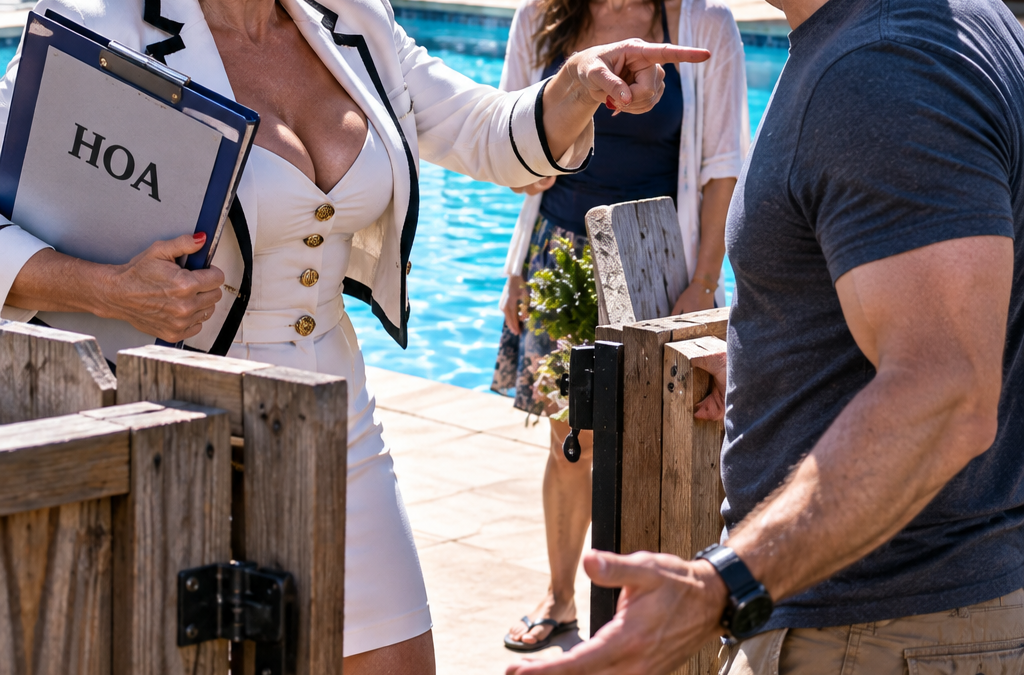
Instead, she looked past me toward the closed side gate leading to my backyard and said, “The community is very excited about finally having access to the new shared amenity.”
I was holding a forty-pound bag of dirt against my hip. For a second, I thought maybe I had misheard her.
“The what?”
“The shared amenity,” she said, nodding toward my backyard.
I set the bag down slowly. “Are you talking about my pool?”
She smiled, pleased that I was catching up. “Yes.”
“My private pool?”
Her smile sharpened. “That depends on interpretation.”
I stared at her.
There are moments in life when a person says something so strange that your mind cannot immediately decide whether to laugh, argue, or ask if they need medical attention.
I chose politeness.
“I think there’s been a misunderstanding,” I said. “The pool is on our property. It’s enclosed by our fence. It belongs to us.”
Karen made a small sound, almost a laugh, but colder. “You really need to read the rule book more carefully before making claims about what you own.”
The word “own” hit me wrong.
I had signed the papers. I had drained accounts, taken on a mortgage, and committed years of my life to paying for that house. I knew exactly what I owned.
“I read the documents before closing,” I said. “There’s no shared access.”
“You may have read the sales documents,” she replied, “but the HOA charter contains broader community-use provisions.”
“That sounds unlikely.”
“It isn’t.”
“The gate is locked.”
“For now.”
I felt my patience thinning. “Karen, no one from the HOA is using my pool.”
Her eyebrows rose as if I had said something childish. “We will discuss it at the appropriate time.”
“No,” I said. “We’re discussing it now. The answer is no.”
She looked at me for a long second, then turned away.
As she walked down the driveway, she called over her shoulder, “New homeowners often misunderstand how things work here.”
I stood there beside the open trunk, watching her leave.
I should have been angrier, but at that point I mostly felt confused. The claim was so ridiculous that it did not feel threatening yet. I went inside, pulled out our property documents, and checked everything again. The pool was ours. Completely ours. No shared access. No public easement. No HOA ownership interest. No community-use clause. Nothing.
I showed my wife.
She frowned at the paperwork. “So what was she talking about?”
“Nothing real.”
“You sure?”
“Absolutely.”
She looked toward the backyard. “That woman gives me a bad feeling.”
I wanted to tell her she was overreacting.
Instead, I said, “Me too.”
Still, life moved on.
I work long hours, usually leaving before sunrise and getting home late in the afternoon. My wife works from home some days, but on office days our house sits empty for most of the day. We settled into a routine. Coffee in the morning. Work. Dinner. Maybe a swim if the evening was warm enough. Slowly, the house started feeling less like a purchase and more like home.
Then little things began happening.
At first, they were easy to dismiss.
One evening, my wife came home before me and called while I was still at work.
“Did you come home for lunch?” she asked.
“No. Why?”
“One of the lounge chairs is right at the edge of the pool.”
“So?”
“I didn’t leave it there.”
I thought about the wind, although the chairs were heavy. I thought maybe I had moved it and forgotten. I told her not to worry.
A few days later, we found wet footprints on the concrete near the shallow end.
Again, we tried to explain it away. Sprinklers. Rainwater from the plants. Maybe a neighbor’s cat had somehow gotten in. None of the explanations felt right, but they were easier than the obvious one.
Then my wife found the towel.
It was bright pink with a floral pattern, draped over the back of one of our patio chairs like it belonged there.
We stood in the backyard staring at it.
All our pool towels were navy blue.
My wife hugged her arms around herself. “Someone has been back here.”
The sentence changed the air around us.
There is a special kind of violation in realizing someone has entered your private space when you were not home. It is not just fear. It is contamination. The backyard no longer felt like a hidden room under the sky. It felt watched. Touched. Claimed by someone who had no right to be there.
I picked up the towel with two fingers like it was evidence from a crime scene.
My wife said, “Do you think it was her?”
I did not want to say yes.
“Yes,” I said.
That night, I ordered a security system.
Not a cheap one. I bought three outdoor cameras with motion alerts and cloud storage. I spent the next Sunday installing them. One covered the driveway. One covered the back patio door. One was mounted high on the corner of the house, angled toward the pool and side gate. I tested the app until I could see every important angle from my phone.
The cameras made me feel better.
For about two days.
The following Tuesday, I was sitting at my desk at work when my phone buzzed.
Motion detected in backyard.
I opened the app expecting to see a bird, a branch, maybe nothing at all.
Instead, I saw Karen.
She was standing inside my backyard.
Inside my fenced, private backyard.
I froze at my desk, one hand on the mouse, the other holding my phone like it had suddenly become something dangerous.
She had unlatched the side gate and walked in as casually as if she were entering a community clubhouse. She wore a cover-up, sunglasses, and sandals. A tote bag hung from her shoulder. She did not look nervous. She did not hurry. She dragged one of my lounge chairs into the sun, placed her bag on another chair, removed her cover-up, and dove into my pool.
My pool.
The water my wife and I had dreamed about.
The backyard we had paid extra to have.
The privacy we had purchased because we were tired of sharing walls and noise and space with strangers.
Karen swam laps for twenty minutes.
I watched every second in disbelief.
Then she climbed out, walked to our towel rack, took one of our navy blue towels, dried herself off, and dropped it in a wet pile on the concrete before leaving through the gate.
I remember sitting there after the video ended, staring at my phone while the sounds of the office continued around me. Keyboards clicking. Someone laughing near the printer. A forklift beeping faintly from the warehouse floor.
The world had kept moving as if nothing had happened.
But something had happened.
A woman who barely knew me had walked into my private yard and used my pool because she had decided my “no” did not count.
I wanted to leave work immediately and confront her, but I forced myself to wait. Anger makes you sloppy. I needed proof. I needed to know whether this was a one-time act of arrogance or part of a pattern.
It was a pattern.
Wednesday, 1\:03 p.m.
Karen entered through the side gate, swam for fifteen minutes, used our towel, left it on the chair.
Thursday, 12\:58 p.m.
Same routine. This time she brought a bottle of sparkling water and left the empty bottle beside the planter.
Friday, 1\:06 p.m.
She arrived with a book, floated in the shallow end, read for half an hour, then walked out with one of our towels wrapped around her shoulders like she was at a resort.
By Friday afternoon, I was no longer just angry.
I was shaking.
My wife watched the footage that night at the kitchen table. Her face went pale, then red.
“She’s been doing this every day?”
“Yes.”
“While we’re at work?”
“Yes.”
“She’s using our towels?”
“Yes.”
My wife pushed the laptop away like she could not stand looking at it. “This is our home.”
“I know.”
“No, I mean it. This is our home. She doesn’t get to do this.”
There was hurt in her voice that cut deeper than my anger. I could handle being challenged. I could handle legal nonsense, bad neighbors, even HOA stupidity. But seeing my wife feel unsafe in the place we had bought for peace made something harden inside me.
“I’ll handle it,” I said.
“How?”
“I’m going to tell her we have video. Then I’m going to tell her if she steps through that gate again, I’m calling the police.”
My wife looked at me for a long time. “Do not let her twist this.”
“I won’t.”
The next morning, I saw Karen walking her little dog down the sidewalk. She held a coffee cup in one hand and her phone in the other, pausing occasionally to examine lawns like a bored inspector searching for meaning.
I stepped outside.
“Karen.”
She turned with a polite smile that vanished when she saw my expression. “Yes?”
“We need to talk.”
“If this is about your yard waste bins, I was planning to—”
“It’s about you trespassing in my backyard.”
For the first time, something flickered in her face.
Not guilt.
Calculation.
“I don’t know what you mean.”
“I have video.”
Her mouth tightened.
“High-definition video,” I said. “Several days of it. You opening my gate. You entering my yard. You swimming in my pool. You using our towels. You leaving through the gate afterward.”
She took a slow sip of coffee.
I expected denial. Maybe embarrassment. Maybe a fake apology.
Instead, she lowered the cup and said, “Then you understand this is not trespassing.”
I stared at her. “Excuse me?”
She reached into her pocket, pulled out her phone, and opened a document. “The HOA charter is very clear about maintaining visual community features.”
I almost laughed. “Do not do this.”
She raised her voice slightly and began reading from the screen. The section she quoted was written in the vague, bloated language of old neighborhood documents. It mentioned that homeowners were required to maintain “the high aesthetic quality of prominent landscaping and visual water features for the visual enjoyment of the community.”
When she finished, she looked at me triumphantly.
I waited.
“That’s it?” I asked.
“That is the applicable provision.”
“My pool is behind a six-foot privacy fence.”
“But the blue reflection can be seen through the gaps in the boards from certain angles.”
I looked around, hoping someone else had heard her say that.
She continued, “Because the water feature enhances the neighborhood aesthetic, it qualifies as a community visual asset.”
“A community visual asset.”
“Yes.”
“And because someone can see a tiny reflection through my fence, you think you can open my gate and swim in my pool?”
“As president, I have authority to interpret the bylaws.”
“No, you don’t.”
“I do.”
“You have authority to trespass?”
“I have authority to inspect and enjoy shared amenities.”
“It is not shared.”
“It has been designated as such.”
“By who?”
“The board.”
“When?”
“The matter has been discussed.”
That was when I understood she did not just believe she could win.
She believed she had already won.
I stepped closer, keeping my voice low. “Listen carefully. If you enter my backyard again, I will call the police. Not the HOA. Not the board. The police.”
Her expression hardened. “If you deny access to a designated community asset, I will issue daily maximum fines against your property.”
I felt my jaw tighten.
“And if you refuse to pay,” she added, “the HOA can pursue a lien.”
For a moment, all I could hear was the blood rushing in my ears.
She was threatening my house.
Over my pool.
Over water behind a fence on land I owned.
“You’re insane,” I said.
Her smile returned. “No. I am informed.”
I turned to walk away, but she called after me.
“The board will be coming next Friday at two o’clock for documentation.”
I stopped.
“What documentation?”
“A promotional update for the neighborhood website. We need professional photos of the water feature. We will also test water quality.”
“By swimming in it?”
“If necessary.”
I looked back at her.
She stood on the sidewalk holding her coffee, perfectly calm, her small dog sniffing at a mailbox as if this were all normal.
“You are not bringing the board into my backyard.”
“If you lock the gate or obstruct entry,” she said, “that will be considered deliberate restriction of a community asset.”
I had many things I wanted to say.
None of them would have helped.
So I walked inside.
My wife was waiting near the window. “What happened?”
“She’s coming Friday with the board.”
My wife closed her eyes. “You’re kidding.”
“No.”
“She can’t do that.”
“I know.”
“So what do we do?”
That question followed me for the rest of the day.
The obvious answer was to call a lawyer. And I considered it. I could have paid someone to send a letter. I could have filed a police report with the footage. I could have begun the slow, expensive process of proving something that should not have needed proof in the first place.
But HOA disputes have a way of becoming mud pits. Even when you are right, they drag you in. Fines. Hearings. Letters. Threats. Meetings full of people pretending nonsense deserves debate because it has been printed on letterhead.
I did not want a year-long fight.
I wanted an ending.
That night, I sat at the kitchen table with my laptop open and read the bylaw Karen had cited. Then I read it again. Then a third time.
Maintain the high aesthetic quality of visual water features.
The phrase was ridiculous. Poorly written. Vague enough that a determined bully could twist it, but also specific enough to give me an idea.
A very simple idea.
Karen wanted me to maintain the visual quality of the water feature.
She wanted photos.
She wanted dramatic blue water for the neighborhood website.
Fine.
I would give her exactly what she asked for.
My wife came into the kitchen as I was drafting the email.
“What are you doing?”
“Complying.”
She leaned over my shoulder. “That tone worries me.”
“It should.”
I wrote carefully. Politely. Professionally.
I apologized for my previous misunderstanding of the HOA’s position. I said that after reviewing the bylaw, I understood the importance of maintaining the visual appeal of the water feature. I said I looked forward to hosting the board on Friday afternoon for their planned photo session.
Then I added the sentence that mattered.
I promised that I would treat the pool beforehand so the water would look especially vibrant and beautiful for the community website.
Before sending it, I showed my wife.
She read it twice.
“What are you planning?”
“Nothing illegal.”
“That is not an answer.”
“It’s the only answer I should give right now.”
She studied my face, then looked back at the email. “Is anyone going to get hurt?”
“No.”
“Are you sure?”
“Yes.”
“Then send it.”
Karen replied five minutes later.
Glad you finally understood the rules. See you Friday at 2 p.m.
I read that sentence and smiled for the first time in days.
The next afternoon, during my lunch break, I drove across town past the regular neighborhood pool stores and went to a commercial pool supply warehouse. It was the kind of place that sold chemicals and equipment for hotels, city pools, gyms, and water parks. Everything was larger, stronger, and more serious than what homeowners usually bought.
The employee behind the counter looked up. “What can I do for you?”
“I need your strongest dark blue pool dye.”
He raised an eyebrow. “How big is the pool?”
“Residential.”
His eyebrow climbed higher. “And you want commercial dye?”
“I have a very specific landscaping project.”
“What are you trying to do?”
“Make the water look as blue as physically possible.”
He shrugged the way employees shrug when they have decided the customer is strange but not their problem. A few minutes later, he returned from the back with a heavy plastic jug filled with the darkest liquid I had ever seen. It looked almost black until the light hit it, and then it flashed deep blue.
At the car, I read the label carefully.
The product was legal. Designed for swimming pools. Environmentally safe when used properly. Safe for swimmers after dilution.
But the instructions were clear: pour into pool water and allow the circulation system to run for a minimum of twenty-four hours before swimming. If not fully diluted, the concentrated dye could stain skin, fabric, porous surfaces, and anything else it touched.
I read that section three times.
There it was.
The entire plan depended on one thing: Karen ignoring a clear warning.
I already knew she would.
That was the ugly brilliance of it. I did not have to trick her into doing something she would not normally do. I only had to place a visible boundary in front of her and let her be herself.
Friday arrived hot, bright, and still.
I took the afternoon off work. My wife decided she wanted no part of the actual event and went to her sister’s house, though she made me promise to call her the second it was over.
Before she left, she touched my arm.
“Be careful.”
“I will.”
“I mean it. She’s not rational.”
“I know.”
“That’s what scares me.”
After she left, I closed the blinds at the front of the house and made everything look empty. Then, at exactly one o’clock, one hour before the board was scheduled to arrive, I went into the backyard.
The pool looked peaceful.
For a moment, I felt a pang of sadness. This place had been our sanctuary for such a short time before Karen poisoned it with her entitlement. I hated that my own backyard had become a stage for a confrontation I never wanted.
Then I remembered my wife’s face when she saw that strange towel.
I remembered Karen’s voice saying community asset.
I turned off the circulation pump.
The water went perfectly still.
I opened the jug.
The dye inside was thick and dark, almost syrupy. I carried it to the deep end and poured it into the water. Because the pump was off, the dye did not circulate the way it was supposed to. It spread slowly, blooming beneath the surface like a cloud of ink. Within minutes, the deep end had turned an astonishing shade of blue, rich and opaque and strangely beautiful.
It looked like a tropical lagoon painted by someone with no sense of restraint.
Then I did the most important part.
I placed the empty dye bottle on the glass patio table in plain sight.
Next to it, I set a large bright yellow warning sign I had printed and laminated.
WARNING\: CHEMICALS DILUTING. DO NOT ENTER WATER FOR 24 HOURS. STRICTLY NO SWIMMING.
I did not hide it.
I did not angle it away.
I placed it where anyone entering the pool area would have to walk directly past it.
Then I went inside, locked the back door, opened the camera feed on my tablet, and waited.
At 1\:45 p.m., the side gate rattled.
Karen was early.
Of course she was.
She entered alone, carrying a large tote bag and a folded tripod. She was wearing a white one-piece swimsuit under a sheer cover-up, sunglasses perched on her head, hair styled like she was arriving at a resort instead of trespassing in a neighbor’s yard.
She paused when she saw the pool.
Even through the camera feed, I could see her reaction. Her eyes widened. The dye had made the water look unreal, a deep sapphire that caught the sunlight and threw it back in shimmering sheets.
She looked delighted.
Not cautious.
Not curious.
Delighted.
She walked toward the patio chairs. To get there, she passed directly beside the glass table.
She stopped.
She looked at the dye bottle.
Then she looked at the yellow sign.
I leaned closer to the tablet.
The camera caught everything. Her face. Her eyes moving across the words. Her slight lean forward as she read. The pause long enough for any reasonable person to understand exactly what the sign meant.
Then she rolled her eyes.
That was the moment I knew, beyond any doubt, that whatever happened next belonged to her.
Karen tossed her cover-up onto one of our chairs. She set up her tripod near the deep end and mounted her phone. She adjusted the angle, checked herself in the screen, smiled, and hit record.
Then she walked to the edge of the deepest, darkest, most concentrated area of the pool and dove straight in.
I sat alone in my kitchen, watching silently.
For ten minutes, Karen performed.
She swam through the thick blue cloud, turning her body gracefully for the camera. She splashed water into the sunlight. She flipped her hair back. She laughed toward her phone. She posed with one arm on the pool edge like she was filming a luxury vacation ad.
She looked completely pleased with herself.
Completely victorious.
Completely unaware of what the dye was doing.
Then she swam to the shallow end and began walking up the steps.
At first, I thought the camera color was glitching.
Then I realized it was not the camera.
It was her.
The water ran off her body, but the blue stayed behind.
Her arms were blue.
Her legs were blue.
Her hands, neck, shoulders, and face were stained a shocking, uneven, aggressive blue. Her expensive white swimsuit had become a blotchy disaster of dark indigo streaks. Her fingernails and toenails looked dipped in ink.
Karen stopped on the second step and looked down at herself.
For one full second, she did not move.
Then she screamed.
It was so loud I heard it through the closed double-pane windows.
She began rubbing her arms frantically, which only smeared the concentrated dye deeper across her skin. She slapped at her legs, looked at her hands, touched her face, and screamed again. She stumbled out of the pool and grabbed a white towel from her bag. The towel turned blue almost instantly. Then she wiped her face with it, making everything worse.
I had expected staining.
I had not expected art.
She looked like someone had tried to turn a human being into a warning label.
And then, with almost perfect timing, the side gate opened again.
Three other HOA board members walked into my backyard holding clipboards and folders.
They stopped dead.
Karen stood in the middle of my pool deck, dripping blue water, clutching a ruined towel, shrieking for help.
I decided that was my cue.
I opened the back door and stepped onto the patio.
I kept my voice calm. Concerned, even.
“Karen,” I said, “are you okay? Why on earth did you get into the water?”
She spun toward me, pointing a bright blue finger at my face.
“What did you do to me?”
The board members stared.
“You poisoned me!” she screamed. “You poisoned me! I’m calling the police!”
I looked at the table, then back at her. “I didn’t poison anyone. I treated the visual water feature like you asked.”
Her mouth opened and closed.
I pointed to the dye bottle and the yellow sign.
“I bought a professional pool treatment to make sure the water looked vibrant for your photo shoot. The instructions clearly say the dye needs twenty-four hours to dilute before anyone swims. That’s why I placed the warning sign right there.”
The older man on the board walked to the table and read the sign.
Then he looked at Karen.
“Karen,” he said slowly, “the warning is right here.”
She was breathing hard, blue water dripping from her elbows onto the concrete.
“He did this on purpose.”
“I followed your instructions,” I said. “You said the pool was a visual community water feature. You said I had to maintain its appearance. I treated it to improve the color for your website photos. I also posted a clear safety warning on my own patio.”
“You knew I would swim!”
“I knew you were told not to.”
The sentence landed hard.
One of the other board members, a woman I had seen at the mailbox cluster a few times, covered her mouth. I could not tell if she was horrified or trying not to laugh.
Karen saw it and became even more furious.
“This is community property!” she shouted.
“No,” I said. “It is my private pool. But even if it were community property, which it is not, you ignored a safety warning on what you claimed was a shared amenity. That seems like a serious liability problem for the HOA.”
The older board member closed his eyes for a moment, as if a headache had just bloomed behind them.
“Karen,” he said, “you need to go home and wash that off before it sets further.”
“It won’t come off!”
“Then you should have read the sign.”
“I did read the sign!”
The second she said it, silence fell.
She seemed to realize too late what she had admitted.
I said nothing.
I did not need to.
The board members looked from Karen, to the sign, to the empty dye bottle, to me, and then back to Karen. The entire story was standing there in blue.
Karen grabbed her tripod, her bag, and the ruined towel. She stormed toward the gate, leaving vivid wet footprints across my clean concrete deck. At the gate, she turned back toward me.
“You’ll regret this.”
I smiled politely. “Please close the gate behind you.”
She slammed it instead.
The three board members remained in my yard, looking deeply uncomfortable.
The older man cleared his throat. “We are very sorry for the disturbance.”
“I appreciate that.”
The woman avoided looking at the blue footprints. “The water does look… very blue.”
“It should photograph well.”
Her mouth twitched.
The older man shot her a warning look, then turned back to me. “We’ll be reviewing the situation.”
“I hope you do,” I said. “Because I have video of her entering my property multiple times before today.”
All three of them went still.
“Multiple times?” the older man asked.
“Yes. Swimming. Using our towels. Leaving through the gate. I also have video of her reading today’s warning sign before diving in.”
No one said anything for a moment.
Then he nodded slowly. “Please preserve that footage.”
“Oh, I have.”
They left a few minutes later.
I spent the next hour pressure-washing blue footprints off my pool deck before they could become permanent. As I worked, my anger drained away and left behind something lighter. Not joy, exactly. Not cruelty. Just relief.
For the first time since the pink towel appeared in our yard, I felt like the backyard belonged to us again.
My wife came home that evening, and I showed her the footage.
She watched Karen read the sign.
She watched Karen roll her eyes.
She watched Karen dive.
She watched Karen emerge blue.
My wife pressed both hands over her mouth, and for a second I thought she was upset.
Then she started laughing so hard she had to sit down.
“She looks like a furious blueberry,” she gasped.
“I was thinking Smurf.”
“She deserves both.”
For the next two and a half weeks, Karen disappeared.
No clipboard walks.
No inspections.
No dramatic sidewalk conversations.
No sudden appearances near our gate.
Neighbors noticed. Of course they did. In a neighborhood like that, the absence of Karen was as obvious as the presence of a storm cloud suddenly gone from the sky.
Rumors spread almost immediately.
Someone had seen her through a window wearing long sleeves in ninety-degree weather. Someone else claimed her hands were still blue. Another neighbor said she had ordered every skin treatment known to mankind and none of them worked quickly enough.
I did not confirm anything.
I did not need to.
The next mandatory HOA meeting was held at the community center, and I made sure to attend.
Karen was there.
She sat at the front table wearing long pants, long sleeves, and a wide-brimmed white hat even though the room was warm and stuffy. She had tried to cover as much skin as possible, but she could not hide her hands or the side of her neck. The blue had faded, but not enough. Her skin still carried a pale, unmistakable tint, like a bruise made of embarrassment.
The meeting began with normal business. Streetlights. Landscaping. A discussion about mailbox repairs. Karen avoided looking at me.
Then a resident raised his hand.
“I have a question about the new shared amenity.”
The room shifted.
Karen froze.
The man continued, “We were told there would be photos for the website. What happened with that?”
There it was.
My moment.
I stood.
Karen’s head snapped toward me.
I kept my voice calm and respectful.
“I can answer that.”
A murmur moved through the room. People turned in their chairs.
I introduced myself, though most people knew who I was by then. I explained that Karen had informed me my private backyard pool had been interpreted as a community visual water feature under an old bylaw. I explained that she had entered my property multiple times without permission. I explained that when I confronted her, she threatened fines and a lien if I restricted access.
Karen slammed her palm on the table. “That is a misrepresentation.”
I looked at her pale blue fingers.
“No,” I said. “It is not.”
The room went quiet.
I reached into my bag and pulled out the documents.
I had gone to a print shop and made full-color still frames from the security footage. Not blurry screenshots. Clear images. Karen entering my gate. Karen swimming in my pool. Karen using our towel. Karen standing beside the warning sign. Karen reading it. Karen diving into the treated water.
And finally, Karen standing on my pool deck, soaked, furious, and blue from head to toe.
I handed the stack to the nearest row.
“Please pass those around.”
The first person looked down and made a noise that was half gasp, half laugh.
Then the photos began moving through the room.
The reaction built like a wave.
Whispers.
Laughter.
Shocked comments.
Someone said, “Oh my God.”
Someone else said, “She actually read the sign.”
A man in the back laughed so hard his wife elbowed him.
Karen sat at the front table trembling with rage.
I almost felt sorry for her.
Almost.
But then I remembered my wife standing beside that strange pink towel, realizing our private space had been invaded. I remembered the threats. The fines. The lien. The way Karen had said community asset like my home was just something waiting for her approval.
So I kept going.
“I want to be very clear,” I said. “My pool is private property. It is inside my fenced backyard. It is listed in my deed. There is no shared access, no easement, and no legal basis for anyone to enter my yard without permission.”
Several residents nodded.
“The bigger issue,” I continued, “is liability. Your HOA president claimed my pool was a community amenity. Then she ignored a large, bright safety warning and entered treated water before it was safe. If she is willing to ignore posted warnings while claiming to act on behalf of this association, that creates a serious risk for every homeowner paying dues here.”
That changed the mood.
Embarrassment was one thing.
Money was another.
People who had been laughing began to look concerned. Someone asked whether insurance could be affected. Someone else asked whether the HOA could be sued if Karen got hurt while trespassing under the supposed authority of the board. A third person asked who had approved classifying my pool as a shared amenity in the first place.
Karen tried to regain control.
“This is being exaggerated,” she said. “The bylaw gives the board interpretive authority over—”
“No,” the older board member interrupted.
Every head turned toward him.
He looked exhausted, but firm. “The bylaw does not authorize entry onto private property.”
Karen stared at him like he had betrayed her.
He continued, “And the board did not formally approve any community use of this homeowner’s pool.”
A murmur spread.
Karen’s face darkened.
“That is not accurate,” she snapped.
The board member folded his hands. “It is accurate.”
The room erupted.
Questions came from every side. How many other rules had been “interpreted” this way? Had Karen issued improper fines? Had she trespassed elsewhere? Could residents challenge past violations? Who was overseeing the president?
For years, apparently, people had tolerated Karen because fighting her was exhausting. She had annoyed them, intimidated them, measured their lawns, criticized their garages, and treated the neighborhood like a kingdom. Many had grumbled privately. Few had challenged her publicly.
But now they were looking at printed proof of what her entitlement had become.
A woman in the second row stood up.
“I move for an emergency vote of no confidence.”
Karen shot to her feet. “You cannot do that.”
Another resident stood. “I second it.”
“This is not on the agenda!” Karen shouted.
The older board member looked at the room, then at Karen. “Given the liability concerns, I think we need to address it.”
The rest happened quickly.
People spoke. Not politely at first, then not politely at all. Stories poured out. Fines that made no sense. Threats over harmless decorations. Inspections nobody had requested. Letters written in a tone that made neighbors feel like tenants in their own homes.
Karen tried to interrupt each person until the room finally shouted her down.
By the end of the meeting, under pressure from the board and half the neighborhood, Karen stepped down as HOA president effective immediately.
She did not apologize.
People like Karen rarely do.
She gathered her papers with shaking hands, refusing to look at anyone. As she passed me on the way out, she stopped just long enough to whisper, “You humiliated me.”
I looked at her faded blue hands.
“No,” I said quietly. “I documented you.”
She left without another word.
The following week, the newly appointed board reviewed the old charter language. They formally removed the vague “visual water feature” provision and sent me a signed written statement confirming what had already been true from the beginning: my pool was private property, not subject to community access, inspection, photography, swimming, enjoyment, interpretation, or any other HOA fantasy.
I framed a copy of that letter.
Not in the living room. I am not that dramatic.
I put it in a folder with the security footage, the photos, the emails, and the original bylaw. I hope I never need any of it again, but I learned something from Karen: peace is easier to keep when proof is close at hand.
After Karen resigned, the neighborhood changed.
Not overnight, but noticeably.
People seemed lighter. Garage doors stayed open longer. Flowerpots appeared on porches. Someone painted their front door a shade of yellow that Karen would have probably tried to classify as emotionally disruptive. Lawns remained cut, houses remained maintained, and somehow the world did not end without her clipboard patrolling the sidewalks.
The new board president came by one evening while I was cleaning the pool filter.
He stood outside the gate and called my name instead of letting himself in.
That alone made him better than Karen.
“I wanted to apologize again,” he said when I opened the gate.
“I appreciate it.”
“We should have stopped her sooner.”
I did not argue.
He sighed. “A lot of us thought she was just overzealous.”
“That word does a lot of work.”
“Yes,” he said. “It does.”
He looked past me toward the pool. The water was clear now, ordinary blue, the kind of blue that belonged to summer evenings instead of HOA warfare.
“For what it’s worth,” he said, “it really is a beautiful pool.”
I smiled. “Thank you.”
“And it is absolutely none of our business.”
“That is also correct.”
He laughed, a little embarrassed, and left.
For a while afterward, my wife and I barely used the pool. That surprised me. I thought once Karen was gone, we would reclaim it instantly, but violation leaves a residue. The first few evenings, we sat outside and listened to the water move, but neither of us got in.
Then one Saturday, my wife came out wearing her swimsuit, carrying two navy blue towels.
She handed one to me.
“It’s ours,” she said.
I looked at the water.
Then at the fence.
Then at her.
“Yes,” I said. “It is.”
We swam for nearly an hour. No performance. No anger. No audience. Just the two of us, floating under the open sky in the privacy we had wanted from the beginning.
At one point, she leaned back against the steps and smiled.
“This,” she said, “was worth it.”
The words were the same ones she had said after we first moved in.
This time, they meant more.
Karen still lives three houses down, though she rarely comes outside when people are around. When she does, she keeps her eyes forward. She no longer carries a clipboard. She no longer measures lawns, at least not where anyone can see her. Her skin eventually returned to normal, but the story stuck longer than the dye ever could.
Neighborhood kids still call her “the blueberry lady” when adults are not supposed to hear.
I pretend not to hear.
I do not know whether Karen learned humility. I doubt it. Some people do not change when consequences find them. They only become quieter because they are outnumbered.
But the neighborhood learned something.
My wife and I learned something too.
A fence is only wood unless you are willing to defend what it means.
A gate is only a gate unless people understand that closed means closed.
And a home is not truly yours just because papers say it is. It becomes yours in the moments when you refuse to let someone else rewrite the boundaries around it.
I still dislike HOAs.
Maybe more than before.
But I also understand now that the real problem is not always the rules. Sometimes the problem is the person who sees rules not as limits, but as weapons. Karen did not care about community standards. She cared about control. The pool was just the thing she chose to control.
She thought vague language gave her permission.
She thought a title gave her power.
She thought my patience meant I would keep backing up forever.
For a while, I tried to reason with her. I tried documents, warnings, conversations, and restraint. None of it worked because she did not want the truth. She wanted obedience.
So in the end, I gave her exactly what she demanded.
A beautiful visual water feature.
A photo opportunity.
A clear warning.
And one final chance to follow the rules she claimed to love so much.
She ignored the warning.
She walked past the evidence.
She dove straight into the consequence.
The pool is quiet tonight as I write this. My wife is inside, the kitchen window glowing behind me. The fence stands tall around the yard. The gate is locked. The water is clear, soft blue under the patio lights.
No one is coming through that gate without permission anymore.
And if Karen ever looks through the fence and sees the reflection of the water, she is welcome to enjoy it from exactly where she belongs.
On the other side.
𝗧𝗛𝗘 𝗘𝗡𝗗
I Let the HOA President Believe My Backyard Belonged to Her for One More Afternoon
She did not sneak into my backyard like a thief.
She walked through my gate like she owned the water, the fence, the chairs, and the peace my wife and I had spent years trying to buy.
By the time she realized I had stopped arguing with her, it was already too late for her to walk away clean.
I never wanted to live in a neighborhood with a homeowner association.
That was one of the first things I told our real estate agent when my wife and I started looking for a house. We were not difficult buyers. We did not need a mansion. We did not need a gated entrance, a clubhouse, or a perfectly manicured subdivision where every mailbox looked like it had been approved by a committee. We had lived long enough in a cramped apartment with thin walls, crowded parking, and neighbors we could hear arguing through the vents.
All we wanted was quiet.
A little privacy.
A house that felt like it belonged to us when we came home at the end of a long day.
And more than anything, we wanted a pool.
That might sound simple, maybe even selfish, but for us it meant something. My wife worked long hybrid hours in a job that drained her emotionally. I worked as a logistics manager, which meant most of my days were spent solving problems that were already late, expensive, and somehow on fire before I even opened my email. We were tired people. Not broken, not miserable, just tired in the way adults become when every week feels like a list of things that must be handled before anything can be enjoyed.
The idea of coming home, closing a gate behind us, and sitting by our own private swimming pool felt like a dream.
No crowded public pool.
No apartment complex noise.
No strangers cannonballing three feet away from my wife while she tried to read.
Just water, shade, and silence.
So when we found the house, I wanted to hate it at first.
It was too perfect, and perfect things usually hide a catch.
The street was quiet. The kitchen was exactly what my wife had been hoping for, with wide counters, deep drawers, and a window over the sink that looked into the backyard. The bedrooms were the right size. The garage had space for my tools. The neighborhood looked clean without feeling sterile. There were old trees along the sidewalks, enough distance between homes to breathe, and the kind of evening stillness that made you lower your voice without thinking.
Then we saw the backyard.
I still remember the way my wife stopped walking when the agent opened the sliding door.
The pool sat behind a solid six-foot wooden privacy fence, wide and blue and beautifully maintained. There was a concrete deck around it, a few built-in planters, and enough room for lounge chairs, a small grill, and the patio table we had been dragging from rental to rental for years. From the outside, no one could see in unless they pressed themselves against the fence and stared through the tiny spaces between the boards.
It felt less like a backyard and more like a hidden room under the sky.
My wife looked at me.
I looked at her.
We were both trying not to smile too hard in front of the agent.
Then came the catch.
“The house is in an HOA,” the agent said.
My stomach sank.
I had heard too many horror stories. People fined for trash cans left out six minutes too long. People ordered to repaint shutters because the shade of white was apparently too emotional for the board. People harassed over lawn height, holiday decorations, flowerpots, fence stains, bird feeders, basketball hoops, and whether a pickup truck counted as a commercial vehicle if it had a company logo on the side.
I did not want that.
I did not want to ask permission to live in a house I was paying for.
The agent must have seen my face, because she quickly added, “It’s a very quiet association. Mostly inactive. They maintain the entrance sign, streetlights, a few common areas. That’s about it.”
My wife squeezed my hand.
I wanted to believe the agent.
More honestly, I wanted the house badly enough to believe her.
So we read the documents. We checked the property lines. We asked questions. We confirmed the pool was entirely within our private deeded property. No easement. No shared access. No community use language. Nothing that suggested anyone but us had any right to step into that backyard.
Against my better instincts, we bought the house.
For the first few weeks, I thought maybe I had been too suspicious.
We moved in slowly, unpacking after work and on weekends. My wife organized the kitchen with the kind of joy that made every cabinet seem like a small victory. I set up shelves in the garage. We bought new pool towels, all navy blue because my wife liked things simple and coordinated. We trimmed shrubs, cleaned windows, and spent our first Sunday evening sitting beside the pool with our feet in the water, eating takeout from paper containers because we were too tired to cook and too happy to care.
“This,” my wife said softly, leaning back in her chair, “was worth it.”
I looked at the fence, the water, the warm light fading across the deck.
“Yeah,” I said. “It was.”
For a little while, it really was.
Then we met Karen.
Her actual name was Karen. I wish I could say I changed it for the story, because it almost sounds too obvious, but I did not. She lived three houses down from us and served as the HOA president, a title she wore like a crown. We heard about her before we really dealt with her.
The guy across the street gave me the first warning while I was unloading boxes from my car.
“You met Karen yet?” he asked.
“Which one is Karen?”
He gave me a look that answered the question before he did. “HOA president. Walks around with a clipboard sometimes.”
“That bad?”
He laughed without humor. “She once measured my grass with a ruler.”
I thought he was exaggerating.
He was not.
Another neighbor later told my wife that Karen had a habit of peeking into open garages because she was convinced half the neighborhood was secretly running illegal businesses. Someone else said she had reported a family for having a visible garden hose coiled beside their house. Another person told me she had once tried to fine a homeowner because their dog barked during “quiet enjoyment hours,” which, as far as anyone could tell, she had invented during the argument.
Still, gossip is gossip.
I told myself that if we kept the grass cut, paid dues on time, brought the trash cans in, and avoided drawing attention, Karen would have no reason to bother us.
That belief lasted less than a month.
It happened on a Saturday morning.
I was standing in the driveway unloading heavy bags of potting soil from the trunk of my car when Karen marched up like she had been summoned by the smell of unauthorized landscaping. She was a woman in her late forties or early fifties, carefully dressed, with sharp eyes and the kind of smile that felt more like a locked door than a greeting. She carried a clipboard against her chest.
“Good morning,” I said, trying to be neighborly.
She did not say welcome to the neighborhood.
She did not introduce herself in any normal way.
Instead, she looked past me toward the closed side gate leading to my backyard and said, “The community is very excited about finally having access to the new shared amenity.”
I was holding a forty-pound bag of dirt against my hip. For a second, I thought maybe I had misheard her.
“The what?”
“The shared amenity,” she said, nodding toward my backyard.
I set the bag down slowly. “Are you talking about my pool?”
She smiled, pleased that I was catching up. “Yes.”
“My private pool?”
Her smile sharpened. “That depends on interpretation.”
I stared at her.
There are moments in life when a person says something so strange that your mind cannot immediately decide whether to laugh, argue, or ask if they need medical attention.
I chose politeness.
“I think there’s been a misunderstanding,” I said. “The pool is on our property. It’s enclosed by our fence. It belongs to us.”
Karen made a small sound, almost a laugh, but colder. “You really need to read the rule book more carefully before making claims about what you own.”
The word “own” hit me wrong.
I had signed the papers. I had drained accounts, taken on a mortgage, and committed years of my life to paying for that house. I knew exactly what I owned.
“I read the documents before closing,” I said. “There’s no shared access.”
“You may have read the sales documents,” she replied, “but the HOA charter contains broader community-use provisions.”
“That sounds unlikely.”
“It isn’t.”
“The gate is locked.”
“For now.”
I felt my patience thinning. “Karen, no one from the HOA is using my pool.”
Her eyebrows rose as if I had said something childish. “We will discuss it at the appropriate time.”
“No,” I said. “We’re discussing it now. The answer is no.”
She looked at me for a long second, then turned away.
As she walked down the driveway, she called over her shoulder, “New homeowners often misunderstand how things work here.”
I stood there beside the open trunk, watching her leave.
I should have been angrier, but at that point I mostly felt confused. The claim was so ridiculous that it did not feel threatening yet. I went inside, pulled out our property documents, and checked everything again. The pool was ours. Completely ours. No shared access. No public easement. No HOA ownership interest. No community-use clause. Nothing.
I showed my wife.
She frowned at the paperwork. “So what was she talking about?”
“Nothing real.”
“You sure?”
“Absolutely.”
She looked toward the backyard. “That woman gives me a bad feeling.”
I wanted to tell her she was overreacting.
Instead, I said, “Me too.”
Still, life moved on.
I work long hours, usually leaving before sunrise and getting home late in the afternoon. My wife works from home some days, but on office days our house sits empty for most of the day. We settled into a routine. Coffee in the morning. Work. Dinner. Maybe a swim if the evening was warm enough. Slowly, the house started feeling less like a purchase and more like home.
Then little things began happening.
At first, they were easy to dismiss.
One evening, my wife came home before me and called while I was still at work.
“Did you come home for lunch?” she asked.
“No. Why?”
“One of the lounge chairs is right at the edge of the pool.”
“So?”
“I didn’t leave it there.”
I thought about the wind, although the chairs were heavy. I thought maybe I had moved it and forgotten. I told her not to worry.
A few days later, we found wet footprints on the concrete near the shallow end.
Again, we tried to explain it away. Sprinklers. Rainwater from the plants. Maybe a neighbor’s cat had somehow gotten in. None of the explanations felt right, but they were easier than the obvious one.
Then my wife found the towel.
It was bright pink with a floral pattern, draped over the back of one of our patio chairs like it belonged there.
We stood in the backyard staring at it.
All our pool towels were navy blue.
My wife hugged her arms around herself. “Someone has been back here.”
The sentence changed the air around us.
There is a special kind of violation in realizing someone has entered your private space when you were not home. It is not just fear. It is contamination. The backyard no longer felt like a hidden room under the sky. It felt watched. Touched. Claimed by someone who had no right to be there.
I picked up the towel with two fingers like it was evidence from a crime scene.
My wife said, “Do you think it was her?”
I did not want to say yes.
“Yes,” I said.
That night, I ordered a security system.
Not a cheap one. I bought three outdoor cameras with motion alerts and cloud storage. I spent the next Sunday installing them. One covered the driveway. One covered the back patio door. One was mounted high on the corner of the house, angled toward the pool and side gate. I tested the app until I could see every important angle from my phone.
The cameras made me feel better.
For about two days.
The following Tuesday, I was sitting at my desk at work when my phone buzzed.
Motion detected in backyard.
I opened the app expecting to see a bird, a branch, maybe nothing at all.
Instead, I saw Karen.
She was standing inside my backyard.
Inside my fenced, private backyard.
I froze at my desk, one hand on the mouse, the other holding my phone like it had suddenly become something dangerous.
She had unlatched the side gate and walked in as casually as if she were entering a community clubhouse. She wore a cover-up, sunglasses, and sandals. A tote bag hung from her shoulder. She did not look nervous. She did not hurry. She dragged one of my lounge chairs into the sun, placed her bag on another chair, removed her cover-up, and dove into my pool.
My pool.
The water my wife and I had dreamed about.
The backyard we had paid extra to have.
The privacy we had purchased because we were tired of sharing walls and noise and space with strangers.
Karen swam laps for twenty minutes.
I watched every second in disbelief.
Then she climbed out, walked to our towel rack, took one of our navy blue towels, dried herself off, and dropped it in a wet pile on the concrete before leaving through the gate.
I remember sitting there after the video ended, staring at my phone while the sounds of the office continued around me. Keyboards clicking. Someone laughing near the printer. A forklift beeping faintly from the warehouse floor.
The world had kept moving as if nothing had happened.
But something had happened.
A woman who barely knew me had walked into my private yard and used my pool because she had decided my “no” did not count.
I wanted to leave work immediately and confront her, but I forced myself to wait. Anger makes you sloppy. I needed proof. I needed to know whether this was a one-time act of arrogance or part of a pattern.
It was a pattern.
Wednesday, 1\:03 p.m.
Karen entered through the side gate, swam for fifteen minutes, used our towel, left it on the chair.
Thursday, 12\:58 p.m.
Same routine. This time she brought a bottle of sparkling water and left the empty bottle beside the planter.
Friday, 1\:06 p.m.
She arrived with a book, floated in the shallow end, read for half an hour, then walked out with one of our towels wrapped around her shoulders like she was at a resort.
By Friday afternoon, I was no longer just angry.
I was shaking.
My wife watched the footage that night at the kitchen table. Her face went pale, then red.
“She’s been doing this every day?”
“Yes.”
“While we’re at work?”
“Yes.”
“She’s using our towels?”
“Yes.”
My wife pushed the laptop away like she could not stand looking at it. “This is our home.”
“I know.”
“No, I mean it. This is our home. She doesn’t get to do this.”
There was hurt in her voice that cut deeper than my anger. I could handle being challenged. I could handle legal nonsense, bad neighbors, even HOA stupidity. But seeing my wife feel unsafe in the place we had bought for peace made something harden inside me.
“I’ll handle it,” I said.
“How?”
“I’m going to tell her we have video. Then I’m going to tell her if she steps through that gate again, I’m calling the police.”
My wife looked at me for a long time. “Do not let her twist this.”
“I won’t.”
The next morning, I saw Karen walking her little dog down the sidewalk. She held a coffee cup in one hand and her phone in the other, pausing occasionally to examine lawns like a bored inspector searching for meaning.
I stepped outside.
“Karen.”
She turned with a polite smile that vanished when she saw my expression. “Yes?”
“We need to talk.”
“If this is about your yard waste bins, I was planning to—”
“It’s about you trespassing in my backyard.”
For the first time, something flickered in her face.
Not guilt.
Calculation.
“I don’t know what you mean.”
“I have video.”
Her mouth tightened.
“High-definition video,” I said. “Several days of it. You opening my gate. You entering my yard. You swimming in my pool. You using our towels. You leaving through the gate afterward.”
She took a slow sip of coffee.
I expected denial. Maybe embarrassment. Maybe a fake apology.
Instead, she lowered the cup and said, “Then you understand this is not trespassing.”
I stared at her. “Excuse me?”
She reached into her pocket, pulled out her phone, and opened a document. “The HOA charter is very clear about maintaining visual community features.”
I almost laughed. “Do not do this.”
She raised her voice slightly and began reading from the screen. The section she quoted was written in the vague, bloated language of old neighborhood documents. It mentioned that homeowners were required to maintain “the high aesthetic quality of prominent landscaping and visual water features for the visual enjoyment of the community.”
When she finished, she looked at me triumphantly.
I waited.
“That’s it?” I asked.
“That is the applicable provision.”
“My pool is behind a six-foot privacy fence.”
“But the blue reflection can be seen through the gaps in the boards from certain angles.”
I looked around, hoping someone else had heard her say that.
She continued, “Because the water feature enhances the neighborhood aesthetic, it qualifies as a community visual asset.”
“A community visual asset.”
“Yes.”
“And because someone can see a tiny reflection through my fence, you think you can open my gate and swim in my pool?”
“As president, I have authority to interpret the bylaws.”
“No, you don’t.”
“I do.”
“You have authority to trespass?”
“I have authority to inspect and enjoy shared amenities.”
“It is not shared.”
“It has been designated as such.”
“By who?”
“The board.”
“When?”
“The matter has been discussed.”
That was when I understood she did not just believe she could win.
She believed she had already won.
I stepped closer, keeping my voice low. “Listen carefully. If you enter my backyard again, I will call the police. Not the HOA. Not the board. The police.”
Her expression hardened. “If you deny access to a designated community asset, I will issue daily maximum fines against your property.”
I felt my jaw tighten.
“And if you refuse to pay,” she added, “the HOA can pursue a lien.”
For a moment, all I could hear was the blood rushing in my ears.
She was threatening my house.
Over my pool.
Over water behind a fence on land I owned.
“You’re insane,” I said.
Her smile returned. “No. I am informed.”
I turned to walk away, but she called after me.
“The board will be coming next Friday at two o’clock for documentation.”
I stopped.
“What documentation?”
“A promotional update for the neighborhood website. We need professional photos of the water feature. We will also test water quality.”
“By swimming in it?”
“If necessary.”
I looked back at her.
She stood on the sidewalk holding her coffee, perfectly calm, her small dog sniffing at a mailbox as if this were all normal.
“You are not bringing the board into my backyard.”
“If you lock the gate or obstruct entry,” she said, “that will be considered deliberate restriction of a community asset.”
I had many things I wanted to say.
None of them would have helped.
So I walked inside.
My wife was waiting near the window. “What happened?”
“She’s coming Friday with the board.”
My wife closed her eyes. “You’re kidding.”
“No.”
“She can’t do that.”
“I know.”
“So what do we do?”
That question followed me for the rest of the day.
The obvious answer was to call a lawyer. And I considered it. I could have paid someone to send a letter. I could have filed a police report with the footage. I could have begun the slow, expensive process of proving something that should not have needed proof in the first place.
But HOA disputes have a way of becoming mud pits. Even when you are right, they drag you in. Fines. Hearings. Letters. Threats. Meetings full of people pretending nonsense deserves debate because it has been printed on letterhead.
I did not want a year-long fight.
I wanted an ending.
That night, I sat at the kitchen table with my laptop open and read the bylaw Karen had cited. Then I read it again. Then a third time.
Maintain the high aesthetic quality of visual water features.
The phrase was ridiculous. Poorly written. Vague enough that a determined bully could twist it, but also specific enough to give me an idea.
A very simple idea.
Karen wanted me to maintain the visual quality of the water feature.
She wanted photos.
She wanted dramatic blue water for the neighborhood website.
Fine.
I would give her exactly what she asked for.
My wife came into the kitchen as I was drafting the email.
“What are you doing?”
“Complying.”
She leaned over my shoulder. “That tone worries me.”
“It should.”
I wrote carefully. Politely. Professionally.
I apologized for my previous misunderstanding of the HOA’s position. I said that after reviewing the bylaw, I understood the importance of maintaining the visual appeal of the water feature. I said I looked forward to hosting the board on Friday afternoon for their planned photo session.
Then I added the sentence that mattered.
I promised that I would treat the pool beforehand so the water would look especially vibrant and beautiful for the community website.
Before sending it, I showed my wife.
She read it twice.
“What are you planning?”
“Nothing illegal.”
“That is not an answer.”
“It’s the only answer I should give right now.”
She studied my face, then looked back at the email. “Is anyone going to get hurt?”
“No.”
“Are you sure?”
“Yes.”
“Then send it.”
Karen replied five minutes later.
Glad you finally understood the rules. See you Friday at 2 p.m.
I read that sentence and smiled for the first time in days.
The next afternoon, during my lunch break, I drove across town past the regular neighborhood pool stores and went to a commercial pool supply warehouse. It was the kind of place that sold chemicals and equipment for hotels, city pools, gyms, and water parks. Everything was larger, stronger, and more serious than what homeowners usually bought.
The employee behind the counter looked up. “What can I do for you?”
“I need your strongest dark blue pool dye.”
He raised an eyebrow. “How big is the pool?”
“Residential.”
His eyebrow climbed higher. “And you want commercial dye?”
“I have a very specific landscaping project.”
“What are you trying to do?”
“Make the water look as blue as physically possible.”
He shrugged the way employees shrug when they have decided the customer is strange but not their problem. A few minutes later, he returned from the back with a heavy plastic jug filled with the darkest liquid I had ever seen. It looked almost black until the light hit it, and then it flashed deep blue.
At the car, I read the label carefully.
The product was legal. Designed for swimming pools. Environmentally safe when used properly. Safe for swimmers after dilution.
But the instructions were clear: pour into pool water and allow the circulation system to run for a minimum of twenty-four hours before swimming. If not fully diluted, the concentrated dye could stain skin, fabric, porous surfaces, and anything else it touched.
I read that section three times.
There it was.
The entire plan depended on one thing: Karen ignoring a clear warning.
I already knew she would.
That was the ugly brilliance of it. I did not have to trick her into doing something she would not normally do. I only had to place a visible boundary in front of her and let her be herself.
Friday arrived hot, bright, and still.
I took the afternoon off work. My wife decided she wanted no part of the actual event and went to her sister’s house, though she made me promise to call her the second it was over.
Before she left, she touched my arm.
“Be careful.”
“I will.”
“I mean it. She’s not rational.”
“I know.”
“That’s what scares me.”
After she left, I closed the blinds at the front of the house and made everything look empty. Then, at exactly one o’clock, one hour before the board was scheduled to arrive, I went into the backyard.
The pool looked peaceful.
For a moment, I felt a pang of sadness. This place had been our sanctuary for such a short time before Karen poisoned it with her entitlement. I hated that my own backyard had become a stage for a confrontation I never wanted.
Then I remembered my wife’s face when she saw that strange towel.
I remembered Karen’s voice saying community asset.
I turned off the circulation pump.
The water went perfectly still.
I opened the jug.
The dye inside was thick and dark, almost syrupy. I carried it to the deep end and poured it into the water. Because the pump was off, the dye did not circulate the way it was supposed to. It spread slowly, blooming beneath the surface like a cloud of ink. Within minutes, the deep end had turned an astonishing shade of blue, rich and opaque and strangely beautiful.
It looked like a tropical lagoon painted by someone with no sense of restraint.
Then I did the most important part.
I placed the empty dye bottle on the glass patio table in plain sight.
Next to it, I set a large bright yellow warning sign I had printed and laminated.
WARNING\: CHEMICALS DILUTING. DO NOT ENTER WATER FOR 24 HOURS. STRICTLY NO SWIMMING.
I did not hide it.
I did not angle it away.
I placed it where anyone entering the pool area would have to walk directly past it.
Then I went inside, locked the back door, opened the camera feed on my tablet, and waited.
At 1\:45 p.m., the side gate rattled.
Karen was early.
Of course she was.
She entered alone, carrying a large tote bag and a folded tripod. She was wearing a white one-piece swimsuit under a sheer cover-up, sunglasses perched on her head, hair styled like she was arriving at a resort instead of trespassing in a neighbor’s yard.
She paused when she saw the pool.
Even through the camera feed, I could see her reaction. Her eyes widened. The dye had made the water look unreal, a deep sapphire that caught the sunlight and threw it back in shimmering sheets.
She looked delighted.
Not cautious.
Not curious.
Delighted.
She walked toward the patio chairs. To get there, she passed directly beside the glass table.
She stopped.
She looked at the dye bottle.
Then she looked at the yellow sign.
I leaned closer to the tablet.
The camera caught everything. Her face. Her eyes moving across the words. Her slight lean forward as she read. The pause long enough for any reasonable person to understand exactly what the sign meant.
Then she rolled her eyes.
That was the moment I knew, beyond any doubt, that whatever happened next belonged to her.
Karen tossed her cover-up onto one of our chairs. She set up her tripod near the deep end and mounted her phone. She adjusted the angle, checked herself in the screen, smiled, and hit record.
Then she walked to the edge of the deepest, darkest, most concentrated area of the pool and dove straight in.
I sat alone in my kitchen, watching silently.
For ten minutes, Karen performed.
She swam through the thick blue cloud, turning her body gracefully for the camera. She splashed water into the sunlight. She flipped her hair back. She laughed toward her phone. She posed with one arm on the pool edge like she was filming a luxury vacation ad.
She looked completely pleased with herself.
Completely victorious.
Completely unaware of what the dye was doing.
Then she swam to the shallow end and began walking up the steps.
At first, I thought the camera color was glitching.
Then I realized it was not the camera.
It was her.
The water ran off her body, but the blue stayed behind.
Her arms were blue.
Her legs were blue.
Her hands, neck, shoulders, and face were stained a shocking, uneven, aggressive blue. Her expensive white swimsuit had become a blotchy disaster of dark indigo streaks. Her fingernails and toenails looked dipped in ink.
Karen stopped on the second step and looked down at herself.
For one full second, she did not move.
Then she screamed.
It was so loud I heard it through the closed double-pane windows.
She began rubbing her arms frantically, which only smeared the concentrated dye deeper across her skin. She slapped at her legs, looked at her hands, touched her face, and screamed again. She stumbled out of the pool and grabbed a white towel from her bag. The towel turned blue almost instantly. Then she wiped her face with it, making everything worse.
I had expected staining.
I had not expected art.
She looked like someone had tried to turn a human being into a warning label.
And then, with almost perfect timing, the side gate opened again.
Three other HOA board members walked into my backyard holding clipboards and folders.
They stopped dead.
Karen stood in the middle of my pool deck, dripping blue water, clutching a ruined towel, shrieking for help.
I decided that was my cue.
I opened the back door and stepped onto the patio.
I kept my voice calm. Concerned, even.
“Karen,” I said, “are you okay? Why on earth did you get into the water?”
She spun toward me, pointing a bright blue finger at my face.
“What did you do to me?”
The board members stared.
“You poisoned me!” she screamed. “You poisoned me! I’m calling the police!”
I looked at the table, then back at her. “I didn’t poison anyone. I treated the visual water feature like you asked.”
Her mouth opened and closed.
I pointed to the dye bottle and the yellow sign.
“I bought a professional pool treatment to make sure the water looked vibrant for your photo shoot. The instructions clearly say the dye needs twenty-four hours to dilute before anyone swims. That’s why I placed the warning sign right there.”
The older man on the board walked to the table and read the sign.
Then he looked at Karen.
“Karen,” he said slowly, “the warning is right here.”
She was breathing hard, blue water dripping from her elbows onto the concrete.
“He did this on purpose.”
“I followed your instructions,” I said. “You said the pool was a visual community water feature. You said I had to maintain its appearance. I treated it to improve the color for your website photos. I also posted a clear safety warning on my own patio.”
“You knew I would swim!”
“I knew you were told not to.”
The sentence landed hard.
One of the other board members, a woman I had seen at the mailbox cluster a few times, covered her mouth. I could not tell if she was horrified or trying not to laugh.
Karen saw it and became even more furious.
“This is community property!” she shouted.
“No,” I said. “It is my private pool. But even if it were community property, which it is not, you ignored a safety warning on what you claimed was a shared amenity. That seems like a serious liability problem for the HOA.”
The older board member closed his eyes for a moment, as if a headache had just bloomed behind them.
“Karen,” he said, “you need to go home and wash that off before it sets further.”
“It won’t come off!”
“Then you should have read the sign.”
“I did read the sign!”
The second she said it, silence fell.
She seemed to realize too late what she had admitted.
I said nothing.
I did not need to.
The board members looked from Karen, to the sign, to the empty dye bottle, to me, and then back to Karen. The entire story was standing there in blue.
Karen grabbed her tripod, her bag, and the ruined towel. She stormed toward the gate, leaving vivid wet footprints across my clean concrete deck. At the gate, she turned back toward me.
“You’ll regret this.”
I smiled politely. “Please close the gate behind you.”
She slammed it instead.
The three board members remained in my yard, looking deeply uncomfortable.
The older man cleared his throat. “We are very sorry for the disturbance.”
“I appreciate that.”
The woman avoided looking at the blue footprints. “The water does look… very blue.”
“It should photograph well.”
Her mouth twitched.
The older man shot her a warning look, then turned back to me. “We’ll be reviewing the situation.”
“I hope you do,” I said. “Because I have video of her entering my property multiple times before today.”
All three of them went still.
“Multiple times?” the older man asked.
“Yes. Swimming. Using our towels. Leaving through the gate. I also have video of her reading today’s warning sign before diving in.”
No one said anything for a moment.
Then he nodded slowly. “Please preserve that footage.”
“Oh, I have.”
They left a few minutes later.
I spent the next hour pressure-washing blue footprints off my pool deck before they could become permanent. As I worked, my anger drained away and left behind something lighter. Not joy, exactly. Not cruelty. Just relief.
For the first time since the pink towel appeared in our yard, I felt like the backyard belonged to us again.
My wife came home that evening, and I showed her the footage.
She watched Karen read the sign.
She watched Karen roll her eyes.
She watched Karen dive.
She watched Karen emerge blue.
My wife pressed both hands over her mouth, and for a second I thought she was upset.
Then she started laughing so hard she had to sit down.
“She looks like a furious blueberry,” she gasped.
“I was thinking Smurf.”
“She deserves both.”
For the next two and a half weeks, Karen disappeared.
No clipboard walks.
No inspections.
No dramatic sidewalk conversations.
No sudden appearances near our gate.
Neighbors noticed. Of course they did. In a neighborhood like that, the absence of Karen was as obvious as the presence of a storm cloud suddenly gone from the sky.
Rumors spread almost immediately.
Someone had seen her through a window wearing long sleeves in ninety-degree weather. Someone else claimed her hands were still blue. Another neighbor said she had ordered every skin treatment known to mankind and none of them worked quickly enough.
I did not confirm anything.
I did not need to.
The next mandatory HOA meeting was held at the community center, and I made sure to attend.
Karen was there.
She sat at the front table wearing long pants, long sleeves, and a wide-brimmed white hat even though the room was warm and stuffy. She had tried to cover as much skin as possible, but she could not hide her hands or the side of her neck. The blue had faded, but not enough. Her skin still carried a pale, unmistakable tint, like a bruise made of embarrassment.
The meeting began with normal business. Streetlights. Landscaping. A discussion about mailbox repairs. Karen avoided looking at me.
Then a resident raised his hand.
“I have a question about the new shared amenity.”
The room shifted.
Karen froze.
The man continued, “We were told there would be photos for the website. What happened with that?”
There it was.
My moment.
I stood.
Karen’s head snapped toward me.
I kept my voice calm and respectful.
“I can answer that.”
A murmur moved through the room. People turned in their chairs.
I introduced myself, though most people knew who I was by then. I explained that Karen had informed me my private backyard pool had been interpreted as a community visual water feature under an old bylaw. I explained that she had entered my property multiple times without permission. I explained that when I confronted her, she threatened fines and a lien if I restricted access.
Karen slammed her palm on the table. “That is a misrepresentation.”
I looked at her pale blue fingers.
“No,” I said. “It is not.”
The room went quiet.
I reached into my bag and pulled out the documents.
I had gone to a print shop and made full-color still frames from the security footage. Not blurry screenshots. Clear images. Karen entering my gate. Karen swimming in my pool. Karen using our towel. Karen standing beside the warning sign. Karen reading it. Karen diving into the treated water.
And finally, Karen standing on my pool deck, soaked, furious, and blue from head to toe.
I handed the stack to the nearest row.
“Please pass those around.”
The first person looked down and made a noise that was half gasp, half laugh.
Then the photos began moving through the room.
The reaction built like a wave.
Whispers.
Laughter.
Shocked comments.
Someone said, “Oh my God.”
Someone else said, “She actually read the sign.”
A man in the back laughed so hard his wife elbowed him.
Karen sat at the front table trembling with rage.
I almost felt sorry for her.
Almost.
But then I remembered my wife standing beside that strange pink towel, realizing our private space had been invaded. I remembered the threats. The fines. The lien. The way Karen had said community asset like my home was just something waiting for her approval.
So I kept going.
“I want to be very clear,” I said. “My pool is private property. It is inside my fenced backyard. It is listed in my deed. There is no shared access, no easement, and no legal basis for anyone to enter my yard without permission.”
Several residents nodded.
“The bigger issue,” I continued, “is liability. Your HOA president claimed my pool was a community amenity. Then she ignored a large, bright safety warning and entered treated water before it was safe. If she is willing to ignore posted warnings while claiming to act on behalf of this association, that creates a serious risk for every homeowner paying dues here.”
That changed the mood.
Embarrassment was one thing.
Money was another.
People who had been laughing began to look concerned. Someone asked whether insurance could be affected. Someone else asked whether the HOA could be sued if Karen got hurt while trespassing under the supposed authority of the board. A third person asked who had approved classifying my pool as a shared amenity in the first place.
Karen tried to regain control.
“This is being exaggerated,” she said. “The bylaw gives the board interpretive authority over—”
“No,” the older board member interrupted.
Every head turned toward him.
He looked exhausted, but firm. “The bylaw does not authorize entry onto private property.”
Karen stared at him like he had betrayed her.
He continued, “And the board did not formally approve any community use of this homeowner’s pool.”
A murmur spread.
Karen’s face darkened.
“That is not accurate,” she snapped.
The board member folded his hands. “It is accurate.”
The room erupted.
Questions came from every side. How many other rules had been “interpreted” this way? Had Karen issued improper fines? Had she trespassed elsewhere? Could residents challenge past violations? Who was overseeing the president?
For years, apparently, people had tolerated Karen because fighting her was exhausting. She had annoyed them, intimidated them, measured their lawns, criticized their garages, and treated the neighborhood like a kingdom. Many had grumbled privately. Few had challenged her publicly.
But now they were looking at printed proof of what her entitlement had become.
A woman in the second row stood up.
“I move for an emergency vote of no confidence.”
Karen shot to her feet. “You cannot do that.”
Another resident stood. “I second it.”
“This is not on the agenda!” Karen shouted.
The older board member looked at the room, then at Karen. “Given the liability concerns, I think we need to address it.”
The rest happened quickly.
People spoke. Not politely at first, then not politely at all. Stories poured out. Fines that made no sense. Threats over harmless decorations. Inspections nobody had requested. Letters written in a tone that made neighbors feel like tenants in their own homes.
Karen tried to interrupt each person until the room finally shouted her down.
By the end of the meeting, under pressure from the board and half the neighborhood, Karen stepped down as HOA president effective immediately.
She did not apologize.
People like Karen rarely do.
She gathered her papers with shaking hands, refusing to look at anyone. As she passed me on the way out, she stopped just long enough to whisper, “You humiliated me.”
I looked at her faded blue hands.
“No,” I said quietly. “I documented you.”
She left without another word.
The following week, the newly appointed board reviewed the old charter language. They formally removed the vague “visual water feature” provision and sent me a signed written statement confirming what had already been true from the beginning: my pool was private property, not subject to community access, inspection, photography, swimming, enjoyment, interpretation, or any other HOA fantasy.
I framed a copy of that letter.
Not in the living room. I am not that dramatic.
I put it in a folder with the security footage, the photos, the emails, and the original bylaw. I hope I never need any of it again, but I learned something from Karen: peace is easier to keep when proof is close at hand.
After Karen resigned, the neighborhood changed.
Not overnight, but noticeably.
People seemed lighter. Garage doors stayed open longer. Flowerpots appeared on porches. Someone painted their front door a shade of yellow that Karen would have probably tried to classify as emotionally disruptive. Lawns remained cut, houses remained maintained, and somehow the world did not end without her clipboard patrolling the sidewalks.
The new board president came by one evening while I was cleaning the pool filter.
He stood outside the gate and called my name instead of letting himself in.
That alone made him better than Karen.
“I wanted to apologize again,” he said when I opened the gate.
“I appreciate it.”
“We should have stopped her sooner.”
I did not argue.
He sighed. “A lot of us thought she was just overzealous.”
“That word does a lot of work.”
“Yes,” he said. “It does.”
He looked past me toward the pool. The water was clear now, ordinary blue, the kind of blue that belonged to summer evenings instead of HOA warfare.
“For what it’s worth,” he said, “it really is a beautiful pool.”
I smiled. “Thank you.”
“And it is absolutely none of our business.”
“That is also correct.”
He laughed, a little embarrassed, and left.
For a while afterward, my wife and I barely used the pool. That surprised me. I thought once Karen was gone, we would reclaim it instantly, but violation leaves a residue. The first few evenings, we sat outside and listened to the water move, but neither of us got in.
Then one Saturday, my wife came out wearing her swimsuit, carrying two navy blue towels.
She handed one to me.
“It’s ours,” she said.
I looked at the water.
Then at the fence.
Then at her.
“Yes,” I said. “It is.”
We swam for nearly an hour. No performance. No anger. No audience. Just the two of us, floating under the open sky in the privacy we had wanted from the beginning.
At one point, she leaned back against the steps and smiled.
“This,” she said, “was worth it.”
The words were the same ones she had said after we first moved in.
This time, they meant more.
Karen still lives three houses down, though she rarely comes outside when people are around. When she does, she keeps her eyes forward. She no longer carries a clipboard. She no longer measures lawns, at least not where anyone can see her. Her skin eventually returned to normal, but the story stuck longer than the dye ever could.
Neighborhood kids still call her “the blueberry lady” when adults are not supposed to hear.
I pretend not to hear.
I do not know whether Karen learned humility. I doubt it. Some people do not change when consequences find them. They only become quieter because they are outnumbered.
But the neighborhood learned something.
My wife and I learned something too.
A fence is only wood unless you are willing to defend what it means.
A gate is only a gate unless people understand that closed means closed.
And a home is not truly yours just because papers say it is. It becomes yours in the moments when you refuse to let someone else rewrite the boundaries around it.
I still dislike HOAs.
Maybe more than before.
But I also understand now that the real problem is not always the rules. Sometimes the problem is the person who sees rules not as limits, but as weapons. Karen did not care about community standards. She cared about control. The pool was just the thing she chose to control.
She thought vague language gave her permission.
She thought a title gave her power.
She thought my patience meant I would keep backing up forever.
For a while, I tried to reason with her. I tried documents, warnings, conversations, and restraint. None of it worked because she did not want the truth. She wanted obedience.
So in the end, I gave her exactly what she demanded.
A beautiful visual water feature.
A photo opportunity.
A clear warning.
And one final chance to follow the rules she claimed to love so much.
She ignored the warning.
She walked past the evidence.
She dove straight into the consequence.
The pool is quiet tonight as I write this. My wife is inside, the kitchen window glowing behind me. The fence stands tall around the yard. The gate is locked. The water is clear, soft blue under the patio lights.
No one is coming through that gate without permission anymore.
And if Karen ever looks through the fence and sees the reflection of the water, she is welcome to enjoy it from exactly where she belongs.
On the other side.