𝗣𝗔𝗥𝗧 𝟮 I Invited Everyone to My Dying K9’s Sixteenth Birthday, but Someone Was Still Missing
𝗣𝗔𝗥𝗧 𝟮
He helped locate missing children.
He tracked violent offenders who fled into thick woodland.
He found discarded evidence along roadside embankments.
He once followed a suspect’s trail through nearly two miles of rain-soaked farmland after other search teams had lost the scent.
But despite all of his success, Oliver’s favorite part of the day was always returning to David.
If the sergeant had been away for a meeting, Oliver greeted him as though he’d been missing for months.
He’d circle once, tail whipping behind him, then press his head against David’s thigh.
David always responded the same way.
He’d lower one hand, tap twice against his leg, and say, “Easy, Ollie. You’re home.”
That was their little ritual.
I’d heard it so many times that I stopped noticing.
After a hard search.
After a training exercise.
At the end of a long patrol.
“Easy, Ollie. You’re home.”
And Oliver would settle beside him.
It didn’t matter how frantic he’d been a moment earlier.
That quiet voice meant the danger was over.
It meant his job was finished.
It meant he could rest.
David used to say every working dog needed a way to understand when the world had become safe again.
For Oliver, those words were that signal.
And for David, I think they were something more.
His wife, Rebecca, once told me that Oliver had changed her husband’s life.
David had always been devoted to his family, but the job had taken a toll on him.
He carried difficult calls home.
Sometimes he became quiet after a long shift.
Sometimes he sat alone on the porch rather than talk about what he’d seen.
But Oliver never needed explanations.
He simply sat beside him.
Rebecca said that on the worst evenings, she’d look through the kitchen window and see David with one arm around the dog’s shoulders.
They’d sit that way for an hour.
Sometimes longer.
No conversation.
No expectations.
Just a tired man and a dog who knew how to stay.
I didn’t know how important those moments would become until David got sick.
It started with headaches.
At first, he blamed exhaustion.
Then his balance became unreliable.
One morning, during an ordinary training exercise, he stumbled and nearly fell.
Oliver immediately stopped working and ran back to him.
David laughed it off.
But Frank insisted he see a doctor.
The diagnosis came several weeks later.
A brain tumor.
Aggressive.
Difficult to treat.
I remember the silence in the station when David told us.
He stood near the coffee machine, holding a paper cup that trembled slightly in his hand.
He tried to make a joke.
“Guess I’m getting some unexpected vacation time.”
Nobody laughed.
I stepped closer.
“Dave.”
He looked at me.
And for the first time since I’d known him, I saw real fear in his eyes.
Not fear of death exactly.
Fear of leaving people behind.
Rebecca.
Emma.
His son, Joshua.
And Oliver.
Especially Oliver.
Because David knew that working dogs don’t understand medical diagnoses.
They understand routines.
They understand presence.
They understand the people who become the center of their world.
And David was Oliver’s entire world.
He underwent treatment.
For a while, it helped.
He spent several months away from duty, but he visited the station whenever he had the strength.
Oliver always seemed to know when he arrived.
Even before we opened the kennel door, the dog would begin pacing.
Then David would appear.
“Hey, handsome.”
Oliver would bark.
His tail would move so fast that his whole body seemed to shake.
David would crouch, even when the effort exhausted him, and wrap his arms around the dog.
“Easy, Ollie.”
Then he’d whisper those familiar words.
“You’re home.”
I watched their reunions with a mixture of happiness and dread.
Every visit seemed a little harder for David.
He grew thinner.
His face became pale.
Sometimes he needed help walking across the training yard.
But Oliver never hesitated.
He approached him gently.
No jumping.
No wild excitement.
Just a quiet muzzle pressed against his hand.
As if he understood that the man who had once run beside him could no longer move the way he used to.
One afternoon, David asked me to meet him outside the station.
He was sitting on a bench beneath an oak tree.
Oliver lay at his feet.
The air smelled of approaching rain.
I sat beside him.
“How are you doing?”
He shrugged.
“Been better.”
I didn’t know what to say.
He looked down at Oliver.
“Jim, I need to ask you something.”
“Anything.”
He was quiet for a moment.
Then he said, “If I don’t make it, I want you to take care of him.”
I looked at the dog.
“Dave—”
“Please.”
His voice was calm, but there was something in it that stopped me.
I nodded.
“Of course.”
“He doesn’t do well with people who rush him.”
I smiled sadly.
“I know.”
“He needs somebody patient.”
“I know that too.”
David scratched Oliver’s ears.
“He’ll work for you. He’s too good not to.”
I looked at him.
“You’re going to be back.”
David smiled.
I could tell he wanted to believe that.
But he didn’t answer.
Instead, he reached into his jacket and handed me Oliver’s training journal.
It was a small black notebook with frayed corners.
David had recorded years of exercises, behavioral observations, and handwritten reminders.
I opened it.
Some pages listed scent-tracking distances and training results.
Others contained notes about Oliver’s temperament.
Gets frustrated when handler rushes.
Needs quiet reassurance after difficult deployments.
Responds well to familiar voice.
And on one page, written in the margin, were five words:
Never confuse aging with failure.
I looked up.
David watched Oliver.
“Someday he’ll slow down,” he said.
I swallowed.
“Yeah.”
“He won’t understand why.”
His voice grew softer.
“When that happens, make sure somebody remembers who he was.”
I closed the notebook.
“You have my word.”
David nodded.
Then he bent forward and pressed his forehead against Oliver’s.
“Good boy.”
The dog rested his muzzle against David’s knee.
I looked away.
Because I knew I was watching two partners preparing for something neither of them knew how to face.
David died four months later.
He was forty-two years old.
Oliver was seven.
Emma was eighteen.
And our little department lost a man none of us could imagine replacing.
The funeral was held on a gray Thursday morning.
Officers from several counties attended.
The church was filled.
Rebecca sat in the front pew with Emma and Joshua.
I stood with the honor guard.
Oliver waited outside with another handler, wearing his black working harness.
After the service, we brought him to the cemetery.
He walked quietly beside me.
When we stopped near the grave, he looked around.
He sniffed the air.
Then he turned toward the road.
I knew what he was doing.
He was searching.
I crouched beside him.
“Hey, buddy.”
He looked at me.
I stroked his head.
“I’m here.”
But he wasn’t looking for me.
He was looking for David.
After the funeral, Oliver became restless.
He waited beside the kennel door.
Whenever someone walked past wearing a uniform, he lifted his head.
If a vehicle sounded like David’s truck, his ears rose.
Sometimes he sat beside the training yard gate for an hour.
Waiting.
I tried taking him for short exercises.
He worked well enough.
His nose was still extraordinary.
His obedience remained strong.
But after every session, he looked toward the place where David used to stand.
I remember one evening when I brought him to my house.
My wife, Margaret, prepared a place for him beside the fireplace.
Oliver ate dinner.
Drank water.
Walked through the living room.
Then sat beside the front door.
I called him.
“Come on, Ollie.”
He didn’t move.
I brought his blanket closer.
He looked at it.
Then returned his attention to the door.
Margaret sat beside me.
“He’s waiting for David, isn’t he?”
I nodded.
She took my hand.
“Poor boy.”
That night, I slept on the living room floor beside him.
Around two in the morning, Oliver finally lay down.
He rested his head against my shoulder.
And I cried quietly into his fur.
Not only because I missed David.
But because I had no way to explain to Oliver that the man he loved was never coming home.
I became Oliver’s handler that summer.
Our first months together were difficult.
Not because he couldn’t work.
He could.
But because I was not David.
I didn’t move like him.
I didn’t sound like him.
I didn’t know every habit.
And sometimes, when Oliver looked at me, I felt as though he was waiting for somebody better.
I made mistakes.
I rushed him during searches.
I gave commands too quickly.
I expected him to adapt to my routines without remembering that his entire world had been taken from him.
Then one evening, after a frustrating training session, I opened David’s journal.
I found the page about Oliver’s need for quiet reassurance.
Beneath the notes, David had written:
When he’s uncertain, don’t make him guess whether you’re angry. Let him know he’s safe.
I stared at those words.
Then I walked into the backyard, where Oliver was lying beside the fence.
I crouched.
“Hey, buddy.”
He lifted his head.
I tapped my leg twice.
“Easy, Ollie.”
His ears rose.
“You’re home.”
He stood.
For a moment, he watched me.
Then he approached and rested his head against my chest.
I wrapped my arms around him.
And for the first time since David died, I felt Oliver relax completely beside me.
I didn’t replace David.
I never could.
But slowly, Oliver made room for me.
And that became enough.
We spent the next four years working together.
He remained an extraordinary tracking dog.
His experience compensated for the few signs of aging that began appearing around his muzzle.
We located missing hikers.
Assisted neighboring departments.
Tracked suspects through woodland and abandoned buildings.
But what I remember most is the way he became part of my family.
Margaret adored him.
Our grandchildren loved visiting him.
And every evening, when I came home exhausted, Oliver settled beside my chair as though he’d always belonged there.
Sometimes I thought about David.
About the bench outside the station.
About the promise I’d made.
Someday he’ll slow down. Make sure somebody remembers who he was.
I wondered whether David would approve of the life we were giving his old partner.
I hoped so.
Oliver retired from police work at eleven.
By then, his hips had begun stiffening, and he no longer recovered quickly after difficult searches.
The department veterinarian recommended retirement before his condition progressed.
I agreed.
There was no argument.
I’d learned enough from David to know that a dog didn’t have to injure himself proving he’d earned his place.
We held a small ceremony.
Frank Lawson gave a speech.
Several officers shared stories.
Oliver received a certificate and a new collar.
Then I brought him home.
Permanently.
He slept beside our fireplace that night.
Margaret brought him an extra blanket.
I sat beside him and scratched his ears.
“No more midnight calls, partner.”
His tail moved.
“No more chasing people through the woods.”
He sighed.
I smiled.
“From now on, you get to be spoiled.”
And he was.
For the next five years, Oliver became the center of our household.
He loved warm blankets.
He loved lying in patches of afternoon sunlight.
He loved watching birds through the kitchen window.
He loved the smell of bacon, although Margaret rarely allowed him anything beyond a tiny piece.
But more than anything, he loved being near us.
If I worked in the garage, he slept beside my toolbox.
If Margaret folded laundry, he followed her into the bedroom.
If our grandchildren visited, he lay on the living room rug and allowed them to build toy houses around him.
He was patient.
Gentle.
And still stubborn enough to pretend he couldn’t hear me whenever I called him away from the kitchen.
Retirement gave him a different kind of happiness.
A quieter one.
The kind David had wanted for him.
But by the time Oliver reached fifteen, age began taking things away faster than we could adjust.
First, he stopped climbing the porch steps.
Then he stopped walking to the mailbox.
His hind legs began slipping.
His appetite became unpredictable.
Some mornings, he looked almost like his old self.
Other mornings, I had to help him stand just to go outside.
Dr. Hannah Collins, our veterinarian, diagnosed advanced arthritis and degenerative spinal disease.
Later, tests revealed progressive heart disease.
Medication helped for a while.
We bought ramps.
We placed rugs over the slippery floors.
I moved his bed closer to the fireplace.
And when standing became difficult, I used a support harness to help him move.
But the decline continued.
By the winter of his sixteenth year, Oliver could no longer rise without assistance.
His breathing was sometimes labored.
He slept most of the day.
And the eyes that had once followed tiny movements across a distant field had grown cloudy.
Dr. Collins visited our house three weeks before his birthday.
She examined him carefully.
Then she sat beside me at the kitchen table.
Margaret stood near the sink, twisting a dish towel between her hands.
“James,” the veterinarian said gently, “I think we need to talk about his remaining time.”
I looked toward Oliver.
He was asleep beside the fireplace.
His breathing sounded heavier than usual.
“How much time?”
Dr. Collins hesitated.
“It’s impossible to predict precisely.”
I waited.
“But we’re likely talking about a short period. His body is very tired.”
I stared at the table.
“Could he make it to his birthday?”
She looked at him.
“Possibly.”
I swallowed.
“He’s turning sixteen.”
She nodded.
“That’s a remarkable age, especially for a dog with his working history.”
I looked down at my hands.
“I wanted to do something for him.”
Dr. Collins leaned forward.
“What did you have in mind?”
I explained that I wanted to invite a few people from the old department.
Not a loud celebration.
Not a crowd.
Just familiar voices.
People who had worked beside him.
People who remembered him before age took away his strength.
She considered it.
“If he’s comfortable, a short, quiet visit could be lovely. Just watch for signs that he’s becoming tired or overwhelmed.”
I nodded.
“I will.”
She looked at me carefully.
“And James?”
“Yeah?”
“Please don’t feel you have to wait for a particular date if he begins suffering.”
My throat tightened.
“I know.”
I did know.
But knowing something and accepting it are very different things.
After she left, I sat beside Oliver’s bed.
He opened his eyes when I touched his head.
“Hey, birthday boy.”
His tail moved faintly.
“Sixteen years.”
I smiled through tears.
“Can you believe that?”
He blinked.
I leaned closer.
“I think we ought to have a party.”
His ears moved.
“Nothing too crazy.”
I laughed softly.
“Your old friends are almost as worn out as you are.”
He rested his muzzle against my hand.
I stroked his cheek.
“One more birthday, buddy.”
My voice broke.
“Let’s make it a good one.”
The morning of Oliver’s birthday began with snow.
Not a storm.
Just a thin, quiet snowfall drifting over our backyard in the pale light before sunrise.
I woke at five-thirty because I’d heard Oliver coughing.
The sound came from his bed beside ours.
I sat up immediately.
“Hey, buddy.”
His head was turned toward the wall.
His breathing sounded rough.
I climbed out of bed and knelt beside him.
“Easy.”
I stroked the fur beneath his chin.
He opened his eyes.
For several seconds, he simply looked at me.
Then his tail shifted against the blanket.
I smiled.
“Happy birthday, old man.”
He blinked.
“Sixteen.”
I scratched his ears.
“You’re officially older than most of the deputies I used to supervise.”
His tail moved again.
I laughed softly.
“Yeah. I know. They weren’t very bright.”
I stayed beside him until his breathing became easier.
Then I helped him drink a little water and settled him more comfortably on his bed.
Margaret appeared in the doorway wearing her bathrobe.
“How’s our birthday boy?”
I looked up.
“Tired.”
She knelt beside us.
“Hey, sweetheart.”
Oliver lifted his eyes toward her.
She kissed his forehead.
“Happy birthday.”
I watched her stroke his cheek.
Then she looked at me.
“Are you sure about today?”
I glanced at Oliver.
“I think so.”
“He’s very weak.”
“I know.”
“We don’t have to invite everybody.”
I looked toward the living room.
The photographs were already arranged.
The cake was in the refrigerator.
I’d spent the previous three days calling people who had known Oliver during his working years.
Some of them hadn’t seen him in years.
I wanted them to remember him.
More importantly, I wanted them to have the chance to tell him goodbye.
But Margaret was right.
Oliver’s comfort mattered more than anything I’d planned.
“We’ll keep it quiet,” I said. “And if he gets tired, we’ll stop.”
She nodded.
“Okay.”
Then she looked down at him.
“You’re in charge today, Oliver.”
He gave a tired sigh.
Margaret smiled.
“As usual.”
By ten o’clock, the house smelled of coffee, fresh biscuits, and the small dog-safe birthday cake Margaret had made from a recipe approved by our veterinarian.
There was no sugar or chocolate.
Just ingredients Oliver could enjoy in moderation if he felt like eating.
I’d decorated the dining room with blue and gold balloons.
On one wall, I hung a collection of photographs from his career.
Oliver as a young dog during training.
Oliver standing beside David Mercer.
Oliver posing with officers after a successful search.
Oliver sleeping in the back of our patrol SUV.
Oliver sitting beside me on the day he retired.
I spent nearly an hour looking through those photographs while I arranged them.
In some, his muzzle was black.
In others, the gray had begun spreading around his nose.
His body had gradually changed.
His eyes had remained the same.
I placed his old working harness over the back of a chair.
Beside it, I set his retirement certificate and a collection of worn tennis balls.
One of those balls had a deep bite mark across the side.
I remembered exactly when he’d made it.
He was six years old, and David had been trying to teach him to release a reward toy after completing a search.
Oliver had decided the toy belonged to him.
David spent nearly twenty minutes negotiating with a dog who weighed seventy pounds and refused to surrender a four-dollar ball.
I remembered David laughing.
“Jim, one day this dog is going to be smarter than all of us.”
I smiled at the memory.
Then I looked toward Oliver.
He lay beside the fireplace, resting against a thick blanket.
His breathing was quiet.
I wished David could see him.
I wished he could see how long Oliver had lived.
How much he’d done.
How deeply he’d become part of our family.
I touched the old tennis ball.
“Your boy made it to sixteen, Dave.”
My voice was quiet.
“I hope you’re somewhere smiling about that.”
The first guest arrived shortly after eleven.
It was Frank Lawson.
He was seventy-four now, with white hair and a walking cane he’d finally agreed to use after years of refusing.
He stepped through the front door carrying a small gift bag.
“Where’s the birthday troublemaker?”
I pointed toward the fireplace.
“Over there.”
Frank’s smile softened.
He crossed the room slowly.
Oliver opened his eyes.
“Hey, old buddy.”
Frank knelt with some difficulty.
“You remember me?”
Oliver sniffed his fingers.
His tail moved.
Frank laughed.
“I’ll take that as a yes.”
He stroked the dog’s head.
“Sixteen years.”
His voice grew quieter.
“I never thought I’d get to see that.”
I stood beside him.
“Neither did I.”
Frank opened the gift bag.
Inside was a new soft rubber ball.
He placed it gently beside Oliver.
“Remember when you stole three of these from my training bag?”
Oliver sniffed it.
Frank chuckled.
“Still not sorry, are you?”
The dog’s tail moved faintly.
Frank wiped his eyes.
“Yeah. Didn’t think so.”
Next came Officer Luis Ramirez, who had served alongside Oliver during several difficult tracking operations.
Luis carried an old photograph showing a much younger version of himself standing knee-deep in mud.
Beside him stood Oliver, completely covered in dirt but looking extremely pleased.
Luis held up the picture.
“Remember this?”
I burst out laughing.
“Black Creek.”
“Four hours in the rain,” Luis said. “And your dog decided to roll in the mud right after we found the suspect.”
I shook my head.
“Oliver enjoyed that search.”
“He enjoyed it. I smelled like a swamp for three days.”
We laughed.
Oliver lifted his head slightly at the sound.
Luis knelt beside him.
“Hey, partner.”
He scratched his ears.
“You gave me some of the best years of my career.”
Oliver rested his muzzle against the man’s hand.
Luis looked away quickly.
I knew that expression.
I’d worn it myself too many times lately.
The other guests arrived over the next hour.
Retired Deputy Sarah Bennett brought a framed photograph from a winter search.
Dispatcher Nora Collins, who had spent years hearing our voices over the radio, brought a recording of Oliver barking during a training demonstration.
Officer Peter Lang arrived with a collection of photographs he’d found in an old station archive.
And former deputy Thomas Keller brought a little blue stuffed bear that Oliver had once stolen from the station’s holiday donation box before the toys were distributed.
We’d replaced the bear with a new one before the drive.
But Oliver had become so attached to the original that nobody could persuade him to give it up.
Thomas had kept it all those years.
“I figured the criminal ought to get his property back,” he said.
Everyone laughed.
I placed the bear beside Oliver.
The old dog sniffed it.
Then rested his chin against one of its faded ears.
For a moment, I saw the younger Oliver.
The dog who used to carry toys through the station with his tail held high.
The dog who believed every ball in the county belonged to him.
The dog who had once been impossible to tire out.
Now he couldn’t lift the bear.
He couldn’t run to greet the people who’d loved him.
He could only lie there while they came to him.
And that realization hurt more than I’d expected.
I turned toward the kitchen so nobody would see my face.
Margaret followed.
“James?”
I opened a cabinet.
Pretended to look for something.
“I’m okay.”
She waited.
I set a mug on the counter.
“He used to knock people over when they came through the door.”
“I remember.”
“He used to get so excited that Frank couldn’t keep him still.”
Margaret stepped closer.
“I remember that too.”
I stared at the mug.
“Now he can’t even get up.”
She rested her hand against my back.
“Then they can come to him.”
I closed my eyes.
Her voice softened.
“He doesn’t need to be who he was ten years ago for them to love him today.”
I looked toward the living room.
Frank was sitting on the rug beside Oliver.
Luis was showing him an old photograph.
Sarah was gently stroking his ears.
They were talking to him as though nothing had changed.
And suddenly, I understood.
I’d invited them because I wanted them to remember the strong dog Oliver had been.
But they hadn’t come to see a police dog perform.
They’d come to see their friend.
I wiped my face.
Then went back into the living room.
We gathered around Oliver for the birthday cake shortly after one.
Margaret placed a tiny portion on a shallow plate.
I knelt beside him.
“All right, birthday boy.”
His ears moved.
“Make a wish.”
Everyone laughed softly.
I held the plate close enough for him to smell it.
He sniffed.
Then gave the smallest lick.
I smiled.
“That’s my boy.”
He took two more little tastes.
Then turned his head away.
I moved the plate.
“Okay. That’s enough.”
Nobody complained.
Nobody encouraged him to eat more.
We simply accepted what he could manage.
Margaret lit a single decorative candle on the cake sitting on the dining room table, safely away from Oliver.
We gathered nearby and sang “Happy Birthday” quietly.
My voice broke halfway through.
I couldn’t finish.
But the others kept singing.
When they reached his name, Oliver opened his eyes.
He looked toward us.
And his tail tapped the blanket once.
That was enough to make three grown police officers start crying.
Afterward, we sat around the living room sharing stories.
Frank told us about Oliver’s first obedience test, when he had performed every exercise perfectly until the final command.
Then he’d stolen the evaluator’s glove and run across the field.
Luis remembered the night Oliver located a suspect hiding inside an empty grain silo.
Sarah told us about a search for a missing elderly woman who had wandered away during a winter storm.
Oliver had tracked her through a wooded ravine and found her sitting beneath a fallen tree.
She was frightened, cold, and barely able to speak.
But when Oliver approached, she put her arms around his neck and refused to release him until the paramedics arrived.
Sarah smiled through her tears.
“She kept calling him her guardian angel.”
I looked down at Oliver.
His eyes were closed.
His breathing was slow.
I wondered whether he remembered any of those people.
Any of those places.
The nights.
The storms.
The frightened voices.
Or whether those memories had faded as his body grew weaker.
Then Frank told a story I’d almost forgotten.
It happened during Oliver’s second year with David.
The two of them had been searching for a missing child near a wooded campground.
The search lasted nearly six hours.
When they finally found the little boy, he was hiding beneath an overturned canoe, frightened but unharmed.
David sat beside him, talking quietly until the rescue team arrived.
Oliver lay with his head on the child’s lap.
When the boy’s father reached them, he fell to his knees and began crying.
Later, David told Frank something that stayed with him.
“He said the best part of the job wasn’t catching bad guys,” Frank recalled.
I looked up.
Frank smiled sadly.
“It was watching somebody get the person they loved back.”
Nobody spoke for several seconds.
Then Luis nodded.
“That sounds like Dave.”
I looked toward the photograph of David and Oliver hanging on the wall.
The young sergeant was smiling.
Oliver stood beside him with his ears high.
I suddenly missed David with an intensity that surprised me.
Nine years.
Nine years since we’d buried him.
And the absence still found new ways to hurt.
The afternoon passed slowly.
We kept the room quiet.
Whenever Oliver looked tired, we stopped talking near him and let him rest.
People took turns sitting beside his bed.
Some told stories.
Some simply touched his shoulder.
At one point, Nora played the old training recording from her phone.
A younger Oliver barked sharply through the tiny speaker.
The sound filled the living room.
Oliver opened his eyes.
His ears moved.
For a moment, he seemed confused.
Then he lowered his head again.
Nora quickly stopped the recording.
“Sorry, handsome.”
I smiled.
“It’s okay.”
She put the phone away.
“I just wanted to hear him like that again.”
I looked at Oliver.
“Me too.”
By late afternoon, the snow had stopped.
The sky was beginning to darken.
Our guests started gathering their coats.
Frank knelt beside Oliver one last time.
“Happy birthday, troublemaker.”
He scratched his ears.
“You gave us a lot of good years.”
Oliver’s tail moved.
Frank leaned closer.
“Thank you for every one of them.”
Luis followed.
Then Sarah.
Then Nora.
Each goodbye was quiet.
Nobody tried to make it dramatic.
But we all understood what might be happening.
We were saying goodbye to a friend we might never see again.
I stood near the front door, thanking everyone for coming.
Frank gripped my shoulder.
“Call me if you need anything.”
I nodded.
“I will.”
He looked toward the fireplace.
“Don’t wait until you can’t handle things, Jim.”
I swallowed.
“Okay.”
Then someone knocked.
I glanced toward the door.
Through the narrow glass panel, I saw a young woman standing on the porch.
She wore a dark blue police uniform beneath a black winter jacket.
A small wooden frame was tucked beneath her arm.
I opened the door.
“Emma?”
She smiled sadly.
“Hi, Uncle Jim.”
Emma Mercer wasn’t my niece by blood.
But I’d known her since she was a little girl.
David had been one of my closest friends.
After he died, our families remained connected.
I attended her high school graduation.
I watched her enter the police academy.
And I’d been there when she received her badge.
But our schedules had kept us apart recently.
She looked exhausted.
“I’m sorry I’m late. We had a call that ran long.”
I shook my head.
“Don’t worry about it.”
She looked past me.
“Is he still awake?”
I nodded.
“On and off.”
She swallowed.
“Can I see him?”
“Of course.”
She stepped inside.
Several officers recognized her immediately.
Frank smiled.
“Well, if it isn’t little Emma Mercer.”
She laughed softly.
“Not so little anymore, Captain.”
He shook his head.
“Your father would be proud.”
Her smile trembled.
“Thank you.”
Then she saw Oliver.
He lay beside the fireplace, his body resting against the thick fleece blanket.
His gray muzzle was turned toward the room.
His eyes were half-closed.
Emma stopped walking.
For a moment, she looked like the frightened teenager I’d seen standing beside her father’s grave nine years earlier.
“Oh, Ollie.”
Her voice cracked.
She knelt beside him.
“Hey, sweetheart.”
Oliver opened his eyes.
His ears moved.
Emma carefully stroked his cheek.
“You remember me?”
He sniffed her fingers.
His tail shifted.
She smiled through tears.
“Hi, handsome.”
I stood behind her.
Watching.
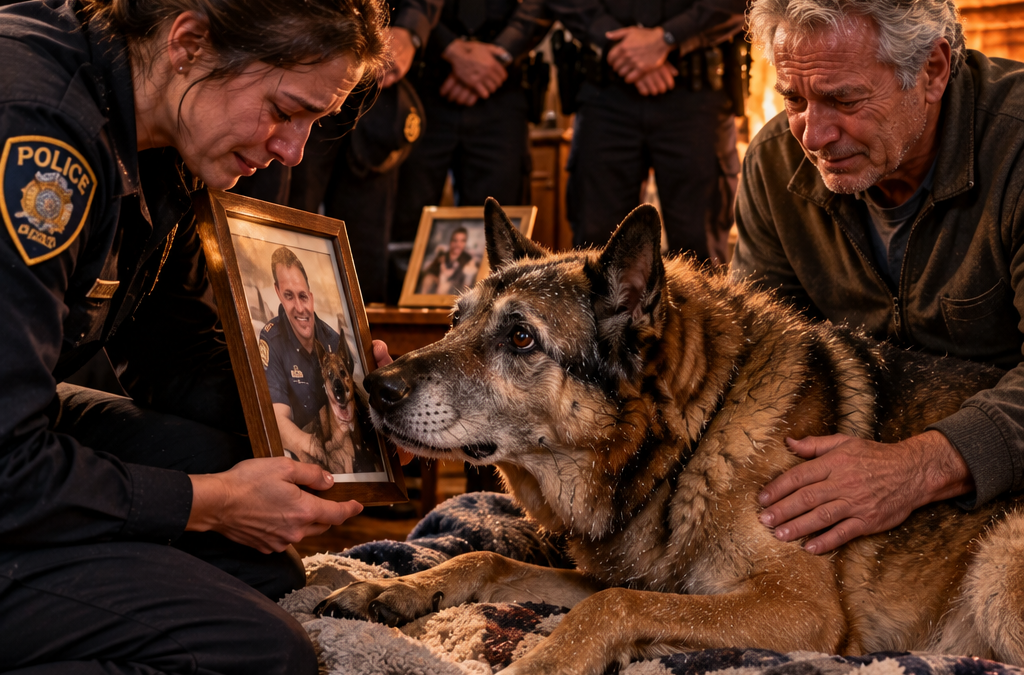
Emma set the wooden frame on the floor.
Then she looked up at me.
“I found something last weekend.”
I frowned.
“What?”
“Mom’s been cleaning out the old house. She gave me a box of Dad’s things.”
Her voice softened.
“There were training notes. Old badges. Pictures. A bunch of stuff from the K9 unit.”
I looked at the frame.
“And this.”
She turned it toward me.
The photograph was slightly faded.
It showed David sitting on the tailgate of his old pickup truck, wearing jeans and a gray sweatshirt.
Oliver stood beside him.
He was young.
Maybe two years old.
His ears were upright, his eyes bright, and his front paws rested against David’s knee.
David had one arm wrapped around the dog’s shoulders.
He was laughing.
Not the polite smile people wear in official photographs.
A real laugh.
The kind that reached his eyes.
I recognized the location immediately.
The training yard behind the old station.
I remembered the afternoon.
We’d been celebrating the end of Oliver’s first full year of service.
Emma had taken pictures with her mother’s camera while the officers argued over who would get the last slice of pizza.
I stared at the photograph.
“I haven’t seen this in years.”
Emma nodded.
“Neither had I.”
She lowered it toward Oliver.
“Dad would’ve wanted you to have it.”
Then she looked at the old dog.
“Hey, Ollie.”
Her voice grew quiet.
“I brought somebody who couldn’t come.”
My chest tightened.
Emma rested the frame gently against a cushion beside him.
Oliver’s eyes moved toward it.
He sniffed the wooden edge.
Emma began crying.
“That’s Dad.”
I watched her.
Then she lowered one hand beside Oliver’s head.
She tapped twice against the blanket.
And whispered:
“Easy, Ollie. You’re home.”
Oliver’s ears lifted.
His eyes opened wider.
He raised his head.
I moved forward instinctively.
“Oliver?”
The old dog looked toward Emma.
Then he pushed against the blanket with his front legs.
His hindquarters didn’t move.
But he kept trying.
“Easy, buddy.”
I knelt beside him, supporting his chest so he wouldn’t strain.
Emma leaned closer.
“Hey, handsome.”
Her voice trembled.
“It’s okay.”
Oliver gave a faint whine.
Then his tail began moving.
Slowly.
Weakly.
But unmistakably.
Frank stopped near the doorway.
Luis turned.
Nobody spoke.
Emma placed her palm against Oliver’s cheek.
“That’s right, Ollie.”
His tail moved again.
She bent closer.
“Dad used to say that to you, didn’t he?”
I could barely see through my tears.
Emma looked at me.
“Mom told me he said it every time they came home from work.”
I nodded.
“He did.”
She smiled through tears.
“I remember hearing it when I was little.”
Oliver pressed his muzzle weakly into her hand.
Then he rested his head against the cushion beside the photograph.
The room was silent.
For the first time all afternoon, I wasn’t thinking about the dog Oliver used to be.
I was thinking about the young sergeant who’d loved him first.
And the years we’d all spent learning how to live without him.
Emma looked at the photograph again.
“There’s something on the back.”
I turned toward her.
She lifted the frame and carefully removed the backing.
A small folded piece of paper was tucked behind the photograph.
The paper was old.
Its corners were yellowed.
Emma unfolded it.
“Dad wrote this.”
Her voice shook.
“I found it with the picture.”
She handed it to me.
I recognized David’s handwriting immediately.
The letters were neat, slightly slanted to the right.
At the top, he’d written:
For Oliver, whenever he gets old.
My throat closed.
I looked at Emma.
She nodded.
“Read it.”
My hands trembled as I opened the paper fully.
David had written only a short note.
Not an official training record.
Not a letter to the department.
Just words from a man who loved his dog.
One day, Ollie won’t be able to run the way he does now.
He’ll get gray around his muzzle, and his legs will slow down.
He might forget commands. He might sleep through things that used to make him jump to attention.
When that day comes, I hope whoever loves him remembers that he never worked for medals or praise.
He worked because he trusted us.
And when he can’t do that anymore, I hope we give him the same loyalty he gave us.
Let him sleep somewhere warm.
Let him take his time.
Tell him he’s a good boy even when he hasn’t done anything at all.
And please, never let him think he has to earn his place beside you.
I stopped reading.
I couldn’t see the words anymore.
Tears blurred the page.
Emma put her hand over mine.
“There’s one more line.”
I looked down.
At the bottom, in slightly smaller handwriting, David had added:
If I’m lucky enough to be there when he’s old, I hope he knows I’ll still be proud of him.
I pressed the paper against my chest.
For nine years, I’d carried the weight of a promise made to a dying friend.
I’d tried to protect Oliver.
I’d tried to give him a good retirement.
I’d tried to make sure he never felt abandoned.
But reading David’s words, I realized that my friend had understood something long before I did.
Oliver’s value had never depended on his ability to work.
It depended on nothing.
He was worthy of love simply because he existed.
Frank sat heavily in a chair.
Luis wiped his eyes.
Sarah moved closer to the fireplace.
Nobody seemed interested in leaving anymore.
Emma placed the photograph beside Oliver again.
Then she rested her forehead gently against his.
“Dad loved you so much, Ollie.”
The old dog’s ears moved.
“He used to talk about you all the time.”
She smiled through tears.
“He told me you were the smartest dog in the county.”
I laughed weakly.
“Dave was a little biased.”
Emma looked at me.
“He said you were stubborn.”
“That part was true.”
She stroked Oliver’s cheek.
“He said you always wanted to do the right thing.”
Oliver sighed.
Emma’s voice softened.
“And he said that someday, when I was old enough, I should find something in my life worth caring about as much as he cared about you.”
I looked at her uniform.
She followed my gaze.
“I think that’s part of why I became an officer.”
Her eyes filled.
“I wanted to understand the work he loved.”
She looked down at Oliver.
“And the dog he never stopped talking about.”
For several minutes, Emma sat beside him.
She told him about graduating from the academy.
About her first patrol shift.
About the mistakes she’d made.
About how nervous she’d been the first time she had to speak over the radio.
Oliver rested quietly, his head against her hand.
His tail moved occasionally.
The others listened.
And somehow, the birthday gathering became something different.
Not a celebration of accomplishments.
Not a farewell to a decorated K9.
But a room full of people remembering the lives that had become connected because of one dog.
Frank eventually stood.
He walked toward Emma and rested a hand on her shoulder.
“Your father would’ve loved seeing this.”
She nodded.
“I know.”
He looked at Oliver.
“Sixteen years, old boy.”
His voice broke.
“David would’ve been proud.”
I looked at the photograph.
Then at the dog lying beside it.
And for the first time that day, I stopped wishing Oliver could stand.
He didn’t need to.
Everyone who mattered had come down to his level.
The guests remained another half hour.
Then, one by one, they said their final goodbyes.
Frank kissed Oliver’s forehead.
Luis rested his hand against the dog’s chest.
Sarah whispered that he had been the finest partner she’d ever worked beside.
Nora thanked him for all the times she’d heard his bark over the radio and known another missing person had been found.
Thomas left the old blue bear beside his blanket.
Emma was the last to rise.
She looked at me.
“Can I leave the photograph here?”
I nodded.
“Please.”
She smiled through tears.
Then she crouched beside Oliver once more.
“Happy birthday, Ollie.”
His eyes moved toward her.
She tapped the blanket twice.
“Easy, handsome.”
Her voice cracked.
“You’re home.”
Oliver’s tail moved once.
Emma pressed a kiss between his ears.
Then she stood.
I walked her to the porch.
The evening air was cold.
Snow clung to the grass.
She pulled her jacket tighter around herself.
“Thank you for inviting me.”
I shook my head.
“I’m glad you came.”
She looked toward the living room window.
“He seems so small now.”
I swallowed.
“Yeah.”
“I remember him pulling Dad across the training yard.”
I smiled.
“So do I.”
Emma’s eyes filled.
“I wish Dad could’ve seen him grow old.”
I looked at her.
Then toward the house.
“I think he would’ve liked the old version even more.”
She nodded.
“Me too.”
Before leaving, Emma hugged me.
A long, tight hug.
The kind she’d given me at her father’s funeral.
Then she whispered, “You kept your promise to him.”
I closed my eyes.
“I tried.”
She stepped back.
“No.”
Her voice was firm.
“You did.”
I watched her drive away.
Then I returned to the living room.
Margaret was clearing cups from the coffee table.
The balloons moved gently in the warm air.
Oliver lay beside the fireplace.
The photograph of David rested near his front paws.
I sat beside him.
“Well, birthday boy.”
His eyes opened.
“That was something, wasn’t it?”
His tail shifted.
I laughed through my tears.
“Sixteen years old, and you still know how to make a room full of cops cry.”
I stroked his ears.
“David would’ve been proud.”
Oliver rested his chin against my hand.
I looked toward the photograph.
For years, I had worried that I couldn’t give Oliver everything David had.
I wasn’t as patient.
I wasn’t as naturally gifted with dogs.
I made mistakes.
Sometimes I raised my voice when I should have remained calm.
Sometimes I was too busy to notice what Oliver needed.
But we’d built our own life together.
He’d accepted me.
Trusted me.
And eventually, loved me.
I realized that loving someone who has lost another person doesn’t mean replacing what was taken away.
It means making room for what remains.
Oliver had loved David.
Then he’d learned to love me.
Neither love diminished the other.
Both had shaped his life.
And now, as he approached the end, I felt grateful that I’d been allowed to share those years with him.
Margaret sat beside me.
“How’s he doing?”
I listened to his breathing.
“Tired.”
She nodded.
“We should let him rest.”
I looked at the cake on the table.
The balloons.
The photographs.
The old toys.
For a moment, I felt foolish.
I’d spent days preparing a party for a dog who could barely lift his head.
I’d wanted to make one final memory.
But Oliver didn’t care about decorations.
He didn’t understand birthdays.
He didn’t know that turning sixteen was an extraordinary achievement for a dog of his size and working history.
He knew only that familiar people had come.
That gentle hands had touched him.
That voices he trusted had surrounded him.
And that he was safe.
I looked at Margaret.
“Thank you for helping me.”
She smiled sadly.
“He’s family, James.”
I nodded.
“Yeah.”
She leaned against me.
“He always has been.”
That night, we moved Oliver’s bed into our bedroom.
The party was over.
The house was quiet.
His breathing had become heavier during the evening, and he seemed too exhausted to respond whenever I touched him.
I helped him settle onto his side.
I placed a rolled blanket behind his back for support.
Then I set the photograph of David on the nightstand.
Margaret brought a glass of water.
“Are you coming to bed?”
I looked at Oliver.
“In a minute.”
She understood.
She kissed my forehead.
“Call me if you need anything.”
I nodded.
Then she turned off the hallway light.
I remained on the floor.
For a while, I simply watched Oliver breathe.
The room was dim.
Moonlight came through the curtains.
The old clock on the dresser ticked softly.
Every few seconds, Oliver’s chest rose.
Then fell.
It was a rhythm I’d known for years.
In patrol vehicles.
In training kennels.
Beside campfires during extended searches.
On our living room rug.
At the foot of my bed.
Sometimes I believed I could identify his breathing in a room full of sleeping dogs.
It was familiar in a way I couldn’t explain.
Like the sound of a person’s footsteps.
Or the way somebody you love clears their throat before speaking.
Small sounds that become part of what home means.
I listened.
And I began to cry.
Because I realized there might not be many nights left when I could hear it.
Maybe this was the last.
Maybe tomorrow, the room would be quiet.
I lowered myself onto the blanket beside him.
My knees ached.
My back protested.
I didn’t care.
I wrapped one arm gently around his shoulders.
He opened his eyes.
“Hey, buddy.”
His tail moved faintly.
I stroked his cheek.
“That was a good birthday.”
He blinked.
“Everybody came.”
I smiled through tears.
“Frank brought you another ball. Like you needed more.”
His ears shifted.
“Luis still blames you for ruining his boots.”
I laughed softly.
“And Emma…”
My voice broke.
“Emma brought David.”
I looked toward the photograph on the nightstand.
“Not the way we wanted.”
I swallowed.
“But she brought him back for a little while.”
Oliver’s breathing was slow.
I pressed my forehead against his.
“You were so loved, buddy.”
My tears fell onto his blanket.
“More than you ever knew.”
For several minutes, I couldn’t speak.
Then I remembered the training journal.
David’s little black notebook.
I’d kept it in the cabinet beside my desk for nine years.
I hadn’t opened it in months.
I rose carefully, walked down the hallway, and found it beneath a stack of old certificates.
The cover was worn.
The pages smelled faintly of paper and dust.
I brought it back to the bedroom and sat beside Oliver.
Then I began turning the pages.
Excellent tracking response.
Needs more patience during release work.
Loves reward ball.
Strong bond developing.
I smiled.
Then I found an entry from Oliver’s second year.
David had written:
Oliver has started checking on me after every difficult search. I think he knows when I’m shaken.
I read it twice.
Then turned the page.
Another note.
He seems happiest when all the people he loves are in one place.
I looked down at Oliver.
“Well.”
My voice trembled.
“You got that today, didn’t you?”
His ears moved.
I stroked his shoulder.
“Everybody who could come.”
Then I found the final entry David had made before becoming too sick to work.
It was dated several weeks after his diagnosis.
The handwriting was shakier than usual.
Worked with Ollie for fifteen minutes today. He was gentle with me. Didn’t pull once.
I swallowed.
Below it, David had written:
I used to think I was teaching him how to be a good partner.
Now I’m starting to think he’s been teaching me how to be one.
I closed the notebook.
Tears ran down my face.
I looked toward Oliver.
He was resting quietly.
And for the first time, I understood why David had trusted me with him.
Not because I was the best handler in the department.
Not because I could give Oliver a perfect life.
But because David believed I would stay.
Even when the dog became old.
Even when caring for him became difficult.
Even when there was nothing left to accomplish except making sure he wasn’t alone.
I lowered myself onto the blanket again.
“Hey, partner.”
His eyes opened.
“I’ve got something to tell you.”
I stroked his gray muzzle.
“I don’t know how much longer we’ve got.”
His breathing remained soft.
“But I’m not going anywhere.”
I kissed his forehead.
“You don’t have to get up tomorrow.”
My voice shook.
“You don’t have to eat your cake. You don’t have to chase a ball. You don’t have to prove you’re still the dog you used to be.”
I rested my forehead against his.
“You already gave us everything.”
He sighed.
I closed my eyes.
“And if you’re tired…”
The words caught in my throat.
I tried again.
“If you’re tired, buddy, it’s okay.”
I held him gently.
“You can rest.”
For a long time, we lay there together.
I listened to his breathing.
Sometimes it became uneven.
Then steadied.
Every time it changed, fear gripped my chest.
I wanted to call the veterinarian.
I wanted to ask whether there was something more we could do.
But Oliver remained calm.
He wasn’t struggling or crying.
He rested against me, occasionally opening his eyes when I spoke.
Dr. Collins had helped us make a comfort-care plan, and I knew what signs would mean he needed immediate medical help.
I kept my phone beside me.
And I stayed.
Around two in the morning, Margaret woke and found us on the floor.
She knelt beside Oliver.
“How is he?”
I shook my head.
“Very tired.”
She stroked his ears.
He opened his eyes.
“Hey, sweetheart,” she whispered.
His tail moved faintly.
Margaret’s face crumpled.
“Oh, Oliver.”
She kissed his forehead.
Then she lay down on the other side of him.
For a while, the three of us remained together.
Two aging people and an old police dog who had somehow become the center of our home.
Margaret reached across Oliver and took my hand.
“You remember when we brought him home?”
I smiled through tears.
“He wouldn’t stop watching the driveway.”
She nodded.
“He kept looking for David.”
I looked at Oliver.
“He did that for weeks.”
Margaret stroked his shoulder.
“And then one night, he came into our bedroom and lay beside your side of the bed.”
I nodded.
“I remember.”
She smiled sadly.
“I think that was when he decided you were his person too.”
I looked down at the old dog.
His muzzle rested against my wrist.
“I never wanted him to forget David.”
Margaret squeezed my hand.
“He didn’t have to forget him to love you.”
I closed my eyes.
There it was again.
A truth I’d spent years slowly learning.
Love doesn’t need an empty place before it can enter.
Sometimes it simply makes room.
Around four in the morning, Oliver stirred.
His breathing changed.
I lifted my head.
“Buddy?”
He opened his eyes.
I touched his cheek.
“Hey.”
He looked toward me.
Then toward the nightstand.
I followed his gaze.
The photograph of David stood beneath the small bedside lamp.
I couldn’t know what Oliver was looking at.
Maybe the light.
Maybe the movement of my hand.
Maybe nothing in particular.
But I found myself reaching for the photograph anyway.
I placed it on the floor beside us.
David’s younger face smiled from behind the glass.
I looked at it.
“Hey, Dave.”
My voice broke.
“Your boy turned sixteen.”
I laughed weakly.
“Can you believe that?”
Oliver’s tail moved.
I stroked his ears.
“He had a good day.”
I paused.
“We all did.”
Then I remembered David’s voice.
The way he used to kneel beside Oliver after difficult searches.
The two taps against his leg.
The quiet reassurance.
Easy, Ollie. You’re home.
I placed my hand against the blanket.
Tapped twice.
Oliver’s ears moved.
I leaned closer.
“Easy, Ollie.”
My voice cracked.
“You’re home.”
His body relaxed.
He gave a long, tired sigh.
Then rested his muzzle against my forearm.
I held him.
And cried.
Because after all those years, after every search, every loss, every hard night, those words still meant the same thing.
The work was finished.
The danger was over.
He was safe.
Just before sunrise, Oliver’s breathing became slower.
I noticed immediately.
I had been listening for hours.
There were longer pauses between breaths.
His body seemed very still.
I whispered his name.
“Oliver?”
His eyes opened a little.
I stroked his cheek.
“I’m here.”
Margaret woke beside us.
She sat up.
“James?”
I looked at her.
She saw my face.
And understood.
We moved closer to Oliver.
I rested one hand against his chest.
Margaret stroked his back.
I whispered every word I could think of.
“You’re a good boy.”
His breathing was quiet.
“The best boy.”
I kissed his forehead.
“Thank you for taking care of us.”
My tears fell.
“Thank you for trusting me.”
For one brief moment, his eyes met mine.
I smiled through the pain.
“David would’ve been so proud of you.”
His ears shifted faintly.
Then his breathing slowed again.
I bent close.
“Good work, partner.”
My voice broke.
“You’re home.”
Oliver gave one final, peaceful breath.
And then he was still.
For several seconds, I didn’t understand.
I kept my hand against his chest.
Waiting.
Listening.
Begging silently for the familiar rhythm to return.
But it didn’t.
Margaret began crying.
I whispered his name again.
“Oliver?”
Nothing.
I pressed my forehead against his.
And the truth finally reached me.
My old partner was gone.
The dog who had run through snowstorms and dark forests.
The dog who had worked beside two men who loved him.
The dog who had survived injuries, retirement, old age, and the loss of his first handler.
The dog who had turned sixteen surrounded by friends only hours earlier.
He was gone.
I held him for a long time.
I didn’t know how to let go.
Margaret called Dr. Collins, who guided us through what to do next and later came to confirm his passing.
But those first moments belonged only to us.
I sat with Oliver’s head in my lap.
The photograph of David rested beside his blanket.
And for the first time in fifteen years, I could no longer hear the breathing that had become one of the most familiar sounds in my life.
I had known that silence was coming.
I’d spent weeks preparing for it.
But nothing could make it easier.
It felt as though a part of the house had stopped breathing too.
We held a small memorial for Oliver the following week.
Not a formal police ceremony.
Just family, friends, and several officers who had loved him.
We gathered beneath the large oak tree in our backyard.
It was where Oliver used to sleep during summer afternoons.
Frank came with his cane.
Luis brought the muddy photograph from Black Creek.
Nora brought a copy of Oliver’s retirement certificate.
And Emma arrived carrying her father’s old training journal.
She had asked to borrow it for a few days.
I gave it to her without hesitation.
At the memorial, she stood beside me holding the notebook.
“I’ve been reading Dad’s notes,” she said.
I smiled sadly.
“He wrote everything down.”
She nodded.
“Even the ridiculous stuff.”
I laughed.
“Especially the ridiculous stuff.”
Emma looked toward Oliver’s memorial stone.
Then she opened the journal to a page near the end.
“I found something I wanted to read.”
Everyone grew quiet.
She took a breath.
“My father wrote this before he got sick.”
Her voice trembled.
“If I do my job right, Oliver will spend his working years learning how to protect people.”
She paused.
“But if we’re lucky, he’ll spend his older years learning that he doesn’t have to.”
Emma wiped her eyes.
“I hope whoever loves him someday understands that his greatest reward should be a quiet place to sleep, a warm hand to rest against, and somebody who stays.”
She closed the notebook.
For several moments, nobody spoke.
Then Frank lowered his head.
Luis wiped his eyes.
Margaret took my hand.
And I looked at the little stone beneath the oak.
We had chosen a simple inscription.
OLIVER
FAITHFUL K9 PARTNER
BELOVED FAMILY
2010–2026
ALWAYS HOME.
I stared at the words.
Sixteen years.
Such a short space for a life that had contained so much.
After the memorial, Emma and I sat alone beneath the tree.
She was still holding the photograph of her father and Oliver.
“I used to be angry,” she said quietly.
I looked at her.
“About your dad?”
She nodded.
“After he died, I couldn’t understand why he spent so much time working.”
I waited.
“He missed dinners. School events. Birthdays.”
Her eyes filled.
“And then he got sick, and suddenly there wasn’t any more time.”
I put my hand over hers.
“I’m sorry, Emma.”
She shook her head.
“I know he loved us. I always knew that.”
She looked at the photograph.
“But I used to think the job took him away from us.”
I didn’t know what to say.
She continued.
“Then I read his notes about Oliver.”
Her voice softened.
“He wrote about the people they found. How scared they were. How relieved their families looked.”
She swallowed.
“I started understanding why the work mattered to him.”
I looked toward the memorial stone.
Emma smiled faintly.
“And then I remembered something.”
“What?”
“One night, when I was little, I asked Dad why he cared so much about Oliver.”
I turned toward her.
“What did he say?”
She looked at me.
“He said, ‘Because someday he’ll be old, and somebody will have to love him when he can’t give anything back.'”
My eyes filled.
Emma rested the photograph on her lap.
“He said that was when you found out whether you’d really been a good partner.”
I closed my eyes.
For years, I’d worried about whether I’d fulfilled my promise to David.
Whether I’d given Oliver enough.
Whether I’d done the right things.
But hearing Emma speak, I realized that David had never asked me to be perfect.
He’d asked me to stay.
And I had.
Through the easy years.
Through the difficult ones.
Through retirement.
Through sickness.
Until the very end.
I looked at Emma.
“Your father taught me more than he ever knew.”
She smiled through her tears.
“I think he knew.”
We sat there quietly.
The wind moved through the oak leaves.
Then Emma leaned toward me.
“Uncle Jim?”
“Yeah?”
“Do you think Oliver remembered Dad?”
I looked at the photograph.
Then toward the house.
I remembered the two taps against the blanket.
The familiar words.
The way Oliver’s ears had lifted when Emma spoke.
I couldn’t know exactly what an aging dog’s mind held.
I couldn’t say whether Oliver recognized David’s face in a photograph or simply responded to familiar sounds and people.
But I knew he’d responded to that quiet ritual all his life.
And I knew that the people who loved him had carried David’s memory into his final hours.
“I think some things stay with us longer than we understand,” I said.
Emma nodded.
“Yeah.”
She looked at the stone.
“I think so too.”
In the months after Oliver died, our house changed.
His bed remained beside the fireplace for several weeks.
I couldn’t bring myself to move it.
His old harness hung in the hallway.
The blue stuffed bear sat on a shelf.
And David’s photograph stood beside Oliver’s collar on the mantel.
Sometimes I walked into the living room expecting to see him sleeping.
Sometimes I heard a noise in the hallway and turned, thinking it was the sound of his paws.
Sometimes I woke at night and reached toward the place beside the bed where he’d spent his final years.
Every time, my hand found empty space.
Grief has a strange way of making ordinary silence feel enormous.
But slowly, life continued.
Margaret and I began taking walks again.
We visited our grandchildren.
I returned to my weekly breakfast meetings with retired officers.
And occasionally, Emma stopped by after a shift.
Sometimes we talked about Oliver.
Sometimes we talked about David.
Sometimes we simply sat with coffee and said nothing at all.
One afternoon, several months after the birthday, Emma arrived carrying an envelope.
She handed it to me.
“What’s this?”
She smiled.
“Open it.”
Inside was a photograph.
Not an old one.
A new one.
It showed Emma standing beside a young K9 handler from her department and a Belgian Malinois puppy.
The dog’s ears were much too large for his head.
His expression was intense.
And he was trying to steal the tennis ball attached to the handler’s belt.
I laughed.
“Oh, my God.”
Emma grinned.
“Remind you of anyone?”
I looked at the photograph.
“Unfortunately, yes.”
She sat beside me.
“The department is expanding its K9 program. I’ve been helping with community training events.”
I studied the young dog.
“What’s his name?”
“Cooper.”
I smiled.
“He’s handsome.”
“He’s a nightmare.”
I laughed harder.
“Sounds about right.”
Emma became quiet.
Then she said, “The handler asked me how I knew so much about working dogs.”
I looked at her.
“What did you tell him?”
She smiled sadly.
“I told him my dad taught me some things.”
She glanced toward Oliver’s photograph.
“And an old dog taught me the rest.”
My throat tightened.
I looked at the young puppy.
Then at Oliver’s worn collar.
For a moment, I felt the strange tenderness of watching life move forward.
Oliver was gone.
David was gone.
Nothing would change that.
But the things they’d taught us hadn’t disappeared.
Their patience.
Their courage.
Their devotion.
Those things continued in the lives of people who remembered them.
I placed the photograph beside Oliver’s frame.
Two working dogs.
Two different generations.
One beginning his career.
The other resting after a lifetime of service.
I looked at Emma.
“Take good care of that young one.”
She nodded.
“I will.”
Then she smiled.
“And if he gets old, I’ll make sure somebody remembers who he was.”
I couldn’t speak.
I only reached for her hand.
That evening, after Emma left, I sat beside the fireplace.
Margaret was reading in her chair.
The house was quiet.
I looked at Oliver’s photographs.
The young dog standing beside David.
The proud K9 at his retirement ceremony.
The gray-faced old boy lying on his sixteenth birthday, surrounded by friends.
Three photographs.
Three different versions of the same life.
For so long, I’d thought of Oliver’s birthday as the day we said goodbye.
But now I remembered it differently.
I remembered Frank struggling to kneel beside him.
Luis laughing about his ruined boots.
Nora smiling through tears when she heard an old recording of his bark.
Margaret carefully holding a little plate of birthday cake.
And Emma entering the room with a photograph of the man who had loved Oliver first.
I remembered the old dog’s tail moving.
The way he lifted his head.
The way every person in that room became quiet because they understood how much effort the smallest movement required.
I’d wanted to give Oliver a beautiful final birthday.
Instead, he had given us something I hadn’t expected.
A reminder that love doesn’t become smaller when a body grows weak.
That friendship doesn’t end when working days are over.
And that sometimes, the greatest gift we can give someone at the end of life is not another adventure.
It’s a room full of people who remember.
People who come.
People who sit.
People who stay.
Later that night, I went into the bedroom.
The blankets had been washed.
The floor was clean.
Oliver’s bed was no longer there.
But I could still picture him resting beside us.
His gray muzzle.
His tired eyes.
The soft rise and fall of his chest.
I lay down.
Margaret turned off the light.
For a while, I listened to the quiet.
Then I thought about the final night.
The way I’d held Oliver.
The way he’d relaxed when I tapped the blanket twice.
The way his breathing had slowed as the sun began rising.
I remembered my fear that I would forget that sound.
The familiar rhythm.
The quiet sighs.
The small movements of a dog sleeping peacefully beside the person he trusted.
I closed my eyes.
And for one brief moment, the memory felt so real that I could almost hear him again.
Not struggling.
Not hurting.
Just sleeping.
Safe.
Loved.
Home.
I smiled through the tears that still came sometimes.
“Happy birthday, Ollie,” I whispered into the darkness.
My voice trembled.
“Thank you for letting us have one more.”
Then I thought of David.
The friend I’d lost nine years earlier.
The man who had asked me to take care of his partner.
The man who had written that Oliver deserved love even when he had nothing left to give.
I looked toward the empty space beside the bed.
“I kept my promise, Dave.”
My eyes filled.
“Your boy was never alone.”
And as the house settled into silence, I understood that Oliver’s last birthday hadn’t broken my heart because it was the end of his story.
It had broken my heart because, for one afternoon, everyone who loved him had gathered to show him that his story would never be forgotten.
He had spent his life helping people find their way home.
And when his own journey finally ended, we made sure he was surrounded by the people who had become his.
He didn’t have the strength to stand for us anymore.
So we came down to the floor and stayed beside him.
And that was where my old partner spent the happiest hours of his final day.