𝗙𝗨𝗟𝗟 𝗦𝗧𝗢𝗥𝗬 I Bought a Quiet Piece of Land, but the HOA Next Door Refused to Accept What Was Hidden Behind My Locked Gate
𝗣𝗔𝗥𝗧 𝟮
Because it revealed how completely some of these people had reversed the situation in their minds.
I wasn’t entering their neighborhood and demanding special privileges.
They were entering my property.
Somehow, I was the inconvenience.
I didn’t want to spend every morning standing beside a gravel path arguing with strangers, so I decided to contact the homeowners association.
I found the management company’s phone number on the decorative sign near the neighborhood entrance.
The woman who answered was professional and courteous.
I explained that residents were using a private road across my property and asked whether the association could notify homeowners that the path wasn’t open to public traffic.
She listened patiently.
Then she said something that would become increasingly ironic over the following months.
“Unfortunately, since your property isn’t part of our association, we don’t have authority over what our residents do outside the community.”
I paused.
“So you’re telling me you can’t ask them to stop trespassing?”
“I’m saying we don’t regulate activities outside HOA property.”
“Even when your residents are using somebody else’s private road?”
“I understand your concern, sir. You might consider posting no-trespassing signs.”
I thanked her and ended the call.
When I told my wife, she stared at me.
“They can’t control what their residents do?”
“That’s what she said.”
“But they can tell people what color to paint their fences?”
“Apparently that’s different.”
She shook her head.
“Put up the signs.”
So I did.
That weekend, I went to the hardware store and bought four large NO TRESPASSING signs.
I installed two at the subdivision entrance to the path and two at the eastern road.
I made sure they were visible from approaching vehicles.
Then I bought a heavy chain, installed sturdy posts at the western entrance, and stretched the chain across the gravel.
I attached another sign directly to it.
It wasn’t particularly sophisticated.
But it was unmistakable.
Nobody could honestly claim they didn’t understand what it meant.
I remember stepping back after finishing the installation.
My wife had come down to see the result.
“That should do it,” she said.
I nodded.
“People might be annoyed for a few days, but they’ll get used to taking the regular road.”
For one day, the chain remained in place.
The next afternoon, I found it lying in the gravel.
Somebody had unhooked it.
There was no sign of damage.
They had simply removed the barrier, driven through, and left it on the ground.
I picked it up and reattached it.
The following day, the same thing happened.
Then it happened again.
By the fourth time, I was losing patience.
My wife found me standing in the garage holding the chain.
“What happened?”
“Somebody took it down again.”
She sighed.
“Maybe we need something they can’t just unhook.”
“I was hoping not to turn this into a construction project.”
“Well, apparently somebody else has made that decision for us.”
The fifth incident changed everything.
I came home from work and noticed the chain wasn’t hanging between the posts.
At first, I assumed somebody had unhooked it again.
But when I walked closer, I saw a clean cut through one of the metal links.
Someone had brought a cutting tool specifically to remove my barrier.
I crouched beside the broken chain.
For several seconds, I just stared at it.
That was the moment my frustration became something more serious.
There was no misunderstanding anymore.
Nobody accidentally cuts through a chain.
Nobody mistakes a locked barrier and multiple no-trespassing signs for an invitation.
Somebody had deliberately damaged my property because they believed their convenience mattered more than my rights.
I carried the chain back to the house.
My wife took one look at my face.
“What now?”
“They cut it.”
She looked at the broken link.
Her expression hardened.
“Okay. That’s enough.”
The following weekend, I bought two heavy-duty steel gates.
They weren’t decorative driveway gates.
They were practical agricultural-style gates made from thick steel tubing, designed to withstand weather and regular use.
I installed the first at the entrance nearest the HOA development, securing it between properly anchored posts.
Then I installed the second at the eastern road.
Both gates received heavy-duty padlocks.
Now the gravel path was blocked at both ends.
I stood beside the western gate after finishing the work.
The chain had been an inconvenience.
This was a physical barrier.
If anybody wanted to drive across my land now, they would have to deliberately break through.
For four days, everything was quiet.
No cars.
No honking.
No damaged hardware.
I began to feel hopeful.
Then, on Thursday evening, I found a folded note tucked into my front door.
It wasn’t mailed.
Somebody had physically walked up to our house and left it there.
The message was short and aggressive.
It informed me that I was blocking a road used by the community for more than a decade.
It demanded that I remove the gates immediately.
It threatened legal action if I refused.
And it claimed that my decision was negatively affecting more than one hundred families.
At the bottom, the note was signed simply:
HOA Board Member.
No name.
No contact information.
No explanation of what legal authority this mysterious board member supposedly possessed.
Just a demand.
I read it twice.
Then I laughed.
Not because it was funny.
Because the sheer arrogance was almost difficult to comprehend.
A stranger had entered my property, approached my home, and delivered a threatening note demanding access to land they didn’t own.
I showed it to my wife.
She didn’t laugh.
“That’s creepy.”
“What is?”
“Someone came all the way up to our front door to leave that.”
“Probably because they couldn’t drive through the back anymore.”
“Exactly. They know where we live. And they’re getting angry.”
That took some of the humor out of it.
I crumpled the note and threw it away.
At the time, I didn’t realize how useful it might have been as evidence.
I assumed the threats would remain exactly that.
Threats.
Two mornings later, I learned how wrong I was.
It was Saturday, around ten.
My wife and I were enjoying a slow morning at home when a car horn began sounding from the direction of the western gate.
At first, I thought it was somebody passing on a nearby road.
Then it continued.
Long, angry blasts.
One after another.
My wife looked toward the window.
“Is somebody seriously honking at our gate?”
I listened.
Another blast echoed through the trees.
“Looks that way.”
I pulled on my boots and headed outside.
As I approached the gravel path, I saw an SUV parked directly in front of the gate.
A woman was sitting behind the wheel with one hand pressed against the horn.
The moment she noticed me, she stopped honking, opened the door, and climbed out.
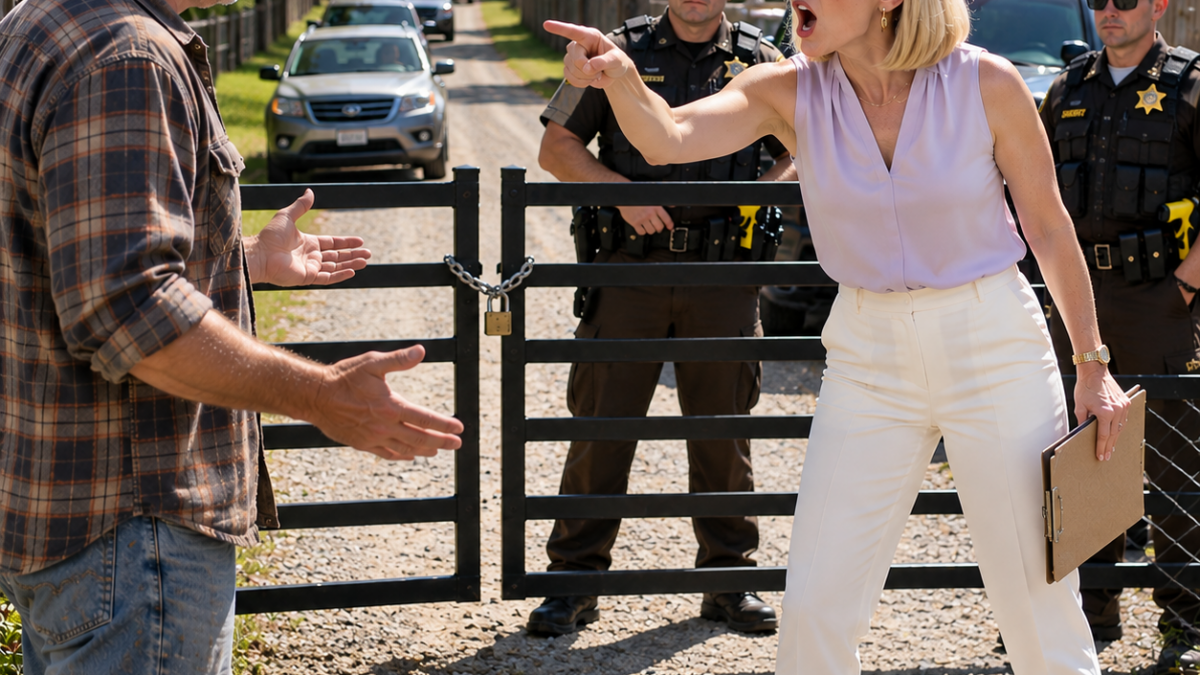
She was dressed neatly, carried herself with an air of authority, and had the furious expression of somebody who expected the world to move aside whenever she raised her voice.
“Are you the property owner?” she demanded.
“Yes.”
“Then you need to open this gate.”
I stopped several feet away.
“Why?”
“Because this is a community access road, and you have no right to block it.”
I took a second to process that.
“Ma’am, this is my property.”
She waved a hand dismissively.
“This road has been used by our neighborhood for more than ten years.”
“That doesn’t make it public.”
“I’m on the HOA board.”
She said those words as though they were supposed to end the conversation.
I waited.
When I didn’t respond, she continued.
“And I’m telling you that you cannot just move in here and shut down an established community access route.”
“I can close a road on my own land.”
“No, you can’t.”
“Yes, I can.”
She stepped closer.
“Do you understand how many families rely on this road?”
“I understand that people have been using it as a shortcut.”
“It’s not just a shortcut.”
“Then what is it?”
“It’s community access.”
I pointed toward the gate.
“That gate is on land described in my deed. I have a survey confirming the boundaries. I pay the property taxes. This path was never dedicated as a public road.”
She folded her arms.
“You can’t just decide that.”
“I didn’t decide it. That’s how the property was legally established.”
She stared at me, apparently expecting me to give in.
When I didn’t, her face reddened.
“Fine. I’m calling the police.”
I nodded.
“Go ahead.”
She seemed surprised.
“You want me to call them?”
“If you believe I’m breaking the law, you’re welcome to call.”
She returned to her SUV and pulled out her phone.
I stayed nearby.
There was no point arguing anymore.
About twenty minutes later, a sheriff’s deputy arrived.
He was younger than I expected, calm, and clearly uninterested in getting drawn into a shouting match.
He spoke with the woman first.
I could see her gesturing toward the gate, the gravel path, and eventually me.
Then he walked over.
“Sir, are you the property owner?”
“Yes.”
“Do you have any documents establishing the property boundary?”
“I do. Give me a minute.”
I went back to the house and retrieved the survey and deed from the folder where I kept our closing documents.
My wife met me near the front door.
“Police?”
“She called them.”
“Because you won’t open your own gate?”
“That’s apparently the emergency.”
My wife looked exhausted.
“Just show them the paperwork.”
I returned and handed everything to the deputy.
He studied the survey, checked the property description, and compared it with the location of the gravel path.
After a minute, he nodded.
“Well, this appears pretty straightforward.”
“That’s what I’ve been saying.”
“The path is on your land.”
“Yes, sir.”
“And you installed the gate?”
“After people repeatedly ignored signs and cut through a chain.”
He looked up.
“They cut the chain?”
“Yes.”
“Did you report it?”
“Not yet.”
“You should.”
He handed the documents back.
Then he walked toward the woman.
I stayed close enough to hear most of the conversation.
“Ma’am,” he said, “I’ve reviewed the property documents. This is private land.”
She immediately protested.
“But we’ve used this road for years.”
“I understand.”
“Then you understand he can’t suddenly block it.”
“That’s not what the documents show.”
Her voice rose.
“People depend on this road.”
“The fact that people have been driving through private property doesn’t automatically give them the right to continue.”
She stared at him.
“So you’re taking his side?”
“I’m explaining what the documents establish.”
“This is ridiculous.”
The deputy remained calm.
“If the HOA believes it has a legal claim, that’s something for an attorney and a civil court to address. But right now, the owner has the right to secure his property.”
She pointed toward the gate.
“And what if someone needs to get through?”
“They can use the public roads.”
She made an exasperated sound.
“This isn’t over.”
The deputy nodded slightly.
“That’s your decision. But I strongly advise you not to damage this man’s gate or enter his property without permission.”
She glared at him.
Then at me.
For one strange moment, I wondered whether she was going to start arguing with the deputy too.
Instead, she climbed back into her SUV, slammed the door, and drove away.
The deputy returned.
“You’ve got a determined neighbor,” he said.
“She’s not even my neighbor. She lives in the subdivision.”
He gave a tired half-smile.
“Well, I’d recommend putting up cameras.”
“Already considering it.”
“And call us if somebody tampers with your gates again.”
I thanked him.
As he drove away, I felt cautiously relieved.
An actual law enforcement officer had explained the situation directly.
Surely that would settle things.
But the woman had made one thing very clear.
She wasn’t interested in being told no.
Within the next week, I installed six security cameras.
Two covered the western gate.
Two covered the eastern gate.
One watched the driveway.
The last covered the rear of the house.
I configured the system to record continuously and send motion alerts to my phone.
I also arranged cloud storage so the footage would survive even if somebody damaged or stole the cameras.
My wife watched me checking the camera angles one evening.
“I hate that we need all this.”
“Me too.”
“We moved out here because we wanted privacy.”
“I know.”
“Now it feels like we’re protecting the house from people we don’t even know.”
I looked toward the tree line.
That bothered me more than I wanted to admit.
Our property was supposed to feel safe.
Instead, I had started checking the windows whenever I heard an unfamiliar engine.
I found myself listening for footsteps outside.
Every trip away from home came with a small but persistent question.
Would everything still be intact when we returned?
The cameras proved those worries weren’t imaginary.
During the following two weeks, I caught people interfering with my gates three separate times.
Twice, someone appeared to use a pry bar against the padlock.
Both attempts failed.
The third person arrived carrying bolt cutters.
The footage showed the individual approaching the western gate, working at the lock, and eventually cutting through it.
When I came home, the gate was hanging open.
The damaged padlock lay in the gravel.
The person had worn a hat that obscured their face, so I couldn’t identify them.
But I could see where they came from.
The HOA neighborhood.
I stood beside the open gate, holding the ruined lock.
I had already tried talking.
I had tried warning signs.
I had tried a chain.
Then gates.
Now people were coming prepared to break through those gates.
I replaced the lock with a heavier model and added a secondary chain.
Then I went to the sheriff’s office.
I filed a report and submitted the camera footage.
The deputy who had responded to the earlier confrontation came out again.
He watched the recording with me.
“Unfortunately, we can’t identify the person from this angle,” he said.
“I figured.”
“But keep this.”
He tapped the report.
“Every incident matters. If this gets worse, you’ll want a documented history.”
“How much worse does it have to get?”
He looked at the broken lock.
“Hopefully, it doesn’t.”
I appreciated his honesty.
But I wasn’t reassured.
That evening, my wife and I sat at the kitchen table and talked about what to do next.
She had spread the photographs of damaged chains and locks across the table.
I had my laptop open to the camera footage.
Neither of us said much for a while.
Finally, she asked, “Are we supposed to keep buying locks forever?”
“I don’t know.”
“What if somebody comes through when we’re home?”
I looked up.
“What do you mean?”
“What if they get angry? What if one of them comes up to the house?”
I didn’t have an answer.
Because that possibility had already crossed my mind.
We weren’t dealing with people who simply misunderstood where a property line was.
We were dealing with people who repeatedly ignored obvious boundaries and deliberately damaged barriers.
And one of their HOA board members had personally threatened legal action when I refused her demands.
I decided to consult an attorney.
I gathered the deed, survey, police reports, photographs, and camera footage.
Then I scheduled a meeting with a local lawyer experienced in property disputes.
He listened carefully as I explained everything.
When I finished, he leaned back in his chair.
“So the neighborhood has a legal entrance?”
“Yes.”
“And the gravel path is entirely on your property?”
“According to the survey.”
“And you’ve never granted the association permission to use it?”
“Absolutely not.”
He nodded.
“Then the basic ownership question is straightforward. The complication is whether they attempt to claim some form of easement based on historical use.”
That was the first time someone had explained the issue in legal terms.
We discussed prescriptive easements, the relevant requirements in our state, and the difference between occasional tolerated use and a legally established right of access.
He also reviewed the incidents involving damaged chains and locks.
I asked what additional steps I could take to prevent vehicles from entering after someone broke through a gate.
That led to a discussion about tire-deflation devices.
My attorney explained that, under the rules applicable to our property in our state, certain commercially manufactured devices could be used as vehicle-access controls if installed lawfully with adequate warnings.
He emphasized that they had to be clearly visible and properly marked.
He did not suggest hiding hazards or setting traps.
The distinction mattered.
I wasn’t trying to injure somebody.
I wanted to stop people from driving through locked gates onto land they had been repeatedly told not to enter.
After reviewing the options, I purchased two sets of commercial tire-deflation strips.
They were similar to the devices sometimes found at controlled parking exits.
I installed one set inside each gate, on my side of the property line.
The devices were visible and positioned to discourage unauthorized vehicles from entering.
Then I installed large yellow warning signs on both gates.
The signs explicitly warned that tire-deflation devices were in use.
I used two signs per gate.
There was no fine print.
No hidden warning.
No need to guess.
Anyone approaching would see that the land was private, the entrance was restricted, and driving through could damage their tires.
I stood back and examined the setup.
The steel gate.
The heavy lock.
The chain.
The warning signs.
The tire-deflation device beyond them.
There were multiple opportunities for anybody approaching to decide that driving across my property wasn’t worth it.
My wife came outside and stood beside me.
“Do you think they’ll finally stop?”
“I hope so.”
She studied the signs.
“They can’t say they weren’t warned.”
“No.”
I looked down the gravel path.
“And that’s the whole point.”
For the next two weeks, the gates remained undisturbed.
No damaged locks.
No cut chains.
No vehicles.
The motion alerts became less frequent.
For the first time in months, I felt like I could enjoy my property again.
Then my wife and I left for a weekend trip.
We departed Friday afternoon and planned to return Sunday evening.
It was supposed to be a chance to get away from the stress and spend a couple of days together without discussing locks, cameras, or the HOA.
Saturday morning, around nine, my phone buzzed.
Motion detected: West Gate.
I glanced at the notification.
At first, I assumed it was an animal or a passing vehicle.
Then another alert appeared.
I opened the live feed.
Two people stood outside my gate.
I recognized the woman immediately.
The HOA board member.
The same woman who had honked at me and called the sheriff.
Beside her stood a man I had never seen before.
They appeared to be studying the warning signs.
My wife noticed my expression.
“What?”
I turned the phone toward her.
“She’s back.”
The man reached into his vehicle and took out a pair of bolt cutters.
My stomach tightened.
“Oh, you’ve got to be kidding me.”
He positioned the tool around the chain.
A moment later, he cut through it.
They opened the gate.
Then they walked onto my property.
I stared at the screen.
They weren’t driving through.
They were entering on foot.
They passed the tire-deflation device and continued down the gravel path toward the house.
My wife leaned closer.
“Where are they going?”
“I don’t know.”
The camera view switched as they moved deeper onto the property.
They walked slowly, stopping periodically to look around.
The man had his phone out.
He was taking photographs.
They approached the garage.
He photographed the building.
Then they moved closer to the house.
One camera showed them standing outside a window.
The woman leaned forward, apparently trying to see inside.
My wife went completely still.
“Are they looking into our house?”
“Yes.”
“Why?”
I couldn’t answer.
I watched the man raise his phone again.
Another photograph.
Then another.
The woman pointed toward part of the property, and the two of them stood talking.
I couldn’t hear everything.
But I could see enough.
They had cut my chain.
Entered my property without permission.
Walked around my home.
Looked into the windows.
Photographed the buildings.
And were apparently conducting some kind of unauthorized inspection.
All while they knew I wasn’t there.
My wife reached for my arm.
“Call the sheriff.”
I already had my phone in my hand.
Then she hesitated.
“Actually, maybe we should wait until we get home.”
I looked at her.
“Wait?”
“Not ignore it. Document it properly. Save everything. We have the recordings.”
I watched the woman and the man walking back toward the gate.
They had spent roughly fifteen minutes on our property.
Then they left.
The gate remained unsecured.
I wanted to drive home immediately.
I wanted to confront the woman and demand to know what she thought she was doing.
But my wife was right about one thing.
We needed to handle this carefully.
By the time we returned Sunday evening, I had already saved copies of the recordings.
I transferred the footage to my computer, backed it up in several locations, and watched every angle carefully.
The recordings were even more disturbing on a full-size monitor.
From one of the cameras near the gate, I could hear a portion of their conversation.
The woman said something about a section of land potentially being reclassified.
Then I heard her mention bringing the issue to the board.
That was the moment I understood they might be doing more than trying to reopen a shortcut.
They were examining my property as though it were something the HOA could eventually control.
I turned to my wife.
“She doesn’t think she’s trespassing.”
“What?”
“She thinks this is an HOA issue. Like our land is some unfinished piece of their development.”
My wife looked at the screen.
“But it isn’t.”
“I know.”
“Then why does she keep acting like it is?”
I stared at the woman standing outside our window.
“Because nobody has managed to make her accept the word no.”
Monday morning, I went to the sheriff’s office.
I brought a USB drive containing the footage and photographs of the damaged chain.
I explained the previous incidents and identified the woman from the earlier police response.
The officer taking the report watched part of the recording.
His expression grew serious.
“You’re saying neither of these people had permission to enter?”
“Correct.”
“And they cut the chain?”
“You can see it happen.”
He nodded.
“We’ll include the property damage and trespassing allegations in the report.”
I also gave him the earlier case numbers.
He told me the incidents would be reviewed together.
When I left the station, I felt exhausted.
Not triumphant.
Not vindicated.
Just tired.
I had bought this land because I wanted freedom from exactly this kind of conflict.
Instead, protecting a quiet stretch of gravel had turned into a second job.
Two days later, another letter arrived.
This time it came from the HOA management company.
It was formal.
Official-looking.
And far more aggressive than the handwritten note.
The association claimed it was exploring legal options to establish an easement across my property based on historical use.
It stated that I should expect communication from the HOA’s legal counsel.
And it requested that, while the matter was being reviewed, I remove the gates and tire-deflation devices to restore community access.
I read that sentence several times.
Restore community access.
As though community access had ever legally existed.
As though I had stolen something from them.
I called my attorney.
“I got a letter.”
“What kind?”
“They’re threatening an easement claim.”
He asked me to send it over.
After reviewing it, he called back.
“They’re going to have a difficult time proving this.”
“How difficult?”
“In this state, the prescriptive easement period applicable to this situation is twenty years. You told me the subdivision is only about ten years old.”
“That’s right.”
“Then their claimed use through that development doesn’t satisfy the required period.”
He explained that historical use alone wouldn’t automatically establish an easement.
The circumstances mattered.
The timeline mattered.
The nature of the use mattered.
And the evidence mattered.
He also reminded me that we had a documented series of actions showing I had objected to continued use and taken steps to prevent it.
Then his tone grew more serious.
“That board member entering your property and looking into your windows is particularly concerning.”
“I filed a police report.”
“Good. Keep every recording. And if they serve you with legal papers, call me immediately.”
I hoped he wouldn’t need to do anything more.
A week later, I was served.
The HOA was suing me.
For several seconds, I stood in my kitchen staring at the paperwork.
There it was.
An actual lawsuit.
My wife walked in and saw the envelope.
“What is that?”
I looked up.
“They did it.”
“Did what?”
“They’re taking us to court.”
She closed her eyes.
“Oh, come on.”
The association claimed that the gravel path had become a de facto community road through years of continuous use.
It sought a permanent easement.
It also alleged that my tire-deflation devices were dangerous, unreasonable, and effectively constituted a booby trap.
The HOA wanted the court to order me to remove the gates and devices and allow residents to continue driving across my property.
I remember sitting down at the kitchen table and feeling a strange mix of anger and disbelief.
They had ignored my signs.
Cut my chains.
Damaged my locks.
Entered my land without permission.
Walked around my house while I was away.
And now they were suing me because I had tried to stop them.
My wife sat across from me.
“Are we going to have to pay thousands of dollars just to keep land we already own?”
I looked at the papers.
“Probably.”
She was quiet for a moment.
Then she said something I’ll never forget.
“Then we fight it.”
I looked up.
“We’re not giving them our property because they’re louder than we are.”
That settled the question.
I called our attorney.
He filed the appropriate response, and we began preparing our defense.
What happened during that preparation changed my understanding of the entire dispute.
My lawyer started digging through county records.
He examined the subdivision’s original development documents, property transactions, and available planning records.
Eventually, he found something that made me sit forward in my chair when he explained it.
When the HOA subdivision was first being developed, the developer had approached the previous owner of my land.
They wanted to purchase a strip of his property for a second access road.
The developer understood that the gravel path could provide a convenient connection to the eastern rural road.
They had tried to acquire the land legally.
And the owner had refused.
The county records documented the failed attempt.
I stared at my attorney.
“You’re telling me they knew?”
He nodded.
“The original developer knew this land was privately owned and that they didn’t have the right to use it as a public road.”
“From the beginning?”
“From the beginning.”
For a moment, I couldn’t speak.
I thought back to the pickup driver who told me he’d been using the path for six years.
The woman who said I couldn’t suddenly block community access.
The anonymous letter demanding that I remove my gates.
All the arguments about established use.
All the accusations that I was somehow taking away something the neighborhood had a right to.
And now there was documentation showing that the people who built the neighborhood had once tried to buy that access.
They knew it wasn’t theirs.
They knew permission had been refused.
Yet the residents had continued using the path.
My lawyer had more.
He obtained HOA-related documents containing references to the eastern access path.
Some discussed maintaining access to the private road.
Not a public road.
A private road.
That language mattered.
I read through the records that evening.
The more I read, the angrier I became.
The association had treated access across my property as a convenience worth preserving, even though the underlying ownership issue had been known for years.
The woman at my gate hadn’t been the beginning of this problem.
She was simply the loudest person defending it.
For the first time, I understood why polite requests had accomplished nothing.
Some people had become so accustomed to enjoying something that wasn’t theirs that they considered losing access an injustice.
My attorney organized the evidence.
We had the deed.
The survey.
The original developer’s documented attempt to purchase the land.
The HOA records.
The photographs of our signs.
The cut chains.
The broken padlocks.
The police reports.
The camera footage.
And a clear timeline showing that I had started with the least confrontational approach possible.
I hadn’t immediately erected barriers.
I had spoken directly to drivers.
Contacted the management company.
Posted signs.
Installed a chain.
Replaced it repeatedly.
Installed gates only after deliberate interference.
Added stronger locks after further damage.
And installed clearly marked vehicle-control devices after consulting legal counsel.
The progression was important.
Every new measure had been a response to someone refusing to respect the previous one.
My lawyer seemed increasingly confident.
I was less comfortable.
Because no matter how strong our case looked, we were still heading toward court.
There were expenses.
Uncertainty.
The risk of an unfavorable ruling.
The possibility of prolonged litigation.
And the knowledge that even a favorable outcome might not make the hostility disappear.
My wife noticed how much it was affecting me.
One evening, she found me reviewing the same documents for what must have been the tenth time.
“You’re doing it again,” she said.
“Doing what?”
“Looking at those papers like the answer is going to change.”
I rubbed my face.
“I just keep thinking there has to be something we’re missing.”
She sat beside me.
“We bought the property legally.”
“I know.”
“We have the survey.”
“I know.”
“They’ve broken our locks and walked around our house.”
“I know.”
She put her hand over mine.
“Then stop acting like we’re the ones who need to apologize.”
I looked at her.
She smiled sadly.
“This place was supposed to be our home. Don’t let them turn every minute we spend here into a fight.”
I wanted to promise her I wouldn’t.
But the fight wasn’t finished.
In fact, the most important evidence was still waiting to be recorded.
About three weeks before the scheduled court date, I had to travel for work.
It was only a two-day trip.
My wife had other commitments and wasn’t at the house for much of that time either.
Before leaving, I checked both gates.
Locked.
Secured.
Warning signs visible.
Cameras functioning.
Everything appeared normal.
I returned home two days later, unpacked, and opened the security app out of habit.
There had been several motion alerts.
Most were unremarkable.
Then I reached one from the afternoon of the second day.
Approximately two o’clock.
A vehicle had approached the western gate.
I opened the recording.
The SUV looked familiar.
My stomach tightened before the driver even stepped out.
It was her.
The HOA board member.
Again.
She parked directly in front of my locked gate and got out.
But this time, she wasn’t carrying bolt cutters.
She walked toward the padlock holding something small in her hand.
I leaned closer to the screen.
A key.
She inserted it into the lock.
Turned it.
And opened the gate.
I sat completely still.
She had a working key to my padlock.
I had never given her one.
I had never authorized anybody from the HOA to possess one.
I didn’t know whether she had obtained a duplicate, acquired it from somebody else, or somehow gotten access through another means.
But the video clearly showed her unlocking my gate.
That alone was enough to make my pulse quicken.
Then she climbed back into the SUV.
Started the engine.
And drove forward.
Straight past the warning signs.
Straight through the gate.
Onto my land.
Ten feet beyond the entrance, she reached the tire-deflation device.
The camera captured what happened next.
The front of her SUV dipped as the tires encountered the device.
The vehicle jolted.
She apparently reacted abruptly, accelerating instead of stopping.
The SUV lurched forward and swerved to the right.
It left the gravel path and entered the softer ground alongside it.
The front tire on the right was visibly losing air.
The vehicle leaned, slid farther sideways, and dropped into the shallow drainage ditch running parallel to the road.
It didn’t roll over.
There was no dramatic crash.
But it was stuck.
The front end pointed downward, and the driver’s side sat noticeably higher than the passenger side.
I stared at the screen.
For a few seconds, I couldn’t process what I had just watched.
This woman had personally called the police on me for closing my property.
She had threatened legal action.
She had entered my land with another man and inspected my house.
Her association was actively suing me over the gates and tire-deflation devices.
And now, while that lawsuit was pending, she had returned with a working key, opened my locked gate, ignored the warnings, and driven directly onto the protected path.
I watched her climb out of the SUV.
She looked shaken.
She stood beside the vehicle for a moment, apparently assessing the situation.
Then she pulled out her phone.
I kept watching.
Roughly thirty minutes later, a tow truck arrived.
A second vehicle appeared carrying two other people.
They stood near the disabled SUV, examining the tires and looking toward the warning signs.
At one point, someone gestured toward the metal device in the gravel.
The tow truck operator eventually pulled the SUV out of the ditch.
Both front tires were flat.
The vehicle was loaded for removal.
The woman left with the two people who had arrived separately.
And once again, nobody bothered to close my gate.
I replayed the footage.
Then I replayed it again.
I checked the time stamps.
I reviewed the camera angle showing the warning signs.
I watched her unlock the padlock.
There was no ambiguity about what she had done.
My wife came into the room.
“What are you watching?”
I looked at her.
“You’re not going to believe this.”
She came around the desk.
I played the footage without explaining.
She watched the woman arrive.
Watched her unlock the gate.
Watched her drive through.
Then watched the SUV slide into the ditch.
My wife covered her mouth.
“Oh my God.”
I said nothing.
“Is she okay?”
“She got out and walked around. A tow truck came.”
My wife looked at me.
“Why would she do that?”
“I don’t know.”
“She knows about the signs.”
“Yes.”
“She’s seen the gates.”
“Yes.”
“And they’re suing us over those exact devices.”
“Yes.”
She stared at the screen.
Then she shook her head.
“I don’t understand how somebody can be that determined to prove a point.”
Neither did I.
I called my attorney immediately.
He listened as I described the footage.
Then he asked me to send him a copy.
A few minutes later, my phone rang.
His voice sounded different.
More alert.
Almost incredulous.
“She used a key?”
“Yes.”
“An actual key?”
“It’s on video.”
“And she drove past the warning signs?”
“Both signs are clearly visible.”
He paused.
“Have you saved the original recording?”
“Yes.”
“Good. Make another backup. Do not edit it. Preserve every camera angle.”
I assured him I would.
Then he said something that, after months of frustration, finally gave me a reason to feel hopeful.
“This is extremely helpful to your case.”
I leaned back in my chair.
“How helpful?”
“Think about their argument. They’re claiming your security measures create an unreasonable danger to the public. Meanwhile, one of their own board members deliberately accessed a locked gate with a key you never provided, entered your property without authorization, ignored explicit warnings, and drove into the devices.”
I looked toward the monitor.
“Exactly.”
“That conduct is going to be difficult for them to explain.”
I filed another police report.
This time, the deputy had a clearly identifiable person, a specific time, and multiple camera angles.
The sheriff’s office followed up.
The board member received a citation for criminal trespassing.
She was also cited in connection with damage to my gate hardware, including a bent mounting bracket that appeared to have resulted from the way the gate was forced open.
When I learned that, I didn’t feel particularly happy.
I felt relieved that someone was finally treating her actions as more than an argument between neighbors.
For months, she had behaved as though her position on the HOA board entitled her to ignore my boundaries.
Now there was an official record tying her directly to the conduct.
The court hearing arrived soon afterward.
I barely slept the night before.
I had gone over the evidence with my attorney.
I understood our arguments.
I knew the documents were strong.
But knowing you have a good case and sitting in a courtroom waiting for a judge to decide what happens to your property are two very different experiences.
That morning, my wife helped me straighten my collar before we left.
“You look nervous,” she said.
“I am nervous.”
“Good thing you’re not the lawyer.”
I laughed weakly.
She placed a hand against my chest.
“Just tell the truth.”
“That’s the plan.”
“And remember something.”
“What?”
“No matter how this turns out today, you didn’t start this.”
I nodded.
I wanted to believe the court would see that too.
When we arrived, I saw the HOA’s representatives sitting with their attorney.
The woman was there.
She looked composed, but I noticed she avoided looking directly at me.
I wondered whether she knew how much of her behavior had been captured.
I wondered whether she’d told the rest of the board exactly what happened when she entered my property.
And I wondered how many homeowners in that subdivision actually knew what their association had been doing in their name.
The hearing began.
The HOA’s attorney went first.
He argued that the gravel path had been used continuously by residents for more than a decade.
He described it as an established route.
He suggested that the neighborhood had relied on it for access and that my decision to block it created unreasonable inconvenience.
The phrase “de facto community road” came up.
I remember hearing it and feeling my jaw tighten.
A road doesn’t become yours because you keep driving on it.
But I stayed quiet.
My lawyer had warned me not to react to every statement.
The HOA attorney then turned to the tire-deflation devices.
He described them as hazardous.
He argued that they were disproportionate to the problem of unauthorized traffic.
He raised concerns about possible injuries, vehicle damage, and the theoretical risk to somebody who entered by mistake.
He suggested that the devices were essentially a dangerous trap.
I could feel my wife shift beside me.
We both knew that argument ignored the locked gates and multiple warning signs.
But the attorney spoke as though the gravel path were an ordinary neighborhood road where an unsuspecting driver might suddenly encounter a hidden obstacle.
When he finished, my attorney stood.
He didn’t begin with the board member.
He didn’t begin with the damaged SUV.
He began with the land.
He presented the deed.
The survey.
The county property records.
He established the location of the path and its ownership.
Then he introduced the documentation from the subdivision’s original development.
The records showing that the developer had once attempted to purchase a strip of land for a second access road.
The records showing that the previous owner refused.
My attorney explained that the development had proceeded without acquiring that property interest.
The path had remained private.
The HOA had never purchased it.
The association had never obtained a recorded easement granting the access it now demanded.
Then he introduced the HOA-related documents referring to the eastern path as private property.
I watched the opposing attorney examine the papers.
For the first time that morning, he seemed less comfortable.
My lawyer explained the statutory period relevant to the HOA’s prescriptive easement theory.
Twenty years.
The subdivision had existed for approximately ten.
Whatever the residents had been doing during those years, the timeline simply didn’t support the claim they were advancing.
He also established my response after discovering the traffic.
I had not sat silently for years allowing the association to believe I accepted its claim.
Within weeks of moving in, I had started asking drivers to stop.
Then I had contacted the management company.
Posted signs.
Installed barriers.
Repeatedly repaired damage.
And documented the continuing trespass.
My attorney introduced photographs of the original chain.
Then the cut chain.
Then the gates.
Then the broken padlock.
He showed the police reports.
And he explained the sequence.
Each additional security measure had been adopted because a less restrictive one had been ignored or destroyed.
I remember watching the judge review the photographs.
He asked a question about when the first barrier had been installed.
My attorney referred to the documented timeline.
Then the judge asked whether the HOA had any recorded authorization for use of the path.
The opposing attorney returned to the long history of neighborhood traffic.
But history wasn’t the same as authorization.
And the gap between those two things was becoming increasingly obvious.
Then my lawyer moved to the camera footage.
He first played the recording of the board member arriving with the unidentified man.
The courtroom screen showed the western gate.
The warning signs.
The chain.
The man taking out bolt cutters.
The chain being cut.
The gate opening.
Then the two of them walking onto my property.
My attorney identified the date and explained that my wife and I were away when the incident occurred.
He showed the additional camera angles.
The two walking toward our house.
The man photographing the garage.
The woman looking into the windows.
I felt my wife’s hand tighten around mine.
Seeing that footage in court was different from watching it at home.
At home, we had been frightened and angry.
In court, the intrusion was being examined in front of people who had legal authority to decide its significance.
My attorney explained that no permission had been given for the visit.
He pointed out that the board member was already aware of the ownership dispute.
She had personally been told by a deputy that the path was private.
And yet she had participated in cutting a chain and entering the property.
The opposing attorney objected to some of the characterization.
There was discussion.
The judge allowed the relevant evidence to be considered.
Then came the second recording.
The one from my work trip.
The screen showed the same SUV approaching the gate.
The board member stepping out.
The key entering the padlock.
The gate opening.
My attorney paused the video.
He directed the court’s attention to the warning signs.
Two prominent yellow signs.
Clearly visible.
He then resumed the recording.
The woman drove through.
The SUV struck the tire-deflation device.
The vehicle swerved and slid into the drainage ditch.
There was a brief silence in the courtroom.
My attorney let the footage continue.
The woman stepped out.
Made her phone call.
The tow truck arrived.
The SUV was recovered.
And the woman left.
When the video ended, my attorney turned toward the judge.
“Your Honor, this was not an unsuspecting member of the public accidentally entering an unmarked road.”
He gestured toward the still image on the screen.
“This individual was a member of the plaintiff association’s board. She had personally been advised that the property was private. She had participated in a prior unauthorized entry. She approached a locked gate displaying conspicuous warning signs, opened that gate using a key the property owner had never supplied to her, and deliberately drove onto the land.”
He paused.
“The association claims these security measures were unreasonable because an innocent person might encounter them without warning. But the incident they rely upon involved someone who had been warned repeatedly and chose to proceed anyway.”
I looked toward the judge.
He was studying the screen.
My attorney continued.
“The homeowner took progressively stronger steps only after repeated trespassing and property damage. The barriers were not concealed. The warnings were not hidden. This was a restricted entrance to private land, and the plaintiff’s own representative deliberately bypassed it.”
The HOA attorney tried to recover.
He argued that the devices could still present a danger to emergency vehicles.
He suggested an emergency responder might need to access the land through the gravel path.
My lawyer responded that the property had its own lawful driveway connecting to another road.
Emergency services did not need to use the HOA-side gate as a public access route to my residence.
He also pointed out that the disputed path was closed by locked barriers and clearly marked.
The judge asked several questions about the property layout.
My attorney referred to the survey.
The discussion continued for a while.
But by then, I felt something I hadn’t felt throughout the entire dispute.
The facts were finally being considered together.
Not as disconnected arguments.
Not as angry accusations between neighbors.
As a complete sequence of events.
The original ownership.
The rejected purchase.
The HOA’s awareness.
The unauthorized traffic.
The damaged barriers.
The escalating security.
The board member’s repeated entries.
And the incident that had landed her SUV in the ditch.
The judge eventually called a recess.
We stepped into the hallway.
My wife leaned against the wall beside me.
“How do you think it’s going?”
“I don’t want to guess.”
She nodded.
“That video was something.”
“Yeah.”
“Watching her unlock the gate in front of the judge…”
“I know.”
My attorney approached us.
He remained professional, but I could tell he was pleased with how the evidence had been presented.
“We’ve made the points we needed to make,” he said.
“Do you think he’ll rule today?”
“That’s possible.”
I looked toward the courtroom doors.
“What if he doesn’t?”
“Then we follow the process.”
I appreciated his composure.
I wasn’t feeling particularly composed myself.
After roughly an hour, we were called back.
The judge returned and delivered his ruling.
He denied the HOA’s claim for a prescriptive easement.
He explained that the evidence did not establish the legal requirements necessary for the association to acquire access rights across my property.
The documented history of the subdivision was significant.
The neighborhood was too new to satisfy the statutory period being asserted.
And the development records showed that the original developer had recognized the land was privately owned and had failed to purchase the desired access strip.
The evidence of my prompt objections and attempts to stop unauthorized use also weighed against the association’s position.
I sat very still as the judge spoke.
I didn’t want to move.
I didn’t want to misunderstand anything.
Then he addressed the gates.
The court found no basis to require me to remove them and provide the HOA with access.
My property remained my property.
The association did not acquire the shortcut it wanted.
I felt my shoulders loosen.
My wife squeezed my hand.
But the judge wasn’t finished.
He turned to the tire-deflation devices.
He reviewed the evidence of repeated trespassing, damaged security barriers, and the conspicuous warnings posted at the entrances.
Under the applicable law and the circumstances established in this case, he found that the devices did not provide grounds for the HOA’s requested relief.
He recognized that property owners could employ lawful protective measures, while emphasizing the importance of adequate warnings and the specific facts before the court.
Then he addressed the conduct of the HOA’s board member.
His tone became noticeably sharper.
He described the documented entries onto my property as troubling.
He pointed out that the board member had been aware of the ownership dispute and had nevertheless continued interfering with the restricted entrance.
The footage showed conduct that went far beyond a good-faith disagreement about access.
The judge indicated that the association should seriously consider the potential consequences of its representative’s actions.
He also observed that the HOA was fortunate I had not already pursued a separate civil claim for damages.
I glanced at my attorney.
He didn’t smile.
But I saw a slight change in his expression.
Because we had discussed exactly that.
When the hearing ended, I remained seated for a moment.
My wife turned toward me.
“It’s over.”
I looked at her.
“The easement case is.”
She nodded.
Then she smiled.
“They don’t get the road.”
“No.”
For the first time in months, those words felt real.
They don’t get the road.
I had spent so much time defending something that was already mine that I had almost forgotten what victory would feel like.
It wasn’t excitement.
It was the sensation of a weight finally being lifted.
Outside the courthouse, my attorney reviewed the decision with us.
The HOA had failed to establish its requested access rights.
The gates could remain.
The security measures at issue had survived the challenge under the circumstances presented.
The association couldn’t force me to turn my private path into a neighborhood shortcut.
Then I asked about the next step.
“The damages.”
He nodded.
“We can pursue them.”
I thought about every damaged chain.
Every ruined lock.
The bent gate hardware.
The security cameras.
The legal bills.
The countless hours spent dealing with a problem created entirely by people refusing to stay off private property.
But more than that, I thought about my wife standing beside the window, wondering whether strangers would return while we were away.
I thought about how uncomfortable she had become leaving the house unattended.
The incident with the two people photographing our home had crossed a line that couldn’t be repaired with a simple apology.
“Let’s do it,” I said.
We pursued civil claims against the HOA and the board member individually.
The claims covered the property damage, unauthorized entries, and the broader pattern of interference.
We also sought recovery of various security expenses and legal costs associated with the dispute.
The documented amount was approximately fourteen thousand dollars.
By that point, the association had already lost its attempt to secure access.
The footage was preserved.
The police reports were available.
The damaged hardware had been photographed and retained.
And the board member’s conduct had been discussed openly in court.
The HOA was no longer arguing from the position of confidence it had displayed when the first threatening letter arrived.
Settlement discussions followed.
Eventually, we reached an agreement for close to fifteen thousand dollars, together with specific written commitments from the association.
Those commitments were just as important to me as the money.
The HOA agreed to formally notify residents that the gravel path was private property.
The notice would make clear that unauthorized use was prohibited.
It would warn that residents who trespassed could face HOA fines as well as potential legal consequences.
The association also agreed that it would not defend or represent residents who chose to trespass.
In other words, the neighborhood would no longer be able to pretend that the path was an informal extension of its street system.
The agreement acknowledged what I had been saying from the beginning.
The road belonged to me.
The HOA had no right to treat it as community property.
And its residents were responsible for respecting that boundary.
The financial settlement also carried a consequence for the woman who had led the fight.
Approximately thirty-eight hundred dollars of the total was attributed to her individual trespassing and property damage.
She had to pay that portion herself.
The remainder came from the HOA’s funds.
I had mixed feelings about that part.
On one hand, I was glad we were being reimbursed for the expense and damage.
On the other, I understood that HOA money ultimately came from the homeowners who paid dues.
Some of those residents had probably never driven across my land.
Some might not have known about the damaged gates or unauthorized inspections.
And now their association’s decisions had cost the community money.
That was unfortunate.
But I didn’t create those expenses.
I had tried to resolve the problem with a conversation.
The HOA had chosen lawyers.
I had tried a chain.
Other people had chosen bolt cutters.
The consequences didn’t come from my refusal to surrender my property.
They came from the repeated refusal to respect it.
A short time after the settlement, I received a copy of the notice sent to HOA residents.
I sat at the kitchen table and read it slowly.
The language was direct.
It identified the gravel path along the eastern boundary of the neighborhood as privately owned land.
It stated that the path was not available for community traffic.
It warned residents that the property owner had lawful security measures in place.
And it explained that unauthorized access could result in HOA penalties and potential criminal proceedings.
The notice also made clear that the association would not provide legal defense or representation to anyone who chose to ignore those restrictions.
I handed it to my wife.
She read it.
Then she looked at me.
“That’s all we wanted.”
I nodded.
“Pretty much.”
She placed the letter on the table.
“Imagine how much trouble everyone could have avoided if they’d sent this two years ago.”
I thought about that.
All the arguments.
The chains.
The gates.
The cameras.
The police reports.
The lawsuit.
The court hearing.
The settlement.
Every piece of it could have been avoided if the HOA had simply told its residents the truth.
This road is private.
Please don’t use it.
Instead, some people had decided that a five-minute shortcut was worth turning into a legal battle.
The association’s board member resigned about a month after the settlement.
I learned about it through one of the few residents from the subdivision I actually got along with.
His name was never particularly important to the story, but he was one of those neighbors who understood how to behave like a decent human being.
We occasionally talked when we crossed paths near the country road.
He had never tried to use the gravel path after learning it was private.
And unlike some of his neighbors, he didn’t seem personally offended by the concept of property boundaries.
One afternoon, we were talking near the fence when he mentioned the resignation.
“You hear about the board member?”
I shook my head.
“What about her?”
“She’s gone.”
“Gone?”
“Resigned.”
I looked toward the subdivision.
“Seriously?”
“Yep. About a month after everything settled.”
I didn’t know what to say.
He gave a small laugh.
“Apparently, she tried to get people worked up about you again at a board meeting.”
“After the settlement?”
“After the settlement.”
I stared at him.
“You’re kidding.”
“Nope. Wanted to keep pushing the issue. Talking about unfair treatment and how the neighborhood had lost access.”
“And?”
“Nobody wanted any part of it.”
I raised an eyebrow.
He shrugged.
“People were tired of hearing about it. Especially after finding out how much money the whole thing cost.”
I looked down at the fence rail.
“Well, I didn’t exactly enjoy spending my weekends dealing with it either.”
“I know.”
He hesitated.
Then he said, “For what it’s worth, most people aren’t angry with you anymore.”
I glanced up.
“Anymore?”
He smiled awkwardly.
“Look, at first, people were irritated because the shortcut was gone. That’s true. But once everything came out, the court case, the damage, the videos, a lot of them started asking why the board was fighting over a road it never owned.”
That was strangely comforting.
Not because I needed the HOA residents to like me.
I didn’t.
But because I had spent so long being treated like the unreasonable outsider that it mattered to hear some people finally understood what had happened.
He continued.
“Most folks just wish she’d dropped it when the sheriff told her it was private.”
I nodded.
“That would’ve saved everyone a lot of trouble.”
“Exactly.”
We talked for a few more minutes.
Then he headed home.
I stayed beside the fence, looking toward the gravel path.
For the first time since moving in, I wasn’t watching for a vehicle.
I wasn’t checking whether the gate was open.
I wasn’t wondering who might be walking around the house.
I was simply looking at my land.
The same land my wife and I had fallen in love with years earlier.
The same quiet stretch of countryside where we’d imagined building a life away from unnecessary conflict.
The legal dispute was finished.
The settlement was completed.
The HOA had formally acknowledged the boundaries.
And the woman who had spent months insisting that she could control my property no longer held her position on the board.
Life slowly returned to normal.
The motion alerts became ordinary again.
A deer near the tree line.
A raccoon wandering past the garage.
An occasional bird close enough to the camera to trigger a notification.
No more people arriving with tools to destroy the locks.
No more cars parked outside the gate honking for access.
No more threatening letters demanding that I surrender the road.
The gates stayed closed.
The warning signs remained visible.
And the gravel path returned to what it had always been.
A private road running across private land.
At first, I kept checking the cameras compulsively.
Years of ordinary living had never made me as vigilant as those months of conflict.
Even after everything was resolved, an unexpected notification could still make my stomach tighten.
My wife noticed.
One Sunday morning, she found me sitting on the porch with my phone in my hand.
“What happened?”
“Nothing.”
She looked at the screen.
“Cameras again?”
I nodded.
“Just checking.”
She sat beside me.
For a while, neither of us spoke.
The morning was quiet.
Sunlight filtered through the trees, and a gentle breeze moved across the grass.
Eventually, she reached over and took my phone.
“Come on.”
I looked at her.
“What?”
“Drink your coffee.”
I smiled.
“That’s what I’m doing.”
“No. You’re holding coffee while waiting for somebody to do something stupid.”
I laughed.
She placed the phone facedown on the table.
“Look around.”
I did.
The trees.
The clearing.
The garage I’d wanted for years.
The house we’d built together.
Everything was exactly where it belonged.
“This is why we moved here,” she said.
I nodded slowly.
“I know.”
“Then enjoy it.”
And for the first time in a long time, I did.
I leaned back in my chair and listened to the wind moving through the branches.
There were no engines on the gravel.
No angry voices.
No one trying to open the gate.
Just the kind of peaceful morning we’d imagined when we first stood beside the old hunting cabin and talked about building a home.
Sometimes I think about how ridiculous the whole situation became.
A neighborhood of roughly 120 homes had a perfectly functional public entrance.
Nobody was trapped.
Nobody was being denied access to their house.
Nobody faced an emergency because the shortcut was closed.
The alternative route added perhaps five or six minutes to a drive.
That was it.
Five or six minutes.
And because some people couldn’t accept losing those minutes, they turned a simple property boundary into a dispute involving damaged gates, police reports, surveillance footage, lawyers, court hearings, and thousands of dollars.
The woman who confronted me at the gate had every opportunity to walk away.
When I first explained that the path was private, she could have accepted it.
When the deputy confirmed the ownership, she could have accepted it.
When the warning signs went up, she could have accepted it.
When the HOA began discussing legal options, she could have waited for the court to decide.
Instead, she kept escalating.
Every time she was confronted with a boundary, she treated it like a challenge.
Every time she was told no, she searched for another way around it.
She was so convinced that her position on the HOA board gave her authority over the situation that she seemed unable to recognize the difference between controlling association property and interfering with somebody else’s home.
And in the end, the very behavior she believed would help her win became some of the strongest evidence against her.
I don’t particularly enjoy knowing that somebody ended up with two ruined tires and an SUV stuck in a ditch.
I never wanted that.
I didn’t buy the property hoping to punish people.
I didn’t install gates because I enjoyed making someone else’s commute inconvenient.
And I certainly didn’t want to spend months in court.
What I wanted was simple.
I wanted strangers to stop driving through my land without permission.
I wanted my wife to feel comfortable in our home.
I wanted to be able to leave for a weekend without worrying that somebody would cut another lock, enter our property, or peer through the windows.
Most of all, I wanted people to understand that owning something doesn’t mean much if others can simply decide they’re entitled to it.
That lesson cost us time, money, and peace of mind.
But it also taught me something important about standing up for yourself.
You can be reasonable.
You can be polite.
You can explain your position calmly, document everything, and give people opportunity after opportunity to do the right thing.
But sometimes, none of that matters to someone who has already convinced themselves that their convenience outweighs your rights.
At that point, being reasonable doesn’t mean surrendering.
It means staying calm, protecting yourself lawfully, preserving the evidence, and refusing to let somebody else’s aggression dictate your decisions.
That’s what we eventually did.
We didn’t win because we shouted louder.
We didn’t win because we threatened anybody.
We won because the records, the law, and the documented events supported our position.
A few weeks after the HOA sent its final notice, I walked down to the western gate one evening.
The sun was beginning to set.
Long shadows stretched across the gravel.
I stopped beside the steel posts and looked toward the neighborhood beyond.
In the distance, I could see cars moving along the subdivision’s streets.
People were coming home from work.
Some were probably heading out to dinner.
Others were returning from errands.
They were doing exactly what they’d always been able to do.
Using their own roads.
Leaving through their legitimate entrance.
Driving to the highway without crossing my property.
It might have taken them a few minutes longer.
But the world hadn’t ended.
I placed my hand against the gate.
For a moment, I remembered the first morning I’d stood in that exact area, waving down a pickup truck and politely asking a stranger to stop using the path.
I remembered how annoyed he’d looked.
How confidently he’d told me that he’d been using the road for six years.
How stunned he seemed that the actual owner might object.
Back then, I’d believed one conversation would probably solve the problem.
I had no idea how far things would go.
I looked along the gravel path toward my house.
Everything was still.
The gate was secure.
The property was quiet.
And nobody was demanding that I open it.
I turned around and started walking home.
When I reached the porch, my wife was waiting with two cups of coffee.
She handed one to me.
“Everything okay down there?”
I looked back toward the trees.
“Yeah.”
She studied my face.
“Really?”
I smiled.
“Really.”
We sat together as the last sunlight faded across the yard.
For a long time, we didn’t say anything.
We didn’t need to.
The house was ours.
The land was ours.
The road was ours.
And after everything we’d been through, we could finally enjoy the peace we’d worked so hard to build.
I used to think the most important thing about owning rural property was having enough space between yourself and your neighbors.
Now I know something else matters just as much.
Those neighbors have to understand where their rights end and yours begin.
Because the distance between two properties doesn’t mean much when someone believes they can cross it whenever they please.
The HOA board member had tried to turn her personal entitlement into legal authority.
She had brought police officers, threats, lawyers, and an entire homeowners association into a fight over a road she didn’t own.
But the property line had never moved.
Not when she shouted.
Not when she called the sheriff.
Not when she cut through our security.
And not when her association took us to court.
It remained exactly where it had always been.
The only thing that finally changed was whether she and the HOA were willing to respect it.
And in the end, that was all I had ever asked.