𝗙𝗨𝗟𝗟 𝗦𝗧𝗢𝗥𝗬 The Woman Across the Street Said My Sister Already Had a Brother, So She Was Keeping Me
part2
Megan’s house felt wrong the moment I stepped inside, though I did not have the words for that feeling yet.
It was not dirty or scary. That would have been easier. It was bright and full of things. Toys everywhere. Barbies, plastic animals, Hot Wheels, stuffed bears, dollhouses, puzzles, Legos, bins overflowing onto the carpet. To a little kid, it should have looked like treasure.
For one second, it did.
Then I realized there were too many toys and not enough life.
At my house, toys were scattered because people had played with them and left them in the middle of something. Evan’s action figures guarded couch cushions. Rachel’s books leaned in stacks. My cars slept under chairs. Everything had fingerprints on it, history, noise.
Megan’s toys looked more like proof.
Proof that she had everything.
Proof that she did not have anyone.
She walked through the living room without touching any of it and led me straight to the backyard.
And there it was.
A small metal merry-go-round, faded red and yellow, planted near a patch of dry grass.
I forgot every nervous feeling in my body.
I ran to it and climbed on. Megan jumped on after me, and we pushed off with our feet, laughing as the world spun around us. For a few minutes, there was nothing wrong. Just sun, dizziness, squeaky metal, and the special joy of playing with a kid you had known for less than an hour but already trusted because children trust quickly when nobody teaches them not to.
Then Karen came outside.
I did not know her name at first. I only knew she was Megan’s mother.
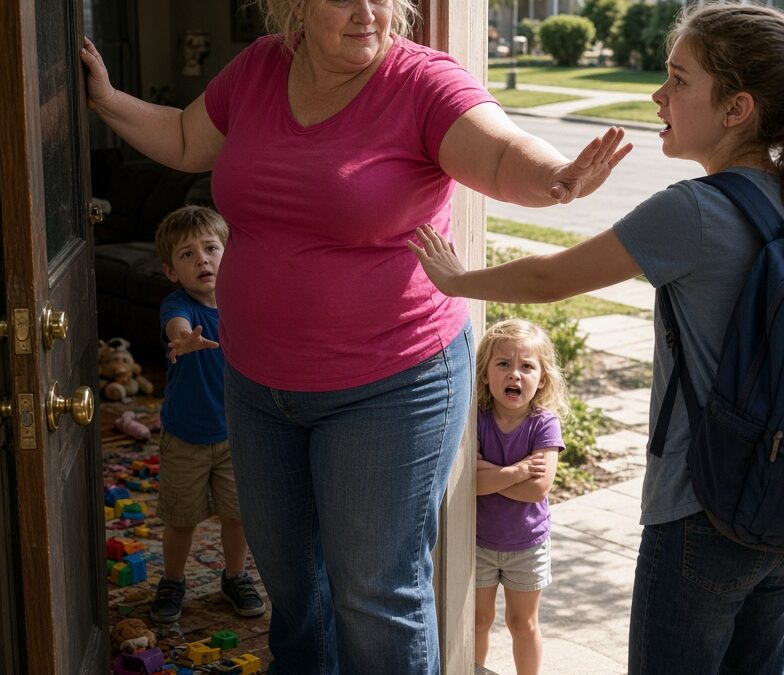
She was a large woman with messy blond hair pinned badly at the back of her head, a bright hot-pink shirt, faded jeans, and a cigarette pinched between two fingers. I remember the color of that shirt more clearly than I remember faces of teachers I had for entire school years. It was too bright, almost neon, a color that seemed to hum in the afternoon light.
She stood on the back step for a moment, watching us.
Not the way Lucy watched us.
Lucy watched kids while doing three other things. Folding laundry. Talking to someone. Drinking coffee. Calling out gentle warnings before danger even formed.
Karen watched like she was studying a possibility.
Then she smiled.
“Having fun?”
Megan shouted, “Yes!”
I nodded because I had suddenly become shy.
Karen sat down in a plastic chair and smoked while we spun. She kept smiling. At first, I tried to smile back, because adults liked polite children and Dad had raised us to be polite. But something about her attention made my skin feel too small.
I realized I had never seen her before that day.
Not at the playground. Not near the mailboxes. Not talking to Dad. Not waving from a porch. On our street, new adults stood out. Everyone knew everyone, or at least seemed to. But Karen felt like a door that had appeared in a hallway overnight.
After a while, she called, “I’m going inside to start dinner. Kyle, you can stay and eat with us if you want.”
I looked at her.
I knew I was supposed to say thank you. I also knew, in the simple way children know household law, that I ate dinner at my own house unless Dad said otherwise.
“I have to ask my dad,” I said.
Karen’s smile did not change, but something behind it tightened.
“Well, we’ll see.”
She went inside.
The backyard felt different without her, but not better. The merry-go-round slowed. Megan jumped off and grabbed my hand.
“Come play with my toys.”
I followed her back in because I did not know how to say no without being rude.
Inside, the house smelled like cigarette smoke and something frying. Megan dumped a box of Legos onto the carpet. I sat cross-legged and picked up a red brick, trying to make myself interested. She talked quickly, showing me toy after toy, barely waiting for me to respond before moving on.
“This is mine,” she said again and again. “This is mine. This is mine too. My mom got me this. I have more upstairs. I have a lot because I don’t have a brother.”
I nodded.
At home, I complained about Evan taking my things and Rachel bossing me around. But sitting there in that toy-filled house, I began to understand that having siblings meant someone could annoy you, yes, but also someone could come get you.
Half an hour passed.
Maybe less. Maybe more.
Time feels strange when you are waiting for permission to leave but nobody has told you that you are trapped yet.
Then came a knock at the door.
It was light. Polite. Familiar.
I looked up.
My heart lifted.
Rachel.
I stood and peeked into the hallway.
Karen opened the front door but did not open it all the way. She stood with one hand on the edge, body filling the frame.
Rachel was on the porch.
She looked older than she was in that moment, her backpack still over one shoulder, her hair windblown, her face serious in the way it got when Dad had trusted her with responsibility.
“Is Kyle here?” she asked.
Karen leaned against the doorframe.
“Yes.”
“Can you please tell him dinner is ready? Dad wants him home.”
I took a step toward the hallway.
Before I could say anything, Megan appeared behind me.
I did not even hear her move.
She inhaled hard, like she was about to scream underwater, then shouted, “No!”
The word cracked through the house.
I turned.
Megan stood with her feet planted wide, fists tight at her sides, face red and furious.
“No!” she said again. “He’s staying!”
Karen looked back at her daughter.
Something passed between them.
Not surprise.
Permission.
Then Karen turned to Rachel with a slow smile.
“Well,” she said, “why doesn’t his father come get him?”
Rachel straightened.
“I’m in charge of him.”
Karen’s smile sharpened.
“Missy, I don’t care what you think you’re in charge of.”
I moved closer to the hall, clutching the red Lego brick so hard the corners hurt my palm.
Rachel’s voice changed.
It was still polite, but there was steel in it now.
“He needs to come home.”
Karen tilted her head.
“You already have one brother.”
Silence.
I did not understand at first.
Neither did Rachel, I think.
Karen continued in a voice that was almost reasonable, which made it much worse.
“My daughter has none. Do you really need this one back so soon?”
The house seemed to tilt.
I remember Rachel saying nothing.
I remember Megan breathing hard behind me.
I remember Karen’s pink shirt filling the doorway like a warning sign.
Then Karen shut the door in my sister’s face.
Not gently.
She slammed it.
The sound went through my chest.
For a second, nobody moved.
Then the fear came.
Not all at once. It rose from my stomach into my throat, thick and hot. My eyes filled with tears before I gave them permission. The red Lego slipped from my hand and landed on the carpet.
Karen turned around and saw me.
Her face softened in a way that made me more afraid, not less.
“Oh, don’t cry, darling,” she said.
I wanted Rachel.
I wanted Dad.
I wanted my boring yard and Evan teasing me and Linda from two houses down yelling for someone to stop riding bikes through her flower bed.
Karen stepped toward me.
“She won’t take you home now.”
My breath caught.
Karen bent slightly, hands on her knees, speaking in a sweet motherly voice that felt sticky.
“You just wash up for dinner. It’s almost ready.”
Megan clapped.
“Yay!”
I stared at them.
My brain was small, but it was not stupid. Every alarm inside me was ringing. The problem was that I did not know what to do with alarms yet. Adults were supposed to be safe. Houses across the street were supposed to be safe. Mothers were supposed to open doors when sisters came for you.
Karen pointed down the hall.
“Bathroom is there.”
Megan skipped toward the kitchen, already happy again, like the matter had been settled.
I walked to the bathroom.
I did not run.
Some part of me understood running too soon would make Karen grab me.
The bathroom was small and smelled like lemon cleaner and smoke. I closed the door, but not all the way. My hands shook. I turned on the faucet because she had told me to wash up. Water rushed into the sink, loud enough to cover small sounds.
I looked at the window.
Too high.
I looked at the door.
Open a crack.
From the kitchen, Karen said something to Megan. Megan giggled. Plates clinked.
I remember thinking one clear thought.
Rachel knows.
That thought saved me.
Rachel had seen the door close. Rachel knew Karen had not let me out. Rachel might already be telling Dad. Or maybe she was still outside. Maybe she was scared too. Maybe if I waited, Karen would lock the door or take me farther inside or make me sit at the table and then it would be harder.
I wiped my wet hands on my shorts even though I had not washed them.
Then I turned off the faucet.
The sudden quiet made my ears ring.
I opened the bathroom door slowly.
No one was in the hallway.
The front door was only a few steps away.
I could hear Karen in the kitchen.
“…such a nice boy,” she was saying. “Isn’t he?”
Megan answered, “He can be my brother.”
My skin went cold.
I reached the front door.
The knob was huge in my hand.
For one terrible second, I thought it would be locked.
It turned.
I opened the door just wide enough to squeeze through.
Then I ran.
I ran across the porch, down the steps, across the yard, into the street without looking both ways the way Dad always told me to. A car horn did not sound. No brakes screamed. Maybe there were no cars. Maybe God covered for me that once.
I ran across the street to my house and burst inside.
The kitchen smelled like dinner.
Dad stood near the stove, turning around with the irritated look parents get when a kid comes in loud.
“You’re late,” he said.
I stood there breathing hard.
Rachel was at the table, pale and stiff.
Evan was beside her, looking confused.
Dad’s face changed.
“Kyle?”
I looked at Rachel.
Her eyes were wide.
She had not told him.
I know that now.
Maybe she had been about to. Maybe she froze. Maybe she was trying to decide how to explain something so strange that even she did not fully understand it. She was only a child too, though at the time I thought she was practically grown.
Dad walked toward me.
“What happened?”
I opened my mouth.
Nothing came out.
Karen’s voice was still in my head.
You already have one brother.
My daughter has none.
Do you really need this one back so soon?
The words were too big. Too impossible. I did not know how to say that an adult had decided I might belong to her because her daughter wanted me.
So I did what frightened children often do.
I made myself smaller than the truth.
“I had to go to the bathroom,” I said.
Dad frowned.
“At their house?”
I nodded.
“You should have come home when Rachel came for you.”
Rachel looked down at her plate.
I waited for her to speak.
She did not.
Dad sighed, still not understanding, and pointed toward the sink.
“Wash your hands here. Dinner’s ready.”
And just like that, the world pretended to be normal.
But I was not normal.
Not through dinner. Not that night. Not for a long time after, though I could not have explained why.
I sat at the table and ate whatever Dad had made. I do not remember the food. I remember Rachel looking at me, then away. I remember Evan asking why I was acting weird and Dad telling him to leave me alone. I remember jumping when someone knocked a fork against a plate.
After dinner, Rachel followed me to the room I shared with Evan.
Evan was somewhere else, probably avoiding dish duty.
Rachel stood in the doorway.
“Did she hurt you?” she whispered.
I shook my head.
“Did she say anything else?”
“She said I could stay.”
Rachel’s face twisted.
“I told her Dad wanted you.”
“I know.”
“She wouldn’t let me in.”
“I know.”
“She said—”
Rachel stopped.
Her eyes filled with tears, which scared me more than Karen had in a different way. Rachel did not cry easily. Rachel was the bossy one. The brave one. The one who tied my shoes too tight and told me monsters were not real.
“She said I had another brother,” Rachel whispered.
I nodded.
For a moment, we just stared at each other.
Then she crossed the room and hugged me so hard I could barely breathe.
“You don’t go there again,” she said into my hair.
“I won’t.”
“Promise.”
“I promise.”
“And if she talks to you, you run home.”
“Okay.”
“I mean it, Kyle.”
“I promise.”
We never told Dad.
That is the part people judge when I tell the story now, if I tell it at all.
They say we should have told him. They are right. Of course they are right. My father would have crossed that street in seconds. Navy man, single dad, tired beyond measure but fierce when it came to us. If he had known what Karen said, what she did, how she slammed that door, there is no version of reality where he would have shrugged and told us to forget it.
He would have called base security.
He would have found out who she was.
He would have made sure she never came near us again.
But children do not think like adults.
Rachel was scared she would get in trouble for letting me go. I was scared I would get in trouble for going. Both of us were scared because the thing that happened felt unreal, and unreal things are hard to explain to adults who expect the world to make sense.
So we kept it.
Between us.
The next day, I played inside.
The day after that, I stayed in our yard.
When I saw Megan outside across the street, I went behind the house. She called my name once. I remember hearing it through the side gate and standing very still beside the trash cans until she stopped.
Karen came outside too.
I saw her from the window.
She stood on her porch smoking, looking toward our house. Not frantic. Not guilty. Just watching.
That was when I understood, in the simple fear-language of childhood, that I had escaped something, not merely left somewhere.
A few weeks later, that family was gone.
I do not know if they moved, if they had been staying temporarily, if Dad heard something from another adult and never told us, or if base housing worked its mysterious way and swallowed them back into whatever place they had come from. One day the house across the street had their toys in the yard. Then it did not.
Lucy and Sarah returned, and the street went back to itself.
Almost.
But safety, once cracked, never becomes exactly the same shape again.
For years, the memory came to me in pieces.
The bright pink shirt.
The sound of the door.
Megan’s “No.”
The bathroom faucet.
Rachel’s face at dinner.
But I did not think of it as a near abduction because that phrase belonged to TV shows, missing posters, strangers in vans. Karen was not a stranger in a van. She was a mom across the street with too many toys in the house and smoke curling around her fingers. She had a daughter my age. She had a dinner on the stove. She smiled.
That was what made it worse.
As a kid, I could not understand her motive beyond the words she gave us.
You already have one brother.
My daughter has none.
Do you really need this one back so soon?
As an adult, I understand more and less at the same time.
I understand loneliness can twist people. I understand some parents look at their children’s sadness and think the whole world should rearrange itself to soothe it. I understand entitlement can dress itself up as love. Karen saw Megan wanting a sibling and somehow turned that want into permission to treat me like a toy that had wandered within reach.
But I do not understand how any adult looks at a child crying to go home and chooses possession over mercy.
I do not understand how she heard Rachel ask politely and decided my sister’s fear was an inconvenience.
I do not understand how she slammed the door.
Maybe there is no understanding that kind of person.
Maybe there is only naming what she did.
She tried to keep me.
Not forever, maybe. Maybe if Dad had knocked next, she would have laughed and said it was a misunderstanding. Maybe she would have opened the door and acted offended that anyone doubted her. Maybe she would have told herself she only meant dinner, only meant company for her daughter, only meant to borrow me for a little while.
People like Karen survive on those words.
Only.
Just.
A little.
They build bridges from small violations to larger ones and act shocked when anyone notices the river below.
But in that moment, when Rachel stood outside and Karen stood inside, she made a choice.
She chose not to let me go.
The memory stayed hidden between Rachel and me until I visited our old hometown many years later.
Dad had long since left the Navy by then. He had done what he always said he wanted to do once he could—be more present, more rooted, more available. By then, we were grown. Rachel had children of her own. Evan had become the kind of uncle who brought loud toys and left before bedtime. Dad’s hair had gone mostly gray, though he still stood like a man waiting for inspection.
The base housing neighborhood looked smaller than I remembered.
That happens with childhood places. Streets that once felt endless become short. Front yards shrink. Corners lose mystery. The houses looked similar but not the same, painted different colors, with new families, new bikes, new children shouting over games they would someday remember incorrectly.
I stood near our old corner lot and looked across the street.
The house was still there.
Different curtains. Different car in the driveway. Different life.
But for a second, I saw the old door.
I saw Karen leaning against it.
I saw Rachel on the porch.
And I was five again.
Rachel had come with me on that trip. We had not planned to talk about it. In fact, I am not sure either of us knew we were both carrying the same memory so close to the surface until we stood there.
She looked at the house.
Then she said, “I should’ve told Dad.”
Her voice was quiet.
I looked at her.
“You were a kid.”
“I was in charge of you.”
“You were a kid,” I said again.
She swallowed.
“I can still hear her.”
“So can I.”
Rachel wrapped her arms around herself.
“I thought if I told Dad, I’d get in trouble for letting you go over there. And then I thought maybe I misunderstood. Adults didn’t do things like that, you know?”
“Yeah.”
“But I didn’t misunderstand.”
“No,” I said. “You didn’t.”
For a long moment, neither of us moved.
Then Rachel laughed once, but it broke halfway through.
“You escaped through the bathroom.”
“I faked washing my hands.”
“Smart kid.”
“Terrified kid.”
“Same thing sometimes.”
We stood there looking at the house where a woman once decided my family had one child too many and hers had too few.
There was no grand confrontation waiting for us as adults. No Karen to expose. No police report to file decades late. No satisfying courtroom scene where everyone finally understood. Real life does not always give you a clean ending.
Sometimes the only justice is realizing you were right to be afraid.
Sometimes the only victory is that the child got out.
And I did.
I got out.
I opened the door myself.
I ran home.
For years, I thought of that as luck. And yes, luck was part of it. The door was unlocked. Karen was in the kitchen. Megan did not follow me. No car hit me in the street. Rachel had come when she did.
But standing there as an adult, I finally allowed myself to see the other part.
I saved myself.
A five-year-old boy with no vocabulary for danger listened to the alarm bells in his body. He noticed the wrongness. He made a plan small enough to fit inside his fear. Turn on the faucet. Walk quietly. Open the door. Run.
I wish no child ever had to be that clever.
But I am grateful I was.
Rachel and I never told Dad while we were kids. I used to feel guilty about that. Now I mostly feel sad for the two children we were, carrying an adult-sized fear because we thought we had done something wrong.
We had not.
That was Karen’s wrong.
Not ours.
Before we left the old neighborhood, Rachel crossed the street and stood on the sidewalk in front of that house. I followed.
She looked at the front door.
“You know what I remember most?” she asked.
“What?”
“She didn’t look crazy.”
I knew exactly what she meant.
Karen had not looked like a monster from a movie. She had looked like a mother. Messy hair. Bright shirt. Cigarette smoke. Dinner sounds behind her. A child at her side.
That is why children need adults who listen.
Because danger does not always arrive with a mask.
Sometimes it smiles and says dinner is almost ready.
Sometimes it has a daughter who wants a brother.
Sometimes it lives across the street in a place everyone assumes is safe.
I have children now.
I try not to raise them afraid of the world, because fear can become its own kind of cage. But I teach them that their uncomfortable feelings matter. I teach them they do not have to be polite to adults who make them feel trapped. I teach them that “no” is not a rude word when their body is trying to protect them. I teach them that if anyone ever says they cannot come home, they scream, run, break something, make noise, and tell me everything.
Especially if they think they will be in trouble.
Especially then.
Once, my daughter asked me why I say that part so often.
I told her, “Because safety matters more than trouble.”
She nodded like that made perfect sense.
I hope it always does.
As for Karen, I do not know where she went. I do not know whether she ever understood what she almost did. I do not know if Megan grew up remembering the afternoon she tried to keep a boy as a brother or if her mind softened it into just another strange childhood playdate.
Part of me hopes Megan forgot.
Part of me hopes she did not.
Not because I want her haunted, but because I hope somewhere in her life, she learned that love is not ownership. Wanting someone does not make them yours. Loneliness does not give you rights over another person’s freedom.
Karen never seemed to understand that.
She looked at her daughter’s empty place at the table and decided my family should fill it.
She looked at Rachel and saw not a child doing her best, but an obstacle.
She looked at me and saw not a little boy with a home, a father, a sister, a brother, and dinner waiting, but something her daughter wanted.
A spare child.
That phrase did not come to me until years later.
But that was what she meant.
You already have one brother.
My daughter has none.
Do you need this one back so soon?
I was not spare.
I was loved.
Messily, imperfectly, loudly loved by a tired Navy father, a bossy sister, a teasing brother, grandparents, neighbors, and a home that might have looked boring from the outside but was mine.
That was the truth Karen could not erase by closing a door.
When I think of the story now, I do not end it with her.
I do not end it with the slam of the door or the pink shirt or the smell of smoke in that hallway.
I end it with my hand on the knob.
I end it with the turn.
I end it with air on my face and pavement under my feet and my own house growing closer with every step.
I end it with Rachel hugging me hard enough to hurt.
I end it with the promise we made in whispers because we were too young to know we deserved help.
I promise.
I won’t go back.
And I never did.
𝗧𝗛𝗘 𝗘𝗡𝗗
The Woman Across the Street Said My Sister Already Had a Brother, So She Was Keeping Me
Karen smiled at me like dinner was ready, not like she had just refused to let a five-year-old boy go home.
My sister stood on the other side of the door, close enough for me to hear her breathing, but Karen’s body filled the frame like a locked gate.
Then her daughter crossed her arms and shouted one word that still makes my stomach drop when I remember it.
No.
I was five years old when I almost did not come home for dinner.
That is the cleanest way I know how to say it now, as a grown man with years between me and that afternoon. It sounds simple when I put it that way. Almost small. A childhood scare. One of those strange old memories that families laugh about later because everyone survived it, because time has sanded the sharp edges down until the danger looks distant.
But it did not feel small then.
It felt like the whole world had changed shape while I was sitting on a stranger’s carpet with a pile of Legos in front of me.
My dad was in the Navy back then. He was a single father with three kids, which still amazes me when I think about it as an adult. I can barely keep track of myself some weeks, and he somehow managed uniforms, deployments, school forms, grocery runs, scraped knees, bedtime, discipline, birthdays, and the thousand quiet emergencies children create without meaning to.
He did not do it alone, exactly. My grandparents helped when they could. Sometimes there were nannies when he was overseas. Neighbors helped, too, because we lived in base housing, the kind of place where everyone knew everyone’s business and everyone’s kids. Doors stayed open. Bikes lay abandoned in yards. Parents yelled dinner times from porches. If you fell down three houses away, somebody else’s mom cleaned your knee and sent you home with a juice box.
It felt safe.
Maybe that was the danger.
We lived on a corner lot with the biggest front yard on the block, so kids gathered at our place without anyone really planning it. My older sister, Rachel, was usually in charge when Dad was inside or busy. She took that job seriously in the way only an oldest child can, bossy and loving at the same time. My older brother, Evan, helped when he felt like it, which was not often enough for Rachel’s standards.
Across the street lived Lucy, the unofficial nanny of the neighborhood. Her daughter Sarah was my best friend. Sarah and I dug holes in the dirt, raced plastic cars, made mud pies nobody asked for, and once tried to convince ourselves a beetle was a pet. I trusted Lucy’s house because Dad trusted Lucy’s house. In my five-year-old mind, that meant the whole street belonged to us.
The day it happened, Lucy and Sarah were not home.
Rachel and Evan were still at school for most of the afternoon, and Dad told me I could play outside but not wander far. That was the rule. Stay near the house. Stay where someone could see you. Do not cross the street without telling somebody.
I was in the yard picking at grass, bored in the dramatic way only a little kid can be bored, when I saw a girl standing across the street.
She was about my age, blond, wearing a purple shirt and holding a toy horse in one hand. I had never seen her before. She watched me for a while from her own yard, shy at first, then slowly crossed over when no cars were coming.
“Hi,” she said. “My name is Megan.”
“My name is Kyle,” I said.
That was probably the entire conversation before we became friends, because children do not need résumés. We sat in the grass and talked about toys, clouds, bikes, and whatever else mattered to us for thirty seconds at a time.
At some point, she looked around my yard and frowned.
“Your house is boring.”
I was offended because it was my house, but also because she was right at that moment.
“It’s not boring when my brother and sister are here,” I said. “Then we can go to the park.”
Megan’s face changed.
“I don’t have a brother or sister.”
That sounded lonely to me.
Then she brightened.
“But I have way more toys than you.”
I believed her immediately.
“Want to come see?” she asked. “I have a merry-go-round in my backyard.”
A merry-go-round.
To an adult, that might sound like a small backyard toy, maybe a little metal platform that spins if someone pushes it hard enough.
To me, it sounded like Disneyland had moved across the street.
“Hold on,” I said. “I have to tell my dad.”
Just then, Rachel and Evan came around the corner from school, backpacks bouncing, Rachel already scanning the yard like she was counting heads.
Instead of going inside to Dad, I ran to her.
“Megan has a merry-go-round,” I said breathlessly. “I’m going to her house.”
Rachel stopped walking.
“Where does she live?”
Megan pointed across the street.
Rachel looked at the house, then back at me. It was close. Visible. In the world we lived in, that seemed safe enough.
“Okay,” she said. “I’ll come get you when dinner’s ready.”
“Don’t forget to tell Dad,” I said, already running after Megan.
Rachel said something behind me, probably a warning, probably my name, probably something I should have listened to.
But I was five.
And there was a merry-go-round.
part2
Megan’s house felt wrong the moment I stepped inside, though I did not have the words for that feeling yet.
It was not dirty or scary. That would have been easier. It was bright and full of things. Toys everywhere. Barbies, plastic animals, Hot Wheels, stuffed bears, dollhouses, puzzles, Legos, bins overflowing onto the carpet. To a little kid, it should have looked like treasure.
For one second, it did.
Then I realized there were too many toys and not enough life.
At my house, toys were scattered because people had played with them and left them in the middle of something. Evan’s action figures guarded couch cushions. Rachel’s books leaned in stacks. My cars slept under chairs. Everything had fingerprints on it, history, noise.
Megan’s toys looked more like proof.
Proof that she had everything.
Proof that she did not have anyone.
She walked through the living room without touching any of it and led me straight to the backyard.
And there it was.
A small metal merry-go-round, faded red and yellow, planted near a patch of dry grass.
I forgot every nervous feeling in my body.
I ran to it and climbed on. Megan jumped on after me, and we pushed off with our feet, laughing as the world spun around us. For a few minutes, there was nothing wrong. Just sun, dizziness, squeaky metal, and the special joy of playing with a kid you had known for less than an hour but already trusted because children trust quickly when nobody teaches them not to.
Then Karen came outside.
I did not know her name at first. I only knew she was Megan’s mother.
She was a large woman with messy blond hair pinned badly at the back of her head, a bright hot-pink shirt, faded jeans, and a cigarette pinched between two fingers. I remember the color of that shirt more clearly than I remember faces of teachers I had for entire school years. It was too bright, almost neon, a color that seemed to hum in the afternoon light.
She stood on the back step for a moment, watching us.
Not the way Lucy watched us.
Lucy watched kids while doing three other things. Folding laundry. Talking to someone. Drinking coffee. Calling out gentle warnings before danger even formed.
Karen watched like she was studying a possibility.
Then she smiled.
“Having fun?”
Megan shouted, “Yes!”
I nodded because I had suddenly become shy.
Karen sat down in a plastic chair and smoked while we spun. She kept smiling. At first, I tried to smile back, because adults liked polite children and Dad had raised us to be polite. But something about her attention made my skin feel too small.
I realized I had never seen her before that day.
Not at the playground. Not near the mailboxes. Not talking to Dad. Not waving from a porch. On our street, new adults stood out. Everyone knew everyone, or at least seemed to. But Karen felt like a door that had appeared in a hallway overnight.
After a while, she called, “I’m going inside to start dinner. Kyle, you can stay and eat with us if you want.”
I looked at her.
I knew I was supposed to say thank you. I also knew, in the simple way children know household law, that I ate dinner at my own house unless Dad said otherwise.
“I have to ask my dad,” I said.
Karen’s smile did not change, but something behind it tightened.
“Well, we’ll see.”
She went inside.
The backyard felt different without her, but not better. The merry-go-round slowed. Megan jumped off and grabbed my hand.
“Come play with my toys.”
I followed her back in because I did not know how to say no without being rude.
Inside, the house smelled like cigarette smoke and something frying. Megan dumped a box of Legos onto the carpet. I sat cross-legged and picked up a red brick, trying to make myself interested. She talked quickly, showing me toy after toy, barely waiting for me to respond before moving on.
“This is mine,” she said again and again. “This is mine. This is mine too. My mom got me this. I have more upstairs. I have a lot because I don’t have a brother.”
I nodded.
At home, I complained about Evan taking my things and Rachel bossing me around. But sitting there in that toy-filled house, I began to understand that having siblings meant someone could annoy you, yes, but also someone could come get you.
Half an hour passed.
Maybe less. Maybe more.
Time feels strange when you are waiting for permission to leave but nobody has told you that you are trapped yet.
Then came a knock at the door.
It was light. Polite. Familiar.
I looked up.
My heart lifted.
Rachel.
I stood and peeked into the hallway.
Karen opened the front door but did not open it all the way. She stood with one hand on the edge, body filling the frame.
Rachel was on the porch.
She looked older than she was in that moment, her backpack still over one shoulder, her hair windblown, her face serious in the way it got when Dad had trusted her with responsibility.
“Is Kyle here?” she asked.
Karen leaned against the doorframe.
“Yes.”
“Can you please tell him dinner is ready? Dad wants him home.”
I took a step toward the hallway.
Before I could say anything, Megan appeared behind me.
I did not even hear her move.
She inhaled hard, like she was about to scream underwater, then shouted, “No!”
The word cracked through the house.
I turned.
Megan stood with her feet planted wide, fists tight at her sides, face red and furious.
“No!” she said again. “He’s staying!”
Karen looked back at her daughter.
Something passed between them.
Not surprise.
Permission.
Then Karen turned to Rachel with a slow smile.
“Well,” she said, “why doesn’t his father come get him?”
Rachel straightened.
“I’m in charge of him.”
Karen’s smile sharpened.
“Missy, I don’t care what you think you’re in charge of.”
I moved closer to the hall, clutching the red Lego brick so hard the corners hurt my palm.
Rachel’s voice changed.
It was still polite, but there was steel in it now.
“He needs to come home.”
Karen tilted her head.
“You already have one brother.”
Silence.
I did not understand at first.
Neither did Rachel, I think.
Karen continued in a voice that was almost reasonable, which made it much worse.
“My daughter has none. Do you really need this one back so soon?”
The house seemed to tilt.
I remember Rachel saying nothing.
I remember Megan breathing hard behind me.
I remember Karen’s pink shirt filling the doorway like a warning sign.
Then Karen shut the door in my sister’s face.
Not gently.
She slammed it.
The sound went through my chest.
For a second, nobody moved.
Then the fear came.
Not all at once. It rose from my stomach into my throat, thick and hot. My eyes filled with tears before I gave them permission. The red Lego slipped from my hand and landed on the carpet.
Karen turned around and saw me.
Her face softened in a way that made me more afraid, not less.
“Oh, don’t cry, darling,” she said.
I wanted Rachel.
I wanted Dad.
I wanted my boring yard and Evan teasing me and Linda from two houses down yelling for someone to stop riding bikes through her flower bed.
Karen stepped toward me.
“She won’t take you home now.”
My breath caught.
Karen bent slightly, hands on her knees, speaking in a sweet motherly voice that felt sticky.
“You just wash up for dinner. It’s almost ready.”
Megan clapped.
“Yay!”
I stared at them.
My brain was small, but it was not stupid. Every alarm inside me was ringing. The problem was that I did not know what to do with alarms yet. Adults were supposed to be safe. Houses across the street were supposed to be safe. Mothers were supposed to open doors when sisters came for you.
Karen pointed down the hall.
“Bathroom is there.”
Megan skipped toward the kitchen, already happy again, like the matter had been settled.
I walked to the bathroom.
I did not run.
Some part of me understood running too soon would make Karen grab me.
The bathroom was small and smelled like lemon cleaner and smoke. I closed the door, but not all the way. My hands shook. I turned on the faucet because she had told me to wash up. Water rushed into the sink, loud enough to cover small sounds.
I looked at the window.
Too high.
I looked at the door.
Open a crack.
From the kitchen, Karen said something to Megan. Megan giggled. Plates clinked.
I remember thinking one clear thought.
Rachel knows.
That thought saved me.
Rachel had seen the door close. Rachel knew Karen had not let me out. Rachel might already be telling Dad. Or maybe she was still outside. Maybe she was scared too. Maybe if I waited, Karen would lock the door or take me farther inside or make me sit at the table and then it would be harder.
I wiped my wet hands on my shorts even though I had not washed them.
Then I turned off the faucet.
The sudden quiet made my ears ring.
I opened the bathroom door slowly.
No one was in the hallway.
The front door was only a few steps away.
I could hear Karen in the kitchen.
“…such a nice boy,” she was saying. “Isn’t he?”
Megan answered, “He can be my brother.”
My skin went cold.
I reached the front door.
The knob was huge in my hand.
For one terrible second, I thought it would be locked.
It turned.
I opened the door just wide enough to squeeze through.
Then I ran.
I ran across the porch, down the steps, across the yard, into the street without looking both ways the way Dad always told me to. A car horn did not sound. No brakes screamed. Maybe there were no cars. Maybe God covered for me that once.
I ran across the street to my house and burst inside.
The kitchen smelled like dinner.
Dad stood near the stove, turning around with the irritated look parents get when a kid comes in loud.
“You’re late,” he said.
I stood there breathing hard.
Rachel was at the table, pale and stiff.
Evan was beside her, looking confused.
Dad’s face changed.
“Kyle?”
I looked at Rachel.
Her eyes were wide.
She had not told him.
I know that now.
Maybe she had been about to. Maybe she froze. Maybe she was trying to decide how to explain something so strange that even she did not fully understand it. She was only a child too, though at the time I thought she was practically grown.
Dad walked toward me.
“What happened?”
I opened my mouth.
Nothing came out.
Karen’s voice was still in my head.
You already have one brother.
My daughter has none.
Do you really need this one back so soon?
The words were too big. Too impossible. I did not know how to say that an adult had decided I might belong to her because her daughter wanted me.
So I did what frightened children often do.
I made myself smaller than the truth.
“I had to go to the bathroom,” I said.
Dad frowned.
“At their house?”
I nodded.
“You should have come home when Rachel came for you.”
Rachel looked down at her plate.
I waited for her to speak.
She did not.
Dad sighed, still not understanding, and pointed toward the sink.
“Wash your hands here. Dinner’s ready.”
And just like that, the world pretended to be normal.
But I was not normal.
Not through dinner. Not that night. Not for a long time after, though I could not have explained why.
I sat at the table and ate whatever Dad had made. I do not remember the food. I remember Rachel looking at me, then away. I remember Evan asking why I was acting weird and Dad telling him to leave me alone. I remember jumping when someone knocked a fork against a plate.
After dinner, Rachel followed me to the room I shared with Evan.
Evan was somewhere else, probably avoiding dish duty.
Rachel stood in the doorway.
“Did she hurt you?” she whispered.
I shook my head.
“Did she say anything else?”
“She said I could stay.”
Rachel’s face twisted.
“I told her Dad wanted you.”
“I know.”
“She wouldn’t let me in.”
“I know.”
“She said—”
Rachel stopped.
Her eyes filled with tears, which scared me more than Karen had in a different way. Rachel did not cry easily. Rachel was the bossy one. The brave one. The one who tied my shoes too tight and told me monsters were not real.
“She said I had another brother,” Rachel whispered.
I nodded.
For a moment, we just stared at each other.
Then she crossed the room and hugged me so hard I could barely breathe.
“You don’t go there again,” she said into my hair.
“I won’t.”
“Promise.”
“I promise.”
“And if she talks to you, you run home.”
“Okay.”
“I mean it, Kyle.”
“I promise.”
We never told Dad.
That is the part people judge when I tell the story now, if I tell it at all.
They say we should have told him. They are right. Of course they are right. My father would have crossed that street in seconds. Navy man, single dad, tired beyond measure but fierce when it came to us. If he had known what Karen said, what she did, how she slammed that door, there is no version of reality where he would have shrugged and told us to forget it.
He would have called base security.
He would have found out who she was.
He would have made sure she never came near us again.
But children do not think like adults.
Rachel was scared she would get in trouble for letting me go. I was scared I would get in trouble for going. Both of us were scared because the thing that happened felt unreal, and unreal things are hard to explain to adults who expect the world to make sense.
So we kept it.
Between us.
The next day, I played inside.
The day after that, I stayed in our yard.
When I saw Megan outside across the street, I went behind the house. She called my name once. I remember hearing it through the side gate and standing very still beside the trash cans until she stopped.
Karen came outside too.
I saw her from the window.
She stood on her porch smoking, looking toward our house. Not frantic. Not guilty. Just watching.
That was when I understood, in the simple fear-language of childhood, that I had escaped something, not merely left somewhere.
A few weeks later, that family was gone.
I do not know if they moved, if they had been staying temporarily, if Dad heard something from another adult and never told us, or if base housing worked its mysterious way and swallowed them back into whatever place they had come from. One day the house across the street had their toys in the yard. Then it did not.
Lucy and Sarah returned, and the street went back to itself.
Almost.
But safety, once cracked, never becomes exactly the same shape again.
For years, the memory came to me in pieces.
The bright pink shirt.
The sound of the door.
Megan’s “No.”
The bathroom faucet.
Rachel’s face at dinner.
But I did not think of it as a near abduction because that phrase belonged to TV shows, missing posters, strangers in vans. Karen was not a stranger in a van. She was a mom across the street with too many toys in the house and smoke curling around her fingers. She had a daughter my age. She had a dinner on the stove. She smiled.
That was what made it worse.
As a kid, I could not understand her motive beyond the words she gave us.
You already have one brother.
My daughter has none.
Do you really need this one back so soon?
As an adult, I understand more and less at the same time.
I understand loneliness can twist people. I understand some parents look at their children’s sadness and think the whole world should rearrange itself to soothe it. I understand entitlement can dress itself up as love. Karen saw Megan wanting a sibling and somehow turned that want into permission to treat me like a toy that had wandered within reach.
But I do not understand how any adult looks at a child crying to go home and chooses possession over mercy.
I do not understand how she heard Rachel ask politely and decided my sister’s fear was an inconvenience.
I do not understand how she slammed the door.
Maybe there is no understanding that kind of person.
Maybe there is only naming what she did.
She tried to keep me.
Not forever, maybe. Maybe if Dad had knocked next, she would have laughed and said it was a misunderstanding. Maybe she would have opened the door and acted offended that anyone doubted her. Maybe she would have told herself she only meant dinner, only meant company for her daughter, only meant to borrow me for a little while.
People like Karen survive on those words.
Only.
Just.
A little.
They build bridges from small violations to larger ones and act shocked when anyone notices the river below.
But in that moment, when Rachel stood outside and Karen stood inside, she made a choice.
She chose not to let me go.
The memory stayed hidden between Rachel and me until I visited our old hometown many years later.
Dad had long since left the Navy by then. He had done what he always said he wanted to do once he could—be more present, more rooted, more available. By then, we were grown. Rachel had children of her own. Evan had become the kind of uncle who brought loud toys and left before bedtime. Dad’s hair had gone mostly gray, though he still stood like a man waiting for inspection.
The base housing neighborhood looked smaller than I remembered.
That happens with childhood places. Streets that once felt endless become short. Front yards shrink. Corners lose mystery. The houses looked similar but not the same, painted different colors, with new families, new bikes, new children shouting over games they would someday remember incorrectly.
I stood near our old corner lot and looked across the street.
The house was still there.
Different curtains. Different car in the driveway. Different life.
But for a second, I saw the old door.
I saw Karen leaning against it.
I saw Rachel on the porch.
And I was five again.
Rachel had come with me on that trip. We had not planned to talk about it. In fact, I am not sure either of us knew we were both carrying the same memory so close to the surface until we stood there.
She looked at the house.
Then she said, “I should’ve told Dad.”
Her voice was quiet.
I looked at her.
“You were a kid.”
“I was in charge of you.”
“You were a kid,” I said again.
She swallowed.
“I can still hear her.”
“So can I.”
Rachel wrapped her arms around herself.
“I thought if I told Dad, I’d get in trouble for letting you go over there. And then I thought maybe I misunderstood. Adults didn’t do things like that, you know?”
“Yeah.”
“But I didn’t misunderstand.”
“No,” I said. “You didn’t.”
For a long moment, neither of us moved.
Then Rachel laughed once, but it broke halfway through.
“You escaped through the bathroom.”
“I faked washing my hands.”
“Smart kid.”
“Terrified kid.”
“Same thing sometimes.”
We stood there looking at the house where a woman once decided my family had one child too many and hers had too few.
There was no grand confrontation waiting for us as adults. No Karen to expose. No police report to file decades late. No satisfying courtroom scene where everyone finally understood. Real life does not always give you a clean ending.
Sometimes the only justice is realizing you were right to be afraid.
Sometimes the only victory is that the child got out.
And I did.
I got out.
I opened the door myself.
I ran home.
For years, I thought of that as luck. And yes, luck was part of it. The door was unlocked. Karen was in the kitchen. Megan did not follow me. No car hit me in the street. Rachel had come when she did.
But standing there as an adult, I finally allowed myself to see the other part.
I saved myself.
A five-year-old boy with no vocabulary for danger listened to the alarm bells in his body. He noticed the wrongness. He made a plan small enough to fit inside his fear. Turn on the faucet. Walk quietly. Open the door. Run.
I wish no child ever had to be that clever.
But I am grateful I was.
Rachel and I never told Dad while we were kids. I used to feel guilty about that. Now I mostly feel sad for the two children we were, carrying an adult-sized fear because we thought we had done something wrong.
We had not.
That was Karen’s wrong.
Not ours.
Before we left the old neighborhood, Rachel crossed the street and stood on the sidewalk in front of that house. I followed.
She looked at the front door.
“You know what I remember most?” she asked.
“What?”
“She didn’t look crazy.”
I knew exactly what she meant.
Karen had not looked like a monster from a movie. She had looked like a mother. Messy hair. Bright shirt. Cigarette smoke. Dinner sounds behind her. A child at her side.
That is why children need adults who listen.
Because danger does not always arrive with a mask.
Sometimes it smiles and says dinner is almost ready.
Sometimes it has a daughter who wants a brother.
Sometimes it lives across the street in a place everyone assumes is safe.
I have children now.
I try not to raise them afraid of the world, because fear can become its own kind of cage. But I teach them that their uncomfortable feelings matter. I teach them they do not have to be polite to adults who make them feel trapped. I teach them that “no” is not a rude word when their body is trying to protect them. I teach them that if anyone ever says they cannot come home, they scream, run, break something, make noise, and tell me everything.
Especially if they think they will be in trouble.
Especially then.
Once, my daughter asked me why I say that part so often.
I told her, “Because safety matters more than trouble.”
She nodded like that made perfect sense.
I hope it always does.
As for Karen, I do not know where she went. I do not know whether she ever understood what she almost did. I do not know if Megan grew up remembering the afternoon she tried to keep a boy as a brother or if her mind softened it into just another strange childhood playdate.
Part of me hopes Megan forgot.
Part of me hopes she did not.
Not because I want her haunted, but because I hope somewhere in her life, she learned that love is not ownership. Wanting someone does not make them yours. Loneliness does not give you rights over another person’s freedom.
Karen never seemed to understand that.
She looked at her daughter’s empty place at the table and decided my family should fill it.
She looked at Rachel and saw not a child doing her best, but an obstacle.
She looked at me and saw not a little boy with a home, a father, a sister, a brother, and dinner waiting, but something her daughter wanted.
A spare child.
That phrase did not come to me until years later.
But that was what she meant.
You already have one brother.
My daughter has none.
Do you need this one back so soon?
I was not spare.
I was loved.
Messily, imperfectly, loudly loved by a tired Navy father, a bossy sister, a teasing brother, grandparents, neighbors, and a home that might have looked boring from the outside but was mine.
That was the truth Karen could not erase by closing a door.
When I think of the story now, I do not end it with her.
I do not end it with the slam of the door or the pink shirt or the smell of smoke in that hallway.
I end it with my hand on the knob.
I end it with the turn.
I end it with air on my face and pavement under my feet and my own house growing closer with every step.
I end it with Rachel hugging me hard enough to hurt.
I end it with the promise we made in whispers because we were too young to know we deserved help.
I promise.
I won’t go back.
And I never did.