𝗙𝗨𝗟𝗟 𝗦𝗧𝗢𝗥𝗬 The HOA Demanded Fifteen Years of Dues From My Dead Brother’s Workshop—So I Let the Courts Show Them Who Actually Owned the Land
𝗣𝗔𝗥𝗧 𝟮
I didn’t care.
I took over the business.
I kept both longtime assistants.
I told them immediately:
“I’m not him.”
One of them, Ramon, nodded.
“We know.”
“I can’t carve like him.”
“We know.”
“You’re not helping.”
That made him smile.
I knew enough about the business to keep it operating.
I’d spent weekends there growing up.
I could handle customers.
Ordering.
Books.
Scheduling.
Basic woodworking.
Repairs.
Finishing.
I knew what good work looked like even if my hands couldn’t yet reproduce everything my brother could do.
The assistants knew the craft.
I knew the business side.
Between us, I thought we could keep my brother’s name alive.
For about two weeks, that was all I focused on.
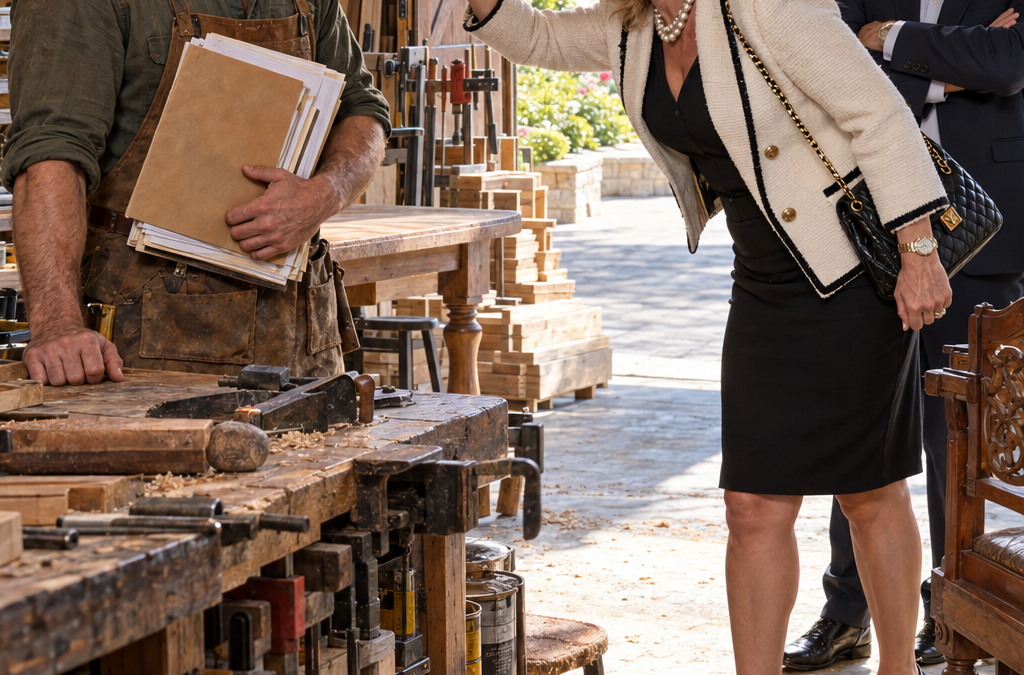
Then Karen walked into the courtyard.
At first I assumed she was a customer.
She was around forty, strikingly beautiful, with long blonde hair, expensive makeup, and the kind of carefully controlled smile that made you feel she had already decided how the conversation was going to end.
She wore one of the strangest outfits I’d ever seen inside a woodworking shop.
A fitted white military-style jacket with polished gold buttons, structured shoulders, and a deep neckline that emphasized her very large chest.
Matching white trousers.
White heels.
Not one speck of sawdust on her.
She carried a leather folder and a clipboard.
Karen was president of the neighboring subdivision’s homeowners association.
I didn’t know that yet.
I walked out of the office wiping my hands.
“Good morning.”
She looked around the courtyard.
Workers.
Lumber.
Dust.
Stacks of finished furniture.
Then at me.
“Are you the new owner?”
Her tone wasn’t unfriendly.
But it wasn’t normal either.
“Yes.”
She nodded.
“So your brother passed?”
The words were blunt enough that I paused.
“Yes.”
“I’m Karen.”
She extended her hand.
“President of the homeowners association.”
I shook it.
“I’m sorry we haven’t formally met.”
I assumed the next sentence would be condolences.
It wasn’t.
“Now that ownership has changed, we need to clear the outstanding account.”
I stared at her.
“What account?”
Karen opened the folder.
“The association account attached to this property.”
I almost laughed.
“There isn’t one.”
Her smile tightened.
“There is.”
“No. We’re not part of your subdivision.”
She tapped the clipboard.
“According to our internal master map, this parcel falls within our management zone.”
I looked toward the wall separating us from the subdivision.
“That’s incorrect.”
“No.”
She smiled again.
“It’s actually a longstanding issue.”
“What is?”
“Your brother’s refusal to comply.”
That got my attention.
“My brother?”
Karen nodded.
“This property has accumulated unpaid association assessments, maintenance fees, security contributions, environmental fees, penalties, and interest.”
I stared at her.
“For how long?”
She looked down as though checking.
“Approximately fifteen years.”
For a moment, the workshop noise seemed to disappear.
I thought I had misunderstood.
“Fifteen years?”
“Yes.”
“You think my brother owed your HOA dues for fifteen years?”
“Not think.”
She looked back at me.
“He did.”
“No.”
Karen sighed.
I learned later that she did that whenever she wanted to make somebody feel childish.
“You’ve just inherited the property.”
“Correct.”
“So I understand you may not know its full administrative history.”
“I know enough to know this parcel isn’t in your HOA.”
“Unfortunately, that’s incorrect.”
“We pay property taxes directly to the municipality.”
“That doesn’t eliminate association obligations.”
“We don’t use your subdivision.”
“That’s irrelevant.”
“We don’t enter through your gates.”
“Also irrelevant.”
“We have our own access road.”
“Still irrelevant.”
I crossed my arms.
“Then explain what exactly we’re paying for.”
Karen’s expression cooled.
“Maintenance of the larger residential environment.”
“No.”
“Security.”
“We have our own.”
“Environmental management.”
“No.”
“Area preservation.”
“No.”
She stopped.
“You’re saying no quite a lot.”
“Because you’re listing things we never agreed to buy.”
Karen closed the folder.
“The point isn’t whether you personally use every service.”
“The point is we’re not members.”
“The property falls inside our zone of control.”
“According to what?”
“Our internal records.”
“Your internal map doesn’t change my title.”
Her eyes narrowed.
“You’re becoming argumentative.”
“My brother died two weeks ago and you walked into his workshop asking me for fifteen years of fake bills.”
That wiped the smile away.
“They are not fake.”
“Then show me the recorded covenant.”
Karen hesitated.
Tiny pause.
“Association membership predates your ownership.”
“Our ownership predates your subdivision.”
Her jaw tightened.
“The surrounding development has governed this area for years.”
“Not this lot.”
She leaned slightly across the counter.
“I think it would be in your interest not to begin your relationship with the community in an antagonistic way.”
There it was.
The first threat hidden inside polite language.
“My relationship with your community is that we’re neighbors.”
“It’s more complicated.”
“No.”
I pointed toward the workshop entrance.
“Your subdivision ends at that boundary.”
Karen’s face reddened.
“Your brother used to make this exact argument.”
My stomach tightened.
“What?”
She realized she’d said more than she intended.
But she recovered quickly.
“This has been disputed before.”
“He told you we weren’t part of the HOA.”
“He resisted his obligations.”
“How long were you bothering him?”
Karen’s tone sharpened.
“Watch your language.”
“How long?”
She tapped the folder.
“The account goes back fifteen years.”
The grief inside me changed shape.
I had assumed this was a mistake.
Now I knew it wasn’t.
Karen had been chasing my brother for years.
And I’d never known.
She slid a printed sheet across the counter.
“That is the current balance.”
I looked down.
The total was hundreds of thousands of Philippine pesos.
Dues.
Interest.
Penalties.
Administrative charges.
Legal review fees.
Security assessments.
Environmental charges.
Numbers stacked on numbers.
It looked official.
That made it more insulting.
I looked up.
“You’re serious.”
“Completely.”
“I’m not paying this.”
Karen’s eyes became cold.
“You have thirty days.”
“No.”
“If the debt isn’t resolved, the board will begin legal recovery.”
“Recovery of what?”
“Association obligations.”
“You have no claim.”
“That will be for the legal process to determine.”
She slipped the papers back into her folder.
Then added:
“Potential remedies may include foreclosure proceedings against the parcel.”
I stared at her.
“You are threatening to foreclose on my brother’s workshop?”
“If the balance remains unpaid.”
“You don’t own the debt.”
“The association recognizes it.”
“Your association can recognize unicorns. Doesn’t make them real.”
Her lips pressed together.
“We can also seek seizure of business assets if necessary.”
That was the moment I stopped seeing Karen as merely arrogant.
She looked around at my brother’s workshop while saying it.
The saws.
Planers.
Carving tools.
Clamps.
Lathes.
Finished furniture.
Machines my brother had saved years to buy.
Everything he’d left me.
Karen was telling me she intended to take it.
“If you continue refusing to comply,” she said, “operations could be shut down.”
Ramon had stopped working nearby.
I could feel him listening.
Karen continued.
“You need to understand that inheritance doesn’t erase outstanding liabilities.”
“And you need to understand the land isn’t yours.”
She smiled without warmth.
“Then comply with the law and prove it.”
I stared at her.
She had no idea how important those words would become.
“Comply with the law?”
“Exactly.”
“Fine.”
I folded the fake statement.
“That’s what I’ll do.”
Karen took my calmness as surrender.
I could see it.
“Good.”
She smiled again.
“I knew we could resolve this professionally.”
Then she turned and walked out.
White heels crossing the dusty courtyard.
Ramon came closer after she left.
“What was that?”
I handed him the statement.
He read the total.
His eyes widened.
“Sir…”
“Did my brother ever mention this?”
Ramon shook his head.
“Never.”
“Karen?”
“We saw her sometimes.”
“Here?”
“At the gate.”
“How often?”
“Not much.”
That answer bothered me.
I went into my brother’s office.
His filing system was old-fashioned.
Metal cabinets.
Handwritten folder labels.
Receipts going back years.
Tax documents.
Customer sketches.
Supplier contracts.
Insurance.
Permits.
Business papers.
I started searching.
PROPERTY.
LAND TITLE.
TAX.
BOUNDARY.
Then I found a folder labeled:
HOA / SUBDIVISION
It was thick.
Too thick.
I opened it.
And felt my anger rise with every page.
Letters.
Dozens of them.
Years of correspondence.
Karen’s name appeared again and again.
Warning notices.
Fee demands.
Threats.
Requests to “normalize membership status.”
Claims about association jurisdiction.
Statements of arrears.
Threats of collection.
My brother’s replies were attached.
Polite.
Calm.
Almost painfully polite.
One read:
As previously stated, my property is not part of your homeowners association. Attached again is a copy of the land title and tax declaration showing the independent lot designation. Please update your records.
Another:
I do not use subdivision security, road access, waste management, or other common facilities. My property has its own independent access and predates the subdivision development.
Another:
I respectfully request that you stop sending payment demands unsupported by any contractual or title obligation.
Then Karen again.
And again.
And again.
My brother had been dealing with this for over a decade.
He never told me.
Never told our parents.
Never complained.
He had simply filed each letter.
Responded when necessary.
Then gone back to building furniture.
I sat in his chair with those papers spread across the desk.
The grief hit me all over again.
I imagined him opening those envelopes.
Reading threats about his livelihood.
Worrying whether someone would actually file something against the land.
Wondering if Karen’s connections mattered.
Trying not to involve the family because he didn’t want us concerned.
He had been sick during some of the later letters.
One demand had arrived while he was already undergoing treatment.
Karen knew that.
The correspondence proved it.
She had continued.
My brother’s final reply had been written only months before his death.
Shorter than the others.
This issue has already been answered repeatedly. Please refer to the previously supplied title documentation.
That was it.
No anger.
No threat.
He was tired.
And Karen had waited until he died.
Then, less than two weeks after ownership transferred, she’d walked into the workshop believing the new owner might be easier to frighten.
Something inside me became very calm.
Not less angry.
More focused.
My brother had told me not to let anybody push me around on that land.
Now I knew exactly who he meant.
Karen wanted me to comply with the law.
Fine.
I would.
The next morning, I called one of the most reputable property law firms I could find locally.
I asked specifically for someone experienced with land titles and boundary disputes.
I brought everything.
Title.
Tax records.
Subdivision correspondence.
My brother’s replies.
The fifteen-year assessment statement.
Old surveys.
My inheritance documents.
The lawyer spent almost an hour reading before saying much.
He was in his fifties, calm, and not easily impressed.
Eventually, he looked up.
“How long has this been happening?”
“Apparently more than ten years.”
“And your brother never sued?”
“No.”
“He kept responding.”
“Yes.”
The lawyer tapped one letter.
“This is extraordinary.”
“Good extraordinary?”
“No.”
He picked up Karen’s latest demand.
“She’s claiming authority over property that appears independently titled.”
“That’s what I’ve been saying.”
“I need certified copies.”
“Of what?”
“Everything.”
I leaned forward.
“Can they foreclose?”
He almost smiled.
“Not on what you’ve shown me.”
“Can they seize equipment?”
“No legitimate basis that I see.”
“Can they shut us down?”
“Not through HOA authority if the property is outside the association.”
I felt tension leave my shoulders for the first time since Karen arrived.
Then he added:
“But I don’t want to rely on copies from your brother’s cabinet.”
“What do you want?”
“Government-certified records.”
“Get them.”
“Historical development plan too.”
“Get it.”
“Original subdivision boundaries.”
“Everything.”
He looked at me.
“You want a defensive letter?”
“No.”
That surprised him.
“What do you want?”
I pushed Karen’s fifteen-year invoice toward him.
“She told me to comply with the law.”
A smile slowly appeared on his face.
“Did she?”
“Repeatedly.”
“And?”
“I’d like to take her advice.”
We started with records.
Certified true copies of our land title.
Official government surveys.
Historical boundary descriptions.
Tax documentation.
Lot numbers.
Then the subdivision’s original development filings.
That was where Karen’s entire story died.
The developer’s own master plan explicitly marked our family land as excluded.
Not ambiguous.
Not unclear.
Excluded private lot.
Different number.
Different access.
Independent title.
The HOA’s claimed “zone of control” existed only on internal maps it had created for itself.
My lawyer spread the documents across his conference table.
“This is beautiful.”
I laughed.
“Lawyers have strange ideas of beauty.”
“No.”
He pointed.
“This is unusually clear.”
“So she invented it.”
“Yes.”
“All fifteen years.”
“Based on these records, I see no legitimate foundation for the charges.”
“What about the threats?”
“Those are more interesting.”
He pulled out my brother’s folder.
“Because she’s been notified repeatedly.”
“Meaning?”
“Meaning this is difficult to characterize as an innocent administrative error.”
Exactly.
If Karen had sent one mistaken bill fifteen years ago and corrected it after seeing the title, there would have been no story.
Instead, she had received proof.
Then kept sending demands.
Year after year.
To my brother.
Then to me.
Knowing the property was excluded.
My lawyer explained potential claims.
Harassment.
Improper attempts to assert authority over independent land.
Damages.
Possible issues arising from threats to seize assets and foreclose without legal basis.
Other legal theories specific to the situation.
I won’t pretend I understood every technical detail.
I understood the strategy.
Don’t just respond.
Create an official record.
Force Karen and the HOA to defend what they’d been doing.
I said:
“Do it.”
“You understand litigation costs money.”
“Yes.”
“It takes time.”
“Yes.”
“Once filed, this becomes public.”
“Good.”
He studied me.
“You’re angry.”
“Very.”
“Angry clients sometimes make bad decisions.”
“I’m not asking you to invent anything.”
“No.”
“I’m asking you to use the documents.”
“Good.”
“I don’t care about humiliating her.”
That wasn’t completely true.
But it wasn’t the goal.
“I want the workshop protected forever.”
“That’s achievable.”
“And I want her to stop.”
He nodded.
“That is also achievable.”
We filed.
A civil suit against the HOA and Karen personally concerning the repeated demands, threats, harassment, and attempted enforcement against property that wasn’t part of the association.
Then my lawyer pursued another step I hadn’t initially expected.
A court protection order.
The long history helped.
So did the threats.
So did Karen’s willingness to come directly onto business property demanding payment.
When the order was granted, it restricted Karen, relevant board representatives, and their agents from approaching me, my staff, and the workshop property beyond specified legal limits.
The irony was almost perfect.
Karen had spent years pretending she controlled my brother’s land.
Now a real court order told her she couldn’t even approach it.
My lawyer called.
“We have it.”
“The order?”
“Yes.”
“When does she get served?”
He assumed we’d send it routinely.
I thought about that.
Then asked:
“When is their next board meeting?”
He paused.
“Why?”
My brother’s records contained HOA notices.
Meeting schedules.
Copies of correspondence.
Their monthly board meetings were held at an open-air clubhouse inside the subdivision.
Usually dozens of homeowners attended.
Garbage collection.
Security.
Streetlights.
Events.
Maintenance.
Normal HOA business.
The residents likely had no idea Karen had spent years threatening an independent workshop using their association’s name.
“I want proper service.”
My lawyer understood immediately.
“Public?”
“Official.”
He was careful.
“We are not staging theater.”
“Agreed.”
“We do this exactly within procedure.”
“Absolutely.”
“So if service happens during a meeting, it happens because that’s a reliable location to find her.”
I smiled.
“Exactly.”
A court server attended the meeting.
I did not.
That mattered.
I didn’t stand outside waiting.
Didn’t bring friends.
Didn’t record from the bushes.
Didn’t need to.
The official process was enough.
I heard the details afterward from several people.
Karen was sitting at the front with the board.
White military-style jacket.
Gold buttons.
Clipboard.
Her little kingdom arranged around her.
Residents sat facing the table.
The meeting had already begun.
Then the server walked in.
Asked for Karen by full name.
Everything paused.
Karen apparently smiled at first.
Probably assumed he had some routine document.
Then he identified himself.
Presented the court summons.
The civil filing.
And the protection order.
Her face changed.
One homeowner later described it to me as “watching electricity go out in a building.”
Karen tried to take the documents quietly.
The server needed to complete formal service.
He clearly identified what was being served.
Civil action relating to land claims and harassment.
Court order restricting contact.
Karen tried to dismiss it.
“Administrative misunderstanding.”
That’s what she called fifteen years of threats.
A misunderstanding.
Someone in the audience asked:
“What property?”
Another asked:
“Is this HOA business?”
Karen tried moving on.
The server clarified enough for the service record.
Independent business property.
Disputed fifteen years of HOA fee demands.
Court action.
Protection order.
The room erupted.
Karen tried to adjourn.
People demanded answers.
“Why are we suing a workshop?”
“Is that land even ours?”
“Are HOA funds paying lawyers?”
“How long has this been happening?”
Karen apparently snapped:
“This isn’t the appropriate forum.”
Wrong answer.
It was their money.
Their association.
Their liability.
Suddenly, it was exactly the appropriate forum.
She ended the meeting early.
But the damage was done.
For fifteen years, Karen had benefited from my brother’s silence.
He fought privately.
Letters.
Documents.
No public conflict.
No scandal.
She assumed I would do the same.
The lawsuit changed that.
Homeowners started asking questions.
And once people begin asking what an HOA president is doing with association money, the conversation rarely stays limited to one subject.
A group of residents formed an internal committee.
They demanded records.
Historical correspondence.
Legal expenses.
Financial books.
Administrative costs.
Invoices.
Board approvals.
Karen resisted.
That made them more suspicious.
Eventually, they forced an audit.
The audit uncovered something I had never expected.
Karen had been using HOA money for personal expenses.
Not enormous luxury purchases openly labeled as hers.
She was smarter than that.
Costs were apparently buried under broad categories like administrative expenses and operational costs.
Enough irregular spending appeared that homeowners became furious.
My lawsuit was no longer just about me.
Now they were asking whether Karen had exposed their association to legal costs while also using association funds for herself.
The people she had ruled through intimidation turned on her quickly.
I heard arguments were happening inside the subdivision almost nightly.
Homeowners stopped accepting vague answers.
They demanded receipts.
Approvals.
Meeting records.
Karen blamed me.
Of course she did.
One resident who came to the workshop told me she’d said:
“That man is trying to destroy our community.”
I looked around at my brother’s workbenches.
“I’m standing here making cabinets.”
The resident laughed.
“That’s basically what I told her.”
The protection order worked exactly as intended.
Karen never came near the workshop again.
Neither did board members.
No security guards.
No envelopes handed over personally.
Nothing.
If anybody wanted to communicate, it went through lawyers.
The fake dues stopped.
The fake fines stopped.
The threats stopped.
For the first time in more than a decade, the workshop had silence.
I hated that my brother wasn’t alive to enjoy it.
Some mornings that thought made victory feel hollow.
I would sit at his desk while the legal case developed and look at the thick HOA folder he’d saved.
My brother had endured all of it quietly.
Maybe if I had known earlier, I could have helped.
Maybe we could have stopped Karen years before.
Maybe stress from those letters had affected him more than he admitted.
I’ll never know.
That uncertainty became part of my anger.
But anger wasn’t the only thing keeping the lawsuit alive anymore.
I had employees.
Customers.
A business.
Land.
If I simply accepted an apology with no official resolution, what happened when another HOA president took office ten years later and discovered the same fake internal map?
No.
The record needed to be permanent.
Eventually, residents called an emergency community assembly.
The turnout was massive.
Karen apparently tried to rally supporters beforehand.
She argued that aggressive enforcement was necessary to protect property values.
She said strong leadership sometimes required unpopular decisions.
She claimed the workshop dispute had been inherited from previous administrations.
That last part was difficult to sell when my brother’s letters had Karen’s name on them for years.
Homeowners voted.
Overwhelmingly.
Karen was removed as president.
Then removed from the board completely.
Several other board members who had supported her without asking enough questions were voted out too.
A new board took over.
Within days, my lawyer received a formal letter.
Different tone entirely.
Professional.
Direct.
Apologetic.
The HOA acknowledged that my family’s property was independent.
It withdrew all claims for past or present dues.
All penalties.
All assessments.
All supposed jurisdiction.
It recognized the separate title and boundary.
It condemned the former president’s conduct.
Then came the part they cared about most.
Settlement.
The lawsuit had become dangerous for the association.
Defense costs were mounting.
Homeowners were terrified that Karen’s behavior would drain reserves or force special assessments.
The new board wanted an end.
My lawyer asked:
“What do you want?”
That question mattered.
By then, I could have pushed harder.
More money.
More punishment.
More public fighting.
Part of me wanted to.
But I thought about my brother.
He hadn’t built the workshop so I could spend the next five years sitting in court.
He built furniture.
He created things.
He cared about the men who worked with him.
He cared about the customers who came back ten years later asking him to build something for their children.
My goal had never been to bankrupt a neighborhood full of homeowners who didn’t know what Karen was doing.
My goal was the workshop.
Security.
Finality.
Legacy.
So we negotiated.
The settlement recognized everything that mattered.
Independent property.
No HOA authority.
No back dues.
No future dues.
No claims.
Clear boundaries.
Appropriate resolution of legal costs and damages.
The exact financial terms became part of the settlement process and weren’t the part I cared about most.
I cared about the sentence that meant Karen’s lie was dead forever.
The HOA had no jurisdiction over our land.
We settled.
The association survived.
The workshop survived.
Karen’s problems did not.
The new board refused to cover her personal legal expenses where it was not obligated to do so.
That meant she was paying her own lawyers.
The audit findings destroyed whatever remained of her reputation.
People who used to smile and nod when she marched through the subdivision with a clipboard now avoided her.
Invitations disappeared.
Neighbors stopped speaking to her.
Community events became places she wasn’t welcome.
She had spent years making residents afraid of being singled out.
Now she was the person everyone was discussing.
Eventually, a FOR SALE sign appeared in front of her house.
I heard about it from Ramon.
He walked into the office one morning.
“You hear?”
“Hear what?”
“General is moving.”
“Who?”
He straightened his back, pushed out his chest, and mimed holding a clipboard.
I laughed.
“Karen?”
He nodded.
“House for sale.”
I didn’t go look.
Didn’t need to.
A few months later, she was gone.
No dramatic final confrontation.
No visit to the workshop.
The court order would have made that a very bad idea anyway.
She sold.
Moved away.
Her time as neighborhood dictator ended with a moving truck.
The new HOA board was almost shockingly normal.
The first time two representatives visited, they called ahead through my attorney and asked permission.
That alone made me suspicious.
Normal behavior felt unfamiliar after Karen.
They stood outside the workshop.
One man extended his hand.
“We wanted to introduce ourselves as neighbors.”
Not authority.
Neighbors.
I shook it.
“Good start.”
He smiled nervously.
“We’re trying.”
We developed a decent relationship.
Sometimes subdivision residents ordered furniture from us.
We built a large conference table for one homeowner.
Cabinets for another.
A carved entrance piece for a family who had just renovated.
Funny.
Karen had spent years insisting our workshop was harming or exploiting the subdivision somehow.
Once she disappeared, actual economic relationships developed naturally.
People came because they wanted to.
That’s the difference between community and control.
Community is voluntary.
Karen never understood that.
The workshop improved.
I learned more of the craft.
Slowly.
Painfully.
My first attempt at one of my brother’s carved floral patterns looked like a vegetable had exploded.
Ramon stared at it.
“Very modern.”
“Shut up.”
He laughed.
I practiced.
Months later, I completed a pattern that wasn’t perfect.
But it was good.
I hung it in the office.
Not for sale.
A reminder.
We kept my brother’s workbench exactly where it had always been.
I replaced tools only when necessary.
Some customers still asked for him.
That part was difficult.
“I’m sorry, he passed away.”
Faces would change.
People would tell stories.
“He made our wedding table.”
“He restored my mother’s cabinet.”
“He carved our front doors.”
Every story gave me another piece of a brother I thought I knew completely.
Then one afternoon, an older customer brought in a small wooden box.
My brother had made it twenty years earlier.
The hinges needed repair.
I turned it over.
His mark was underneath.
I ran my thumb across it.
The customer said:
“He told me good wood lasts if people take care of it.”
That night, I thought about the workshop.
The land.
The title.
Karen.
My brother’s folder.
Good things last if people take care of them.
Sometimes “taking care of them” means oil and sanding.
Sometimes it means hiring a lawyer.
I eventually went through every HOA letter my brother had saved.
Not because I needed evidence anymore.
The case was settled.
I wanted to understand what he’d lived with.
The earliest letters were almost polite.
Requests for dues.
My brother replied with documentation.
Karen escalated.
Threats of penalties.
My brother replied again.
Karen changed wording.
“Community obligations.”
“Area-wide maintenance responsibility.”
“Shared environmental impact.”
Different phrases.
Same lie.
Later letters became harsher.
Collection.
Legal action.
Consequences.
My brother’s responses became shorter.
By the end, he barely engaged.
He knew Karen couldn’t win easily.
But he also knew she wouldn’t stop.
I wished he had told me.
I was angry with him for keeping it secret.
Then immediately ashamed for being angry.
That was who he was.
He protected people by carrying things alone.
Probably thought he was doing us a favor.
Maybe he even found Karen ridiculous rather than frightening.
I hope so.
One document made me sit back.
A letter from Karen dated years before his illness.
It said, in part, that continued noncompliance could eventually affect “the continued viability of commercial activity on the parcel.”
Almost the same threat she made to me.
Shut down the workshop.
She had been trying to frighten him with the same script for years.
And he’d kept building.
That changed the way I thought about the entire battle.
I hadn’t saved my brother’s legacy alone.
He had already saved it repeatedly.
Every time he refused to pay fake dues.
Every time he attached his title again.
Every time he filed another threat rather than surrendering.
Every day he unlocked the workshop and kept working despite somebody insisting she could take it.
My lawsuit was only the final chapter of a fight he’d quietly been winning for fifteen years.
Karen thought his death had created an opening.
That’s why she came so quickly.
Two weeks.
She barely waited for the registration transfer to finish.
She probably imagined me grieving.
Confused.
Unfamiliar with the business.
Maybe desperate for simplicity.
Then she placed a giant bill in front of me and threatened everything at once.
Land.
Equipment.
Business.
She counted on fear.
That’s what bullies do.
They create urgency.
Thirty days.
Pay now.
Lien.
Foreclosure.
Seizure.
Shutdown.
Big words.
Short deadlines.
Don’t think.
Don’t investigate.
Don’t call a lawyer.
Just obey.
If I hadn’t opened my brother’s filing cabinet, maybe the strategy might have worked differently.
I wouldn’t have paid.
But maybe I’d have wasted months trying to negotiate.
Maybe we’d have traded letters.
Maybe the HOA could have framed it publicly as a genuine boundary disagreement.
Instead, Karen handed me the key to her own history.
Fifteen years of proof that she already knew.
That’s what destroyed her position.
Not my anger.
Documentation.
Her letters.
My brother’s replies.
Official titles.
Government plans.
Surveys.
Records.
Signatures.
People underestimate boring paperwork.
They shouldn’t.
A liar can argue with memory.
They can argue with a conversation.
They can say:
“I never said that.”
“You misunderstood.”
“That’s not what happened.”
Paper doesn’t care.
Karen’s own letters testified against her.
That’s the most satisfying part.
She spent more than a decade manufacturing evidence of her own misconduct.
All my brother had to do was keep it.
The internal HOA audit was similar.
People often imagine corruption as suitcases of cash.
Secret rooms.
Complex schemes.
Sometimes it’s much more boring.
A vague expense category.
A reimbursement nobody questions.
A payment hidden among legitimate costs.
An administrator who assumes nobody will ever demand the receipts.
Karen’s mistake was making the homeowners angry enough to look.
Once they did, her control evaporated.
She lost the presidency.
Lost the board.
Lost her standing.
Paid lawyers.
Lost neighbors.
Eventually lost her desire to remain in the community at all.
And it started because she couldn’t leave one independent workshop alone.
Sometimes I wonder what would have happened if Karen had walked into the courtyard that first day and said:
“I’m sorry about your brother.”
Nothing else.
Maybe months later she could have approached me as a neighbor.
Maybe we could have found ways the workshop and subdivision benefited each other.
We might have sponsored an event.
Built benches.
Donated woodworking for a community project.
Instead, she saw a death as leverage.
The old owner is gone.
New owner.
Fresh target.
Collect.
Threaten.
Control.
That choice cost her everything that followed.
I don’t celebrate the fact that she had to move.
I don’t sit around thinking about her suffering.
I have too much work.
Orders.
Payroll.
Suppliers.
Customers.
Repairs.
Learning.
Living.
But I also don’t feel sorry for her.
There were fifteen years of opportunities to stop.
After the first title copy.
Stop.
Second.
Stop.
Third.
Stop.
When my brother became ill.
Stop.
When he died.
Stop.
When I explained the land was independent.
Stop.
Before threatening foreclosure.
Stop.
Before threatening to seize equipment.
Stop.
Before a lawsuit.
Before the protection order.
Before the audit.
Before the emergency vote.
Karen chose escalation every time.
All I eventually did was make sure escalation reached somewhere she couldn’t control.
A real courtroom.
That’s the irony.
She told me to comply with the law.
She expected “the law” to mean whatever the HOA printed on its letterhead.
I took her literally.
We checked the actual title.
The actual survey.
The actual subdivision plan.
The actual court system.
The actual legal boundaries.
Once the real law entered the conversation, Karen’s imaginary authority disappeared almost overnight.
Today, the workshop is doing better than I expected.
Not because I’ve become my brother.
I haven’t.
Never will.
That used to bother me.
Now it doesn’t.
He had his hands.
I have mine.
His style was his.
Mine is developing.
Some of the furniture still follows his designs.
Some pieces are completely new.
We added a small showroom.
Improved ventilation.
Reorganized storage.
Kept the old workbench.
The assistants are still with me.
We’ve hired younger apprentices.
Sometimes I hear one of them complain about how exacting Ramon is and I laugh because he learned it from my brother.
The land is secure.
The boundary is unquestioned.
Our title is recognized.
The HOA no longer sends anything except occasional legitimate correspondence if something affects neighboring infrastructure.
And when they do?
It begins:
Dear Neighbor.
Neighbor.
Not member.
Not delinquent owner.
Not noncompliant parcel.
Neighbor.
One word.
That’s all I ever wanted.
I keep my brother’s original HOA folder in the office.
Not hidden.
Not framed.
Just filed.
On the front, I added a new label beneath his old handwriting.
RESOLVED.
Sometimes I open it.
Not often.
Inside are fifteen years of Karen’s threats.
And fifteen years of my brother refusing to be frightened.
Then behind them are the final documents.
Certified title.
Subdivision master plan.
Settlement acknowledgment.
Official recognition that our land is independent.
When I look at them together, the story feels different than it did at the beginning.
At first, I thought I’d inherited a workshop.
Then I thought I’d inherited a legal problem.
The truth is, I inherited a responsibility.
My brother spent his life making things meant to outlast him.
Tables.
Doors.
Carvings.
Furniture.
The workshop itself.
His reputation.
The land.
Karen looked at his death and thought everything had become easier to take.
She misunderstood inheritance.
Inheritance doesn’t mean the person guarding something disappeared.
Sometimes it means somebody else just took their place.
Karen walked into my brother’s workshop less than two weeks after I inherited it and told me I had thirty days to pay fifteen years of fake debt or she would foreclose on the land and seize his life’s work.
I didn’t pay one peso.
I didn’t surrender one meter of property.
I didn’t move one machine.
Instead, I followed the instruction she gave me.
I complied with the law.
The real law.
And by the time it was finished, Karen had lost her presidency, her board, her standing in the neighborhood, and eventually even the home she had lived in beside the community she once controlled.
My brother’s workshop?
It’s still here.
Every morning, I unlock the doors.
Sawdust rises.
Machines start.
Wood moves across benches.
His old tools still hang where he left them.
And whenever someone tries to tell me that fighting back was too much, I think about one thing.
Karen threatened to erase my brother’s legacy because she believed grief made me weak.
All I did was make sure the paperwork told the truth louder than she could.
𝗧𝗛𝗘 𝗘𝗡𝗗
The HOA Demanded Fifteen Years of Dues From My Dead Brother’s Workshop—So I Let the Courts Show Them Who Actually Owned the Land
Two weeks after I inherited my late brother’s workshop, the HOA president walked in and demanded fifteen years of unpaid dues on land her association had never owned.
She threatened to foreclose on the property, seize the equipment, and erase everything my brother had spent his life building.
What she didn’t know was that my brother had saved every single letter she had ever sent him.
My brother’s workshop smelled like him long after he was gone.
Sawdust.
Linseed oil.
Old teak.
Fresh-cut narra.
Coffee that had sat too long beside a workbench.
Even now, when I unlock the big wooden doors in the morning and the first sunlight stretches across the concrete floor, there are moments when I expect to hear him in the back room.
A saw starting.
A drawer closing.
His voice calling out that somebody had put the wrong chisel back in the wrong place.
Then I remember.
He isn’t there.
My older brother spent his entire adult life building that workshop into something people respected.
Not because it was huge.
It wasn’t.
Not because he had investors.
He didn’t.
He became respected because he was good.
Very good.
He made custom dining tables that families saved for years to commission.
Hand-carved doors.
Cabinets.
Religious pieces.
Wooden screens.
Mantels.
Decorative carvings.
Beds.
Desks.
Sometimes a customer would bring him an old piece of furniture that had belonged to a grandparent and ask him to restore it.
Those were his favorite jobs.
He used to say making something new was easy compared with understanding why something old mattered.
He never married.
Never had children.
The workshop was his family in a way.
The people there were his people.
He had two longtime assistants who had worked beside him for years.
Local men who knew his habits, his standards, the way he wanted lumber stacked and tools maintained.
He treated them well.
When business was good, they benefited.
When business was slow, he made sure they still had enough work.
The property itself had belonged to our family for generations.
Our grandfather had owned the land before the gated subdivision beside it existed.
Back then, most of the surrounding area was agricultural.
Fields.
Scattered homes.
Narrow roads.
Over the decades, developers bought up the surrounding parcels.
Eventually, a wealthy residential subdivision rose beside the workshop.
Walls.
Security gates.
Uniform landscaping.
Large houses.
An HOA.
But our property remained independent.
Completely independent.
We had our own lot number.
Our own title.
Our own tax record.
Our own direct access road leading to the provincial highway.
We didn’t drive through the gated subdivision.
We didn’t use its guards.
We didn’t use its trash collection.
Its streetlights.
Its landscaping.
Its roads.
Its clubhouse.
Its drainage maintenance.
Nothing.
The developer’s original master plan had even marked our property as an excluded private parcel.
There had never been any legitimate question about it.
At least that’s what I believed.
Then my brother got sick.
He didn’t tell us how serious it was at first.
That was typical of him.
He had always been the kind of person who would wrap a bleeding hand in a shop towel and finish a chair before admitting he probably needed stitches.
At first, he called his illness “something the doctors are checking.”
Then “a treatment.”
Then “a rough few months.”
By the time I understood how bad things were, we were already running out of months.
I spent as much time with him as I could.
Hospital visits.
Trips home.
Sitting beside him when he had enough strength to complain about how his assistants were sanding a cabinet the wrong way.
He never stopped thinking about work.
Even near the end.
One evening he looked at me and asked:
“What are you going to do with the shop?”
I thought he was talking hypothetically.
“You’re not going anywhere.”
He gave me that older-brother look.
The one that said I was being stupid.
“Answer.”
“I don’t know.”
“Don’t sell it to a developer.”
“I won’t.”
“You might.”
“I won’t.”
He studied me.
Then nodded.
“The tools stay together.”
“Okay.”
“The guys stay if they want.”
“Okay.”
“And don’t let anybody push you around on that land.”
That last part confused me.
“What do you mean?”
He closed his eyes.
“People are always trying things.”
I assumed he was talking generally.
Business.
Taxes.
Suppliers.
Developers.
I didn’t push him.
I wish I had.
He died not long afterward.
Unexpectedly, even though we’d all known the direction things were moving.
Knowing death is coming doesn’t make the day itself predictable.
There is still a moment when somebody is alive.
Then there is a moment when they aren’t.
Everything after that feels like paperwork pretending to be grief.
Death certificate.
Will.
Bank accounts.
Business registrations.
Property transfer.
Insurance.
Government offices.
Documents.
Signatures.
My brother had no wife and no children.
In his will, he left the workshop, business, equipment, inventory, and land to me.
I didn’t feel lucky.
People said things like:
“At least he left everything organized.”
“At least the business is valuable.”
“At least you have options.”
All I heard was:
He’s dead.
I had been working a corporate job at the time.
Good salary.
Air-conditioned office.
Predictable schedule.
The kind of career my parents once hoped both of us would have.
My brother had never wanted it.
He wanted wood dust in his hair and calluses on his hands.
After his funeral, I spent several days inside the workshop trying to decide what to do.
Selling would have been easy.
Developers would have wanted the land.
Equipment could have been auctioned.
Inventory liquidated.
I could have returned to my job and taken the money.
But every time I imagined strangers tearing the workshop down, I felt physically sick.
So I resigned from corporate work.
My manager thought grief had damaged my judgment.
Maybe it had.
I didn’t care.
I took over the business.
I kept both longtime assistants.
I told them immediately:
“I’m not him.”
One of them, Ramon, nodded.
“We know.”
“I can’t carve like him.”
“We know.”
“You’re not helping.”
That made him smile.
I knew enough about the business to keep it operating.
I’d spent weekends there growing up.
I could handle customers.
Ordering.
Books.
Scheduling.
Basic woodworking.
Repairs.
Finishing.
I knew what good work looked like even if my hands couldn’t yet reproduce everything my brother could do.
The assistants knew the craft.
I knew the business side.
Between us, I thought we could keep my brother’s name alive.
For about two weeks, that was all I focused on.
Then Karen walked into the courtyard.
At first I assumed she was a customer.
She was around forty, strikingly beautiful, with long blonde hair, expensive makeup, and the kind of carefully controlled smile that made you feel she had already decided how the conversation was going to end.
She wore one of the strangest outfits I’d ever seen inside a woodworking shop.
A fitted white military-style jacket with polished gold buttons, structured shoulders, and a deep neckline that emphasized her very large chest.
Matching white trousers.
White heels.
Not one speck of sawdust on her.
She carried a leather folder and a clipboard.
Karen was president of the neighboring subdivision’s homeowners association.
I didn’t know that yet.
I walked out of the office wiping my hands.
“Good morning.”
She looked around the courtyard.
Workers.
Lumber.
Dust.
Stacks of finished furniture.
Then at me.
“Are you the new owner?”
Her tone wasn’t unfriendly.
But it wasn’t normal either.
“Yes.”
She nodded.
“So your brother passed?”
The words were blunt enough that I paused.
“Yes.”
“I’m Karen.”
She extended her hand.
“President of the homeowners association.”
I shook it.
“I’m sorry we haven’t formally met.”
I assumed the next sentence would be condolences.
It wasn’t.
“Now that ownership has changed, we need to clear the outstanding account.”
I stared at her.
“What account?”
Karen opened the folder.
“The association account attached to this property.”
I almost laughed.
“There isn’t one.”
Her smile tightened.
“There is.”
“No. We’re not part of your subdivision.”
She tapped the clipboard.
“According to our internal master map, this parcel falls within our management zone.”
I looked toward the wall separating us from the subdivision.
“That’s incorrect.”
“No.”
She smiled again.
“It’s actually a longstanding issue.”
“What is?”
“Your brother’s refusal to comply.”
That got my attention.
“My brother?”
Karen nodded.
“This property has accumulated unpaid association assessments, maintenance fees, security contributions, environmental fees, penalties, and interest.”
I stared at her.
“For how long?”
She looked down as though checking.
“Approximately fifteen years.”
For a moment, the workshop noise seemed to disappear.
I thought I had misunderstood.
“Fifteen years?”
“Yes.”
“You think my brother owed your HOA dues for fifteen years?”
“Not think.”
She looked back at me.
“He did.”
“No.”
Karen sighed.
I learned later that she did that whenever she wanted to make somebody feel childish.
“You’ve just inherited the property.”
“Correct.”
“So I understand you may not know its full administrative history.”
“I know enough to know this parcel isn’t in your HOA.”
“Unfortunately, that’s incorrect.”
“We pay property taxes directly to the municipality.”
“That doesn’t eliminate association obligations.”
“We don’t use your subdivision.”
“That’s irrelevant.”
“We don’t enter through your gates.”
“Also irrelevant.”
“We have our own access road.”
“Still irrelevant.”
I crossed my arms.
“Then explain what exactly we’re paying for.”
Karen’s expression cooled.
“Maintenance of the larger residential environment.”
“No.”
“Security.”
“We have our own.”
“Environmental management.”
“No.”
“Area preservation.”
“No.”
She stopped.
“You’re saying no quite a lot.”
“Because you’re listing things we never agreed to buy.”
Karen closed the folder.
“The point isn’t whether you personally use every service.”
“The point is we’re not members.”
“The property falls inside our zone of control.”
“According to what?”
“Our internal records.”
“Your internal map doesn’t change my title.”
Her eyes narrowed.
“You’re becoming argumentative.”
“My brother died two weeks ago and you walked into his workshop asking me for fifteen years of fake bills.”
That wiped the smile away.
“They are not fake.”
“Then show me the recorded covenant.”
Karen hesitated.
Tiny pause.
“Association membership predates your ownership.”
“Our ownership predates your subdivision.”
Her jaw tightened.
“The surrounding development has governed this area for years.”
“Not this lot.”
She leaned slightly across the counter.
“I think it would be in your interest not to begin your relationship with the community in an antagonistic way.”
There it was.
The first threat hidden inside polite language.
“My relationship with your community is that we’re neighbors.”
“It’s more complicated.”
“No.”
I pointed toward the workshop entrance.
“Your subdivision ends at that boundary.”
Karen’s face reddened.
“Your brother used to make this exact argument.”
My stomach tightened.
“What?”
She realized she’d said more than she intended.
But she recovered quickly.
“This has been disputed before.”
“He told you we weren’t part of the HOA.”
“He resisted his obligations.”
“How long were you bothering him?”
Karen’s tone sharpened.
“Watch your language.”
“How long?”
She tapped the folder.
“The account goes back fifteen years.”
The grief inside me changed shape.
I had assumed this was a mistake.
Now I knew it wasn’t.
Karen had been chasing my brother for years.
And I’d never known.
She slid a printed sheet across the counter.
“That is the current balance.”
I looked down.
The total was hundreds of thousands of Philippine pesos.
Dues.
Interest.
Penalties.
Administrative charges.
Legal review fees.
Security assessments.
Environmental charges.
Numbers stacked on numbers.
It looked official.
That made it more insulting.
I looked up.
“You’re serious.”
“Completely.”
“I’m not paying this.”
Karen’s eyes became cold.
“You have thirty days.”
“No.”
“If the debt isn’t resolved, the board will begin legal recovery.”
“Recovery of what?”
“Association obligations.”
“You have no claim.”
“That will be for the legal process to determine.”
She slipped the papers back into her folder.
Then added:
“Potential remedies may include foreclosure proceedings against the parcel.”
I stared at her.
“You are threatening to foreclose on my brother’s workshop?”
“If the balance remains unpaid.”
“You don’t own the debt.”
“The association recognizes it.”
“Your association can recognize unicorns. Doesn’t make them real.”
Her lips pressed together.
“We can also seek seizure of business assets if necessary.”
That was the moment I stopped seeing Karen as merely arrogant.
She looked around at my brother’s workshop while saying it.
The saws.
Planers.
Carving tools.
Clamps.
Lathes.
Finished furniture.
Machines my brother had saved years to buy.
Everything he’d left me.
Karen was telling me she intended to take it.
“If you continue refusing to comply,” she said, “operations could be shut down.”
Ramon had stopped working nearby.
I could feel him listening.
Karen continued.
“You need to understand that inheritance doesn’t erase outstanding liabilities.”
“And you need to understand the land isn’t yours.”
She smiled without warmth.
“Then comply with the law and prove it.”
I stared at her.
She had no idea how important those words would become.
“Comply with the law?”
“Exactly.”
“Fine.”
I folded the fake statement.
“That’s what I’ll do.”
Karen took my calmness as surrender.
I could see it.
“Good.”
She smiled again.
“I knew we could resolve this professionally.”
Then she turned and walked out.
White heels crossing the dusty courtyard.
Ramon came closer after she left.
“What was that?”
I handed him the statement.
He read the total.
His eyes widened.
“Sir…”
“Did my brother ever mention this?”
Ramon shook his head.
“Never.”
“Karen?”
“We saw her sometimes.”
“Here?”
“At the gate.”
“How often?”
“Not much.”
That answer bothered me.
I went into my brother’s office.
His filing system was old-fashioned.
Metal cabinets.
Handwritten folder labels.
Receipts going back years.
Tax documents.
Customer sketches.
Supplier contracts.
Insurance.
Permits.
Business papers.
I started searching.
PROPERTY.
LAND TITLE.
TAX.
BOUNDARY.
Then I found a folder labeled:
HOA / SUBDIVISION
It was thick.
Too thick.
I opened it.
And felt my anger rise with every page.
Letters.
Dozens of them.
Years of correspondence.
Karen’s name appeared again and again.
Warning notices.
Fee demands.
Threats.
Requests to “normalize membership status.”
Claims about association jurisdiction.
Statements of arrears.
Threats of collection.
My brother’s replies were attached.
Polite.
Calm.
Almost painfully polite.
One read:
As previously stated, my property is not part of your homeowners association. Attached again is a copy of the land title and tax declaration showing the independent lot designation. Please update your records.
Another:
I do not use subdivision security, road access, waste management, or other common facilities. My property has its own independent access and predates the subdivision development.
Another:
I respectfully request that you stop sending payment demands unsupported by any contractual or title obligation.
Then Karen again.
And again.
And again.
My brother had been dealing with this for over a decade.
He never told me.
Never told our parents.
Never complained.
He had simply filed each letter.
Responded when necessary.
Then gone back to building furniture.
I sat in his chair with those papers spread across the desk.
The grief hit me all over again.
I imagined him opening those envelopes.
Reading threats about his livelihood.
Worrying whether someone would actually file something against the land.
Wondering if Karen’s connections mattered.
Trying not to involve the family because he didn’t want us concerned.
He had been sick during some of the later letters.
One demand had arrived while he was already undergoing treatment.
Karen knew that.
The correspondence proved it.
She had continued.
My brother’s final reply had been written only months before his death.
Shorter than the others.
This issue has already been answered repeatedly. Please refer to the previously supplied title documentation.
That was it.
No anger.
No threat.
He was tired.
And Karen had waited until he died.
Then, less than two weeks after ownership transferred, she’d walked into the workshop believing the new owner might be easier to frighten.
Something inside me became very calm.
Not less angry.
More focused.
My brother had told me not to let anybody push me around on that land.
Now I knew exactly who he meant.
Karen wanted me to comply with the law.
Fine.
I would.
The next morning, I called one of the most reputable property law firms I could find locally.
I asked specifically for someone experienced with land titles and boundary disputes.
I brought everything.
Title.
Tax records.
Subdivision correspondence.
My brother’s replies.
The fifteen-year assessment statement.
Old surveys.
My inheritance documents.
The lawyer spent almost an hour reading before saying much.
He was in his fifties, calm, and not easily impressed.
Eventually, he looked up.
“How long has this been happening?”
“Apparently more than ten years.”
“And your brother never sued?”
“No.”
“He kept responding.”
“Yes.”
The lawyer tapped one letter.
“This is extraordinary.”
“Good extraordinary?”
“No.”
He picked up Karen’s latest demand.
“She’s claiming authority over property that appears independently titled.”
“That’s what I’ve been saying.”
“I need certified copies.”
“Of what?”
“Everything.”
I leaned forward.
“Can they foreclose?”
He almost smiled.
“Not on what you’ve shown me.”
“Can they seize equipment?”
“No legitimate basis that I see.”
“Can they shut us down?”
“Not through HOA authority if the property is outside the association.”
I felt tension leave my shoulders for the first time since Karen arrived.
Then he added:
“But I don’t want to rely on copies from your brother’s cabinet.”
“What do you want?”
“Government-certified records.”
“Get them.”
“Historical development plan too.”
“Get it.”
“Original subdivision boundaries.”
“Everything.”
He looked at me.
“You want a defensive letter?”
“No.”
That surprised him.
“What do you want?”
I pushed Karen’s fifteen-year invoice toward him.
“She told me to comply with the law.”
A smile slowly appeared on his face.
“Did she?”
“Repeatedly.”
“And?”
“I’d like to take her advice.”
We started with records.
Certified true copies of our land title.
Official government surveys.
Historical boundary descriptions.
Tax documentation.
Lot numbers.
Then the subdivision’s original development filings.
That was where Karen’s entire story died.
The developer’s own master plan explicitly marked our family land as excluded.
Not ambiguous.
Not unclear.
Excluded private lot.
Different number.
Different access.
Independent title.
The HOA’s claimed “zone of control” existed only on internal maps it had created for itself.
My lawyer spread the documents across his conference table.
“This is beautiful.”
I laughed.
“Lawyers have strange ideas of beauty.”
“No.”
He pointed.
“This is unusually clear.”
“So she invented it.”
“Yes.”
“All fifteen years.”
“Based on these records, I see no legitimate foundation for the charges.”
“What about the threats?”
“Those are more interesting.”
He pulled out my brother’s folder.
“Because she’s been notified repeatedly.”
“Meaning?”
“Meaning this is difficult to characterize as an innocent administrative error.”
Exactly.
If Karen had sent one mistaken bill fifteen years ago and corrected it after seeing the title, there would have been no story.
Instead, she had received proof.
Then kept sending demands.
Year after year.
To my brother.
Then to me.
Knowing the property was excluded.
My lawyer explained potential claims.
Harassment.
Improper attempts to assert authority over independent land.
Damages.
Possible issues arising from threats to seize assets and foreclose without legal basis.
Other legal theories specific to the situation.
I won’t pretend I understood every technical detail.
I understood the strategy.
Don’t just respond.
Create an official record.
Force Karen and the HOA to defend what they’d been doing.
I said:
“Do it.”
“You understand litigation costs money.”
“Yes.”
“It takes time.”
“Yes.”
“Once filed, this becomes public.”
“Good.”
He studied me.
“You’re angry.”
“Very.”
“Angry clients sometimes make bad decisions.”
“I’m not asking you to invent anything.”
“No.”
“I’m asking you to use the documents.”
“Good.”
“I don’t care about humiliating her.”
That wasn’t completely true.
But it wasn’t the goal.
“I want the workshop protected forever.”
“That’s achievable.”
“And I want her to stop.”
He nodded.
“That is also achievable.”
We filed.
A civil suit against the HOA and Karen personally concerning the repeated demands, threats, harassment, and attempted enforcement against property that wasn’t part of the association.
Then my lawyer pursued another step I hadn’t initially expected.
A court protection order.
The long history helped.
So did the threats.
So did Karen’s willingness to come directly onto business property demanding payment.
When the order was granted, it restricted Karen, relevant board representatives, and their agents from approaching me, my staff, and the workshop property beyond specified legal limits.
The irony was almost perfect.
Karen had spent years pretending she controlled my brother’s land.
Now a real court order told her she couldn’t even approach it.
My lawyer called.
“We have it.”
“The order?”
“Yes.”
“When does she get served?”
He assumed we’d send it routinely.
I thought about that.
Then asked:
“When is their next board meeting?”
He paused.
“Why?”
My brother’s records contained HOA notices.
Meeting schedules.
Copies of correspondence.
Their monthly board meetings were held at an open-air clubhouse inside the subdivision.
Usually dozens of homeowners attended.
Garbage collection.
Security.
Streetlights.
Events.
Maintenance.
Normal HOA business.
The residents likely had no idea Karen had spent years threatening an independent workshop using their association’s name.
“I want proper service.”
My lawyer understood immediately.
“Public?”
“Official.”
He was careful.
“We are not staging theater.”
“Agreed.”
“We do this exactly within procedure.”
“Absolutely.”
“So if service happens during a meeting, it happens because that’s a reliable location to find her.”
I smiled.
“Exactly.”
A court server attended the meeting.
I did not.
That mattered.
I didn’t stand outside waiting.
Didn’t bring friends.
Didn’t record from the bushes.
Didn’t need to.
The official process was enough.
I heard the details afterward from several people.
Karen was sitting at the front with the board.
White military-style jacket.
Gold buttons.
Clipboard.
Her little kingdom arranged around her.
Residents sat facing the table.
The meeting had already begun.
Then the server walked in.
Asked for Karen by full name.
Everything paused.
Karen apparently smiled at first.
Probably assumed he had some routine document.
Then he identified himself.
Presented the court summons.
The civil filing.
And the protection order.
Her face changed.
One homeowner later described it to me as “watching electricity go out in a building.”
Karen tried to take the documents quietly.
The server needed to complete formal service.
He clearly identified what was being served.
Civil action relating to land claims and harassment.
Court order restricting contact.
Karen tried to dismiss it.
“Administrative misunderstanding.”
That’s what she called fifteen years of threats.
A misunderstanding.
Someone in the audience asked:
“What property?”
Another asked:
“Is this HOA business?”
Karen tried moving on.
The server clarified enough for the service record.
Independent business property.
Disputed fifteen years of HOA fee demands.
Court action.
Protection order.
The room erupted.
Karen tried to adjourn.
People demanded answers.
“Why are we suing a workshop?”
“Is that land even ours?”
“Are HOA funds paying lawyers?”
“How long has this been happening?”
Karen apparently snapped:
“This isn’t the appropriate forum.”
Wrong answer.
It was their money.
Their association.
Their liability.
Suddenly, it was exactly the appropriate forum.
She ended the meeting early.
But the damage was done.
For fifteen years, Karen had benefited from my brother’s silence.
He fought privately.
Letters.
Documents.
No public conflict.
No scandal.
She assumed I would do the same.
The lawsuit changed that.
Homeowners started asking questions.
And once people begin asking what an HOA president is doing with association money, the conversation rarely stays limited to one subject.
A group of residents formed an internal committee.
They demanded records.
Historical correspondence.
Legal expenses.
Financial books.
Administrative costs.
Invoices.
Board approvals.
Karen resisted.
That made them more suspicious.
Eventually, they forced an audit.
The audit uncovered something I had never expected.
Karen had been using HOA money for personal expenses.
Not enormous luxury purchases openly labeled as hers.
She was smarter than that.
Costs were apparently buried under broad categories like administrative expenses and operational costs.
Enough irregular spending appeared that homeowners became furious.
My lawsuit was no longer just about me.
Now they were asking whether Karen had exposed their association to legal costs while also using association funds for herself.
The people she had ruled through intimidation turned on her quickly.
I heard arguments were happening inside the subdivision almost nightly.
Homeowners stopped accepting vague answers.
They demanded receipts.
Approvals.
Meeting records.
Karen blamed me.
Of course she did.
One resident who came to the workshop told me she’d said:
“That man is trying to destroy our community.”
I looked around at my brother’s workbenches.
“I’m standing here making cabinets.”
The resident laughed.
“That’s basically what I told her.”
The protection order worked exactly as intended.
Karen never came near the workshop again.
Neither did board members.
No security guards.
No envelopes handed over personally.
Nothing.
If anybody wanted to communicate, it went through lawyers.
The fake dues stopped.
The fake fines stopped.
The threats stopped.
For the first time in more than a decade, the workshop had silence.
I hated that my brother wasn’t alive to enjoy it.
Some mornings that thought made victory feel hollow.
I would sit at his desk while the legal case developed and look at the thick HOA folder he’d saved.
My brother had endured all of it quietly.
Maybe if I had known earlier, I could have helped.
Maybe we could have stopped Karen years before.
Maybe stress from those letters had affected him more than he admitted.
I’ll never know.
That uncertainty became part of my anger.
But anger wasn’t the only thing keeping the lawsuit alive anymore.
I had employees.
Customers.
A business.
Land.
If I simply accepted an apology with no official resolution, what happened when another HOA president took office ten years later and discovered the same fake internal map?
No.
The record needed to be permanent.
Eventually, residents called an emergency community assembly.
The turnout was massive.
Karen apparently tried to rally supporters beforehand.
She argued that aggressive enforcement was necessary to protect property values.
She said strong leadership sometimes required unpopular decisions.
She claimed the workshop dispute had been inherited from previous administrations.
That last part was difficult to sell when my brother’s letters had Karen’s name on them for years.
Homeowners voted.
Overwhelmingly.
Karen was removed as president.
Then removed from the board completely.
Several other board members who had supported her without asking enough questions were voted out too.
A new board took over.
Within days, my lawyer received a formal letter.
Different tone entirely.
Professional.
Direct.
Apologetic.
The HOA acknowledged that my family’s property was independent.
It withdrew all claims for past or present dues.
All penalties.
All assessments.
All supposed jurisdiction.
It recognized the separate title and boundary.
It condemned the former president’s conduct.
Then came the part they cared about most.
Settlement.
The lawsuit had become dangerous for the association.
Defense costs were mounting.
Homeowners were terrified that Karen’s behavior would drain reserves or force special assessments.
The new board wanted an end.
My lawyer asked:
“What do you want?”
That question mattered.
By then, I could have pushed harder.
More money.
More punishment.
More public fighting.
Part of me wanted to.
But I thought about my brother.
He hadn’t built the workshop so I could spend the next five years sitting in court.
He built furniture.
He created things.
He cared about the men who worked with him.
He cared about the customers who came back ten years later asking him to build something for their children.
My goal had never been to bankrupt a neighborhood full of homeowners who didn’t know what Karen was doing.
My goal was the workshop.
Security.
Finality.
Legacy.
So we negotiated.
The settlement recognized everything that mattered.
Independent property.
No HOA authority.
No back dues.
No future dues.
No claims.
Clear boundaries.
Appropriate resolution of legal costs and damages.
The exact financial terms became part of the settlement process and weren’t the part I cared about most.
I cared about the sentence that meant Karen’s lie was dead forever.
The HOA had no jurisdiction over our land.
We settled.
The association survived.
The workshop survived.
Karen’s problems did not.
The new board refused to cover her personal legal expenses where it was not obligated to do so.
That meant she was paying her own lawyers.
The audit findings destroyed whatever remained of her reputation.
People who used to smile and nod when she marched through the subdivision with a clipboard now avoided her.
Invitations disappeared.
Neighbors stopped speaking to her.
Community events became places she wasn’t welcome.
She had spent years making residents afraid of being singled out.
Now she was the person everyone was discussing.
Eventually, a FOR SALE sign appeared in front of her house.
I heard about it from Ramon.
He walked into the office one morning.
“You hear?”
“Hear what?”
“General is moving.”
“Who?”
He straightened his back, pushed out his chest, and mimed holding a clipboard.
I laughed.
“Karen?”
He nodded.
“House for sale.”
I didn’t go look.
Didn’t need to.
A few months later, she was gone.
No dramatic final confrontation.
No visit to the workshop.
The court order would have made that a very bad idea anyway.
She sold.
Moved away.
Her time as neighborhood dictator ended with a moving truck.
The new HOA board was almost shockingly normal.
The first time two representatives visited, they called ahead through my attorney and asked permission.
That alone made me suspicious.
Normal behavior felt unfamiliar after Karen.
They stood outside the workshop.
One man extended his hand.
“We wanted to introduce ourselves as neighbors.”
Not authority.
Neighbors.
I shook it.
“Good start.”
He smiled nervously.
“We’re trying.”
We developed a decent relationship.
Sometimes subdivision residents ordered furniture from us.
We built a large conference table for one homeowner.
Cabinets for another.
A carved entrance piece for a family who had just renovated.
Funny.
Karen had spent years insisting our workshop was harming or exploiting the subdivision somehow.
Once she disappeared, actual economic relationships developed naturally.
People came because they wanted to.
That’s the difference between community and control.
Community is voluntary.
Karen never understood that.
The workshop improved.
I learned more of the craft.
Slowly.
Painfully.
My first attempt at one of my brother’s carved floral patterns looked like a vegetable had exploded.
Ramon stared at it.
“Very modern.”
“Shut up.”
He laughed.
I practiced.
Months later, I completed a pattern that wasn’t perfect.
But it was good.
I hung it in the office.
Not for sale.
A reminder.
We kept my brother’s workbench exactly where it had always been.
I replaced tools only when necessary.
Some customers still asked for him.
That part was difficult.
“I’m sorry, he passed away.”
Faces would change.
People would tell stories.
“He made our wedding table.”
“He restored my mother’s cabinet.”
“He carved our front doors.”
Every story gave me another piece of a brother I thought I knew completely.
Then one afternoon, an older customer brought in a small wooden box.
My brother had made it twenty years earlier.
The hinges needed repair.
I turned it over.
His mark was underneath.
I ran my thumb across it.
The customer said:
“He told me good wood lasts if people take care of it.”
That night, I thought about the workshop.
The land.
The title.
Karen.
My brother’s folder.
Good things last if people take care of them.
Sometimes “taking care of them” means oil and sanding.
Sometimes it means hiring a lawyer.
I eventually went through every HOA letter my brother had saved.
Not because I needed evidence anymore.
The case was settled.
I wanted to understand what he’d lived with.
The earliest letters were almost polite.
Requests for dues.
My brother replied with documentation.
Karen escalated.
Threats of penalties.
My brother replied again.
Karen changed wording.
“Community obligations.”
“Area-wide maintenance responsibility.”
“Shared environmental impact.”
Different phrases.
Same lie.
Later letters became harsher.
Collection.
Legal action.
Consequences.
My brother’s responses became shorter.
By the end, he barely engaged.
He knew Karen couldn’t win easily.
But he also knew she wouldn’t stop.
I wished he had told me.
I was angry with him for keeping it secret.
Then immediately ashamed for being angry.
That was who he was.
He protected people by carrying things alone.
Probably thought he was doing us a favor.
Maybe he even found Karen ridiculous rather than frightening.
I hope so.
One document made me sit back.
A letter from Karen dated years before his illness.
It said, in part, that continued noncompliance could eventually affect “the continued viability of commercial activity on the parcel.”
Almost the same threat she made to me.
Shut down the workshop.
She had been trying to frighten him with the same script for years.
And he’d kept building.
That changed the way I thought about the entire battle.
I hadn’t saved my brother’s legacy alone.
He had already saved it repeatedly.
Every time he refused to pay fake dues.
Every time he attached his title again.
Every time he filed another threat rather than surrendering.
Every day he unlocked the workshop and kept working despite somebody insisting she could take it.
My lawsuit was only the final chapter of a fight he’d quietly been winning for fifteen years.
Karen thought his death had created an opening.
That’s why she came so quickly.
Two weeks.
She barely waited for the registration transfer to finish.
She probably imagined me grieving.
Confused.
Unfamiliar with the business.
Maybe desperate for simplicity.
Then she placed a giant bill in front of me and threatened everything at once.
Land.
Equipment.
Business.
She counted on fear.
That’s what bullies do.
They create urgency.
Thirty days.
Pay now.
Lien.
Foreclosure.
Seizure.
Shutdown.
Big words.
Short deadlines.
Don’t think.
Don’t investigate.
Don’t call a lawyer.
Just obey.
If I hadn’t opened my brother’s filing cabinet, maybe the strategy might have worked differently.
I wouldn’t have paid.
But maybe I’d have wasted months trying to negotiate.
Maybe we’d have traded letters.
Maybe the HOA could have framed it publicly as a genuine boundary disagreement.
Instead, Karen handed me the key to her own history.
Fifteen years of proof that she already knew.
That’s what destroyed her position.
Not my anger.
Documentation.
Her letters.
My brother’s replies.
Official titles.
Government plans.
Surveys.
Records.
Signatures.
People underestimate boring paperwork.
They shouldn’t.
A liar can argue with memory.
They can argue with a conversation.
They can say:
“I never said that.”
“You misunderstood.”
“That’s not what happened.”
Paper doesn’t care.
Karen’s own letters testified against her.
That’s the most satisfying part.
She spent more than a decade manufacturing evidence of her own misconduct.
All my brother had to do was keep it.
The internal HOA audit was similar.
People often imagine corruption as suitcases of cash.
Secret rooms.
Complex schemes.
Sometimes it’s much more boring.
A vague expense category.
A reimbursement nobody questions.
A payment hidden among legitimate costs.
An administrator who assumes nobody will ever demand the receipts.
Karen’s mistake was making the homeowners angry enough to look.
Once they did, her control evaporated.
She lost the presidency.
Lost the board.
Lost her standing.
Paid lawyers.
Lost neighbors.
Eventually lost her desire to remain in the community at all.
And it started because she couldn’t leave one independent workshop alone.
Sometimes I wonder what would have happened if Karen had walked into the courtyard that first day and said:
“I’m sorry about your brother.”
Nothing else.
Maybe months later she could have approached me as a neighbor.
Maybe we could have found ways the workshop and subdivision benefited each other.
We might have sponsored an event.
Built benches.
Donated woodworking for a community project.
Instead, she saw a death as leverage.
The old owner is gone.
New owner.
Fresh target.
Collect.
Threaten.
Control.
That choice cost her everything that followed.
I don’t celebrate the fact that she had to move.
I don’t sit around thinking about her suffering.
I have too much work.
Orders.
Payroll.
Suppliers.
Customers.
Repairs.
Learning.
Living.
But I also don’t feel sorry for her.
There were fifteen years of opportunities to stop.
After the first title copy.
Stop.
Second.
Stop.
Third.
Stop.
When my brother became ill.
Stop.
When he died.
Stop.
When I explained the land was independent.
Stop.
Before threatening foreclosure.
Stop.
Before threatening to seize equipment.
Stop.
Before a lawsuit.
Before the protection order.
Before the audit.
Before the emergency vote.
Karen chose escalation every time.
All I eventually did was make sure escalation reached somewhere she couldn’t control.
A real courtroom.
That’s the irony.
She told me to comply with the law.
She expected “the law” to mean whatever the HOA printed on its letterhead.
I took her literally.
We checked the actual title.
The actual survey.
The actual subdivision plan.
The actual court system.
The actual legal boundaries.
Once the real law entered the conversation, Karen’s imaginary authority disappeared almost overnight.
Today, the workshop is doing better than I expected.
Not because I’ve become my brother.
I haven’t.
Never will.
That used to bother me.
Now it doesn’t.
He had his hands.
I have mine.
His style was his.
Mine is developing.
Some of the furniture still follows his designs.
Some pieces are completely new.
We added a small showroom.
Improved ventilation.
Reorganized storage.
Kept the old workbench.
The assistants are still with me.
We’ve hired younger apprentices.
Sometimes I hear one of them complain about how exacting Ramon is and I laugh because he learned it from my brother.
The land is secure.
The boundary is unquestioned.
Our title is recognized.
The HOA no longer sends anything except occasional legitimate correspondence if something affects neighboring infrastructure.
And when they do?
It begins:
Dear Neighbor.
Neighbor.
Not member.
Not delinquent owner.
Not noncompliant parcel.
Neighbor.
One word.
That’s all I ever wanted.
I keep my brother’s original HOA folder in the office.
Not hidden.
Not framed.
Just filed.
On the front, I added a new label beneath his old handwriting.
RESOLVED.
Sometimes I open it.
Not often.
Inside are fifteen years of Karen’s threats.
And fifteen years of my brother refusing to be frightened.
Then behind them are the final documents.
Certified title.
Subdivision master plan.
Settlement acknowledgment.
Official recognition that our land is independent.
When I look at them together, the story feels different than it did at the beginning.
At first, I thought I’d inherited a workshop.
Then I thought I’d inherited a legal problem.
The truth is, I inherited a responsibility.
My brother spent his life making things meant to outlast him.
Tables.
Doors.
Carvings.
Furniture.
The workshop itself.
His reputation.
The land.
Karen looked at his death and thought everything had become easier to take.
She misunderstood inheritance.
Inheritance doesn’t mean the person guarding something disappeared.
Sometimes it means somebody else just took their place.
Karen walked into my brother’s workshop less than two weeks after I inherited it and told me I had thirty days to pay fifteen years of fake debt or she would foreclose on the land and seize his life’s work.
I didn’t pay one peso.
I didn’t surrender one meter of property.
I didn’t move one machine.
Instead, I followed the instruction she gave me.
I complied with the law.
The real law.
And by the time it was finished, Karen had lost her presidency, her board, her standing in the neighborhood, and eventually even the home she had lived in beside the community she once controlled.
My brother’s workshop?
It’s still here.
Every morning, I unlock the doors.
Sawdust rises.
Machines start.
Wood moves across benches.
His old tools still hang where he left them.
And whenever someone tries to tell me that fighting back was too much, I think about one thing.
Karen threatened to erase my brother’s legacy because she believed grief made me weak.
All I did was make sure the paperwork told the truth louder than she could.