𝙍𝙚𝙖𝙙𝙈𝙤𝙧𝙚👉 The HOA Queen Put a Lien on My House for a Door She Had No Right to Control
𝗙𝗨𝗟𝗟 𝗦𝗧𝗢𝗥𝗬
I put one hand up, not touching it, just stopping myself from being dismissed that easily. “Karen, I mean it. I don’t want trouble. I have two kids. I work full time. I’m fixing that house one paycheck at a time. I’m not bothering anyone.”
Her eyes moved over me.
No sunglasses this time.
They were green, sharp, and completely unmoved.
“Then compliance should be easy,” she said.
The door closed.
A week later, the next notice came.
Improper storage of waste containers.
My trash can had been visible from the street on pickup day.
Pickup day.
The day trash cans are supposed to be visible from the street.
Three days after that, another letter appeared.
Unsightly items on front porch.
The “items” were Max’s bike helmet and Lily’s jump rope, left outside for one afternoon after school.
Then came one about seasonal decorations.
My children had taped construction-paper ghosts in the front window for Halloween. They were crooked, lopsided, and adorable. Karen’s notice described them as unapproved holiday décor.
That was when my youngest started calling the letters “mean lady mail.”
I wish I could say I handled all of it with perfect dignity.
I did not.
I cried in the laundry room once, silently, while the dryer thumped behind me and the kids watched cartoons in the living room. Not because of the letters themselves. The letters were absurd. But absurdity becomes heavy when it keeps showing up at your door with deadlines and threats.
I emailed the HOA’s generic address.
Subject: Not in HOA, Please Stop.
I attached my deed excerpt, the survey, the recorded subdivision boundary, and a short message explaining the mistake.
The reply came two days later.
Your property is subject to community standards.
That was it.
No name.
No evidence.
No explanation.
Just one sentence pretending reality had already been decided.
I called the number on the notices. It went to voicemail. I left a message explaining again, carefully, that my house was not part of the HOA. Nobody called back.
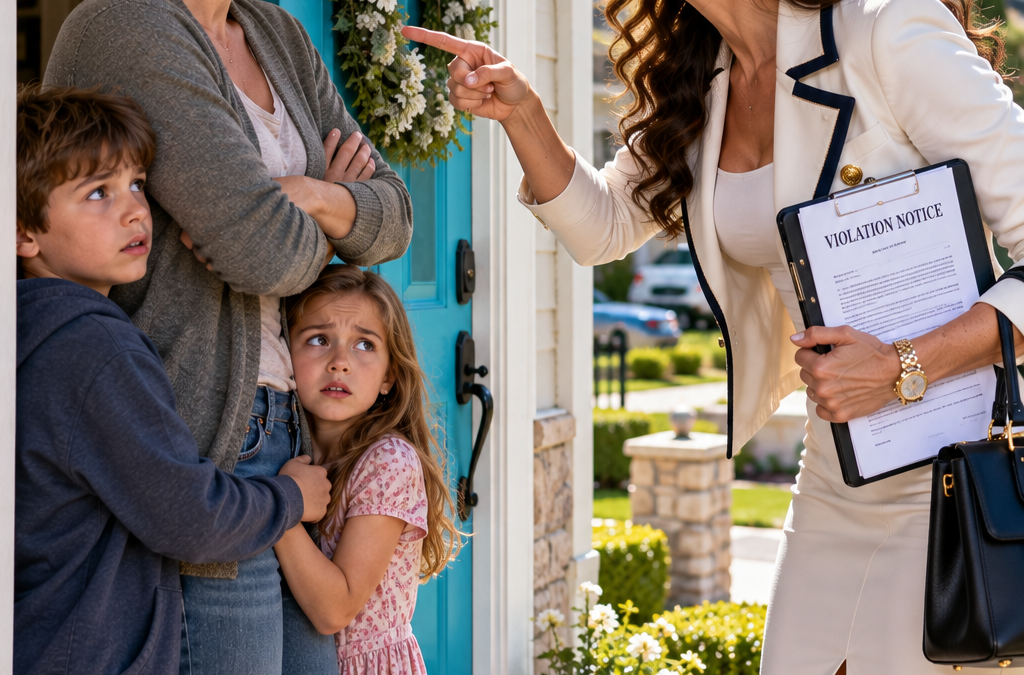
Two days later, Karen taped another notice to my door about the front door color.
The old one. Again.
Like she was playing her greatest hit.
I bought a cheap outdoor camera the following weekend. Originally, I told myself it was because there had been a few package thefts nearby. That was partly true. Mostly, I wanted proof. I was tired of finding paper on my door and imagining Karen’s manicured fingers pressing it there while my children’s backpacks hung inside and dinner boiled on the stove.
The camera caught everything.
Karen did not sneak.
That was almost the most disturbing part.
She walked up in broad daylight, usually dressed like she was on her way to a country club lunch, holding a clipboard or a folder, and taped notices to my door with the calm confidence of someone performing a public service. Sometimes she paused afterward and looked at the door, my porch, the kids’ plant, the welcome mat, as if searching for new violations.
She began slow drive-bys too.
Her pearl-white SUV would creep past my house at odd hours. Once, I saw it roll by three times in one afternoon. Another evening, while I was making spaghetti, Lily looked out the kitchen window and said, “Mom, the fancy mean lady is watching our door again.”
I turned.
Karen’s SUV was stopped across the street.
The driver’s window was down.
She was looking straight at my house.
I stepped outside.
The SUV pulled away.
After that, fear began mixing with anger.
It was no longer just paper. It was attention. Constant, unwanted attention from a woman who had decided my little house represented a flaw in her kingdom.
One Tuesday, I came home from work and found her standing on the sidewalk near my driveway with a clipboard pressed to her chest.
“Can I help you?” I asked, getting out of my car.
She didn’t look up right away. “Your vehicle is too close to the curb.”
I laughed because I honestly thought she was joking.
She lifted her head slowly. “This is not funny.”
“My car is in my driveway.”
“You are angled.”
“It’s a driveway. It’s literally angled.”
She made a note.
“Karen,” I said, “we’ve done this. I’m not in your HOA.”
“You benefit from our community.”
“I benefit from your community?”
“You use our roads.”
“They’re public roads.”
Her jaw tightened. “That’s not the point.”
And there it was.
The point was not roads. Or bylaws. Or community standards. Or color palettes.
The point was control.
Karen could not stand that my house sat on the edge of her perfect subdivision and refused to obey her. My door was bright. My kids’ bikes sometimes existed where people could see them. My porch plant leaned when I forgot to rotate it. My grass was cut, but not golf-course perfect. My trash can came out on pickup day and sometimes stayed there until after dinner because I was busy keeping two small humans alive.
Worst of all, she had no legal power over me.
So she tried to invent it.
The notices became more frequent and more ridiculous.
Grass height.
Improperly displayed address numbers.
Non-compliant porch furniture.
My porch furniture was one chair.
Not even a comfortable chair.
At first, I responded every time with facts.
I am not part of your HOA. Please stop contacting me. Attached are my deed and survey.
Then I stopped responding and simply documented.
Photos.
Videos.
Emails.
Dates.
Times.
Copies of every notice went into a binder I started keeping beside my desk.
A neighbor from the HOA side, an older man named Mr. Powell who walked a little brown dog past my house most mornings, stopped one day while I was pulling weeds.
“She’s doing it again?” he asked quietly.
I looked up. “Again?”
He glanced back toward the subdivision as if Karen might materialize from a hedge.
“Couple years ago, she went after a family near the far edge. Fence color, mailbox, holiday lights. Fines. Collections. They paid a bunch just to make it stop and moved not long after.”
“Were they in the HOA?”
He gave a small shrug. “I assumed so. She sure acted like they were.”
That sentence stayed with me.
She sure acted like they were.
That was Karen’s power. Not law. Not truth. Performance.
She dressed authority in nice clothes, expensive perfume, and official-looking letters. She spoke with such certainty that tired people, busy people, frightened people began to wonder if maybe fighting would cost more than surrender.
Then she made it financial.
The collections letter came on a Friday.
I remember because Fridays were pizza nights with the kids. Cheap frozen pizza if money was tight, delivery if I had survived the week with my sanity intact. That night was supposed to be delivery. Lily had gotten a good grade on her spelling test. Max had cleaned his room without turning it into a hostage negotiation. I had promised breadsticks.
The envelope was waiting in the mailbox.
Inside was a letter from a collections company stating that I owed $4,800 in unpaid HOA fines, late fees, and administrative costs.
$4,800.
I sat at the kitchen table while the oven preheated and read it three times.
My hands started to shake.
Not dainty trembling. Real shaking. The kind that makes paper rattle.
I was not poor in the way people imagine poor. The lights were on. The kids had shoes. The mortgage was paid. I could buy groceries, though I knew which store had cheaper eggs and which weeks required generic everything.
But I was not surprise-$4,800 fine.
I was not lawyer-on-retainer casual.
I was not someone who could absorb a financial punch thrown by a woman with a clipboard and a grudge.
Lily came into the kitchen. “Mom?”
I folded the letter fast. “Yeah, baby?”
“Can we get breadsticks?”
My throat closed.
“Yes,” I said. “Of course.”
I ordered the pizza. I smiled through dinner. I listened to Max explain a video game I did not understand and Lily describe the social politics of third-grade recess as if briefing the United Nations.
After they went to bed, I called the collections number.
The woman who answered sounded bored before I finished my first sentence.
“I am not part of this HOA,” I said, probably too fast. “This debt is invalid. They’ve been harassing me. I have my deed, survey, everything.”
“Ma’am, we have an account in your name with an outstanding balance.”
“But the account is wrong.”
“If you wish to dispute the debt, you will need to submit documentation in writing.”
“Where?”
She gave me an email address in the same tone someone might use to read cereal ingredients.
I sent everything.
Deed.
Survey.
Closing documents.
HOA boundary records.
Copies of notices.
Photos.
A timeline.
The PDF was so large it looked like I was applying for citizenship.
Then I did what I should have done sooner.
I searched my address on the county records website.
I didn’t even know exactly what I was looking for at first. I just had a bad feeling. The kind that starts in your stomach and spreads upward until your fingers go cold.
There it was.
A recorded lien.
Claim of lien.
My name.
My address.
The legal description of my property.
I clicked the document and stared at the screen.
The HOA had recorded a lien against my house for unpaid fines.
A house that was not in their HOA.
A debt I did not owe.
A claim they had no right to make.
For a few seconds, I couldn’t breathe normally.
A lien is not just a letter. It is not just a threat taped to a door. It sits in the records like a stain on your title. It can complicate refinancing. It can scare lenders. It can interfere with selling. It can turn your home—the one solid thing you fought for—into a legal mess.
It felt like Karen had walked into the county office and scribbled her name across my roof.
In the living room, the kids laughed in their sleep-show dreams, completely unaware.
I pressed one hand over my mouth and tried not to make a sound.
Because that was the moment it stopped being annoying.
That was the moment it became war.
The next morning, I called a real estate attorney.
Her name was Maya Bennett, and the first thing I liked about her was that she didn’t rush me. I told the story badly, in pieces, because anger and fear kept tripping over each other. I explained the house. The HOA boundary. The door. Karen. The notices. The collections letter. The lien.
When I finished, there was a pause.
Then Maya said, “Let me make sure I understand. They recorded a lien against your property even though your lot is not subject to their declaration?”
“Yes.”
“You have your deed and survey?”
“Yes.”
“And the HOA declaration?”
“No.”
“I can pull it.”
Then her voice changed.
Not louder.
Sharper.
“If your property is not subject to their recorded covenants, this is a serious problem for them.”
That was the first time in months I felt something other than cornered.
Maya moved fast.
She pulled the recorded HOA declaration, subdivision documents, my deed, my legal description, and the county records. Two days later, she called.
“You were right,” she said.
I closed my eyes.
“Your lot is explicitly excluded from the association. Their declaration defines the property subject to the HOA, and your property is not included. There is no annexation amendment. No recorded document adding your lot. Nothing.”
“So the lien?”
“Wrongful.”
“Then how did they record it?”
“County recorders generally review documents for format, not truth. If someone submits paperwork that looks recordable, it can end up in the records. That does not make it valid.”
I sat down on the edge of my bed.
“So what happens now?”
“Now,” Maya said, “we send letters they cannot ignore.”
The cease and desist letter went to the HOA, the management company, and the collections company.
Maya’s letter was nothing like mine.
Mine had been polite and pleading, full of please stop and attached again.
Hers was surgical.
It stated that my property was not subject to the HOA’s covenants. The fines were invalid. The debt was invalid. The recorded lien was wrongful and must be released immediately. All collection activity must stop. All further attempts to enforce HOA rules against my property would be treated as harassment and pursued accordingly. She demanded preservation of all communications, notices, fine records, board minutes, and documents related to my property.
I read it three times because watching a professional say what I had been trying to say for months felt like someone finally handed me oxygen.
The collections company backed off almost immediately.
They emailed Maya confirming the account was marked disputed and collection activity paused pending review.
The HOA did not back off.
Two days after Maya’s certified letter was delivered, Karen came to my door again.
The camera caught her perfectly.
She wore a fitted black dress, nude heels, large sunglasses, and a cream-colored coat draped over her shoulders like she expected wind machines. She walked up my porch steps holding another plastic-sleeved notice.
She knew about the attorney.
She knew she had been warned.
She looked directly into my camera, smiled, and taped the notice to my door.
When I came home, the notice said the HOA intended to proceed with enforcement actions, including foreclosure, if compliance was not achieved.
FORECLOSURE.
In bold.
My knees went weak.
Not because I believed they had the right.
Because they were willing to write the word.
They were willing to put it on my door where my children could see it.
Max saw my face before I could hide it.
“Mom?” he asked. “Is that more mean lady mail?”
I pulled the notice down and forced a smile so fake it hurt. “Nothing for you to worry about.”
But that night, after the kids were asleep, I forwarded the notice and the camera clip to Maya.
Her response came twenty minutes later.
Okay. If they want to play, we play.
The next week changed everything.
Maya contacted the HOA management company directly. Their first response was corporate and slippery, claiming they processed enforcement at the board’s direction. Maya replied by reminding them that participating in the recording and collection of an invalid lien could expose them to liability too.
Suddenly, they became more responsive.
She contacted individual board members.
Not just Karen.
All of them.
That was important.
Karen had thrived in darkness, making herself the voice, the face, the enforcer. Maya dragged the whole board into the light and asked each member to explain the legal basis for fining a property outside the association.
Within days, a board member named Daniel Cross emailed asking for clarification.
I sent one PDF.
Not emotional.
Just facts.
My deed.
My survey.
The HOA declaration.
The notices.
The collections letter.
The lien.
A timeline.
Maya told me not to write essays. “Let the documents do the talking.”
Documents, I learned, have a calm that angry people lack.
The HOA scheduled a board meeting.
I found out because Mr. Powell, the neighbor with the little brown dog, slipped a printed notice into my mailbox with a sticky note that said, Thought you should know.
I did not attend.
I wanted to. Part of me wanted to stand in that room, hold up the foreclosure notice, and ask each person whether they would enjoy explaining to my children why their home was at risk because Karen hated turquoise.
But Maya advised against it.
“Let them panic without you in the room,” she said.
So I stayed home, helped Lily with math homework, and checked my email every five minutes.
The next day, Maya requested records.
Any documents showing annexation of my property.
Any board vote adding my lot.
Any membership record.
Any legal opinion supporting enforcement.
Any communication regarding my property.
Any fine calculation.
Any authorization for the lien.
Made-up authority hates paperwork.
There was no annexation.
No vote.
No amendment.
No membership record.
No legal opinion.
There was just Karen.
Karen issuing notices.
Karen pushing the management company.
Karen telling the board my house was “functionally part of the community.”
Karen describing my blue door as a “visible challenge to neighborhood standards.”
Karen calculating fines.
Karen approving collections.
Karen signing off on the lien.
Karen sending an email that made Maya go silent for several seconds before reading it aloud to me.
We cannot allow noncompliant border homes to undermine our authority. If she is permitted to ignore standards, others will follow.
Border homes.
That phrase made my skin crawl.
I was not a neighbor to Karen. I was not a single mom. I was not a homeowner with kids and a mortgage and a fixer-upper that looked a little brighter because I painted the door.
I was a border problem.
A crack in the wall.
A woman to be made an example of.
Then came the note.
Not typed.
Handwritten.
Shoved between my front door and storm door with no envelope.
You are undermining this community. You will regret making enemies.
Signed Karen Whitcomb.
I stood on the porch reading it while the evening air pressed cool against my face.
For three seconds, I laughed.
Then I put it in a plastic sleeve like evidence from a crime show.
Maya laughed too, but hers was the dangerous kind.
“She signed it?” she asked.
“Yes.”
“Helpful.”
That was when we filed suit.
Wrongful lien.
Slander of title.
Harassment.
Violation of consumer collection protections where applicable.
Damages.
Attorney fees.
Whatever else Maya believed could stick.
I did not file because I wanted drama. I filed because the lien had crossed a line that polite letters could not uncross. Karen had put my home at risk on paper. She had threatened foreclosure after being warned. She had tried to scare me into paying money I did not owe.
I was not going to be the next family that paid to make her stop.
The HOA hired its own attorney.
That attorney, apparently, asked the one question nobody on the board had bothered to ask before recording a lien against my house.
Is her property actually in the HOA?
The board’s tone changed fast after that.
Not Karen’s.
The board’s.
The management company contacted Maya and offered to release the lien “as a courtesy.”
As a courtesy.
I remember Maya reading that phrase to me over the phone and waiting.
I said, “Absolutely not.”
“Good,” she said.
“I want it released, but not as a favor. I want them to admit it was wrong.”
“That’s the correct answer.”
The next few weeks were strange.
Life kept going in all the ordinary ways while a legal fight pulsed underneath it.
I packed lunches. I folded laundry. I drove Max to soccer. I helped Lily build a poster about sea turtles. I fixed a leaking sink with a video tutorial and language I told the kids never to repeat. I paid bills. I clipped coupons. I answered work emails.
And in the background, Maya applied pressure.
Records requests.
Settlement demands.
Draft pleadings.
Calls with the HOA’s attorney.
Preservation notices.
Every few days, a new piece of the picture emerged.
Karen had done this before in smaller ways. Fines for faded shutters. Fines for a plastic playhouse visible from the street. Fines for holiday lights kept up three days too long. Fines for fences and flower beds and basketball hoops. Most homeowners complied because fighting cost more than paint or storage bins.
The difference with me was that Karen had no authority at all.
So she tried to manufacture it.
Neighbors began reaching out quietly.
One woman messaged me from a private account and said Karen had once made her cry at a board meeting because her husband built a wheelchair ramp for his mother before submitting the right architectural form.
Another said Karen had driven by their house every morning for two weeks after they planted flowers she disliked.
Mr. Powell told me the family who moved away after the fence fight had paid nearly $3,000 just to end the stress.
“Why didn’t anyone stop her?” I asked him.
He looked embarrassed. “Because as long as she was aiming at someone else, people were relieved it wasn’t them.”
That was the saddest and most honest thing anyone said during the entire mess.
Karen finally confronted me in person again outside my house one afternoon in early spring.
I was unloading groceries.
She crossed the street with that same smooth, confident walk, her hair shining, sunglasses on, a pale pink blouse tucked into fitted jeans. She looked gorgeous, composed, and absolutely furious.
“You must be enjoying this,” she said.
I put a grocery bag on the porch. “Enjoying what?”
“Turning the neighborhood against me.”
“I didn’t do that.”
She laughed softly. “Please. You and your attorney have made quite a production.”
“You recorded a false lien against my house.”
“I enforced community standards.”
“My house is not in your community.”
“You live on the boundary. You benefit from our property values.”
“I pay my mortgage. I pay my taxes. I follow the law. I don’t owe you obedience because my house offends your view.”
Her lips tightened. “That door is garish.”
I stared at her.
After everything—the fines, the collections, the lien, the foreclosure threat—it still came back to the door.
“My kids picked that color,” I said.
“Then you should teach them that choices have consequences.”
Something in me went very still.
I stepped down one porch step.
Karen’s sunglasses hid her eyes, but I saw her chin lift.
“You can threaten me,” I said quietly. “You can glare at my house. You can write your little notes and pretend your clipboard is a crown. But do not talk about my children like they are part of your enforcement plan.”
For the first time, she stepped back.
Only half a step.
But I saw it.
“You’re emotional,” she said.
“Yes,” I said. “You threatened my home. I’m allowed to be.”
She recovered quickly, smiling with that fake softness I had come to hate. “This could all go away if you simply agreed to maintain your property according to our standards.”
“No.”
“Think carefully.”
“I have.”
Her smile vanished.
“You will regret humiliating me,” she said.
I picked up the grocery bag. “Karen, I’m not humiliating you. I’m documenting you.”
I went inside and locked the door.
The settlement meeting happened three months after the lawsuit was filed.
I sat in a conference room beside Maya while the HOA’s attorney joined remotely with two board members, the management company representative, and, to my surprise, Karen.
Even through a screen, Karen performed.
Perfect lighting. Perfect blouse. Perfect posture. She looked less like a defendant in a legal dispute and more like a lifestyle influencer about to explain how to arrange tulips.
Maya had warned me not to engage directly.
“Let me talk,” she said.
So I let her.
The HOA’s attorney opened by saying everyone wanted to resolve the matter without further expense.
Maya replied, “My client wanted that before your association recorded an invalid lien and threatened foreclosure.”
Karen leaned toward her camera. “The board acted in good faith based on community impact.”
Maya looked at her. “Mrs. Whitcomb, please identify the recorded covenant that subjects Ms. Harper’s property to your association.”
Karen’s face barely moved. “Her property benefits from—”
“That is not what I asked.”
The HOA attorney interrupted quickly. “We acknowledge there are concerns regarding the applicability of the governing documents.”
Maya smiled slightly. “There are not concerns. There are records. Her property is not included.”
The meeting lasted two hours.
Karen tried every angle.
Community character.
Aesthetic consistency.
Implied association.
Border impact.
Historic understanding.
Maintenance expectations.
Maya dismantled each one with documents.
At one point, Karen said, “If homes like hers ignore standards, our authority becomes meaningless.”
Maya replied, “Your authority is meaningless where it does not legally exist.”
I wrote that sentence down and looked at it whenever I needed strength.
The final settlement did not happen that day, but the terms were shaped there.
The HOA released the lien.
Not as a courtesy.
As part of a written settlement acknowledging that my property was not part of the HOA, had never been part of the HOA, and was not subject to its covenants, rules, fines, fees, or enforcement actions.
They sent written notice to the collections company that the alleged debt was invalid and must be withdrawn.
They paid my attorney fees.
They paid additional damages for the wrongful lien, the time, the stress, and the mess they had created.
They agreed that no HOA representative would enter my property, tape notices to my door, contact me for enforcement purposes, or claim authority over my home again.
Karen’s removal from the board was not written as a formal condition because, as Maya explained, I generally could not dictate internal HOA politics.
But two weeks after the settlement was signed, Mr. Powell walked by with his dog and gave me the news.
“She’s out.”
I was pulling weeds near the walkway. I sat back on my heels. “What?”
“Karen. Removed from the board last night.”
I stared at him.
He looked almost giddy. “Technically she resigned before the vote finished, but everyone knows.”
I sat there in the dirt, garden gloves on, not sure what I felt.
Relief came first.
Then exhaustion.
Then something that might have been satisfaction if I had had the energy for it.
“What happened?” I asked.
“People were furious about the settlement. Dues might go up. Insurance is asking questions. The board attorney apparently made it very clear she exposed everyone to liability.”
“And Karen?”
He smiled. “She said she was being punished for protecting standards.”
Of course she did.
A few days later, Karen’s house went quiet in a way that felt unnatural. No slow drive-bys. No clipboard walks. No white SUV pausing across from my porch. I saw her once at the subdivision entrance, standing beside another woman, talking sharply with one hand slicing the air. When she noticed me, she stopped.
I expected the glare.
I got it.
But it didn’t have the same power anymore.
A bully without borrowed authority is just an angry person standing too far away to matter.
When the settlement money came through, I did the boring responsible things first.
I paid down debt that had been hanging over me since the early fixer-upper days. I replaced the broken section of backyard fence where my dog, Biscuit, kept trying to escape into what I assume he believed was a better life. I fixed the upstairs bathroom pipe so it no longer sounded haunted. I put a little aside for emergencies because I never wanted to feel that helpless again.
Then I did the thing that made me cry.
I opened college funds for Max and Lily.
Not huge ones. Not miracle ones. But real accounts with their names attached to a future Karen could not tape a notice over.
When I told the kids, Max asked if college funds meant he had to go to college.
I said no, but it meant he would have choices.
Lily asked if she could use hers for art school.
I said yes.
Then she asked if art school allowed purple doors.
I hugged her so hard she complained.
The turquoise door stayed.
Of course it stayed.
In fact, after the settlement, I gave it a fresh coat.
Not because it needed one.
Because I did.
I sanded it lightly, wiped it clean, and painted slowly while music played from my phone. The kids helped for about fifteen minutes before getting bored and chasing Biscuit around the yard. The plant beside the door had somehow survived all of it, though barely, so I repotted it in a brighter pot.
A week later, a woman from the HOA side walked by and stopped.
I braced myself.
She looked at the door, then at me.
“I like the color,” she said.
I almost didn’t know how to answer.
“Thank you.”
She smiled awkwardly. “A lot of us do.”
Then she walked on.
I stood there with the paintbrush in my hand, feeling something inside me unclench.
That was when I realized Karen had not only been trying to control my house. She had been controlling the silence around it. People had opinions. People had doubts. People had discomfort. But Karen’s authority had made quiet seem safer.
Until it wasn’t.
The months after that were ordinary in the best possible way.
No letters.
No notices.
No collections calls.
No county records panic.
No camera clips of Karen on my porch.
The house still had problems because old houses are petty, living creatures. The kitchen faucet dripped again. The porch step needed work. The upstairs window stuck when it rained. But those were honest problems. Mine to solve, on my time, with money I could plan for.
One evening, almost a year after the first notice, I came home late from work.
The sky was deep blue, the kind that makes porch lights glow warmer than usual. Max was at a friend’s house. Lily was inside doing homework with the dramatic sighs of a child being oppressed by fractions. Biscuit barked like I had returned from war instead of a staff meeting.
I parked in the driveway and sat there for a moment.
The turquoise door was visible in the headlights.
Bright.
Stubborn.
Still there.
I thought about the first day I painted it. How small that happiness had been. How Karen looked at it and saw rebellion. How quickly a person with too much time and too much borrowed power could turn a color into a crisis, a crisis into fines, fines into a lien, a lien into a threat against someone’s home.
People sometimes say, “It’s just a door.”
They’re wrong.
It was never just a door.
It was the first thing my kids saw when we came home.
It was proof that the house did not have to stay tired forever.
It was a choice I made without asking a committee, without begging permission, without shrinking myself to fit someone else’s idea of acceptable.
Karen understood that better than anyone.
That was why she hated it.
She did not care about turquoise.
She cared that I chose it.
A few weeks later, I saw Karen one last time up close.
I was in the grocery store, standing in the cereal aisle comparing prices because some habits survive even after settlement checks. She turned the corner with a shopping basket over one arm.
For a second, we both froze.
She looked different.
Still beautiful. Still polished. But there was a tightness around her mouth that makeup couldn’t soften. Her hair was perfect, but her eyes were tired. Without the board behind her, without letters and notices and management companies acting on her commands, she looked smaller.
Not harmless.
Never that.
Just smaller.
Her gaze dropped to the cereal boxes in my hands, then back to my face.
“Still enjoying your little victory?” she asked.
I looked at her for a long moment.
A year earlier, that voice would have spiked my heart rate. It would have sent me home angry, shaken, replaying every word.
Now, I just felt tired.
“No,” I said. “I’m buying cereal.”
Her face tightened.
I put the cheaper box in my cart.
Then I added the name-brand one too, because Lily liked the marshmallows and some victories are quiet.
Karen watched me.
“You turned everyone against me,” she said.
I shook my head. “No. I stopped letting you use me to scare them.”
Her lips parted, but nothing came out.
I pushed my cart past her.
I did not look back.
That night, the kids ate cereal for dessert out of mugs because all the bowls were in the dishwasher and nobody felt like unloading it. We sat on the living room floor with Biscuit trying to nose his way into everyone’s food. Lily told me her art teacher said she had a good eye for color. Max said our door was still the best one on the street.
I said I agreed.
And I meant it.
The legal papers are still in the folder.
The settlement agreement. The lien release. The letter from the collections company confirming the debt was invalid. The recorded documents showing my title clear. The photos. The notices. The handwritten threat note in its plastic sleeve.
I keep them not because I want to relive it, but because I learned something.
Being right is not always enough.
You need proof.
You need records.
You need help.
You need to stop explaining reality to people who benefit from denying it.
Most of all, you need to know when politeness has become permission for someone else to keep hurting you.
Karen mistook my exhaustion for weakness.
She mistook my small house for vulnerability.
She mistook my single motherhood for isolation.
She mistook my bright door for something she could erase.
She was wrong every time.
I did not beat her because I was louder. I did not beat her because I had more money, more free time, or more power. I beat her because the truth was recorded before she ever taped the first notice to my door.
My house was never in her HOA.
My children were never subject to her standards.
My home was never hers to threaten.
And that door?
That bright, bold, cheerful turquoise door?
It is still the first thing I see when I come home.
Every time I turn into the driveway after a long day, every time the porch light catches that color, every time my kids run through it with backpacks, muddy shoes, art projects, and all the noise of a life Karen could not control, I feel the same quiet certainty.
She tried to make my home smaller.
Instead, she taught me exactly how fiercely it belonged to me.
𝗧𝗛𝗘 𝗘𝗡𝗗
The HOA Queen Put a Lien on My House for a Door She Had No Right to Control
Karen thought my bright front door was the first crack in her perfect neighborhood.
Then she tried to turn that crack into $4,800 in fake fines, a recorded lien, and a threat to take the only home my children had.
She picked a tired single mother because she thought I would be too scared to fight back, but she forgot that mothers learn how to become dangerous when someone threatens their roof.
The front door was supposed to be a happy thing.
That was all.
Just one cheerful, stubborn, beautiful thing in the middle of a life that had not been easy for a long time.
When I bought my house, nobody would have called it charming unless they were trying to sell it to me, which, of course, they were. The siding was faded. The porch sagged slightly on one side. The kitchen cabinets had that sticky old varnish that made every drawer sound like it was arguing with you. The backyard fence leaned in three directions, and the upstairs bathroom made a pipe-rattling groan every time someone flushed.
But it was mine.
Mine and my kids’.
I was a single mom with two children, a job that drained me, a savings account that never felt full enough, and the kind of budget where one surprise repair could turn a normal month into a math problem with no good answer. I had looked at houses for nearly a year before I found that tired little fixer-upper on a corner lot at the edge of a newer subdivision. Most buyers passed it by. I understood why. It needed paint, patience, and a person willing to see potential under neglect.
I saw it.
Or maybe I needed to see it.
Either way, when I signed the papers, I cried in my car afterward with the keys in my hand. Not the pretty kind of crying people do in movies. The exhausted kind. The kind where your whole body finally admits it has been holding fear for months.
The house sat on the border of a neighborhood with an HOA. That was one of the first things my realtor explained, because it mattered. The newer subdivision wrapped around one side of my street with its stone entrance sign, manicured lawns, matching mailbox posts, and a list of rules long enough to make a person afraid of planting flowers without legal review.
My house predated all of that.
My lot was older. Separate. Outside the recorded HOA boundary. The title company confirmed it. The county records confirmed it. My deed confirmed it. The subdivision declaration listed the lots subject to the association, and mine was not one of them.
That was part of why I could afford the place.
No HOA dues. No clubhouse fee. No pool I would never have time to use. No committee telling me what shade of beige counted as tasteful.
I liked that.
I needed that.
My kids did too.
For the first few months, we lived in survival mode. Boxes in corners. Cheap curtains. Frozen pizza. Homework at the kitchen table while I learned which light switches did nothing and which floorboards squeaked loud enough to wake the dead. Slowly, we made it ours.
My son, Max, claimed the smaller bedroom because it had “better spy angles” out the window. My daughter, Lily, chose the room with the slanted ceiling and spent three days arranging glow-in-the-dark stars above her bed. I painted the kitchen cabinets white over two weekends and only cried once. We bought a used couch from a woman who had three cats and swore none of them had peed on it. I chose to believe her.
Then, one Saturday, after months of responsible decisions and boring repairs, I decided to do something purely because it made me happy.
I painted the front door.
Not neon. Not wild. Not some offensive color visible from space.
It was a rich, bold turquoise-blue, bright enough to make the front of the house look awake. The kind of color that made me smile when I pulled into the driveway after work, when my shoulders ached and my brain was still full of emails and grocery lists and bills I needed to schedule.
The kids helped pick it.
Max wanted red because he said red doors looked “important.” Lily wanted purple because Lily wanted everything purple. We compromised on the turquoise because it looked like summer and hope, and hope had been in short supply.
We spent a whole weekend sanding, priming, painting, repainting, cleaning drips, and arguing about whether the welcome mat should have flowers or a fox on it. The kids chose the fox. They also insisted on a little ceramic pot with a plant beside the door, promising they would water it every day.
They watered it for six days.
After that, it became my plant.
Still, when it was done, the house looked different.
Less like a leftover.
More like a beginning.
Two days later, the first letter appeared.
It was taped to the front door at eye level, crisp white paper in a plastic sleeve, as if someone had served my little house official notice that happiness required approval.
NOTICE OF VIOLATION.
I remember standing on the porch with my work bag still over my shoulder, reading the words while Lily shouted from inside that she couldn’t find her sneakers and Max asked whether cereal counted as dinner.
The letter said my front door color violated the HOA’s exterior color guidelines. I had ten days to cure the violation before fines would be assessed.
At first, I thought it had to be a mistake.
I actually looked at the envelope as if maybe it belonged to one of the houses across the street. But my address was typed right there. My name too.
I read it twice.
Then I looked up.
Across the street, on the HOA side, a woman stood on the sidewalk with her arms folded.
She looked like she had been waiting for me to notice her.
She was around forty, maybe early forties, and beautiful in a way that felt sharpened rather than softened by age. Glossy dark hair fell in loose waves over one shoulder. Oversized sunglasses covered half her face. Her white tennis skirt and fitted navy top looked expensive enough to have their own care instructions. Gold bracelets gleamed at her wrist. Her lipstick was perfect. Her posture was perfect. Even the way she stood seemed arranged to imply ownership over everything she could see.
She did not wave.
She just tilted her head slightly, like a queen acknowledging a problem subject.
I should have gone inside.
I was tired. The kids were hungry. The letter was ridiculous enough to ignore.
But there is something about being watched on your own porch that pushes a button deep in the body.
So I walked across the street, letter in hand.
“Hi,” I said, trying to sound polite even though my pulse was already up. “I think this was delivered to the wrong house.”
She smiled.
Not kindly.
“Was it?”
“I’m not in the HOA.”
Her smile widened a little, like I was a child who had said something amusing and incorrect. “Yes, you are.”
I blinked. “No. I’m not.”
“I’m Karen Whitcomb,” she said, extending one manicured hand as if introducing herself at a charity luncheon. “HOA president.”
I looked at her hand.
Then at the letter.
Then back at her face.
“That still doesn’t make me part of your HOA.”
Her hand lowered slowly. Her smile stayed fixed. “Your home is in our community.”
“My home is beside your community.”
“It has been annexed.”
She said the word annexed with such confidence that for half a second my brain tried to make room for it.
“Annexed by who?” I asked.
“The board.”
“The board can’t just adopt my house.”
Karen gave a tiny laugh, soft and feminine and condescending enough to make my teeth touch. “You should read the neighborhood bylaws.”
“I don’t have neighborhood bylaws,” I said. “I have a mortgage.”
Her sunglasses tilted toward my bright blue door. “We’ll see.”
Then she turned and walked away.
Conversation over.
Just like that.
part2
That night, after the kids went to bed, I pulled out my house folder.
Every adult has one eventually. Mine was a thick accordion folder I kept in the bottom drawer of my desk because being a single mom teaches you that if you lose a document, the universe will pick the worst possible moment to ask for it.
Deed.
Survey.
Closing statement.
Title insurance.
Mortgage paperwork.
Inspection report.
The expensive little stack of proof that I had clawed my way into ownership.
I spread everything across the kitchen table and read until my eyes blurred.
My lot was outside the HOA boundary. Not kind of outside. Not maybe outside. Completely outside. The HOA declaration referenced the subdivision lots by number, and mine was not listed. The recorded plat showed my corner property sitting right against the edge like a stubborn tooth that had refused to become part of the smile.
I made copies the next morning.
I highlighted the relevant sections.
Then, because I was still under the delusion that paperwork and reason could stop a person like Karen, I put the copies in an envelope and walked them to her house.
Her house, of course, looked flawless. Brick exterior. Black shutters. Perfect landscaping. Seasonal wreath. Not a leaf out of place. It sat inside the HOA subdivision just far enough from my house to make her obsession feel even stranger.
Karen opened the door wearing a silk blouse, white pants, and the expression of a woman interrupted during something more important than justice.
I handed her the envelope.
“This is from my closing paperwork,” I said. “My property is not part of your HOA. Please stop putting notices on my door.”
She took the envelope between two fingers like it might leave a stain.
“I’ll review it.”
“Great.”
She began to close the door.
I put one hand up, not touching it, just stopping myself from being dismissed that easily. “Karen, I mean it. I don’t want trouble. I have two kids. I work full time. I’m fixing that house one paycheck at a time. I’m not bothering anyone.”
Her eyes moved over me.
No sunglasses this time.
They were green, sharp, and completely unmoved.
“Then compliance should be easy,” she said.
The door closed.
A week later, the next notice came.
Improper storage of waste containers.
My trash can had been visible from the street on pickup day.
Pickup day.
The day trash cans are supposed to be visible from the street.
Three days after that, another letter appeared.
Unsightly items on front porch.
The “items” were Max’s bike helmet and Lily’s jump rope, left outside for one afternoon after school.
Then came one about seasonal decorations.
My children had taped construction-paper ghosts in the front window for Halloween. They were crooked, lopsided, and adorable. Karen’s notice described them as unapproved holiday décor.
That was when my youngest started calling the letters “mean lady mail.”
I wish I could say I handled all of it with perfect dignity.
I did not.
I cried in the laundry room once, silently, while the dryer thumped behind me and the kids watched cartoons in the living room. Not because of the letters themselves. The letters were absurd. But absurdity becomes heavy when it keeps showing up at your door with deadlines and threats.
I emailed the HOA’s generic address.
Subject: Not in HOA, Please Stop.
I attached my deed excerpt, the survey, the recorded subdivision boundary, and a short message explaining the mistake.
The reply came two days later.
Your property is subject to community standards.
That was it.
No name.
No evidence.
No explanation.
Just one sentence pretending reality had already been decided.
I called the number on the notices. It went to voicemail. I left a message explaining again, carefully, that my house was not part of the HOA. Nobody called back.
Two days later, Karen taped another notice to my door about the front door color.
The old one. Again.
Like she was playing her greatest hit.
I bought a cheap outdoor camera the following weekend. Originally, I told myself it was because there had been a few package thefts nearby. That was partly true. Mostly, I wanted proof. I was tired of finding paper on my door and imagining Karen’s manicured fingers pressing it there while my children’s backpacks hung inside and dinner boiled on the stove.
The camera caught everything.
Karen did not sneak.
That was almost the most disturbing part.
She walked up in broad daylight, usually dressed like she was on her way to a country club lunch, holding a clipboard or a folder, and taped notices to my door with the calm confidence of someone performing a public service. Sometimes she paused afterward and looked at the door, my porch, the kids’ plant, the welcome mat, as if searching for new violations.
She began slow drive-bys too.
Her pearl-white SUV would creep past my house at odd hours. Once, I saw it roll by three times in one afternoon. Another evening, while I was making spaghetti, Lily looked out the kitchen window and said, “Mom, the fancy mean lady is watching our door again.”
I turned.
Karen’s SUV was stopped across the street.
The driver’s window was down.
She was looking straight at my house.
I stepped outside.
The SUV pulled away.
After that, fear began mixing with anger.
It was no longer just paper. It was attention. Constant, unwanted attention from a woman who had decided my little house represented a flaw in her kingdom.
One Tuesday, I came home from work and found her standing on the sidewalk near my driveway with a clipboard pressed to her chest.
“Can I help you?” I asked, getting out of my car.
She didn’t look up right away. “Your vehicle is too close to the curb.”
I laughed because I honestly thought she was joking.
She lifted her head slowly. “This is not funny.”
“My car is in my driveway.”
“You are angled.”
“It’s a driveway. It’s literally angled.”
She made a note.
“Karen,” I said, “we’ve done this. I’m not in your HOA.”
“You benefit from our community.”
“I benefit from your community?”
“You use our roads.”
“They’re public roads.”
Her jaw tightened. “That’s not the point.”
And there it was.
The point was not roads. Or bylaws. Or community standards. Or color palettes.
The point was control.
Karen could not stand that my house sat on the edge of her perfect subdivision and refused to obey her. My door was bright. My kids’ bikes sometimes existed where people could see them. My porch plant leaned when I forgot to rotate it. My grass was cut, but not golf-course perfect. My trash can came out on pickup day and sometimes stayed there until after dinner because I was busy keeping two small humans alive.
Worst of all, she had no legal power over me.
So she tried to invent it.
The notices became more frequent and more ridiculous.
Grass height.
Improperly displayed address numbers.
Non-compliant porch furniture.
My porch furniture was one chair.
Not even a comfortable chair.
At first, I responded every time with facts.
I am not part of your HOA. Please stop contacting me. Attached are my deed and survey.
Then I stopped responding and simply documented.
Photos.
Videos.
Emails.
Dates.
Times.
Copies of every notice went into a binder I started keeping beside my desk.
A neighbor from the HOA side, an older man named Mr. Powell who walked a little brown dog past my house most mornings, stopped one day while I was pulling weeds.
“She’s doing it again?” he asked quietly.
I looked up. “Again?”
He glanced back toward the subdivision as if Karen might materialize from a hedge.
“Couple years ago, she went after a family near the far edge. Fence color, mailbox, holiday lights. Fines. Collections. They paid a bunch just to make it stop and moved not long after.”
“Were they in the HOA?”
He gave a small shrug. “I assumed so. She sure acted like they were.”
That sentence stayed with me.
She sure acted like they were.
That was Karen’s power. Not law. Not truth. Performance.
She dressed authority in nice clothes, expensive perfume, and official-looking letters. She spoke with such certainty that tired people, busy people, frightened people began to wonder if maybe fighting would cost more than surrender.
Then she made it financial.
The collections letter came on a Friday.
I remember because Fridays were pizza nights with the kids. Cheap frozen pizza if money was tight, delivery if I had survived the week with my sanity intact. That night was supposed to be delivery. Lily had gotten a good grade on her spelling test. Max had cleaned his room without turning it into a hostage negotiation. I had promised breadsticks.
The envelope was waiting in the mailbox.
Inside was a letter from a collections company stating that I owed $4,800 in unpaid HOA fines, late fees, and administrative costs.
$4,800.
I sat at the kitchen table while the oven preheated and read it three times.
My hands started to shake.
Not dainty trembling. Real shaking. The kind that makes paper rattle.
I was not poor in the way people imagine poor. The lights were on. The kids had shoes. The mortgage was paid. I could buy groceries, though I knew which store had cheaper eggs and which weeks required generic everything.
But I was not surprise-$4,800 fine.
I was not lawyer-on-retainer casual.
I was not someone who could absorb a financial punch thrown by a woman with a clipboard and a grudge.
Lily came into the kitchen. “Mom?”
I folded the letter fast. “Yeah, baby?”
“Can we get breadsticks?”
My throat closed.
“Yes,” I said. “Of course.”
I ordered the pizza. I smiled through dinner. I listened to Max explain a video game I did not understand and Lily describe the social politics of third-grade recess as if briefing the United Nations.
After they went to bed, I called the collections number.
The woman who answered sounded bored before I finished my first sentence.
“I am not part of this HOA,” I said, probably too fast. “This debt is invalid. They’ve been harassing me. I have my deed, survey, everything.”
“Ma’am, we have an account in your name with an outstanding balance.”
“But the account is wrong.”
“If you wish to dispute the debt, you will need to submit documentation in writing.”
“Where?”
She gave me an email address in the same tone someone might use to read cereal ingredients.
I sent everything.
Deed.
Survey.
Closing documents.
HOA boundary records.
Copies of notices.
Photos.
A timeline.
The PDF was so large it looked like I was applying for citizenship.
Then I did what I should have done sooner.
I searched my address on the county records website.
I didn’t even know exactly what I was looking for at first. I just had a bad feeling. The kind that starts in your stomach and spreads upward until your fingers go cold.
There it was.
A recorded lien.
Claim of lien.
My name.
My address.
The legal description of my property.
I clicked the document and stared at the screen.
The HOA had recorded a lien against my house for unpaid fines.
A house that was not in their HOA.
A debt I did not owe.
A claim they had no right to make.
For a few seconds, I couldn’t breathe normally.
A lien is not just a letter. It is not just a threat taped to a door. It sits in the records like a stain on your title. It can complicate refinancing. It can scare lenders. It can interfere with selling. It can turn your home—the one solid thing you fought for—into a legal mess.
It felt like Karen had walked into the county office and scribbled her name across my roof.
In the living room, the kids laughed in their sleep-show dreams, completely unaware.
I pressed one hand over my mouth and tried not to make a sound.
Because that was the moment it stopped being annoying.
That was the moment it became war.
The next morning, I called a real estate attorney.
Her name was Maya Bennett, and the first thing I liked about her was that she didn’t rush me. I told the story badly, in pieces, because anger and fear kept tripping over each other. I explained the house. The HOA boundary. The door. Karen. The notices. The collections letter. The lien.
When I finished, there was a pause.
Then Maya said, “Let me make sure I understand. They recorded a lien against your property even though your lot is not subject to their declaration?”
“Yes.”
“You have your deed and survey?”
“Yes.”
“And the HOA declaration?”
“No.”
“I can pull it.”
Then her voice changed.
Not louder.
Sharper.
“If your property is not subject to their recorded covenants, this is a serious problem for them.”
That was the first time in months I felt something other than cornered.
Maya moved fast.
She pulled the recorded HOA declaration, subdivision documents, my deed, my legal description, and the county records. Two days later, she called.
“You were right,” she said.
I closed my eyes.
“Your lot is explicitly excluded from the association. Their declaration defines the property subject to the HOA, and your property is not included. There is no annexation amendment. No recorded document adding your lot. Nothing.”
“So the lien?”
“Wrongful.”
“Then how did they record it?”
“County recorders generally review documents for format, not truth. If someone submits paperwork that looks recordable, it can end up in the records. That does not make it valid.”
I sat down on the edge of my bed.
“So what happens now?”
“Now,” Maya said, “we send letters they cannot ignore.”
The cease and desist letter went to the HOA, the management company, and the collections company.
Maya’s letter was nothing like mine.
Mine had been polite and pleading, full of please stop and attached again.
Hers was surgical.
It stated that my property was not subject to the HOA’s covenants. The fines were invalid. The debt was invalid. The recorded lien was wrongful and must be released immediately. All collection activity must stop. All further attempts to enforce HOA rules against my property would be treated as harassment and pursued accordingly. She demanded preservation of all communications, notices, fine records, board minutes, and documents related to my property.
I read it three times because watching a professional say what I had been trying to say for months felt like someone finally handed me oxygen.
The collections company backed off almost immediately.
They emailed Maya confirming the account was marked disputed and collection activity paused pending review.
The HOA did not back off.
Two days after Maya’s certified letter was delivered, Karen came to my door again.
The camera caught her perfectly.
She wore a fitted black dress, nude heels, large sunglasses, and a cream-colored coat draped over her shoulders like she expected wind machines. She walked up my porch steps holding another plastic-sleeved notice.
She knew about the attorney.
She knew she had been warned.
She looked directly into my camera, smiled, and taped the notice to my door.
When I came home, the notice said the HOA intended to proceed with enforcement actions, including foreclosure, if compliance was not achieved.
FORECLOSURE.
In bold.
My knees went weak.
Not because I believed they had the right.
Because they were willing to write the word.
They were willing to put it on my door where my children could see it.
Max saw my face before I could hide it.
“Mom?” he asked. “Is that more mean lady mail?”
I pulled the notice down and forced a smile so fake it hurt. “Nothing for you to worry about.”
But that night, after the kids were asleep, I forwarded the notice and the camera clip to Maya.
Her response came twenty minutes later.
Okay. If they want to play, we play.
The next week changed everything.
Maya contacted the HOA management company directly. Their first response was corporate and slippery, claiming they processed enforcement at the board’s direction. Maya replied by reminding them that participating in the recording and collection of an invalid lien could expose them to liability too.
Suddenly, they became more responsive.
She contacted individual board members.
Not just Karen.
All of them.
That was important.
Karen had thrived in darkness, making herself the voice, the face, the enforcer. Maya dragged the whole board into the light and asked each member to explain the legal basis for fining a property outside the association.
Within days, a board member named Daniel Cross emailed asking for clarification.
I sent one PDF.
Not emotional.
Just facts.
My deed.
My survey.
The HOA declaration.
The notices.
The collections letter.
The lien.
A timeline.
Maya told me not to write essays. “Let the documents do the talking.”
Documents, I learned, have a calm that angry people lack.
The HOA scheduled a board meeting.
I found out because Mr. Powell, the neighbor with the little brown dog, slipped a printed notice into my mailbox with a sticky note that said, Thought you should know.
I did not attend.
I wanted to. Part of me wanted to stand in that room, hold up the foreclosure notice, and ask each person whether they would enjoy explaining to my children why their home was at risk because Karen hated turquoise.
But Maya advised against it.
“Let them panic without you in the room,” she said.
So I stayed home, helped Lily with math homework, and checked my email every five minutes.
The next day, Maya requested records.
Any documents showing annexation of my property.
Any board vote adding my lot.
Any membership record.
Any legal opinion supporting enforcement.
Any communication regarding my property.
Any fine calculation.
Any authorization for the lien.
Made-up authority hates paperwork.
There was no annexation.
No vote.
No amendment.
No membership record.
No legal opinion.
There was just Karen.
Karen issuing notices.
Karen pushing the management company.
Karen telling the board my house was “functionally part of the community.”
Karen describing my blue door as a “visible challenge to neighborhood standards.”
Karen calculating fines.
Karen approving collections.
Karen signing off on the lien.
Karen sending an email that made Maya go silent for several seconds before reading it aloud to me.
We cannot allow noncompliant border homes to undermine our authority. If she is permitted to ignore standards, others will follow.
Border homes.
That phrase made my skin crawl.
I was not a neighbor to Karen. I was not a single mom. I was not a homeowner with kids and a mortgage and a fixer-upper that looked a little brighter because I painted the door.
I was a border problem.
A crack in the wall.
A woman to be made an example of.
Then came the note.
Not typed.
Handwritten.
Shoved between my front door and storm door with no envelope.
You are undermining this community. You will regret making enemies.
Signed Karen Whitcomb.
I stood on the porch reading it while the evening air pressed cool against my face.
For three seconds, I laughed.
Then I put it in a plastic sleeve like evidence from a crime show.
Maya laughed too, but hers was the dangerous kind.
“She signed it?” she asked.
“Yes.”
“Helpful.”
That was when we filed suit.
Wrongful lien.
Slander of title.
Harassment.
Violation of consumer collection protections where applicable.
Damages.
Attorney fees.
Whatever else Maya believed could stick.
I did not file because I wanted drama. I filed because the lien had crossed a line that polite letters could not uncross. Karen had put my home at risk on paper. She had threatened foreclosure after being warned. She had tried to scare me into paying money I did not owe.
I was not going to be the next family that paid to make her stop.
The HOA hired its own attorney.
That attorney, apparently, asked the one question nobody on the board had bothered to ask before recording a lien against my house.
Is her property actually in the HOA?
The board’s tone changed fast after that.
Not Karen’s.
The board’s.
The management company contacted Maya and offered to release the lien “as a courtesy.”
As a courtesy.
I remember Maya reading that phrase to me over the phone and waiting.
I said, “Absolutely not.”
“Good,” she said.
“I want it released, but not as a favor. I want them to admit it was wrong.”
“That’s the correct answer.”
The next few weeks were strange.
Life kept going in all the ordinary ways while a legal fight pulsed underneath it.
I packed lunches. I folded laundry. I drove Max to soccer. I helped Lily build a poster about sea turtles. I fixed a leaking sink with a video tutorial and language I told the kids never to repeat. I paid bills. I clipped coupons. I answered work emails.
And in the background, Maya applied pressure.
Records requests.
Settlement demands.
Draft pleadings.
Calls with the HOA’s attorney.
Preservation notices.
Every few days, a new piece of the picture emerged.
Karen had done this before in smaller ways. Fines for faded shutters. Fines for a plastic playhouse visible from the street. Fines for holiday lights kept up three days too long. Fines for fences and flower beds and basketball hoops. Most homeowners complied because fighting cost more than paint or storage bins.
The difference with me was that Karen had no authority at all.
So she tried to manufacture it.
Neighbors began reaching out quietly.
One woman messaged me from a private account and said Karen had once made her cry at a board meeting because her husband built a wheelchair ramp for his mother before submitting the right architectural form.
Another said Karen had driven by their house every morning for two weeks after they planted flowers she disliked.
Mr. Powell told me the family who moved away after the fence fight had paid nearly $3,000 just to end the stress.
“Why didn’t anyone stop her?” I asked him.
He looked embarrassed. “Because as long as she was aiming at someone else, people were relieved it wasn’t them.”
That was the saddest and most honest thing anyone said during the entire mess.
Karen finally confronted me in person again outside my house one afternoon in early spring.
I was unloading groceries.
She crossed the street with that same smooth, confident walk, her hair shining, sunglasses on, a pale pink blouse tucked into fitted jeans. She looked gorgeous, composed, and absolutely furious.
“You must be enjoying this,” she said.
I put a grocery bag on the porch. “Enjoying what?”
“Turning the neighborhood against me.”
“I didn’t do that.”
She laughed softly. “Please. You and your attorney have made quite a production.”
“You recorded a false lien against my house.”
“I enforced community standards.”
“My house is not in your community.”
“You live on the boundary. You benefit from our property values.”
“I pay my mortgage. I pay my taxes. I follow the law. I don’t owe you obedience because my house offends your view.”
Her lips tightened. “That door is garish.”
I stared at her.
After everything—the fines, the collections, the lien, the foreclosure threat—it still came back to the door.
“My kids picked that color,” I said.
“Then you should teach them that choices have consequences.”
Something in me went very still.
I stepped down one porch step.
Karen’s sunglasses hid her eyes, but I saw her chin lift.
“You can threaten me,” I said quietly. “You can glare at my house. You can write your little notes and pretend your clipboard is a crown. But do not talk about my children like they are part of your enforcement plan.”
For the first time, she stepped back.
Only half a step.
But I saw it.
“You’re emotional,” she said.
“Yes,” I said. “You threatened my home. I’m allowed to be.”
She recovered quickly, smiling with that fake softness I had come to hate. “This could all go away if you simply agreed to maintain your property according to our standards.”
“No.”
“Think carefully.”
“I have.”
Her smile vanished.
“You will regret humiliating me,” she said.
I picked up the grocery bag. “Karen, I’m not humiliating you. I’m documenting you.”
I went inside and locked the door.
The settlement meeting happened three months after the lawsuit was filed.
I sat in a conference room beside Maya while the HOA’s attorney joined remotely with two board members, the management company representative, and, to my surprise, Karen.
Even through a screen, Karen performed.
Perfect lighting. Perfect blouse. Perfect posture. She looked less like a defendant in a legal dispute and more like a lifestyle influencer about to explain how to arrange tulips.
Maya had warned me not to engage directly.
“Let me talk,” she said.
So I let her.
The HOA’s attorney opened by saying everyone wanted to resolve the matter without further expense.
Maya replied, “My client wanted that before your association recorded an invalid lien and threatened foreclosure.”
Karen leaned toward her camera. “The board acted in good faith based on community impact.”
Maya looked at her. “Mrs. Whitcomb, please identify the recorded covenant that subjects Ms. Harper’s property to your association.”
Karen’s face barely moved. “Her property benefits from—”
“That is not what I asked.”
The HOA attorney interrupted quickly. “We acknowledge there are concerns regarding the applicability of the governing documents.”
Maya smiled slightly. “There are not concerns. There are records. Her property is not included.”
The meeting lasted two hours.
Karen tried every angle.
Community character.
Aesthetic consistency.
Implied association.
Border impact.
Historic understanding.
Maintenance expectations.
Maya dismantled each one with documents.
At one point, Karen said, “If homes like hers ignore standards, our authority becomes meaningless.”
Maya replied, “Your authority is meaningless where it does not legally exist.”
I wrote that sentence down and looked at it whenever I needed strength.
The final settlement did not happen that day, but the terms were shaped there.
The HOA released the lien.
Not as a courtesy.
As part of a written settlement acknowledging that my property was not part of the HOA, had never been part of the HOA, and was not subject to its covenants, rules, fines, fees, or enforcement actions.
They sent written notice to the collections company that the alleged debt was invalid and must be withdrawn.
They paid my attorney fees.
They paid additional damages for the wrongful lien, the time, the stress, and the mess they had created.
They agreed that no HOA representative would enter my property, tape notices to my door, contact me for enforcement purposes, or claim authority over my home again.
Karen’s removal from the board was not written as a formal condition because, as Maya explained, I generally could not dictate internal HOA politics.
But two weeks after the settlement was signed, Mr. Powell walked by with his dog and gave me the news.
“She’s out.”
I was pulling weeds near the walkway. I sat back on my heels. “What?”
“Karen. Removed from the board last night.”
I stared at him.
He looked almost giddy. “Technically she resigned before the vote finished, but everyone knows.”
I sat there in the dirt, garden gloves on, not sure what I felt.
Relief came first.
Then exhaustion.
Then something that might have been satisfaction if I had had the energy for it.
“What happened?” I asked.
“People were furious about the settlement. Dues might go up. Insurance is asking questions. The board attorney apparently made it very clear she exposed everyone to liability.”
“And Karen?”
He smiled. “She said she was being punished for protecting standards.”
Of course she did.
A few days later, Karen’s house went quiet in a way that felt unnatural. No slow drive-bys. No clipboard walks. No white SUV pausing across from my porch. I saw her once at the subdivision entrance, standing beside another woman, talking sharply with one hand slicing the air. When she noticed me, she stopped.
I expected the glare.
I got it.
But it didn’t have the same power anymore.
A bully without borrowed authority is just an angry person standing too far away to matter.
When the settlement money came through, I did the boring responsible things first.
I paid down debt that had been hanging over me since the early fixer-upper days. I replaced the broken section of backyard fence where my dog, Biscuit, kept trying to escape into what I assume he believed was a better life. I fixed the upstairs bathroom pipe so it no longer sounded haunted. I put a little aside for emergencies because I never wanted to feel that helpless again.
Then I did the thing that made me cry.
I opened college funds for Max and Lily.
Not huge ones. Not miracle ones. But real accounts with their names attached to a future Karen could not tape a notice over.
When I told the kids, Max asked if college funds meant he had to go to college.
I said no, but it meant he would have choices.
Lily asked if she could use hers for art school.
I said yes.
Then she asked if art school allowed purple doors.
I hugged her so hard she complained.
The turquoise door stayed.
Of course it stayed.
In fact, after the settlement, I gave it a fresh coat.
Not because it needed one.
Because I did.
I sanded it lightly, wiped it clean, and painted slowly while music played from my phone. The kids helped for about fifteen minutes before getting bored and chasing Biscuit around the yard. The plant beside the door had somehow survived all of it, though barely, so I repotted it in a brighter pot.
A week later, a woman from the HOA side walked by and stopped.
I braced myself.
She looked at the door, then at me.
“I like the color,” she said.
I almost didn’t know how to answer.
“Thank you.”
She smiled awkwardly. “A lot of us do.”
Then she walked on.
I stood there with the paintbrush in my hand, feeling something inside me unclench.
That was when I realized Karen had not only been trying to control my house. She had been controlling the silence around it. People had opinions. People had doubts. People had discomfort. But Karen’s authority had made quiet seem safer.
Until it wasn’t.
The months after that were ordinary in the best possible way.
No letters.
No notices.
No collections calls.
No county records panic.
No camera clips of Karen on my porch.
The house still had problems because old houses are petty, living creatures. The kitchen faucet dripped again. The porch step needed work. The upstairs window stuck when it rained. But those were honest problems. Mine to solve, on my time, with money I could plan for.
One evening, almost a year after the first notice, I came home late from work.
The sky was deep blue, the kind that makes porch lights glow warmer than usual. Max was at a friend’s house. Lily was inside doing homework with the dramatic sighs of a child being oppressed by fractions. Biscuit barked like I had returned from war instead of a staff meeting.
I parked in the driveway and sat there for a moment.
The turquoise door was visible in the headlights.
Bright.
Stubborn.
Still there.
I thought about the first day I painted it. How small that happiness had been. How Karen looked at it and saw rebellion. How quickly a person with too much time and too much borrowed power could turn a color into a crisis, a crisis into fines, fines into a lien, a lien into a threat against someone’s home.
People sometimes say, “It’s just a door.”
They’re wrong.
It was never just a door.
It was the first thing my kids saw when we came home.
It was proof that the house did not have to stay tired forever.
It was a choice I made without asking a committee, without begging permission, without shrinking myself to fit someone else’s idea of acceptable.
Karen understood that better than anyone.
That was why she hated it.
She did not care about turquoise.
She cared that I chose it.
A few weeks later, I saw Karen one last time up close.
I was in the grocery store, standing in the cereal aisle comparing prices because some habits survive even after settlement checks. She turned the corner with a shopping basket over one arm.
For a second, we both froze.
She looked different.
Still beautiful. Still polished. But there was a tightness around her mouth that makeup couldn’t soften. Her hair was perfect, but her eyes were tired. Without the board behind her, without letters and notices and management companies acting on her commands, she looked smaller.
Not harmless.
Never that.
Just smaller.
Her gaze dropped to the cereal boxes in my hands, then back to my face.
“Still enjoying your little victory?” she asked.
I looked at her for a long moment.
A year earlier, that voice would have spiked my heart rate. It would have sent me home angry, shaken, replaying every word.
Now, I just felt tired.
“No,” I said. “I’m buying cereal.”
Her face tightened.
I put the cheaper box in my cart.
Then I added the name-brand one too, because Lily liked the marshmallows and some victories are quiet.
Karen watched me.
“You turned everyone against me,” she said.
I shook my head. “No. I stopped letting you use me to scare them.”
Her lips parted, but nothing came out.
I pushed my cart past her.
I did not look back.
That night, the kids ate cereal for dessert out of mugs because all the bowls were in the dishwasher and nobody felt like unloading it. We sat on the living room floor with Biscuit trying to nose his way into everyone’s food. Lily told me her art teacher said she had a good eye for color. Max said our door was still the best one on the street.
I said I agreed.
And I meant it.
The legal papers are still in the folder.
The settlement agreement. The lien release. The letter from the collections company confirming the debt was invalid. The recorded documents showing my title clear. The photos. The notices. The handwritten threat note in its plastic sleeve.
I keep them not because I want to relive it, but because I learned something.
Being right is not always enough.
You need proof.
You need records.
You need help.
You need to stop explaining reality to people who benefit from denying it.
Most of all, you need to know when politeness has become permission for someone else to keep hurting you.
Karen mistook my exhaustion for weakness.
She mistook my small house for vulnerability.
She mistook my single motherhood for isolation.
She mistook my bright door for something she could erase.
She was wrong every time.
I did not beat her because I was louder. I did not beat her because I had more money, more free time, or more power. I beat her because the truth was recorded before she ever taped the first notice to my door.
My house was never in her HOA.
My children were never subject to her standards.
My home was never hers to threaten.
And that door?
That bright, bold, cheerful turquoise door?
It is still the first thing I see when I come home.
Every time I turn into the driveway after a long day, every time the porch light catches that color, every time my kids run through it with backpacks, muddy shoes, art projects, and all the noise of a life Karen could not control, I feel the same quiet certainty.
She tried to make my home smaller.
Instead, she taught me exactly how fiercely it belonged to me.