The Tiny Kitten Kept Forcing Herself to Sit Up—Then a Second Cry From the Place She Was Found Changed Everything
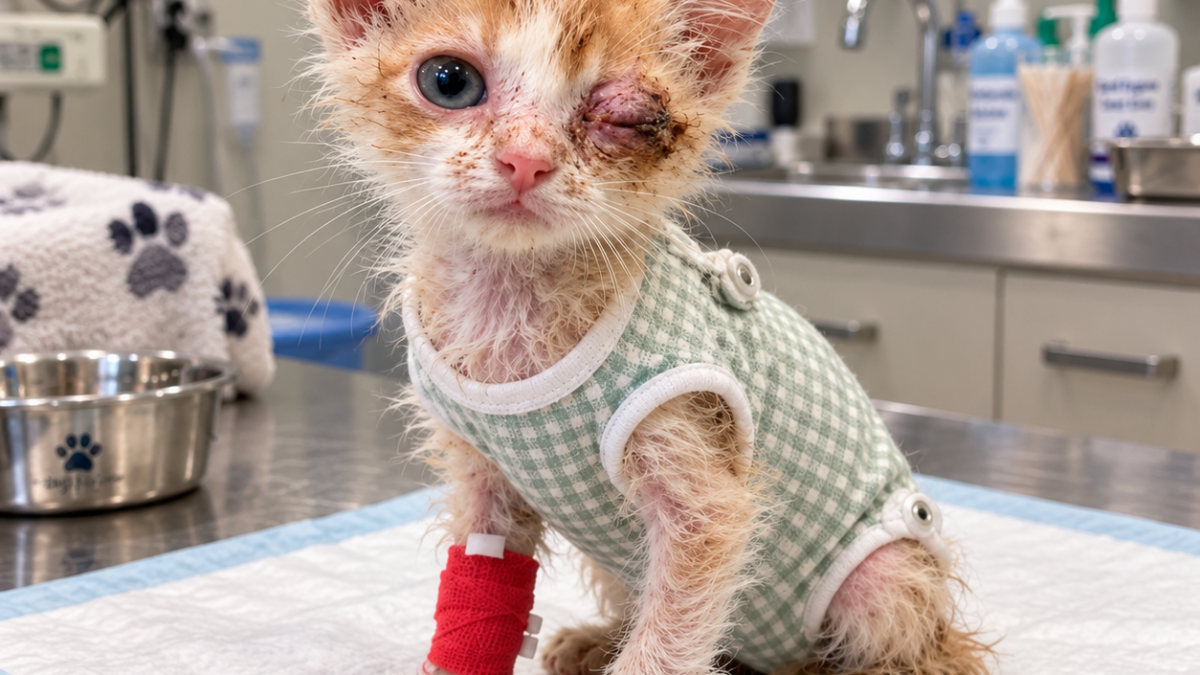
The veterinarian said the strangest thing about the dying orange-and-white kitten wasn’t her swollen eye or the fact that she weighed almost nothing—it was that every time we laid her down, she forced herself back into a sitting position.
She was exhausted enough that her paws shook beneath her, yet she kept staring past us toward the clinic doorway as though lying down meant she might miss whoever she was waiting for.
We didn’t understand what she was trying so desperately to stay awake for until the phone rang that evening and someone said they had heard another tiny cry coming from the place where she had been found.
My name is Megan Carter, and I was working the evening shift at a small veterinary rescue clinic when the kitten arrived wrapped inside an old gray towel.
The man who brought her in had found her behind a row of abandoned storage buildings near the edge of town.
He didn’t know where she had come from.
He only knew she had been sitting beside a rusted metal door when he spotted her.
By the time he carried her inside, she barely felt like an animal in his arms.
She felt like a bundle of fur and bones.
I opened the carrier.
For one second, nobody moved.
The kitten was tiny—maybe six or seven weeks old—with tangled orange-and-white fur pressed against a painfully narrow body.
One eye remained open.
Cloudy blue.
Watching.
The other was swollen shut beneath a thick crust of dried discharge.
“Oh, sweetheart.”
I reached in slowly.
She didn’t hiss.
Didn’t scratch.
Didn’t try to escape.
She simply let me lift her.
That frightened me more than aggression would have.
Healthy kittens fight.
Frightened kittens run.
This one seemed to have run out of both options.
Dr. Hannah Lewis placed her on the stainless-steel examination table.
The kitten’s front legs immediately trembled.
Her head lowered.
Then her chin touched the absorbent pad.
“Let her lie down,” Hannah said.
I gently shifted her onto her side.
Within seconds, the kitten pushed one paw beneath herself.
Then another.
Her whole body shook.
But she sat up again.
Hannah frowned.
“Why are you doing that?”
We tried once more.
Same thing.
Lay her down.
She struggled upright.
Not panicked.
Not fighting us.
Just determined.
As if sleep itself were dangerous.
We checked her temperature.
Too low.
Dehydrated.
Extremely underweight.
Her skin was irritated beneath the dirty fur.
The damaged eye needed immediate treatment, though we wouldn’t know yet how much vision could be saved.
I secured a tiny IV catheter beneath red wrap on her front leg while Hannah prepared medication and fluids.
Then we slipped her into a soft green recovery suit to protect the irritated skin and help conserve warmth.
The suit nearly swallowed her.
For a moment, she sat beneath the clinic lights surrounded by gauze, bottles, metal trays, and strangers.
Then I placed a small bowl of recovery food nearby.
She looked at it.
But instead of moving toward the food, she looked toward the doorway.
Again.
And again.
Every few seconds.
I crouched beside her.
“What are you looking for?”
Her open eye followed the hallway.
Hannah noticed.
“Could there have been another kitten?”
“Maybe.”
“A mother?”
“Maybe.”
We had no answers.
The man who found her said he had only seen one animal.
For now, all we could do was keep this one alive.
Eventually, her posture softened.
I reached toward her carefully.
I expected her to shrink away.
Instead, she leaned forward.
Her tiny forehead pressed against the palm of my hand.
Only for a few seconds.
Then she sagged.
That small gesture broke something in me.
After everything her body had endured, she still believed a gentle hand might be worth trusting.
By evening, we had stabilized her enough to settle her into a warmed recovery kennel.
For the first time, she stopped forcing herself upright.
She curled beneath the blanket.
Her breathing became slow.
Quiet.
I had just begun writing her overnight notes when the clinic phone rang.
The caller was the same man who had found her.
“Megan,” he said, breathless. “I went back.”
My hand tightened around the phone.
“Back where?”
“To the storage building.”
Then he said the words that made all of us turn toward the sleeping kitten.
“I heard another baby crying inside the wall.”
PART 2
For half a second, I thought I had misunderstood him.
“Inside the wall?”
“That’s what it sounds like.”
The man’s name was Daniel Morris. He worked at an auto-parts warehouse across the road from the abandoned storage units, and he was the one who had found the kitten at the end of his shift.
His voice was shaking now.
“I came back because I kept thinking about where she came from.”
“Daniel, don’t start tearing anything open.”
“I haven’t.”
“Can you see anything?”
“No. There’s a gap near the bottom of the siding. I heard something behind it.”
“A kitten?”
“I think so.”
I looked through the glass panel into our recovery room.
The orange-and-white kitten was asleep.
For the first time since arriving, she was lying fully on her side.
One paw curled under her chin.
The red IV wrap looked enormous on her front leg.
I suddenly remembered the way she had kept forcing herself upright.
The doorway.
The hallway.
Listening.
Waiting.
“Hannah.”
Dr. Hannah Lewis looked up from the computer.
“What?”
“There may be another one.”
She was already standing.
“I’m going.”
“So am I.”
Hannah pointed toward the treatment room.
“You’re on shift.”
“So are you.”
“And I’m the veterinarian.”
“Exactly. You’re harder to replace.”
She glared.
Daniel’s voice came through the phone.
“Should I call animal control?”
“Yes,” I said. “And the fire department if the structure looks unsafe. Do not crawl inside.”
“I’m not leaving.”
“I didn’t ask you to.”
That sentence surprised me.
Maybe because it was exactly what I imagined our little patient had been thinking all day.
Don’t leave.
Hannah looked at me.
“I’ll stay with her. Take Chloe.”
Chloe was our veterinary technician and, more importantly, the smallest adult in the building, which had become relevant on more rescue calls than I could count.
Ten minutes later, Chloe and I were in my car.
The drive took twelve minutes.
It felt like forty.
Rain had started.
Not heavy.
Just enough to turn the road glossy beneath streetlights.
When we reached the storage property, Daniel was standing outside the third unit with a flashlight.
An animal-control truck had just arrived.
Officer Marcus Reed climbed out.
I knew him from other neglect cases.
“What do we have?”
“Possible kitten inside the structure.”
Marcus looked toward the building.
It was worse than I expected.
Old metal siding.
Sagging roof.
Broken window.
A padlock hung uselessly from a door that no longer closed properly.
We entered carefully.
The smell came first.
Dust.
Rotting wood.
Mouse droppings.
Standing water.
Then Daniel raised one hand.
“Listen.”
Everybody stopped.
At first, nothing.
Rain against the roof.
Traffic in the distance.
Then—
A sound.
So small I almost thought I imagined it.
“Meeeh.”
Chloe’s eyes widened.
“There.”
Again.
“Meeeh.”
Not from the open room.
From somewhere behind a stack of broken shelving.
We moved boxes.
Slowly.
Carefully.
Behind them was a section where corrugated metal had pulled away from the interior framing.
A narrow gap opened into darkness.
Daniel knelt.
“That’s where I heard it.”
Marcus shined his light.
Nothing.
Then two tiny eyes reflected back.
“Oh my God,” Chloe whispered.
A kitten.
Smaller than the first.
Gray and white.
Wedged between broken insulation and a wooden beam.
“Can you reach?” I asked.
Chloe lowered herself.
“Maybe.”
Marcus stopped her.
“Wait.”
The wall section was unstable.
One wrong movement and loose material could fall.
He called the fire department.
Ten minutes later, two firefighters arrived.
One removed a section of damaged siding while another stabilized the loose frame.
The crying became louder.
Then another sound answered.
Not one kitten.
Two.
Chloe covered her mouth.
“No.”
We widened the opening.
The first kitten was gray and white.
Behind him, almost completely hidden, was a black kitten.
Both thin.
Both filthy.
But moving.
Alive.
Chloe reached in.
The gray kitten hissed.
That sound made me smile.
“Good.”
Daniel looked confused.
“He’s scared.”
“Scared is energy.”
Chloe wrapped him in a towel.
Then reached again.
The black kitten tried to crawl backward.
He had more strength than his sister at the clinic.
But not much.
We got him out too.
Marcus shined the flashlight deeper.
“Anything else?”
We listened.
Nothing.
Then Daniel said:
“Wait.”
He moved toward the rear of the building.
“What?”
“I saw something earlier.”
He pointed to the floor.
Small paw prints.
Larger than the kittens’.
They crossed a dusty section near the back wall.
Mother.
Possibly.
Chloe looked at me.
“If she’s here—”
“We search.”
For forty minutes, we checked every accessible corner.
No adult cat.
But we found evidence.
A nesting area made from torn insulation.
Food wrappers.
A damaged cardboard box.
Small feces.
And near an opening in the rear wall, a trail leading outside.
Marcus photographed everything.
I carried the gray kitten.
Chloe held the black one.
Daniel stood watching the empty nesting space.
“You think the orange one crawled out first?”
“Maybe.”
“Why?”
I looked toward the gap.
“She may have been looking for help.”
That was speculation.
I knew it.
But something about the way she had sat at the clinic doorway returned to me.
Maybe she was simply disoriented.
Maybe the sitting had nothing to do with her siblings.
Maybe we humans were assigning meaning because meaning helps us tolerate suffering.
Still, three kittens had been here.
One got out.
Two remained trapped.
And the one who got out had nearly died doing it.
We brought both kittens to the clinic.
Hannah was waiting at the entrance.
The moment she saw the towels, she sighed.
“How many?”
“Two.”
“Of course.”
“Possibly a mother.”
“Of course.”
The gray kitten went onto one exam table.
The black kitten onto another.
Our orange patient woke when she heard them.
I will never forget what happened next.
The gray kitten cried.
The orange kitten’s head lifted.
Weakly.
Slowly.
Then she tried to sit.
Hannah looked at me.
We both froze.
Another cry.
The orange kitten answered.
Not loudly.
A tiny raspy sound.
Almost nothing.
But the gray kitten stopped moving.
Then cried again.
I carried him closer.
The orange kitten stretched her neck.
Their noses touched through the bars of the recovery kennel.
For the first time all day, she stopped looking toward the doorway.
Hannah whispered:
“Well.”
I swallowed.
“That explains something.”
We named her Clementine.
Orange-and-white.
Tiny.
Stubborn.
Clementine.
The gray kitten became Ash.
The black kitten became Pepper.
Their conditions were serious, but Clementine was clearly the sickest.
Ash was dehydrated and underweight.
Pepper had parasites and an upper respiratory infection beginning.
Neither had the severe eye damage Clementine had.
That raised another question.
Why her?
What had happened to that eye?
Was it infection?
Trauma?
Something congenital?
Hannah cleaned it carefully.
Under the crusting, the tissue was badly inflamed.
“We might save it.”
“Vision?”
“I don’t know.”
“But the eye?”
“Maybe.”
That became our first goal.
Not perfect sight.
Not cosmetic recovery.
Comfort.
Function if possible.
Pain control.
Clementine received antibiotics, ophthalmic medication, fluids, nutritional support, and warming.
Ash and Pepper received their own treatment plans.
All three were isolated because of infection concerns, but we positioned their enclosures where they could smell and hear one another safely.
Clementine changed almost immediately.
She still tried to sit.
But not constantly.
When Ash cried, her ears moved.
When Pepper shifted, she looked over.
Then she rested.
Really rested.
Hannah stood beside me.
“You were right.”
“About what?”
“She wasn’t afraid to lie down.”
“What then?”
“Maybe she was trying to stay alert.”
“To protect them?”
Hannah shook her head.
“Careful.”
I knew.
We could not know what she was thinking.
But we could observe behavior.
Before the siblings arrived, Clementine repeatedly forced herself upright and monitored the doorway.
After they arrived, that behavior decreased.
That was enough.
Around midnight, Daniel returned.
He had gone home, showered, changed, then come back carrying three tiny fleece blankets.
“You bought those?”
“My sister had them.”
“For cats?”
“For a baby doll.”
I laughed.
“That works.”
He stood at Clementine’s enclosure.
“She looks different.”
“She’s sleeping.”
“No. Her face.”
“Medication.”
He shook his head.
“Not that.”
I looked.
He was right.
Her entire expression had softened.
Daniel asked:
“Can they stay together?”
“Not yet.”
“Eventually?”
“If they recover and testing allows it.”
He nodded.
Then:
“What about their mother?”
“We’re going back.”
“When?”
“Morning.”
“I’m coming.”
Marcus and a small rescue team returned to the warehouse at sunrise.
We set humane traps.
Food.
Water.
Cameras.
We searched the surrounding lots.
Nothing.
Day one.
No mother.
Day two.
A raccoon investigated the trap and insulted all of us by stealing food without entering.
Day three.
A thin adult orange-and-white cat appeared on camera at 2:14 a.m.
My heart jumped when Marcus sent the image.
Same coloring as Clementine.
Adult female.
Nursing signs visible.
“She’s alive.”
Daniel responded immediately:
“WHEN DO WE GO?”
That evening we repositioned the trap.
At 11:47 p.m., the camera notification came.
Trap door closed.
Cat inside.
I drove there in pajamas under my coat.
I was not proud.
Daniel beat me by five minutes.
The cat was terrified.
Growling.
Throwing herself against the trap.
“Easy,” I whispered.
No approach.
No hands.
We covered the trap with a blanket.
Brought her to the clinic.
Hannah checked her under sedation.
Underweight.
Fleas.
Parasites.
Minor wounds.
But overall much healthier than Clementine.
She had likely been leaving the warehouse to forage.
Her kittens couldn’t.
Maybe Clementine had followed.
Maybe she had slipped through the wall gap.
Whatever happened, that tiny escape had led us back to the others.
We named the mother Maple.
The reunion happened gradually and safely.
When Maple woke and heard Ash crying, she became frantic.
Hannah looked at me.
“That’s our answer.”
We brought the carrier closer.
Maple sniffed.
Ash cried.
Maple pressed against the carrier door.
Once medical concerns were addressed and it was safe, we allowed supervised contact.
Maple went first to Clementine.
She sniffed her face.
Then began licking the top of her head.
Clementine collapsed beneath her.
Not from weakness.
Relaxation.
Her entire little body went limp against her mother’s chest.
I cried.
Chloe cried.
Daniel absolutely cried despite denying it later.
Maple cleaned Clementine’s damaged eye area carefully.
Then Ash.
Then Pepper.
All three kittens pressed into her.
Hannah whispered:
“There’s your family.”
For the next several days, something remarkable happened.
Clementine improved.
Not miraculously.
Medicine mattered.
Nutrition mattered.
Warmth mattered.
But stress reduction mattered too.
She ate more.
Slept more deeply.
Gained weight.
Her temperature stabilized.
Her skin irritation improved.
And she stopped fighting rest.
That was what affected me most.
The kitten who had forced herself upright under bright clinic lights now slept with her body curved against Maple’s belly.
No watching the door.
No lifting her head at every hallway sound.
Whatever she had been waiting for, she had it now.
But the story of how they ended up in that warehouse remained unresolved.
Marcus kept investigating.
The property had been abandoned commercially, but not technically ownerless.
A real-estate holding company had acquired it eighteen months earlier.
Security inspections were supposed to happen monthly.
Records showed they had.
That bothered Marcus.
“How do three kittens and a mother live inside without anybody noticing?”
“Maybe inspectors never entered that section.”
“They signed that they did.”
That was the first crack.
He contacted the inspection contractor.
A man named Raymond Ellis.
Raymond admitted he sometimes conducted exterior-only checks and signed full inspection sheets anyway.
“Because the building was empty,” Marcus told me.
“Apparently not.”
“No.”
“Did Raymond see the cats?”
“He says no.”
“Believe him?”
“Don’t know.”
Then surveillance footage from a nearby business changed things.
A camera pointed toward the side alley behind the storage units.
Poor quality.
Wide angle.
But enough.
Three weeks before Clementine’s rescue, a pickup truck had stopped near the rear entrance.
A man got out.
He carried a plastic storage bin.
Set it near the wall.
Opened it.
Walked back to the truck.
The adult cat emerged first.
Then several tiny shapes.
My stomach dropped.
“Someone dumped them.”
Marcus paused the video.
“Yes.”
The truck drove away.
Maple stayed near the bin.
Kittens around her.
Clementine.
Ash.
Pepper.
Possibly one more.
I leaned closer.
“How many?”
“Hard to tell.”
We watched again.
There might have been four kittens.
Maybe a shadow.
Maybe not.
Daniel was beside me.
“If there was another—”
“I know.”
We searched the warehouse again.
No fourth kitten.
No remains.
Nothing.
The video resolution made identification difficult.
But the truck had one distinctive feature.
A damaged white rear panel.
Marcus circulated the image.
Two days later, someone recognized it.
The truck belonged to a handyman named Curtis Bell.
He had previously done maintenance at the property.
Marcus interviewed him.
Curtis denied everything.
Then the footage was shown.
His story changed.
He said the cats were not his.
Someone had left them near a rental property where he worked.
He “relocated” them.
“To an abandoned warehouse?” I asked when Marcus told me.
“That’s his wording.”
“Relocated.”
“Yes.”
“Did he leave food?”
“No.”
“Water?”
“No.”
“Did he tell anyone?”
“No.”
I felt physically sick.
Maple had not simply wandered into danger.
A human being had placed a nursing mother and kittens in an abandoned industrial building because moving the problem somewhere unseen was easier than solving it.
That made Clementine’s struggle different.
Three weeks.
Three weeks of Maple leaving to search for food.
Three weeks of kittens growing weaker.
Three weeks of disease spreading through Clementine’s eye.
Then one tiny kitten crawled outside.
Maybe accidentally.
Maybe following her mother.
Maybe because hunger pushed her.
Daniel found her because he saw movement.
The entire family existed now because one weak kitten had been visible long enough for one person to stop.
Curtis faced an animal-abandonment investigation.
His defense was exactly what you would expect.
He didn’t intend harm.
He thought the mother cat could care for them.
He had seen stray cats survive outdoors.
The warehouse offered shelter.
He believed someone nearby might feed them.
Every sentence shifted responsibility toward an imaginary future stranger.
Someone would help.
Someone would notice.
Someone would feed them.
Nobody had been asked.
No rescue called.
No shelter contacted.
No humane trap borrowed.
No veterinary clinic.
Just a mother and babies moved from one inconvenient place to somewhere they could suffer privately.
The case took months.
I wish I could tell you there was a dramatic courtroom confrontation.
There wasn’t.
Real accountability often arrives through documents.
Photographs.
Veterinary statements.
Video.
Statements.
Fines.
Animal-ownership restrictions.
Mandatory education.
Restitution.
The evidence established abandonment and failure to provide adequate care after relocation.
Curtis was ordered to pay toward the veterinary expenses and prohibited from possessing animals for a period under the court’s conditions.
I attended the hearing.
Not because Clementine needed revenge.
She didn’t know Curtis existed.
I attended because I wanted the record to say clearly:
Moving an animal somewhere unseen is not rescue.
It is abandonment.
Outside court, Curtis approached me.
He was older than I expected.
Maybe fifty.
Work-worn hands.
Tired face.
He didn’t look like a monster.
Few people do.
“Are they alive?”
I stopped.
“All four.”
He looked surprised.
“The mother too?”
“Yes.”
He nodded.
“I figured she’d be okay.”
I stared at him.
“One kitten nearly lost an eye.”
His face changed.
“I didn’t know.”
“That’s the problem.”
“I thought cats survive.”
“Some do.”
“I didn’t hurt them.”
“You put them somewhere without food or water.”
“There were mice.”
That sentence made me furious.
“Mice?”
He looked away.
“I thought she’d hunt.”
“She was nursing.”
“I know.”
“No. You know now.”
Marcus stood nearby but did not intervene.
Curtis whispered:
“I should’ve called someone.”
“Yes.”
“I panicked.”
“Why?”
“The landlord wanted them gone. He told me to handle it.”
“Handle it.”
“I thought moving them was better than—”
He stopped.
“Better than what?”
Nothing.
I suddenly wondered if the original property owner had threatened something worse.
Poison.
Removal.
Animal control.
I never learned.
It didn’t matter.
There had been legal options.
Humane options.
He chose the easiest option for himself.
I said:
“You didn’t solve a problem. You moved suffering somewhere you didn’t have to watch it.”
He looked at me.
That landed.
Good.
Not because I wanted pain.
Because truth should land somewhere.
Clementine’s eye recovery became its own long story.
The swelling decreased.
Infection responded.
But the cornea had been badly damaged.
Hannah brought in a veterinary ophthalmologist.
Dr. Patel examined her.
Clementine sat in my hands wearing the tiny green recovery suit, now actually fitting her because she had gained weight.
“Vision?” I asked.
“Limited.”
“Can we save the eye?”
“Probably.”
“Pain?”
“Improving.”
That became enough.
Over weeks, the cloudy blue eye changed.
Some clarity returned.
Not perfect.
She would never see normally through it.
But she could detect light.
Movement.
Shapes.
And most importantly, it no longer hurt.
Her other eye opened fully.
Bright amber.
The first time she looked at me with both eyes, uneven though they were, I laughed.
“There you are.”
Clementine meowed.
Very loudly.
The quiet clinic patient developed a voice.
A serious one.
Meal late?
Meow.
Door closed?
Meow.
Maple bathing her against her will?
Outrage.
Pepper sitting on her?
Immediate legal complaint.
Her siblings recovered faster.
Ash became fearless first.
Pepper became enormous compared with the others and developed a habit of sleeping directly on top of everyone.
Clementine remained the smallest.
But she became the boss.
Maybe because she had survived being weak.
Maybe simply because she was orange.
The laws of orange cats are mysterious.
By eight weeks after rescue, all three kittens could run.
That day nearly broke me.
We had set up a safe playroom.
Ash chased a plastic spring.
Pepper attacked a paper bag.
Clementine watched.
Then Ash ran past.
Clementine launched.
Not graceful.
One front paw slipped.
She recovered.
Then chased him across the room.
Daniel was filming.
“You got that?”
“I got it.”
“Send it.”
“You’re standing next to me.”
“Send it.”
He did.
I watched immediately.
The kitten who once struggled merely to sit was running so fast the video blurred.
I saved it.
Maple watched from a window perch.
Calm.
Her job changing too.
The kittens needed her less.
They ate independently.
Played.
Explored.
Clementine still slept against her sometimes.
But not from desperation.
Choice.
There is an enormous difference.
Adoption discussions began.
At first, we considered placing the kittens separately.
They were young enough to adapt.
But Clementine and Ash had formed a particularly strong attachment.
When Ash disappeared from the room, Clementine searched.
When Clementine had eye treatments, Ash waited nearby.
Pepper loved everybody.
Maple seemed ready for quieter independence once the kittens matured.
Behaviorally, the best pairing looked like Clementine and Ash.
Pepper could go to a home with another young cat.
Maple needed someone patient who understood adult former strays.
Applications came.
Many wanted Clementine because of her story.
That worried me.
I did not want anyone adopting “the kitten who almost died.”
That was not who she was anymore.
She was a loud, food-obsessed, partially sighted orange criminal who climbed curtains.
Important distinction.
One applicant wrote:
“I feel like she will always know I saved her.”
Rejected.
Animals do not owe eternal gratitude.
Another wanted her alone because “she deserves all the attention.”
No.
Clementine deserved what Clementine needed.
Then the Harper family applied.
Jason and Rebecca.
Two children, twelve and fifteen.
One senior cat named Oliver.
Indoor-only household.
Long veterinary history.
They were interested in two kittens.
They did not specify Clementine.
That made me interested immediately.
They visited.
Ash approached first.
Of course.
He climbed onto Jason’s shoe.
Pepper attacked Rebecca’s purse.
Clementine sat three feet away.
Watching.
Their fifteen-year-old son, Noah, sat on the floor.
He did not call her.
Good.
Clementine approached eventually.
Sniffed his knee.
Then climbed into his lap.
Noah froze.
“Can I touch her?”
“Yes.”
“Where?”
“Behind the ears.”
He did.
Clementine pressed her forehead into his hand.
Exactly like she had done to mine at the clinic.
I had to look away.
Rebecca noticed.
“Are you okay?”
“Perfect.”
Clementine stayed.
Ash eventually climbed into Noah’s lap too.
The decision almost made itself.
They adopted Clementine and Ash together.
Pepper went to a young couple with a playful two-year-old cat.
Maple took longer.
Adult cats do.
Especially those who have survived outdoors and are less immediately charming than kittens.
Three months.
Then four.
Daniel visited constantly.
“I can’t believe nobody wants her.”
“They want kittens.”
“She saved those kittens.”
“She did.”
“She deserves—”
“She deserves the right home, not the first emotional one.”
Then a woman named Susan Lee came in.
Sixty-eight.
Widowed.
Quiet house.
Had owned cats for forty years.
No interest in kittens.
“I like old souls,” she said.
Maple was only maybe two or three, but she had the eyes of something older.
Susan sat in the room.
Maple stayed on a shelf.
Twenty minutes.
Nothing.
Thirty.
Susan read a magazine.
Forty-five.
Maple jumped down.
Walked past her.
Susan did not reach.
Maple circled.
Then sat beside her chair.
Susan looked at me.
“Do I touch her?”
“Not yet.”
She smiled.
“I can wait.”
There it was.
Maple went home with Susan a week later.
Every member of the warehouse family had a home.
That should have been the end.
It wasn’t.
Clementine became the one we heard from most.
Rebecca sent videos.
Clementine climbing onto shelves she was forbidden to reach.
Clementine sleeping with Ash.
Clementine stealing lettuce for reasons nobody understood.
Clementine sitting at the front window every afternoon waiting for Noah to come home from school.
That last behavior fascinated me.
Waiting.
But different now.
Not desperate.
Not refusing rest.
A routine.
Noah came home.
Every day.
She had learned what reliable waiting felt like.
One year after adoption, the family brought Clementine and Ash to our clinic for a checkup.
Clementine entered in a carrier screaming as though being murdered.
Hannah looked offended.
“You used to be polite.”
Clementine screamed again.
Ash sat quietly behind her.
Hannah examined the eye.
Stable.
Comfortable.
Limited vision but functional enough.
Healthy weight.
Healthy heart.
Coat beautiful.
Then Clementine slapped Hannah’s stethoscope.
Hannah stared.
“She almost died in my hands.”
I smiled.
“And this is how she repays you.”
Clementine tried to bite the tubing.
“Successful recovery.”
Noah laughed.
“She runs the house.”
“I assumed.”
The Harpers had one concern.
Clementine sometimes sat upright at night near the bedroom door.
Not distressed.
Just watching.
Rebecca wondered whether it related to her early trauma.
Maybe.
Maybe not.
Cats watch doors.
Cats sit.
Cats are strange.
I cautioned them against turning every normal behavior into a wound from the past.
Rescued animals deserve the freedom to have ordinary quirks.
Not everything is trauma.
Sometimes a cat is simply a cat.
Still, one detail remained.
Whenever Ash cried from another room, Clementine appeared.
Immediately.
Even years later.
No hesitation.
Sibling call.
Clementine came.
Maybe some bonds remain encoded in habit.
At three years old, Clementine underwent a minor procedure related to the old eye injury.
Nothing emergency.
Scar tissue irritation.
Noah, now eighteen, drove home from college for it.
Rebecca told him he didn’t need to.
He came anyway.
At the clinic, Clementine woke groggy.
Her open eye searched.
Noah sat beside the carrier.
“Hey.”
Clementine pushed herself upright.
Hannah and I looked at each other.
There it was again.
The old movement.
Sit up.
Watch.
Wait.
Noah put his hand inside.
Clementine leaned forward.
Forehead to palm.
Then lay down.
I nearly cried.
Noah looked at me.
“What?”
“Nothing.”
“What?”
“That’s what she did the first night.”
“With you?”
“Yes.”
He stroked her head.
“She still does it every night.”
“What?”
“Head bump before she sleeps.”
Of course.
The first gentle touch she trusted had become part of how she loved people.
Not because I had uniquely saved her.
Because somebody stayed still long enough for her to choose contact.
That was a better lesson.
Years passed.
Ash grew bigger than Clementine.
Much bigger.
Pepper became an eighteen-pound disaster despite being on a diet.
Maple turned into Susan’s lap cat after pretending for six months that laps were beneath her.
Daniel continued receiving updates.
The man who had noticed movement near a warehouse door became absurdly invested in feline birthdays.
He sent toys.
Bad toys.
Noisy toys.
Rebecca once called me.
“Please tell Daniel to stop buying battery-powered mice.”
“I can’t control him.”
“Ash brought one into my bed at three in the morning.”
“Daniel will consider that success.”
He did.
Five years after rescue, the abandoned storage property was renovated.
Marcus called.
“They’re tearing out the wall.”
“The wall?”
“You know.”
I did.
The section where Ash and Pepper had been trapped.
I drove there with Daniel.
The building had new owners.
A woodworking company.
Clean exterior.
Fresh paint.
The old rusted siding was being removed.
Daniel stood beside me.
“Looks smaller.”
“What?”
“The place.”
I understood.
In memory, suffering makes places enormous.
Reality shrinks them.
We walked to the rear section.
The nesting cavity was gone.
Workers had pulled out the damaged framing.
Sunlight reached the concrete.
Daniel looked around.
“You think Clementine crawled all the way from there?”
“Maybe.”
“That’s far.”
For a six-week-old sick kitten, it was.
He shook his head.
“She was trying to get help.”
“We don’t know that.”
“I know.”
“Daniel.”
“I said I know.”
He smiled.
“But let me have it.”
So I did.
Maybe Clementine crawled toward light.
Maybe toward Maple.
Maybe following sound.
Maybe pure chance.
Whatever her reason, she ended up outside.
Visible.
And visibility saved all four.
Sometimes survival turns on something that small.
Being seen.
That idea stayed with me.
The legal case against Curtis eventually disappeared into the past.
He completed the conditions.
Paid what he was ordered.
Did not fight the ownership restriction.
Years later, Marcus told me Curtis had contacted a local rescue about cats living near another work site.
“He called before moving them,” Marcus said.
I stared.
“Seriously?”
“Yes.”
“What happened?”
“TNR group handled the adults. Kittens fostered.”
I didn’t know how to feel.
“Good?”
Marcus nodded.
“Good.”
No grand redemption.
No friendship.
No forgiveness scene.
Just different behavior when the same type of problem appeared again.
That mattered.
Consequences are most useful when they change what happens next.
Curtis had once moved a nursing cat and kittens into an abandoned warehouse.
Years later, he picked up a phone.
The second group never had to become Clementine.
That was accountability producing something practical.
I could live with that.
At seven, Clementine developed early kidney changes.
Nothing severe.
The Harpers caught it during routine bloodwork.
Diet adjustment.
Monitoring.
Water fountains.
She loved the fountains.
Mostly because splashing Ash was apparently entertaining.
At nine, her damaged eye became uncomfortable again.
This time, preserving it no longer served her quality of life.
The veterinary ophthalmologist recommended removal.
Rebecca cried.
Noah, now in his twenties, flew home.
I attended surgery day because they invited me.
Clementine emerged with one eye.
No pain from the damaged one anymore.
Within forty-eight hours, she was navigating normally.
Within seventy-two, she jumped onto a counter.
Rebecca called me furious.
“The surgeon said keep her quiet.”
“She disagrees.”
“She has one eye!”
“She has four legs and no respect for authority.”
Clementine adapted beautifully.
That became another lesson.
Saving an organ is not always the same as saving quality of life.
We had spent years preserving the eye because it was comfortable and functional enough.
When it stopped being comfortable, letting it go was care.
Not failure.
Clementine seemed relieved.
No more drops.
No more irritation.
Just one bright amber eye.
And attitude.
By eleven, she had slowed.
Ash too.
They still slept together.
Not every night.
But often.
One curled into the other.
The kittens rescued from opposite sides of a broken wall had become old cats in the same house.
That fact alone could make me emotional.
Maple died at around thirteen.
Susan called me.
Kidney failure.
Peaceful euthanasia at home.
Susan had given her nearly a decade of quiet life.
Maple spent her final years sleeping on the back of Susan’s couch and yelling for tuna.
The former stray mother who once had to leave her kittens in a warehouse to search for food spent her last morning refusing regular breakfast because she wanted fish.
That was abundance.
Pepper died two years later.
Heart disease.
His family sent a photograph of him enormous and dignified in sunlight.
Ash and Clementine remained.
At thirteen, Ash developed cancer.
Aggressive.
The Harpers tried reasonable treatment.
It bought months.
Then stopped helping.
Clementine knew something had changed.
She followed him more.
Slept closer.
The night before Ash’s final appointment, Noah slept on the floor with both cats.
He later told me Clementine did something she hadn’t done in years.
She stayed sitting while Ash slept.
Upright.
Watching.
When I heard that, my chest tightened.
Maybe meaningless.
Maybe not.
The next morning, Ash died peacefully at home.
Clementine sniffed him.
Sat beside him.
Then eventually walked away.
For several days afterward, she searched the house.
Called once or twice.
Waited near his favorite window.
Rebecca worried.
“She’s not eating as much.”
“Vet?”
“Already called.”
Good.
Always good.
Clementine was examined.
Physically stable.
Grieving, most likely.
They supported her.
Stayed.
Did not rush to adopt another cat.
Did not try to force distraction.
Clementine slowly adjusted.
But something changed.
She became more attached to Noah.
He had moved back temporarily for work.
Every night, she slept against his arm.
The bond shifted.
Luna? No. Wrong story. Clementine, always the one who had once leaned into a nurse’s palm because a gentle hand remained.
She chose another steady hand.
At fourteen, Clementine’s kidney disease progressed.
The family managed fluids.
Diet.
Medication.
Regular monitoring.
She tolerated almost everything except subcutaneous fluids, which she considered an act of war.
Noah learned to administer them.
The first week, she hated him for twenty minutes afterward.
Then returned.
One evening, Rebecca sent me a picture.
Clementine sitting beside Noah after fluids.
One eye narrowed.
Expression furious.
Caption:
SHE HAS FORGIVEN HIM 12%.
I laughed.
By fifteen, she was very old.
Tiny again.
Not starvation tiny.
Age.
Muscle loss.
Thin shoulders.
Sharp hips under soft fur.
But context changes everything.
Clean coat.
Warm bed.
Fresh water.
Veterinary care.
Family watching.
A thin old animal can be deeply cared for.
I had learned never to judge one visual without asking the rest.
Clementine’s appetite became unpredictable.
Noah discovered she would almost always eat warmed chicken.
So chicken became medicine.
She still sat near doors.
Still watched hallways.
But now someone always appeared.
Noah.
Rebecca.
Jason.
A visitor.
A familiar voice.
Reliable world.
Her final decline came in autumn.
Kidneys.
Age.
Weakness.
One morning she tried to stand and sat back down.
Rebecca called the veterinarian immediately.
No waiting.
No “maybe tomorrow.”
The contrast with the warehouse was enormous.
Treatment helped briefly.
Then stopped.
The family chose home euthanasia.
They invited me.
I almost declined.
Not because I didn’t love Clementine.
Because goodbyes accumulate in rescue.
Every animal takes a small piece.
But this was Clementine.
I went.
She was lying in a green blanket.
Rebecca had chosen it deliberately.
Same color as the oversized recovery suit from her first day.
I noticed immediately.
“You remembered.”
She nodded.
Noah sat beside Clementine.
He was a grown man now.
The child who had once let her climb into his lap at an adoption meeting.
His hand rested near her face.
Clementine’s single eye opened when I approached.
“Hey, little fighter.”
I hated the phrase the moment I said it.
She had no obligation to fight now.
So I corrected myself.
“Hey, Clementine.”
Better.
She lifted her head.
Tried to sit.
Noah immediately supported her.
I froze.
Fifteen years vanished.
Clinic.
Stainless steel.
Red IV wrap.
Tiny green suit.
Every time we laid her down, she sat back up.
Hannah wondering why.
Doorway.
Waiting.
Now she tried again.
Old habit.
Old body.
Noah whispered:
“You don’t have to sit up.”
Clementine looked at him.
He placed his palm near her forehead.
She leaned into it.
Exactly as she had leaned into mine fifteen years earlier.
Forehead.
Hand.
Trust.
Then she lowered herself.
I cried before anything had even happened.
Noah looked at me.
“She’s always done that.”
“I know.”
The veterinarian arrived.
Clementine was comfortable.
That mattered.
No emergency.
No pain crisis.
A planned goodbye before suffering took over.
Rebecca brought a photograph.
Clementine and Ash as young cats.
Another of Maple.
Another of Pepper.
The entire warehouse family.
Four lives.
Four endings.
None in that warehouse.
That was enough.
Noah held Clementine.
The sedative made her body soften.
For once, she did not try to sit.
She rested.
Fully.
Completely.
Safe.
I touched her shoulder.
“Everyone was found.”
The sentence came out before I thought about it.
Maple.
Ash.
Pepper.
Clementine.
All four.
No one left behind that we knew of.
No crying behind the wall.
No tiny body watching a doorway.
Clementine’s breathing slowed.
Noah whispered:
“Good night.”
Her forehead remained against his hand.
Then she was gone.
I cried in the car afterward.
Not because the story had ended badly.
Because even good endings hurt when they are complete.
Fifteen years.
The kitten nobody could promise would survive one night had become an old cat.
That was the miracle if you wanted to use the word.
Not survival alone.
Aging.
Gray? Cats don’t gray the same way, but the softening coat, slower steps, kidney medication, old-cat stubbornness.
She got enough life to lose siblings to old age.
Enough life to become somebody’s history.
Several weeks later, Noah came to the clinic carrying a box.
Inside was Clementine’s green blanket.
“I thought another kitten could use it.”
I touched the fabric.
“You sure?”
“Yes.”
He smiled sadly.
“She’d hate anything sentimental.”
Correct.
We washed it.
Folded it.
Placed it in the recovery cabinet.
Months later, a tiny tabby recovering from pneumonia slept in it.
The blanket continued.
That pleased me.
Clementine’s family also donated to an emergency kitten fund.
We used it for eye infections, respiratory cases, neonatal feeding supplies, and spay-neuter work.
Not named dramatically.
Just:
Clementine Fund.
Daniel insisted on the name.
Of course.
He was older now too.
The day he saw the first kitten treated with it, he sent me a photo.
A black-and-white kitten with one swollen eye.
Under it:
LOOK FAMILIAR?
I replied:
DO NOT START.
He answered:
TOO LATE.
Some people never change.
Thankfully.
The most satisfying part came years after the original court case.
A volunteer mentioned that a local property-maintenance company had begun automatically contacting a TNR organization whenever workers found cat colonies at vacant properties.
“Why?”
“Apparently one of their contractors got in trouble years ago for relocating kittens.”
Curtis.
I never confirmed whether the policy came directly from him.
I didn’t need to.
The behavior had changed.
Cats found at abandoned properties were now reported.
Traps brought.
Mothers assessed.
Kittens fostered.
Nobody put them in a truck and moved them to somewhere invisible because that was easier.
That was the only revenge worth keeping.
The suffering became a procedure that prevented repetition.
The kitten who almost lost an eye became part of why other kittens did not have to.
When people ask me which image I remember most, they expect me to say Clementine sitting on the examination table.
I do remember it.
Tiny body.
One eye swollen shut.
The other cloudy blue.
Green recovery suit too large.
Red bandage around one front leg.
Trying to hold herself upright.
But that is not my favorite memory.
My favorite came years later.
Clementine was maybe six.
Rebecca sent a video.
Late afternoon.
Sunlight on the living-room floor.
Ash asleep on a chair.
Clementine stretched across a rug.
Completely flat.
Belly exposed.
One paw over her face.
Doorway open nearby.
People moving through the house.
She did not lift her head.
Did not monitor.
Did not force herself upright.
She slept.
Deeply.
Carelessly.
That was recovery.
Not the dramatic run.
Not the adoption.
Not saving the eye.
The kitten who once seemed unable to let herself lie down had finally learned that she could sleep while the world kept moving around her.
Someone else was watching.
Someone else would stay.
If Ash cried, she could wake.
If Noah came home, he would still be there.
Food would return.
Hands would be gentle.
Morning would come.
She did not have to keep herself upright anymore.
That is the ending I hold.
Not Clementine fighting.
Clementine resting.
Because survival is not supposed to remain a fight forever.
One day, if rescue succeeds, the animal should become safe enough to stop proving how badly they want to live.
Clementine did.
She got fifteen years of not having to prove anything.
The warehouse gave her weeks of fear.
Her family answered with thousands of ordinary nights.
The abandoned wall gave her siblings darkness.
They later slept in windows full of sunlight.
Someone moved Maple and her babies because they were inconvenient.
Years later, people rearranged their homes, schedules, vacations, budgets, and lives around those same animals because love makes inconvenience feel very different.
Curtis left them where he would not have to see the consequences.
The rest of their lives became visible.
Photographs.
Vet records.
Birthday videos.
Gray whiskers.
Old-cat medication.
Goodbyes.
Evidence not of suffering, but of time.
And every time I think about the first night, I return to that phone call.
“I heard another baby crying inside the wall.”
One cry.
That cry changed three kittens.
A mother.
A family.
A clinic.
A future property policy.
People think rescue happens when you lift the animal.
Sometimes rescue begins earlier.
When you hear something small and decide not to ignore it.
Daniel heard the cry.
He stayed.
We opened the wall.
Years later, when Clementine finally closed her one good eye for the last time, she was not waiting for anyone to come through a doorway.
Everyone she needed was already there.
And for the first time in her long story, nobody needed to tell her to keep fighting.
All we had to tell her was:
“You can rest now.”
And this time, Clementine believed us.
[EXPANDED ENDING — APPROX. 3,000 WORDS]
All we had to tell her was:
“You can rest now.”
And this time, Clementine believed us.
For several weeks after she died, I kept expecting to see her name on the clinic schedule.
That sounds strange.
Clementine had not been one of our regular patients for years. The Harper family had their own veterinarian closer to home for most routine care, and she only returned to us for special follow-ups or when nostalgia convinced Rebecca that Clementine needed to “visit the people who knew her before she became impossible.”
Still, her name seemed permanently attached to the building.
Clementine.
Orange-and-white female.
Eye injury.
Warehouse rescue.
There were folders with her old records.
Photographs in our treatment room.
A faded picture Daniel had taped beside the staff refrigerator showing Clementine at eight weeks old sitting inside the oversized green recovery suit.
Under it, he had written:
SHE EVENTUALLY GREW INTO THE ATTITUDE.
Nobody had taken it down.
A month after Clementine died, I arrived before sunrise and found our newest veterinary assistant, Kayla, standing in front of that photograph.
She had joined us only the previous year.
She had never met Clementine.
“Who was she?” Kayla asked.
I stopped.
“You’ve never heard the story?”
“I know she was rescued from somewhere.”
“An abandoned storage building.”
“The one with the kittens inside the wall?”
“That’s her.”
Kayla studied the photograph.
“She looks terrible.”
“She was.”
“Did she lose that eye then?”
“Not until years later.”
“She lived that long?”
“Fifteen years.”
Kayla turned toward me.
“Seriously?”
I smiled.
“Seriously.”
She looked at the tiny kitten in the picture again.
“That doesn’t even look possible.”
I understood what she meant.
Rescue photographs freeze animals at moments when the future looks almost absurd.
A body too small.
An infection too advanced.
A kitten too exhausted even to lie down without worrying about what she might miss.
People see that moment and assume survival, if it happens, must feel miraculous every day afterward.
But Clementine’s life had not been fifteen years of miracle.
It had been fifteen years of cat.
That distinction mattered.
“She bit a veterinarian,” I said.
Kayla looked at me.
“What?”
“Several.”
“You’re ruining the story.”
“No. I’m improving it.”
“She looked so sweet.”
“She became a criminal.”
Kayla laughed.
I told her about the lettuce.
The battery-powered mouse Daniel bought.
The counter jumping after losing the damaged eye.
The screaming during routine car rides.
Ash.
Maple.
Pepper.
Noah.
By the time I finished, Kayla was smiling at the photograph differently.
Not pity.
Recognition.
That was how I wanted Clementine remembered.
Not forever trapped on a stainless-steel table.
Alive beyond it.
A few months later, the Clementine Fund paid for its first case that felt almost painfully familiar.
A six-week-old calico kitten came in with a severe respiratory infection and both eyes crusted shut.
She had been found beneath a porch.
No mother located.
The woman who brought her in kept apologizing.
“I should’ve seen her yesterday.”
“You saw her today,” I said.
“But what if—”
“You saw her today.”
I had learned to interrupt that sentence.
What if I had noticed earlier?
Sometimes useful.
Often poison.
The calico weighed barely over a pound.
Her temperature was low.
One eye looked worse than the other.
Kayla carried her to the treatment table.
I watched her reach for the warming supplies.
Fluids.
Medication.
Eye care.
Small nutritional support.
Everything familiar.
Then Kayla asked:
“What should we call her?”
I almost said no.
Not Clementine.
Never Clementine II.
Animals deserve their own names.
The woman who found her looked at the tiny patchwork face.
“Hazel?”
Hazel opened her mouth.
No sound.
Kayla smiled.
“Hazel.”
The Clementine Fund covered the emergency eye consultation because the woman who found Hazel could not afford specialty care and had already agreed to foster her through recovery.
That was what the fund was for.
Not sentiment.
Intervention.
Hazel kept both eyes.
Weeks later, she was adopted by the woman who had found her.
Of course.
Daniel saw the adoption picture.
“Another foster failure.”
“It happens.”
“You created a disease.”
“I did not.”
“It’s contagious.”
Daniel had become slower by then.
Gray.
A little bent at the shoulders.
But still himself.
He remained strangely attached to every case connected to Clementine’s fund.
He never admitted why.
I knew.
He had heard the second cry.
That sound had divided his life into before and after.
Before, Daniel was a man who worked across the road from some old storage units and happened to notice a kitten.
After, he became the person who could no longer pass suffering and assume somebody else would handle it.
He fostered eventually.
Not kittens.
He claimed kittens were “too manipulative.”
Instead, he specialized in senior cats nobody wanted.
His first was a twelve-year-old gray male named Milton.
Milton had diabetes.
Daniel complained constantly.
“This animal costs more than my car.”
“Your car is eighteen years old.”
“Not relevant.”
Milton slept on his chest every night.
When Milton died three years later, Daniel called me and could not speak for almost a full minute.
Afterward he said:
“Never again.”
Six weeks later, he fostered a fourteen-year-old tuxedo cat named Bernard.
I never let him forget it.
Clementine’s story did that too.
It did not turn everyone into saints.
It simply altered certain decisions.
Daniel stopped assuming someone else would help.
Curtis learned to call instead of relocate.
The property company changed its policy.
Our clinic improved how we documented mother-and-kitten cases found at vacant structures.
Even Noah changed.
Years after Clementine died, he sent me an email.
He was no longer the quiet teenager who had sat on our adoption-room floor.
He had become an architect.
That surprised me only until I read the rest.
His firm was working on the redevelopment of an old industrial property.
During an early site inspection, workers found several adult cats and kittens living beneath one of the buildings.
Construction management wanted them removed immediately.
Noah stopped the work in that section.
He contacted a local TNR organization.
Set a temporary exclusion zone.
Waited until the kittens were old enough for safe handling.
Had the mother trapped, spayed, and returned where appropriate.
The adoptable kittens went into foster care.
His email ended:
I kept thinking about the wall Ash and Pepper were behind. I couldn’t be the person who said, “Move them somewhere else.”
I sat at my desk for a long time after reading that.
Clementine had been gone almost four years.
Still influencing construction decisions in a city she had never seen.
That was what legacy looked like when stripped of romance.
A person making a different choice because they remembered what happened last time.
I called Noah.
“You did good.”
He laughed.
“I mostly delayed a contractor for three days.”
“Exactly.”
“My boss was not thrilled.”
“Is he now?”
“The project continued.”
“And the cats?”
“Handled safely.”
“Then your boss survived.”
Noah laughed again.
“Clementine would have bitten him.”
“Absolutely.”
He went quiet.
“I miss her.”
“I know.”
“She used to sleep on my drafting books.”
“That sounds inconvenient.”
“It was.”
“Perfect.”
Another silence.
Then he said:
“Sometimes I feel guilty that I don’t remember the bad parts clearly.”
“What bad parts?”
“The eye drops. Kidney disease. Ash dying. Her final week.”
I leaned back.
“Noah.”
“Yeah?”
“That’s not a failure.”
“It feels like I should remember everything.”
“No.”
“Why?”
“Because Clementine’s life wasn’t an exam.”
He said nothing.
“You don’t owe her perfect memory.”
“I know.”
“You remember what mattered.”
“What if I don’t?”
“Do you remember her sleeping on your plans?”
“Yes.”
“Do you remember her yelling for food?”
“Yes.”
“Do you remember the head bump?”
His voice changed.
“Yes.”
“Then you’re fine.”
People often believe grief requires preserving pain.
As though forgetting the worst moments means betraying the one who suffered.
I disagree.
If love has done its job, sometimes memory gets softer.
The emergency becomes less sharp.
The last day stops occupying the whole story.
Clementine had fifteen years.
Her death deserved one chapter.
Not the entire book.
That became especially clear when Rebecca visited us for the first time after Clementine was gone.
She brought no box.
No blanket.
No dramatic memorial.
She brought cookies.
“For the staff.”
I took them.
“You don’t have to feed us because your cat died.”
“I know.”
“Then why?”
“Because Daniel told me you complain when nobody feeds you.”
I looked toward him.
He was pretending not to listen.
Traitor.
Rebecca sat in our waiting room.
For a moment, neither of us knew what to say.
Then she looked toward the recovery room.
“Do you still use green suits?”
“Sometimes.”
She smiled.
“That thing looked ridiculous on her.”
“She was ridiculous.”
“I thought she looked so fragile when we adopted her.”
“She was already much stronger.”
“I know.”
Rebecca’s eyes filled.
“But when you told me what she’d survived, I was terrified for the first year.”
“Of what?”
“That everything would come back.”
“Infection?”
“Something.”
She shook her head.
“I kept thinking, what if there was permanent damage nobody found? What if her body had been through too much?”
I understood.
Trauma makes caregivers suspicious of ordinary silence.
A nap becomes lethargy.
A skipped meal becomes crisis.
A sneeze becomes disease.
“When did that stop?” I asked.
Rebecca laughed.
“When she knocked a lamp off the shelf and looked me directly in the eye while doing it.”
“Reasonable.”
“I realized she wasn’t fragile.”
“No.”
“She was just small.”
Exactly.
Fragility is not an identity.
Clementine had once been medically fragile.
That did not mean she stayed emotionally delicate forever.
She became bold.
Demanding.
Confident.
Partially blind.
Then one-eyed.
Still perfectly capable of terrorizing a household.
Rebecca wiped her eyes.
“I’m glad she got difficult.”
“So am I.”
A year later, the property-maintenance company involved in the original warehouse case asked whether someone from our clinic would train employees on what to do when animals were discovered during site checks.
I expected Marcus to take it.
He had retired.
He told me:
“Your story.”
“I hate public speaking.”
“So did I. Didn’t save me.”
I agreed.
The training room held twenty-seven people.
Property inspectors.
Maintenance workers.
Security staff.
Supervisors.
I began with no photograph.
Just one sentence on a screen:
IF YOU FIND AN ANIMAL ON A VACANT PROPERTY, MOVING IT IS NOT THE SAME AS HELPING IT.
Then I explained practical steps.
Do not seal entry points if nursing animals may be inside.
Do not separate kittens from a mother unless medically necessary.
Document location.
Call animal control or rescue.
Provide water when safe and appropriate.
Do not handle feral adults without proper equipment.
Use humane trapping.
Check walls, crawl spaces, and cavities if crying is heard.
Coordinate before construction.
Simple things.
Then I showed Clementine.
That first clinic photograph.
Room quiet.
“She came from one of your properties?” somebody asked.
“A property managed by a company that later changed procedures.”
I did not name individuals.
The point was prevention.
A young inspector raised his hand.
“What if we don’t know whether someone is feeding them?”
“Verify.”
“What if the owner says they want them gone immediately?”
“Legal removal still has to be humane.”
“What if we’re afraid of getting scratched?”
“Call someone trained.”
Then an older man near the back asked:
“What if I’m not sure there’s actually an animal?”
I thought of Daniel.
Rain on metal.
One tiny cry.
“Check again.”
That became the most important phrase in the whole session.
Check again.
If you hear something.
Check again.
If the mother disappears but kittens might remain.
Check again.
If a supposedly empty building has bowls inside.
Check again.
If paperwork says an inspection happened but conditions suggest otherwise.
Check again.
Clementine existed because Daniel checked again.
Years later, one of those trainees emailed me.
During a demolition inspection, he had heard scratching in a ceiling cavity.
Contractors thought it was rodents.
He remembered the training.
They opened the section before demolition.
Inside was a litter of four kittens.
Alive.
Mother located nearby.
Rescue coordinated.
No catastrophe.
No viral story.
That was the victory.
The best consequences of Clementine’s suffering were cases that never became dramatic enough to tell.
Kittens found before they were starving.
Mothers trapped before construction.
Animals removed safely.
Nothing tragic.
Nothing cinematic.
Prevention is boring.
I came to love boring.
Daniel understood too.
We once sat outside the clinic after a long day while he drank terrible vending-machine coffee.
“Funny,” he said.
“What?”
“Everybody knows Clementine because she almost died.”
“True.”
“But if the new system works, nobody will know the names of the cats it saves.”
“Exactly.”
“That seems unfair.”
“To who?”
“The cats.”
I laughed.
“They don’t care.”
He thought.
“Good point.”
“The goal isn’t fame.”
“What is?”
“No story.”
He looked confused.
I explained.
“The ideal outcome is an inspector hears kittens, makes one phone call, everyone gets moved safely, and nobody writes fifteen thousand words about it.”
Daniel stared at me.
“That sounds personal.”
“Possibly.”
He smiled.
“Clementine would’ve hated being boring.”
“Clementine loved being boring.”
He frowned.
“She screamed in cars.”
“Ordinary cat crime.”
“Stole lettuce.”
“Ordinary orange-cat confusion.”
“Attacked medical equipment.”
“Normal.”
He laughed.
Maybe that was the heart of everything.
We had once celebrated Clementine simply lying down.
Later we laughed about her destroying household objects.
The distance between those two versions of her was the entire point.
When I eventually left full-time clinic work, the staff gave me a framed collage.
Hundreds of patients.
Dogs.
Cats.
Rabbits.
One angry goose.
Animals I remembered.
Animals I barely did.
In the lower corner was Clementine.
Not sick.
Not old.
Around four years old.
Standing on Noah’s kitchen counter beside an overturned bowl.
One eye slightly cloudy.
Tail high.
Expression completely unrepentant.
Under the photograph, someone had written:
SHE RESTED EVENTUALLY.
I laughed until I cried.
That frame hangs in my house now.
People notice the goose first.
Fair.
But I always notice Clementine.
Sometimes I think about the possibility that Daniel had not gone back that night.
It is an uncomfortable thought.
Maybe Ash and Pepper would have survived until morning.
Maybe Maple would have returned.
Maybe someone else would have heard them.
Maybe not.
We can torture ourselves forever with branches of history that never happened.
I try not to.
What happened is enough.
Daniel went back.
He heard a cry.
He called.
We opened the wall.
That action became the hinge.
Clementine herself became another hinge.
If she had remained hidden with the others, nobody might have known kittens were there.
If she had crawled somewhere less visible, Daniel might never have spotted her.
If her body had given out a few hours earlier, we might have arrived too late.
But she was outside.
Sitting.
Waiting.
Seen.
Sometimes that is the entire distance between a tragedy nobody knows about and a rescue story people remember for fifteen years.
Visibility.
Later, when Noah had his first child, he sent me a photograph.
Baby girl asleep in a crib.
On the shelf above it was a framed picture of Clementine and Ash.
I called him.
“You put cats above your daughter?”
“Symbolically.”
“Dangerous precedent.”
He laughed.
“We named her middle name Clementine.”
I went completely silent.
“Not because of the cat,” he said quickly.
“Liar.”
“Rebecca liked the name.”
“Liar.”
“Okay. Partly.”
I started crying.
“Don’t make this weird.”
“You named a human after a cat.”
“Middle name.”
“Still.”
He laughed.
“She’ll hear the story someday.”
“Which version?”
“The good one.”
“What does that mean?”
He was quiet.
“The one where someone heard something small and stopped.”
That answer stayed with me.
Not the story of abandonment.
Not infection.
Not court.
The story of stopping.
Listening.
Opening the wall.
That is what Noah wanted to pass forward.
Years later, when his daughter was old enough to understand, he brought her to visit me.
She was six.
Curious.
Loud.
She saw the framed collage.
“Is that the cat I’m named after?”
Noah groaned.
“I told you not exactly.”
She pointed at Clementine.
“She only has one eye?”
“In that picture, yes.”
“What happened to the other one?”
“It got sick.”
“Did it hurt?”
“Eventually.”
“So the doctor took it out?”
“Yes.”
“Was she sad?”
Good question.
“I don’t know.”
“Could she still run?”
“Oh, yes.”
“Jump?”
“Unfortunately.”
“See?”
“With one eye, yes.”
The girl considered this.
Then asked:
“Was she brave?”
I almost gave the easy answer.
Yes.
Brave little kitten.
Fighter.
Warrior.
But I had spent years learning not to demand heroism from animals simply because they survived.
So I said:
“She was sick, and people helped her.”
The girl frowned.
“That’s not brave.”
“Maybe not.”
“Then why is she special?”
Noah looked at me.
I smiled.
“Because she was Clementine.”
The child waited.
“She didn’t have to earn being worth saving.”
That seemed too complicated for six.
But she nodded anyway.
Then pointed at the goose.
“What did he do?”
I laughed.
Conversation over.
Still, the question stayed with me.
Why was Clementine special?
Not because she tried harder than other kittens.
Not because she deserved treatment more.
Not because she sat up when she should have rested.
She was special because once we knew she existed, she became our responsibility.
That is enough.
Every suffering animal is not required to perform courage for us.
Some bite.
Some hide.
Some give up.
Some do not trust the first gentle hand.
They still deserve care.
Clementine leaning into my palm was beautiful.
But I would have treated her exactly the same if she had hissed.
That became another part of how I taught younger rescuers.
Do not confuse gratitude with worth.
The frightened cat who scratches you is not less deserving.
The puppy too shut down to wag is not less worthy.
The animal that never becomes social may still deserve comfort.
Rescue is not a transaction.
We do not save them because they promise to become inspirational.
That lesson came partly from Clementine too.
She trusted us quickly.
Maple did not.
For weeks, Maple tolerated humans more than loved us.
Susan adopted her anyway.
And eventually Maple became affectionate because she chose to, not because affection was the price of safety.
Different animals.
Same worth.
As the Clementine Fund grew, we quietly changed its mission.
Originally emergency kitten care.
Then eye injuries.
Then maternal-family rescue.
Eventually we broadened it to cover animals found in inaccessible or abandoned structures.
Not just cats.
One spring, it paid for sedated extraction and treatment of a small dog trapped beneath a collapsed shed.
Another year, newborn kittens were removed from a storm drain before heavy rain.
One rabbit came from a condemned house.
Clementine would have objected to sharing funds with a rabbit.
We did it anyway.
The paperwork still carried her name.
I liked that.
A kitten discovered because somebody looked twice now helping animals nobody could easily reach.
Noah once asked whether we should rename it something more professional.
“Structural Animal Rescue Assistance Fund.”
I stared.
“That sounds like insurance.”
“It’s accurate.”
“It’s terrible.”
“It would help grant applications.”
“Fine. Put it in small letters.”
Official documents gained a formal subtitle.
Everyone still called it the Clementine Fund.
Some things survive bureaucracy.
Daniel died before seeing its largest expansion.
Cancer.
Fast.
He hated the diagnosis.
Not because he feared dying, at least not openly.
Because hospital appointments interfered with feeding Bernard.
We arranged temporary care.
Daniel objected.
“He likes things a certain way.”
“So leave instructions.”
He left fourteen pages.
For a cat.
Bernard had three medication items.
Fourteen pages.
When Daniel became too sick to return home, Bernard went to live permanently with Daniel’s sister.
Daniel asked for photographs daily.
The last photograph he saw showed Bernard asleep in her laundry basket.
“Good,” Daniel whispered.
Then:
“Tell her not to move him.”
Of course.
After Daniel died, his sister found something among his papers.
The original flashlight from the night he went back to the warehouse.
He had kept it.
Cheap black plastic.
Scratched.
Barely working.
She gave it to me.
“I don’t know why he saved this.”
I did.
He had been holding it when he heard the cry.
I almost put it in a memorial case.
Then I thought of Daniel mocking me.
So I replaced the batteries and kept it in my emergency rescue kit.
Years later, during a nighttime call for kittens beneath a loading dock, a volunteer used that flashlight.
She had no idea.
That was perfect.
Useful again.
Clementine’s green blanket.
Milo’s slow feeder in another story.
Daniel’s flashlight.
Objects moving forward instead of becoming untouchable relics.
I came to believe this was one of the healthiest ways to remember.
Use what remains.
Turn grief into equipment.
Turn regret into protocol.
Turn love into another animal getting home.
Near the end of my career, I returned to the old storage property one final time.
The woodworking company had expanded.
The walls were clean.
Large windows.
Workers moved furniture through the building.
I stood outside near where Daniel had once found Clementine.
Nothing remained from that night.
No rusted door.
No broken siding.
No opening where a kitten could crawl through.
For a moment, I missed the physical evidence.
Then I understood.
Good.
The place should change.
Clementine had.
We all had.
I sat in my car and opened the oldest photograph on my phone.
Clementine on the clinic table.
Tiny.
Green suit.
One open blue-clouded eye.
Trying to sit.
Then I opened another.
Clementine at six years old.
Sleeping flat on the rug.
Door open.
Ash nearby.
Belly exposed.
No vigilance.
I put the two photographs side by side.
That was the entire story.
First image:
I have to stay awake.
Second:
I know someone else is staying.
People often think trust looks like running toward someone.
Sometimes.
But Clementine taught me that trust can also look like sleep.
Deep sleep.
Unprotected posture.
Not watching the exit.
Not checking every sound.
Letting the world continue without supervising it.
There was no more honest proof that she had found safety.
The first night, we kept telling her:
“Lie down, sweetheart.”
She couldn’t.
Fifteen years later, she lay down for the final time with Noah’s palm beneath her forehead.
And she did not rise.
Not because she had lost.
Not because she had stopped fighting.
Because there was nothing left she needed to guard.
Ash was gone.
Maple had been safe.
Pepper had been loved.
Noah was beside her.
Rebecca and Jason nearby.
Her home secure.
Her body tired.
Everyone accounted for.
Every cry answered.
That was the symmetry I had not understood until years later.
Clementine began her life sitting up because something felt unfinished.
She ended it able to rest because nothing important was missing.
The kittens behind the wall had been found.
Her mother had been found.
Her family had grown.
Her damaged eye had been cared for.
Her pain had been managed.
Her old age had been noticed.
No one waited until suffering became unbearable.
No one moved her somewhere else because care became inconvenient.
No one walked away pretending another person would handle it.
They stayed.
Every time.
Maybe that is why the ending still satisfies me even though it hurts.
We could not erase what happened in the warehouse.
We did something better.
We made it small.
Fifteen years made three terrible weeks small.
A family made abandonment small.
Thousands of safe nights made one frightening night small.
Years of sleep made those first desperate attempts to remain upright small.
Curtis made one terrible decision.
Later, procedures changed.
Workers called.
Cats were trapped humanely.
Kittens were fostered.
Clementine’s suffering became less repeatable.
That was justice.
Not Curtis being ruined.
Not revenge as pain returned for pain.
Prevention.
Responsibility.
The next animal not having to live the same story.
And Clementine herself?
She got the only revenge she would ever have understood.
Comfort.
Food.
Warmth.
Ash’s body beside hers.
Maple washing her face.
Pepper annoying her.
Noah’s hand.
Windows.
Sun.
Counters she was forbidden to climb.
Chicken when her kidneys failed.
A green blanket at the end.
Fifteen years in which people rearranged their lives around a kitten someone else had treated as disposable.
The warehouse said:
You can be moved somewhere unseen.
Her life answered:
People will notice when you miss breakfast.
The wall said:
No one can hear you.
Her life answered:
Someone will come when you call.
Illness said:
Stay awake.
Her home answered:
Sleep.
And eventually, when age finally made her body too tired to continue, we did not ask for one more performance of courage.
No sitting up.
No fighting.
No heroic language.
No demands.
No promise she needed to keep.
Only Noah’s hand beneath her forehead.
Only familiar voices.
Only one final truth.
Everyone was there.
So Clementine lowered her head.
Closed her eye.
And rested.
Years later, when I tell her story to new rescuers, I always end there.
Not with the warehouse.
Not with the courtroom.
Not even with the first rescue.
I end with an old one-eyed cat lying safely in a green blanket while the people who loved her tell her she no longer has to stay awake.
Because that is what rescue should eventually become.
Not endless fighting.
Peace.
And after fifteen years of making sure nobody she loved disappeared behind another wall, Clementine finally had enough proof to believe that peace was safe.
So she stopped watching the doorway.
She leaned into the same kind of open hand she had trusted as a tiny kitten.
And for the first time in her entire story, there was absolutely nothing left for her to wait for.


