The Starving Dog Never Growled—But When I Reached Toward His Left Side, I Finally Understood Why He Wouldn’t Leave the Crate
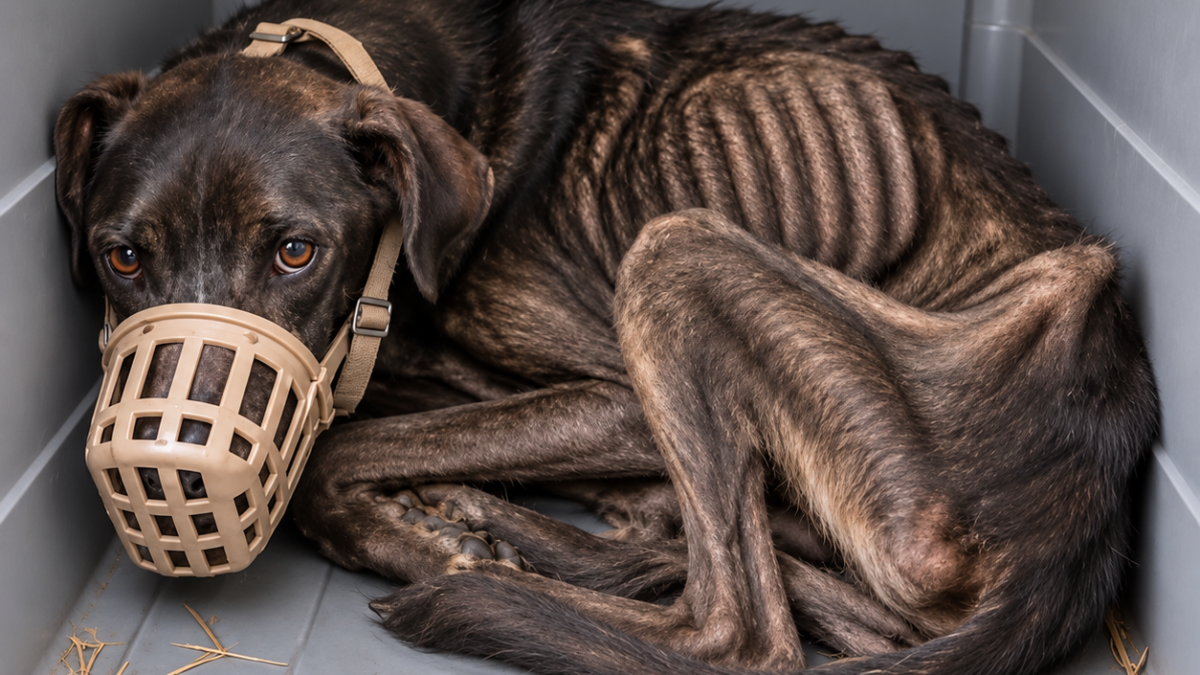
The dog never growled when I opened the crate, and somehow that frightened me more than if he had lunged at me.
He only curled tighter into the plastic corner, ribs showing beneath his dark coat, as if becoming smaller was the last survival skill anyone had left him.
But when I reached toward one side of his body and saw what he did next, I realized fear wasn’t the only reason he refused to come out.
My name is Megan Carter, and I had been a veterinary nurse at Cedar Ridge Animal Rescue for almost nine years when the transport van backed up to our intake door that Tuesday afternoon.
“Special handling,” the driver warned me.
He handed me a clipboard.
Male dog. Adult. Exact age unknown. Severe malnutrition. Possible bite risk.
The last line had been underlined twice.
A basket muzzle had been secured around his face before transport, and normally I understood why precautions like that were necessary. A terrified animal could react in ways nobody expected.
But when two staff members carefully carried the crate inside and set it on the examination-room floor, I looked through the wire door and saw no aggression.
I saw exhaustion.
The dog was almost black except for a faded brown patch around his muzzle and a small white mark on his chest. He should have been broad through the shoulders.
Instead, his body looked folded in on itself.
Every rib was visible.
His hips protruded sharply beneath his coat.
His spine ran down his back like someone had drawn it there with a ruler.
“Oh, buddy,” I whispered.
His eyes moved toward me.
Nothing else did.
Dr. Priya Patel crouched beside me.
“Don’t open it yet.”
“I know.”
We dimmed the lights.
Then we opened the crate door and backed away.
Nobody reached inside.
Nobody dragged him out.
I put a shallow bowl of water several feet from the entrance and slid a small amount of food beside it.
The dog stared.
Five minutes passed.
Then ten.
He never moved.
Eventually Priya sent everyone else out.
I stayed.
I sat sideways on the floor so I wouldn’t face him directly and pretended to study his paperwork.
For almost twenty minutes, the only sounds were the ventilation system and the faint scrape of his claws whenever he adjusted himself against the crate wall.
Then I noticed something.
Every time I shifted toward his right side, he simply watched me.
But when my hand moved toward the left side of the crate, he reacted immediately.
His entire body tightened.
Despite having barely enough strength to lift his head, he twisted himself until his left side was pressed against the floor.
I stopped.
A minute later I tried again without touching him.
Same reaction.
He curled around that side of his body as if he were shielding it.
“Priya,” I called softly.
She came back.
I showed her.
Her expression changed.
“That’s not aggression,” she whispered.
“No.”
“That’s guarding.”
I nodded.
The question was what he was guarding.
We could have forced the issue.
We could have restrained him, sedated him immediately, pulled him onto the examination table, and found our answer in minutes.
Instead, we waited.
I removed the muzzle only after Priya and I were certain it could be done safely.
Then I placed a folded blanket just outside his door.
“You decide,” I told him.
For a long time, nothing happened.
Then his nose moved.
He smelled the air.
A few minutes later, one paw slid forward.
Barely an inch.
I didn’t move.
Another inch.
Eventually, his paw touched the blanket.
I felt tears sting my eyes over something so ridiculously small.
“That’s it,” I whispered. “Nobody’s taking anything from you.”
His head slowly lowered near the doorway.
That was when I saw the first change.
Not trust.
Not yet.
But uncertainty.
As if the rules he had learned about people were no longer matching what was happening in the room.
By evening, he had drunk a little water and eaten several carefully measured bites.
We couldn’t give him too much. A body that starved for too long could become dangerously sick if food was reintroduced too quickly.
So we waited again.
Before leaving for the night, I returned to check him.
His body was no longer curled into the tight circle I had first seen.
One front leg rested across the blanket.
I crouched near him.
“Can I look now?”
His brown eyes followed my hand.
Slowly, I reached toward his left side.
He trembled.
But this time, he didn’t hide it completely.
I lifted the edge of his dirty coat, parted the matted fur, and froze.
“Priya.”
She hurried in, saw my face, and knelt beside me.
Then she looked where I was looking.
For several seconds neither of us said anything.
Finally, Priya whispered, “Megan… don’t touch that yet.”
Because underneath the fur on the side he had spent hours protecting was something neither of us had been prepared to find.
PART 2
I kept my hand suspended above him.
“What is it?” I asked.
Priya leaned closer without touching the dog.
At first I had thought the dark line beneath his coat was simply dried mud.
It wasn’t.
A narrow wound curved around the left side of his chest, disappearing beneath his front leg. The skin around it was inflamed, and several patches of fur had been rubbed completely away.
But that wasn’t what had made Priya stop me.
There was metal buried beneath the matted hair.
Not inside his body.
Around it.
“Get the clippers,” she said quietly.
I stared at her.
“Is that wire?”
“I think so.”
Something cold settled in my stomach.
The dog’s eyes moved between us.
I stood slowly.
“No restraint unless we have to.”
“Agreed.”
I retrieved the quietest clippers we had, towels, saline, bandage material, and the emergency medication cart.
Priya prepared a mild sedative.
The dog had tolerated us better than expected, but pain changes everything. We weren’t going to punish him for defending an injury.
Before doing anything, I sat down again.
“You need help, buddy.”
His ears flattened.
“I know you don’t believe me.”
His eyes stayed on mine.
“But I need you to give me one chance.”
I don’t know why people say things like that to frightened animals.
Maybe because we need them to understand.
Maybe because we need ourselves to understand.
Priya administered the medication as gently as possible.
Within several minutes the tension began leaving his body.
Not completely.
Even half asleep, he kept trying to curl over his left side.
That broke something in me.
Whatever had happened to him, he had learned that protecting pain was safer than showing it.
Once he was sedated, we carefully lifted him from the crate.
He weighed forty-one pounds.
Priya stared at the scale.
“A dog his frame should probably be closer to seventy.”
I looked away.
On the examination table, under proper light, his condition was worse than it had appeared inside the crate.
Pressure sores marked his elbows and hips.
His nails were badly overgrown.
There were old scars around his neck.
Muscle wasting ran through his hindquarters.
Then I began clipping the fur around his chest.
The metal appeared slowly.
It wasn’t one piece.
It was part of a thin cable.
The kind coated in dark plastic.
At some point, it had been looped around his body behind the front legs.
And then he had grown—or swollen—or simply lived with it long enough that it had begun cutting into him.
I felt my jaw tighten.
“Somebody left this on him?”
Priya didn’t answer immediately.
She was examining the wound.
“This didn’t happen yesterday.”
“How long?”
“Weeks. Possibly longer.”
I stared at the sleeping dog.
His ribs moved slowly beneath my hand.
Weeks.
He had been hungry for weeks.
In pain for weeks.
Afraid for longer than either of those.
And somehow people had decided the most important warning on his transport sheet was POSSIBLE BITE RISK.
“Photograph everything,” Priya said.
I looked at her.
Her tone had changed.
It was no longer only medical.
It was evidence.
I grabbed the clinic camera.
We documented the cable before removing it.
The wound.
The scars.
His body condition.
His paws.
His teeth.
Every injury.
When Priya finally cut the cable away, the dog released a sound so quiet I almost missed it.
A breath.
Almost a sigh.
I rested my palm beside his head.
“You don’t have to protect it anymore.”
That night, we gave him a name.
Not because we knew anything about him.
Because writing “unknown male dog” on his medical chart suddenly felt unbearable.
Our receptionist suggested Midnight.
One technician suggested Bear.
Priya suggested Shadow.
I looked through the recovery-room window at the skinny dark dog sleeping beneath two blankets.
“Ash,” I said.
Priya glanced at me.
“Why Ash?”
I thought about something surviving after everything around it had burned away.
“I don’t know.”
She smiled faintly.
“Ash it is.”
His first seventy-two hours were medically fragile.
Severe starvation isn’t fixed by placing a full bowl of food in front of an animal.
Sometimes that can make things worse.
Priya designed a feeding schedule measured almost painfully carefully.
Tiny portions.
Frequent meals.
Bloodwork repeated.
Electrolytes monitored.
Fluids adjusted.
His wound was cleaned and dressed.
X-rays revealed two ribs that had once been fractured and healed poorly.
No fresh breaks.
That should have relieved me.
Instead, all I could think was that somebody had hurt this dog long enough ago for his bones to heal while everything else continued.
On the second morning, I entered his room carrying breakfast.
Ash immediately backed into the far corner.
I stopped.
“Okay.”
I set down the bowl.
“No argument.”
I backed out.
When I checked the camera twenty minutes later, the bowl was empty.
That became our routine.
For almost a week, he ate only when nobody watched.
If I sat in the room, he wouldn’t touch food.
If a man entered, he pressed himself against the wall.
If someone carried a broom, mop handle, or leash, he froze.
The worst reaction came on day five.
One of our maintenance workers, Greg, opened the door while carrying a coil of black extension cord.
Ash saw it.
His legs collapsed beneath him.
Not because he was weak.
Because he was terrified.
He urinated where he lay and shoved himself backward so hard that his shoulder struck the wall.
Greg dropped the cord immediately.
“Oh God.”
I ran inside.
“Ash.”
The dog was shaking violently.
Greg stood outside the doorway, pale.
“I didn’t know.”
“You didn’t do anything wrong.”
But Greg’s eyes had filled.
“I scared him.”
I sat beside the wall without approaching Ash.
“No,” I said. “Somebody else did that a long time before you walked in.”
For forty minutes I stayed there.
Eventually his breathing slowed.
Greg never carried cords through that hallway again.
None of us did.
By the end of the first week, Ash had gained less than two pounds.
But he had started watching the door when I arrived.
That mattered more to me than the scale.
Every morning I would sit outside his kennel with coffee before my shift officially began.
I read patient notes.
Answered messages.
Sometimes I read aloud.
Weather reports.
Grocery lists.
A ridiculous article about a goat that had wandered into a courthouse.
Ash didn’t care what I said.
He cared that I sat there without demanding anything from him.
On the ninth morning, I was reading an email when I felt something touch the toe of my shoe.
I froze.
Ash had stretched one paw through the kennel opening.
His paw rested against my sneaker.
I didn’t reach for him.
I didn’t even look directly at him.
“Morning,” I said.
His paw stayed there for perhaps ten seconds.
Then he pulled it back.
I cried in the supply closet afterward.
Not dramatic crying.
Silent crying.
The kind where you keep holding gauze boxes because if you put them down, you’re afraid your hands will start shaking.
Priya found me.
“He touched you?”
I nodded.
She smiled.
“That’s good.”
“I know.”
“Then why are you crying?”
“Because he thought touching my shoe was brave.”
Priya’s smile disappeared.
She leaned against the shelf beside me.
“We’re going to find out who did this.”
I looked at her.
Until then, neither of us had said it that directly.
The county animal-control officer who transferred Ash had told us he’d been found near an abandoned equipment shed outside Millbrook.
No collar.
No owner present.
A property caretaker had reported seeing him.
Supposedly.
But the cable around his body changed the case.
So did his condition.
The photographs were forwarded to Officer Daniel Ruiz, the county cruelty investigator.
Daniel arrived that afternoon.
He had handled animal cases for fifteen years and possessed the tired expression of someone who had learned not to be surprised by people.
He stood outside Ash’s room.
“That him?”
“Yes.”
Ash saw Daniel and retreated immediately.
Daniel didn’t enter.
“Tell me about the cable.”
Priya explained.
He studied the photographs.
“Can I get copies?”
“We already made them.”
He nodded.
“And bloodwork?”
“Everything.”
“Good.”
I crossed my arms.
“Good for what?”
Daniel looked at me.
“Good for proving duration.”
“You think someone can be charged?”
“If we can connect him to somebody.”
“He didn’t starve himself.”
“I know.”
“Somebody put that cable on him.”
“I know.”
“And somebody watched him disappear.”
Daniel met my eyes.
“That part is what I need to prove.”
He pulled a scanner from his bag.
“Has anyone checked him for a chip?”
My stomach tightened.
We had.
On intake.
Nothing.
But Ash’s body had been so painful that the initial scan had been quick.
Daniel suggested doing it again once Ash was calmer.
Two days later, we tried.
I held the scanner several inches above his neck.
Beep.
Nothing.
Shoulders.
Nothing.
Back.
Nothing.
I moved toward his left shoulder.
Beep.
I stopped.
Priya looked up.
“Again.”
I passed the scanner over the same area.
A long identification number appeared on the display.
For a moment, nobody spoke.
Daniel wrote it down.
“Chip migrated.”
Apparently microchips sometimes move under the skin over time.
Ash had been chipped.
Which meant somewhere, probably, there had once been a name attached to him.
Daniel stepped into the hallway and made several calls.
I stayed with Ash.
My heart was beating too fast.
Part of me wanted an answer desperately.
Another part was afraid of what an answer would bring.
Twenty minutes later Daniel returned.
His face told me before he spoke.
“You found somebody.”
He nodded.
“Chip was registered six years ago.”
“To whom?”
“A man named Harlan Voss.”
The name meant nothing to me.
Then Priya reacted.
“Voss?”
Daniel glanced at her.
“You know him?”
“Green County Working Dogs.”
I had heard the name.
Everybody around Millbrook had.
Harlan Voss trained guard dogs, security dogs, and what he advertised as “estate protection dogs.”
His company appeared at county fairs.
Local sporting events.
Business expos.
He had glossy advertisements showing muscular German shepherds and Belgian Malinois standing beside expensive trucks.
Ash didn’t resemble the polished animals in those advertisements.
Daniel continued.
“The registration name was different.”
“What name?” I asked.
“Ranger.”
Ash lifted his head at the sound.
Every person in the hallway went silent.
I looked through the kennel door.
“Ash?”
Nothing.
Daniel lowered his voice.
“Ranger.”
The dog’s ears moved.
My stomach turned.
“That’s him.”
“Looks like it.”
Daniel kept reading from his notes.
“Registered to Voss six years ago. Listed as black shepherd mix. Male. Approximately one year old at time of registration.”
“So he’s seven?”
“Approximately.”
I stared at Ash.
Seven years.
Not ancient.
Not even close.
Yet his body looked like something that had survived a lifetime.
“Call him,” Priya said.
Daniel shook his head.
“Not yet.”
I turned toward him.
“Why not?”
“Because I want to know what he says before he knows what we have.”
That was the first moment I understood this was becoming more than a rescue.
Daniel pulled old county licensing records.
Then veterinary records.
Then business permits.
By the following afternoon, the story had become stranger.
According to Voss’s company records, Ranger had been one of his earliest trained dogs.
According to a social media post from three years earlier, Ranger had supposedly been “retired to a private family.”
According to county licensing records, no ownership transfer had ever been filed.
According to the microchip company, Harlan Voss was still the registered owner.
Then Daniel discovered something else.
Eight months before Ash arrived at our rescue, Voss had reported Ranger missing.
He claimed the dog had escaped during a storm.
He posted photographs.
Offered a reward.
People shared the story hundreds of times.
There were comments from neighbors saying how devastated Voss seemed.
Two months later, Voss publicly announced that he believed Ranger was dead.
I sat at the clinic computer reading the old post.
“We searched every road, field and creek,” it said. “Sometimes loving a dog means accepting that you may never get your goodbye.”
I felt physically sick.
Priya stood behind me.
“Could Ash have actually escaped?”
“Maybe.”
Neither of us wanted to jump to a conclusion.
That mattered.
Anger makes people careless.
Daniel reminded us constantly that suspicion was not evidence.
Maybe Ranger had disappeared.
Maybe someone else had found him and mistreated him.
Maybe the cable came later.
Maybe Voss was innocent.
Then Daniel obtained something that changed everything.
Traffic-camera footage.
The equipment shed where Ash had been found sat along an old county access road.
There were no security cameras at the shed.
But there was a Department of Transportation camera two miles away at the intersection.
Daniel requested footage covering several days before Ash’s discovery.
On Thursday evening, he called me.
“Megan, are you still at the rescue?”
“Yes.”
“I need you and Dr. Patel to see something.”
He arrived thirty minutes later carrying a laptop.
We gathered in the staff office.
Daniel opened a video.
Timestamp: Sunday, 11:48 p.m.
A white pickup traveled through the intersection.
Nothing unusual.
Daniel paused.
Zoomed in.
The image was grainy.
But the company logo on the door was visible.
GREEN COUNTY WORKING DOGS.
Nobody spoke.
Daniel advanced to another camera angle.
The truck turned onto the access road leading toward the equipment shed.
At 12:17 a.m., the same truck came back.
I stared at the screen.
“When was Ash found?”
“Monday morning. Approximately 6:40.”
Priya’s voice was barely audible.
“So Voss’s truck drove in there six hours earlier.”
“Yes.”
“Can you prove he was driving?”
“Not yet.”
Daniel closed the laptop.
“But now I can ask.”
The interview happened two days later.
Voss didn’t know about the footage.
According to Daniel, he initially appeared shocked that Ranger was alive.
Then relieved.
Then emotional.
He said he wanted his dog returned immediately.
Daniel asked where he had been Sunday night.
Voss reportedly answered that he had been home.
Daniel asked whether anyone else used his company truck.
Voss said no.
Then Daniel showed him a still photograph from the traffic camera.
His story changed.
He said he had driven down the access road looking for stolen equipment.
Daniel asked why he had never reported stolen equipment.
The story changed again.
He said he had been searching for a loose training dog.
Which dog?
He couldn’t remember.
That was when Daniel stopped the interview.
Not because he was finished.
Because he finally had enough inconsistency to seek a warrant.
Three mornings later, I arrived at Cedar Ridge at 6:15 and found Daniel waiting beside the front entrance.
He wasn’t alone.
Two sheriff’s vehicles were parked behind him.
I felt my heartbeat in my throat.
“What happened?”
“We’re serving a search warrant at Voss’s training property.”
I looked toward Ash’s wing.
“What are you expecting to find?”
Daniel took a breath.
“I don’t know.”
That frightened me more than any answer could have.
The search began shortly after sunrise.
I wasn’t there.
Neither was Priya.
We worked.
Or tried to.
At 8:22, Daniel texted.
Eight dogs located.
At 8:41:
Need transport assistance.
At 8:47:
Make room.
Everything inside Cedar Ridge changed instantly.
Kennels were prepared.
Medical stations opened.
Volunteers were called.
Blankets were stacked.
IV supplies checked.
We didn’t know what was coming.
Then the first county vehicle arrived.
There were three dogs inside.
They were not in Ash’s condition.
Thank God.
But they were thin.
Filthy.
Two had untreated skin infections.
Another had a badly swollen ear.
The second vehicle carried two more.
The third carried three.
One dog was so afraid of leaving the transport kennel that I felt as though I were watching Ash arrive all over again.
I looked at Daniel.
“What did you find?”
His jaw tightened.
“A hidden kennel building behind the main training facility.”
“Hidden?”
“Not visible from the road.”
“Were these dogs in it?”
“Yes.”
“Why weren’t they with the others?”
Daniel didn’t answer immediately.
Then he said, “They weren’t the dogs customers were supposed to see.”
That sentence stayed with me.
The beautiful dogs appeared in advertisements.
The healthy dogs went through demonstrations.
And behind a second building, out of sight, were animals who apparently no longer served whatever purpose Harlan Voss expected them to serve.
Daniel showed me photographs only after the dogs had been stabilized.
Rows of narrow enclosures.
Dirty water containers.
Old chains.
Training equipment.
And hanging from a peg near the rear kennels were several lengths of black coated cable.
The same type we had cut from Ash.
It still wasn’t enough by itself.
But the warrant produced records too.
Handwritten logs.
Expense sheets.
Training notes.
Dog identification numbers.
And there it was.
RANGER.
The final entries were made months after Voss had publicly claimed Ranger was missing.
Weight declining.
“Low drive.”
“Refuses work.”
“Unreliable.”
Then a line from seven weeks earlier:
REMOVE FROM PROGRAM.
No destination.
No adoption record.
No transfer.
Nothing.
I stared at a copy of the page.
“What does ‘remove’ mean?”
Daniel shook his head.
“That’s one of the questions he’ll answer.”
Ash continued recovering while the investigation grew around him.
That became important to me.
Because I refused to let his entire identity become evidence.
He was not Exhibit A.
He was not Case Number 26-4417.
He was Ash.
And Ash had started doing something remarkable.
He had begun waiting for me.
Every morning, when I turned the hallway corner, his head appeared at the kennel door.
He still wouldn’t approach most strangers.
He still panicked around cables.
He still flattened himself if voices became too loud.
But with me, things were changing.
One morning I sat on the floor and placed a piece of chicken several feet away.
He stared at it.
Then at me.
I looked away.
He stepped forward.
One step.
Then another.
He ate the chicken.
I placed another piece closer.
He stopped.
I could see the conflict inside him.
Food.
Human hand.
Food.
Human hand.
His body wanted one.
His memory feared the other.
I kept my palm open.
“You decide.”
He stretched his neck.
Sniffed.
Retreated.
Came forward again.
Then, with the delicacy of someone picking up something breakable, Ash took the chicken from my fingers.
I laughed.
It slipped out before I could stop myself.
Ash jumped backward.
“Sorry.”
He stared.
Then something happened that I will remember until I die.
His tail moved.
Once.
Not a wag.
Barely even a twitch.
But I saw it.
“Oh, don’t you start,” I whispered, suddenly crying again. “I have a reputation around here.”
Over the next month, Ash gained thirteen pounds.
His wound began closing.
His coat improved.
His eyes changed most.
People underestimate how much expression lives in a dog’s eyes.
When Ash arrived, his eyes watched hands.
Always hands.
Where were they moving?
What were they holding?
How quickly were they approaching?
Later, he started watching faces.
That was progress.
A hand had once meant danger.
A face could eventually become a person.
The criminal case against Voss moved more slowly.
Cases always do.
People imagine justice as a door being kicked open and somebody immediately going to jail.
Usually it looks more like paperwork.
Photographs.
Veterinary affidavits.
Interviews.
Timelines.
Receipts.
Arguments about ownership.
Arguments about intent.
Arguments about whether neglect was deliberate or merely irresponsible.
Voss hired an attorney.
Then he went public.
That was his mistake.
He posted a video claiming the county had “stolen valuable working animals” from his business.
He called the investigation a misunderstanding.
He claimed Ranger had been found after months missing and that someone else must have abused him.
He said his truck had been near the equipment shed because he had received an anonymous tip.
The video spread quickly.
People argued.
Some defended him.
He had trained dogs in the county for years.
He sponsored youth baseball.
Donated to fundraisers.
Provided security dogs for businesses.
People said, “That doesn’t sound like Harlan.”
I learned something during those weeks.
People are uncomfortable when cruelty and respectability occupy the same person.
They want monsters to look like monsters.
It makes life easier.
But cruelty often has a business card.
A clean shirt.
A smile at charity events.
One afternoon a woman arrived at Cedar Ridge asking to speak with Daniel.
Her name was Claire Bennett.
She had purchased a dog from Voss four years earlier.
When Ranger’s story appeared in the news, something bothered her.
She brought paperwork.
Emails.
And photographs.
“I think there were other dogs,” she said.
Daniel invited her into the conference room.
I wasn’t part of the interview, but later, with her permission, he explained.
Claire had originally visited Voss to purchase a trained shepherd.
During one appointment she heard dogs barking behind a building.
When she asked about them, Voss said those animals were “washouts.”
Dogs that failed training.
She remembered seeing a dark shepherd mix briefly through an open doorway.
Thin.
Nervous.
She couldn’t prove it was Ranger.
But she had taken a photograph of the facility that day.
In the far background was the hidden kennel building.
That helped establish it had existed years earlier.
Then another former client came forward.
Then a former employee.
His name was Eli Mercer.
And Eli had the evidence everyone had been waiting for.
He had worked for Voss for eighteen months.
He quit the previous winter.
Why?
Because of Ranger.
When Daniel told me, I had to sit down.
Eli said Ranger had once been one of Voss’s best dogs.
Smart.
Steady.
Fast.
But as Ranger grew older, he developed anxiety during certain training exercises.
Voss became frustrated.
Ranger began resisting.
The harder Voss pushed, the worse the dog became.
Eventually Ranger snapped at a training sleeve.
Not at a person.
At the sleeve.
Voss called him useless.
According to Eli, Ranger was moved to the back kennels.
His food portions became inconsistent.
His exercise stopped.
Eli confronted Voss twice.
The second argument became severe.
Eli secretly photographed Ranger because he planned to report the facility.
Before he could, Voss fired him.
Eli did report it.
But there had been a problem.
When county inspectors arrived, the rear building was empty.
Every dog had been moved.
No violation was substantiated.
Weeks later, Voss announced Ranger had escaped.
Eli assumed Ranger was gone.
Until Ash’s photograph appeared.
Daniel showed us the image Eli had taken.
My throat closed.
It was Ash.
Healthier.
Heavier.
But unmistakably Ash.
He was standing behind kennel fencing.
The small white patch on his chest was visible.
So was the beginning of the scar around his neck.
The timestamp was seventeen days before Voss claimed Ranger disappeared.
“That proves he had him,” I said.
“Yes.”
“And the records prove he still had him afterward.”
“Yes.”
“And the camera puts his truck where Ash was dumped.”
Daniel nodded.
“So arrest him.”
Daniel looked tired.
“Megan.”
“What?”
“We’re building the case.”
“How much more building does it need?”
“Enough that it doesn’t collapse when his attorney attacks it.”
I hated that answer.
Because it was correct.
Three days later, Voss came to Cedar Ridge.
I was in Ash’s room when the front desk called me.
“Megan?”
“What?”
“There’s a man here asking for Ranger.”
I stopped breathing.
“Who?”
“I think it’s Harlan Voss.”
Ash was standing beside me.
I closed the kennel door.
“Do not let him past reception.”
“He says he owns the dog.”
“Call Daniel.”
“He already told me to.”
I stepped into the hallway.
My hands were shaking.
Not from fear exactly.
From anger.
Priya intercepted me.
“Don’t engage him.”
“I’m not going to hit him, Priya.”
“That isn’t what I mean.”
“What does he want?”
“He brought an attorney.”
Of course he did.
When I reached reception, Harlan Voss was standing beside the front desk.
I recognized him from advertisements.
Early fifties.
Tall.
Gray at the temples.
Expensive boots.
Calm expression.
His attorney stood beside him.
Voss smiled when he saw me.
“You’re Megan?”
I didn’t answer.
“I understand you’ve been caring for Ranger.”
“His name here is Ash.”
“His name is Ranger.”
The calmness in his voice made my skin crawl.
His attorney stepped forward.
“Mr. Voss is requesting access to his property.”
“His property?”
“The dog is legally registered to him.”
I looked at Voss.
“You told everybody he was dead.”
His attorney interrupted.
“We’re not discussing the case.”
Voss kept his eyes on me.
“I thought he was dead.”
“Funny.”
“Megan,” Priya warned.
I ignored her.
“You also thought he was missing while you were writing training notes about him.”
For the first time, Voss’s expression changed.
Only slightly.
But I saw it.
His attorney said, “We’re done.”
Then Ash barked from the back hallway.
One bark.
Voss looked toward the sound.
“Ranger.”
His voice carried.
What happened next erased every doubt I had left.
From fifty feet away, behind two closed doors, Ash began screaming.
Not barking.
Not growling.
Screaming.
I had never heard that sound from him.
I ran.
Priya was behind me.
When we reached his room, Ash had shoved himself behind his bed.
His entire body shook.
His paws clawed at the floor as though he were trying to push through the wall.
“Ash.”
He couldn’t hear me.
“Ash, it’s me.”
His eyes were wide.
His breathing came too fast.
I sat on the floor.
Nobody touched him.
Behind me, Priya closed the hallway door.
Voss never saw him.
He didn’t need to.
Daniel arrived eight minutes later and escorted Voss from the property.
That night I stayed past midnight.
Ash wouldn’t eat.
He wouldn’t sleep.
Every time footsteps passed, his head jerked up.
Eventually I carried my paperwork into his room.
I sat against the wall.
Around 1:00 a.m., he crawled from behind the bed.
At 1:17, he lay six feet away.
At 1:42, four feet.
At 2:03, he rested his head on my shoe.
I didn’t move for almost an hour.
That was when my anger changed.
Before, I wanted Voss punished.
That night, I wanted something more.
I wanted Ash to become so safe that Voss no longer mattered.
That became my version of revenge.
Not suffering returned for suffering.
Freedom.
Two weeks later, Harlan Voss was arrested.
The charges included multiple counts related to animal neglect and falsification of business records.
More charges were considered as the investigation continued.
His business license was suspended pending proceedings.
The rescued dogs remained in protective custody.
News trucks appeared outside the courthouse.
Suddenly everyone who had said, “That doesn’t sound like Harlan,” wanted to explain what they had always suspected.
I stopped reading comments.
Ash didn’t know there was a case.
He didn’t know people were arguing about him online.
He didn’t know a judge had signed papers declaring that Voss could not reclaim him while the case was pending.
Ash knew breakfast came at 7:00.
He knew I arrived before breakfast.
He knew the squeaky blue ball belonged to him.
He knew Greg carried treats now instead of extension cords.
He knew Priya scratched behind his right ear exactly the way he liked.
And one Friday afternoon, Ash learned grass.
We had waited until his weight and strength were stable before giving him more outdoor freedom.
The rescue had a fenced rehabilitation yard behind the medical wing.
I clipped a lightweight leash to his harness.
He froze.
The leash was still difficult for him.
So I placed it on the ground.
Waited.
He smelled it.
Then stepped over it.
Eventually I picked up the end without tension.
We walked three steps.
Stopped.
Five steps.
Stopped.
At the outside door, Ash hesitated.
Sunlight spilled across the floor.
He stared at it.
“You’ve got this.”
One paw crossed the threshold.
Then another.
Outside, he stopped completely.
Wind moved through his coat.
Birds called from the trees.
Somewhere beyond the fence, a truck passed.
Ash lifted his nose.
For almost thirty seconds he simply breathed.
Then he stepped onto the grass.
I expected him to be cautious.
Instead, he lowered his nose and smelled one patch for so long I laughed.
“What is it?”
He moved to another patch.
Then another.
Suddenly Ash trotted.
Three steps.
Five.
Ten.
He reached the end of the leash, felt slight pressure, and stopped.
I immediately loosened it.
He looked back.
“Go ahead.”
I followed.
He trotted again.
Then, for the first time since he arrived, Ash ran.
Not far.
His muscles were still rebuilding.
But he ran six or seven yards across the grass before turning around.
His ears bounced.
His mouth opened.
And his tail—
His tail wagged.
Really wagged.
I covered my mouth.
Greg stood at the window inside.
Priya was beside him.
Both were crying.
Ash ran toward me.
I crouched instinctively.
For one terrifying second I thought I had moved too quickly.
Then he crashed into my chest.
Not hard.
Just enough.
His head pressed beneath my chin.
His entire body trembled from exertion.
I wrapped my arms around him.
And he let me.
The dog who once folded himself into the corner of a crate because being invisible felt safe let a human being hold him.
“Okay,” I whispered into his coat. “Now you’re just showing off.”
He licked my chin.
I laughed so hard I cried.
The court case stretched through autumn.
Defense motions.
Hearings.
Continuances.
Expert reports.
More former employees came forward.
Investigators found financial records showing that several dogs listed as “retired placements” had no corresponding transfer documentation.
Not every case could be proven.
Some dogs had disappeared years earlier.
Some records were incomplete.
That was frustrating.
Justice is rarely as complete as people want it to be.
But Ash’s case was strong.
The photographs documented prolonged neglect.
His veterinary condition established duration.
The microchip established ownership.
Business records contradicted Voss’s public claims.
Eli’s photographs placed Ash at the property shortly before the supposed disappearance.
Internal logs continued mentioning him afterward.
Traffic footage placed Voss’s truck near the location where Ash was abandoned.
And the coated cable found at the facility was consistent with what had been removed from Ash.
The defense still fought.
They argued that somebody else could have taken Ranger.
They challenged timelines.
They questioned employees’ motives.
They claimed Voss’s paperwork was sloppy rather than fraudulent.
Then something unexpected happened.
Voss accepted a plea agreement.
I learned about it when Daniel walked into Cedar Ridge holding a folder.
“It’s over,” he said.
I stared at him.
“What do you mean?”
“He pleaded.”
“To what?”
Daniel explained the agreement.
Multiple animal-neglect counts.
One count related to false records.
Permanent surrender of the seized dogs.
A prohibition against operating or owning a commercial animal-training business for years under the court order, with additional ownership restrictions governed by the final sentence.
Fines.
Restitution.
Probationary supervision after custody requirements determined by the court.
The exact punishment mattered.
Of course it did.
But one sentence mattered more to me.
Permanent surrender.
“He can’t take Ash?”
“No.”
“Ever?”
“Not through this case.”
I sat down.
My knees had suddenly stopped cooperating.
Daniel smiled.
“He’s free.”
Ash was asleep in the rehabilitation office.
I walked to him.
He opened one eye when I entered.
I sat beside his bed.
“You won.”
His tail tapped the floor.
“You have absolutely no idea what I’m talking about.”
Another tap.
I put my hand against his chest.
The old wound had become a pale scar.
“You’re free.”
That night, I took Ash home.
Technically, I was only fostering him.
That distinction lasted eleven days.
I had resisted fostering for years because I knew myself.
I told everyone veterinary staff shouldn’t become emotionally attached to every patient.
Priya called that “the funniest thing Megan has ever said.”
My house was small.
Two bedrooms.
A fenced yard.
Old hardwood floors.
Quiet neighborhood.
I expected Ash to struggle.
He did.
The first night, he refused to leave the kitchen.
I placed a bed near the refrigerator.
He ignored it and slept beneath the table.
At 3:12 a.m., I woke to scratching.
I found him standing beside my bedroom door.
He looked at me.
Then down the hallway.
“What?”
He walked away.
I followed.
His water bowl was empty.
“Oh.”
I filled it.
He drank.
Then he walked back to my bedroom.
I climbed into bed.
Ash stood in the doorway.
“You can come in.”
He remained there.
I patted the floor.
“Your choice.”
He stepped inside.
He slept beside the door.
The next night, halfway between the door and my bed.
The third night, beside the bed.
On the sixth morning, I woke because something heavy landed across my ankles.
Ash had climbed onto the mattress.
His head rested on my legs.
I stayed completely still.
He opened one eye.
“Seriously?”
His eye closed.
That was apparently permission for me to remain in my own bed.
Life became a collection of firsts.
First car ride without shaking.
First walk around the block.
First time accepting a treat from Greg.
First time barking because a squirrel had offended him personally.
First time stealing food.
That one happened three months after his arrival.
I left half a turkey sandwich on the coffee table.
When I returned from the kitchen, the plate was empty.
Ash sat four feet away.
A piece of lettuce was stuck to his nose.
I stared.
He stared.
“Ash.”
Tail wag.
“Did you steal my sandwich?”
Tail wag faster.
I should have been annoyed.
Instead, I sat on the couch and laughed until my stomach hurt.
Six months earlier, he had been too afraid to eat while anyone watched.
Now he was committing sandwich theft directly in front of me.
Progress isn’t always dignified.
The other seized dogs recovered too.
Three were adopted by experienced families.
Two entered specialized foster homes.
One older shepherd stayed with Greg.
That surprised everyone except me.
Greg named him Walter.
The dog followed him everywhere.
The remaining two required longer behavioral rehabilitation, but eventually both found permanent homes.
Eli Mercer visited Cedar Ridge once after the case ended.
He stood outside Ash’s yard.
“I don’t know if I should see him.”
“Why?”
“I left.”
“You reported Voss.”
“Too late.”
“You tried.”
“Not hard enough.”
There are some kinds of guilt nobody can talk you out of.
I understood that.
So I opened the gate.
“Sit down.”
Eli sat on the grass.
Ash noticed him.
His body stiffened.
Eli didn’t move.
For several minutes they simply watched each other.
Then Ash approached.
Slowly.
He smelled Eli’s shoe.
His pant leg.
His hand.
Eli began crying before Ash even touched him.
“I’m sorry, Ranger.”
Ash’s ears moved at the old name.
Eli lowered his face.
“I’m so sorry.”
Ash stepped closer.
Then licked his hand.
Eli covered his eyes.
I looked away because some moments deserve privacy even when they happen in front of you.
Later, he told me something I had never known.
“Ranger used to love tennis balls.”
“Seriously?”
“He’d lose his mind over them.”
The next morning, I bought a bag of tennis balls.
I took Ash to the yard.
I bounced one.
Nothing.
I threw it.
He watched it roll.
“Apparently Eli exaggerated.”
Then Ash’s ears lifted.
He ran after it.
Picked it up.
And for the next twenty minutes, the dignified survivor at the center of a county criminal case acted like a complete idiot.
He chased.
Dropped.
Pounced.
Missed.
Skidded across the grass.
Once he ran past the ball entirely and had to turn around.
I sat in the yard laughing until tears blurred my vision.
Somewhere inside that frightened dog, the animal he had been before all the fear had survived.
That discovery mattered more than anything Voss had lost.
His business.
His reputation.
His money.
His freedom for whatever period the court imposed.
Those things were consequences.
But Ash becoming himself again?
That was revenge.
A year after Ash arrived, the cable scar was barely visible.
His weight had stabilized at seventy-three pounds.
His coat had become thick and glossy.
His shoulders filled out.
People who met him for the first time often didn’t believe photographs of his arrival were the same dog.
Emotionally, some scars remained.
Black cables still made him uncomfortable.
Raised voices could send him from a room.
He disliked enclosed plastic crates.
We never forced one.
And unfamiliar men needed to earn his trust slowly.
Healing did not erase memory.
I learned to stop expecting it to.
The goal was never to make him forget.
The goal was to give him enough good days that the old ones no longer controlled every decision.
On the anniversary of his rescue, Cedar Ridge held a small open house.
Nothing dramatic.
Adopters visited.
Volunteers brought food.
Children decorated paper dog bones for the kennel walls.
Greg brought Walter.
Priya brought cupcakes.
Daniel came in uniform after his shift.
Ash wore a blue bandanna.
At one point, I stood near the rehabilitation yard watching him accept scratches from Daniel.
I remembered the dog who had panicked when a man carrying an extension cord walked through a doorway.
Daniel looked over.
“What?”
“Nothing.”
“You’re doing that emotional thing again.”
“I don’t do emotional things.”
“Megan, you cried when he stole a sandwich.”
“That was a significant sandwich.”
Daniel laughed.
Ash leaned against his leg.
I felt something settle inside me.
Not happiness exactly.
Something quieter.
Closure.
Months later, I attended the final restitution hearing.
I had debated whether to go.
Ultimately, I needed to.
Voss sat at the defense table.
He looked smaller than he had in our reception area.
Maybe that was only because he no longer had control of the room.
Several former employees attended.
So did representatives from the county.
Priya sat beside me.
The prosecutor described the veterinary costs.
The seized animals.
The investigation.
The documented neglect.
Then victim-impact statements were read from organizations involved in their care.
I had written one.
I did not call Voss a monster.
I did not say I hated him.
I wrote about Ash.
About the first day.
About the crate.
About the way he made himself smaller.
About the fact that he would rather press an injured side into the floor than let a human hand reach it.
I wrote:
“The greatest damage was not the weight he lost or the wound around his body. Those healed first. The greatest damage was that he believed disappearing was safer than being noticed.”
When the prosecutor read that sentence, Voss looked down.
For months I had imagined that moment.
I thought I would feel victorious.
I didn’t.
I felt tired.
Because punishment cannot travel backward in time.
It cannot feed the dog who was hungry last year.
It cannot unbreak a rib.
It cannot turn fear into something that never happened.
Justice can only draw a line.
Before this.
After this.
No more.
When court ended, I walked outside.
Reporters gathered near the steps.
I avoided them.
Priya followed me toward my car.
“Feel better?”
I considered the question.
“Yes.”
“Because he was punished?”
I shook my head.
“Because he can’t do it to Ash again.”
That evening, I drove home before sunset.
Ash was waiting behind the front window.
The moment my car entered the driveway, his tail began slamming against the glass.
I opened the door.
He greeted me with a tennis ball.
Naturally.
“Five minutes.”
He ran toward the backyard.
Apparently five minutes meant immediately.
I followed him outside.
The sky was turning orange beyond the trees.
I threw the ball.
Ash sprinted.
Seventy-three pounds of muscle, fur, and ridiculous enthusiasm tore across the yard.
He brought it back.
I threw it again.
And again.
Eventually I sat on the porch steps.
Ash dropped the ball, walked over, and lowered himself beside me.
His body pressed against my leg.
For several minutes we watched the yard.
Then I ran my fingers over the faint scar behind his front leg.
He didn’t flinch.
That still amazed me.
Once, the slightest movement toward that spot made him fold himself into a corner.
Now he sighed and rolled partly onto his side.
Trust can look very ordinary from the outside.
A dog sleeping.
A paw resting on someone’s shoe.
A body stretched across a blanket.
But if you know where an animal started, ordinary can feel miraculous.
Two years have passed since Ash arrived at Cedar Ridge.
He is asleep beside me as I write this.
He snores now.
Loudly.
He has claimed half my couch, two blankets, an expensive orthopedic bed he rarely uses, and apparently all legal rights to anything containing turkey.
Every morning we walk before work.
He still stops at one particular patch of grass near the park to smell it as though the fate of civilization depends on the information contained there.
Sometimes strangers ask if they can pet him.
If Ash wants to approach, he does.
If he doesn’t, I say no.
Choice matters to him.
I think it always will.
Cedar Ridge eventually used part of the restitution money to renovate the behavioral-recovery wing.
We replaced several old kennel doors with quieter ones.
Created decompression rooms.
Added outdoor runs.
Bought special harnesses.
We even established a small fund for cruelty-case dogs requiring long-term rehabilitation.
There is a photograph of Ash in the hallway.
Not the intake photograph.
I refused that.
The picture shows him running through the rehabilitation yard with a tennis ball in his mouth.
Underneath it is a small plaque.
It says:
ASH FUND
For animals learning that safety is real.
Visitors sometimes ask me why we chose that photograph instead of something dramatic.
Why not the rescue?
Why not the courtroom case?
Why not the before-and-after photographs?
Because suffering should not always be the most memorable thing about a survivor.
Ash deserves to be remembered for running.
One winter afternoon, almost exactly three years after his rescue, snow began falling while we were at Cedar Ridge.
I had finished my shift.
Ash was waiting in my office because he came to work with me occasionally now.
When I opened the exterior door, he stopped.
Fresh snow covered the grass.
He looked at me.
“What?”
He stepped outside.
Sniffed.
Then jumped backward when his paw sank into the snow.
I laughed.
He looked personally betrayed.
“Terrifying, huh?”
He tried again.
Another step.
Then another.
Within thirty seconds he was running circles through the yard.
Snow flew behind him.
He shoved his nose into a drift.
Sneezed.
Ran faster.
Priya came outside with her phone.
“Look at him.”
“I’m looking.”
“Remember when he wouldn’t leave the crate?”
I did.
Of course I did.
Sometimes I still dreamed about that first day.
The muzzle.
The ribs.
The tired brown eyes.
The dog shrinking toward the floor because smaller felt safer.
I watched Ash leap through the snow.
“No,” I said quietly.
Priya glanced at me.
“No?”
I smiled.
“I remember.
“But I don’t think that’s who he is anymore.”
Ash ran toward us.
At the last second, instead of stopping, he slammed his snowy body against my legs.
“Ash!”
Priya laughed.
I grabbed his collar loosely while he twisted with excitement.
Three years earlier, I had whispered to a terrified dog that nobody was going to take anything else from him.
At the time, I wasn’t sure I could keep that promise.
There were laws.
Owners.
Court hearings.
Medical problems.
Fear deeper than anything I knew how to fix.
But in the end, we kept it.
Nobody took anything else.
Instead, Ash collected things.
Blankets.
Tennis balls.
Friends.
A yard.
A home.
A ridiculous number of treats.
And something far more important.
The right to decide when he wanted to come closer.
The right to walk away.
The right to sleep without listening for footsteps.
The right to exist without apologizing for taking up space.
That may be the part people misunderstand about rescue.
They imagine you save an animal once.
You open a crate.
Cut a cable.
Clean a wound.
Serve a warrant.
Win a case.
But rescue happened for Ash hundreds of times.
Every time someone waited instead of grabbing.
Every time a hand stopped when he became afraid.
Every time food arrived on schedule.
Every time a leash went loose instead of tight.
Every time he woke from sleep and discovered he was still safe.
Every time he made a choice and a human respected it.
Those moments rebuilt him.
Tiny piece by tiny piece.
And if you want to know what happened to the frightened dog who once tried to disappear into the corner of a plastic crate, I can tell you exactly where he is tonight.
He is stretched across my bed.
All seventy-three pounds of him.
His paws are occupying my side.
His head is on my pillow.
There is a tennis ball underneath his front leg.
And when I tried to move him ten minutes ago, he opened one eye, sighed dramatically, and somehow made himself even bigger.
I stood there laughing.
Because once, making himself small had been the only way Ash knew to survive.
Now he takes up all the room he wants.
And I let him.
Every single inch.
But Ash’s story did not end when the court papers were signed.
For a while, I thought it had.
Voss had surrendered every legal claim to the dogs. His training business was finished. The county had seized equipment and records, former clients were demanding refunds, and every animal recovered from the back kennels had been placed either in a permanent home or a long-term rehabilitation program.
Ash was safe.
That should have been enough.
Then, six months after the final hearing, Daniel Ruiz called me at Cedar Ridge.
“Megan, I need you to sit down.”
I was filling medication cups in the treatment room.
“That sentence has never ended well.”
“I’m serious.”
I put the tray down.
“What happened?”
Daniel was quiet for a second.
“We found another property.”
Every muscle in my body tightened.
“What kind of property?”
“A rental Voss had been paying for through one of his companies.”
My stomach dropped.
“Dogs?”
“We don’t know yet.”
“What do you mean, you don’t know?”
“It’s an old storage barn about thirty miles north of Millbrook. The lease was paid through a shell business. We found it going through financial records connected to the restitution investigation.”
I was already reaching for my jacket.
“Megan.”
“What?”
“You’re not going there.”
“I absolutely am.”
“No.”
“Daniel—”
“We have a warrant team. Animal control is going in with deputies. If animals are there, we’ll bring them to Cedar Ridge.”
I gripped the edge of the counter.
“How long has nobody checked that place?”
“We don’t know.”
Those four words followed me for the next three hours.
We don’t know.
At 2:14 p.m., the first call came.
Three dogs.
At 2:31, another.
Five more.
At 2:44, Daniel called again.
His voice sounded different.
“Megan.”
“How many?”
He exhaled.
“Eleven total.”
I closed my eyes.
“Alive?”
“Ten.”
The room went silent around me.
“What happened to the eleventh?”
“Too late.”
I sat down.
The cruelty cases I had worked taught me something I wish I had never needed to learn.
Rescue stories are usually told backward.
People start with the happy ending.
The healed animal.
The adoption photo.
The dog running through grass.
What they don’t show is the moment before rescue arrives.
Sometimes that moment is minutes long.
Sometimes it is years.
And sometimes rescue arrives one day too late.
We prepared every available space.
By sunset, transport vehicles were pulling into the Cedar Ridge parking lot.
The dogs were a mixture of shepherds and working breeds.
Most were underweight.
Several had severe skin disease.
One older Belgian Malinois had a untreated leg injury that had healed at the wrong angle.
A female shepherd had worn her teeth down chewing on metal kennel bars.
But the dog I remember most was number eight.
Nobody knew his name.
He was a large black-and-tan shepherd, probably four or five years old, and when his crate door opened, he did something that stopped me cold.
He curled into the back corner.
Exactly the way Ash had.
I stood there staring at him.
Priya touched my arm.
“Megan?”
“I know.”
The dog watched me.
His breathing was shallow.
His body wasn’t as emaciated as Ash had been, but the posture was identical.
Head down.
Shoulders rounded.
Eyes tracking hands.
I crouched.
“Hey.”
He pressed himself farther backward.
I swallowed.
“Okay.”
Priya looked at me.
“You don’t have to handle him.”
“Yes, I do.”
“You’re shaking.”
“I’m fine.”
“You’re not.”
I looked at the frightened shepherd.
“I know what he needs.”
I brought a blanket.
Water.
A small food portion.
Then I sat outside the open crate.
No touching.
No grabbing.
No demands.
For nearly an hour, he refused to move.
The old version of me might have become impatient.
Not cruel.
Just efficient.
Veterinary medicine trains you to solve problems.
Check vitals.
Draw blood.
Take radiographs.
Treat wounds.
Move to the next patient.
Ash had taught me that sometimes efficiency is the wrong medicine.
So I waited.
At some point, I heard claws clicking in the hallway.
I turned.
Ash stood there beside Greg.
“What is he doing here?”
Greg shrugged.
“You left your office door open. He followed me.”
I started to send him back.
Then the shepherd inside the crate raised his head.
Ash stopped.
The two dogs stared at each other.
No barking.
No growling.
Nothing dramatic.
Ash took one step forward.
The shepherd’s ears lifted.
Then Ash lay down.
Right there in the hallway.
I looked at Greg.
“Don’t move.”
“I wasn’t planning to.”
For twenty minutes, Ash stayed on the floor.
The frightened dog watched him.
Then something extraordinary happened.
The shepherd stretched one paw toward the crate opening.
I felt my throat tighten.
Ash remained still.
Another paw.
The dog’s nose appeared beyond the threshold.
Eventually he stepped out.
Not toward me.
Toward Ash.
He moved slowly until he was close enough to smell him.
Ash turned his head sideways.
The shepherd sniffed his ear.
Then his shoulder.
Then, without warning, he sat down beside him.
I laughed through tears.
“You’ve got to be kidding me.”
Greg wiped his face.
“What?”
“Nothing.”
“You’re crying.”
“I’m not.”
“You absolutely are.”
The new dog stayed beside Ash for nearly five minutes before retreating to his crate.
That night, I wrote one word across the top of his intake sheet.
BENNY.
I don’t know why.
The name simply fit.
Benny became the last dog from Voss’s network to enter long-term rehabilitation.
And Ash, without anyone training him to do it, became his guide.
We started allowing them controlled time together.
At first, Ash mostly ignored him.
That turned out to be exactly what Benny needed.
Ash didn’t demand play.
He didn’t crowd.
He simply existed nearby.
If Ash walked through a doorway, Benny followed.
If Ash drank from a bowl, Benny approached afterward.
If I clipped a leash to Ash’s harness and nothing bad happened, Benny watched.
Weeks passed.
Then one morning I realized Benny had walked all the way from his kennel to the outdoor yard without freezing once.
He was following Ash.
Priya stood beside me.
“He remembers.”
“Remembers what?”
“What it was like.”
I looked at Ash.
“I don’t know if dogs think that way.”
“Maybe not.”
She smiled.
“But he knows fear.”
Benny eventually found a home with a retired firefighter named Robert Mills and his wife, Elaine.
Robert had fostered difficult dogs before.
He didn’t care that Benny might never be the kind of animal who greeted strangers at the door.
The first time they visited, Robert sat on the ground for forty-five minutes without trying to touch him.
I liked him immediately.
When the adoption became official, Benny refused to enter Robert’s SUV.
Robert didn’t pull.
Didn’t lift him.
Didn’t get frustrated.
He simply opened both rear doors, sat in the cargo area, and waited.
Ash climbed in first.
Benny followed.
Robert looked at me.
“I’m guessing your dog is coming home with us too.”
“Not unless you want a custody battle.”
For the next year, Robert sent photos.
Benny sleeping beside a fireplace.
Benny walking through autumn leaves.
Benny standing beside a lake.
In every photograph, his body looked a little less tense.
The final picture came almost eighteen months later.
Benny was stretched upside down on a couch, all four legs in the air.
I showed Ash.
“Look.”
He sniffed my phone.
“That’s your friend.”
Ash licked the screen.
“Great. Thank you.”
By then, the story of Cedar Ridge’s cruelty investigation had reached beyond our county.
Donations increased.
So did requests for help.
Small shelters called asking how we handled terrified dogs.
Veterinary students visited.
Animal-control officers came through training programs.
Priya eventually convinced the board to expand the Ash Fund into a formal behavioral rehabilitation program.
She asked me to run it.
I said no.
Then yes.
The title was Behavioral Recovery Coordinator.
Greg called me the Dog Trauma Department.
I threatened to fire him even though I had no authority to do that.
We changed small things.
Quiet hinges on kennel doors.
Visual barriers between anxious dogs.
Fewer people in intake rooms.
Longer decompression periods.
We taught volunteers not to treat eye contact as a requirement.
Not to confuse stillness with calmness.
Not to assume an animal who wasn’t growling wasn’t terrified.
We taught them something Ash had taught me.
Fear often looks like obedience.
That lesson mattered.
One volunteer named Sophie learned it with a brindle pit bull named Rosie.
Rosie never barked.
Never snapped.
Never fought the leash.
Everyone initially described her as “easy.”
But Sophie noticed Rosie’s body went rigid every time someone touched her collar.
“She isn’t easy,” Sophie told me.
“She’s frozen.”
Exactly.
So they changed everything.
Three months later Rosie initiated contact for the first time.
Sophie called me from the kennel hallway.
“She put her head in my lap.”
I smiled.
“And?”
“I’m afraid to move.”
“Then don’t.”
“I’ve been sitting here twenty minutes.”
“Congratulations. You’re officially rescue staff.”
She laughed.
I hung up and looked beneath my desk.
Ash was asleep across my feet.
That became the strangest part of our life together.
He had once been the dog everybody needed to save.
Now, without understanding any of it, he was changing the way other dogs were saved.
But one piece of unfinished business remained.
Harlan Voss.
I thought I had stopped caring about him.
Mostly, I had.
Then Daniel called again.
Voss had violated the court order.
Not by running another kennel.
Not exactly.
He had been consulting under someone else’s business license in another county.
Training dogs.
Collecting money.
Keeping his name off paperwork.
“Can they prove it?” I asked.
“Yes.”
“What happens?”
“Back to court.”
The hearing was shorter than the first case.
There were no dramatic arguments.
No mystery.
Investigators had emails.
Payment records.
Photographs.
Witness testimony.
Voss’s attorney argued that he was only providing “informal guidance.”
The judge disagreed.
So did the licensing board.
His remaining privileges involving commercial training were revoked under the applicable orders, additional penalties were imposed, and the probation violation carried consequences his attorney had clearly hoped to avoid.
I attended.
This time I did not feel angry.
I looked at him sitting there and realized something surprising.
He had become irrelevant to Ash’s life.
That was the real ending.
Not the sentence.
Not the fine.
Not the humiliation.
Voss could no longer reach the dog he had taught to fear the world.
Ash had outgrown him.
After court, Daniel met me on the steps.
“That satisfying enough?”
I considered it.
“No.”
He raised an eyebrow.
“No?”
“Ask me tonight.”
That evening I took Ash to the park.
It was early October.
Leaves covered the walking trail.
Children were throwing a football near the picnic area.
Two women jogged past us.
Ash ignored everyone.
Then we reached the fenced dog field.
I unclipped his leash.
He stood still for a second.
That old hesitation remained.
Choice.
Always choice.
Then he ran.
He chased a tennis ball until he was panting.
He rolled in dead leaves.
He greeted an old Labrador and attempted to steal the Labrador’s ball.
The Labrador objected.
Ash surrendered it.
Barely.
At sunset, I sat beneath an oak tree.
Ash walked over and dropped beside me.
His chest rose and fell.
I rested my hand against the scar on his side.
“Daniel asked whether today was satisfying.”
Ash yawned.
“I think this is.”
He leaned against me.
And suddenly I remembered the crate again.
I could see every detail.
The plastic walls.
The dirty straw.
The muzzle.
The ribs.
That exhausted brown eye watching my hand.
The way he twisted his body over his wound.
I had thought he was guarding pain.
Later I understood he had been guarding the only thing he still believed belonged to him.
His body.
His last bit of control.
His right to say no.
Cruelty had taken food.
Strength.
Comfort.
Safety.
But somewhere inside him, one final instinct remained.
Protect yourself.
That was why forcing him out of the crate would have been the wrong beginning.
He didn’t need someone to conquer his fear.
He needed someone to respect it.
The sun disappeared behind the trees.
I clipped his leash back on.
“Home?”
Ash stood.
On the walk to the car, a little girl and her father approached from the opposite direction.
The girl slowed.
“Can I pet your dog?”
Years earlier, I might have answered for him.
Now I looked down.
Ash looked at the girl.
She waited.
Her father waited.
I loosened the leash.
“Let him decide.”
The girl held her hand low.
Ash took two cautious steps.
Sniffed.
Another step.
Then he leaned his shoulder gently against her knee.
Her face lit up.
“He likes me.”
I smiled.
“He chose you.”
She stroked his back carefully.
Ash’s tail moved.
When he had enough, he stepped away.
Nobody stopped him.
Nobody pulled him back.
Nobody demanded another touch.
The girl waved.
“Bye, doggy.”
Ash followed me to the car.
I opened the rear door.
For the first year I had owned him, vehicles had been difficult.
Crates had been worse.
Now he jumped inside before I could finish moving his blanket.
“You could at least pretend you need encouragement.”
He turned twice, settled down, and sighed.
On the drive home, I watched him in the mirror.
His head rested against the seat.
Eyes half closed.
Completely unguarded.
At home, he ran straight to the kitchen because dinner was four minutes late and this was apparently a violation of his civil rights.
I filled his bowl.
He ate.
Then he carried a tennis ball into the living room.
I ignored him.
He dropped it onto my lap.
“No.”
He stared.
“Ash, we just spent an hour at the park.”
Stare.
“You are seven—maybe eight—years old.”
Tail wag.
“You should develop reasonable expectations.”
He dropped the ball closer to my hand.
I threw it.
Of course I did.
Later that night, thunder rolled somewhere beyond town.
Ash lifted his head from the couch.
Storms used to send him into closets.
That night he listened.
Another rumble.
His ears moved.
Then he put his head back down.
I sat beside him.
The television played quietly.
Rain tapped the windows.
Nothing important happened.
And maybe that was the most important thing.
No sirens.
No courtroom.
No rescue transport.
No evidence photographs.
No frightened dog hiding from a human hand.
Just rain outside.
A lamp glowing in the corner.
And Ash asleep beside me.
For years, people asked me how I knew he had finally healed.
I never knew how to answer.
Healing isn’t a finish line.
Ash still had fears.
So did I.
There were places in both of us that remained tender.
But I eventually found the answer one ordinary Sunday morning.
I woke late.
Sunlight came through the curtains.
For once, Ash was not lying across my legs.
I found him in the backyard.
He was stretched in the middle of the lawn.
Flat on his side.
Eyes closed.
Belly exposed to the sun.
A tennis ball rested three feet away.
He wasn’t guarding it.
Wasn’t watching the fence.
Wasn’t listening for footsteps.
He was simply sleeping.
I stood at the kitchen door and watched him.
The dog who had once believed survival meant making himself invisible was sleeping in the brightest part of the yard.
Taking up space.
Completely exposed.
Completely safe.
I didn’t call his name.
I didn’t take a picture.
I didn’t need to preserve the moment.
I only needed to let him have it.
So I closed the door gently.
And I left him there in the sunlight.
Exactly where he had chosen to be.


