The HOA Demanded $50,000 or They’d Foreclose on My Ranch—So I Made Them Prove They Had Any Claim at All
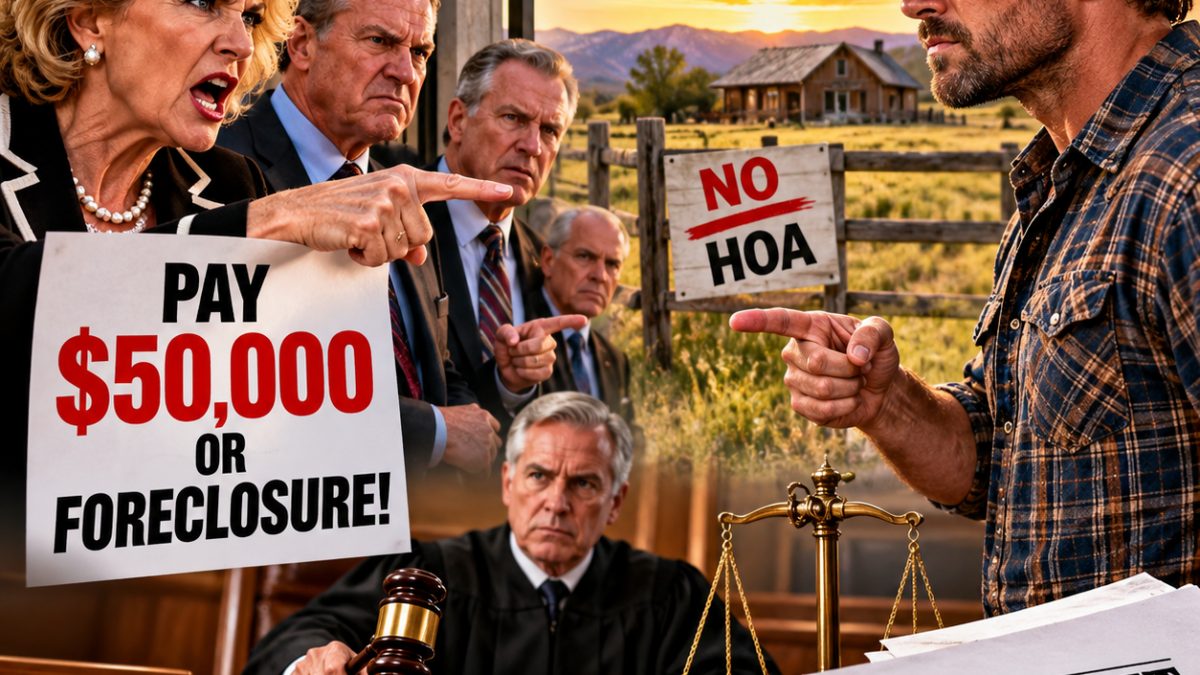
PART 2
For a few seconds, I said nothing.
I could hear Naomi breathing through the phone while the old ceiling fan clicked above my desk.
“They actually filed it?”
“Yes.”
“For the full amount?”
“Fifty thousand three hundred eighty dollars.”
“And the legal description?”
“Your ranch.”
I looked through the office window toward the pasture.
Juniper had wandered toward the far fence, Avery trailing behind her with a grooming brush tucked into the back pocket of her jeans. From where I stood, everything looked exactly as it had that morning.
Fence.
Barn.
Cottonwoods.
Open grass.
But somewhere in a county database, my property now carried a recorded lien claiming I owed an HOA more than fifty thousand dollars.
“The county accepted it?”
“The recorder accepted the document,” Naomi said. “That does not mean the county ruled that the claim is valid. Recorders record instruments. They don’t hold a trial at the counter.”
“So they can put this against my title even if they’re wrong?”
“They already did.”
I rubbed my forehead.
“Did they file foreclosure?”
“I found a notice of intent. I don’t see a foreclosure complaint yet.”
That distinction mattered, but not enough to make me feel better.
The lien was already there.
Anyone searching my title could see it.
“Daniel?”
“Yeah.”
“Do not pay them.”
“I wasn’t going to.”
“And do not sign anything they give you. You need a real estate litigation attorney today.”
I should have listened to the second half of that advice immediately.
Instead, I did something stubborn.
I drove to Brier Glen.
I wanted to put my deed on their table and force Celeste to explain, face-to-face, how she believed a board vote had somehow replaced the county records.
The Brier Glen management office sat beside the clubhouse in a low stone building surrounded by decorative grasses and identical young maples. Everything looked controlled.
Trimmed.
Approved.
Measured.
Inside, Celeste was waiting at the end of a polished conference table.
Beside her sat a man I had seen once before when I delivered one of my certified letters.
Martin Vale.
He was Brier Glen’s association manager, thin and carefully dressed, with silver-framed glasses and a blue tie. He held a silver pen between two fingers and rolled it slowly across his knuckles as I sat down.
I placed my documents on the table.
My deed.
Title commitment.
County tax record.
Certified-mail receipts.
Their lien.
“The parcel number on your filing belongs to Brier Glen property,” I said. “The legal description belongs to me.”
Martin adjusted his glasses.
“Our legal department prepared the instrument.”
“Then your legal department combined two different properties.”
Celeste folded her hands.
“The parcel number is a clerical error.”
“Then release the lien.”
“It does not affect the underlying obligation.”
“What obligation?”
“The assessments attached to your property.”
“My property is not in your association.”
“The board determined that your property falls within the western expansion area.”
I slid my deed across the table.
“Show me the recorded declaration.”
Neither of them touched it.
“The declaration or amendment,” I said. “Show me the document that makes my ranch part of Brier Glen.”
Celeste’s tone cooled.
“Your ranch receives benefits from this community.”
“That isn’t what I asked.”
“You use Brier Glen Parkway.”
“That’s a county road.”
“Our entrance improvements raise surrounding property values.”
“My driveway starts before your monument sign.”
“We provide security patrols.”
“On your streets.”
Martin finally opened a folder.
“Perhaps this will clarify the board’s position.”
He removed three pages of meeting minutes and pushed them toward me.
Six months earlier, the board had voted to approve something called the Annexation of Adjacent Benefiting Parcels.
My ranch was listed by name.
So were two undeveloped tracts north of the irrigation ditch.
I turned the pages over.
No owner signatures.
No consent forms.
No recorded amendment.
No county stamp.
I looked at Celeste.
“You voted to claim land you don’t own.”
“We voted to protect neighborhood standards.”
“On somebody else’s property.”
“Property values don’t stop at an arbitrary line on a map.”
“It isn’t arbitrary. It’s the legal boundary.”
Martin’s pen stopped moving.
Celeste leaned back.
“I’m giving you an opportunity to resolve this privately.”
“You can resolve it right now. Release the lien.”
“We are prepared to compromise.”
I almost laughed.
“Compromise on what?”
“If you pay thirty-five thousand dollars by Friday, the board may waive the remaining balance.”
I stared at her.
Five minutes earlier, $50,380 had supposedly been a fixed obligation attached to my land.
Now fifteen thousand dollars could vanish because Celeste felt generous.
That was the moment the number stopped looking like accounting to me.
It looked like leverage.
I gathered my documents slowly.
“Nothing with my signature stays here.”
As I reached the door, Martin spoke without looking up.
“Recorded liens are public, Mr. Mercer.”
I stopped.
He rolled the silver pen again.
“Lenders can see them. Business partners can see them. Anyone running a title search can see them.”
I turned around.
Celeste said nothing.
She did not need to.
The point had been made.
They did not have to win in court tomorrow.
They only had to make the lien expensive enough today.
My phone rang before I reached my truck.
It was my bank.
The officer handling the credit line for my irrigation company sounded uncomfortable from the first sentence.
“Daniel, our monitoring service picked up a new lien connected with your real property.”
“I know.”
“Is it legitimate?”
“No.”
“Is it being challenged?”
“It will be.”
There was a pause.
“I need more than that for underwriting.”
The equipment line financed pipe, pumps, valves, trenching rentals, and material deposits for three winter stock-water systems I had already contracted to install before the ground froze solid.
Six seasonal workers were scheduled on those projects.
Six men with mortgages, truck payments, kids, groceries, and winter heating bills.
“How long do I have?” I asked.
“Ten business days to show the lien is formally disputed and enforcement has been stopped. Until then, new draws are frozen.”
My grip tightened around the phone.
“And after ten days?”
“The loan could be canceled.”
I looked back at the stone management office.
Celeste’s white SUV was visible around the side of the building, sunlight flashing from its windshield.
A few minutes earlier, this had been a fight over a document.
Now it was threatening my payroll.
My contracts.
My daughter’s home.
I called Naomi from the parking lot.
Then I called the attorney she recommended.
Her name was Lydia Shaw.
Her office was on the second floor above an old hardware store in the county seat. The stairwell smelled faintly of lumber and dust, and her waiting room had two chairs that looked like they had survived three generations of clients.
Lydia was fifty-two, with dark hair threaded with gray and the kind of expression that made me think she had spent years listening to people tell half-truths.
She read every page I brought her.
Then she read them again.
Finally, she put the lien beside my deed.
“The parcel-number error is sloppy,” she said.
“But?”
“But do not make the mistake of thinking that typo wins the case for us.”
“I wasn’t.”
“Good.”
She tapped the legal description.
“This is the dangerous part. They described your ranch accurately enough to create a title problem.”
“What about the board vote?”
“A homeowners association board cannot make someone else’s property subject to its covenants merely by voting.”
“So the lien is invalid.”
“If the documents are what they appear to be, we have a very strong argument that it is. But I want the full chain. If they claim your ranch was annexed, I want the recorded instrument and the owner authorization.”
“There isn’t one.”
“Then they have a serious problem.”
“So we remove it.”
“We first demand that they release it voluntarily. We also put them on notice that the debt is disputed and that their actions are already damaging your business.”
She picked up the foreclosure notice.
“And this Friday deadline?”
“Theater?”
“Pressure,” she corrected. “Do not confuse pressure with harmless. A weak legal claim can still cost you a fortune until a judge stops it.”
Before sunset, Lydia sent Brier Glen’s attorney a formal demand.
Release the lien.
Withdraw the foreclosure threat.
Notify my bank that the debt was disputed.
Stop representing the ranch as HOA property.
Preserve every document connected to the supposed annexation.
She gave them until noon the next day.
Their attorney replied at 11:48.
Brier Glen refused.
The letter also introduced a legal theory I had never heard before.
According to them, Walter Bell had “impliedly participated” in Brier Glen for years.
He had driven on Brier Glen Parkway.
He had supposedly attended two community meetings.
He had benefited from drainage improvements and security.
Therefore, they argued, the ranch had effectively become part of the community even without a recorded annexation.
I read the letter twice.
Then I looked at Lydia.
“The stormwater pond is almost a mile from my southern boundary.”
“I know.”
“There’s a county road and an irrigation ditch between us.”
“I know.”
“And Walter driving on a public road makes his ranch HOA property?”
Her mouth twitched.
“Yesterday their position was that the parcel number was a clerical mistake. Today they’re building an entire theory around participation and benefits.”
“You don’t believe it.”
“I believe they intend to make you spend money disproving it.”
That afternoon, Avery got off the school bus and found a bright orange notice zip-tied to our gate.
She did not remove it.
She called me.
“Dad?”
I heard the strain in her voice immediately.
“What happened?”
“There’s something on the gate.”
“What does it say?”
She read it aloud.
“Property subject to HOA lien. Contact Brier Glen management before entering for commercial purposes.”
My chair scraped backward.
“Don’t touch it.”
“I already took pictures.”
“You did?”
“Front, back, the tie, the post, everything.”
Despite everything, I nearly smiled.
“Why?”
“You said records matter.”
I was at the ranch ten minutes later.
The orange paper snapped in the wind while Juniper stood at the fence staring at us.
Avery handed me her phone.
She had photographed everything exactly as she said.
I put the notice into a clear document sleeve.
Then I checked the security camera mounted under the barn eaves.
At 2:13 p.m., Martin Vale’s management vehicle pulled up.
He got out.
Attached the notice.
Photographed it.
Then waited.
Thirty seconds later, my feed truck appeared.
Martin stepped toward the road.
The driver stopped.
The two men spoke.
Then the truck backed up.
I called the feed company.
The dispatcher put me through to the driver.
“What did that man tell you?”
“That the property was under foreclosure restriction,” he said. “Said commercial delivery might expose us to liability.”
“That’s nonsense.”
“Maybe. But I’m not getting my employer dragged into somebody’s foreclosure fight.”
“There is no foreclosure.”
“I’m sorry, Daniel. I was told not to enter.”
When I told Lydia, her voice went completely flat.
“Save the original video.”
“I already copied it.”
“Save everything.”
She added the footage, Avery’s photographs, the canceled feed invoice, the orange notice, and the bank freeze to an emergency filing.
By the next morning, we had sued.
We asked the district court to declare the lien invalid and to stop Brier Glen from enforcing it or making further foreclosure representations while the dispute was pending.
The court scheduled an emergency hearing for Friday.
Thursday night, Naomi called me.
It was almost ten.
I had been pacing between the kitchen and office while Avery finished homework at the dining table.
“I found something,” Naomi said.
“What?”
“An archive file from an old title company.”
I stopped moving.
“What kind of file?”
“Seven years ago, Brier Glen tried to obtain an easement from Walter Bell.”
I looked toward the dark pasture outside the window.
“Did he sign?”
“No.”
A pause.
“Daniel, that isn’t the important part.”
My pulse changed.
“What is?”
“I’m emailing you the letter.”
The document arrived while we were still on the phone.
I opened it.
Brier Glen had requested a thirty-foot access easement across the eastern side of Walter’s ranch so association contractors could reach a proposed utility site.
The language was formal.
Precise.
Then I reached the second paragraph.
I read one sentence three times.
Because the Bell property lies outside Brier Glen’s recorded boundaries and beyond the association’s regulatory authority, the association seeks a voluntary easement agreement with the owner.
At the bottom was a signature.
Celeste Harrow.
Across the offer, in Walter Bell’s handwriting, was one word.
DECLINED.
I forwarded the file to Lydia.
She called me almost immediately.
“She signed it,” I said.
“Yes.”
“She knew.”
“She knew what Brier Glen’s boundary was seven years ago.”
“That ends this.”
“It helps us enormously.”
“Helps?”
“Daniel, stop thinking only about winning the lien issue.”
I leaned against my desk.
“What else is there?”
“She acknowledged the ranch was beyond Brier Glen’s authority. Years later, she approved a lien saying the opposite. I want to know what happened in between.”
Friday morning, the courthouse smelled like floor wax and old paper.
Lydia arranged our exhibits in neat stacks.
I sat behind her with my closing binder in my lap.
Across the aisle, Celeste wore the same dark pink suit she had worn at my gate.
Martin sat beside her, turning that silver pen between his fingers.
Brier Glen’s attorney spoke first.
He argued that my property received economic benefits from the subdivision, that Walter Bell had participated informally in community affairs, and that the association believed future annexation had been contemplated for years.
Lydia did not interrupt him.
When he finished, she stood.
“Your Honor, may I display Exhibit Seven?”
The judge nodded.
Celeste’s old easement letter appeared on the courtroom monitor.
One sentence was enlarged.
The Bell property lies outside Brier Glen’s recorded boundaries and beyond the association’s regulatory authority.
Celeste stopped writing.
Lydia faced the judge.
“We are not asking the court to decide every issue today. We are asking the court to stop an association from using a disputed lien as leverage against Mr. Mercer’s lender and business while the validity of that lien is adjudicated.”
Judge Warren read the letter.
Then he looked toward Brier Glen’s attorney.
“Was this document disclosed to your office before the lien was recorded?”
The attorney whispered with Celeste.
Then Martin.
Finally, he stood.
“Your Honor, I would request a brief recess.”
“Fifteen minutes.”
We stepped into the hallway.
Lydia’s phone buzzed.
She looked at the screen.
Then at me.
“What?”
“Your bank officer forwarded an email.”
“From who?”
“Brier Glen.”
I took the phone.
The email had been sent twenty-three minutes before the hearing.
It told my lender that foreclosure against my ranch was imminent.
I looked at Lydia.
“They sent this today?”
“Yes.”
“They agreed through counsel not to escalate before the hearing.”
“Yes.”
“That wasn’t a mistake.”
“No.”
When court resumed, Lydia handed the email to the clerk.
Brier Glen’s attorney admitted Celeste had authorized it.
He tried to argue that “imminent” did not mean a foreclosure sale had actually been scheduled.
Judge Warren removed his glasses.
“Your client knew the property owner was appearing in this courtroom this morning to challenge the validity of the lien.”
“Yes, Your Honor.”
“Nevertheless, she contacted his lender and represented foreclosure as imminent.”
The lawyer shifted his weight.
“The association was attempting to preserve its collection rights.”
“What lawful collection purpose required contacting the lender this morning?”
Silence.
Celeste leaned toward him and whispered.
He lifted one hand slightly.
She stopped.
Judge Warren issued a temporary order.
Brier Glen could not enforce the lien while the case was pending.
It could not initiate foreclosure.
It could not tell my lender that foreclosure was imminent.
The HOA had until 3:00 p.m. to send the bank a written correction.
Both sides were ordered to preserve every record connected to the annexation claim, the lien, and any proposed use of my property.
The judge had not yet erased the lien.
But he had taken the weapon out of Celeste’s hand.
At 2:46 that afternoon, my bank officer called.
“We received the correction.”
I leaned back in Lydia’s conference-room chair.
“What happens to my credit line?”
“It stays open while the title dispute is litigated.”
I closed my eyes.
“And the equipment draw?”
“Have your vendor resubmit it today.”
I called the supplier before the banker had finished his last sentence.
The pumps shipped Saturday morning.
The pipe order followed.
All six of my seasonal workers kept their contracts.
That mattered more to me than the courtroom order.
For the first time since Celeste stepped onto my cattle guard, the damage had stopped spreading.
Outside the courthouse, Celeste caught me near the steps.
“You’re spending thousands of dollars to avoid paying your fair share.”
I turned.
Lydia was several feet behind me, putting files into her bag.
“I’m spending thousands because you filed a lien on land you already knew was outside Brier Glen.”
“Our residents have supported Western Connectivity for years.”
I stared at her.
“Western what?”
Something flickered across her face.
Barely there.
But Lydia saw it too.
“Western Connectivity,” I repeated. “What is that?”
“Community planning.”
“What kind?”
Celeste reached for her keys.
“I’m not discussing internal planning with you.”
“Then I’m sure discovery will explain it.”
She stopped.
“You can still settle.”
“Release the lien.”
“Twenty-five thousand.”
I said nothing.
“Pay twenty-five thousand and join Brier Glen voluntarily. The association releases everything.”
Days earlier, fifty thousand dollars had supposedly been a debt attached to the land.
Now half of it could disappear if I voluntarily surrendered the one thing they kept pretending they already had.
Authority.
Lydia stepped between us.
“Any settlement proposal goes through my office.”
Celeste walked away.
That evening, I opened the ranch gate and heard the brass tag on Walter’s old key ring tap against the lock.
People forget. Paper doesn’t.
That was what Walter had told me at closing.
At the time, I thought the old man had been talking about maintenance records.
Over the next six weeks, I learned how wrong I had been.
Lydia moved quickly.
Because the lien continued to cloud my title, the court allowed expedited discovery.
We asked for boundary maps.
Assessment ledgers.
Board minutes.
Emails.
Digital files.
Drafts.
Documents concerning annexation.
And everything connected to the phrase Western Connectivity.
Brier Glen responded with boxes of records.
Pool invoices.
Landscaping bids.
Insurance renewals.
Gate repairs.
Clubhouse maintenance.
Pages and pages that had nothing to do with my ranch.
There was almost nothing about Western Connectivity.
Too little.
“They’re burying us in paper,” I said.
Lydia looked over the production index.
“Sometimes people do that because the useful page is missing.”
One night, Naomi came to the ranch carrying two archive boxes recovered from old development files.
Avery was asleep upstairs.
We worked beneath the green desk lamp while wind pushed dust against the office window.
The first box contained utility agreements.
The second held planning documents from Brier Glen’s expansion twelve years earlier.
Near midnight, Naomi unfolded a large map across my desk.
A yellow line showed Brier Glen’s recorded western boundary.
My fence sat nearly eight hundred feet beyond it.
Then I saw another line.
Red pencil.
It crossed the county road.
Jumped the irrigation ditch.
And enclosed sixty-two acres of my eastern pasture.
Beside the red line, somebody had written:
Future trail and amenity corridor — subject to acquisition.
Underneath were two initials.
C.H.
I looked at Naomi.
“Celeste Harrow.”
She nodded.
I followed the red line with one finger.
It crossed the part of the pasture where Avery rode Juniper.
It passed the cottonwoods.
Then it connected back toward Brier Glen.
“She wasn’t trying to regulate the ranch,” I said.
Naomi looked at me.
“She wanted part of it.”
The next morning, Lydia sent a licensed surveyor to walk the boundary with us.
He marked coordinates against the recorded plat while Naomi compared the title documents.
Brier Glen’s attorney had repeatedly claimed the HOA maintained drainage infrastructure near my property.
We found the channel they appeared to mean.
A metal plaque identified it as county stormwater infrastructure.
County owned.
County maintained.
Across the road from my ranch.
Not theirs.
Then the surveyor stopped near the irrigation ditch.
“What are those?”
Three fresh wooden stakes stood in the grass.
Pink survey ribbon snapped from the tops.
Each carried a project number.
Nobody touched them.
The surveyor photographed the stakes and called the company listed on the tags.
When he ended the call, he looked at me.
“Brier Glen commissioned the preliminary survey.”
“When?”
“Two weeks before Ms. Harrow delivered the demand to you.”
“For what?”
He glanced at the notes he had written.
“Pedestrian trail connection.”
I looked across my pasture.
They had surveyed a route toward my property before demanding money from me.
Naomi folded her arms.
“So either they genuinely believed they already controlled your land…”
“Or?”
“Or they needed something that could help them create that impression.”
Two days later, the first meaningful discovery production arrived.
Most of it was ordinary.
Then I opened a spreadsheet.
I recognized the property description immediately.
My ranch.
The owner field was blank.
Five years of assessments had been entered retroactively.
Annual dues.
Late fees.
Interest.
Landscape penalties.
Attorney charges.
Collection costs.
At the far right was a comment.
Acquire through compliance or collection.
I stared at those words.
Then at the file information.
The spreadsheet had been created four months before I bought the ranch.
I called Lydia.
“Do not alter the original,” she said before I finished explaining.
“I haven’t.”
“Make a working copy. Preserve metadata.”
Naomi joined us by video.
She inspected the document properties.
“Creator is Martin Vale.”
“When?”
She read the timestamp.
Then looked up.
“Three days after Walter rejected Brier Glen’s second easement request.”
I sat back.
“They created a debt before I even owned the place.”
“Not necessarily a debt,” Lydia said. “We need to be precise.”
I pointed to the spreadsheet.
“They calculated five years of charges.”
“They may claim it was modeling.”
That was exactly what they claimed.
Brier Glen’s attorney called the spreadsheet an internal financial-planning tool that had never been used to determine my actual balance.
The explanation survived six hours.
Naomi compared the spreadsheet with Celeste’s original demand.
Every annual assessment matched.
Every interest charge.
Every penalty.
Every attorney fee.
To the penny.
$50,380.
Lydia requested the native file, revision history, and all communications connected to it.
Brier Glen objected.
She filed a motion to compel.
The judge ordered production.
A forensic document examiner working under the litigation protocol reviewed the file history.
Seventeen revisions had been made during the month before I closed on the ranch.
More edits appeared shortly before the lien was recorded.
Then the county clerk located something none of us expected.
An old presentation stored on a retired planning server.
The title slide read:
WESTERN CONNECTIVITY STRATEGY.
The first pages showed ordinary community material.
Sidewalks.
Playgrounds.
Landscaped entrances.
Pedestrian access.
Then Lydia advanced to the fourth slide.
A green line crossed my eastern pasture.
The proposed trail passed near the cottonwoods and continued toward a future county park.
The next slide estimated that direct trail access could increase values of nearby Brier Glen homes by approximately six percent.
Then came the final page.
Three options.
Voluntary easement.
Purchase of sixty-two acres.
Collection remedy following mandatory annexation.
Beside that third option were four words:
Lowest projected acquisition cost.
Presented by Celeste Harrow.
Financial analysis by Martin Vale.
Nobody spoke for several seconds.
Then Lydia opened an email attached to the county file.
Celeste had sent it after Walter rejected an easement request.
If the parcel changes hands, begin compliance immediately. A new owner will not have his institutional memory.
I read the sentence again.
And again.
Walter had known.
Maybe not every detail.
But he had known enough to keep everything.
Every letter.
Every offer.
Every map.
Every conversation.
“This establishes motive,” Lydia said.
“They were waiting for him to sell.”
“It certainly supports that inference.”
“They thought I’d be easier.”
Lydia looked at me.
“Now we need to establish exactly how they turned a rejected land-acquisition plan into a recorded debt.”
Part of the answer came from Martin Vale.
His deposition began on a Tuesday morning.
He arrived with his attorney and the same silver pen.
He sat across from Lydia in the conference room, swore to tell the truth, and spent the first hour answering everything in the smallest number of words possible.
“Is there a signed covenant binding the Mercer ranch to Brier Glen?”
“No.”
“Is there a recorded amendment annexing the ranch?”
“No.”
“Does the official county plat place the ranch inside Brier Glen?”
“No.”
“Did Daniel Mercer sign an annexation agreement?”
“No.”
“Did Walter Bell?”
Martin looked at his attorney.
“No written agreement.”
Lydia placed the assessment spreadsheet in front of him.
“Did you create this file?”
“Yes.”
“Why?”
“To model potential assessments.”
“At whose request?”
“President Harrow’s.”
“When you created it, was the Bell ranch legally part of Brier Glen?”
“No.”
“Why did you enter five years of charges?”
“To evaluate potential liability.”
“Potential liability if what occurred?”
“If the property became subject to the association.”
Lydia leaned slightly forward.
“Was it subject to the association when you sent Mr. Mercer the demand?”
Martin’s fingers stopped moving.
“Not by a recorded instrument.”
“Then why did this hypothetical model become a demand for an existing debt?”
“The board later used the figures.”
“Which board meeting?”
“I don’t recall.”
“You produced board minutes for the year.”
“Yes.”
“Show me the meeting where that happened.”
His attorney shifted.
“Objection to form.”
Lydia waited.
Martin looked down at the silver pen.
“I don’t know.”
There were two missing sets of minutes in the HOA production.
One of those meetings had occurred three days before the lien was recorded.
Celeste’s deposition was scheduled for Friday.
Thursday evening, my gate camera sent an alert.
I was washing dishes.
Avery was upstairs.
I opened the security app.
A white SUV had stopped outside the ranch.
Celeste got out alone.
She carried a large envelope.
She walked to the gate, glanced toward the barn, and pushed it underneath the chain.
Then she returned to her vehicle and left.
I waited until her taillights disappeared before going outside.
The envelope was addressed to me.
Inside was a settlement proposal.
I read the first page standing beneath the gate light.
Brier Glen would erase all $50,380.
Release the lien.
Dismiss its claims.
End the litigation.
In return, I would grant the association a permanent twenty-foot recreational easement across my eastern pasture.
And waive every claim against Brier Glen, its officers, managers, employees, and agents.
I read it again.
The debt they said had been mandatory disappeared completely if I gave them the trail.
I left the envelope where it was long enough to photograph it.
Then I collected it with the same care Avery had used with the orange notice.
The next morning, I was outside Lydia’s office before she arrived.
She read page one.
Then the easement section.
Then the waiver.
“She delivered this personally?”
“Camera recorded everything.”
“After opposing counsel directed settlement communications through the attorneys?”
“Yes.”
I pointed at the page.
“This is what they wanted.”
Lydia did not answer immediately.
Then she said, “It connects the alleged debt directly to the property interest they were trying to acquire.”
We rejected the proposal in writing.
Lydia informed Brier Glen’s attorney that the original envelope and gate recording had been preserved.
Eleven minutes later, he responded.
Celeste had acted without legal advice.
Friday morning, she entered the deposition room looking composed.
Same pink suit.
Same leather portfolio.
She sat across from Lydia.
Her attorney sat beside her.
I stayed behind my lawyer, listening.
Lydia began with the boundary.
“You reviewed the recorded plat before the Mercer lien was filed?”
“Yes.”
“The Mercer ranch appears outside Brier Glen’s recorded boundary?”
“The historical boundary.”
“Is there another recorded boundary?”
Celeste paused.
“No.”
“Did Daniel Mercer sign an annexation agreement?”
“No.”
“Did Walter Bell?”
“He verbally agreed to future annexation.”
I nearly laughed.
Lydia did not move.
“When?”
“At a community picnic.”
“What year?”
“I don’t remember exactly.”
“Who witnessed this agreement?”
“I don’t remember.”
“Was it reduced to writing?”
“Walter preferred handshakes.”
I looked down at the brass key tag I had placed beside my notebook.
Walter Bell had documented rainfall.
Cattle weights.
Diesel purchases.
Broken hinges.
Fence repairs.
Well maintenance.
Easement conversations.
The idea that he had casually surrendered control of 162 acres over potato salad at a neighborhood picnic and never written a word about it was almost insulting.
Lydia placed Celeste’s seven-year-old easement letter in front of her.
“You signed this?”
“Yes.”
“You wrote that the Bell property lay outside Brier Glen’s recorded boundaries and beyond the association’s regulatory authority.”
“At that time.”
“What changed?”
“Community development.”
“Did community development move the recorded boundary?”
“No.”
“Did it create a signed annexation agreement?”
Her attorney objected.
Lydia continued.
She displayed the Western Connectivity presentation.
“You presented this plan?”
“Yes.”
“You proposed acquiring sixty-two acres of the Bell ranch?”
“As one potential option.”
“Why would Brier Glen need to acquire land it already had regulatory authority over?”
Celeste’s mouth tightened.
“We did not claim ownership.”
“But you later claimed authority to impose assessments.”
“We believed annexation was appropriate.”
“Appropriate and completed are different, correct?”
Silence.
“Correct?”
“Yes.”
Then Lydia placed the settlement offer on the table.
Celeste’s eyes went to it immediately.
“If the $50,380 represents valid mandatory assessments, why does every dollar disappear if Mr. Mercer grants Brier Glen a trail easement?”
“Settlements involve compromise.”
“What was the association compromising?”
“Our claims.”
“Your position is that the assessments were legally owed.”
“Yes.”
“And yet your proposal values those supposedly mandatory assessments at zero dollars if Mr. Mercer gives you access across his pasture.”
Celeste adjusted one cuff.
Lydia continued.
“Walter Bell rejects your easement request.”
She placed the letter down.
“You develop the Western Connectivity plan.”
The presentation landed beside it.
“Mr. Vale creates five years of hypothetical assessments.”
The spreadsheet came next.
“The property changes hands.”
Then my deed.
“You instruct staff to begin compliance.”
The email.
“The association demands $50,380.”
The letter.
“A lien is recorded.”
The lien.
“Mr. Mercer’s lender is contacted.”
The bank email.
“And finally, every dollar of the alleged debt disappears in exchange for the same kind of land access Walter Bell refused to provide.”
The settlement proposal joined the row.
The room was silent.
Celeste looked at the documents lined across the table.
Then at Lydia.
“I never instructed anyone to fabricate a debt.”
“Who told Mr. Vale to make the projected assessments appear as an existing balance?”
“I asked for financial modeling.”
“That wasn’t my question.”
“I don’t know how Martin interpreted the request.”
Martin’s attorney requested a break later that afternoon.
The next day, Lydia called me.
“I need you in the office.”
“What happened?”
“Martin wants to supplement his testimony.”
His sworn declaration arrived at 4:17 p.m.
I read it standing beside Lydia’s desk.
Martin now claimed that Celeste had instructed him to convert the projected assessments into what looked like an existing balance.
He said he warned her that the ranch was outside Brier Glen.
According to Martin, Celeste responded:
The lien will create leverage before anyone asks that question.
I looked up.
“That’s it.”
“Keep reading,” Lydia said.
There was another paragraph.
Three months before I bought the ranch, Brier Glen’s own attorney had written Celeste a memorandum analyzing whether the association had any authority over Walter’s property.
According to Martin, the memo concluded that the ranch could not legally be assessed, liened, or foreclosed upon because it had never been annexed.
We had never received that document.
Lydia demanded it immediately.
Brier Glen refused.
Attorney-client privilege.
Normally, that would have put the memo beyond our reach.
But Celeste had repeatedly testified that she genuinely believed Brier Glen possessed authority over the ranch and that she had acted in good faith.
Lydia argued that Celeste had put her state of knowledge and reliance on legal advice directly at issue.
She asked Judge Warren to review the memorandum privately.
The judge ordered Brier Glen to submit it under seal.
Three days later, Lydia called me from chambers.
“Limited disclosure was granted under a protective order.”
I drove to her office.
The memorandum was six pages long.
Dated three months before my closing.
Addressed to Celeste Harrow.
Brier Glen’s former counsel had reviewed the HOA declaration.
The county plat.
Walter’s deed.
The annexation provisions.
The conclusion could not have been clearer.
The Bell ranch had never joined Brier Glen.
No HOA assessments could be imposed against it.
No valid assessment lien could attach to it.
Any future annexation required written authorization from the owner and proper recording.
Then came the final paragraph.
The attorney warned that using assessment or lien procedures to pressure Walter Bell—or any future purchaser—into granting an easement could expose the association to litigation costs, fee awards, and damages.
I looked at Lydia.
“She was told exactly what not to do.”
“Keep reading.”
Beneath the memorandum was Celeste’s email response.
Five words.
Understood. We will explore other leverage.
I sat down.
For months, every explanation from Brier Glen had left them somewhere to hide.
Clerical mistake.
Misunderstanding.
Community benefit.
Historical expectations.
Verbal annexation.
Overzealous management.
Planning model.
Those five words left very little fog.
She had been warned.
She had understood.
Then she had looked for leverage.
The summary judgment hearing was scheduled several weeks later.
By then, my winter projects were underway.
The equipment credit line had been fully restored.
My six workers were trenching stock-water lines before the freeze.
The ranch itself had returned to something close to normal.
One evening, I came home after dark and found Avery in the barn brushing Juniper.
“You missed dinner.”
“I know.”
“She was mad.”
“Juniper?”
“Grandma.”
My mother had come over twice that week because I had been spending too many nights with Lydia reviewing documents.
Avery kept brushing.
After a minute, she asked, “How much have you spent?”
I knew what she meant.
“Enough.”
“More than fifty thousand?”
I hesitated.
“Not yet.”
“So wouldn’t it have been cheaper to pay them?”
That question had crossed my mind at two in the morning more times than I wanted to admit.
I leaned against the stall.
“Maybe.”
She stopped brushing.
“Then why didn’t you?”
“Because paying them wouldn’t necessarily have ended it.”
“What do you mean?”
“They wanted part of the pasture.”
Her eyes moved toward the dark doors.
“Juniper’s pasture?”
“Twenty feet of it at first. Maybe more later.”
She looked back at me.
“They knew they didn’t own it?”
I thought about the memorandum.
“Yes.”
Her face tightened.
“Then make them say it.”
The morning before court, I repaired a loose hinge on the barn door because I needed something I could fix with a wrench.
Avery came outside carrying two mugs.
Mine was coffee.
Hers was mostly milk, cinnamon, and enough sugar to qualify as dessert.
She handed mine to me.
“Is tomorrow the last time?”
“I hope so.”
“Are they still trying to take the pasture?”
“No.”
She narrowed her eyes.
“You sound sure this time.”
I smiled.
“This time I’ve read the records.”
The next morning, the courtroom benches were crowded.
Several Brier Glen residents had come.
Some I recognized from driving past the subdivision.
Others I did not.
One was an older woman with silver hair and a cracked blue notebook in her lap.
I would later learn her name was Ruth Calder.
Lydia began with the simplest evidence.
The recorded county plat appeared on the monitor.
Yellow boundary.
Brier Glen on one side.
My ranch on the other.
Then came my deed.
Then the HOA declaration.
Then the annexation clause requiring written owner authorization and a recorded amendment.
Nothing existed.
Next came Celeste’s old easement request.
Her own sentence acknowledging that Walter’s property lay outside Brier Glen’s regulatory authority.
Then Western Connectivity.
The trail.
The sixty-two acres.
The projected increase in neighboring property values.
Then the assessment spreadsheet.
Then the lien.
Then the bank communication.
Then the gate settlement.
Finally, the legal memorandum.
Lydia stood beside the monitor.
“The association was not mistaken about where the boundary was. Its president acknowledged that boundary years ago. Its planning documents treated the ranch as property that had to be acquired. Its own attorney advised that Brier Glen lacked authority to assess, lien, or foreclose upon it.”
She turned one page.
“What changed was not the legal boundary.”
She looked toward Celeste.
“What changed was the owner.”
Brier Glen’s attorney rose.
He described the situation as administrative overreach.
He argued that historical discussions had created expectations of eventual annexation.
He emphasized that no foreclosure sale had actually occurred.
Judge Warren looked over his glasses.
“Counsel, your client issued a foreclosure threat on legal letterhead.”
“Yes, Your Honor, but—”
“Your client contacted Mr. Mercer’s lender.”
“Yes.”
“Your client represented that foreclosure was imminent while the lien’s validity was being challenged.”
“The process had not advanced to a sale.”
The judge leaned back.
“What part of the threat was Mr. Mercer supposed to treat as imaginary?”
The attorney did not answer immediately.
He moved instead to Walter Bell’s supposed verbal agreement.
Lydia displayed the annexation provision.
Written owner authorization.
Recorded amendment.
No exceptions for picnics.
No exceptions for expectations.
No exceptions for community benefit.
Then Judge Warren looked toward Celeste.
“Ms. Harrow, please stand.”
She did.
The courtroom became very quiet.
“Before this lien was authorized, did you receive legal advice stating that the Mercer property was outside Brier Glen?”
Celeste looked at her attorney.
He whispered something.
“Yes.”
“Did you disclose that advice to the full board before the lien was approved?”
“No.”
“Did the board vote to disregard counsel’s conclusion?”
“No.”
“Did the board direct Mr. Vale to convert projected assessments into an existing debt?”
Celeste opened her mouth.
“I don’t believe that was the board’s understanding.”
“That was not my question.”
Nobody moved.
The judge repeated it.
“Did the board direct Mr. Vale to do that?”
“No.”
“Then whose decision was it?”
Celeste’s fingers tightened against the edge of the table.
For the first time since I had met her, she looked toward the residents sitting behind us.
Then at Martin.
Then at the judge.
“Mine.”
No one gasped.
Real courtrooms are quieter than television.
I heard a page turn.
A chair creak.
Someone inhale slowly behind me.
Judge Warren looked down at the record.
Then he ruled.
My ranch was not and had never been part of Brier Glen.
The assessments were void.
The $50,380 debt did not exist.
The lien was invalid.
Brier Glen had to release it.
The association was permanently barred from claiming regulatory authority over my ranch unless a future owner entered a lawful written and recorded agreement.
Brier Glen would also be responsible for my reasonable attorney fees and the costs necessary to clear the title.
Issues involving record alteration, discovery conduct, and sanctions would be addressed separately.
Lydia turned the original demand letter toward me.
She took a pen.
Across $50,380, she drew one straight line.
I looked across the aisle.
Celeste had sat down.
She was staring at the table.
Eleven months earlier, I had bought 162 acres because I wanted quiet.
I had not wanted a legal battle.
I had not wanted revenge.
I had wanted space for Avery and Juniper.
I wanted to build irrigation systems during the week and hear Walter’s old bell on Saturday mornings.
But sitting in that courtroom, I finally understood something.
The most satisfying part was not watching Celeste lose.
It was watching the threat become ordinary paper again.
At 4:38 that afternoon, the county recorder stamped the lien release.
The cloud on my title was gone.
I should have driven home.
Instead, as Lydia and I walked out of the courthouse, we found Martin Vale waiting beneath the clock near the front steps.
He no longer carried the silver pen.
He held a thick folder against his chest.
Lydia stopped.
“What is it?”
Martin looked at me.
“The ranch wasn’t the only property.”
We sat on a stone bench.
Martin opened the folder.
Inside were assessment ledgers for seven parcels along Brier Glen’s western edge.
Lydia compared the first legal description to the county map on her tablet.
Outside the boundary.
Second parcel.
Outside.
Third.
Outside.
Every one of them had been charged something labeled provisional community fees.
Three property owners had paid.
One name appeared repeatedly.
Ruth Calder.
The silver-haired woman from the courtroom.
She had paid almost eight thousand dollars after receiving a lien warning.
Another file belonged to a young couple who had paid several thousand dollars while postponing repairs to a leaking roof because they believed the HOA could take their home.
Lydia looked at Martin.
“Why do you still have these?”
His face changed.
“Celeste told me to delete them.”
“Did you?”
“No.”
“Why?”
“I made a copy.”
“That wasn’t what I asked. Why didn’t you delete them?”
He stared at the courthouse lawn.
“Because by then I knew what we were doing was wrong.”
My anger came back so fast it surprised me.
“You knew before my lien.”
He looked at me.
“Yes.”
“You knew when you posted that orange notice.”
“Yes.”
“You knew when you stopped my feed delivery.”
His eyes dropped.
“Yes.”
“And you still did it.”
“I wanted to keep my job.”
I stood.
“People almost lost money they didn’t have because you wanted a paycheck.”
“I know.”
“No. You know now because you’re scared you’ll be blamed.”
Lydia touched my arm.
Not to silence me.
Just enough to remind me that anger did not need to run the next ten minutes.
Martin looked exhausted.
“I’m not asking you to forgive me.”
“Good.”
“I’m giving you everything I kept.”
Lydia held out her hand.
“We’ll preserve it properly. You understand I cannot promise you immunity or protection.”
“Yes.”
“You may need separate counsel.”
“I already have it.”
There was no heroic redemption for Martin.
He had preserved evidence.
He had also participated.
Both facts remained true.
By the following week, the court had copies of the ledgers.
An independent accounting review began.
Word spread through Brier Glen faster than any official notice.
Residents started requesting their own histories.
Then they compared them.
People who had rarely questioned a line item began asking what authority supported it.
Board members who had spent years approving whatever Celeste placed in front of them suddenly wanted source documents.
One Friday evening, more than sixty residents packed the Brier Glen clubhouse.
Ruth Calder called me that afternoon.
“I’d like you to attend.”
“I’m not a member.”
“That is precisely why I’d like you there.”
I almost declined.
I had spent enough time inside Brier Glen buildings.
Then Avery looked up from the kitchen table.
“You should go.”
“Why?”
“Because they tried it with other people.”
So I went.
Ruth saved a seat beside her.
Up close, she looked to be in her late sixties. Her cracked blue notebook was open across her knees.
“I paid them $7,842,” she said before the meeting began.
“I saw the ledger.”
“My husband died five years ago. He handled property paperwork. When the lien warning came, I thought maybe I had missed something.”
“You shouldn’t have had to know HOA law to keep your own money.”
She gave me a tired smile.
“I postponed replacing my porch steps.”
“I’m sorry.”
“Don’t be. I’m angry now. That’s more useful.”
The room quieted when Celeste entered.
Same leather portfolio.
Different suit.
For years, I imagined people must have moved aside when she walked through that clubhouse.
That evening, nobody did.
She had to squeeze past folding chairs like everyone else.
The acting board secretary opened the meeting.
An independent reviewer summarized the preliminary findings.
Improper assessments.
Unsupported fees.
Boundary inconsistencies.
Incomplete minutes.
Payments collected from properties without documented association membership.
A man near the back interrupted.
“Did Celeste know?”
The secretary looked uncomfortable.
Ruth raised her hand.
“Read the attorney memorandum.”
Celeste stood.
“That document is privileged and has been mischaracterized in litigation.”
I heard my chair scrape before I realized I had leaned forward.
The secretary said, “The court made findings concerning the ranch.”
“The ranch litigation is separate.”
Ruth’s voice cut through the room.
“Was my property ever in Brier Glen?”
Celeste looked toward her.
“Ruth, individual accounts should not be discussed publicly.”
“You discussed my lien publicly enough when you mailed the warning.”
A murmur passed through the room.
Celeste gripped the portfolio.
“There were historical reasons for treating the western properties as benefiting parcels.”
“Was my property in the HOA?”
Celeste’s voice hardened.
“The matter is under review.”
Ruth closed her notebook.
“That means no.”
The remaining board members voted that evening.
Celeste was removed as president while the audit continued.
The Western Trail project was canceled.
The consulting agreement associated with it was terminated.
Martin Vale resigned as manager and turned the original accounting archive over to the independent reviewer.
I watched Celeste gather her papers.
Nobody applauded.
That made the moment feel more real.
She simply no longer controlled the room.
As she passed my chair, she stopped.
“This cost everyone more than it needed to.”
I looked up.
“You could have released the lien the first day.”
Her jaw tightened.
“You think you fixed something?”
“No.”
I glanced at Ruth’s blue notebook.
“I think people started reading.”
Celeste walked out.
Weeks later, the final orders and settlement terms were entered.
Brier Glen reimbursed the owners who had paid unsupported charges.
Interest was added.
My attorney fees were paid.
My title remained clean.
Celeste was barred under the settlement from serving as an association officer or controlling association funds.
Questions involving altered accounting records and the missing materials were referred for additional review through the appropriate channels.
I did not spend much time wondering what would happen after that.
I had already spent too much of a year thinking about Celeste Harrow.
What mattered to me was simpler.
The ranch was mine.
Not provisionally.
Not until an HOA board held another meeting.
Not unless somebody redrew a pink shape on a planning map.
The same way it had been Walter’s.
Because the deed said so.
Ruth received her reimbursement on a Monday.
The following Saturday, she drove to the ranch carrying a jar of homemade peach preserves.
“I repaired the porch steps,” she said.
“Good.”
“And bought a new railing.”
“Even better.”
She handed me the jar.
“You opened the door.”
I shook my head.
“They left a paper trail.”
“You followed it.”
“That part I’ll take.”
By early fall, grass had grown over the places where Celeste’s survey stakes had marked the proposed trail.
The orange foreclosure notice was gone.
The released lien sat in my closing binder beside the original title commitment.
My credit line was completely back to normal.
All three winter irrigation projects had been finished before the first hard freeze.
Every one of my six seasonal workers received every week of work I had promised.
And Avery stopped asking whether Juniper would lose her pasture.
One Saturday morning, she met me outside the barn before sunrise.
The sky above the cottonwoods was just beginning to turn pale blue.
Juniper waited near the fence.
Avery wrapped one hand around the rope hanging from Walter Bell’s old brass dinner bell.
“You ready?”
“For what?”
She gave me a look.
“It’s Saturday.”
Then she pulled.
The bell rang.
Clear.
Deep.
The sound rolled across the yard, over the pasture, through the cottonwoods and toward the irrigation ditch.
Juniper lifted her head.
The cattle shifted farther out.
I thought about the morning Celeste had stood on my cattle guard.
The pink suit.
The white SUV.
The $50,380 demand.
The colored map that somebody thought could replace a legal boundary.
Then I thought about everything that had stopped it.
Walter’s old letter.
Avery’s photographs.
The gate camera.
Martin’s spreadsheet.
The survey stakes.
The Western Connectivity presentation.
The attorney memorandum.
Five words in an email.
None of those things had looked powerful by itself.
A photograph.
A document.
A timestamp.
A sentence someone expected nobody else to read.
But once we put them together, they told one story.
Later that afternoon, Ruth and several Brier Glen residents came over for a picnic beside the barn.
The association’s new treasurer brought a copy of its first independent audit.
Every assessment category now identified its authority.
Boundary maps were attached to the association records.
Major expenditures carried supporting documentation.
Meeting records were available again.
Three children spent most of the afternoon staring at Juniper from the fence.
Their parents asked whether they could come closer.
Avery looked at me.
I nodded.
For the next hour, she taught them how to hold their hands flat when feeding a horse.
I sat near the barn with a cup of coffee.
The original foreclosure demand was on the table beside me, held down by a mug so the afternoon wind would not carry it away.
$50,380.
Once, that number had looked enormous.
Large enough to freeze my business credit.
Large enough to frighten my daughter.
Large enough to make surrender seem cheaper than resistance.
Now it was ink on a canceled demand.
Avery walked toward the bell before everyone left.
She pulled the rope one more time.
The sound traveled across all 162 acres.
No orange warning hung from the gate.
No survey ribbon snapped beside the ditch.
No imaginary boundary covered the eastern pasture.
Juniper grazed where Celeste’s trail had once been drawn.
I listened until the last note of Walter Bell’s bell disappeared into the evening.
The records had said where the boundary was all along.
All I had finally done was make everyone read them.
[END OF STORY]

