PART 2: HOA Karen Called the Cops on Me in My Own Cabin—Then One Piece of Evidence Turned the Whole HOA Against Her
PART 2
Then I heard voices.
Several voices.
From the kitchen.
My stomach turned cold.
The boy hadn’t been alone.
I headed toward the kitchen.
When I stepped through the doorway, I stopped dead.
There were people everywhere.
A woman I had never seen before stood beside my kitchen island holding one of my coffee mugs.
A toddler sat on my sofa watching cartoons.
An elderly man was asleep in my recliner with a blanket tucked around his legs.
A half-open cooler sat near the dining table.
Plastic grocery bags covered the counter.
Someone had made sandwiches.
Someone had opened a bottle of wine.
A casserole dish sat beside my stove.
Children’s shoes were scattered near my fireplace.
And leaning against my refrigerator like she owned the place was Karen Whitmore.
HOA Karen.
One of the Twin Pines board members.
She lived two doors down.
I had dealt with her before over ordinary HOA nonsense.
A trash bin left visible for two hours too long.
A stack of firewood she claimed was three feet beyond an “approved visual zone.”
A porch light bulb she thought was too bright.
She was the type of person who could turn a pleasant Saturday morning into a debate about mailbox aesthetics.
But irritating was one thing.
Finding her inside my locked house with half her family was something else entirely.
She looked at me.
There was no panic on her face.
No embarrassment.
No guilt.
She simply raised her eyebrows.
“Oh,” she said. “You’re back.”
I couldn’t speak.
She gave me a small smile.
“We weren’t expecting you for another few days.”
That sentence hit me harder than anything else.
We weren’t expecting you.
Not, “Why are you here?”
Not, “There’s been a misunderstanding.”
Not even, “I’m sorry.”
They knew my schedule.
They knew when I was supposed to return.
I slowly lowered the fireplace poker.
“You knew I was gone?”
Karen blinked.
“Well, obviously.”
I looked around again.
The toddler.
The old man.
The food.
The luggage.
My towels.
My television.
My furniture.
The reality settled over me.
This wasn’t someone checking a window.
They had moved in.
“You broke into my house.”
Karen actually laughed.
A short, dismissive laugh.
“Oh, Daniel. Don’t be dramatic.”
“Get out.”
She sighed.
“We didn’t break in.”
“Then how did you get inside?”
She pointed toward the back of the cabin as casually as if explaining where she had parked.
“We used your spare key.”
My stomach dropped.
“What spare key?”
“The one under the frog statue.”
I stared at her.
Beside the back steps, I kept a small iron frog decoration my mother had given me years ago.
Underneath it was an emergency key.
Almost nobody knew about it.
I had once mentioned it to a neighbor after locking myself out during winter.
Apparently, that information had traveled.
Karen continued.
“Everybody around here knows that’s where you keep it.”
I felt heat rising into my face.
“Everybody?”
She waved her hand.
“You know how neighborhoods are.”
“No. I don’t know how neighborhoods are, Karen. Because normal neighbors don’t use someone else’s hidden key to move their family into his house.”
The woman holding my coffee mug looked uncomfortable.
Karen didn’t.
She rolled her eyes.
“Relax. We’re house-sitting.”
I stared at her.
“You were not asked to house-sit.”
“You were away.”
“That doesn’t answer what I said.”
She crossed her arms.
“You didn’t officially notify the board that anyone would be checking the property.”
“I didn’t ask anyone to check it.”
“Exactly.”
I almost laughed because the logic was so absurd.
“You can’t possibly hear yourself.”
Her husband appeared from the kitchen doorway carrying a beer.
I recognized him from neighborhood events.
He looked at me and then at Karen.
“Everything okay?”
“No,” I said. “Everything is absolutely not okay. Who else is here?”
Karen made a face.
“Don’t start.”
“How many people are inside my house?”
“It’s family.”
“How many?”
Her husband shrugged.
“Six, depending if you’re counting Dad.”
I looked toward the elderly man sleeping in my chair.
“Of course I’m counting him. He’s in my living room.”
The teenage boy I had encountered earlier appeared outside the back window, apparently too embarrassed to return inside.
Karen frowned at me.
“You scared Mason half to death.”
I almost couldn’t believe it.
“I scared him?”
“You walked in on him.”
“In my bathroom!”
“He’s sixteen.”
“I don’t care if he’s six or sixty-six. He was showering in my house without permission.”
The woman holding my mug quietly set it on the counter.
Karen’s face tightened.
I pointed toward the door.
“Everybody out. Now.”
Her husband took another sip of beer.
“Maybe everybody should calm down.”
“You can calm down in your own house.”
Karen stepped closer.
Her voice dropped.
“Daniel, you’re making this much bigger than it needs to be.”
“You moved your family into my cabin.”
“We’re maintaining the property.”
“You’re drinking my beer.”
Her husband’s eyes dropped toward the bottle in his hand.
He actually checked the label.
I stared at him.
“That’s from my refrigerator.”
He shrugged.
“I figured we’d replace it.”
That was when I pulled out my phone.
“I’m calling the sheriff.”
Karen’s expression changed.
Not fear.
Calculation.
Her hand went immediately into her purse.
She pulled out her phone.
“What are you doing?”
She turned away.
“Handling this.”
“Karen.”
She tapped the screen.
Then she looked directly at me.
“You’re not supposed to be here.”
For a moment, I thought I had misunderstood.
“What?”
She lifted the phone to her ear.
“I’m calling the police.”
I stared at her.
“You are calling the police on me?”
She didn’t answer.
A dispatcher must have picked up because Karen’s entire voice changed.
Suddenly she sounded frightened.
Breathless.
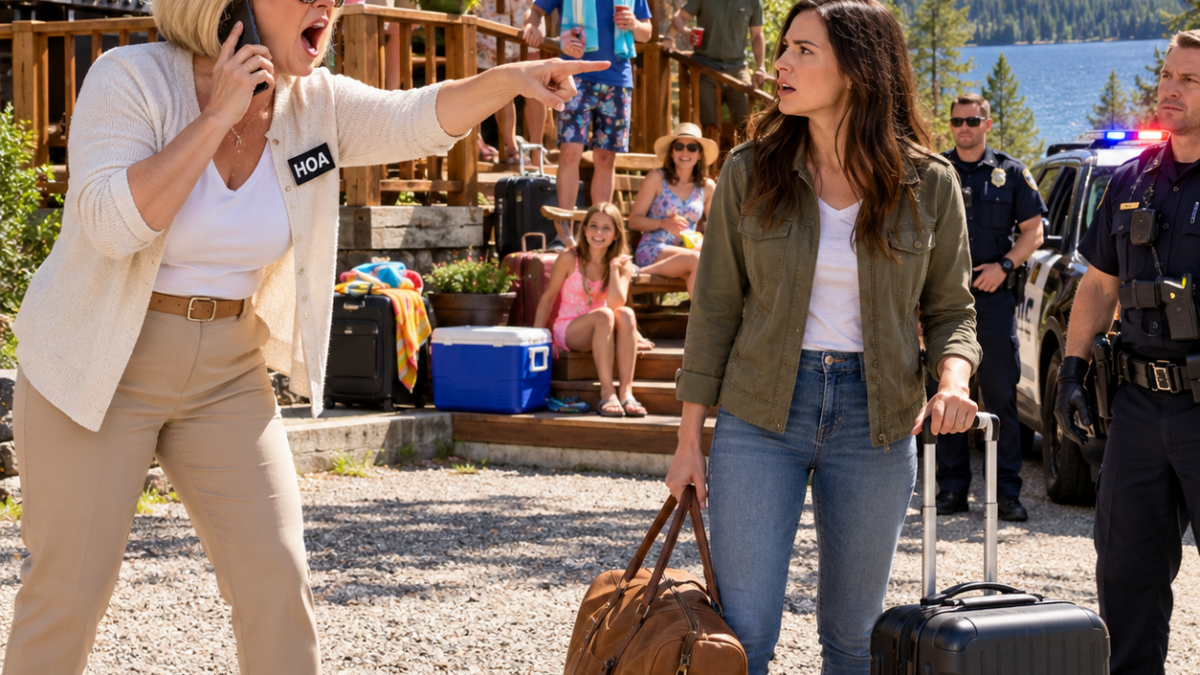
“Yes, hello. We need officers at 418 Pine Ridge Lane. There’s a man here who entered the house and he’s acting aggressively.”
My mouth fell open.
“Karen!”
She turned away from me.
“He’s carrying some kind of metal weapon.”
I looked at the fireplace poker still in my hand.
I immediately placed it on the floor.
“You’ve got to be kidding me.”
Karen continued.
“Yes. There are children present.”
Her husband suddenly looked less relaxed.
He whispered, “Karen, maybe don’t—”
She held up one finger to silence him.
“Yes, please hurry.”
She hung up.
For three seconds, nobody spoke.
Then I said, very quietly, “You just reported me as an intruder in my own home.”
She raised her chin.
“You came in acting threatening.”
“I unlocked my front door.”
“You startled everyone.”
“Because you were trespassing.”
“We are not trespassing.”
“You have no permission to be here.”
“That’s debatable.”
“No, Karen. It really isn’t.”
I picked up my own phone and called the sheriff’s office.
I explained that I was the property owner, that people had entered using an emergency key without permission, and that one of them had already called claiming I was the intruder.
The dispatcher told me deputies were on the way.
I put my phone down.
Karen folded her arms.
Her husband returned to the kitchen and, unbelievably, kept drinking my beer.
The toddler continued watching television.
The elderly man woke up, looked around, and asked, “What’s happening?”
Karen said, “Nothing, Dad. Daniel is having one of his episodes.”
I stared at her.
“My episodes?”
She ignored me.
Outside, headlights appeared between the trees.
Then flashing red and blue lights painted the front windows.
Two sheriff’s vehicles pulled into my driveway.
Karen moved faster than I did.
She opened the front door and hurried onto the porch.
I followed.
Two deputies stepped out.
One looked to be in his thirties.
The other was older, maybe mid-fifties.
Before either officer reached the steps, Karen started talking.
“Thank God you’re here.”
She pointed at me.
“That’s him.”
The deputies looked at me.
I could feel how bad the scene looked.
Karen standing near the doorway.
A frightened teenage boy visible through the window.
Several other people inside.
Me arriving with a suitcase still near the entrance.
And a fireplace poker lying in the hallway.
Karen raised her voice.
“He’s trespassing. We’re house-sitting for the owner. He came through the back and threatened us.”
I stared at her.
That wasn’t bending the truth.
That was a complete fabrication.
“I came through the front door with my key,” I said.
The younger deputy held up a hand.
“Everybody stay calm.”
“I am calm.”
Karen immediately said, “He’s not.”
I ignored her.
“My name is Daniel Reeves. I own this cabin.”
The younger deputy looked toward me.
“You have identification?”
“Yes.”
“Where is it?”
“My wallet. Back pocket.”
The older deputy stepped closer.
“Don’t reach for it yet.”
I stopped.
“Fine.”
Karen hugged her arms around herself.
“He burst in while my son was in the shower.”
I looked at her.
“Your son was using my shower.”
“See?” she said to the deputies. “He’s fixated on my child.”
That was when I realized how far she was willing to take this.
Every word could be twisted.
Every reaction could be used against me.
I forced myself to lower my voice.
“Officers, I can prove ownership immediately. My driver’s license matches this address. My utility bills are inside. Mortgage documents. Property tax records. The deed.”
The younger deputy nodded.
“We’ll verify everything.”
Karen suddenly added, “He was holding a metal rod.”
“It was my fireplace poker because I heard somebody inside my house.”
“He threatened us with it.”
“I never threatened anyone.”
Her teenage son called from inside.
“He didn’t hit anybody.”
Karen spun around.
“Mason, go inside.”
He disappeared.
The older deputy walked behind me.
“Sir, until we establish exactly what’s happening, we’re going to temporarily detain you.”
For the first time since entering the cabin, I felt actual fear.
“What?”
“Turn around.”
“I’m the homeowner.”
“Turn around, please.”
I looked at Karen.
She was watching me.
And then I saw it.
A tiny smile.
It lasted less than a second.
But I saw it.
She had wanted this.
Maybe not the entire situation, but this moment.
Me being treated like the problem.
Me being controlled.
Me being humiliated.
The deputy guided my arms behind me.
Cold steel closed around my wrists.
I heard the click.
Something inside me went completely still.
“You’re cuffing me,” I said.
“Temporary detention.”
“On my own property.”
“Until we verify ownership.”
“While the people who entered my house using my hidden key stand on my porch?”
“Sir, don’t make this harder.”
Karen walked past me.
As she did, she leaned close enough that only I could hear.
“Maybe next time you’ll remember to notify the HOA before disappearing.”
I turned my head toward her.
“You made a huge mistake.”
She smiled.
“We’ll see.”
The deputies placed me in the back seat of the cruiser.
Through the window I watched Karen return to my porch like a victorious landlord.
Her husband sat on my porch swing.
The teenager stood behind the curtains.
Her father had apparently gone back to my recliner.
I had never felt rage like that.
Not explosive rage.
Something colder.
Something that makes you remember details.
Names.
Times.
Statements.
Evidence.
I started cataloging everything.
When I arrived.
What she said.
Who was inside.
Where their belongings were.
Which food they had taken.
Which door I entered.
What the deputies witnessed.
About ten minutes later, the younger deputy came out of the cabin carrying a stack of documents.
My documents.
He spoke briefly with the older officer.
Then he approached the cruiser and opened the door.
“Mr. Reeves.”
“Yes?”
“We’ve confirmed the property is registered to you.”
I stared at him.
“Great. Can we start with taking these cuffs off?”
He hesitated.
“We’re going to remove them.”
The older deputy unlocked them.
I rubbed my wrists.
“Now remove them.”
Karen stood at the porch steps.
The younger deputy turned toward her.
“Ma’am, Mr. Reeves is the confirmed property owner.”
Karen’s face barely changed.
“I never said he wasn’t.”
My head snapped toward her.
“You told dispatch I was an intruder.”
“You weren’t supposed to be here.”
The older deputy frowned.
“Ma’am, whether he was expected home tonight isn’t relevant. He owns the property.”
Karen reached into a large tote bag.
“I think you’re missing important context.”
She pulled out a manila folder.
Of course she had a folder.
Twin Pines Lakeside HOA letterhead was printed across the top.
She flipped through several pages with the confidence of someone who had rehearsed this moment.
“This property is governed by the Twin Pines Lakeside Declaration and Community Standards.”
I laughed once.
The younger deputy glanced at me.
Karen continued.
“Section 14C. Temporary Absentee Maintenance Clause.”
She found the page.
“If a homeowner is absent for more than seventy-two hours without notifying the board, the HOA may take reasonable action to maintain the property for safety, appearance, and community standards.”
She looked up.
“There.”
The deputy read the paragraph.
I knew the rule.
It had been created after an owner left for three months and his broken sprinkler flooded part of the common road.
It allowed the association to arrange emergency exterior maintenance.
Lawn mowing.
Snow clearing.
Storm damage.
Leaking irrigation.
It certainly didn’t allow board members to sleep in your bed and put their children in your shower.
I stepped closer.
“Read the next paragraph.”
Karen’s eyes narrowed.
The deputy continued.
“Authorized actions should be limited to what is reasonably necessary to prevent damage, nuisance, hazard, or code violation.”
I looked at Karen.
“Exactly.”
She pointed toward the cabin.
“We were protecting the property.”
“From what?”
“Wildlife.”
I stared at her.
She continued.
“Vagrants. Weather. Plumbing problems.”
I looked toward the teenage boy.
“Was your son showering to test the plumbing?”
Nobody answered.
Her husband stepped onto the porch holding a sandwich.
My sandwich.
He took a bite.
“Great place you’ve got here,” he said.
The older deputy looked at him.
“Sir, is that your food?”
He stopped chewing.
I pointed toward the kitchen.
“He made it from my refrigerator.”
The deputy turned to Karen.
“Ma’am, do you have written permission from Mr. Reeves to enter the residence?”
She paused.
It lasted maybe one second.
But everybody noticed.
Then she said, “The key was accessible.”
“That wasn’t my question.”
“It’s a known HOA practice.”
“Do you have written permission?”
“No written permission is necessary under section fourteen—”
“Do you have verbal permission?”
She stiffened.
“We acted under board authority.”
The younger deputy folded his arms.
“So the answer is no?”
Karen’s confidence finally flickered.
I walked into the house.
The deputies followed.
“This is what she calls maintenance.”
I pointed around the room.
Blankets.
Suitcases.
Food containers.
A child’s coloring supplies.
Shoes.
A portable crib.
Used towels.
A phone charger plugged in beside my sofa.
Someone’s jacket hanging on my chair.
A half-finished board game on the coffee table.
“They’ve been living here.”
Karen followed us.
“For two nights.”
I turned.
“Two nights?”
Her eyes widened.
She had just admitted it.
The older deputy looked at her.
“You’ve been staying here for two nights?”
Karen tried to recover.
“Only because the property needed supervision.”
Her husband muttered, “Karen.”
She glared at him.
I walked to my kitchen counter.
That was when I saw the envelope.
It sat beside the fruit bowl.
My name was written across the front in uneven letters.
MR. REEVES.
I picked it up.
Karen suddenly moved.
“That’s private.”
I looked at her.
“Private? It’s sitting on my kitchen counter with my name on it.”
I opened it.
Inside was a crayon drawing.
A stick-figure cabin.
A blue lake.
Several people standing beside a crooked green tree.
Underneath was a note.
I read it once.
Then again.
Then I felt my anger turn into something else.
Vindication.
I handed the note to the younger deputy.
He read it silently.
His eyebrows lifted.
The older deputy took it from him.
Karen’s face drained.
“What does it say?” her husband asked.
The deputy looked at Karen.
I answered for him.
“‘Thank you for letting us stay in your cabin, Mr. Reeves. Mommy says you’re always gone, so she said we could use it. I love your shower. Mason.'”
Silence.
Absolute silence.
Karen lunged forward.
“That is a child’s note. It doesn’t mean anything.”
I stared at her.
“It means your son understood exactly what you were doing.”
“He misunderstood.”
“He thanked me for letting you stay when I didn’t even know you were here.”
“Children say things.”
The deputy folded the note.
“Ma’am.”
Her voice rose.
“You can’t seriously use a child’s drawing as some kind of legal document.”
“No one said it’s a legal document,” the older deputy replied. “But it does support Mr. Reeves’s statement that your family was using this property as accommodation rather than performing emergency maintenance.”
“We were supervising it.”
“With suitcases?”
She said nothing.
“With groceries?”
Nothing.
“With a cooler?”
Her husband slowly lowered the sandwich.
The deputy’s expression hardened.
“Ma’am, you and your family need to gather your belongings and leave.”
Karen blinked.
“Excuse me?”
“This is Mr. Reeves’s property. He’s revoked any access you believe you had.”
“I am a board member.”
“That doesn’t change property ownership.”
“You don’t understand HOA authority.”
The older deputy gave her a look I will never forget.
“I understand enough to know an HOA board doesn’t become a hotel company because a homeowner takes a trip.”
Her husband coughed to hide a laugh.
Karen whirled toward him.
“This isn’t funny.”
“No,” I said. “It isn’t.”
The older deputy pointed toward the hallway.
“You have fifteen minutes to collect your belongings. We’ll remain here while you do it.”
Karen’s face turned red.
“This is harassment.”
“No, ma’am.”
“You’re humiliating my family.”
I nearly laughed.
“You called the police and had me handcuffed in my own driveway.”
“You came in aggressively.”
“I came home.”
“You scared Mason.”
“He was naked in my bathroom!”
The younger deputy stepped between us.
“Enough. Everybody lower their voice.”
I backed away.
My hands were shaking.
Not from fear anymore.
From adrenaline.
Karen stormed through the cabin.
“Mason! Get your things!”
From the rear hallway came, “I can’t find my shoes!”
“Then find them!”
She pointed at her husband.
“Pack the cooler.”
He sighed.
Her father woke again.
“Are we leaving?”
“Yes, Dad.”
“Why?”
“Because apparently some people don’t understand neighborly cooperation.”
I stared at her.
“Neighborly cooperation?”
She ignored me.
For the next fifteen minutes, my home turned into the strangest eviction scene imaginable.
Her husband carried out a cooler.
The unknown woman gathered children’s clothes.
The toddler cried because somebody turned off the television.
Mason emerged wearing sweatpants and one sock.
Karen carried a casserole dish that hadn’t finished baking.
Her father shuffled toward the door wearing slippers.
When he reached the porch, he looked back at my recliner.
“I liked that chair.”
I almost felt sorry for him.
Almost.
Outside, neighbors had begun appearing.
Not openly.
Twin Pines residents preferred pretending not to watch drama while watching every second of it.
Curtains moved.
Porch lights came on.
A man across the road stood beside his mailbox despite there being no mail delivery at nine o’clock.
Karen noticed them too.
And because Karen could never simply leave quietly, she turned toward the neighborhood.
“This community used to be friendly!”
Nobody answered.
She raised her voice.
“People used to look out for one another!”
I crossed my arms.
“Looking out for someone usually doesn’t involve sleeping in their house without permission.”
She glared at me.
Her husband opened the minivan.
Karen pointed at me.
“You’ll hear from the board.”
“I’m sure I will.”
“This isn’t over.”
“I was afraid you’d say that.”
She climbed into the van and slammed the door.
The deputies waited until the vehicle disappeared down the road.
I stood on the porch.
For the first time in what felt like hours, my cabin was mine again.
Then the younger deputy approached.
“Mr. Reeves.”
Something in his tone made my stomach tighten.
“What now?”
He glanced toward his notepad.
“Mrs. Whitmore has filed a complaint related to the incident.”
I laughed because I genuinely thought he was joking.
He wasn’t.
“Against me?”
“She claims you created an unsafe situation, threatened a board member and minors, and violated HOA procedures related to extended absence.”
I stared at him.
“She entered my house.”
“I understand.”
“She called you and said I was the burglar.”
“I understand.”
“You handcuffed me.”
He looked uncomfortable.
“We responded to the information available at the time.”
I exhaled.
“I’m not blaming you for verifying. I’m saying this is insane.”
The older deputy walked over.
“For what it’s worth, document everything.”
“I plan to.”
“Change your locks.”
“I will.”
“And don’t throw away that note.”
I looked at the crayon drawing still in my hand.
“Oh, I’m keeping everything.”
The deputies left shortly afterward.
I walked inside.
The silence I had wanted so badly now felt different.
Violated.
Everywhere I looked, I noticed evidence that strangers had treated my home like a rental cabin.
The refrigerator door had fingerprints on it.
My bedroom comforter was wrinkled.
One of my pillows smelled like somebody else’s cologne.
Wet towels covered the bathroom floor.
The trash can was filled with snack wrappers.
Someone had moved framed photographs to make room for their luggage.
A drawer in my bedroom was half open.
That bothered me most.
I checked it immediately.
Nothing obvious was missing.
But someone had opened it.
Someone had gone through spaces where I kept private things.
For the first time since buying the cabin, it didn’t feel entirely safe.
I spent nearly an hour taking photographs before cleaning anything.
Every room.
Every bag of trash.
Every abandoned food container.
Every stain.
Every towel.
Every sign of occupation.
I photographed the spare-key location.
Then I removed the key.
At midnight, I sat at the kitchen table with my laptop.
I created a timeline.
7:41 p.m. — Arrived home.
7:44 — Heard shower.
7:46 — Encountered minor inside bathroom.
7:48 — Discovered multiple unauthorized occupants.
7:52 — Karen called police alleging trespass.
8:01 — Deputies arrived.
8:07 — Temporary detention.
8:18 — Ownership verified.
8:31 — Unauthorized occupants ordered to leave.
I wrote down exact phrases while they were still fresh in my memory.
“We didn’t expect you for another few days.”
“Everyone in the HOA knows where you keep your spare key.”
“We’re just house-sitting.”
“You’re not supposed to be here.”
“Maybe next time you’ll remember to notify the HOA before disappearing.”
Then I photographed Mason’s note again.
The next morning, I called an attorney.
His name was Eric Nolan.
He had handled a property-line disagreement for a friend of mine several years earlier.
I explained the entire story.
There was silence on the phone.
Then he said, “Let me make sure I understand. An HOA board member entered your residence using a hidden emergency key without permission, moved multiple relatives into the property for at least two nights, and when you returned unexpectedly, she called law enforcement and claimed you were trespassing?”
“That’s correct.”
“And she cited an HOA maintenance provision?”
“Yes.”
“Send me the declaration.”
I did.
Twenty minutes later he called back.
“Daniel.”
“Yeah?”
“This clause does not say what she thinks it says.”
“I know.”
“No, I mean it really doesn’t say what she thinks it says.”
He read from the document.
“The board may arrange reasonable exterior or emergency maintenance when an absent owner cannot be reached and a condition threatens community property, neighboring property, safety, or compliance.”
“Exactly.”
“It doesn’t authorize residential occupancy. It doesn’t authorize recreational use. It doesn’t authorize access for convenience.”
“That’s what I told them.”
He paused.
“Did she personally benefit from entering the property?”
“Her family slept there.”
“Good.”
“Good?”
“Good for your documentation. Bad for her.”
I smiled for the first time since the previous night.
Eric continued.
“Do not communicate with her privately.”
“Understood.”
“If she sends you anything, preserve it.”
“Absolutely.”
“And Daniel?”
“Yes?”
“Install cameras.”
By that afternoon, I had replaced every exterior lock.
I installed two additional security cameras.
One covered the front porch.
One covered the back entrance and the iron frog.
The frog stayed.
The key did not.
Two days later, I received an official-looking envelope from the HOA.
Twin Pines Lakeside Homeowners Association.
NOTICE OF VIOLATION.
I almost admired the audacity.
According to the letter, I was accused of “failing to notify the association of extended absence,” “interfering with authorized property stewardship,” “creating a hostile environment for an HOA representative,” and “engaging in conduct inconsistent with community safety standards.”
Possible fine: $500.
I called Eric.
He laughed.
Not a polite chuckle.
A real laugh.
“They actually put that in writing?”
“Yes.”
“Send it.”
Thirty minutes later, he called again.
“Keep the envelope.”
“Why?”
“Postmark.”
I looked at it.
The letter had been mailed the morning after the incident.
“So?”
“So Karen apparently had a formal violation prepared almost immediately after law enforcement removed her from your property. That helps establish retaliation.”
I leaned back.
“She really thinks the HOA can protect her.”
“Maybe it has before.”
That sentence stayed with me.
Maybe it has before.
I started asking neighbors questions.
Carefully.
I didn’t launch a campaign.
I didn’t gossip.
I simply mentioned that I would be attending the next board meeting and asked whether anyone had ever experienced unusual enforcement from Karen.
The responses were immediate.
Mrs. Alvarez from Lot 12 told me Karen had once entered her screened porch while she was away because the board member claimed she was “checking for standing water.”
“You weren’t home?” I asked.
“No.”
“Did you give her permission?”
Mrs. Alvarez laughed bitterly.
“She said the porch wasn’t technically part of the interior.”
Another neighbor, Greg, told me Karen had fined him two hundred dollars because his trash container remained near the road overnight after he had returned late from the hospital.
“Meanwhile,” he said, “her husband parks in the fire lane every time they have a party.”
A retired couple named the Harrisons told me Karen had photographed their backyard over the fence to document an “unapproved garden structure.”
“What structure?”
Mr. Harrison pointed.
A birdbath.
The more people talked, the clearer the pattern became.
Karen had spent years expanding her authority inch by inch.
Most people hadn’t challenged her because each individual incident seemed too small.
A $100 fine.
A rude email.
An unauthorized inspection.
A threatening letter.
A complaint about a porch chair.
A warning about a guest vehicle.
Everybody paid, complied, or moved on.
And every time nobody challenged her, she learned the same lesson.
She could go further.
By the time she entered my cabin, she had apparently convinced herself there was no meaningful line between HOA oversight and ownership.
The monthly meeting was scheduled for the following Thursday.
I spent the week preparing.
I had no intention of walking in angry and improvising.
Karen was good at emotional theater.
She could portray herself as the victim faster than most people could finish explaining what happened.
So I built a binder.
Section one: property documents.
Deed.
Mortgage statement.
Tax record.
Driver’s license showing residence.
Section two: HOA governing documents.
The full declaration.
Section 14C highlighted.
Definitions of “emergency maintenance.”
Limitations on board access.
Section three: photographs.
The occupied living room.
Suitcases.
Cooler.
Used towels.
Groceries.
Half-cooked casserole.
Children’s belongings.
Section four: police incident information.
Names of responding deputies.
Case number.
My written timeline.
Section five: correspondence.
Karen’s violation letter.
Postmarked one day after the incident.
Section six: Mason’s note.
I placed the original inside a protective sleeve.
Eric prepared a formal letter for the HOA board.
It demanded preservation of records, meeting notes, communications regarding my property, and any internal authorization Karen claimed to have obtained.
It also warned that continued retaliation could expose both Karen and the association to legal action.
Thursday night arrived.
The parking lot at the Twin Pines Community Center was packed.
More vehicles than I had ever seen at an HOA meeting.
Word had spread.
I walked inside carrying my binder and a flash drive.
The room was already full.
Rows of folding chairs faced a long table where five board members normally sat.
Karen occupied the center seat.
She wore a navy blazer and had a clipboard in front of her.
Her expression was composed.
Professional.
Controlled.
If you hadn’t known what happened, you might have thought she was chairing a school fundraiser.
Her husband sat in the rear row wearing sunglasses indoors.
I still don’t know why.
Maybe he thought it made him look intimidating.
Mostly it made him look like a man who had taken a wrong turn leaving a casino.
Karen saw me.
Her eyes dropped toward the binder.
Then to the flash drive in my hand.
Her expression changed slightly.
One of the other board members, a quiet man named Robert, leaned toward her and whispered something.
She answered without looking away from me.
I took a seat near the front.
At seven sharp, Karen tapped a small wooden gavel.
“Let’s begin.”
The room settled.
She started reading routine updates.
“Landscaping contractors will begin fall trimming Monday.”
Nobody cared.
“The dock inspection is scheduled for the nineteenth.”
Several people shifted impatiently.
“The lawn at Lot Seven remains above acceptable seasonal height.”
Someone behind me whispered, “Unbelievable.”
Karen continued as though she hadn’t heard.
“Finally, we need to address a serious incident involving homeowner Daniel Reeves and violations related to extended absence, hostile conduct, and interference with authorized board responsibilities.”
I stood.
Karen stopped.
“Mr. Reeves, you’ll have an opportunity to speak after the board presents—”
“No.”
Her eyebrows rose.
“No?”
“With respect to everyone here, we’re not starting with your version and treating it as established fact.”
She tightened her jaw.
“This meeting follows procedure.”
“So does due process.”
“This isn’t a courtroom.”
“Good, because if it becomes one, the association is going to have much bigger problems.”
The room went silent.
I lifted my binder.
“I have documentation of unauthorized entry into my home, unauthorized occupancy, misuse of HOA authority, a false police complaint, and retaliatory enforcement initiated immediately after law enforcement ordered a board member’s family off my property.”
Whispers moved through the chairs.
Karen’s cheeks flushed.
“Those are inflammatory accusations.”
“They’re documented events.”
“You violated Section 14C.”
I opened the binder.
“Would you like to read Section 14C out loud?”
“I know what it says.”
“So do I.”
Robert, the board member beside her, spoke.
“Maybe we should review the exact language.”
Karen looked at him sharply.
“It’s unnecessary.”
He held out his hand.
“I’d like to see it.”
I walked forward and gave him a copy.
Robert read.
Another board member leaned closer.
Then another.
Karen sat rigidly.
Robert looked up.
“This says emergency maintenance.”
“Correct,” I said.
Karen interrupted.
“The house was unattended.”
I turned toward the audience.
“My house was locked.”
Then back to the board.
“I had exterior lighting, fencing, cameras, functioning utilities, no reported hazard, no leak, no storm damage, no nuisance complaint, and no emergency.”
Karen said, “You were gone for several days.”
“So?”
“You failed to notify us.”
“Show me where failure to notify gives you permission to sleep in my house.”
She opened her mouth.
Nothing came out.
I plugged the flash drive into the community-center computer.
The projector flickered.
A photograph appeared.
My living room.
Karen’s son sat on the sofa eating cereal in pajamas.
A suitcase rested beside him.
Gasps moved through the room.
Karen pushed back from the table.
“This is inappropriate.”
I clicked.
Next photograph.
The kitchen.
Groceries.
Wine.
Casserole.
Children’s cups.
Next.
Used towels.
Next.
Cooler.
Next.
Luggage in the bedroom.
“This,” I said, “is what Karen describes as emergency HOA maintenance.”
Someone laughed.
Karen pointed toward the screen.
“Those photographs were taken after Daniel returned. There’s no context.”
“I’ll give you context.”
I clicked again.
A timestamp.
Then my travel itinerary showing the original return date.
Then my updated flight showing I had returned four days early.
“I didn’t tell anybody because I had no reason to. When I entered my home, Karen’s teenage son was showering in my bathroom.”
Murmurs erupted.
Karen raised her voice.
“Don’t bring my child into this.”
“I didn’t bring him into my house. You did.”
The room went quiet again.
Karen stared at me.
I continued.
“Karen then called the sheriff and reported that I was trespassing.”
A man in the back row said, “What?”
I nodded.
“She claimed she was house-sitting for the owner.”
More murmurs.
Karen slammed her hand onto the table.
“That is not what I said.”
I opened my binder.
“The responding deputies documented the call.”
Her face changed.
I didn’t need to exaggerate.
Facts were enough.
“Because of her report, I was temporarily handcuffed in my own driveway while her family remained inside my house.”
Someone behind me muttered, “Jesus.”
I looked at the board.
“After deputies verified that I owned the property, Karen claimed Section 14C gave her authority to enter.”
Robert turned toward her.
“Did you tell law enforcement that?”
Karen hesitated.
“I explained our maintenance authority.”
“Did you have Daniel’s permission?”
“I didn’t need—”
“Yes or no?”
She looked at him.
“No.”
The room erupted.
Karen raised her hands.
“You people don’t understand what managing a community requires!”
A woman in the third row stood.
“I understand.”
Everyone turned.
It was Mrs. Alvarez.
Karen’s expression immediately hardened.
Mrs. Alvarez continued.
“Last winter, you entered our screened porch while we were visiting my sister.”
Karen shook her head.
“There was standing water.”
“There was a flowerpot.”
“It presented a mosquito concern.”
“In January?”
People laughed.
Karen’s face reddened.
Another man stood.
Greg.
“You fined me two hundred dollars because my trash can stayed outside one night.”
“That was a valid violation.”
“Your husband’s SUV blocked the fire lane for an entire weekend.”
Karen’s husband slowly removed his sunglasses.
A third neighbor spoke.
“You photographed our backyard over the fence.”
“A structure was visible.”
“It was a birdbath.”
More laughter.
Karen lost control of the room.
“Enough!”
She grabbed the gavel and struck it.
“This meeting is about Mr. Reeves.”
“No,” I said.
I reached into the binder.
“It’s about abuse of authority.”
I held up Eric’s letter.
“My attorney has formally requested preservation of all board communications involving access to my property, including any messages discussing my travel schedule and the location of my spare key.”
That landed hard.
Two board members immediately looked at Karen.
Robert said, “Messages?”
Karen stared forward.
I continued.
“If Karen acted with board authorization, those records should show it.”
Nobody spoke.
“If she acted alone and then used HOA letterhead to retaliate after being removed from my property, those records should show that too.”
The board treasurer, Linda, turned toward Karen.
“Did the board vote on entering Daniel’s house?”
Karen looked at her.
“We don’t vote on routine maintenance.”
“Did we discuss it?”
Karen didn’t answer.
“Karen.”
“I believed I had authority.”
Linda’s eyes widened.
“You believed?”
Karen’s voice sharpened.
“That’s my responsibility as compliance liaison.”
Robert said, “Your responsibility does not include occupying somebody else’s residence.”
“We were not occupying it.”
I reached into my binder.
“Then maybe this will help.”
I removed the protective sleeve.
Karen saw it.
Her face went white.
I held up Mason’s note.
Her husband whispered something under his breath.
Karen stood.
“Do not read that.”
I looked at her.
“Why?”
“Because it’s private correspondence from a minor.”
“It’s addressed to me.”
“He didn’t understand what he was writing.”
“You told him enough to write it.”
I turned toward the board.
“This was sitting on my kitchen counter when I returned.”
I read the note.
“‘Thank you for letting us stay in your cabin, Mr. Reeves. Mommy says you’re always gone, so she said we could use it. I love your shower. Mason.'”
Nobody laughed.
Nobody whispered.
The room became completely still.
There was something about hearing a child’s simple words that destroyed every complicated excuse Karen had built.
No emergency language.
No maintenance language.
No community standards.
Just the truth.
Mommy says you’re always gone, so she said we could use it.
Karen finally exploded.
“He is a child!”
I looked at her.
“Exactly.”
She stopped.
“He had no reason to invent an HOA justification. He simply wrote what he understood was happening.”
Karen turned toward the other board members.
“You’re seriously going to allow this?”
Robert leaned back.
“I don’t think we’re the ones who created this situation.”
She pointed at me.
“He’s manipulating everybody!”
I felt my anger rise again, but this time I controlled it.
“No, Karen. I didn’t need to manipulate anything.”
I pointed toward the projected photograph of her family’s luggage.
“You entered my home.”
I clicked.
Her son in pajamas.
“You moved your family in.”
I clicked.
The police incident information.
“You called law enforcement when I returned.”
I held up the violation notice.
“Then you used your board position to retaliate when officers removed you.”
I placed everything on the table.
“You did all of that.”
She looked around the room.
For the first time since I had known her, Karen seemed to realize nobody was afraid of her authority.
Not anymore.
Linda spoke.
“I want an executive review.”
Karen snapped, “For what?”
“Your conduct.”
“You don’t have grounds.”
Robert shook his head.
“I think we have several.”
Karen looked stunned.
“I’m an elected board member.”
“So are we.”
“You cannot remove me because one homeowner is angry.”
Greg called from the audience.
“It’s not one homeowner.”
Mrs. Alvarez added, “Not even close.”
Several people voiced agreement.
The mood shifted instantly.
Stories started coming out.
One after another.
Unauthorized porch entry.
Selective fines.
Threatening letters.
Harassment over guest parking.
Inspections that no other board member knew about.
Warnings issued under vague interpretations of rules.
Karen tried to interrupt.
Then she tried to defend herself.
Then she tried to blame homeowners for failing to cooperate.
Each answer made things worse.
Finally Robert struck the table with his palm.
“Enough.”
The room quieted.
He turned toward Karen.
“I move that the board immediately suspend Karen Whitmore’s enforcement authority pending review and place before the membership a motion for removal based on abuse of position, unauthorized property access, and conduct exposing the association to potential liability.”
Karen stared at him.
“You can’t be serious.”
Linda spoke.
“I second.”
Karen looked from face to face.
“You people are making a huge mistake.”
No one answered.
The procedural vote came first.
Four votes in favor.
Karen’s lone vote against.
Her authority was suspended immediately.
Then, under the association bylaws, the membership considered removal.
Ballots were distributed.
Karen stood beside the board table while homeowners marked their choices.
The woman who had spent years judging everybody else’s fences, garbage cans, lights, porches, cars, gardens, and lawns suddenly had no control over what anyone in that room wrote.
I watched her face.
Confusion.
Anger.
Disbelief.
Then fear.
The votes were counted.
Unanimous among eligible votes cast.
Karen Whitmore was removed from the Twin Pines Lakeside HOA board.
For several seconds, she didn’t move.
Robert quietly pushed the gavel toward himself.
“Karen, you’ll need to return association files, access credentials, and property within forty-eight hours.”
She looked at him.
“You’ll regret this.”
He didn’t respond.
She grabbed her clipboard.
Her husband stood from the back.
Together they walked toward the exit.
When Karen passed me, she stopped.
Her voice was low.
“You humiliated me.”
I looked directly at her.
“No.”
She waited.
“You called the police on a man for coming home to his own house.”
Her jaw tightened.
“You humiliated yourself.”
She walked outside.
I followed several minutes later.
The parking lot was cold and dark.
Karen stood near her minivan while her husband unlocked it.
She saw me.
I could have said nothing.
Probably should have.
But after the week I’d had, I allowed myself one sentence.
“Karen.”
She turned.
“Next time you want a vacation, try Expedia.”
Her face tightened.
“Not breaking and entering.”
Her husband looked away.
Karen said nothing.
She climbed into the van.
They drove off.
I stood there listening to the sound of their engine disappear through the trees.
For the first time in days, my shoulders relaxed.
There were still details to handle.
The association formally withdrew the violation notice.
Robert sent me written confirmation that no board vote, authorization, or emergency finding had existed before Karen entered my home.
The HOA adopted stricter policies requiring documented owner consent or a genuine emergency before interior residential access.
Board members were prohibited from using information about residents’ travel schedules for anything unrelated to verified association business.
The association also established a rule requiring two board representatives whenever emergency entry was genuinely necessary.
I changed every lock anyway.
The hidden key never returned beneath the frog.
I added cameras.
I changed my alarm code.
And for several weeks, I still checked every room when I came home.
That was the part people didn’t understand.
Everyone in the neighborhood focused on the absurdity.
The teenager in my shower.
The casserole.
The grandfather in my recliner.
The crayon note.
Karen calling the police.
Those details were outrageous enough to become neighborhood legend.
But what stayed with me wasn’t funny.
It was the moment I opened my bedroom drawer and realized somebody had looked through a private space because they believed my absence gave them permission.
Your home is supposed to be where your guard comes down.
Where you don’t need permission to enter.
Where silence belongs to you.
Karen had turned that into something conditional.
For a while, every unfamiliar noise bothered me.
A branch brushing the window.
A pipe settling.
A car slowing near the driveway.
Then slowly, the cabin began to feel like mine again.
One Saturday morning, several weeks after the meeting, I woke before sunrise.
I made coffee.
My coffee.
In my mug.
I walked onto the porch.
Mist floated over the lake.
The mountains were dark silhouettes against the early sky.
Nothing moved except the pines.
No strangers.
No suitcases.
No HOA folders.
No deputies.
No one telling me I needed permission to stand on my own property.
Just quiet.
The kind I had been expecting the night I came home early.
Later that morning, Robert stopped by.
He remained on the porch.
That detail mattered.
He didn’t walk inside.
Didn’t reach for the handle.
Didn’t assume.
He knocked.
I opened the door.
“Got a minute?”
“Sure.”
He held out an envelope.
It was a formal letter from the association.
The board acknowledged that Karen had acted without authorization.
The violation against me had been rescinded.
Any related fees were canceled.
The association apologized for the misuse of its procedures.
I read it.
Then looked at Robert.
“I appreciate this.”
He nodded.
“We should’ve noticed the pattern earlier.”
“People were dealing with their own problems.”
“Still.”
He looked toward the lake.
“Power gets weird in places like this.”
I laughed softly.
“That’s one way to put it.”
He shook his head.
“Give somebody authority over paint colors long enough, eventually they start thinking they’re governor.”
I laughed harder.
It felt good.
Before leaving, he paused.
“For what it’s worth, Mason feels terrible.”
I frowned.
“Karen’s son?”
“Yeah.”
“Why?”
“He thinks the note got his mother removed.”
I looked down at the envelope.
“That wasn’t his fault.”
“I know.”
“Make sure somebody tells him that.”
Robert nodded.
“He told the truth.”
“Exactly.”
After Robert left, I thought about that note again.
Karen had called it embarrassing.
Private.
Meaningless.
But it had been the purest evidence in the entire mess because there was no legal strategy behind it.
A kid believed he was on vacation.
Because that’s what his mother had told him.
She hadn’t told him they were performing emergency property maintenance.
She hadn’t told him they were preventing nuisance conditions.
She hadn’t explained Section 14C.
She had apparently told him the homeowner was always gone, so they could use the cabin.
That simple truth collapsed everything.
A few months later, life around Twin Pines felt noticeably different.
Not perfect.
It was still an HOA.
There were still emails about docks.
Still arguments about snow removal.
Still debates over whether holiday lights should come down by January fifteenth or February first.
But people spoke up more.
Board meetings had larger attendance.
Fines required clearer documentation.
Homeowners asked for rule citations instead of automatically paying.
And nobody treated Karen’s old interpretations like sacred law.
As for Karen, I still saw her occasionally.
At the mailbox.
Driving through the neighborhood.
Walking with her husband.
She never spoke to me.
I didn’t need her to.
Once, during early spring, I was repairing a section of fence near the road when her minivan slowed.
For a second, I thought she might stop.
She didn’t.
She kept driving.
I watched the van disappear around the bend.
Then I went back to work.
I had no desire to chase revenge beyond what had already happened.
I didn’t need her afraid of me.
I didn’t need to ruin her life.
I wanted one thing.
A boundary.
A very clear one.
My property was mine.
My home was mine.
My absence did not transfer ownership.
My membership in an HOA did not erase my rights.
And nobody—no board member, committee chair, neighborhood busybody, or self-appointed guardian of community standards—could simply invent authority because other people were too exhausted to challenge them.
The irony was that Karen had spent years accusing homeowners of disrespecting the community.
But communities don’t work because one person controls everyone.
They work because boundaries are respected.
Rules apply evenly.
Authority has limits.
And neighbors understand the difference between looking out for someone and helping themselves to his house.
I never again hid a spare key outside.
Whenever I travel now, I lock the cabin, arm the cameras, and leave.
I don’t submit an itinerary to the HOA.
I don’t ask permission.
And I certainly don’t announce when I’ll be home.
Because the last time I came back unexpectedly, I found a teenager in my shower, six strangers treating my home like a vacation rental, and an HOA board member confident enough to call the police on me for walking through my own front door.
She thought the badge on her HOA binder mattered more than the name on my deed.
She thought if she spoke confidently enough, the police would remove me while her family finished their vacation.
For a few terrifying minutes, with cold handcuffs around my wrists and Karen smiling from my porch, it almost looked like she was going to get away with it.
But authority built on intimidation has one weakness.
Evidence.
A deed.
A police report.
Photographs.
A retaliatory violation letter.
Neighbors finally willing to talk.
And, most damaging of all, one innocent crayon note from a kid who had no idea he was documenting his mother’s lie.
Karen wanted everyone to believe she had entered my home to protect the community.
Her own son told us why they were really there.
Mommy says you’re always gone, so she said we could use it.
That was all it took.
The woman who had walked through my cabin like she owned it walked out of the community center without her board position.
And when I finally returned home that night, I unlocked my door, stepped inside, and listened.
No shower running.
No strangers talking in my kitchen.
No television playing for somebody else’s child.
No man eating food from my refrigerator.
Nothing.
Just the soft hum of the cabin and the sound of wind moving through the pines outside.
I locked the door behind me.
Then I stood there for a moment, letting the silence settle around me.
This time, it didn’t feel empty.
It felt like freedom.
It felt like privacy.
It felt like home.
And after everything Karen had tried to take from me, that quiet was the one thing she never got to keep.

