PART 2: We Found Her Under an Abandoned Car, Soaked to the Bone—But All Five Puppies Behind Her Were Almost Dry
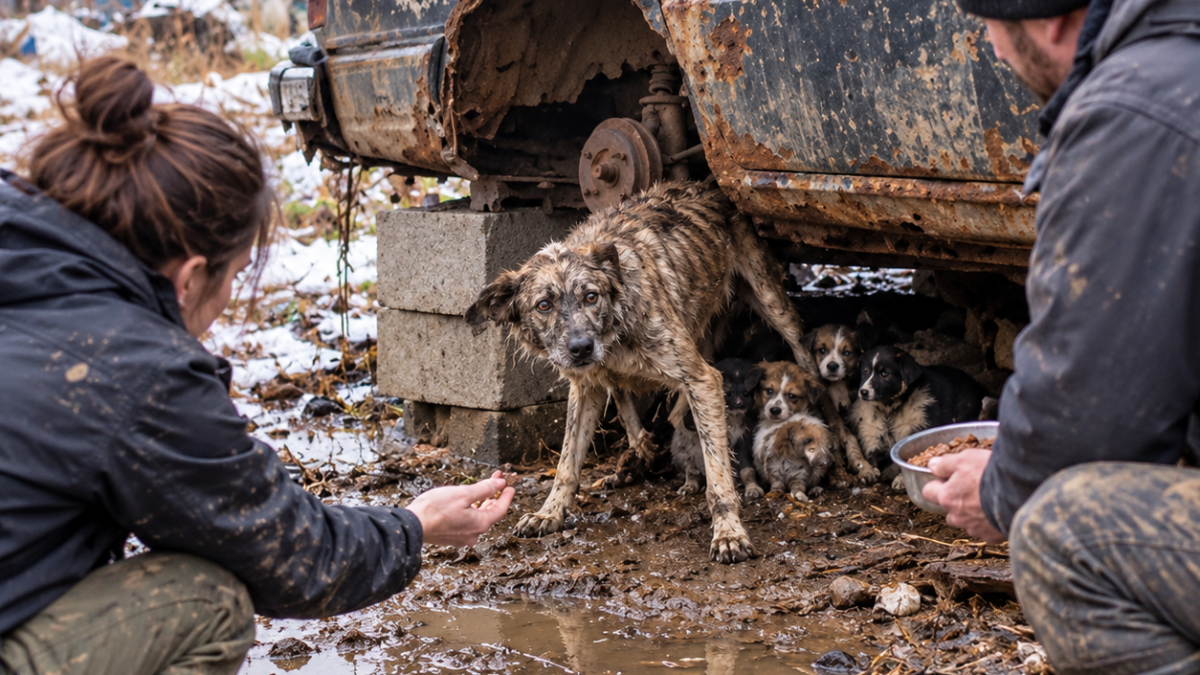
PART 2
At first I thought the noise came from the road.
A truck engine.
Maybe machinery from one of the warehouses.
Then it came again.
A metallic crash.
Closer this time.
The mother dog flattened herself over the puppies.
Every muscle in her exhausted body tightened.
Claire turned.
“What was that?”
I stood slowly and looked toward the broken fence line.
A sheet of corrugated metal hanging from an old storage frame had come loose in the wind.
The rain had softened the ground around it, and each gust made the entire panel swing violently against a steel post.
Bang.
The mother flinched.
Now I understood.
To us, it was junk moving in bad weather.
To her, every loud sound in that lot probably meant danger.
People.
Vehicles.
Metal.
Dogs.
Who knew what she had already survived?
I crouched again.
“It’s okay.”
The words sounded useless.
She did not know me.
She had no reason to believe me.
Another gust hit.
The metal slammed.
The puppies cried.
The mother tucked her head around them.
Claire looked at me.
“We have to get them out.”
“I know.”
“But if we rush her—”
“She’ll spend whatever strength she has left fighting.”
Claire nodded.
That was the problem.
The mother wasn’t aggressive in the ordinary sense.
She was afraid.
And fear combined with maternal instinct can make an exhausted animal attempt things her body cannot survive.
If she bolted, we could lose her in an industrial area filled with traffic, broken fencing, and flooded drainage channels.
If she lunged, she could injure herself.
If we frightened her away from the puppies, they could become hypothermic before we secured her.
So we stopped trying to rescue her for several minutes.
That sounds strange.
Sometimes the fastest way to save an animal is to stop moving.
Claire remained near the car.
I walked back toward our van and retrieved food, a large blanket, transport crates, towels, and a slip lead.
The warehouse worker who had called us appeared near the gate wearing a yellow rain jacket.
His name was Marc.
“You found them?”
“Yes.”
“How bad?”
I looked toward the car.
“Bad.”
He followed my eyes.
“I’ve been leaving food.”
“How long have you seen her?”
“Maybe four days. Puppies longer, but I didn’t realize there were five at first.”
“You ever see anyone with her?”
“No.”
“Any other dogs?”
“Sometimes strays come through.”
“People?”
He hesitated.
“What?”
“This property gets used at night.”
“For what?”
“Dumping things. Scrap. Tires. Sometimes animals.”
My stomach tightened.
“Animals?”
“I’ve seen cats left in boxes. A rabbit once.”
Claire heard him.
“You reported that?”
“Property owner doesn’t care. Police said unless I saw who did it, there wasn’t much to go on.”
Another metallic bang echoed across the lot.
The mother covered her puppies tighter.
Marc shook his head.
“She’s been doing that every time.”
“How long has that panel been loose?”
“Since yesterday.”
I looked at the dog.
So she had spent an entire night in cold rain, starving, shielding five puppies from both weather and terrifying noise.
No sleep.
No security.
No way to leave because the puppies could not follow.
And still she had stayed.
I opened a can of high-calorie recovery food.
The smell reached her immediately.
Her nose lifted.
That was the first sign I had seen that anything besides the puppies could penetrate her focus.
Claire smiled faintly.
“She’s hungry.”
“She’s beyond hungry.”
I placed a small amount on a flat plastic lid.
Then pushed it carefully beneath the car.
The mother watched my hand.
I pulled away.
She stared at the food.
Then at me.
Then at the puppies.
Nothing happened.
“Come on, mama.”
No movement.
Claire whispered, “Move back.”
We did.
Ten feet.
Fifteen.
The mother waited.
Finally her nose moved again.
She shifted one front paw.
Stopped.
Then another.
Her legs shook violently.
She reached the food.
Smelled it.
Ate.
Not carefully.
Desperately.
Three bites disappeared.
Then she stopped and turned toward the puppies.
One squeaked.
She immediately moved back.
Claire looked at me.
“She won’t leave them even for food.”
That told us something useful.
We could use food.
But not by asking her to move far away.
I prepared another portion.
This time I placed it closer to the puppies.
She ate without standing completely.
Then another.
Slow.
Small.
Too much food too quickly could cause problems in a severely malnourished dog.
Every instinct says feed them everything.
Sometimes everything is dangerous.
We gave her enough to build trust and energy.
Then water.
She drank for nearly a full minute.
Paused.
Drank again.
When she finished, she looked at us differently.
Not trusting.
Considering.
That was enough.
Claire lowered herself onto the mud.
“I’m going to try the blanket.”
I nodded.
She moved inch by inch.
The mother watched.
Claire stopped whenever the dog’s body stiffened.
Three feet.
Two.
One.
Finally she reached the edge of the car.
One puppy crawled toward her hand.
The mother raised her head.
Claire froze.
“I’m not taking him.”
The puppy squeaked and pressed against the mother again.
Claire slowly slid the blanket across the wet ground.
The mother sniffed it.
Nothing.
Then Claire laid part of it near her front paws.
The dog did something unexpected.
She rested her chin on it.
Claire looked at me.
That tiny movement broke something in my chest.
The mother was exhausted enough to accept softness from strangers.
We waited another ten minutes.
Then I tried the slip lead.
The dog watched.
When the loop came near her head, she pulled back.
I stopped.
“No.”
Claire whispered, “Don’t push.”
We tried food again.
Then touch.
The first time my fingers reached the side of her neck, she flinched so hard I almost withdrew immediately.
But she did not growl.
I let my hand remain.
No pressure.
Just contact.
Her skin was cold beneath the fur.
After several seconds, she exhaled.
I stroked once.
Her eyes closed.
That was the moment.
“Claire.”
“I see it.”
I moved the lead slowly over her head.
She noticed.
But this time she did not resist.
I secured it loosely.
Claire prepared the first puppy carrier.
The harder part came next.
Removing the babies.
I touched the nearest puppy.
The mother opened her eyes.
“Easy.”
I lifted him maybe two inches.
She tried to stand.
I immediately lowered him.
“Okay.”
The mother pressed her nose against the puppy’s back.
Claire said, “What if we move her with them?”
That was safer emotionally.
Harder physically.
The space under the car was too low for a crate.
But we could create a platform.
Marc brought a piece of clean plywood from the warehouse.
We wrapped it in dry blankets.
Then slowly slid it beneath the car beside the family.
The mother watched every movement.
One puppy crawled onto the blanket on his own.
Then another.
The mother shifted.
Eventually three were partly on the improvised platform.
We placed food near the far edge.
She moved toward it.
The remaining puppies followed her body.
Little by little, we had the entire family on the blanket.
“Now what?” Marc whispered.
“Now nobody makes a mistake.”
Claire took the front edge.
I took the side.
Marc held the rear.
We moved the platform inches at a time.
The mother began to stand.
I kept one hand near her shoulder.
“You’re coming too.”
She hesitated.
Then the puppies cried.
She stepped forward.
The entire family emerged from beneath the car.
That was the first time I saw her fully.
And it was worse than I expected.
Her coat was dark tan beneath the mud.
Large mixed breed.
Maybe shepherd.
Maybe mastiff.
Maybe something else entirely.
It did not matter.
Her ribs were shocking.
The muscles along her back had wasted.
Her teats hung heavy from nursing.
One hind leg had an old scar.
The skin around her neck showed a raw line as if a collar had once rubbed there for too long.
Claire whispered, “She should not still be standing.”
But she was.
Barely.
We moved the puppies into a dry crate first.
The mother panicked.
Not violently.
She simply tried to climb into the crate with them before there was enough room.
“Okay. Okay.”
We opened a larger transport kennel.
Put the puppy crate inside.
The mother followed.
Immediately.
No hesitation.
Once all five babies were visible, she stepped inside.
I closed the door.
For the first time that morning, I breathed normally.
Claire sat back in the mud.
“We got them.”
Marc rubbed both hands over his face.
“I thought she was going to die under there.”
“So did I.”
Inside the kennel, the mother counted the puppies with her nose.
One.
Two.
Three.
Four.
Five.
Then she lowered herself around them.
The puppies began nursing.
Claire looked at me.
“She’s still feeding them.”
I nodded.
“That stops being impressive and starts being terrifying when you see her body.”
We carried the crate toward the van.
The mother never took her eyes off the puppies.
I drove.
Claire sat in the back.
Every few minutes I asked:
“She okay?”
“Yes.”
“Puppies?”
“Yes.”
Five minutes later:
“She okay?”
“Still yes.”
At one point Claire laughed.
“If anything changes, I’ll tell you.”
“I know.”
“You don’t act like you know.”
I gripped the steering wheel.
“I hate how thin she is.”
“So do I.”
“What if her organs—”
“Drive.”
I drove.
The veterinary clinic knew we were coming.
When we arrived, two technicians met us outside.
The mother had to be lifted with the puppies because she refused to move away from them.
Inside, the examination became a complicated negotiation.
The veterinarian, Dr. Laurent, looked at her body and frowned.
“Severe malnutrition.”
“How severe?”
“We weigh first.”
Twenty-one kilograms.
For her frame, she should have weighed much more.
He examined her gums.
Pale.
Temperature low-normal.
Heart fast.
Dehydrated.
Skin infection in several places.
Possible parasites.
No obvious acute fractures.
Then he examined the puppies.
“About four weeks,” he said.
“Healthy?”
“Relatively.”
That word again.
Relative health.
Compared with their mother, they looked almost robust.
Compared with properly raised four-week-old puppies, they were underweight.
But warm.
Responsive.
Nursing.
One technician said, “She kept them alive.”
Dr. Laurent nodded.
“Yes.”
I asked, “At what cost?”
He looked at the mother.
“Most of herself.”
Blood tests followed.
Anemia.
Low protein.
Nutritional deficits.
Parasites.
Nothing that surprised him.
Everything that frightened me.
“Can she continue nursing?”
“For now, partially. But we need to supplement the puppies immediately. We cannot ask her body to carry all five.”
Claire crouched beside the kennel.
The mother’s eyes followed every technician.
“What do we call her?”
No identification.
No microchip.
No tag.
Marc had called again to say nobody in the nearby businesses recognized her.
Claire looked at the dog.
“She looks like she’s been holding a kingdom together.”
“What?”
“A queen.”
I smiled.
“Reine?”
Claire nodded.
“Reine.”
The mother lifted her head when Claire said it.
“See?”
“She responded to your voice.”
“No. She chose it.”
We laughed.
It felt good to laugh.
The puppies received temporary names too.
Theo.
Milo.
June.
Pepper.
And Scout.
Not because those names necessarily stayed.
Names make care easier.
They also make danger harder.
Once you name an animal, paperwork changes into attachment.
That first day became feeding schedules.
Fluids.
Warmth.
Medication.
Flea treatment appropriate for their ages.
Parasite control.
Nutritional planning.
Reine was offered small, frequent meals.
The first bowl disappeared so quickly that she licked the stainless steel after it was empty.
She looked at me.
Then the bowl.
Then me.
“I know.”
She stood.
Her legs shook.
“You’re getting more.”
She sat immediately.
Apparently she understood the important words.
The puppies started supplemental formula.
Reine hated that.
The first time Claire picked up Scout for feeding, Reine followed her so closely the lead tightened.
“Easy.”
Scout squeaked.
Reine tried to stand on her back legs despite barely having strength to stand on four.
Claire lowered herself to the floor.
“Look.”
She let Reine smell the bottle.
Then Scout.
The puppy fed.
Reine watched.
When Scout returned to the bedding, she licked him until he protested.
“You’re going to remove his skin,” I said.
Reine ignored me.
That night, we needed a foster home.
Not easy.
One depleted adult.
Five young puppies.
Medical monitoring.
Separate feeding.
Laundry.
Mess.
No foster in our network immediately had room.
Claire looked at me.
“I can take them for tonight.”
“You already have three dogs.”
“Separate room.”
“Your husband?”
“Will complain.”
“That’s not the same as agreeing.”
She called him.
I heard only her side.
“Yes.”
“I know.”
“Five.”
“Yes, five.”
“And the mother.”
“No, that makes six total, not six puppies.”
Pause.
“You married me voluntarily.”
Longer pause.
Claire smiled.
“Love you too.”
She hung up.
“He said yes?”
“He said this is why we can’t have nice furniture.”
“That’s basically yes.”
Reine and the puppies spent their first foster night in Claire’s converted laundry room.
I stayed until almost midnight.
Fresh bedding covered the floor.
A low heater warmed the space.
Food and water sat near Reine.
Puppies slept in a pile against her stomach.
Claire sat against the wall.
“I’m afraid to leave.”
“She’ll be fine.”
“You don’t believe that.”
“No.”
“Thanks.”
Reine slept.
Deeply.
Possibly for the first time in days.
Her body twitched occasionally.
Paws moving in dreams.
The puppies nursed, then slept.
I watched her breathing.
Slow.
Steady.
For three nights, Reine barely moved except to eat, drink, relieve herself, and check the puppies.
Then something changed.
On the fourth morning, Claire sent me a video.
Reine standing at the doorway.
Tail moving.
Not much.
But moving.
Under the video:
“She greeted me.”
That was the first sign that Reine’s life contained something besides survival and motherhood.
I came after work.
When I opened the door, she lifted her head.
“Hey, Queen.”
Tail.
One wag.
Then another.
I sat.
She walked toward me.
Slowly.
She put her head against my knee.
That simple gesture felt enormous.
The dog who had stood in freezing mud between us and her puppies was asking for touch.
I scratched behind her ears.
“You don’t have to protect everybody every second.”
She leaned harder.
Behind her, Theo crawled over Milo.
Pepper squeaked.
Reine turned instantly.
“Apparently you disagree.”
The puppies improved quickly.
That was the blessing.
Young bodies can change fast when given food, warmth, and veterinary care.
Bellies filled.
Eyes brightened.
Movement became coordinated.
Then uncoordinated again because puppies apparently believe legs are suggestions.
At five weeks, they began eating softened puppy food.
At six, the laundry room stopped containing puppies and began containing five small disasters.
June learned how to climb over the low barrier.
Scout learned from June.
Milo discovered shoelaces.
Theo carried socks.
Pepper barked at the washing machine.
Claire called me.
“Come get your criminals.”
“They’re your criminals.”
“I’m filing for shared custody.”
Reine watched the chaos from her bed.
For the first time, she looked amused.
Or maybe exhausted.
Motherhood can create similar facial expressions.
Her weight climbed slowly.
Twenty-two kilograms.
Twenty-three.
Twenty-four.
Her hip bones softened beneath muscle.
The line of her ribs became less severe.
Her coat changed dramatically.
The dirt was gone after careful baths once she was stable enough.
Underneath was a warm brown-and-black coat.
Not glamorous.
Beautiful.
One afternoon, Claire brushed her.
Clumps of dead fur came loose.
Reine closed her eyes.
“Look at you.”
Claire sent me a photo.
Reine lying on a rug.
Clean.
Puppies around her.
I compared it with the first photograph under the car.
I had taken one from a distance after we secured the lead.
In that image, rain ran off her back.
Her face looked hollow.
Now her eyes were soft.
Still watchful.
But no longer expecting disaster every second.
The investigation into where she came from began almost accidentally.
Marc called two weeks after the rescue.
“You said the dog had a collar mark?”
“Yes.”
“I found something.”
He had been cleaning near the old sedan after the property owner finally agreed to remove some debris.
Under a pallet, he found a torn red nylon collar.
No tag.
But part of a metal buckle remained.
He sent a photograph.
“Could be hers?”
“Could be any dog’s.”
“I know.”
Then he said:
“There’s also a camera.”
“What camera?”
“The warehouse across the street.”
My heart started beating faster.
“Does it see the lot?”
“Part of it.”
“How long do they keep footage?”
“Manager says maybe a month.”
Reine had been found two weeks earlier.
I called the local animal protection officer.
We gave him everything.
Location.
Dates.
Photographs.
Veterinary documentation.
The warehouse manager agreed to review footage with authorities.
Two days later, I received a call.
“We may have something.”
“What?”
“A vehicle enters the lot nine days before the rescue.”
“So?”
“It stops near the back.”
My hand tightened around the phone.
“Can you see the dog?”
“Not clearly.”
“Puppies?”
“No.”
The officer continued.
“A person gets out. Opens the rear door. Something jumps down.”
My stomach turned.
“Then?”
“The vehicle leaves three minutes later.”
“And the animal?”
“Doesn’t leave with them.”
I sat down.
“You think that was Reine.”
“I think we need more evidence before saying that.”
Correct answer.
Infuriating answer.
The license plate was partially visible.
Enough for investigators to follow.
I did not tell Claire immediately.
I wanted facts.
Not anger.
When I finally told her, she sat beside Reine for a long time.
Someone may have driven this dog to an abandoned industrial lot.
Possibly pregnant or already nursing.
Possibly with puppies hidden somewhere.
Or the puppies may have been born later.
We didn’t know.
The footage showed only a large dog.
No babies visible.
The dates suggested the puppies would already have been alive.
Maybe they were inside the vehicle.
Maybe elsewhere.
Maybe Reine had moved them.
We refused to invent details.
But the possibility of deliberate abandonment changed the emotional temperature of the case.
I looked at Reine.
She was sleeping.
June’s head rested on her back.
Whoever had left her, if that was indeed what happened, was no longer part of her day.
That mattered.
I tried to follow her example.
The investigation could happen elsewhere.
Reine needed food.
Walks.
Rest.
The puppies needed socialization.
Those were our jobs.
At seven weeks, the puppies received more vaccinations and health checks.
They were thriving.
Dr. Laurent smiled at Reine.
“She did an extraordinary job.”
I scratched her neck.
“She heard you.”
“Her bloodwork is much better.”
“How much better?”
“Protein improving. Anemia resolving. Weight improving.”
“Can she stop nursing?”
“She should.”
Reine strongly disagreed.
When the puppies tried to nurse, she still often allowed it.
Claire started separating them for longer periods.
At first Reine paced.
Then she discovered the couch.
Everything changed.
The first time she climbed onto it, she looked at us as though waiting for punishment.
Claire froze.
“So?”
I whispered, “Don’t react.”
Reine stood with two paws on the cushion.
Then climbed fully up.
She turned three circles.
Lay down.
Closed her eyes.
Claire stared.
“That’s my seat.”
“No longer.”
Within ten minutes, Reine was asleep.
The dog who had slept beneath a wheel-less car in flooded dirt had discovered upholstery.
That felt like justice.
The puppies eventually began their adoption process.
This part hurt Claire.
It always does.
You save a litter.
Keep them alive.
Wake for bottle supplements.
Clean endless mess.
Watch personalities develop.
Then send them away.
That is the goal.
It still hurts.
Theo was adopted first by a young couple who had recently lost an elderly dog.
They had a fenced yard.
Good veterinary references.
Patience.
Reine watched them leave with Theo.
She paced for an hour.
That broke my heart.
But later she settled beside the remaining puppies.
Milo went next.
Then Pepper.
Scout and June stayed another week.
With each departure, Reine seemed confused.
We managed the transitions slowly.
Kept familiar blankets.
Allowed goodbye contact.
Maintained routine.
Then Scout left.
June was last.
She was the bold one.
The climber.
The escape artist.
Claire had threatened to keep her at least six times.
Her husband had stopped pretending he believed otherwise.
But a family with an older gentle dog applied.
Perfect fit.
June left on a Saturday.
After the door closed, the laundry room became silent.
Reine walked inside.
Smelled the empty bedding.
Looked behind the barrier.
Then looked at Claire.
Claire sat on the floor.
“Oh, mama.”
Reine walked toward her.
Put her head against Claire’s chest.
Claire cried into her neck.
I stood in the doorway.
Nobody spoke.
For weeks, Reine’s identity had been mother.
Every decision.
Every movement.
Puppies.
Now they were gone.
Safe.
Loved.
Healthy.
But gone.
The first night without them, Reine slept in Claire’s bedroom.
Not the laundry room.
Not the couch.
At the foot of the bed.
At two in the morning, Claire woke and found Reine sitting beside her.
“Everything okay?”
Reine put one paw on the mattress.
Claire lifted the blanket.
“Come on.”
Reine climbed onto the bed.
The next morning, Claire sent me a photograph.
Reine stretched beside her husband.
His message underneath:
“This dog has stolen everything.”
I replied:
“She gave everything first.”
Two months after the rescue, the investigation became clearer.
The vehicle owner had been identified.
A former acquaintance confirmed that Reine had belonged to the household.
Her original name was apparently Bella.
I looked at Claire when we learned that.
“Do we change it?”
Claire looked at Reine.
“Reine.”
The dog lifted her head immediately.
“No.”
I agreed.
Whatever name she once had belonged to a life we could not reconstruct.
Reine was the dog we knew.
Investigators learned she had given birth shortly before being abandoned.
The exact circumstances remained disputed.
The owner claimed Reine escaped during a stop.
The video showed a different picture.
The vehicle remained on the property for several minutes.
No one appeared to search.
No one returned.
Messages recovered during the investigation indicated complaints about “getting rid of the dog and puppies.”
That changed everything.
The case moved forward as suspected abandonment and neglect.
Veterinary records supported the severity of Reine’s condition.
I gave a statement.
Claire did too.
Marc described finding them.
Dr. Laurent documented her malnutrition and the puppies’ condition.
I expected rage to feel satisfying.
It didn’t.
Every time I read the reports, I wanted to close them and go sit with Reine.
She had survived people who treated her like an inconvenience.
I didn’t want those people becoming the most important characters in her story.
Still, consequences mattered.
If somebody could abandon one nursing dog, another animal might come next.
The legal process lasted months.
By then, Reine barely resembled the animal from the flooded lot.
She weighed close to thirty kilograms.
Her coat was thick.
Her eyes bright.
She ran.
Not far.
Not wildly.
But she ran.
The first time I watched it, I laughed out loud.
Claire opened the back door.
Reine went into the yard.
A squirrel crossed the fence.
Something prehistoric awakened inside her.
She sprinted.
“Reine!”
Too late.
The squirrel escaped.
Reine reached the tree.
Stared upward.
Then looked back at us.
Her entire body seemed confused by its own energy.
Claire laughed.
“You can run!”
Reine raced back.
For a dog who had once barely stood between us and her babies, that run felt like rebellion.
The court hearing was small.
No reporters.
No dramatic confrontation.
Real consequences often happen beneath fluorescent lights with paperwork.
The former owner argued financial hardship.
That part mattered.
People can fall into desperate circumstances.
But hardship does not make abandonment the only option.
Shelters existed.
Rescues.
Veterinary surrender options.
Animal services.
Phone calls.
No one had to leave a nursing mother and five puppies in a flooded industrial lot.
The magistrate reviewed evidence.
Video.
Messages.
Veterinary documentation.
Witness statements.
There were fines.
A period restricting animal ownership.
Responsibility for some medical and care costs.
It was not revenge in the cinematic sense.
Nobody gasped.
Nobody applauded.
The person did not suddenly understand everything Reine had suffered.
When we walked outside, Claire looked at me.
“That’s it?”
“That’s it.”
“I thought I’d feel better.”
“So did I.”
She checked her phone.
A new photograph from one of the adopters.
Theo sleeping upside down on a couch.
Claire smiled.
Then another.
Pepper wearing a ridiculous raincoat.
I laughed.
Maybe that was the answer.
The hearing could only provide accountability.
Reine’s real victory was elsewhere.
Five puppies alive.
Five puppies home.
One mother on a couch.
The people who abandoned her had reduced her future to a flooded lot.
She expanded it beyond them.
That felt better than punishment.
The larger question became Reine’s permanent home.
Claire had been fostering her for months.
At least, officially.
Nobody believed the word anymore.
Reine slept in the bedroom.
Had a favorite couch cushion.
Knew exactly where treats were stored.
Followed Claire’s husband into the kitchen every evening.
Walked with their other dogs.
Stood by the window when Claire’s car pulled in.
Still, Claire insisted:
“We need to find her the right home.”
I stared at her.
“You are her right home.”
“I already have three dogs.”
“You currently have four.”
“Foster.”
“Reine sleeps on your husband.”
“That proves nothing.”
“Your husband bought her an orthopedic bed.”
“He said it was on sale.”
“He had her name embroidered on it.”
Claire glared.
“That was unnecessary.”
“It said REINE.”
She crossed her arms.
“We need objectivity.”
“Absolutely.”
Reine walked into the room carrying Claire’s slipper.
I pointed.
“Objective evidence.”
The truth was more complicated.
Claire loved her.
But rescue people know love alone is not always enough.
Space.
Money.
Time.
Other animals.
Long-term medical needs.
All matter.
So we opened adoption applications.
The first family looked good on paper.
Quiet home.
Large yard.
No small children.
They met Reine.
She was polite.
Gentle.
Then repeatedly returned to sit beside Claire.
That could have changed with time.
Not unusual.
But something in the family’s expectations worried us.
They wanted an outdoor dog who would “guard the property.”
Reine had spent enough nights outside.
No.
Second applicant.
Kind retired couple.
Excellent home.
They loved her.
Reine seemed comfortable.
This one was harder.
We arranged a trial visit.
Claire drove Reine to their house.
Reine explored.
Accepted treats.
Lay near the couple.
Everything looked promising.
Then Claire walked toward the door.
Reine stood.
Claire said:
“Stay.”
Reine followed.
The couple distracted her with food.
Claire stepped outside.
Reine began pacing.
Then whining.
Then scratched at the door.
They waited.
Ten minutes.
Fifteen.
She did not settle.
Claire returned.
Reine pressed against her so hard Claire almost lost balance.
The retired couple looked at each other.
The woman smiled sadly.
“I think she already chose.”
Claire started crying.
“I’m sorry.”
“Don’t be.”
The woman stroked Reine.
“She has spent enough time losing things.”
That sentence decided more than anyone admitted.
The next morning, Claire called me.
“I’m adopting her.”
I tried to sound surprised.
“You are?”
“Don’t.”
“I said nothing.”
“I can hear your face.”
“What changed?”
Claire was quiet.
Then:
“I kept thinking I was supposed to give her the best possible home.”
“Yes.”
“I forgot to ask whether she believed she already had it.”
I smiled.
“Does she?”
Reine barked somewhere in the background.
Then Claire shouted:
“Get off the table!”
I laughed.
“She sounds settled.”
The adoption paperwork was completed officially.
Claire’s husband signed too.
Under adopter name, they wrote both of theirs.
Under animal name:
Reine.
No longer foster.
No temporary language.
Home.
We celebrated with a ridiculous dog-safe cake.
Reine ate hers in twelve seconds.
One of the resident dogs stole part of another piece.
Nobody behaved with dignity.
Perfect.
Updates from the puppies continued.
Theo grew enormous.
Milo remained smaller but developed an obsession with tennis balls.
Pepper became fearless.
Scout loved water, which felt ironic given his beginning beneath a flooded car.
June remained a criminal.
She learned to open lower kitchen cabinets.
Claire received photographs regularly.
We created a group chat for the adopters.
Someone named it:
THE ROYAL FAMILY.
Reine’s family.
Five puppies.
Five homes.
One mother.
On their first birthday, all five adopters agreed to meet at a fenced private field.
We debated whether bringing Reine would overwhelm her.
Dr. Laurent said:
“Watch her body language.”
So we brought her.
The puppies were no longer puppies.
Gangly young dogs.
Different sizes.
Different coats.
But recognizable.
Theo arrived first.
He saw Reine.
Stopped.
Tail moved.
Reine stared.
Then Theo ran.
Claire panicked.
“Slow!”
No chance.
Theo reached Reine and immediately lowered his body like an oversized puppy.
Reine smelled his face.
His neck.
His ears.
Then licked him.
Claire started crying.
Milo came next.
Then Scout.
Pepper.
June last.
Within minutes, Reine stood surrounded by the five lives she had once covered beneath her starving body.
Nobody knew how much dogs remember family relationships after separation.
We did not make claims we could not prove.
But something happened.
Reine was calm.
Interested.
The younger dogs were unusually attentive to her.
June tried to climb on her.
Reine corrected her with one look.
Motherhood apparently has permanent authority.
We let them play.
The field became chaos.
Five dogs running.
Reine watching.
Then, unbelievably, she joined.
Not fast.
But enough.
Theo chased her.
She chased Milo.
Pepper barked.
Scout rolled in mud.
Of course Scout rolled in mud.
Claire looked at me.
“Do you remember the car?”
“Yes.”
“She couldn’t stand.”
“I remember.”
Reine ran past us.
Her coat caught the sunlight.
For several seconds, the flooded industrial lot felt like something from another life.
That was the revenge the user of cruelty never expected.
Time.
Reine got time.
Her puppies got years.
We took a photograph.
Reine in the center.
Five grown puppies around her.
Claire kneeling behind them.
The image became the one everyone shared.
Not the rescue photo.
That mattered to me.
The world had first known them as victims.
Now they looked like a family.
Another year passed.
Reine settled fully into ordinary life.
She loved early walks.
Hated heavy rain.
That made sense.
Whenever storms became intense, she paced.
The first time, Claire called me.
“She’s shaking.”
Thunder?
“No.”
Rain?
“Yes.”
We understood.
Memory lives in bodies.
Claire moved Reine’s bed into the bedroom.
Turned on soft music.
Sat beside her.
Did not force.
Reine eventually lay down.
During later storms, she improved.
Never loved rain.
No reason she should.
But she learned something new.
Rain could happen while walls stayed solid.
Roof overhead.
Food inside.
People remained.
No puppies needed her body as shelter.
That realization took time.
One stormy night, Claire sent me a photograph.
Reine asleep on the couch while rain hammered the windows.
Caption:
“She finally slept through it.”
I stared at the image for a long time.
Healing does not always look like joy.
Sometimes it looks like sleeping during a storm.
Two years after the rescue, Marc invited us back to the industrial property.
The land had been sold.
Cleanup had begun.
The abandoned car was gone.
Broken pallets removed.
Drainage repaired.
Part of the old lot was being redeveloped into storage units.
“Want to see?”
Claire hesitated.
“Should we bring Reine?”
We decided no.
She did not need the place.
We did.
We walked to where the car had stood.
Nothing remained.
No blocks.
No muddy hollow.
No sign of five puppies pressed against a starving mother.
Marc pointed.
“Right there.”
I knew.
I could still see it.
Reine’s back facing the rain.
Puppies behind her.
The weak warning.
The shaking legs.
Her body lowering over them when the metal crashed.
Marc said:
“I thought she’d bite you.”
“So did I.”
“She barely had strength.”
“She had enough for them.”
We stood silently.
Then Claire said:
“I’m glad it’s gone.”
The car.
The shelter.
The physical marker of her suffering.
Gone.
We left.
Reine met Claire at the door when we returned home.
Tail moving.
She smelled our shoes.
Perhaps the mud carried something familiar.
Maybe not.
Claire knelt.
“We went somewhere without you.”
Reine licked her face.
“Better this way.”
That night she slept between Claire and the edge of the bed.
Her past stayed where it belonged.
Behind her.
Years accumulated.
The puppies grew.
Some families moved.
One had a baby.
Another adopted a second dog.
Every so often, the Royal Family group revived with photographs.
Theo beside a Christmas tree.
June asleep with a child.
Scout at a lake.
Pepper hiking.
Milo surrounded by tennis balls.
And Reine.
Always Reine.
Gray eventually appeared around her muzzle.
The dog we rescued had not been young, though nursing and malnutrition had made estimating her age difficult.
Maybe four.
Maybe five.
Years later, gray made age obvious.
Her pace slowed.
The same body that had survived starvation began asking for gentler days.
Claire noticed stiffness.
Veterinary checks found arthritis.
Nothing unexpected.
Joint supplements.
Weight management.
Pain medication when needed.
Soft bed.
Shorter walks.
The embroidered orthopedic bed finally became useful.
Reine had ignored it for years.
Now she loved it.
Claire’s husband said:
“See? Good investment.”
“You bought it five years too early.”
“I plan ahead.”
Reine became the oldest dog in the house.
That changed her role.
Once, she had been the depleted mother everyone watched.
Now she was the calm senior younger foster dogs gravitated toward.
Yes.
Claire continued fostering.
Of course she did.
The first nursing mother they fostered after Reine was difficult emotionally.
Different dog.
Three puppies.
Good health.
No emergency.
Still, when Claire prepared the foster room, she cried.
Reine stood beside her.
“What?” I asked.
“I keep seeing her under the car.”
Reine smelled one of the clean blankets.
Then walked away.
Claire wiped her eyes.
“She doesn’t care.”
“Maybe she’s smarter than us.”
The new mother settled.
Reine was not allowed near the puppies at first.
Later, through a gate, she watched.
No agitation.
No frantic maternal reaction.
Just curiosity.
Eventually the mother dog and puppies were adopted.
Reine returned to her couch.
Life continued.
One autumn morning, almost seven years after the rescue, Claire called me.
Her voice sounded different.
“Reine collapsed.”
I stood up.
“Where are you?”
“Clinic.”
“Which one?”
She told me.
“I’m coming.”
By the time I arrived, Reine was conscious.
Weak.
Dr. Laurent, older too now, stood beside the examination table.
Tests followed.
A heart issue.
Age.
Nothing related directly to starvation from years earlier, as far as anyone could say.
But serious.
Medication could help.
Maybe months.
Maybe longer.
No certainty.
Claire sat with Reine’s head in her lap.
“Not yet.”
Dr. Laurent spoke gently.
“We’re not saying today.”
“I know.”
But the future had entered the room.
That is the terrible privilege of keeping an animal long enough.
Eventually, rescue changes direction.
At first, you fight to give them years.
Then the years succeed.
Then you have to help them leave gently when their body is done.
Reine went home.
She improved.
For a while.
Medication helped.
Walks shortened.
Appetite remained good.
The Royal Family group heard.
Within days, five photographs arrived.
Each puppy—now an older dog too.
Their families sent messages.
“Tell their mama we love her.”
Claire cried through all of them.
Then June’s family suggested something.
“Can we visit?”
We asked the veterinarian.
If calm.
Short.
No chaos.
One by one, not all five together.
So they came.
Theo first.
Now a large, graying dog.
He entered slowly.
Saw Reine on her bed.
Paused.
Walked toward her.
Reine lifted her head.
They smelled each other.
Theo lay down beside her.
No running.
No reunion chaos.
Just quiet.
I remembered him as a tiny shape pressed against her stomach under the car.
Now he was bigger than she was.
He stayed thirty minutes.
Before leaving, he touched noses with her.
Milo came another day.
Pepper.
Scout.
June last.
June, still bold even with gray around her eyes, walked straight to Reine and curled beside her.
Claire whispered:
“All five came home.”
Not forever.
Not as dependent puppies.
But home enough to say goodbye.
That was more than we ever could have imagined in the flooded lot.
Reine rallied again.
Another three months.
Then winter.
Rain one night.
Hard rain.
Claire called me.
“She wants outside.”
“In this?”
“Yes.”
Reine stood by the door.
Claire put on a coat.
Opened it.
The dog stepped onto the covered porch.
Rain fell beyond the roofline.
Reine did not shake.
She stood watching.
Then lay down on the dry porch.
Claire sat beside her.
I arrived twenty minutes later.
“Why are we outside?”
Claire smiled.
“She chose it.”
Reine watched the rain.
I sat on the other side.
The three of us listened.
For years, rain had represented the worst beginning we knew.
Now Reine listened from under a solid roof.
Warm.
Fed.
Old.
Loved.
No puppies beneath her because all five were safe in homes of their own.
I touched her shoulder.
“You won.”
Claire looked at me.
“What?”
“Nothing.”
But I meant it.
Reine had won.
Not against rain.
Not against one former owner.
Not against the industrial lot.
Against the ending that had been waiting for her there.
The ending where she starved.
Where one puppy got cold.
Then another.
Where nobody came.
That ending lost.
A different one happened.
Weeks later, Reine’s appetite began fading.
Her heart condition worsened.
She struggled to stand after sleep.
The veterinarian adjusted medication.
For several days she improved.
Then stopped eating breakfast.
Claire knew.
I knew.
Dr. Laurent knew.
Nobody wanted to say it.
Finally Claire called.
“I think she’s tired.”
I drove over.
Reine lay on her embroidered bed.
REINE.
The same bed we had teased Claire’s husband about buying years earlier.
Her muzzle was almost completely gray.
Her breathing slow.
I sat on the floor.
“Hey, Queen.”
Tail.
One faint movement.
That was enough to destroy me.
Claire’s husband knelt.
“We can give her more time.”
Claire looked at him.
“At what cost?”
He looked down.
No answer.
Love sometimes asks you to fight.
Other times, love asks you to stop fighting on someone else’s behalf.
The veterinarian came to the house the following afternoon.
Before that, Claire messaged the puppy families.
Nobody rushed over.
We had already given them their quiet visits.
They sent messages instead.
Photographs.
Thank-yous.
One wrote:
“Without her, we wouldn’t have Theo.”
Another:
“She saved June before we ever knew June existed.”
Scout’s family wrote:
“She gave him the dry ground.”
That sentence made me cry harder than anything else.
She gave him the dry ground.
That was exactly what Reine had done.
Not only beneath the car.
For all five.
She gave them enough dry ground to reach the next life.
When the veterinarian arrived, Reine was lying between Claire and her husband.
I sat near her front paws.
Rain tapped lightly against the window.
Of course rain.
Claire noticed too.
She laughed through tears.
“Perfect.”
Reine’s eyes opened.
No fear.
No shaking.
The rain did not own her anymore.
Claire held her face.
“You were the best mother.”
Reine breathed.
“You kept them all alive.”
Her husband stroked her back.
“You ruined my couch.”
Claire laughed.
I did too.
Reine’s tail moved once.
Maybe at the voices.
Maybe nothing.
We took it.
The veterinarian gave the first medication.
Reine relaxed.
Her head grew heavy in Claire’s hands.
Claire whispered:
“You don’t have to hold anything up anymore.”
That sentence broke all of us.
No car.
No rain.
No puppies behind her.
No body needed as a wall.
“You can rest.”
Reine exhaled.
Her breathing slowed.
The veterinarian checked.
Claire kissed her forehead.
I held one paw.
And Reine died inside the home she had once been only supposed to visit temporarily.
A home where she had stolen a couch.
Raised five puppies long enough to give them futures.
Survived storms.
Welcomed foster dogs.
Grew gray.
Learned softness.
Learned that hands could approach without taking anything.
Learned that rain could strike a roof instead of her back.
Afterward, the house felt wrong.
All houses do when a dog has occupied a particular shape inside them for years.
The embroidered bed remained for several days.
Then Claire washed the cover.
Folded it.
Could not put it away.
Eventually she donated the bed to our foster network.
One condition.
“It goes to another mother.”
It did.
A few months later, a nursing dog with four puppies slept on that bed.
I sent Claire a photograph.
She replied:
“Good.”
Then:
“Reine would approve.”
Maybe.
We cannot know.
But I liked the thought.
The five puppies continued aging.
Theo died years later at a good age.
Milo too.
Life did what life does.
But for a long time, the Royal Family group remained active.
Every October, someone posted the first rescue anniversary.
Not the photograph under the car.
Eventually we stopped using that one.
Instead we posted the family reunion photograph.
Reine standing in sunlight.
Five grown dogs around her.
That became the image of the story.
Because suffering may begin a rescue story, but it should not own the final frame.
Years after Reine was gone, I returned once more to the old industrial property.
The redevelopment was complete.
Concrete.
Clean drainage.
Vehicles parked in marked spaces.
Nobody standing there could have guessed what once happened beneath a rusted sedan.
I stood near the approximate spot.
No mud.
No blocks.
No puppies.
I remembered Claire whispering:
“Look at her.”
I remembered Reine’s trembling legs.
The way she stood anyway.
That image will stay with me.
But not because I want to preserve her suffering.
Because it showed me something I misunderstood before that day.
Strength does not always look powerful.
Sometimes strength is an animal with nothing left.
No food.
No warmth.
No safe place.
Barely enough muscle to stand.
And still deciding:
Them first.
Reine did not save her puppies through some grand heroic act.
She did it hour by hour.
Feed them.
Cover them.
Stay.
Take the rain.
Get up when strangers approach.
Lie down when cold wind enters.
Do it again.
Motherhood became repetition.
Survival became repetition.
Then rescue did too.
One small meal.
Then another.
One bottle.
One medical check.
One pound gained.
One puppy adopted.
Then another.
One safe storm.
One year.
Then another.
That is how terrible beginnings lose power.
Not because anyone erases them.
Because life becomes longer.
I used to think the most satisfying part of rescue was punishment for whoever caused suffering.
Sometimes accountability is necessary.
In Reine’s case, it was.
The investigation mattered.
The court order mattered.
Restrictions on future ownership mattered.
But if you ask me now what justice looked like, I do not see a courtroom.
I see Reine on Claire’s couch.
I see Theo asleep upside down.
June stealing food from a cabinet.
Scout swimming.
Pepper hiking.
Milo carrying a ball.
I see five adult dogs returning to lie beside their mother when she became old.
I see rain hitting a porch roof while Reine sleeps underneath it.
That is justice.
A person can abandon a dog.
They cannot decide what the rest of her life becomes once somebody else chooses to care.
That is the part they lose control over.
Reine’s former owner left her future in a flooded lot.
Reine took it back one puppy at a time.
Claire gave her a home.
Five families gave her babies homes.
Years gave her gray hair.
And at the end, she died knowing exactly where she belonged.
That was the outcome nobody standing beneath that abandoned car could have promised.
When I first reached toward her babies, Reine had looked at me with the exhausted determination of a mother convinced the entire world might be another threat.
I wish I could have told her what was coming.
Not that everything would be easy.
It wasn’t.
Not that her past would disappear.
It didn’t.
But I wish I could have said:
You don’t have to be the roof forever.
One day, there will be a roof above you.
You don’t have to give every calorie away.
One day, someone will worry that you are getting too many treats.
You don’t have to stay awake every time the rain hits metal.
One day, you will sleep through storms.
You don’t have to keep all five puppies beneath your body.
One day, they will be grown.
They will have couches.
Beds.
Children.
Backyards.
Birthdays.
And one day they will come back to you not because they need milk or warmth, but because they remember enough—or love enough—to simply lie beside you.
I could not tell her any of that.
So I told her the only thing I could honestly promise beneath that car.
“We’re going to help.”
At first, she did not believe me.
Why should she?
Then she allowed a hand near her neck.
A blanket beneath her paws.
A lead around her head.
A platform beneath her babies.
One inch.
Then another.
Trust began.
Not as affection.
As permission.
Permission to move her.
Permission to feed her.
Permission to touch the puppies.
Eventually permission to love her.
That is the part of rescue photographs never capture properly.
The rescued animal is not simply saved.
She has to decide, repeatedly, whether to trust the saving.
Reine did.
Slowly.
Cautiously.
And once she did, she gave herself to life with the same determination she had given to motherhood.
The first time she chased that squirrel, I saw it.
The first time she stole the couch.
The first time she slept through heavy rain.
The first time she walked away from her grown puppies after their reunion because she had decided she was done supervising them.
That was Reine.
Not only sacrifice.
Personality.
She was stubborn.
Food-obsessed.
Patient with puppies but much less patient with adult dogs who invaded her bed.
She liked cheese.
Hated nail trims.
Loved Claire’s husband even though she stole his spot on the couch every evening.
Snored.
Hated getting wet once she had the choice.
Those details mattered.
Because they transformed her from a symbol into a dog.
And dogs deserve more than being remembered only for what humans did to them.
They deserve to be remembered for who they became afterward.
So when people ask about the mother under the abandoned car, I do not begin with the court case.
I do not begin with neglect.
I begin with five puppies.
Alive.
Then I tell them about the mother.
Twenty-one kilograms.
Starving.
Drenched.
Standing anyway.
I tell them we named her Reine because even before she had a home, she had spent every remaining piece of herself holding a tiny kingdom together.
I tell them about the couch.
The squirrel.
The storms.
The reunion.
The gray muzzle.
And eventually I tell them about her final afternoon.
About Claire saying:
“You don’t have to hold anything up anymore.”
Because that sentence contained her entire life.
For so long, Reine held everything up.
Five puppies.
Fear.
Hunger.
Cold.
Then, after rescue, other people finally carried things for her.
Food.
Safety.
Medicine.
Home.
Love.
Until the last day, when there was nothing left she had to protect.
She could simply rest.
That was the ending she earned.
Not dramatic revenge.
Something better.
Peace.
And every time hard rain starts now, I still think of that rusted sedan.
For a second, I see brown water.
Broken pallets.
A shaking mother dog beneath metal.
Then I force myself to keep remembering.
The picture changes.
A warm living room.
An old dog on an embroidered bed.
Rain against a window.
Five grown puppies safe in five different homes.
Claire’s hand resting on Reine’s head.
No one cold.
No one hungry.
No one left behind.
That is where I stop the story.
Because we found Reine under an abandoned car using her own body to keep five puppies dry.
But that was never the most important thing that happened to her.
The most important thing was what happened next.
She finally reached a place where she never had to be anybody’s shelter again.
She had one of her own.

