PART 2: We Finally Gave Darby a Warm Bed—Three Days Later, I Had to Make the Promise I Never Wanted to Make
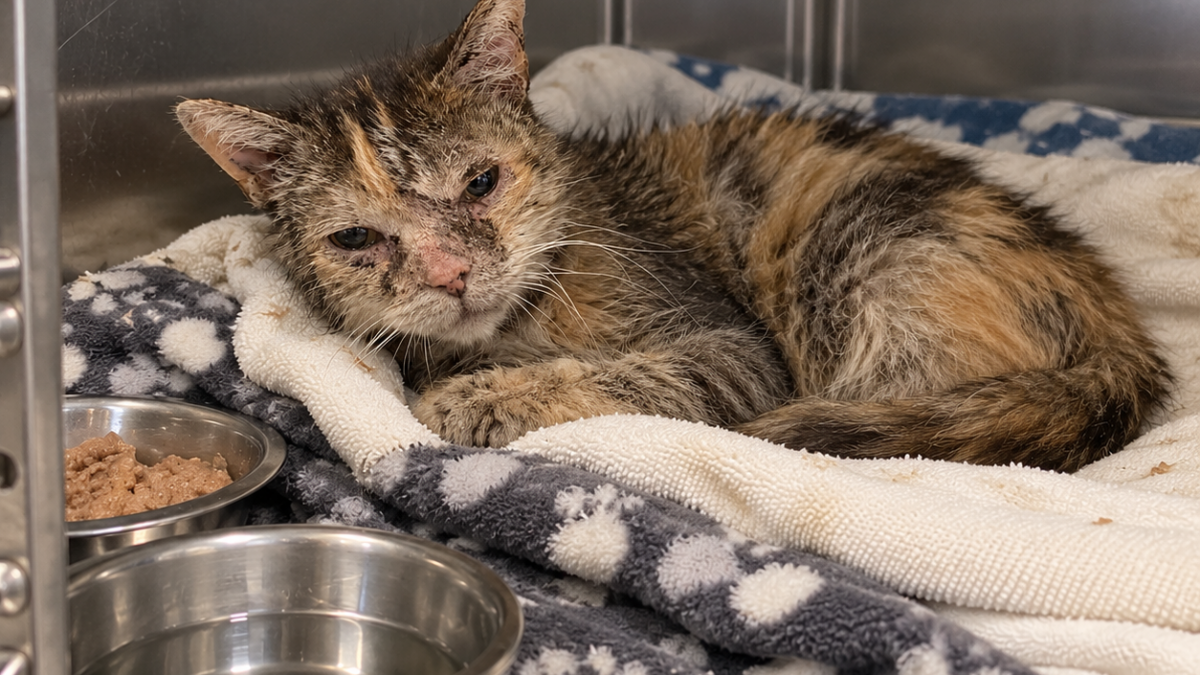
By the time Darby finally slept on a warm blanket, I was already terrified we had found her too late.
For weeks I had watched an old cat survive outside with a face full of sores, telling myself we only needed a little more money and a little more time.
Then the phone rang from the hospital, and one quiet sentence changed everything I thought rescue was supposed to mean.
The first time I saw Darby, she was crouched beneath a rusted patio chair behind a row of aging duplexes on the edge of town. It was cold enough that my breath showed, but she did not move toward the food in my hand. She only watched me with tired amber eyes while the wind lifted the rough fur along her spine.
“Hey, sweetheart,” I whispered. “You don’t have to run.”
She didn’t.
That was worse.
Most frightened outdoor cats bolted when I got too close. Darby seemed too exhausted to waste the energy. Her face was mottled with sores, the fur around her cheeks thin and dirty. When she opened her mouth, I saw teeth darkened by decay. She looked old, but not simply old. She looked worn down.
I crouched a few feet away and slid a dish toward her.
She sniffed it, took two bites, and stopped.
That night I drove home with her face in my mind and our rescue account open on my phone at every red light. We had three animals already in medical boarding, one surgery scheduled, and an emergency balance that barely covered a weekend hospitalization. I knew what Darby needed. Bloodwork. Dental care. Testing. Fluids. Maybe imaging. Probably more.
What I did not have was the money to promise all of that.
There is a particular kind of shame that comes with rescue when you care deeply and still have to say, “Not yet.”
I hated those words.
Over the next two weeks, I checked on Darby whenever I could. A woman named Denise who lived nearby left food under the awning and had been watching her for months. She told me Darby had spent most of her life outdoors.
“People think she’s mean because she won’t come close,” Denise said one evening.
Darby was curled behind a planter, her body tucked tightly against the concrete.
“She’s not mean,” I said. “She’s hurting.”
Denise looked at me. “Can you take her?”
I looked at Darby, then at the ground.
“I’m trying.”
It felt like a betrayal.
Every morning I checked our donations. Every night I worried someone would message me saying Darby had disappeared.
Then the Solomon charity event happened.
People showed up who had never met us. Families dropped bills into jars. A local business matched part of the total. Volunteers worked until their feet hurt. By the end of the night, I kept refreshing the number because I was afraid I had read it wrong.
For the first time, there was enough room in the budget to say yes.
I called Denise before I even left the parking lot.
“Get the carrier ready,” I said. “We’re taking Darby.”
The next afternoon, Darby was wrapped in a towel on the passenger seat beside me, staring through the carrier door while I drove toward the veterinary hospital.
“You’re done being cold,” I told her. “You hear me? We’ve got you now.”
At the hospital, the team moved quickly. They took blood, started fluids, began antibiotics, cleaned what they safely could, and placed her in a warmed kennel with thick blankets underneath her.
For the first time since I had known her, Darby stretched out instead of curling into a protective ball.
I stood with my fingers through the kennel bars.
She leaned her cheek against them.
I nearly cried from relief.
Dr. Ellis came beside me holding the first lab results.
“She’s very sick,” she said carefully. “But she’s here. We treat what we can, we support her, and we see how she responds.”
I nodded too quickly.
“What do you need from me?”
“Tonight? Hope.”
So I went home and gave myself permission to believe in tomorrow.
The next morning, I returned before visiting hours officially began. Darby was still under the same pale-blue blanket. Her food had barely been touched.
I told myself that sick cats needed time.
Then Dr. Ellis walked toward me with a new set of bloodwork in her hand, and before she said a word, I saw the answer in her face.
PART 2
I stood before she reached me.
“How bad?”
Dr. Ellis pulled a stool beside Darby’s kennel instead of answering immediately.
That frightened me more than anything she could have said.
“Sit down for a minute.”
“I’m okay.”
“I know. Sit anyway.”
I sat.
Through the glass door of the kennel, Darby lifted her head when she heard my voice. It was only an inch or two, but I grabbed onto that tiny movement as if it were evidence that everything was going to be fine.
“She knows I’m here,” I said.
“She does.”
“That has to be good.”
Dr. Ellis looked at Darby before turning back to me.
“Her bloodwork hasn’t improved the way we hoped.”
The words seemed to land one at a time.
Her anemia was still significant. Her inflammatory markers were concerning. Her body was fighting infection while already depleted from what appeared to be prolonged illness, poor nutrition, and chronic dental disease.
Then Dr. Ellis told me Darby had tested positive for FIV.
I knew enough about feline immunodeficiency virus not to panic simply because of the test. I had known FIV-positive cats who lived comfortable lives for years.
Dr. Ellis seemed to read the thought on my face.
“I want to be very clear,” she said. “An FIV-positive result by itself is not why I’m worried about losing her.”
I nodded.
“It’s everything together.”
“Yes.”
She showed me the numbers again.
Darby’s immune system had likely been struggling for a long time. Her mouth was in terrible condition. Some teeth were so badly decayed that eating must have been painful. The sores around her face were inflamed. Her body condition told its own story.
This wasn’t a cat who had gotten sick on Tuesday.
This was a cat whose body had been asking for help for months, maybe longer.
I stared at the laboratory sheet until the numbers blurred.
“So what do we do?”
“We keep doing what we’re doing today. Fluids. Medication. Nutrition if she’ll tolerate it. Warmth. Rest. We repeat bloodwork. And we watch her very closely.”
“Then we do that.”
Dr. Ellis nodded.
But there was something in her expression I didn’t like.
“What aren’t you saying?”
She took a breath.
“I’m saying we need to give treatment a chance. I’m also saying I don’t want to make promises her body may not be able to keep.”
I looked through the kennel door.
Darby had lowered her head again.
Her front paw was stretched over the edge of the blanket, and one claw rested against the stainless-steel floor.
I opened the kennel carefully.
“Can I?”
“Of course.”
I tucked the paw back onto the blanket.
Darby didn’t resist.
Her paw pads were rough in a way indoor cats’ paws rarely are. The fur between her toes was dirty even after the staff had cleaned her as much as they could without exhausting her.
I ran one finger along the top of her paw.
“You didn’t come all this way to quit now,” I whispered.
Her eyes opened.
For a second, she looked straight at me.
I made the mistake rescuers make all the time.
I turned that look into a promise.
She wants to live.
She’s telling me to keep fighting.
She’s going to make it.
Sometimes hope is necessary.
Sometimes it is also selfish.
At that moment, I couldn’t tell the difference.
I stayed for almost two hours.
A veterinary technician named Maya warmed a small amount of food and offered it from a spoon.
Darby sniffed it.
“Come on, girl,” Maya whispered. “Just one bite.”
Darby licked a little gravy.
I nearly cheered.
“There,” I said. “She ate.”
Maya smiled, but gently.
“She tasted it.”
“That counts.”
“It counts.”
Darby took another lick.
I sent Denise a message.
She ate a little.
Denise replied almost immediately.
That’s our girl. Tell her I’m waiting for her to come home.
Home.
That word stopped me.
We hadn’t even decided where Darby would go after discharge.
It had seemed too early.
But suddenly I could picture it.
I had a spare room at my house that had served as a temporary recovery room dozens of times. The old bookcase had been moved out years ago. There was a washable rug, a low window, a heated cat bed, and a small wooden step for animals that couldn’t jump well.
I pictured Darby there.
No concrete.
No wind.
No searching for dry places beneath patio furniture.
Just sunlight through the window and a bowl that never went empty.
“I can foster her,” I said aloud.
Maya glanced at me.
“If she gets discharged, I can foster her.”
“That would be wonderful.”
“When she gets discharged,” I corrected.
Maya paused.
Then she nodded.
“When.”
I went home that afternoon and prepared the room.
That was how certain I had decided to be.
I washed two blankets.
I set up food and water bowls.
I found an old cat bed in the closet and decided it wasn’t soft enough, so I drove to a pet store and bought the thickest orthopedic bed they had.
At the register, the cashier smiled at it.
“New cat?”
“Sort of.”
“Kitten?”
I almost laughed.
“No. Senior girl.”
“Those are the best ones.”
“Yeah,” I said. “I think she might be.”
I put the bed beside the window.
Then I sat on the floor staring at an empty room and imagined Darby asleep in it.
I didn’t know yet that she would never see it.
The second call came at 7:14 that evening.
It was Maya.
“Darby’s had a change.”
My stomach dropped.
“What kind of change?”
“She seems weaker in her back legs.”
“How much weaker?”
There was a pause.
“She’s having trouble standing.”
I was already reaching for my keys.
“I’m coming.”
The hospital was twenty minutes away.
I made it in sixteen.
When I walked into the treatment area, Darby was lying on her side.
Dr. Ellis was examining her hind limbs.
“She was walking yesterday.”
“I know.”
“What happened?”
“We’re trying to determine that.”
“Did she fall?”
“No.”
“Blood clot?”
“We don’t think so, but we’re evaluating everything we reasonably can.”
Darby attempted to reposition herself.
Her front legs worked.
Her rear legs seemed slow to follow.
I felt something cold move through my chest.
“Can she feel them?”
“Yes. She has sensation.”
“So that’s good.”
“It’s better than no sensation.”
I hated the precision of the answer.
I wanted someone to lie to me.
I wanted a doctor to say, She’ll be fine.
I wanted certainty in a place built around uncertainty.
Instead, Dr. Ellis gave me medicine, not magic.
She explained possibilities: profound weakness from systemic illness, neurologic involvement, inflammation, metabolic problems, complications of prolonged disease.
More tests might give us more information.
But every test also had to be weighed against Darby’s condition.
“Do whatever she needs,” I said.
Dr. Ellis looked at me.
“We will. But ‘whatever she needs’ and ‘everything medically possible’ are not always the same thing.”
I stared at her.
She continued quietly.
“There are tests I could order because the technology exists. There are procedures we could discuss. But if she isn’t stable enough to benefit from them, putting her through those procedures can become something we do for ourselves rather than for her.”
I knew she was right.
I resented her for being right.
“So what are you recommending?”
“Support her tonight. Keep her comfortable. Reassess her bloodwork and neurologic status in the morning.”
“Another night.”
“Yes.”
I put both hands against the edge of the kennel.
“Darby, you hear that? Just another night.”
She looked at me.
Then something happened that I still think about.
She pushed her forehead slowly into my palm.
Not hard.
Not dramatically.
Just enough for me to feel the weight of her head.
I stroked the fur between her ears.
“You’re coming home with me,” I whispered.
She closed her eyes.
That evening, I stayed until the staff finally convinced me to go home.
I barely slept.
At 2:00 a.m., I checked my phone.
At 2:38, I checked again.
At 3:11, I opened the photo Denise had sent me from the previous summer.
Darby was sitting beneath a hydrangea bush.
She looked thinner than a healthy cat should have, but far better than she did now.
I enlarged the photo.
Even then, there were marks near her mouth.
I texted Denise even though I knew she was asleep.
Do you know who she belonged to?
I wasn’t sure why I asked.
Maybe because fear was turning into anger.
Maybe because when an animal is suffering in front of you, your mind starts searching for somewhere to put the pain.
Denise responded at 5:46.
I think I do. Call me when you’re awake.
I was already awake.
I called immediately.
“You said you know who owned her?”
Denise hesitated.
“I didn’t want to get into all of that while you were trying to save her.”
“Get into what?”
“She wasn’t always a stray.”
I sat upright in bed.
“What do you mean?”
“She used to belong to somebody in Building C.”
“How do you know?”
“I saw her inside.”
“When?”
“A few years ago. Maybe three. Four at most.”
“Who?”
Another hesitation.
“His name is Wesley Crane.”
I wrote it down.
“What happened?”
“I don’t know all of it. His mother used to live with him. Darby was hers, I think. After his mother passed, the cat started being outside more and more.”
“Did he surrender her?”
“No.”
“Did he rehome her?”
“Not that I know of.”
“Then what?”
“I asked him about her once.”
“What did he say?”
Denise’s voice changed.
“He said she preferred being outside.”
I looked across my bedroom toward the empty hallway.
A senior cat with rotting teeth, facial lesions and a failing body.
She preferred being outside.
Something inside me hardened.
“Did you ever see him feeding her?”
“Sometimes at first.”
“And later?”
“No.”
“Did anyone call animal control?”
“I did once.”
“What happened?”
“She disappeared before they came. Then she showed up again weeks later.”
“Do you have anything showing she was his?”
“I might.”
“What?”
“Old messages.”
“Save everything.”
There was silence.
Then Denise said, “Is Darby doing worse?”
I closed my eyes.
“Yeah.”
“How much worse?”
“She’s losing strength in her back legs.”
“Oh, God.”
“We’re not giving up yet.”
“No.”
But the way she said it told me she heard the same thing in my voice that I had seen in Dr. Ellis’s face.
Fear.
At 6:30 that morning, my phone rang.
The hospital.
This time it was Dr. Ellis.
“Can you come in?”
Five words.
There are five words that can empty an entire room even when you’re standing alone.
I was dressed before the call ended.
When I arrived, Darby had been moved onto a padded mat so the staff could clean her more easily.
She had lost control of her bladder overnight.
Then her bowels.
Maya had cleaned her carefully and placed another warm blanket beneath her.
There was a towel rolled along her back so she wouldn’t have to struggle to keep herself positioned.
I knelt beside her.
“Hey, sweetheart.”
Her ear moved.
Just slightly.
I looked at Dr. Ellis.
“Bloodwork?”
“Still not improving.”
“Neurologically?”
“Worse.”
“But she’s awake.”
“Yes.”
“She knows I’m here.”
“I believe she does.”
“Then we keep going.”
Dr. Ellis did not answer.
My voice rose.
“We said another night.”
“We gave her another night.”
“So give her another one.”
The words came out sharper than I intended.
Nobody in the room reacted.
They had probably heard them before.
Dr. Ellis pulled a chair beside me.
“We can.”
I looked at her.
“We can continue fluids. We can continue medication. We can continue warming her and cleaning her when she soils herself.”
“Then why are you looking at me like that?”
“Because you need to ask what another night is for.”
“For her to get better.”
“What evidence do we have that she is?”
I opened my mouth.
Nothing came out.
“She licked food yesterday.”
“She did.”
“She pushed her head into my hand.”
“She did.”
“She’s still looking at me.”
“Yes.”
I hated every gentle answer.
“Then how do I decide that isn’t enough?”
“You don’t decide whether her life is worth something. It is. You decide whether the treatment is still giving her a realistic path back to a life she can enjoy.”
I stared at Darby.
Dr. Ellis continued.
“If we were seeing even modest improvement in the major things worrying us, I would tell you. If I believed another twenty-four hours had a reasonable chance of turning this around, I would tell you that too.”
“But you don’t.”
“No.”
The room became very quiet.
“What if you’re wrong?”
“I could be.”
That answer broke something in me.
I had wanted certainty.
She refused to manufacture it.
“I wish I could give you a percentage that would make this easier,” she said. “I can’t. I can only tell you what I see. Darby is profoundly ill. Her bloodwork is not responding. She is weaker than she was yesterday. She is losing neurologic function and continence. She is not eating enough to sustain herself. And despite aggressive supportive care, her trajectory is downward.”
I leaned over Darby.
Her breathing was shallow but steady.
“She spent her whole life fighting.”
“I know.”
“And now I’m supposed to stop?”
Dr. Ellis shook her head.
“You’re not stopping her fight.”
She placed one hand on the edge of the blanket.
“You may be giving her permission not to fight anymore.”
I looked away.
I was angry at Darby’s body.
Angry at the money we hadn’t had two weeks earlier.
Angry at whoever had let her get this sick.
Angry at winter.
Angry at every empty food bowl.
Angry at myself.
Most of all, I was angry because love had arrived and apparently love was not enough to undo what had already happened.
“I bought her a bed yesterday,” I said.
Dr. Ellis blinked.
“A ridiculous one. It cost more than mine probably did.”
Maya turned away.
I heard her sniff.
“It’s next to the window.”
I swallowed.
“She never even got to see it.”
“No,” Dr. Ellis said softly.
That was when I started crying.
Not graceful tears.
Not the kind from movies where one tear slides neatly down someone’s cheek.
I folded over Darby’s blanket and cried with my forehead against the edge of the table.
“I’m sorry.”
Darby’s ear moved.
“I’m so sorry.”
Maya brought me tissues.
I didn’t use them.
After a while, Dr. Ellis asked the question I had been avoiding.
“What would you want for her if you knew she was never going to leave this hospital?”
I looked at Darby.
The answer came instantly.
“I wouldn’t make her suffer.”
“Then let that answer guide you.”
I placed my palm under Darby’s cheek.
She was so light.
There was almost nothing to hold.
“What happens?”
“We can give her medication first so she becomes deeply relaxed. You can hold her if you want. We won’t rush anything.”
“Will she be scared?”
“We’ll do everything we can to make sure she isn’t.”
“Will it hurt?”
“The initial injection may pinch. After that, she should become very sleepy.”
“Can I stay?”
“As long as you want.”
I rubbed my thumb across Darby’s forehead.
“Then I stay.”
Before we did anything, I called Denise.
She answered on the first ring.
The moment she heard my breathing, she knew.
“No.”
“I’m sorry.”
“No, no, no.”
“I’m so sorry.”
“Can I come?”
“Yes.”
Denise arrived twelve minutes later wearing pajama pants beneath a winter coat and two different shoes.
She ran through the hospital lobby.
When she entered the room, Darby opened her eyes.
Denise stopped.
“Oh, baby.”
She dropped to her knees beside us.
For months Denise had left bowls beneath awnings, built makeshift shelters from storage bins and straw, and watched for Darby during storms.
Now she touched her for the first time.
Darby didn’t pull away.
Denise started crying immediately.
“I always thought you hated me.”
Darby blinked.
“No,” I said. “She was hurting.”
“I know that now.”
For several minutes, neither of us spoke.
We just touched her.
Her ears.
Her cheeks.
Her tired paws.
Places that life had rarely allowed anyone to touch without fear.
Dr. Ellis returned.
“Are you ready?”
No.
“No,” I said.
She waited.
I took a breath.
“But she is.”
The first medication made Darby sleepy.
Slowly, the tension left her face.
Her head became heavier in my hands.
I lifted her carefully and placed her against my chest.
It was the first time I had truly held her.
All those weeks I had worried she might scratch or panic if I tried.
Now she rested beneath my chin as if she had always belonged there.
“You’re warm,” I whispered.
Denise stroked her back.
“You’re inside.”
Darby’s eyes were almost closed.
“No more concrete.”
Her breathing slowed.
“No more rain.”
I kissed the top of her head.
“No more being hungry.”
My voice broke.
“No more fighting.”
Dr. Ellis gave me time.
Then she asked again.
I nodded.
The final medication went into the catheter already placed in Darby’s leg.
I kept one hand against her chest.
For a few seconds, I felt the small rhythm beneath my palm.
Then I didn’t.
Dr. Ellis listened with her stethoscope.
The room was absolutely still.
“She’s gone.”
I had imagined death would feel like something leaving.
Instead, it felt like the entire room had stopped.
I pressed my face into Darby’s fur.
“I’m sorry.”
Denise was sobbing beside me.
Dr. Ellis touched my shoulder.
“She wasn’t alone.”
I knew she meant it as comfort.
At that moment, it wasn’t enough.
“She should have had years.”
“Yes.”
“She should have had that bed.”
“Yes.”
“She should have known this before the last three days.”
“Yes.”
There was no attempt to soften it.
That was what I needed.
Because Darby’s ending was peaceful.
Her life had not been fair.
Both things could be true.
We stayed nearly an hour.
The staff made a clay impression of her paw.
Maya clipped a small lock of fur for me.
I wrapped Darby in the blue blanket one final time before they took her.
I remember smoothing the edge beneath her chin.
It was absurd.
She was gone.
She couldn’t feel whether the blanket was straight.
But I fixed it anyway.
When I walked into the parking lot, the morning sun had come out.
People were going to work.
A delivery truck backed toward a loading dock.
Someone across the street was laughing into a phone.
The world had the nerve to continue.
I sat in my car without starting it.
On the passenger seat was the empty carrier I had used to bring Darby in.
Three days earlier, I had told her she was done being cold.
I had meant that as the beginning of her new life.
Instead, it had become one of the last promises I kept.
My phone buzzed.
It was a message from a volunteer.
How is Darby this morning?
I stared at it.
Then another arrived.
And another.
People who had met Darby only through photographs were waiting for good news.
I couldn’t give it to them.
I typed the words.
Deleted them.
Typed again.
Finally, I wrote:
Darby is gone. We let her go peacefully this morning. She was warm, she was held, and she knew she was not alone.
I pressed send.
Then I put my phone facedown and screamed.
Not words.
Just sound.
I hit the steering wheel once with the heel of my hand.
Then again.
“Why?”
There was nobody there to answer me.
I had been in rescue long enough to know death.
I had lost newborn kittens whose lungs never opened properly.
I had held old dogs after cancer took away their ability to stand.
I had made impossible decisions before.
But Darby was different.
Because she had reached safety.
That was what felt so cruel.
We had opened the door.
She had stepped through.
And there had been no time left on the other side.
For the next two days, I barely went into the spare room.
The expensive bed sat beside the window.
On the third morning, I finally walked in.
Sunlight covered half of it.
I sat on the floor and put Darby’s clay paw print beside me.
I kept thinking about something Dr. Ellis had said.
Her body had been struggling for a long time.
A long time.
Long enough for somebody to notice.
Long enough for somebody to choose differently.
My grief began changing shape.
It became anger.
And anger wanted a name.
I called Denise.
“Tell me everything you know about Wesley Crane.”
There was a pause.
“You think he did this?”
“I don’t know.”
That distinction mattered.
Even angry, I knew I couldn’t accuse someone without evidence.
“But you said Darby lived with him.”
“She did.”
“Then I want to know how she went from living inside that apartment to dying outside.”
Denise exhaled.
“I have messages.”
“Can I see them?”
“Come over.”
An hour later, we sat at Denise’s kitchen table.
She had kept more than I expected.
Photographs.
Text messages.
Screenshots.
Dates.
Denise was the kind of person who never deleted anything from her phone.
For once, I was grateful.
The earliest photo showed Darby sitting inside the front window of Apartment C-4.
She looked years younger.
Her coat was smooth.
Her eyes were bright.
A gray-haired woman sat behind her.
“That’s Evelyn Crane,” Denise said. “Wesley’s mother.”
“She was Darby’s owner?”
“Yes. Everybody knew that cat was hers.”
“What happened to Evelyn?”
“Cancer. She died about three years ago.”
“And Wesley?”
“He kept the apartment.”
Denise swiped to another photograph.
Darby was outside now, sitting on the concrete steps.
Date: four months after Evelyn’s death.
“Did he tell you he was putting her outside?”
“No. I assumed she slipped out at first.”
Then came the messages.
Denise had texted him after seeing Darby outdoors repeatedly.
Is your mom’s cat supposed to be outside?
His response:
She’s fine.
A month later:
Darby looks thin. Is she sick?
Response:
She’s old. Old cats get thin.
Then, eight months before we rescued her:
Her mouth looks bad. I think she needs a vet.
His answer was only six words.
Not paying hundreds for that cat.
I read it twice.
Something hot rose behind my eyes.
“Is this number still his?”
“As far as I know.”
I kept scrolling.
There were more.
Denise offering to help transport Darby to a clinic.
Wesley saying Darby wouldn’t allow herself to be caught.
Denise suggesting surrendering her to a rescue.
No answer.
Then a message from the previous winter.
It’s going below ten tonight. Please bring Darby inside.
His response:
She knows where the shed is.
I put the phone down.
“Where’s the shed?”
“Behind Building C.”
We went outside.
The shed was little more than plywood walls behind the dumpsters.
There was no insulation.
No heat.
A cracked panel at the bottom created an opening large enough for a cat.
Inside, I found an old plastic food dish.
Empty.
A water bowl stained with rust.
And a flattened towel that smelled of mildew.
I stood there imagining Darby curled against the wall while winter wind came through the cracks.
I wanted revenge then.
Actual revenge.
The kind that doesn’t think about tomorrow.
I wanted to walk to Wesley’s door, put Darby’s hospital photographs in his face and demand that he look at every sore, every rotten tooth, every laboratory result.
I wanted him to see her unable to stand.
I wanted him to hear me say, You did this.
I started toward the building.
Denise grabbed my arm.
“Don’t.”
“He needs to see this.”
“Not like this.”
“He left her out here.”
“I know.”
“He was told she needed a vet.”
“I know.”
“He wrote it down.”
“I know.”
“Then why shouldn’t I knock on his door?”
“Because you want justice for Darby?”
“Yes.”
“Then don’t give him a reason to make you the problem.”
That stopped me.
I looked back at the shed.
Denise was right.
My anger could make me feel better for five minutes.
Evidence could do something that lasted longer.
I called county animal control.
Officer Leah Martinez met us that afternoon.
She was quiet while Denise showed her the messages.
She photographed the shed.
She photographed the bowls.
She asked for copies of every image showing Darby over time.
Then she asked me for Darby’s veterinary records.
“What happens now?” I said.
“I investigate.”
“Is this enough?”
“It’s enough for me to start asking questions.”
“He knew she was sick.”
“I see the message.”
“He refused treatment.”
“I see that too.”
“She died.”
Officer Martinez looked directly at me.
“I’m sorry.”
“I don’t want sorry.”
My voice came out harder than I intended.
“I want something to happen.”
“I understand.”
“Do you?”
Her expression didn’t change.
“Yes.”
Then she said something that stayed with me.
“But if you want something to happen, let me build it correctly.”
I stepped back.
“Okay.”
She gave me her card.
“Send the complete medical record. Not just the worst photographs. I need intake notes, bloodwork, diagnoses, condition scoring, treatment, everything.”
“You’ll have it today.”
“I’ll also need a statement from the veterinarian about whether the conditions appeared acute or chronic.”
“I’ll ask.”
“And don’t contact Mr. Crane.”
I glanced toward his apartment.
Officer Martinez noticed.
“I mean that.”
“Fine.”
“You’re angry.”
“Yes.”
“Stay angry if you need to. Just don’t spend the evidence on a confrontation.”
I almost smiled despite myself.
“You say that often?”
“More than you’d think.”
Dr. Ellis agreed to provide a medical statement.
She was careful.
Veterinarians are scientists.
They do not write dramatic language because people are grieving.
She documented what she had observed.
Severe dental disease consistent with prolonged deterioration.
Poor body condition.
Chronic-appearing facial lesions and infection.
Evidence of systemic illness.
Profound weakness.
A condition that, in her medical opinion, had not developed over a single day or two.
She also documented something else.
FIV was part of Darby’s medical picture, but it was not a justification for assuming treatment was pointless.
Darby’s euthanasia had been based on her overall decline, failure to respond to supportive care, progressive weakness and neurologic deficits, loss of continence, inability to maintain nutrition, and extremely poor prognosis.
That mattered to me.
Darby wasn’t euthanized because she was FIV-positive.
She was euthanized because by the time she reached us, too much of her body was failing at once.
Officer Martinez interviewed neighbors.
I did not know that until later.
I tried not to interfere.
It was harder than I expected.
Every morning I wanted to call.
Every afternoon I stopped myself.
Instead, I went back to rescue work.
There were cages to clean.
Medication schedules to manage.
Adoption applications to review.
A young tabby named Pickles threw litter across an entire room and then looked personally offended when I swept it up.
Life continued.
But the spare room remained untouched.
Darby’s bed stayed beside the window.
A week after her death, we received her ashes.
The box was smaller than I expected.
Everything about death becomes smaller.
A body becomes a box.
Years become dates.
A life becomes a name engraved on a plate.
DARBY
That was all.
I placed the box beside her paw print.
Then I sat on the floor.
“You should be in that bed,” I said.
Silence.
I stayed there until the sunlight moved off the wall.
Two weeks after Darby died, Officer Martinez called.
“Do you have a minute?”
“Yes.”
“We interviewed Mr. Crane.”
I stood.
“And?”
“He confirms the cat originally belonged to his mother.”
My grip tightened around the phone.
“He admits Darby remained at the property after his mother died.”
“Inside?”
“He says she began spending time outdoors.”
“Began?”
“That’s his description.”
“What else?”
“He says he considered her a community cat.”
“A community cat?”
My voice rose.
“He inherited her.”
“I’m telling you what he said.”
“He had people texting him about her.”
“We showed him the messages.”
“And?”
“He said he believed neighbors were feeding her.”
I closed my eyes.
“That isn’t medical care.”
“No.”
“Did he explain the message where he said he wasn’t paying for a vet?”
“He said he didn’t believe the condition was serious at the time.”
“The message was eight months before she died.”
“I know.”
“So charge him.”
“We’re submitting the case.”
“To whom?”
“The county attorney.”
I hated that answer because it wasn’t immediate.
“What does that mean?”
“It means I put the evidence together, write the report, include the veterinary records and witness statements, and the attorney decides what can be supported under the statute.”
“What if they say no?”
“Then they say no.”
“And that’s it?”
“For criminal charges, potentially.”
“That’s not good enough.”
“I know it doesn’t feel good enough.”
“It doesn’t feel anything. It isn’t good enough.”
Officer Martinez was silent for a moment.
Then she said, “This is where you decide whether you want a five-minute confrontation or a record nobody can pretend didn’t exist.”
I remembered the shed.
My clenched fist.
Denise holding my arm.
“I want the record.”
“Good.”
Three days later, Wesley Crane came looking for me.
He found me outside the rescue building while I was unloading cat litter.
A silver pickup stopped behind my car.
A man in his mid-forties stepped out.
I knew his face from Denise’s old photographs.
“You the rescue lady?”
I set the litter bag down.
“Who’s asking?”
“Wes Crane.”
Every part of me went still.
Officer Martinez had told me not to contact him.
She hadn’t said what to do if he contacted me.
“What do you want?”
“You filed a complaint.”
“I provided veterinary records to animal control.”
“Same thing.”
“No. It isn’t.”
He walked closer.
Not threateningly.
But aggressively enough that I noticed the distance between us.
“You people are making it sound like I tortured that cat.”
“I haven’t said that.”
“She was old.”
“Yes.”
“She was sick.”
“Yes.”
“What was I supposed to do?”
I stared at him.
“Take her to a veterinarian.”
His jaw tightened.
“You think everybody has thousands of dollars lying around?”
“No.”
“Then maybe stop judging people.”
“I run a rescue. I understand not having money better than you think.”
“Then you should understand.”
“I understand asking for help.”
He scoffed.
“You think a rescue would’ve taken her?”
“We did.”
“When she was practically dead.”
The sentence hit me like a slap.
For a second, I couldn’t speak.
Then I stepped closer.
“Exactly.”
He looked away.
“We took her when she was practically dead because by then she had nowhere else left to go.”
“She wouldn’t come inside.”
“You had years.”
“She didn’t want to be inside.”
“You had years.”
“She scratched me.”
“You had years.”
“Stop saying that.”
“You had years.”
His face changed.
“There it is. You want somebody to blame because your little rescue couldn’t save her.”
That one landed.
Because part of me had said the same thing to myself every night.
Maybe we should have taken her sooner.
Maybe I should have put the bill on my own credit card.
Maybe I should have done more.
Wesley must have seen something in my face because his voice softened in the ugliest possible way.
“You’re mad at me because you were too late.”
For one dangerous second, I wanted to hurt him.
Not physically.
I wanted to reach into the most vulnerable part of him and put my grief there.
Instead, I heard Officer Martinez.
Don’t spend the evidence on a confrontation.
I picked up the litter bag.
“You need to leave.”
“That’s it?”
“Yes.”
“You’ve got nothing else to say?”
I looked at him.
“I held Darby when she died.”
His expression shifted.
I continued.
“She weighed almost nothing. She couldn’t use her back legs properly. She couldn’t control her bladder anymore. Her mouth hurt so badly she barely ate. And when we gave her medication to make her sleepy, she relaxed in my arms.”
Wesley said nothing.
“She wasn’t angry.”
I swallowed.
“She didn’t know enough about people to be angry. She was just tired.”
His eyes dropped.
“That is all I have to say to you.”
He got into his truck and drove away.
My hands started shaking only after he left.
I sat on the curb.
Five minutes later, I called Officer Martinez.
“You told me not to contact him.”
“I did.”
“He contacted me.”
I explained everything.
“Did he threaten you?”
“No.”
“Touch you?”
“No.”
“Did you threaten him?”
“No.”
A pause.
“Good.”
“I wanted to.”
“I know.”
“I told him what Darby looked like when she died.”
“That’s not a crime.”
“Do you think he cared?”
Officer Martinez took a moment before answering.
“I don’t know.”
That was the truth.
And I had to learn something difficult.
Justice could not depend on whether Wesley felt guilty.
Remorse was his business.
Accountability was ours.
Three weeks passed.
Then four.
The rescue received the final hospital invoice.
I opened it at my desk.
Three days of hospitalization.
Repeated bloodwork.
FIV testing.
Medication.
Fluids.
Supportive care.
Nursing.
Emergency examinations.
End-of-life care.
Cremation.
I looked at the total for a long time.
Months earlier, that number would have terrified me.
Now it just made me sad.
Every line represented something we had tried.
A bag of fluids.
A medication.
A test.
A technician’s time.
A warm place.
A final kindness.
Nothing on the invoice said FAILURE.
I realized I had been writing that word there myself.
I took a black marker.
At the top of the bill, I wrote:
WE KEPT OUR PROMISE.
Then I filed it.
The call from the county attorney came six days later.
They were proceeding.
Not with the dramatic felony charges my angry imagination had invented during sleepless nights.
The actual case was narrower.
More careful.
More grounded.
The evidence supported allegations of prolonged neglect and failure to obtain necessary care while retaining responsibility for an animal whose deteriorating condition had been repeatedly brought to Wesley’s attention.
There would be a hearing.
Denise would testify.
Dr. Ellis might testify.
So would I.
“Will he go to jail?” I asked Officer Martinez.
“Probably not.”
I felt disappointment before I could stop it.
“What happens, then?”
“That depends on the court.”
“Fine?”
“Potentially.”
“Restitution?”
“Potentially.”
“Can they stop him from owning animals?”
“That may be requested.”
That mattered more than the fine.
“When?”
“Next month.”
I wrote the date on the calendar.
Then I circled it.
The hearing took place on a rainy Tuesday morning.
I had never been in that courtroom before.
It wasn’t dramatic.
No packed gallery.
No television cameras.
No giant wooden doors.
Just fluorescent lights, rows of benches, attorneys carrying folders and ordinary people waiting for decisions that felt enormous only to them.
Denise sat beside me.
“You okay?” she whispered.
“No.”
“Me neither.”
Across the aisle, Wesley sat with an attorney.
He never looked at us.
Officer Martinez was called first.
She described the investigation.
The original ownership.
The timeline.
The messages.
The condition of the property.
The shed.
Then Denise testified.
The county attorney showed her photographs.
Darby inside the apartment years earlier.
Darby outside.
Darby growing thinner.
Darby with increasing facial irritation.
“When did you first become concerned she needed veterinary care?” he asked.
“About a year before she died.”
“Did you communicate that concern?”
“Yes.”
“To whom?”
“Mr. Crane.”
“And what response did you receive?”
Denise’s voice shook.
“He told me he wasn’t paying hundreds of dollars for the cat.”
The message was entered into the record.
Wesley’s attorney argued that Denise was not a veterinarian and could not diagnose an animal.
That was true.
The county did not pretend otherwise.
Then Dr. Ellis testified.
She did not exaggerate.
That made her devastating.
She explained Darby’s condition clinically.
The severe dental disease.
Chronic infection.
Poor body condition.
Lesions.
Systemic compromise.
Progressive weakness.
Neurologic decline.
She explained that no one could say with certainty how Darby’s outcome would have changed if treatment had begun months earlier.
My heart sank at first.
I wanted her to say Darby would absolutely have lived.
But science does not owe grief the answer grief wants.
Then the county attorney asked:
“In your medical opinion, Doctor, would seeking veterinary evaluation earlier have given Darby more options than she had by the time she arrived at your hospital?”
Dr. Ellis answered without hesitation.
“Yes.”
That was enough.
When my turn came, my knees felt weak.
I raised my hand.
Swore to tell the truth.
Sat down.
The county attorney asked how I met Darby.
I told him.
He asked why we did not take her immediately.
That question hurt.
“Resources,” I said.
“Explain.”
“We’re a small rescue. At that time we already had multiple animals in medical care. Darby clearly needed extensive evaluation and treatment. I was afraid of taking responsibility for her and then being unable to provide what she needed.”
“Did you ignore her?”
“No.”
“What did you do?”
“I checked on her. Denise fed her. We looked for funding. Then the Solomon Organization and our community helped through a charity event. Once we had enough financial capacity, we took her directly to the hospital.”
“How long was she hospitalized?”
“Three days.”
“And the outcome?”
I looked down.
“We euthanized her.”
“Why?”
“Because she was dying.”
The courtroom was silent.
I corrected myself.
“Because her body was failing despite treatment, and continuing was no longer giving her a realistic path to recovery.”
The attorney nodded.
“Were you present?”
“Yes.”
“Tell the court only what you’re comfortable sharing.”
I looked across the room.
For the first time, Wesley looked at me.
I could have used that moment to punish him.
I could have described everything in the most graphic way possible.
Instead, I told the truth.
“She was given medication to relax her. I held her. Another woman who had cared for her outside was with us. Darby was warm. She was calm. She died in my arms.”
My voice cracked.
I paused.
“She deserved that kindness. She also deserved it sooner.”
Wesley looked down.
His attorney asked me questions afterward.
He asked whether I could prove Darby would have survived with earlier treatment.
“No.”
Whether FIV can affect immune function.
“Yes.”
Whether Darby was already a senior cat.
“Yes.”
Whether the rescue itself had waited before accepting her.
That one stung.
“Yes.”
His attorney stepped closer.
“So you agree that even after you became aware of this cat’s condition, your organization did not immediately take custody.”
“That’s correct.”
“Because treatment was expensive.”
“Yes.”
“Yet you fault my client for not paying for treatment he says he could not afford.”
I took a breath.
“No.”
He paused.
“No?”
“I fault him for doing nothing.”
The room became still.
I continued.
“If he could not afford care, there were rescues. Shelters. Low-cost clinics. Surrender options. People around him were already offering help. Denise asked him directly. He didn’t have to pay thousands of dollars. He had to tell somebody the truth and let her go.”
The attorney started to interrupt.
I kept my voice level.
“We did not own Darby while we were trying to raise money. The moment we accepted responsibility for her, she went to the hospital. Mr. Crane had responsibility for years.”
The attorney looked toward the judge.
“No further questions.”
I stepped down.
I didn’t feel victorious.
I felt empty.
The judge did not decide immediately.
We returned several weeks later.
Wesley entered an agreement rather than take the matter further.
There were fines.
Restitution toward a portion of documented veterinary expenses.
Mandatory animal-care education.
Probation.
And, most importantly to me, a restriction preventing him from owning or taking primary responsibility for companion animals during the probationary period.
It wasn’t the cinematic punishment my grief had once imagined.
No handcuffs.
No gasping courtroom.
No satisfying speech where everyone applauded.
Real justice rarely looks like that.
But when the judge spoke Darby’s name into the official record, something inside me shifted.
She had spent years becoming invisible.
Now there was a record saying she had existed.
A record saying someone had been responsible.
A record saying her suffering mattered.
Outside the courthouse, Denise leaned against the brick wall.
“Do you feel better?”
I thought about it.
“No.”
She nodded.
“Me neither.”
Then we both started laughing.
Not because anything was funny.
Because we had expected justice to feel like revenge.
It didn’t.
Nothing could punish somebody into giving Darby back her lost years.
Nothing could make her wake up in that ridiculous bed beside my window.
Nothing could erase the hospital room.
The best justice could do was draw a line beneath what happened and say:
This mattered.
This should have been different.
Do not do it again.
That afternoon I went home and finally picked up Darby’s bed.
For a moment, I considered putting it in storage.
Then my phone rang.
It was Officer Martinez.
“I know today was a lot,” she said.
“Yeah.”
“I have another question.”
I almost laughed.
“What?”
“We picked up a cat this morning.”
I looked at the bed in my hands.
“No.”
“You don’t even know what I’m asking.”
“I know exactly what you’re asking.”
“She needs somewhere quiet for a few days.”
“Leah.”
“Just listen.”
I sat on the edge of the bed.
“Female. Adult. Found behind a grocery store. Underweight. Upper respiratory infection. Nothing like Darby’s condition. The shelter is packed, and she’s scared.”
“No.”
“She’s already been examined.”
“No.”
“She’s eating.”
I closed my eyes.
“That was low.”
“I know.”
“Send me a picture.”
Three seconds later, my phone buzzed.
The cat in the photograph was small and gray with a white chin.
Her eyes were enormous.
One ear folded slightly at the tip.
She looked terrified.
I looked at Darby’s empty bed.
Then back at the photograph.
“What’s her name?”
“She doesn’t have one.”
“She does now.”
“What is it?”
I stared at the rain outside.
“June.”
“Why June?”
“Because I’m ready for something warmer.”
Officer Martinez was quiet.
Then she said, “I’ll bring June at five.”
June arrived in a carrier that evening.
When I opened the door, she refused to come out.
“That’s okay,” I said.
I sat on the floor.
The same place I had sat imagining Darby.
June remained inside for twenty-three minutes.
Then one paw appeared.
Then another.
She crept across the room.
Sniffed the water.
Circled the bed.
And climbed into it.
Darby’s bed.
I covered my mouth.
Officer Martinez watched from the doorway.
“You okay?”
“Yeah.”
I wasn’t.
But I was closer.
June turned around three times and lay down.
Within minutes, she was asleep.
Sunlight from the late afternoon window touched the edge of her fur.
I took a photograph.
Not for social media.
Not for fundraising.
Just for me.
That night, for the first time since Darby died, the spare room was not empty.
June recovered.
Her respiratory infection cleared.
She gained weight.
She learned that the refrigerator door meant food.
She learned that my feet beneath the blankets were apparently enemies requiring immediate attack.
She learned to sit in the window and chirp at birds.
Three weeks later, a retired teacher named Carol adopted her.
Carol had recently lost her husband and said the house had become unbearably quiet.
At the adoption meeting, June crawled directly into her lap.
Carol started crying.
“I think she picked me.”
“She does have strong opinions.”
Carol laughed through her tears.
I sent June home with Darby’s bed.
I hadn’t planned to.
But when Carol started carrying the other supplies toward her car, I looked at the bed and knew.
“That goes too.”
“You don’t need it?”
I ran my hand over the fabric.
“No.”
That wasn’t true.
I did need it.
I simply no longer needed to keep it.
“It belongs with a cat.”
Carol carried it to the car.
June rode home curled inside it.
After they left, I stood alone in the spare room.
The square of carpet beneath the bed was slightly cleaner than the rest.
I placed Darby’s paw print there.
“You did that,” I whispered.
More animals came.
Not all of them survived.
That is the truth rescue stories sometimes hide because happy endings are easier to share.
There was a black kitten with congenital heart disease we could not save.
A fifteen-year-old terrier whose family surrendered him after his owner entered hospice.
A tabby named Frank who screamed at everyone for nine days and then became the most affectionate cat in the building.
There were victories.
There were losses.
But something had changed after Darby.
We created an emergency medical fund from the restitution, the remaining proceeds of the Solomon charity event, and money the organization formally designated for urgent cases.
We called it Darby’s Promise.
The name wasn’t my idea.
Maya suggested it.
“What promise?” I asked.
“The one you made in the car.”
I looked at her.
She remembered.
You’re done being cold.
That became the principle behind the fund.
If an animal was suffering and we had a reasonable path to help, we wanted money to be one less reason for delay.
The fund didn’t make us limitless.
Nothing could.
We still had to make hard decisions.
We still had to say no sometimes.
But Darby changed the threshold.
Months later, in early winter, my phone rang at 10:36 p.m.
Denise.
“Please don’t hate me.”
I sat up.
“What happened?”
“There’s a cat.”
Of course there was.
“Where?”
“Same property.”
My body went cold.
“What do you mean, same property?”
“Behind Building C.”
I was already dressing.
“What does it look like?”
“Orange. Young, I think. His eye is swollen.”
“Can you contain him?”
“I have him in my bathroom.”
“I’m coming.”
I drove through the same streets I had driven the night Darby first consumed every thought I had.
Denise opened the door before I knocked.
The orange cat was hiding behind her toilet.
He hissed when I approached.
Good.
I smiled.
Denise stared at me.
“Why are you smiling?”
“He has enough energy to hate me.”
“That’s good?”
“Tonight it is.”
We took him to the emergency clinic.
He had an infected eye injury, fleas, mild dehydration and a fever.
Treatable.
The veterinarian expected him to recover.
At 1:30 in the morning, I sat in the parking lot holding the estimate.
A year earlier, that number might have meant waiting until morning.
Calling around.
Hoping.
This time, I signed the authorization.
Darby’s Promise covered the deposit.
The orange cat, whom Denise named Solomon, kept his eye.
He recovered.
And every time I saw him afterward, I thought about the old cat who had not.
That was when I finally understood the revenge I had wanted.
I had wanted Wesley to hurt because Darby hurt.
I had wanted him to experience some equivalent amount of pain, as if suffering could be balanced like an account.
But pain doesn’t work that way.
Making another person hurt would never have warmed Darby.
It would never have repaired her teeth.
It would never have restored the strength in her back legs.
It would never have given her another morning.
The only revenge that meant anything was making neglect lose the next time.
The next cold cat would come inside sooner.
The next infected eye would be treated.
The next frightened animal would hear yes before its body had already spent everything it had.
That became my answer.
Not forgiveness.
I never told myself what happened to Darby was acceptable.
Not forgetting.
I kept every record.
Not pretending the system was perfect.
It wasn’t.
Accountability mattered.
But revenge stopped meaning destruction.
It became interruption.
Break the cycle.
Change what happens next.
A year after Darby died, I drove to the hospital carrying a small paper bag.
Maya was working.
Dr. Ellis was between appointments.
“What’s this?” Maya asked.
I handed her the bag.
Inside was a framed photograph.
Not of Darby sick.
I had stopped wanting her remembered that way.
It was the old photograph Denise had taken beneath the hydrangea bush.
Darby was sitting upright.
The sun was on her face.
Her amber eyes were open.
Underneath the photograph was a small engraved line:
DARBY — SHE WAS HERE, AND SHE MATTERED.
Maya cried first.
Then I did.
Dr. Ellis held the frame.
“She looks beautiful.”
“She was.”
“We knew that.”
I looked toward the treatment area where Darby had spent her last three days.
“For a long time I thought we failed her.”
Dr. Ellis returned the frame to me.
“Do you still?”
“Sometimes.”
“What do you think you should have done differently?”
“Gotten there sooner.”
“You didn’t control when her needs began.”
“I know.”
“Do you?”
I smiled slightly.
“I’m learning.”
She leaned against the counter.
“Rescue creates a dangerous illusion.”
“What?”
“That because you care, you should be able to save everyone.”
I said nothing.
“You can provide medicine. Food. Shelter. Surgery. Time. You can advocate. You can make difficult choices. But you do not control biology, history, or everything that happened before an animal reached you.”
“I still wish love had been enough.”
“Love was enough for what she needed from you at the end.”
I looked at her.
“She needed somebody to make the decision she couldn’t make for herself.”
That hurt.
But less than it once would have.
“Do you think she knew?”
“Knew what?”
“That we loved her.”
Dr. Ellis smiled.
“I don’t know what cats understand as a concept. But she knew warmth. She knew gentle touch. She knew your voice. She knew she could relax in your arms.”
She paused.
“I think that’s close enough.”
We hung the photograph in the hallway near the treatment rooms.
Over the next few months, I sometimes saw people stop in front of it.
They didn’t know Darby’s entire story.
They didn’t need to.
She was no longer only the cat with sores.
No longer only the medical bill.
No longer only the case file.
She was Darby.
One evening, almost two years after her death, Denise called me.
“I found something.”
Those words still had the power to frighten me.
“What?”
“Come over when you can.”
I went the next day.
She handed me a cardboard box.
“I’m moving,” she said. “Found this in a closet.”
Inside were photographs that had belonged to Evelyn Crane.
Apparently, after Evelyn died, a neighbor helped clear some belongings and accidentally mixed the photographs into a box Denise had stored.
We went through them at the kitchen table.
Family birthdays.
Christmas dinners.
A garden.
Then Darby.
Young Darby.
Healthy Darby.
She was sprawled across Evelyn’s lap with one paw over the woman’s arm.
Another showed her asleep beneath a Christmas tree.
Another showed Evelyn reading while Darby sat on the back of the couch behind her head.
I touched the photograph.
“She was an indoor cat.”
“Looks like it.”
There were dozens.
Darby had not begun life unwanted.
That realization broke my heart in a completely different way.
For years I had pictured her entire life as cold pavement and sheds.
But before that, somebody had loved her.
Really loved her.
Evelyn had written dates on the backs of the photographs.
On one she had written:
Darby stole my chair again.
On another:
My little shadow.
I laughed.
Then cried.
“Look at her,” Denise said.
“I know.”
Darby was plump in those photographs.
Confident.
Annoyingly comfortable.
Exactly as a cat should be.
I took one photograph home.
In it, Darby was asleep on a floral blanket with her belly exposed and all four paws in the air.
The posture of absolute trust.
I placed it beside her ashes.
For the first time, her memorial did not feel like a monument to failure.
It felt like a whole life.
A life with a beginning.
A woman named Evelyn who adored her.
A terrible middle after Evelyn was gone.
And then us.
Not long enough.
Never long enough.
But us.
Years passed.
Darby’s Promise helped dozens of animals.
A dog hit by a car.
A kitten with pneumonia.
An old cat with an infected tooth who arrived early enough to have surgery, recover and spend three more years sleeping in a sunroom.
Every time the fund was used, Darby’s name appeared on the internal paperwork.
Most adopters never knew why.
I did.
One winter afternoon, I received a Christmas card from Carol.
Inside was a photograph of June.
The frightened gray cat from the carrier was now round, glossy and deeply spoiled.
She was asleep in the same orthopedic bed I had once bought for Darby.
A knitted blanket covered half her body.
On the back, Carol had written:
She sleeps here every afternoon when the sun comes through the window.
I sat at my desk holding the photograph.
Sun through the window.
Exactly what I had imagined.
Not the same cat.
Not the same ending.
But somehow the promise had traveled forward.
I put June’s photograph beside Darby’s for a while.
Then I understood something I wish I had understood sooner.
A satisfying ending is not always getting back what was taken.
Sometimes nothing can restore what was lost.
Sometimes the ending is that the loss refuses to remain useless.
Darby had been loved too late to save her.
That sentence would always hurt.
But it was no longer the whole truth.
She was loved soon enough to stop suffering alone.
Soon enough to sleep on clean blankets.
Soon enough to hear gentle voices.
Soon enough to have people fighting over what might give her another day.
Soon enough to have someone choose mercy when another day would only have been for us.
Soon enough to become a name people remembered.
And soon enough to change what happened to the animals who came after her.
On the anniversary of her death, I no longer go to the cemetery or sit beside her ashes all day.
I work.
That is how I remember her now.
I clean bowls.
I answer calls.
I drive carriers across town.
I argue politely with clinics about appointment times.
I make room where there supposedly isn’t any.
And when I am afraid to take a difficult case because I remember how much it hurt to lose Darby, I look at the photograph of her upside down on Evelyn’s floral blanket.
Not the hospital photograph.
Not the sick cat.
The loved cat.
I remind myself that rescue is not a promise that nobody will die.
It is a promise that while they are here, their suffering will matter.
Recently, a volunteer asked why our emergency fund was called Darby’s Promise.
She was new.
She had never heard the story.
I pointed toward the framed photograph.
“That cat.”
“What happened to her?”
I looked at Darby’s face.
For years, I would have answered:
We were too late.
Now I said something different.
“She taught us to get there earlier.”
The volunteer studied the photograph.
“Did she make it?”
It was the question everyone asks in rescue.
Did she make it?
As if survival is the only measurement by which a life can be redeemed.
I thought about the three hospital days.
The heated kennel.
Maya offering food from a spoon.
Denise arriving in mismatched shoes.
Dr. Ellis refusing to sell me false hope.
Darby’s forehead pressing into my hand.
The weight of her body against my chest.
The moment her muscles finally relaxed.
The courtroom.
June.
Solomon.
All the animals whose paperwork later carried Darby’s name.
I answered carefully.
“No. She died.”
The volunteer’s face fell.
Then I added, “But yes. In another way, she made it.”
She looked confused.
I smiled.
“You’ll understand.”
That night, after everyone left, I stood in front of Darby’s photograph.
The rescue was quiet.
One cat snored in the adoption room.
A washing machine thumped in the back.
Rain tapped lightly against the windows.
Years earlier, weather like that would have sent my mind immediately to Darby beneath the rusted patio chair.
Cold.
Wet.
Waiting.
I no longer picture her there.
Now I picture the final morning.
Not the death.
The moment before it.
Darby against my chest.
Wrapped in warmth.
Denise touching her back.
A doctor beside us.
No pavement.
No wind.
No hunger.
No one walking past.
And I hear myself whispering the promise that once felt unbearably small.
“You don’t have to fight anymore.”
For a long time, I thought those words meant I had failed her.
Now I know better.
Sometimes fighting for an animal means treatment.
Sometimes it means surgery.
Sometimes it means spending a night beside an oxygen cage and praying for numbers to improve.
Sometimes it means confronting neglect through the proper channels and making sure the truth enters the record.
And sometimes fighting for them means being brave enough to stop asking them to endure pain simply because we cannot bear the goodbye.
Darby taught me all of those things in three days.
Three days.
That used to sound cruelly short.
Now I think about what was inside them.
Warmth.
Medicine.
Food offered by hand.
Clean bedding.
Names spoken softly.
People checking her breathing.
People arguing about how best to help her.
People crying because she mattered.
A woman racing across town in mismatched shoes because she could not let Darby leave without saying goodbye.
A veterinarian willing to tell me the truth when a lie would have been easier.
And finally, two arms holding her while she rested.
Darby did not die belonging to nobody.
She belonged to us.
She belonged to Denise.
To Maya.
To Dr. Ellis.
To every person who helped us reach the point where we could finally say yes.
Most of all, for those final three days, she belonged to herself.
She no longer had to earn food by surviving outside.
She no longer had to find shelter.
She no longer had to hide pain because no one was listening.
Her needs became important simply because they were hers.
That should have happened years earlier.
I will never pretend otherwise.
I will never romanticize what she endured.
I will never say everything happens for a reason.
Some things happen because someone failed to act.
Some suffering is preventable.
Some chances really are lost.
But what came afterward mattered too.
Wesley was held accountable through the legal process.
Darby’s suffering became part of an official record instead of disappearing with her.
The medical fund carrying her name meant another cat received treatment before infection took his eye.
June slept in the bed Darby never reached.
Other animals came through our doors sooner because we had learned what waiting could cost.
That was the only revenge worth having.
Not making someone suffer because Darby suffered.
Making sure her suffering took something away from neglect.
Its silence.
Its excuses.
Its ability to remain invisible.
Darby lost her life.
But neglect did not get the last word.
Love did.
I touched the edge of her photograph.
“Goodnight, old girl.”
Then I turned off the hallway lights.
The photograph disappeared into the darkness, but I knew exactly where it was.
I knew her name.
I knew her story.
And I knew the promise we would keep because of her.
The next frightened animal would not have to be nearly dead before somebody decided she mattered.
The next old cat would not be dismissed simply because she was old.
The next person who said, “She’s fine outside,” would have to answer harder questions.
The next empty kennel we could afford to fill would not remain empty because we were afraid of heartbreak.
Darby had spent too much of her life waiting for somebody to say yes.
In the end, we were able to give her only three days after that yes.
I will always wish there had been three years.
Ten years.
An entire lifetime.
I wish she had slept in my spare room with sunlight warming her back.
I wish she had scratched my furniture.
I wish she had screamed for breakfast at five in the morning.
I wish she had become fat and demanding and completely unreasonable.
I wish the ridiculous orthopedic bed had been hers until it wore out.
None of those wishes came true.
But the promises that remained within my power did.
She was warm.
She was clean.
She received medical care.
Her pain was taken seriously.
Her story was documented.
She was defended.
She was held.
She was loved.
And when her exhausted body finally had nothing left to give, nobody forced her to keep fighting just to spare us the pain of losing her.
I used to think rescue meant saving a life.
Darby taught me that sometimes rescue means something harder.
Sometimes you arrive after saving is no longer possible, and you still have work to do.
You can replace cold concrete with a blanket.
You can replace hunger with a bowl.
You can replace indifference with attention.
You can replace fear with gentle hands.
You can replace an anonymous death with a name somebody will remember.
And when nothing else can be repaired, you can make sure the final thing an animal learns about this world is not abandonment.
It is love.
That was Darby’s ending.
Not the one I wanted.
Not the one she deserved.
But it was hers.
And years later, whenever I walk past her photograph and see those amber eyes, I no longer hear myself saying, “I’m sorry we were too late.”
I say:
“We kept going because of you.”
Then I open the next carrier.
I kneel beside the next frightened animal.
And I make the promise again.
“You’re safe now.
We see you.
You matter.
And this time, we’re here.”



