PART 2: They Wrapped Her Wounds in Bright Colors—A Year Later, Riona Showed Us What Real Revenge Looks Like
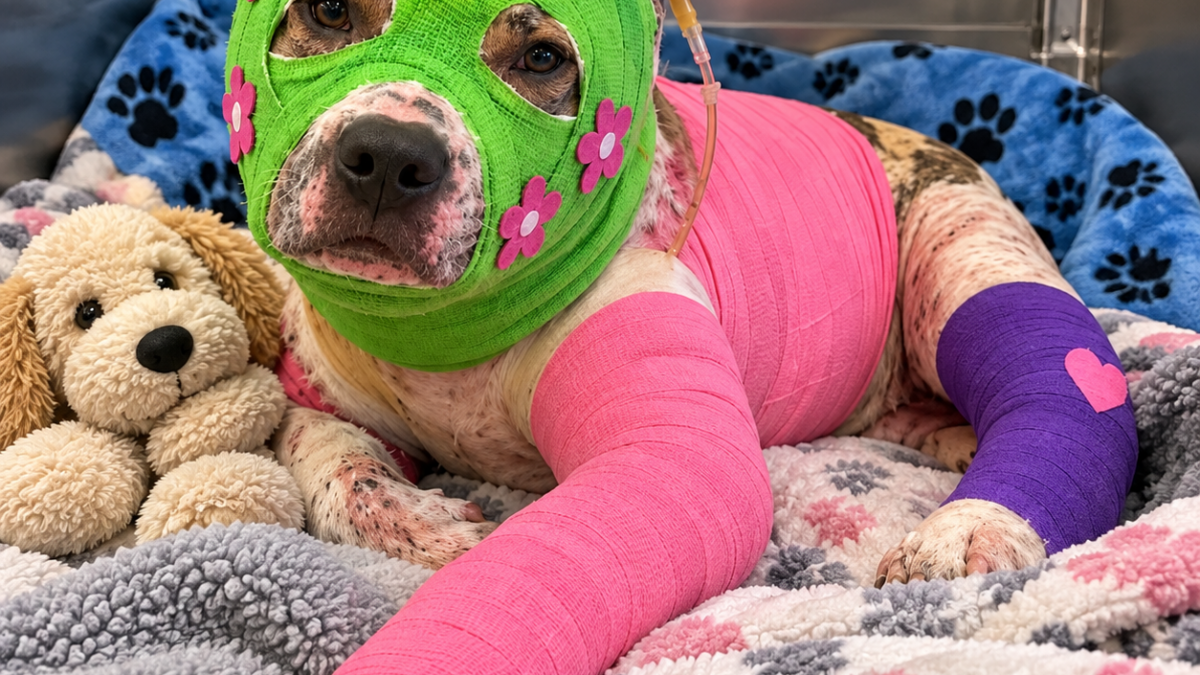
The first time I saw Riona, I could barely find the dog beneath the bandages.
Her body told me what cruelty had done to her, but her eyes asked a question I wasn’t sure any of us deserved to answer.
And one year later, when she finally walked toward the kind of hands she once feared, I realized surviving had only been the beginning.
I was standing near the treatment room when they brought her in.
The first thing I noticed was color.
Bright green gauze wrapped around her head. Pink bandages covered much of her body and one leg. Another limb was hidden beneath a deep purple dressing. Someone had placed tiny pink flowers on the green wrap around her face, the kind of small gesture veterinary workers make when they are trying desperately to put something gentle into a scene that has none.
From the doorway, the colors almost looked cheerful.
Then I saw what they were protecting.
I stopped breathing for a second.
I had worked around injured animals long enough to know how to keep moving when my emotions wanted me to freeze. You check vital signs. You prepare medication. You listen to the veterinarian. You focus on what needs to happen next.
But Riona was different.
She lay almost completely still while we worked around her.
Not relaxed.
Still.
There is a difference.
A relaxed dog trusts the room.
A frightened dog sometimes becomes so quiet because she has learned that struggling changes nothing.
“Easy, sweetheart,” I whispered.
Her eyes moved toward me.
That was all.
No growl.
No attempt to bite.
No tail wag.
She simply watched my hand as I reached toward her.
I stopped before touching her.
“You don’t know me yet,” I said softly. “That’s okay.”
One of the nurses looked at me over the treatment table.
“She’s been through enough,” she said.
I nodded.
We all knew it.
Over the next several days, Riona’s life became a cycle of examinations, medications, dressing changes, cleaning wounds, replacing bandages and watching carefully for infection.
Healing sounds peaceful when you describe it afterward.
It isn’t.
Healing can hurt.
It can itch.
It can exhaust an animal that has already spent everything she had surviving the injury itself.
Some mornings Riona seemed stronger.
Other mornings she barely lifted her head.
But we began creating routines.
Her blanket was always arranged the same way.
Food arrived at predictable times.
We spoke before touching her.
Nobody reached suddenly toward her face.
Nobody forced affection on her just because we wanted reassurance that she still liked people.
Trust had to belong to her.
One afternoon, while I was helping with another bandage change, I noticed something.
My hand was resting on the edge of the table.
Riona stared at it.
For several seconds she did nothing.
Then her nose moved forward.
Barely an inch.
She sniffed my fingers.
I stayed perfectly still.
Another inch.
Then the tip of her nose touched my hand.
Nobody in the room spoke.
I felt ridiculous because my eyes immediately filled with tears.
It wasn’t a kiss.
It wasn’t forgiveness.
It wasn’t even trust yet.
It was simply a badly wounded dog deciding, for one second, not to pull away.
And somehow that felt enormous.
Days became weeks.
The colors of the bandages changed.
Her wounds slowly changed with them.
New tissue appeared where damaged skin had been. Her expression softened. She began paying attention when someone entered the room instead of shrinking into herself.
Then came the morning I walked in carrying her breakfast and heard a faint sound against the kennel floor.
Tap.
Pause.
Tap.
I looked down.
Riona’s tail had moved twice.
“Did you just do that?” I whispered.
Her eyes stayed on me.
The tail moved again.
I crouched beside her.
“Well,” I said, my voice breaking into a laugh, “there you are.”
But recovery was still fragile.
We knew there could be setbacks. We knew wounds were only one part of what had happened to her. And we knew the hardest question was waiting beyond the clinic walls.
What happens to a dog after medicine saves her body?
Because eventually the bandages would come off.
Eventually there would be no treatment room left to hide behind.
And one afternoon, when our veterinarian walked toward me holding Riona’s latest examination results, the look on her face told me we had finally reached the decision none of us was ready to make…
PART 2
Dr. Miller closed the treatment-room door behind her.
That small click made my stomach tighten.
Riona was lying on her blanket with her head lifted, watching us. By then she had learned our routines well enough to know when something unusual was happening. She knew the rattle of the medication cart. She knew the sound of the refrigerator where we kept certain supplies. She knew which pocket I usually carried treats in.
And apparently she knew when three adults entered a room and suddenly became too quiet.
Dr. Miller looked at the chart in her hand.
“The wounds are progressing better than I expected.”
I should have felt relief.
Instead I asked, “But?”
She exhaled.
“But we’re reaching the point where keeping her here simply because we’re afraid to let her leave may stop being good medicine.”
I looked at Riona.
A section of her wrapping had been removed that morning. More of her face was visible now, including one ear that had spent weeks partially hidden beneath dressing material.
She looked vulnerable without it.
The bandages had become armor in my mind.
I knew that was irrational.
Still, removing them felt like sending a soldier outside without a helmet.
“She’s not ready,” I said.
Dr. Miller didn’t argue.
That made me more uncomfortable.
“She still startles when strangers come in,” I continued. “She doesn’t like men standing over her. Yesterday the laundry cart hit the doorway and she tried to get behind the kennel.”
“I know.”
“And she’s only just started walking comfortably.”
“I know.”
“Then how is she ready?”
Dr. Miller set the chart on the counter.
“I didn’t say she’s ready for everything.”
She looked at Riona.
“I said she’s getting ready for something different.”
That sentence stayed with me.
Something different.
For weeks our entire definition of success had been medical.
Temperature normal.
Appetite improving.
No infection.
Healthy tissue.
Pain controlled.
Bandages staying clean.
But Riona was not a collection of wounds.
She was a dog.
Eventually she would need grass beneath her feet instead of rubber flooring.
She would need sunshine that didn’t come through a clinic window.
She would need to learn what a front door meant, what a couch was for, what it felt like when someone went to work and actually came home again.
She needed a life.
And suddenly that frightened me more than surgery ever had.
“What are you thinking?” I asked.
“A foster home first.”
I immediately shook my head.
“With who?”
“We’ll screen carefully.”
“That’s not what I asked.”
Dr. Miller gave me a look.
I knew that look.
It meant she was about to say something I didn’t want to hear.
“There’s another problem.”
My chest tightened.
“What?”
“Attention.”
I stared at her.
“Attention?”
“Riona’s story is spreading.”
I looked instinctively toward the hallway.
We had already seen some of it.
People called asking about her.
People wanted updates.
Some offered blankets, food, donations, toys.
Most meant well.
But attention changes things.
A wounded dog becomes a story.
A story becomes a symbol.
And sometimes people fall in love with the symbol without understanding the animal underneath it.
Dr. Miller continued.
“We’ve already had people asking if they can adopt her.”
“That’s good.”
“Some of them haven’t owned a dog.”
I frowned.
“Not good.”
“One family said they wanted her because their daughter saw her picture.”
“How old is the daughter?”
“Six.”
“No.”
“I agree.”
“Anyone else?”
“A man called three times.”
Something in her voice made me look up sharply.
“About what?”
“He kept asking whether she would look normal when she healed.”
For a moment I said nothing.
Then anger rose through me so quickly that my hands shook.
“That’s his concern?”
“He won’t be considered.”
“Good.”
“He also asked whether she’d be good for social media.”
I turned away.
There are days in animal rescue when you become deeply grateful for people.
Then there are moments when someone opens his mouth and reminds you why locked doors were invented.
“She is not a prop.”
“I know.”
“She is not an inspirational photograph.”
“I know.”
“She doesn’t owe anybody a happy ending just because they watched her suffer.”
Dr. Miller’s face softened.
“That’s exactly why we have to be careful.”
Behind us, I heard movement.
Riona had pushed herself upright.
Her eyes shifted between us.
I lowered my voice.
“Sorry, girl.”
Her tail touched the blanket once.
That night I went home angry.
I lived alone then, in a small house about fifteen minutes from the clinic.
Usually I appreciated the silence.
That night it felt accusing.
I stood in my kitchen eating cereal straight from the bowl because I was too tired to cook, and I kept picturing strangers looking at Riona like she was a prize.
Would she look normal?
Could she become content?
Would she photograph well?
The questions kept repeating in my head.
None of them asked whether she would feel safe.
I put the bowl down.
My dog, Cooper, lifted his head from his bed near the refrigerator.
He was twelve, gray around the muzzle, and deeply committed to sleeping seventeen hours a day.
“You know what people are like?” I asked him.
Cooper sighed.
“Exactly.”
I sat on the floor beside him.
He placed one paw on my leg.
The simplicity of that gesture hurt.
Trust seems ordinary until you meet an animal whose trust has been broken.
Then every small act becomes sacred.
The next morning I arrived early.
Riona was awake.
“Morning.”
Her tail moved.
I opened the kennel and sat beside her without reaching.
That had become our ritual.
She decided when contact happened.
For nearly a minute she simply watched me.
Then she leaned forward and rested the side of her face against my forearm.
I closed my eyes.
“Okay,” I whispered. “We’ll get this right.”
I didn’t know how.
But I meant it.
Over the following two weeks, Riona’s medical progress accelerated.
More bandages disappeared.
Every removal revealed the truth beneath them.
Healing skin.
Scarring.
Places where hair might return.
Places where it might not.
Some people imagine recovery as returning to what existed before.
That was never going to happen for Riona.
Her body would always carry evidence.
The goal was not to erase her past.
The goal was to make sure her past didn’t own everything that came after it.
Physical therapy became part of her routine.
At first we took only a few careful steps down the hallway.
I walked beside her while one of the technicians followed.
“Come on, girl.”
Riona placed one paw forward.
Then another.
Her gait was uneven.
I held my breath every time she shifted her weight.
“You’re okay.”
Three steps.
Four.
She stopped.
I crouched.
“That’s enough.”
She looked down the hallway.
At the far end, sunlight came through the glass entrance doors.
Riona stared at it.
Then she took another step.
I smiled.
“Of course you’re stubborn.”
The technician behind us laughed.
“Think she gets that from you.”
“She’s known me two months.”
“Long enough.”
By the end of that week, Riona could walk the entire corridor.
Slowly.
But she did it.
We started taking her into a small fenced courtyard behind the clinic.
The first time she stepped outside, she froze.
Wind touched her face.
Her nose lifted.
The world reached her all at once.
Grass.
Cars in the distance.
Warm concrete.
A bird calling from somewhere beyond the fence.
For several seconds she looked overwhelmed.
Then she lowered her head toward the grass.
Sniffed.
Took one step.
And another.
I followed with the leash loose in my hand.
She reached a patch of sunlight and stopped.
Then, very carefully, Riona lowered herself onto the grass.
I expected her to remain alert.
Instead she closed her eyes.
Sunlight fell across her scarred face.
I sat beside her.
Neither of us moved for almost ten minutes.
It was the first time I saw her sleep outside a kennel.
The next challenge was people.
Not staff.
Strangers.
Dr. Miller arranged controlled introductions.
One person at a time.
Nobody approaching directly.
Nobody bending over her.
Nobody touching unless she initiated.
The first volunteer was an older woman named Susan who had fostered injured dogs for years.
Susan entered the room sideways, sat in a chair and ignored Riona completely.
That was the plan.
She opened a book.
For seven minutes nothing happened.
Then Riona stood.
She sniffed the floor.
Susan kept reading.
Riona took two steps.
Stopped.
Another step.
Susan turned a page.
I almost laughed because the book was upside down.
She was so nervous she hadn’t noticed.
Riona approached her shoe.
Sniffed.
Susan remained still.
Then Riona moved away.
“That was perfect,” I said.
Susan finally breathed.
“I think I forgot oxygen exists.”
We repeated the exercise with other volunteers.
Women.
Men.
Young adults.
Older people.
Different voices.
Different clothing.
Different movements.
Men were harder.
The first time a tall male volunteer entered wearing a baseball cap, Riona retreated so fast that the leash tightened.
I immediately stepped between them.
“Back up.”
He did.
Riona’s body trembled.
I knelt beside her.
“You’re safe.”
The volunteer removed his cap.
“Should I leave?”
Dr. Miller nodded.
“Today, yes.”
He looked disappointed, but not offended.
That mattered.
“Tell her I’m sorry.”
“You didn’t do anything wrong.”
“I scared her.”
“You listened when she told you.”
He left.
Two days later he returned.
No cap.
He sat twenty feet away.
Riona watched him.
Five minutes.
Ten.
Then she lay down.
We counted that as victory.
Progress with trauma is often invisible to people who expect dramatic transformations.
Sometimes progress is a dog not running.
Sometimes it is eating while someone unfamiliar is in the room.
Sometimes it is sleeping with her back toward the door.
Sometimes it is simply choosing curiosity instead of fear.
I learned to celebrate inches.
Then we had our first real setback.
It happened during a storm.
Rain had been falling since afternoon. By evening the wind pushed hard against the clinic windows.
I was helping finish medications when thunder cracked directly overhead.
Riona panicked.
There was no warning.
One moment she was standing inside her kennel.
The next she threw herself backward and began clawing desperately at the corner.
“Riona!”
I opened the door but stopped myself from grabbing her.
Her eyes were wild.
Another thunderclap rolled through the building.
She pressed her body against the wall.
I sat on the floor.
“It’s me.”
She didn’t seem to hear.
“It’s me, girl.”
A technician appeared.
“Do you need help?”
“Turn off the overhead light.”
“What?”
“Please.”
She did.
The room became softer.
I stayed six feet away.
Riona panted.
Her body shook.
I spoke quietly.
Not instructions.
Not commands.
Just nonsense.
I told her about Cooper stealing half a sandwich from my kitchen counter.
I told her my car needed an oil change.
I told her the coffee machine at work made something that legally qualified as coffee only because no one had sued us yet.
Slowly, her breathing changed.
Another rumble came.
She flinched but didn’t scramble.
Then she looked at me.
“That’s right.”
I put my hand palm-down on the floor.
She stared at it.
Two minutes passed.
Then Riona crawled forward.
Not walked.
Crawled.
She stopped beside me.
Her shoulder touched my knee.
I didn’t move.
She pushed closer.
And for the first time since arriving at the clinic, Riona deliberately pressed her entire body against a human being for comfort.
My throat tightened.
Outside, thunder shook the windows again.
Inside, she stayed.
That night changed something.
Not because fear disappeared.
It didn’t.
But because fear had finally become something she could experience without being alone.
A week later, Susan asked to speak with me.
We stood in the courtyard while Riona explored the fence line.
“I’d like to foster her.”
I had expected the request.
I still felt defensive.
“For how long?”
“As long as she needs.”
“You have two dogs.”
“Both calm. Both older. We can separate them indefinitely if necessary.”
“Children?”
“Grandchildren visit, but they won’t while she’s settling.”
“Men?”
“My husband.”
“How does he feel?”
“He understands he may spend a month pretending she doesn’t exist.”
I looked at her.
“He said that?”
Susan smiled.
“He said he’s been married thirty-two years. He has experience.”
I laughed despite myself.
Then my chest tightened again.
Because this was real.
Riona might leave.
Susan seemed to read my face.
“You don’t have to decide today.”
“It isn’t my decision.”
“You know what I mean.”
I watched Riona sniff a patch of grass.
“She trusts the clinic.”
“She trusts you.”
“That’s different.”
Susan nodded.
“And eventually she needs to learn that safety exists somewhere else too.”
There was Dr. Miller’s phrase again.
Something different.
I hated when everyone else was reasonable.
Three days later, we drove to Susan’s house.
We wanted Riona to visit before making any decision.
The neighborhood was quiet.
The yard had a six-foot privacy fence.
Inside, baby gates divided the rooms so introductions could happen gradually.
Dog beds were everywhere.
There were probably more blankets in that house than furniture.
Susan’s husband, Mark, waited in the kitchen.
He was a large man with a gray beard.
The moment Riona saw him, she stopped.
Mark didn’t move.
“Hi, Riona,” he said quietly.
Her ears shifted.
He looked at me.
“Should I leave?”
“Sit down and turn sideways.”
He did.
Riona remained near the doorway.
Susan placed treats on the floor.
Nobody spoke.
One minute.
Two.
Five.
Eventually Riona began sniffing.
She found the first treat.
Then another.
She looked at Mark.
He kept his eyes on the newspaper.
For nearly twenty minutes she explored the room.
Then she passed within six feet of him.
I watched every muscle in her body.
Tense.
But moving.
She circled the table.
Passed him again.
This time four feet away.
Mark still didn’t react.
Finally he said, without looking at her, “She’s braver than I am.”
I liked him immediately.
The visit lasted forty-five minutes.
When it was time to go, something unexpected happened.
Riona paused at the front door.
She looked back.
Not frightened.
Curious.
That was the moment I knew.
She could do this.
I wasn’t sure I could.
Her foster move happened the following Monday.
I packed her medication.
Instructions.
Extra bandages.
Food.
Two blankets.
Her favorite rubber toy.
Then I added another blanket.
Dr. Miller removed it.
“You already packed two.”
“She likes options.”
“She’s a dog.”
“You don’t know that.”
Riona watched us from her kennel.
When Susan arrived, I walked Riona outside.
My hands felt too tight around the leash.
I loosened them.
Susan opened the back door of her SUV.
A padded crate waited inside.
Riona looked at me.
I crouched.
“You’re going somewhere good.”
She stepped closer.
“This isn’t goodbye.”
I suddenly couldn’t continue.
Susan looked away, pretending not to notice.
I kissed my fingers and touched them gently to the uninjured part of Riona’s forehead.
“You get a house now.”
Riona sniffed my cheek.
Then she climbed into the vehicle.
I closed the door.
Susan drove away.
I stood in the parking lot long after the SUV disappeared.
The clinic felt wrong without her.
Too quiet.
Her kennel had already been cleaned.
Fresh bedding waited for the next animal who needed it.
That is the strange cruelty of rescue work.
You can spend months pouring yourself into one life.
Then the space must be made ready again.
There is always another animal coming.
That evening Susan sent a photograph.
Riona was standing in her kitchen, looking suspiciously at a stainless-steel water bowl.
The message said:
She has inspected every room twice. She has rejected the expensive dog bed and chosen an old bathmat. I believe she is management now.
I laughed out loud.
The next photograph arrived an hour later.
Riona asleep on the bathmat.
I saved it.
The first foster week was difficult.
Riona paced at night.
She startled whenever Mark stood too quickly.
She refused to enter one narrow hallway.
If the washing machine reached its spin cycle, she hid beneath a table.
Susan called me every evening.
“I feel like I’m failing her.”
“You’re not.”
“She looked happier at the clinic.”
“She understood the clinic.”
“That’s what I mean.”
“She has to build a new map.”
“A map?”
“Of what’s safe.”
There was silence.
Then Susan said, “That might be the saddest thing I’ve ever heard.”
“It’s also temporary.”
I hoped I was right.
On the eighth day, Mark accidentally dropped a metal pan.
The sound crashed through the kitchen.
Riona bolted.
She ran behind the couch and wouldn’t come out.
Mark stood frozen.
Susan called me.
“She’s shaking.”
“Don’t reach for her.”
“We aren’t.”
“Sit down.”
“We are.”
“Give her time.”
Twenty minutes passed.
Then thirty.
Susan kept me on speakerphone.
Eventually I heard Mark’s voice.
“I think she’s looking at me.”
“Don’t look back.”
“She’s coming out.”
I stopped breathing.
Susan whispered, “She’s walking toward him.”
Another pause.
Then Mark made a sound halfway between a laugh and a sob.
“She put her nose on my shoe.”
I closed my eyes.
“Good.”
“She’s just standing here.”
“Let her.”
“I’m afraid to move.”
“Welcome to loving Riona.”
The next morning Susan sent a photograph.
Mark was asleep in a recliner.
Riona was lying six feet away.
Not touching him.
Not hiding.
Six feet.
I showed Dr. Miller.
She smiled.
“That’s huge.”
I nodded.
It was.
Over the next month, six feet became four.
Then three.
Then one evening Mark sat on the floor watching television.
Riona walked into the room.
She circled once.
Then lowered herself beside him.
Her hip touched his leg.
Mark didn’t move for an entire hour because he was afraid she would leave.
Susan later told me his foot went numb.
“He said it was worth it.”
I believed her.
Riona was learning the rules of ordinary life.
Breakfast happened every morning.
Nobody took her bowl away.
Doors opened.
Doors closed.
People left.
People returned.
Hands reached for leashes instead of hurting her.
Blankets were for sleeping.
Cars could lead to parks.
Voices could be loud without becoming dangerous.
A dropped object was just a dropped object.
Every discovery rewrote a tiny part of the world.
Then one afternoon, nearly four months after Riona arrived at the clinic, I received a call from the animal welfare investigator assigned to her case.
His name was James Carter.
We had spoken before, mostly when he needed medical documentation.
His voice sounded different.
“Do you have a minute?”
I stepped into an empty office.
“Yes.”
“We identified the person we believe was responsible.”
My hand tightened around the phone.
For months I had deliberately avoided imagining a face.
Cruelty is easier to survive emotionally when it remains abstract.
A faceless darkness.
A terrible event.
Not someone who eats breakfast.
Drives a car.
Checks the weather.
Sleeps at night.
I sat down.
“What happens now?”
“We’re moving through the legal process.”
“Is there evidence?”
“Yes.”
“What kind?”
“I can’t discuss everything.”
I closed my eyes.
Of course.
He continued.
“I wanted you to hear it from me before it becomes public.”
My jaw tightened.
“Is Riona safe?”
“Yes.”
“Absolutely?”
“Yes.”
“Does this person know where she is?”
“No.”
“Keep it that way.”
“We will.”
I ended the call and sat alone for several minutes.
I expected satisfaction.
Instead I felt rage.
Pure, hot rage.
I pictured Riona covered in bandages.
Her eyes following my hand.
Her body trembling during the storm.
Her crawling toward me because thunder had convinced her the world was dangerous again.
My fist hit the desk before I realized I had moved.
Dr. Miller appeared in the doorway.
“What happened?”
“They found someone.”
She understood immediately.
“Oh.”
“That’s all you have?”
“What do you want me to say?”
“I don’t know.”
I stood.
“I want to know why.”
She remained quiet.
“I want someone to explain how a person can look at an animal and decide pain is something to give.”
“Sometimes there isn’t an explanation that helps.”
“That’s not good enough.”
“No.”
I looked away.
“I want him to see her.”
Dr. Miller’s expression changed.
“No.”
“I want him to see what he did.”
“No.”
“I want him to stand ten feet from her and look at those scars.”
“No.”
“Why?”
“Because Riona does not exist to educate the person who hurt her.”
That stopped me.
Dr. Miller stepped closer.
“She owes him nothing. Not her fear. Not her scars. Not her recovery. Nothing.”
My anger didn’t disappear.
But it changed direction.
I sat down again.
“What if the punishment isn’t enough?”
“Then you’ll be angry.”
“That’s it?”
“Yes.”
I stared at her.
She sat across from me.
“You’re looking for revenge.”
I didn’t deny it.
“I’ve thought about it too,” she said.
That surprised me.
She was the calm one.
The practical one.
The doctor who could move from a heartbreaking case to a vaccination appointment because the next patient still deserved her full attention.
“What did you imagine?”
She almost smiled.
“Nothing I’d admit in court.”
I laughed once.
Then my eyes burned.
She continued.
“But every time I think about revenge, I remember something.”
“What?”
“Whoever hurt her had control of one moment.”
She pointed toward the hallway.
“We’ve had every day since.”
I looked at her.
“That’s not revenge.”
“No.”
She stood.
“It’s better.”
At the time, I wasn’t convinced.
I wanted consequences.
I wanted a courtroom.
I wanted certainty.
I wanted some perfect equation where pain given could be measured and returned in equal amount.
But life rarely gives you equations.
It gives you choices.
And Riona’s next choice was waiting.
Susan called that weekend.
Her voice sounded strange.
I immediately asked, “Is she okay?”
“She’s fine.”
“Then what happened?”
“Nothing happened.”
“Susan.”
She sighed.
“I think we need to talk about adoption.”
My chest tightened.
“Someone applied?”
“Several people.”
“You don’t sound happy.”
“I’m not.”
I already knew.
“You want to keep her.”
Susan began crying.
“I tried not to.”
I sat down on my couch.
Cooper raised his head.
“I really tried,” she said. “I told myself fostering means letting go. I know that. I’ve done it before.”
“How many dogs?”
“Twenty-three.”
“And you let all twenty-three go?”
“Yes.”
“What’s different?”
She laughed through tears.
“You know what’s different.”
I did.
But I needed her to say it.
“She trusts Mark.”
“That matters.”
“She sleeps by our bedroom door now.”
“That matters too.”
“She knows where the treats are. She waits by the window at four-thirty because she knows he’ll come home. Yesterday he was late and she sat there for forty minutes.”
I smiled.
“Susan—”
“She has a life here.”
There it was.
Not a recovery room.
Not a foster placement.
A life.
“What does Mark say?”
“He says I was supposed to call you three days ago.”
“Why didn’t you?”
“I was afraid you’d say no.”
“It isn’t just my decision.”
“I know.”
“But if it were?”
She waited.
I looked at Cooper.
Then out my window.
I remembered Riona standing at Susan’s front door after her first visit, turning back toward the house.
Curious.
Not scared.
Something different.
“If it were my decision,” I said slowly, “I’d ask whether you understand what keeping her could mean.”
“I do.”
“She may always have fear responses.”
“I know.”
“She may need future medical care.”
“I know.”
“She may never behave like a dog who didn’t experience what she experienced.”
“I know.”
“You can’t love trauma out of her.”
“I know.”
“You can only love her while she learns to live with it.”
Susan was quiet.
Then she said, “That’s exactly what we want to do.”
I swallowed.
“Then I’d say yes.”
She sobbed so loudly I had to pull the phone away from my ear.
Cooper stared at me.
“Apparently we made someone happy,” I told him.
The adoption wasn’t immediate.
There were evaluations.
Paperwork.
Follow-up examinations.
A home visit.
More discussions than Susan probably thought necessary.
I refused to apologize for any of it.
By then Riona’s story had attracted attention far beyond our clinic.
Messages arrived from people who wanted to know how she was doing.
Some were survivors of terrible things themselves.
They recognized something in her.
A woman wrote that she had spent years believing scars made her difficult to love.
A veteran said Riona’s fear of sudden noises reminded him of his own reactions after coming home.
A teenager recovering from an accident sent a photograph of a hospital bracelet beside a drawing of Riona.
I kept that one.
But we also received ugliness.
People wanted graphic details.
They wanted photographs of the worst moments.
They wanted anger more than healing.
One website published speculation that wasn’t true.
Another posted a location connected to someone who had nothing to do with the case.
That frightened me.
Pain attracts compassion.
It also attracts spectacle.
We stopped responding publicly for a while.
Riona did not need to become entertainment.
She needed normalcy.
Then came the court date.
I had known it was coming.
Still, when Carter called, my stomach tightened.
“You aren’t required to attend,” he said.
“I know.”
“Medical records are already submitted.”
“I’m going.”
He paused.
“Are you sure?”
“Yes.”
The courthouse was smaller than I expected.
That annoyed me.
Some irrational part of me believed the building should look enormous if it was going to contain everything I felt.
Instead it had fluorescent lights, scratched benches and a vending machine that ate my dollar.
Dr. Miller came with me.
We sat near the back.
I won’t describe the person accused of hurting Riona.
I won’t give him more space than he deserves.
What I remember is how ordinary everything looked.
That was the disturbing part.
No monster.
No shadow.
No dramatic music.
Just a human being standing in a room where people were discussing suffering as evidence.
Photographs were referenced.
Medical findings were discussed.
Statements were read.
I stared at my hands.
At one point the defense attorney spoke about context.
That word nearly broke me.
Context.
As if enough surrounding words could soften what Riona’s body had shown us.
My jaw tightened.
Dr. Miller touched my sleeve.
“Don’t.”
I hadn’t realized I was half-standing.
I sat.
The legal process was slower and less emotionally satisfying than I had imagined.
There was no thunderous speech.
No judge pounding a gavel and declaring that the universe had been repaired.
There were procedures.
Dates.
Documents.
Arguments.
Consequences would come through the system, but nothing in that room could give Riona back the days before her injuries.
Walking out, I felt hollow.
“That’s it?” I asked.
Dr. Miller looked at me.
“For today.”
“I thought I’d feel better.”
“Why?”
“Because somebody finally had to answer for it.”
She pushed open the courthouse door.
Sunlight hit us.
“And did that make her scars disappear?”
“No.”
“Then maybe you were asking the court to do something courts can’t do.”
I stopped on the steps.
“What am I supposed to do with all this anger?”
She looked down toward the parking lot.
“Take it somewhere useful.”
I almost asked what that meant.
Then my phone vibrated.
Susan had sent a video.
Riona was in the backyard.
Mark stood twenty feet away holding a tennis ball.
He threw it badly.
Very badly.
The ball bounced sideways.
Riona looked at him as if questioning his intelligence.
Then she ran.
Not gracefully.
Not quickly.
But she ran.
I watched the video three times.
On the fourth viewing I noticed something I had missed.
Her tail.
High.
Loose.
Wagging.
I sat down on the courthouse steps.
Dr. Miller watched over my shoulder.
“Well,” she said.
“What?”
“I think that’s where you take the anger.”
I knew what she meant.
You take it home.
You turn it into another safe day.
And another.
And another.
The official adoption took place two weeks later.
We held it quietly at the clinic.
No crowd.
No press.
Just the people Riona already trusted.
Susan brought her through the front door.
The moment Riona saw me, her entire body changed.
Her ears lifted.
Her tail started moving.
Then she pulled Susan across the lobby.
“Riona!”
She reached me and pushed her nose against my stomach.
I dropped to my knees.
“Look at you.”
She smelled like grass.
That detail nearly destroyed me.
Not antiseptic.
Not medication.
Not bandages.
Grass.
Home.
She licked my chin once.
I laughed.
“You remember me?”
Her tail thumped against the cabinet.
Mark walked in behind Susan carrying a folder.
“She remembers where the treat pockets are.”
“That too.”
We completed the paperwork.
Susan signed.
Mark signed.
Dr. Miller signed.
Then she slid the final page toward them.
“She’s yours.”
Susan covered her mouth.
Mark stared down at Riona.
For a man who once claimed he wasn’t emotional, he suddenly became extremely interested in the ceiling.
I clipped a new identification tag onto Riona’s collar.
Her name was engraved on one side.
Susan and Mark’s number was on the other.
I ran my thumb across the letters.
RIONA.
For months her identity had been tied to what happened to her.
The injured dog.
The burned dog.
The dog in colorful bandages.
But a name on a collar means something different.
It means someone expects you home.
I fastened it.
“There.”
Riona shook.
The tag jingled.
Everyone laughed.
That sound became one of my favorite sounds in the world.
Before they left, Susan handed me a small bag.
“What’s this?”
“Open it later.”
I did.
Inside was a section of bright green bandage material.
Clean.
Unused.
Attached to it was one tiny pink fabric flower like the ones we had once placed around Riona’s head.
There was also a note.
For the day you forget how far she came.
I still have it.
Months passed.
Riona kept improving.
Not perfectly.
There were hard days.
Fireworks were terrible.
Thunder remained difficult.
Unexpected visitors could make her nervous.
Certain smells caused reactions nobody fully understood.
Trauma does not always explain itself.
Sometimes the body remembers before the mind can tell you why.
But now when Riona became frightened, something else happened too.
She looked for someone.
Susan.
Mark.
Sometimes the quiet corner of the living room where her bed sat.
Fear no longer meant she had been abandoned.
That difference changed everything.
One evening Susan called laughing so hard she could barely speak.
“What happened?”
“She stole a roast.”
I sat up.
“Riona?”
“Yes.”
“From where?”
“The counter.”
“You left a roast within reach of a dog?”
“She has never stolen food!”
“She has never had enough confidence.”
There was silence.
Then Susan laughed harder.
“You’re proud of her.”
“A little.”
“Mark says this is your fault.”
“Tell Mark I’m proud of her criminal development.”
In the background I heard him yell, “I heard that!”
For the first time since meeting her, Riona was getting in trouble for being ordinary.
It was wonderful.
She dug a hole beneath a hydrangea.
She barked at the mail carrier.
She destroyed a decorative pillow that Susan admitted she had never liked anyway.
She learned that squirrels were enemies.
She discovered peanut butter.
She learned the sound of Mark’s truck.
She became obsessed with one particular yellow blanket.
She slept upside down with all four legs in the air.
Every photograph looked like evidence from another universe.
Then, almost a year after she had first arrived at the clinic, Susan asked whether I would come to the house on Saturday.
“Why?”
“Just come.”
“That sounds suspicious.”
“It is.”
I drove over that afternoon.
There were a few familiar cars outside.
Dr. Miller was there.
Carter, the investigator, was there too.
Two technicians from the clinic.
A couple of volunteers.
No reporters.
No strangers.
Just us.
The backyard had been decorated simply.
A small table held food.
Near the fence was a wooden sign Mark had made.
It said:
ONE YEAR OF SECOND CHANCES
I stood staring at it.
Susan appeared beside me.
“You okay?”
“No.”
“Good no or bad no?”
“I haven’t decided.”
She squeezed my arm.
Then the back door opened.
Riona came outside.
She wasn’t wearing bandages.
She wasn’t being carried.
She wasn’t surrounded by medical equipment.
She walked into the sunlight wearing a simple collar.
Her scars were visible.
Some hair had grown back.
Some never would.
She was not the dog she had been before.
She was not supposed to be.
She was herself.
Riona saw the group.
She hesitated.
Old instincts.
Then she recognized us.
Her tail started.
She went first to Dr. Miller.
Then one of the technicians.
Then Carter.
Then she saw me.
She ran.
Actually ran.
Across the yard.
I crouched just before she reached me.
Her front paws landed against my chest.
I fell backward into the grass.
Everyone laughed.
Riona climbed halfway on top of me and began licking my face.
“Okay! Okay!”
I tried to sit up.
She wouldn’t let me.
For months I had protected her wounds from my hands.
Now I was trying to protect my face from her tongue.
It felt like justice.
Later, after everyone ate, Carter came and stood beside me.
“She looks good.”
“She is good.”
He nodded.
“The case is finished.”
I looked at him.
He didn’t offer details.
I didn’t ask.
I already knew enough.
There had been accountability.
There had been legal consequences.
But I realized something surprising.
I no longer needed to hear numbers.
Months.
Fines.
Sentences.
Conditions.
None of it would change the thing standing twenty feet away trying to convince Mark to surrender a piece of chicken.
“I used to think about revenge constantly,” I said.
Carter nodded.
“That’s common.”
“I wanted whoever did this to suffer.”
He didn’t answer.
“I thought that would make everything balance.”
“Did it?”
“No.”
Riona barked.
Mark immediately surrendered the chicken.
Traitor.
I smiled.
“This does.”
Carter followed my gaze.
Riona ate the chicken and looked around for another victim.
“You know,” he said, “people hear about cases like hers and think rescue happened the day she was removed from danger.”
“That was the easy part.”
He looked at me.
I corrected myself.
“Not easy. But short.”
He nodded.
“The rest took a year.”
“And a lot of bandages.”
He laughed.
“And apparently roast theft.”
“You heard?”
“Everyone heard.”
As evening approached, the other guests began leaving.
Dr. Miller hugged Susan.
Mark packed food into containers.
Carter drove away.
Eventually only Susan, Mark and I remained.
Riona had fallen asleep in the grass.
The sunlight was lower now.
Warm.
Quiet.
I sat several feet from her.
For a while none of us spoke.
Then Susan asked, “Do you remember the first picture?”
I did.
Green around her head.
Pink around her body.
Purple on one leg.
Tiny flowers trying to soften something unbearable.
“Yes.”
“I almost didn’t look at it.”
“Why?”
“I didn’t think I could handle it.”
Mark sat beside her.
“But you did.”
Susan watched Riona sleeping.
“I thought I was looking at a dog who had been destroyed.”
I looked at her.
“She wasn’t.”
“No.”
Susan smiled.
“She was just buried under what happened to her.”
That sentence hit me harder than I expected.
Buried.
Not gone.
Underneath pain, fear, medication, dressings and exhaustion, Riona had still been there.
The dog who would steal roast.
The dog who would sleep upside down.
The dog who would wait at the window for Mark.
The dog who would run across a yard because someone she loved had arrived.
We hadn’t created that dog.
We had simply helped her reach the surface.
Riona woke.
She looked at us.
Then she stood, stretched and walked over.
She stopped in front of me.
For a moment I saw both versions of her at once.
The first day.
The bright bandages.
The eyes tracking my hand.
And now.
I held out that same hand.
Riona didn’t flinch.
She pushed her forehead beneath it.
I stroked her gently.
Human hands had once taught her something terrible.
That they could cause pain.
That they could make the world unsafe.
That being close to a person could mean suffering.
But hands had taught her other things since then.
Hands changed dressings.
Hands held water bowls.
Hands measured medication.
Hands opened kennel doors.
Hands clipped on leashes.
Hands placed blankets beneath her.
Hands waited instead of grabbing.
Hands touched only when she said yes.
Hands scratched the safe place behind her ear.
Hands threw tennis balls badly.
Hands opened front doors every evening.
Hands wrote her name on adoption papers.
Hands did not erase what happened.
They gave her enough new experiences that the old ones no longer stood alone.
That was healing.
Not forgetting.
Not pretending.
Adding something different until fear was no longer the only truth she knew.
A few weeks later, I experienced one final moment that changed the way I understood Riona’s story.
Susan brought her to the clinic for a routine follow-up.
The waiting room was busy.
A puppy barked nonstop.
A cat yowled from a carrier.
Phones rang.
The printer jammed.
Normal chaos.
Riona walked in beside Susan.
She hesitated when she smelled the clinic.
Then she looked toward the treatment hallway.
I wondered whether she remembered.
Of course she remembered.
Dogs remember places through scent more deeply than we understand.
She walked forward.
One of our newer assistants approached.
The young woman had never met Riona.
She crouched several feet away.
“Hi, sweetheart.”
Riona watched her.
The assistant held out one hand.
I almost told her not to.
Old instinct.
Protect Riona.
Control the interaction.
Then I stopped.
This wasn’t the first day anymore.
Riona stepped forward.
Sniffed the young woman’s fingers.
And placed her head beneath the waiting hand.
The assistant scratched her gently.
Riona’s tail wagged.
I turned away because tears had already started.
Dr. Miller saw me.
“You all right?”
“Yeah.”
“You don’t look all right.”
I laughed.
“She just walked up to someone she doesn’t know.”
Dr. Miller looked over.
The assistant was now sitting on the floor while Riona leaned against her.
“That’s good.”
“Good?”
I stared at her.
“That’s all you’ve got?”
She smiled.
“What do you want me to say?”
I realized she was repeating my own words from the day investigators identified the person responsible.
Back then I had wanted rage.
Justice.
Revenge.
Something enormous.
Now I looked at Riona.
A stranger’s hand rested against her shoulder.
Riona’s eyes were half closed.
Relaxed.
Trusting.
Safe.
And suddenly I understood.
This was enormous.
A year earlier, I had watched her track every approaching hand because she had learned that hands could hurt.
Now she was walking toward them.
Not because she had forgotten.
Because she had learned something new.
The person who harmed her had tried to make pain the final truth of her life.
It wasn’t.
Fear didn’t get the last word.
Cruelty didn’t get the last word.
The scars didn’t even get the last word.
Riona did.
And her answer was not anger.
It was the sound of her collar jingling as she followed Susan home.
It was dirt beneath her paws from a backyard she owned in every way that mattered.
It was Mark complaining about stolen dinner while quietly cutting an extra piece of chicken when he thought nobody was watching.
It was a yellow blanket covered in dog hair.
It was tennis balls beneath the couch.
It was a scratched back door.
It was veterinary appointments that had become ordinary instead of desperate.
It was a name engraved on a tag.
It was someone waiting for her.
It was home.
Before Susan left that afternoon, she turned at the door.
“We’re taking her to the park.”
“Which one?”
“The big one by the lake.”
“Keep her leashed.”
“Yes, Mom.”
“I’m serious.”
“I know.”
Riona looked back at me.
For one second she stood framed by the doorway exactly where sunlight crossed the floor.
I remembered that first walk down the clinic hallway.
How she had stared toward the light.
How every step had looked difficult.
Now she stepped through the door without hesitation.
I watched her go.
And I finally understood what Dr. Miller had meant months earlier when she told me the best revenge was something better than suffering returned for suffering.
The person who hurt Riona had wanted control over one terrible moment.
But he didn’t get the year that followed.
He didn’t get the nurses who whispered to her during painful dressing changes.
He didn’t get the volunteers who sat quietly and let her approach on her own terms.
He didn’t get Susan’s patience.
He didn’t get Mark sitting motionless until his leg went numb because a frightened dog had finally chosen to rest beside him.
He didn’t get the first tail wag.
The first stolen roast.
The first run across the backyard.
The first night she slept deeply enough to dream.
He didn’t get any of it.
Riona did.
That was her revenge.
She lived long enough to discover that the worst thing someone did to her was not the most important thing that would ever happen to her.
She learned that pain could end.
That fear could shrink.
That scars could exist beside joy.
That a body could remember cruelty while a heart slowly made room for trust.
And most importantly, she learned something I will never forget.
Human hands had once given her wounds.
But human hands also changed her bandages.
Held her food.
Opened her doors.
Signed her adoption papers.
Reached toward her carefully.
Waited patiently.
And finally, one ordinary afternoon almost a year later, rested gently on her scarred head while Riona closed her eyes instead of pulling away.
That was the moment I knew she had won.
Not because the scars disappeared.
They never did.
Not because the past was erased.
It couldn’t be.
Riona won because what happened to her became only one chapter in a much longer story.
And when she walked out of our clinic beside the people who had become her family, her tail swinging freely behind her, she never once looked like a dog defined by what someone had done.
She looked exactly like what she had fought so hard to become.
A dog going home.
A dog going home.
For a long time, I believed those three words were the end of Riona’s story.
I was wrong.
They were only the first words of the life she had nearly been denied.
A few days after that final clinic visit, Susan sent me a photograph from the park by the lake.
There was nothing dramatic about it.
No bandages.
No medical equipment.
No rescue workers surrounding her.
Riona was simply lying beneath an oak tree with her front legs stretched out in the grass.
Mark was sitting beside her with one hand resting near her shoulder.
Not on her.
Near her.
Even after all those months, he still gave her the choice.
Behind them, sunlight glittered across the lake.
Susan had written one sentence beneath the picture.
She fell asleep while children were playing twenty feet away.
I stared at that message longer than I should have.
Anyone else might have seen a sleeping dog.
I saw a miracle.
Riona had once been unable to relax even inside a quiet treatment room surrounded by people she knew.
Now there were bicycles passing.
Children laughing.
A lawn mower running somewhere nearby.
A Labrador splashing into the lake.
Strangers walking dogs along the path.
And Riona had closed her eyes.
She had decided the world could continue making noise without hurting her.
I saved the photograph.
Then I added it to a folder on my phone that had grown over the year.
The first image in that folder showed a dog wrapped in green, pink, and purple bandages.
The newest showed the same dog sleeping beneath a tree.
Sometimes recovery is easier to understand when you place the beginning and the present beside each other.
A month later, I visited Susan and Mark for dinner.
I arrived carrying dessert and made it exactly four steps through their front door before Riona appeared.
She stopped at the end of the hallway.
For half a second she stared at me.
Then recognition hit.
Her tail began swinging.
She came toward me faster than she probably should have and pressed her entire body against my legs.
“Hey, trouble.”
I crouched.
She pushed her head beneath my arm.
Susan laughed from the kitchen.
“Apparently I no longer exist.”
“You feed her every day. I’m special because I show up occasionally.”
“That’s how grandparenting works.”
Mark walked past carrying plates.
“You’re also the person who encouraged the roast theft.”
“I encouraged confidence.”
“He encouraged crime,” Mark told Riona.
Riona followed him into the kitchen.
Because Mark had chicken.
Some things never change.
Dinner that night was ordinary.
That was what made it extraordinary.
We talked about work.
Susan complained about a leaking faucet.
Mark argued that he could fix it himself.
Susan said that was exactly why it had been leaking for three weeks.
Riona moved between us collecting whatever attention she wanted.
At one point she rested beneath the table with her paws crossed.
I looked down at her.
Her scars were still visible beneath the thinner patches of fur.
I had stopped seeing them first.
That realization came quietly.
For months, scars had been the first thing anyone noticed.
Now when I looked at Riona, I saw the way one ear tilted when someone said her name.
I saw her obsession with chicken.
I saw the tiny white patch near her chest.
I saw the way she sighed dramatically if humans talked too long without acknowledging her.
The injuries were still there.
They simply weren’t the headline anymore.
After dinner, Mark opened the back door.
“Come on, Ro.”
Riona ran outside.
Ro.
A nickname.
That got me.
Animals who survive terrible things are often trapped inside serious names and serious conversations.
Patient.
Victim.
Evidence.
Rescue.
Case.
But somewhere between bandage changes and stolen dinners, Riona had become Ro.
A dog whose family shortened her name because they said it fifty times a day.
I followed them outside.
Mark threw a tennis ball.
Riona chased it.
She had developed an unusual interpretation of fetch.
She would run after the ball, pick it up, then carry it approximately halfway back before dropping it and expecting Mark to finish the job.
“This is not fetch,” he complained.
Riona stared at him.
“It’s delegation,” Susan said.
I laughed.
Mark retrieved the ball.
Again.
Riona ran again.
Her stride still wasn’t perfect.
It probably never would be.
But she was fast enough to feel wind against her face.
She was fast enough to chase.
Fast enough to choose where she wanted to go.
That was enough.
When darkness came, we moved onto the porch.
Riona settled between Susan and Mark.
At some point, she fell asleep with her head on Mark’s boot.
He looked down.
“Remember when she wouldn’t come within ten feet of me?”
“I remember.”
“I used to think she hated me.”
“She didn’t know you.”
“I know that now.”
He looked at her for a long moment.
“I spent weeks trying not to take it personally.”
“That was important.”
He nodded.
“I think people want animals to forgive too quickly.”
That surprised me.
Mark wasn’t usually philosophical.
He scratched his beard.
“We do something nice and expect them to understand who we are.”
He looked at Riona again.
“But she didn’t owe me trust just because I wanted to be good to her.”
“No.”
“I had to show her.”
“Every day.”
He nodded.
“Every day.”
That was probably the best description of healing I ever heard.
Not one heroic moment.
Not one dramatic rescue.
Every day.
The following winter tested Riona in ways none of us expected.
The first major storm arrived in December.
Wind rattled the windows.
Rain slammed against the roof.
Then thunder rolled across the neighborhood.
Susan called me before the storm became severe.
“She’s pacing.”
I heard Riona panting in the background.
“Where’s Mark?”
“On the living room floor.”
I smiled.
“Of course he is.”
“He brought her yellow blanket.”
“Don’t force her under it.”
“We aren’t.”
Thunder cracked.
I heard something move.
Susan lowered her voice.
“She went to him.”
“What?”
“She just went straight to Mark.”
I said nothing.
“She’s lying against his chest.”
My throat tightened.
“Stay calm.”
“I’m trying.”
“No, I mean for her.”
“I know.”
Another thunderclap.
Susan whispered, “She flinched, but she didn’t run.”
I remembered the clinic.
The first storm.
Riona pressed against a kennel wall.
Riona crawling toward me.
Riona trembling because thunder had become part of a world she could not control.
Now that same fear had returned.
But the ending was different.
Fear had arrived.
So had Mark.
That was the difference between trauma and healing.
Healing does not promise the fear will never return.
It gives fear somewhere safe to go.
The next morning Susan sent a photograph.
Mark was asleep on the carpet.
Riona was curled against his chest.
The yellow blanket covered both of them.
The caption said:
He claims he slept comfortably. He is lying.
I printed that one.
It ended up beside the photograph of Riona beneath the oak tree.
The legal case reached its final stage not long afterward.
Carter called me.
“There’s been a final disposition.”
I stood alone in the supply room.
For months I had expected that call to feel enormous.
Instead I felt strangely calm.
“What happened?”
He explained.
There were consequences.
There were restrictions.
There were conditions intended to prevent another animal from being placed in the same situation.
I listened carefully.
When he finished, Carter asked, “How do you feel?”
I looked through the small window in the door.
A young technician was carrying a sleepy beagle toward an examination room.
“Relieved.”
“Only relieved?”
I thought about it.
“Yes.”
That surprised both of us.
A year earlier, I had wanted rage answered with punishment.
I had wanted some perfect balance.
But revenge had changed shape for me.
Accountability mattered.
It mattered deeply.
Animals needed protection.
Cruelty needed consequences.
But no sentence pronounced in a courtroom would become the center of Riona’s future.
She had already moved beyond that room.
“Do Susan and Mark know?” Carter asked.
“Not yet.”
“You can tell them.”
“I will.”
Before we hung up, he said, “You know, this is one of the cases I’ll remember.”
“So will I.”
“Not for the same reason I expected.”
“What do you mean?”
He paused.
“When I first saw the evidence, I thought I’d remember what happened to her.”
“And now?”
“Now I think I’ll remember what happened after.”
I understood.
That evening, I drove to Susan’s house.
I told them about the case.
Susan listened quietly.
Mark’s jaw tightened.
For a moment I saw anger flash across his face.
Then Riona walked into the room carrying a sock.
Mark looked down.
“That’s mine.”
Riona backed away.
“Ro.”
She wagged.
“Give me the sock.”
She turned and ran.
Mark stared after her.
Susan started laughing.
I laughed too.
Within seconds Mark was chasing Riona around the couch.
“No! That was clean!”
Riona disappeared into the hallway.
The conversation about court ended there.
Not because justice didn’t matter.
Because life interrupted it.
And for Riona, that was the victory.
Her days were no longer organized around what someone had done to her.
They were organized around breakfast.
Walks.
Naps.
The mail carrier.
Squirrels.
Mark’s socks.
The sound of Susan opening the refrigerator.
A dog should be allowed to have small concerns.
Riona finally did.
Spring came.
Susan began taking her on longer walks.
At first they avoided crowded areas.
Then they started visiting quieter trails.
One Saturday morning, Susan called.
“You need to see this.”
Twenty minutes later, I met them at a community park.
A group of people had gathered near a pavilion.
Several had dogs.
“What is this?” I asked.
Susan smiled.
“Just watch.”
Riona stood beside Mark.
She looked uncertain but not frightened.
A woman approached slowly with an older mixed-breed dog.
The dog had recently undergone surgery and still wore a shaved patch along one side.
The woman kept several feet between them.
“This is Daisy,” she said.
Mark looked down at Riona.
“Your call, Ro.”
Riona sniffed.
Daisy sniffed.
They approached.
No tension.
No drama.
Just two dogs exchanging information in the quiet language humans never fully understand.
After several seconds, Riona wagged.
Daisy wagged back.
The woman wiped her eyes.
“I’m sorry.”
Susan touched her arm.
“Don’t apologize.”
The woman looked at Riona.
“My dog has been afraid of everything since surgery.”
I knew that tone.
People sometimes need another survivor because hope is easier to believe when it has a face.
Or four legs.
Riona and Daisy stood together beneath the pavilion.
Nobody called it therapy.
Nobody needed to.
That afternoon gave Susan an idea.
She began working with a local rescue organization and our clinic to create small educational sessions for people fostering injured or frightened dogs.
Not dramatic seminars.
No inspirational slogans.
Practical things.
How to let a dog approach first.
How to recognize shutdown behavior.
Why stillness doesn’t always mean calm.
Why forcing affection can slow trust.
Why recovery can move backward before it moves forward again.
They called the program Second Chances.
Mark hated the name.
“Too sentimental,” he said.
Susan ignored him.
I helped when I could.
Riona sometimes attended.
Never as a performance.
If she wanted to lie in the corner, she did.
If she wanted to greet someone, she did.
If she wanted to leave, we left.
That rule became the foundation of everything.
Her choice.
One afternoon a teenage boy came with his mother.
They were fostering a dog who hid beneath furniture whenever anyone entered the room.
The boy sat on the floor several feet from Riona.
He didn’t touch her.
He simply watched.
After ten minutes, Riona walked over.
She sniffed his sneaker.
The boy remained still.
Then she rested beside him.
His mother covered her mouth.
The boy whispered, “How long did it take her?”
I answered honestly.
“A long time.”
He looked disappointed.
Then I added, “But she didn’t need to become fearless. She only needed enough safe days to start believing fear wasn’t everything.”
He looked at Riona.
“She still gets scared?”
“Yes.”
“And she’s okay?”
“Yes.”
That seemed to matter to him.
Maybe because we spend too much time telling people and animals that healing means becoming untouched again.
It doesn’t.
Healing means having enough good around the damage that the damage no longer controls every decision.
By the second anniversary of Riona’s rescue, her life was almost aggressively ordinary.
She gained weight.
She became picky about treats.
She learned that if she stared at Susan long enough during dinner, Susan would eventually surrender.
She hated baths.
She tolerated nail trims.
She adored car rides unless they ended at the clinic.
She developed a rivalry with a squirrel that lived near the backyard fence.
Mark named the squirrel Kevin.
I never understood why.
“Kevin knows what he did,” he said.
Riona agreed.
She also became deeply attached to that old yellow blanket.
Susan bought her a newer, softer one.
Riona ignored it.
The old blanket stayed.
Its edges frayed.
It collected hair.
One corner had a small hole.
Susan asked me once, “Should I throw it away?”
“No.”
“Why?”
“Because we don’t know what it means to her.”
Susan nodded.
The blanket stayed.
Then came the day that completed the circle for me.
It happened almost three years after Riona’s first arrival.
I was working an early shift when an emergency case came through the door.
A young dog.
Terrified.
Injured.
Wrapped in temporary dressings from an emergency transport.
The details were different.
The feeling was not.
The dog froze when anyone approached.
Every hand made him shrink.
I felt that old pressure in my chest.
Memory can return through smell.
Disinfectant.
Gauze.
Medication.
Fear.
I thought of Riona.
Later that afternoon Susan happened to bring her in for a routine appointment.
I didn’t plan what happened next.
Riona and the injured dog never met directly.
They stayed separated.
But as Susan walked Riona through the hallway, she paused outside the treatment room.
Riona stopped.
Her nose lifted.
She smelled something.
Maybe the other dog.
Maybe the stress.
Maybe only the familiar clinic.
She stood there for several seconds.
Then she looked at me.
I touched her shoulder.
“You know.”
She leaned against my leg.
Inside the room, the frightened dog began whining.
Riona’s ears turned toward the sound.
She did not become agitated.
She simply listened.
For some reason, that broke me.
I suddenly remembered the first night.
The bright bandages.
The flowers placed around her face.
The way she watched every hand.
At the time, her suffering had felt endless.
Now she stood beside me as proof that endings can hide inside beginnings.
Susan noticed my expression.
“What?”
“Nothing.”
“That’s obviously not nothing.”
I smiled.
“I was just remembering.”
She looked through the small window in the treatment-room door.
“Bad case?”
“Yes.”
“Will he make it?”
“I think so.”
She looked down at Riona.
“Then he’s already started.”
That night, after my shift, I drove to Susan and Mark’s house.
We sat on the porch.
Riona lay between us.
She was older now.
Gray had begun appearing around her muzzle.
Not much.
Just enough to make time visible.
I hated it.
We rescue animals from death and then somehow expect them never to age.
Life does not make that promise.
Mark scratched behind her ear.
“She’s slowing down.”
“A little.”
Susan gave us both an irritated look.
“She is not old.”
Riona groaned as she changed positions.
Mark raised an eyebrow.
“She sounds like me getting out of bed.”
“You’re old,” Susan said.
“Thank you.”
I rested my hand near Riona.
She moved closer until her paw touched my shoe.
For a while we watched the yard.
The hydrangea she once dug beneath had grown back.
The fence had been repaired twice.
Kevin—or perhaps one of Kevin’s descendants—ran along the top.
Riona saw him.
Her head lifted.
For one hopeful second, I thought she might give chase.
Then she decided the squirrel was not worth standing up for.
Wisdom comes with age.
Or laziness.
“Do you ever think about the first day?” Susan asked.
“All the time.”
“I don’t anymore.”
I looked at her.
She stroked Riona’s side.
“I know it happened. I know it matters. But when I think of her now, I think of this.”
She gestured toward the yard.
The blanket near the door.
The water bowl on the porch.
Mark’s tennis balls beneath a chair.
A half-chewed toy in the grass.
Home.
“I think that’s what we wanted,” I said.
“What?”
“For the worst day to stop being the first thing people remember.”
Susan smiled.
“Then it worked.”
Years earlier, I had believed revenge required suffering.
Someone had caused Riona pain.
I wanted pain returned.
But I understand it differently now.
The greatest defeat cruelty suffered was not inside a courtroom.
It happened here.
In a backyard.
On a couch.
Under an oak tree.
During thunderstorms.
Beside dinner tables.
It happened every time Riona slept without fear.
Every time she stole food.
Every time she approached a stranger because curiosity had become stronger than memory.
Every time someone opened a door and she expected to be welcomed through it.
Cruelty had tried to make her world small.
Fearful.
Painful.
Temporary.
Instead, her world became bigger.
That was the ending I had wanted without knowing how to name it.
One summer evening, several years after her rescue, we returned to the lake.
The same park where Susan had taken that photograph of Riona sleeping beneath the oak tree.
We chose a quiet spot near the water.
Riona walked slowly now.
Her body carried age along with scars.
Mark shortened his stride so she never had to hurry.
Susan carried the yellow blanket.
I carried water.
We settled beneath the tree.
Riona sniffed the grass.
Then she lowered herself onto the blanket.
The lake was calm.
Children were playing farther down the shore.
A dog barked.
Bicycles passed.
Someone laughed near the parking lot.
Riona closed her eyes.
Just like the photograph.
Susan sat beside me.
“She knows she’s safe.”
I watched Riona breathing.
Slow.
Steady.
“Yes.”
“How can you tell?”
I thought about the first day.
A body frozen beneath bright dressings.
Eyes following every movement.
A dog who didn’t understand what hands were coming next.
Then I looked at her now.
Sleeping deeply enough that one paw twitched in a dream.
“Because she stopped checking.”
Susan wiped her cheek.
Mark looked out across the water.
None of us needed to say more.
Riona woke near sunset.
She lifted her head.
The sky had turned gold above the lake.
Mark offered his hand.
Not grabbing.
Never grabbing.
Just offering.
Riona leaned forward and pushed her forehead beneath his palm.
The same gesture she had given me years earlier.
The same choice.
Trust.
I reached over and touched the scarred place behind her ear.
Susan rested one hand along her back.
Three human hands.
Riona closed her eyes again.
There had been a time when human hands meant pain.
Now she was surrounded by them.
And she slept.
That is the ending I carry with me.
Not the courtroom.
Not the wounds.
Not even the bandages.
I remember a warm evening beside a lake.
An old yellow blanket.
A dog with scars sleeping between people who loved her.
A family that expected to take her home.
Riona never needed her past erased.
She needed a future large enough to contain something more.
She got one.
She got mornings by the window.
Chicken stolen from plates.
Thunderstorms survived against Mark’s chest.
Walks beside Susan.
Treats from my pocket.
Squirrels worth barking at.
Beds she ignored.
Blankets she claimed.
People who left and came back.
Doors that opened.
Hands that healed.
And years after someone had once tried to reduce her life to pain, Riona gave us the only answer that ultimately mattered.
She lived.
She trusted.
She loved.
And every night, when Susan turned off the lights and Mark checked the back door, Riona curled onto her yellow blanket knowing exactly where she would wake up.
Home.


