PART 2: They Were Labeled “Unadoptable” and Running Out of Time—Then One Old Barn Changed Everything
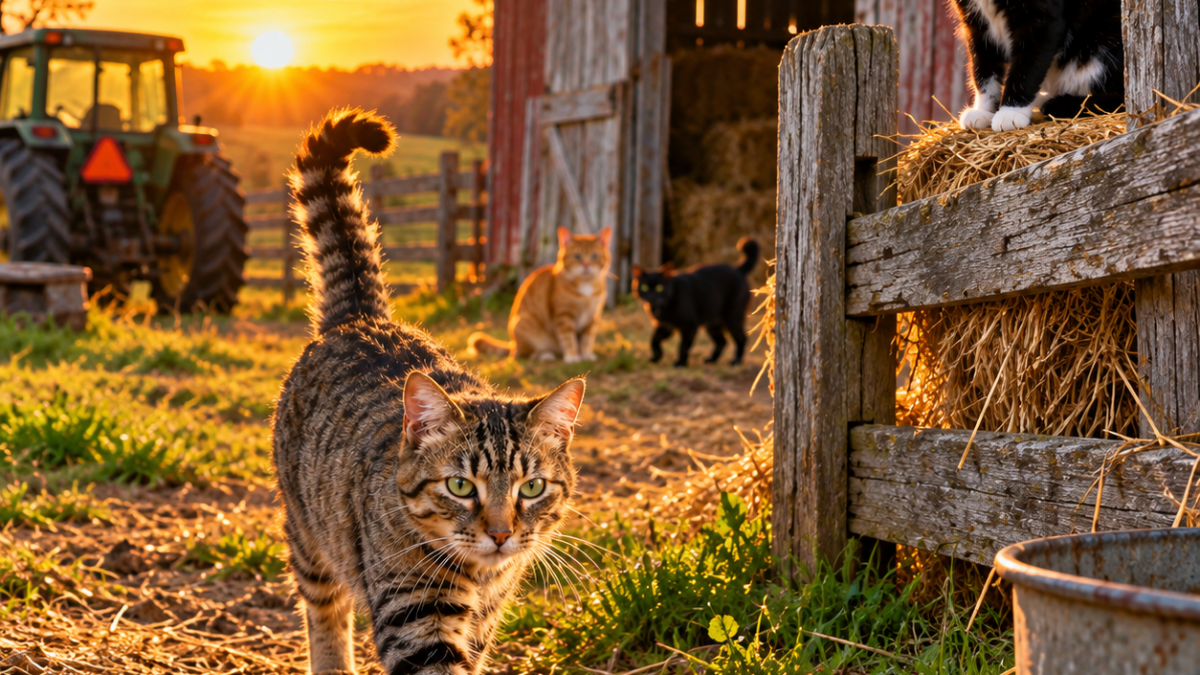
PART 2
The next morning, I arrived before sunrise.
The shelter was quieter at that hour.
No phones ringing.
No visitors walking between kennels.
No metal food bowls clattering against countertops.
Just the hum of the ventilation system and the occasional soft movement from an animal waking as I passed.
I went directly to the cat room.
Coal was already awake.
He sat at the back of his enclosure with his paws tucked beneath him, yellow eyes following me.
“Morning,” I whispered.
He blinked once.
For Coal, that was practically a conversation.
I pulled a chair over and opened my laptop.
If I was going to suggest a working-cat placement program, I needed more than emotion.
I needed structure.
I began writing.
The cats would not simply be dropped at farms and expected to survive.
Every property would be inspected.
Each caretaker would agree to provide fresh food and water every day regardless of whether the cats hunted.
There would be protected sleeping areas away from predators and dangerous machinery.
Veterinary care would remain mandatory.
Every cat would be spayed or neutered, vaccinated, and medically cleared before placement.
Most importantly, the cats would go through a gradual acclimation period.
Two to four weeks in a secure enclosure at the new property.
Long enough to learn the smells.
The sounds.
The feeding schedule.
The people.
The location of safety.
Only then would they begin exploring.
I kept writing until the sun rose.
By eight, I had six pages.
By nine, I had a headache.
By ten, Linda was standing beside my desk holding the proposal.
“You wrote this overnight?”
“Most of it.”
She flipped another page.
“You really believe people will volunteer for this?”
“I think the right people will.”
She looked toward the cat room.
“And if they don’t?”
That was the question I had tried not to ask myself.
“Then at least we’ll know we tried the right door before deciding there wasn’t one.”
Linda studied me for another second.
Then she closed the folder.
“County meeting is Thursday.”
My stomach tightened.
“You’ll let me present it?”
“I’ll let you try.”
That was enough.
At least I thought it was.
I spent the next three days preparing.
I called farmers.
Horse owners.
A landscaping company.
A grain warehouse.
Two people laughed politely and said they already had enough cats.
One man asked whether we could guarantee every mouse on his property would disappear.
I told him absolutely not.
“These aren’t machines,” I said. “They’re cats.”
He hung up.
Another woman listened carefully before saying, “So you’re telling me I provide food even if they hunt?”
“Yes.”
“Vet care?”
“Yes.”
“Shelter in bad weather?”
“Yes.”
“And I shouldn’t expect them to become pets?”
“Correct.”
She paused.
“That actually sounds reasonable.”
Her name was Rebecca Hayes.
She owned a small horse farm about thirty minutes outside town.
Before hanging up, she told me something I wrote on a sticky note and kept beside my computer for years afterward.
“I don’t need a cat to sit in my lap,” she said. “I just need it to know this place is safe.”
I stared at that sentence after the call ended.
That was it.
That was the entire program.
Not forcing affection.
Creating safety.
Thursday arrived.
I carried twelve printed copies of the proposal into a county conference room that smelled like old coffee and furniture polish.
Linda sat beside me.
Across the long table were shelter administrators, county representatives, two volunteers, and three members of the advisory board.
One of them was a man named Richard Keller.
Keller had never been openly unkind to animals.
He simply believed shelters should operate like equations.
Intake.
Cost.
Adoption rate.
Average length of stay.
Numbers went in.
Numbers came out.
Anything difficult to measure made him uncomfortable.
Halfway through my presentation, he leaned back in his chair.
“So these cats cannot be adopted normally.”
“Not safely or successfully in many cases.”
“And your answer is to place them outside.”
“In managed environments.”
“They’re feral.”
“Some are. Others are simply poorly socialized or extremely fearful.”
He tapped my proposal.
“And taxpayers would support this?”
“The placement families would assume normal daily care. The shelter would cover initial veterinary preparation, which we’re already providing.”
He looked unconvinced.
“What happens when they run away?”
“That is why we require an acclimation period.”
“And if they still leave?”
“Then we evaluate the placement just as we would any adoption that wasn’t working.”
Keller glanced around the table.
I could feel the room shifting.
Not against me exactly.
But not with me either.
He finally said the words I had been afraid someone would say.
“Maybe we’re putting too much effort into animals that simply aren’t suitable for homes.”
My hands went cold.
Linda looked at me.
She knew me well enough to recognize the expression on my face.
I wanted to argue.
Instead, I forced myself to slow down.
“They are suitable for homes,” I said. “We’re disagreeing about what a home has to look like.”
Keller opened his mouth.
I continued.
“A home does not have to include a couch.”
Silence.
“It can be a stable with a heated tack room.”
I placed another photograph on the table.
“It can be a barn with an insulated shelter.”
Another photograph.
“A warehouse where employees feed them every morning.”
Another.
“What these cats need is not less care. They need a different form of care.”
Keller shook his head.
“You’re asking us to redefine adoption.”
“Yes.”
That answer surprised even me.
But once I said it, I knew I meant it.
He leaned forward.
“And if your experiment fails?”
“Then I’ll tell you it failed.”
“And if it succeeds?”
I looked directly at him.
“Then we stop calling animals hopeless simply because they don’t fit our favorite version of happiness.”
Nobody spoke for several seconds.
The board voted.
Three in favor.
Two against.
One abstention.
The program was approved as a ninety-day pilot.
I should have felt victorious.
Instead, I felt terrified.
Because now I had to prove it could work.
Rebecca became our first approved caretaker.
Her farm sat at the end of a narrow gravel road surrounded by pastureland.
The main barn was older but solid, painted red years ago and weathered enough that the boards had faded toward brown.
Inside were six horse stalls, a feed room, a tack room, and a wide central aisle.
Mice had become a persistent problem around the grain storage area.
But when I inspected the property, I barely cared about that.
I cared about what Rebecca had prepared.
She had converted one empty stall into a secure acclimation space.
Mesh covered the upper openings.
There was a covered sleeping box in one corner.
A litter area.
Food.
Fresh water.
Several hiding spaces.
A low wooden platform where the cats could climb without escaping.
“You did all this yesterday?” I asked.
Rebecca shrugged.
“You said they needed somewhere they could hide without disappearing.”
I smiled.
“Exactly.”
Her husband, Sam, walked into the aisle carrying a toolbox.
He glanced at the enclosure.
“You’re sure they won’t want us petting them?”
“Some may eventually,” I said. “But don’t make that the goal.”
“What is the goal?”
“That they feel safe enough to stay.”
He nodded slowly.
“I can do that.”
We chose Maple and Coal for the first placement.
Dusty stayed behind because he had developed a mild respiratory infection and needed treatment.
On placement morning, Maple entered her carrier with very little protest.
Coal required patience.
A lot of patience.
When we finally loaded both carriers into the van, I sat in the driver’s seat without starting the engine.
Linda opened the passenger door.
“You okay?”
“I think so.”
“They’re going somewhere better.”
“I know.”
“But?”
I looked behind me at the carriers.
“What if Keller was right?”
Linda closed the door and sat beside me.
“He wasn’t.”
“You don’t know that.”
“No. But I know you haven’t promised these cats a perfect life.”
She fastened her seat belt.
“You’ve promised them a chance.”
Then she pointed through the windshield.
“So drive.”
We reached the farm just after nine.
Rebecca had been instructed to keep the barn calm.
No crowd.
No children gathering around.
No attempt to touch the cats.
We placed Maple’s carrier inside the acclimation stall and opened the door.
She did not move.
That was fine.
We placed Coal’s carrier beside hers.
He immediately backed deeper inside.
Also fine.
I sat on an overturned bucket several feet away.
“Now what?” Sam whispered.
“Now we leave them alone.”
He laughed quietly.
“All that work for you to tell me to ignore them?”
“Respectfully ignore them.”
“That sounds complicated.”
“It is for people.”
Over the next two weeks, Rebecca sent me daily updates.
Day one:
Both cats hiding. Food eaten overnight.
Day two:
Coal came out after dark. Maple still hiding.
Day three:
Found paw prints in litter. Water bowl moved.
Day four:
Coal watched Sam from the sleeping box. No panic.
Day five:
Maple ate while Rebecca was in barn aisle.
Day six:
Coal discovered platform.
Day seven:
Both cats eating normally.
Each message felt enormous.
At the shelter, some staff members began gathering around my phone when Rebecca sent photos.
The pictures were rarely dramatic.
A pair of yellow eyes behind straw.
A black tail disappearing into a wooden box.
Maple sitting near a water dish.
Yet those ordinary images represented something we had not seen at the shelter.
Choice.
The cats could hide because hiding was available.
They could observe people from a distance instead of being forced into interaction.
Their environment was not asking them to perform friendliness.
On day fourteen, Rebecca called.
“I think Maple likes me.”
I almost laughed.
“What happened?”
“She sat outside the box while I filled the food bowl.”
“How far away?”
“Maybe six feet.”
“That’s great.”
“She didn’t run.”
“Even better.”
“I didn’t look at her.”
“Perfect.”
Rebecca hesitated.
“You make friendship sound very strange.”
“With cats like Maple, friendship sometimes starts when you prove you’re willing to leave them alone.”
Another week passed.
Then came release day.
We planned it carefully.
The barn doors remained closed at first.
Rebecca opened the acclimation enclosure while I stood several yards away.
For nearly twenty minutes, nothing happened.
Coal stayed inside.
Maple stayed inside.
Sam whispered, “Do they know they’re free?”
“They know the door changed.”
Another ten minutes.
Maple appeared first.
One paw.
Then her head.
Then her entire body.
She stepped into the barn aisle.
Every muscle looked ready to send her racing back.
Rebecca froze beside the feed room.
Maple looked left.
Right.
Up toward the rafters.
She sniffed the air.
Then she walked forward.
No cheering.
No clapping.
No sudden movement.
We had agreed on that.
Still, I had to press my lips together to stop myself from making a sound.
Maple reached a stack of hay bales and disappeared behind it.
Coal came out nearly fifteen minutes later.
Unlike Maple, he did not hesitate once he committed.
He stepped from the enclosure, crossed the aisle, jumped onto a low beam, and vanished into the shadows above the stalls.
Sam stared upward.
“Well,” he murmured, “I guess he found the penthouse.”
I laughed.
That night, I barely slept.
At 5:42 the next morning, my phone lit up.
Rebecca.
For one terrible second, I imagined the worst.
I answered immediately.
“What’s wrong?”
“Nothing.”
Her voice sounded strange.
Excited.
“You need to see what your cats did.”
She sent me a photo.
Coal was sitting beside the feed room door.
Maple was several feet behind him.
Both were watching Rebecca prepare breakfast.
They had stayed.
I stared at that picture for a long time.
The shelter had spent weeks trying to convince those cats that a cage was safe.
Rebecca’s barn had given them enough space to decide for themselves.
Three days later, she called again.
“Coal followed Sam this morning.”
“Followed him?”
“From the hay storage area to the horse stalls.”
“How close?”
“Ten feet.”
“That doesn’t mean he wants contact.”
“I know.”
She sounded almost offended.
“I’ve been trained.”
I smiled.
“Good.”
Then her voice softened.
“He just… walked behind him.”
There was wonder in the way she said it.
Not because Coal had suddenly become affectionate.
Because he had chosen proximity.
For a cat who had spent his shelter stay desperate to escape human presence, ten feet was not distance.
It was trust.
The first month of the pilot program went better than I had hoped.
We received nine applications.
Four were unsuitable.
One property had loose dogs with unrestricted barn access.
Another applicant wanted cats only for rodent control and refused to guarantee daily feeding.
A third expected us to deliver cats and simply release them immediately.
We declined all three.
The program existed to improve lives, not relocate problems.
But five applications were promising.
A cabinet-making workshop outside town.
A greenhouse.
Two horse farms.
And an old apple orchard with several storage buildings.
That orchard became Dusty’s new home.
By then, his respiratory infection had cleared.
His caretaker was a seventy-year-old widower named Frank Mercer.
Frank came to the shelter wearing faded work boots and a denim jacket that looked older than some of our volunteers.
When I explained that Dusty might never allow petting, Frank shrugged.
“Neither did my father.”
I stared at him.
Then he grinned.
“Still loved the old man.”
I laughed.
Dusty’s placement went smoothly.
Frank visited the secure acclimation enclosure every evening at exactly five thirty.
He brought food.
Changed the water.
Cleaned the litter area.
Then sat on an upside-down crate and listened to a small radio.
He never reached for Dusty.
Never cornered him.
Never tried to prove anything.
After eleven days, Dusty began eating while Frank was sitting there.
After seventeen days, he slept outside his hiding box.
After twenty-three days, something happened that Frank insisted was “probably an accident.”
Dusty walked past him close enough for his tail to brush Frank’s work boot.
Frank called me immediately.
“You think that counts?”
“As what?”
“I don’t know.”
He sounded embarrassed.
“As him liking me.”
“Did he run afterward?”
“No.”
“Then I’d count it.”
“Huh.”
Silence.
Then Frank said, “Don’t tell anybody I called about this.”
“I absolutely won’t.”
The next morning, he sent me four photos.
I did not remind him of our conversation.
For a while, the success felt almost too easy.
That should have warned me.
Trouble arrived during the second county review.
Keller had requested updated numbers.
I brought them.
Eight cats placed.
Seven still at their properties.
One transferred to a different barn after a resident dog created too much stress.
No cats missing.
No serious medical problems.
Every caretaker compliant with feeding requirements.
Average shelter stay for those cats had decreased substantially.
I thought the data would end the argument.
Instead, Keller studied the pages and said, “Eight animals isn’t enough to call this successful.”
“It’s a pilot.”
“Exactly.”
“We’re evaluating it.”
He looked at another sheet.
“What about public complaints?”
“We’ve had two.”
Linda answered before I could.
“One came from a neighbor who believed barn cats were being released without care. We inspected. The cats had shelter, food, water, and veterinary records.”
“And the second?”
“Someone objected to the idea of outdoor placement in general.”
Keller nodded.
“So there are concerns.”
“There are always concerns,” I said.
He looked at me.
“You seem personally invested in this program.”
“I am.”
“That can make objectivity difficult.”
The sentence irritated me more than it should have.
I kept my voice level.
“Which number would you like to dispute?”
His jaw tightened slightly.
“I didn’t say the numbers were wrong.”
“Then let’s discuss the numbers.”
The room became very quiet.
Keller flipped through the report.
“What about liability?”
“We have placement agreements.”
“Wildlife?”
“We screen locations and discuss responsible management.”
“Road access?”
“Evaluated.”
“Predators?”
“Evaluated.”
“Extreme weather?”
“Shelter requirements are mandatory.”
I realized something as he continued asking questions.
He had expected enthusiasm.
He had expected emotion.
What he had not expected was preparation.
For every concern, we had a procedure.
For every procedure, we had documentation.
For every placement, we had records.
Finally, Keller closed the report.
“I still think traditional adoption should be the goal.”
“So do I,” I said.
He looked surprised.
“When it’s appropriate.”
I pointed to the report.
“These cats are not replacing traditional adoptions. They are cats traditional adoption wasn’t serving.”
He said nothing.
I continued.
“We can keep measuring success by how many cats learn to tolerate our idea of a home.”
I paused.
“Or we can build more than one kind of home.”
The pilot was extended another six months.
Keller voted against it.
That bothered me.
Not because I needed him to agree with me.
Because his language had begun spreading.
A local social media page posted a distorted version of the program.
The shelter is dumping unwanted cats on farms.
That was the headline.
It was false.
But it traveled quickly.
Within hours, strangers were commenting.
Some accused us of abandoning animals.
Others claimed we were using cats as free pest control.
A few demanded the program be closed.
I read the comments until Linda took my phone out of my hand.
“Stop.”
“They’re lying.”
“Yes.”
“They’re saying we don’t feed them.”
“We have contracts saying otherwise.”
“They’re saying we just open cages and leave.”
“We don’t.”
“People believe it.”
“Some people believe whatever makes them angry fastest.”
I looked toward the office window.
“What do we do?”
“The same thing we’ve been doing.”
“That isn’t enough.”
“It is if we’re doing it right.”
She placed my phone on the desk.
“Show them.”
So we did.
Not with arguments.
Not with angry replies.
With evidence.
We invited a local reporter to observe the program.
We showed her an acclimation enclosure.
We showed daily care logs.
Veterinary records.
Placement requirements.
We brought her to Rebecca’s farm.
Before she arrived, I warned her.
“You may not see either cat.”
“That is fine.”
“You definitely won’t be able to touch them.”
“Also fine.”
“The entire point is that we don’t force contact.”
“I understand.”
When we entered the barn, Maple was nowhere visible.
Coal was sitting on a beam.
The reporter looked up.
“That’s him?”
“Yes.”
“He looks comfortable.”
“He is.”
Rebecca carried two food bowls into the aisle.
Coal watched her.
She placed his bowl near the feed room and stepped away.
He jumped down.
The reporter raised her camera slowly.
Coal paused.
Then walked to the bowl.
He ate.
Ten minutes later, Maple appeared from behind the hay.
She kept her distance but did not flee.
Rebecca smiled.
“She used to vanish if I entered the building.”
The reporter watched Maple carefully.
“Does she ever let you pet her?”
“No.”
“Does that bother you?”
“Why would it?”
The reporter lowered her notebook.
Rebecca continued.
“She doesn’t owe me affection.”
I will never forget that sentence.
“She lives here. She eats here. She’s warm in winter. She gets veterinary care. And when I’m cleaning stalls, sometimes she sits where she can watch me.”
Rebecca smiled.
“That is enough.”
The article was published two days later.
The headline was far different from the social media post.
For Some Shelter Cats, Home Has Hay Instead of a Sofa.
Applications doubled.
Then tripled.
The angry comments did not disappear.
But now they were surrounded by people asking real questions.
How does acclimation work?
Can I apply if I have a workshop?
What if my barn is not heated?
Do cats still need daily food if they hunt?
Can older cats participate?
The conversation had changed.
And nothing changed it more than the cats themselves.
Three months after Coal and Maple arrived at Rebecca’s farm, I visited for a routine check.
A thunderstorm had passed the previous night.
The pasture was muddy.
The barn roof still dripped in a few places.
I walked inside expecting Coal to disappear.
He did not.
He sat on a wooden rail near the tack room.
Maple was on the floor beneath him.
I stopped.
Rebecca came around the corner.
“Don’t move.”
“I wasn’t planning to.”
She laughed softly.
“Watch.”
She walked toward the feed room.
Coal jumped down.
Maple stood.
Both followed her.
Not close.
Not like house cats weaving between somebody’s legs.
But they followed.
Rebecca filled two bowls.
Coal sat about eight feet away.
Maple remained twelve or fifteen feet back.
Rebecca put the food down and stepped aside.
Coal approached first.
Then Maple.
I felt my throat tighten.
In the shelter, Coal had flattened himself against the rear wall whenever I changed his water.
Maple had once refused food for hours because someone had moved a chair too close to her enclosure.
Now both were eating in a bright barn while horses shifted quietly in nearby stalls.
Nothing miraculous had happened.
That was the beautiful part.
They had not been transformed.
They had been understood.
Rebecca leaned against the wall.
“You look like you’re going to cry.”
“I’m not.”
“You are.”
“Dust.”
“Sure.”
I wiped my eye.
She pretended not to notice.
Then she said, “You know they caught a mouse in the grain room last week.”
I groaned.
“Please don’t tell Keller that.”
“Why?”
“He’ll put it in a spreadsheet.”
Rebecca laughed so loudly that Maple looked up.
For the first time, I laughed too.
The program continued growing.
We eventually created three placement categories.
Barn placements.
Commercial working-cat placements.
And controlled rural properties such as orchards, greenhouses, and stables.
Every application went through screening.
We learned from mistakes.
One barn had too much nighttime machinery noise, so we relocated the cat before release.
At another property, the original feeding station was too exposed, so we moved it.
A warehouse employee began leaving extra treats for two cats until both gained too much weight.
We corrected that too.
Good programs were not built by pretending problems never happened.
They were built by responding when they did.
And the cats kept teaching us.
A tortoiseshell named Cricket refused to leave her acclimation enclosure for three days after the door opened.
We thought something was wrong.
There wasn’t.
On the fourth morning, she walked out, explored the barn for twenty minutes, then returned to sleep.
A white-and-gray tom named Henry vanished into a hay loft immediately after release.
His caretaker panicked.
That evening, Henry appeared at dinner exactly when the feed container opened.
He had apparently decided the loft was acceptable housing.
Two sisters named Juniper and Fern stayed almost completely hidden for six weeks.
Then their caretaker sent us a photograph of both sleeping in the sun beside a greenhouse wall.
No humans near them.
No dramatic rescue.
No cuddling.
Just two cats warm, fed, safe, and peaceful.
That picture became one of my favorites.
But our biggest challenge was still ahead.
Six months after the pilot began, the county scheduled a final vote.
The program could become permanent.
Or disappear.
By then, forty-one cats had entered the placement system.
Thirty-six remained successfully placed.
Three had been moved to better-matched properties.
Two had returned to shelter care because medical changes meant they needed closer monitoring.
Those numbers mattered.
But Keller had prepared his own presentation.
When I entered the conference room, he had a thick folder on the table.
I sat beside Linda.
“You knew about this?” I whispered.
“He requested speaking time.”
“For what?”
“He wouldn’t say.”
The meeting began.
I presented first.
Program statistics.
Costs.
Medical outcomes.
Placement retention.
Application numbers.
Shelter capacity.
Then Keller stood.
He began calmly.
He acknowledged that the program had performed better than he expected.
That surprised me.
Then came the turn.
He argued that the initial success had created a different risk.
Expansion.
More applications meant more staff time.
More inspections.
More follow-up visits.
More administration.
He proposed limiting the program to ten placements per year.
Ten.
We had already placed more than three times that number.
My stomach dropped.
His proposal would not technically end the program.
It would make it almost meaningless.
Keller finished and sat down.
The chair asked whether anyone wanted to respond.
I raised my hand.
When I stood, I did not open my folder.
I had numbers.
I had charts.
But suddenly none of them felt like the right answer.
“Keller is correct about one thing,” I said.
He looked up.
“The program requires work.”
I turned toward the board.
“We inspect properties because these animals deserve safe placements.”
“We train caretakers because dumping a cat somewhere and hoping for the best is not a program.”
“We conduct follow-ups because our responsibility does not disappear when an animal leaves the building.”
I paused.
“All of that takes time.”
Keller folded his arms.
I continued.
“But the question isn’t whether the program costs staff hours.”
“The question is what those hours accomplish.”
I opened my folder and removed three photographs.
Maple.
Coal.
Dusty.
I placed them on the table.
“These were among the first cats.”
I pointed to Maple’s shelter intake photo.
“She spent most of her time hiding.”
Then Coal.
“He became severely stressed in confinement.”
Then Dusty.
“He tolerated people, but he did not want a traditional household.”
I replaced the photographs with newer ones.
Maple sitting near a barn door.
Coal asleep on a beam.
Dusty stretched beneath an apple tree while Frank sat several feet away.
“These are the same cats.”
Nobody spoke.
“They were not broken.”
I looked toward Keller.
“They were misplaced.”
His expression remained neutral.
I faced the board again.
“If we limit this program because doing it responsibly requires effort, then we are not protecting resources.”
“We are protecting convenience.”
That drew a small reaction from the room.
The chair leaned forward.
“Do you have a staffing proposal?”
“Yes.”
This time Linda smiled.
We had prepared one.
Volunteer property inspectors.
Standardized orientation materials.
Digital care logs.
Partnerships with local veterinary clinics.
A waiting list organized by placement type.
The program could expand without overwhelming the shelter.
I walked them through every point.
When I finished, the chair turned to Keller.
“Response?”
Keller looked at the photographs.
For a few seconds, I thought he might argue again.
Instead, he asked something unexpected.
“Which one is the gray cat?”
“Dusty.”
“He’s the older one?”
“Yes.”
“And that’s his caretaker?”
“Frank Mercer.”
Keller stared at the photo.
Dusty was lying in the grass.
Frank was sitting nearby repairing a wooden crate.
There was no touching.
No staged affection.
They simply occupied the same space.
“Yes,” I said.
Keller leaned back.
The vote began.
One by one, hands went up.
Permanent program.
Permanent program.
Permanent program.
Then Keller’s turn.
He hesitated.
I held my breath.
His hand rose.
Permanent program.
The vote was unanimous.
For a moment, I could not process what I had seen.
Then the chair said, “Motion carries.”
Linda gripped my arm under the table.
I looked at Keller.
He avoided my eyes.
That should have been enough.
But what happened afterward meant even more.
As people began leaving, Keller remained seated.
I gathered my papers.
He finally said, “You were right.”
I stopped.
Those three words sounded almost unnatural coming from him.
“About what?”
He looked at Dusty’s photograph again.
“I thought you were trying to turn feral cats into pets without calling them pets.”
I waited.
“I didn’t understand that the point was the opposite.”
He slid the photograph toward me.
“You were letting them remain what they already were.”
I picked it up.
“That’s the idea.”
He nodded.
Then, to my surprise, he said, “My brother has a machine shop.”
I stared at him.
“Okay.”
“He’s been complaining about rodents in a storage building.”
I could not stop the smile.
Keller immediately pointed a finger at me.
“Don’t make that face.”
“What face?”
“That face.”
“I don’t know what you’re talking about.”
“He has a heated utility room.”
“Interesting.”
“And no dogs.”
“Very interesting.”
“He would have to apply.”
“Yes.”
“And you would inspect it.”
“Absolutely.”
Keller sighed.
“Send me the paperwork.”
It was the most satisfying revenge I could have imagined.
Not humiliation.
Not punishment.
Not watching someone lose.
Watching the man who had once questioned whether these cats deserved our effort become the person asking how to give one a home.
His brother eventually adopted two working cats.
A bonded pair named Pepper and Ash.
Keller attended their release.
He stood in the machine shop doorway with his hands in his coat pockets while Pepper cautiously emerged from the acclimation enclosure.
Ash remained hidden.
Keller whispered, “Shouldn’t we do something?”
“No.”
“We just stand here?”
“Yes.”
He looked at me.
“I remember somebody saying humans have trouble with that.”
I smiled.
“Some improve with training.”
He almost laughed.
Pepper walked behind a stack of wooden pallets and disappeared.
Five minutes later, Ash stepped out.
Keller did not move.
Neither did I.
That was the moment I realized the program had changed more than placement numbers.
It had changed our language.
Before, staff sometimes said:
“This cat doesn’t like people.”
Now we said:
“This cat prefers distance.”
Before:
“This cat can’t be adopted.”
Now:
“What environment would work?”
Before:
“Nobody will want this one.”
Now:
“Let’s find the right caretaker.”
Those differences might sound small.
They were not.
Words became expectations.
Expectations became decisions.
And decisions determined whether animals like Maple, Coal, and Dusty were treated as problems or individuals.
A year after the program became permanent, I visited Frank’s orchard.
It was late October.
The apple harvest was almost finished.
Leaves covered the ground.
A cold wind moved between the rows of trees.
Frank met me near the storage barn.
“Dusty’s around somewhere.”
“Still doing well?”
“Better than me.”
We walked toward the barn.
I checked the insulated sleeping area.
Clean.
Dry.
Fresh bedding.
The heated water bowl was working.
Food station looked good.
Veterinary records were current.
Everything was exactly as it should be.
Then Dusty appeared.
He came from beneath an old piece of farm equipment.
He looked healthier than he had at the shelter.
His coat was thicker.
His body fuller.
His movements relaxed.
He stopped when he saw me.
I expected him to leave.
Instead, he sat.
Frank noticed.
“Well, I’ll be.”
“What?”
“He usually disappears when strangers come.”
“I don’t think I count as a stranger.”
Frank looked at me.
“You think he remembers you?”
“I don’t know.”
Dusty blinked.
Then walked toward Frank.
He stopped beside the older man’s boot.
Frank froze.
Dusty rubbed his cheek once against the denim covering Frank’s ankle.
Just once.
Then he walked away.
Frank did not speak.
I did not speak.
Dusty disappeared through the barn doorway.
Finally, Frank cleared his throat.
“That was…”
“I saw it.”
“He’s never…”
“I know.”
Frank stared after him.
The old man’s eyes had become wet.
He rubbed his face with the back of his glove.
“Wind,” he muttered.
“Definitely.”
“Cold today.”
“Very.”
We both looked away politely.
A few minutes later, Frank said something I still think about.
“Everybody assumes affection is the reward.”
“What do you mean?”
“They think if you’re patient enough, eventually the cat sits on your lap.”
He looked toward the barn.
“Maybe that’s not the reward.”
“What is?”
Frank smiled.
“Maybe the reward is that he doesn’t have to be afraid anymore.”
That sentence stayed with me.
Because he was right.
We love transformation stories.
We love the frightened animal who becomes affectionate.
The abandoned dog who learns to play.
The shy cat who becomes someone’s constant companion.
Those stories matter.
But they can accidentally teach us that healing has only one acceptable ending.
It does not.
Maple never became a lap cat.
Coal never wanted to be carried.
Dusty never moved inside Frank’s house.
And none of those facts made their lives incomplete.
Maple developed a routine.
Every morning, she waited near the barn doors while Rebecca fed the horses.
She remained several feet away.
If Rebecca spoke softly, Maple sometimes blinked.
That was their relationship.
Coal became bolder.
He followed Sam around the barn almost daily.
One winter afternoon, Sam sent me a photograph I initially thought had been staged.
Coal was asleep on a folded horse blanket.
Sam was sitting on a bench six feet away drinking coffee.
Neither seemed interested in the other.
The caption said:
“Guys’ afternoon.”
I printed it and taped it beside my desk.
The barn-cat program continued expanding.
Other shelters called us.
They wanted forms.
Placement agreements.
Inspection checklists.
Acclimation instructions.
We shared everything we could.
I always included the same warning.
Do not build the program around rodent control.
That benefit might matter to caretakers.
But it could never become the reason the cats’ welfare came second.
Working cats still needed food every day.
Fresh water.
Medical care.
Shelter.
Protection from dangerous weather.
Monitoring.
A cat did not earn those things by catching anything.
They deserved them because they were living animals placed in our care.
That distinction mattered.
It mattered especially when another controversy appeared almost two years after our first placement.
A property owner from outside the county contacted us.
He owned several large storage buildings.
He wanted twelve cats.
Twelve.
That number immediately concerned me.
During the application interview, I asked why.
“Mice,” he said.
“How many cats currently live on the property?”
“None.”
“Have you used professional pest exclusion?”
“What?”
“Sealing food sources, building gaps, entry points.”
“No. That’s why I want cats.”
My concern grew.
“Cats can discourage rodents, but they aren’t a replacement for proper building management.”
“Listen, I don’t care about all that.”
There it was.
“I need animals that work.”
I kept my voice calm.
“They would still require daily food.”
“Why would I feed them if I want them hunting?”
“Because withholding food is not part of our program.”
He laughed.
Actually laughed.
“Then what’s the point?”
“The point is placing cats in safe environments where their natural behavior is compatible with the property.”
“I thought these were cats nobody else wanted.”
I felt my shoulders tighten.
“They are cats unsuited to traditional indoor homes.”
“Same thing.”
“No.”
He sighed.
“Can I get the twelve cats or not?”
“No.”
The answer surprised him.
“What?”
“Your application will not be approved.”
“You haven’t even inspected the property.”
“You’ve already told me you don’t intend to meet the feeding requirement.”
“They’re barn cats.”
“They’re still cats.”
His voice hardened.
“I’ll call someone above you.”
“You’re welcome to contact our administration.”
“Maybe I’ll call the county.”
“You can do that too.”
“You people are unbelievable.”
“I’m sorry you feel that way.”
He hung up.
Twenty minutes later, Keller called me.
Of course he did.
I answered expecting trouble.
“Did you reject an application for twelve cats?” he asked.
“Yes.”
“Why?”
I explained.
Silence.
Then Keller said, “Good.”
I actually checked the screen to make sure I had called the right person.
“Good?”
“That’s not our program.”
Our program.
I leaned back in my chair.
Two years earlier, he had questioned whether the program should exist.
Now he was defending its standards.
“He says he’s contacting the county,” I said.
“He already did.”
“And?”
“I told them exactly what you just told me.”
I smiled.
“Keller?”
“Yes?”
“I need you to understand how much I’m enjoying this.”
“Don’t.”
“I really am.”
“Goodbye.”
He disconnected.
I laughed for nearly a full minute.
That applicant posted angry comments online.
He accused us of refusing to place “unwanted” animals.
This time, I did not lose sleep over it.
We published our program requirements.
Daily food.
Fresh water.
Safe shelter.
Veterinary care.
Gradual acclimation.
Responsible supervision.
The reaction was completely different than it had been two years earlier.
Former skeptics defended us.
Caretakers shared photographs.
People explained why feeding cats was essential.
Frank even created a social media account solely because he was annoyed.
His first post was a photograph of Dusty sitting beside a feed bowl.
The caption read:
“He gets dinner whether he catches anything or not. That’s the deal.”
It was shared hundreds of times.
When I called Frank, he sounded confused.
“Why are strangers sending me little heart pictures?”
“They like Dusty.”
“Well, Dusty doesn’t know them.”
“That hasn’t stopped anyone.”
Frank paused.
“Internet is strange.”
“Yes.”
“Can I turn it off?”
“Yes, Frank.”
“Good.”
Three years after Maple and Coal left the shelter, Rebecca invited our staff to her farm for a small anniversary gathering.
Nothing formal.
Coffee.
Cookies.
A few volunteers.
Some of the people who had helped build the program.
Keller came.
So did Frank.
Dusty stayed at the orchard because Frank said, “He wasn’t consulted about attending.”
That sounded fair.
By then, the program had placed more than two hundred cats.
Not every story was perfect.
A handful of cats had disappeared despite proper acclimation.
Some placements failed.
Some cats needed medical transitions to indoor environments as they aged.
One caretaker moved unexpectedly and we had to relocate three animals.
But most stayed.
Most adapted.
Most built quiet routines around humans who understood them.
That mattered.
During the gathering, I stood beside the original acclimation stall.
Rebecca had kept it.
The mesh had been repaired twice.
The sleeping box had been replaced.
But it was still used whenever new working cats arrived.
“You remember that first morning?” she asked.
“When they wouldn’t come out?”
“I thought we’d done something wrong.”
“So did I.”
She smiled.
“Coal didn’t.”
We looked toward the far side of the barn.
Coal was older now.
His black coat had a few white hairs around the face.
He sat on a shelf above the feed room.
Maple rested near a patch of sunlight.
“They look like they own the place,” I said.
“They do.”
Sam walked by carrying a bucket.
Coal jumped down and followed him.
Three years.
That cat had once thrown himself toward the back of a shelter enclosure just to create another foot of distance from us.
Now he followed a man carrying a bucket because somewhere along the way, Sam had become part of the landscape of safety.
Not an owner in the way people usually imagined.
Not a person Coal needed to obey.
Simply someone predictable.
Someone kind.
Someone who brought food and never demanded payment in affection.
Keller joined us.
He watched Coal disappear behind Sam.
“I was wrong about him,” he said.
“You were wrong about the entire program.”
“I knew inviting you to this conversation was a mistake.”
Rebecca laughed.
Keller shook his head.
Then his expression grew serious.
“I really was wrong.”
I looked at him.
He continued.
“I thought success meant making animals fit into the system we already had.”
He nodded toward Maple.
“You changed the system instead.”
“No,” I said.
“They did.”
He frowned.
“The cats?”
“The cats told us the system wasn’t working.”
I pointed toward Maple.
“We finally listened.”
That evening, after everyone left, I stayed behind for a few minutes.
The sun was setting beyond the pasture.
The barn had become quiet.
Rebecca and Sam were inside their house.
The horses shifted occasionally in their stalls.
Coal had disappeared into the loft.
Maple sat near the open barn door.
I stood twenty feet from her.
She watched the pasture.
I watched her.
Neither of us moved.
I remembered the first week she came to the shelter.
Her body pressed against the rear of the enclosure.
Her eyes wide whenever somebody approached.
People had walked past her and said things they probably did not mean cruelly.
“She doesn’t seem friendly.”
“She’ll be difficult.”
“Who would adopt her?”
Those sentences had nearly defined her future.
Now she sat in the evening light with acres in front of her and a warm barn behind her.
She did not need to prove anything.
She did not need to become friendlier.
She did not need to become somebody else’s idea of a successful rescue.
She was simply Maple.
Alive.
Safe.
Fed.
Known.
And free to choose her distance.
When I finally turned to leave, I heard movement behind me.
Maple had stood.
For one ridiculous second, I wondered whether she might approach.
She did not.
She walked toward the feed room.
I laughed softly.
“Fair enough.”
She stopped.
Looked back at me once.
Then continued.
I drove home thinking about all the animals we label too quickly.
Difficult.
Unfriendly.
Unadoptable.
Hopeless.
Words can become doors.
Some open.
Some close.
The barn-cat program taught me to be careful which kind I was building.
Years later, people still asked whether I considered Maple and Coal “rescued.”
The question always surprised me.
Of course they were.
But rescue was not the moment we removed them from danger.
It was not the day they entered the shelter.
It was not even the day they arrived at Rebecca’s farm.
Rescue became real when we stopped insisting that safety had to look the same for every animal.
For one cat, safety might be sleeping at the foot of someone’s bed.
For another, it might be watching that person from the opposite side of a barn.
For one, love might mean being held.
For another, love might mean never being grabbed again.
A good life is not defined by how closely an animal behaves like a pet.
It is defined by whether that animal has security, health, protection, care, and the ability to live without constant fear.
That was what Maple taught me.
Coal taught me something else.
Trust should not be measured by touch.
Years after his placement, he still rarely allowed anyone closer than a few feet.
But he waited for Sam each morning.
He followed him through the barn.
He slept in places where people walked nearby.
During thunderstorms, he moved into the tack room because he had learned that the building would stay safe.
That was trust.
Dusty taught me perhaps the hardest lesson.
Love does not always arrive dramatically.
Sometimes it is a seventy-year-old man sitting on an upside-down crate every evening.
Sometimes it is a radio playing softly while a frightened animal eats.
Sometimes it is a tail brushing a work boot.
Sometimes it is a single moment of contact after months of patience.
And sometimes the most loving thing a person can say is:
You do not have to change for me.
Toward the end of Dusty’s life, Frank called me.
His voice sounded different.
Dusty had begun losing weight.
He was moving more slowly.
The veterinarian believed age was catching up with him.
I drove to the orchard the next afternoon.
Dusty was resting inside his insulated shelter.
Frank sat beside the entrance.
Not touching him.
Just sitting.
Exactly as he had during those first weeks.
“How old do you think he is?” Frank asked.
“Hard to know.”
“Twelve?”
“Maybe older.”
Frank nodded.
Dusty opened his eyes.
He looked at us.
Then closed them again.
“The vet says he’s comfortable,” Frank said.
“That’s what matters.”
“I could bring him inside.”
“You could.”
“He wouldn’t like it.”
“Probably not.”
Frank looked toward his house.
“I’ve got a room ready anyway.”
I smiled.
“Of course you do.”
“Just in case.”
For several weeks, Dusty continued his routine.
Then one morning he surprised everyone.
He walked from the barn toward Frank’s back porch.
Frank saw him through the kitchen window.
Dusty had never approached the house before.
Frank opened the door.
He did not call him.
Dusty stood outside for almost a minute.
Then stepped in.
He remained near the doorway.
Frank sat at the kitchen table.
Neither moved.
Eventually, Dusty walked toward the warm vent beneath the window and lay down.
That became his winter place.
Not because Frank forced him inside.
Because Dusty chose it.
He still went outdoors when he wanted.
Still slept in the barn some nights.
But when the temperature dropped, he came to the kitchen.
One evening, Frank called me nearly whispering.
“You’re not going to believe this.”
“What happened?”
“He’s on the couch.”
I sat up.
“Dusty?”
“No, the mayor.”
I laughed.
“Yes, Dusty.”
“Are you touching him?”
“Absolutely not.”
“Good.”
“He’s asleep.”
“Then leave him alone.”
“I know the rules.”
There was pride in his voice.
Not because he had finally “won” Dusty’s affection.
Because Dusty trusted the house enough to sleep.
Dusty lived another year.
When his health eventually declined, Frank worked with the veterinarian to keep him comfortable.
There was no dramatic transformation at the end.
No sudden desire to be held.
No movie-style scene where he became a different cat.
He remained Dusty.
Independent.
Quiet.
Selective.
And deeply connected to the person who had never demanded that connection.
Afterward, Frank brought Dusty’s old radio to the shelter.
I recognized it immediately.
“What am I supposed to do with this?”
“Use it.”
“For what?”
“Your next difficult cat.”
I looked at him.
He pushed the radio toward me.
“Worked once.”
My eyes stung.
“Frank…”
“Don’t.”
He pointed at me.
“Wind.”
“We’re indoors.”
“Draft.”
I smiled through tears.
“Fine.”
He cleared his throat.
Then he reached into his jacket.
“And I’ve got something else.”
It was an application.
I stared at it.
“Another cat?”
“Don’t get excited.”
“I’m trying.”
“I’ve got an empty barn.”
“You’ve always had an empty barn.”
“Exactly.”
I looked at the form.
Preferred cat:
Independent.
Older okay.
Shy okay.
No expectation of physical contact.
At the bottom, under additional comments, Frank had written one sentence.
**Send me the one everybody keeps walking past.**
I had to stop reading for a moment.
That sentence brought me all the way back to the beginning.
Back to Maple hiding behind a box.
Coal pressing himself against a shelter wall.
Dusty watching me as if I were temporary.
Back to a conference room where people had debated whether cats like them were worth the effort.
I thought about the most satisfying part of everything that had happened.
It was not proving Keller wrong.
It was not winning the vote.
It was not watching critics change their minds.
It was this.
A man who had given one overlooked cat a home now asking for another.
A program that began because three animals did not fit inside our definition of adoption had become a way to expand that definition for hundreds more.
We eventually placed another cat with Frank.
Her name was Birdie.
She was ten years old.
Small.
Black and white.
Suspicious of everybody.
During her first week, she stayed inside the farthest hiding box.
Frank sat beside the acclimation enclosure every evening.
The radio played quietly.
He did not reach for her.
He did not stare.
He waited.
On day eight, Birdie ate while he was sitting there.
Frank called me.
“She ate.”
“I knew she would.”
“No, you didn’t.”
“Fine. I hoped she would.”
“She looked at me.”
“That’s good.”
“I looked at the wall.”
“Even better.”
He sounded pleased.
“You trained me pretty well.”
“Some humans are adoptable.”
He laughed.
Then Birdie apparently moved, because Frank lowered his voice.
“I’ve got to go.”
“Why?”
“She came out again.”
The line went dead.
I sat at my desk holding the phone.
Behind me, Dusty’s old radio played softly for another nervous cat.
Outside my office were animals waiting for homes.
Some would leave in carriers lined with blankets and sleep on beds that night.
Others would leave weeks later and spend their first nights inside secure barn enclosures.
Neither future was lesser.
Neither kind of adoption was more meaningful.
The right home was simply the place where an animal’s needs were understood.
That became the principle behind everything we did.
We stopped asking:
“Why won’t this cat become more social?”
We started asking:
“What makes this cat feel secure?”
We stopped asking:
“Who would want an animal they cannot hold?”
We started asking:
“Who can provide a good life without demanding physical affection?”
We stopped measuring love only by closeness.
And once we did that, we discovered something extraordinary.
There were far more people willing to offer that kind of love than we had imagined.
Farmers.
Horse owners.
Warehouse managers.
Garden-center employees.
Orchard workers.
People with workshops.
People with quiet rural properties.
People who had no interest in forcing a frightened animal onto a couch but had every interest in keeping that animal fed, protected, healthy, and respected.
Some sent monthly pictures.
Others rarely contacted us because everything was going well.
Occasionally, years later, a caretaker would call with a breakthrough.
“He sat three feet from me today.”
“She waited beside the barn door.”
“He followed me to the tractor.”
“She sleeps on the shelf above my desk now.”
To an outsider, those updates might sound small.
To us, they were enormous.
Because none of those moments had been demanded.
They had been chosen.
One winter morning, many years after the program began, I returned to Rebecca’s farm.
Maple was old.
Coal was older too.
Both moved more slowly.
Rebecca had added heated sleeping shelters inside the barn.
Their veterinary visits were more frequent.
They no longer roamed as far as they once had.
But they were still there.
Rebecca stood beside me watching Maple cross the aisle.
“She never did let me pet her,” she said.
“Does that disappoint you?”
She looked genuinely confused.
“No.”
Then she smiled.
“Not even a little.”
Coal appeared behind Sam.
Still following him.
Still keeping several feet of space.
Sam turned.
“Morning, boss.”
Coal sat.
I laughed.
“He still supervises?”
“Every day.”
We walked toward the original acclimation stall.
Another pair of cats had arrived the previous evening.
They were hiding.
Of course they were.
Rebecca had already prepared everything.
Food.
Water.
Fresh bedding.
Safe hiding spaces.
She had written their feeding schedule on the wall.
“How many does this make?” I asked.
“Over the years?”
“Yes.”
She thought.
“Twenty-three, counting temporary placements.”
I stared at her.
“Twenty-three?”
“I told you this place was safe.”
I remembered her saying those words before Maple and Coal ever arrived.
She had been right.
Inside the enclosure, one of the new cats shifted behind a wooden box.
Rebecca immediately stepped farther away.
That movement told me everything.
She understood.
Years of experience had not made her impatient.
It had made her gentler.
She did not look at the hidden cat and see rejection.
She saw fear.
And fear needed time.
Before leaving, I stood near Maple.
Not close.
Never close.
She was lying in a patch of sunlight.
Her eyes were partly closed.
I thought about the version of her I had first met.
The cat people could barely see because she spent her days trying to disappear.
I had once worried that nobody would ever choose her.
I had been asking the wrong question.
Rebecca had not chosen Maple because Maple offered affection.
She had chosen responsibility.
Safety.
Respect.
Maple had been free to decide what came afterward.
And that, I realized, was the heart of every successful placement we had made.
A second chance should not come with a demand that the animal become somebody else.
Real rescue does not say:
I saved you, so now behave the way I want.
It says:
You are safe.
We will feed you.
We will protect you.
We will care for you when you are sick.
We will give you somewhere warm when the weather turns bad.
And we will allow trust to grow at the speed you can handle.
If affection comes, we will treasure it.
If it never comes, your life still matters.
As I walked toward my car, Sam called after me.
“Hey.”
I turned.
Coal had followed him to the barn entrance.
Sam pointed at the old cat.
“Tell Keller his rodent-control investment is retiring.”
I laughed.
“Full pension?”
“Absolutely.”
“Health benefits?”
“Premium plan.”
Rebecca folded her arms.
“He hasn’t caught anything in months.”
Coal sat in the doorway looking completely unconcerned.
Sam shrugged.
“Management position.”
That became another picture on my office wall.
Coal sitting proudly beside Sam with the caption:
**PROMOTED TO SUPERVISOR.**
Whenever somebody asked what happened to the cats from our original pilot, I showed them that photograph.
Then Maple.
Then Dusty.
Not because their stories were identical.
Because they proved the same thing.
There is more than one version of a happy ending.
For Maple, happiness was sunlight on a barn floor and enough distance to feel safe.
For Coal, it was following Sam from stall to stall without ever needing to be touched.
For Dusty, it became an orchard, a radio, an old man’s patient company, and eventually a warm place beside a kitchen vent that he chose for himself.
Those lives would never have happened if we had treated “not suited to a traditional home” as another way of saying “not worth saving.”
That was the mistake the program corrected.
And that was the lesson I carried with me long after the first county vote, long after the arguments online, and long after Keller finally admitted he had been wrong.
The cats did not need us to lower our standards for what a good life should be.
They needed us to broaden our imagination of what a good life could look like.
That difference changed everything.
Today, whenever I walk past a frightened cat pressed against the back of an enclosure, I do not immediately wonder whether someone will ever cuddle that animal.
I wonder what safety looks like to them.
Maybe it is a bedroom.
Maybe it is a workshop.
Maybe it is a quiet greenhouse.
Maybe it is an old barn where morning light comes through gaps in the boards and food appears at the same time every day.
Maybe their perfect person is not someone waiting to pick them up.
Maybe it is someone patient enough to sit ten feet away.
Someone who understands that trust cannot be forced.
Someone willing to love an animal without needing that animal to perform love in return.
That is what these cats taught me.
And when I think about the people who once said the program was pointless, I no longer feel angry.
The best answer was never an argument.
The answer was Maple sitting peacefully in the sun.
Coal following Sam down the barn aisle.
Dusty choosing Frank’s kitchen after years of choosing distance.
Birdie eating while an old radio played beside her enclosure.
Hundreds of cats who were once called difficult finding places where nobody asked them to be easy.
That was our victory.
Nobody needed to be humiliated.
Nobody needed to lose everything.
The people who doubted us simply had to watch the cats succeed.
And eventually, even some of the loudest skeptics became caretakers themselves.
I cannot imagine a more satisfying ending than that.
Because sometimes a second chance is not about teaching an animal how to fit into our world.
Sometimes it is about becoming wise enough to make room for theirs.
And sometimes the cat everyone thought had nowhere to go was never homeless because something was wrong with the cat.
We simply had not opened the right door yet.

