PART 2: THEY WERE ADOPTED TWICE—AND RETURNED TWICE—BECAUSE NO ONE UNDERSTOOD WHY THEY COULDN’T SURVIVE APART
PART 2
Sarah stared at me for so long that I started wondering whether tearing up the list had made me look less romantic and more unstable.
Then she whispered, “Both?”
“Yes.”
“You said one dog fifteen minutes ago.”
“I’ve changed my position.”
“You made a spreadsheet.”
“It was a list.”
“You numbered it.”
“That does not make it a spreadsheet.”
She was crying now, which made the argument difficult to maintain.
Rachel was watching us with the cautious expression of someone who had seen emotional shelter decisions before and knew enthusiasm was not the same thing as readiness.
“I need to say something before we talk paperwork,” she said.
I nodded.
“Please.”
“These are not beginner dogs in the easiest sense.”
My old instincts immediately returned.
“What does that mean?”
“They’re sensitive. They’re sighthounds. They’re physically athletic, emotionally reserved, and they don’t respond well to pressure. They may need time before they trust you.”
Sarah looked through the gate.
“We have time.”
Rachel continued.
“They also have a history now.”
“Because of the separations.”
“Yes.”
“How bad?”
“We don’t know yet.”
That was the sentence I disliked most.
I liked numbers.
Schedules.
Known problems.
Things that could be prepared for.
We don’t know yet meant no list could protect me.
Rachel seemed to understand exactly what was happening inside my head.
She leaned forward.
“If either dog becomes distressed when the other leaves the room, you can’t solve that by forcing independence overnight. They’ve already learned that separation can mean loss.”
I looked at Milos.
His paw was no longer over Lana’s.
But his shoulder remained against hers.
“What happens if one needs to go to the veterinarian?”
“We prepare them slowly. Sometimes both go initially. Sometimes you practice very short separations later. Their bond should make them feel safe, not imprison them. But you have to earn enough trust that they can eventually understand one dog walking through a door does not mean permanent disappearance.”
That made sense.
It also sounded like work.
Sarah touched my arm.
I knew what she was asking without words.
Still both?
I looked at the torn paper in my pocket.
Still both.
Rachel opened the kennel and invited us into a small meeting room rather than letting us enter their enclosure.
“We’ll bring them to you.”
“Why?”
“Because I want them to choose the distance.”
Another sentence I remembered later.
Choose the distance.
We sat on the floor.
Sarah looked completely natural doing it.
I felt ridiculous.
“I’m fifty-two years old,” I whispered.
“And?”
“My knees.”
“Love is sacrifice.”
“Love apparently requires cartilage.”
The door opened.
Milos entered first.
Lana stayed half a step behind him.
They stopped.
Looked at us.
Then at Rachel.
Then back toward the hallway.
Neither approached.
I wanted to call them.
Rachel gave me a subtle head shake.
So we waited.
Five minutes.
Milos sniffed the wall.
Lana sniffed his shoulder.
Sarah remained still.
I watched.
Eventually, Milos crossed part of the room.
Not toward us exactly.
Just closer.
Lana followed.
Sarah extended one hand and rested it palm-down on the floor.
Milos approached first.
Sniffed.
Retreated.
Lana watched.
Milos returned.
This time, he remained.
Sarah did not touch him.
That impressed me.
My wife had been talking about adopting a dog for months, and now one stood inches away, yet she let him decide.
Milos sniffed her fingers.
Then looked at Lana.
Lana moved forward.
She smelled the same hand.
Sarah whispered, “Hi.”
No one moved.
Then Milos sat.
Lana sat beside him.
Rachel smiled.
“That’s good.”
“Good enough to adopt?” I asked.
Sarah glared at me.
“What?”
Rachel laughed.
“Let’s discuss your home first.”
That discussion lasted almost an hour.
Fence?
Yes.
Six feet along most of the backyard.
Rachel asked us to reinforce one shorter section before placement.
Work schedules?
Sarah worked remotely three days a week.
I had flexibility.
Children?
Adults.
Other animals?
None.
Veterinarian?
We had used the same clinic years earlier for our previous family dog.
Exercise plan?
I said walks.
Rachel said, “More.”
I said longer walks.
She smiled.
“Better.”
Sleeping arrangements?
“Dog beds downstairs,” I said.
Sarah said nothing.
I looked at her.
“What?”
“Nothing.”
“You’re already planning to put them in our bedroom.”
“No.”
“You have that face.”
“What face?”
“The face you had when our daughter said she wanted a hamster and we ended up building a three-level habitat.”
Rachel interrupted.
“I’m going to strongly suggest letting them sleep near each other wherever they settle initially.”
“Fine.”
Sarah smiled.
I ignored her.
Then came finances.
Food for two lean, athletic dogs.
Routine care.
Emergency fund.
Training.
Potential behavioral support.
Insurance.
I asked questions.
A lot of questions.
Probably too many.
Rachel answered all of them.
At the end, she looked at me.
“You’re nervous.”
“Yes.”
“Good.”
That surprised me.
“Good?”
“The dangerous adopters are sometimes the ones who think love will solve everything.”
Sarah looked at me.
I knew she enjoyed hearing that.
Rachel continued.
“Love matters. But routine matters. Management matters. Veterinary care matters. A secure yard matters. Patience matters.”
I nodded.
“That I understand.”
She smiled.
“I think you do.”
We were not allowed to take Milos and Lana home that day.
I was secretly relieved.
Not because I had changed my mind.
Because I wanted to prepare.
We drove home with a list.
A new one.
Sarah read it aloud.
“Two large beds.”
“Three.”
She looked at me.
“Three?”
“What if they don’t always want to sleep together?”
She smiled.
“You’ve changed.”
“Continue.”
“Two martingale collars. Two harnesses. Gates. Food. Bowls. Crates if recommended. Car restraints. Reinforce fence. Remove breakable vase near back door.”
“That vase is ugly anyway.”
“It was your mother’s.”
“The vase is priceless.”
We spent the weekend preparing.
By Sunday night, our quiet house looked as if we were expecting two unusually elegant toddlers.
Rugs appeared on slippery floors.
Beds arrived.
I installed a taller gate.
The backyard fence was reinforced.
Sarah ordered blankets.
Too many.
I ordered a double-leash system.
Also too much.
Our daughter called on video.
“You’re getting two dogs?”
“Yes.”
“Dad agreed to two?”
Sarah turned the camera toward me.
I was assembling a raised feeding stand.
Our daughter started laughing.
“I need photographic evidence.”
“Very funny.”
“Mom, what did you do to him?”
“Nothing.”
“She used emotional manipulation.”
“I showed you dogs.”
“Exactly.”
Our son called next.
He said, “Are these the weird skinny dogs?”
“They are Azawakhs.”
“Skinny dogs.”
“They are supposed to be lean.”
“Dad’s already correcting breed descriptions.”
I hung up.
The adoption approval took five days.
Longest five days of my year.
We visited twice during that time.
Each visit, Milos and Lana approached a little faster.
Not much.
But enough.
On the last visit, Milos rested his chin briefly on my knee.
I froze.
Sarah smiled.
“Don’t move.”
“I’m not breathing.”
“Try to breathe.”
Lana stood behind him.
Watching.
I slowly lowered one hand.
Milos remained.
My fingers touched the side of his neck.
Warm.
Fine-boned beneath the skin.
Sensitive.
He did not pull away.
Then Lana came closer.
Milos moved his head.
Lana placed her muzzle against my other knee.
Two dogs.
One on each side.
Rachel watched through the door.
I looked at her.
“Are they doing this because they know?”
“Know what?”
“That we’re taking them.”
“No.”
“Oh.”
“They’re doing it because they trust you more than last time.”
That was better.
Adoption day arrived on a gray Thursday afternoon.
I had imagined excitement.
Instead, I felt terrified.
Paperwork covered the desk.
Microchip transfers.
Medical records.
Feeding instructions.
Behavior notes.
Emergency contacts.
Rachel reviewed everything.
“Last chance to run.”
Sarah said, “We’re not running.”
I looked at Milos and Lana.
“Apparently none of us are.”
Rachel became serious.
“You know what happened with the first two placements.”
“Yes.”
“If either dog stops eating—”
“Call.”
“If either becomes frantic when separated—”
“Call.”
“If you feel overwhelmed—”
“Call.”
“Before returning them.”
I looked at her.
“We’re not returning them.”
She held my gaze.
“I hope not. But don’t promise me. Promise them through what you do.”
That line humbled me.
We clipped on the leashes.
Milos followed Rachel out of the kennel.
Lana followed Milos.
At the shelter door, both stopped.
Outside meant change.
Change had not been kind to them.
Milos looked toward the hallway behind us.
Lana pressed into his side.
I crouched several feet away.
“We’re not separating you.”
Their ears moved.
Words meant little.
Our behavior would have to translate.
We waited.
Eventually Milos stepped through the door.
Lana went with him.
The drive home was forty minutes.
Sarah sat in the back seat between them.
I drove like we were transporting explosives.
“Daniel.”
“What?”
“You’re going forty-five.”
“Speed limit is fifty-five.”
“I know.”
“Safety.”
“Milos has fallen asleep.”
I looked in the mirror.
He had.
Lana remained awake.
Head high.
Watching every turn.
Sarah rested one hand between them but did not touch.
When we arrived, neither dog wanted to leave the vehicle.
We waited.
Ten minutes.
Fifteen.
Milos eventually stepped down.
Lana immediately followed.
The front door was worse.
They stopped at the threshold.
I opened it wide.
“Take your time.”
Milos sniffed.
One paw inside.
Then back.
Lana stayed behind him.
Sarah sat on the floor inside.
I stood outside with the loose leashes.
No pulling.
Milos finally entered.
Lana went with him.
The first room they investigated was the living room.
Then hallway.
Kitchen.
Dining room.
Back to living room.
They moved like one organism.
If Milos turned, Lana turned.
If Lana stopped, Milos stopped.
They sniffed each bed.
Ignored all three.
Then lay together on the rug.
Of course.
Sarah whispered, “We spent four hundred dollars.”
“Don’t calculate it.”
“I thought you liked lists.”
“Not anymore.”
The first evening went almost too well.
They ate.
Not much.
But enough.
Drank.
Explored the yard on leashes.
Milos urinated on my favorite shrub.
Lana watched.
“Excellent,” I said.
Sarah laughed.
“Your standards have changed.”
By nine, both dogs were sleeping on the rug.
At ten, we turned off the television.
That woke them.
Milos stood.
Lana stood.
We walked toward the bedroom.
They followed.
Sarah placed two beds beside our bed.
I looked at her.
“You planned this.”
“I anticipated.”
“They stay on the beds.”
“Of course.”
At midnight, I woke because something was staring at me.
Lana.
Standing beside my pillow.
Silently.
I opened one eye.
“Hello.”
She stepped back.
Milos stood behind her.
“Everything okay?”
No answer.
Obviously.
I reached down slowly.
Lana sniffed.
Then lay on the floor.
Milos lowered beside her.
Not on the beds.
Between the beds.
I went back to sleep.
At three, I woke again.
Both were gone.
I sat up.
“Sarah.”
“What?”
“They’re gone.”
“They’re dogs, Daniel. Not fugitives.”
I found them in the hallway near the front door.
Milos sitting.
Lana beside him.
Both looking at the door.
My stomach tightened.
Waiting.
For what?
Shelter?
Previous family?
Another separation?
I sat several feet away.
“You’re staying.”
Milos looked at me.
Lana didn’t.
I stayed twenty minutes.
Eventually, Milos lay down.
Lana followed.
I slept on the hallway floor that night.
At fifty-two.
My back hated love.
The next morning, breakfast became our first real problem.
Milos would not eat.
Lana did.
A little.
Milos sniffed the bowl and walked away.
My chest tightened immediately.
Eleven days.
That was what Rachel had said.
Eleven days without eating after the first separation.
But Lana was right beside him.
Why wasn’t he eating?
I called the shelter.
At 7:12 in the morning.
Rachel answered.
“Daniel?”
“Milos isn’t eating.”
Pause.
“How long has breakfast been down?”
“Seven minutes.”
Silence.
“Rachel?”
She started laughing.
“This isn’t funny.”
“He has been in your house less than twenty-four hours.”
“So?”
“So he may be stressed.”
“He ate last night.”
“Good.”
“What do I do?”
“Pick up breakfast after fifteen minutes. Offer again later. Keep water available. If he refuses multiple meals or shows other symptoms, call the vet.”
“Multiple meals?”
“Yes.”
“So one refusal is not crisis.”
“No.”
Sarah walked past.
“Told you.”
I covered the phone.
“You did not.”
Rachel heard.
“You’re going to make yourself insane.”
“Already there.”
“Let them settle.”
Fine.
Milos ate dinner.
I nearly announced it to the neighborhood.
Week one became an exercise in discovering how little control I actually possessed.
Milos hated the vacuum.
Lana hated the blender.
Both hated sudden metal sounds.
Neither cared about the expensive toys.
They loved a worn fleece blanket Sarah almost threw away.
They refused to use the backyard alone.
If I opened the door, they stared until one of us stepped outside too.
Walks were cautious.
Cars made Lana freeze.
Men wearing hats made Milos suspicious.
Children on scooters terrified both.
We shortened routes.
Used quieter streets.
No pressure.
The trainer Rachel recommended, a woman named Melissa, visited after ten days.
She watched Milos and Lana move together.
“They’re very connected.”
“Too connected?” I asked.
She thought.
“Ask a better question.”
I sighed.
Sarah smiled.
Everyone enjoyed correcting me.
“What’s a better question?”
“Does the bond help them function or stop them from functioning?”
I looked at the dogs.
“What’s the answer?”
“Right now? Both.”
That worried me.
“How do we fix it?”
“Don’t fix the bond.”
Melissa sat.
“Build safety around it.”
She explained.
If Lana believed only Milos could keep her safe, the goal was not to prove she didn’t need him.
The goal was to show her Sarah and I could also become reliable.
Same with Milos.
We began small.
Sarah took Lana into the kitchen while I stayed with Milos in the living room.
Door open.
Ten seconds.
Return.
No panic.
Twenty seconds.
Return.
Next day, thirty.
Then around a corner.
Then front porch with one dog while the other remained just inside with the second person.
Milos hated that.
The first time Lana stepped outside without him, he stood.
Body rigid.
He whined.
One sound.
I sat.
“She’s coming back.”
Five seconds.
Lana returned.
Milos rushed to smell her.
She pushed into him.
We repeated later.
Again.
Again.
Not to separate them.
To teach a new rule.
Leaving is not disappearing.
That became the most important lesson in our house.
Two weeks passed.
Then three.
The dogs changed slowly.
Lana began approaching Sarah on her own.
Not only following Milos.
She learned Sarah often had treats.
Useful information.
Milos started sleeping near my chair while Lana lay near the window.
Only six feet apart.
At first, Sarah and I celebrated silently.
Then one afternoon, Lana walked into the kitchen alone.
Milos stayed asleep.
Sarah texted me from ten feet away.
LOOK.
I turned.
Lana was drinking water.
Milos remained on the rug.
I looked back at Sarah.
She had tears in her eyes.
This was ridiculous.
We were crying because one dog got water without another dog supervising.
Recovery changes your definition of victory.
A month after adoption, we had our first serious setback.
I took Milos to the veterinarian.
Alone.
Melissa believed he was ready for a short trip without Lana because we had progressed to brief separations at home.
The clinic was only twelve minutes away.
Sarah stayed home with Lana.
Milos walked to the car reluctantly.
Looked back.
Lana stood behind the window.
Milos stopped.
I waited.
Eventually he got into the car.
At home, according to Sarah later, Lana began pacing immediately.
Not screaming.
Not scratching.
But pacing.
Door.
Window.
Hallway.
Back.
Sarah sat with her.
Used the exercises.
Treats.
Calm voice.
Lana would not take food.
Meanwhile, Milos stood in the veterinary waiting room shaking.
I called Sarah.
“How is she?”
“Not great.”
“Milos is worse.”
“Should you come home?”
The appointment was routine.
Vaccines.
Weight.
Physical exam.
Could reschedule.
I looked at Milos.
His body leaned against my legs.
“Maybe.”
Then the vet came out.
“Let’s do this quickly.”
She let Milos remain beside me.
No taking him to the back unless necessary.
Exam in the room.
He settled slightly.
Appointment finished in fifteen minutes.
We drove home.
When Milos entered the house, Lana ran to him.
He ran to her.
They smelled each other frantically.
Then pressed together.
I felt sick.
Had we moved too fast?
Melissa came the next day.
I explained.
She nodded.
“You found the edge.”
“So we failed.”
“No.”
“That looked like failure.”
“You went too far.”
“That is failure.”
“No. Failure would be deciding the lesson is impossible.”
She looked at both dogs.
“You learned what they can handle right now.”
We stepped back.
Shorter separations.
More paired vet visits temporarily.
Then gradually rebuilt.
That setback taught me something my old lists never had.
Progress is not a staircase.
It is a map drawn while you are walking.
Sometimes you hit a wall.
You back up.
Try another route.
Three months after adoption, Milos could spend ten minutes in the yard with me while Lana stayed inside with Sarah.
Lana could walk to the mailbox with Sarah while Milos remained home.
No screaming.
No refusal to eat.
They still looked for each other upon return.
That was fine.
Love was not the disorder.
Terror was.
We were reducing terror.
The dogs’ personalities also became clearer.
Milos was cautious but quietly funny.
He stole socks.
Only mine.
Never Sarah’s.
He carried them to his bed and slept beside them.
“Why mine?”
Sarah said, “Your feet smell like security.”
“Romantic.”
Lana was more observant.
She watched everything.
She discovered reflections in windows.
Spent ten minutes one evening staring at herself.
Milos joined her.
They both became confused.
We laughed so hard Sarah had to sit down.
Lana eventually learned that the refrigerator contained important possibilities.
She would stand near it at dinner time.
Milos would stand behind her.
Organized crime.
They filled the house.
Not with noise.
Azawakhs are not particularly noisy dogs in our experience.
They filled it with movement.
Presence.
Routine.
Two beds occupied.
Four feet crossing the hallway.
Two long bodies stretched in impossible positions near the heat vent.
Dinner conversations changed.
Instead of bills:
“Did Lana eat?”
“Did Milos limp?”
“Who destroyed the paper towel?”
“Why is there a sock in the yard?”
Our daughter visited after four months.
She entered the house excited.
“Where are they?”
“Don’t rush.”
“I know.”
She sat on the couch.
Milos watched from the hallway.
Lana behind him.
Our daughter ignored them.
Good.
Ten minutes later, Milos approached.
Sniffed.
She didn’t move.
Lana followed.
By the end of the evening, both were lying near her feet.
Our daughter looked at me.
“You really love them.”
“Obviously.”
“No.”
She smiled.
“I mean you really love them.”
I understood the distinction.
Before adoption, I had thought wanting control made me responsible.
Now I knew responsibility sometimes means committing before certainty.
Not recklessly.
Informed commitment.
Different thing.
At six months, we received a call from Rachel.
“Can you come to the shelter?”
I panicked.
“Why?”
“Nothing’s wrong.”
“Then why?”
“We’re updating bonded-pair protocols.”
I paused.
“Because of Milos and Lana?”
“Partly.”
The shelter had reviewed what happened in their first two adoptions.
Both times, staff had warned families that the dogs were attached.
But “bonded” had not yet been treated as a firm placement requirement.
Someone had believed each dog would adjust.
They hadn’t.
Now the shelter was formalizing criteria before separating dogs showing certain behavioral signs.
Not every pair sleeping together would automatically be classified bonded.
But pairs with severe distress upon separation would receive stronger protection.
Milos and Lana’s history was part of that conversation.
Sarah and I attended.
So did Melissa.
Several shelter staff.
No media.
No ceremony.
Just policy.
Rachel explained the first adoption.
Milos stopped eating.
Second.
Lana’s panic.
Then our experience.
The director asked us questions.
“What helped?”
“Keeping them together.”
Obviously.
“What else?”
I thought.
“Not treating togetherness as the problem.”
Melissa smiled slightly.
I continued.
“We taught them that we come back. We did not teach them they were wrong to need each other.”
That became a line in the shelter’s training notes.
I was strangely proud.
The real revenge against those failed adoptions was not making the previous families feel guilty.
I never met them.
I did not know whether they were selfish, uninformed, overwhelmed, or simply given bad guidance.
The revenge was better.
The shelter learned.
Milos and Lana stayed together.
Future bonded animals might avoid the same mistake.
Pain became information instead of only pain.
Around the same time, something happened I had secretly feared since adoption.
Lana became sick.
It started with vomiting.
Then refusal to eat.
By evening, she was lethargic.
We went to the emergency vet.
Both dogs.
No debate.
Milos came with us.
Tests.
Bloodwork.
Imaging.
Possible intestinal obstruction.
They needed to keep Lana overnight.
Milos could not stay.
My stomach dropped.
“What do we do?”
The veterinarian looked confused.
“With Milos?”
“They’re bonded.”
“We can let him see her before you leave.”
“That’s not enough.”
Sarah touched my arm.
“Daniel.”
I hated that she was calm.
This was exactly the situation we had been preparing for.
The thing we could not prevent forever.
Sometimes life separates you temporarily whether you approve or not.
Melissa joined us by phone.
“Do not panic.”
“Easy for you.”
“Daniel.”
“I’m listening.”
“Let Milos see Lana. Let him smell the room. Then take him home. Keep routine. If he refuses food tonight, don’t catastrophize. If distress becomes severe, call.”
Catastrophize.
A word invented specifically for me.
We were allowed a few minutes.
Lana lay on a padded mat.
IV line in her leg.
Milos approached.
Sniffed her face.
Lana lifted her head.
Touched noses.
Milos whined.
I wanted to cry.
The technician gave us time.
Then we left.
Milos looked back at the hospital door.
My heart broke.
At home, he paced.
Front door.
Window.
Hallway.
Exactly like the old stories.
I sat on the floor.
“She’s coming back.”
Milos stared at me.
For the first time, I wondered whether the sentence was for him or for me.
Sarah put Lana’s blanket beside Milos’s bed.
He sniffed.
Then lay on it.
Dinner came.
Milos looked at his bowl.
Walked away.
My chest tightened.
Eleven days.
That old number.
“Daniel.”
Sarah watched me.
“I know.”
“Give him time.”
Twenty minutes later, Milos returned.
He ate three bites.
I almost cheered.
Then stopped myself.
He ate half.
Good enough.
At midnight, he slept.
Not deeply.
But slept.
At six the next morning, the hospital called.
Lana had passed the suspected material without surgery.
No obstruction requiring operation.
Hydration improving.
She could probably come home that afternoon if she kept food down.
I sat on the edge of the bed.
Sarah started crying.
Milos lifted his head.
I laughed.
“She’s coming home.”
He could not understand the words.
But he understood our bodies.
Our relief.
His tail moved.
At three that afternoon, we took him with us.
When Lana entered the waiting room, Milos saw her.
Everything stopped.
He stood.
She stood.
Then they moved toward each other.
No screaming.
No desperate collision.
They touched noses.
Milos sniffed her neck.
Lana smelled his face.
Then they stood side by side.
Calm.
The veterinarian smiled.
“You’d expect more drama.”
I shook my head.
“No.”
“What?”
“This is their drama.”
Standing together.
That night, both ate.
Then slept.
I sat in the kitchen staring at them.
Sarah came beside me.
“You okay?”
“Yes.”
“You look terrified.”
“I realized something.”
“What?”
“We can’t protect them from every separation.”
“No.”
“One will eventually leave first.”
Sarah’s expression changed.
We had never said that out loud.
Dogs age.
Bodies fail.
Pairs are broken eventually by time even if humans never break them.
I looked at Milos and Lana.
“I hate that.”
Sarah leaned against me.
“So love them now.”
Simple.
Terrible.
Correct.
We stopped using training only as a response to fear.
We continued because resilience mattered.
Not independence for its own sake.
Confidence.
Milos learned he could accompany me alone for short hardware-store trips where dogs were allowed.
Lana learned she could walk with Sarah through the neighborhood.
They still preferred being together.
So did we.
The goal was never to make them stop choosing each other.
The goal was to make choice different from terror.
One year after adoption, their shelter anniversary arrived.
Rachel invited us for a visit.
We brought Milos and Lana.
I worried they would panic at the building.
Instead, they entered cautiously.
Smelled.
Recognized people.
Rachel crouched.
“Hi, you two.”
Lana approached.
Milos beside her.
Rachel cried.
I pretended not to notice.
The old kennel at the end of the corridor contained another dog now.
Milos paused near it.
I wondered what memory meant to dogs.
Did he know?
The gate?
The smells?
The concrete?
Lana leaned into him.
Milos leaned back.
Then they kept walking.
That was enough.
We did not force them to stand there for a symbolic photograph.
Their lives had moved.
So should we.
The shelter staff had framed a small picture of them in the adoption office.
Not with a dramatic caption.
Just:
MILOS & LANA — ADOPTED TOGETHER.
I loved that.
The important word was not adopted.
Together.
The second year was easier.
Not easy.
Easier.
They knew the house.
Our schedule.
The sound of our cars.
Sarah’s conference-call voice.
My tendency to drop keys on the table too loudly.
They knew thunderstorms were unpleasant but survivable.
They knew the mail carrier was not invading.
Mostly.
They knew children visiting might be noisy but would eventually leave food unattended.
Important.
Milos gained confidence.
Lana gained mischief.
The dog who once screamed when removed from him developed a habit of sneaking upstairs alone to steal tissues.
Milos would discover her missing.
Look up.
Listen.
Then go back to sleep.
The first time I saw this, I stood in the hallway in disbelief.
“Sarah.”
“What?”
“Lana is upstairs.”
“So?”
“Milos is here.”
Sarah looked.
Milos remained on his bed.
She smiled.
“You going to cry?”
“No.”
“You’re going to cry.”
“I am not.”
I went to find Lana.
She had shredded three tissues.
Beautiful.
We took a picture.
Sent it to Rachel.
Her reply:
PROGRESS IS MESSY.
Literally.
By the third year, nobody meeting them for the first time would have guessed how fragile their bond once was.
They still slept together often.
Still touched.
Still checked on each other.
If one barked outside, the other appeared immediately.
But they also separated naturally.
Lana slept in sun upstairs.
Milos stayed near me downstairs.
Milos went into the yard.
Lana remained on the couch.
They trusted the other would return.
That sentence sounds ordinary.
It took years.
Trust rarely arrives as one emotional breakthrough.
It accumulates.
Door opens.
Dog returns.
Car leaves.
Car returns.
Person goes upstairs.
Person comes down.
Brother disappears around corner.
Brother comes back.
Again.
Again.
Again.
Reliability rewrites fear.
One spring, Sarah found the torn adoption list.
I had kept it.
I don’t know why.
Two pieces inside an old desk drawer.
She brought them to the kitchen.
“Look.”
One dog.
Medium-sized.
Calm.
House-trained.
No major medical problems.
No severe separation anxiety.
She read it.
Then looked toward the living room.
Milos and Lana occupied the entire couch.
Both long-legged.
Both unquestionably not medium.
Lana had recently needed dental work.
Milos had anxiety history.
Sarah laughed.
“How’d that list work out?”
“Poorly.”
“Want to frame it?”
“No.”
“We should.”
“Absolutely not.”
She framed it.
Of course.
It hung near the mudroom for years.
Underneath she added a tiny card:
PLANS CHANGE.
I hated it.
Secretly loved it.
Our children started referring to Milos and Lana as our replacement children.
I objected.
Then we changed vacation plans because a boarding facility did not understand their needs.
My son said, “Exactly.”
We found a pet sitter they trusted instead.
A woman named Jenny.
First visit, Lana would not approach her.
Milos did.
Second visit, both took treats.
Third, Jenny walked around the yard with us.
Fourth, she stayed while Sarah and I drove around the block.
Then an hour.
Then dinner.
Eventually, we spent one night away.
Our first since adoption.
I checked the camera seventeen times.
Sarah counted.
“You have a problem.”
“I’m verifying.”
“At 2:00 a.m.?”
“What if they need something?”
“They’re asleep.”
They were.
Pressed together on the rug.
Jenny on the couch reading.
Fine.
When we returned, both greeted us.
Excited.
But not frantic.
Another victory.
This one belonged as much to us as them.
We had learned leaving can be safe too.
Years moved faster.
They always do once you stop counting in training sessions and start counting seasons.
Milos developed gray around his muzzle first.
Lana followed.
Their runs in the yard became shorter.
The explosive bursts of Azawakh speed became occasional instead of daily.
They still looked elegant.
Just softer.
Older.
One winter, Milos developed a limp.
Vet.
X-rays.
Arthritis.
Manageable.
Medication.
Weight control.
Warm beds.
We added rugs.
Sarah laughed.
“Our house is becoming a senior-dog rehabilitation center.”
“I like rugs.”
“You hate rugs.”
“I have evolved.”
Lana began sleeping closer to Milos when he hurt.
Not clinging.
Care.
Sometimes she licked his ears.
He tolerated it.
When she stopped, he put his muzzle over her neck.
The exact position from the shelter.
Years disappeared for a second.
I remembered concrete walls.
Rachel saying, They’re bonded.
I remembered the paw.
The torn list.
I sat beside them.
“Still together.”
Milos opened one eye.
Lana did not.
The real crisis came when Milos was around eleven.
We noticed fatigue.
Then coughing after exertion.
Cardiology visit.
Heart disease.
Not immediately terminal.
Treatable.
Manageable.
Medication.
Monitoring.
I hated every word.
Sarah listened better than I did.
At home, I organized medication into labeled containers.
Of course I did.
List.
Schedule.
Timers.
My old self returned.
This time, I understood the difference.
Planning could serve love.
It just could not control it.
Milos responded well for almost two years.
Lana adjusted to his slower pace.
If she wanted to run, she ran a short loop and returned.
Walks shortened.
We brought both.
Always.
When Milos needed specialist appointments, Lana initially came in the car.
Later, as their resilience improved, she sometimes stayed home with Sarah while I drove him.
She waited.
But ate.
Rested.
No screaming.
No bloody paws.
No frantic destruction.
The same dog who once could not survive one night apart had learned temporary absence.
That may be the greatest evidence of healing I ever saw.
Not forgetting Milos.
Trusting life enough to wait without breaking.
Then one September morning, Milos collapsed in the yard.
I was ten feet away.
One moment standing.
Next on his side.
“Milos!”
Lana reached him before I did.
She stood over him.
Sniffed his face.
I called emergency veterinary care while Sarah got the car.
Milos recovered consciousness.
Weak.
We lifted him.
Lana tried to climb into the same space.
“Both,” Sarah said.
No debate.
At the emergency hospital, they took Milos into treatment.
Lana remained with us.
She stared at the door.
Then at me.
I sat on the floor.
“You know this.”
She leaned against Sarah.
Hours.
Tests.
Heart failure worsening.
Medication adjustment possible.
But prognosis changed.
Months, perhaps.
Could be shorter.
I listened.
Took notes.
Asked too many questions.
The cardiologist let us bring Lana in after Milos stabilized.
She approached slowly.
Sniffed his IV line.
His chest.
His face.
Then lay beside the blanket.
The veterinarian watched.
“Bonded?”
“Yes.”
“Clearly.”
Milos came home the next afternoon.
We entered a phase I had feared since the first year.
Good days.
Bad days.
Medication times.
Breathing counts.
Appetite.
Energy.
Quality of life.
Lana stayed close.
But something had changed in her too.
She had aged.
Her hips were stiff.
She slept more.
Two old dogs.
Still together.
We stopped asking them to perform anything.
No training goals.
No resilience exercises.
They had already learned enough.
Now our job was comfort.
One evening, I found the framed torn list in the mudroom.
I stood looking at it.
One dog.
Calm.
Simple.
I almost laughed.
Nothing about the next decade had been simple.
It had been better.
Sarah came beside me.
“Thinking?”
“Dangerous.”
“What?”
“I thought we were giving the house noise again.”
She looked toward the living room.
Milos and Lana slept together.
“We did.”
“No.”
I shook my head.
“They gave us a life again.”
Before them, Sarah and I had been functioning.
Comfortable.
Good marriage.
No crisis.
But something had gone quiet.
Milos and Lana required us to coordinate.
Walk.
Train.
Adapt.
Laugh.
Worry.
Sit on floors.
Cancel plans.
Celebrate weird things.
We talked differently.
Not because dogs repaired a broken marriage.
Our marriage was not broken.
They made our shared life active again.
That mattered.
Milos declined through winter.
No dramatic sudden ending.
A slow narrowing.
Short walks became backyard trips.
Appetite became picky.
Breathing became harder.
We adjusted medication.
One morning, the cardiologist said the sentence I did not want.
“We’re reaching the point where treatment is buying time, not comfort.”
I looked at Sarah.
She cried immediately.
I asked, “How do we know?”
The veterinarian explained.
Resting breathing.
Weakness.
Appetite.
Collapse episodes.
Distress.
Then she said something I remembered from years earlier with another animal.
“Choose before the worst day, if you can.”
I hated her.
Not personally.
For being right.
We brought Milos home.
Lana sniffed him.
Then lay beside him.
For three days, we watched.
Milos ate chicken.
Good.
Walked to the yard.
Good.
Slept.
Mostly comfortable.
Then the fourth night, he could not settle.
Stand.
Lie down.
Stand.
Breathe.
Move.
Lana followed him.
Finally she lay near his front paws.
Milos lowered his head across her neck.
That same position.
I went into the kitchen.
Sarah followed.
“It’s time.”
I shook my head.
Not denial.
Pain.
“I know.”
We arranged for a veterinarian to come to the house.
I insisted.
Milos had spent enough of his early life losing control over where he went and who stayed.
His last moments would be home.
The veterinarian arrived the following afternoon.
Before she came, we did nothing special.
No steak feast.
No forced celebration.
Milos did not want much food.
We sat outside in weak winter sun.
Lana beside him.
Sarah on one side.
Me on the other.
Milos lifted his face into the air.
Smelled.
Then rested.
Inside, we moved his bed near the window.
Lana lay next to him.
The veterinarian explained the process.
I already knew.
Still hated hearing.
Milos was calm.
Sarah stroked his shoulder.
I held his paw.
Lana’s head rested against his chest.
When the first medication made him sleepy, Milos shifted.
His muzzle moved.
He placed it across Lana’s neck.
Exactly.
I broke.
No controlled tears.
Nothing dignified.
I cried like a man who had spent years pretending planning could protect him from endings.
Lana did not move.
Milos relaxed.
His breathing slowed.
Then stopped.
The room became silent.
Lana remained.
The veterinarian gave us time.
Lots.
We let Lana smell Milos.
She sniffed his face.
Chest.
Legs.
Then stood.
Walked away.
Came back.
Lay beside him again.
Not screaming.
Not scratching.
Not trying to open a door.
She stayed.
That was the thing that destroyed me.
She understood something differently now.
Maybe age.
Maybe scent.
Maybe years of learning that disappearance was not always abandonment.
Milos had not been taken from her behind a closing door.
He had left while she was touching him.
That mattered.
When the veterinarian eventually carried Milos away, Lana watched.
She stood at the front window.
I prepared for panic.
She whined once.
Then Sarah sat on the floor.
Lana turned.
Looked.
Walked to her.
Placed her head in Sarah’s lap.
We cried together.
That first night, Lana searched.
Of course.
Living room.
Bedroom.
Milos’s bed.
Back door.
She slept poorly.
So did we.
But she ate breakfast the next morning.
Not much.
Enough.
Eleven years earlier, Milos had almost starved himself when humans took Lana away.
Now Lana had lost Milos permanently.
And she ate.
I don’t say that because she loved him less.
She loved him her whole life.
I say it because healing had worked.
She had more than one anchor now.
Milos.
Sarah.
Me.
Home.
Routine.
Trust.
Losing one did not destroy the entire world.
That was what we had spent years building without understanding exactly why.
The second day, Lana lay on Milos’s bed.
Third, beside it.
Fourth, in her own.
At night, she began sleeping near us.
Closer than before.
We let her.
For weeks, she looked toward the hallway whenever she woke.
Then less.
We kept walking.
Slow.
We kept meals on time.
We kept talking to her.
We did not remove Milos’s bed immediately.
Eventually, Sarah washed it.
Then moved it.
Lana watched.
No panic.
That night she slept on the rug.
A month passed.
Then two.
Lana changed.
Quieter.
But not broken.
She started doing something she had almost never done while Milos lived.
She came to me alone for affection.
Walked across the room.
Placed her head in my lap.
Stayed.
The first time, I cried into her neck.
“You know, you’re not supposed to be the strong one.”
She sighed.
Old dog.
No interest in my speech.
Sarah and I took Lana back to the shelter one final time later that year.
Rachel still worked there.
Older.
Gray hair now.
She walked into the lobby.
Saw Lana.
Stopped.
“Oh.”
Lana approached.
Slowly.
Rachel crouched.
“Where’s Milos?”
She knew before asking.
My face answered.
Rachel covered her mouth.
“I’m sorry.”
Lana sniffed her.
Then leaned.
Rachel held her.
After a minute, Rachel said, “She’s okay.”
“Yes.”
“She’s really okay.”
“Yes.”
We stood there in the same building where, years before, staff had believed the two dogs might not survive apart.
They had been right then.
And yet life had changed them.
Not by breaking their bond.
By adding to it.
Rachel walked us to the old kennel.
A young pair of bonded hounds occupied it now.
Pressed together.
I stared.
One dog had his head over the other’s back.
Rachel said, “We don’t separate bonded pairs now unless there’s a compelling behavioral reason and a proper assessment.”
I looked at her.
“Because of them?”
“Because of several cases.”
She smiled.
“But they mattered.”
I crouched near Lana.
“You did that.”
She looked at me.
Probably wondering whether I had treats.
The new pair was adopted together two weeks later.
Rachel sent us the photo.
Two dogs in one back seat.
Going home.
I printed it.
Put it beside the torn list.
That was the revenge.
Not against the families who separated Milos and Lana.
Not against anyone.
Against the idea that their pain meant they were defective.
They had been returned because one stopped eating.
Returned because one screamed.
Returned because they could not fit neatly into someone else’s plan.
Years later, their story helped change the plan instead.
The shelter adapted.
People learned.
Another bonded pair left together.
Milos’s suffering had not been necessary.
Lana’s suffering had not been necessary.
But once it happened, we refused to let it be useless.
Lana lived almost two more years after Milos died.
She became fully herself in a new way.
Still quiet.
Still elegant.
Still suspicious of bowls crashing.
But she surprised us.
She loved morning walks alone.
She claimed Milos’s old spot near my chair.
She learned to ask Sarah for treats directly instead of waiting for Milos to lead.
Our granddaughter was born that year.
When our daughter visited, I worried Lana would find the baby stressful.
Instead, Lana approached the carrier.
Sniffed.
Then lay several feet away.
Watching.
Months later, when the baby began crawling, Lana moved out of reach.
Wise.
Our granddaughter grew up knowing only Lana.
Not Milos.
That hurt.
So we showed photographs.
“Who’s that?”
“Milos.”
“Lana’s brother?”
“Her family.”
At three, our granddaughter could not understand bonded pairs.
She understood one thing.
“They loved each other.”
“Yes.”
“Like Grandma and Grandpa?”
Sarah laughed.
“Mostly.”
I said, “Exactly.”
Lana died at an old age.
Peacefully.
Not suddenly.
Her hips failed gradually.
Kidneys changed.
Appetite faded.
We knew the signs this time.
Knowing did not make it easier.
But it made us braver.
On her last day, we brought her outside.
Spring sun.
Warm.
She lay in the grass.
No Milos beside her.
I wondered whether that absence still existed inside her.
Maybe.
But Sarah sat on one side.
I sat on the other.
Lana looked between us.
Relaxed.
That mattered.
The veterinarian came to the house again.
Same room.
Same window.
Different bed.
Before the medication, I reached into my wallet.
For years, I had carried one tiny piece of that original torn adoption list.
Sarah didn’t know.
I unfolded it.
Faded.
Only three words remained legible.
ONE DOG.
I laughed.
Sarah looked.
“You kept that?”
“Apparently.”
“You sentimental idiot.”
“Correct.”
I held the paper near Lana.
“You ruined this.”
Her eyes half closed.
“Best thing that happened to it.”
I tore the final piece again.
Tiny fragments.
Put them in my pocket.
Then I held Lana’s paw.
The veterinarian gave the first medication.
Lana relaxed.
Her head lowered.
For one irrational second, I wanted Milos there.
Not in a supernatural way.
I wanted the physical shape of him beside her.
The muzzle across the neck.
Paw touching paw.
Then Sarah placed one hand on Lana.
I placed mine beside hers.
Two hands.
Lana breathed.
Slow.
Safe.
The second medication followed.
Her breathing stopped gently.
No screaming.
No door.
No separation.
Just an old dog at home between the two humans who had spent years proving they would come back.
After she died, Sarah and I sat on the floor for a long time.
Eventually she whispered, “The house is quiet again.”
That sentence took me back to the beginning.
The house feels too quiet.
That was why we went to the shelter.
I looked around.
Two beds.
Bowls.
Collars.
Empty hallway.
Yes.
Quiet.
But not the same.
Before Milos and Lana, the quiet had been emptiness.
Now it was memory.
Huge difference.
We did not adopt again immediately.
People expected us to.
We didn’t.
We needed time.
I kept the collars.
One fawn.
One sand-colored.
The shelter offered us a small framed photograph from their intake file.
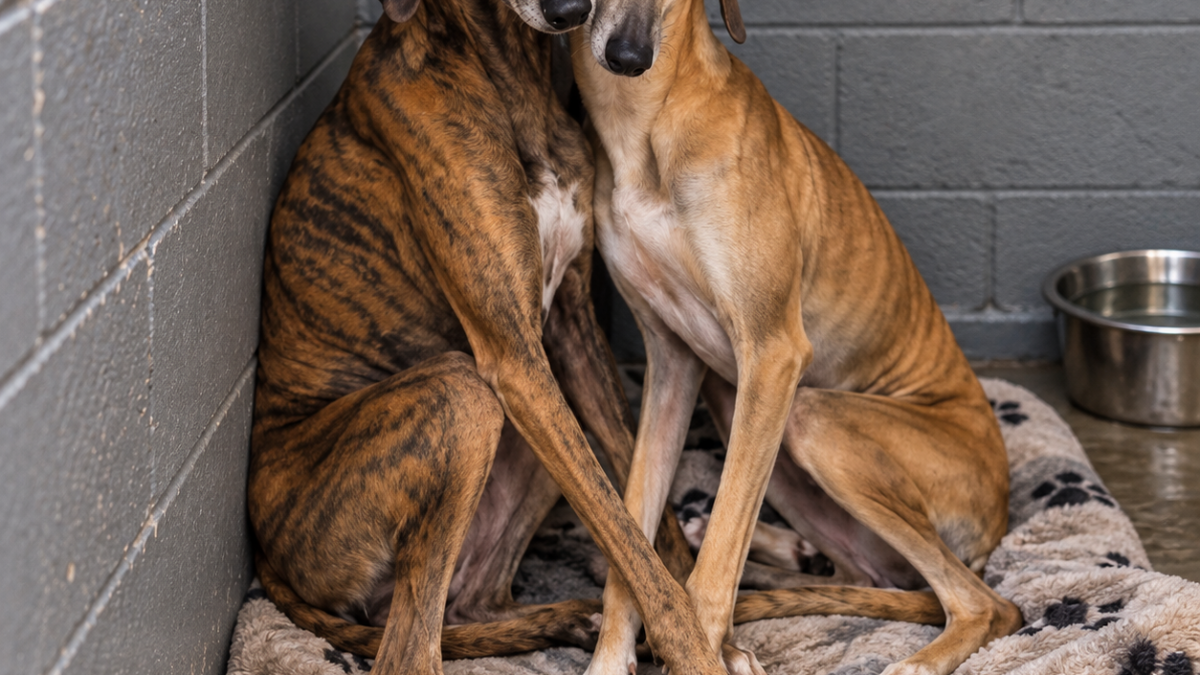
Milos and Lana together in the kennel.
His muzzle across her neck.
Paw touching hers.
I placed it beside a photograph from years later.
Same dogs.
Older.
Gray.
Sleeping together in our living room.
Then, beside those, the photograph of the bonded pair whose adoption policy had been influenced by cases like theirs.
Three pictures.
Beginning.
Life.
Legacy.
One afternoon, our granddaughter stood looking at them.
“Why did you get two dogs?”
I looked at Sarah.
She smiled.
I told the truth.
“I went there wanting one.”
“Why?”
“Because I thought one would be easier.”
“What happened?”
I looked at the first photograph.
“They showed me that easier wasn’t the important thing.”
She frowned.
“What was?”
I thought about it.
“Keeping a promise.”
“What promise?”
“That if they came home with us, they came home together.”
She seemed satisfied.
Children understand commitment better than adults sometimes.
They do not need spreadsheets.
Years later, I can still feel the torn paper in my hand.
One dog.
Medium-sized.
Calm.
House-trained.
Low medical needs.
No severe separation anxiety.
Every line represented what I thought I needed to control.
Then Milos placed one paw over Lana’s.
Such a small gesture.
No barking.
No theatrics.
Just contact.
Stay.
I’m here.
She stopped retreating.
That gesture did not prove they were easy.
It proved the opposite.
They came with history.
Fear.
Need.
Complexity.
And they were worth all of it.
People sometimes say we “saved” them by adopting both.
I don’t like that version.
We gave them a home.
Yes.
But Milos had been saving Lana long before we arrived.
Lana had been saving Milos too.
What we did was stop interrupting what already worked.
Then we expanded their world around it.
That distinction matters.
Their bond was never the pathology.
The terror of losing it was.
Once they learned home could hold both, fear loosened.
Once they learned people returned, doors became less dangerous.
Once they learned love did not always end in removal, they became more independent naturally.
Not because we forced them apart.
Because safety made distance survivable.
That is what I wish the first two families had known.
Maybe they would have done differently.
Maybe not.
I do not know them.
I do not want to turn them into villains simply to make the story cleaner.
They made decisions that hurt Milos and Lana.
That is true.
But the ending did not require revenge against them.
The satisfying part came later.
Milos learned to eat even when Lana was temporarily away.
Lana learned a closed door could open again.
The shelter learned bonded pairs needed stronger protection.
Another pair went home together.
And Sarah and I learned the life we thought we wanted was smaller than the one waiting for us.
That is enough.
Sometimes I still find pieces of dog life around the house.
A hair beneath an old cabinet.
A scratch on the hardwood where Milos once slipped while chasing a toy.
A mark near the back door from Lana’s nails.
I never repaired that one.
Sarah says I should.
I say the paint matches.
She knows I’m lying.
The torn adoption list frame still hangs in the mudroom.
The paper inside is incomplete because I kept destroying pieces of it.
Under it, Sarah’s little card remains:
PLANS CHANGE.
I used to think the message was about spontaneity.
It isn’t.
Plans should change when reality teaches you something more important.
That Saturday, I had planned to bring home one manageable dog.
Instead, two frightened animals taught me that responsibility is not choosing only what fits conveniently into your life.
Sometimes it means changing your life enough to fit what you have chosen.
We changed.
Furniture moved.
Schedules changed.
Trips changed.
The backyard changed.
Our budget changed.
Our understanding of fear changed.
Our definition of progress changed.
And the house?
The house became loud in ways we never expected.
Not always with barking.
With life.
Leashes moving.
Water bowls.
Toenails.
Doors opening.
Dogs stretching.
Sarah laughing because Lana stole something.
Me complaining because Milos took my socks.
People visiting.
Trainers.
Veterinary calls.
Family photographs.
Years.
Then, eventually, quiet again.
But when I stand in that quiet now, I do not wish we had chosen easier.
I wish we had more time.
That is how I know the torn list was the best decision I ever made.
I wrote it because I was afraid of choosing wrong.
Milos and Lana taught me that the right choice can still be difficult.
The right choice can include emergencies.
Setbacks.
Fear.
Medical bills.
Sleepless nights.
Grief.
A right choice is not the choice that prevents pain.
Sometimes it is the choice that makes the pain worth having endured.
If I could walk back into that shelter again and stand outside the final kennel, I know exactly what I would see.
Two thin dogs pressed together.
Milos’s muzzle over Lana’s neck.
One paw touching hers.
Sarah crouching.
Rachel explaining.
Me reaching into my pocket for a list that suddenly looked absurd.
I would not change a second.
Not even the difficult ones.
Because the last chapter explains the first in a way I could not understand then.
Those two dogs were not clinging because they were weak.
They were clinging because, at that point, each other was the only promise that had never been broken.
We simply became additional promises.
Over time, they trusted us too.
And when life finally separated them in the only way none of us could prevent, Lana survived.
Not because Milos mattered less.
Because the world around her had finally become safe enough to remain standing after he was gone.
That may be the greatest gift we gave either of them.
And they gave us something just as large.
A house that had grown quiet after our children left became a home again.
Not because we found one perfect dog.
Because two imperfect, frightened, inseparable dogs walked through our door together and taught us that sometimes the thing you never planned for becomes the life you cannot imagine having missed.

