PART 2: They Tried to Adopt Only One Kitten—Then His Brother Wrapped Both Paws Around Him and Wouldn’t Let Go
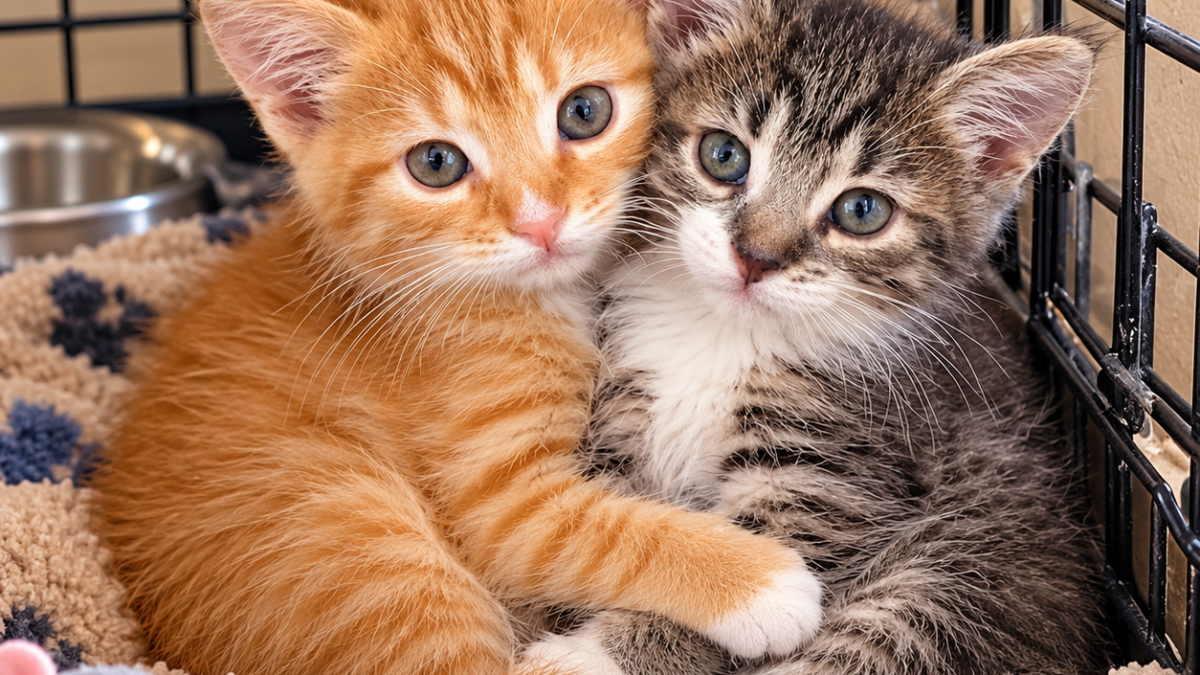
They had survived the streets by holding on to each other, and even inside the shelter, neither kitten would step out of the cage alone.
Then a family arrived, pointed at the orange one, and said they wanted only him.
What happened when I reached inside to separate the brothers made the entire adoption room go silent.
My name is Claire, and I had been volunteering at our small county animal shelter for almost six years when I met Milo and Jasper.
They were found late one October evening behind an abandoned repair garage on the edge of town.
A mechanic closing his shop heard faint crying near a stack of rusted sheet metal. When he lifted one piece, he found two kittens pressed so tightly together that at first he thought he was looking at one animal.
One was gray with a white chest.
The other was orange, with a tiny pale mark beside his nose.
They were cold, hungry, filthy, and far too young to be outside alone.
I drove out with another volunteer named Rachel.
The orange kitten let me pick him up first.
The second I lifted him away from the ground, he screamed.
Not an ordinary kitten meow.
A desperate, frantic cry.
At the same moment, the gray kitten twisted out of Rachel’s hands and scrambled toward him.
“Wait,” I said.
We lowered them together.
Instantly, the crying stopped.
The gray kitten buried his face against his brother’s neck.
The orange kitten wrapped one paw over his back.
Rachel looked at me.
“They’re terrified of being separated.”
So we carried them together.
At the shelter, we named the orange kitten Milo and the gray one Jasper.
From the first night, they did everything as a pair.
They slept curled into one another until it was almost impossible to tell where one kitten ended and the other began.
If Milo walked toward the food bowl, Jasper followed.
If Jasper woke from a nap, Milo’s eyes opened seconds later.
Even when we opened their kennel door, they hesitated.
Milo would poke his little orange head outside first.
He would look left.
Then right.
Then turn around as though checking whether Jasper was still there.
Only after Jasper moved closer would Milo step out.
Sometimes neither came out at all.
For weeks, I watched them grow stronger.
Their fur became soft.
Their ribs disappeared beneath healthy weight.
Milo became curious and playful.
Jasper remained quieter.
Whenever something startled him—a dropped bowl, barking from the dog wing, a stranger entering too quickly—he immediately searched for Milo.
And Milo always went to him.
I started telling potential adopters the same thing.
“They’re a bonded pair. We really want them placed together.”
Most people smiled.
Some understood immediately.
Others walked away.
Then one Saturday afternoon, a family came in.
A mother named Linda, her husband, Mark, and their teenage daughter, Sophie.
They stopped in front of Milo and Jasper’s kennel.
“Oh my goodness,” Linda said. “Look at the orange one.”
Sophie crouched.
“He’s perfect.”
Milo came toward the gate.
Jasper remained behind him.
Linda looked at me.
“We want him.”
I smiled politely.
“They’re brothers, and they’re extremely bonded. We’re looking for a home willing to adopt both.”
Linda’s smile disappeared.
“No. We only need one cat.”
I explained that separating bonded animals could cause severe stress.
Mark shrugged.
“They’ll adjust.”
I had heard those words before.
But something about Jasper’s face made me hesitate.
He was pressed against Milo’s side, watching us.
Linda opened the kennel before I could stop her.
“Come here, sweetheart.”
She reached toward Milo.
He sniffed her fingers.
Then she slid both hands beneath him and began lifting him out.
Jasper stood immediately.
Milo twisted around.
The moment his back paws left the kennel floor, he saw Jasper.
And something changed.
He reached backward.
One paw.
Then both.
His claws caught gently in Jasper’s fur as he pulled himself toward his brother.
Jasper pushed forward and wrapped his body around Milo.
Linda tried to separate them carefully.
Milo cried.
Jasper cried back.
She loosened one paw.
Milo grabbed Jasper again.
The harder we tried to create space between them, the tighter they held on.
Then Jasper made a sound I will never forget.
It wasn’t loud.
It was small.
Broken.
Terrified.
The same sound he had made beneath that rusted metal the night we found them.
Everyone in the room stopped moving.
Sophie lowered her eyes.
Mark said nothing.
Linda looked at me, still holding Milo halfway outside the kennel.
And I finally said the words I should have said the moment they walked in.
“No.”
She stared at me.
“What?”
I gently placed my hand beneath Milo.
“These two have already lost everything once.”
Linda’s expression hardened.
I looked at the brothers clinging to each other.
“And I’m not going to make them lose each other too.”
PART 2
For several seconds, nobody spoke.
Milo was still half in Linda’s arms and half inside the kennel, his front paws tangled around Jasper’s shoulders.
Jasper had pushed himself as close as physically possible against his brother.
Their little bodies were trembling.
Linda looked at me as if I had insulted her.
“You’re refusing to let us adopt a cat?”
“I’m refusing to separate these two.”
Mark stepped closer.
“We drove almost an hour.”
“I understand.”
“No, I don’t think you do.”
His voice sharpened.
“My daughter has been looking at cats for weeks.”
Sophie’s face turned red.
“Dad, it’s okay.”
“No, it isn’t.”
Linda finally lowered Milo back into the kennel.
The instant all four of his paws touched the blanket, Jasper shoved his face beneath Milo’s chin.
Milo began licking the top of Jasper’s head.
It was automatic.
Comfort.
Reassurance.
A ritual they had probably practiced long before anyone found them.
Linda crossed her arms.
“They’re kittens. They’ll forget.”
I had worked at the shelter long enough to know how dangerous that sentence could be.
People often assumed young animals were blank pages.
That anything could be erased simply because they were small.
But fear does not care how old you are when you learn it.
Neither does safety.
Sometimes the first creature who keeps you alive becomes the center of your whole world.
“These two depend on each other,” I said.
“They eat without each other?”
“Yes.”
“Then they’re not dependent.”
“That isn’t what bonded means.”
Mark sighed loudly.
“This is ridiculous.”
Sophie was still crouched beside the kennel.
She was no longer looking at Milo.
She was watching Jasper.
He had positioned himself between Milo and the open kennel door.
Not aggressively.
He wasn’t hissing.
He wasn’t swatting.
He was simply there.
A tiny gray wall.
Protecting the only thing he had left.
Sophie whispered, “Mom.”
Linda looked down.
“They really are scared.”
“They’ll get over it.”
Sophie stood.
“What if they don’t?”
Linda’s expression tightened.
“We don’t have room for two.”
Their house was not my business.
Their finances were not my business.
Their family decisions were not my business.
Protecting the animals in our care was.
So I closed the kennel door.
“I’m sorry. Milo isn’t available separately.”
Linda stared at the latch as though I had closed it on her hand.
“Who’s your manager?”
There it was.
The sentence every shelter volunteer eventually hears.
I pointed toward the front desk.
“Her name is Denise.”
Linda turned immediately.
Mark followed.
Sophie stayed.
For another moment, she stood beside Milo and Jasper.
Then she looked at me.
“I’m sorry.”
“You didn’t do anything wrong.”
She swallowed.
“I thought we were just getting a kitten.”
“I know.”
She watched Milo grooming Jasper.
“They love each other, don’t they?”
“I think they’re each other’s home.”
Sophie nodded slowly.
Then she joined her parents.
I expected Denise to come back annoyed.
Instead, she appeared five minutes later with Linda and Mark behind her.
Denise had managed the shelter for fourteen years.
She was five feet two on a generous day, wore purple reading glasses on a chain around her neck, and had the calmest voice I had ever heard.
That voice had convinced angry owners to surrender neglected animals peacefully.
It had also made grown men stop shouting.
She stopped beside me.
“Claire says Milo and Jasper are being adopted as a pair.”
“Yes,” I said.
Linda interrupted.
“But nowhere on the card does it say we’re required to take both.”
Denise glanced at the kennel card.
That was true.
The printed card said:
MILO
Male
Approx. 12 weeks
Domestic shorthair
JASPER
Male
Approx. 12 weeks
Domestic shorthair
A handwritten note beneath said:
Bonded siblings—preferred placement together.
Linda pointed at one word.
“Preferred.”
Denise nodded.
“I see that.”
“So it isn’t required.”
“Not on that card.”
Linda smiled as though she had won.
Then Denise removed the purple glasses from around her neck and put them on.
“But our behavioral notes can override the public kennel card.”
Mark groaned.
“You’re serious?”
“Very.”
He looked at me.
“This is because she doesn’t like us.”
“No,” Denise said. “This is because our responsibility is to make the most appropriate placement for the animals.”
“You have too many animals already.”
“That’s true.”
“You’re constantly asking people to adopt.”
“Also true.”
“And now someone is standing here ready to adopt one, and you’re saying no?”
Denise folded her hands.
“Yes.”
Mark actually laughed.
“That makes no sense.”
“It does if adopting one creates a serious welfare problem for the other.”
Linda shook her head.
“They are cats.”
Denise did not react.
“Yes.”
“They’re not children.”
“No one said they were.”
“They’ll adapt.”
“Maybe.”
Linda blinked.
She clearly expected an argument.
Denise continued.
“Or Jasper may stop eating. Milo may become distressed. One or both may develop behavioral problems. They may recover quickly. They may not. We have already observed significant distress when they are separated.”
Mark gestured toward the kennel.
“They’re touching right now because you upset them.”
“No,” I said.
“They sleep like that.”
He ignored me.
Denise opened the clipboard hanging beside the enclosure.
Inside were our daily behavior sheets.
She read aloud.
“Day two: Milo removed for weighing. Jasper vocalized continuously until Milo returned.”
She flipped the page.
“Day five: Jasper taken to treatment room for examination. Milo refused food until Jasper was returned.”
Another page.
“Day eleven: separate play attempt. Both kittens immediately searched for each other, vocalized, and would not engage with staff.”
Linda’s face changed slightly.
Denise continued.
“Day sixteen: shared play session. Both explored room successfully.”
She lowered the clipboard.
“That’s why we’re keeping them together.”
Sophie had returned and was standing behind her mother.
She whispered, “Can we just look at another kitten?”
Linda turned.
“But you wanted Milo.”
“I know.”
“You’ve been talking about an orange kitten forever.”
Sophie looked at the cage.
Then at her mother.
“I don’t want him if taking him hurts the other one.”
That was the moment the room shifted.
Not because Linda changed her mind.
She didn’t.
But because her daughter had.
Linda’s cheeks reddened.
“We came here for you.”
“And I’m saying no.”
“Sophie—”
“I don’t want him without Jasper.”
Mark rubbed his forehead.
“This is unbelievable.”
Denise quietly closed the clipboard.
“I can show you several wonderful kittens who are comfortable being adopted individually.”
Nobody moved.
Finally Sophie walked toward the kitten room across the hallway.
“I want to see them.”
Mark followed.
Linda stayed behind another second.
She looked at me.
“This shelter is going to regret making adoption this difficult.”
Then she walked away.
I wish I could say that was the end of it.
It wasn’t.
Two days later, Denise called me into her office.
She had her laptop open.
“Have you seen this?”
On the screen was a public review.
One star.
The reviewer described our shelter as arrogant, unprofessional, and more interested in “controlling families” than finding homes for animals.
The post claimed we had refused to adopt a healthy kitten to a loving family “for no legitimate reason.”
It did not mention Jasper.
It did not mention the crying.
It did not mention that Milo had physically clung to his brother.
It did not mention the behavioral records.
Within hours, people had started commenting.
Some defended us.
Others didn’t.
Why would a shelter turn away a good home?
This is why animals stay locked in cages.
Power-hungry rescue people.
Adopt one and save one—that should be enough.
One comment bothered me more than the others.
Cats don’t have human emotions. Stop projecting.
I looked through Denise’s office window.
Across the hall, Milo was sleeping with his head resting over Jasper’s ribs.
Every time Jasper breathed, Milo’s head rose slightly.
Down.
Up.
Down.
Up.
I said, “Should we answer?”
“We already did.”
Denise showed me the shelter’s response.
It was short.
Professional.
No names.
No details that violated privacy.
It explained that placement decisions could include behavioral observations and that bonded animals were sometimes required to remain together.
That should have ended it.
Instead, the review spread.
Someone copied it into a neighborhood group.
Then someone else posted it in a county pet group.
By the weekend, our phones were ringing.
Some people wanted to complain.
Some wanted to ask about Milo.
Not Jasper.
Milo.
Apparently the argument had done what arguments on social media often do.
It made him famous.
People loved the orange kitten with the little mark beside his nose.
One woman called from two counties away.
“I saw that post. Is the orange kitten still available?”
“With his brother.”
“I only want orange.”
“Then no.”
Another man said, “I’ll take both and bring the gray one back next week.”
I thought I had misunderstood him.
“Excuse me?”
“If your paperwork requires me to adopt both, I’ll sign for both. Then I’ll surrender the one I don’t want.”
I hung up after telling him he would not be approved.
The worst call came from a woman who said, “You know people can just lie to you, right?”
“Yes.”
“So why are you being so difficult?”
I looked at Jasper through the glass.
“Because occasionally someone tells us exactly who they are before we hand them an animal.”
She hung up.
Still, the attention had one unexpected benefit.
People began asking about bonded pairs.
Not just Milo and Jasper.
We had an older pair of cats named Tilly and Rose who had spent four months being overlooked.
A retired teacher saw the discussion, came in, sat with them for nearly two hours, and adopted both.
A week later, she emailed a picture of them asleep on her bed.
Denise printed it and taped it beside the front desk.
“Something good came from the mess,” she said.
I smiled.
But Milo and Jasper were still there.
Five weeks became six.
Six became seven.
They grew.
That matters in shelters.
People say they want kittens, but often what they mean is tiny kittens.
Milo and Jasper were no longer small enough to fit together in one hand.
Their legs became longer.
Their faces lost some of the roundness.
Milo’s orange coat deepened.
Jasper’s white chest widened.
They were still adorable.
But every week new kittens arrived.
Smaller kittens.
Fluffier kittens.
Kittens who did not come with the requirement of adopting two.
People stopped asking about them.
That was when I began to worry.
One evening, after we closed, I sat inside their playroom.
Milo was chasing a felt mouse.
Jasper watched from beneath a chair.
I rolled the toy toward him.
He looked at it.
Then at Milo.
Milo pounced.
Jasper immediately joined.
Within seconds they were tumbling across the rug.
“You two are making this difficult,” I told them.
Milo attacked my shoelace.
Jasper climbed onto my ankle.
“We need someone crazy enough to want both of you.”
Milo bit the lace.
“Preferably before you eat my entire shoe.”
Jasper put one paw on Milo’s back.
I looked down at them.
I had been careful not to become attached.
Shelter volunteers learn that lesson quickly.
You love them.
You care for them.
But you cannot emotionally adopt every animal that enters the building.
If you do, the work eats you alive.
Still, Milo and Jasper had slipped through.
Maybe because I had found them.
Maybe because I had watched them grow.
Maybe because every time they held each other, I imagined that cold night beneath the metal behind the garage.
They had survived before us.
Together.
I couldn’t stop thinking about what might have happened if someone had found only Milo.
Would Jasper have survived the night?
What if the mechanic had heard only one kitten crying?
How long had they been under that sheet of metal?
Where was their mother?
Had something happened to her?
We never learned.
All we knew was that when the world disappeared around them, the brothers had stayed.
And now the world kept asking us to break the one thing that had kept them alive.
I refused.
A few days later, Sophie came back.
Alone.
At first I didn’t recognize her.
She wore a gray sweatshirt and carried a school backpack.
“Hi,” she said.
“Hi.”
“My mom is outside.”
That made me nervous.
“She doesn’t want to come in.”
“Oh.”
Sophie looked toward Milo and Jasper.
“Can I sit with them?”
I hesitated.
Then nodded.
“Sure.”
I opened the playroom.
The brothers knew her almost immediately.
Or perhaps they simply remembered that she had been gentle.
Milo walked over first.
Sophie sat cross-legged.
He sniffed her shoe.
Jasper stayed several feet back.
Sophie did not reach for either one.
Good instinct.
After a while Milo climbed onto her knee.
She smiled.
“He got bigger.”
“A lot.”
Jasper approached next.
Sophie looked at me.
“Is it okay if I pet him?”
“If he asks.”
She waited.
Jasper sniffed her fingers.
Then rubbed his cheek against one.
Sophie’s eyes filled with tears.
I pretended not to notice.
After several minutes she said, “My mom wrote the review.”
I already knew.
“I figured.”
“She’s still angry.”
“I’m sorry.”
Sophie shook her head.
“I’m not.”
That surprised me.
She scratched Milo beneath the chin.
“We adopted another kitten.”
I smiled.
“You did?”
“A black one. From another shelter.”
“How’s he doing?”
“Good. His name is Bean.”
“That’s a great name.”
She smiled.
“He sleeps in my laundry basket.”
Milo climbed higher into her lap.
Sophie’s smile faded.
“My mom said we proved your shelter was wrong because Bean is happy alone.”
I didn’t know what to say.
Sophie did.
“But Bean wasn’t bonded to anybody.”
“No.”
“I understand that now.”
I sat against the wall.
“You understood it that day.”
“Not really.”
She looked at Jasper.
“I just knew he was scared.”
That was enough, I thought.
Sometimes empathy begins before understanding.
Sophie unzipped her backpack.
“I brought something.”
She pulled out two small fleece blankets.
One orange.
One gray.
“My grandma helped me make them.”
I stared.
“They’re for Milo and Jasper.”
Sophie’s voice became quieter.
“I wanted them to have one each when they get adopted.”
I swallowed.
“That’s very kind.”
She looked embarrassed.
“I know they’ll probably sleep on the same one.”
I laughed.
“They absolutely will.”
We put both blankets inside their kennel.
That night, they ignored the gray blanket entirely and squeezed themselves together on the orange one.
I took a picture and sent it to Sophie through the shelter’s official account.
She replied:
I knew it.
Three weeks passed.
Christmas decorations appeared in stores.
A plastic wreath hung on the shelter door.
Someone donated tiny knitted hats for the animals, which every cat hated.
Milo lasted approximately four seconds in his.
Jasper looked at me as though our entire relationship had been built on lies.
I took the hats off immediately.
Then, on a cold Wednesday afternoon, a man named Daniel Harper walked through our front door.
He was about forty.
Work boots.
Faded denim jacket.
Sawdust on one sleeve.
He stood awkwardly near the desk.
“I called about two kittens.”
Denise glanced up.
“Milo and Jasper?”
“Yeah.”
My attention snapped toward him.
Most callers asked about Milo.
He had said both names.
Denise pointed toward me.
“Claire can introduce you.”
Daniel followed me to the kennel.
Milo came forward immediately.
Jasper stayed behind.
Daniel crouched.
“So that’s them.”
“That’s them.”
He didn’t stick his fingers through the bars.
He didn’t call them.
He just watched.
After a while he said, “Which one is the brave one?”
I smiled.
“That depends.”
He pointed at Milo.
“He looks like the brave one.”
“Milo explores first.”
Daniel nodded.
“And Jasper?”
“Jasper thinks first.”
“That sounds nicer than scared.”
“He’s cautious.”
Daniel watched them.
Milo sat near the door.
Jasper sat directly behind him.
“Why do they have to go together?”
I told him.
The garage.
The rescue.
The panic when separated.
The adoption incident.
I expected him to say what many people said.
They’ll adjust.
Instead he asked, “What happens if one gets sick someday?”
That question caught me off guard.
“What do you mean?”
“If they’re that attached, and one has to stay overnight at a vet.”
It was a good question.
“We would work with the adopter and veterinarian. Short separations may eventually be manageable. We can gradually help them build confidence independently. Bonded doesn’t mean they can never be physically apart for five minutes.”
“But it means don’t deliberately split their lives.”
“Exactly.”
Daniel nodded.
“My wife would have understood that.”
The sentence was soft.
Past tense.
I waited.
He stared at the cats.
“She died eight months ago.”
“I’m sorry.”
“Cancer.”
He rubbed his thumb across one knuckle.
“We had two cats when we got married. Brothers. Charlie and Finn.”
Something in his face changed.
“Charlie died at sixteen.”
I already knew what came next.
“Finn stopped eating.”
Daniel nodded.
“Barely moved for weeks.”
He looked at Jasper.
“My wife slept downstairs beside him because he kept wandering the house at night looking for Charlie.”
He gave a small laugh.
“She said grief doesn’t stop being grief just because the one feeling it has whiskers.”
I felt my throat tighten.
“What happened to Finn?”
“He lived another year.”
Daniel smiled sadly.
“My wife got him eating again.”
He finally looked at me.
“So when I read that you wouldn’t separate these two, I figured somebody over here knew what they were doing.”
“You saw the review?”
“The whole county saw the review.”
I groaned.
He smiled.
“My sister sent it to me. She thought I needed a cat.”
“Do you?”
“No idea.”
That answer made me like him.
People who were certain they needed an animal sometimes had a picture in their head that no real animal could satisfy.
People who admitted they didn’t know were often ready to meet the one actually standing in front of them.
Daniel spent an hour with Milo and Jasper.
Milo climbed into his lap after ten minutes.
Jasper took forty-five.
Daniel never rushed him.
He sat on the floor and talked about ordinary things.
His woodworking business.
The old farmhouse he lived in.
The heated mudroom he had converted for his wife’s cats years earlier.
A screened porch.
No children.
One elderly dog named Hank who ignored cats.
When Jasper finally stepped onto Daniel’s shoe, Daniel did not even look down.
He kept talking.
Five minutes later, Jasper curled against his thigh.
Daniel’s voice stopped.
He stared at me.
“Does that mean something?”
“It means don’t move.”
He remained almost perfectly still.
Milo climbed onto his other leg.
Daniel looked at both of them.
Then he whispered, “Well, this seems unfair.”
“What?”
“I came here planning to think about it.”
I laughed.
“Thinking is allowed.”
He looked down.
“I’m not sure they agree.”
Daniel completed an application that afternoon.
We did not approve adoptions instantly.
Especially not bonded pairs.
We called his veterinarian.
His references.
We confirmed his landlord situation, which was easy because he owned his home.
We asked about Hank.
The veterinarian described Hank as “possibly the laziest Labrador in the state.”
Everything checked out.
But the following morning, something happened that made the situation complicated again.
Linda came back.
This time without Sophie.
She marched to the desk holding her phone.
“I need to speak to Denise.”
Denise emerged from her office.
Linda held up the screen.
“I heard somebody applied for the orange kitten.”
I felt cold.
Adoption applications were confidential.
“How did you hear that?” Denise asked.
“A friend was here yesterday.”
Apparently one of our visitors had seen Daniel meeting Milo and Jasper.
Linda continued.
“If you’re willing to adopt him now, we still want him.”
“With Jasper?”
“No.”
“Then nothing has changed.”
Linda stared at her.
“You’ve kept that kitten locked here for months because of some ridiculous rule.”
“Both kittens are receiving appropriate care.”
“You could have placed Milo with us weeks ago.”
“And left Jasper here alone.”
“He would have been adopted eventually.”
“Maybe.”
Linda lowered her voice.
“You don’t know that.”
“No.”
“So you chose to keep one cat from a home because another cat might get sad.”
Denise remained calm.
“Yes.”
Linda seemed startled by the simplicity of the answer.
“You’re proud of that?”
“I’m comfortable with it.”
“What if this new person changes his mind?”
“Then we wait.”
“What if nobody takes them?”
“Then we keep trying.”
Linda laughed bitterly.
“This is why rescues get a bad reputation.”
A sound came from behind us.
Sophie.
She had entered without either of us noticing.
“Mom.”
Linda turned.
“What are you doing here?”
“Grandma brought me.”
An older woman stood near the entrance, looking deeply uncomfortable.
Sophie stepped closer.
“Why are you doing this again?”
Linda’s face flushed.
“This doesn’t concern you.”
“It was supposed to be my cat.”
“We can still get him.”
“I don’t want him!”
The shelter went silent.
Sophie’s eyes filled.
“I told you that.”
Linda lowered her voice.
“Sophie.”
“No. You keep saying they embarrassed you.”
“This is not the place.”
“You wrote about them online. You called people. You keep checking their page.”
Linda glanced around.
Several visitors were pretending not to listen.
Sophie continued.
“This isn’t about Milo anymore.”
Her voice shook.
“It’s because they told you no.”
Linda went completely still.
There are truths that become sharper when spoken by your own child.
For once, Linda had no response.
Sophie wiped her face.
“We have Bean. I love Bean.”
“I know.”
“Then stop trying to take Milo away from Jasper.”
Linda looked toward the kennel.
Milo and Jasper were curled together on the orange blanket Sophie had made.
For a long time, she said nothing.
Then she put her phone into her purse.
Her voice, when it came, was quieter.
“Come on.”
Sophie did not move.
“Mom—”
“I said come on.”
The grandmother placed a gentle hand on Sophie’s shoulder.
“I’ll bring her home.”
Linda looked at her mother.
Then at Sophie.
Then at Denise.
She left alone.
Sophie began crying after the door closed.
I knelt beside her.
“I’m sorry.”
“She’s not usually like this.”
“You don’t need to explain your mother to me.”
“She hates being wrong.”
Most people do, I thought.
Some of us simply cause more damage avoiding it.
Sophie looked toward the kittens.
“Are they really getting adopted?”
“If everything works out.”
“Together?”
“Together.”
She smiled through tears.
“Good.”
Daniel returned Saturday morning.
He had passed every part of the application.
Before signing, Denise gave him the full medical histories.
Vaccination schedules.
Microchip information.
Feeding routines.
Behavioral notes.
He read everything.
Every page.
Then he asked, “What food are they eating?”
We told him.
“What litter?”
We told him.
“What kind of carrier?”
“Preferably one large enough that they can travel together for now.”
He had already bought one.
He showed me a photo.
I laughed.
“You were confident.”
“No.”
He put his phone away.
“I was hopeful.”
When it was finally time, I opened the kennel.
Milo stepped into the carrier first.
Then he turned around.
Just as he always did.
Checking.
Jasper stood inside the kennel.
For one second my heart stopped.
Then Milo chirped.
A tiny sound.
Jasper walked forward.
He climbed into the carrier and immediately pressed against his brother.
Daniel closed the door.
“That’s it?”
“That’s it.”
I had done hundreds of adoptions.
I knew what came next.
Smile.
Congratulations.
Paperwork.
Goodbye.
Instead, my eyes filled.
Daniel noticed.
“You okay?”
“I found them.”
His expression softened.
“Behind the garage?”
I nodded.
“They were so small.”
Daniel looked through the carrier door.
“I’ll take care of them.”
I believed him.
Still, handing over animals you love is an act of faith.
You inspect homes on paper.
You call references.
You ask questions.
But eventually, you put two living creatures into someone else’s hands and watch them walk out the door.
I crouched beside the carrier.
Milo pushed his nose against the grate.
Jasper stayed behind him.
“Remember,” I whispered, “you’re a package deal.”
Daniel laughed.
“I’m starting to understand.”
I looked at Jasper.
“You make sure he behaves.”
Jasper blinked.
“And Milo?”
The orange kitten pawed at the door.
“You make sure Jasper remembers the world isn’t always terrible.”
Daniel lifted the carrier.
Before he left, Sophie arrived with her grandmother.
She had asked to know the adoption date.
Denise had gotten Daniel’s permission for them to say goodbye.
Sophie ran in holding the gray blanket.
“You forgot this.”
She pushed it through the top opening of the carrier.
Jasper immediately stepped on it.
Sophie laughed.
Daniel smiled at her.
“You made those?”
She nodded.
“The orange one too.”
“They’re coming home with us.”
Her eyes filled again.
“Can you send the shelter pictures?”
“I can do that.”
“Of both?”
Daniel looked at her.
“Always both.”
That nearly finished me.
Sophie knelt and placed one finger against the carrier door.
Milo sniffed it.
“Bye, Milo.”
Then she moved her finger closer to Jasper.
“Bye, Jasper.”
She whispered, “Stay together.”
Daniel carried them outside.
The carrier went into the back seat, secured with a seat belt.
He had placed towels around it.
A small detail.
But shelter people notice small details.
Small details tell you whether somebody thought about the animals before arriving.
His truck disappeared down the road.
I stood beside Sophie.
For the first time in nearly three months, kennel seventeen was empty.
She looked at me.
“It feels sad.”
“It always does.”
“But good sad?”
I smiled.
“The best kind.”
That night, Daniel sent his first picture.
Milo was under a wooden kitchen chair.
Jasper was behind him.
Message:
They’ve inspected approximately six square feet of the house. Very demanding home inspectors.
The next morning came another.
Both kittens were under Daniel’s bed.
Message:
Inspection expanded overnight. No permits approved yet.
Two days later:
Milo had discovered the windowsill.
Jasper was sitting directly behind him.
A week later:
Both were asleep on Hank, the supposedly cat-indifferent Labrador.
Hank looked deeply resigned.
Daniel wrote:
Hank has filed a formal complaint.
Denise printed that one.
We taped it beside the photo of Tilly and Rose.
A month passed.
Milo became fearless.
He climbed bookcases.
Investigated sinks.
Attacked shoelaces.
Once he fell into an empty bathtub and apparently blamed Daniel for twenty minutes.
Jasper changed more slowly.
He followed Milo.
Watched Milo.
Learned from Milo.
When Milo approached Daniel, Jasper observed.
When Milo slept on the couch, Jasper eventually joined.
When Milo walked past Hank without being eaten, Jasper began doing the same.
Then one evening Daniel sent a video.
I opened it at the shelter desk.
Milo was nowhere in sight.
Jasper was alone in the living room.
Playing.
By himself.
He chased a little ball across the floor.
Stopped.
Pounced.
Ran after it.
No Milo.
I watched the clip twice.
Then a third time.
Denise came over.
“What is it?”
I showed her.
She smiled.
“That’s progress.”
Exactly.
Keeping bonded animals together did not mean making them incapable of independence.
Sometimes safety gives independence room to grow.
Jasper could explore alone because he knew Milo still existed somewhere nearby.
He no longer had to guard against losing him every second.
That difference mattered.
Two months after the adoption, Daniel called.
His voice sounded strained.
My stomach dropped.
“What happened?”
“Jasper’s at the emergency clinic.”
I stood immediately.
“Why?”
“He swallowed something. They think thread.”
Anyone who has cats knows how dangerous that can be.
“Where’s Milo?”
“At home.”
“How is he?”
“That’s why I’m calling.”
Milo had been searching the house for Jasper since Daniel returned without him.
He cried at the carrier.
Cried by the door.
Would not eat.
The emergency clinic needed to keep Jasper overnight for imaging and possible surgery.
Daniel sounded exhausted.
“I know this sounds stupid.”
“It doesn’t.”
“Can I bring Milo to the clinic?”
“You’ll have to ask them.”
“I did.”
“And?”
“They said maybe, but they weren’t sure whether it would help.”
“Tell them they’re documented as a bonded pair.”
Daniel exhaled.
“I knew you’d say that.”
The clinic allowed Milo to visit under supervision.
Daniel sent me a message afterward.
You’re going to cry.
Then a picture.
Jasper was inside a recovery kennel wearing a small bandage on one leg.
Milo sat outside the kennel door.
Their noses touched through the bars.
I did cry.
The veterinarian decided to let Milo remain in a separate carrier beside Jasper for part of the evening.
Jasper stabilized.
Fortunately, the thread had not caused the catastrophic intestinal damage everyone feared.
He still needed treatment and observation, but surgery was avoided.
The next afternoon he went home.
Daniel told me that the first thing Milo did was lick Jasper’s entire face.
The second thing Jasper did was walk to the food bowl.
Daniel said, “I think I finally understand what you were protecting.”
I smiled into the phone.
“They would have survived apart.”
“Maybe.”
“But surviving isn’t the only standard.”
“No.”
There was a pause.
Then Daniel said, “I’m glad you told that family no.”
So was I.
But our story with Linda was not finished.
Nearly four months after Milo and Jasper left the shelter, she returned.
This time, there was no anger.
No phone in her hand.
No demand to speak with Denise.
She simply stood near the desk.
I recognized her immediately.
“Hello.”
“Hi.”
She looked uncomfortable.
“Is Denise here?”
“She is.”
“Can I talk to both of you?”
That surprised me.
Denise joined us.
Linda took a folded piece of paper from her purse.
“I deleted the review.”
Neither of us spoke.
“I should have done it earlier.”
Denise nodded.
“Okay.”
Linda looked at me.
“I also posted a correction.”
That surprised me more.
She handed over the paper.
It was a printed screenshot.
Linda had written that after learning more about bonded animals, she believed the shelter had made the right decision keeping Milo and Jasper together.
She admitted that her earlier review had left out important facts.
She apologized.
Publicly.
I looked at her.
“What changed?”
Her eyes lowered.
“Sophie.”
Of course.
Linda sat in one of the lobby chairs.
“She barely spoke to me for three days after that last visit.”
“I’m sorry.”
“No.”
Linda shook her head.
“She should have been angry.”
She looked at Denise.
“I made that whole thing about myself.”
Denise remained silent.
Linda continued.
“I told myself I was fighting because a shelter was being unreasonable. But Sophie was right. I was angry because someone told me no.”
There was no satisfying comeback to give her.
No victory speech.
Sometimes the most difficult thing a person can do is return voluntarily to the room where they behaved badly and say exactly what they did.
Linda looked through the window toward the cat room.
“Bean got sick last month.”
My stomach tightened.
“Is he okay?”
“He’s fine now.”
She smiled faintly.
“Stomach problem.”
She looked down at her hands.
“Sophie slept beside him all night.”
The parallel was obvious.
“When I saw how scared she was, I kept thinking about Jasper.”
I said nothing.
“She asked me what I thought Jasper would have done if we had taken Milo.”
Linda’s eyes filled.
“I didn’t have an answer.”
Denise sat beside her.
“You have one now.”
Linda nodded.
“Yes.”
She wiped beneath one eye.
“I was wrong.”
Then she reached into her purse again.
This time she removed an envelope.
“I want to pay Milo and Jasper’s adoption fee.”
I blinked.
“They’re already adopted.”
“I know.”
“Daniel paid it.”
“I know.”
She pushed the envelope toward Denise.
“Then use it for another bonded pair.”
Denise looked at me.
I looked at Linda.
“Why?”
Linda gave a sad little laugh.
“Because apparently my daughter is raising me.”
That made all three of us smile.
Inside the envelope was enough money to cover two cat adoption fees and part of their routine veterinary care.
Denise created a small fund.
We called it the Together Fund.
Linda specifically asked that her name not be attached.
That surprised me too.
A month later, the fund helped place two older cats whose owner had died.
Then it helped a bonded rabbit pair.
Sophie began volunteering with us the summer after she turned sixteen.
Her mother signed every permission form.
At first Linda waited in the parking lot.
Eventually she came inside.
Eventually she started helping wash blankets.
People are complicated.
That is something animal rescue teaches you almost as quickly as it teaches you about animals.
We like stories with obvious villains.
Cruel person.
Kind rescuer.
Helpless animal.
Justice.
Real life rarely stays that simple.
Linda had behaved badly.
She had tried to pressure us.
She had posted an unfair review.
She had continued pushing long after her daughter asked her to stop.
But when confronted with the truth, eventually, painfully, she changed.
That did not erase what happened.
It did something better.
It prevented it from becoming permanent.
If you had asked me during that first confrontation what justice would look like, I might have imagined Linda seeing Milo happy somewhere she couldn’t have him.
I might have imagined her regretting everything.
In a way, that happened.
But the revenge I thought I wanted would have been too small.
The better outcome was that two kittens stayed together.
Another bonded pair got adopted because of the attention.
Then another.
A teenager learned she could speak up even when the adult in front of her disagreed.
Her mother learned how to admit she had been wrong.
And a shelter changed one word on a kennel card.
After Milo and Jasper, “preferred placement together” became:
BONDED PAIR — MUST BE ADOPTED TOGETHER.
No ambiguity.
No debate at the kennel door.
No kitten hanging from somebody’s arms while his brother cried behind him.
Months turned into a year.
Milo and Jasper grew into beautiful adult cats.
Milo became a long, lean orange troublemaker with endless confidence.
Jasper grew broad across the shoulders and developed a white chest that made him look like he was wearing a formal shirt.
Their personalities remained exactly what we expected.
Milo entered rooms first.
Jasper followed.
Milo investigated guests.
Jasper watched.
Milo once climbed onto Daniel’s roof through an upstairs window and had to be bribed down with chicken.
Jasper sat safely behind the screen and screamed at him the entire time.
Daniel sent me the photo afterward.
Milo looked proud.
Jasper looked furious.
His message said:
Marriage counseling has been scheduled.
I replied:
They’re brothers.
Daniel answered:
Tell them that.
They slept together less as they grew.
That surprised me at first.
Sometimes Milo slept on Daniel’s bed while Jasper slept in the hallway.
Sometimes Jasper spent the afternoon alone on the screened porch.
Sometimes they ignored each other for hours.
But every night, according to Daniel, they eventually checked where the other one was.
And storms brought them back together.
Always.
The first major thunderstorm after their adoption hit in late spring.
Daniel later told me the power went out around midnight.
He came downstairs with a flashlight.
Milo and Jasper were beneath the dining room table.
Curled into each other.
Just as they had been beneath the rusted metal behind that garage.
Daniel sat on the floor nearby.
He did not try to pull them out.
Eventually Milo came to him.
Jasper followed.
The three of them slept in the living room until the storm passed.
When Daniel told me, I thought about that first night.
Two tiny kittens.
Cold pavement.
Rusty metal.
No mother.
No safety.
Only each other.
People often asked me why bonded pairs mattered.
That night was the answer.
You cannot always know which memory an animal is carrying.
You cannot explain to them that the thunder is harmless.
That the carrier returns home.
That the person who leaves in the morning will return after work.
That the veterinarian is trying to help.
That this home is permanent.
But sometimes another animal can say something we cannot.
I’m still here.
You’re not alone.
Nothing has changed between us.
Years later, Daniel invited several shelter volunteers to his home for a small fundraiser.
Sophie came.
So did Linda.
By then Sophie was eighteen and preparing for college.
Linda had become one of our most reliable blanket washers.
Life is strange.
When we arrived, Milo greeted us at the door.
Naturally.
Jasper watched from the stairs.
I crouched.
“Hey, boys.”
Milo walked directly to me.
He sniffed my shoes and allowed exactly seven seconds of petting before deciding Daniel’s grocery bag was more interesting.
Jasper came down more slowly.
I held my hand low.
He sniffed.
Then rubbed his face against my knuckles.
Sophie saw it.
“He remembers you.”
“I don’t know.”
“He does.”
Maybe.
Or maybe I smelled like the shelter.
Maybe I smelled like a hundred cats.
Maybe Jasper had simply become brave enough to greet strangers.
I didn’t need the romantic version to be true.
The reality was beautiful enough.
Linda stood in the doorway.
When Jasper approached her, she froze.
He sniffed her jeans.
She looked at me.
“What do I do?”
“Nothing.”
She stayed completely still.
Jasper sniffed her hand.
Then walked away.
Linda laughed.
“I think I’ve been judged.”
“Possibly.”
Milo appeared carrying a toy mouse.
Sophie sat on the floor.
He dropped it beside her.
“Remember me?”
Milo attacked her shoelace.
She laughed.
“I guess not.”
Daniel came in carrying drinks.
“Oh, he remembers shoes.”
The house was warm.
Hank, the old Labrador, was asleep beside the fireplace.
The gray blanket Sophie had made years earlier was draped over the back of a chair.
The orange blanket was in a basket near the window.
Both were faded.
Both had little claw marks.
Neither had been thrown away.
I touched the edge of the orange one.
Daniel noticed.
“They still use them.”
“All these years?”
“Mostly in winter.”
I smiled.
Sophie came over.
“That was the blanket they slept on at the shelter.”
“I remember.”
Linda stood beside us.
For a moment the three of us looked across the room.
Milo had climbed onto Hank.
Jasper was sitting nearby.
Daniel was trying to convince Milo that a Labrador was not furniture.
Nobody was listening.
Linda said quietly, “I really would have taken only Milo.”
I looked at her.
“I know.”
“I thought Jasper would forget.”
“I know.”
She watched him.
“He wouldn’t have, would he?”
I considered the question.
“He might have adapted.”
“That isn’t what I asked.”
No.
It wasn’t.
So I answered honestly.
“I don’t think he would have forgotten.”
Linda nodded.
Neither of us said anything else.
There was nothing left to prove.
The decision had been made years earlier.
The evidence was walking around the living room.
Later that evening, Daniel showed me something he had kept.
The original adoption photo.
Milo and Jasper inside their carrier.
Sophie’s gray blanket beneath them.
Both staring through the door.
Then he showed me another picture taken that morning.
The same carrier.
He still owned it, though they rarely used it now.
Milo was sitting inside.
Jasper beside him.
They barely fit.
I laughed.
“Why were they in there?”
“I was cleaning it.”
“And?”
“They climbed in.”
“Together?”
“Of course.”
He looked at the photo.
“I think some places become safe because of who was there with you.”
That stayed with me.
The garage had not been safe.
The shelter kennel had not been home.
The carrier was not freedom.
Yet Milo and Jasper had transformed each place simply by having each other inside it.
Maybe that was what a home really was.
Not walls.
Not ownership papers.
Not a perfect room.
The certainty that when you turned around, someone was still there.
Five years after we found them, Hank died.
Daniel called me the next week.
“I think Jasper understands.”
“How?”
“He keeps sleeping in Hank’s old spot.”
“And Milo?”
“With Jasper.”
For several days, the brothers stayed closer than usual.
They searched the house.
Milo checked the back door.
Jasper waited beside Hank’s bed.
Daniel let them investigate.
Let them grieve.
He did not rush to remove the bed.
He did not tell himself they were “just cats.”
He understood now.
A month later, he sent me a photo.
Milo and Jasper sleeping together in Hank’s old bed.
Caption:
Still taking care of each other.
I printed that one too.
By then the shelter had an entire bulletin board filled with adopted bonded pairs.
Dogs.
Cats.
Rabbits.
Two guinea pigs named Salt and Pepper.
Underneath we placed one sentence:
SOME ANIMALS COME TO US WITH THEIR FAMILY ALREADY CHOSEN.
Visitors asked about the sign.
That gave us a chance to explain.
Most understood.
Some still complained.
There will always be someone who believes love should rearrange itself around convenience.
But our policy remained.
Milo and Jasper had changed that.
Not because they were extraordinary.
Because they made something visible that people often overlooked.
Animals form relationships.
They grieve.
They seek security.
They recognize familiar bodies, smells, routines, sounds.
And when an animal has survived fear beside another animal, that bond can become more than companionship.
It can become a map of safety.
Years passed.
Sophie graduated from college with a degree in veterinary technology.
The day she received her first job offer, she visited the shelter before telling almost anyone else.
“You know this is your fault,” she told me.
“My fault?”
She pointed toward the cat wing.
“All of this.”
I laughed.
“You came here wanting one kitten.”
“And left wanting to work with every animal nobody understands.”
“That sounds expensive.”
“It is.”
Linda stood behind her, smiling.
“I tried to talk her into accounting.”
Sophie rolled her eyes.
“No, you didn’t.”
“I considered it.”
By then, Linda could joke about that first day.
Not dismiss it.
Not erase it.
But own it.
There is a difference.
Sophie eventually began working at a veterinary clinic with a fear-free handling program.
She became especially interested in anxious cats.
She told me once that Jasper was the reason.
“I keep thinking about him holding Milo.”
She demonstrated with her hands.
“People saw him as the quieter kitten. The less adoptable one.”
“He was.”
“That’s what bothers me.”
She looked serious.
“If Mom had taken Milo, everybody would have called it a successful adoption because the cute orange kitten got a home.”
“And Jasper would have stayed.”
“Exactly.”
Her voice softened.
“Sometimes the animal nobody picks is the reason the one everybody wants is okay.”
I had never put it that way.
But she was right.
Milo was the visible one.
Bright orange.
Curious.
Friendly.
The kitten people pointed at.
Jasper was the shadow behind him.
Quiet.
Gray.
Cautious.
Easy to overlook.
Yet Milo needed Jasper just as much.
Their dependence simply looked different.
Jasper hid behind Milo.
Milo checked for Jasper before moving forward.
One fear was visible.
The other was disguised as confidence.
That lesson stayed with me far beyond those two kittens.
Years later, when adopters came looking for the playful cat and ignored the shy one sitting beside him, I watched differently.
When someone said, “He’ll get over it,” I asked what evidence supported that assumption.
When someone said animals did not understand separation, I remembered Milo reaching backward from Linda’s arms.
Two front paws.
Clinging.
Refusing to release his brother.
Nobody in that room needed a scientific paper to understand what he wanted.
He was saying no in the only language available to him.
Put me back.
My brother is there.
That moment lasted perhaps fifteen seconds.
It changed shelter policy for years.
Nearly eight years after Milo and Jasper were found, Daniel called me on a Sunday morning.
His voice told me immediately that something was wrong.
“Claire.”
“What happened?”
“It’s Jasper.”
I sat down.
He had been diagnosed with kidney disease the year before.
We knew.
Daniel had managed it beautifully.
Special food.
Fluids.
Regular veterinary care.
For months Jasper remained comfortable.
But that weekend he stopped eating.
Bloodwork showed his kidneys were failing.
He was in the hospital.
Milo was at home.
I closed my eyes.
“How bad?”
Daniel’s voice broke.
“The vet says maybe days.”
I had known this day would come.
Knowing did nothing.
“What are you going to do?”
“Bring him home.”
“Good.”
“I don’t want him dying in a hospital.”
“No.”
“And Milo…”
Daniel stopped.
“What about Milo?”
“I don’t know how to do this to him.”
There it was.
The question behind every bonded pair.
Together does not mean forever.
Nothing gets forever.
One day, unless fate is impossibly precise, one will leave first.
The answer is not to prevent love because grief will eventually follow.
The answer is to make the grief survivable too.
I drove to Daniel’s house that afternoon.
Sophie came after her shift at the clinic.
She had already spoken with Jasper’s veterinarian.
Linda arrived carrying food no one ate.
Daniel brought Jasper home wrapped in a blue hospital blanket.
He looked smaller than I remembered.
Older.
His gray coat had silvered around the face.
But when Daniel placed the carrier on the floor, Milo appeared immediately.
Eight years old now.
Still bright orange.
Still with the pale mark beside his nose.
He approached the carrier.
Sniffed.
Then made a sound.
The same small questioning chirp he had made as a kitten.
Daniel opened the door.
Jasper did not walk out.
Milo climbed inside.
No one stopped him.
He curled beside his brother.
Pressed his face against Jasper’s neck.
The room went silent.
I was back in the shelter.
Linda lifting Milo.
Jasper clinging.
Two terrified kittens refusing to let a human decision separate them.
Except now there was no decision we could reverse.
No manager to call.
No policy.
No argument to win.
Only time.
Daniel sat on the floor.
“I hate this.”
Sophie knelt beside him.
“I know.”
Jasper came home on Sunday.
He surprised everyone by eating a little chicken that evening.
On Monday he walked onto the porch.
Milo followed.
They lay together in the sunlight.
Tuesday was harder.
By Wednesday, Jasper could barely stand.
The veterinarian came to Daniel’s house.
The same screened porch where the brothers had spent thousands of afternoons together became quiet.
Jasper lay on the orange blanket.
The original one.
Faded almost white in places.
Milo sat beside him.
The veterinarian explained what would happen.
Daniel cried openly.
I did too.
Sophie sat with Linda.
Nobody tried to remove Milo.
That was important.
The veterinarian allowed him to stay.
Daniel kept one hand on Jasper.
Milo’s paw rested against his brother’s shoulder.
Jasper died peacefully there.
At home.
Beside the creature he had refused to leave when he was twelve weeks old.
For several minutes afterward, Milo did not move.
The veterinarian let him smell Jasper.
Let him understand in whatever way cats understand absence.
Milo sniffed his brother’s face.
His ears.
His paws.
Then he sat.
He simply sat beside him.
No screaming.
No dramatic reaction.
Just stillness.
Eventually Milo stood.
Walked three feet away.
Turned around.
Returned.
He did that twice.
Then he climbed onto Daniel’s lap.
Daniel held him.
For the first time in all the years I had known Milo, he did not look back for Jasper.
I think some part of him understood there was nowhere to look.
The weeks that followed were difficult.
Milo searched.
Of course he did.
He checked the porch.
The bedroom.
Jasper’s favorite chair.
He slept more.
Ate less.
Daniel worked with his veterinarian.
Kept routines stable.
Spent evenings on the floor.
Sophie visited.
So did I.
We never pretended Milo did not grieve.
But something was different from the terror we had feared when he was a kitten.
Milo was no longer a twelve-week-old animal whose whole world consisted of one brother and one cage.
Because he had been allowed to keep Jasper, he had also learned to trust Daniel.
Hank.
The house.
The porch.
Sophie.
Me.
The world had expanded around the bond instead of replacing it.
That was why keeping them together had never made them weaker.
It had given them the foundation to become stronger.
Three months after Jasper died, Daniel sent me a picture.
Milo was sleeping in the window alone.
Sunlight across his face.
Message:
First time he’s slept there since Jasper.
I smiled and cried at the same time.
Another month passed.
Daniel adopted an older cat.
Not a kitten.
A six-year-old black female named Nora whose owner had entered assisted living.
He did not adopt her to replace Jasper.
Nobody could.
He adopted her because the house had room.
Milo hated her for eleven days.
On day twelve, they touched noses.
On day twenty-seven, Daniel found them asleep on opposite ends of the same couch.
Six months later, Nora was stealing Milo’s food.
Life had continued.
Not unchanged.
Never unchanged.
But continued.
Milo lived to be sixteen.
When he died years later, Daniel buried his ashes beside Jasper’s beneath a maple tree behind the house.
He placed no elaborate monument there.
Just one flat stone.
Two names.
Milo.
Jasper.
And beneath them:
Together from the beginning.
When Daniel sent me a photograph of the stone, I stared at it for a long time.
I thought about the garage.
The rusted metal.
Two tiny bodies pressed together against the cold.
I thought about Linda reaching into the kennel.
Milo turning backward.
Jasper reaching forward.
Their paws locking.
Everyone in that room becoming silent because something so small had made itself impossible to ignore.
I thought about all the times people told us we were being unreasonable.
All the calls.
The review.
The accusations.
The people who insisted animals forgot.
Maybe some would say the story proves the opposite of what we believed because Jasper eventually died and Milo had to live without him.
I see it differently.
They got eight years.
Eight years they would not have had if convenience had won that afternoon.
Eight years of windows.
Sunlight.
Thunderstorms.
A lazy dog named Hank.
A screened porch.
Faded blankets.
Emergency vet visits.
Christmas mornings.
Arguments over toys.
Shared bowls they weren’t supposed to share.
Thousands of nights when each brother could wake up, look across the room, and know the other one was still there.
We could not give them forever.
We gave them the time that belonged to them.
That was enough.
I am older now.
I do fewer late-night rescue calls than I used to.
Sophie handles many of them.
Sometimes she sends me photos from the clinic.
A frightened cat.
A bonded pair.
A dog nobody can touch yet.
She always remembers the same rule.
Do not begin by asking what is convenient for us.
Begin by asking what the animal is telling us.
Years ago, Milo and Jasper told us very clearly.
They did not have words.
They didn’t need them.
One kitten was lifted away.
He turned back.
One kitten thought he was being left behind.
He reached forward.
Four tiny paws held on.
And for once, the humans in the room were smart enough to stop pulling.
That was the whole difference.
We stopped.
We listened.
We put Milo back.
And because we did, two frightened kittens who once had nothing but a piece of rusted metal and each other eventually got a home where nobody ever asked them to choose between safety and family again.
People sometimes think rescue means carrying an animal out of danger.
That is only the first part.
Sometimes rescue means knowing what not to take away afterward.
Milo and Jasper taught me that.
They taught Sophie.
Eventually, they even taught Linda.
And every time I walk past the shelter wall and see the photographs of bonded pairs who went home together because of the policy those two kittens inspired, I remember the day everyone in the adoption room went quiet.
Linda had Milo in her hands.
Jasper was crying inside the kennel.
Milo twisted around and grabbed him.
And I said no.
At the time, Linda believed that word meant I was denying her family something they wanted.
Years later, I understood what it really meant.
No, you don’t have to lose him.
No, your fear does not have to be tested just because humans think you will adjust.
No, survival is not the only thing you deserve.
No, love does not become disposable because it is inconvenient.
And most importantly:
No, little one.
We are not taking your brother away.
Not today.
Not while we have a choice.

