PART 2: They Thr3w Her Into the Atlantic 3 Miles Offshore—11 Hours Later, I Found Her Claws Buried in a Floating Plank
PART 2
We turned toward shore immediately.
Every trap still in the water could wait.
Thirty-one years as a commercial fisherman teaches you priorities quickly, and nothing I had planned that morning mattered anymore.
Ray knelt beside the oilskin jacket.
The cat remained curled around the cut section of plank.
“Should we warm her up?”
“Slowly.”
Neither of us was a veterinarian, but we knew enough about severe hypothermia to understand that throwing intense heat at a dangerously cold body could create problems.
We wrapped another dry coat around her.
Ray touched one ear.
“She’s ice cold.”
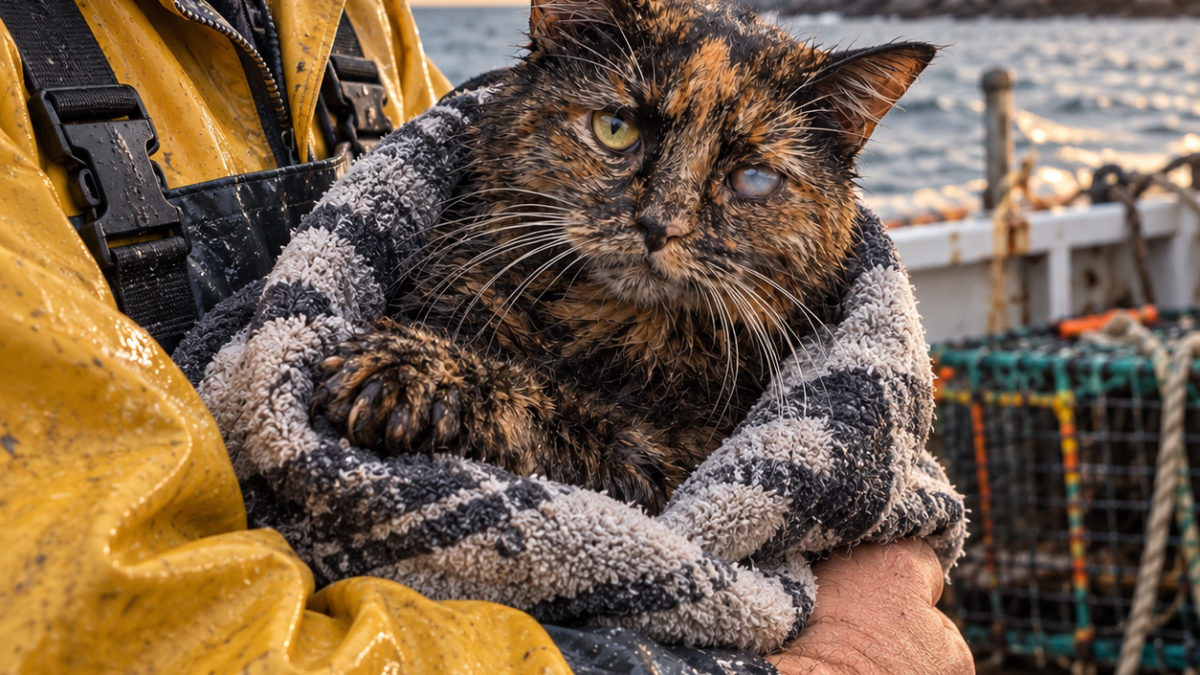
Her fur was soaked through.
The tortoiseshell pattern was barely visible beneath seawater and grime.
I could see orange patches around one cheek and black along her back.
Tiny animal.
Maybe four or five pounds.
That was all.
The tremors wouldn’t stop.
Not normal shivering.
I’ve seen men shiver after falling overboard.
This was different.
Her body vibrated continuously while her head barely moved.
Like everything inside her was failing but one primitive motor had not yet received permission to quit.
I kept one hand near her.
Not touching at first.
Then I rested two fingers lightly against her shoulder.
She felt frighteningly cold.
“Stay with me.”
Ray looked up.
“You talking to the cat?”
“Shut up.”
He smiled for half a second.
We needed that half second.
Then his face became serious again.
“How long do you think she’s been out here?”
“I don’t know.”
“Hours?”
“Had to be.”
The sun had only recently come up.
If she had fallen from a boat that morning, somebody would probably still be nearby.
No boats were close.
No distress call.
Nothing.
The harbor appeared eventually through the gray.
Before we reached the breakwater, the radio came alive.
A harbor officer was waiting.
So was someone from a local veterinary clinic.
That surprised me.
Later I learned the harbor office had called ahead.
When we tied up, Officer Brennan came onto the boat.
He looked into the jacket.
Then stopped.
“Jesus.”
“She’s stuck to the wood.”
“What do you mean?”
I lifted the edge.
He saw the claws.
“Don’t pull.”
“I wasn’t planning to.”
The veterinary technician who had come down from the clinic knelt immediately.
She took one look and said:
“We need to move her with the plank.”
Exactly.
We lifted the jacket like a sling.
Cat and wood together.
A transport crate would have been useless because her front legs were essentially attached to the board.
As we carried her toward the dock, Officer Brennan said:
“You’re not going to like this.”
I looked at him.
“What?”
“We had a call this morning about marina footage.”
I stopped.
“What footage?”
“Private marina north of here.”
Ray had come behind us.
Brennan continued:
“Something happened last night.”
“What?”
“Security camera caught two people on a recreational boat.”
My stomach tightened.
“What did they do?”
Brennan’s jaw hardened.
“Camera shows them throwing something overboard.”
“What kind of something?”
“Small.”
I looked down at the cat.
“No.”
“Timestamp was 9:47 last night.”
My hands tightened around the jacket.
“What time is it now?”
Just after nine.
Eleven hours.
I looked back at the ocean.
Three miles offshore.
Dark.
Cold.
Eleven hours.
“Where were they?”
“About three miles out.”
“And you’re telling me—”
“We don’t know yet.”
Brennan’s tone was careful.
Police careful.
“We need to identify the object conclusively.”
I looked at him.
“The object?”
He immediately understood how that sounded.
“Animal.”
I said nothing.
He continued:
“Boat has been identified.”
“People?”
“We’re working on it.”
I wanted names.
Right then.
I wanted faces.
I wanted explanations.
But the cat in the jacket moved slightly.
That pulled me back.
“Save her first.”
The technician nodded.
“Exactly.”
We drove to the clinic.
I followed behind in my truck because there was no chance I was going home.
Ray came too.
At the clinic, Dr. Mercer met us.
She had practiced for years along the coast.
Fishing injuries.
Boat accidents involving pets.
Exposure.
Hypothermia.
She’d seen plenty.
When she uncovered the cat, her expression told me this was different.
“How long?”
“Possibly eleven hours.”
She looked at me.
“In the water?”
“Back legs the whole time.”
“What was the temperature?”
“Low fifties.”
Dr. Mercer stared for a second.
Then moved.
“Treatment room.”
They put the cat on a padded table while keeping the piece of plank beneath her paws.
A technician checked temperature.
Dr. Mercer read the number.
“Eighty-six.”
I knew enough to understand how bad that was.
“What should it be?”
“Around one hundred to one-oh-two.”
Thirteen to sixteen degrees below normal.
Heart rate next.
“Forty.”
I looked up.
“Forty what?”
“Beats per minute.”
“Normal?”
“One-sixty to two hundred, approximately.”
Ray whispered:
“Jesus.”
Respiration.
Six breaths per minute.
Six.
I watched the cat’s side rise.
Wait.
Fall.
Wait.
Too much waiting between them.
“What are her chances?”
Dr. Mercer didn’t answer immediately.
That frightened me.
Finally:
“If she survived the ocean for that long, I’m not going to bet against her.”
Not exactly optimism.
But I’ll take it.
Then she examined the claws.
Even with the cat nearly unresponsive, the grip remained.
Dr. Mercer gently tried moving one paw.
No release.
She looked at a technician.
“We’ll have to sedate her.”
“Is that safe with her temperature?”
“Nothing is safe right now.”
That sentence stayed with me.
Sedation could lower blood pressure.
Stress could kill her.
Pulling her loose could destroy her toes.
Doing nothing left her attached to a dirty piece of timber while her circulation and body temperature remained critical.
They started warmed intravenous fluids.
Oxygen.
External warming.
Not aggressive.
Controlled.
A heated blanket.
Warm packs wrapped in towels.
The cat vomited suddenly.
Water.
Mostly clear.
Then again.
Then again.
Saltwater.
Dr. Mercer turned her head carefully to protect her airway.
“She’s swallowed a lot.”
“What does that do?”
“Salt load. Kidney stress. Stomach irritation. Esophagus.”
She vomited a fourth time.
My stomach turned.
How many waves had hit her face during those eleven hours?
How many times had she swallowed ocean because there was nowhere else for her mouth to go?
Dr. Mercer listened to her lungs.
“Possible aspiration. We’ll monitor.”
The sedation finally took effect.
At least we thought it had.
Her eyes closed.
Her head relaxed.
But her claws stayed buried.
The tendons did not release.
One minute.
Two.
Three.
Dr. Mercer stared.
“I’ve never seen this.”
“What?”
“She should relax.”
Her entire body was sedated.
But her front paws remained locked.
The veterinarian began working each claw loose manually.
Tweezers.
Small cutters.
Saline.
The wood was so soaked that fibers had swollen around them.
Eight of ten front claws had penetrated beyond the quick.
Three had curled around splinters underneath the surface.
Two had shattered.
I felt sick.
“She did that holding on?”
“Yes.”
“For eleven hours?”
Dr. Mercer didn’t answer.
What answer could there be?
When the final claw came free, the plank was moved aside.
For the first time since I had seen her, the cat’s paws were no longer touching it.
Dr. Mercer examined the pads.
Skin missing.
Raw tissue.
Splinters between toes.
Cuts.
They counted while removing them.
One.
Two.
Three.
Eventually:
Eighteen.
Eighteen splinters from two tiny front paws.
Ray stood near the doorway pale as a sheet.
“I need air.”
He left.
I stayed.
I don’t know why.
Maybe because I felt I’d already seen the worst.
I was wrong.
An X-ray showed no major fractures.
That was good.
Bloodwork was ugly.
Kidneys strained.
Electrolytes abnormal.
Severe dehydration despite the ocean around her.
That sounds impossible until you remember seawater is not hydration.
Drink enough of it and the salt pulls you further from safety.
Her body weight:
Four and a half pounds.
Dr. Mercer looked at her frame.
“She should probably be closer to eight.”
“So she was already underweight before?”
“Possibly.”
That bothered me.
The ocean hadn’t caused everything.
Maybe she’d already been neglected.
We couldn’t know yet.
Her left eye had a cloudy area.
Salt irritation.
Both corneas inflamed.
Her hind legs were the next concern.
They had been submerged for hours while her chest stayed partly above water.
The cold had damaged nerves.
When she began waking later, she couldn’t move either rear paw normally.
Dr. Mercer touched the left.
Some response.
Right.
Almost none.
“What does that mean?”
“Could recover.”
“Could?”
“Could be permanent.”
I looked at the cat.
She had survived eleven hours only to face a lifetime of consequences from every minute.
That made the rage arrive.
Until then, I had been too busy.
Find.
Lift.
Cut.
Radio.
Drive.
Clinic.
Now there was nothing for my hands to do.
So anger filled the space.
I looked at Officer Brennan, who had come to the clinic.
“Did you find them?”
“We know whose boat it was.”
“Did they admit it?”
“Not yet.”
“Why would anybody do this?”
“I don’t know.”
“Was it their cat?”
“We’re checking.”
“Were they drunk?”
“We’re checking.”
“You keep saying that.”
“Because that’s what investigations are.”
I hated him for being calm.
It wasn’t his fault.
“What does the footage show?”
He hesitated.
“Enough.”
“Show me.”
“No.”
“Why?”
“Evidence.”
“Brennan—”
“You don’t want to see it.”
That stopped me.
I looked at him.
He had been a harbor officer for years.
Not sentimental.
Not dramatic.
If he was telling me I didn’t want to see something, I believed him.
“What do they do?”
He answered quietly.
“One person holds the animal. The other appears to open something. Then the animal is thrown.”
My jaw locked.
“Does she hit the boat?”
“I don’t know.”
“Does she swim?”
“The camera is too far.”
“Where did the plank come from?”
“We don’t know.”
I turned toward the treatment room.
Maybe she’d hit the water.
Panic.
Darkness.
Cold.
No land visible.
No idea what direction meant safety.
Then somewhere in that black ocean, a piece of broken dock floated close enough.
She found it.
Or it found her.
She clawed onto it.
How long did that take?
Seconds?
Minutes?
Had she been swimming first?
We’ll never know.
But somehow those tiny paws reached wood.
And once they did, she never released.
Officer Brennan eventually left.
I remained.
By evening, the cat’s temperature reached ninety-one degrees.
Heart rate improved.
Still dangerous.
But movement in the right direction.
Dr. Mercer said:
“We need a name.”
“For paperwork?”
“Mostly.”
I looked at the cut section of wood leaning against the wall.
Ray had returned by then.
“Drift?”
he suggested.
I shook my head.
“Too pretty.”
“What?”
“She doesn’t need pretty.”
Ray frowned.
“Then what?”
I pointed.
“Plank.”
He stared at me.
“You’re naming a cat Plank?”
“Yeah.”
“That’s terrible.”
“That plank kept her alive.”
“You could call her Hope.”
“No.”
“Marina?”
“No.”
“Lucky?”
“Absolutely not.”
Ray sighed.
“Plank.”
I looked at the cat.
“Plank.”
The name felt right immediately.
Not because it was beautiful.
Because it was true.
That piece of garbage floating in the Atlantic had mattered more than any expensive thing in the world during those eleven hours.
Someone’s broken dock.
Rubbish.
Worthless debris.
Her entire life depended on it.
She deserved a name that remembered that.
The next morning, Plank was still alive.
That felt like victory.
Small.
But real.
Temperature:
Ninety-six.
Heart rate stronger.
Breathing improved.
Kidneys still concerning.
Left hind leg responding slightly.
Right nearly motionless.
She opened her eyes.
The left remained cloudy.
When I came near the cage, she watched me.
I reached toward the door.
Then stopped.
After what human hands had done to her, I wasn’t assuming she wanted one near her.
I placed my hand several inches away.
She stared.
Then lowered her head.
That was all.
Good enough.
Ray said:
“You know you’re adopting her.”
I looked at him.
“No.”
“Yes.”
“I fish twelve-hour days.”
“Then she’ll sleep.”
“I’ve never owned a cat.”
“You own one now.”
“That’s not how ownership works.”
He pointed toward Plank.
“She disagrees.”
Plank was asleep.
“She isn’t even looking.”
“Still.”
I ignored him.
For three days.
Then Officer Brennan called.
“They were arrested.”
I went quiet.
“Both?”
“Yes.”
“What charges?”
“Animal cruelty-related charges. There may be additional counts depending on the investigation.”
“Did they confess?”
“I can’t discuss statements.”
“Was she theirs?”
Pause.
“Evidence indicates they had possession of her before the incident.”
Not enough for me.
But close.
“Why?”
“I can’t tell you yet.”
“Because of evidence?”
“Yes.”
“Can I see them?”
“What?”
“The people.”
“At arraignment eventually, maybe.”
“I want them to see her.”
Brennan’s voice hardened.
“No.”
“Why?”
“Because this isn’t your revenge.”
That word hit me.
Revenge.
I hadn’t said it.
But maybe I had been thinking it.
I looked through the clinic window at Plank.
Her paws were wrapped.
IV line in place.
One eye cloudy.
Right leg stretched strangely.
“You’re right.”
He softened.
“Let the case happen.”
“They deserve to know she survived.”
“They will.”
“How?”
“Because she’s evidence.”
I hated that word too.
Evidence.
But this time it gave her power.
They had thrown her away as though no one would ever know.
Now the animal they expected the Atlantic to erase was alive in a veterinary clinic.
Alive.
Photographed.
Examined.
Documented.
Every damaged claw had a medical record.
Every splinter.
Her temperature.
Heart rate.
Saltwater in her stomach.
Neuropathy.
Corneal damage.
They hadn’t erased anything.
They had created evidence with a heartbeat.
That thought helped.
On day four, Plank ate voluntarily.
Not much.
A teaspoon.
Then another.
Dr. Mercer smiled.
“Good.”
“That’s enough?”
“For now.”
Plank swallowed slowly.
Her throat remained irritated.
Each bite seemed uncomfortable.
But she ate.
Day five, she tried to stand.
The front legs worked.
The left rear leg shook.
The right dragged.
She collapsed.
I moved instinctively.
Dr. Mercer held up a hand.
“Let her try.”
Plank tried again.
Front paws.
Left rear.
Right rear sliding.
She managed two steps.
Then three.
Collapsed.
I found myself smiling like an idiot.
“She walked.”
“Badly.”
“She walked.”
Dr. Mercer laughed.
“Yes.”
A week after the rescue, they removed the bandages for a longer examination.
The paw pads looked awful.
Raw.
Healing.
Several claws permanently damaged.
The roots had been injured.
Dr. Mercer said some might grow crooked.
I looked at them.
“Will that hurt?”
“Maybe on certain surfaces.”
“What can we do?”
“Keep nails monitored. Soft flooring. Watch for ingrowth.”
I mentally redesigned a house I had not yet admitted a cat would live in.
Ray noticed.
“You’re buying rugs.”
“Shut up.”
“You hate rugs.”
“Shut up.”
By week two, Plank’s body temperature and heart rate were stable.
The kidney values improved.
Not perfect.
But better than anyone expected.
Her appetite returned.
Weight moved upward slowly.
Four point seven.
Four point nine.
Five.
Every ounce felt important.
The left hind leg began functioning.
Weakly.
But she could lift it.
The right remained damaged.
She dragged the paw.
Dr. Mercer tested nerve response.
Minimal.
“Permanent?”
I asked.
“Likely some permanent deficit.”
Plank looked up from the table.
“What does that mean for her life?”
“Mostly adaptation.”
“Can she climb?”
“Probably.”
“Run?”
“Maybe differently.”
“Pain?”
“Not necessarily.”
I nodded.
“Then fine.”
Dr. Mercer looked at me.
“You’re already talking like an owner.”
I ignored her too.
Apparently everyone at the clinic had joined the conspiracy.
The saltwater damage in the left eye settled into a cloudy scar.
Bright examination lights made her squint.
That would stay.
Another permanent mark.
I began keeping a list without meaning to.
Right rear paw drags.
Left eye cloudy.
Crooked front claws.
Sensitive paw pads.
Four reminders.
Not of weakness.
Of what somebody had done.
That distinction mattered.
The local news picked up the case.
I hated that.
Cameras came to the harbor.
Reporters asked questions.
“Were you shocked?”
What kind of question is that?
“No, I routinely find cats three miles offshore.”
They didn’t appreciate my tone.
Ray did.
Another reporter asked:
“What did you think when you saw her?”
I said:
“That she needed out of the water.”
“What do you think of the people who allegedly threw her?”
I looked toward the harbor.
Then at the camera.
I knew exactly what I wanted to say.
Instead:
“I think the court can deal with them.”
“Do you want justice?”
“Yes.”
“What would justice look like?”
That question stopped me.
At the time, I thought justice meant punishment.
Later, I changed my mind.
But that day I answered:
“They threw her away expecting the ocean to finish it.”
I paused.
“She lived.”
That clip ran everywhere locally.
I regretted speaking publicly afterward.
Then letters started arriving at the clinic.
Cards.
Donations.
People offering to adopt Plank.
One envelope contained nothing but twenty dollars and a note:
FOR SOFT RUGS.
Ray laughed so hard he had to sit down.
“You’ve got a rug fund.”
“I don’t need a rug fund.”
“You absolutely do.”
I donated most of the money to the clinic’s emergency animal fund.
But I kept the note.
Soft rugs.
Because whoever wrote it understood the practical thing.
Not inspirational posters.
Not heroic language.
A cat with damaged paws needed comfortable floors.
That’s love in useful form.
Week three, sensation returned significantly to Plank’s left rear leg.
Dr. Mercer pinched gently.
Plank pulled away.
We celebrated being scratched.
The right leg responded only partially.
She learned to compensate.
Step.
Drag.
Step.
Drag.
At first, every movement looked painful to me.
The veterinarian corrected me.
“Don’t project.”
“What?”
“She isn’t necessarily suffering each time.”
“But look.”
“I am looking.”
She watched Plank cross the room.
“She has a gait difference.”
“Because of what happened.”
“Yes.”
“That doesn’t mean every step is a tragedy.”
That sentence changed how I saw her.
People love rescue animals by turning scars into constant sadness.
Plank didn’t seem interested in being sad every second.
She wanted food.
Warmth.
Windows.
And eventually my jacket.
That began during week four.
I came into the clinic wearing the same oilskin coat I’d used on the boat.
Cleaned, but still smelling faintly like the harbor.
Plank was walking around the exam room.
Slow.
Dragging the right foot.
I sat.
She looked at me.
Then approached.
That alone surprised me.
She still avoided most strangers.
Hands made her cautious.
Sudden movement made her flatten.
But she walked toward me.
Stopped at my boot.
Sniffed.
Then climbed.
Clumsily.
Front paws on my knee.
Left rear pushing.
Right dragging.
I helped under her belly.
She ended up in my lap.
Ray stood in the doorway.
“There.”
“Don’t.”
“That’s your cat.”
“Don’t.”
Plank put both front paws against my oilskin jacket.
Then her claws came out.
I froze.
She pressed them into the fabric.
Not kneading.
No alternating motion.
Both paws.
Grip.
Hard.
My chest tightened.
“Ray.”
His smile disappeared.
“I see it.”
She held on.
Exactly like the wood.
Her body leaned into me.
Claws deep.
The crooked ones caught especially hard.
I didn’t move.
Dr. Mercer entered.
She stopped.
“Oh.”
“What?”
She watched.
“Association, maybe.”
“With what?”
“The jacket. Smell. Texture.”
Plank kept gripping.
“She thinks she’s falling?”
“I wouldn’t say that.”
“Then what?”
“I don’t know.”
The honest answer.
Good veterinarian.
I stayed twenty minutes.
Plank never released until she fell asleep.
I carried that moment home.
My house overlooked the harbor.
Small.
Old.
Nothing fancy.
I had lived alone for years.
Fishing keeps strange hours and ruins plenty of relationships if both people don’t understand it.
I’d never owned an animal because I wasn’t home enough.
But after Plank, the house felt different in my imagination.
I pictured a heated bed.
Soft rugs.
Water away from open doors.
A litter box.
I hated litter boxes already and hadn’t bought one.
Ray came over one evening.
“You’re doing it.”
“Doing what?”
“Preparing.”
“I bought a rug.”
“Three.”
“How do you know?”
“You left the receipt on your truck seat.”
“Mind your business.”
“Cat trees next?”
“No.”
Two weeks later, there was a cat tree.
Low.
Because of the leg.
Ray took a photograph and threatened to show the entire harbor.
I considered throwing him overboard.
Unlike certain people, I would have given him a life jacket.
The legal case moved forward.
I attended one early hearing.
Not because I had to.
Because I wanted to see them.
Officer Brennan had warned me.
“Do not engage.”
“I won’t.”
“Do not speak to them.”
“I won’t.”
“Do not stare like you’re planning homicide.”
“That one I can’t promise.”
He sighed.
The two defendants looked ordinary.
That disturbed me more than if they had looked monstrous.
One wore a clean jacket.
The other kept looking at the floor.
Human beings expect cruelty to wear a recognizable face.
It doesn’t.
Sometimes it looks like someone standing in line at a grocery store.
Their attorneys spoke.
The prosecutor spoke.
Charges were read.
I won’t pretend the legal system moved fast.
It didn’t.
Court dates.
Paperwork.
Evidence review.
Statements.
But I heard one thing clearly.
The prosecution referenced veterinary documentation showing severe hypothermia, near drowning, saltwater ingestion, claw trauma, and nerve damage.
Plank’s injuries were read into a courtroom.
The ocean had failed to erase them.
One of the defendants looked up when her name was mentioned.
Plank.
That irritated me.
They had known her by another name, apparently.
I didn’t want it.
Plank was who she had become after surviving them.
That might sound petty.
Maybe it was.
But naming can be reclamation.
They had treated her like something disposable.
She survived with a new name tied to the object that refused to let her disappear.
That was enough.
I left before the hearing ended.
Brennan followed me outside.
“You okay?”
“No.”
“Good answer.”
I looked back at the courthouse.
“I thought seeing them would help.”
“Did it?”
“No.”
“What did you expect?”
“I don’t know.”
Maybe rage wants a face because it imagines that once it finds one, the anger will become simpler.
It doesn’t.
I drove to the clinic instead.
Plank was sleeping.
She woke when I entered.
Came toward the cage door.
Step.
Drag.
Step.
Drag.
I opened it.
She climbed into my lap.
Claws into jacket.
There.
That helped.
Not because she knew about court.
Because while people argued over what should happen to the ones who threw her into the ocean, Plank was busy learning what happened after survival.
Food.
Warm room.
Lap.
Sleep.
That became more important.
At seven weeks, Dr. Mercer called.
“She can go.”
I pretended not to understand.
“Go where?”
She stared at me.
“Your house.”
“Why mine?”
“Because adoption paperwork has your signature on it.”
I had signed it two days earlier.
“Technicality.”
“Take your cat home.”
Ray waited outside with a bag of supplies.
“You bought more?”
“Don’t want her first night ruined because you’re incompetent.”
“I hate you.”
“Plank likes me.”
“She tolerates you.”
“Same thing.”
We brought her home.
The first thing she did was hide beneath the kitchen table.
Fine.
I left food.
Water.
Bed.
She ignored the expensive bed.
Of course.
Used an old folded sweatshirt instead.
Maybe cats have a union agreement against appreciating purchases.
The ocean was visible through my front windows.
The house sits above the harbor.
I had wondered how she’d react.
The answer came the first morning.
Plank climbed onto the windowsill.
Looked out.
The Atlantic spread below.
Gray.
Cold.
Moving.
Her body froze.
Not metaphorically.
Every muscle locked.
She backed away so quickly her damaged leg slipped.
I caught her.
She fought out of my hands and disappeared under the chair.
I felt terrible.
I’d never considered that the view itself could affect her.
After that, I partially closed the lower curtains.
Not completely.
She deserved the choice.
Weeks passed.
Eventually she approached the window again.
From farther back.
Then closer.
She could look.
She just wouldn’t approach any open door leading toward the water.
The dock?
Impossible.
I tried once.
Not forcing her.
Carrying her securely.
The moment we were within twenty yards of the dock, she panicked.
Claws into my jacket.
Body twisting.
So I turned around.
Never tried again.
People asked:
“Will you desensitize her?”
No.
She did not need to prove bravery to anybody.
The ocean had already taken enough from her.
If Plank wanted to spend the rest of her life seeing water only through glass, that was fine.
The glass worked.
Safety isn’t cowardice.
That became another thing she taught me.
Her routines developed.
Breakfast early.
Naturally.
Fisherman’s cat.
She learned the sound of my boots before sunrise.
When I came downstairs, she’d be waiting.
Right rear paw dragging slightly.
Tail high.
I fed her.
Then left.
The first few weeks, I worried constantly.
What if something happened while I was offshore?
I installed cameras.
Ray mocked me.
“You became one of those people.”
“What people?”
“Cat-camera people.”
“I need to know she’s okay.”
“You check that more than the weather.”
“Weather lies.”
“Cat doesn’t?”
“Cat sleeps.”
He was right.
Mostly I watched her sleep.
Hours of footage.
A tremendous use of modern technology.
But it helped.
When I returned from fishing, Plank met me at the door.
She always sniffed the oilskin jacket first.
Salt.
Diesel.
Fish.
Cold air.
The world that nearly killed her carried home on my shoulders.
Yet she came closer.
Not away.
Then one evening she climbed into my lap.
Front paws stretched.
Claws into jacket.
Grip.
I waited.
Five minutes.
Ten.
Twenty.
My legs went numb.
Ray called.
I didn’t answer.
Plank held.
Eventually, she slept.
The grip loosened only slightly.
That became every evening.
Not occasionally.
Every evening.
I came home.
Chair by window.
Plank climbed up.
Claws into oilskin.
Held.
Sometimes an hour.
At first, I wondered whether I should discourage it.
Her nails were crooked.
Fabric caught.
Could hurt.
Dr. Mercer checked.
“As long as you’re monitoring her claws and she’s not injuring herself, let her.”
“Why does she do it?”
“We can’t know.”
“Memory?”
“Maybe.”
“Trauma?”
“Possibly.”
“Security?”
“Likely.”
I hated vague answers.
But animals do not owe us explanations.
Eventually I stopped asking.
She held because she needed to hold.
I stayed because I could.
Simple.
Winter came.
Maine winter.
Snow.
Ice.
Harbor partly frozen.
Plank hated the cold coming through an open door.
She retreated whenever I brought firewood inside.
I installed a second barrier so she couldn’t accidentally escape.
The woman at the hardware store asked:
“Baby?”
“Cat.”
She nodded as though that made complete sense.
Apparently I had become recognizable.
“You’re the fisherman.”
“Unfortunately.”
“With the ocean cat.”
“Her name is Plank.”
She smiled.
“I know.”
Local fame is strange.
People at the grocery store asked about her kidneys.
Men at the harbor asked about her paw.
Children sent drawings.
One drawing showed Plank surfing on a board wearing sunglasses.
I put it on the refrigerator.
Completely inaccurate.
Still my favorite.
The court case continued.
I stopped attending most hearings.
Brennan kept me informed where he could.
The two people had been identified from marina video, registration records, witness information, and other evidence.
The case was real.
That was enough for me.
I had once wanted some huge punishment that would make what happened feel balanced.
But nothing could balance eleven hours in the ocean.
You cannot sentence someone to the exact terror they caused an animal.
And maybe you shouldn’t.
Law isn’t revenge.
It is boundary.
Record.
Consequence.
A public statement:
This was not acceptable.
That began to matter more.
The marina added better monitoring.
Harbor officers talked with boat owners.
Local rescue groups used Plank’s case to raise awareness about animal cruelty.
People who might once have dismissed a missing cat as “just an animal” now saw the photograph of those claws buried in wood.
Evidence changes conversations.
Plank became unwillingly famous.
She didn’t care.
Food.
Jacket.
Window.
That’s all.
Spring came.
Her right hind leg improved enough that the drag became subtle.
Still present.
Always.
On wood floors, you could hear it.
Tap.
Scrape.
Tap.
Scrape.
At first, the sound made me sad.
Then it became one of the sounds that meant home.
I’d wake at night.
Tap.
Scrape.
Plank walking down the hall.
No sadness.
Just:
She’s here.
Her left eye stayed cloudy.
Morning sunlight made her squint.
So I adjusted blinds.
Her front claws grew back.
Several curved inward.
I learned how to trim them carefully.
The first attempt nearly ended with my own medical emergency.
Ray found this hilarious.
“You’ve handled lobsters for thirty-one years.”
“Lobsters don’t twist.”
“They absolutely twist.”
“Not like this.”
Plank escaped under the couch.
I had scratches.
“Hero fisherman defeated by four-pound cat.”
“She weighs seven now.”
“Oh, excuse me.”
By summer she reached almost eight pounds.
Healthy.
Her coat became thick.
Tortoiseshell colors bright.
The skinny, yellow-eyed creature on the plank disappeared physically.
But not entirely.
Certain things remained.
Water.
No.
Dock.
No.
Unexpected grabbing.
No.
Hands above her head sometimes made her flatten.
We respected that.
Visitors were told:
Let her approach.
She usually did.
Especially if they had fish.
Ray became her second favorite person.
He pretended not to care.
“Cats are useless.”
Plank sat on his lap.
“Completely useless.”
He stroked her for forty minutes.
“Wouldn’t have one.”
Bought her treats the next week.
Typical.
One evening, nearly a year after the rescue, Ray sat with me watching the harbor.
Plank had her claws embedded in my jacket.
He stared.
“She still does that.”
“Every night.”
“Does it hurt?”
“Sometimes.”
“Why don’t you move her?”
I looked at him.
“Why would I?”
“Because you’re bleeding.”
I looked down.
One claw had caught through the fabric.
Tiny spot on my wrist.
“Fine.”
“You’re ridiculous.”
“Probably.”
Plank tightened her grip when a truck passed outside.
Then settled.
Ray looked at her.
“Think she remembers?”
“Yes.”
No hesitation.
“Everything?”
“No idea.”
“Think she knows you pulled her out?”
“No.”
He looked surprised.
“What?”
“I don’t think she understands the story like we do.”
“Then why you?”
I thought.
Because I smelled like the boat.
Because she woke at the clinic and saw me repeatedly.
Because I fed her.
Because I was there.
Because cats build trust from repetition, not mythology.
“She knows I’m safe.”
Ray nodded.
Maybe that was better.
Being safe matters more than being a hero.
I stopped thinking of myself as the man who saved Plank.
I was the man who happened to be there when she needed the boat.
She did the impossible part.
Eleven hours.
I drove the last mile.
There is a difference.
The veterinarian once told me something similar.
“You didn’t save a weak cat.”
“What?”
“People frame her as helpless.”
“She was dying.”
“Yes.”
“But?”
Dr. Mercer smiled.
“You found an animal who had already spent eleven hours saving herself.”
That changed how I told the story.
I found her.
I didn’t create her survival.
The plank didn’t either.
It helped.
But Plank chose—or instinctively managed—to keep her claws there minute after minute beyond what anyone could explain.
There is humility in rescue.
You arrive late.
The animal has often been fighting long before you know there is a fight.
Years of fishing taught me the sea doesn’t care about courage.
It doesn’t reward strength.
It isn’t cruel either.
The ocean has no intention.
It just is.
That is why what happened to Plank angered me so much.
She did not accidentally fall overboard.
A storm didn’t sweep her away.
Human hands deliberately put her into something indifferent enough to kill her without effort.
That distinction mattered.
The sea wasn’t the villain.
People were.
I still loved the ocean.
That surprised some people.
“How can you go back out after what happened?”
Because the water didn’t throw her.
Humans did.
Plank understood none of that philosophy.
She simply refused the dock.
Fair.
One afternoon, Officer Brennan visited my house.
Plank hid initially.
Then emerged.
He hadn’t seen her since the clinic.
“That’s the same cat?”
“Yeah.”
“She looks…”
“Fat?”
“Normal.”
I liked that word.
Normal.
Not survivor.
Not evidence.
Not cruelty case.
Cat.
Normal cat.
Brennan crouched.
Plank sniffed his hand.
Then walked away.
“Rejected.”
“Don’t take it personally.”
He smiled.
Then became serious.
“The case is nearing resolution.”
I looked at him.
“What does that mean?”
“I can’t discuss everything until it’s public.”
“Okay.”
“But they are facing consequences.”
I nodded.
For once, I didn’t ask details.
That surprised him.
“You don’t want to know?”
“I will when it’s done.”
He looked toward Plank.
“What changed?”
I thought.
“Her.”
Plank jumped onto the windowsill.
Ocean behind glass.
“She doesn’t spend her day thinking about them.”
“How do you know?”
“I don’t.”
I watched her tail flick.
“But I do know I was spending too much time thinking about them.”
Brennan nodded.
“Fair.”
“I’d rather spend it thinking about what she needs.”
“That may be the healthiest thing I’ve heard from you.”
“Don’t tell Ray.”
“Never.”
Justice came.
Not in some cinematic way.
No screaming courtroom confession.
No one dragged away while crowds applauded.
The two individuals faced the animal cruelty charges generated by the evidence investigators had collected.
The marina footage existed.
The boat was identified.
Plank existed.
Her injuries existed.
The veterinary findings existed.
There was a record.
What mattered most to me was simple:
Nobody could say it hadn’t happened.
Nobody could pretend the animal had wandered into the ocean.
Nobody could rewrite the night.
The attempt to make her disappear failed.
She survived long enough for the truth to reach shore.
That was enough revenge for me.
They threw a cat into darkness believing they were ending her story.
Instead, they created the first chapter of the life everyone would remember.
I don’t mean that in the sentimental way.
I would erase those eleven hours if I could.
Take away the limp.
Fix the eye.
Straighten every claw.
Return every piece of skin to her paws.
I would choose a boring life for her over an inspiring survival story every time.
People sometimes say:
“Everything happens for a reason.”
No.
Some things happen because people do terrible things.
The reason comes later if we decide to build one.
Plank survived.
That’s not justification for what happened.
It is defiance of it.
There is a difference.
Her second year with me was uneventful.
That’s another way of saying perfect.
No rescues.
No court calls.
No major medical emergencies.
Breakfast.
Fishing.
Window.
Chair.
Jacket.
Repeat.
She became territorial about my bed.
Learned cabinet doors.
Discovered lobster smells.
Attempted to steal bait once.
That led to a stern conversation.
“You are not eating that.”
Plank disagreed.
“You nearly died in the Atlantic and this is what you do with your second chance?”
She stole a piece anyway.
Ray said:
“She’s from Maine now.”
Apparently.
The harbor community adopted her symbolically.
One guy made a little wooden plaque:
PLANK — HARBOR SURVIVAL OFFICER.
I refused to hang it.
Ray hung it on my shed.
It remains.
Tourists occasionally ask where Plank is.
I point toward the house.
“Inside.”
“Can we see her?”
“No.”
“Why?”
“Because she’s a cat, not a lighthouse.”
They usually laugh.
I’m serious.
Her life belongs to her now.
Not to the story.
Not to the public.
Not even entirely to me.
She earned privacy.
I gave one final radio interview about two years after the rescue.
The host asked:
“What do you remember most?”
Everybody expects:
Finding her.
Cutting the plank.
The clinic.
I said:
“Her claws.”
“Why?”
“Because I still can’t understand it.”
The host waited.
“I know what cold does to muscle.”
I spent my life around water.
“Hands stop working.”
“Cramping.”
“Grip fails.”
“Yet she held eleven hours?”
“That’s the estimate.”
“How?”
“I don’t know.”
“Willpower?”
Maybe.
Maybe not.
We use that word when biology exceeds our explanation.
I said:
“People call it the will to live.”
Pause.
“I pulled it out of the water.”
The studio became quiet.
“I had to cut her loose because she physically couldn’t release the thing keeping her alive.”
The host asked:
“Does she still grip things?”
I looked toward the glass window of the studio.
Ray had driven me.
He was smiling because he knew the answer.
“Yes.”
“What?”
“My jacket.”
“Every day?”
“Every evening.”
“Why?”
“I don’t know.”
Then I added:
“So I let her.”
That became another quote people shared.
They left out the important part.
For as long as she needs.
That is the entire philosophy of our house.
Hold on as long as you need.
No one is throwing you anywhere.
No one is pulling your claws free before you’re ready.
If you want the window, take it.
If you don’t want the dock, don’t.
If you need my jacket for an hour, I’ll sit.
Her life had contained one moment when she had no choice.
Everything after should contain as many choices as possible.
Dr. Mercer liked that.
“Trauma-informed cat ownership.”
“Is that a thing?”
“It is now.”
Plank turned five.
Approximately.
We don’t know her exact birthday.
I chose the rescue date.
Ray objected.
“That isn’t her birthday.”
“Close enough.”
“That’s the day you found her.”
“Then it’s the day her second life started.”
He stopped arguing.
We gave her salmon.
Not cake.
She approved.
The left eye remained cloudy.
The right leg still dragged when she was tired.
Her claws remained crooked.
The paw-pad scars became smooth but sensitive.
I covered rough thresholds.
Added rugs.
The original soft-rug note stayed in a kitchen drawer.
Sometimes I read it.
FOR SOFT RUGS.
Simple kindness from somebody whose name I never knew.
Plank’s story contained terrible humans.
It also contained dozens of strangers who cared.
I try to remember both.
Cruelty gets headlines.
Kindness does maintenance.
The harbor officer who waited.
Technician who drove early.
Veterinarian who worked for hours.
Ray bringing supplies.
People donating.
Someone sending twenty dollars for rugs.
The legal system documenting.
Neighbors checking her when weather trapped me.
All of that formed the life after.
You cannot repair harm by pretending the harm didn’t happen.
You build enough care around the survivor that harm stops being the largest thing in the picture.
Plank became larger than what they did to her.
Not physically.
Still a small cat.
But the story.
Her life.
Eventually, when people asked about her, I stopped beginning with the ocean.
I said:
“She hates closed bathroom doors.”
“She steals fish.”
“She sleeps on my coat.”
“She drags one foot.”
“She’ll bite you if you trim the wrong claw.”
That’s who she is.
The ocean is history.
Important.
Not identity.
Sometimes, though, the past surfaces.
Storm nights are hard.
Wind hits the windows.
The harbor grows loud.
Plank becomes restless.
She doesn’t hide.
She looks for me.
Then jacket.
Grip.
On those nights, she holds harder.
I stay longer.
Once during a northeast storm, she hooked both paws so deeply into the oilskin I couldn’t stand without taking her with me.
I had to use the bathroom.
I waited forty-five minutes.
Ray later said:
“You’ve lost control of your own house.”
Correct.
Worth it.
When the storm ended, Plank slept.
I watched the water through the window.
I thought about that September night.
No warm room.
No human.
No chair.
Only a plank.
I’ve wondered whether she slept at all.
Probably not.
Whether waves washed completely over her.
Probably.
Whether she nearly released a hundred times.
Maybe.
Whether animals understand death.
I don’t know.
We ask too many questions they cannot answer.
The body understands danger.
That’s enough.
Her body chose grip.
And grip became survival.
There is one photograph from the rescue I rarely look at.
Ray took it after we reached shore.
Plank wrapped in my oilskin.
Piece of plank still attached.
Her eyes open.
She looks dead.
I hate it.
There are later photographs I prefer.
Plank asleep upside down.
Plank in the window.
Plank attacking a paper bag.
Plank sitting on Ray’s jacket while he protests.
Plank fat.
Fat is good.
People want the dramatic image because that’s where the story appears obvious.
I like the boring images.
Boring is the victory.
A cat near death becoming an animal with opinions about dinner.
That’s the ending.
One summer afternoon, years after I found her, I repaired a fence near the dock.
Plank watched from inside.
Door closed.
Window glass between her and the ocean.
I held up a new board.
She followed it with her eyes.
I laughed.
“Don’t worry.”
The wood was nothing like the original plank.
Fresh cedar.
Dry.
Clean.
Still, I thought about naming.
Plank.
Ray once asked whether I regretted giving her such an ugly name.
No.
Beautiful names are easy.
Plank tells the truth.
Something ordinary saved her.
That matters.
We think salvation should arrive beautifully.
Lifeboat.
Rescue helicopter.
Hero.
Sometimes it’s rotten wood.
Sometimes the thing keeping you alive looks like trash to everyone else.
Who cares?
If it floats, hold.
If it gets you through the night, hold.
That isn’t philosophy Plank chose.
It’s something humans can borrow from her.
Still, I don’t tell people “never let go.”
Sometimes letting go is healthy.
Sometimes survival means releasing what hurts.
Plank’s story is specific.
For eleven hours, the correct choice was grip.
Later, the correct choice was learning she could sleep without gripping wood.
Then learning a jacket could be held without waves beneath her.
Healing isn’t always holding.
It’s learning when holding is no longer the only thing between you and death.
Plank still grips my jacket.
But then she releases.
That’s progress too.
The first year, she might hold an hour.
Now some nights ten minutes.
Then claws retract.
She stretches.
Sleeps.
I notice every time.
I never celebrate aloud.
Let her choose.
Her body knows.
As I grow older, fishing gets harder.
Thirty-one years became thirty-two.
Then thirty-three.
Hands stiff.
Back sore.
Ray says we should reduce days.
He’s right.
I hate that.
Plank waits regardless.
If I’m home early:
Jacket.
Lap.
Grip.
If weather keeps us in port all day, she sometimes grips a dry sweater instead.
Not as strongly.
Oilskin remains preferred.
Salt.
Diesel.
Familiar.
Strange that the smell of the world that hurt her became attached to the man who brought her out.
Trauma is not logical.
Neither is comfort.
Sometimes they share a scent.
I’ve considered washing the jacket more.
Ray said:
“Don’t.”
“Why?”
“That’s her thing.”
He understands now.
The original section of plank stayed at the veterinary clinic for a while.
Evidence photographs were taken.
After legal requirements ended, someone asked whether I wanted it.
I said no.
Then changed my mind.
Not for the house.
I gave it to the harbor rescue office.
They mounted a small portion—not the entire bloody, damaged thing—in a private training area.
Not tourist display.
Not spectacle.
A reminder.
Officer Brennan added a note:
CHECK WHAT YOU THINK IS DEBRIS.
I liked that.
Because I almost didn’t.
That’s another part that bothers me.
We see wood constantly.
What if I’d turned ten degrees differently?
What if fog were thicker?
What if I looked down at the radio?
What if the plank rolled?
Those thoughts go nowhere useful.
But one lesson remains.
Look twice.
At sea especially.
Things that look dead sometimes aren’t.
Things that look like trash may be carrying life.
Ray became fanatical after that.
“Debris port side.”
We look.
“Buoy?”
We look.
“Bird?”
We look.
Most times nothing.
Once we found a young seal tangled in line.
Called marine rescue.
Another time an injured seabird.
Plank made us more annoying fishermen.
Good.
Maybe that’s part of her revenge too.
Someone treated her like garbage.
Now because of her, we look more carefully at everything floating.
The opposite of disposal.
Attention.
One winter, Dr. Mercer visited for dinner.
Plank sat in her lap.
I was offended.
“She never sits with anybody that quickly.”
“She remembers competent medical care.”
“You drugged her.”
“For her own good.”
“Still.”
Plank purred.
Dr. Mercer touched one crooked claw.
“She’s doing beautifully.”
“She still drags the leg.”
“Yes.”
“Eye still cloudy.”
“Yes.”
“Paws sensitive.”
“Yes.”
I looked at her.
“You call that beautifully?”
She smiled.
“Yes.”
Then explained something I needed.
“Outcome isn’t absence of permanent injury.”
I listened.
“Outcome is whether she can live comfortably with what remains.”
Plank rolled onto her side.
Belly exposed.
“Looks comfortable.”
Exactly.
We cannot make the story perfect by erasing scars.
The scars are real.
A satisfying ending does not require pretending the damage vanished.
Plank’s body remembers.
So does mine, in a different way.
I cannot go three miles offshore at night without thinking about her.
But both of us continue.
That’s enough.
Years after the case ended, I saw one of the people involved outside a store.
By accident.
I recognized the face.
They recognized me.
For a moment, neither moved.
Old anger came back instantly.
Hot.
Fast.
I could have crossed the parking lot.
Said something.
Asked why.
Demanded an explanation that could never be good enough.
Instead, I stood.
Then thought about Plank at home.
Probably asleep.
Safe.
No idea this person existed.
I got into my truck.
Drove away.
That might disappoint people who like revenge stories.
But here’s what I’ve learned.
The best revenge was already complete.
They intended for Plank to disappear beneath the Atlantic.
She didn’t.
They intended darkness to hide what happened.
A camera saw.
They intended water to erase evidence.
A fisherman found her.
They threw away a living creature like bait.
She became loved by an entire harbor.
They gave her nothing but death.
She took a floating scrap of wood and turned it into eleven more hours.
Then years.
How could I improve on that?
I couldn’t.
So I went home.
Plank met me at the door.
Oilskin smelled of salt.
She followed me to the chair.
Climbed up.
Front paws out.
Claws into fabric.
I looked down.
“Yeah.”
She held.
I let her.
That was the answer I needed.
Not why.
Not punishment.
This.
A cat who should have been dead warm in my lap.
The ocean outside.
Glass between.
Home around.
One evening, another fisherman asked me whether I thought Plank forgave the people who did it.
I laughed.
“Cats don’t do courtroom philosophy.”
“You know what I mean.”
“No, I don’t.”
“Does she carry anger?”
“How would I know?”
He looked toward her.
Plank was sleeping.
I said:
“I think humans obsess over forgiveness because we want stories to feel finished.”
He waited.
“I don’t know what she feels about the past.”
I touched one crooked claw.
“But she trusts me now.”
That seemed more useful.
Healing isn’t required to look like forgiveness.
Maybe Plank would panic near water forever.
Fine.
Maybe hands moving too fast would always frighten her.
Fine.
She doesn’t owe the world a complete recovery to prove the rescue succeeded.
She gets to remain affected.
She gets to be safe anyway.
That is something people often misunderstand.
Survivors are not inspirational machines.
They don’t need to erase evidence of harm to make us comfortable.
Plank limps.
Her eye clouds.
Her claws curve.
And she has a good life.
Both truths.
Every September, the rescue date comes.
I don’t throw parties anymore.
First few years, people sent cards.
Now mostly Ray remembers.
He’ll say:
“Eleven-hour girl.”
I tell him not to call her that.
Then give Plank salmon.
She has no idea why.
Good.
The anniversary belongs more to me than her.
I stand at the window sometimes.
Look toward the stretch of water where we found her.
Ocean changes constantly.
No marker.
No coordinates anyone visiting would recognize.
Just water.
That feels right.
The place doesn’t deserve a monument.
Plank is the monument.
Alive.
Older.
Annoying.
Hungry.
One year, on the anniversary, I took the original oilskin jacket out of storage.
It had been repaired several times.
Tiny punctures everywhere from Plank.
I could buy a new one.
I own newer ones.
But she prefers that coat.
So it stays beside the chair.
A fisherman keeping a punctured jacket for a cat.
Thirty-year-old me would have laughed.
Thirty-one-years-at-sea me knows better.
Objects matter because stories settle into them.
Plank knew that before I did.
She chose rotten wood.
Then oilskin.
Things that held.
At night, the harbor lights reflect across the water.
Plank watches from the window.
Her good eye follows moving lights.
Cloudy left one squints sometimes.
She never touches the glass.
Just looks.
I wonder what she sees.
Not emotionally.
Literally.
Blurred water on one side.
Clearer on the other.
Maybe waves.
Maybe only light.
Doesn’t matter.
She has distance.
Choice.
Dry floor.
When she turns away, the ocean stays outside.
That is her victory.
My favorite evenings are boring.
I come home.
Boots wet.
Hands smelling like bait.
Hang gear.
Sit.
Plank arrives.
Step.
Drag.
Step.
Jump—less graceful than healthy cats, but effective.
Lap.
Front paws.
Grip.
The claws catch.
Sometimes hard enough I feel through fabric.
I place one hand gently on her back.
No pressure.
No attempt to release.
Eventually she sighs.
I’ve learned cats do that.
Then she watches the water.
So do I.
Two creatures with very different relationships to the same ocean.
It gave me a living.
Nearly took her life.
Neither of us needs the other to feel the same way about it.
That’s another kind of respect.
When people ask why I never try to take her onto the boat now, I stare at them.
Why would I?
For a cute photograph?
To prove she conquered fear?
No.
Courage is not returning to every place that hurt you.
Sometimes courage is refusing.
She doesn’t owe the dock reconciliation.
She doesn’t owe the Atlantic forgiveness.
Window is enough.
Home is enough.
I once told Ray:
“If she never touches water again, good.”
He nodded.
“Agreed.”
“Except drinking.”
“Obviously.”
We laughed.
Plank was asleep.
The ocean existed without her.
That is how it should be.
Sometimes I think about the exact moment her claws found wood.
I imagine darkness.
Maybe no moon.
Cold so brutal the body stops feeling correctly.
Waves lifting her.
Salt in eyes.
Salt in mouth.
Hind legs weakening.
Then something touches a paw.
Wood.
Did she understand?
No.
Instinct.
Claw.
Grip.
Another claw.
Grip.
Then do not release.
Eleven hours.
People say she was lucky.
Yes.
The plank was luck.
The fisherman was luck.
The camera was luck.
The harbor officer.
Clinic.
All luck.
But luck didn’t keep those claws inside wood hour after hour.
Plank did that part.
I respect that.
There’s a photograph Dr. Mercer gave me of the plank after the claws were removed.
Tiny punctures.
Deep grooves.
Fibers torn.
You can trace where each claw entered.
I keep it in a drawer.
Not displayed.
Sometimes I look.
It resembles nothing.
Just damage to old timber.
Unless you know.
Then it becomes a record.
A body’s refusal.
People talk about “the will to live” as if it is noble and clean.
Maybe sometimes it’s ugly.
Bleeding paws.
Broken claws.
Vomiting seawater.
Shaking until muscles fail.
Nothing poetic.
Survival often looks terrible while it is happening.
Poetry comes later.
Warm house.
Window.
Oilskin.
That’s the part I prefer.
If I ever stop fishing, I imagine Plank will be confused.
No wet boots.
Less diesel.
No daily jacket ritual from the harbor.
Maybe I’ll still put on the oilskin.
Ray says that’s pathetic.
He’s probably right.
But Plank likes consistency.
So do I.
I’ve already decided retirement will include a chair beside the same window.
Maybe more mornings home.
She’ll be older too.
Two retirees.
One with a damaged back.
One with damaged paws.
Could be worse.
When I think about the people who threw her overboard now, I feel less anger than I expected.
Not none.
Never none.
Some acts deserve anger.
But rage stopped being useful.
The case created a consequence.
The community knew.
The evidence stood.
What happened couldn’t be buried.
I focus on the rest.
They gave her one night of horror.
They do not get every night after.
That’s the line I draw.
Her life belongs here now.
Not in their act.
That’s the revenge.
Taking the story away from the people who tried to end it.
They are a paragraph.
Plank is the rest of the book.
She survived seven weeks of treatment.
Years of mornings after.
Thousands of meals.
Hundreds of naps.
Countless evenings gripping my coat.
That’s scale.
Eleven terrible hours cannot compete forever with years of safety if we keep adding safe days.
Maybe that is how recovery works.
Not deleting the worst night.
Outnumbering it.
One good day.
Another.
Another.
Until the calendar contains more home than ocean.
Plank’s scars remain.
But the math changed.
I like that.
If I had found her one hour later, Dr. Mercer believes her heart might have stopped.
One hour.
Sometimes I think about that while hauling traps.
What was I doing an hour before?
Probably swearing at a tangled line.
Drinking coffee.
Ordinary.
While Plank’s body was approaching its final limits.
Life contains simultaneous worlds we know nothing about.
Someone drinking coffee.
Someone drowning.
Someone driving.
Someone waiting.
Then paths cross.
Responsibility begins at the crossing.
You cannot save what you don’t know exists.
But once you see?
You act.
That part is simple.
I saw her.
Cut the wood.
Brought her in.
Everything else grew from that.
People call me a hero sometimes.
I hate it.
A hero implies something extraordinary.
Any decent person would have pulled her out.
Ray would.
Brennan would.
Dr. Mercer would.
The extraordinary thing was the cat.
I tell people:
“I showed up at hour eleven.”
She handled one through ten.
That usually silences them.
Good.
Plank is older now.
Approximately five became six.
Then more.
Time does what it does.
Her right paw drags more when she’s tired.
I added another rug.
The soft-rug person would approve.
Her left eye needs drops occasionally.
Claws monitored.
Still crooked.
Still strong.
Maybe stronger than necessary.
She grips.
I stay.
Some evenings she releases after five minutes.
Other evenings an hour.
Storm nights longer.
No rule.
I don’t rush.
I once had dinner burn because I wouldn’t move her.
Ray said:
“You could have picked her up.”
“No.”
“She would’ve survived.”
“Not the point.”
“What is the point?”
I looked at Plank.
“She gets to decide when she lets go now.”
Ray became quiet.
That’s the entire story, maybe.
Someone else once decided she would be thrown away.
Now she gets choices.
Food.
Window.
Distance.
Touch.
Grip.
Release.
Her own timing.
Freedom can be very small.
A paw unclenching when it chooses.
Every night, before bed, I walk through the kitchen.
Plank follows.
Water bowl.
Food.
Then bedroom.
She sometimes sleeps on a chair beside the bed.
Sometimes on the bed.
Never under blankets.
Too trapped, maybe.
I don’t know.
I don’t insist.
Morning comes.
Ocean still there.
We continue.
If I could speak to the two people who put her overboard—and I don’t want to—I would not threaten them.
Wouldn’t shout.
I think I’d tell them one thing.
“You failed.”
That’s all.
You wanted her gone.
Failed.
You wanted darkness to hide it.
Failed.
You wanted the water to finish what you started.
Failed.
You treated her as disposable.
Failed.
The cat you considered worthless became important to fishermen, veterinarians, harbor officers, strangers, and me.
She got a name.
A home.
Years.
Your act did not become the ending.
That is enough.
I wouldn’t need them to answer.
Plank already did.
Every step of that dragging rear paw is an answer.
Every crooked claw.
Every meal.
Every evening.
Every time she sleeps deeply enough to dream.
Failed.
There is satisfaction in that word.
Not because suffering became worthwhile.
Because cruelty did not achieve its intended result.
People like clean endings.
The bad people punished.
The animal fully healed.
Hero rewarded.
Life is not clean.
Plank’s right leg never fully recovered.
Her left eye never cleared.
Several claws never grew normally.
She still fears water.
She still grips my jacket like release means death.
Those facts remain.
But the ending is still good.
Because good doesn’t mean untouched.
Good means safe enough to live with what remains.
She is safe.
Loved.
Fed.
Warm.
Home.
That’s a complete ending in my book.
One evening, years after the rescue, the sky turned orange over the harbor.
Rare clear sunset.
Water almost calm.
Plank sat on my lap.
Oilskin across my knees.
Claws hooked.
I scratched behind her ear.
She looked toward the window.
I thought about the first time I saw her face.
Eyes open.
No expression.
Body shaking.
Chin on wood.
I had wondered whether she even knew I was there.
Now I knew exactly how she’d react if I tried getting up.
She’d tighten.
So I stayed.
Sun dropped.
Harbor lights came on.
My legs cramped.
Didn’t matter.
Eventually, one front paw loosened.
Then the other.
Claws slid out.
Plank stretched.
Turned in a circle.
Curled against my stomach.
No grip.
Just sleep.
I looked down.
That moment meant more than all the dramatic parts.
She let go.
Not into water.
Into safety.
That’s the difference a home made.
People often ask why I named her Plank instead of something prettier.
I still give the same answer.
Because pretty had nothing to do with surviving that night.
The plank was ugly.
Broken.
Waterlogged.
Probably torn from somebody’s dock and forgotten.
No one wanted it.
No one valued it.
Then a four-and-a-half-pound cat found it in the Atlantic, and suddenly it became the most important object in the world.
Value changes depending on who’s drowning.
I like remembering that.
Sometimes what saves you isn’t beautiful.
Sometimes it’s simply there.
Solid enough.
Floating enough.
Enough for one more hour.
Then another.
Then another.
Until morning.
Plank deserved that name because the wood mattered.
But she also deserved it because she and that piece of timber had something in common.
Both had been discarded.
Both were supposed to disappear into the ocean.
Neither did.
She held onto it.
It held her.
And eventually, I found them both.
I don’t have the original plank anymore.
I don’t need it.
Plank is here.
When I come home tonight, my boots will be wet.
The oilskin will smell like salt and diesel.
I’ll sit in the same chair.
She’ll come from wherever she’s sleeping.
Step.
Drag.
Step.
Jump.
Then both paws will stretch across my chest.
The crooked claws will sink into the old jacket.
And she’ll hold.
I won’t tell her to stop.
I won’t pry her loose.
I won’t decide she’s been holding long enough.
I’ll put one hand on her back and look through the window at the ocean with her.
Maybe ten minutes.
Maybe an hour.
However long she needs.
Because there was one night when letting go meant death, and her entire body learned that lesson harder than any animal ever should have had to.
Now she lives in a house where holding on doesn’t have to hurt.
And when she’s ready, she releases.
Every time.
That’s the part I wish people understood.
Plank’s greatest victory was not that she held on for eleven hours.
It was that she eventually learned she could let go and still be safe.
The Atlantic didn’t get her.
The people who threw her didn’t get the last word.
The cold didn’t get her.
The salt didn’t get her.
The broken claws didn’t get her.
The damaged leg didn’t get her.
The dark didn’t get her.
She came home.
And after a lifetime-defining night spent gripping one useless piece of floating wood with everything she had, she finally found something stronger to hold onto.
Not because she was still drowning.
Because she wasn’t anymore.
So I let her hold on.
For as long as she needs.
She’s earned that grip.



