PART 2: THEY STARVED HARVEY UNTIL HIS BODY BEGAN EATING ITS OWN MUSCLE—THEN DUMPED HIM JUST THREE MILES FROM HOME
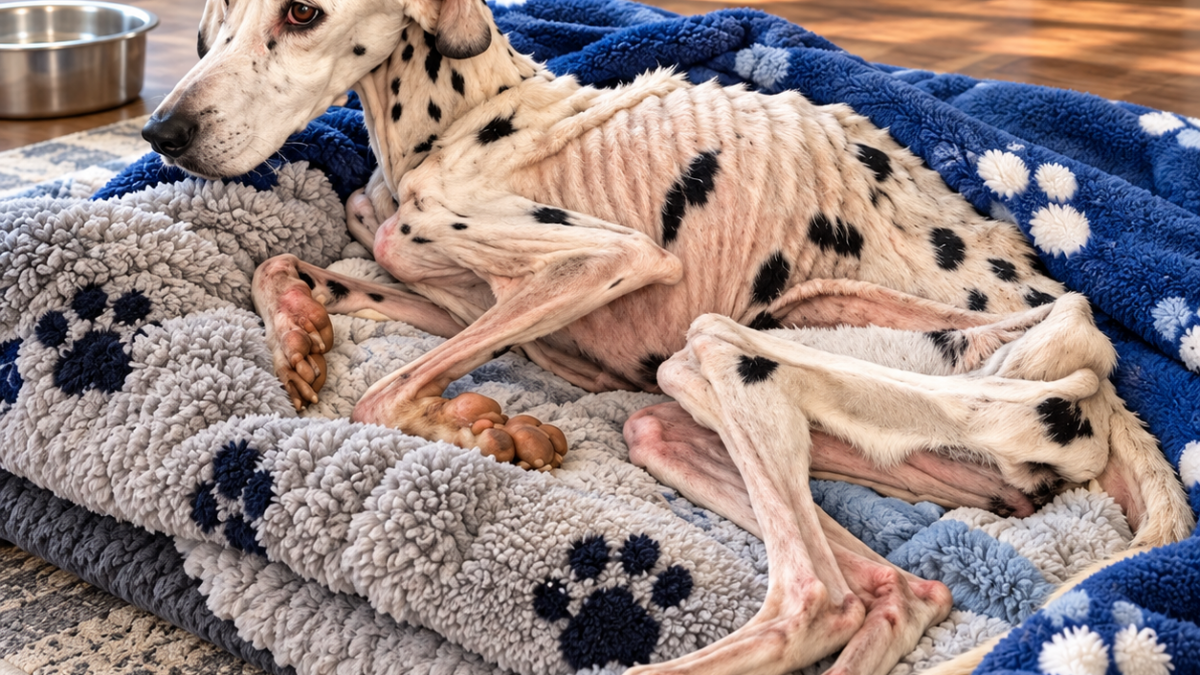
PART 2
The first meal looked insulting.
That is the only way I can describe it.
After seeing Harvey’s body, after tracing every rib with my eyes and watching his legs shake simply because he was standing, I expected the veterinarian to bring him a bowl filled to the top.
Instead, she brought a tiny measured portion.
I stared at it.
“That’s all?”
“For now.”
“He’s starving.”
“Yes.”
“He’s going to think we’re starving him too.”
The veterinarian sat beside me.
“His body is not working like a healthy dog’s body right now.”
“I understand that.”
“I don’t think you do yet.”
She pointed gently toward Harvey.
“His metabolism has adapted to prolonged deprivation. His electrolyte balance is fragile. His heart is fragile. His organs are fragile. If we suddenly load him with calories, especially carbohydrates, we could create a rapid shift that his body can’t compensate for.”
I looked from her to the food.
“So feeding him could kill him.”
“Feeding him incorrectly could.”
That sentence terrified me more than anything I had heard so far.
We finally had Harvey somewhere safe.
There was food within reach.
And still we had to hold ourselves back.
The first measured meal was placed in front of him.
Harvey lifted his head.
The effort alone seemed enormous.
His nose moved.
He smelled it.
Then he tried to stand.
His front legs trembled.
“Stay down,” I whispered.
He ignored me.
Food existed.
That was all that mattered.
We slid the dish closer so he wouldn’t have to move.
Harvey ate.
Slowly at first.
Then faster.
Too fast.
“Easy,” the veterinarian said.
We moved the bowl back slightly.
Harvey’s eyes followed it.
The look on his face hurt me more than if he had cried.
He did not understand measured feeding.
He understood hunger.
Weeks of it.
Maybe longer.
His body had learned that food could disappear.
We were asking him to trust that another meal would come.
That became the first promise we had to prove.
Not with words.
With repetition.
Meal one.
Then meal two.
Then meal three.
Eight tiny meals every day.
Same careful measurements.
Same monitoring.
Bloodwork.
Temperature.
Hydration.
Heart rate.
Weight.
Electrolytes.
Every bite mattered.
Every number mattered.
The first day, Harvey mostly slept.
His body had almost nothing to spare.
He would wake for food, eat, then sink back down.
Sometimes someone touched him and his tail moved.
That tiny motion became our emotional lifeline.
One of the veterinary technicians knelt near him after a meal.
“Hey, handsome.”
Harvey’s tail tapped the blanket.
She smiled.
“You hear that?”
Another tap.
“You’re flirting.”
I laughed through tears.
“He’s barely alive.”
“And he’s still charming.”
Harvey opened one eye.
The technician rubbed his chest.
Then Harvey shifted.
Slowly.
Painfully.
He rolled more onto his back.
She stopped.
“No way.”
I looked.
Harvey exposed his belly.
Again.
The technician laughed.
“You want a belly rub?”
His tail moved.
She gently rubbed an area without sores.
I had to turn away.
I didn’t want them to see me crying again.
It seemed unfair that an animal could remain that gentle after people had failed him so completely.
I kept asking myself the same question.
How?
How do you starve a dog who wags when you enter the room?
How do you ignore ribs becoming visible?
How do you ignore hips protruding?
How do you watch muscle disappear from his legs?
How do you let pressure sores form over bone?
How do you keep walking past a bowl without filling it?
Then, when his body is almost gone, how do you put him beside a road?
Three miles from home.
That distance haunted me.
Three miles.
Not another state.
Not another county.
Not some mysterious place hundreds of miles away.
Three miles.
Close enough that whoever had left him probably knew exactly where they were going.
Close enough that Harvey may have recognized smells.
Roads.
Sounds.
Close enough that home was almost within reach but might as well have been another world.
We later learned enough about where he had come from to understand that he had not simply wandered away healthy and become thin on the road.
Three veterinarians agreed.
This level of starvation took time.
Weeks.
His wounds told the same story.
His blood told the same story.
His body told the same story.
Someone had watched him disappear.
The first night after his evaluation, I couldn’t sleep.
I kept seeing the number.
Twenty-four pounds.
Then another.
One out of nine.
Lowest possible body condition score.
I looked up what a healthy dog of his build might normally weigh.
The comparison made me sick.
But the veterinarians warned us not to obsess over a target weight yet.
First, survive refeeding.
Then stabilize.
Then rebuild.
Recovery had stages.
I wanted to skip all of them and see Harvey strong.
That impatience became something I had to fight.
On the second day, Harvey was still incredibly weak.
We dressed him in warm clothing because starvation had destroyed his ability to regulate temperature properly.
He looked almost ridiculous in the little layer.
A dog dressed for cold weather while indoors.
But there was nothing funny about why.
His body had burned through its insulation.
Fat gone.
Muscle being consumed.
Heat became precious.
When we needed to move him outside, we carried him.
The ground was freezing.
His paws did not need another hardship.
I slid my arms beneath him.
He felt like a bag of sticks wrapped in fur.
“Twenty-four pounds,” I whispered.
Harvey rested his head against me.
“You’re supposed to be heavier than this.”
His tail gave the faintest movement.
“I know. We’re working on it.”
The drive to Yaqui Animal Rescue took approximately five hours.
Five hours is not long when you are going on vacation.
It is endless when a severely starved dog is lying beside you and you are terrified he might deteriorate halfway there.
We prepared carefully.
Blankets.
Warmth.
Food schedule.
Water.
Instructions.
Emergency numbers.
Someone stayed beside Harvey for the entire drive.
We did not put him in the back and hope for the best.
One person sat with him.
Watched his breathing.
Touched him.
Talked.
Every so often, Harvey lifted his head.
“Still with us?”
Tail movement.
“That’s my boy.”
The vehicle rolled mile after mile.
I remember watching the landscape pass and thinking about the ridiculous contrast.
Somewhere behind us was the place where Harvey had lost almost everything.
Ahead of us was a rescue facility preparing to build him back gram by gram.
The road between those places felt like a line between two lives.
At one stop, we offered one of his measured meals.
Harvey woke immediately.
His nose knew before his eyes did.
We fed him carefully.
Then stopped.
He searched for more.
“I know.”
He looked at the empty space where the bowl had been.
“Another one is coming.”
He did not understand.
So I said it anyway.
“You never have to wonder if food is coming again.”
That became my promise to Harvey.
Not endless food.
Not dangerous feeding.
Reliable food.
The difference matters.
When we reached Yaqui Animal Rescue, people were waiting.
Someone opened the vehicle door.
Harvey blinked.
“Hi, Harvey.”
His tail moved.
A woman put both hands over her mouth.
“Oh, sweetheart.”
There is a particular expression rescue people wear when they have seen terrible things before but a new animal still shocks them.
They do not gasp dramatically.
They go quiet.
That happened with Harvey.
Everyone moved carefully around him.
No crowding.
No excitement.
No unnecessary handling.
His bed was prepared.
Warm.
Soft.
Easy to clean.
His feeding schedule was posted where nobody could miss it.
Eight tiny meals.
Specific amounts.
Specific times.
No extras.
Not even if Harvey begged.
Especially if Harvey begged.
His first days at the rescue were almost boring.
Eat.
Sleep.
Wake.
Eat.
Sleep.
Medical checks.
Eat.
Sleep.
That boredom was beautiful.
No crisis.
No road.
No freezing ground.
No hunger stretching endlessly.
Only small meals arriving like clockwork.
Harvey began to learn the pattern.
At first, he woke frantically when food appeared.
By the third day, something changed.
After finishing one meal, he looked toward us for more.
We removed the bowl.
Harvey watched.
Then lowered his head and went back to sleep.
I stared at him.
“He knows.”
A caregiver asked, “Knows what?”
“That another meal is coming.”
Maybe I was imagining it.
But I wanted to believe.
Starvation is not only physical.
It changes behavior.
Food insecurity teaches the body panic.
Eat now.
Guard.
Search.
Never trust the next meal.
We wanted Harvey’s nervous system to learn something different.
There will be more.
That took longer than rebuilding weight.
But the first signs appeared early.
On day four, Harvey raised his head when someone entered.
Not because they carried food.
Just because a person came in.
“Hey, Harvey.”
His ears moved.
Then his tail.
The caregiver knelt.
“You’re awake.”
Harvey kept his head up.
Five seconds.
Ten.
That sounds meaningless until you remember we had found him barely able to hold it up.
“You’re getting stronger.”
Harvey looked at her.
She rubbed his head.
He leaned slightly into the touch.
That became another milestone.
Not weight.
Attention.
His world was expanding beyond survival.
Food no longer occupied every waking second.
People existed.
Sounds existed.
Comfort existed.
One morning, his bloodwork came back improved.
Not normal.
Improved.
I learned to love that word.
Normal is demanding.
Improved is merciful.
“His anemia?”
“Better.”
“How much better?”
“Enough that we’re encouraged.”
“Organs?”
“Responding.”
“Electrolytes?”
“Stable.”
I exhaled.
The veterinarian smiled.
“You can breathe.”
“I’ll breathe when he runs.”
She laughed.
“Then you’ll be waiting a while.”
I looked at Harvey.
“Fine.”
I had waited days.
I could wait months.
The cuts along his body began closing.
Pressure sores started healing.
Those wounds bothered me emotionally.
Every sore represented a place where bone had pressed against skin because there wasn’t enough tissue between.
That is what starvation does when it becomes extreme.
It does not merely make a dog thin.
It turns every hard surface into an injury.
Beds matter when a body has no padding.
We used thick bedding.
Repositioned him.
Checked wounds constantly.
Cleaned.
Treated.
Protected.
Care became repetitive.
That repetition saved him.
People like dramatic rescue moments.
The dog pulled from traffic.
The door broken open.
The first hospital rush.
But most recovery is not dramatic.
Most recovery is checking the same wound again.
Washing the same bowl.
Measuring the same meal.
Recording another weight.
Giving medicine.
Changing bedding.
Waiting.
Then doing it again.
Harvey’s life was rebuilt through boring excellence.
I came to respect that more than heroics.
One afternoon, we saw something new.
Harvey tried to stand without being asked.
His front legs pushed.
His rear legs trembled.
He got halfway.
Then sat back down.
A caregiver reached automatically to help.
I stopped her.
“Wait.”
Harvey tried again.
Up.
Shake.
Pause.
Then standing.
For three seconds.
He looked surprised.
We were more surprised.
“Harvey!”
His tail moved.
He lost balance and sat.
I laughed.
“That counts.”
It absolutely counted.
The next day he did it again.
Longer.
Soon he could walk a few steps to his food.
We still prevented unnecessary exertion.
His muscles needed rebuilding gradually.
But now movement came from him.
That mattered.
There is a difference between being carried because you cannot walk and choosing to walk because strength has begun returning.
Harvey was moving into the second category.
His personality emerged with his muscles.
He was affectionate.
Almost absurdly affectionate.
The same dog who had rolled for a belly rub while half-starved became known for seeking touch.
Someone would sit near him.
Harvey would lean.
Someone stopped petting.
Harvey would nudge.
“Excuse me?”
Nudge.
“You want more?”
Tail.
He had expectations now.
I loved that.
A dog who once accepted deprivation had started expecting good things.
Attention.
Meals.
Warmth.
That emotional recovery was as important as the physical one.
Around this time, questions about responsibility became harder to ignore.
Three veterinarians had reached the same conclusion.
Deliberate starvation over weeks.
This was not a dog missing for a few days.
This was not a parasite alone.
Not a sudden illness that explained everything.
Not an accident.
Weeks.
Someone had access to Harvey during those weeks.
Someone had the ability to feed him.
And somehow he ended up beside a road close to home only when his condition became impossible to hide.
Information was documented.
His weight.
Body condition.
Photographs.
Wounds.
Bloodwork.
Veterinary opinions.
Where he had been found.
Everything.
I wanted accountability.
More than wanted it.
I could feel anger sitting behind my ribs every time I looked at Harvey.
There were moments I imagined finding the person who had done it.
“Look at him.”
That was what I wanted to say.
“Look.”
Not glance.
Look.
See every rib you allowed to emerge.
See the muscle missing from his legs.
See the sores.
See the cuts.
See the coat we had to put on him because his body could not stay warm.
See eight tiny meals on the wall because you starved him so severely even feeding him had become dangerous.
See twenty-four pounds.
See one out of nine.
Then explain.
Explain how.
Explain why.
But anger cannot replace evidence.
So we documented.
Reported what could be reported.
Preserved medical records.
Let professionals handle the part beyond rescue.
That was difficult.
Rescue action is immediate.
Legal accountability often is not.
You can pick up a dog in seconds.
You cannot build a case in seconds.
I had to separate Harvey’s recovery from my need to see someone punished.
If I didn’t, every good day would remain tied to the person who hurt him.
I refused to give them that much of his future.
So when anger came, I looked at Harvey.
Not backward.
Forward.
One day, he attempted something ridiculous.
Stairs.
We had not asked.
We absolutely had not approved it.
Harvey wandered toward a short staircase.
I saw him.
“Harvey.”
He looked back.
“No.”
He turned toward the stairs.
“Harvey.”
One paw up.
“Absolutely not.”
Another paw.
I hurried over.
He tried to lift himself.
His legs trembled.
I put my hands under him.
“What do you think you’re doing?”
Harvey’s tail wagged.
“You can barely walk across the room.”
Wag.
“You are not climbing stairs.”
He tried again.
I laughed.
“Apparently we have reached the stubborn phase.”
That attempt became one of my favorite milestones.
Not because he climbed them.
We stopped him.
His body was not ready.
But because he wanted to.
Weeks earlier, Harvey had barely been able to lift his head.
Now he was looking at elevation and thinking, I can probably do that.
Confidence had returned before muscle fully caught up.
That is a wonderful problem.
We redirected him.
He looked offended.
“You’ll get there.”
He stared at the stairs.
“Not today.”
We increased gentle rehabilitation.
Short walks.
Controlled movement.
Rest.
Nutrition.
More bloodwork.
His weight began increasing.
Slowly.
Safely.
Every pound was celebrated.
I remember the first time the scale showed a meaningful gain.
Someone read the number.
I said, “Again.”
She laughed.
“You think the scale is lying?”
“After twenty-four pounds, I trust nothing.”
We weighed him again.
Same number.
I crouched.
“Harvey.”
His tail moved.
“You gained.”
He looked at my hand.
“No food in here.”
His eyes shifted away.
I laughed.
“I know what you care about.”
Food remained important.
Understandably.
But his relationship with it changed.
Early on, Harvey inhaled every meal.
Later, he began chewing more slowly.
Eventually, he sometimes left the bowl before licking every molecule from it.
The first time that happened, I thought something was wrong.
“He didn’t finish.”
A caregiver checked.
“He ate almost all of it.”
“But Harvey always finishes.”
“He’s full.”
I stared.
Full.
Such an ordinary word.
For Harvey it felt revolutionary.
“He’s full?”
“Yes.”
I sat down beside him.
Harvey rested his head.
“You stopped because you were full?”
Tail tap.
I rubbed his ears.
“That might be my favorite thing you’ve ever done.”
A starving dog eats because food exists.
A secure dog can stop because more food will exist later.
That unfinished bite said safety in a language I understood.
His coat began changing.
At first it was dull.
Then softer.
His eyes became brighter.
The sunken look around his face eased.
Muscle slowly returned across his shoulders and legs.
His hips became less shocking.
Ribs stopped dominating his silhouette.
One day I realized I could no longer count every rib from across the room.
I called someone.
“Come here.”
“What?”
“Look at him.”
She looked.
“What am I looking at?”
“You can’t count them.”
She stared.
Then understood.
“Oh.”
We both smiled.
Harvey stood.
Tail wagging.
Completely unaware that two adults were emotional because his ribs were becoming harder to see.
That was recovery.
The body reclaiming privacy.
His skeleton no longer announcing itself.
As he became stronger, Harvey’s affection became more energetic.
He no longer merely rolled for belly rubs.
He demanded them.
He would approach.
Lean.
Drop dramatically.
Roll.
Look at you.
If your hand did not immediately move, his paw might lift.
“Seriously?”
Tail.
“You are becoming spoiled.”
Tail faster.
“That is a compliment.”
It was.
I wanted Harvey spoiled in the healthiest possible way.
Not overfed.
Never that.
His nutrition had to remain appropriate.
But emotionally?
Spoiled.
Let him learn that humans could be annoyingly attentive.
Let him discover beds softer than necessary.
Blankets.
Toys.
Voices calling him handsome.
People noticing when he wanted something.
He had experienced the extreme of being denied basic needs.
I wanted the rest of his life shaped by reliability.
Around the time his strength improved enough for more activity, we took him outside on a mild day.
Not freezing.
No need to carry him.
Harvey stepped onto the ground himself.
I watched his paws touch.
The same paws we had once protected from cold because he had no reserves left.
He sniffed.
Then took another step.
His head came up.
Wind moved across him.
He looked around.
“Go ahead.”
Harvey walked.
Not far.
Not fast.
But without being held.
He stopped near a patch of grass.
Sniffed.
His tail moved.
I had seen dogs explore grass thousands of times.
This felt different.
Harvey had been found stumbling beside asphalt.
Now his world included choices.
Left.
Right.
Smell this.
Ignore that.
Stop.
Continue.
Choice is easy to underestimate until you see an animal who once had almost none.
We kept walks short.
Harvey disagreed.
When we turned toward the building, he looked back.
“You’re done.”
He resisted slightly.
I laughed.
“You wanted to keep going?”
Tail.
“You’re not ready.”
He looked forward again.
“Soon.”
Soon became another promise.
Not food this time.
Distance.
Soon, you’ll go farther.
His medical improvements continued.
The anemia resolved gradually.
Blood values moved toward normal.
Wounds closed.
Pressure sores healed.
Muscle returned.
We remained alert for complications.
Severe starvation can damage organs.
Some consequences appear later.
Every normal test brought relief.
Every abnormal one brought another adjustment.
But the general direction was clear.
Harvey was coming back.
People who saw new photographs had difficulty believing the comparison.
At first, I liked showing before and after.
Then something changed.
I started preferring the after without the before.
Not because the original condition should be forgotten.
It mattered.
Evidence matters.
Education matters.
But Harvey deserved to exist in people’s minds without always being paired with the worst image of his life.
One afternoon, someone new visited.
She met Harvey without knowing his story.
He walked up.
Tail wagging.
She rubbed his head.
“He’s sweet.”
“Yes.”
“How old?”
“Three.”
“He looks young.”
“He is.”
She scratched his chest.
“What’s his story?”
I hesitated.
For a second I wanted to say nothing.
Just let Harvey be a dog.
Eventually, I told her.
She looked down at him.
“You?”
Harvey rolled over.
She laughed in disbelief.
“This dog?”
“Yes.”
She looked at me.
“How?”
“Eight meals a day at first.”
“No, I mean how did anyone do that to him?”
I didn’t have an answer.
I never did.
Cruelty is often less mysterious than people pretend.
It does not require a monster from a movie.
Sometimes it requires a person deciding repeatedly that another living being’s suffering is not important enough to interrupt their day.
One missed meal becomes more.
One day becomes a week.
Or food is intentionally withheld.
Either way, Harvey’s body recorded every choice.
We did not need to invent extra horror.
Twenty-four pounds was horror enough.
His recovery created its own drama.
The day he ran for the first time remains burned into me.
We had reached the stage where supervised free movement was safe.
Harvey stood in the yard.
His body looked completely different.
Not fully filled out yet.
But strong.
Strong enough.
A caregiver called.
“Harvey!”
He turned.
Then trotted.
I froze.
The trot became faster.
His ears lifted.
Tail high.
Then he ran.
Actually ran.
Across the backyard.
I heard someone scream with joy.
I may have been that person.
“Harvey!”
He kept going.
Past one person.
Turned.
Came back.
His legs moved with a confidence I had never seen.
The dog whose legs once barely supported him was running because nothing hurt badly enough to stop him.
I covered my mouth.
Someone beside me cried.
Harvey reached us.
Panting.
Bright-eyed.
Tail moving so violently his whole back end joined in.
I knelt.
“You’re running.”
He licked my face.
“You’re running!”
He tried to move away again.
I grabbed him gently.
“Hold on. We are having a moment.”
Harvey disagreed.
He wanted the yard.
We let him go.
That was important.
His recovery was not for our emotional satisfaction.
It was for him.
Run.
Sniff.
Play.
Be three.
That was the point.
He crossed the yard again.
For a second, I imagined the two women who first spotted him by the road.
If someone had told us that day that this same dog would be running, I would have wanted to believe it.
I’m not sure I could have.
Back then, lifting his head looked difficult.
Now he was too fast for tears.
That became the image I wanted associated with Harvey.
Not the road.
The yard.
Not twenty-four pounds.
Muscle moving under healthy skin.
Not one out of nine.
A dog whose body no longer needed a score to explain its condition.
Not eight tiny meals.
A normal feeding schedule.
Not pressure sores.
Fur.
Not freezing paws carried over the ground.
Paws pounding across grass.
That was the transformation.
But the emotional transformation was quieter.
Harvey began greeting people with expectation rather than relief.
There is a difference.
Early on, every touch seemed to surprise him with kindness.
Later, he assumed kindness.
A person entered.
Harvey approached.
Of course they would pet him.
Why wouldn’t they?
That assumption made me happier than running.
The world had become trustworthy enough for him to expect something good.
One day, a volunteer sat down to tie her shoe.
Harvey walked over.
Pushed his nose under her arm.
She laughed.
“I’m busy.”
He pushed again.
“Harvey.”
Tail.
“You have thirty people who love you.”
Nudge.
“And apparently that’s not enough.”
She rubbed his belly.
Harvey relaxed.
I watched.
Someone had once allowed this dog to starve.
Now he considered delayed petting unacceptable.
That was revenge.
The kind I could support.
Not harm returned.
Standards raised.
Expectations transformed.
Whoever had taught Harvey that nothing was guaranteed no longer controlled the lesson.
We did.
Meals arrive.
Beds are warm.
Hands are kind.
People come back.
As weeks became months, Harvey’s story drew attention.
People wanted to know how he was doing.
Some were angry.
Some cried.
Some wanted the person responsible identified.
I understood every reaction.
But we were careful.
Facts only.
What veterinarians documented.
What was known.
No invented accusation.
No public mob.
Real justice has to survive scrutiny.
Harvey’s medical records spoke powerfully enough.
Multiple veterinarians agreeing deliberate prolonged starvation.
That was not speculation.
The legal or investigative process, where applicable, belonged with authorities.
Our responsibility was Harvey.
That separation protected him from becoming a prop in someone else’s outrage.
He was not evidence first.
He was a dog first.
Evidence existed because his body had suffered.
But his life should not revolve forever around punishment.
There came a day when I realized I had gone several hours without thinking about whoever had starved him.
That felt strange.
Then freeing.
I had spent so long carrying anger that its absence felt almost disrespectful.
Shouldn’t I still be furious?
I was.
But fury no longer had to be active every minute.
Harvey was playing.
Why should the person who hurt him occupy my mind while he enjoyed himself?
That person had already taken weeks of Harvey’s life.
I refused to donate more.
So I watched the dog in front of me.
He had discovered toys.
At first, Harvey did not seem to understand them.
Food made sense.
Beds made sense.
Touch made sense.
A rubber toy?
Why?
A volunteer squeaked one.
Harvey’s ears moved.
Squeak.
Head tilt.
Squeak.
He approached.
Sniffed.
The volunteer rolled it.
Harvey looked at her.
Then the toy.
Then her.
“Go get it.”
Harvey took one step.
Stopped.
The toy sat there.
He returned to the volunteer for petting.
We laughed.
“He’s a lover, not an athlete.”
That changed later.
Once Harvey discovered that toys could become games, he became enthusiastic.
Not elegant.
But enthusiastic.
He chased.
Picked up.
Sometimes forgot to bring them back.
Normal dog incompetence.
Perfect.
His appetite stayed healthy, but we watched his weight carefully.
Recovery from starvation creates another challenge: humans want to overcompensate.
We see the skeletal photographs and want to feed endlessly.
That is not care.
A healthy body needs appropriate nutrition, not emotional feeding.
We learned to separate our guilt from his bowl.
Harvey’s meals became normal portions.
Fewer.
Larger.
Balanced.
Eventually the eight-meal schedule disappeared.
I remember removing the old chart from the wall.
Eight times.
Measurements.
Notes.
I held it.
A volunteer asked, “Keeping that?”
I thought.
Then folded it.
“Yes.”
“Why?”
“Because one day I’m going to look at Harvey and need proof this happened.”
She smiled.
“You won’t forget.”
“No.”
But memory changes.
I wanted evidence of the stage when food had to be treated like medicine.
Years later, perhaps I would see Harvey begging dramatically and think he had always been that way.
I wanted to remember the day we were afraid a full bowl might kill him.
Not to live in sadness.
To respect the distance.
The first time Harvey ate a normal meal, we watched like nervous parents.
He finished.
Looked around.
Then drank.
Nothing happened.
No crisis.
No frantic monitoring.
His body handled food the way a body should.
I laughed.
“We’re celebrating digestion now.”
The veterinarian said, “You people celebrate everything.”
“With this dog? Yes.”
We did.
Weight.
Bloodwork.
Wounds.
Stairs.
Meals.
Runs.
Barks.
Normal poop.
Everything.
Harvey made ordinary biology emotional.
The stairs returned.
Remember that earlier attempt?
He had not forgotten them.
Once he was strong enough, we supervised.
Harvey approached.
One paw up.
Then another.
Step.
Pause.
Next step.
His back legs pushed.
Strong.
No shaking.
He climbed.
At the top, he turned.
Tail wagging.
I stood below.
“You’ve been waiting for that.”
He looked triumphant.
A volunteer beside me said, “He remembers.”
Maybe.
Or maybe dogs simply like going where we tell them they cannot.
Either way, I applauded.
Then immediately worried about him going down.
Recovery does not cure human anxiety.
We guided him.
He did fine.
Soon stairs became boring.
Another milestone lost its drama.
I loved when that happened.
Boring meant integrated.
A movement that once required celebration became normal enough to ignore.
That is healing.
The people caring for Harvey began talking about the next stage.
Long-term placement.
Adoption.
A forever home.
Those conversations were bittersweet.
Rescue staff work toward goodbye.
The better you do your job, the more likely the animal leaves.
Harvey had become woven into routines.
Morning greeting.
Meals.
Walks.
Belly rubs.
Everyone knew him.
Everyone wanted him.
But wanting to keep every rescued animal is how organizations run out of space to save the next one.
So we prepared.
Potential adopters heard the story.
Some focused too much on it.
“Oh, the poor thing.”
I watched Harvey.
He did not look poor.
He looked like he wanted their snack.
“His past matters,” I would say, “but what matters now is who he is.”
“What special care does he need?”
“Normal responsible care, monitoring, and the commitment never to let his history repeat.”
That last part mattered.
Harvey had already experienced a home failing him.
The next one had to be real.
We looked for people who asked good questions.
What does he enjoy?
How is he with routines?
Does he need ongoing veterinary monitoring?
What food?
How much exercise?
What makes him nervous?
What kind of home environment suits him?
Not:
Will he always be traumatized?
Harvey was not a tragedy waiting to happen.
He was a young dog with a past and a future.
One family seemed especially promising.
They met him calmly.
No rushing.
No dramatic crying over scars.
They sat.
Harvey approached.
Tail moving.
He sniffed.
Then leaned.
Of course.
Harvey had never learned subtlety with affection.
The woman laughed.
“Well, hello.”
He pushed harder.
The man scratched his chest.
“He’s strong.”
I smiled.
That word.
Strong.
Not thin.
Not fragile.
Strong.
“You should have seen him when—”
I stopped myself.
They looked at me.
“When what?”
I shook my head.
“Nothing. Yes. He’s strong.”
I did not need to lead every new relationship with the skeleton.
They had medical records.
They knew.
Now they needed to meet Harvey.
The dog in front of them.
He rolled over.
Belly exposed.
The woman laughed.
“Oh, I see how this works.”
He had perfected the technique.
That visit went well.
Then another.
We watched Harvey.
He seemed comfortable.
They respected feeding instructions.
Asked about long-term health.
Discussed veterinary care.
Yard safety.
Exercise.
Emergency plans.
Good questions.
I began to hope.
That hope hurt.
Giving up an animal after nursing him from near death has its own grief.
Not bad grief.
But real.
I had lifted Harvey when the ground was too cold.
Sat through feeding schedules.
Watched bloodwork.
Celebrated his head coming up.
His first stronger steps.
His run.
Now strangers might take him home.
That is rescue.
You save someone so they can belong to someone else.
The final placement process moved carefully.
No rushing because emotions were high.
Harvey deserved stability.
When the day arrived, I brought him outside.
He looked healthy.
Bright eyes.
Muscle.
Tail impossible to control.
The family waited.
Harvey saw them.
Ran.
Actually ran.
Toward them.
I stopped walking.
There it was again.
The transformation condensed into seconds.
Roadside Harvey stumbled toward strangers because he needed help.
Healthy Harvey ran toward people because he expected love.
The woman knelt.
Harvey collided gently into her.
She laughed.
“Hi!”
He licked her face.
The man rubbed his side.
Harvey wagged harder.
I stood back.
Someone asked, “You okay?”
“No.”
They smiled.
“That’s normal.”
“I hate this part.”
“You love this part.”
“Both.”
Harvey turned toward me.
Came back.
For one irrational second, I thought, He chose me.
Then he rolled onto his back.
Belly.
I laughed.
“Of course.”
I rubbed him.
“You have absolutely no loyalty.”
Tail.
“You’re going home.”
His eyes looked at me.
I touched his face.
“Do you know what that means?”
No.
Dogs do not understand the ceremonial weight of adoption.
They understand patterns later.
This bowl.
That bed.
These people.
This door.
Again tomorrow.
That becomes home.
We sent Harvey with instructions.
Records.
Food plan.
Medical information.
Everything.
Then we watched the vehicle leave.
I cried.
Not because I thought something bad was happening.
Because something good was finally happening without us needing to fix a crisis first.
That is a different kind of cry.
The first update came that evening.
Harvey found the bed.
Then ignored it.
Chose the couch.
Naturally.
Photo attached.
Harvey stretched across furniture like he had paid for it.
I laughed.
“Twenty-four pounds and now he owns property.”
The next update:
Ate well.
Drank.
Explored yard.
Belly rub demanded.
Of course.
Day two:
Slept through the night.
Day three:
Tried to follow someone upstairs.
I replied:
“He has history with stairs.”
The family sent a photo of him at the top.
Triumphant again.
I stared.
Home.
Not rescue.
Home.
That distinction softened something inside me.
Harvey’s story could have ended there.
Happy.
Complete.
But there was another emotional thread I needed to settle.
Accountability.
I had spent months imagining a confrontation.
Not violent.
But direct.
I wanted the responsible person to see what Harvey became.
I wanted them to know the dog they allowed to starve was running now.
That strangers had spent time, money, medical expertise, fuel, sleep and emotion repairing what they had done.
I wanted them to understand the scale of the neglect.
But life rarely delivers cinematic confrontations exactly when we want them.
Investigations depend on evidence, jurisdiction, ownership records, witness cooperation and more.
Where reliable evidence supported action, it was preserved and provided.
I had to accept what was within our control.
Harvey’s medical record existed.
His condition had been documented by multiple veterinarians.
His rescue had been witnessed.
What happened to him was not erased simply because punishment moved on a slower timeline.
And then something happened that changed how I thought about revenge permanently.
Harvey’s new family sent a video.
No music.
No explanation.
Just Harvey in the backyard.
He stood at one end.
Someone called.
“Harvey!”
He ran.
Full speed.
Bright eyes.
Mouth open.
Tail high.
Across the yard.
Turned.
Ran again.
I watched it five times.
On the sixth, I stopped thinking about the person who starved him.
That felt like freedom.
Harvey’s revenge was not that someone else became miserable.
His revenge was that he stopped being miserable.
I know that sounds simple.
It isn’t.
Cruelty steals more than health.
It tries to dominate the entire narrative.
Every future photograph.
Every conversation.
Every introduction.
“The dog who was starved.”
Harvey eventually became something else.
“The dog who loves belly rubs.”
“The dog who runs everywhere.”
“The dog who steals the couch.”
“The dog who thinks every visitor came specifically for him.”
That was victory.
His abuser, whoever had made those decisions, became smaller in the story.
Harvey became bigger.
That was exactly as it should be.
His new family learned his food history but did not let it turn the household into a place of anxiety.
Meals were predictable.
Healthy.
Consistent.
No one teased him by withholding food.
No one made his history into entertainment.
Food was simply available at the right times.
At first, Harvey still watched meal preparation with intense focus.
Eventually, he relaxed.
He might lie down while someone filled the bowl.
That video made me cry more than running.
Because the body can gain weight before the nervous system gains security.
Lying down while food is prepared means trust.
You believe it will reach you.
You do not have to fight for it.
One afternoon, his family sent another update.
Harvey had walked away from a few pieces of kibble left in his bowl.
I called.
“Is he sick?”
They laughed.
“No. He’s fine.”
“He left food?”
“He wasn’t hungry.”
I sat down.
“What?”
“He wasn’t hungry.”
I smiled.
“That may be the greatest sentence I’ve ever heard.”
A dog once so starved his body consumed muscle now had the luxury of not being hungry.
Think about that.
Hunger had once controlled every cell.
Now Harvey could choose not to finish.
That was abundance without excess.
Security.
His family continued veterinary checkups.
The early starvation made us cautious.
Heart.
Organs.
Blood values.
Weight.
Muscle condition.
Everything stayed monitored.
Each good result pushed the past slightly farther away.
Eventually, the veterinarian examining him looked at the old records and then at Harvey.
“This is the same dog?”
The family laughed.
“Yes.”
She ran her hands along his side.
“He looks excellent.”
Excellent.
From one out of nine to excellent.
I kept that word.
Not as a score.
As a memory.
There were other scars.
Some physical marks remained.
One pressure sore area grew hair differently.
A few cuts left traces.
But Harvey did not inspect himself in a mirror.
He did not compare.
He lived inside function.
Run.
Eat.
Sleep.
Love.
Dogs may understand life more efficiently than we do.
Humans want to erase scars to declare recovery complete.
Harvey did not need erasure.
He needed no new wounds.
That was enough.
His family sent holiday photos.
Harvey in ridiculous clothing.
I laughed because when we first dressed him warmly, clothing had been medically necessary.
His body could not regulate heat.
Now someone put a festive sweater on him because they thought it was cute.
Same action.
Completely different reason.
That contrast hit me unexpectedly.
I saved the photo.
The rescue sweater meant survival.
The family sweater meant belonging.
Harvey looked equally tolerant of both.
Poor dog.
One winter morning, they sent a picture of Harvey outside.
Snow.
He stood on all four paws.
Healthy coat.
Muscle.
Cold air.
Then returned inside on his own.
I remembered carrying him so his paws would not touch freezing ground.
I stared at the photograph for a long time.
There are moments when recovery folds time.
You see both images at once.
Then and now.
Being carried.
Walking himself.
Body unable to stay warm.
Body strong enough for a short winter outing.
I replied with one sentence:
“Look at those legs.”
They answered:
“We do every day.”
Harvey’s legs became one of the clearest symbols of his recovery.
At the road, they barely held him.
At rescue, they trembled.
On the stairs, they tried before they were ready.
In the yard, they ran.
Muscle is not merely appearance.
It is possibility.
A body with muscle can choose.
Stand.
Turn.
Play.
Jump.
Run.
Harvey regained choices as he regained muscle.
That is what starvation had stolen.
Not just weight.
Options.
By the time he had been home for months, Harvey developed a habit of racing toward the back door when someone asked, “Outside?”
He loved the yard.
I could understand why.
Open space had once meant danger.
Roadside.
Exposure.
Abandonment.
Now open space had fences.
Family.
A door back inside.
That difference changes everything.
Harvey would run out.
Circle.
Sniff.
Sometimes lie in the sun.
Then return.
He always returned.
Because there was something to return to.
Home.
I thought about the location where he had been found.
Three miles from his old home.
Only three.
I used to imagine Harvey trying to go back.
Did he know where he was?
Did he smell familiar territory?
Would he have crawled those miles if his body allowed it?
That thought tortured me.
Eventually, I stopped asking.
Why imagine him trying to return to a place that failed him when I could watch him return to a place that didn’t?
The new home mattered more.
That is another lesson Harvey taught me.
Proximity is not belonging.
A house three miles away can be farther from home than people five hours away who stay beside you in a vehicle.
Home is not the nearest roof.
Home is the place where your needs are answered.
Harvey found that.
The rescue remained connected to his progress.
Updates came regularly.
Sometimes significant.
Often boring.
Boring updates became my favorites.
“Harvey stole a sock.”
“Harvey fell asleep under the table.”
“Harvey barked at the vacuum.”
“Harvey rolled in mud.”
“Harvey begged during dinner.”
Perfect.
The more mundane, the better.
Trauma stories often end too early.
We stop at survival.
But survival is only the door.
Life is what comes after.
I wanted Harvey to have years of uneventful nonsense.
That was the real happy ending.
One day, his family visited the rescue.
Harvey came too.
I heard he was outside before I saw him.
“Harvey?”
A dog rounded the corner.
For one second I did not recognize him.
That sounds impossible.
But he was filled out.
Coat healthy.
Movement strong.
Eyes bright.
Then the tail started.
I knew.
“Harvey!”
He ran.
Straight at me.
I dropped down.
He hit my arms.
Licked my face.
I laughed.
“You’re heavy!”
He pressed closer.
“You’re actually heavy.”
I put my hands around his shoulders.
Muscle.
Real muscle.
I could feel it.
I thought about the veterinarian saying his body had been consuming its own muscle.
Now my hands were resting on what he had rebuilt.
That broke me.
I cried into his fur.
Harvey, as usual, decided the appropriate response was to roll over.
Belly.
I laughed through tears.
“You have not changed at all.”
His family stood nearby smiling.
I rubbed his belly.
“You remember this?”
Tail.
“Of course you do.”
He stayed for several minutes.
Then got up and went to greet someone else.
No exclusivity.
Harvey remained a social opportunist.
Perfect.
A volunteer who had cared for him early stood frozen.
“That’s Harvey?”
His family nodded.
The volunteer shook her head.
“I remember carrying him.”
“We can barely carry him now.”
Harvey looked proud.
Maybe I imagined that.
We brought out the old photograph.
Twenty-four pounds.
The family looked from the phone to Harvey.
One person said, “It doesn’t look real.”
I understood.
Severe starvation distorts the familiar shape of a dog so completely that recovery can make the before image look like another species.
But it was him.
Same eyes.
Same tail.
Same affection.
Different body.
We did not show Harvey the picture.
He didn’t care.
Good.
After that visit, I thought about all the hands involved.
Two women stopping beside a road.
Veterinarians.
Drivers.
The person sitting with him for five hours.
Yaqui Animal Rescue staff.
Volunteers.
Medical teams.
Adopters.
Harvey’s survival was collective.
No single hero.
That matters.
Rescue culture sometimes centers one dramatic person.
In reality, complex cases survive because chains do not break.
One person notices.
Another transports.
Another diagnoses.
Another pays.
Another measures meals.
Another cleans wounds.
Another sleeps nearby.
Another adopts.
Harvey traveled through that chain.
Each link mattered.
Had one failed early enough, the outcome could have changed.
That knowledge made me grateful.
It also made me angry about how preventable his condition had been.
All the resources required to repair Harvey were enormous compared with what would have prevented the suffering.
Food.
Water.
Basic care.
Veterinary help if illness existed.
That is the tragedy of neglect.
Prevention is often simple.
Recovery becomes complex.
Eight meals a day.
Bloodwork.
Transport.
Wound care.
Warmth.
Monitoring.
Rehabilitation.
All because somebody failed at the beginning.
That is why accountability matters beyond punishment.
It teaches prevention.
Animals depend on humans for needs they cannot purchase or schedule themselves.
When a person accepts that responsibility, failure has consequences written into flesh.
Harvey was evidence of that responsibility being abandoned.
His recovery was evidence of what responsibility looks like when restored.
I began telling his story less as a tale of miraculous weight gain and more as a lesson in consistency.
People ask, “What saved him?”
They expect one answer.
A medication.
A surgery.
A breakthrough.
The honest answer?
Meals arriving eight times a day in amounts safe for his physiology.
Warmth.
Monitoring.
Rest.
Then more meals.
Then more rest.
It is difficult to make consistency viral.
But consistency saves lives.
Harvey did not need one giant meal.
One giant meal could have killed him.
He needed measured care repeated hundreds of times.
That feels symbolic now.
Love is not always giving everything at once.
Sometimes love is giving exactly what someone can survive receiving.
Then doing it again tomorrow.
Harvey’s family understood that too.
They did not drown him in treats because they felt sorry.
They maintained a healthy weight.
That took discipline.
Visitors sometimes saw the old photo and said, “Give him whatever he wants forever.”
His family smiled.
“No. We want him healthy forever.”
That is better love.
Trauma can tempt caregivers to overcompensate.
A starved dog becomes obese.
An abused dog never receives boundaries.
A frightened dog never experiences challenge.
Compassion needs structure or it can create new problems.
Harvey got structure.
Meals.
Exercise.
Veterinary care.
Affection.
Rules.
Freedom.
Balance.
He thrived.
One afternoon, I received a photo that made me laugh out loud.
Harvey had his front paws on the kitchen counter.
Apparently investigating food.
The caption:
“From starvation victim to food thief.”
I replied:
“Progress.”
Then immediately added:
“Get him down.”
We could laugh now.
Food could become comedy.
That itself was healing.
Early on, there was nothing funny about Harvey and food.
Every bite had medical stakes.
Now he could be told, “No, that’s not yours,” and the world would not end.
He knew another meal would come.
Boundaries are safe when needs are reliable.
Harvey learned that.
There were also moments when his past still appeared emotionally.
If a meal was delayed, he might become more alert than other dogs.
If someone moved a bowl, he watched closely.
Those behaviors could have been remnants of food insecurity.
His family responded calmly.
Predictability.
No punishment for anxiety.
No teasing.
No dramatic reassurance.
Just routine.
Food arrived.
Again.
And again.
Over time, the intensity softened.
Bodies remember.
They can also relearn.
That became one of the most hopeful parts of Harvey’s story.
Muscle regrew visibly.
Trust regrew invisibly.
Both required nutrition of different kinds.
Protein.
Calories.
Consistency.
Safety.
Love.
When the anniversary of his rescue approached, people asked whether the rescue would post his transformation.
Of course.
But I had one request.
“Use a current photo first.”
Why?
Because Harvey should enter people’s attention as who he is now.
Then show where he came from.
Not the other way around.
Trauma does not always deserve top billing.
Current Harvey deserved the first frame.
Bright eyes.
Healthy body.
Tail wagging.
Then people could understand the distance.
That mattered to me.
We wrote about the roadside.
Twenty-four pounds.
One out of nine.
Starvation.
Eight meals.
But we ended with running.
Always running.
The final image was Harvey crossing the yard.
That is where I wanted people to leave him in their minds.
Motion.
One person commented, “I can’t believe this is the same dog.”
Neither could we sometimes.
But then Harvey would roll over for a belly rub.
There he was.
Same heart.
That continuity amazed me most.
Starvation changed his body dramatically.
Recovery changed it again.
Yet the dog inside maintained affection from the beginning.
He wagged when we found him.
He rolled over while skeletal.
That trait survived everything.
I began to think of it as Harvey’s core.
Not naivety.
Resilience.
He remained open to connection.
We had a responsibility not to punish that openness again.
His family honored it.
One day, I asked them, “What is he like when nobody is visiting?”
They laughed.
“Lazy.”
“Really?”
“He runs, plays, eats, and then sleeps like it’s his full-time job.”
I smiled.
“That sounds right.”
“Also snores.”
“Of course.”
“Loudly.”
“Even better.”
A dog once too hungry for his body to maintain itself now spent afternoons snoring after breakfast.
That is the kind of revenge I will celebrate.
Against deprivation.
Abundance.
Against cold.
Blankets.
Against abandonment.
Routine.
Against muscle loss.
Running.
Against silence.
Snoring.
Perfect.
I do not know whether Harvey remembers the roadside.
I hope not.
But memory in animals is complicated.
Maybe certain smells remain.
Maybe hunger anxiety lived in him for a while.
Maybe cold had associations.
We cannot ask.
Our responsibility is not to force forgetting.
It is to make the present safe enough that memory does not control behavior.
Harvey’s present became very safe.
His future looked good.
That is enough.
There was eventually a day when his veterinary team considered him fully recovered from the acute effects of starvation.
Not that history vanished.
But medically, the crisis had ended.
I asked, “That’s it?”
The veterinarian smiled.
“What do you mean?”
“No more special refeeding.”
“No.”
“No more anemia?”
“Resolved.”
“Wounds?”
“Healed.”
“Weight?”
“Healthy.”
“Muscle?”
“Excellent.”
I looked at Harvey.
He was pulling toward someone because he wanted attention.
“So we’re done?”
She shook her head.
“You’re never done caring for a dog.”
I laughed.
“Fair.”
“But the starvation recovery phase? Yes.”
I expected a huge emotional reaction.
Instead, I felt quiet.
There had been no single finish line.
Recovery had faded gradually into normal care.
Maybe that is why the declaration felt almost unnecessary.
Harvey had already told us with his body.
He ran.
He ate normally.
He slept.
He played.
He had moved on before the paperwork did.
That is healthy.
Animals do not wait for official closure.
I tried to learn from him.
The anger toward whoever starved him never vanished completely.
I still believe deliberate cruelty deserves accountability.
But anger stopped shaping my identity in his story.
Harvey needed people who could experience joy with him.
Not caregivers permanently trapped in rage.
So when I thought about those weeks of starvation, I let myself feel it.
Then I looked at current Harvey.
That was the antidote.
One afternoon, his family brought him to a larger enclosed yard.
He had room.
Real room.
Someone opened the gate after checking everything was secure.
Harvey entered.
Sniffed.
Then started running.
Not because anyone called.
Because he wanted to.
He ran in a wide curve.
Tail up.
Looped around.
Came back.
Then away again.
I watched the video later.
The person filming laughed.
“Harvey! What are you doing?”
He ran faster.
At one point, he stopped.
Looked toward the camera.
Then took off again.
No reason.
Pure dog joy.
I replayed that part.
A body that had once consumed itself for fuel now had energy to waste.
That line hit me.
Energy to waste.
Running nowhere.
No survival purpose.
No food.
No escape.
Just movement because movement felt good.
That might be the greatest physical sign of recovery.
Enough energy for useless joy.
Harvey deserved useless joy.
Every animal does.
There is another image I keep.
Not the worst one.
Not the best one.
A middle one.
Harvey wearing warm clothes while still thin.
He is looking up.
Not yet healthy.
But present.
That image reminds me recovery is often most courageous in the middle.
The beginning gets urgency.
The end gets celebration.
The middle gets work.
Days when the dog is better but still fragile.
Meals.
Cleaning.
Waiting.
Uncertainty.
Harvey survived because people stayed through the middle.
That is where many rescue stories are actually decided.
Not the dramatic pickup.
The fourth week.
The sixth appointment.
The fiftieth measured meal.
Staying when novelty is gone.
Harvey’s people stayed.
That is why he got a backyard.
When I speak to newer volunteers, I sometimes use Harvey as an example.
Not to shock them.
To prepare them.
“You may not get a miracle moment every day.”
They nod.
“You may get two grams.”
A cleaned wound.
A normal temperature.
A dog lifting its head.
That matters.
If you only value dramatic progress, rescue will exhaust you.
Harvey taught us to celebrate tiny biological decisions.
Today his body makes those decisions automatically.
That is the goal.
One day, while watching him at home, I realized something else.
Harvey no longer looked grateful all the time.
And that made me happy.
I know how that sounds.
People love the idea of rescue dogs displaying eternal gratitude.
But think about what constant gratitude would mean.
That every meal still feels shocking.
Every bed still feels like an unexpected gift.
Every gentle touch still contrasts with fear.
I wanted goodness to become boring.
Harvey reached that point.
He did not stare at his bowl as though it were a miracle.
It was dinner.
He did not treat the couch as sacred.
It was his couch, apparently.
He did not seem astonished when family returned.
He expected them.
Expectation means security.
Harvey stopped being grateful for survival and started being entitled to life.
Good.
He should be.
One evening, he was lying across the floor blocking a walkway.
Someone said, “Harvey, move.”
He looked up.
Did not move.
They stepped around him.
I laughed.
“From roadside abandonment to human obstacle.”
His family replied, “Promotion.”
Exactly.
Harvey had become inconvenient.
A living animal should be inconvenient sometimes.
Needs interrupt schedules.
Bodies take space.
Dogs shed.
They block hallways.
They wake people.
They need appointments.
The person who starved Harvey had treated his needs as optional.
His new family treated inconvenience as part of belonging.
That is the moral difference.
Love does not mean an animal stops needing things.
Love means needs do not threaten the relationship.
Harvey could need food, care, time, money, space.
Still home.
That stability healed something no blood test measured.
The rescue eventually received another video of Harvey attempting the stairs at home with absurd confidence.
Up.
Down.
Back up.
Someone said, “Remember when we had to stop him after one step?”
I did.
Now he used stairs because there might be a person upstairs worth bothering.
I watched his hind legs.
Strong.
I never got tired of that.
There are parts of recovery you can quantify.
Weight.
Hemoglobin.
Body condition.
Then there are parts that are emotional.
A staircase ceases to represent weakness.
It becomes architecture.
That is when you know trauma has lost territory.
Harvey reclaimed a lot of territory.
Food.
Ground.
Cold.
Stairs.
Roads.
People.
Sleep.
Touch.
Each thing had once been connected to danger or deprivation.
Each became normal.
He did not need to understand the symbolism.
We did.
One year after his rescue, we gathered some of the original team.
Not everyone could attend.
But enough.
Harvey arrived with his family.
He ran in.
No dramatic entrance planned.
He made his own.
Tail.
People calling his name.
“Harvey!”
He greeted everyone.
Some he likely remembered.
Some maybe not.
Didn’t matter.
Affection was universal.
One of the veterinarians who had first assessed him knelt.
Harvey approached.
She touched his side.
Then looked at me.
“I can’t feel every rib.”
We smiled.
“No.”
She rubbed his shoulders.
“Look at this muscle.”
“I know.”
She grew quiet.
“I really wasn’t sure.”
“About?”
“Whether he’d make it.”
I knew.
We had all known without saying.
“What changed your mind?”
She watched Harvey.
“Honestly? He did.”
“How?”
“He kept responding.”
Tail.
Food.
Bloodwork.
Head up.
Standing.
The body giving us enough positive answers to keep asking the next question.
Can he survive today?
Yes.
Can he tolerate more food?
Yes.
Can he gain?
Yes.
Can he stand?
Yes.
Can he walk?
Yes.
Can he run?
Harvey sprinted past us.
The veterinarian laughed.
“Apparently yes.”
That anniversary felt like closure.
Not because the injustice was erased.
Because Harvey’s life had outgrown it.
The person who hurt him had occupied the first chapter.
They did not deserve the last.
The last belonged to Harvey.
His family.
His yard.
His future.
That is how I think about revenge now.
If justice can hold someone accountable, pursue it lawfully.
Document.
Report.
Protect other animals.
But emotionally, do not build the survivor’s happiness around the offender’s suffering.
Build it around the survivor’s freedom.
Harvey’s freedom was visible every time he ran.
No chain.
No empty bowl.
No cold roadside.
No trembling legs.
Just speed.
I remember one late-afternoon video particularly well.
Golden light in the yard.
Harvey stands near the back step.
Someone opens the door.
He looks outside.
For a second, still.
Then he launches.
Across the grass.
Full speed.
His body stretches beautifully.
Muscle under coat.
Tail extended.
He turns.
Runs toward the camera.
Bright eyes.
Open mouth.
Happy.
If you saw only that video, you might never guess.
Maybe that is why it moves me.
Recovery can become so complete that strangers cannot see the history.
That does not make the history less real.
It makes care visible in a different way.
The absence of obvious suffering is itself an achievement.
Someone spent hours creating that normalcy.
We all did.
Harvey did most.
One day his family sent me a message:
“He’s gained a little too much. Vet says reduce treats.”
I laughed so hard I nearly cried.
“Do you understand how absurd that message is?”
They did.
Harvey, once at the lowest possible body condition score, now needed ordinary weight management.
That was comedy written by recovery.
“Tell him I’m proud.”
“We’re not telling him. He’s angry enough.”
Apparently Harvey disagreed with portion adjustments.
Good.
A normal dog problem.
The family reduced treats responsibly.
Harvey survived the injustice.
His dramatic expression suggested otherwise.
We joked.
Humor is easier when the body is safe.
The person who first told us about refeeding syndrome had warned that our desperate desire to feed him could hurt him.
Now, years later, the lesson remained.
Love is not measured by the size of the bowl.
It is measured by whether the bowl supports health.
Harvey’s life came full circle around food.
Starvation.
Dangerous refeeding.
Measured recovery.
Normal eating.
Then portion control.
A complete nutritional arc.
I know that sounds clinical.
To me, it is beautiful.
His body went from consuming itself to having enough reserves that humans had to say, “No more treats today.”
There is satisfaction in that no punishment could match.
Another winter came.
Harvey wore a coat outside sometimes because many dogs benefit from one in cold weather.
But now the clothing was normal seasonal care, not emergency insulation for a wasted body.
His family sent a picture.
He looked annoyed.
I wrote:
“He remembers we used clothing to save his life. Show some respect.”
They replied:
“He says fashion is oppression.”
Harvey had opinions now.
Excellent.
In the beginning, his body was too busy surviving for personality to fill the room.
As survival became secure, personality expanded.
That is one of the pleasures of rehabilitation.
You meet the animal gradually.
At first, you know symptoms.
Then preferences.
Harvey preferred soft beds.
Belly rubs.
People.
Yards.
Food, obviously.
He disliked being ignored.
He was curious.
Determined.
Sometimes stubborn.
These traits had always been there somewhere beneath starvation.
Recovery uncovered them.
Maybe that is why rescue feels like discovery.
You are not creating a new animal.
You are removing crisis until the animal can emerge.
Harvey emerged beautifully.
Years later, if someone saw him sleeping on his side, they might see only a healthy dog.
I see more.
I see space between ribs that is no longer visible.
I see skin resting on muscle.
I see wounds closed.
I see legs heavy with strength.
I see a stomach that knows meals will return.
I see a nervous system relaxed enough for deep sleep.
I see proof of hundreds of small acts.
I see the two women by the road.
The veterinarians.
The five-hour drive.
The person sitting beside him.
Eight meals.
Warm clothes.
Yaqui Animal Rescue.
Stairs.
Backyard.
Family.
All of it sits inside one sleeping dog.
That is why I never call his recovery simple.
The result looks simple.
Dog alive.
Dog healthy.
The path was not.
Still, the final lesson Harvey taught me is surprisingly simple.
Feed the dog.
Not only literally.
Feed what keeps life going.
Food.
Warmth.
Medical care.
Safety.
Attention.
Routine.
Respect.
Then give time.
Bodies know what to do with care when given the chance.
Harvey’s body used it.
At first to survive.
Then to heal.
Then to build.
Then to run.
I sometimes think about the first moment he rolled over for a belly rub.
That should not have mattered medically.
No blood value changed.
No wound closed.
No pound appeared.
But emotionally, it told us who Harvey was.
He had almost nothing.
Still offered trust.
Maybe “offered” is too generous.
Maybe he simply wanted affection.
Either way, we accepted.
That belly rub became the beginning of a relationship between Harvey and the world.
One side had hurt him.
Another side answered.
Gently.
I am glad the gentle side got the final turn.
Today, when Harvey hears familiar voices, he runs.
When food is prepared, he waits with the confidence of a dog who knows the bowl will arrive.
When he gets tired, he sleeps somewhere warm.
When he wants affection, he asks.
Loudly, sometimes.
When the back door opens, he goes into a yard and uses the muscles his body once had to consume just to stay alive.
Every step is ordinary now.
That is what makes it extraordinary to me.
Three miles.
That number still returns sometimes.
Only three miles between where he was abandoned and the place associated with his earlier life.
But distance is misleading.
Harvey traveled far more than three miles.
He traveled from one out of nine to healthy.
From twenty-four pounds to strong.
From eight tiny meals to normal dinner.
From pressure sores to a coat people run their hands over without fear.
From being carried over frozen ground to racing across grass.
From abandoned to expected.
That last distance is immeasurable.
Expected.
Someone now expects Harvey at breakfast.
At the door.
On the couch.
At the veterinarian.
In family photos.
If he is not in the room, they notice.
If he does not eat, they notice.
If his energy changes, they notice.
If he wants a belly rub, he makes sure they notice.
Once, nobody responded enough to his most basic need.
Now he cannot disappear inside his own home.
That is belonging.
And if I could stand beside the person who let him starve, I no longer think I would scream.
I would show them one image.
Harvey running.
Then I would say:
“You failed to decide his ending.”
That is all.
Because they did.
They could damage his body.
They could abandon him.
They could reduce him to twenty-four pounds.
They could leave scars.
But once two women stopped beside that road, control changed hands.
Veterinarians chose treatment.
Rescuers chose eight meals.
Someone chose a five-hour drive.
Someone chose to sit beside him the whole way.
Yaqui Animal Rescue chose patience.
A family chose forever.
Harvey chose, if dogs can be said to choose these things, to keep eating.
Keep standing.
Keep trusting.
Keep moving.
The ending belonged to all of those choices.
Not the cruelty.
One evening, I received what remains my favorite video.
Harvey’s family was outside.
Someone filming called his name.
He appeared from the far side of the yard.
At first, a trot.
Then faster.
Tail wagging so hard his whole body curved.
He ran directly toward the camera.
The person laughed.
Harvey nearly crashed into them.
Then the video shook because they were petting him.
You could hear someone say:
“Easy, Harvey. Easy.”
I watched it again.
The words took me back to the road.
“Easy.”
Same word.
Different dog.
Back then, easy meant:
Don’t fall.
Don’t use what little energy you have.
Let us carry you.
Now easy meant:
You are running too fast because you are happy.
There is no more satisfying ending I can imagine.
Harvey was only three years old when someone starved him so severely his body began consuming its own muscle.
He should have been in the strongest years of his life.
Instead, two strangers found him stumbling beside a road with his ribs, spine and hips visible beneath his skin.
Twenty-four pounds.
One out of nine.
Anemic.
Cut.
Covered in pressure sores.
Too fragile to receive a full meal without risk.
We fed him eight tiny times a day.
Carried him.
Warmed him.
Watched him sleep.
Celebrated when his head came up.
Celebrated when his blood improved.
Celebrated when he tried the stairs.
Then one day, there was nothing left to celebrate about simply surviving because Harvey had moved beyond survival.
He was living.
Running.
Playing.
Sleeping.
Demanding.
Belonging.
The person who starved him had reduced his world to one desperate need.
Food.
Harvey’s new life became full of needs so ordinary they were almost funny.
Open the door.
Throw the toy.
Move over on the couch.
Rub my belly.
Why is dinner late?
Come outside.
Look at me.
Love me.
And every night, when he settles somewhere warm with a body strong enough to carry itself and a stomach that knows breakfast will come, Harvey proves something far more powerful than revenge.
Cruelty had him for weeks.
Love got the rest of his life.
And love won.

