PART 2: They Said Tiny Bobo Might Never Walk—Then the Kitten Everyone Feared We’d Lose Started Running
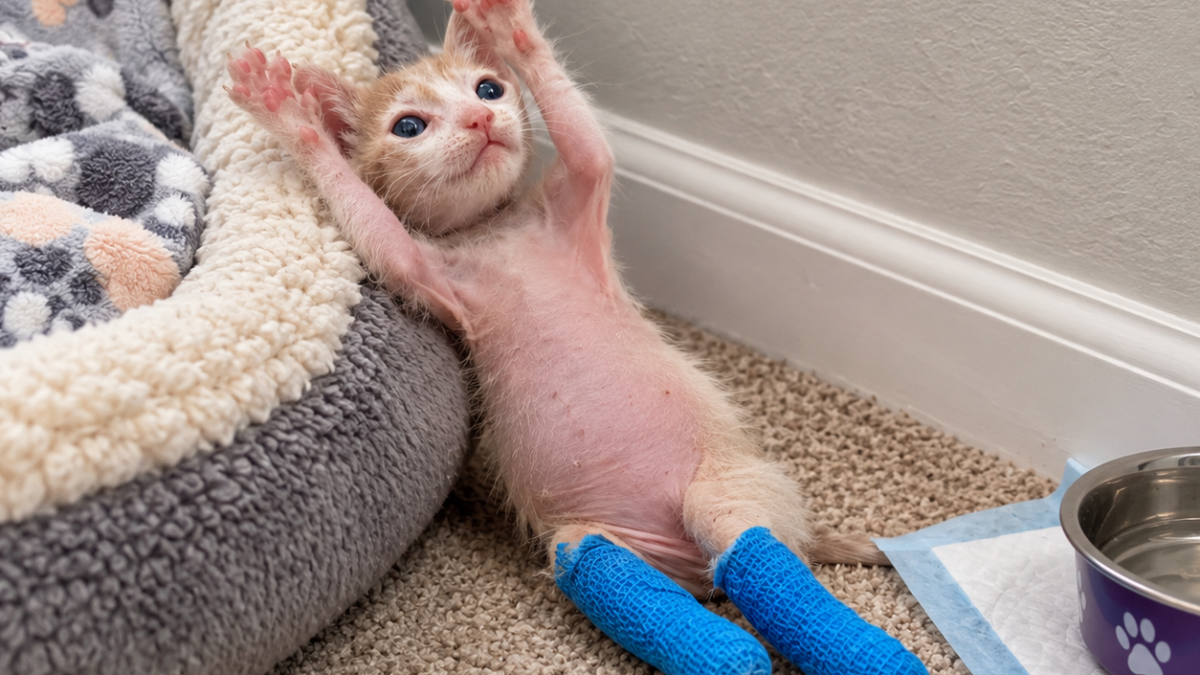
PART 2
The change happened so quickly that I almost convinced myself I was imagining it.
Bobo had never been an easy kitten to care for, but by then I understood his normal.
He was awkward.
He got tired faster than other kittens.
His splints needed constant checking because he was growing almost daily, and any rubbing or swelling could create another problem.
But he had also developed habits.
He squeaked when he wanted food.
He protested when I cleaned him.
He tried to bite the edge of his blanket whenever I adjusted his legs.
And after every feeding, he would press his tiny face against my hand until he fell asleep.
So when he didn’t complain one morning, I noticed.
I lifted him from his bed.
“Bobo?”
Usually, being picked up before breakfast earned me an indignant squeak.
That morning, nothing.
He simply rested in my palm.
My stomach tightened.
I brought him closer to my face.
His eyes opened, but only halfway.
“You don’t feel good.”
I prepared his food.
He turned his head away.
That frightened me more than anything his legs had ever done.
For Bobo, food was not optional.
He had started life struggling to get enough nourishment, so once his appetite developed, he approached meals with the seriousness of a much larger animal.
He should have been trying to climb into the dish.
Instead, he wouldn’t even lick food from my fingertip.
I tried again.
“Come on.”
Nothing.
Within an hour, he vomited.
I called the clinic immediately.
“We’re coming in.”
The technician heard something in my voice.
“How long has he been off food?”
“Since this morning.”
“Any diarrhea?”
“No.”
“Vomiting?”
“Once.”
“Bring him now.”
I wrapped Bobo in his blanket and drove with one hand resting against the carrier at every stoplight.
I kept talking to him.
“You are not allowed to make this dramatic.”
No response.
“You’ve already got the legs. That’s enough.”
His eyes remained closed.
“Bobo.”
I tapped the carrier lightly.
One ear moved.
That tiny movement was enough to keep me breathing.
At the clinic, the veterinarian took one look at him and stopped smiling.
She weighed him.
He had lost weight.
Not much by the standards of an adult cat.
For Bobo, it mattered.
When an animal is that small, every ounce matters.
Every missed meal matters.
Every episode of vomiting matters.
His blood sugar was low.
He was dehydrated.
The veterinarian felt his abdomen carefully.
“Has he gotten into anything?”
“No. I watch him constantly.”
“Any plants? String? Litter?”
“No.”
“Change in formula or food?”
“No.”
She nodded.
“We’re going to run tests.”
I stood beside the examination table while a technician prepared supplies.
Bobo’s legs looked especially small without the confidence he had been developing.
The splints had helped.
We could see improvement.
But suddenly none of that mattered.
What good were straighter legs if he didn’t have enough strength to use them?
The veterinarian returned with preliminary results.
“Nothing is giving us a simple answer yet.”
I hated that sentence.
A simple answer meant a simple treatment.
No answer meant waiting.
And waiting is one of the hardest things you can do beside a sick animal.
You can clean.
Feed.
Measure.
Record.
Drive.
Pay.
Pray.
But eventually there comes a point where you have done everything possible, and the body in front of you has to decide what happens next.
We started supportive care.
Fluids.
Medication for nausea.
Warmth.
Close monitoring.
And food.
Especially food.
The problem was that Bobo still wouldn’t eat.
I tried his usual meal.
Nothing.
A different texture.
Nothing.
Warm food.
Nothing.
Food from my finger.
Nothing.
He sniffed once and turned his face away.
The veterinarian watched him.
“If he doesn’t start taking calories soon, we need another plan.”
I already knew what she meant.
“How soon?”
“With a kitten this small? We don’t have much time to waste.”
That afternoon we discussed assisted feeding.
I had tube-fed animals before.
That did not make it easy when the animal was Bobo.
Everything felt more frightening because of his size.
The equipment looked enormous beside him.
The measurements had to be exact.
Too much food could create problems.
Too quickly could make him sick.
Incorrect positioning could be dangerous.
Every feeding had to be calm, controlled, deliberate.
The veterinarian demonstrated the procedure again.
“Go slowly.”
“I know.”
“And if anything feels wrong—”
“I stop.”
“Exactly.”
She looked at me.
“You’re tired.”
“I’m fine.”
“You’re not.”
“I can be tired later.”
She didn’t argue.
That first night, Bobo came home with me again.
I set alarms.
11:00 p.m.
1:00 a.m.
3:00 a.m.
5:00 a.m.
Small amounts.
Carefully measured.
Every feeding took longer than it should have because I checked everything twice.
Sometimes three times.
Bobo hated the process.
I couldn’t blame him.
He squirmed when he had the strength.
When he didn’t, I wished he would.
At one in the morning, he fought me enough to push one paw against my wrist.
“Good,” I whispered.
It probably sounded absurd.
I was congratulating a kitten for resisting me.
But resistance meant energy.
At three, he barely moved.
I finished feeding him and wrapped him in the soft towel we used for warmth.
His head rested in the bend of my elbow.
“Don’t you dare.”
His eyes opened slightly.
“I mean it.”
I knew how ridiculous it was to bargain with a kitten.
I did it anyway.
“You worked too hard on those legs to quit now.”
His nose twitched.
“You’re supposed to grow up and destroy my furniture.”
Nothing.
“You’re supposed to wake me up at four in the morning for no reason.”
His breathing stayed steady.
“You’re supposed to become a complete menace.”
I touched my forehead lightly to his.
“That’s the deal.”
By five, I had stopped pretending I might sleep.
I sat on the floor beside his bed, watching his chest.
Up.
Down.
Up.
Down.
It is amazing how quickly the entire world can shrink to one small movement.
I didn’t care about messages on my phone.
I didn’t care about bills.
I didn’t care that I hadn’t showered.
The only thing that mattered was up and down.
When morning finally came, Bobo was still with me.
But he wasn’t better.
The next three days blurred together.
Clinic.
Home.
Feeding.
Medication.
Cleaning.
Monitoring.
Repeat.
His bloodwork shifted but offered no dramatic answer.
His stomach remained sensitive.
He would occasionally show interest in food, then turn away.
One morning he licked a small amount from a spoon.
I nearly celebrated.
Then he vomited again.
I sat on the kitchen floor afterward holding him.
“Why?”
I wasn’t asking him.
I wasn’t asking anyone.
I was simply angry.
Angry at his legs.
Angry at his stomach.
Angry at biology.
Angry at every person who had said, “Maybe he just isn’t meant to make it.”
People say things like that because they want to protect themselves from disappointment.
Nature knows best.
Some animals aren’t meant to survive.
You can’t save them all.
I understood all of those arguments.
I had repeated some of them myself in other situations.
But Bobo was alive.
That was what mattered.
He was warm in my hands.
His heart was beating.
He still responded to touch.
As long as those things were true and the veterinarian believed treatment was humane, I was going to fight beside him.
Not because I could guarantee the ending.
Because Bobo deserved the chance to reach it himself.
On the fourth day, I was cleaning around his mouth after a feeding when he did something I hadn’t heard in almost a week.
He purred.
It was faint.
Almost mechanical.
For a second, I thought I was imagining the vibration.
Then he did it again.
I stopped moving.
“Bobo?”
His eyes were closed.
My finger rested beneath his chin.
The purr continued.
I started crying.
Not dramatically.
Just silent tears landing on my sleeves while I sat there smiling like an idiot.
“You are unbelievable.”
He purred harder.
The next morning, he took three bites of food on his own.
Three.
I counted.
The fourth remained in the dish.
Normally, three bites would have been nothing.
That morning, three bites felt like a revolution.
I called the clinic.
“He ate.”
“How much?”
“Three bites.”
There was a pause.
Then the technician laughed.
“I’ve never heard someone this excited about three bites.”
“You haven’t spent this week with Bobo.”
“We’ll take it.”
By afternoon, he ate a little more.
The feeding tube remained necessary, but something had changed.
His interest was returning.
The following morning, when I offered food, Bobo pushed his face into the dish so eagerly that he got food across his nose.
I laughed.
“There you are.”
He ate.
Not enough.
But voluntarily.
That mattered.
His vomiting decreased.
His hydration improved.
His blood sugar stabilized.
He began complaining again.
The first time he screamed while I cleaned his paws, I kissed the top of his head.
“I missed that.”
He bit my finger.
Not hard.
But with intention.
I laughed even more.
“Oh, you’re definitely feeling better.”
Over the next week, the feeding tube became less important.
Bobo began finishing larger portions on his own.
Then one morning, the veterinarian looked at his chart and said the words I had been waiting for.
“I think we can try without it.”
I stared at her.
“Really?”
“If he keeps eating.”
I looked at Bobo.
He was trying to chew the edge of her clipboard.
“I think he intends to.”
She removed the tube.
Bobo immediately complained.
Then he attacked his breakfast.
That evening I sat beside him while he ate from a small bowl.
No tube.
No syringe.
No measuring every swallow.
Just a kitten eating.
I had forgotten how beautiful ordinary things could be.
But with Bobo, ordinary never lasted long.
Several weeks later, after his appetite had returned and we thought the worst crisis was behind us, I picked him up one morning and felt it immediately.
Too light.
Again.
My heart sank.
“No.”
I put him on the scale.
The number confirmed it.
Weight loss.
Not as dramatic as before, but unmistakable.
Bobo looked at me as though I was inconveniencing him.
His appetite hadn’t disappeared completely.
He was still eating.
He was still playful at times.
But something was wrong.
We returned to the clinic.
More tests.
More questions.
More waiting.
By then Bobo had become familiar enough with the staff that one technician called him “Mr. Trouble.”
He protested blood draws.
He tried to escape the scale.
He attempted to climb the veterinarian’s shirt.
Watching him misbehave should have reassured me.
Instead, I was afraid because I had learned something during his first illness.
Small animals can compensate until suddenly they can’t.
I didn’t want to miss the warning signs.
The veterinarian studied his latest results.
“We’re going to adjust his nutrition and monitor him very closely.”
“Is something failing?”
“Nothing points to that right now.”
“Then why is he losing weight?”
“There may be several things happening at once. He’s still growing. His body has been under enormous stress. We need to support him and watch the trend.”
Watch the trend.
Another version of wait.
I hated it.
But we did exactly that.
Every morning before breakfast, Bobo went on the scale.
I recorded the number.
If it increased, I felt like we had won something.
If it dropped, the entire day felt heavier.
Bobo, meanwhile, had decided the scale was his enemy.
He would step onto it, immediately turn around, and attempt to escape.
“Stay.”
He stepped off.
“Bobo.”
He looked at me.
“Two seconds.”
He put one paw on.
“That is not two seconds.”
He meowed.
“You are the least cooperative medical patient I’ve ever met.”
Another meow.
“You’re lucky you’re cute.”
He knew.
Everyone knew.
His personality was expanding even when his body struggled to keep up.
He discovered toys.
At first, his strange legs made chasing them awkward.
He would launch himself after a small ball, lose balance, roll sideways, then stare at the toy as if it were responsible.
But he always tried again.
That was Bobo.
Try.
Fall.
Try.
Miss.
Try.
Rest.
Try.
Again.
The splints had been changed repeatedly as he grew.
Each new set required careful fitting.
We checked his skin constantly for irritation.
We adjusted angles gradually.
Nothing about correcting his legs could be rushed.
Growing bone is not clay.
You don’t simply push it into place.
You guide.
Support.
Observe.
Adjust.
Some days I worried we weren’t making progress.
Then the veterinarian would remove the splints briefly and place Bobo on a padded surface.
“Let’s see.”
He would stand.
Still crooked.
But less.
Then take a step.
Then another.
At one appointment, he crossed almost half the examination table before falling.
I clapped.
The veterinarian laughed.
“Don’t encourage him too much. He already thinks he’s impressive.”
Bobo sat up.
He absolutely did.
As his strength returned, he developed a strange little swagger.
His walk wasn’t perfect.
It probably never would be.
But it belonged to him.
He would move with his back end slightly different from other kittens, then suddenly sprint as though physics had become optional.
That was when one of the technicians first called him “Bobo the Bodybuilder.”
It was ridiculous.
He was still small.
But his shoulders had started getting stronger from compensating for his legs.
Whenever he hauled himself onto something, his front half did much of the work.
“Look at those muscles,” she said.
I laughed.
“Don’t tell him that.”
Too late.
“Bobo the Bodybuilder.”
He climbed onto her scrub top.
The name stayed.
A few weeks later, another nickname appeared.
Bobo the Boss.
That one fit even better.
He began ordering everyone around.
He had specific opinions about meals.
He wanted the warmest blanket.
He wanted the toy another cat was using.
He wanted doors opened immediately.
If I ignored him, he climbed my leg.
If I moved him, he returned.
If another foster kitten was sleeping in the bed he wanted, Bobo stood beside it and complained until someone moved.
“You are five pounds of unreasonable demands,” I told him one morning.
He stared at me.
Then climbed into my lap.
“You know exactly what you’re doing.”
He began purring.
That was his secret weapon.
For all his attitude, Bobo remained extraordinarily affectionate.
He didn’t merely tolerate being loved.
He searched for it.
If I sat down, he appeared.
If I lay on the couch, he found my chest.
If I was working at the table, he climbed onto my lap and pushed his head beneath my hand until I stopped what I was doing.
The kitten who had entered life without enough maternal care seemed determined to collect affection from everyone he met.
Even at the clinic, after unpleasant procedures, he would eventually lean toward the same person who had just examined him.
The veterinarian once said, “He doesn’t hold grudges.”
I looked at Bobo.
“He doesn’t have time. He’s too busy demanding things.”
She smiled.
But I thought about her words later.
Bobo didn’t hold grudges.
That became important to me.
People sometimes want animal rescue stories to contain a villain.
Someone to blame.
Someone to punish.
Someone whose suffering balances what happened to the animal.
Bobo’s story wasn’t like that.
His enemy was not a person.
It was circumstance.
A body that hadn’t formed normally.
A mother who couldn’t or wouldn’t care for him.
Illness.
Weakness.
Weight loss.
A long list of reasons he should not have had an easy life.
There was no door to kick down.
No abuser to confront.
No courtroom where someone could be punished.
So if Bobo was going to get revenge, it would have to be against every prediction that had been made about him.
And he seemed perfectly happy with that arrangement.
His revenge started small.
The first time he used the litter box completely on his own, I nearly cried.
That might sound ridiculous until you’ve cared for a kitten whose legs made the simple act of stepping over a low edge difficult.
Before treatment, Bobo often lost balance.
He would try to climb in.
His legs would fold awkwardly.
Sometimes he would fall.
Sometimes he’d miss the box entirely because positioning his body was too difficult.
We tried shallower trays.
Different surfaces.
Better grip.
Anything that made life easier.
Then one morning I heard scratching.
I turned.
Bobo was inside the litter box.
Standing.
Balanced.
Doing exactly what every ordinary kitten does.
When he finished, he stepped out without falling.
I stared.
Bobo looked at me.
“What?”
Of course he didn’t say it.
But his expression did.
I crouched.
“You just did that.”
He walked past me.
No celebration required.
That was how recovery often looked.
The enormous moments were ordinary to the animal experiencing them.
To us, they were everything.
His next act of revenge happened with the couch.
For weeks, Bobo could not jump high enough to reach it.
He would place his front paws against the cushion and pull.
Sometimes he made it halfway.
Then slid down.
I had placed small steps nearby.
Bobo ignored them.
Apparently assistance was an insult.
One afternoon I was sitting there reading when I heard his claws against fabric.
“Use the steps.”
Scratch.
“Bobo.”
Scratch.
I looked over the edge.
His front half was on the cushion.
His back legs kicked beneath him.
I reached down.
Then stopped.
He hated being helped when he believed he could do something himself.
“Fine.”
He pulled.
His body rose another inch.
One back paw found the edge.
Then the other.
With a final scramble, Bobo landed beside me.
He froze.
I froze.
He looked at the floor.
Then at me.
Then he puffed his chest.
“You’re very impressive.”
He immediately climbed onto my stomach and went to sleep.
A week later, he was jumping onto the couch without hesitation.
Then came chairs.
Low shelves.
Window ledges.
The cat tree.
The first time I saw him halfway up the cat tree, I panicked.
“Bobo!”
He continued.
“Get down.”
He looked back.
That was a mistake.
His balance shifted.
I rushed forward.
Bobo corrected himself and climbed higher.
“Fantastic. Now you’re a mountain climber.”
He reached the platform.
Then sat there looking smug.
The veterinarian had told us climbing was acceptable as his legs grew stronger, provided we controlled dangerous heights.
So I stood below him like an anxious parent.
Bobo washed one paw.
“You’re enjoying this.”
He was.
The kitten once unable to stand had discovered elevation.
Life became much more complicated after that.
I had to Bobo-proof everything.
He climbed furniture.
Curtains tempted him.
Shoelaces became targets.
Cardboard boxes became castles.
He chased the other cats.
Sometimes he moved so quickly that his slightly unusual gait disappeared completely.
He wasn’t graceful.
He was determined.
There is a difference.
Graceful cats calculate.
Bobo committed.
If another kitten jumped from the chair to the couch, Bobo jumped too.
If he landed badly, he rolled.
Then got up as though the roll had been intentional.
Watching him made me laugh almost every day.
It also made me afraid sometimes.
Recovery does that.
When you have nearly lost an animal, happiness becomes mixed with vigilance.
Every quiet morning makes you check whether they’re breathing.
Every skipped meal makes your stomach tighten.
Every unusual nap makes you remember the worst night.
Bobo could be perfectly healthy, asleep in a patch of sunlight, and I would still touch his side just to feel movement.
One afternoon he slept longer than usual.
I walked past him once.
Twice.
Three times.
Finally I crouched.
“Bobo?”
His eyes opened.
He looked furious.
“Sorry.”
He closed them.
Five minutes later I checked again.
This time he bit my finger.
“Okay. Message received.”
I started learning that loving Bobo meant letting him become normal.
Not normal in the sense of having perfect legs.
Normal in the sense that not every moment needed to be a medical event.
He was allowed to sleep without being monitored.
Play without someone analyzing his stride.
Eat without every bite being counted forever.
Eventually, he was allowed to simply be a cat.
That transition was harder for me than it was for him.
The veterinary team helped.
At one follow-up appointment, I arrived carrying my notebook.
Weight history.
Food history.
Bathroom habits.
Activity notes.
Questions.
Lots of questions.
The veterinarian looked through them.
Then looked at Bobo, who was attempting to knock a jar of cotton swabs off the counter.
She caught the jar.
“He’s doing well.”
“He lost a little weight Tuesday.”
“How much?”
I told her.
“And then?”
“Gained it back.”
“Eating?”
“Yes.”
“Vomiting?”
“No.”
“Energy?”
I pointed at Bobo.
He had found a paper towel and was dragging it across the table.
She smiled.
“I’m going to prescribe something for you.”
“What?”
“Stop weighing him three times a day.”
I stared at her.
“I don’t weigh him three times every day.”
She raised an eyebrow.
“Only when I’m worried.”
“And how often are you worried?”
I didn’t answer.
She laughed gently.
“Once daily is enough for now. Soon we’ll reduce that too.”
I looked at Bobo.
He was chewing paper.
“What if I miss something?”
“You know him better than anyone. You won’t.”
That sentence meant more than she realized.
For months I had felt like I was constantly one mistake away from losing him.
Feed too much.
Feed too little.
Miss a skin irritation.
Miss weight loss.
Miss dehydration.
Miss vomiting.
Miss infection.
Miss one tiny clue.
But maybe Bobo had reached the stage where survival no longer depended on every decision I made perfectly.
Maybe his body could help carry the responsibility now.
His legs certainly were.
The day the final splints came off permanently, I hardly trusted myself to be excited.
We had removed them temporarily many times.
But this appointment was different.
The veterinarian examined each leg.
Flexed the joints gently.
Watched Bobo move.
Placed him on the floor.
Bobo walked across the room.
Stopped.
Turned.
Walked back.
His gait still had personality.
That was the polite word.
The technician smiled.
“He walks like he owns a nightclub.”
I laughed.
Bobo walked directly toward my bag because he knew treats were inside.
The veterinarian watched his alignment carefully.
Then said, “I think we’re done with the splints.”
I looked at her.
“Done?”
“Done.”
“You mean permanently?”
“As long as he continues doing well.”
I crouched and touched Bobo’s back.
For months his treatment had been part of every day.
Wrap.
Check.
Adjust.
Inspect.
Return to clinic.
Repeat.
Now his legs were simply his.
No braces.
No casts.
No tiny medical equipment.
I picked him up.
“You hear that?”
He bit the zipper on my jacket.
“No more splints.”
He bit it again.
“That means nothing to you, does it?”
Of course it didn’t.
Bobo had never been waiting for a medical milestone.
He had been waiting to get on with his life.
He did exactly that.
Without the splints, his confidence exploded.
Running became his favorite activity.
Not running toward anything.
Just running.
He would launch from one side of the hallway to the other for reasons known only to him.
Sometimes at midnight.
Sometimes at five in the morning.
Sometimes immediately after using the litter box.
He chased invisible enemies.
He attacked rugs.
He hid behind doorframes and ambushed the other cats.
He learned the sound of a food container opening from two rooms away.
He started wrestling.
That was when “Bobo the Bodybuilder” truly became accurate.
He had several feline friends by then.
Most were larger.
Bobo didn’t care.
He would stalk them.
Leap.
Wrap both front legs around their shoulders.
Roll.
If they escaped, he chased them.
One older cat named Milo tolerated Bobo with the exhausted patience of someone babysitting an energetic younger brother.
“Leave Milo alone.”
Bobo pounced.
Milo sighed.
“Bobo.”
Milo walked away.
Bobo followed.
Eventually Milo turned and tapped him on the forehead.
Bobo sat down.
For three seconds.
Then attacked again.
I laughed.
“You deserve whatever happens next.”
Milo wrestled him onto the carpet.
Bobo escaped.
Returned immediately.
There was no fear in him.
That amazed me.
The kitten who had started life unable to move properly now believed the entire house belonged to him.
And perhaps it did.
He had paid for it.
Not with money.
With effort.
Every room represented something he had learned to reach.
The kitchen once required carrying.
Now he sprinted there.
The couch once required climbing.
Now he jumped.
The hallway had once been too long for his weak legs.
Now it was a racetrack.
The litter box had once been an obstacle.
Now he kicked litter onto the floor with great enthusiasm.
“You’re making a mess.”
Scratch.
“Bobo.”
More litter flew.
“I wanted independence. This is apparently what I get.”
He stepped out and walked away.
I swept.
That became our arrangement.
His body changed too.
The bald or thin patches from medical treatment filled in.
His coat softened.
His ribs disappeared under healthy weight.
His eyes became brighter.
The fragile triangular face of a sick kitten rounded into something confident and mischievous.
At every appointment someone said, “Look at him.”
I never got tired of hearing it.
One day, a technician pulled up one of Bobo’s earliest photos on her phone.
He looked impossibly small.
His legs curved beneath him.
His body seemed no larger than a handful of fur.
She held the phone beside him.
Bobo was sitting on the counter, healthy and annoyed by our attention.
“Same cat,” she said.
I stared.
Logically, I knew that.
Emotionally, it was hard to believe.
Memory softens things.
When you’re in crisis, every hour feels enormous.
Afterward, the weeks compress.
You remember fear, but not always the texture of it.
That photograph brought everything back.
The tiny splints.
The feeding tube.
The alarms.
The vomiting.
The scale.
The night I watched his chest rise and fall until sunrise.
I reached for him.
Bobo moved away.
I laughed.
“Of course.”
The veterinarian entered.
“What happened?”
“They’re embarrassing me with baby pictures.”
She nodded seriously.
“A terrible violation.”
Bobo climbed onto her shoulder.
She had seen him at his worst.
Now she had to remove him from her hair.
That felt like justice.
By then people had started asking what would happen next.
Was Bobo adoptable?
Would he need lifelong special care?
Could his legs worsen again?
Would he always have medical issues?
The answers were cautiously optimistic.
He might always walk a little differently.
We would watch his joints as he aged.
He needed a family willing to maintain veterinary care and pay attention if his mobility changed.
But Bobo was no longer a kitten whose life centered around treatment.
He was ready for a home.
That sentence hurt.
I had known it would come.
Rescue creates a strange kind of love.
You fight as though the animal is yours forever.
Then, if you do your job correctly, you may have to let them belong to someone else.
I told myself Bobo was different.
I could handle it.
I had fostered before.
I understood the process.
Then I opened the adoption application and started crying before reading the first name.
Bobo was sitting beside my keyboard.
He stepped directly onto the paper.
“Perfect timing.”
He sat.
“You know people want to adopt you?”
Bobo licked one paw.
“Several people.”
He washed his face.
“You could at least pretend this is emotional.”
Nothing.
I picked him up.
“What am I supposed to do without you climbing my leg every morning?”
He purred.
That was not helpful.
Applications came from kind people.
Families.
Couples.
Single adopters.
People who had seen Bobo’s progress.
Some described him as inspirational.
Some wanted a special-needs cat.
But that description no longer quite fit him.
Bobo had needs, yes.
Every animal does.
But I didn’t want someone adopting a symbol.
I wanted them adopting Bobo.
The bossy, affectionate, food-obsessed, overconfident troublemaker.
A kitten who might one day need extra veterinary attention, but who currently needed far more protection from his own curiosity than from his legs.
One application stood out.
A couple named Rachel and Thomas.
They had two cats.
A safe indoor home.
Experience with medical fosters.
And one sentence caught my attention.
“We don’t need Bobo to inspire us. We just want to give him room to be a cat.”
I read it twice.
Then three times.
Exactly.
We arranged a meeting.
I expected Bobo to take time warming up.
He didn’t.
Thomas sat on the floor.
Bobo immediately climbed onto his leg.
Rachel offered a toy.
Bobo stole it.
One of their existing cats had come in a carrier for a controlled introduction.
Bobo approached.
Sniffed.
Made a ridiculous little sideways hop.
The other cat stared.
Bobo bounced again.
“Is that good?” Rachel asked.
“It means Bobo has decided they’re going to be friends whether your cat agrees or not.”
Thomas laughed.
“I like his confidence.”
“You may regret that.”
Bobo climbed into Rachel’s lap.
She looked at me.
“I think he’s making the decision.”
“No. He does this to everyone.”
Bobo curled into a ball.
I sighed.
“Okay. Not everyone.”
We did more meetings.
A home visit.
Long conversations about his history.
Diet.
Legs.
Potential future arthritis.
Warning signs.
Emergency care.
Everything.
Rachel took notes.
Thomas asked thoughtful questions.
Neither treated Bobo as fragile.
That mattered.
During one visit, Bobo jumped from the sofa and landed slightly crooked.
I flinched.
Rachel noticed.
“He okay?”
“Yes.”
I watched him run away.
“That’s harder for me than him.”
She nodded.
“I can understand that.”
“If he comes here, please don’t spend every day waiting for something to go wrong.”
She looked toward Bobo.
“We won’t.”
“Watch him. Care for him. But let him live.”
“We will.”
That should have comforted me.
Instead, it made the reality sharper.
He might actually be leaving.
The adoption date was set for Saturday.
Friday night, I couldn’t sleep.
Bobo could.
He was sprawled across my pillow.
I moved him.
He returned.
I moved him again.
He put one paw across my cheek.
“You are unbelievably inconsiderate.”
Purr.
“You’re leaving tomorrow.”
Purr.
“You could pretend to care.”
He pushed his forehead against mine.
That broke me.
I wrapped both arms around him.
For several minutes, Bobo allowed it.
Then he bit my chin gently and escaped.
I laughed through tears.
“Of course.”
Saturday morning arrived too quickly.
I packed his things.
Medical records.
Favorite blanket.
Food.
Toys.
One ridiculous stuffed mouse he had nearly destroyed.
I held it up.
“This thing is disgusting.”
Bobo tried to grab it.
“I guess it’s coming.”
Rachel and Thomas arrived around noon.
They were excited.
Nervous too.
That helped.
I didn’t want him going somewhere that treated taking responsibility for a life casually.
We reviewed everything again.
Probably unnecessarily.
I showed Rachel how Bobo sometimes placed one back foot.
She had already seen it.
I explained his food.
Again.
I pointed out emergency numbers.
Again.
Finally Thomas smiled gently.
“We’ve got him.”
I knew.
That was the problem.
I had to let them.
I crouched beside Bobo.
He was investigating their carrier.
“This is where I say something meaningful.”
He stepped inside.
I laughed.
“Really?”
Rachel smiled.
“He’s ready.”
Apparently.
I reached inside and scratched his chin.
“Listen to me, Bobo.”
His eyes half closed.
“You were supposed to be the kitten who couldn’t stand.”
Purr.
“Then you were the kitten who might not survive.”
Purr.
“Then you became the kitten who kept scaring me every time your weight moved by half an ounce.”
He opened his eyes.
“And now you’re just Bobo.”
He reached one paw toward my hand.
I held it gently.
“That’s exactly what I wanted.”
The carrier door closed.
My chest hurt.
Rachel hugged me.
“We’ll send updates.”
“I know.”
“We’re not disappearing.”
“I know.”
Thomas lifted the carrier.
Bobo meowed.
I immediately leaned down.
“He does that.”
Thomas laughed.
“You sure?”
“He’s probably complaining about the service.”
Another meow.
“See?”
They carried him to the car.
I stood on the porch.
I had imagined this moment many times.
I thought I would feel proud.
I did.
I also felt terrible.
Both can be true.
The car pulled away.
I went inside.
For the first time in months, nobody attacked my shoelaces.
Nobody screamed from the kitchen.
Nobody climbed my pants.
Nobody knocked a toy under the refrigerator and demanded I retrieve it.
The house felt too quiet.
I looked at the empty spot beside my bed where Bobo’s little setup had once been.
Then my phone rang.
A photo.
Rachel.
Bobo was still in the car.
Already asleep.
I laughed.
“Traitor.”
Two hours later, another photo arrived.
Bobo sitting on their couch.
Then one of him exploring.
Then a short video.
He was chasing a toy across the hallway.
His strange little walk appeared for half a second.
Then he accelerated.
Gone.
That evening Rachel called.
“He ate.”
“Good.”
“Used the litter box.”
“Good.”
“Stole food from Thomas.”
“Excellent.”
Thomas’s voice came through the background.
“Why is that excellent?”
“Because that’s Bobo.”
Rachel laughed.
Then her voice softened.
“He seems comfortable.”
I closed my eyes.
“Thank you.”
“No. Thank you.”
I shook my head even though she couldn’t see me.
“He did most of the work.”
That was always true.
We provided tools.
Bobo provided determination.
The first month in his new home went better than any of us expected.
He bonded with one of their cats quickly.
The other required negotiation.
Bobo’s idea of negotiation was repeated wrestling attempts.
Eventually they found a rhythm.
Rachel sent photos almost every day at first.
Bobo asleep in a window.
Bobo inside a cardboard box too small for him.
Bobo stealing Thomas’s chair.
Bobo standing beside an empty bowl with a deeply offended expression.
Bobo halfway up a cat tree.
Bobo asleep across both other cats as though they existed for his convenience.
Then came the video that made me cry again.
Rachel had placed her phone at the end of the hallway.
Bobo appeared at the opposite side.
She shook a toy.
He ran.
Not stumbled.
Not crawled.
Ran.
Straight toward the camera.
His back legs moved with their unique rhythm, but they worked.
His entire body stretched into the motion.
He reached the toy.
Grabbed it.
Turned.
Ran back.
I watched the clip again.
Again.
Again.
Finally I paused it on a frame where all four paws were off the ground.
Bobo was airborne.
The kitten who once couldn’t stand was airborne.
I sent the image to his veterinarian.
She replied almost immediately.
“BOBO THE BODYBUILDER.”
I laughed.
A few months later, Rachel brought him back for a routine check.
I arrived because I couldn’t resist.
When the carrier opened, Bobo stepped out.
He had grown.
Really grown.
He was no longer the tiny baby my hands could almost completely cover.
His chest was broader.
His coat was thick.
His eyes were bright.
He saw me.
For half a second, nothing happened.
I prepared myself.
Maybe he didn’t remember.
Then he ran toward me.
I crouched.
Bobo jumped into my lap.
“Oh.”
That was all I managed.
He shoved his face under my hand.
I scratched his cheeks.
“You remember me.”
He purred loudly.
Rachel smiled.
“I told you.”
I held him against my chest.
He tolerated exactly twelve seconds before attempting to climb onto the examination counter.
Still Bobo.
The veterinarian entered.
“There he is.”
She examined him.
Weight healthy.
Heart good.
Coat good.
Mobility good.
She watched him walk across the floor.
Then she smiled.
“His gait is quirky.”
Rachel laughed.
“We love it.”
“So do I.”
The veterinarian touched Bobo’s back legs.
“They’re functional. Strong. I don’t see anything today that worries me.”
Today.
We all respected that word.
Nobody promised his joints would never give him trouble later.
Nobody promised he would never need additional treatment.
But we also stopped living inside hypothetical disasters.
Today, Bobo was healthy.
That counted.
After the examination, the veterinarian pulled up his first medical photograph.
Rachel had never seen that particular one.
She covered her mouth.
“That was him?”
I nodded.
Bobo in the photograph looked exhausted.
Tiny.
His legs folded beneath him.
Rachel looked at the living cat now attempting to steal cotton balls from a container.
“Oh, Bobo.”
He knocked one onto the floor.
Thomas picked it up.
“He doesn’t appear traumatized by his past.”
“No,” I said. “He’s too busy planning crimes.”
Everyone laughed.
But I kept looking at that first image.
There are some victories so complete that they feel like revenge.
Bobo never knew anyone had doubted him.
He never knew people had looked at his legs and questioned whether he could have a normal life.
He never understood the phrase poor prognosis.
He didn’t know what congenital meant.
He didn’t know his feeding tube was supposed to be frightening.
He knew only sensations.
Hungry.
Warm.
Cold.
Pain.
Comfort.
Tired.
Safe.
Loved.
And because he didn’t understand the predictions, he never felt obligated to obey them.
That became one of the things I loved most about him.
Humans hear limits and build walls around themselves.
Animals often just try the next movement.
Bobo couldn’t stand.
So he pushed.
He couldn’t walk.
So he stumbled.
He couldn’t climb.
So he pulled.
He couldn’t eat.
So we fed him until he could.
He lost weight.
Then gained it.
He fell.
Then stood.
There was no grand philosophy.
Just next.
Next breath.
Next feeding.
Next step.
Next attempt.
His revenge against everything that tried to stop him was simply refusing to remain where it left him.
A year after his adoption, Rachel invited me to Bobo’s birthday celebration.
We didn’t know his exact birthday with certainty, so they chose a date close to when he had been rescued.
When I arrived, a handmade banner hung in the living room.
It said:
BOBO THE BOSS.
I laughed before I had even removed my shoes.
“That’s accurate.”
Thomas pointed toward the hallway.
“Wait.”
A sound came from around the corner.
Rapid paws.
Then Bobo appeared.
He sprinted directly toward me.
He was not kitten-sized anymore.
He hit my leg with enough force that I nearly lost balance.
“Bobo!”
He meowed.
“You got huge.”
He climbed onto a chair.
Then onto the table.
Rachel lifted him down.
“He thinks rules are suggestions.”
“He always did.”
His feline friends joined us.
One chased a toy.
Bobo intercepted it.
Another tried to take it back.
Within seconds they were wrestling.
I watched Bobo roll.
Kick.
Leap away.
Chase.
Turn.
Run again.
Nobody watching that scene would have guessed what his first weeks had looked like.
Maybe that was the most satisfying part.
He wasn’t performing recovery.
He wasn’t proving anything.
He was simply living.
Later Rachel brought out a small cat-safe treat.
Bobo’s attention locked onto it.
Thomas laughed.
“Bodybuilder mode activated.”
Bobo sat.
Mostly because Rachel had taught him that sitting increased the probability of receiving food.
“Good boy.”
He received his portion.
He ate with enthusiasm.
No tube.
No coaxing.
No fear.
Just appetite.
I remembered holding a syringe in the middle of the night.
I remembered measuring nourishment as though every drop might decide whether morning came.
Now Bobo was trying to convince Rachel that Thomas had failed to give him his share.
“He already ate,” Thomas said.
Bobo meowed.
“He says you’re lying,” I told him.
“I figured.”
We sat talking while the cats played.
At some point Bobo climbed into my lap.
He was heavier than I expected.
Healthy weight.
Warm.
Solid.
I ran my fingers along one back leg.
The curve was still slightly noticeable if you knew what to look for.
I remembered the tiny splints.
The careful wrapping.
The constant fear of irritation.
Bobo looked up.
“What?”
I smiled.
“Nothing.”
He settled.
Rachel was telling a story about how Bobo had recently learned to open one kitchen cabinet.
I listened while touching his fur.
No bald patches.
No splints.
No tubing.
No trembling newborn body.
Just Bobo.
I realized something then.
When I first rescued him, I believed success meant keeping him alive.
Then I believed success meant getting him to walk.
Then eating.
Then gaining weight.
Then removing the splints.
Then adoption.
But success kept moving.
Because survival wasn’t the finish line.
A life worth surviving for was.
Bobo had one.
He had people who adored him.
Other cats to annoy.
Windows to sit in.
Furniture to climb.
Meals to steal.
Veterinary care.
Warm beds.
Toys.
Safety.
He had the privilege of becoming ordinary.
That is something rescue teaches you to appreciate.
An ordinary morning can be extraordinary when you once believed the animal might never see it.
A cat sleeping in sunlight.
A bowl being emptied.
A sprint through the hallway.
A scratched couch.
A litter box mess.
Ordinary.
Beautiful.
Later that evening everyone gathered near the hallway because Rachel wanted to show me something.
“Bobo learned a new game.”
“That sentence scares me.”
“It should.”
Thomas went to the opposite end of the hallway holding Bobo’s favorite toy.
Rachel stayed near me.
“Ready?”
Thomas moved the toy.
Bobo crouched.
His body went still.
Then he launched.
He ran the entire hallway.
Reached Thomas.
Turned.
Ran back.
Rachel moved another toy.
Bobo changed direction.
Again.
Again.
His paws struck the floor in a rapid rhythm.
He slid around a corner.
Recovered.
Kept going.
Everyone laughed.
“Look at him!” Rachel said.
I was.
I could not stop.
There are images that become permanently attached to a person.
For me, Bobo’s first image had always been his legs folded beneath him.
He would push with his front paws while his back half struggled to follow.
That was how I had first understood him.
Fragile.
Limited.
Needing help.
But watching him run that night, I felt the old image finally loosen its grip.
This was Bobo too.
Maybe more truly.
The cat crossing a hallway at full speed because someone had moved a toy.
The cat whose body had been given a chance to become itself.
Bobo reached me and skidded.
I caught him.
“You little maniac.”
He twisted free.
Ran again.
Thomas shouted, “Bodybuilder!”
Rachel countered, “Boss!”
I laughed.
Both.
When it was time to leave, I found Bobo sitting near the window.
The house had become quiet.
The other cats were resting.
I crouched beside him.
He looked outside.
There was nothing dramatic out there.
A dark yard.
Porch light.
Trees moving slightly.
I touched his back.
“You know, there were people who weren’t sure you’d make it.”
His ear moved.
“People weren’t sure you’d walk.”
He turned his head toward me.
“They weren’t sure you’d grow.”
I smiled.
“You showed them.”
Bobo stood.
For one emotional second, I imagined he might do something meaningful.
Rub against me.
Purr.
Look into my eyes.
Instead, he saw something moving near the couch and ran after it.
I laughed so hard Rachel came in to ask what happened.
“Nothing.”
And that was perfect.
Bobo did not need to understand his victory for it to matter.
He had already won.
Years later, when people asked me about the most difficult animals I had cared for, Bobo always came to mind.
Not because his case was the most medically complicated.
There are more complicated cases.
Not because he suffered more than every animal.
That would be impossible to compare.
Bobo stayed with me because his entire life seemed to happen one impossible inch at a time.
His first stable stand.
His first independent steps.
His first bites after refusing food.
His first run.
His first jump.
His first day without splints.
His first night in his permanent home.
His first time racing through a hallway as though his legs had never been questioned.
I still received updates.
Bobo asleep on Thomas’s chest.
Bobo sitting in a grocery bag that had been placed on the floor for three seconds.
Bobo watching birds.
Bobo wrestling.
Bobo sitting beside an empty food bowl while apparently starving despite having eaten fifteen minutes earlier.
Then one morning Rachel sent me a message.
“Remember how you told us to let him live?”
I stared at the screen.
“Yes.”
A video followed.
They had installed a larger cat climbing system along one wall.
Platforms at different heights.
Wide, safe surfaces.
Easy routes.
I pressed play.
Bobo stood on the floor.
Looked up.
Jumped to the first platform.
Paused.
Second.
Third.
Then higher.
Each movement was controlled.
Confident.
He reached the top.
Turned.
Sat.
The camera zoomed slightly.
Bobo looked down at everyone.
King of the room.
Bobo the Boss.
I replayed the video.
Then I found one of his earliest photographs.
I placed the two images side by side on my screen.
On the left, a newborn kitten whose legs could barely support him.
On the right, a grown cat sitting near the ceiling because apparently the floor had become beneath him.
I laughed.
Then cried.
That was Bobo’s revenge.
Not anger.
Not punishment.
Not hurting anyone who had doubted him.
Elevation.
Every prediction had placed him low.
Bobo kept climbing.
He climbed onto his feet.
Onto the couch.
Onto chairs.
Onto cat trees.
Onto a family’s lap.
Into a life that once seemed impossible.
And eventually, literally, to the highest platform in the house.
A few days later I visited.
Bobo greeted me normally.
Meaning he screamed for attention, ignored me briefly, then climbed onto me the moment I sat down.
Rachel pointed toward the climbing wall.
“He spends half the day up there.”
“Of course he does.”
Thomas laughed.
“Do you remember telling us he might need help getting onto furniture?”
“Yes.”
“We’d like to file a complaint.”
Bobo leaped onto the second platform.
“I accept responsibility.”
We watched him climb.
No hesitation.
At the top, he turned around and looked at us.
Thomas shook his head.
“He knows.”
“Knows what?”
“That he’s Bobo.”
That was probably true.
Maybe that was enough.
Before leaving, I picked Bobo up.
He was no longer easy to hold with one hand.
I needed both arms.
I remembered the first time.
Tiny.
Trembling.
Fragile enough that I was afraid my hands were too large.
Now he pressed against me with warm, healthy weight.
His legs rested against my arm.
Functional.
Strong.
Not textbook perfect.
Bobo perfect.
“You’ve gotten heavy.”
He purred.
“That is a compliment.”
Purr.
“You know what everybody worried about when you were born?”
He pushed his face beneath my chin.
“Whether you’d survive.”
I held him tighter.
“You didn’t just survive.”
There are words rescue people use constantly.
Miracle.
Fighter.
Survivor.
Sometimes they become clichés because we say them so often.
Bobo was all of those things.
But none of them completely described him.
He wasn’t miraculous because everything became perfect.
It didn’t.
His legs still carried evidence of how he entered the world.
His early health scares were real.
We never erased them.
He wasn’t a fighter because he consciously decided to become inspirational.
He wanted food.
Warmth.
Comfort.
Movement.
Love.
He simply kept reaching for those things.
And he wasn’t special because suffering made him special.
Bobo was special before suffering.
That is something I wish more people understood.
Animals do not need tragic stories to earn kindness.
They don’t need extraordinary transformations to deserve homes.
Bobo deserved love the day he fit inside my palm.
He deserved it when he couldn’t stand.
He deserved it when he vomited.
He deserved it when he needed a feeding tube.
He deserved it when his medical bills grew.
He deserved it when his prognosis was uncertain.
He deserved it before we knew whether his ending would make anyone smile.
Fortunately, his ending does.
Though “ending” isn’t really the right word.
Bobo’s story continued in thousands of small ways I would never witness.
Morning sunlight.
Breakfast.
Naps.
Veterinary checkups.
Games.
Arguments over who stole whose toy.
Holiday photos.
Visitors.
Rain against windows.
Warm blankets.
Ordinary years.
That was the future we fought for when he was small enough to sleep in my hand.
Not a viral transformation.
Not a dramatic before-and-after picture.
Years.
One winter afternoon, several years after his adoption, I stopped by Rachel and Thomas’s house.
Bobo met me at the door.
He was fully grown now.
He walked with the same slightly unusual rhythm.
A tiny reminder.
Otherwise, he moved without hesitation.
He followed me into the living room.
Jumped onto the couch.
Then onto the back of it.
Rachel brought coffee.
“He still remembers you.”
“I hope so.”
“He definitely does.”
Bobo stepped onto my shoulder.
I laughed.
“He also still has no concept of boundaries.”
“Definitely.”
We talked for nearly an hour.
Bobo moved between us.
At one point he disappeared.
Then came running back carrying a small stuffed toy.
He dropped it.
I picked it up.
“Want this?”
He crouched.
I tossed it across the room.
Bobo sprinted.
For a moment, everything else disappeared.
The years.
The medical records.
The fear.
I watched his legs.
Not critically.
Not medically.
Just watched.
They carried him exactly where he wanted to go.
He grabbed the toy.
Turned.
Ran back.
Dropped it again.
I threw.
Again.
Bobo chased.
Again.
Again.
That word had defined him from the beginning.
Again.
Fall.
Again.
Lose strength.
Again.
Lose weight.
Again.
Get sick.
Again.
Eat.
Again.
Stand.
Again.
Run.
Again.
Love.
Again.
Bobo eventually became tired.
He climbed onto the couch beside me.
Then into my lap.
His body curled naturally.
I rested one hand over him.
His purr vibrated against my arm.
Rachel smiled from across the room.
“Hard to believe, isn’t it?”
I knew exactly what she meant.
“Yes.”
But it was also becoming easier to believe.
Because Bobo was no longer a miracle we were afraid might disappear.
He was simply himself.
A healthy cat.
A loved cat.
A slightly strange walker.
An unapologetic food thief.
A champion furniture climber.
A professional lap occupier.
Bobo the Bodybuilder.
Bobo the Boss.
Before I left, I stood near the door.
Bobo sat in the hallway watching me.
I pointed at him.
“Stay out of trouble.”
He blinked.
Rachel laughed.
“That has never worked.”
I opened the door.
Then looked back.
For a moment I saw every version of him layered together.
The trembling newborn.
The kitten in splints.
The sick baby beside a feeding tube.
The patient on the scale.
The kitten learning to walk.
The cat jumping onto furniture.
The confident animal racing through this same hallway.
All of them Bobo.
All connected by the same stubborn little heartbeat.
I once believed the most powerful moment in his story would be when he finally stood.
I was wrong.
Then I thought it would be when the splints came off.
Wrong again.
Maybe when he survived the illness.
Or when he was adopted.
Or when he ran for the first time.
Those moments mattered.
But the most powerful moment was much quieter.
It was this one.
Bobo sitting inside his own home while somebody he loved stood in the kitchen preparing dinner.
No emergency.
No medical crisis.
No one wondering whether he would survive the night.
He didn’t know anyone had once considered his future uncertain.
He didn’t know his early photos could make strangers cry.
He didn’t know how many people had worried about him.
He only knew that dinner was late.
So naturally, he began yelling.
Rachel called from the kitchen.
“I know, Bobo!”
He yelled again.
Thomas appeared.
“He ate two hours ago.”
Bobo answered him.
I laughed.
The tiny kitten people once struggled to keep alive was now loudly protesting because his next meal had not arrived quickly enough.
That was the ending I wanted.
Not revenge through suffering.
Revenge through abundance.
Once, his body had not been given what it needed to stand.
Now he ran wherever he wanted.
Once, he had been unable to feed himself.
Now he complained because the menu did not operate on his schedule.
Once, he had been abandoned by the comfort nature was supposed to provide.
Now he had more arms willing to hold him than he could possibly need.
Once, every ounce lost frightened us.
Now he was strong enough that I joked about how heavy he had become.
Once, people wondered whether he would make it.
Now nobody in that house thought of Bobo as a cat who was dying.
He was the cat stealing someone’s seat.
Knocking things down.
Chasing toys.
Bossing everyone around.
Living.
That was his answer to every terrible possibility that had surrounded his birth.
He lived.
Not cautiously.
Not quietly.
Not apologetically.
Bobo lived like the world owed him every room he entered.
Maybe after everything, it did.
I bent down one final time.
He approached.
I scratched beneath his chin.
“You won, little man.”
He purred.
And then, because Bobo had always known how to ruin a serious moment, he grabbed my shoelace and ran.
I nearly fell trying to follow him.
Rachel laughed from the kitchen.
Thomas shouted, “Bobo!”
He disappeared around the corner dragging the lace.
I stood there laughing so hard I had tears in my eyes.
Years earlier, I had cried because I was afraid his legs would never carry him anywhere.
Now I was crying because they had carried him away with part of my shoe.
Perfect.
Absolutely perfect.
That is how I remember Bobo now.
Not beneath a blanket.
Not connected to a feeding tube.
Not trembling while someone carefully positioned tiny splints around his legs.
I remember him running.
A shoelace in his mouth.
A family laughing behind him.
Four strong paws carrying him toward whatever trouble he had chosen next.
The day he was born, survival had seemed almost too much to ask.
But Bobo had never been interested in simply surviving.
He wanted the whole life.
The food.
The toys.
The climbing.
The wrestling.
The naps.
The family.
The mischief.
The love.
And somehow, one determined step at a time, he got every bit of it.
That was Bobo’s victory.
That was his revenge against every frightening prognosis and every night we feared losing him.
And that was the life this tiny kitten had fought for from the very beginning.
Not just to stay alive.
But to become strong enough, loved enough, and wonderfully stubborn enough to finally live like nobody had ever doubted him at all.

