PART 2: They Said My Shelter Pit Bull Had No Place on a Mountain Search—Then He Dragged Me Off the Grid Into the Dark
PART 2
The first hundred yards were ugly.
There was no trail.
No obvious game path.
Nothing that would have made me choose that direction during a normal search.
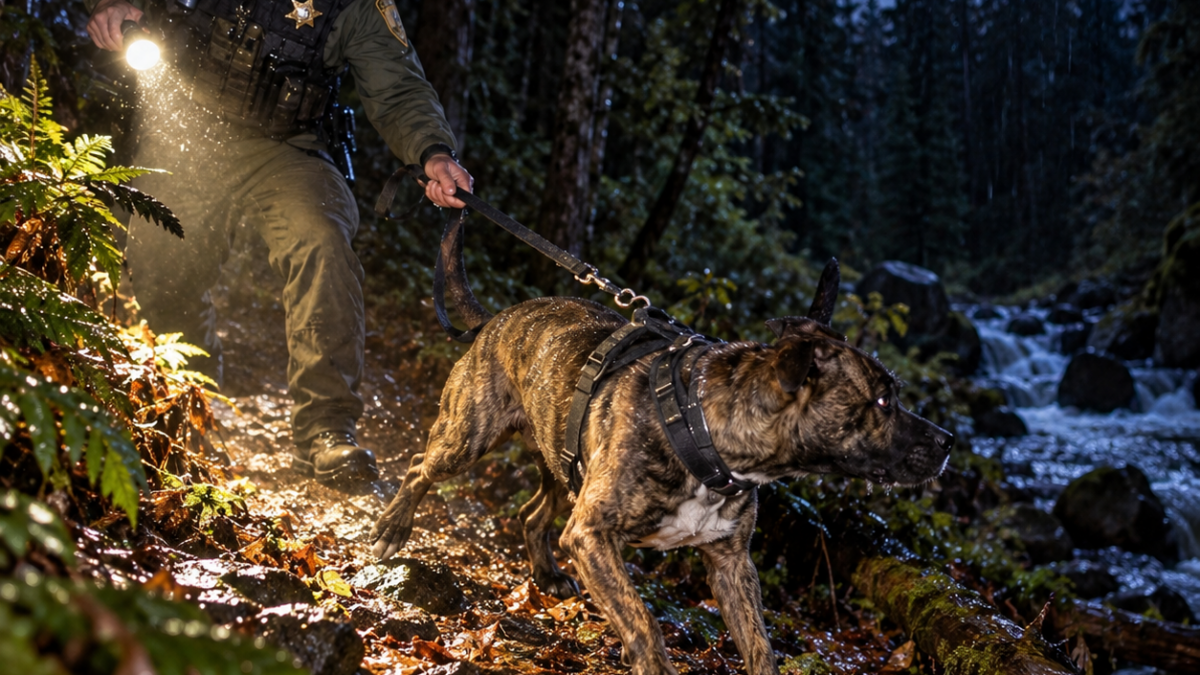
Compass threaded between spruce trunks, over fallen branches, and across patches of frozen ground as if he had already made up his mind about where we were going.
I followed because Reyna had authorized it.
That mattered.
I want to be clear about something.
I did not heroically ignore command and chase my dog into the wilderness.
That makes a better story.
It would also have been stupid.
People die in mountain searches because they decide rules no longer apply to them.
I had coordinates.
A radio.
Emergency gear.
A team moving behind me.
Still, every professional part of me felt uncomfortable.
Compass was not trained.
That fact didn’t disappear simply because he looked confident.
I keyed my radio.
“Yates. Moving north-northeast. Roughly one hundred yards off assigned trail.”
“Copy,” Reyna answered.
“Dog still pulling?”
“Yes.”
“Behavior change?”
“No.”
“Keep moving.”
Compass did.
I had to duck beneath a fallen trunk.
The lead caught.
“Wait.”
Compass stopped.
The second I freed it, he pulled again.
Not frantically.
Purposefully.
I started paying closer attention.
His nose wasn’t buried in the ground.
He wasn’t sweeping back and forth the way I’d seen trained trailing dogs work.
He would move twenty or thirty feet, pause, raise his head, adjust direction, then continue.
Air scent.
Maybe.
Or maybe I was inventing expertise because I wanted an explanation.
My flashlight moved across the trees.
Nothing.
“Compass.”
He ignored me.
“Buddy, if you’re following an elk, you and I are going to have a serious conversation.”
His ears flicked.
No response.
Another fifty yards.
Then Compass stopped again.
His nose lifted.
This time I heard something.
I froze.
Nothing.
Wind moved through branches.
“Compass?”
He stared downhill.
I turned off my own breathing in my head and listened.
There.
Maybe.
A sound.
Too faint to identify.
I keyed the radio.
“Command, hold traffic.”
The channel went quiet.
I listened.
Nothing.
Then something again.
A tiny sound.
Almost like metal tapping stone.
I looked at Compass.
His ears were forward.
“Did you hear that?”
He moved.
Fast.
I nearly fell.
## OFF THE GRID
The terrain dropped sharply.
I slowed Compass.
“Easy.”
He pulled sideways instead.
Smart.
There was a narrow shelf between two rock outcroppings.
He found it before I did.
We moved diagonally down the slope.
I called coordinates.
Reyna’s voice came back.
“Second team is four minutes behind you.”
“Copy.”
“Daniel?”
She only used my first name when she was worried.
“Yeah.”
“If terrain gets bad, stop.”
“Understood.”
“If Compass continues but you can’t safely follow, stop.”
“Understood.”
I looked at my dog.
He was already twenty feet ahead.
“Did you hear that?” I asked him.
He pulled.
“Right.”
I followed.
The ground became softer near a shallow drainage.
Snow from the previous week had melted and frozen repeatedly, leaving slick patches under pine needles.
Compass crossed carefully.
Then stopped.
His body changed.
For the first time since leaving the trail, his tail moved.
Not wagging.
Lower.
His ears shifted back.
He looked uncertain.
That worried me.
“What?”
He stared ahead.
My flashlight revealed a steep wall of brush and broken rock.
No obvious route.
Compass moved left.
Stopped.
Moved right.
Stopped again.
Then he whined.
It was the first sound he’d made.
My pulse increased.
“Command, Yates.”
“Go.”
“Dog changed behavior. Vocalizing.”
Reyna answered immediately.
“Possible proximity?”
“I don’t know.”
“Support team is close.”
I took two steps forward.
“Caleb!”
Nothing.
My voice disappeared into the trees.
“Caleb Foss!”
Silence.
Compass pulled right.
I followed.
“Caleb!”
Then I heard it.
So faint I almost doubted it.
A voice.
Not words.
Just a weak sound.
Human.
“Command.”
My voice changed enough that Reyna heard it.
“What?”
“I may have voice contact.”
The radio channel became completely still.
I shouted again.
“Caleb!”
This time, something answered.
A child’s voice.
“Here.”
One word.
Barely audible.
Every hair on my arms rose.
“Caleb!”
“Here!”
Louder.
I looked at Compass.
He was already pulling.
“We’ve got him,” I said into the radio.
I didn’t know whether that was technically true yet.
But I knew.
“We’ve got the kid.”
## THE DROP
Getting to Caleb was harder than hearing him.
He was below a rock ledge in a narrow pocket of timber where the slope folded into itself.
From the marked trail, the terrain looked like an unremarkable wall of trees.
From above, his location was hidden beneath branches and broken rock.
It made sense why visual teams had missed him.
He had wandered farther than anyone expected and then dropped into a natural depression.
“Caleb!”
“I’m here!”
His voice cracked.
“Keep talking!”
“I’m cold.”
“I know, buddy. We’re coming.”
Compass began whining harder.
I shortened the lead.
“Easy.”
I found the edge.
About fifteen feet below, my flashlight finally caught something reflective.
Blue.
A jacket.
Then a face.
Caleb was sitting against a rock with one leg stretched awkwardly in front of him.
His skin looked pale.
His lips were dry.
But he was conscious.
I have never been happier to see a terrified child in my life.
“Caleb Foss?”
He nodded.
“You Daniel?”
I blinked.
“No.”
He looked disappointed.
“My dad’s Daniel.”
“My name is Daniel too.”
That seemed to confuse him.
Then Compass moved into the flashlight beam.
Caleb’s eyes widened.
“Dog.”
“Yeah.”
For the first time, his face changed.
Just slightly.
“His name’s Compass.”
Caleb stared.
“Can he come down?”
My throat tightened.
“He sure can.”
That was why I had brought him.
Funny how plans sometimes arrive from a completely different direction.
## GETTING DOWN
The support team reached me minutes later.
Deputy Miguel Santos and volunteer medic Erin Walsh.
Miguel came through the trees breathing hard.
“You weren’t kidding about terrain.”
“No.”
Then he saw Caleb below.
“Well, I’ll be.”
Erin immediately began assessing access.
“Can he walk?”
“One leg may be injured.”
“Conscious?”
“Yes.”
“Responsive?”
“Yes.”
Caleb shouted, “I want the dog.”
Miguel looked at me.
“Apparently your suspect has requested counsel.”
Despite everything, I laughed.
“Compass, you’re up.”
We secured our descent.
Erin went first.
Then me.
Compass followed with a controlled line.
I had no idea how he would react to climbing down into a tight rocky area.
He behaved as if we’d practiced it.
When my boots touched the bottom, Caleb looked smaller than he had from above.
Eight years old.
Mud on his jacket.
One shoe wet.
A scrape across his cheek.
He was trying hard not to cry.
Erin knelt.
“Hey, Caleb. I’m Erin.”
He looked past her.
At Compass.
I moved closer.
“This is Compass.”
“Does he bite?”
“No.”
Compass heard his name and stepped forward.
Caleb lifted one hand.
Then hesitated.
Compass made the decision for him.
He lowered his head and pressed his forehead gently beneath Caleb’s palm.
The boy collapsed emotionally.
One second, he was holding himself together.
The next, he wrapped both arms around Compass’s neck and started crying.
Not screaming.
Just deep, exhausted sobs.
Compass stood completely still.
Didn’t lick him.
Didn’t pull away.
He simply let Caleb hold him.
Erin looked at me.
I looked away.
I’ve worked accidents.
Domestic calls.
Deaths.
Missing children.
You learn how to build walls.
That moment got through mine.
## “I THOUGHT NOBODY WAS COMING”
Erin assessed Caleb while he kept one hand buried in Compass’s fur.
Mild hypothermia.
Dehydration.
Possible ankle injury.
Exhaustion.
Nothing immediately life-threatening if we moved carefully.
“What happened?” I asked.
Caleb looked down.
“I tried to go back.”
“Back where?”
“Camp.”
“Why did you leave?”
He frowned, trying to remember.
“I saw the red bird.”
“Bird?”
“It was on a tree.”
He had followed it.
Then thought he knew the way back.
Then didn’t.
Simple.
Terrifying.
Exactly the kind of mistake children make because they don’t understand how quickly wilderness changes direction.
“How did you get down here?”
“I slipped.”
“Last night?”
He nodded.
“My foot hurts.”
“You stay here the whole time?”
“I tried climbing.”
He pointed toward the rock wall.
“I couldn’t.”
“Did you hear us searching?”
“Sometimes.”
My stomach twisted.
“Did you yell?”
“Yes.”
We had been close enough at some point for him to hear us.
But wind and terrain had swallowed his voice.
Caleb buried his fingers deeper into Compass’s neck.
“I thought nobody was coming.”
Compass leaned against him.
I swallowed.
“We came.”
Caleb looked at the dog.
“He came.”
I smiled.
“Yeah.”
“He found me?”
I looked at Compass.
“Yeah, buddy. He did.”
## THE RADIO CALL
There are radio transmissions you forget before the shift ends.
Then there are ones you remember for the rest of your life.
I keyed my microphone.
“Command, Yates.”
“Go.”
“We have physical contact with Caleb Foss.”
Silence.
Then Reyna:
“Say again.”
“Physical contact. Caleb is alive, conscious, mild hypothermia, possible lower-leg injury. Medic is with him.”
The radio erupted.
People trying not to talk over each other.
Command confirming.
Medical preparing.
Teams standing down sectors.
Then Reyna came back.
“How did you locate?”
I looked at Compass.
Caleb still had one arm around him.
“Dog.”
Pause.
“Certified team?”
“No.”
Another pause.
Then I heard someone in command laugh.
Reyna said, “Copy. We’ll discuss that later.”
“Looking forward to it.”
“Evac plan?”
Erin took over.
We would stabilize Caleb’s ankle, warm him, provide fluids in small amounts, then move him upslope to a point where a litter team could assist.
Helicopter extraction at night wasn’t ideal given the terrain and tree cover.
Ground evacuation was safer.
It would also take time.
Caleb had already survived eighteen hours.
Now our job was not to rush and create a new emergency.
## COMPASS WOULD NOT LEAVE HIM
We tried moving Compass aside while Erin worked.
Caleb objected.
“No.”
“Buddy, Erin needs room.”
“No. He stays.”
Compass looked at me.
I sighed.
“You heard the patient.”
Erin laughed.
“As long as he doesn’t interfere.”
He didn’t.
Compass lay beside Caleb.
The boy kept one hand on his back while Erin wrapped his ankle.
Any time Caleb became anxious, his fingers tightened in the brindle fur.
Compass never moved.
I watched him and thought about the shelter.
Four years earlier, he had been sitting in the back row because too many people passed his kennel.
He was nearly two.
Big.
Brindle.
Pit Bull mix.
A combination that shelters know can make adoption difficult.
I had gone there looking for a small dog.
Something easy.
I lived alone.
Worked long shifts.
Didn’t need sixty pounds of muscle occupying my couch.
Then Compass sat at the kennel door and watched me.
Didn’t bark.
Didn’t jump.
Just watched.
The employee told me:
“He’s been here a while.”
“How long?”
“Four months.”
“Why?”
She gave a tired little smile.
“Look at him.”
I knew what she meant.
People saw a large blocky-headed dog.
Some saw risk before personality.
I saw it too.
At first.
That part is important.
I wasn’t above the stereotype.
I almost walked away because of it.
Then a family came through the adoption room.
A little girl, maybe six, dropped a stuffed rabbit through the kennel bars.
Compass picked it up carefully.
Instead of tearing it apart, he pushed it back toward her.
She laughed.
Compass wagged.
Something in me changed.
I adopted him the next day.
Now that same dog was lying beside a missing eight-year-old boy in a mountain drainage while certified rescuers prepared an evacuation.
Life has a sense of humor.
## THE CLIMB OUT
Getting Caleb out took nearly three hours.
Additional responders brought a lightweight litter and warming equipment.
We secured him.
Caleb insisted Compass stay where he could see him.
“He’s coming.”
“Yes.”
“Promise?”
“I promise.”
The trail back wasn’t really a trail.
We had to create a route.
Four people rotated on the litter.
Others managed ropes.
I handled Compass.
Normally, he pulled.
Now he slowed to match Caleb.
At every stop, he moved toward the litter.
Caleb reached down.
Compass lifted his nose.
It became their routine.
Move.
Stop.
Touch.
Move.
Stop.
Touch.
Halfway up, one of the rescuers named Pike looked at me.
“Your dog ever done this?”
“No.”
“Tracking?”
“No.”
“Cadaver?”
“No.”
“Detection?”
“No.”
“What exactly does he do?”
“Destroys pillows.”
Pike laughed.
“Highly specialized.”
Compass looked offended.
We kept climbing.
## CALEB’S FATHER
We reached the lower staging area just before 2:00 a.m.
Caleb’s parents had been moved there after command confirmed he was found.
I saw his father before he saw us.
He was standing beneath floodlights, rigid, hands locked behind his head.
His mother sat wrapped in a blanket, surrounded by relatives.
When the litter emerged from the dark, someone shouted.
Caleb’s mother stood.
Then ran.
Medical personnel slowed everyone enough to keep the scene controlled.
You don’t want desperate parents falling onto an injured child while crews are still transferring him.
Caleb saw them.
“Mom!”
That sound tore through the entire staging area.
His mother covered her mouth.
His father bent forward like someone had hit him.
We lowered the litter onto the medical cot.
Compass stood beside me.
Caleb reached one hand toward him.
“Compass!”
His father looked at the dog.
Then at me.
“That’s the dog?”
I nodded.
“He found him.”
The man stared.
Then walked toward us.
For one second, I wasn’t sure what he was going to do.
Then he dropped to his knees in the mud and wrapped his arms around Compass.
My dog looked completely confused.
Caleb’s father buried his face against Compass’s shoulder.
“Thank you.”
Compass looked at me.
I swear his expression said:
Why is this man crying on me?
I scratched his neck.
“Just go with it.”
## THE QUESTION EVERYONE ASKED
By sunrise, Caleb was at the hospital.
His injuries were far less severe than we feared.
A sprained ankle.
Dehydration.
Cold exposure.
Scrapes.
Exhaustion.
He was expected to recover completely.
That should have been the end of my involvement.
It wasn’t.
By eight in the morning, everyone wanted to know how Compass did it.
So did I.
The search coordinator pulled me aside.
“Walk me through it.”
I did.
Where Compass stopped.
His behavior.
How he air-scented.
The direction changes.
The vocalization near the drainage.
A certified canine handler named Laura Bennett listened.
She had been running one of the trained search dogs on another sector.
“Did he have Caleb’s scent article?”
“No.”
“Ever met Caleb?”
“No.”
“Been around his family?”
“No.”
“Any kids on the trail?”
“Earlier, yes.”
She frowned.
“What was wind direction?”
We checked.
Laura looked at the terrain map.
Then smiled.
“Possible.”
“What?”
“Air scent.”
I folded my arms.
“He’s never trained.”
“Doesn’t mean he doesn’t have a nose.”
“I know he has a nose.”
“Daniel.”
“I mean—”
“Training teaches a dog how to communicate what he’s finding and work systematically. It doesn’t install the sense of smell.”
“So he caught Caleb’s scent?”
“Maybe human scent. Maybe distress odor. Maybe a combination.”
“From how far?”
She shrugged.
“Under the right wind and terrain? Farther than you think.”
“You’re telling me he accidentally did search work.”
“I’m telling you dogs have been doing dog things longer than we’ve been writing certifications.”
I looked at Compass.
He was asleep under the command trailer.
Snoring.
Laura smiled.
“Don’t quit your day job, Compass.”
## THEN CAME THE PROBLEM
By noon, the story had spread.
Not publicly yet.
Inside the department.
Inside county services.
Volunteers.
Search groups.
“Yates’s pet dog found the kid.”
Every retelling got less accurate.
By the afternoon:
“Untrained pit bull beats professional search dogs.”
I hated that version.
It wasn’t true.
The certified teams had covered enormous terrain.
Without them, command would never have narrowed sectors effectively.
Compass happened to encounter scent in the right place.
That didn’t diminish the trained teams.
But social media doesn’t enjoy nuance.
A volunteer posted a photograph of Compass and me leaving staging.
Within hours, it was shared thousands of times.
The caption read:
**RESCUE PIT BULL FINDS MISSING BOY AFTER PROFESSIONAL TEAMS MISS HIM.**
I called Reyna.
“This is bad.”
“Caleb is alive.”
“You know what I mean.”
“Yes.”
“The canine handlers are going to hate me.”
“They don’t.”
“The public is turning this into a competition.”
“Then don’t participate.”
Easy advice.
Hard reality.
The comments became ridiculous.
Some praised Compass.
Some insulted professional search teams.
Others attacked Compass because of his breed.
One comment said:
**No child should be near a pit bull, rescued or not.**
Another:
**Probably lucky the dog didn’t attack him.**
I stared at that one longer than I should have.
Compass was asleep beside my couch.
The same dog Caleb had refused to let out of his sight.
I closed the app.
## CALEB ASKED FOR COMPASS
Three days later, Caleb’s father called me.
“He’s home.”
“That’s good.”
“He keeps asking about Compass.”
I looked down.
Compass heard his name and raised his head.
“You want to visit?”
The tail started.
Apparently yes.
Caleb lived about forty minutes away.
When we arrived, he was on the couch with his ankle elevated.
The second the door opened, Compass pulled.
I almost laughed.
“Now you recognize him?”
Caleb shouted:
“Compass!”
The dog ran to the couch.
Caleb wrapped both arms around him.
His mother cried.
Again.
His father tried not to.
Again.
I stood near the door.
Caleb looked at me.
“Can he sleep here?”
His father choked on his coffee.
“No.”
“Why?”
“Because he belongs to Deputy Yates.”
Caleb frowned.
“Can I have him?”
“No.”
I answered before his dad could.
Caleb considered.
“Can I borrow him?”
“We’ll negotiate.”
He smiled.
That was the first time I saw him smiling without exhaustion behind it.
## WHAT CALEB REMEMBERED
Later, Caleb told us something that changed how I thought about the search.
He had heard dogs.
Not Compass.
The certified teams.
Earlier in the day, one search dog had worked along a ridge above the drainage.
Caleb tried calling.
Wind carried his voice the wrong way.
The dog may have caught intermittent scent but couldn’t resolve it because terrain pushed air downhill and away.
By the time Compass entered the lower trail hours later, the night air had cooled and shifted.
Scent that had previously moved away from the ridge may have settled toward our sector.
Timing.
Wind.
Chance.
A dog.
That was all.
People wanted a miracle.
I saw a chain of ordinary things lining up exactly once.
Maybe that’s what miracles are.
## THE DEPARTMENT FAMILY DAY
Two months later, Caleb was walking normally again.
The sheriff’s department held its annual family day.
Compass usually attended.
That year, everybody knew him.
Kids lined up to pet him.
Deputies took pictures.
Someone made him a fake badge.
**K9 COMPASS — SPECIAL OPERATIONS**
Reyna hated it.
“Take that off.”
“He’s earned it.”
“He has no standards.”
Compass was eating a hot dog someone dropped.
“Clearly.”
Caleb arrived with his parents.
Compass spotted him from across the field.
That reaction answered any question about whether dogs remember.
He ran.
Caleb ran.
They met in the middle.
No dramatic music.
No cameras arranged.
Just a boy and a dog.
Caleb dropped to his knees.
Compass nearly knocked him over.
Everybody laughed.
Even Reyna.
## THE FIRST OFFER
After the rescue story circulated, a regional search-and-rescue group contacted me.
“We’d like to evaluate Compass.”
“For what?”
“Search potential.”
I laughed.
They didn’t.
“You’re serious.”
“Very.”
“He’s five.”
“That’s not too old to assess.”
“He has no obedience titles.”
“We’re not asking about titles.”
“He steals food.”
“So do half our dogs if given the opportunity.”
I looked at Compass.
“He’s not becoming some full-time rescue dog.”
“Nobody said he has to.”
I agreed to an evaluation because I was curious.
That decision started another chapter.
## THE TEST
Laura Bennett conducted part of the evaluation.
She had been on Caleb’s search.
She greeted Compass.
“Famous now?”
Compass sniffed her pockets.
“Still humble.”
The tests were basic.
Confidence in new environments.
Interest in people.
Response to noise.
Problem solving.
Scent interest.
Recall.
Compass failed recall spectacularly when another volunteer had chicken.
Laura wrote something on her clipboard.
“What did you write?”
“Strong food motivation.”
“He ignored me.”
“Training opportunity.”
“That’s a generous description.”
Then they ran a simple hidden-person exercise.
A volunteer played with Compass briefly.
Then disappeared behind trees while Compass was distracted.
We released him.
Compass searched.
Not elegantly.
He checked the wrong direction first.
Then caught something.
Head lifted.
Same posture.
Same stillness.
My stomach tightened.
He turned.
Ran.
Found the volunteer.
Barked once.
Then demanded chicken.
Laura looked at me.
“You see it?”
I did.
“What exactly?”
“He likes finding people.”
That didn’t make him certified.
Didn’t make him ready for missions.
But it gave us something real.
## TRAINING
I almost quit after three weeks.
Search-dog training is repetitive.
Precise.
Humbling.
Compass had natural ability in some areas and absolutely none in others.
He loved finding people.
He hated waiting his turn.
He was powerful on lead.
His obedience was adequate until food existed within one hundred yards.
Worst of all, I had to learn.
I was the weaker half of the team.
Laura reminded me constantly.
“Stop directing him.”
“I know where the subject is.”
“He doesn’t know you know.”
“I can see the volunteer.”
“Exactly. Stop helping.”
Another exercise.
Compass moved left.
I unconsciously stepped right.
Laura shouted:
“You’re steering!”
“I’m walking.”
“You’re contaminating the test.”
“That sounds dramatic.”
“Because you are dramatic.”
Compass found the volunteer anyway.
He received chicken.
I received criticism.
This continued for months.
## THE HATERS
As Compass became more publicly associated with search training, the breed debate followed.
Most people were supportive.
Some weren’t.
A local community page posted:
**COUNTY DEPUTY TRAINS PIT BULL INVOLVED IN CHILD RESCUE FOR SEARCH WORK**
The comments became a war.
People argued about statistics.
Breed labels.
Shelters.
Safety.
Half the comments had nothing to do with Compass as an individual dog.
I made the mistake of reading too many.
One person wrote:
**This is irresponsible. Working dogs should come from proven lines, not random shelters.**
That one bothered me more than the breed insults.
Not because proven working lines aren’t valuable.
They are.
But because “random shelter dog” was being used as another way of saying worthless.
I knew that language.
Compass had lived inside it.
## THE OLD SHELTER
One afternoon, I drove Compass back to the shelter where I adopted him.
The director, Maria, recognized him immediately.
“Look at you.”
Compass recognized the building.
His behavior changed.
Not fear.
Alertness.
He sniffed every corner.
Maria scratched his chest.
“You know how many people passed this dog?”
“I remember.”
“Thirty-two documented meet-and-greets.”
I stared.
“Thirty-two?”
“Most chose another dog.”
“Why?”
She shrugged.
“Too big. Too strong. Wrong breed. Too old for puppy seekers. Too young for senior adopters.”
Compass leaned against her.
Maria smiled.
“He was everybody’s almost.”
That sentence stayed with me.
Everybody’s almost.
Until me.
## THE DOG NOBODY CHOSE
Maria showed me his old intake photograph.
I had forgotten it.
Compass looked thin.
His ears sat differently.
His eyes were guarded.
“What do you know about where he came from?” I asked.
“Stray pickup.”
“Nothing else?”
“Found near a truck stop.”
“No chip?”
“No.”
“Nobody claimed him?”
“Nobody.”
I stared at the photograph.
Compass had gone from nameless shelter dog to the animal who led me to Caleb.
Not because someone bred him for greatness.
Not because he had perfect genetics.
Not because anybody saw potential.
He was simply himself.
And someone eventually gave him a chance to become more of that.
## CALEB’S NIGHTMARES
Several months after the rescue, Caleb’s father called.
“He won’t sleep alone.”
I understood.
“What does his therapist say?”
“Normal trauma response.”
“Okay.”
“He keeps asking if Compass can come.”
I was careful.
A dog isn’t a substitute for therapy.
But companionship can help.
We arranged visits.
Compass would spend an evening there occasionally.
The first time, Caleb slept on the couch with one hand hanging over the edge.
Compass lay directly beneath it.
Around midnight, Caleb’s father sent me a photograph.
The boy asleep.
Compass beneath him.
Caption:
**First night without waking up scared.**
I sat in my kitchen staring at the photo.
That, more than the search, became Compass’s real job.
Finding Caleb had taken maybe forty minutes.
Helping him feel safe again took much longer.
## ONE NIGHT AT THE STATION
I brought Compass to the station after training.
A deputy I won’t name looked at him and said:
“So we’re really pretending he’s a working dog now?”
I laughed.
“He’s training.”
“Same thing.”
“No.”
“Certified?”
“Not yet.”
“Then he’s a pet.”
“Correct.”
The deputy smiled.
“With a publicity problem.”
I didn’t appreciate the tone.
“He found a kid.”
“One time.”
“Yes.”
“Could’ve been luck.”
“Absolutely.”
That surprised him.
I continued.
“It probably was luck. Wind, position, instinct, timing. You know what else was luck?”
“What?”
“That I walked into his shelter.”
The deputy looked away.
I didn’t need Compass to become legendary.
I needed people to stop acting as though being a pet or a shelter dog made what he had done meaningless.
## THE CERTIFICATION ATTEMPT
About a year after Caleb’s rescue, Compass entered his first formal evaluation.
I was more nervous than I had been during my deputy promotion board.
Reyna came to watch.
“Why are you here?”
“To enjoy your failure.”
“Supportive.”
“Always.”
The test included obedience, control, search behavior, indication, stamina, and handler communication.
Compass performed beautifully through the early stages.
Then came a long wilderness problem.
Subject hidden.
Large area.
Variable terrain.
Compass started well.
Then lost scent.
He checked downhill.
Nothing.
Moved uphill.
Nothing.
I felt anxiety building.
Laura had warned me:
Trust the dog.
Don’t rush.
Don’t invent.
Compass looked at me.
For half a second, I saw Caleb’s search again.
The trees.
The darkness.
That look.
He turned left.
I let him.
Five minutes.
Ten.
Then his posture changed.
Head high.
Focused.
He moved faster.
Found the subject.
Barked.
I almost shouted.
Then he did something unforgivable.
He stole the evaluator’s lunch.
Failed.
Not the entire test because of lunch alone.
There were technical issues with control and indication consistency.
But the stolen sandwich became legendary.
Reyna laughed so hard she had to sit down.
“Elite operator.”
“Go away.”
Compass ate the evidence.
## FAILURE
I was angry.
Not at Compass.
At myself.
We had worked for months.
People had been waiting for the shelter dog story.
The perfect ending.
Missing child saved.
Untrained dog reveals natural talent.
Dog becomes certified search dog.
Beautiful.
Except real life refused.
We failed.
Laura found me near my truck.
“You okay?”
“Fine.”
“No.”
“I messed up.”
“Yes.”
I glared.
“Thank you.”
“What did you expect?”
“Comfort.”
“Wrong trainer.”
Compass jumped into the truck.
Laura leaned against the door.
“Why did you start training him?”
“Because he found Caleb.”
“Wrong.”
“What?”
“You started because everybody told you the dog might have potential.”
“Okay.”
“Why did you keep training him?”
I looked at Compass.
Because he loved it.
The second the search harness came out, he came alive.
“Because he likes it.”
Laura nodded.
“Then today changed nothing.”
“He failed.”
“So train.”
## THE SECOND ATTEMPT
Four months later, we tried again.
This time, nobody from the department came.
I didn’t tell Caleb.
Didn’t tell Reyna.
Didn’t need an audience.
Compass worked calmly.
His indication had improved.
His control was better.
I had improved most.
I stopped trying to be right.
That may be the hardest skill for a cop to learn.
Halfway through the final problem, Compass lost scent.
I waited.
He circled.
Moved.
Checked.
Then looked at me.
I said nothing.
He turned.
Worked uphill.
Found the hidden subject.
Returned indication.
Passed.
Laura handed me the certification result.
“Congratulations.”
I looked at Compass.
He was trying to reach her treat pouch.
“Very dignified.”
“Always.”
Compass became a certified wilderness search dog.
At six years old.
A former shelter dog.
A Pit Bull mix.
The pet I had brought along because he was good at hugging kids.
## I DIDN’T TELL CALEB
I drove straight to Caleb’s house.
He was playing basketball in the driveway.
He saw the truck.
Then Compass.
He ran over.
“What’s the vest?”
Compass was wearing his new working vest.
I handed Caleb the certification patch.
He read it.
Then looked at me.
“He passed?”
“Yeah.”
Caleb screamed.
His father came outside thinking somebody was hurt.
Caleb held up the patch.
“COMPASS IS REAL NOW!”
I laughed.
“He was real before.”
“You know what I mean.”
His father smiled.
Caleb hugged Compass.
Then looked at me.
“Was I his first find?”
The question caught me.
“Yeah.”
“Ever?”
“As far as we know.”
He looked proud.
“Then I trained him.”
“No.”
“Kind of.”
“No.”
Compass wagged.
Caleb said:
“He agrees.”
## OUR FIRST OFFICIAL SEARCH
Compass’s first deployment after certification was not dramatic.
An older hiker overdue by several hours.
We searched a trail network.
Another team located him before Compass did.
He was tired but fine.
Compass found nothing.
That was real search work.
Most searches don’t end with your dog making the find.
You clear terrain.
You remove possibilities.
You support a system.
Compass didn’t care.
He got chicken afterward.
Success.
## THE SECOND FIND
Months later, Compass alerted during a search for a confused elderly man who had wandered from a rural property.
This time, he worked a drainage.
His behavior sharpened.
He pulled.
I trusted him.
We located the man sitting beneath a cottonwood tree, exhausted and disoriented but alive.
Two finds.
People started calling Compass exceptional.
I corrected them.
“He’s good.”
“Exceptional.”
“Good.”
Why did I resist?
Because I had learned something.
My pride could make me dangerous.
The night we found Caleb worked because I doubted Compass enough to call command.
Professionalism isn’t refusing instinct.
It’s putting instinct inside a system.
## THE WOMAN AT THE GROCERY STORE
One afternoon, I was leaving a grocery store with Compass when a woman stopped me.
“Is that the pit bull that found the boy?”
“He’s a mix, but yes.”
She pulled her child closer.
Not dramatically.
Just instinctively.
I noticed.
She noticed me noticing.
“I’m sorry,” she said.
“You don’t have to apologize.”
“I’m nervous around those dogs.”
“That’s okay.”
Compass sat beside me.
Her son stared at him.
“Can I pet him?”
The mother hesitated.
I said:
“You don’t have to.”
The boy asked again.
She looked at Compass.
“Is he safe?”
“He’s comfortable with kids, but we’ll let him decide.”
I had the boy stand sideways.
Compass approached.
Sniffed.
Leaned against him.
The child laughed.
His mother relaxed.
Five minutes later, she touched Compass too.
That moment mattered more to me than online arguments.
You rarely change someone by humiliating their fear.
You let them meet reality.
## THE INTERVIEW I ALMOST REFUSED
A regional news station wanted to do a feature.
I said no twice.
They wanted:
**Hero Pit Bull Defies the Odds.**
I hated it.
The reporter finally asked:
“What story would you tell?”
I answered:
“The boy’s.”
“And the dog?”
“The dog is part of it.”
“People care about Compass.”
“Then tell them the truth.”
“What truth?”
“He didn’t beat trained search dogs.”
“He found Caleb.”
“Yes.”
“He wasn’t trained.”
“At the time.”
“So what’s wrong?”
“The trained teams made that search possible. Command took my report seriously enough to let me follow Compass. A team backed me. A medic treated Caleb. Crews carried him out.”
The reporter paused.
“You want a team story.”
“I want an accurate one.”
The segment aired.
For once, it was good.
They showed Compass.
Caleb.
Search maps.
Certified handlers.
Volunteers.
The shelter.
The message wasn’t:
Random pit bull defeats professionals.
It was:
A shelter dog became one unexpected piece of a rescue built by dozens of people.
That I could live with.
## CALEB GREW UP
Years passed faster than I expected.
Caleb went from eight to nine.
Then ten.
He joined a youth hiking group.
That surprised me.
His mother called before the first trip.
“Are we making a mistake?”
“No.”
“What if he panics?”
“He might.”
“That’s not reassuring.”
“Fear doesn’t disappear because you avoid every place that reminds you of it.”
Compass and I met Caleb for several practice hikes.
At first, he watched trail markers constantly.
Checked behind himself.
Asked distance every ten minutes.
Compass walked beside him.
Eventually, Caleb relaxed.
On his first overnight camp after the incident, he carried a small compass clipped to his pack.
Not because he needed one.
Because of the dog.
## THE NAME
I had never thought much about Compass’s name.
The shelter gave it to him.
Apparently, he had a habit of turning in circles before lying down.
One volunteer joked he was trying to find north.
The name stuck.
After Caleb’s rescue, people assumed I had named him Compass because he led me through the wilderness.
That would have been a little too perfect.
Real life had simply beaten fiction to the joke.
## THE CALL FROM THE SHELTER
Maria called one afternoon.
“We’re naming a room after him.”
“No.”
“Yes.”
“Don’t.”
“Too late.”
The shelter had renovated a quiet adoption space for long-stay dogs.
They called it the Compass Room.
The plaque read:
**FOR THE DOG EVERYONE ALMOST CHOSE—UNTIL ONE PERSON FINALLY DID.**
That destroyed me.
Everybody’s almost.
I remembered.
I stood beneath the sign with Compass beside me.
He cared only about a box of treats on the desk.
Maria said:
“That’s his revenge.”
“What?”
“All those people who walked past him.”
I laughed.
“Compass doesn’t hold grudges.”
“I know.”
She smiled.
“That’s why it’s better.”
## WHAT REVENGE REALLY LOOKED LIKE
If you want a revenge ending, I suppose Compass got one.
Not against a person.
Against every assumption attached to him.
Too big.
Too strong.
Wrong breed.
Too old.
Untrained.
Just a pet.
Just a shelter dog.
He answered each one without understanding any of them.
He didn’t need to attack stereotypes.
He simply lived long enough for reality to embarrass them.
The dog people crossed the shelter aisle to avoid became the dog an eight-year-old refused to release in the dark.
The dog nobody selected became a certified search partner.
The dog with no known history became part of a child’s family story forever.
The dog people called dangerous lay beneath Caleb’s hand while the boy slept through the night.
That was enough revenge for me.
## COMPASS AGES
By the time Compass turned ten, I noticed the first real slowdown.
His muzzle had gone gray.
Jumping into the truck required thought.
Long searches tired him faster.
His mind was still sharp.
His body had started negotiating.
Laura saw it before I wanted to.
“We need to discuss retirement.”
“No.”
“Daniel.”
“He’s fine.”
“He’s ten.”
“You’re older.”
“Very mature.”
“He can still work.”
“Some searches.”
I knew.
Retiring a working dog is difficult because they don’t understand career transitions.
Compass heard the search gear and became young again.
But responsible handling means loving the dog more than the job.
We reduced deployments.
Shorter tasks.
Training demonstrations.
Community programs.
Then eventually, no operational searches.
Compass retired at eleven.
## CALEB CAME TO THE RETIREMENT
The department organized something small.
I specifically requested small.
Naturally, half the county appeared.
Compass wore a ceremonial vest.
Reyna, now lieutenant, gave a speech.
I hated speeches.
She knew.
Which is why hers was long.
“Compass began his public service career,” she said, “without permission, credentials, or any clear understanding of chain of command.”
Everybody laughed.
“Which makes him remarkably similar to Deputy Yates.”
More laughter.
I considered leaving.
Then she became serious.
“He reminded us that training matters, systems matter, expertise matters—and that sometimes good professionals also need enough humility to notice information arriving from an unexpected source.”
She looked at Compass.
“Good dog.”
Compass wagged.
Then Caleb walked forward.
He was fourteen.
Tall.
No longer the tiny boy I remembered beneath the rock ledge.
He knelt beside Compass.
“I wrote something.”
I immediately became nervous.
Caleb unfolded paper.
“When I was eight, I thought nobody was coming.”
His voice shook slightly.
“Then I heard somebody yelling my name.”
I looked down.
“And then I saw Compass.”
The room went silent.
“I don’t remember everything about that night anymore. I remember being cold. I remember my ankle hurt. I remember being scared.”
He looked at the dog.
“But I remember him being warm.”
That was it.
I was done.
Reyna handed me tissues without looking at me.
“Don’t.”
“Take them.”
“I hate you.”
“I know.”
## THE LAST SEARCH
Retirement lasted six months before Compass accidentally got involved again.
Not officially.
We were visiting a county fair when a five-year-old girl became separated from her family.
Security began searching.
The mother was panicking.
Compass was with me.
He was old.
Retired.
Wearing no working vest.
He heard the child’s name repeated.
Maybe it meant nothing.
Then his head lifted.
I stared at him.
“No.”
Compass looked toward the livestock barns.
“Oh, absolutely not.”
He pulled.
I radioed fair security.
Not because I had learned nothing.
Because I had learned everything.
“Retired search dog showing interest near livestock barns. I’m checking with security approval.”
Permission came.
We followed.
Three minutes later, we found the girl behind a row of horse trailers, crying because she couldn’t remember which direction led back to the rides.
Compass walked up.
She hugged him.
Of course.
I looked toward the sky.
“Really?”
Compass wagged.
Apparently retirement rules were flexible.
## THE FINAL VISIT TO CALEB
Compass was almost thirteen when we visited Caleb’s family for the last time.
He moved slowly.
Arthritis.
Hearing loss.
Cloudy eyes.
But when Caleb opened the door, Compass knew him.
No hesitation.
The tail moved.
Caleb sat on the floor.
Compass walked to him.
Slowly.
Then leaned.
Caleb wrapped his arms around him.
Now the boy was nearly sixteen.
His arms looked enormous around the old dog.
“You remember me.”
Of course he did.
Caleb looked at me.
“Do you think he remembers finding me?”
“I don’t know.”
“I do.”
We sat outside.
Caleb had begun volunteering with a local outdoor safety program.
He taught younger kids what to do if they became lost.
Stop moving.
Stay visible.
Protect yourself from weather.
Make noise.
Don’t wander farther trying to fix the mistake.
I smiled.
“You really leaned into this.”
He shrugged.
“I got good source material.”
Compass slept at his feet.
## THE NIGHT COMPASS COULDN’T GET UP
The call no dog owner wants doesn’t come from anyone else.
It comes from your own house.
One morning, I heard Compass moving downstairs.
Then silence.
Then a small sound.
I found him beside his bed.
He had tried to stand and couldn’t.
For one second, the deputy part of my brain took over.
Assess.
Breathe.
No panic.
Then I became just a man with an old dog.
“Hey.”
Compass looked at me.
“I’m here.”
The vet found severe arthritis and neurological decline.
Medication helped.
For several months.
Then less.
We used ramps.
Harnesses.
Short walks.
Compass accepted everything with the same dignity he had shown Caleb.
## CALEB’S LETTER
Caleb sent me a letter when Compass’s health worsened.
Not a text.
A real letter.
I read it alone.
He wrote:
**I know everyone says Compass saved my life. I don’t know whether that’s exactly how I think about it. A lot of people saved me. But Compass was the first thing I trusted after I thought I was alone.**
Then:
**When I remember being lost, I don’t remember the dark first anymore. I remember putting my hand in his fur.**
I had to stop reading.
The last line:
**Please tell him he found me twice. Once on the mountain, and once after.**
I read that line to Compass.
His hearing was poor.
I don’t know what he understood.
I scratched his chest.
“Kid says you did good.”
His tail moved once.
That was enough.
## THE FINAL DAY
Compass made it to thirteen.
A good age for a sixty-pound dog.
Not long enough.
Never long enough.
His final day was at home.
I wanted that.
He hated clinics by then.
Caleb and his father came.
Reyna came.
Laura came.
Maria from the shelter came.
I hadn’t planned a gathering.
People simply found out.
Compass lay on his bed near the back door.
His old search vest was beside him.
Not on him.
He didn’t need it.
Caleb sat on the floor.
Same position as years earlier.
This time, the dog was the one who needed comfort.
Caleb put one hand in Compass’s fur.
I watched them.
Eight-year-old Caleb beneath a mountain ledge.
Sixteen-year-old Caleb beside an old dog.
Time folded together.
“Remember when you wouldn’t let him leave?” I asked.
Caleb smiled through tears.
“Still won’t.”
My throat closed.
Compass’s breathing was slow.
I touched his face.
Thirteen years of life.
Nine with me.
Searches.
Training.
Failures.
Certification.
Caleb.
All of it.
“You know what you did to my life?”
His eye opened.
“You made everything complicated.”
Tail movement.
“Yeah.”
I laughed.
“Exactly.”
Compass left quietly.
Surrounded by people.
With Caleb’s hand still resting in his fur.
## AFTER COMPASS
For weeks, I still looked toward the back seat of my truck.
His hair remained everywhere.
I found search treats in jacket pockets.
An old lead beneath the seat.
One tennis ball behind the couch.
I kept the working vest.
Couldn’t put it away.
Couldn’t leave it out.
So it sat on a chair.
Reyna came over one evening.
She looked at it.
“You going to move that?”
“No.”
“Okay.”
We sat outside.
Neither of us talked much.
Finally, she said:
“Do you remember what you told me that night?”
“What?”
“He’s sure.”
I did.
I remembered every second.
“You trusted him.”
“No.”
She looked at me.
“I asked permission.”
“Daniel.”
“I mean it.”
I looked at the yard.
“I trusted the system enough to tell you what he was doing.”
Reyna nodded.
“Fair.”
Then she smiled.
“And I was smart enough to say go.”
“Naturally.”
## THE COMPASS PROGRAM
A year after his death, the shelter and county SAR group created a small partnership.
Nothing dramatic.
No promise that every shelter dog could become a search dog.
Most couldn’t.
Working-dog selection is demanding.
Temperament matters.
Drive matters.
Health matters.
Training matters.
But the program offered behavioral assessments for suitable long-stay shelter dogs who showed potential for scent work, therapy support, or other structured jobs.
They called it the Compass Initiative.
I objected.
Nobody listened.
The first dog evaluated was a black Lab mix named June.
She didn’t become a search dog.
She became a certified therapy dog.
The second was a shepherd mix who eventually trained for wilderness search.
The third failed everything and was adopted by the evaluator.
That was probably my favorite outcome.
## THE PLAQUE
The shelter added another plaque beneath the Compass Room sign.
It read:
**COMPASS
ADOPTED HERE.
FOUND HIS PURPOSE LATER.**
I stood there one afternoon.
A family was meeting a brindle dog in the room.
The father looked uncertain.
The little girl sat on the floor.
The dog approached slowly.
I stayed back.
The girl held out a stuffed rabbit.
My chest tightened.
For one second, I was four years earlier again.
Compass behind bars.
A child.
A toy.
A decision.
The brindle dog took the rabbit gently.
The little girl laughed.
Her father smiled.
I walked away before they noticed me watching.
## WHAT HAPPENED TO CALEB
Caleb grew up.
That’s the part that matters most.
He graduated high school.
Went to college.
Studied environmental science and emergency management.
He eventually joined a volunteer mountain rescue organization.
The first time he told me, I said:
“Your mother approved this?”
“Eventually.”
“Your father?”
“Less eventually.”
He laughed.
Then he became serious.
“I know what it feels like to be the person waiting.”
That was his reason.
Not Compass.
Not hero worship.
Not some dramatic destiny.
Empathy.
He understood what it meant to sit in darkness listening for footsteps that didn’t come.
So he became someone who walked toward people.
I couldn’t imagine a better ending.
## YEARS LATER
I returned to the original search area with Caleb almost twelve years after that night.
He was twenty.
I was older than I wanted to admit.
We hiked the marked trail.
He remembered almost none of it.
“Was it here?”
“Close.”
“How did I get that far?”
“Eight-year-olds are surprisingly mobile when making terrible decisions.”
He laughed.
We reached the place where Compass had first stopped.
I knew because I had saved the coordinates.
The trees had changed slightly.
A few had fallen.
Others grew.
I stood there.
Caleb looked north.
“So he just pulled?”
“Yep.”
“And you followed?”
“Eventually.”
“Why?”
I thought about the question.
There were many answers.
His posture.
His certainty.
The timing.
Reyna’s authorization.
Instinct.
Luck.
Finally, I said:
“Because he asked twice.”
Caleb smiled.
We walked into the timber.
Not far.
Just enough.
We reached the ridge above the drainage.
Caleb looked down.
“That’s where I was?”
“Yeah.”
He stared for a long time.
Then:
“I thought it would feel worse.”
“Doesn’t?”
“No.”
“What does it feel like?”
He thought.
“Small.”
I understood.
Places that dominate memory shrink when you return to them with a different life.
We stood there quietly.
Then Caleb pulled something from his pack.
Compass’s old certification patch.
“You kept that?”
“You gave it to me.”
“I forgot.”
“I didn’t.”
He placed it on a rock.
I shook my head.
“Don’t leave that.”
“I wasn’t.”
He laughed.
He held it.
Then looked into the trees.
“Good dog.”
The wind moved through the branches.
Nothing dramatic happened.
No sign.
No sound.
Just mountains.
That was enough.
## THE REAL STORY
People still tell the story wrong.
Sometimes I hear:
**A heroic pit bull succeeded where professional search dogs failed.**
Wrong.
Sometimes:
**An untrained dog miraculously tracked a child for miles.**
Wrong.
Sometimes:
**Deputy ignored orders and followed his instincts.**
Very wrong.
The real story is better because it is less perfect.
Professional teams worked all day.
Terrain and wind complicated scent.
A missing child ended up in an unexpected pocket.
An untrained shelter dog happened to encounter something that interested him.
A deputy noticed.
A commander listened.
A support team followed.
A medic treated.
Rescuers carried.
Parents waited.
A boy survived.
Then that dog trained.
Failed.
Trained again.
Passed.
Worked.
Retired.
Grew old.
Was loved.
That is the real story.
No single hero.
Just one extraordinary moment inside a system full of ordinary people doing their jobs.
And a dog nobody expected anything from.
## HIS REVENGE
If Compass got revenge, this was it.
He never knew people were afraid of dogs who looked like him.
He never knew adoption statistics.
He never knew commenters called shelter dogs unreliable.
He never knew someone wrote that a working dog should come from “proven lines” instead of a kennel.
He never knew any of it.
That made his answer better.
He didn’t argue.
He worked.
He found Caleb.
He helped Caleb sleep.
He trained.
He failed certification.
He trained again.
He passed.
He found another missing person.
He visited children.
He retired.
He got old.
He died loved.
And after he was gone, other shelter dogs got evaluated because Compass had forced people to reconsider what potential can look like.
That is the only revenge story about him I care to tell.
Not somebody else losing.
Compass winning.
## IF I COULD GO BACK
If I could return to that mountain night, I know exactly where I’d find myself.
Standing on the trail.
Lead tight.
Flashlight pointed into black timber.
Compass pulling.
Me resisting.
I’d tell myself:
Call command.
Do exactly what you did.
Don’t become reckless.
Don’t decide you’re special.
Don’t imagine the dog is magical.
Just report what you’re seeing.
Then listen.
Because good judgment isn’t knowing every answer.
Sometimes it’s recognizing when you don’t.
I would tell myself something else too.
That dog pulling you into the trees is going to change more than one night.
He’s going to change a boy.
A department.
A shelter.
You.
But don’t worry about that yet.
For now, follow the lead.
Five minutes at a time.
Call your position.
Watch your footing.
Trust the people behind you.
And when you hear that small voice from below the rocks, don’t pretend you aren’t going to cry.
You are.
## THE LAST THING I REMEMBER
People ask what memory of Compass comes back most often.
You might expect the moment he found Caleb.
It isn’t.
You might expect his certification.
No.
His retirement.
No.
The last day.
Not that either.
The memory I get most often is much smaller.
Caleb sitting beneath that rock ledge.
Cold.
Exhausted.
Eighteen hours lost.
Compass walking toward him.
The boy lifting one uncertain hand.
Compass lowering his head beneath it.
Then Caleb wrapping both arms around him.
That’s the whole story for me.
A child who thought nobody was coming.
A dog who had once sat in a shelter while person after person walked away.
And somehow, in the middle of a dark mountain, they found each other.
Neither one knew the other’s history.
Neither needed to.
Caleb needed something safe to hold.
Compass needed nothing except permission to stay.
So he did.
And years later, when Compass was old and tired, Caleb returned the favor.
Same hand in the same brindle fur.
Same quiet promise.
I’m here.
Maybe that’s why this story stayed with me.
It wasn’t really about a dog outperforming anybody.
It wasn’t about breed.
Certification.
Luck.
Training.
Maps.
Not in the end.
It was about being found.
Compass was found in a shelter.
Caleb was found on a mountain.
And I suppose somewhere in between, I was found too.
Because before Compass, I believed professionalism meant trusting only what could be explained, measured, assigned, and documented.
After him, I still believed in all those things.
Maybe more than ever.
But I also learned to leave room for information arriving in a form I didn’t expect.
A look.
A lead going tight.
A dog turning toward the dark.
Compass never learned what people said about him.
He never cared.
He simply kept being the dog he had always been.
Gentle with children.
Obsessed with food.
Terrible with unattended sandwiches.
Stubborn.
Brave when bravery mattered.
And occasionally, impossibly right.
The night Caleb disappeared, I brought Compass because I thought a frightened child might need him after we completed the search.
I was wrong about only one thing.
The child needed him before the search was over.
And when my shelter dog pulled me off the grid into those trees, I thought I was taking a risk by following him.
Years later, I understand it differently.
I wasn’t following him away from the search.
Compass was leading me to the part of it we hadn’t found yet.
And at the end of that dark stretch of timber was a little boy waiting for somebody to come.
Compass did.
That was enough.

