PART 2: They Said My Newborn Puppy Might Never Walk—Weeks Later, He Did Something That Left the Entire Clinic in Tears
PART 2
The veterinarian came back to speak with me after what felt like an hour, although it was probably less than twenty minutes.
“We’ve stabilized his temperature,” she said. “His blood sugar was dangerously low, and he’s dehydrated. His breathing is still concerning.”
“Is it because of his leg?”
“No. The leg is a separate issue.”
She explained that puppies that small could deteriorate frighteningly fast. Because he was weak and struggling to nurse, he had probably not been getting enough calories. There was also concern that he might have inhaled a small amount of milk while feeding, which could irritate his lungs and potentially develop into pneumonia.
At six days old, even a problem that seemed minor in an adult dog could become life-threatening.
I stared at her.
“So what happens now?”
“We support him.”
She pointed through the window.
“He needs warmth. Fluids. Careful feeding. Oxygen if his breathing doesn’t improve. And somebody needs to watch him very closely.”
“I’ll do whatever you tell me.”
“I know.”
Then she glanced toward his front leg.
“As for the deformity, we shouldn’t make predictions yet.”
My eyes followed hers.
“Will he ever walk?”
“He’s six days old,” she said. “His bones and soft tissues are still developing. That’s actually one thing working in his favor. But we need imaging when he’s stable enough, and we’ll have to see how the limb develops.”
I swallowed.
“And if it doesn’t?”
She didn’t give me false hope.
“We’ll cross that bridge if we get there.”
If.
That word followed me home.
If he survived the night.
If he became strong enough to eat.
If his lungs cleared.
If his leg could be corrected.
If he could walk.
There were suddenly too many ifs attached to a puppy who had been alive for less than a week.
The clinic kept him for observation.
I hated leaving him there.
Every instinct in me screamed that he belonged with his mother and littermates, but I also knew that home was no longer enough.
Before I left, a technician let me see him.
He was inside a temperature-controlled enclosure, wrapped in a soft cloth.
He looked impossibly small.
His chest still rose too quickly.
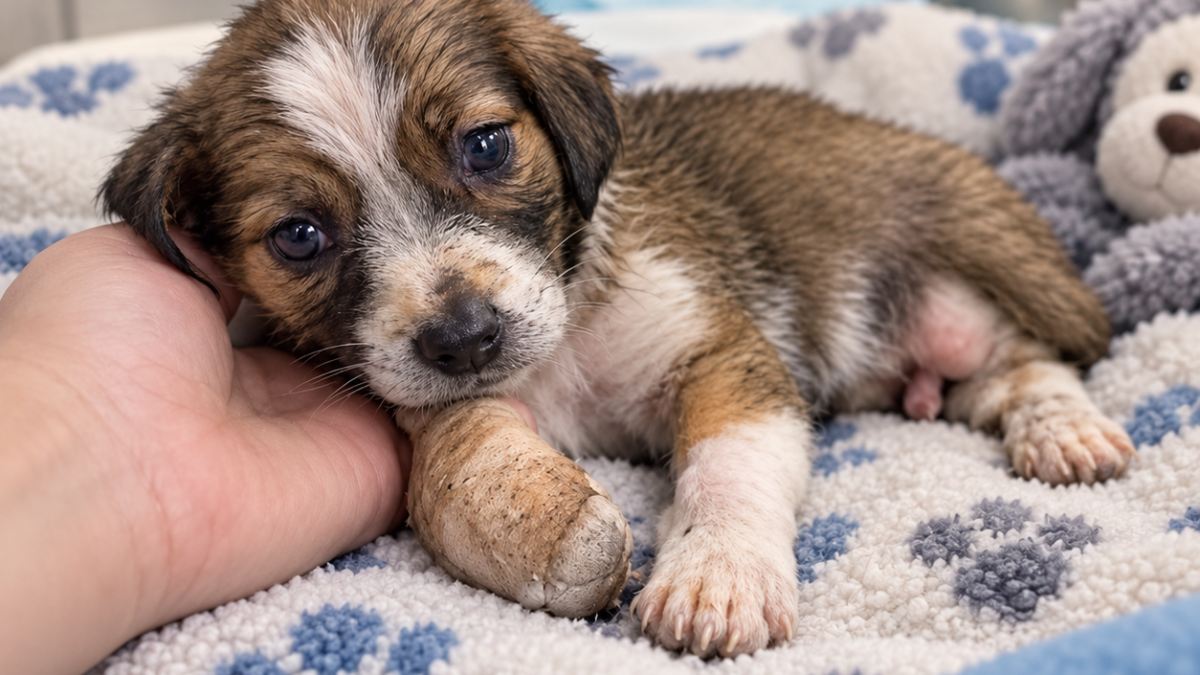
One front leg rested at that strange angle beneath him.
I put one finger near his face.
He turned his head slightly.
Then his nose touched my skin.
That tiny movement nearly broke me.
“I’m coming back,” I whispered. “You hear me? This is not goodbye.”
His mouth opened.
A sound came out so faint I almost missed it.
But it was there.
A little complaint.
A little protest.
And somehow, it made me smile through my tears.
“That’s right,” I said. “Be mad.”
That night was one of the longest of my life.
I kept my phone beside me.
Every time the screen lit up, my heart stopped.
At midnight, the clinic called.
I answered before the first ring had finished.
“He’s still with us,” the technician said immediately.
I sank against the wall.
His blood sugar had improved. His temperature was holding. He had accepted a tiny amount of food through careful assisted feeding.
But his breathing remained unstable.
“Should I come?”
“Not yet.”
Not yet.
Two hours later, I was still awake.
At three in the morning, I finally fell asleep sitting on my couch.
At 4:17, my phone rang.
I woke so violently that I almost dropped it.
“Hello?”
The veterinarian’s voice was on the other end.
“He had a difficult episode.”
My entire body went cold.
“What does that mean?”
“His oxygen level dropped. We increased respiratory support, and he responded.”
“Is he dying?”
There was a pause.
“He’s fighting.”
That was not the same as no.
I drove to the clinic before sunrise.
The waiting room was almost empty.
A nurse brought me into a consultation room and told me the veterinarian would be with me shortly.
I sat there staring at the floor.
After several minutes, the door opened.
The veterinarian entered carrying him.
I stood so quickly my chair scraped backward.
He was wrapped in a blue towel.
A small oxygen line rested near his face.
But his eyes were moving beneath closed lids.
His nose twitched.
“Can I hold him?”
“For a few minutes.”
She placed him against my chest.
I didn’t realize I had been holding my breath until I felt his body.
Warm.
Alive.
Fragile, but alive.
His tiny head rested beneath my chin.
Then something happened that sounds insignificant unless you’ve ever believed you were about to lose something you loved.
He moved his back leg.
Just once.
A weak little kick against my shirt.
I laughed and cried at the same time.
“There you are.”
The veterinarian smiled.
“He has some attitude.”
“He has a lot of attitude.”
That morning, she told me she wanted to start treating him for a suspected respiratory infection rather than waiting for it to become worse.
His condition was too fragile to take unnecessary chances.
For the next forty-eight hours, improvement came in increments so small that I learned to celebrate things I would never have noticed before.
A slightly stronger suck.
A warmer body temperature.
A few grams gained.
A longer period without breathing distress.
A louder cry.
The first time the technician told me, “He actually yelled at me during feeding,” I almost hugged her.
“Good.”
She laughed.
“Most people don’t celebrate being yelled at.”
“I do now.”
By the end of the third day at the hospital, his oxygen support had been reduced.
By the fourth, he was breathing more comfortably.
By the fifth, he was strong enough that the staff began discussing sending him home.
I should have felt relieved.
Instead, I was terrified.
At the clinic, machines and professionals surrounded him.
At home, there would be me.
“What if he crashes again?”
The veterinarian looked directly at me.
“Then you call us. But right now, he needs controlled time with his mother, careful supplemental feeding, warmth, daily weight checks, and rest.”
“And the leg?”
“We’ll start with very gentle physical management. Nothing aggressive. When he’s stronger, we’ll evaluate whether a soft support or splint might help.”
I looked down at him.
He had already fought through the first battle.
The second one was waiting.
When I brought him home, his mother smelled him for several seconds before beginning to lick his head.
Then something happened that made me sit on the floor and cry.
His siblings crawled toward him.
They piled around him as though he had never been gone.
One ended up stretched across his back.
Another tucked its head beneath his neck.
And for the first time since he was born, he didn’t lie alone on the edge of the group.
He was right in the middle.
I decided that night he needed a name.
Until then, I had avoided naming him.
I hadn’t admitted that to anyone.
Maybe some part of me had been protecting myself.
If I didn’t name him, maybe losing him would hurt less.
That was ridiculous, of course.
I already loved him.
So I looked at the little puppy who had nearly died before his eyes had even opened and said, “I think you’ve earned a name.”
He yawned.
“Teddy.”
I don’t know why.
It simply fit.
“Teddy,” I repeated.
His nose twitched.
“Okay. Teddy it is.”
From that point on, my life ran according to Teddy’s schedule.
I weighed him before feeding.
I weighed him after feeding.
I logged every number in a notebook.
I wrote down how long he nursed, whether he coughed, how his breathing sounded, how active he was, even how often he cried.
At first, his progress was frustratingly slow.
The other puppies seemed to grow in front of my eyes.
Teddy remained tiny.
But he grew.
That was what mattered.
Ten grams.
Then twelve.
Then fifteen.
I began to understand that recovery wasn’t dramatic most of the time.
It was numbers in a notebook.
It was setting an alarm at 1:30 in the morning.
It was warming a bottle.
It was cleaning blankets.
It was sitting beside the whelping box with one hand resting near a tiny body because I was afraid to sleep.
It was learning to be grateful for boring days.
Especially boring days.
When Teddy was a little over two weeks old, his eyes opened.
I was sitting beside him when it happened.
One eye appeared first as a narrow dark line.
Then the other.
Within a day or two, he was looking at the world.
I leaned over the box.
“Well, hello.”
His eyes were still cloudy with that newborn blue-gray color.
He stared in my direction.
Then he tried to crawl toward me.
His back legs pushed.
His healthy front leg reached forward.
The deformed one folded underneath him.
He tipped sideways.
I caught him before his head bumped the bedding.
He squeaked angrily.
“I know.”
He tried again.
He fell again.
That was the second thing Teddy taught me.
Failure meant almost nothing to him.
He had no embarrassment.
No self-pity.
He didn’t know his siblings were doing something he couldn’t.
He only knew he wanted to get somewhere.
So he kept trying.
At his next veterinary appointment, the doctor examined the leg again.
Teddy had gained enough strength for a more thorough assessment.
She gently extended and flexed his paw, wrist, elbow and shoulder.
He complained loudly.
“That’s actually good,” she said.
“His yelling is good?”
“It means he has sensation.”
X-rays followed.
I sat in the waiting room, feeling that old fear return.
When the veterinarian came back, she placed the images on a screen.
“The good news is that this doesn’t look like a situation where the entire limb is malformed beyond function.”
I leaned forward.
“Meaning?”
“The position of the lower limb is abnormal, but there may be a significant soft-tissue component. Because he’s so young, we might be able to influence the alignment as he grows.”
“Might?”
“Might.”
There was that word again.
Hope always came with caution.
She explained that Teddy would need gentle stretching exercises several times a day.
Nothing painful.
Nothing forceful.
The goal was to encourage the muscles and tendons to lengthen and to guide the paw toward a more functional position.
Later, if his skin tolerated it, they could try a lightweight custom support.
“So he could walk normally?”
“He could walk.”
The way she said it stopped me.
Not normally.
Not perfectly.
Just walk.
Suddenly, that sounded like the most beautiful word I had ever heard.
We began the exercises that evening.
Three times a day, I held Teddy in my lap and gently worked with his front leg.
At first he hated it.
He squirmed.
He squeaked.
He tried to chew my fingers with a mouth that barely contained teeth.
“You survived oxygen therapy,” I told him. “You’re not going to defeat me with gums.”
He bit me anyway.
As the days passed, his personality emerged.
Teddy wasn’t timid.
He wasn’t delicate emotionally just because his body had been fragile.
In fact, he was becoming the troublemaker of the litter.
Once his lungs recovered, he seemed determined to compensate for lost time.
He crawled over his siblings.
He stole the warmest sleeping spot.
He complained whenever I moved him.
When their first clumsy puppy games began, Teddy participated.
He just participated differently.
The others bounced.
Teddy rolled.
The others wrestled standing up.
Teddy launched himself at them from the floor.
More than once, I watched one of his larger brothers tumble backward because Teddy had grabbed his ear and refused to let go.
“You’re a menace,” I told him.
He wagged his tiny tail.
At three and a half weeks, we tried his first support.
The veterinary rehabilitation technician had created a tiny padded splint designed to encourage a better position without putting dangerous pressure on his growing bones.
It looked impossibly small sitting on the table.
Still, it looked enormous on Teddy.
He stared at it as though someone had attached a tree branch to his body.
Then he tried to walk.
One step.
Collapse.
He stood again.
Two steps.
Collapse.
Then he became furious.
He barked.
It was his first real bark.
Tiny.
Sharp.
Completely ridiculous.
Everyone in the rehabilitation room laughed.
Teddy did not appreciate that.
He tried again.
The splint made his front leg feel unfamiliar. His balance changed. He kept stumbling.
After several minutes, his frustration overwhelmed him.
He sat down and cried.
I picked him up.
“It’s okay.”
The therapist touched my shoulder.
“Give him time.”
I looked at Teddy.
“We’ve heard that before, haven’t we?”
Time.
Patience.
A few grams.
One breath.
One step.
We went home.
For the next several days, Teddy wore the support only for carefully controlled periods.
I checked his toes constantly for swelling.
I inspected his skin.
I massaged the limb.
Then I let him move without it.
The improvement was almost invisible at first.
Then one morning I noticed something.
Teddy was standing beside the water dish.
Actually standing.
His twisted paw wasn’t flat.
His leg wasn’t straight.
But he was putting weight through it.
“Teddy.”
He looked up.
The movement made him lose his balance.
He sat down hard.
I laughed.
Then I started crying.
My family thought something terrible had happened when I called them into the room.
“What?”
“Look.”
“At what?”
“His foot.”
Teddy stood again.
Three seconds.
Maybe four.
Then he fell.
No one spoke.
Those few seconds meant more to me than I could explain.
I took a video and sent it to the veterinary team.
The reply came quickly.
THAT’S PROGRESS.
Two words.
I stared at them for a long time.
By five weeks, Teddy was no longer the smallest by such a dramatic margin.
He was still smaller than his littermates, but the gap was closing.
His breathing sounded normal.
He ate like a puppy determined to make up for every meal he had struggled through.
His front leg remained visibly different, but it was becoming useful.
He could brace himself with it.
He could push.
He could even take several awkward steps.
Then, just when I finally started allowing myself to believe we were moving beyond the worst of it, everything changed again.
It happened late at night.
The puppies had finished eating and were settling down.
Teddy had been playing harder than usual.
I noticed him sitting by himself.
That alone made me uneasy.
“Teddy?”
He didn’t come.
I walked over and picked him up.
His body felt hot.
Too hot.
I grabbed the thermometer.
The number made my heart hammer.
Fever.
Within minutes, I was back in the same car, driving down the same road, toward the same clinic where I had taken him weeks earlier.
Only this time Teddy wasn’t a nearly lifeless newborn wrapped in a towel.
He was older.
Stronger.
And I had allowed myself to believe that meant he was safe.
I was wrong.
The veterinarian on duty examined him.
His breathing was faster again.
He was lethargic.
Bloodwork showed signs of inflammation.
Given his early respiratory history, they were worried about infection.
“Are we back where we started?”
The doctor shook her head.
“No. He’s much stronger now.”
“But this is serious.”
“Yes.”
I closed my eyes.
There are moments when fear doesn’t arrive as panic.
Sometimes it arrives as exhaustion.
I sat beside Teddy’s kennel after the staff allowed me into the treatment area and stared at him.
“You’ve already done this,” I whispered.
He lifted his head.
“Don’t make me learn how to lose you now.”
He rested his chin on the blanket.
I stayed until they told me I had to go.
That night, all the old memories returned.
The first drive.
The oxygen line.
The phone call at four in the morning.
The word if.
But something was different now.
Teddy was different.
At six days old, he had almost no reserves.
Now he had muscle.
Weight.
Strength.
And, apparently, enough attitude to become furious when a technician tried to take his temperature.
At 2:11 in the morning, the clinic called.
I braced myself.
“He’s doing better.”
I nearly laughed.
His fever was coming down.
His oxygen levels were good.
He had eaten.
Then the technician added, “He also tried to steal my pen.”
I covered my face with my hand.
“That’s him.”
The setback lasted several days, but Teddy recovered.
Again.
And after that, something changed in me.
I stopped waiting for the universe to take him away.
Not completely.
I don’t think fear like that disappears entirely.
But I began thinking less about how Teddy might die and more about how Teddy might live.
That shift mattered.
At six weeks old, his siblings were running.
Teddy wasn’t.
Not yet.
They chased toys across the floor, skidded around corners, pounced on one another and crashed into furniture.
Teddy chased them in his strange, determined way.
His stride was uneven.
One front leg landed differently from the other.
Sometimes he stumbled.
Sometimes he went down hard.
But he always stood up again.
I started placing rugs across the slippery parts of the floor.
I created small obstacle courses with rolled towels and cushions.
The rehabilitation team showed me exercises that encouraged him to shift weight carefully from one front leg to the other.
We used treats.
A lot of treats.
Teddy became an enthusiastic student once he realized rehabilitation involved food.
One afternoon, the therapist placed him at one end of a padded hallway and asked me to kneel several feet away.
“Call him.”
“Teddy.”
His head lifted.
“Come here, buddy.”
He moved toward me.
One awkward step.
Then another.
Then three faster steps.
He stumbled.
Recovered.
Kept coming.
“Come on!”
Four steps.
Five.
Six.
For the first time, I realized I wasn’t holding my breath.
Teddy crossed the distance and crashed into my knees.
I scooped him up.
Behind me, someone clapped.
Then someone else.
I turned.
Two technicians and one receptionist were watching through the doorway.
The receptionist wiped her eyes.
“Oh, don’t start,” I said, already crying myself.
“I’m not crying.”
“You absolutely are.”
“So are you.”
Teddy licked my chin.
He had no idea why the humans had suddenly become ridiculous.
The veterinarian who had first treated him came into the hallway.
She crouched.
“Put him down again.”
I did.
Teddy looked at her.
Then at me.
Then at the treat bag.
He walked.
Not perfectly.
Not smoothly.
But independently.
All the way across the floor.
The veterinarian pressed her lips together.
I remembered the first conversation we’d had.
Will he ever walk?
We had no answer then.
Now the answer was wobbling toward us with his ears bouncing.
“Looks like you were right,” I said.
She smiled.
“About what?”
“When you said we’d cross that bridge if we got there.”
Teddy reached her shoes.
She picked him up.
“Apparently he decided to build the bridge himself.”
By eight weeks, it was time for Teddy’s siblings to begin going to their new homes.
That day hurt more than I expected.
One by one, families arrived.
I watched each puppy leave in someone’s arms.
Teddy watched too.
He sat beside me while his litter grew smaller.
When the last sibling went through the door, he wandered back toward the empty puppy area and sniffed the blankets.
Then he looked at me.
Something tightened in my chest.
“You know you’re not leaving, right?”
His tail moved.
“I couldn’t get rid of you now if I tried.”
That wasn’t entirely true.
There had been interest in Teddy.
People had seen pictures and heard pieces of his story.
Some asked whether he would be available for adoption.
But every time I tried to imagine handing him to someone else, I couldn’t.
I had counted his breaths.
Held oxygen tubing near his face.
Fed him when he was too weak to eat.
Learned every angle of his deformed leg.
Celebrated grams.
Celebrated urine.
Celebrated barking.
Celebrated the first time he annoyed me.
He was mine long before I admitted it.
So Teddy stayed.
And without his siblings around, he attached himself to me completely.
He followed me from room to room.
If I went into the kitchen, Teddy came.
If I went to the laundry room, Teddy came.
If I walked outside, Teddy stood at the door and acted as though I had abandoned him for ten years.
His leg continued improving.
By three months, the deformity was still noticeable, but it no longer defined his movement.
We stopped using the support as often.
His muscles were strengthening.
The paw landed more naturally.
He still tired faster than other puppies, so I controlled his activity carefully.
That did not mean Teddy controlled his activity carefully.
He believed medical restrictions were personal insults.
One afternoon I looked outside and saw him sprinting—actually sprinting—after a leaf blowing across the yard.
“Teddy!”
He ignored me.
The leaf bounced across the grass.
Teddy accelerated.
His strange front leg pumped beneath him.
For several seconds, his body moved with the reckless joy of any other puppy.
Then he tripped.
I gasped.
He rolled twice.
I ran toward him.
Before I reached him, Teddy stood.
He shook himself.
Found the leaf.
And attacked it.
I stopped halfway across the yard.
Then I laughed so hard I had to put my hands on my knees.
That became Teddy’s version of revenge.
Not revenge against a person.
Not anger.
Not cruelty.
His revenge was against every terrible prediction that had followed him from birth.
Too small.
Too weak.
Too fragile.
Maybe he wouldn’t survive.
Maybe he wouldn’t walk.
Maybe the leg would never function.
Maybe his respiratory problems would return.
Teddy answered every maybe in the only language he understood.
He kept moving.
At four months, the veterinarian scheduled a full orthopedic reevaluation.
I was nervous even though Teddy seemed well.
The new X-rays showed what months of growth, rehabilitation and careful management had accomplished.
The alignment was not perfect.
It probably never would be.
But the limb was functional.
The joints were stable enough.
His shoulder had developed good strength.
Surgery, which once had been one possibility if the deformity caused severe functional problems, was not recommended at that point.
“You’re telling me he doesn’t need an operation?”
“Not now.”
I looked at Teddy.
He was trying to eat a paper towel from the trash.
“He doesn’t seem concerned.”
The veterinarian rescued the paper towel.
“He’s developed extremely well.”
I smiled.
“Say that again.”
“He’s developed extremely well.”
“No, the other part.”
She laughed.
“He doesn’t need surgery right now.”
I wanted those words engraved somewhere.
As Teddy grew, his story spread through the clinic.
Whenever we came for appointments, someone would recognize him.
“Is that Teddy?”
Sometimes it was a staff member I remembered.
Sometimes it was someone I didn’t.
One technician came from the back and knelt beside him.
“You probably don’t remember me.”
Teddy immediately tried to climb into her lap.
She laughed.
“I fed you at three in the morning when you were the size of a potato.”
Teddy licked her face.
“Apparently he remembers.”
Another woman stood nearby watching.
She was holding a small dog against her chest.
The dog wore a bandage on one hind leg.
“Was he born like that?” she asked, looking at Teddy’s front leg.
“Yes.”
“And he can walk?”
Before I could answer, Teddy spotted a rolling stool.
He chased it.
The woman laughed.
“I guess that answers my question.”
Then her expression changed.
“My puppy may lose her leg.”
I looked at the little dog in her arms.
She looked terrified.
Not the puppy.
The woman.
I recognized that fear.
Different problem.
Same helplessness.
I sat beside her.
“I can’t tell you what will happen with your dog.”
She nodded.
“But I can tell you something my vet told me when Teddy was six days old.”
“What?”
“Don’t make tomorrow’s decision with today’s fear.”
She looked down at her puppy.
I hadn’t realized until then how many things Teddy’s survival had taught me.
Not just about dogs.
About fear.
Fear loves the ending before the story has reached the middle.
It tells you the worst thing that could happen and then behaves as though it already has.
Teddy had forced me to stop doing that.
At six months, he returned to the rehabilitation department for what I expected to be a routine evaluation.
The therapist watched him walk.
Then trot.
Then move across a low balance cushion.
She examined his leg.
“His strength is excellent.”
I grinned.
“So we’re done?”
“With regular therapy? Probably.”
The word hit me strangely.
Done.
For months, our entire life had revolved around fixing, strengthening, checking and protecting.
Now someone was telling me Teddy could simply be a dog.
I looked at him.
He was chewing the strap on a piece of exercise equipment.
“What do I do now?”
The therapist laughed.
“Try to keep him out of trouble.”
“That sounds harder.”
“It probably will be.”
Then she said something I will never forget.
“Would you let us record him walking?”
“Of course.”
“We have another puppy coming next week with a somewhat similar limb problem. Not identical, but the family is terrified. Sometimes seeing a dog who adapted helps.”
I looked down at Teddy.
The puppy everyone had worried might never walk was about to become the example shown to someone else who needed hope.
“Record whatever you want.”
They placed Teddy at the end of the rehabilitation room.
I stood near the camera.
“Come here.”
Teddy trotted toward me.
No splint.
No assistance.
His left front paw still turned slightly.
Anyone looking carefully could see something was different.
But he moved.
Confidently.
Happily.
Without hesitation.
Halfway across the room, he suddenly sped up.
The technician filming laughed.
Teddy reached me and jumped against my legs.
“Again,” she said.
We did it again.
And again.
By the fourth take, Teddy realized this game produced treats and became completely unmanageable.
He began sprinting toward the camera before anyone called him.
“He’s cheating.”
“He has always been an opportunist.”
The veterinarian who had treated him during his first crisis happened to walk past the doorway.
She stopped.
For a moment, she didn’t say anything.
Then she leaned against the frame and watched.
Teddy ran across the room.
He spun around.
Ran back.
The veterinarian looked at me.
“Do you remember how small he was?”
I nodded.
“I remember every second.”
“I honestly wasn’t sure we’d get here.”
Neither was I.
Teddy ran past us again.
There was no dramatic music.
No miracle light.
No audience except a handful of veterinary staff.
But I understood why several people had tears in their eyes.
They weren’t crying because Teddy had become perfect.
He hadn’t.
They were crying because he had become possible.
There is a difference.
For so long, everything about Teddy had been discussed in possibilities.
He might survive.
He might gain weight.
He might recover from the respiratory infection.
He might use the limb.
He might walk.
Now he was simply there.
Alive.
Running.
Demanding treats.
Trying to bite a shoelace.
The future we had once been afraid to imagine was standing in front of us.
And then Teddy did something none of us expected.
He walked over to the veterinarian.
The same woman who had held him when he was barely breathing.
She crouched.
Teddy placed both front paws against her knee.
Including the deformed one.
Then he pushed himself upright.
She froze.
He licked her chin.
For a few seconds, nobody spoke.
The veterinarian lowered her face against his head.
When she stood, her eyes were wet.
“Well,” she said, clearing her throat, “that’s not very professional.”
Nobody laughed at her.
We were all crying.
I drove home that afternoon with Teddy asleep in the passenger seat.
At a red light, I looked over at him.
He was bigger now.
He no longer fit in my palm.
The ribs that had once been visible through his skin were covered with healthy muscle.
His chest rose and fell slowly.
Easily.
I realized I hadn’t watched him breathe for months.
Not in the terrified way I once had.
That thought alone felt enormous.
A few weeks later, something happened that tested everything we had learned.
Teddy escaped through a gate.
It was my fault.
I had carried groceries inside and failed to latch it completely.
A gust of wind pushed the gate open.
Teddy saw freedom.
By the time I turned around, he was gone.
“Teddy!”
Nothing.
I ran outside.
The yard was empty.
The gate stood open.
My heart stopped.
I sprinted toward the road.
“Teddy!”
Then I heard barking.
Across the field behind the house.
I ran toward the sound.
At first, I couldn’t see him.
Then a brown shape appeared between the tall grass.
Running.
Toward me.
Not limping.
Not struggling.
Running.
His ears flew backward.
His tongue hung from the side of his mouth.
His awkward front leg stretched forward, hit the earth and pushed again.
“Teddy!”
He crossed the field.
I dropped to my knees.
He crashed into me so hard he nearly knocked me backward.
I grabbed him.
“You absolute idiot.”
His entire body wiggled.
“You scared ten years off my life.”
He licked my mouth.
“That is not an apology.”
He disagreed.
On the walk home, I couldn’t stop thinking about the field.
Months earlier, I had been afraid Teddy might never take a step.
Now I was angry because he had run too far.
Life had a strange sense of humor.
Teddy turned one year old on a rainy Saturday.
I made him a dog-safe cake.
It was unnecessarily elaborate.
He destroyed it in approximately forty seconds.
The veterinary staff had sent a card.
On the front was a photograph taken during his first week at the hospital.
I had never seen that picture.
Teddy was inside the warming enclosure.
Tiny.
Fragile.
Wrapped in blue.
Inside the card, several staff members had written messages.
One sentence stopped me.
**We remember when every breath was a victory. Happy birthday to the puppy who never stopped fighting.**
I sat at my kitchen table for a long time.
Adult Teddy lay beneath my chair chewing a toy.
Every breath was a victory.
That had been true.
I had forgotten.
Or perhaps I had simply become accustomed to the miracle.
That’s the strange thing about getting what you once prayed for.
Eventually, it becomes ordinary.
The puppy survives.
Then he grows.
He eats breakfast.
He scratches at the door.
He steals socks.
He barks at delivery drivers.
He gets mud on the carpet.
The thing you once begged the universe to give you becomes daily life.
And sometimes you need an old photograph to remember that ordinary life was once everything you wanted.
Teddy’s second year was mostly uneventful.
And I loved that.
There were no oxygen cages.
No emergency phone calls.
No midnight fever.
No desperate weigh-ins.
His leg remained different, but he learned his own way of moving.
The veterinarian warned me to monitor his joints as he aged because his altered gait could create additional stress over time.
So I kept him lean.
We avoided excessive jumping.
We continued simple strengthening exercises.
Teddy considered all of this deeply offensive.
He wanted to run.
So we found safe places where he could.
His favorite was a wide grassy field behind a local walking trail.
The first time I unclipped his leash there, he looked at me as though he couldn’t believe I had made such an irresponsible decision.
“Go.”
He stood still.
“Go on.”
Then he exploded.
He ran enormous circles around me.
His mouth open.
His ears bouncing.
Every few seconds he looked back to make sure I was watching.
I was.
I always watched.
Maybe I always would.
Not because I expected him to fall.
Because I remembered when standing had been impossible.
One afternoon, while we were walking back to the car, a little boy noticed Teddy.
“What’s wrong with his leg?”
His mother looked embarrassed.
“I’m sorry.”
“It’s okay.”
The boy crouched.
Teddy walked over.
“He was born that way,” I explained.
“Does it hurt?”
“No.”
“Can he run?”
I smiled.
“You want to see?”
The boy nodded.
I tossed Teddy’s ball.
Teddy tore after it.
The boy laughed.
“He’s fast!”
“Don’t tell him. His ego is already terrible.”
The boy watched Teddy return.
Then he pointed at the leg.
“So that’s just his special leg?”
I looked at him.
“Yeah.”
I had spent months calling it his deformed leg.
His bad leg.
The injured-looking leg.
The problem.
A child needed five seconds to find a better name.
His special leg.
“Yeah,” I repeated. “That’s exactly what it is.”
From that day forward, that was what I called it.
Teddy’s special leg.
Years passed.
He never became a perfectly normal dog.
I’m glad I stopped needing him to.
Normal was never the point.
Teddy was healthy.
He was happy.
He could walk, run and play.
He had limitations, and we respected them.
There were days after too much activity when he moved more slowly.
There were occasional rehabilitation checkups.
As he grew older, we added supplements and modified his exercise.
But the tiny puppy who had once been unable to reach his mother without falling had become a dog who lived completely on his own terms.
He loved car rides.
He hated baths.
He was suspicious of umbrellas.
He believed every visitor had come specifically to see him.
He stole one slipper but never the pair.
He slept upside down.
And every night, almost without exception, he rested one front paw against me when he fell asleep.
Usually the special one.
I liked to think it was accidental.
I knew it wasn’t.
When Teddy was three, the veterinary clinic contacted me with an unusual request.
They were hosting an event for families whose pets were undergoing long-term rehabilitation.
Would I bring Teddy?
I agreed.
The event was held in a large room behind the clinic.
There were dogs in wheelchairs.
Dogs recovering from surgery.
Older dogs learning to move comfortably after injuries.
Families who looked exhausted.
Families who looked afraid.
I recognized them.
Not their faces.
Their expressions.
I had worn those expressions once.
The rehabilitation therapist introduced Teddy.
She told the shortened version of his story.
Born with a severe limb deformity.
Critically weak as a newborn.
Respiratory crisis.
Assisted feeding.
Splinting.
Therapy.
Setback.
More therapy.
Then she pointed toward him.
Teddy was lying on his back while a child rubbed his stomach.
A few people laughed.
Afterward, several owners came to speak with me.
One woman had a puppy scheduled for an amputation.
A man had an older dog recovering from spinal surgery.
Another family had adopted a dog with two badly malformed legs.
They asked what Teddy’s recovery had been like.
I gave them the only honest answer.
“Hard.”
I didn’t tell them everything would be fine.
I hated that phrase.
Sometimes everything isn’t fine.
Sometimes love doesn’t change the medical outcome.
Sometimes people do everything right and still lose.
Hope isn’t pretending bad things can’t happen.
Hope is deciding that while there is something reasonable to fight for, you will be present for the fight.
So that was what I told them.
“We didn’t know if Teddy would make it. We didn’t know how well he’d walk. We just dealt with the problem in front of us each day.”
The woman with the puppy facing amputation looked at Teddy.
“Wasn’t it exhausting?”
“Completely.”
“Were you scared?”
“Constantly.”
She hesitated.
“Was it worth it?”
Teddy stood.
He walked over to me.
Then he leaned against my leg.
I scratched behind his ears.
“Every second.”
Near the end of the event, the veterinarian who had treated Teddy as a newborn came over.
She had gray in her hair now that I didn’t remember from those first nights.
Or maybe I had simply been too terrified to notice it.
“He’s still causing trouble?”
“Professionally.”
She laughed.
Then she looked down at his leg.
“You know, medically, his outcome was better than I expected.”
“I know.”
“We were very cautious with you.”
“I know that too.”
She paused.
“Did that bother you?”
“No.”
And it didn’t.
When people are afraid, they often want certainty.
Tell me he’ll survive.
Tell me he’ll walk.
Tell me everything will be okay.
But medicine cannot honestly promise those things.
What the veterinary team gave Teddy was better than a promise.
They gave him a chance.
And then they worked.
I worked.
Teddy worked hardest of all.
The room was beginning to empty when a staff member rolled a small cart past us.
Teddy jumped sideways.
Then barked at it.
The veterinarian stared.
“After all these years, you’re afraid of a cart?”
Teddy barked again.
I shook my head.
“He survived respiratory failure. Wheels are apparently where he draws the line.”
We laughed.
That sound—ordinary laughter in the same building where I had once thought Teddy was going to die—felt like the perfect ending.
But Teddy wasn’t finished giving me lessons.
At five years old, he developed pain in his shoulder.
I noticed it after a long walk.
He hesitated before climbing the porch step.
The next morning, he was limping.
The old fear came back instantly.
For a few minutes, I wasn’t standing beside a five-year-old dog.
I was holding a six-day-old puppy again.
I called the clinic.
X-rays showed early arthritic changes, likely partly related to the unusual mechanics of his front limb.
I felt guilty.
“Did I let him run too much?”
“No.”
“Did I do something wrong?”
“No.”
“Should I have protected him more?”
The veterinarian looked at me.
“Protected him from what? Living?”
I stopped.
She explained we could manage it.
Weight control.
Modified activity.
Medication when necessary.
Physical therapy.
Swimming.
Teddy, meanwhile, was attempting to steal treats from a jar.
The veterinarian pointed at him.
“That dog has spent five years using that limb. That’s five years more than you were once afraid he’d have.”
That sentence stayed with me.
I had spent so much of Teddy’s life being grateful that he could do things that I sometimes forgot why we had fought for those abilities.
We hadn’t saved his leg so he could preserve it untouched.
We had saved its function so he could use it.
So he could chase leaves.
Run across fields.
Jump into my lap.
Dig holes he wasn’t supposed to dig.
Make choices.
Be a dog.
The arthritis wasn’t proof that we had failed.
It was proof that he had lived long enough to wear his body down a little.
We adjusted.
Teddy began swimming once a week.
At first, he hated it.
Then he realized swimming came with treats.
His objections vanished.
His shoulder became stronger.
His limp improved.
And once again, a problem that initially felt like the end turned into another chapter.
That was Teddy’s real gift.
He taught me not to confuse a difficult chapter with the ending.
The ending came much later.
Not the ending of Teddy’s life.
I don’t want to tell that story because it hasn’t happened.
As I write this, Teddy is lying nearby.
His face has begun to gray.
He doesn’t run as fast as he once did.
He sleeps more.
Sometimes he studies a staircase for a moment before deciding whether the journey is worth it.
But he’s here.
Still stubborn.
Still hungry.
Still convinced that my food legally belongs to him.
The ending I’m talking about happened when we returned to that veterinary clinic for another rehabilitation event.
Teddy was older by then.
Calmer.
Mostly.
A family had brought in a newborn puppy with a malformed front leg.
The puppy was only a few weeks old.
Small enough to fit in two hands.
The mother holding him looked exhausted.
She had been crying.
I knew before anyone explained.
Fear.
That same old fear.
The therapist introduced us.
“This is Teddy.”
The woman looked down.
Then at Teddy.
“This is him?”
Apparently someone had shown her his old rehabilitation video.
She had watched it after her puppy’s diagnosis.
She crouched.
Teddy walked toward her.
His front leg turned slightly with every step.
The woman stared.
“He walks.”
I smiled.
“Yes.”
“He really walks.”
“Every day.”
Her face crumpled.
She covered her mouth.
I knelt beside her.
The tiny puppy in her hands squirmed.
Teddy sniffed him.
Very gently.
Then Teddy did something that silenced all of us.
He lowered himself beside the puppy.
The tiny dog tried to crawl.
His malformed front leg folded.
He fell.
He tried again.
Teddy watched.
The puppy pushed forward.
Fell again.
Teddy remained beside him.
And suddenly I was back at the beginning.
I could see the whelping box.
The brothers and sisters moving toward their mother.
The tiny puppy left behind.
The shallow breaths.
The warm towel.
The drive to the hospital.
The oxygen.
The splint.
The first three-second stand.
The hallway.
The running field.
Everything.
The woman beside me whispered, “I’m so scared.”
I looked at her.
“I know.”
“What if he never walks?”
I could have pointed at Teddy.
I could have said, “Look. Teddy did.”
But that would have been a promise I had no right to make.
Her puppy wasn’t Teddy.
Every condition is different.
Every outcome is different.
So instead I said what I wish someone could have made me believe in those first terrifying days.
“Then you’ll deal with that if it happens. Today, he’s here. Today, he needs you. Start there.”
She cried harder.
I put my arm around her.
Teddy rested his head on her knee.
The tiny puppy crawled forward again.
One inch.
Maybe two.
Then he bumped into Teddy’s paw.
Teddy didn’t move it.
The puppy leaned against him.
For a moment, that tiny body rested against the same leg that had once caused everyone so much fear.
I looked at the veterinarian across the room.
She was crying.
The therapist was crying.
The puppy’s owner was crying.
And I was crying so hard I couldn’t pretend otherwise.
Teddy simply lay there.
He didn’t know what his survival meant to us.
He didn’t know that people had once discussed his future in cautious voices.
He didn’t know his first weeks had been filled with questions.
He didn’t know that there had been a time when walking across a room seemed almost impossible.
Dogs don’t carry those stories the way humans do.
Maybe that’s why they survive certain things better than we do.
Teddy never hated his leg.
He never looked at his siblings and asked why they had four straight limbs while he had three and one difficult one.
He never felt ashamed when he fell.
He never considered himself broken.
He never demanded that the world be fair before agreeing to participate in it.
He simply wanted to get from where he was to where he wanted to be.
So he tried.
Again.
And again.
And again.
That night, Teddy and I drove home in the rain.
He slept on the back seat now because he was too large and too old for the passenger seat position he’d had as a puppy.
When we reached the house, the rain had stopped.
I opened the car door.
Teddy looked at me.
“Come on, old man.”
He climbed down carefully.
One paw.
Then the other.
His special front leg touched the driveway.
He paused.
Then he walked toward the house.
Slowly.
Confidently.
I followed behind him.
Near the porch, a dry leaf scraped across the pavement in the wind.
Teddy stopped.
His ears lifted.
I knew exactly what he was thinking.
“Don’t even think about it.”
The leaf moved.
Teddy looked at me.
“Teddy.”
He lunged after it.
Not fast.
Not gracefully.
But with exactly the same ridiculous determination he had shown as a puppy.
I laughed.
He caught the leaf near the steps and stood over it proudly.
“Congratulations.”
His tail wagged.
“You defeated vegetation.”
He carried the leaf inside.
I let him.
Later that night, he fell asleep beside me.
As always, one paw rested against my leg.
The special one.
I touched it gently.
For years, people had told me Teddy was lucky to have me.
They were wrong.
I had been lucky to have him.
I thought I had spent those first weeks teaching a fragile puppy how to survive.
But Teddy had been teaching me something much harder.
He taught me that courage does not always look powerful.
Sometimes courage weighs less than a pound.
Sometimes it cannot stand.
Sometimes it struggles to breathe.
Sometimes it falls after one step.
And sometimes courage looks like a tiny newborn puppy with a twisted leg dragging himself toward his mother one more time because he has not yet learned that the world expects him to give up.
Teddy never became the dog he was “supposed” to be.
He became something better.
He became himself.
His leg never became perfectly straight.
His past never disappeared.
The difficult first weeks remained part of him, even if he couldn’t remember them.
But the thing that once looked like the tragedy of his life became the reason his story reached people who needed hope.
The leg everyone feared would hold him back carried him through years of adventures.
The lungs that once struggled for every breath powered him across open fields.
The puppy who could barely reach his mother became the dog another frightened family looked at and whispered, “Maybe ours can have a life too.”
And that, to me, was the most satisfying revenge imaginable.
Not revenge against a person.
Not punishment.
Not anger.
It was revenge against every hopeless possibility that had surrounded him before he was old enough to open his eyes.
The answer to “he may not survive” was years of birthdays.
The answer to “he may never walk” was muddy paw prints across my floor.
The answer to “his life may be limited” was a life so full that one ordinary afternoon could contain more happiness than I had dared to imagine during his first terrifying week.
Sometimes I still find the old notebook.
The one where I recorded every feeding and every tiny increase in weight.
The pages are worn.
Some numbers are blurred because I wrote them while exhausted.
Near the beginning, there is a line from the night after Teddy first returned home.
I had forgotten writing it.
It says:
**Please let tomorrow be better.**
Whenever I read those words, I look across the room.
There he is.
Older now.
Sleeping peacefully.
Breathing without effort.
One front paw bent slightly differently from the other.
Tomorrow did become better.
Not immediately.
Not easily.
Not all at once.
It became better ten grams at a time.
One feeding at a time.
One breath at a time.
One frightening night at a time.
One failed attempt at standing.
One successful attempt.
One step.
Then another.
Then six steps down a rehabilitation hallway while a room full of people tried not to cry.
Then a run across a field.
Then years.
If I could go back to the woman I was on the sixth day of Teddy’s life—the woman gripping a steering wheel with one hand while reaching toward a warm towel with the other—I wouldn’t tell her everything would be easy.
It wasn’t.
I wouldn’t promise her the puppy would survive.
At that moment, nobody could honestly promise that.
I would simply tell her this:
Keep driving.
He is still breathing.
That is enough for now.
And if Teddy could tell his younger self anything, I don’t think he would say much at all.
He would probably sniff him.
Steal his blanket.
Look for food.
Then he would walk away on the very leg everyone had been so afraid of.
And that would say everything.

