PART 2: They Said Bianca Might Never Walk or Eat Again—Then Her Tiny Paws Did Something Nobody Expected
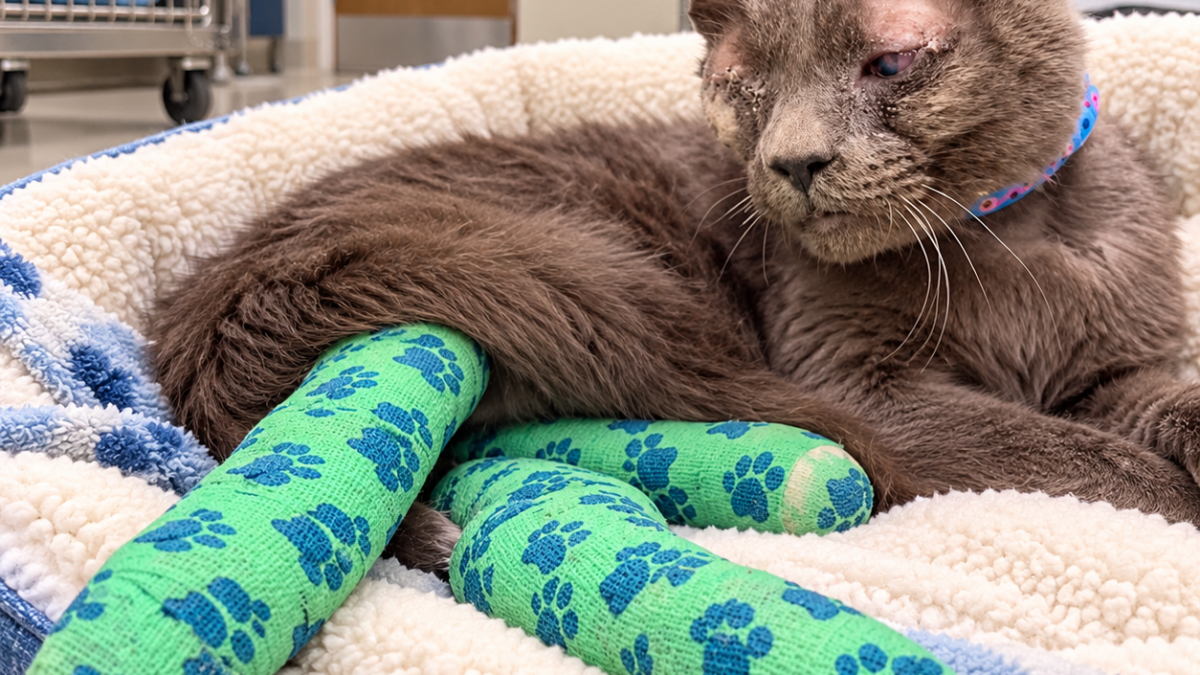
PART 2
I had spent the entire day begging for good news, yet when the veterinarian finally gave me some, I discovered how quickly relief could turn back into fear.
“She made it through this stage.”
I held onto those words.
Then he continued.
“The jaw fractures are severe. We’ve stabilized what we can for now, but she will need careful monitoring. Her legs are another issue. We’re going to have to take this step by step.”
“Is she in pain?”
“We’re managing it aggressively.”
“Can I see her?”
“Soon.”
I hated that word.
Soon had become one more thing I couldn’t control.
I sat in the waiting room again, staring at a vending machine without seeing it.
People came and went.
A man carried a terrier wrapped in a towel.
A woman held a cardboard carrier containing a kitten who complained loudly enough for the entire building to hear.
Normally I would have smiled.
That night I barely noticed.
My entire world had narrowed to a treatment room behind two closed doors.
Eventually, a technician appeared.
“You can come back.”
Bianca looked even smaller after surgery.
There were bandages and support around parts of her body.
Her face was swollen.
Her breathing was steady, but every breath looked precious.
I pulled a chair beside her and lowered myself carefully.
“Hey, sweetheart.”
Nothing.
The technician touched my shoulder.
“She’s still coming out of anesthesia.”
“I know.”
“You can sit with her.”
So I did.
For hours, I sat beside a cat who couldn’t answer me.
I told her stupid things because silence felt worse.
I told her about the weather.
I told her that the coffee in the lobby tasted terrible.
I told her she had already scared ten years off my life.
At one point, I whispered, “You picked a dramatic way to meet everybody.”
The technician nearby laughed quietly.
It was the first time I had heard laughter since Bianca arrived.
Sometime after midnight, Bianca moved.
Just one ear.
Then her eye opened.
It was unfocused at first.
She blinked.
I leaned closer.
“Bianca.”
Her eye turned toward my voice.
There she was.
Not fixed.
Not safe.
Not healed.
But there.
I put my hand near her without touching the injured parts of her face.
“You came back.”
Her eye slowly closed again.
I stayed until I was told she needed quiet.
The next morning brought the first problem we had known was coming.
Food.
Bianca’s jaw was too damaged and too fragile for normal eating.
The medical team had already planned how to support her, but knowing something intellectually is different from seeing it.
A technician prepared a tiny amount of food that could be given carefully through a syringe.
“She may not take much.”
I nodded.
Bianca was awake but exhausted.
The technician touched the syringe near her mouth.
Nothing.
Another try.
Nothing.
My stomach tightened.
“Is she refusing?”
“She’s tired. Give her a second.”
A tiny drop touched her tongue.
Bianca swallowed.
The technician smiled.
“There.”
I stared.
“That’s good?”
“That’s very good.”
She offered another tiny amount.
Bianca swallowed again.
I laughed.
Two swallows.
That was all.
And somehow, those two tiny movements felt like winning something enormous.
From then on, my life changed its unit of measurement.
I no longer counted progress by days.
I counted swallows.
Head movements.
Eye contact.
Minutes of comfortable sleep.
A slightly stronger breath.
A paw moving half an inch.
Every detail mattered.
People sometimes imagine recovery as a dramatic climb from injury to health.
Bianca’s recovery was not like that.
It was a collection of tiny things nobody would have noticed in a healthy cat.
On the third day, her whiskers twitched.
I was sitting beside her when I saw it.
At first I thought I had imagined it.
Then they moved again.
“Did you see that?”
The technician looked over.
“What?”
“Her whiskers.”
Bianca’s whiskers twitched a third time.
The technician grinned.
“Well, look at you.”
I felt ridiculous for becoming emotional over whiskers.
But after watching Bianca lie almost motionless, any voluntary movement felt like a message.
She was still participating.
The following day, she lifted her head.
Only for a few seconds.
Her muscles trembled.
She lowered it again.
“That was enough,” I told her.
She did it again later.
Then came one of the moments I will never forget.
Bianca was lying on a folded blanket.
One paw was partially supported because of the injuries.
I noticed her toes flex.
Then release.
Flex.
Release.
“Wait.”
I leaned closer.
Her paw pressed into the blanket.
Then the other one moved as much as it could.
She was kneading.
Making biscuits.
A cat with three badly injured legs, after surgeries and pain and days of being unable to move properly, was trying to make biscuits on her blanket.
A volunteer beside me covered her mouth.
“Oh my God.”
Bianca pressed again.
The volunteer’s eyes filled with tears.
“She feels safe.”
That sentence destroyed me.
We had been so focused on whether Bianca could survive that I had forgotten survival was not the only thing we were watching for.
Comfort mattered.
Interest mattered.
Trust mattered.
A cat does not knead because a doctor told her to.
She does it because something inside her remembers warmth.
Security.
Motherhood.
Comfort.
Home.
That day, Bianca showed us something medicine could not measure.
She still had room inside her for something besides pain.
But the next morning reminded us how dangerous it was to celebrate too quickly.
She seemed tired.
More tired than before.
She did not respond as brightly.
Her appetite through assisted feeding dropped.
I immediately panicked.
“What changed?”
The veterinarian examined her.
“Nothing obvious.”
“She was doing better yesterday.”
“She may simply be exhausted.”
“What if she’s getting worse?”
“That’s possible. It’s also possible her body is recovering from major trauma.”
I hated how calm he sounded.
I wanted certainty.
He could not give it.
That became one of the hardest parts of Bianca’s recovery.
There was no straight line.
One day she looked stronger.
The next day she seemed fragile again.
One afternoon she followed everyone with her eye.
The following morning she slept through almost everything.
I began interpreting every small change as either a miracle or disaster.
Finally, one veterinarian pulled a chair beside me.
“You’re going to make yourself sick.”
“I’m fine.”
“You haven’t left this building for more than a few hours.”
“I don’t want her to be alone.”
“She isn’t.”
I looked toward Bianca.
He continued.
“Recovery from this kind of trauma is going to have bad days.”
“How do I know the difference between a bad day and the beginning of the end?”
“You don’t.”
I stared at him.
He didn’t soften the answer.
“You watch. You evaluate. You keep asking whether treatment is helping. You adjust. That’s what we’re doing.”
“What if we get it wrong?”
“Then we make the best decision we can with the information we have.”
That was not comforting.
But it was honest.
Over the following week, Bianca stabilized again.
Her feeding improved.
Her awareness sharpened.
She began reacting when familiar people entered the room.
I discovered she liked one particular technician better than everyone else.
The woman’s name was Rachel.
Every time Rachel approached, Bianca’s eye opened a little wider.
“I see how it is,” I told her.
Rachel laughed.
“She has excellent taste.”
“You gave her pain medication.”
“Exactly. I’m her favorite person.”
Bianca eventually began purring again.
The sound was faint.
So faint that Rachel initially thought equipment was vibrating.
Then she placed two fingers gently near Bianca’s chest.
“She’s purring.”
I leaned in.
There it was.
A tiny engine.
Broken jaw.
Three injured legs.
Damaged eye.
And a purr.
I closed my eyes.
“Keep doing that,” I whispered.
Bianca did.
The second round of procedures frightened me more than the first.
The first time, everything happened so quickly that I barely had time to understand what was coming.
Now I knew the risks.
I knew what it felt like to sit outside closed doors.
I knew how long minutes could become.
When they carried Bianca away again, I felt sick.
Rachel sat beside me in the hallway.
“She’s stronger than she was the first time.”
“I know.”
“Her bloodwork looks better.”
“I know.”
“She has a good team.”
“I know.”
Rachel looked at me.
“None of that helps, does it?”
“No.”
She nodded.
“Fair.”
Hours later, the veterinarian returned.
This time he was smiling slightly.
“It went well.”
I nearly cried before he finished speaking.
The jaw repair looked promising.
The leg procedures had gone as expected.
They still needed time.
Everything still needed time.
But for the first time, the medical conversation began including words like rehabilitation.
Not just survival.
Rehabilitation.
That word sounded like sunlight.
Still, rehabilitation brought its own challenges.
Bianca had been still for a long time.
Her muscles were weak.
Her body had learned caution.
Standing required trust in limbs that had betrayed her once already.
The first time the team encouraged her to bear a little more weight, she refused.
Rachel steadied her.
“Come on, Bianca.”
Bianca sat back down.
I laughed.
“That’s a no.”
Rachel tried again.
Bianca gave her a look so offended that we both started laughing.
“She has opinions now,” Rachel said.
“That’s progress.”
And it was.
A cat who has enough energy to be annoyed is often doing better than one who has none.
The next attempt went differently.
Bianca stood.
Her legs shook.
I instinctively held my breath.
One paw moved.
Then another.
She wobbled.
Rachel supported her.
“That’s okay.”
Bianca froze.
Then sat.
I clapped once.
Rachel glared at me.
“Don’t scare her.”
“Sorry.”
Bianca looked at me like she agreed with Rachel.
The next day, she stood longer.
Then came two steps.
The day after that, three.
They were not graceful.
One leg seemed unsure where to land.
Her balance was affected by her vision.
Her body had changed.
But movement had returned.
I knelt a few feet away.
“Come here.”
Bianca looked at me.
She took one step.
Stopped.
Another.
Stopped.
Then she turned toward Rachel instead.
Rachel laughed so hard she had to look away.
“Traitor,” I told Bianca.
That was the first time the clinic felt normal again.
Not happy exactly.
But alive.
Bianca was no longer only a tragedy being managed.
She had become herself.
Stubborn.
Selective.
Quietly affectionate.
Occasionally dramatic.
And very clear about which human deserved her attention.
The biggest milestone still remained.
Eating.
The assisted feeding had kept her alive.
But nobody wanted it to remain her permanent reality if her jaw could eventually function on its own.
As the fractures healed, the veterinarians gradually began testing what Bianca could do safely.
The first time a shallow dish was placed near her, my heart started pounding harder than it had during some of her procedures.
Rachel crouched beside me.
“Do not expect a miracle.”
“I’m not.”
“You’re staring at the bowl like it contains the meaning of life.”
“It does.”
Bianca smelled the food.
Her whiskers moved.
She leaned forward.
Stopped.
I almost whispered encouragement, but Rachel touched my arm.
“Let her.”
So we watched.
Bianca lowered her face.
Her jaw moved carefully.
She touched the food.
Then pulled back.
My shoulders dropped.
“She can’t.”
“Wait.”
Bianca leaned forward again.
She opened her mouth.
And took the smallest bite I had ever seen.
Rachel grabbed my arm.
I covered my mouth.
Bianca chewed carefully.
Swallowed.
Then looked up.
I started crying.
Rachel shook her head.
“You are impossible.”
“She ate.”
“I saw.”
“She ate by herself.”
“One bite.”
“One bite is eating.”
Bianca took another.
Then a third.
After that, she was tired.
We stopped.
She still needed assistance.
But the world had changed.
Bianca had eaten.
Not because someone pushed food through a syringe.
Not because a technician placed it exactly where she needed it.
She had smelled food, chosen it, lowered her head and taken it herself.
Independence had returned in the size of a bite.
Over the following days, those bites became more frequent.
Three.
Five.
Half a small portion.
Then more.
At first, someone always stayed beside her.
Eventually, we realized Bianca did better when we backed off.
One morning, I walked into the treatment area and found her alone with her bowl.
Her head was bent over it.
She was eating.
I froze.
Rachel looked over from the counter.
“Don’t move.”
“How long?”
“About four minutes.”
“Why didn’t you call me?”
“Because every time six people stand around staring at her, she stops.”
Fair.
I stayed in the doorway.
Bianca kept eating.
A full meal.
I had spent weeks holding syringes and counting swallows.
Now she was ignoring me because breakfast was more interesting.
It was one of the happiest moments of my life.
Then came the day the casts and supports began coming off.
I thought I would feel only excitement.
Instead, I felt terror.
The casts had protected her.
Without them, her legs looked thin.
Vulnerable.
Rachel placed Bianca onto a padded surface.
“Easy.”
Bianca stood.
Her body swayed.
One step.
Another.
Then another.
No cast.
No person carrying her.
She walked toward her bowl.
The room went silent.
The veterinarian who had questioned at the beginning whether treatment might be too much happened to be standing nearby.
He crossed his arms.
“Well,” he said.
I looked at him.
“Well what?”
“She has made her opinion pretty clear.”
I smiled.
That was as close as any of us needed to come to revisiting those early conversations.
Nobody had been wrong to worry.
Nobody had been cruel.
We had asked whether Bianca had a reasonable path toward a life she could enjoy.
Now she was walking toward lunch.
That was an answer.
Her damaged eye remained another adjustment.
Bianca learned to navigate mostly with vision from one side.
At first, she occasionally bumped into things or hesitated when something approached from the side she couldn’t see well.
We adjusted the room.
Food remained in predictable places.
Beds stayed where she expected them.
People learned not to surprise her.
Then Bianca adjusted faster than we did.
Within weeks, she could navigate unfamiliar spaces with astonishing confidence.
Her whiskers helped.
Her hearing helped.
Her memory helped.
And perhaps most importantly, her fear began to fade.
The first few times someone approached from her blind side, Bianca startled.
Later, she merely turned.
Eventually, she stopped behaving as if every surprise might hurt her.
Trust was coming back.
That mattered as much as bones.
Once Bianca was medically stable enough to continue recovery outside the hospital, we prepared a quiet foster room.
I was terrified.
The veterinarian laughed when I started asking questions.
“What if she refuses food?”
“Call.”
“What if she slips?”
“Call.”
“What if her jaw—”
“Call.”
“What if—”
He held up one hand.
“She cannot remain a patient forever.”
I stopped.
He continued.
“At some point, recovery means living.”
That sentence stayed with me.
Bianca had spent weeks being examined.
Measured.
Injected.
Fed.
Carried.
Protected.
Supported.
Evaluated.
Every part of her day had been medical.
But a life cannot remain a treatment plan.
So we brought her home to foster.
I opened her carrier in the recovery room and expected her to hide.
Bianca stepped out.
She stood still for several seconds, studying the space.
Then she walked forward.
Slowly.
Carefully.
She smelled the bed.
The bowls.
The blanket.
The doorway.
I followed behind her like an anxious parent.
Bianca turned.
Her good eye narrowed.
I could almost hear her.
Stop following me.
I sat down.
She continued exploring.
Within twenty minutes, she had selected the best blanket.
Within an hour, she had found the food.
By evening, she was sleeping in a patch of warm light near the window.
The first night, I barely slept.
Every sound made me sit up.
At 2:14 in the morning, I checked on her.
Bianca was asleep.
At 3:37, I checked again.
Still asleep.
At 5:02, I heard movement and rushed into the room.
Bianca was eating.
She looked at me as if I were insane.
“You’re okay.”
She went back to breakfast.
I leaned against the doorframe.
“Yes, I understand. I’m embarrassing.”
Life became gradually more ordinary.
And ordinary turned out to be the greatest gift.
Bianca developed routines.
Breakfast.
Window.
Nap.
Food.
Blanket.
More sleep.
A little wandering.
Another nap.
She began grooming herself more confidently.
At first, watching her clean around her face made me nervous because of the jaw.
Eventually, it simply made me smile.
One afternoon, I was folding towels when I heard the faint sound of fabric moving.
Bianca was on her favorite blanket.
Her paws pressed down.
Released.
Pressed again.
Making biscuits.
This time there were no casts.
No IV lines.
No clinic staff.
Just Bianca.
I sat on the floor.
She kept kneading.
I thought about those legs.
Three had been badly injured.
There had been a time when we didn’t know whether she would use them normally.
Now she was using them for something entirely unnecessary.
That was what made me cry.
Survival is necessary.
Walking to food is necessary.
Moving away from danger is necessary.
Making biscuits is not necessary.
It is something a cat does because she is comfortable.
Because she feels safe.
Because somewhere inside her body, pleasure has become possible again.
That was when I knew Bianca had crossed a line.
She was no longer merely recovering.
She was living.
Her veterinary checkups continued.
Every time we returned to the clinic, people came out to see her.
“Bianca!”
“She looks amazing.”
“Look at those legs.”
“She’s walking!”
Bianca hated the attention.
She sat in her carrier giving everyone a suspicious stare.
Rachel opened the door.
“Don’t pretend you don’t remember me.”
Bianca walked out and rubbed her cheek against Rachel’s hand.
I pointed.
“I knew it.”
Rachel smiled triumphantly.
“Favorite.”
During one appointment, the veterinarian compared current images with the first ones.
I looked at them side by side.
The original fractures made my stomach tighten all over again.
“How did she survive that?”
He shrugged slightly.
“Cats.”
“That’s your scientific explanation?”
“No. My scientific explanation is much longer. ‘Cats’ is the short version.”
Bianca’s jaw was stronger.
Her legs showed good healing.
Her movement was improving.
She was eating normally.
The damaged eye had left her with limitations, but she adapted beautifully.
The prognosis that once consisted of questions was becoming something else.
A future.
That introduced the next challenge.
Adoption.
I knew this day was coming.
I also discovered I hated it.
The entire point of foster rescue is to help an animal heal and then place her in a permanent home.
That sounds easy until you have sat beside the animal through nights when you were afraid she would die.
Bianca had become part of every day.
I knew the sound of her eating.
The way she turned when I entered.
Which blanket she preferred.
Where she slept when sunlight reached the floor.
How long she tolerated petting before deciding she had had enough.
The idea of somebody else becoming her person felt wrong.
Which meant it was time.
A rescue coordinator posted Bianca’s adoption profile.
Applications came in.
Some were wonderful.
Some were not.
One person asked, “Will her eye ever look normal?”
I paused.
“What do you mean by normal?”
“You know. Like another cat.”
“She is another cat.”
They didn’t adopt her.
Good.
Another person wanted a cat for a home with several very energetic animals and seemed irritated when we explained that Bianca would do best with a calmer transition.
Also not right.
Then a family contacted us.
Their first questions were different.
“What food does she like?”
“Where does she sleep?”
“Does she get nervous when people approach from the side she can’t see?”
“How can we arrange the house so she learns it quickly?”
“Does she enjoy being picked up, or does she prefer affection on the floor?”
I started paying attention.
Then they asked the question that mattered most.
“What makes Bianca happy?”
I stared at the message.
Not what is wrong with her?
Not how much will she cost?
Not is she damaged?
What makes her happy?
I wrote back.
“Soft blankets. Quiet people. Good food. Sunlight. Gentle attention when she asks for it. And making biscuits.”
They asked to meet her.
The meeting was scheduled for Saturday.
I woke early and cleaned the house even though they were coming to see the cat, not inspect me.
I straightened Bianca’s blanket.
Then realized she hated when I moved it and put it back.
Bianca watched from her bed.
“Don’t judge me.”
She blinked.
The family arrived right on time.
A woman named Emily.
Her husband, Mark.
And their teenage daughter, Sophie.
What I noticed first was what they did not do.
They did not rush toward Bianca.
They did not reach over her head.
They did not crowd her.
They sat on the floor.
Emily looked at me.
“Should we ignore her?”
“For a few minutes, yes.”
“That’s hard.”
“I know.”
Bianca remained near the window.
Sophie whispered, “She’s beautiful.”
I liked her immediately.
Not brave.
Not pitiful.
Not poor thing.
Beautiful.
I explained Bianca’s history.
The accident.
The surgeries.
The jaw fractures.
The legs.
Her damaged eye.
The feeding.
The rehabilitation.
Emily listened carefully.
“What happens if she has trouble later?”
“You call your veterinarian. She’ll need normal monitoring, and of course we’ll give you her records. But right now she’s doing extremely well.”
Mark asked, “Can she climb?”
“Some. We recommend keeping things easy for her and not expecting huge jumps.”
“That’s fine.”
Sophie asked, “Does she sleep in a regular cat bed?”
“She sleeps anywhere except the expensive cat bed.”
Sophie laughed.
“That sounds like every cat.”
Bianca’s ears moved.
She stood.
I stopped talking.
She crossed the room slowly.
Emily kept her hand still on her knee.
Bianca approached.
Smelled her fingers.
Paused.
Then rubbed her cheek against them.
Emily’s face changed.
“Oh.”
That one sound told me everything.
Bianca moved toward Sophie next.
Sophie did not touch her immediately.
She waited.
Bianca stepped closer.
Sophie stroked the side of her neck carefully.
Bianca remained.
Mark whispered, “I think we’re being interviewed.”
“You are.”
“Who makes the final decision?”
I pointed at Bianca.
He smiled.
The meeting lasted almost two hours.
Bianca eventually climbed onto the blanket beside Sophie.
Not her lap.
Just beside her.
Sophie sat almost motionless because she was afraid to ruin it.
When the family left, Emily turned at the door.
“We’d like to apply officially.”
I nodded.
“I thought you might.”
After they were gone, I returned to Bianca.
She was eating.
“You realize what you just did?”
Nothing.
“You might have found your family.”
Bianca continued chewing.
I sat on the floor.
My eyes filled.
“I hate you a little.”
Her tail flicked.
The adoption was approved.
That should have been pure happiness.
Instead, I spent the following days experiencing something I had not expected.
Grief.
Not because anything was wrong.
Because everything had gone right.
I had met Bianca when death was part of every conversation.
I had prayed for her to reach the next morning.
Then the next surgery.
Then the next swallow.
The next step.
The next bite.
Now she was leaving because we had succeeded.
Rescue is strange that way.
Failure means losing them.
Success sometimes means losing them too.
The difference is where they go.
On Bianca’s final night with me, I barely slept.
She did.
Of course.
At 1:00 in the morning, she was curled on her blanket.
At 3:00, still there.
At sunrise, I sat beside her.
“Today’s the day.”
Bianca opened one eye.
“You’re going home.”
She stretched.
Her paws pressed into the blanket.
One.
Two.
Three.
Making biscuits.
I laughed through tears.
“You really have no idea what’s happening, do you?”
Maybe that was better.
No fear.
No dramatic goodbye.
Just breakfast.
Blanket.
Sunlight.
Then a carrier.
Emily, Mark and Sophie arrived later that morning.
They brought the exact food Bianca ate.
A low-sided litter box.
Two soft beds.
A blanket similar to her favorite.
They had rearranged one room so she could learn the space without obstacles.
They had even placed protective steps near the sofa in case she wanted to climb up without jumping.
Preparation.
That was what convinced me.
People say many things when they want an animal.
Preparation reveals intention.
The paperwork was completed.
Sophie knelt beside Bianca.
“Ready?”
Bianca looked at her.
Sophie opened the carrier.
Nobody pushed her.
Bianca walked toward it.
Smelled the blanket.
Stepped inside.
I almost fell apart.
The cat who once could not walk had just walked voluntarily into the carrier taking her to her permanent home.
Emily hugged me.
“We’ll send updates.”
“Please.”
“I mean it.”
“So do I.”
Mark lifted the carrier carefully.
Sophie walked beside him.
I followed them outside.
When they placed Bianca in the car, I crouched near the carrier door.
Her good eye met mine.
There was so much I wanted to say.
I wanted to tell her I was sorry she had ever known pain.
I wanted to tell her I was proud of her.
I wanted to tell her she had scared us half to death.
I wanted to tell her that every person who had helped her would remember her.
Instead I said, “Be happy.”
The car pulled away.
I stood in the driveway until it disappeared.
Then I went inside and cried harder than I had cried during some of her worst medical days.
Her blanket was gone.
Her bowl was gone.
The room looked enormous without her.
That afternoon, I kept expecting to hear her walking.
At 6:12 p.m., my phone buzzed.
A message from Emily.
I opened it immediately.
“We’re home. She explored the bedroom, found her water, ate dinner and is now under Sophie’s desk.”
A photograph followed.
Bianca sat on a folded blanket.
Her expression looked suspicious but calm.
I laughed.
At 8:40, another message.
“She came out.”
Photo.
Bianca beside Sophie.
At 9:15.
“She used the litter box.”
I responded:
“I have never been so happy to receive a litter box update.”
Emily sent a laughing emoji.
Then, before bed, one final video arrived.
Bianca was on the new blanket.
Her paws moved.
Press.
Release.
Press.
Release.
She was making biscuits.
I watched the video six times.
Maybe more.
I cried every time.
That could have been the ending.
But Bianca’s story continued.
A week later, Sophie sent a video of her walking from the bedroom into the hallway.
Her steps were steady.
Not perfect.
Steady.
Two weeks later, she was eating beside the kitchen doorway.
Three weeks later, she had discovered the sofa.
Emily sent a picture with the caption:
“She rejected the pet steps and climbed up by herself.”
I wrote back:
“Of course she did.”
A month after the adoption, Bianca returned to the clinic for a scheduled checkup.
I arranged to be there.
When Emily carried her inside, several technicians recognized the carrier.
“Is that Bianca?”
Rachel came running from the back.
Bianca’s carrier door opened.
Rachel crouched.
“Bianca.”
Bianca stared at her.
Then stepped out.
She sniffed Rachel’s hand.
Rubbed against it.
Rachel looked at me.
“Still favorite.”
“Apparently.”
Sophie laughed.
Bianca walked around the examination room.
No casts.
No syringe.
No assistance.
She crossed toward Sophie and sat beside her feet.
The veterinarian entered.
He stopped in the doorway.
For a moment, he just watched her.
Then he said, “That doesn’t look like the same cat.”
“It is.”
He crouched.
Bianca walked toward him.
I saw something change in his face.
Veterinarians learn to protect themselves emotionally.
They have to.
They see suffering every day.
They make impossible decisions.
They lose patients despite doing everything correctly.
But Bianca had been one of those cases that stayed with everyone.
He touched her gently near the shoulder.
“You gave us trouble.”
Bianca rubbed against him.
He smiled.
“I’ll accept that as payment.”
The examination went well.
Jaw stable.
Legs strong.
Weight improving.
Navigation excellent.
Her eye required continued awareness, but Bianca had adapted.
When the appointment ended, Sophie spread Bianca’s blanket inside the carrier.
Bianca stepped onto it.
Then those paws started.
Press.
Release.
Press.
Release.
Everyone stopped talking.
Rachel’s eyes filled.
The veterinarian smiled.
Emily looked at me.
“You told us about this.”
“I know.”
“But seeing everyone’s reaction…”
I swallowed.
“The first time she did that, she could barely move.”
Sophie looked down at Bianca.
“She looks comfortable now.”
“Yes.”
That was it.
Comfortable.
What a simple word.
What a huge achievement.
Bianca went home again.
Months passed.
The updates became less medical.
I loved that.
At first every message was about recovery.
Eating.
Walking.
Checkups.
Medication.
Later the messages changed.
“Bianca stole Mark’s chair.”
“Bianca screamed because dinner was five minutes late.”
“Bianca discovered warm laundry.”
“Bianca slept on Sophie’s homework.”
“Bianca tried to fit inside a box half her size.”
That transition meant everything.
She had stopped being an injured cat.
She had become a family cat.
One evening, Sophie sent a photo of Bianca stretched across her bed.
The caption read:
“She sleeps next to me every night now.”
I looked at Bianca’s face.
Eyes closed.
Body loose.
No tension.
Trust.
The accident had taken movement.
Food.
Vision.
Security.
For a while, perhaps trust too.
But trust had returned.
That might have been Bianca’s greatest victory.
Not walking.
Not eating.
Sleeping.
Really sleeping.
Beside a person.
Knowing she would wake up safe.
People sometimes asked whether I was angry about what happened to Bianca.
Of course I was.
Any time I remembered her first day, anger returned.
A car had struck her.
Her body had been shattered.
But we never had enough reliable information to know exactly how the accident happened or who was responsible.
There was no dramatic courtroom confrontation.
No driver to chase.
No revenge to invent.
I refused to turn Bianca’s real suffering into something false simply because revenge would make a cleaner story.
The truth was stronger.
Her revenge, if you wanted to call it that, was life.
The road had left her unable to stand.
She walked.
Her shattered jaw had made eating impossible.
She emptied her own bowl.
Her injured legs had once lain motionless.
They carried her to the people she loved.
Those same paws kneaded blankets every night.
The accident had tried to reduce Bianca’s future to one terrible moment.
Bianca refused to remain inside that moment.
That was enough justice for me.
Nearly a year after I first met her, Emily invited me to visit.
I had seen photographs.
Videos.
Clinic visits.
But I had never seen Bianca fully settled inside her home.
When I arrived, Sophie opened the door.
“Don’t expect her to run to you.”
“I know.”
“She’s asleep.”
“Good.”
I entered quietly.
The house felt warm.
Not physically.
Emotionally.
There were ordinary signs of life everywhere.
Shoes near the door.
Books on a table.
A half-finished mug of coffee.
A blanket draped over the sofa.
And on that blanket was Bianca.
She was asleep in the middle of it.
I stopped.
Emily whispered, “That’s her spot.”
“Of course it is.”
Bianca opened her good eye.
Looked at me.
For several seconds, she did nothing.
I wondered if she remembered me.
Then she stood.
Stretched.
Walked across the sofa.
Climbed down using the little steps the family had placed there.
She crossed the room.
My chest tightened.
Every step still mattered to me.
Bianca stopped in front of my shoes.
Smelled them.
Then looked up.
I crouched.
“Hey.”
She moved closer.
Rubbed the side of her face against my hand.
I laughed.
“You remember.”
Maybe she did.
Maybe she simply decided I was acceptable.
Cats keep some mysteries.
I sat on the floor.
Bianca remained beside me for a moment.
Then walked toward Sophie.
Sophie sat cross-legged.
Bianca climbed into the space beside her thigh and settled.
I expected jealousy.
Instead, I felt peace.
She chose Sophie.
That was the entire point.
Emily brought coffee.
We talked about Bianca’s routines.
She had learned every room.
She knew exactly where food was.
She could navigate stairs with supervision but mostly stayed on one level.
She had developed a habit of yelling when anyone closed a door she wanted open.
“She thinks every room belongs to her,” Mark said.
“It does.”
“That’s what Sophie says.”
Bianca yawned.
Then, almost on cue, she began kneading Sophie’s blanket.
Press.
Release.
Press.
Release.
I stared.
Sophie noticed.
“You always watch her paws.”
“I know.”
“Why?”
I thought about how to explain it.
“Because there was a time when I didn’t know if she would ever use them properly again.”
Sophie looked down at Bianca.
“She uses them a lot now.”
“I can see that.”
Bianca kneaded harder.
Then turned in a circle and lay down.
I felt tears coming.
Sophie smiled gently.
“You’re crying.”
“No.”
“You definitely are.”
“That accusation seems popular.”
Everyone laughed.
Bianca did not care.
She was already half asleep.
I stayed for several hours.
Before leaving, I stood at the door and looked back.
Bianca had returned to the sofa.
Sunlight crossed the blanket.
Her body was stretched out.
One paw hung over the edge.
An ordinary cat on an ordinary afternoon.
That image stayed with me more than the photographs from the clinic.
Because ordinary was the miracle.
A few months later, the rescue received another badly injured animal.
Different case.
Different injuries.
Different future.
I was sitting in the same waiting area where I had once waited for Bianca when a volunteer asked me something.
“How do you know when to keep fighting?”
I looked at her.
She was new.
Scared.
The animal we had brought in was being evaluated.
I thought about Bianca.
Then I answered carefully.
“You don’t always know.”
She looked surprised.
“I thought after doing this for years…”
“No. You still don’t know.”
“So what do you do?”
“You listen to the veterinarians. You look at the medical facts. You think about pain. You think about quality of life. You ask whether there’s a reasonable path forward.”
“And if there is?”
“You give them the chance.”
She nodded.
I added, “But you don’t demand a miracle from them.”
That was what Bianca had taught me.
We had not asked her to perform courage.
We had simply kept opening the next door when it was medically reasonable.
Surgery.
Recovery.
Feeding.
Standing.
Walking.
Eating.
Home.
Bianca chose how far she could go.
She happened to go farther than any of us dared expect.
Years later, I suspect the details of some cases will blur.
Names.
Dates.
Exact procedures.
But I will remember Bianca’s paws.
I will remember that first weak kneading motion against a clinic blanket.
I will remember a room full of exhausted people suddenly going quiet because an injured cat did something cats do every day.
I will remember her first bite.
Her first unsupported steps.
Her suspicious stare when everyone celebrated.
Her walk into the carrier that took her home.
And I will remember the last update Sophie sent me.
It was late one evening.
No dramatic message.
No medical report.
Just a short video.
Bianca was lying beside Sophie on the couch.
A movie played somewhere in the background.
Bianca’s paws moved against a blanket.
Press.
Release.
Press.
Release.
Then she stopped kneading, rested her head against Sophie and closed her eye.
That was all.
No miracle music.
No caption telling everyone what they were supposed to feel.
No big ending.
Just Bianca.
Safe.
Loved.
Home.
I thought back to that examination table.
The frightened cat who could not stand.
The broken jaw.
The damaged legs.
The injured eye.
The room where someone had quietly asked whether letting her go might be kinder.
That question had not been cruel.
It had come from compassion.
We simply did not yet know what Bianca was capable of.
Nobody did.
Maybe Bianca didn’t either.
She didn’t need to know.
She only needed the next hour.
Then the next day.
One swallow.
One movement.
One step.
One bite.
One blanket.
One family.
People like stories where everything changes in one dramatic moment.
Bianca’s life did not change that way.
She rebuilt it in tiny pieces.
That is what made her story real.
Her victory was not loud.
It did not happen all at once.
It looked like a twitching whisker.
A raised head.
A trembling leg.
A shallow bowl.
A small bite.
A paw pressing into a blanket.
And eventually, those tiny victories became a life.
A real one.
A full one.
A life where she could choose which room to sleep in.
A life where she could demand breakfast.
A life where she could steal someone’s chair.
A life where she could trust a teenager enough to sleep beside her.
A life where her history mattered but no longer controlled every moment.
Bianca had once been the cat everyone watched because we were afraid she might stop breathing.
Now she was the cat her family watched because she had stolen their laundry again.
That is the kind of ending rescue workers dream about.
Not perfection.
Not erasing what happened.
Something better.
The animal survives long enough for the terrible thing to become only one chapter.
Bianca still had scars.
She still saw the world differently.
Her body still carried evidence of the accident.
But scars are not the same thing as an ending.
They are proof that an ending did not happen when it could have.
Whenever I think about Bianca now, I no longer picture the road.
I no longer picture surgery.
I picture sunlight.
I picture a soft blanket.
I picture one bright eye slowly closing as she settles beside the people who belong to her.
And I picture those paws.
Press.
Release.
Press.
Release.
The same paws we once feared might never carry her properly again.
The same paws that learned to stand.
Then walk.
Then climb.
Then choose where she wanted to go.
The same paws that now knead a blanket in a home where nobody sees her as a broken cat.
She is simply Bianca.
And maybe that was the thing we had been fighting for all along.
Not to make her exactly what she had been before the accident.
Not to erase every injury.
Not to create some impossible perfect recovery.
We were fighting to give Bianca the chance to become herself again.
She did.
One tiny movement at a time.
And in the end, the cat who could not walk found her way home on her own four paws.
[EXTENDED ENDING — ADDITIONAL ~3,000 WORDS]
But Bianca’s story did not truly end the day she found her home.
I learned that months later, on an ordinary Sunday afternoon, when Sophie sent me a photograph I was not prepared for.
Bianca was sitting on the windowsill.
Nothing about the picture looked dramatic.
There were no bandages.
No veterinary equipment.
No worried faces.
No reminder of the clinic except the memories I carried.
Outside the window, autumn leaves had begun turning gold and red. Sunlight fell across Bianca’s back, catching the soft fur around her shoulders. One front paw rested against the glass while the other was tucked beneath her chest.
Her damaged side faced away from the camera.
Her good eye was fixed on something outside.
Probably a bird.
Maybe a squirrel.
Perhaps nothing at all.
Sophie had written only one sentence beneath the photograph.
“She figured out how to climb up here by herself.”
I stared at those words for a long time.
By herself.
That phrase had once seemed almost impossible.
Bianca had spent the beginning of her recovery depending on everyone.
We carried her.
Fed her.
Supported her.
Moved bowls closer.
Adjusted blankets.
Positioned her body.
Protected her legs.
Helped her through every basic act that healthy animals perform without thought.
Now Bianca had apparently spent part of an afternoon solving the complicated problem of how to reach a window because she wanted a better view.
That was not survival.
That was ambition.
I called Sophie.
She answered immediately.
“Did you see the picture?”
“I did.”
“She’s been trying for three days.”
“What?”
“We kept seeing her looking at the windowsill. Mom put the little pet steps nearby, but she wouldn’t use them at first.”
I laughed.
“That sounds right.”
“This morning she finally climbed them.”
“Was she okay?”
“Completely. She sat there for almost two hours.”
I could hear pride in Sophie’s voice.
Not the kind of pride people sometimes feel when an injured animal performs a trick.
This was different.
Sophie sounded like someone watching a family member regain another piece of independence.
Then she said something that made my throat tighten.
“I think she likes knowing she can get places without us.”
I looked again at the photograph.
“Yes,” I said. “I think she does.”
That became another part of Bianca’s recovery.
Not merely learning what her body could do.
Learning that she was allowed to want things again.
For weeks after the accident, Bianca’s life had been dictated by necessity.
Medicine now.
Food now.
Rest now.
Procedure now.
Do not move.
Do not jump.
Do not chew.
Wait.
Heal.
Recover.
Now she could make choices.
Window or blanket.
Sofa or bed.
Sophie’s room or the living room.
Breakfast immediately or breakfast after screaming at everyone for thirty seconds first.
That freedom seemed small from the outside.
It wasn’t.
Freedom had become the final stage of her healing.
By winter, Bianca had discovered another obsession.
Christmas wrapping paper.
Emily sent me a video two weeks before the holidays.
The family was wrapping gifts on the living-room floor.
Bianca had apparently decided this activity existed entirely for her entertainment.
She walked straight across a sheet of paper.
Sophie gently moved her aside.
Bianca walked back.
Mark tried to fold the paper.
Bianca sat on it.
“Bianca,” Mark said from behind the camera.
She looked directly at him.
“Move.”
Nothing.
Sophie laughed so hard that the video shook.
Then Mark attempted to slide the paper out from beneath her.
Bianca planted both paws harder.
The same paws.
I noticed them immediately.
Strong.
Steady.
Possessive.
“Those are mine now,” I whispered to the screen.
I watched her wrestle with a ribbon.
Not aggressively.
Playfully.
A year earlier, we had celebrated a whisker twitch.
Now she was attacking Christmas ribbon because apparently healing had transformed her into a criminal.
I sent Emily a message.
“Please tell Bianca that stealing wrapping supplies is not part of her rehabilitation plan.”
Emily answered:
“She says you’re no longer in charge.”
Fair.
That Christmas, they sent a family photograph.
Mark and Emily stood behind the couch.
Sophie sat in front.
Bianca occupied the center cushion as if the entire photo session had been organized around her.
I zoomed in on her face.
Relaxed.
Alert.
Confident.
No trace of the frightened stillness I remembered.
I saved the picture.
Not because it was dramatic.
Because it wasn’t.
That became the way I measured Bianca’s success.
The less dramatic her life became, the better.
There were still occasional difficult days.
Cold weather seemed to make one of her previously injured legs slightly stiff.
The first time Emily noticed it, she called me worried.
“She’s walking differently.”
“Call the veterinarian.”
They did.
Bianca was examined.
Nothing catastrophic.
Nothing had failed.
Her old injuries simply meant her body sometimes remembered what it had endured.
The veterinarian suggested small adjustments.
Warm sleeping areas.
Monitoring.
Avoiding unnecessary high jumps.
The family followed every recommendation.
That night Sophie sent a photograph of Bianca sleeping beneath a blanket.
“She has her own heating pad now.”
I smiled.
Of course she did.
That was another truth about happy endings.
They are not perfect.
Bianca did not emerge from her accident untouched.
Her body carried consequences.
Her vision remained limited.
Her legs had history.
Her jaw had history.
Some mornings she moved a little more slowly.
Some environments still required adjustment.
But perfection had never been the goal.
Comfort was.
Dignity was.
Choice was.
Love was.
A life that felt worth waking up for.
Bianca had all of those.
About fourteen months after her adoption, Sophie contacted me again.
This time the message was unusual.
“Can you come to my school?”
I called her.
“Why?”
“We have to give a presentation about something that changed how we think.”
“And?”
“I want to talk about Bianca.”
I smiled.
“What do you need from me?”
“I want to know what happened before we adopted her. Not just the medical stuff. I want to know what everyone felt.”
That question surprised me.
I had told Sophie the facts.
Car accident.
Broken jaw.
Three injured legs.
Damaged eye.
Surgeries.
Assisted feeding.
Rehabilitation.
But I had never told her everything about those first conversations.
The doubt.
The fear.
The people quietly wondering whether continuing treatment was fair.
The long hours when we didn’t know whether Bianca would survive.
So Sophie came over one Saturday afternoon with a notebook.
Bianca came too.
Emily carried her in a soft carrier.
When the door opened, Bianca walked out as if she owned my house.
Some things never change.
Sophie sat at the kitchen table.
“Start from the beginning.”
So I did.
I told her about the examination table.
How still Bianca had been.
How I had watched her chest to make sure she was breathing.
How her good eye followed us.
I told Sophie about the question someone had asked.
Are we helping her by putting her through this?
Sophie stopped writing.
“They thought she should die?”
The words came out sharper than she intended.
I shook my head.
“No.”
“But you said—”
“They were afraid she was suffering.”
Sophie frowned.
“They wanted to protect her from pain.”
“But she survived.”
“Yes.”
“So they were wrong.”
I thought carefully before answering.
“No. They were asking the right question with incomplete information.”
Sophie looked confused.
I continued.
“Loving an animal doesn’t mean forcing her to survive at any cost. Sometimes treatment only prolongs suffering. The difficult part is figuring out whether there’s a realistic path back to comfort.”
She looked toward Bianca.
Bianca was sitting beneath the table, grooming one paw.
“So how did you know?”
“We didn’t.”
Sophie looked back at me.
“That’s scary.”
“It was.”
“What made you try?”
“Her.”
“What did she do?”
“She watched us.”
“That’s all?”
“At first, yes.”
I told her about Bianca’s eye following people.
The swallowing.
The whisker twitch.
The head lift.
The first kneading motion.
The first step.
The first bite.
As I spoke, Sophie’s expression changed.
She stopped looking like a student gathering material for a presentation.
She looked like someone meeting an earlier version of her own cat.
Finally she asked, “Were you ever scared you made the wrong decision?”
“Every day.”
“Even after she got better?”
“Especially before we knew she was getting better.”
Sophie stared at her notebook.
Then she said, “I’m glad you didn’t quit.”
“So am I.”
Bianca walked from beneath the table and rubbed against Sophie’s leg.
Sophie reached down.
“She doesn’t know any of this.”
“No.”
“She doesn’t know how close everything was.”
“No.”
“Good.”
That answer surprised me.
“Why good?”
Sophie scratched beneath Bianca’s chin.
“Because she doesn’t have to remember the worst part every day.”
I went quiet.
A teenager had just explained something I had taken more than a year to understand.
We humans remembered Bianca as the cat who survived catastrophic injuries.
But Bianca did not wake up each morning thinking of herself as a survivor.
She woke up hungry.
She wanted breakfast.
She wanted Sophie.
She wanted the window.
She wanted the warm blanket.
She wanted whatever was inside the cardboard box someone had foolishly left unattended.
Trauma was part of Bianca’s history.
It was not her identity.
Sophie gave her presentation a week later.
She later showed me the final page.
There was a photograph of Bianca on the windowsill.
Underneath it, Sophie had written:
“Sometimes giving someone a chance does not mean knowing they will succeed. It means making sure fear is not the only thing making the decision.”
I had to read that sentence twice.
Then I asked, “Did your teacher help you write that?”
Sophie looked offended.
“No.”
“Just checking.”
She smiled.
Bianca’s influence kept spreading quietly.
One of Sophie’s classmates had a three-legged cat.
Another family later adopted an older shelter dog.
I never pretended Bianca was solely responsible.
People make their own decisions for many reasons.
But Sophie told me that classmates had asked questions after the presentation.
Can animals live happily with disabilities?
Do one-eyed cats behave differently?
Are older animals harder to adopt?
What happens during rehabilitation?
Those questions mattered.
Bianca would never know that a room full of teenagers had learned something because she once refused to stop moving forward.
She didn’t need to know.
Her responsibility had never been inspiring anyone.
Her responsibility was only living.
Two years after the accident, I received another invitation.
This one came from the clinic.
Rachel was leaving.
After years of working in emergency veterinary care, she was moving to another state with her husband.
The clinic planned a small goodbye gathering.
“Bring Bianca if her family is comfortable,” Rachel told me.
I contacted Emily.
They came.
When Sophie carried Bianca through the clinic doors, Rachel burst into tears before the carrier was even opened.
“Oh, absolutely not,” she said, wiping her face. “Nobody warned me.”
“You asked us to bring her.”
“I did not ask anyone to make me emotional.”
Bianca stepped out.
Rachel crouched.
For once, Bianca did not make her wait.
She walked directly toward her.
Rachel held out both hands.
Bianca rubbed against one.
Then the other.
Rachel laughed through tears.
“Still favorite.”
I sighed.
“After two years.”
“Accept reality.”
We stood in the same treatment area where Bianca had once been unable to lift herself.
Now she wandered between people receiving attention.
Someone found one of her old photographs.
The contrast was almost painful.
In the picture, Bianca lay wrapped in medical blankets.
Small.
Swollen.
Fragile.
I looked from the photograph to the cat walking across the floor.
Sophie stood beside me.
“That doesn’t look like her.”
“It is.”
“I know. But it doesn’t.”
Rachel heard us.
She walked over.
“That’s because most of us met her injuries before we met Bianca.”
I looked at her.
She continued.
“The family met Bianca first.”
I understood exactly what she meant.
At the clinic, every early conversation had been about damage.
Jaw.
Legs.
Eye.
Pain.
Surgery.
Nutrition.
Risk.
But by the time Emily, Mark and Sophie entered her life, Bianca had become something larger than her chart.
She had preferences.
Habits.
Attitude.
Trust.
A personality.
A future.
Rachel crouched beside Bianca one last time.
“You were worth the sleepless nights.”
Bianca sat down.
“She agrees,” I said.
Rachel laughed.
Before they left, Sophie placed Bianca’s blanket on the floor.
Bianca stepped onto it.
And, as if she understood that some traditions needed to continue, she began kneading.
Press.
Release.
Press.
Release.
Rachel covered her face.
“No. I’m done. I can’t.”
Everyone laughed.
I didn’t cry.
Not immediately.
I waited until I reached my car.
Some memories work slowly.
Three years after Bianca’s accident, life had become wonderfully predictable.
Then one morning Sophie called me sounding panicked.
“Bianca’s missing.”
My heart stopped.
“What do you mean?”
“We can’t find her.”
“Are the doors open?”
“No.”
“Windows?”
“Closed.”
“When did you last see her?”
“Last night.”
“Then she’s probably inside.”
“We checked everywhere.”
The old fear returned so quickly it shocked me.
Images of roads.
Cars.
Injury.
Helplessness.
I had spent years teaching myself that Bianca was no longer that frightened cat.
One phone call dragged me backward.
I drove over.
Emily met me at the door.
“We’ve checked every room.”
Mark was looking beneath furniture.
Sophie was near tears.
“Bianca!”
Nothing.
We searched closets.
Cupboards.
Behind curtains.
Under beds.
The garage.
Laundry room.
Every impossible space a cat could somehow occupy.
Twenty minutes passed.
Then I heard Mark from upstairs.
“You have got to be kidding me.”
We ran toward his voice.
He stood in the guest bedroom pointing toward an open dresser drawer.
Inside, buried beneath sweaters, was Bianca.
Fast asleep.
Sophie stared.
“Bianca!”
The cat opened her eye.
She looked deeply inconvenienced.
I sat on the floor laughing so hard I couldn’t speak.
Emily leaned against the wall.
Mark shook his head.
“We thought she disappeared.”
Bianca yawned.
Sophie lifted her carefully.
“I was crying!”
Bianca rubbed her face against Sophie’s chin.
Maybe apology.
Probably not.
That ridiculous morning became one of my favorite Bianca memories.
Because fear had arrived expecting tragedy.
Instead, we found a spoiled cat sleeping in expensive sweaters.
That felt like victory too.
The past no longer got to decide every ending.
Years continued moving.
Sophie graduated high school.
Bianca appeared in several graduation photographs, though getting her to look at the camera required treats and negotiation.
When Sophie left for college, everyone worried about how Bianca would react.
For years, Sophie had been her person.
The first week was difficult.
Bianca searched Sophie’s bedroom.
Slept near the door.
Waited in her usual places.
Emily sent me an update.
“She’s okay, but she definitely knows Sophie is gone.”
Sophie came home the following weekend.
Emily recorded what happened.
The front door opened.
Sophie stepped inside.
“Bianca?”
For half a second there was silence.
Then Bianca appeared from the hallway.
She moved faster than I had seen her move in years.
Not running wildly.
But moving with complete purpose.
Straight to Sophie.
Sophie dropped to the floor.
Bianca rubbed against her hands.
Then her arms.
Then pressed her head into Sophie’s chest.
Sophie started crying.
“I missed you too.”
I watched that video repeatedly.
Bianca had once been afraid of the world.
Now she had someone to miss.
That was another luxury.
Attachment creates vulnerability.
You cannot miss what you never trusted yourself to love.
Bianca trusted.
Completely.
As she grew older, her family adjusted again.
Lower steps.
Softer bedding.
More frequent veterinary checks.
Warm places for her joints.
Her early injuries meant everyone remained attentive to small changes.
But age came for Bianca the way it comes for every animal.
Slowly.
Naturally.
Not as another catastrophe.
The first gray hairs around her face appeared.
Her naps grew longer.
She became even more demanding about warm blankets.
She stopped attempting certain jumps.
Her family adapted without drama.
No one expected her to be young forever.
One evening, years after the accident, Sophie—now home from college for a holiday—sent me a photograph.
Bianca was asleep against her stomach.
Her paws rested on the blanket between them.
The message read:
“She still does it.”
I knew exactly what she meant.
A video followed.
The movement was slower now.
Press.
Release.
Press.
Release.
Making biscuits.
I watched those aging paws.
They had traveled through every version of Bianca’s story.
Broken.
Bandaged.
Weak.
Trembling.
Standing.
Walking.
Playing.
Climbing.
Stealing wrapping paper.
Sleeping inside dresser drawers.
Greeting Sophie at the door.
Now old enough to move more slowly.
Still kneading.
I realized then that I had spent years thinking the biscuit-making symbolized recovery.
But maybe I had misunderstood it.
It symbolized continuity.
Bianca had not returned to who she had been before the accident.
None of us truly return to earlier versions of ourselves after something life-changing.
She had continued.
That was more powerful.
Her body changed.
Her circumstances changed.
Her family changed around her.
Sophie grew up.
Rachel moved away.
I helped rescue other animals.
Yet that small motion remained.
Press.
Release.
Press.
Release.
Comfort carried through time.
The final lesson Bianca gave me came quietly.
I had once believed the happy ending was the adoption.
Then I thought it was the first year.
Then the school presentation.
Then the clinic reunion.
Eventually I understood there was no single happy ending.
There were thousands.
Breakfast on Tuesday.
Sleeping beside Sophie on Wednesday.
Sunlight on Thursday.
A stolen chair on Friday.
A veterinarian saying, “Everything looks good.”
A winter night under a warm blanket.
A family returning home and calling her name.
A cat walking toward them because she knew exactly where she belonged.
Those were the endings.
Repeated.
Ordinary.
Almost invisible.
That is what we had really fought to give Bianca.
Not one dramatic victory.
Years of small ones.
When people hear her story, they usually focus on the beginning.
The car.
The fractures.
The surgeries.
The uncertainty.
I understand why.
Pain gets attention.
Disaster creates urgency.
But if I could choose one image to represent Bianca now, it would not be a medical photograph.
It would be that first picture Sophie sent from the windowsill.
Bianca looking outside.
Her paw against the glass.
Autumn sunlight across her back.
She had climbed there because she wanted to see the world.
That was Bianca.
Not what happened to her.
What she wanted afterward.
Whenever another difficult rescue case came through the clinic and someone asked me whether hope was worth the fear, I thought of her.
Not because Bianca proved that every injured animal will survive.
They won’t.
Not because treatment should always continue.
It shouldn’t.
And not because determination can overcome every medical reality.
It cannot.
Bianca’s story was never a promise.
It was a reminder.
When medicine says there is a reasonable path, when pain can be managed, and when an animal still shows engagement with life, sometimes the most important thing humans can do is provide the opportunity.
Then step aside enough to see what the animal chooses.
Bianca chose one tiny thing after another.
A swallow.
A look.
A whisker twitch.
A raised head.
A kneading paw.
A step.
A bite.
A window.
A family.
A life.
And perhaps that is why, after all these years, the memory that still reaches me most deeply is not the moment the veterinarian said she would survive.
It is not the day her casts came off.
Not the adoption.
Not even the first time she walked across a room.
It is the sound of soft fabric moving beneath her paws.
Almost nothing.
Press.
Release.
Press.
Release.
Because there was a time when those paws could barely move.
There was a time when we looked at Bianca and wondered whether the kindest thing might be letting her go.
There was a time when the future was no larger than the next hour.
And then the hours accumulated.
The days accumulated.
The tiny victories accumulated.
Until one day the cat we feared might never walk was climbing onto a windowsill because the view from the floor was no longer good enough.
That is the Bianca I choose to remember.
Not lying beneath fluorescent clinic lights.
Standing in sunlight.
Not waiting for someone to feed her.
Demanding breakfast.
Not being carried from one room to another.
Choosing where she wanted to sleep.
Not defined by a damaged eye.
Watching birds through the one that still showed her the world.
Not defined by injured paws.
Using them to knead the softest blanket in the house.
And not belonging to the accident anymore.
Belonging to Sophie.
Emily.
Mark.
Belonging to herself.
If Bianca could have understood everything we said during those first terrible hours, I wonder what she would have thought.
Perhaps she would have been frightened.
Perhaps annoyed.
Perhaps she would simply have stared at us with that one determined eye.
But I like to imagine that somewhere beneath the pain, the cat she later became was already present.
The cat who would steal chairs.
Fight wrapping paper.
Sleep in dresser drawers.
Climb windowsills.
Demand meals.
Ignore expensive pet beds.
Choose a teenage girl as her person.
And make biscuits until her paws grew old.
We just could not see her yet.
That is what stays with me.
Sometimes the future is already there.
You simply cannot recognize it from the worst day.
Bianca’s worst day was terrible.
But it was only one day.
She got thousands more.
And every one of them became her answer.
The road did not get the final word.
The fractures did not get the final word.
Fear did not get the final word.
Bianca did.
Not with anything dramatic.
Not with a sound.
Not with revenge.
With a life.
A long, stubborn, ordinary, deeply loved life.
And on quiet evenings, whenever Sophie sent another little video of Bianca curled into her blanket, those paws still moved.
Press.
Release.
Press.
Release.
As if she had been saying the same thing all along.
I’m here.
I’m safe.
This is mine.
I’m home.

