PART 2: They Returned This Nearly Blind Pit Bull Six Times—Then the Shelter Discovered What He Had Done for 417 Terrified Puppies
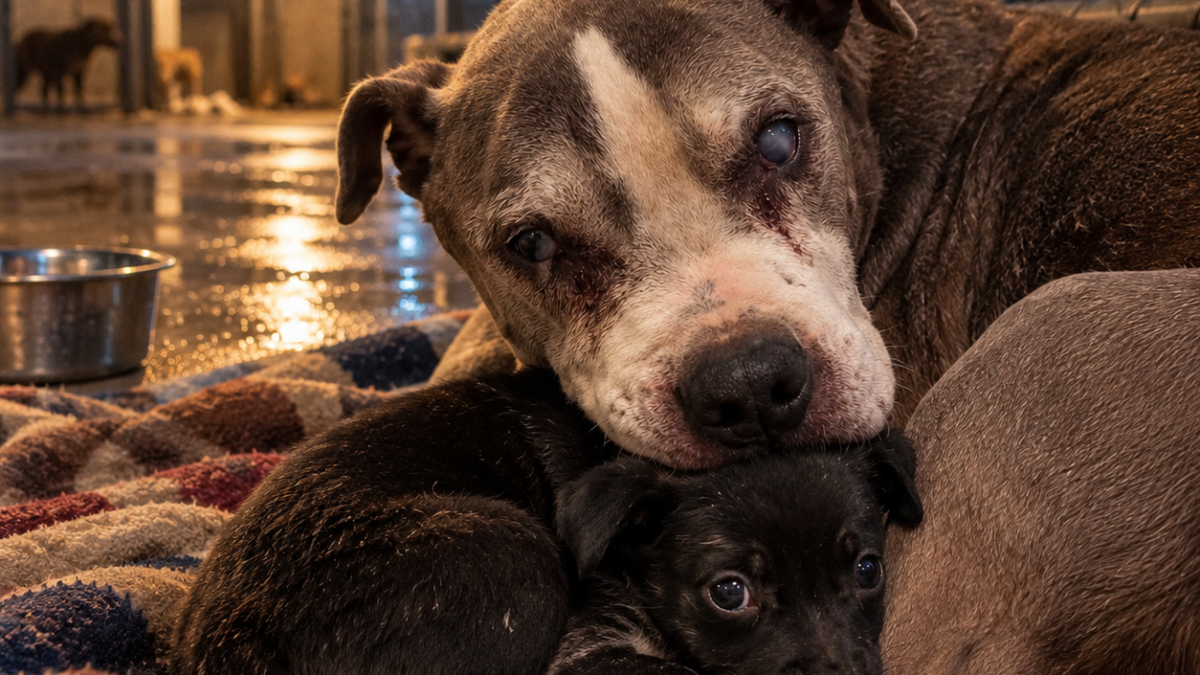
By the time Patsy turned eleven, six different families had adopted him, six different families had brought him back, and the old gray Pit Bull had finally stopped lifting his head when strangers paused in front of his kennel because he had learned that being noticed and being chosen were two very different things.
He was almost blind, his blue-gray eyes could see little more than shifting shadows and changes in light, and most visitors walked past him so quickly that the shelter staff had quietly started calling him “the invisible dog.”
But every night, long after the adoption lobby went dark and the last visitor went home, Patsy would rise from his bed the moment the rear intake doors opened—and what he did next was the reason some of us were willing to risk our jobs when the shelter finally decided there was no longer room for him.
My name is Hannah Brooks, and I had been working the overnight shift at Willow Creek Animal Shelter for nine years when Patsy became the dog I could never stop watching.
He was an American Pit Bull Terrier, pale gray with a white mark on his muzzle shaped like a broken star. At eleven, his face had gone soft with age. His hips were stiff. His hearing was still sharp, but his vision had faded until Dr. Patel told us he could probably see only movement, contrast, and patches of light.
Visitors rarely understood that.
They saw an old dog lying against the back wall.
They saw cloudy eyes.
They saw a kennel card with a terrible little line that followed him everywhere:
RETURNED SIX TIMES.
People made decisions before they ever touched the glass.
“Six times?” I once heard a man whisper to his wife. “There has to be a reason.”
There were reasons.
Just not the one people imagined.
Patsy had never bitten anyone. He had never been declared dangerous. He had never started a fight in the shelter.
Still, six returns became a story stronger than the facts.
So Patsy stopped reacting to footsteps.
When families leaned toward his kennel, he kept his chin on his paws.
When children pointed at younger dogs, he didn’t move.
Even when someone said, “Poor old guy,” he barely blinked.
Then night came.
That was when Patsy changed.
The first time I saw it, an animal-control van arrived just after midnight carrying a ten-week-old puppy found alone behind a grocery store. She was tiny, cream-colored, and terrified of every sound.
The moment we placed her in a clean kennel, she pressed herself into the farthest corner and began crying.
Patsy was three runs away.
He stood immediately.
Walked to the front of his kennel.
And barked.
Not loud.
One soft bark.
Then another.
Then another.
“Patsy, enough,” I whispered.
He kept going.
The puppy kept crying.
Patsy kept answering.
Finally I opened his kennel and clipped on a leash.
He pulled me—not toward the exit, not toward food, but directly toward that puppy.
When I opened the divider between the runs, Patsy walked inside, turned twice, and lay down.
The puppy stared at him.
Patsy didn’t approach.
He simply waited.
A minute later, the puppy crawled across the blanket.
Then closer.
Then tucked her entire body against his chest.
Her crying stopped.
Patsy rested his chin over her back.
Within ten minutes, both dogs were asleep.
That happened again the next week.
Then again.
And again.
Years later, when we finally counted the intake logs, we discovered Patsy had spent first nights beside more than four hundred frightened puppies and young dogs.
He had been returned six times by humans.
Yet every new dog who arrived afraid received from him the thing people had stopped offering Patsy himself.
A reason to believe the next morning might be different.
By then, staff members had started joking that Patsy worked the night shift with us. He knew the sound of the intake van, the click of the rear lock, and the particular silence that came just before a frightened puppy began to cry. He never asked for treats afterward. He never waited for praise. Once the newcomer settled, Patsy simply returned to his own kennel and slept until morning, invisible again by the time the public doors opened.
And then, one Thursday afternoon, our new executive director called me into her office, closed the door, and placed Patsy’s file between us.
“Hannah,” she said, “we need to talk about what happens to him next.”
PART 2
Her name was Meredith Lane.
She had been executive director of Willow Creek for exactly seven weeks.
That mattered because Meredith did not know Patsy.
Not really.
She knew his file.
His medical costs.
His age.
His average length of stay.
His adoption history.
His kennel number.
Those things can look a lot like knowledge when they are organized inside a spreadsheet.
I should probably admit something before I make Meredith sound like a villain.
She wasn’t.
Willow Creek was in trouble.
Our county contract had been reduced.
Food costs had increased.
Veterinary expenses were up nearly twenty percent.
Two kennel technicians had resigned.
One of our HVAC units needed replacing.
A respiratory illness at a neighboring shelter meant we were preparing to accept overflow dogs if necessary.
And the board had given Meredith a clear instruction:
Reduce the average length of stay.
Increase successful placements.
Free kennel capacity.
On paper, Patsy was exactly the kind of dog administrators worry about.
Eleven years old.
Nearly blind.
Arthritis.
Daily medication.
Breed stigma.
Six previous returns.
No serious adoption interest in almost a year.
One kennel permanently occupied.
I sat across from Meredith.
“What happens to him next?”
She turned the file toward me.
“North Valley has offered placement.”
I knew North Valley.
A regional senior-dog sanctuary two counties away.
Good staff.
Good intentions.
Overcrowded.
“What kind of placement?”
“Long-term senior housing.”
“That isn’t an adoption.”
“No.”
“He’d live there.”
“Yes.”
“With how many dogs?”
“Hannah.”
“How many?”
She sighed.
“I don’t know the current number.”
“Then don’t ask me to pretend this is the same as a home.”
“I didn’t say it was.”
“Why move him?”
Meredith folded her hands.
“Because we’re an adoption shelter.”
“And?”
“And Patsy has been here fourteen months this time.”
“He helps with intake.”
“He comforts puppies.”
“He does more than that.”
“I’ve heard the stories.”
That phrase irritated me.
Stories.
As if what Patsy did belonged beside shelter legends about dogs opening doors or cats predicting rain.
“They aren’t stories.”
“Then show me.”
I stopped.
Meredith leaned back.
“The board reviews capacity Monday. I have to justify every long-stay animal. If Patsy has a measurable role here beyond being loved by staff, I need documentation.”
“You need a spreadsheet?”
“I need evidence.”
“He has soothed hundreds of puppies.”
“How many?”
I opened my mouth.
Nothing came out.
We always said hundreds.
Nobody had counted.
Meredith continued.
“How often?”
“I don’t know.”
“Does it change intake behavior?”
“Yes.”
“Documented?”
“No.”
“Does it reduce medication? Stress incidents? Staff time?”
“We aren’t running a clinical trial.”
“I know.”
Her voice softened.
“But a board member is going to look at an eleven-year-old dog occupying a kennel and ask me why he stays when dogs are being turned away.”
That hurt because it wasn’t a stupid question.
Meredith slid the file back toward herself.
“North Valley transport is scheduled Monday afternoon.”
“Four days.”
“Yes.”
“You’ve already scheduled it?”
“Provisionally.”
I stood.
“Hannah.”
I put my hand on the door.
“What?”
“If you can give me a real case before Monday, I will take it to the board.”
I looked at her.
“You mean that?”
“Yes.”
“And if I can’t?”
Her silence answered.
I left furious.
Mostly because she had not given me an easy enemy.
It would have been simpler if Meredith hated old dogs.
She didn’t.
She was trying to keep a shelter functioning.
That meant if I wanted Patsy to stay, emotion wasn’t enough.
I needed facts.
I went straight to his kennel.
Patsy was sleeping.
Of course.
Visitors were still in the building.
A couple stopped at the kennel beside him and crouched to meet a young shepherd mix.
Patsy didn’t lift his head.
I opened his door.
“Hey, old man.”
His ears moved.
Then his tail tapped the blanket.
Once.
I sat beside him.
He raised his head and searched for me by sound.
My hand touched his cheek.
He leaned into it.
“Apparently you’re inefficient.”
Patsy sighed.
“Don’t take it personally.”
He rested his chin on my leg.
I looked at his cloudy eyes.
“How many, Patsy?”
His ear twitched.
“How many puppies?”
No answer.
“I need you to have kept records.”
Patsy went to sleep.
Typical coworker.
I started with the night logs.
Willow Creek kept seven years of digital kennel records and older paper records in storage.
Every intake had a case number.
Every significant kennel interaction was supposed to be noted.
Supposed to be.
Night-shift documentation often looked like this:
11:10 P.M.—Puppy crying. Patsy moved to adjacent kennel. Settled.
1:40 A.M.—New intake highly fearful. Patsy supervised with dog. Both sleeping.
3:05 A.M.—Patsy with litter three. Puppies quiet.
Some entries said nothing.
Some simply had my initials.
Then I remembered something.
Claire.
Claire Mendoza had worked nights with me for four years before moving to Colorado.
She had loved data.
She documented everything.
I called.
She answered on the third ring.
“Hannah?”
“Do you still have the old puppy log?”
Silence.
Then laughter.
“You mean Patsy’s résumé?”
“You made one?”
“I made three.”
I nearly cried.
Claire had started a private spreadsheet after noticing how often Patsy calmed new arrivals.
Not medical research.
Just staff observation.
Date.
Case number.
Dog age.
Reason Patsy was introduced.
Approximate time until the puppy settled.
Whether Patsy stayed overnight.
She emailed it.
I opened the file.
Rows.
Hundreds.
The first year:
Thirty-eight.
Second:
Seventy-one.
Then eighty-four.
Ninety-six.
Some were entire litters counted individually.
Others young adolescent dogs.
I scrolled to the bottom.
Total unique dogs:
**417.**
I stared at the number.
Four hundred seventeen.
Not an estimate.
Not shelter folklore.
Case numbers.
Dates.
Names.
Some names I remembered.
Peaches.
Milo.
Beans.
Rosie.
Charlie.
A puppy named Captain Waffles who had bitten through three leashes but slept with his nose tucked beneath Patsy’s front leg.
Four hundred seventeen.
I called Claire again.
“Why didn’t you ever show this to anyone?”
“I did.”
“To who?”
“Former director.”
“What happened?”
“He thought it was cute.”
Cute.
I wanted to throw my computer.
Instead I asked:
“Can I use this?”
“Please.”
“Board meeting Monday.”
“What’s happening?”
“Patsy’s being transferred.”
Claire stopped breathing for a second.
“No.”
“Unless I make a case.”
“You have four hundred seventeen cases.”
“Observations aren’t outcomes.”
“Hannah.”
“What?”
“Start calling adopters.”
So I did.
Not all four hundred seventeen.
That would’ve been insane.
I selected twenty-five case numbers from different years.
Then fifty.
I matched them with adoption records.
Many were easy.
A puppy Patsy comforted in 2018 had been adopted three days later.
Another went to foster.
One returned years later because an owner entered assisted living.
One had died of old age.
Normal lives.
I called families.
“Hi, my name is Hannah. I’m calling from Willow Creek about a dog you adopted several years ago.”
Some people panicked.
“Is something wrong?”
“No.”
Then I explained Patsy.
The response surprised me.
Several remembered him.
“Oh! The gray dog.”
“My puppy slept with him.”
“Was that Patsy?”
“We have a picture!”
One family had adopted a terrified hound mix named Lucy.
The mother, Diane, told me:
“Lucy wouldn’t come out from under our kitchen table for three days.”
“What happened?”
“We brought home the blanket she had at the shelter.”
“And?”
“She slept on it.”
“Do you remember Patsy?”
“Of course.”
She paused.
“Our daughter called him Grandpa Dog.”
I smiled.
Another adopter had a dog named Benny.
“He was the puppy screaming all night?”
“Yes.”
“The staff told us an older dog stayed with him.”
“That was Patsy.”
Long silence.
Then:
“Is he still alive?”
“Yes.”
“Can we visit?”
That question started happening again and again.
By Friday evening, I had fourteen written statements.
Not proof Patsy clinically reduced stress.
But proof that what he did was real.
Then Dr. Patel gave me something stronger.
She reviewed Patsy’s medical record.
“His health is stable.”
“Stable enough to stay?”
“That’s not a veterinary question.”
“It absolutely is.”
She sighed.
“His arthritis is controlled. His blindness is progressive but not painful. Bloodwork is appropriate for his age.”
“So he isn’t suffering.”
“No.”
“Does he enjoy being with puppies?”
Dr. Patel smiled.
“You know the answer.”
“I need you to say it professionally.”
She hated me for that.
Then she wrote:
**Patsy demonstrates consistent affiliative behavior with appropriately screened puppies and juvenile dogs. In observed supervised interactions, he often remains calm in the presence of distressed young animals and appears to provide social stability without forceful engagement. There is no medical reason he cannot continue limited, supervised interactions provided his rest and mobility needs are protected.**
I printed three copies.
Then something complicated happened.
I opened Patsy’s adoption history.
All six returns.
I had never read every file from beginning to end.
Nobody had.
We knew the shorthand:
Returned six times.
The first adoption had lasted eleven months.
Reason:
**Housing change. Breed restriction.**
Not Patsy’s fault.
Second:
Eight months.
Reason:
**Owner military relocation; unable to take dog overseas.**
Third:
Two years.
That surprised me.
Owner named Mrs. Caroline Wells.
Reason:
**Owner deceased. Family unable to keep pet.**
Not rejection at all.
Patsy had lost a person.
Fourth adoption:
Six months.
**Adopter moved into assisted housing after medical emergency.**
Again.
Nothing about Patsy.
Fifth:
Four months.
**Progressive vision loss; adopter states unable to manage medical needs.**
Sad.
But understandable.
Then number six.
Nine days.
Reason:
**Behavioral incompatibility. Adopter reports unpredictability around young dog.**
That was the return everyone remembered.
It was why Patsy’s kennel card once carried:
**Adult-only home recommended. No young dogs pending evaluation.**
The restriction had later been removed after multiple behavior assessments.
But the return remained.
I pulled the full incident report.
Missing.
Only summary.
I searched archived files.
Nothing.
Then I noticed the staff initials.
**M.S.**
Maria Santiago.
Former behavior technician.
Retired.
I found her number in an old staff directory.
She answered suspiciously.
“Who is this?”
“Hannah Brooks from Willow Creek.”
“Oh Lord. What happened?”
“Do you remember Patsy?”
Silence.
“Gray Pit Bull? White star on nose?”
“Hannah, everybody remembers Patsy.”
“Do you remember his sixth return?”
Longer silence.
“Yes.”
“What happened?”
Maria’s voice changed.
“Why?”
I explained.
When I finished, she said:
“That report should be in his file.”
“It isn’t.”
“Then somebody removed the wrong document during migration.”
“What happened?”
Maria took a breath.
“The family had adopted a young terrier two days after Patsy.”
“What?”
“Yes.”
“The shelter knew?”
“No. Private adoption from somewhere else.”
I started writing.
“They had two new dogs?”
“Patsy first. Terrier puppy later.”
“What happened?”
“Patsy was already losing vision. Nobody realized how much.”
I waited.
“The puppy ran into him while he was asleep.”
“And?”
“Patsy startled. Barked. Stood over the puppy for maybe three seconds.”
“Contact?”
“No.”
“Bite?”
“No.”
“Snap?”
“Not that I saw.”
“You were there?”
“Family brought both dogs back for assessment. I tested him.”
“What did you conclude?”
“Startle response. Vision impairment. Needed management and slow introductions.”
“Why return him?”
“They didn’t want risk.”
That was their right.
But something in the story bothered me.
“Why does summary say unpredictable around young dogs?”
“Because that’s what adopter wrote.”
“Did you disagree?”
“Yes.”
“In writing?”
“Yes.”
“Do you have a copy?”
Maria laughed.
“Hannah, I am seventy-two. I don’t keep shelter paperwork in a scrapbook.”
My hope dropped.
Then she said:
“But I might have the email.”
Twenty minutes later, it arrived.
Maria had emailed the former director after Patsy’s return.
**Observed behavior does not support categorizing Patsy as aggressive toward puppies. Incident appears consistent with startle response in dog with significant visual impairment. Patsy displayed appropriate recovery and affiliative behavior during structured reintroduction. Recommend ophthalmic evaluation and environmental management.**
Attached was a photograph.
Patsy lying beside the terrier puppy during assessment.
The puppy was asleep against him.
I stared at it.
The dog whose sixth return made people think there had to be something wrong with him had been comforting a puppy on the very day he was brought back.
I called Claire.
“You’re not going to believe this.”
She did.
Immediately.
“Of course.”
“Why ‘of course’?”
“Because that’s Patsy.”
Friday night brought a new intake.
Animal control arrived at 11:26 with four puppies from a home where the owner had been hospitalized unexpectedly.
Nothing dramatic.
No cruelty.
No villain.
Just a family emergency and no immediate caregiver.
Three puppies adapted quickly.
The fourth didn’t.
A little brindle female.
Maybe twelve weeks old.
Case name:
June.
She pressed against the back wall.
Wouldn’t eat.
Wouldn’t approach.
Every metal sound made her flinch.
Patsy woke three kennels away.
Soft bark.
June cried.
Another bark.
I closed my eyes.
“Seriously?”
Patsy stood.
“You know I’m building a legal defense for your employment, right?”
His tail moved.
I opened his kennel.
Patsy walked toward June.
By then he knew the route without sight.
Left.
Six steps.
Pause.
Right.
Follow my shoes.
He reached June’s run.
She growled.
Patsy stopped.
He didn’t enter.
Just sat outside.
June growled again.
Patsy lowered himself.
Five minutes.
Ten.
Fifteen.
June stopped growling.
At twenty-three minutes, she approached the bars.
Sniffed.
Patsy remained still.
At thirty-five, I opened the connecting divider.
Patsy entered.
June retreated.
He lay down.
An hour later, she was asleep with one paw across his neck.
I took no dramatic video.
No social-media post.
I logged it.
**11:44 P.M.—Patsy introduced at distance to Case 25-661, female juvenile, high fear response. Voluntary approach after 23 minutes. Shared kennel under supervision after 35 minutes. Puppy resting at 12:51 A.M.**
Evidence.
Boring.
Precise.
Beautiful.
Saturday morning Meredith found me asleep at the break-room table.
Patsy’s file was beneath my arm.
She set down coffee.
“You look awful.”
“Thank you.”
“What have you got?”
I handed her the folder.
She read silently.
417 dogs.
Adopter statements.
Dr. Patel’s assessment.
Return history.
Maria’s email.
June’s overnight log.
Meredith reached the sixth-return email and stopped.
“This wasn’t in his electronic file.”
“No.”
“Why?”
“Migration error, probably.”
She read again.
Then leaned back.
“His entire public narrative is wrong.”
“Yes.”
“Not entirely. Six returns happened.”
“Six circumstances happened.”
She nodded.
That distinction landed.
I asked:
“Is North Valley still Monday?”
Meredith closed the folder.
“Yes.”
My stomach dropped.
“But I’m recommending we postpone transfer pending board review.”
“How long?”
“Thirty days.”
“No.”
“Hannah.”
“He has been returned six times. He isn’t spending thirty days waiting for a seventh institution to decide whether he belongs.”
Meredith looked tired.
“So what are you proposing?”
I hadn’t thought that far.
“Keep him.”
“In a kennel permanently?”
“No.”
“Then where?”
Silence.
Meredith leaned forward.
“This is the problem. Loving Patsy isn’t a plan.”
She was right again.
I hated it.
She continued.
“If you believe his role is real, formalize it. What does he need? What is safe? What is the cost? What happens when he’s too old to do it? What happens when another dog needs the same function?”
A program.
Not an exception.
That changed everything.
By Sunday afternoon, three of us had created a proposal.
Dr. Patel.
Claire by video.
Me.
We called it:
**First-Night Companion Program.**
Terrible name.
Working title.
The idea was simple.
Some newly admitted puppies and young dogs experience severe distress in kennel environments.
When appropriate, screened calm adult dogs could be introduced under staff supervision.
No forced interactions.
No assumption every puppy needed another dog.
No using adult dogs beyond comfort.
Mandatory rest.
Veterinary clearance.
Behavior clearance.
Documented observations.
Foster alternatives prioritized when available.
Patsy would be the first designated mentor.
Not because he was magical.
Because he already did the work.
Meredith reviewed it Sunday night.
“This is actually good.”
“You sound surprised.”
“I’ve read your incident reports.”
“Rude.”
Then she asked:
“Where does Patsy sleep?”
I knew what she meant.
Not during shifts.
At the end of the day.
A shelter mentor was still a shelter dog.
He still had no home.
I went quiet.
Meredith studied me.
“You’re avoiding the larger problem.”
“I know.”
“He deserves a home even if he has a job.”
“I know.”
“Then stop using the program to avoid that.”
That one hurt.
Because somewhere along the way, staff had begun telling ourselves Patsy was happy because he was needed.
Maybe he was.
But being useful is not the same as belonging.
That night, I sat in his kennel.
“Do you want to come home with me?”
Patsy sniffed my sleeve.
“I have two cats.”
He sneezed.
“They’re rude.”
Tail movement.
“My apartment is small.”
He rested his head on my leg.
“I work nights.”
Nothing.
“And apparently I’m talking myself into this.”
Patsy fell asleep.
Monday’s board meeting started at four.
Seven board members.
Meredith.
Finance director.
Medical director.
Two department supervisors.
Me.
I had never attended one.
I hated it immediately.
The first forty minutes were budgets.
Intake numbers.
Contract shortfalls.
Roof repair.
Then Gavin Holt arrived at the issue of long-stay dogs.
Gavin was board treasurer.
Former banking executive.
Very good with numbers.
Very bad at remembering numbers described living things.
He looked at Patsy’s summary.
“Fourteen months current stay?”
“Yes,” Meredith said.
“Six prior returns?”
“Yes.”
“Eleven years old?”
“Yes.”
“Nearly blind?”
“Yes.”
“North Valley has accepted?”
“Yes.”
Gavin removed his glasses.
“Then why are we discussing it?”
I felt heat rise into my face.
Meredith answered before I could.
“Because new information changes our assessment of his role and history.”
Gavin looked at me.
“You’re Hannah?”
“Yes.”
“Night supervisor?”
“Yes.”
“I’ve heard you’re attached to this dog.”
There are sentences designed to make evidence sound emotional before it is presented.
That was one.
I answered carefully.
“Yes. I am.”
“Which is understandable.”
“And irrelevant to the records I’m about to show you.”
Meredith almost smiled.
Gavin did not.
I distributed folders.
“Patsy has assisted with 417 documented first-night or acute-distress interactions involving puppies and juvenile dogs.”
One board member looked up.
“Four hundred seventeen?”
“Yes.”
“Over what period?”
“Approximately six years of reliable logs, with anecdotal reports before that.”
Gavin flipped pages.
“This isn’t a controlled study.”
“No.”
“So we cannot claim clinical benefit.”
“Correct.”
That surprised him.
I continued.
“What we can claim is that staff repeatedly observed frightened young dogs settling voluntarily in his presence, that veterinary and behavior staff found those interactions appropriate, and that this role was never formally recognized because we treated it as a charming shelter story instead of operational behavior support.”
Dr. Patel spoke next.
She explained Patsy’s health.
Stable.
Manageable arthritis.
Vision loss.
No evidence of suffering requiring removal.
Then the returns.
I read all six.
Housing restriction.
Military relocation.
Owner death.
Medical relocation.
Progressive blindness.
One nine-day behavioral return.
Then Maria’s original assessment.
When I finished, board member Sarah Kim said:
“So the phrase ‘returned six times’ is technically accurate and practically misleading.”
“Yes.”
Gavin looked irritated.
“Still, six placements failed.”
I answered:
“Three ended because the humans’ lives changed in ways unrelated to Patsy. One because his owner died. One because an adopter could not manage vision loss. One because of a startle event later evaluated as non-aggressive.”
“That’s still instability.”
“For him.”
The room quieted.
I hadn’t planned that response.
Gavin looked at me.
I continued more softly.
“We keep treating the six returns as evidence that Patsy failed six homes. The records show Patsy lost six homes.”
That was different.
Meredith looked down.
One board member closed the folder and reopened it.
Then Gavin asked the question I knew was coming.
“Even if all of this is true, does an adoption shelter have a duty to keep a permanent resident because he’s comforting to other dogs?”
“No.”
He looked satisfied too quickly.
I continued.
“It has a duty not to confuse age with uselessness, history with fault, or kennel turnover with mission.”
His expression changed.
“Our mission is placement.”
“Yes.”
“Then every kennel occupied long-term reduces capacity.”
“Yes.”
“So?”
“So Patsy shouldn’t live in a kennel.”
Silence.
Meredith looked at me.
I hadn’t told her.
Neither had I fully told myself.
I took out another form.
Foster-to-adopt application.
My name.
Hannah Brooks.
Address.
Landlord approval.
Cat vaccination records.
Backup caregiver.
Dr. Patel’s home-integration plan.
Gavin blinked.
“You’re taking him?”
“If approved.”
Something inside me settled the second I said it.
Not shelter mentor.
Not permanent kennel dog.
Home.
His.
Mine.
One board member smiled.
Gavin did not.
“Then why does the shelter need a formal program?”
“Because Patsy shouldn’t be the only reason we notice frightened puppies need structured support.”
That was the real point.
The vote on Patsy’s transfer happened first.
Seven to zero.
Canceled.
The vote on a ninety-day pilot for the First-Night Companion Program:
Six to one.
Gavin voted no.
I didn’t care.
Then something happened that turned a quiet internal fight into a much bigger story.
Gavin made a mistake.
Not illegal.
Not dramatic.
Just careless.
Two days after the board meeting, he spoke at a donor luncheon and used Patsy as an example of what he called “the emotional challenge of shelter management.”
Someone recorded it.
His exact sentence was:
“Sometimes a kennel is occupied by a dog everyone loves but nobody wants, and leadership has to choose between sentiment and saving the next adoptable animal.”
He didn’t say Patsy’s name.
He didn’t need to.
The clip circulated among volunteers.
Claire sent it to me.
I watched once.
Then again.
Everyone loves but nobody wants.
Patsy was asleep on my living-room rug.
Yes.
My living room.
His first night home had been the previous evening.
He had refused the expensive bed I bought and chosen the rug beside my couch.
My cats, Max and Olive, had watched him from the hallway like two suspicious landlords.
Patsy ignored them.
At 2:00 A.M. he woke and stood beside the front door.
Listening.
Probably expecting the shelter intake van.
I sat on the floor with him.
“You’re off tonight.”
He leaned against my shoulder.
Now, while he slept ten feet away, I heard a board treasurer describe him as a dog nobody wanted.
I wanted to answer publicly.
Meredith stopped me.
“Don’t.”
“He said—”
“I know.”
“It’s wrong.”
“I know.”
“Then correct it.”
“We correct records, not personalities.”
I hated that sentence.
Then she added:
“Something else is happening.”
“What?”
“A donor called.”
“About the video?”
“Yes.”
“Angry?”
“Very.”
“Who?”
“Clara Davenport.”
I knew the name.
Everyone did.
The Davenport Foundation had donated $180,000 toward our renovated puppy wing two years earlier.
“What does she want?”
“To meet Patsy.”
“Why?”
Meredith turned her laptop toward me.
A photograph.
A chocolate-brown dog wearing a therapy vest beside an older woman.
Caption:
**Maggie Davenport, adopted Willow Creek 2019.**
Case number looked familiar.
I searched Claire’s spreadsheet.
There.
Case 19-044.
Maggie.
Nine-week-old puppy.
Found inside an abandoned garage after a storm.
High distress.
Would not eat.
Patsy introduced 1:13 A.M.
Settled after 18 minutes.
Shared supervised sleep period.
I stared.
“Her dog.”
Meredith nodded.
“Her dog was one of Patsy’s puppies.”
Clara arrived Thursday.
No entourage.
No reporter.
Just a seventy-year-old woman in a navy coat with Maggie beside her.
Maggie was seven now.
Confident.
Beautiful.
Certified therapy dog working at a children’s hospital twice a month.
We met in the quiet room.
Patsy came with me.
His vision had worsened enough that he navigated mostly by smell, sound, and memory.
Maggie saw him first.
Something happened.
Her whole body lowered.
Not fear.
Recognition?
Maybe.
Dogs remember in ways we don’t fully understand.
Maggie approached.
Sniffed his face.
Patsy sniffed back.
Then Maggie pressed her head beneath his chin.
Clara covered her mouth.
“That’s him?”
“Yes.”
“The dog they told me stayed with her?”
“Yes.”
“I thought he’d been adopted years ago.”
“He was.”
“How many times?”
I hesitated.
“Six total.”
She stared.
Then Patsy lay down.
Maggie lay beside him.
Clara sat on the floor.
“She was terrified when I first met her.”
“I read the notes.”
“They brought her into the adoption room and she hid under my chair.”
Clara touched Maggie’s back.
“The counselor said an old shelter dog had been sleeping with her at night.”
“That was Patsy.”
Clara looked toward his cloudy eyes.
“Nobody told me he was blind.”
“He wasn’t as impaired then.”
She went quiet.
Then:
“What is this about a board member saying nobody wants him?”
I smiled despite myself.
“I want him.”
“Good.”
“I’m adopting him.”
“Better.”
Clara stood.
“What else?”
“What?”
“What else are they trying to cut?”
I immediately understood how dangerous wealthy angry grandmothers can be.
“Clara—”
“I donated for animal welfare, not a factory line.”
“The shelter has real capacity problems.”
“I know.”
“Gavin’s argument isn’t completely wrong.”
She looked disappointed in me.
I continued.
“But he’s measuring the wrong thing.”
“How?”
“Length of stay is important. Successful placement is important. But if you treat every kennel day as failure, you start making decisions too quickly about animals who need different support.”
Clara looked at Maggie.
“What do you need?”
I told her.
Not money first.
A quiet intake room.
Acoustic panels.
Portable dividers.
Extra foster coordination.
Staff training.
Documentation software.
A place where new puppies didn’t spend their first hours surrounded by forty barking dogs.
Clara listened.
Then said:
“Send me a proposal.”
The Davenport Foundation funded the pilot.
Not because of a viral campaign.
Not because we publicly humiliated Gavin.
Because one donor discovered the nearly blind dog the board considered inefficient had once comforted the puppy sleeping beside her feet.
That was satisfying enough.
But the story wasn’t finished.
Gavin’s comment created pressure.
Volunteers wanted him removed from the board.
Some threatened to resign.
I refused to join that.
“Why?” Claire asked from Colorado.
“Because he’s wrong, not evil.”
“He almost shipped Patsy out.”
“He relied on bad framing and incomplete data.”
“You sound like an accountant.”
“Meredith is infecting me.”
We asked for something better.
A review of long-stay evaluation criteria.
It passed.
Instead of one line saying RETURNED SIX TIMES, adoption profiles would list relevant return context.
Not every private detail.
But enough to avoid turning history into stigma.
Patsy’s profile changed.
The old line disappeared.
In its place:
**Patsy has experienced several previous homes due primarily to changes in adopter circumstances and age-related vision loss. Shelter staff describe him as calm, affiliative, and especially gentle with appropriately matched young dogs.**
Truth takes more words than stigma.
Worth it.
Then Gavin asked to meet me.
I expected an argument.
Instead he came to the shelter alone.
Patsy was with me because I had started bringing him two nights a week for short mentoring shifts during the pilot.
Not every night.
Home first.
Work second.
Gavin watched Patsy settle beside a frightened ten-week-old shepherd.
The puppy had been whining for twenty minutes.
Patsy entered.
Lay down.
Within minutes, the puppy approached.
Gavin said:
“Does that happen every time?”
“No.”
“Most times?”
“Often.”
“How?”
“We don’t know.”
“Scent?”
“Probably part.”
“Body language?”
“Probably.”
“Experience?”
“Maybe.”
He watched.
Then:
“I didn’t know.”
I looked at him.
“You could have.”
He nodded.
That surprised me.
“I should have.”
No defensiveness.
No speech.
Then he said:
“My comment at the donor event was careless.”
“Yes.”
“I wasn’t talking about Patsy specifically.”
“Everyone knew you were.”
“Yes.”
We stood quietly.
Then Gavin said:
“I’ve spent thirty years looking at scarce resources.”
“Useful skill.”
“Sometimes.”
He glanced toward Patsy.
“Sometimes numbers flatten the thing you’re trying to understand.”
That was the closest thing to an apology I needed.
“What are you going to do?”
He smiled slightly.
“Rebuild the dashboard.”
I laughed.
“Of course.”
Three months later, Gavin presented a new performance report.
Length of stay remained.
So did placement rate.
But new categories appeared.
Return reasons.
Medical barriers.
Behavior support needs.
Foster utilization.
Successful senior placement.
Post-adoption support.
The shelter stopped treating every return as identical.
A dog returned because an owner died was not categorized the same as a dog returned for severe behavior incompatibility.
A breed-restriction return wasn’t labeled an adoption failure in the same way.
Neither was military deployment.
Data became more honest.
That was the kind of revenge I could live with.
The system that had reduced Patsy to six failures was forced to admit it had been counting badly.
Patsy adjusted to my apartment more slowly than he adjusted to puppies.
The first week, he slept beside the front door.
Every night.
At 11:30, his ears lifted.
That was around the time the shelter intake van often arrived.
He would stand.
Listen.
Wait.
The first night I ignored it.
The second night, I sat beside him.
“You hear something?”
Patsy looked toward the door.
Nothing.
“You’re home.”
His tail moved.
The third night, same.
The fourth.
Fifth.
At the end of the second week, Patsy stopped standing.
He still lifted his head.
By the fourth week, he slept through 11:30.
That almost hurt.
Because part of me wondered whether he missed being needed.
Then I realized something.
Purpose is good.
Hypervigilance is not.
Patsy did not need to spend every night waiting for someone else’s fear.
He was allowed to sleep.
That became part of our program too.
Mentor dogs weren’t tools.
They had limits.
Consent.
Rest.
No forced interaction.
Patsy came to Willow Creek two evenings a week.
Sometimes he comforted a puppy.
Sometimes he slept in my office.
Sometimes he sniffed a newcomer and walked away.
We honored that too.
“He said no,” I’d tell staff.
People laughed.
I wasn’t joking.
Patsy had spent enough of his life having humans decide where he belonged.
He could choose.
June, the brindle puppy from the night before our board fight, became one of his favorites.
She stayed at Willow Creek seventeen days.
Her fear improved slowly.
No miracle.
Patsy helped.
So did quiet handling.
Food puzzles.
A foster volunteer.
Medication wasn’t needed.
Eventually June allowed people to touch her.
A young couple named Marcus and Ellie adopted her.
The night before she left, June slept beside Patsy one final time.
Morning came.
Her adopters arrived.
June walked out.
Patsy stayed asleep.
That pattern repeated.
Dogs needed him.
Then they left.
For years, I thought that was sad.
Eventually I saw it differently.
Patsy’s gift was not making puppies dependent on him.
It was helping them become safe enough to leave.
Six months after the pilot began, Willow Creek formally adopted the program.
We changed the name.
Thank God.
**The Patsy First-Night Program.**
I hated naming it after him.
Clara insisted.
Meredith agreed.
Gavin voted yes.
Seven to zero.
The renovated room had dimmable lights.
Sound-reducing panels.
Washable floor beds.
Removable barriers.
No bars facing the main kennel corridor.
Calm mentor dogs could visit when appropriate.
Patsy’s photograph hung near the door.
Not a sad kennel picture.
One of him sleeping with Captain Waffles half across his back.
Underneath:
**CALM CAN BE CONTAGIOUS. GIVE FEAR TIME TO BREATHE.**
I liked that.
Then the local newspaper found the story.
I dreaded it.
The reporter, Karen Li, asked good questions.
Not:
How many puppies did Patsy save?
Instead:
Why was he returned?
Why did shelter records fail to capture context?
Why are senior dogs overlooked?
How does stress influence behavior in shelters?
What does responsible mentoring look like?
She spoke with Dr. Patel.
Meredith.
Claire.
Gavin.
Clara.
Me.
The article’s headline was:
**THE DOG NOBODY CHOSE BECAME THE DOG HUNDREDS OF PUPPIES CHOSE FIRST.**
I cried.
I’m not ashamed.
Okay, slightly ashamed.
The article spread.
Adoption inquiries came in.
For Patsy.
Dozens.
That should have been funny.
After years of nobody stopping at his kennel, suddenly people wanted him because he was famous.
But Patsy already had a pending adoption.
Mine.
Willow Creek’s policy required a thirty-day foster period for staff adoptions after long-term shelter residence.
On day thirty-one, I signed.
Official.
Patsy Brooks.
My mother laughed at the name.
“So he’s your son now?”
“No.”
“You gave him your last name.”
“That’s how records work.”
“Sure.”
I took his adoption photo on my couch.
He was asleep.
Of course.
The caption from Willow Creek said:
**After six returns, Patsy has officially gone home. He will continue visiting the shelter on a limited schedule as the founding mentor of the Patsy First-Night Program.**
No dramatic words.
No “forever rejected.”
No blame.
Just home.
The messages came anyway.
Former adopters contacted us.
That was the part I hadn’t expected.
The first was a man named Daniel Price.
Patsy’s second adopter.
Military relocation.
He wrote:
**I’ve thought about him for years. I was twenty-four when I adopted Patsy. I got orders overseas and couldn’t find housing that allowed his breed. I still feel like I failed him. Please tell me he’s safe.**
I replied:
**He is safe. He is home.**
Daniel sent photographs.
Young Patsy.
Four years old.
Running on a beach.
Eyes clear.
White star bright against his muzzle.
I stared for an hour.
Patsy had been young once.
Obvious fact.
Still shocking.
The next message came from Caroline Wells’s daughter.
Caroline had been Patsy’s third owner.
The woman who died.
Her daughter wrote:
**My mother loved Patsy more than I can explain. When she died, I had two dogs and a landlord who allowed only two pets. I tried for weeks to find another place. I have carried guilt ever since. Please know he was not returned because he was unwanted.**
Another photograph.
Patsy asleep beside an elderly woman in a recliner.
His head in her lap.
I printed it.
Then the fourth adopter’s son contacted us.
His father had suffered a stroke and entered rehabilitation.
Patsy had been surrendered because nobody in the family could keep him.
Again:
Not rejected.
Lost.
Then the fifth.
The adopter who returned him after his vision worsened.
Her name was Anne.
Her message was harder.
**I panicked. The vet told me Patsy’s vision would continue declining and I was caring for my mother at the same time. I convinced myself the shelter could find someone better equipped. I wish I had asked for help instead.**
No excuse.
Just honesty.
Then number six.
The nine-day adopter.
His name was Robert Keller.
He asked for a phone call.
I hesitated.
Then agreed.
His voice was older than I expected.
“I saw the article.”
“Yes.”
“I owe Patsy something.”
“What?”
“An apology.”
I didn’t answer.
Robert continued.
“We adopted him because my wife liked calm dogs.”
“Then you brought home another puppy.”
“Yes.”
“Two days later.”
“Yes.”
“Why?”
“My daughter surprised us.”
That matched Maria’s account.
“The puppy ran into Patsy.”
“Yes.”
“He barked.”
“Yes.”
“Did he bite?”
“No.”
“Did he make contact?”
“No.”
Robert exhaled.
“At the time I didn’t care. My grandson was often at our house. I got scared.”
“Understandable.”
“I described Patsy as unpredictable.”
“Yes.”
“I made it sound worse.”
“Why?”
Long silence.
“Because returning a dog after nine days made me feel like a bad person.”
That was brutally honest.
“So if the dog was the problem…”
“Then I wasn’t.”
There it was.
People do that more than we admit.
Rewrite the story until responsibility feels easier.
Robert continued.
“I didn’t know that label stayed.”
“It did.”
“Did it stop adoptions?”
“I can’t prove that.”
“But probably.”
“Yes.”
He started crying.
I didn’t expect it.
“Is he with you?”
“He’s asleep.”
“Can I hear him?”
I almost laughed.
“He snores.”
“Please.”
I put the phone on speaker.
Held it near Patsy’s bed.
There it was.
Soft, ridiculous snoring.
Robert laughed through tears.
“That’s him.”
“Yes.”
“He always did that.”
Patsy’s ear moved.
Robert whispered:
“I’m sorry, old man.”
Patsy kept sleeping.
That was appropriate.
Forgiveness was not Patsy’s job.
Robert later sent a written correction for the shelter record.
The board accepted it as historical context.
Not erasure.
The old record remained because records matter.
But next to it:
**Former adopter states original description overstated incident. No bite or physical contact occurred. Subsequent professional evaluation found behavior consistent with startle response associated with visual impairment.**
Truth added.
Not rewritten.
That mattered.
The six returns no longer looked like six identical red marks.
They looked like six human stories.
Housing.
Deployment.
Death.
Illness.
Fear.
Limited support.
Mistakes.
And one old dog carrying all of them.
Patsy never knew any of this.
Thank God.
He didn’t spend his days wondering why people left.
At least I hope not.
He spent his days learning my apartment.
I put textured mats near doorways so he could navigate.
A runner from bedroom to kitchen.
Small rug before the stairs.
Water bowl always in the same place.
Furniture never moved without warning.
My cats adjusted.
Max accepted Patsy after twelve days.
Olive took three months and one diplomatic incident involving a chicken treat.
Eventually, Olive started sleeping against Patsy’s back.
The first time I found them together, I took fourteen photos.
Patsy didn’t care.
At night he slept beside my bed.
Not in it.
Until January.
A cold front came through.
I woke with sixty-five pounds of old Pit Bull across my legs.
“How did you even get up here?”
Patsy sighed.
“Fine.”
He stayed.
At twelve, his vision disappeared almost completely.
Dr. Patel confirmed it.
Light perception, maybe.
No useful detail.
I cried in the parking lot.
Patsy did not.
He walked into a trash can fifteen minutes later, backed up, adjusted direction, and continued.
That was Patsy.
He adapted.
At the shelter, his blindness changed nothing important.
He knew the mentoring room by smell.
He knew my footsteps.
Meredith’s perfume.
Dr. Patel’s shoes.
The squeak of the treat cabinet.
He knew when a puppy was afraid before I did.
Or at least it seemed that way.
One evening, a six-month-old shepherd mix named Leo arrived after his family lost housing.
Leo wasn’t neglected.
He was loved.
That sometimes made surrender harder.
He screamed after his family left.
Not crying.
Screaming.
Throwing himself at the kennel door.
Panting.
Unable to settle.
We gave him time.
Quiet.
Distance.
Nothing.
Patsy was asleep in my office.
Then he stood.
Walked to the door.
I opened it.
He headed toward the mentoring room.
“Really?”
Patsy waited.
We brought Leo in on the opposite side of a barrier.
Leo barked.
Patsy lay down.
Leo paced.
Patsy slept.
Twenty minutes.
Forty.
An hour.
Leo eventually stopped pacing.
Then lay down.
Not touching Patsy.
Not even close.
Just down.
The next morning, Leo ate.
Two days later, he went to foster.
Three weeks later, his original family found pet-friendly housing and reclaimed him through our temporary-crisis program.
That program had been inspired partly by Patsy’s return history.
If we could prevent temporary human crisis from becoming permanent animal loss, fewer dogs might experience what Patsy did.
Housing assistance referrals.
Short-term foster.
Medical boarding.
Military deployment partnerships.
Senior-owner contingency plans.
Not every surrender can be prevented.
Some should not be.
But asking one more question helped:
**Is the person trying to give up the dog—or trying to survive a temporary crisis?**
That question changed outcomes.
Gavin became one of the program’s strongest board advocates.
Yes.
Gavin.
The man whose comment had enraged us.
People wanted a neat story where he lost his position and disappeared.
Life gave us something better.
He learned.
One night after a board meeting, Gavin sat beside Patsy in the lobby.
Everyone else had left.
I was locking medication storage.
I heard him talking.
“You know, you’re expensive.”
Patsy’s tail tapped.
“And your productivity metrics are questionable.”
Another tap.
“But apparently donors like you.”
I leaned around the corner.
“Are you negotiating with my dog?”
Gavin looked up.
“He’s difficult.”
“Obviously.”
Then he scratched Patsy’s neck.
“My wife wants a senior dog.”
I stared.
“No.”
“What?”
“You are not adopting a dog as a character-development exercise.”
He laughed.
“Fair.”
Six months later, Gavin and his wife adopted a thirteen-year-old Beagle named Martha.
Martha slept eighteen hours a day.
Had kidney disease.
Stole bread.
Gavin became unbearable about her.
He showed everyone photos.
Meredith whispered to me:
“Patsy’s revenge.”
I smiled.
“Maybe.”
The man who once saw senior dogs mainly as capacity problems now carried prescription food in his trunk.
Good enough.
By the second anniversary of the First-Night Program, the shelter had used seven different mentor dogs.
Patsy was no longer responsible for everything.
That was intentional.
A calm Labrador named Tess became wonderful with shy adolescent dogs.
An older mutt named Howard preferred orphaned litters.
Martha, surprisingly, hated puppies.
Gavin was offended.
“She has boundaries,” I told him.
“She’s rude.”
“Same thing sometimes.”
Patsy’s visits decreased.
Two nights a week became one.
Then twice a month.
His arthritis worsened.
He started sleeping through the intake van.
The first time it happened, I stood over him.
Nothing.
A new litter arrived.
Soft crying from the hallway.
Patsy remained asleep.
I felt sad.
Then proud.
Let him sleep.
Tess handled the intake.
That’s what a legacy should do.
Replace the need for the person who built it.
Not trap them forever in the role.
We celebrated Patsy’s thirteenth birthday at home.
No shelter party.
No press.
Just me.
Max.
Olive.
A ridiculous peanut-butter dog cake.
And Dr. Patel because she had become a friend.
Patsy ate too fast.
Coughed.
Scared everyone.
Then demanded more.
“Thirteen,” Dr. Patel said.
“Ancient?”
“Don’t say that in front of him.”
Patsy burped.
“Very dignified.”
I had made a photo album.
Young Patsy from Daniel.
Caroline’s recliner.
Shelter years.
Puppies.
June.
Maggie.
My apartment.
The cats.
I knew Patsy couldn’t see it.
The album was for me.
At the back, I placed one printed page:
**417 documented dogs through initial count. Additional interactions not fully recorded.**
Then beneath it:
**Six returns. One home.**
I cried before dessert.
Again, mildly embarrassing.
Patsy’s health changed six months later.
Nothing dramatic at first.
More sleeping.
Less appetite.
Stiffness.
Blood work showed kidney changes.
Early.
Manageable.
We adjusted food.
Medication.
Water.
He improved.
For another year, life stayed small and good.
Morning bathroom trip.
Breakfast.
Medication hidden in cheese.
Nap.
Short walk.
Nap.
My work shift.
Patsy with my sister or at home with the cats.
Dinner.
Another walk.
Bed.
Ordinary life.
People underestimate ordinary life because it doesn’t make good headlines.
Patsy had spent years being passed between homes and kennels.
Ordinary was luxury.
Knowing where the water bowl would be tomorrow.
Knowing which hand would touch his face.
Knowing which door led outside.
Knowing that if I left, I came back.
That is what home is to an old blind dog.
Predictability without confinement.
At fourteen, Patsy stopped coming to the shelter.
The official announcement was simple:
**Patsy has retired from mentoring and will be enjoying his time at home.**
Volunteers mailed cards.
Adopters sent photos of grown dogs who had once slept beside him.
We received seventy-three letters.
One from Clara.
Maggie had died the previous year.
She wrote:
**I like to imagine Maggie carried some of Patsy’s calm into every hospital room she entered.**
I framed that.
Another from June’s family.
June, now four, lying beside their newly adopted puppy.
Caption:
**She learned from the best.**
That one destroyed me.
Patsy’s effect had become invisible again.
The way good things often do.
One dog learns calm.
Then becomes calm for another.
No one knows where it started.
Maybe nowhere.
Maybe everywhere.
Then came a February morning when Patsy refused breakfast.
He had skipped meals before.
Old dogs do.
I offered chicken.
No.
Cheese.
No.
That scared me.
Patsy considered cheese a constitutional right.
Dr. Patel came to my apartment.
She examined him on his favorite rug.
Listened to his heart.
Checked hydration.
Watched him breathe.
Then looked at me.
I knew the look.
“No.”
“Hannah.”
“No.”
“We need to talk.”
“Tomorrow.”
She sat beside me.
“Okay.”
That surprised me.
“What?”
“We can talk tomorrow if he’s comfortable today.”
I looked at Patsy.
He was resting.
No distress.
Just tired.
Dr. Patel continued.
“This isn’t an emergency tonight.”
“So we have time.”
“Yes.”
“How much?”
“I don’t know.”
I hated that.
She touched my arm.
“Don’t turn uncertainty into a promise.”
I looked away.
For years I had watched adopters cling to one good moment.
He ate chicken.
She wagged.
He stood.
She drank water.
We all do it.
Love makes statisticians of hope.
That evening, Patsy stood at 11:28.
I noticed because I had been watching the clock.
He hadn’t reacted to shelter intake time in years.
He walked slowly toward my front door.
Stopped.
Listened.
There was nothing outside.
I sat beside him.
“What do you hear?”
Patsy tilted his head.
Then barked.
One soft bark.
Exactly the bark he used for frightened puppies.
My chest tightened.
“Who are you talking to?”
Another bark.
Then he lay down.
Maybe nothing.
Maybe age.
Maybe memory.
Maybe a dog in another apartment.
I don’t make supernatural claims.
Real love doesn’t need them.
Still, I slept beside him on the floor that night.
The next morning he ate a little chicken.
I celebrated.
Dr. Patel did not.
“Hannah.”
“I know.”
“Do you?”
“Yes.”
I did.
Mostly.
Three days later, Patsy couldn’t stand without help.
I lifted him.
He leaned against my chest.
His body felt too light.
I called work.
Meredith answered.
“Take whatever you need.”
I didn’t ask permission.
By noon, people started asking to visit.
I said no to most.
Patsy had spent enough of his life being available to everyone.
This was home.
Private.
Claire flew in from Colorado.
I told her not to.
She came anyway.
When she entered, Patsy’s ears lifted.
She knelt.
“Hey, coworker.”
His tail moved.
Claire cried immediately.
“I’ve missed you.”
Patsy sniffed her hands.
Then rested his head on her knee.
She looked at me.
“He remembers.”
“Probably your hand lotion.”
“Let me have this.”
“Fine.”
Dr. Patel came later.
Meredith.
Gavin.
Clara couldn’t travel but sent a voice message.
June’s family sent a video.
I played none of them for Patsy unless the room stayed calm.
No parade.
No performance.
Then something happened I hadn’t planned.
A dog arrived.
Tess.
The Labrador mentor who had taken over many of Patsy’s shifts.
Her handler, Maria—different Maria—stood outside my door.
“I thought maybe…”
I looked at Patsy.
Then opened the door.
Tess entered slowly.
Patsy lifted his head.
She sniffed him.
Then lay down.
Beside him.
Not on him.
Not dramatic.
Just close.
For years, Patsy had been the dog who lay beside someone afraid.
Now another dog did it for him.
I sat on the floor and cried harder than I had through anything else.
Claire put her arm around me.
“Full circle.”
“I hate full circles.”
“I know.”
Patsy slept.
Tess stayed forty minutes.
Then got up.
Touched her nose to his ear.
Left.
Perfect.
The next morning, Dr. Patel returned.
Patsy had not eaten.
Could barely stand.
His breathing wasn’t painful yet.
But his world had narrowed.
No interest in walks.
No cheese.
No response to the treat cabinet.
He still leaned toward my hand.
That mattered.
But I knew.
I had spent years arguing that Patsy deserved more than survival.
Now I had to live by that belief.
I couldn’t reduce his final days to:
Still breathing.
Still drinking.
Still here.
Quality mattered.
Dignity mattered.
Comfort mattered.
I placed his favorite blanket on the living-room rug.
The cats hovered nearby.
Olive eventually curled against his back.
Max sat three feet away pretending not to care.
Dr. Patel gave us time.
I lay beside Patsy.
His head rested against my arm.
“You know everybody thinks you saved four hundred puppies.”
His ear moved.
“I don’t know if that’s technically true.”
Tail movement.
“Don’t get arrogant.”
Another breath.
“You helped.”
I stroked the white broken star on his muzzle.
“More than anybody helped you.”
That sentence hurt.
So I corrected it.
“No.”
I swallowed.
“That’s not true.”
Caroline helped him.
Daniel loved him.
The military man who couldn’t keep him had loved him.
Anne had been afraid but not cruel.
Maria defended him.
Claire documented him.
Shelter staff stayed up beside him.
Meredith fought for a program.
Gavin learned.
Clara funded quiet rooms.
I brought him home.
Patsy had not lived unloved.
He had lived unstably.
Those are different tragedies.
I whispered:
“You were loved in pieces.”
My voice broke.
“But you deserved one place.”
Patsy’s breathing stayed slow.
“I hope this was it.”
His tail moved once.
I’ll take that.
Dr. Patel eventually asked:
“Ready?”
“No.”
She waited.
I laughed through tears.
“That’s a stupid question.”
“I know.”
“Do it anyway.”
I kissed Patsy’s forehead.
“You don’t have to work tonight.”
My whole body shook.
“No puppies.”
I touched his ear.
“No vans.”
His breathing slowed.
“No one needs anything.”
I rested my forehead against his.
“You can just be Patsy.”
And for the first time since I had known him, the invisible dog had absolutely nothing left to prove.
He died at home.
Not in kennel seventeen.
Not behind shelter glass.
Not waiting for footsteps to stop.
Home.
With his head in my hands.
Olive pressed against his back.
Claire beside me.
Dr. Patel crying quietly.
That should have been the ending.
It wasn’t.
Because three weeks later, Willow Creek’s board met.
I didn’t attend.
Couldn’t.
Meredith called afterward.
“We voted.”
“On what?”
“Permanent policy.”
“What policy?”
“The Patsy Program.”
“It already exists.”
“Pilot existed.”
I sat down.
“And?”
“Permanent.”
I couldn’t speak.
Meredith continued.
“Funding approved for three years.”
“Clara?”
“Partly. County added support after outcome review.”
“What outcome review?”
The shelter had compared two years before and after the program.
Carefully.
No exaggerated claims.
No claim mentor dogs magically fixed fear.
But several practical changes correlated with improvement:
More fearful puppies transferred to foster earlier.
Fewer overnight distress calls requiring staff intervention.
More consistent behavior documentation.
Fewer inappropriate labels based on first-night behavior.
Better post-adoption counseling.
Return records contained more context.
The program wasn’t about Patsy lying beside puppies.
Not anymore.
It was about what Patsy had forced us to notice.
First nights matter.
Context matters.
Labels matter.
Quiet matters.
Time matters.
Meredith said:
“There’s more.”
“What?”
“Gavin proposed something.”
I prepared myself.
“What?”
“Retire the phrase ‘adoption failure’ from internal dashboards.”
I actually laughed.
“Gavin?”
“Yes.”
“What instead?”
“Placement disruption, categorized by reason.”
“That sounds incredibly bureaucratic.”
“He’s still Gavin.”
Fair.
But it mattered.
A military deployment wasn’t a dog failing.
An owner’s death wasn’t a dog failing.
Housing discrimination wasn’t a dog failing.
Medical crisis wasn’t a dog failing.
A return could be heartbreaking without being proof something was wrong with the animal.
Numbers learned context.
Patsy won that argument without ever knowing there was one.
The shelter held no public memorial.
My choice.
Instead, we changed the sign outside the mentoring room.
It had said:
**PATSY FIRST-NIGHT PROGRAM**
Below it, Meredith added one line:
**No animal’s worst day should become its permanent identity.**
That was enough.
Months later, a family came to adopt a senior dog.
Not because of Patsy’s story.
They had lost their old dog and wanted another.
They met twelve-year-old Earl.
Gray muzzle.
Cataracts.
Overweight.
Long stay.
The father looked at his kennel card.
“Returned twice.”
My stomach tightened automatically.
Then he read the reasons.
Owner moved to nursing care.
Second adopter developed serious illness.
The father nodded.
“Poor guy’s had a rough year.”
Not:
There must be something wrong with him.
Progress can be one sentence.
They adopted Earl.
I went into the break room and cried.
Again.
At this point you should understand I’m not as tough as my job title suggests.
The years after Patsy changed Willow Creek in quieter ways.
Staff learned to ask:
What happened before this behavior?
Was this fear observed in one environment or many?
What changed in the adopter’s life?
Is the animal failing—or is the placement unsupported?
Can temporary crisis be solved without permanent surrender?
Not every outcome became happy.
Some dogs still required specialized homes.
Some had serious behavioral challenges.
Some adoptions failed despite everyone’s effort.
Some animals stayed longer than anyone wanted.
Reality remained difficult.
But we became more accurate.
Accuracy is kindness too.
Gavin served three more years on the board.
When he stepped down, we gave him a framed photograph.
Not Patsy.
Martha.
His senior Beagle asleep inside an open bread cabinet.
He cried.
I mocked him.
Fair is fair.
Clara’s foundation continued funding the quiet-intake space.
After Clara died, her family maintained the grant.
Maggie’s photograph hung opposite Patsy’s.
The puppy he had once comforted.
The therapy dog she became.
A line between them that no one could see.
Claire eventually moved back to town.
We still work together occasionally.
Every time she hears a puppy crying at night, she says:
“Patsy would’ve heard that first.”
Probably.
June grew into a confident adult.
Her family later fostered puppies.
One photograph showed June asleep while a tiny black puppy curled against her chest.
I put it in Patsy’s album.
That felt important.
Then there was Robert.
The sixth adopter.
He started volunteering.
I didn’t ask him to.
He came one Saturday.
“Where do you need me?”
I stared.
“You sure?”
“Yes.”
“What can you do?”
“I’m retired.”
“That is not a skill.”
“I can clean.”
Useful.
So Robert cleaned kennels.
Week after week.
No speeches.
No demand for forgiveness.
He eventually became one of our senior-dog transport volunteers.
Driving old dogs to veterinary appointments.
Foster homes.
Adoption events.
One afternoon he transported a nearly blind Boxer named Nell to a foster placement.
Before leaving, he stood beside me.
“This one sees about as well as Patsy.”
“Yes.”
“I would’ve been afraid once.”
“And now?”
He looked at Nell.
“Now I know where to put rugs.”
That was enough.
If you want dramatic revenge, maybe that disappoints you.
Nobody lost everything.
Nobody stood in court while a judge delivered a theatrical punishment.
Gavin wasn’t destroyed.
Robert wasn’t publicly humiliated.
Meredith wasn’t fired.
I didn’t expose villains.
Because Patsy’s story wasn’t about destroying people.
It was about destroying a story.
The story that six returns meant six failures.
The story that old meant useless.
The story that blindness meant helplessness.
The story that a kennel occupied by a difficult-to-place dog was automatically wasted space.
The story that animals must earn safety by being adoptable, young, easy, entertaining, or productive.
Patsy defeated all of that simply by continuing to be exactly who he was.
A nearly blind old dog.
Gentle.
Patient.
Sometimes stubborn.
Terrible about taking pills.
Fond of cheese.
A heavy snorer.
A dog who knew fear when he heard it.
And who answered.
One soft bark.
Then another.
I’m writing this years later.
Willow Creek has changed.
New paint.
New software.
Different staff.
Meredith eventually left for a larger nonprofit.
Dr. Patel retired.
The old intake van was replaced.
Kennel seventeen, Patsy’s old run, no longer exists after renovation.
The wall came down to create a larger quiet room.
At first I hated that.
Then I stood inside the new space one night.
A frightened puppy had arrived.
Small.
White paws.
Pressed into a corner.
The mentor dog that evening was Howard.
Old mutt.
Crooked tail.
Not famous.
Nobody had returned him six times.
No article would be written about him.
Howard walked in.
Lay down.
Waited.
The puppy watched.
Minutes passed.
Then she approached.
One step.
Another.
Curled beside him.
The room became quiet.
I stood behind the glass.
And for half a second, I could hear Patsy.
Not literally.
Memory.
One soft bark.
I am here.
You hear me?
You are not alone.
That was what he gave four hundred seventeen documented dogs.
Probably more.
No puppy understood his history.
None knew six families had once returned him.
None knew his eyes barely worked.
None knew strangers walked past his kennel every day.
They didn’t care.
To them, Patsy wasn’t invisible.
He was warm.
Calm.
Present.
Enough.
And maybe that’s the part humans get wrong most often.
We measure animals by what they can give us.
Can he hike?
Can she play?
Is he house-trained?
Will she entertain the kids?
Does he photograph well?
Is he young?
Is he healthy?
Is he easy?
Patsy answered a different question.
Can you stay beside someone when they’re scared?
Yes.
Again and again.
People had walked away from him six times.
Patsy spent the rest of his life refusing to let frightened dogs believe everyone would.
I keep his collar in my desk.
Not on the wall.
Not in a shrine.
Just inside the top drawer.
Sometimes a new employee asks why.
I tell them.
Then I show them the old spreadsheet.
417 rows.
Case number.
Date.
Puppy.
Time.
Notes.
Ordinary records.
That’s the thing about evidence.
It can turn a sentimental story into something undeniable.
One row looks small.
Four hundred seventeen rows become a life.
And at the bottom of Claire’s original spreadsheet, after Patsy’s last documented shelter shift, I added one final line myself.
No case number.
No puppy name.
Just:
**PATSY — HOME.**
Under outcome, I wrote:
**Stayed.**
Six families had brought him back.
Hundreds of frightened dogs had gone forward because he was there.
And in the end, the dog everyone once called invisible finally had something he had spent years giving away to everyone else.
A place where he could close his eyes without listening for who might leave next.
A place where nobody needed him to prove he was worth keeping.
A place where being old wasn’t a problem.
Being blind wasn’t a problem.
Being returned six times wasn’t a warning.
He was simply Patsy.
And he was home.

