PART 2: They Left This Pit Bull Alone for Months—Then Came Back After She Finally Learned to Trust Us
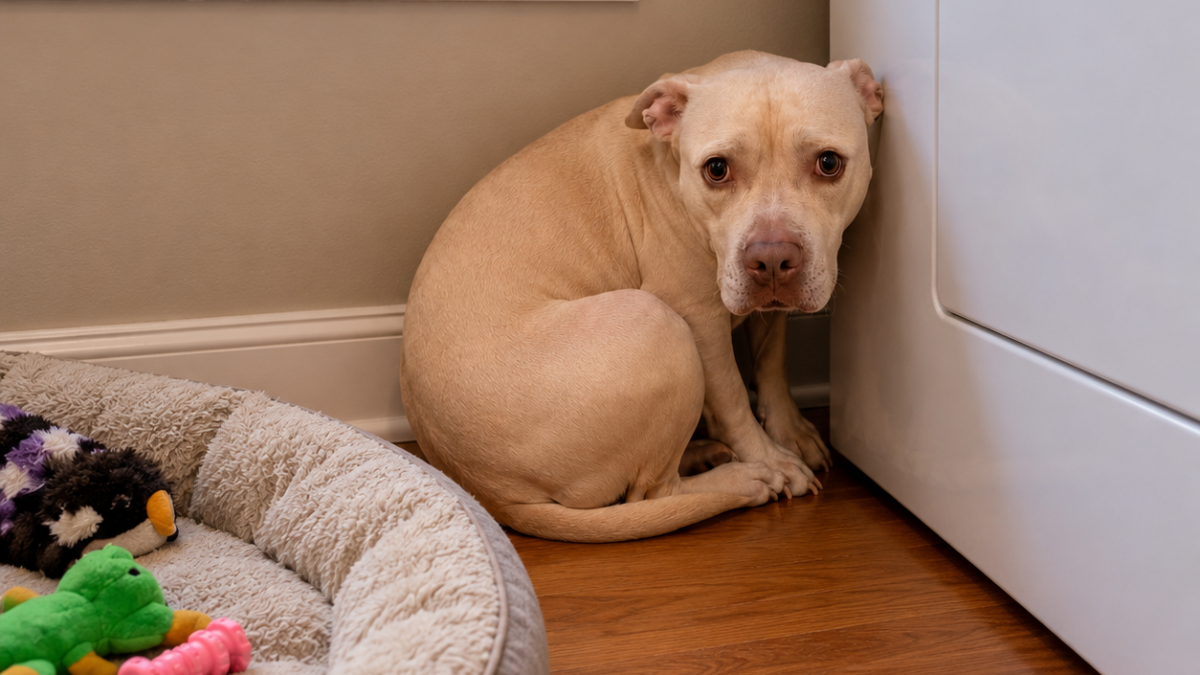
For months, Leicy survived behind the fence of an empty house, waiting for people who had already decided they were never coming back.
By the time rescuers found her, she had food placed in front of her and still wouldn’t eat unless every person in the room stepped away.
But the first time I knelt outside her shelter kennel and she looked directly into my eyes, I saw something that made me realize bringing her home would be the easy part.
My name is Daniel.
For almost two years, my wife, Claire, and I had talked about adopting a dog.
We weren’t looking for a particular breed.
We didn’t care about age.
We just wanted the feeling that came when the right dog appeared and somehow made the decision for us.
Then we saw Leicy’s photograph.
She was a small sand-colored Pit Bull, barely two years old, standing on a concrete floor with her ears lowered and her tail folded beneath her body.
Her amber eyes were enormous.
Not dramatic.
Not pleading.
Just tired.
The caption beneath her photograph said:
**LEICY — 2 YEARS OLD. NEEDS A PATIENT HOME.**
Claire stared at the screen for nearly a minute.
“That’s her.”
I looked at her.
“You haven’t even met her.”
“I know.”
Three days later, we bought a soft gray dog bed.
Then toys.
A squeaky ball.
A rope.
A stuffed bear so soft Claire joked that I would steal it before Leicy ever got the chance.
We placed everything beside the couch.
Looking back, I realize how little we understood.
We were preparing for a dog.
Leicy was preparing for disappointment.
The morning we drove to the shelter, rain covered the windshield in thin silver lines.
Neither of us talked much.
When we arrived, a volunteer named Sarah met us near the front desk.
“You’re here for Leicy.”
It wasn’t a question.
I smiled.
“Is it that obvious?”
“You’re the third couple this month who came specifically to meet her.”
My stomach tightened.
“What happened with the others?”
Sarah’s expression softened.
“They wanted her to come to them immediately.”
“And she didn’t.”
“No.”
She led us toward the kennel wing.
As we walked, she told us what rescuers knew.
Leicy had been found in the backyard of a vacant house.
The family who had lived there moved away.
Leicy stayed.
No leash.
No chain.
No one locking her inside a crate.
They simply left her behind a fence and drove away.
Neighbors occasionally tossed food over the gate.
Someone filled an old plastic container with water when they remembered.
But for nearly three months, no one regularly entered the yard.
Rain came.
Cold nights came.
Then heat.
Leicy survived all of it alone.
“When animal control finally brought her here,” Sarah said, “she wouldn’t eat in front of anyone.”
Claire squeezed my hand.
“Was she sick?”
“Dehydrated. Underweight. Skin irritation. Nothing we couldn’t treat.”
Sarah paused.
“The harder part wasn’t physical.”
We stopped outside a kennel.
There she was.
Leicy.
Smaller than she looked in the photograph.
She was curled against the back wall on a folded blanket.
Her head lifted when we appeared.
She didn’t bark.
Didn’t growl.
Didn’t rush the gate.
She simply watched us.
I crouched.
“Hey, girl.”
Leicy’s eyes moved to me.
Nothing else did.
Sarah gave me several treats.
“Don’t offer them through the bars.”
“Why?”
“Put them down and move back.”
I placed one treat near the gate.
Then stepped away.
Leicy stared at it.
Thirty seconds.
A minute.
Two.
Finally she stood.
Her legs seemed rigid, as though every movement required a decision.
She approached the treat.
Stopped.
Looked at me.
Then Claire.
Then Sarah.
Only when we all turned slightly away did she move forward and take it.
Claire’s eyes filled.
I understood why.
Leicy wasn’t refusing affection.
She was calculating whether affection had a price.
We stayed almost an hour.
I never touched her.
Claire didn’t either.
Before we left, Leicy did something Sarah said she had never done with a potential adopter.
She walked toward the kennel door while we were still standing there.
Not all the way.
Just close enough that I could see the faint scar above her nose.
Then she sat.
And watched us leave.
That should have frightened me.
Instead, I turned to Claire in the parking lot.
“When can we bring her home?”
Three days later, we signed the foster-to-adopt papers.
I thought the difficult part was over.
I had no idea that Leicy’s past was about to follow her straight to our front door.
PART 2
The shelter asked us to begin as foster-to-adopt rather than signing permanent adoption papers immediately.
Sarah explained why.
“Leicy hasn’t lived in a normal home since we found her.”
“What does that mean for us?” Claire asked.
“It means don’t expect anything.”
I laughed.
“That’s reassuring.”
“I’m serious.”
Sarah sat across from us in the consultation room.
“Don’t expect her to play. Don’t expect her to sleep in the bed you bought. Don’t expect her to come when you call. Don’t expect tail wags because you fed her.”
Claire nodded.
“What should we do?”
“Give her choices.”
Sarah slid a printed sheet toward us.
“Keep things quiet. Keep routines predictable. Don’t force physical affection. Don’t corner her. Let her have a safe space.”
I thought about the gray bed beside our couch.
“So basically, we spent two hundred dollars buying things she may ignore.”
Sarah smiled.
“Welcome to having a dog.”
The day we brought Leicy home was bright and cold.
She refused to leave the shelter building at first.
Sarah clipped on a second safety leash and walked beside us.
Leicy reached the doorway.
Stopped.
Outside, a delivery truck rumbled past.
Her body dropped instantly.
Not dramatically.
She simply flattened herself against the floor.
Claire knelt several feet away.
“It’s okay.”
Leicy stared at the parking lot.
Sarah whispered, “Don’t pull.”
I loosened the leash.
We waited.
Five minutes.
Then ten.
People walked around us.
Nobody rushed her.
Eventually Leicy raised her head.
One front paw moved.
Then the other.
She crossed the doorway.
Sarah smiled.
“That matters.”
The walk to our car took almost fifteen minutes.
When I opened the back door, Leicy backed away.
I realized what the vehicle might mean to her.
The last time she had seen people load belongings into a car, they had left without her.
Or maybe she had been driven somewhere frightening before that.
We didn’t know.
I sat on the pavement beside the open door.
Claire stood quietly with Leicy.
“We have all day.”
Eventually Leicy sniffed the seat.
Then placed two paws inside.
Backed out.
Tried again.
Finally, she climbed in.
Claire sat beside her.
I drove home as gently as I could.
Leicy did not look out the window.
She pressed herself against the seat and stared at the floor.
When we reached the house, the process started again.
Car door.
Driveway.
Front steps.
Doorway.
Every threshold mattered.
Every new room had to be evaluated.
Leicy entered our living room at 2:17 that afternoon.
I remember the time because I looked at the clock and thought:
You’re home.
Leicy didn’t know that.
Not yet.
She walked directly past the expensive dog bed.
Ignored the toys.
Passed the couch.
Found the narrow space between an armchair and the wall.
And curled up there.
Claire looked disappointed for approximately half a second.
Then she carried the gray bed across the room and placed it several feet from Leicy’s hiding place.
“Whenever you’re ready.”
We put down water.
Food.
Then we sat on the couch and pretended Leicy wasn’t there.
That was harder than it sounds.
I wanted to look.
To reassure myself.
To see whether she was sleeping.
Every few minutes Claire elbowed me.
“Stop staring.”
“I’m not.”
“You absolutely are.”
“I was looking at the lamp.”
“The lamp is on the other side.”
Leicy didn’t move for three hours.
At six, I went into the kitchen.
When I returned, one piece of kibble was missing.
I looked at Claire.
She shook her head.
“Don’t make a big deal.”
“I’m not.”
“You have the face.”
“What face?”
“The proud-dad face.”
“We’ve had her four hours.”
“Exactly.”
That night, Leicy did not sleep.
Neither did we.
Every time the house creaked, I heard her nails touch the hardwood.
She moved from the chair to the hallway.
Back to the chair.
To the kitchen.
Back again.
At 3:00 a.m., I walked quietly toward the living room.
Leicy froze.
I stopped.
“Hey.”
Her ears flattened.
I sat down on the floor.
Not near her.
Across the room.
She stared at me.
I stayed there for maybe twenty minutes.
Eventually her body lowered.
Then her head.
I whispered:
“You don’t have to trust me tonight.”
Her eyes remained open.
“Tomorrow’s fine.”
I returned to bed.
The next morning, Claire found me asleep on the couch.
Leicy was still behind the chair.
But something had changed.
The bowl was empty.
“She ate.”
I smiled.
Claire kissed my forehead.
“Don’t celebrate too loudly.”
The first week was built from tiny victories.
Leicy drank while we were in the room.
Then ate while we were ten feet away.
Then eight.
She walked into the backyard if we left the door completely open.
She refused to cross the threshold if one of us stood beside it.
So we moved.
At first she remained within three feet of the back door.
Then she explored the patio.
The grass.
The fence line.
On day six, she discovered a patch of sunlight near the garden.
She stood there for almost five minutes.
Then lowered herself onto the warm grass.
Claire watched from the kitchen window.
“Daniel.”
“I see her.”
“Do you think she’s ever done that?”
“Done what?”
“Just laid in the sun because she wanted to.”
I didn’t answer.
We had no way to know.
That was the terrible thing about Leicy’s past.
So much of it existed only in what she couldn’t do yet.
A door closed too quickly?
She ducked.
A man raised his voice on television?
She left the room.
Keys jingled near the front door?
Her entire body stiffened.
Suitcase?
That was worse.
I discovered it accidentally.
Two weeks after Leicy came home, I had a one-night work trip.
I pulled my small suitcase from the closet.
Leicy was lying on the rug.
The moment she saw it, she stood.
Her expression changed.
She followed me into the bedroom.
I packed a shirt.
Leicy stood in the doorway.
Claire noticed.
“Daniel.”
“What?”
“Look at her.”
Leicy wasn’t shaking.
She didn’t bark.
She just stared.
I zipped the suitcase.
Leicy immediately walked into the living room and disappeared behind the chair.
My stomach turned.
“She thinks I’m leaving.”
Claire nodded.
I sat on the floor beside the chair.
“Hey, Leicy.”
Nothing.
“I’m coming back tomorrow.”
I knew how ridiculous it sounded.
She didn’t understand the words.
But I kept talking.
“Claire’s staying. You’re staying. This is your house.”
Nothing.
I reached toward the space, then stopped myself.
Choice.
Always choice.
I left.
Claire told me later that Leicy refused dinner.
The next afternoon, when I opened the front door, I expected her to hide.
Instead, she stood in the hallway.
Not close.
But waiting.
I placed my suitcase down.
“Hey, girl.”
Her ears lifted.
I took one step.
She backed away.
So I stopped.
For several seconds, we looked at each other.
Then Leicy approached.
Slowly.
She came within arm’s reach.
Sniffed my hand.
And walked away.
That was all.
I nearly cried.
Because for Leicy, coming back was not an ordinary thing.
People had left before.
And they hadn’t returned.
Every time Claire or I walked back through the door, we were teaching her something new.
Departure did not always mean abandonment.
The third week, she touched Claire first.
Claire was reading on the floor.
Leicy approached from behind.
Pressed her nose against Claire’s shoulder.
Claire froze.
I was in the kitchen.
She whispered:
“Daniel.”
I looked.
“Don’t move.”
“I’m not.”
Leicy sniffed Claire’s hair.
Then stepped away.
Claire had tears running down her face.
“Don’t cry.”
“I’m not.”
“You absolutely are.”
“Shut up.”
That evening, Leicy took a treat from Claire’s hand.
Two days later, she took one from mine.
Then came the stuffed bear.
The bear had been lying untouched near the gray bed since before Leicy arrived.
One Saturday morning, I came downstairs and found the bear in the hallway.
“Claire?”
“What?”
“Did you move this?”
She walked in.
“No.”
We both looked toward the living room.
Leicy stood near the doorway.
The stuffed bear had one damp ear.
I smiled.
Claire pointed at me.
“Do not make a thing out of it.”
“I’m not.”
“You look like you’re about to call the newspaper.”
“She played.”
“She moved a toy.”
“Same thing.”
It wasn’t.
Not yet.
But the next evening, Leicy picked the bear up in front of us.
She carried it to her corner.
Dropped it.
Looked at us.
I turned away immediately.
Claire whispered:
“Why are you looking at the ceiling?”
“So she doesn’t feel watched.”
“You look insane.”
“I know.”
The first tail wag came after five weeks.
It lasted perhaps two seconds.
Claire walked into the kitchen carrying chicken.
Leicy’s tail moved.
Once.
Then again.
Claire stopped.
“Was that for me?”
I shook my head.
“Definitely the chicken.”
“I’ll take it.”
By the end of the second month, Leicy had started using the dog bed.
Not often.
Usually at night when she thought we were asleep.
But one afternoon I found her curled in it.
Her body was not tight.
Her legs were stretched.
The stuffed bear rested beneath her chin.
I took a photograph.
Not because I wanted to post it.
Because I wanted proof.
Not proof for anyone else.
Proof for me.
This dog could rest.
The shelter invited us for a follow-up evaluation after three months.
The morning we arrived, Leicy stopped in the parking lot.
Her tail tucked.
Sarah came outside.
“Don’t bring her in yet.”
We waited.
Sarah sat on the curb.
“Hi, Leicy.”
Leicy looked at her.
No movement.
Then Sarah turned away.
Ten minutes later, Leicy walked forward.
Sarah’s face changed.
“Oh my goodness.”
“What?”
“Look at her.”
I did.
Her tail was not tucked.
Low, yes.
But not hidden.
She approached Sarah.
Sniffed her hand.
Then allowed Sarah to touch the side of her neck.
Sarah started crying.
Claire laughed.
“Apparently everybody cries around this dog.”
Sarah wiped her eyes.
“You didn’t see her three months ago.”
“I did.”
“Not like we did.”
Inside, the shelter veterinarian examined Leicy.
Weight good.
Skin good.
Muscle tone improved.
Then Sarah asked:
“Are you ready to make the adoption permanent?”
I looked at Claire.
She looked at me.
“Was there another option?”
Sarah smiled.
We signed.
Leicy officially became ours.
The certificate was just paper.
Leicy didn’t know.
But I did.
Nobody could simply decide she was unwanted again.
That night, we cooked dinner.
Leicy slept beside the couch.
I looked at Claire.
“She’s ours.”
Claire corrected me.
“We’re hers.”
Fine.
The next six months were quieter.
Leicy continued changing.
She learned to walk around the neighborhood.
At first, we went after dark when fewer people were outside.
Then early morning.
Then normal hours.
She disliked men wearing baseball caps.
Delivery trucks.
Garbage cans rolling on wheels.
Sudden laughter behind her.
She loved elderly women.
Children who sat quietly.
Cheese.
Sunlight.
And, inexplicably, cardboard boxes.
The first box arrived with dog food inside.
After I unpacked it, Leicy climbed into the empty box.
She was too big.
Half her body stuck out.
Claire laughed.
Leicy jumped out immediately.
Claire covered her mouth.
“Sorry.”
Leicy looked at her.
Then climbed back in.
That became a game.
Every delivery box remained on the floor for twenty-four hours.
Leicy crushed it.
Sat in it.
Carried pieces around.
She was becoming a dog.
Not a rescue story.
Not a victim.
A dog.
That mattered to me.
People sometimes met her and asked:
“What happened to her?”
I stopped answering with the abandonment first.
I would say:
“She likes chicken and cardboard.”
They looked confused.
Then I would tell the rest if it mattered.
Her worst experience was not her identity.
By the end of the first year, Leicy slept on the couch.
She still didn’t climb into bed with us.
That seemed to be a boundary she had chosen.
Fine.
Then one night during a thunderstorm, I woke at 2:14 a.m.
Something touched my foot.
I sat up.
Leicy stood beside the bed.
Lightning flashed.
She flinched.
“Come here.”
I patted the mattress.
She hesitated.
Claire woke.
“What’s happening?”
“Leicy.”
Claire immediately went still.
Leicy placed her front paws on the mattress.
Then jumped up.
She stood between us as if she had made a catastrophic error.
I laughed softly.
“It’s okay.”
She turned twice.
Curled near my legs.
And slept.
The next morning she remained there long after the storm ended.
From that night forward, the bedroom was no longer forbidden.
Trust with Leicy came like that.
One room at a time.
One sound.
One hand.
One return through the door.
Then, nearly fourteen months after we adopted her, Sarah called.
Her voice was different.
“Daniel, I need to tell you something before you hear it from somewhere else.”
My stomach tightened.
“What happened?”
“Someone contacted the rescue.”
“About Leicy?”
“Yes.”
I sat down.
Claire looked at me from across the kitchen.
“Who?”
“A woman named Melissa Grant.”
The name meant nothing to me.
Sarah continued.
“She says Leicy belonged to her family.”
For a moment, I couldn’t process the sentence.
“What?”
“She saw the anniversary post.”
The shelter had shared a photograph of Leicy sleeping in our backyard under the caption:
**One year home.**
Nothing dramatic.
No names from her past.
Just an update.
“What does she want?”
Sarah hesitated.
“She says she wants Leicy back.”
I laughed.
Not because it was funny.
Because the alternative was saying something I would regret.
“They left her in an empty yard.”
“I know.”
“For three months.”
“I know.”
“She nearly shut down completely.”
“I know.”
“And now they want her?”
“That’s what she says.”
Claire sat beside me.
“Put Sarah on speaker.”
I did.
Claire asked:
“Does this woman have proof?”
“She sent old veterinary records and photographs.”
“So she really was their dog.”
“Most likely.”
Claire’s hand tightened around mine.
“What happens?”
Sarah answered carefully.
“Nothing immediately. Your adoption was completed through legal shelter procedures.”
“Immediately?” I repeated.
“I don’t want to overpromise.”
That word frightened me.
“Can someone take her?”
“Daniel, contact an attorney before communicating with this family.”
That afternoon, we did.
The attorney’s name was Rebecca Shaw.
She reviewed our paperwork.
Shelter intake.
Animal control hold.
Attempts to locate owners.
Public notices.
Medical care.
Foster-to-adopt agreement.
Permanent adoption.
Microchip registration.
Rebecca leaned back.
“Your ownership is strong.”
“Strong?”
“I don’t say guaranteed.”
“Why?”
“Because lawyers who say guaranteed eventually regret it.”
I hated her immediately.
Then liked her because of the same answer.
“Could the previous owners sue?”
“They can file something.”
“Could they win?”
“Based on what you’ve shown me, I’d be surprised.”
Claire asked:
“What do we do?”
“Nothing publicly.”
“What if they contact us?”
“Save it.”
“Respond?”
“No.”
“Why?”
“Because angry people write excellent evidence against themselves.”
That sentence would prove accurate.
The first message came that evening.
Melissa found Claire through social media.
**That is our dog. Her real name is Daisy. You need to return her.**
Claire handed me the phone.
I stared at the screen.
Daisy.
Leicy slept ten feet away.
Her name at the shelter had been Leicy because no identification had been found.
Now even that felt strange.
“Do you think she remembers that name?” Claire asked.
“I don’t know.”
We sent the message to Rebecca.
She replied:
**Do not engage.**
The next morning:
**My children are devastated. She was part of our family.**
Then:
**You have no idea what really happened.**
Then:
**The shelter had no right to give her away.**
We remained silent.
Two days later, Melissa’s husband, Evan, contacted the shelter directly.
His explanation was simple.
Their family had been forced to relocate quickly after a financial emergency.
Their new rental did not allow Pit Bulls.
They claimed a neighbor had agreed to care for Leicy temporarily.
The neighbor disappeared.
They believed someone else had taken the dog.
Sarah called me after reviewing the claim.
“What do you think?” I asked.
“I think we need evidence.”
Good answer.
The rescue pulled its old records.
Animal control records.
Photographs.
Neighbor statements.
Then something important appeared.
The original report had not come from a stranger.
It came from the next-door neighbor.
Mrs. Alvarez.
Her statement from more than a year earlier said:
**Family moved approximately twelve weeks ago. Dog remains in backyard. I was told they could not take her. I have been throwing food over the fence and filling water through a gap. No one has returned for the dog.**
Rebecca read it twice.
“That’s helpful.”
Then Sarah located the animal control officer’s notes.
The officer had contacted a phone number connected to the former family.
There were three attempted calls.
Two voicemail messages.
One text.
The text read:
**Animal control has recovered a dog from your former address. Please contact us if you are the owner.**
Delivery confirmed.
No response.
Five days later, a second message.
No response.
Then the legal hold expired.
Leicy became eligible for rescue placement.
“Did they see the texts?” I asked.
Rebecca shook her head.
“We can show delivery, not whether a human actually read them.”
“Still.”
“Still helpful.”
Melissa’s attorney sent a letter.
They claimed the family had never intentionally surrendered ownership.
They demanded that Leicy be returned pending resolution.
Rebecca’s reply was eleven pages.
Mine would have been three words.
Absolutely not.
Hers was better.
Dates.
Records.
Calls.
Public notices.
Months without retrieval.
Medical treatment.
Adoption.
Microchip transfer.
Behavioral history.
Then a sentence that made Claire smile:
**The dog is not an object held in storage while former owners reconsider decisions made more than a year earlier.**
Melissa’s attorney did not appreciate that sentence.
I loved it.
Then the situation became public.
I still don’t know who leaked it.
A local neighborhood page posted:
**FAMILY FIGHTS TO GET BELOVED PIT BULL BACK AFTER RESCUE ADOPTS HER TO NEW HOME.**
That headline made my stomach turn.
Beloved.
Fights to get her back.
No mention of the empty yard.
No mention of three months.
No mention of the unanswered animal control notices.
Comments divided immediately.
Some called us thieves.
Others attacked the former family.
People demanded photographs.
Records.
Names.
I posted nothing.
Neither did Claire.
Sarah released one statement:
**The rescue followed all applicable intake and adoption procedures. Because this is an active ownership dispute, we will not discuss private details publicly. The dog’s welfare remains our priority.**
That did not satisfy anyone.
Of course it didn’t.
Outrage hates incomplete information.
Then Melissa gave an interview.
She cried.
I believe the tears were real.
That made everything harder.
She described Leicy—Daisy—as her children’s dog.
She showed photographs.
In one, Leicy was a puppy wearing a pink collar.
In another, she slept beside a little girl.
A Christmas picture showed her wearing antlers.
The reporter asked:
“Why did you leave her behind?”
Melissa answered:
“We didn’t. We thought someone we trusted was caring for her.”
That clip spread everywhere.
Claire watched it once.
Then turned it off.
“Do you believe her?”
I looked toward Leicy.
She was asleep in a cardboard box she had destroyed.
“I believe parts of it.”
“What parts?”
“That the kids loved her.”
Claire nodded.
“Me too.”
That was important.
Because children do not control leases.
Moves.
Money.
Adult decisions.
Whatever consequences came later, I didn’t want children punished publicly for something they didn’t choose.
But the adult story still did not fit.
If Leicy had been accidentally lost through a failed caretaking arrangement, why ignore animal control?
Why not search the shelter?
Why wait until a photograph appeared fourteen months later?
Rebecca agreed.
“Facts before theories.”
So we kept collecting facts.
Mrs. Alvarez agreed to speak with us.
She was seventy-two.
Sharp.
Direct.
And furious that anyone had portrayed Leicy’s abandonment as a simple misunderstanding.
“They knew,” she said.
“How do you know?”
“Because I asked them.”
The room became still.
“When?”
“The day they moved.”
She described the scene.
A moving truck.
Boxes.
Furniture.
Children in a car.
Leicy in the backyard.
Mrs. Alvarez saw Melissa near the gate.
She asked:
“What about the dog?”
Melissa reportedly said:
“We can’t take her where we’re going.”
Mrs. Alvarez asked whether someone was coming.
Melissa said:
“Maybe my cousin.”
“Maybe?” Rebecca asked.
Mrs. Alvarez nodded.
“What happened next?”
“The truck left.”
“Did the cousin come?”
“Never.”
“Did the family return?”
“No.”
“Did you have contact information?”
“No.”
“Why didn’t you call animal control immediately?”
Mrs. Alvarez looked ashamed.
“I thought someone would come.”
She started tossing food over the fence.
Then water.
“I kept thinking tomorrow.”
Weeks passed.
Leicy began sleeping beneath a patio table.
Rain soaked the yard.
Then Mrs. Alvarez saw the family property listed as vacant.
She called authorities.
“Did anyone ever ask you later about the dog?”
“No.”
“Until now?”
“No.”
Rebecca took careful notes.
Before we left, Mrs. Alvarez asked about Leicy.
“Is she okay?”
“Yes.”
“Does she still hide under tables?”
That stopped me.
“How did you know?”
“She did it before they left.”
I looked at Claire.
There was history before the abandonment.
Not necessarily cruelty.
But fear.
“Was she always timid?”
“Not as a puppy.”
“What changed?”
Mrs. Alvarez shrugged.
“The house got loud.”
That sentence opened another door.
We did not push.
The ownership case was enough.
I didn’t need to turn every family argument into public evidence.
But I began understanding Leicy differently.
Maybe the abandonment did not create all her fear.
Maybe it completed something that had already started.
A dog who had learned uncertainty inside a home then experienced the ultimate confirmation of it.
People leave.
The civil hearing was scheduled six weeks later.
During those six weeks, Leicy changed because we changed.
We became anxious.
Dogs notice.
Every time the phone rang, Claire stiffened.
Every certified letter made me angry.
Leicy began pacing again.
Not constantly.
But enough.
One evening, I realized what we were doing.
We were turning our home into another place where humans carried invisible tension.
I put my phone in a drawer.
Claire looked at me.
“What are you doing?”
“Nothing about the case after seven.”
“Daniel.”
“Seriously.”
“What if Rebecca calls?”
“She can leave a message.”
“What if something happens?”
“Then it happens tomorrow.”
Leicy stood near the couch.
Watching us.
I sat on the floor.
“This house is still normal.”
Claire understood.
She sat beside me.
For the next month, evenings belonged to Leicy.
No documents.
No social media.
No discussion about former owners.
We walked.
Played.
Watched movies.
Leicy slept.
That rule saved us.
Not legally.
Emotionally.
The morning of the hearing, I almost didn’t go.
Claire did.
Rebecca did.
Sarah did.
I wanted to stay with Leicy.
Then Rebecca said:
“You need to be there because this is not only about paperwork. The court may want to hear about her current condition.”
So I went.
The courtroom was small.
Melissa sat with her husband across the aisle.
I recognized her immediately from the interview.
She looked at Claire.
Then me.
For one second, neither side looked like enemies.
Just four exhausted adults connected by one dog who had no idea any of this was happening.
Then the hearing began.
Melissa’s attorney presented photographs first.
Puppy Leicy.
Children.
Christmas.
A backyard birthday party.
Proof that she had once belonged to them.
Rebecca did not dispute it.
That surprised their attorney.
“Yes,” Rebecca said. “The respondents agree the Grant family previously owned the dog.”
The judge looked at her.
“Then what is the dispute?”
“Whether that ownership survived their conduct.”
Simple.
That was Rebecca’s gift.
The former family argued emergency relocation.
Rental restrictions.
Financial hardship.
A promised caretaker.
They said they intended to retrieve Leicy once circumstances improved.
Then Rebecca asked:
“From whom?”
Melissa hesitated.
“The caretaker.”
“Name?”
She gave one.
“Cousin?”
“Family friend.”
“Address?”
Melissa didn’t know the current one.
“Phone?”
Changed.
“Any messages asking for updates on Leicy?”
A pause.
“I lost my old phone.”
“Any photographs sent by this caretaker?”
“No.”
“Veterinary receipts during those three months?”
“No.”
“Food receipts?”
“No.”
“Did you visit?”
“No.”
“Call animal control?”
“No.”
“Check the county shelter website?”
“No.”
“Post about a missing dog?”
“No.”
“Contact neighbors?”
“No.”
Each answer removed another piece of the story.
Then Mrs. Alvarez testified.
The day of the move.
The question about Leicy.
The answer:
We can’t take her.
Food over the fence.
Weeks.
Weather.
No return.
The former attorney challenged her memory.
Mrs. Alvarez was magnificent.
“You remember an exact conversation from more than a year ago?”
“I remember because I was looking at the dog while they drove away.”
No drama.
Just truth.
Then came the animal control logs.
Three calls.
Two texts.
One public intake listing.
No response.
The judge asked Melissa directly:
“Why didn’t you respond?”
She cried.
“I was overwhelmed.”
I believed that too.
The judge waited.
Melissa continued.
“My marriage was falling apart. We were losing everything. I couldn’t deal with another thing.”
Rebecca did not attack her.
That mattered.
Nobody needed to humiliate a person admitting they had failed.
The judge asked:
“Did you know the dog remained behind?”
Melissa looked down.
“Yes.”
Silence.
“Did you believe someone was caring for her?”
“At first.”
“At first?”
“Yes.”
“And later?”
Melissa covered her face.
“I didn’t know.”
“Did you check?”
“No.”
That was the case.
Not because she never loved Leicy.
Because love is not the same as responsibility.
The judge ruled from the bench.
The shelter had obtained lawful custody after appropriate notice and expiration of the statutory hold period.
The rescue placement was valid.
Our adoption remained valid.
Leicy was legally ours.
Melissa lowered her head.
Her husband stared at the table.
Claire gripped my hand so hard my fingers hurt.
Then the judge added something I didn’t expect.
“This court does not need to decide whether the prior owners were bad people.”
The room became still.
“People in crisis make terrible decisions. But later regret does not automatically reverse the consequences of those decisions—especially when another living being has since been placed safely and lawfully.”
That sentence stayed with me.
Outside the courthouse, reporters waited.
We walked past.
No interview.
No victory speech.
No celebration.
I did not want the worst day of another family turned into our content.
We drove home.
Leicy was with Sarah at our house.
When I opened the door, she appeared in the hallway.
Her tail moved.
Then stopped.
She saw Claire.
Wagged again.
Claire dropped to her knees.
“Hey, baby.”
Leicy approached.
Claire wrapped one arm around her, then stopped herself.
Choice.
Even after all that time.
Leicy leaned closer.
Permission.
Claire hugged her.
I sat on the floor beside them.
“It’s over.”
Leicy licked my chin.
I laughed.
“That is disgusting.”
Claire cried.
Leicy licked her too.
“Good girl.”
For the first time in six weeks, our house felt completely quiet.
I thought that was the end.
Then Melissa sent a letter.
Not through lawyers.
Through the rescue.
Sarah called first.
“You don’t have to read it.”
“Is it angry?”
“No.”
I opened it.
Melissa wrote that she did not intend to appeal.
She admitted leaving Leicy had been wrong.
Not unfortunate.
Not complicated.
Wrong.
She said her children had loved Leicy and were still upset.
Then came the sentence that changed how I viewed the entire dispute:
**I think I wanted her back because getting her back would let me pretend I had not been the kind of person who left her.**
I read it twice.
Claire read it.
Then sat silently.
The letter continued.
Melissa explained that when she saw Leicy’s anniversary photograph, she looked healthy.
Relaxed.
Loved.
Instead of feeling relieved, Melissa felt exposed.
Someone else had done what she had failed to do.
So she convinced herself the adoption was the wrong that needed correcting.
That was easier than admitting the original wrong belonged to her.
At the bottom:
**Please tell me only one thing: Is she happy?**
I wanted to ignore the letter.
Claire didn’t.
“Answer.”
“Why?”
“Because the kids deserve to know.”
I thought about it.
Then wrote:
**Yes. She is safe, healthy, deeply loved, and increasingly happy.**
Nothing else.
Three weeks later, another envelope arrived.
Inside was a photograph.
Leicy as a puppy.
She was sitting beside two children.
Her ears were huge.
Her expression ridiculous.
On the back, in a child’s handwriting:
**Please give Daisy this picture. We miss her.**
Dogs do not understand photographs.
I knew that.
Still, we placed the picture in a frame on a shelf.
Not because Leicy needed it.
Because her history belonged to her.
We did not need to erase the years before us in order to love her.
That became important.
Rescue stories sometimes make the past entirely dark so the present can look brighter.
Real life is rarely that clean.
Leicy had been loved by those children.
She had probably played in that yard.
Slept near their beds.
Taken treats from their hands.
Then the adults failed her.
Both things could be true.
The court case ended.
The internet moved on.
Leicy did too.
That was the best revenge, if you want to call it that.
Not Melissa being humiliated.
Not our side winning comments.
Not strangers choosing heroes and villains.
Leicy simply continued becoming a dog who no longer lived according to someone else’s worst decision.
Two years after adoption, she greeted Sarah at the door.
Three years, she started carrying her stuffed bear whenever visitors arrived.
Four years, she learned that suitcases were not emergencies.
That one took the longest.
We practiced.
I put an empty suitcase in the living room.
Nothing happened.
Next day, one shirt inside.
Then two.
Sometimes I closed it and did not leave.
Sometimes I carried it to the car and came back five minutes later.
Eventually, Leicy stopped following me from room to room when I packed.
The first time that happened, I almost celebrated.
Then Claire whispered:
“Don’t make it weird.”
“Why does everybody say that to me?”
“Because you make everything weird.”
Leicy was asleep on the couch.
Suitcase by the door.
No panic.
No hiding.
I wanted to frame the moment.
Instead, I closed the suitcase and went to bed.
The next morning, I left for two nights.
When I returned, Leicy was sleeping.
She heard the door.
Opened one eye.
Then went back to sleep.
I stood there offended.
“Seriously?”
Claire laughed from the kitchen.
“You spent four years teaching her you’ll come back.”
“She could at least pretend she missed me.”
Leicy stretched.
Eventually approached.
Wagged.
I knelt.
“Thank you.”
She licked my face.
There she was.
At five years home, Leicy developed an unusual habit.
Every afternoon around three, sunlight crossed the living room floor.
She followed it.
First near the window.
Then the rug.
Then the hallway.
She moved every twenty minutes to stay inside the warm patch.
Claire called it Leicy’s solar schedule.
Sometimes I would come home and find her stretched across the floor, eyes closed, completely vulnerable.
Remembering the shelter kennel made those moments feel enormous.
The dog who once sat against a wall waiting for people to turn away before she ate now slept belly-up in the center of a room.
Safety has a posture.
I learned that from Leicy.
At six years home, something unexpected happened.
Sarah left the rescue.
She had been offered a job managing a foster program for another organization.
Before leaving, she came over.
Leicy greeted her immediately.
No hesitation.
Sarah sat on the floor.
“You know you ruined me.”
I laughed.
“Me?”
She pointed at Leicy.
“Her.”
Leicy leaned against Sarah.
“When she arrived, I thought success meant getting her adopted.”
“What do you think now?”
Sarah rubbed Leicy’s chest.
“Success is what happens after adoption.”
I understood.
A photograph of a dog leaving a shelter is easy.
The harder story is month three.
Year two.
Vet bills.
Fear returning unexpectedly.
Bad nights.
Changing routines.
Staying.
The opposite of abandonment is not adoption paperwork.
It is consistency.
Years of it.
Sarah cried when she left.
Of course.
Leicy watched the door after she was gone.
Then came to me.
No panic.
She had learned another thing:
Someone can leave the room and still exist in your life.
Not every goodbye is permanent.
That may have been her greatest recovery.
When Leicy was nine, Claire and I welcomed our first child.
A daughter.
Emma.
I worried for months before she was born.
Not because Leicy had ever shown aggression.
She hadn’t.
Because babies are noise.
Unpredictability.
Movement.
Exactly the things Leicy once struggled with.
We worked with a trainer.
Prepared spaces.
Baby gates.
Safe retreat areas.
No forced interactions.
When Emma came home, Leicy sniffed the air from across the room.
The baby cried.
Leicy walked away.
Good.
Choice.
For weeks, that was our routine.
Observe.
Leave.
Return.
One morning, Emma was asleep in a bassinet.
Leicy approached Claire.
Then the bassinet.
She sniffed.
Sat.
Looked at us.
Claire smiled.
“That’s the tiny human.”
Leicy sighed.
Walked to her bed.
Over months, curiosity became familiarity.
When Emma started crawling, we became even more careful.
Dog always had escape routes.
Child never followed.
No climbing.
No hugging.
No face-to-face contact.
Respect went both directions.
By the time Emma was three, Leicy voluntarily slept near her while she colored.
One afternoon, Emma placed the stuffed bear—the same bear we bought before meeting Leicy—beside her.
“For you.”
Leicy picked it up.
Carried it to her bed.
Emma smiled.
“She likes me.”
I looked at Claire.
“She does.”
That bear survived everything.
One ear missing.
One side repaired twice.
Still Leicy’s.
At ten, gray appeared around her muzzle.
At eleven, arthritis.
At twelve, she needed medication.
The girl who once ran the fence line now preferred the sunny living room.
Emma grew up believing Leicy had always been calm.
That made me smile.
She did not know the kennel dog.
The backyard dog.
The dog afraid to eat.
She knew the dog who snored during movies.
Stole chicken.
Slept in cardboard.
Followed sunlight.
People contain multiple versions of themselves.
Animals do too.
At twelve, Leicy started losing hearing.
One afternoon I came through the front door and she didn’t wake.
For a terrible second, my heart stopped.
Then I touched the floor with my foot.
She opened her eyes.
I sat beside her.
“Don’t do that.”
She yawned.
I began using hand signals more deliberately.
She adapted.
Of course she did.
Leicy had spent her whole life adapting.
Sometimes I hated that word.
People praised rescue animals for resilience.
As though surviving hardship turns hardship into a gift.
It doesn’t.
Leicy should never have needed to become resilient.
She deserved stability from the beginning.
Her ability to survive did not make what happened acceptable.
Still, I admired her.
Not because suffering made her special.
Because after people taught her that trust was dangerous, she chose to learn trust again.
Slowly.
On her terms.
That was courage.
When Leicy was thirteen, Sarah came back to visit.
She had not seen her in almost a year.
Sarah entered.
Leicy was asleep.
“She looks so old.”
“Careful.”
“What?”
“She’s sensitive.”
“She’s deaf.”
“Still.”
Sarah sat beside her.
Leicy woke.
Sniffed.
Then her tail began moving.
Sarah cried before Leicy even stood.
Some things never change.
“Hi, beautiful girl.”
Leicy walked toward her.
Pressed her head into Sarah’s chest.
Sarah looked at me.
“She remembered.”
“Of course.”
“I remember when she wouldn’t come within five feet of me.”
“So do I.”
Sarah held Leicy’s face.
“You did okay.”
I corrected her.
“She did better than okay.”
That winter, Leicy’s kidneys began declining.
Nothing catastrophic at first.
More water.
Less appetite.
Blood work.
Diet changes.
Medication.
We managed.
Then managed more.
By spring, stairs became difficult.
I built a ramp.
Leicy refused it.
Claire laughed.
“She hates your craftsmanship.”
“It’s structurally excellent.”
Leicy chose the grass beside it.
I added carpet.
She used it.
“See?”
Claire smiled.
“She hated your interior design.”
Fine.
Emma was eight by then.
Old enough to understand.
“Is Leicy sick?”
“She’s old.”
“Is she going to die?”
Children ask questions adults spend hours avoiding.
“Someday.”
“When?”
“I don’t know.”
Emma sat beside Leicy.
“I don’t want her to.”
“Neither do I.”
“Can we keep her?”
I swallowed.
“We keep loving her. That’s what we can do.”
Emma leaned her head against my shoulder.
Leicy slept between us.
Her final summer was warm.
She spent most mornings outside.
Always the same sunny corner.
Claire brought water.
Emma brought the stuffed bear.
I carried Leicy down the steps when her legs were stiff.
No resentment.
No inconvenience.
Every time I lifted her, I thought about the people who once decided they couldn’t take her with them.
I wasn’t morally superior.
Life had been kinder to us in many ways.
We had a house.
Stable work.
Support.
Money for veterinary care.
Judging desperate people is easy when you’ve never lived their emergency.
But there was still a difference.
When life became difficult, Leicy remained part of the equation.
Not the first thing removed from it.
One September morning, she refused breakfast.
Then dinner.
The next day she ate chicken.
I celebrated too quickly.
The third day, nothing.
Our veterinarian, Dr. Patel, examined her.
Blood work showed what we feared.
Kidneys worse.
Other age-related problems.
We had options for supportive care.
But not a cure.
“How much time?” I asked.
Dr. Patel looked at me.
“Could be weeks. Maybe longer.”
Claire held Leicy’s head.
“Will we know?”
“You’ll know when her world becomes mostly discomfort.”
I hated that answer.
But it was honest.
For three weeks, Leicy rallied.
She ate.
Walked.
Slept in sunlight.
One evening she even chased the squeaky ball for perhaps ten seconds.
Emma cheered.
Leicy looked offended by the attention.
Then October came.
Rain.
The same kind of rain that fell the day Claire and I first met her.
Leicy stood at the back door.
She hated rain.
Always had.
I opened it.
She looked outside.
Then at me.
“No?”
She turned around.
“Fair.”
That afternoon, she couldn’t stand without help.
I knew.
Claire knew.
Emma knew because we did.
We called Dr. Patel.
He offered to come to the house.
Yes.
Absolutely.
Home.
Leicy had spent enough of her life in places that were not hers.
Her final hours would be in the house she had finally believed belonged to her.
We moved the gray dog bed beside the couch.
The same one we bought before meeting her.
Somehow it had survived thirteen years.
Flattened.
Patched.
Still there.
Leicy lay on it.
The stuffed bear beside her.
Emma sat on the floor.
“Can I stay?”
I looked at Claire.
Then Dr. Patel.
He answered gently.
“If your parents think you’re ready.”
We explained everything.
Simple.
No frightening details.
Leicy was very old.
Her body was tired.
We were going to make sure she was comfortable and not afraid.
Emma nodded.
Then whispered:
“I want to tell her something.”
She leaned close.
“Thank you for being my dog.”
I covered my face.
Claire took my hand.
Leicy’s eyes opened.
She looked toward Emma.
Tail moved once.
Maybe coincidence.
Didn’t matter.
Sarah came.
I had called her.
She arrived carrying an envelope.
“What’s that?”
“You’ll see later.”
She knelt.
Leicy smelled her hand.
Sarah laughed through tears.
“You finally learned people can be nice.”
I shook my head.
“No.”
Sarah looked at me.
“She learned specific people could be trusted.”
That was more accurate.
Trust was never universal.
It shouldn’t be.
Leicy didn’t owe humanity forgiveness.
She simply found enough humans who stayed.
Dr. Patel gave us time.
I sat beside Leicy.
My hand rested on her shoulder.
“Do you remember the first day?”
She breathed slowly.
“Probably not.”
Claire sat beside me.
I continued anyway.
“You wouldn’t eat if we looked at you.”
Claire smiled through tears.
“You hid behind the chair.”
“You stole my shirt.”
“That was trust.”
“It was theft.”
Claire laughed softly.
Leicy opened her eyes.
I looked at her amber eyes.
Older now.
Clouded.
Still unmistakably hers.
“I used to think we rescued you.”
My voice broke.
“That’s such an arrogant thing to say.”
Leicy breathed.
“You survived before us.”
I stroked her ear.
“We just gave you a place where survival wasn’t your full-time job anymore.”
That was what I wanted her life to mean.
Not that love magically erased damage.
It didn’t.
Leicy carried pieces of her past until the end.
Rain.
Suitcases.
Sudden doors.
But those pieces stopped controlling the entire story.
She built other memories around them.
Sunlight.
Chicken.
Cardboard boxes.
Emma.
Sarah.
Claire.
Me.
The gray bed.
The stuffed bear.
Thirteen years of people returning through the door.
When the time came, Leicy was calm.
Claire’s hand rested beneath her chin.
Emma held the stuffed bear against her side.
I kept my palm on her shoulder.
No one left.
That mattered more to me than anything.
The dog who had once been left alone behind a fence did not leave this world alone.
She was home.
Afterward, Emma asked:
“Where does trust go when someone dies?”
I didn’t know how to answer.
Children ask impossible questions so casually.
Finally I said:
“Maybe it stays with the people they taught.”
Emma thought about that.
Then nodded.
“I trust dogs better because of Leicy.”
“What does that mean?”
“I know scared dogs aren’t bad dogs.”
I looked at Claire.
There it was.
Leicy’s final gift.
Not a dramatic legacy.
A child who knew fear and meanness were not the same thing.
A child who understood patience.
Two weeks after Leicy died, Sarah’s envelope was still unopened on my desk.
I finally remembered it.
Inside was the original intake photograph.
Leicy on concrete.
Ears low.
Tail tucked.
Behind it Sarah had written:
**The first day she arrived.**
There was another photograph.
Taken the afternoon before her final week.
Leicy asleep in the sun.
Emma beside her reading a book.
On the back:
**The life she deserved.**
I framed them together.
Not because I wanted to preserve the pain.
Because the distance between the photographs mattered.
Not measured in miles.
Measured in mornings.
Meals.
Walks.
Returns.
Years.
Thirteen years of staying.
Months later, the rescue called.
They were starting a program for dogs considered too withdrawn for normal adoption events.
Instead of placing them in busy meet-and-greet rooms, potential adopters would spend quiet time with them.
No reaching through bars.
No expectations.
No requirement for instant affection.
They named it the Quiet Trust Program.
Not after Leicy.
I was glad.
Leicy didn’t need a monument.
Sarah asked whether they could use her story in volunteer training.
“Only if the lesson isn’t that patience fixes every dog.”
She understood immediately.
“What should the lesson be?”
I thought for a moment.
“Don’t demand proof of love from an animal who’s still deciding whether you’re safe.”
Sarah was quiet.
“That’s good.”
“It’s what Leicy taught us.”
The first dog placed through the program was a black-and-white mixed breed named Nora.
She had spent five months hiding whenever visitors appeared.
A retired couple came to meet her.
They sat on the floor.
Read books.
Ignored her.
Forty-five minutes later, Nora came close enough to sniff the man’s shoe.
They applied that afternoon.
Sarah called me.
“You’re going to make this emotional.”
“I haven’t said anything.”
“I can hear your face.”
“You cannot hear a face.”
“I’ve known you fourteen years.”
Nora went home.
Then another dog.
Then another.
Not all placements worked.
Some dogs needed behavioral specialists.
Some needed homes without children.
Some needed more time.
There was no miracle formula.
Only better questions.
One year after Leicy died, Melissa sent another letter.
I almost didn’t open it.
Claire said:
“Read it.”
Inside was no request.
No defense.
No mention of court.
Melissa wrote that her oldest daughter had started volunteering at an animal shelter.
She was eighteen now.
She wanted to study veterinary technology.
Melissa wrote:
**She says what happened to Daisy is the reason she never wants an animal to become invisible just because adults are overwhelmed.**
I read that sentence twice.
Then continued.
**I used to think losing the case was the worst consequence of what I did. It wasn’t. The worst consequence was realizing someone else had to teach my children what responsibility should have looked like.**
No revenge I could invent would have been stronger than that.
Accountability is not always a fine.
Sometimes it is living long enough to understand yourself clearly.
Melissa had.
At the bottom:
**Thank you for giving her the life I should have protected.**
I didn’t answer immediately.
A week later, I wrote:
**Leicy had a good life. Her past mattered, but it did not own her future. I hope your family finds peace with that.**
That was all.
No friendship.
No reunion.
Some stories don’t require reconciliation.
They require boundaries and truth.
Years have passed.
Emma is older now.
The gray bed is gone.
We kept the stuffed bear.
One ear is missing.
The fabric has faded.
It sits on a shelf beside Leicy’s collar.
Visitors sometimes ask about it.
Emma answers before I can.
“That was Leicy’s.”
Then she usually tells them one of the funny stories.
Not the abandonment.
The cardboard boxes.
The suitcase training.
The time Leicy stole an entire roasted chicken breast from the kitchen counter at age ten and then looked genuinely offended when we noticed.
I love that.
Because when people hear Leicy’s name now, the first thing they hear isn’t what happened to her.
It’s who she became.
Several years after losing her, Claire and I adopted another dog.
His name is Toby.
Completely different.
Confident.
No fear of strangers.
Runs toward suitcases because he thinks they mean adventure.
Sleeps through thunderstorms.
Hates cardboard.
The first week we had him, I kept expecting Leicy’s reactions.
They never came.
Claire caught me watching him.
“You’re looking for her.”
“No.”
“Daniel.”
“Maybe.”
She touched my arm.
“He doesn’t have to be Leicy.”
I knew.
That was another lesson.
Rescue experience can make you think you’ve learned dogs.
You haven’t.
You’ve learned one dog.
Maybe two.
Each new animal deserves to be observed fresh.
Not forced into the previous story.
Toby taught me that.
Still, every afternoon when sunlight crosses the living room floor, I look toward the warm patch.
Sometimes Toby sleeps there.
Sometimes not.
But I always see Leicy for a second.
Sand-colored fur.
Amber eyes.
No longer watching the door.
Just sleeping.
If I could go back to that rainy morning at the shelter, I would tell the younger version of myself something.
Not that everything would be easy.
It wasn’t.
Not that love would erase Leicy’s fear.
It didn’t.
Not that the people who abandoned her would become cartoon villains and we would defeat them.
Life was more complicated.
They had loved her once.
Then failed her.
They regretted it.
Then tried to undo the consequence in the wrong way.
Eventually, at least some of them learned.
I would tell myself only this:
Don’t measure progress by how quickly she loves you.
Measure it by how freely she becomes herself.
The first time she eats while you watch.
The first time she sleeps deeply.
The first time she takes a toy.
The first time a suitcase appears and she doesn’t panic.
The first time someone leaves and she believes they will return.
The first time she chooses the center of the room instead of the corner.
Those moments will feel small.
They aren’t.
For a dog like Leicy, they are everything.
When we first saw her shelter photograph, Claire said:
“That’s her.”
I thought she meant:
That’s the dog we should adopt.
Years later, I think she meant something larger without knowing it.
That’s the dog who will change how we understand trust.
Leicy never became the dog who loved everyone.
I am glad.
She didn’t need to.
She loved carefully.
Specifically.
Honestly.
And when she finally gave you her trust, you understood exactly what it cost her to offer it.
People sometimes say rescue dogs are grateful.
I don’t like that word.
Leicy owed us nothing.
Food was not a favor.
Safety was not a gift she had to repay.
A home was not a debt.
Those were things she should have had from the beginning.
What she gave us was voluntary.
Her presence.
Her trust.
Her ridiculous cardboard habit.
Her place beside our daughter.
Her quiet companionship through thirteen years.
That was enough.
More than enough.
The family who left Leicy believed, for one terrible period of their lives, that they could drive away and leave the consequences behind.
They were wrong.
The consequences stayed.
In a frightened dog.
In their children.
In unanswered messages.
In a courtroom years later.
Eventually in their own understanding of what they had done.
But their decision didn’t get the final word.
Leicy did.
Every time she stretched in the sun.
Every time she carried that stuffed bear through our house.
Every time she watched me pack a suitcase and eventually stopped being afraid.
Every time the front door opened and someone she loved returned.
Her life answered abandonment with something much stronger than revenge.
Evidence.
Thirteen years of evidence.
Evidence that she was wanted.
Evidence that she could heal.
Evidence that being left once did not mean everyone would leave.
And on her final afternoon, with Claire beside her, Emma holding her old bear, and my hand resting on her shoulder, Leicy no longer looked toward any door.
She didn’t need to.
Everyone who mattered was already there.

