PART 2: They Left Their Dachshund on a Texas Road—He Waited Three Days for Their Car, Then a Farmer Found the One Thing They Forgot
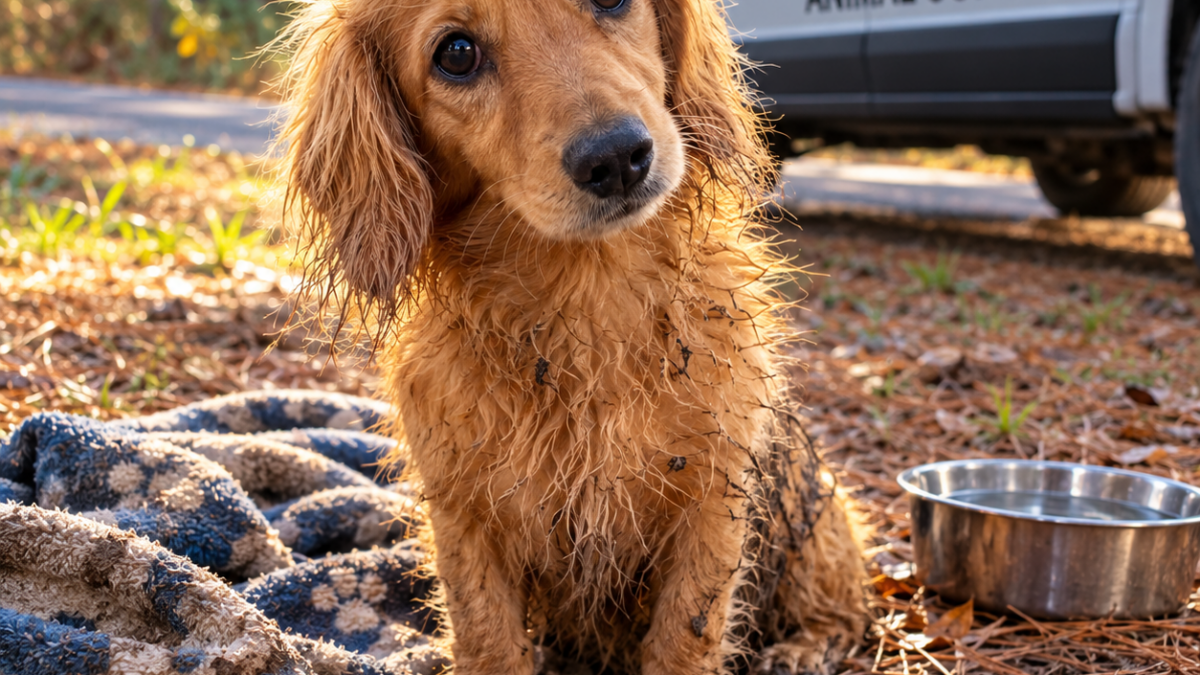
For three straight days, a little golden Dachshund sat beside the same lonely East Texas road, staring west every time an engine appeared because he still believed the people who had driven away would realize their mistake, turn around, and come back for him.
When I finally approached him, he was thirsty, exhausted, and covered in red roadside dust, yet he refused the food in my hand and kept looking past me toward the curve in the highway, as though accepting help from a stranger would somehow mean admitting that his family was really gone.
But before that week was over, I would learn that this tiny dog had not simply been forgotten beside a country road—and the truth about the vehicle that left him there would turn a quiet rescue into one of the most emotional cases I had ever handled.
My name is Sloan Mercer, and I work animal control in a small East Texas county where pine trees stretch for miles and country roads disappear so far into the woods that sometimes it feels like they lead nowhere at all.
The call came just after seven on a cool October morning.
A farmer named Earl Bennett said he had been hearing barking near the edge of his pasture for three days.
“Could be a stray,” I told him.
“I know what strays sound like,” Earl replied. “This ain’t wandering. This one’s waiting.”
That word stayed with me.
Waiting.
I drove out in my county truck.
The road was narrow, bordered by thick pines on one side and cattle fencing on the other. Morning fog still hung low over the grass.
Then I saw him.
A tiny golden Dachshund.
Short legs.
Long body.
Huge dark eyes.
He sat exactly where the asphalt ended and the weeds began.
Not walking.
Not sniffing.
Not searching for food.
Just sitting.
Facing west.
I parked about thirty yards away.
The little dog looked at my truck.
His ears lifted.
For one second, his whole body changed.
He stood.
His tail moved.
Then he saw me step out.
The tail stopped.
He looked behind me.
Toward the road.
Waiting for someone else.
I crouched.
“Hey, buddy.”
He didn’t run.
He didn’t approach.
I held out a piece of chicken.
Nothing.
“You’re hungry.”
He looked at the food, then back toward the bend.
That was when I understood Earl.
This dog wasn’t lost.
He knew exactly where he had been left.
And he believed the car that had driven away was coming back.
There was an old blue collar around his neck, but no tag.
His ribs showed slightly beneath his coat.
When I placed a bowl of water near him and backed away, he drank so quickly I had to refill it twice.
Still, he wouldn’t follow me.
For nearly forty minutes, I sat on the shoulder of that road.
Cars passed.
Every time one approached from the west, the Dachshund stood.
Every time it continued past us, he sat again.
Finally, I moved closer.
“I’m not the person you’re waiting for.”
His eyes stayed on the road.
“I know.”
I slid my hand beneath his chest.
He stiffened.
Then, very slowly, he let me lift him.
The strange thing was how little he weighed.
I carried him toward my truck.
Halfway there, he twisted in my arms and looked backward.
Not at the field.
Not at the trees.
At that exact patch of roadside.
I put him on the passenger seat.
Before closing the door, I whispered:
“If they come back, we’ll find out.”
At the time, I said it only to make myself feel better.
I had no idea that less than twenty-four hours later, Earl Bennett would call me again.
And this time, he wouldn’t be talking about barking.
He would be talking about a camera.
PART 2
Earl called at 6:14 the next morning.
I remember because I was standing in the shelter intake room with the little Dachshund on the examination table when my phone vibrated in my pocket.
The veterinarian, Dr. Rebecca Hall, was listening to his heart.
“Hold still, little man,” she said.
He was trying.
He had spent the night at the county shelter, but nobody had put him in the main kennel wing.
I wouldn’t allow it.
The shelter was already loud, and after three days alone beside a highway, the last thing he needed was forty dogs barking around him.
So we placed him in the small quarantine office beside the clinic.
I gave him two blankets.
A bowl of water.
Food.
He ate only after I turned off the lights and left.
That morning, he’d finally accepted a few pieces of chicken from my hand.
Progress.
My phone buzzed again.
Earl.
I answered.
“Morning.”
“Sloan, you remember that camera I got on my equipment shed?”
I looked toward the dog.
“Yeah.”
“It points toward the road.”
My posture changed.
“What did you find?”
“I think you ought to come see it.”
“Can you send me the video?”
“I can, but there’s more than one recording.”
“What do you mean?”
Earl was quiet for a second.
“I don’t think that dog got there by accident.”
I looked at Dr. Hall.
She could tell something was happening.
“I’ll be there in twenty.”
Dr. Hall nodded toward the Dachshund.
“Take him?”
I thought about it.
“No.”
He had spent enough time on that road.
“Keep him here.”
I touched the little dog’s head.
He flinched slightly, then allowed it.
“I’ll come back.”
His eyes followed me as I left.
Those words felt heavier than they should have.
I’ll come back.
Maybe because somebody else had once promised him the same thing.
Earl’s farm was less than fifteen miles from the shelter.
He was waiting beside a red metal barn when I arrived.
Sixty-two years old.
Work boots.
Faded denim shirt.
Coffee in one hand.
Concern on his face.
“Come inside.”
We entered a small office attached to the barn.
A computer monitor sat beside a stack of feed invoices.
Earl pulled up security footage.
“Camera’s mostly for equipment theft.”
“What direction?”
“Front gate and road.”
The timestamp showed Sunday afternoon.
Three days before Earl called us.
2:37 p.m.
The road was empty.
Then a dark SUV appeared.
It slowed.
Stopped.
My stomach tightened.
The driver’s door opened.
A man stepped out.
Baseball cap.
Dark shirt.
Jeans.
He walked around the vehicle.
Opened the rear passenger door.
Then reached inside.
When he stepped backward, the little golden Dachshund was in his arms.
I felt something cold move through my chest.
The man placed the dog beside the road.
The Dachshund wagged his tail.
He looked up at him.
The man walked back toward the SUV.
The dog followed.
The man turned.
Pointed toward the grass.
I couldn’t hear anything.
No audio.
But the message was obvious.
Stay.
The Dachshund stopped.
The man entered the SUV.
The dog moved toward it again.
The SUV drove forward.
The little dog ran after it.
His legs were so short.
He had no chance.
He followed for maybe thirty yards before stopping.
Then he stood in the middle of the road.
Watching.
I didn’t realize I had clenched my hands until Earl spoke.
“There’s more.”
He changed clips.
Thirty minutes later.
The dog was still there.
An hour.
Still there.
Sunset.
Still there.
The next morning.
Same spot.
Facing west.
I swallowed.
“Do we have the plate?”
Earl froze the original video.
The SUV was angled poorly.
Most of the plate was blurred by distance.
But not all of it.
Texas plate.
Last three characters appeared to be 7KQ.
Maybe 7KO.
I leaned closer.
“Can you export the original?”
“Already did.”
Then Earl opened another clip.
“What is this?”
“Two days later.”
The SUV appeared again.
I stared.
Same color.
Same shape.
It passed the location.
Didn’t stop.
The Dachshund stood instantly.
His tail started moving.
He stepped toward the road.
The SUV continued.
The dog tried to follow.
Again.
I felt sick.
“They came back?”
Earl shook his head.
“They drove past.”
The vehicle disappeared.
The dog remained in the road until another truck approached and forced him back onto the shoulder.
“Why would they come back just to drive past?”
Earl looked at me.
“I’ve been asking myself that all night.”
We exported everything.
I called my supervisor.
Then the sheriff’s office.
Abandoning an animal on a public road can fall under state and local animal cruelty statutes depending on circumstances, but I wasn’t thinking about charges yet.
I wanted a name.
I wanted to know who that dog had spent three days waiting for.
Back at the shelter, the little Dachshund was asleep.
Dr. Hall met me outside the exam room.
“How is he?”
“Physically? Better than I expected.”
“Meaning?”
“Dehydrated. Underweight. Fleas. Mild skin infection. His paws are irritated from the road.”
“Anything else?”
She hesitated.
“He has a microchip.”
I stared at her.
“You’re kidding.”
“I wish.”
“Registered?”
“Yes.”
“Name?”
“Owner is listed as Marcus and Jenna Whitmore.”
My heartbeat quickened.
“Address?”
She showed me.
Thirty-one miles west of where we found him.
Exactly the direction the dog had been staring.
“And the dog?”
“Chip says his name is Cooper.”
I looked through the window.
Cooper.
The name fit him immediately.
“Phone?”
“Two numbers.”
“Did you call?”
“Not yet. I waited for you.”
I nodded.
“Let’s do it.”
We called the first number.
Disconnected.
Second number.
It rang.
Once.
Twice.
Three times.
A woman answered.
“Hello?”
“This is Sloan Mercer with county animal services. Am I speaking with Jenna Whitmore?”
Pause.
“Yes.”
“Do you own a golden Dachshund named Cooper?”
Silence.
Long enough that Dr. Hall looked at me.
“Ma’am?”
Then:
“Cooper ran away.”
I looked toward the glass.
“When?”
“Sunday.”
“From where?”
“Our house.”
“Your current address?”
She gave the microchip address.
I wrote it down.
“What time did he get out?”
“I don’t know. Afternoon.”
“How did he get out?”
“Gate.”
“Which gate?”
Another pause.
“Back gate.”
“Have you filed a missing animal report?”
“No.”
“Posted online?”
“No.”
“Called shelters?”
“We’ve been busy.”
I let the silence sit.
“Mrs. Whitmore, Cooper has been located.”
Her voice changed.
“Where?”
“On County Road 214.”
Another pause.
“Oh.”
Not relief.
Not surprise.
Just oh.
“That’s thirty miles from your residence.”
“Maybe someone picked him up.”
“Possible.”
“Is he okay?”
“He’s safe.”
Dr. Hall looked at me.
I continued.
“We’ll need to speak with you and your husband.”
“My husband is working.”
“When will he be home?”
“Late.”
“We can come tomorrow.”
She hesitated.
Then:
“Do we have to?”
That question told me more than anything else she’d said.
“Yes, ma’am.”
We scheduled ten the next morning.
After I hung up, Dr. Hall folded her arms.
“Ran away.”
“Apparently.”
“Thirty miles.”
“Apparently.”
“Then somebody picked him up and dropped him in exactly the direction of their house.”
I looked toward Cooper.
“Apparently.”
She sighed.
“You’re going to enjoy this too much.”
“No.”
I shook my head.
“I’d enjoy it if the video showed something else.”
That was true.
People sometimes assume animal-control officers enjoy catching bad owners.
We don’t.
The best outcome is finding out you’ve misunderstood.
A gate really was open.
Someone really did make a mistake.
The animal really was loved.
Because when the worst interpretation is true, an animal already paid the price.
That evening, I sat in Cooper’s office.
He had finally started eating.
I tossed pieces of chicken one at a time.
He took them.
After ten minutes, he approached me.
Slowly.
Sniffed my knee.
Then backed away.
“Cooper.”
His ears moved.
Again.
“Cooper.”
He looked directly at me.
There was our confirmation.
He knew the name.
I smiled.
“Hey, Coop.”
His tail moved once.
Not much.
But enough.
Then footsteps sounded in the hallway.
Cooper’s head snapped toward the door.
He stood.
Every muscle alert.
A male employee walked past.
Cooper rushed toward the doorway.
Then stopped when the man disappeared.
The tail lowered.
He returned to his blanket.
That broke my heart more than the roadside video.
Because Cooper wasn’t waiting for a location.
He was waiting for a person.
The next morning, Deputy Aaron Briggs joined me for the visit.
Not because we expected trouble.
Because we were investigating possible abandonment and wanted everything properly documented.
The Whitmore property was a brick house in a newer subdivision outside town.
Two-car garage.
Boat beside the driveway.
Children’s bicycles near the porch.
This wasn’t a picture of obvious hardship.
That didn’t prove anything.
Hardship hides.
But the contrast registered.
Jenna answered the door.
Mid-thirties.
Hair pulled back.
Tired eyes.
Behind her stood a man I immediately recognized.
Baseball cap.
Dark shirt.
Marcus Whitmore.
The man from Earl’s camera.
I said nothing about the video.
Not yet.
“Mr. Whitmore?”
“Yeah.”
“I’m Sloan Mercer.”
He glanced at the deputy.
“What’s this about?”
“Cooper.”
His face stayed neutral.
“She told me.”
“Could we speak inside?”
Marcus stepped onto the porch instead.
“Here is fine.”
Fair enough.
I opened my notebook.
“When did you last see Cooper?”
“Sunday afternoon.”
“Where?”
“Backyard.”
“Your wife says he escaped through the gate.”
“That’s probably what happened.”
Probably.
“Was the gate open?”
“I guess.”
“Who noticed him missing?”
Marcus looked toward Jenna.
She answered.
“I did.”
“When?”
“That night.”
“What did you do?”
“Drove around.”
“Where?”
“Neighborhood.”
“Did you search County Road 214?”
Marcus looked at me.
“Why would we?”
“That’s where he was found.”
“Like I said, someone could’ve picked him up.”
Deputy Briggs said nothing.
He was excellent at silence.
I continued.
“Mr. Whitmore, what vehicle do you drive?”
Marcus’s expression changed by less than an inch.
But it changed.
“Why?”
“Routine question.”
“Black Tahoe.”
“What year?”
He told me.
“What is the license plate?”
“I don’t know off the top of my head.”
Jenna looked at him.
He looked back.
There it was.
A whole conversation without words.
“Is the vehicle here?”
“No.”
“Where?”
“Work.”
I nodded.
“Where do you work?”
Marcus’s tone sharpened.
“Why does that matter?”
“It matters because we’re trying to establish how Cooper got thirty miles from home.”
“I already told you. Someone must have taken him.”
I closed the notebook.
Then I took out my tablet.
“Mr. Whitmore, before I show you something, I’m going to give you another opportunity to tell me what happened Sunday.”
He stared at me.
“Nothing happened.”
I turned the screen toward them.
Pressed play.
The SUV appeared.
Stopped.
Marcus stepped out.
Jenna’s face went white.
Marcus didn’t move.
On-screen, he took Cooper from the back seat.
Set him beside the road.
Returned to the vehicle.
Cooper ran after him.
When the clip ended, nobody spoke.
I switched to the second video.
Two days later.
The Tahoe passed.
Cooper stood.
Tried to follow.
Marcus looked away before the video ended.
Jenna whispered:
“You went back?”
He turned toward her.
“Not now.”
Her face changed.
“You told me you didn’t.”
“Jenna.”
“You said you never went back.”
Deputy Briggs stepped slightly forward.
I raised one hand gently.
“Mrs. Whitmore, did you know Cooper was left there?”
She covered her mouth.
For several seconds, she couldn’t answer.
Then:
“I knew Marcus took him somewhere.”
I nodded.
“Did you agree?”
Tears filled her eyes.
“We were fighting.”
“About Cooper?”
“About everything.”
Marcus interrupted.
“This is getting ridiculous.”
I looked at him.
“Then explain.”
He crossed his arms.
“That dog kept getting into stuff. Barking. Scratching the door. My son got tired of him.”
“How old is Cooper?”
“Six.”
“How long have you owned him?”
“Five years.”
“Where did you get him?”
“My wife’s mother.”
Jenna whispered:
“My mom died.”
Marcus looked annoyed.
She continued anyway.
“Cooper was hers.”
That changed the room.
“When did she die?”
“Two years ago.”
“And you took Cooper?”
She nodded.
“My mom adored him.”
I looked at Marcus.
“So Cooper came with a history.”
“He came with problems.”
“What problems?”
“He peed in the house sometimes.”
“Veterinary evaluation?”
“No.”
“Training?”
“No.”
“Behavior consult?”
“No.”
Marcus laughed once.
“It’s a dog.”
“Exactly.”
His jaw tightened.
“Look, I dropped him where I knew farms were around. I figured somebody would take him.”
“You left him beside a highway.”
“Country road.”
“Vehicles use it.”
“He wasn’t in traffic.”
“The video shows him entering the roadway after your vehicle.”
Marcus looked away.
I continued.
“And two days later, you drove past him.”
He didn’t answer.
“Why?”
Nothing.
“Mr. Whitmore.”
Finally:
“I wanted to see if he was still there.”
Jenna began crying.
“Marcus.”
“What?”
“You saw him?”
“Yeah.”
“And left him again?”
He turned on her.
“You agreed we couldn’t keep him.”
“I agreed we needed to find him another home!”
“I didn’t have time.”
That sentence settled everything.
Not misunderstanding.
Not an open gate.
Not an accidental loss.
Time.
He didn’t have time.
I had heard versions of that sentence hundreds of times.
I didn’t have time to call a rescue.
I didn’t have time to post.
I didn’t have time to ask the shelter.
I didn’t have time to schedule surrender.
So the animal absorbs the cost of human impatience.
Deputy Briggs asked Marcus several formal questions.
I documented the statements.
Then Jenna looked at me.
“Can I see him?”
I hesitated.
“That won’t be my decision today.”
“He’s my mother’s dog.”
Marcus snapped:
“You said we were done.”
Jenna turned toward him.
“I didn’t know you left him on a road.”
“You knew I took him.”
“I thought you brought him to somebody.”
“You didn’t ask.”
“I trusted you.”
Their argument was no longer ours.
Deputy Briggs ended the interview.
We returned to the truck.
He exhaled.
“Well.”
I stared through the windshield.
“Yeah.”
“Charges?”
“County attorney decides.”
“What about the dog?”
“Protective custody pending disposition.”
He nodded.
“Think the wife tries to get him back?”
“Yes.”
“Think she should?”
I looked at him.
“That’s the hard part.”
Marcus had abandoned Cooper.
Jenna had failed to ask enough questions.
But she also appeared genuinely devastated.
People want these cases simple.
Good owner.
Bad owner.
Rescuer.
Victim.
Life is usually messier.
But Cooper’s welfare couldn’t depend on which adult felt worst afterward.
Back at the shelter, he heard my truck before I entered.
When I opened the quarantine-room door, Cooper stood.
For the first time, he came toward me without waiting.
Only two steps.
Still.
Two steps.
I crouched.
“Hey, Coop.”
He sniffed my hand.
I didn’t touch him.
He made the decision.
Another step.
Then his nose pressed against my wrist.
It lasted maybe three seconds.
I sat there for twenty minutes afterward thinking about Jenna.
Her mother’s dog.
A family connection.
A man who made a terrible choice.
A woman who looked away long enough for that choice to happen.
And Cooper.
The only one who hadn’t chosen anything.
The case moved faster than I expected.
Marcus was cited under applicable animal-abandonment provisions while the county attorney reviewed whether additional charges were appropriate.
I won’t pretend the legal process was dramatic.
Most animal cases aren’t.
Paperwork.
Statements.
Hearings.
Evidence.
But then something happened that turned Cooper’s case into a public story.
Earl posted a photograph.
Not the video.
A photograph.
He had taken it before calling us.
Cooper sitting beside the road.
Facing west.
The caption said:
**This little dog sat here for three days waiting for the car that left him. Animal control finally got him safe.**
Earl didn’t include names.
Didn’t accuse anyone publicly.
But the photograph spread.
First locally.
Then across Texas rescue pages.
Then farther.
People asked about Cooper.
Where was he?
Could they adopt him?
Was he okay?
Someone called him “the dog who kept waiting.”
I hated that.
Not because it was inaccurate.
Because I didn’t want Cooper reduced to his worst three days.
Still, attention brought useful things.
Donations for his veterinary care.
Offers from Dachshund rescues.
Foster applications.
And then one email that changed the case.
It came from a woman named Teresa Morgan.
Subject:
**I KNOW COOPER.**
She lived in Tyler.
Her email said:
**I think this dog belonged to my sister, Linda. Linda died two years ago. Cooper went to my niece Jenna. If this is him, please call me.**
I called.
Teresa answered immediately.
“You found him?”
“Possibly.”
“Golden Dachshund? White patch under the chin?”
I looked through the window.
Yes.
“Small scar on left ear?”
Yes.
“Afraid of thunderstorms?”
We hadn’t had one yet.
“I don’t know.”
She started crying.
“It’s him.”
Teresa sent photographs.
Cooper as a puppy.
Cooper on an elderly woman’s lap.
Cooper in a Christmas sweater.
Cooper sleeping beneath a quilt.
His coat healthier.
Body heavier.
Eyes bright.
The woman holding him was Linda.
Jenna’s mother.
“She loved that dog more than most people,” Teresa told me.
“What happened after Linda died?”
“Jenna took him.”
“Willingly?”
“At first.”
“What do you mean?”
“Marcus never wanted him.”
That aligned.
Teresa continued.
“Linda made Jenna promise she’d keep Cooper.”
“Was that in writing?”
“No. Just family.”
“Did you know they were struggling with him?”
“No.”
“Did you know Marcus intended to get rid of him?”
“Absolutely not.”
Then Teresa said something important.
“I would’ve taken him.”
I stopped writing.
“What?”
“If they couldn’t keep him, I would’ve taken him.”
“Did they ask?”
“No.”
“Would Jenna have known that?”
“Of course.”
I closed my eyes.
Another available door Marcus never tried.
“Why do you think they didn’t contact you?”
Teresa was quiet.
Then:
“Pride.”
That word appears in animal cases more often than you might think.
People fear judgment.
So instead of asking for help, they hide the problem.
Sometimes the animal pays.
Teresa wanted custody.
Jenna wanted Cooper back.
Three rescue organizations offered foster care.
And I had started quietly wanting something I should not have wanted.
I wanted Cooper to stay with me.
I didn’t admit that.
Not even to myself.
Not yet.
My job required professional distance.
I had fostered emergency animals before.
Short-term.
Medications.
Transport.
Then goodbye.
But Cooper was different.
Every evening, after my shift ended, I sat in his room.
By week two, he followed me to the door.
By week three, he allowed me to clip on a leash.
Our first walk lasted four minutes.
The shelter parking lot frightened him.
Any dark SUV made him freeze.
So we returned inside.
Next day, six minutes.
Then ten.
Eventually we walked behind the building.
Cooper sniffed grass.
Really sniffed.
Not scanning.
Not waiting.
Just being a dog.
That mattered.
One afternoon, a black Tahoe drove into the shelter lot.
Cooper froze.
The leash went tight.
His ears lifted.
Tail moved.
My heart broke.
The vehicle parked.
A stranger stepped out.
Cooper stared.
The tail stopped.
Then he looked up at me.
That was new.
He looked at me.
Not the road.
Me.
I knelt.
“Wrong car, buddy.”
Cooper stepped closer.
For the first time, he leaned against my leg.
I looked away because one of my coworkers was nearby and I did not intend to cry at work.
She saw anyway.
“You’re keeping him.”
“No.”
“Sloan.”
“I’m county staff.”
“You’re also a human.”
“Debatable.”
She laughed.
“You’re keeping him.”
I didn’t answer.
The custody hearing was scheduled for November.
Jenna petitioned for return.
Her attorney argued that Marcus acted independently and without her full knowledge.
That Cooper was originally her mother’s dog.
That she had a longstanding emotional connection.
That she wanted to correct what happened.
There was truth in all of that.
Our county attorney presented the footage.
The abandonment.
The second drive past.
Marcus’s statement.
Jenna’s acknowledgment that she knew Cooper had been removed from the home but did not verify where he went.
Then Teresa testified.
“I told Jenna after Linda died: if Cooper ever becomes too much, call me.”
Jenna looked down.
“Did she ever call?” the attorney asked.
“No.”
“Would you have taken him?”
“That day.”
Jenna cried.
I felt sorry for her.
I did.
But sympathy and suitability are different questions.
The judge ultimately denied immediate return while the animal-welfare disposition was finalized.
Marcus agreed to relinquish any claim to Cooper as part of resolving the case.
Jenna initially refused.
Then came the moment I did not expect.
She asked to see Cooper.
Privately.
No Marcus.
No cameras.
No social media.
The court allowed a supervised meeting at the shelter.
I hated the idea.
Not because I wanted to punish Jenna.
Because I had no idea what it would do to Cooper.
Dr. Hall said:
“We watch him. If he’s distressed, it ends.”
Jenna arrived carrying something wrapped in a towel.
She looked smaller than I remembered.
Exhausted.
She sat in the visitation room.
I brought Cooper in.
He stopped at the doorway.
Jenna covered her mouth.
“Coopie.”
The reaction was immediate.
Cooper’s ears lifted.
His entire body came alive.
He pulled toward her.
Not violently.
Excited.
Recognizing.
Jenna dropped to her knees.
Cooper ran into her arms.
She sobbed.
Real sobbing.
He licked her face.
Tail moving faster than I had ever seen it.
I stood near the door feeling something painful and complicated.
Cooper loved her.
Of course he did.
Animals do not read court documents.
They don’t understand negligence in legal language.
They remember scent.
Voice.
Routine.
Hands that once fed them.
Beds.
Mornings.
People can fail an animal who still loves them.
Jenna held Cooper.
“I’m sorry.”
He wagged.
“I’m so sorry.”
Then she unwrapped the towel.
Inside was a small blue blanket.
Cooper smelled it.
His body softened immediately.
“That was Mom’s,” Jenna whispered.
“He used to sleep on it.”
Cooper lay down on the blanket.
I had to look away.
After fifteen minutes, something happened.
Jenna reached for the leash.
Not aggressively.
Probably habit.
Cooper stood.
Then he looked at me.
I hadn’t called him.
He simply looked.
Jenna noticed.
Her face changed.
She understood before I did.
“Does he do that with you?”
“What?”
“Look at you.”
“Sometimes.”
She smiled through tears.
“My mom used to say he’d always pick the person who made him feel safest.”
That sentence hit hard.
Jenna stroked his head.
Then she surprised all of us.
“I can’t take him back.”
Dr. Hall, who was observing from the doorway, stepped closer.
“Jenna?”
She wiped her face.
“I want to.”
She looked at Cooper.
“But that’s not the same thing.”
Nobody spoke.
“I wanted the judge to give him back because I thought that would make everything before this less terrible.”
Her voice shook.
“But if I take him home, Marcus is still there.”
That mattered.
She continued.
“And even if Marcus leaves, Cooper would still be going back to the house where he disappeared from.”
She looked at me.
“Is he doing well here?”
“He’s improving.”
“Does he trust you?”
I didn’t know how to answer without sounding self-serving.
Dr. Hall did it for me.
“Yes.”
Jenna nodded slowly.
Then held Cooper’s face.
“My mom would hate me for what happened.”
I wanted to say no.
But I didn’t know Linda.
Jenna continued.
“She’d also tell me not to make the next selfish decision because I’m ashamed of the last one.”
That was one of the bravest things I had ever heard in an animal case.
She signed a voluntary relinquishment that afternoon.
But with one condition.
Not legal.
Personal.
“If Sloan doesn’t adopt him, call my aunt Teresa first.”
I froze.
Jenna looked at me.
“You want him.”
I opened my mouth.
She almost laughed.
“Everyone can see it.”
Dr. Hall nodded.
“Unfortunately.”
I looked at Cooper.
He was asleep on Linda’s blue blanket.
“I hadn’t decided.”
“Then decide.”
I went home that evening without him.
For the first time in weeks.
I needed distance.
My house was small.
One-story rental.
Fenced yard.
I worked long shifts.
But county policy allowed employee adoption after cases were fully closed, provided another officer processed the placement.
I sat at my kitchen table.
There was no dog bed.
No bowl.
No leash.
Just silence.
I thought about Cooper on the road.
Waiting.
Cooper in the shelter.
Learning my footsteps.
Cooper seeing that black Tahoe.
Looking at me.
The next morning, I went to work early.
My coworker Leah was at the front desk.
She saw me carrying a new dog bed.
“Finally.”
“Don’t.”
“You bought the bed before signing.”
“Apparently.”
“Amateur.”
By noon, the paperwork was ready.
I signed.
Sloan Mercer.
Adopter.
Cooper Mercer sounded ridiculous.
I didn’t care.
When I opened his quarantine-room door, Cooper stood.
I clipped on his leash.
“We’re leaving.”
He looked at me.
“Not for a walk.”
His tail moved.
I carried Linda’s blue blanket.
Jenna had left it.
At the lobby door, Cooper stopped.
Exactly like he had stopped at the roadside.
He looked back.
At the hallway.
Then outside.
I waited.
Choice.
He stepped through.
My truck was parked by the curb.
Cooper hesitated when I opened the passenger door.
Then climbed in.
No lifting.
No coaxing.
He turned around twice on the blanket.
Sat.
Looked through the windshield.
I started the engine.
He remained alert for the first ten minutes.
Every passing dark SUV caught his attention.
Then we turned off the highway.
Onto the road leading to my house.
Cooper looked at me.
I reached over.
Touched his chest.
“You’re not waiting this time.”
He didn’t understand the words.
But he lay down.
By the time we reached home, he was asleep.
The first month wasn’t easy.
This is the part rescue stories often skip.
They show the dog leaving the shelter.
Happy music.
New bed.
Happy ending.
Home is where the actual work begins.
Cooper refused to eat if I stood nearby.
Thunderstorms sent him beneath the kitchen table.
Car doors outside made him rush toward the window.
If I walked to the truck without him, he panicked.
The first time I left for work after adoption, Leah stayed with him.
She texted me thirty minutes later.
**He’s sitting at the front door.**
An hour.
Still there.
Three hours.
Still there.
When I returned, Cooper heard my truck.
He began barking.
The moment I opened the door, he launched himself at me.
Not aggressive.
Desperate.
I sat on the floor.
“It’s okay.”
He climbed onto my lap despite being much too long to fit comfortably.
“I’m back.”
His body trembled.
That became our work.
Leaving.
Returning.
Again.
Again.
Again.
Five minutes.
Ten.
Thirty.
An hour.
Every return taught him something.
Cars could leave.
People could still come back.
By January, he no longer sat directly at the door.
By March, Leah sent me a picture during one of my shifts.
Cooper asleep on the couch.
I stared at it for too long.
“He slept?”
Her reply:
**Yes, psycho. Dogs do that.**
Not when they’ve spent three days beside a road waiting for a vehicle.
Not at first.
Spring arrived.
Cooper discovered lizards.
His hunting technique was terrible.
Short legs.
No stealth.
Massive enthusiasm.
He barked at one for twenty minutes.
I finally carried him inside.
“You work for animal control and can’t control one Dachshund,” Leah said.
“He’s not under county jurisdiction.”
“Convenient.”
Cooper gained weight.
His coat improved.
Paw irritation disappeared.
Dr. Hall declared him healthy.
His personality emerged.
Stubborn.
Food obsessed.
Suspicious of vacuum cleaners.
Loved women over sixty.
Hated rain.
Refused to walk through puddles.
Would chase a squirrel with the confidence of a much taller dog.
He slept under blankets even in July.
And every night, he carried Linda’s blue blanket from the living room to my bedroom.
That blanket became sacred.
I washed it carefully.
Repaired one corner.
Never replaced it.
Jenna occasionally asked for updates through Teresa.
Not directly.
That boundary was deliberate.
I sent photographs.
Cooper in the yard.
Cooper asleep.
Cooper wearing a ridiculous bandana at the clinic.
At first I resented sending them.
Then I stopped.
Jenna had failed Cooper.
But she had also made the decision that gave him stability.
People are allowed to become more than their worst decision.
Marcus was different.
He took responsibility only after the evidence left him little room.
His case ended with fines, court costs, mandatory educational requirements, and restrictions connected to animal ownership for a period determined locally.
Nothing cinematic.
No giant punishment.
But consequences.
More importantly, the case was public enough that he could no longer pretend Cooper simply ran away.
The camera existed.
His own words existed.
He had driven past.
That truth belonged to the record.
For a while, I thought that was the revenge Cooper deserved.
Marcus being exposed.
Marcus paying.
Marcus losing the right to decide what happened to Cooper.
Then one afternoon, I realized revenge was the wrong word.
Cooper didn’t care.
He didn’t know Marcus had paid fines.
He didn’t understand court records.
He didn’t need a man punished.
He needed the road to stop mattering.
That was harder.
Because every few months, work took me near County Road 214.
I avoided bringing Cooper.
Then one Saturday, nearly a year after his rescue, I decided not to avoid it anymore.
Not because I wanted to test him.
Because Earl had invited us to a barbecue.
Cooper loved Earl.
He had met him several times at the shelter.
I took the longer route.
Still, we had to pass the location.
As we approached, my hands tightened on the steering wheel.
Would Cooper recognize it?
Smell it?
I slowed.
The grass had grown.
Road looked ordinary.
No sign.
No marker.
Nothing telling the world a dog once sat there for three days waiting.
Cooper stood on the passenger seat.
Looked out the window.
My chest tightened.
He stared at the shoulder.
Then—
A cow moved behind the fence.
Cooper barked.
Once.
Twice.
He nearly climbed into my lap trying to see it.
I laughed so hard my eyes watered.
“That’s it?”
Cooper barked again.
We drove past.
He never looked backward.
I did.
Only once.
That was when I understood.
The road belonged to me now more than it belonged to him.
I was the one carrying the memory.
Cooper had moved on.
Earl’s barbecue became one of my favorite days.
Cooper stole a piece of brisket.
Earl pretended to be angry.
“He owes me eight dollars.”
“Send the invoice.”
Cooper slept beneath the picnic table.
A farmer approached.
“That the road dog?”
I hated the phrase.
“His name is Cooper.”
The farmer nodded.
“Cooper.”
Better.
The story had gone viral enough that strangers recognized him.
Some people wanted selfies.
I stopped that quickly.
Cooper was not a tourist attraction.
He was a dog.
If he approached, fine.
If not, leave him alone.
Mostly he liked people.
Especially anyone carrying meat.
A year later, our county implemented a roadside abandonment response protocol partly because of Cooper’s case.
Farm-camera footage could be submitted directly.
Microchip checks prioritized.
Public education about legal surrender options increased.
We partnered with rescues for emergency owner-support cases.
That last part mattered most to me.
Because not every person considering surrender is Marcus.
Some are scared.
Evicted.
Hospitalized.
Broke.
Trapped between a landlord and an animal they love.
Punishment doesn’t solve those cases.
Options do.
Temporary foster.
Pet-food banks.
Low-cost medical care.
Behavior support.
Legal surrender.
I started telling people something simple:
“If you can’t keep the animal, call before you leave it somewhere.”
Most people did.
One woman called me crying because she had twenty-four hours to leave her apartment.
Two cats.
No place.
We found temporary foster.
She reunited with them six weeks later.
A veteran called because his dog had developed medical problems he couldn’t afford.
A nonprofit helped.
Dog stayed.
A grandmother going into assisted living surrendered her terrier properly.
He found a home.
None of those animals sat beside a road waiting for a car.
That mattered.
Cooper became the unofficial face of the program without ever appearing in advertisements.
I refused.
No sad roadside photograph on posters.
Instead, we used a simple message:
**There is always a safer way to ask for help.**
Marcus never contacted me.
Then, three years after Cooper’s rescue, I received a letter.
No return address.
Inside:
**Ms. Mercer, I don’t expect forgiveness. I saw a photograph of Cooper recently and he looks good. I have thought about that road almost every day. I told myself someone would take him, but the truth is I wanted the problem gone without having to face what I was doing. Driving past him two days later was worse. I saw him recognize my truck. I kept driving because stopping meant admitting what I had done. I know this doesn’t change anything. I am sorry. — Marcus Whitmore**
I read it twice.
Then put it in a drawer.
I didn’t show Cooper.
He didn’t need it.
I did tell Jenna through Teresa that the letter existed.
Her response was one sentence:
**I’m glad he finally said it.**
No reunion.
No redemption scene.
Some relationships do not need restoration.
Sometimes accountability ends with truth.
Cooper was eight by then.
His muzzle started whitening.
He remained stubborn.
One night, he refused to come inside during light rain because a possum had appeared on the fence.
Five minutes later, rain increased.
Cooper immediately decided wildlife investigation was beneath him and scratched at the door.
“Courageous.”
He shook water all over my floor.
At nine, he developed back pain.
Dachshunds are vulnerable to spinal issues.
The first time he yelped climbing the porch step, I froze.
Dr. Hall examined him.
“Very mild right now.”
We started medication.
Weight management.
Ramps.
No jumping.
Cooper disagreed with the no-jumping policy.
I purchased three ramps.
He used none.
I covered them in carpet.
Still no.
Then Earl built one.
Ugly.
Heavy.
Wooden.
Cooper used it immediately.
I stared at Earl.
“What did you do?”
“Built it right.”
“I hate you.”
Earl laughed.
At ten, Cooper slowed.
At eleven, he became mostly deaf.
At twelve, his eyes clouded slightly.
But every evening when my truck pulled into the driveway, Cooper appeared at the door.
Not frantic anymore.
Just waiting.
The difference mattered.
Waiting can come from fear.
Or trust.
Cooper knew I was coming home.
One October afternoon, exactly nine years after Earl first called me, we visited his farm.
He had aged too.
More gray.
Walked slower.
Still drank terrible coffee.
Cooper toddled beside us.
We stood near the fence.
County Road 214 stretched beyond it.
Earl looked down.
“You remember finding him?”
“Every detail.”
“Think he does?”
I watched Cooper sniff a clump of grass.
“No.”
“You sure?”
“No.”
Earl nodded.
“Maybe that’s good.”
It was.
Animals don’t need to preserve trauma because humans find the story meaningful.
Cooper didn’t owe that road remembrance.
We did.
If remembering helped us treat the next animal better.
That was enough.
A truck approached from the west.
Dark SUV.
Old instinct made me glance at Cooper.
He heard almost nothing now.
Didn’t notice.
The SUV passed.
Cooper continued sniffing grass.
I smiled.
That might have been the most satisfying moment of the entire story.
The thing that once controlled every movement of his body had become irrelevant.
At thirteen, Cooper’s spine worsened.
He still walked.
Slowly.
Ramps everywhere.
Medication.
Soft beds.
At fourteen, kidney disease joined the list.
Old age is rarely one problem.
It’s a negotiation.
Food.
Medicine.
Comfort.
Movement.
Good days.
Bad days.
I had spent my career helping people understand when animals were suffering.
That did not make it easier with my own.
If anything, knowledge made denial more creative.
He’s eating.
He’s still wagging.
He had a good morning.
He enjoyed chicken.
All true.
Then eventually you stop asking whether there are good moments and start asking whether good moments are still the majority.
That question is harder.
Cooper’s final winter was gentle.
He slept under Linda’s blue blanket.
Jenna had never asked for it back.
Once, through Teresa, she wrote:
**Mom would want him to keep it.**
I believed that.
One January morning, Cooper refused breakfast.
That was serious.
Cooper once tried to eat a dropped lemon slice.
Food refusal was not normal.
Dr. Hall came to my house.
Same veterinarian who examined him the first morning.
She was older.
So was I.
She sat on the floor beside Cooper.
“Hey, road warrior.”
I gave her a look.
“Sorry.”
She smiled.
“Hey, Cooper.”
Better.
She examined him.
Bloodwork later confirmed significant progression.
Kidneys.
Heart.
Pain.
We adjusted medication.
Bought time.
Three weeks.
Good weeks.
He ate chicken.
Slept in sunlight.
Barked at one squirrel he definitely could not hear.
Then one night, he couldn’t stand.
I lifted him.
He looked at me.
No panic.
Just tired.
I knew.
The next morning, Dr. Hall returned.
Earl came too.
Leah.
Teresa drove in from Tyler.
I debated inviting Jenna.
For hours.
Then I called Teresa.
“Does she want to come?”
Teresa was quiet.
“I’ll ask.”
Jenna came.
Alone.
She had not seen Cooper in person since the shelter meeting almost nine years earlier.
I opened the front door.
She stood there crying before she even entered.
Cooper was on his bed.
Linda’s blanket beneath him.
Jenna approached slowly.
“Coopie.”
His ears didn’t work.
But his nose did.
She knelt.
Held out her hand.
Cooper sniffed.
Then his tail moved.
Once.
Jenna broke.
She pressed her forehead against his.
“Hi.”
I looked away.
Not everything needs witnesses.
After several minutes, Jenna whispered:
“Thank you.”
I thought she meant me.
Maybe she did.
Then she looked at Cooper.
“Thank you for forgiving me.”
I wanted to correct her.
We don’t know whether dogs think in those terms.
But it wasn’t my sentence.
Cooper rested his head on her hand.
That was enough.
She stayed only twenty minutes.
Before leaving, she touched Linda’s blue blanket.
“Mom made that.”
“I know.”
“She couldn’t sew.”
I laughed.
“That explains a lot.”
Jenna smiled through tears.
“She would’ve loved what you gave him.”
I shook my head.
“He gave me more.”
“I figured you’d say that.”
At the door, she stopped.
“Marcus knows?”
“That today’s the day?”
She nodded.
“No.”
“Don’t tell him.”
I looked at her.
“Why?”
“Because this isn’t about him.”
She was right.
Cooper’s last day did not belong to the man who abandoned him.
It belonged to the people who stayed.
After Jenna left, Earl sat beside Cooper.
“You cost me a lot of brisket.”
Cooper slept.
Earl touched his back.
“Good dog.”
Leah cried.
Dr. Hall prepared quietly.
I sat on the floor.
Cooper’s head in my lap.
Blue blanket around him.
I thought about that first road.
Dust.
Pines.
His body facing west.
Every engine a possibility.
Every passing car another disappointment.
I touched his ears.
“You waited three days for somebody who didn’t come back.”
My voice broke.
Earl looked away.
“Then you made me spend fourteen years proving people can.”
Cooper breathed slowly.
I smiled through tears.
“You’re stubborn.”
His tail moved.
Maybe reflex.
Maybe not.
Didn’t matter.
“You changed county policy.”
Nothing.
“Impressive for a dog who refuses ramps unless Earl builds them.”
Earl laughed.
Dr. Hall wiped her eyes.
Then I said the only words I needed him to hear.
“I’m here.”
Not:
Don’t go.
Not:
Stay.
He had spent too much of his life waiting because somebody told him to stay.
“I’m here.”
When Cooper’s breathing stopped, my hand remained on his chest.
The house became impossibly quiet.
For years, I had imagined the story ending with Cooper no longer waiting for the people who left him.
I was wrong.
The real ending was simpler.
At the end, Cooper did not have to wait for anyone.
Everyone who mattered was already there.
Weeks later, Earl came to my office.
He carried a wooden box.
“What is that?”
“Open it.”
Inside was a small plaque.
I groaned.
“No memorial at the road.”
“Relax.”
The engraving read:
**COOPER’S FUND**
I looked at him.
“What?”
Earl sat down.
“I’ve been talking to some people.”
That sentence is dangerous when farmers say it.
He had spoken with local businesses.
Veterinary clinics.
Rescues.
Families.
They wanted to create a small emergency fund for pet owners in crisis.
Temporary boarding.
Food.
Transport.
Surrender fees.
Basic veterinary help.
Anything that might prevent another person from deciding the shoulder of a road was the easiest option.
“No giant picture of Cooper?”
“No.”
“No sad slogan?”
“No.”
“No roadside statue?”
Earl looked offended.
“I had one designed.”
“Earl.”
“Kidding.”
I stared at the plaque.
Then smiled.
“Cooper would’ve supported the food budget.”
“Naturally.”
The fund started small.
First case:
A single father being evicted.
Two dogs.
Temporary foster for twelve days.
Reunited.
Second:
An elderly woman hospitalized unexpectedly.
Neighbor couldn’t keep her cat.
Emergency boarding.
Third:
A young couple whose puppy needed treatment they couldn’t fully afford.
Partial assistance.
No road.
No fence.
No waiting.
After the tenth case, I drove County Road 214 alone.
I pulled over near the spot.
Not exactly.
I couldn’t identify it anymore.
Grass changed.
Trees grew.
Roadwork had widened the shoulder.
That surprised me.
For years, I thought I would always know the place.
I didn’t.
I got out.
Stood beside the truck.
Vehicles passed.
I remembered the little dog sitting there.
Facing west.
I remembered thinking he was waiting for one family.
Now I understood something else.
Cooper had been waiting for evidence that the world still contained someone worth trusting.
He didn’t know that.
Neither did I.
But that was what came next.
Earl.
Dr. Hall.
Leah.
Teresa.
Jenna, eventually honest enough to let him go.
Me.
A whole county program built because one small dog sat beside a road long enough for people to ask why.
Marcus once believed dropping Cooper near farms meant somebody would handle the problem.
In one terrible sense, he was right.
Someone did.
But not the way he imagined.
The farmer’s camera remembered what Marcus wanted forgotten.
The microchip kept Cooper’s name.
The county record kept the truth.
The court took away Marcus’s ability to decide Cooper’s future.
And years later, the dog he treated as a problem became the reason other families received help before desperation turned into abandonment.
If you want to call that revenge, fine.
It was the only kind I ever wanted.
Not pain returned for pain.
Not public humiliation.
Consequences.
Truth.
A life so good that the worst thing someone did to him became smaller and smaller beside everything that came afterward.
Cooper lived fourteen years after somebody decided they didn’t have time for him.
Fourteen years of blankets.
Chicken.
Lizards.
Squirrels.
Farm barbecues.
Rain he refused to walk in.
Ramps he judged.
People who returned.
Every single day, people who returned.
That is what I remember now.
Not the abandoned dog beside the East Texas highway.
The old Dachshund asleep beneath Linda’s blue blanket, completely certain that when my truck left in the morning, it would come back at night.
That certainty took years to build.
But we built it.
And if I could go back to the first morning and sit beside him on that road again, I would not tell him the SUV was never coming back.
I wouldn’t tell him what the camera captured.
I wouldn’t tell him there would be courtrooms, paperwork, arguments, or consequences.
I would tell him something much simpler.
“You can stop watching the road now.”
Because eventually that became true.
The family Cooper had been searching for was not inside the vehicle disappearing around the bend.
His family was still ahead of him.
He just hadn’t met us yet.

