PART 2: They Left Him Beside a Fence for 3 Weeks—What Arhat Did 10 Months Later Left Me in Tears
PART 2
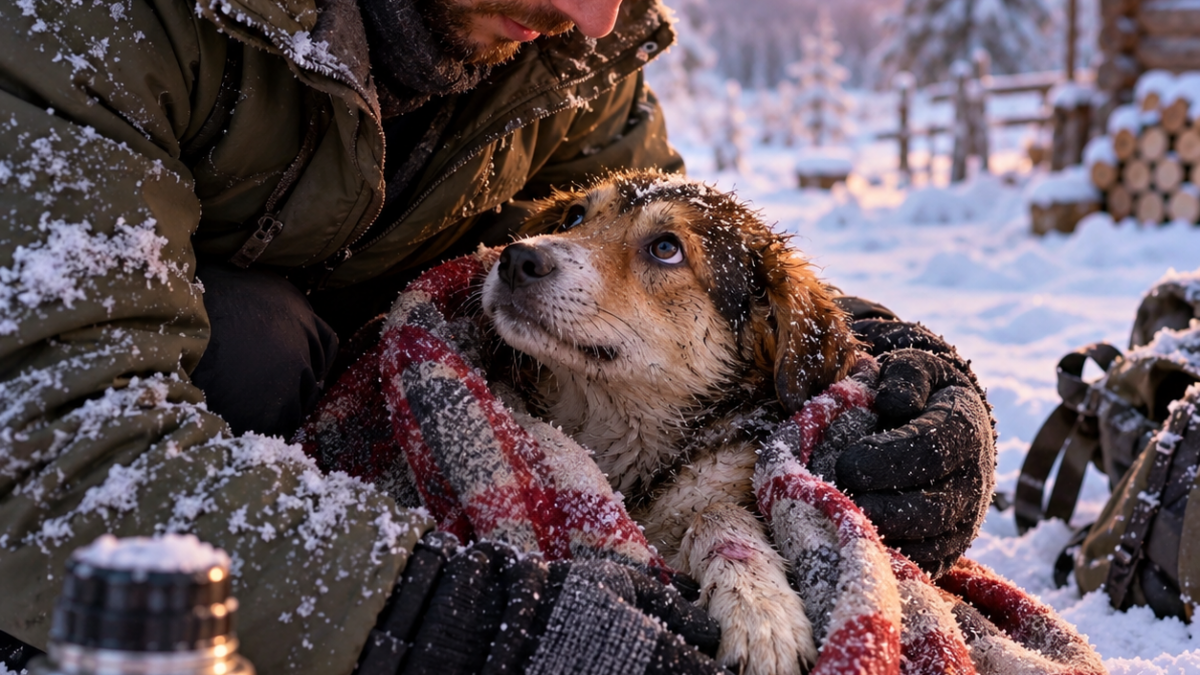
We carried Mishka to the van and placed him on several folded blankets.
I sat in the back beside him while Daniel drove.
The nearest clinic capable of handling serious neurological injuries was nearly an hour away.
I kept one hand near Mishka’s face.
Not on him constantly.
I wanted him to have space.
But every few minutes, I touched his cheek or shoulder lightly so he knew someone was still there.
He never tried to bite.
Never growled.
Never struggled.
That should have made the transport easier.
Instead, it frightened me.
An animal with enough energy to object still has an opinion about what is happening.
Mishka seemed too tired to object.
“Stay with me,” I whispered.
His eyes moved toward my face.
“That’s all you have to do right now.”
His breathing was shallow but steady.
Daniel called ahead so the veterinary team was waiting when we arrived.
The moment the van stopped, two technicians came outside with a larger stretcher.
They took Mishka through the emergency entrance.
Suddenly, I had nothing to do.
That feeling is terrible.
During a rescue, you’re always doing something.
Carrying.
Driving.
Calling.
Wrapping blankets.
Checking breathing.
Then the doors close and professionals take over.
All you can do is wait.
I filled out the intake paperwork.
Name: Mishka.
Age: Unknown.
Estimated: 7–8 years.
Owner: Unknown.
Found: roadside snow depression.
Mobility: unable to use hind limbs.
Then came the question:
“Are you financially responsible for treatment?”
I stared at the box.
Our rescue had very little money.
We survived on donations.
Small donations.
Ten dollars.
Twenty.
Occasionally more.
A neurological case could cost more than we raised in months.
I checked yes anyway.
What else could I do?
Dr. Harris came to speak with me about forty minutes later.
“He was hypothermic, but his temperature is responding.”
“Good.”
“He’s dehydrated.”
“Okay.”
“He has muscle wasting in the rear limbs.”
I stared at him.
“What does that mean?”
“This didn’t happen today.”
“How long?”
“Hard to say. But the weakness has probably existed for a while.”
My stomach tightened.
“So he was already struggling before he ended up in the snow?”
“Likely.”
“What caused it?”
“We need imaging.”
“Do it.”
Dr. Harris paused.
“There are costs—”
“Do it.”
I don’t know whether I sounded brave.
I wasn’t.
I was terrified of the bill.
But I was more terrified of leaving without an answer.
Several hours later, Dr. Harris called me into a dark consultation room.
He placed an image on the screen.
I saw bones.
Vertebrae.
Shapes that meant almost nothing to me.
Then he pointed.
“There.”
A small bright object.
“What is that?”
He looked at me before answering.
“It appears to be a projectile.”
My brain resisted the word.
“A bullet?”
“Something consistent with one.”
I stared at the screen.
Near his spine.
My hands went cold.
“Is that why he can’t move his back legs?”
“It may be a major reason.”
“How long has it been there?”
“Again, difficult to determine.”
“Can you take it out?”
He didn’t answer quickly enough.
“Can you?”
“We need a surgical consultation.”
“That’s not what I asked.”
“I know.”
He pulled up another image.
“It’s located in a difficult area. There may also be secondary inflammation and scar tissue. Removing it could carry significant risk.”
I looked through the small window into the treatment area.
Mishka was under blankets.
His head rested sideways.
His eyes were open.
Still those eyes.
“Then what do we do?”
“First, stabilize him.”
“And after?”
“We evaluate everything.”
“I need more than that.”
Dr. Harris nodded.
“I know.”
He turned off the screen.
“But I don’t want to give you false certainty.”
That became a sentence I heard many times over the next year.
False certainty.
I hated it.
I wanted someone to tell me:
Mishka will walk.
Mishka will recover.
Mishka will be okay.
Instead, everyone said:
Maybe.
We’ll see.
We need time.
Medicine doesn’t care how badly you need a promise.
## THREE DAYS OF WAITING
The first specialist reviewed Mishka’s imaging the next morning.
The second reviewed it that afternoon.
A third requested additional scans.
Every new opinion seemed to create another question.
Could surgery help?
Possibly.
Could it make things worse?
Also possibly.
Was the object causing all the neurological dysfunction?
Probably not all of it.
Had nerve damage already become permanent?
Unknown.
Was there still deep pain sensation?
Some responses suggested there might be.
Was that good?
Yes.
Was it enough?
Nobody knew.
I visited every day.
Mishka remained quiet.
He ate only if someone encouraged him.
He tolerated examinations.
He showed no interest in toys.
When I touched his head, his eyes followed me.
But he didn’t lean into my hand.
He didn’t wag.
He didn’t seek contact.
On the third evening, I sat on the floor beside his kennel.
“You don’t know me,” I told him.
He blinked.
“But apparently I’m the person who keeps coming back.”
Nothing.
“I hope you’re okay with that.”
His nose moved slightly toward my sleeve.
I smiled.
“Good enough.”
The following morning, Dr. Harris asked me into the consultation room again.
I knew before he spoke.
“The surgeons don’t recommend operating.”
I swallowed.
“Why?”
“The risk of causing additional neurological damage is too high relative to the chance of meaningful improvement.”
“So that’s it?”
“No.”
“What do you mean, no?”
“Not operating isn’t the same as doing nothing.”
I felt anger rising.
It wasn’t really directed at him.
But fear often disguises itself as anger.
“He can’t walk.”
“I know.”
“There’s a bullet near his spine.”
“I know.”
“And we’re leaving it there.”
“Because trying to remove it could make his condition worse.”
I looked away.
Dr. Harris waited.
Finally, I asked the question I had been avoiding.
“Will he ever walk?”
He took a slow breath.
“I don’t know.”
“Give me a percentage.”
“I can’t.”
“Ten percent? Fifty?”
“Anything I gave you would be dishonest.”
I hated him in that moment.
Not personally.
I hated his honesty.
“What would you do if he were yours?”
That changed his expression.
He looked through the window toward Mishka.
“I would stop asking only whether he can walk.”
I frowned.
“What else am I supposed to ask?”
“Whether he’s comfortable.”
“Okay.”
“Whether he’s interested in food.”
“Sometimes.”
“Whether he recognizes people.”
“Yes.”
“Whether he wants interaction.”
“Not much.”
“Whether he can experience enjoyment.”
I stared at him.
“And if he can?”
“Then we build from there.”
“And if he can’t?”
He didn’t answer.
He didn’t have to.
I looked back at Mishka.
“Do you think he wants to live?”
Dr. Harris folded his arms.
“I think we should give him a chance to tell us.”
## THE REHABILITATION CENTER
Six days after we found Mishka, he was transferred to a rehabilitation facility run by a woman named Rachel Morgan.
Rachel had the calmest personality of anyone I had ever met.
Nothing seemed to impress her.
Nothing seemed to panic her.
The first time she examined Mishka, she spent almost an hour touching his legs, repositioning his paws, checking reflexes, and observing how he compensated with his front half.
Then she stood.
“Okay.”
“Okay what?”
“We have work.”
“Can he walk again?”
She looked at me.
“Do you ask everyone that?”
“You’re the third person today.”
“I need an answer.”
“No. You need a guarantee.”
“What’s the difference?”
“An answer can change.”
I already disliked her.
Months later, she became one of my closest friends.
But that first morning, I wanted to shake her.
She showed me Mishka’s rehabilitation plan.
Pain management.
Gentle passive range-of-motion exercises.
Supported standing.
Muscle maintenance.
Skin monitoring.
Bladder care.
Hydrotherapy once his condition allowed.
Balance work.
Core strengthening.
Nerve stimulation.
Short sessions.
Frequent rest.
“We don’t exhaust him,” Rachel said.
“But he needs to work.”
“He needs to recover enough to work.”
“What’s the timeline?”
“There isn’t one.”
I sighed.
“Of course.”
She smiled slightly.
“You’re going to be difficult.”
“So is he.”
Mishka stared at us.
Rachel crouched beside him.
“I think we’re going to get along.”
Mishka looked unconvinced.
## DAY THREE
The first days were mostly about teaching Mishka that rehabilitation was not something being done to him.
It was something we were doing with him.
That difference mattered.
Rachel placed a support sling beneath his abdomen.
Two technicians stood nearby.
Mishka’s front paws touched the mat.
Rachel positioned his back paws.
“Ready?”
I stood beside his head.
“Come on, Mishka.”
She lifted just enough to support part of his weight.
His front legs straightened.
His back legs did almost nothing.
Three seconds later, his body sagged.
Rachel lowered him.
“Good.”
I stared.
“That was good?”
“Yes.”
“He barely stood.”
“He stood.”
“With three people holding him.”
“Yesterday, he wouldn’t tolerate this position at all.”
She looked at me.
“Rule one.”
“What?”
“We compare Mishka to yesterday’s Mishka.”
I didn’t understand how important that sentence would become.
The next day, he stood slightly longer.
Then less the day after that.
On the third day of more active work, he pushed so hard with his front legs that his body trembled.
I encouraged him.
“Come on. One more.”
Rachel stopped.
“Done.”
“He can keep going.”
“No.”
“He still has energy.”
She shook her head.
“He has determination. That’s not the same thing.”
Mishka collapsed onto his bed afterward.
His eyes closed almost immediately.
I sat beside him.
“Maybe this is too much.”
Rachel handed me a bottle of water.
“For him or you?”
I looked at her.
“Both.”
“That’s normal.”
I watched Mishka sleep.
“I don’t think he believes this will work.”
Rachel sat beside me.
“Then we believe it for him.”
## THE SADNESS THAT WOULDN’T LEAVE
Physical therapy was difficult.
But Mishka’s emotional state worried me more.
Weeks passed.
He ate enough.
He tolerated handling.
He rested comfortably.
But he seemed disconnected.
He didn’t greet us.
He didn’t show interest in other dogs.
He ignored toys.
He didn’t wag.
When I arrived, his eyes followed me.
That was all.
I began wondering whether Dr. Harris’s question had an answer.
Did Mishka want to live?
One evening, I stayed after everyone else left.
Snow tapped softly against the rehabilitation center windows.
Mishka lay on his bed.
I sat on the floor.
“You know what scares me?”
His ear moved.
“I don’t know whether I’m doing this for you or for me.”
He looked at me.
“I want you to get better because I can’t stand the idea that someone did something terrible and got the final word.”
His eyes stayed on mine.
“But maybe you don’t care about any of that.”
Nothing.
“Maybe you’re tired.”
I touched his paw.
“If you’re tired, I need you to tell me somehow.”
He lifted his head.
Then lowered it onto my hand.
It was the first time he had chosen contact.
I froze.
“Mishka?”
He closed his eyes.
I stayed there nearly an hour.
My arm went numb.
I didn’t move.
## CHICKEN
The first real breakthrough came from boiled chicken.
A volunteer named Sarah brought a container for another recovering dog.
Rachel tore off a small piece.
“Mishka.”
No response.
She held it closer.
His nose twitched.
I leaned forward.
“Did you see that?”
Rachel glared.
“Don’t turn a sniff into a documentary.”
Mishka lifted his head.
The chicken moved.
His eyes followed.
Rachel offered it.
He took it.
We both stared.
She gave him another.
Then another.
“Okay,” I whispered. “You like chicken.”
Rachel handed me a piece.
“Your turn.”
I held it near his mouth.
Mishka sniffed my fingers.
Then ate.
I smiled so hard my face hurt.
When I pulled my hand away, Mishka nudged it.
I started crying.
Rachel looked at the ceiling.
“No.”
“What?”
“You’re teaching him that making you cry produces chicken.”
“That’s fine.”
“It’s emotional manipulation.”
“He’s earned it.”
From that day forward, food became part of rehabilitation.
Not huge quantities.
Just enough motivation.
Mishka began lifting his head when he heard containers open.
Then he started watching the door around the time I usually arrived.
Sarah noticed.
“He knows when you’re coming.”
“No, he knows when chicken is coming.”
“Same thing.”
One afternoon, she asked me to wait outside.
She walked into Mishka’s room.
No reaction.
Then I entered.
His ears lifted.
His tail moved.
Once.
I stopped.
Sarah whispered, “There.”
His tail tapped again.
I dropped to my knees.
“Hey.”
Tap.
“Hi, Mishka.”
Tap.
Three tiny tail movements.
The rehabilitation center might as well have won a championship.
Everyone celebrated.
Rachel pretended not to.
Later, I saw her write on his progress sheet:
**First clear social tail response to familiar person.**
I kept a copy.
## THE BALL
The therapy ball arrived next.
Large.
Blue.
Ridiculous.
Rachel positioned Mishka carefully over it to practice balance, core activation, and controlled weight shifting.
Mishka’s opinion was obvious.
He hated it.
His ears flattened.
His front paws searched for stable ground.
“I know,” Rachel told him. “File a complaint.”
He looked at her with deep suspicion.
I laughed.
She shifted the ball slightly.
Mishka tightened his front legs.
“Good.”
Another shift.
He tried to compensate.
“Good.”
After several minutes, he was exhausted.
Rachel ended the session.
“That’s it?”
I asked.
“Yes.”
“He needs more.”
“No.”
I had become obsessed with progress.
Every toe movement.
Every muscle twitch.
Every possible response.
If I thought I saw his back leg move, I shouted for Rachel.
“That moved.”
“Maybe.”
“It moved.”
“Could be reflexive.”
“Why are you always ruining my happiness?”
“Because your happiness is not a neurological test.”
Mishka watched us argue.
I swear he enjoyed it.
## THE FIRST REAL RESPONSE
Day twenty-eight.
Mishka was in the support sling.
Rachel positioned his paws.
She slowly shifted weight backward.
His left rear leg tightened.
She stopped.
“Again.”
The muscle contracted again.
I grabbed her arm.
“Did you see that?”
“Yes.”
“That was him.”
“Possibly.”
“Rachel.”
She smiled.
“That was something.”
Something.
One word.
It felt enormous.
We repeated the exercise.
No response.
Again.
Nothing.
Then one more contraction.
Mishka looked tired.
Rachel stopped.
“No more.”
“But—”
“No.”
I crouched beside him.
“You did that.”
He licked his lips.
“You know what you did?”
Probably not.
I kissed his forehead anyway.
That evening, I watched the video repeatedly.
A tiny movement most people would never notice.
To me, it was proof the door wasn’t completely closed.
## THE SETBACK
Recovery does not care about your emotional timeline.
Two weeks later, Mishka became sick.
He refused breakfast.
Then dinner.
His temperature rose.
Tests showed a urinary infection, a common complication in dogs with limited mobility.
Rehabilitation paused.
Within two days, he looked weaker.
I panicked.
“We’re losing everything.”
Rachel didn’t.
“He has an infection.”
“He’s not standing.”
“Because he’s sick.”
“His leg isn’t responding.”
“Because he’s tired.”
“What if it doesn’t come back?”
“What if it does?”
I snapped.
“You can say that because he isn’t your dog.”
The silence afterward was awful.
Rachel stared at me.
I regretted it immediately.
“I’m sorry.”
She looked through the glass at Mishka.
“You think I don’t care because I don’t fall apart?”
“No.”
“I’ve watched owners push animals past their limits because they needed a miracle more than the animal needed another exercise.”
“I know.”
“No, you don’t.”
Her voice remained calm.
That made it worse.
“Mishka may never walk normally.”
I looked away.
“You have to hear that.”
“I’ve heard it.”
“Then believe it.”
I swallowed.
“What do you want me to do?”
“Love him anyway.”
That sentence destroyed me.
Because somewhere inside, I had started making walking the price of victory.
I sat beside Mishka later.
He was sleeping.
“I’m sorry.”
His eyes opened.
“I keep asking you to become somebody you used to be.”
He breathed slowly.
“Maybe that’s not fair.”
I touched his head.
“Maybe this version of you is enough.”
The next morning, I ordered a custom mobility cart.
## THE CART
When it arrived, I hated it.
I wish I could pretend I immediately saw freedom.
I didn’t.
I saw surrender.
A metal frame.
Harness straps.
Two wheels.
Evidence that Mishka might never walk independently.
Rachel took one look at my face.
“Don’t.”
“I didn’t say anything.”
“You don’t have to.”
“I thought rehabilitation meant getting him out of this.”
“Out of what?”
“Depending on equipment.”
“Why?”
I didn’t answer.
She crouched beside me.
“Would you take away someone’s glasses because they’re still doing eye exercises?”
“That’s different.”
“Not as different as you think.”
She fitted Mishka into the cart.
He froze.
His expression was offended.
Sarah stood several feet away holding chicken.
“Come on.”
Mishka stretched his neck.
Sarah moved backward.
He pulled with his front legs.
The wheels rolled.
Mishka stopped.
He looked behind himself.
Then forward.
He pulled again.
The cart moved.
Something changed in his face.
He tried again.
Three feet.
Five.
Ten.
Sarah laughed.
“There you go!”
Mishka accelerated.
Rachel opened the therapy-room door.
He rolled into the hallway.
People moved aside.
Mishka kept going.
His front legs worked faster.
The wheels followed.
By the time we reached the courtyard, I was crying and laughing at once.
Snow covered part of the ground.
Mishka stopped.
He lifted his nose.
Cold air.
Trees.
Birds.
Smells.
Then his tail began moving.
Not one small tap.
A full wag.
He rolled forward.
Then faster.
I ran beside him.
“Mishka!”
He didn’t care.
He had somewhere to go.
That was the day I understood the cart was not surrender.
It was independence.
## MISHKA RETURNS
Once Mishka realized he could move, his personality emerged rapidly.
He became impatient if we took too long fitting the harness.
He learned where the treats were stored.
He barked at a squirrel outside the courtyard.
Everyone applauded.
The squirrel left.
He discovered tennis balls.
Rachel rolled one toward him.
Mishka caught it between his front paws.
She reached for it.
He covered it with one paw.
“Give it back.”
Mishka turned his head.
I laughed.
“He’s ignoring you.”
“I can see that.”
Rachel reached again.
Mishka grabbed the ball and rolled backward.
She looked at me.
“You encouraged this.”
“Absolutely.”
He started greeting people.
Sarah received tail wags.
Rachel received demanding barks.
I received everything.
When I entered, Mishka lifted his head and watched me until I reached him.
Eventually he began leaning his body against me.
The hopeless dog from the snow pit was disappearing.
Not because his legs were healed.
Because his world had become interesting again.
## WHO WAS MISHKA BEFORE?
We had posted Mishka’s photograph everywhere.
Local shelters.
Veterinary clinics.
Community groups.
Lost-dog pages.
No owner appeared.
But several people recognized him.
An older farmer called.
“I’ve seen that dog near the old lumber road.”
“How long?”
“Months. Maybe longer.”
“Did he belong to anyone?”
“Not that I know.”
“Was he aggressive?”
The man laughed.
“That dog? No. He’d watch you from a distance. If you left food, he’d wait until you walked away.”
Another woman remembered him from a gas station.
“He slept behind the building sometimes.”
“Did anyone bother him?”
“Kids tried to approach him. He usually moved away.”
“Did he chase anything?”
“Never saw it.”
Another caller said Mishka had followed construction workers for scraps.
Nobody described a dangerous animal.
Nobody described a dog causing trouble.
That made the object near his spine harder to understand.
Why?
Why Mishka?
I filed a report.
Officer Mark Ellis took the information.
He studied the veterinary images.
“Do you know when this happened?”
“No.”
“Where?”
“No.”
“Witnesses?”
“No.”
I felt frustration rising.
“So nothing happens.”
He looked at me.
“I didn’t say that.”
“What can you do?”
“Put it into the system.”
“That’s it?”
“Sometimes a single report is useless.”
“Exactly.”
“Sometimes it matches another.”
I stared at him.
“Has there been another?”
He didn’t answer.
That silence meant something.
## WATER
Hydrotherapy began after Mishka was medically stable enough.
He hated water.
The first time we lowered him into the therapy pool, he panicked.
His front legs paddled wildly.
“Mishka!”
His eyes found me.
“You’re okay.”
Rachel supported his hips.
“Easy.”
The water lifted his body.
His back legs floated.
Then one moved.
I grabbed the railing.
“Rachel.”
“I see it.”
The leg flexed again.
Then the other.
“Is that him?”
“Some is reflex. Some may be intentional.”
“How do you tell?”
“Repetition.”
So we repeated.
Days.
Weeks.
Mishka became calmer in the water.
Then focused.
He learned to move his front legs slowly instead of thrashing.
His right rear leg began cycling more consistently.
The left remained weaker.
Rachel guided it.
“Come on.”
Mishka worked.
Afterward, he slept for hours.
Hydrotherapy became the place where we saw the clearest rear-limb movement.
Not enough to walk.
But enough to know the nervous system was still communicating.
Some days.
Not every day.
Recovery never gave us a straight line.
## THE CALL
Almost three months after I filed the police report, Officer Ellis called.
“How is Mishka?”
“Using a cart.”
“Good.”
“Why are you calling?”
“We’ve received additional complaints from the same region.”
I sat down.
“What complaints?”
“Animals being frightened or injured near private property.”
My stomach tightened.
“Similar to Mishka?”
“Some.”
“You have a suspect.”
“I’m not saying that.”
“You didn’t say no.”
He sighed.
“I need Mishka’s full veterinary file.”
“I already sent it.”
“I need updated records.”
“Why?”
“Because if this becomes a case, we need continuity.”
The word case changed everything.
Until then, what happened to Mishka had been a terrible mystery.
Now the mystery had edges.
A location.
Other reports.
Possibly a person.
For several days, anger took over my thoughts.
I imagined confronting whoever did it.
Asking why.
Demanding an explanation.
Rachel stopped me one afternoon.
“You’ve been angry all week.”
“Wouldn’t you be?”
“Yes.”
“Then what’s the problem?”
“The problem is Mishka doesn’t care about your investigation.”
I stared at her.
“He cares about this chicken.”
She held up a piece.
Mishka stared at it intensely.
Rachel smiled.
“He cares about his ball.”
Mishka looked toward the shelf.
“He cares about whether you arrive.”
His ears moved at my voice.
Rachel handed me the chicken.
“Don’t let whoever hurt him continue controlling the room.”
That stayed with me.
## FIVE SECONDS
Five months after his rescue, Rachel called me early.
“Can you come?”
My heart jumped.
“What’s wrong?”
“Nothing.”
“Then why—”
“Just come.”
I drove too fast.
When I entered the rehabilitation room, Mishka was on a padded mat.
A sling supported him.
Rachel stood beside him.
“What happened?”
“Watch.”
She reduced the support.
Mishka’s front legs stayed firm.
His hind legs trembled.
One knee started to fold.
Then corrected.
Rachel loosened the sling slightly more.
Mishka stood.
All four feet touching the floor.
I stopped breathing.
One second.
Two.
Three.
Four.
Five.
Then he sank into the sling.
I covered my face.
Rachel laughed.
“You can cry now.”
“He stood.”
“Five seconds.”
“He stood.”
I dropped beside him.
Mishka licked my chin.
I hugged his neck.
“You stood.”
He probably cared more about the treat waiting afterward.
I didn’t care.
Five seconds changed nothing and everything.
He still needed the cart.
Still needed rehabilitation.
Still had serious neurological limitations.
But his body had answered.
Not fully.
Not predictably.
But enough.
## THE FIRST STEP
Standing eventually became ten seconds.
Then fifteen.
Then twenty on good days.
We began supported stepping between parallel rails.
Rachel placed his back paws manually.
Front paw forward.
Rear paw placement.
Front paw.
Rear paw.
Again.
Again.
Again.
Then one morning, seven months after his rescue, something happened.
Mishka moved his right rear leg before Rachel could touch it.
The paw lifted.
Moved forward.
Landed.
We froze.
“Did you—”
“Quiet.”
Rachel focused.
Mishka took another front step.
The left rear leg dragged.
Then tried to reposition.
The right moved again.
His own movement.
A step.
I sat down because my legs stopped working better than his.
Rachel laughed.
“Don’t distract him.”
“I’m not.”
“You’re making noise.”
“I’m crying.”
“Loudly.”
Mishka managed four supported steps.
Four.
Then he was exhausted.
Rachel ended the session.
I argued.
She ignored me.
That night, I wrote the number FOUR on a piece of paper and taped it to my refrigerator.
It stayed there for years.
## THE MAN ON THE LUMBER ROAD
Two weeks later, Officer Ellis asked me to come to the station.
He showed me a photograph of a rural property.
“Do you recognize this?”
“No.”
“It’s near where several people remember seeing Mishka.”
Another photograph.
A truck.
Then a man.
“This property owner admitted he used methods to chase stray animals away.”
“What methods?”
Ellis chose his words.
“Methods that violated local law.”
I looked at him.
“Was Mishka one of the animals?”
“We have footage from a business camera showing a dog matching Mishka’s size and coloring near the property.”
“When?”
“Within the likely time range.”
“Does it show what happened?”
“Partially.”
My hands tightened.
“Does it show him?”
“It shows enough for prosecutors to review.”
“Why would anyone do that to a dog?”
Ellis looked tired.
“Some people see a stray animal and think nuisance before they think living creature.”
“He couldn’t even defend himself.”
“I know.”
“Did the man know Mishka survived?”
“Not until recently.”
I laughed bitterly.
“What did he say?”
“That he didn’t intend for the dog to be seriously injured.”
That sentence made me angrier than almost anything.
“He didn’t intend it?”
“Intent is something prosecutors evaluate.”
“Mishka spent months unable to walk.”
“I know.”
“He’s still unable to walk normally.”
“I know.”
“Don’t keep saying you know.”
Ellis waited.
I took a breath.
“What happens next?”
“Evidence goes to the prosecutor.”
“Then?”
“Possibly charges.”
“Possibly?”
“Nothing is guaranteed.”
There it was again.
No guarantee.
I left furious.
## ADOPTION
By then, Mishka had been in rescue care for months.
People began asking whether he was available.
Technically, yes.
Emotionally, I hated every application.
A retired couple with a single-story home.
I found their flooring too slippery.
A veterinary technician with rehabilitation experience.
I complained that her hallway was narrow.
A family with a large fenced yard.
I worried their work schedule was too busy.
Rachel watched this for two weeks.
Finally, she cornered me.
“You’re keeping him.”
“No.”
“You’ve rejected everyone.”
“They weren’t right.”
“A veterinary technician wasn’t right?”
“Her hallway—”
“Stop.”
I folded my arms.
“Mishka has special needs.”
“Yes.”
“His bladder schedule—”
“You know it.”
“His therapy—”
“You do it.”
“The cart—”
“You can assemble it faster than I can.”
I said nothing.
Rachel smiled.
“He spends four nights a week at your house.”
“That’s temporary.”
“He has a bed in your bedroom.”
“For convenience.”
“He knows which cabinet contains treats.”
“Coincidence.”
“He barks when you leave without him.”
I glared.
“That doesn’t mean anything.”
Rachel laughed.
“Emma.”
I looked through the glass.
Mishka was asleep.
My Mishka.
I knew it before saying it.
That was the problem.
I had been his person for months.
I simply hadn’t admitted it because admitting it meant acknowledging another fear.
Someday, I would lose him.
Not because of the injury.
Because every dog leaves eventually.
Loving him made that future unavoidable.
I sat beside him that night at home.
“You are incredibly expensive.”
His tail moved.
“And stubborn.”
Wag.
“You shed everywhere.”
No response.
“You know that’s true.”
He rested his head on my leg.
I sighed.
“Fine.”
The next morning, I completed the adoption paperwork.
Rachel signed as witness.
“Congratulations.”
“This process seems biased.”
“It is.”
Mishka officially became mine.
Nothing changed.
Everything changed.
## COURT
The case eventually reached court.
I was asked to give a statement.
The prosecutor showed me the evidence that could be discussed.
Camera footage.
Witness reports.
Property records.
Mishka’s veterinary documentation.
The man responsible had admitted trying to scare stray dogs away from the area.
His attorney argued he had not intended the level of harm that followed.
I stopped caring about the exact words attorneys used.
I cared that Mishka’s name was in the case.
That the dog nobody had claimed suddenly had records, photographs, veterinarians, therapists, volunteers, and one very angry owner standing behind him.
When I entered the courtroom, the man looked ordinary.
That bothered me.
I had imagined somebody monstrous.
Instead, he looked like a person I might pass in a grocery store.
That taught me something uncomfortable.
People do not have to look frightening to make cruel or reckless decisions.
The prosecutor asked me to describe the morning I found Mishka.
I kept it simple.
“The first thing I noticed was that he wasn’t trying to get away.”
“Why did that matter?”
“Because he couldn’t.”
“What condition was he in?”
“Cold. Weak. Unable to use his back legs properly.”
“What has his recovery required?”
I listed it.
Hospitalization.
Medication.
Rehabilitation.
Hydrotherapy.
Mobility equipment.
Repeated veterinary evaluations.
Home modifications.
Ongoing care.
Then the prosecutor asked:
“What do you want the court to understand about Mishka?”
I looked toward the judge.
“Mishka was a stray.”
The room remained silent.
“He didn’t have a collar. He didn’t have a microchip. There was no owner standing nearby asking anyone to protect him.”
I looked briefly toward the man.
“But that didn’t make him worthless.”
My voice shook.
I continued.
“He couldn’t tell us where he’d been. He couldn’t explain what happened. He couldn’t identify anyone.”
I swallowed.
“But he was alive.”
I looked at the photographs the prosecutor had displayed.
Mishka in his cart.
Mishka with his tennis ball.
Mishka standing.
Mishka asleep on my couch.
“And being alive should have been enough reason to leave him alone.”
The judge later imposed penalties permitted by the evidence and law.
Restrictions related to animals.
Financial responsibility for part of Mishka’s care.
Other consequences.
Was it enough?
I don’t know.
There is no sentence that gives a dog back lost months.
No fine repairs nerve damage.
No courtroom removes what happened.
But when I walked outside afterward, I felt lighter.
Not victorious.
Finished.
The man no longer had the final word.
## MISHKA’S REAL REVENGE
The real revenge wasn’t court.
It was Tuesday morning.
Every Tuesday, I took Mishka to the park before rehabilitation.
I fitted his cart.
Opened the vehicle.
And Mishka launched himself down the ramp.
He loved movement now.
Absolutely loved it.
Someone had once left him unable to climb out of a snow depression.
Now he moved faster than I could follow.
“Mishka!”
He ignored me.
He chased smells.
Investigated trees.
Barked at birds.
Once, he tried to follow a rabbit and nearly rolled me into a bush.
That was revenge.
Every chicken treat was revenge.
Every tennis ball he stole from Rachel was revenge.
Every nap in a warm house.
Every afternoon in the sun.
Every time he looked toward the door because he expected me to return.
Someone had taught Mishka that life could hurt.
We spent the rest of his years teaching him it could also be good.
## THE TRUTH ABOUT HIS RECOVERY
Mishka never became a perfectly walking dog.
That matters.
I don’t want to turn his story into a miracle that erases disability.
He regained meaningful movement.
He could stand for short periods.
He could take supported steps.
On his strongest days, he crossed small distances with minimal help.
His right rear leg remained stronger.
The left often lagged.
For real freedom, he used his cart.
And once he learned how to use it, he didn’t seem interested in anyone feeling sorry for him.
Visitors sometimes said:
“Poor Mishka.”
I corrected them.
“Don’t let him hear you.”
They thought I was joking.
I wasn’t.
Mishka didn’t wake each morning thinking:
I am a tragic disabled dog.
He thought:
Where is breakfast?
Why is the door closed?
Where is my tennis ball?
Why is Emma taking so long?
The sadness we saw in disability often belonged more to us than to him.
Mishka taught me that.
## NOAH
One of my favorite days happened at a fundraiser.
Mishka was wearing his blue mobility cart.
A family approached.
Their son, Noah, was about nine and used a wheelchair.
He looked at Mishka.
Then at his own chair.
Then back at Mishka.
“He has wheels.”
“Yes.”
Noah smiled.
“Like me.”
Mishka rolled closer.
Noah reached out.
“Can I pet him?”
“Yes.”
Mishka rested his head against the boy’s knee.
Noah scratched behind his ears.
“Does he hate his wheels?”
The question surprised me.
“He did at first.”
Noah nodded seriously.
“So did I.”
His mother turned away.
I understood why.
“Now?” Noah asked.
“Now Mishka thinks the wheels are his sports car.”
Noah laughed.
“Can he race?”
That was how Mishka entered the first and only official wheelchair race of his life.
Noah counted down.
“Three! Two! One!”
They started.
Noah went straight.
Mishka immediately veered toward a bush.
Noah shouted:
“He’s cheating!”
“That’s his strategy!”
Mishka stopped to investigate a smell.
Noah crossed the imaginary finish line first.
“I won!”
Mishka eventually rolled over.
Noah leaned down.
“Good race.”
Mishka licked his hand.
Years later, Noah told me that day changed something for him.
“When I first got my chair,” he said, “I thought everyone would only see it.”
“What changed?”
“I met Mishka.”
I smiled.
“What did he teach you?”
“That he didn’t care.”
Exactly.
Mishka didn’t care whether Noah walked.
Noah stopped caring whether Mishka did.
They cared about racing.
And chicken.
## DIRECTOR OF MORALE
The rehabilitation center eventually gave Mishka an unofficial job.
Rachel refused to call him a therapy dog because he hadn’t completed formal certification.
So she made a badge:
**MISHKA — DIRECTOR OF MORALE**
He tried to chew it.
New rehabilitation clients loved him.
People would arrive terrified.
Their dog had lost mobility after surgery.
An older pet was struggling with degenerative disease.
A spinal injury had changed everything overnight.
They expected sadness.
Then Mishka rolled down the hallway demanding snacks.
Their faces changed.
He didn’t promise their dogs would walk.
He showed them something more useful.
Life could continue.
Different did not automatically mean worse.
Hope stopped meaning perfect recovery.
Hope became comfort.
Adaptation.
Joy.
Movement.
Connection.
## THE SECOND WINTER
Two years after I found Mishka, snow fell heavily overnight.
I looked outside.
Then at him.
His cart waited beside the door.
“Not today.”
Tail wag.
“It’s freezing.”
Wag.
“You hate snow.”
He barked.
That was a lie anyway.
He had discovered he loved snow after it stopped being a prison.
I loaded him into the car and drove toward the old access road.
I had not returned since the rescue.
Everything looked smaller.
The ditch.
The trees.
The road.
Memory had turned the place into something enormous.
Mishka looked through the window.
I wondered whether he remembered.
Smells.
Sounds.
Maybe dogs store fear differently.
I almost turned around.
Then Mishka barked.
I fitted his cart.
He rolled onto the snow.
Stopped.
Lifted his nose.
For several seconds, I watched him carefully.
Then he shoved his face into a snowbank.
He came up with snow covering his muzzle.
I laughed.
“Mishka!”
He shook it everywhere.
Then rolled forward.
Past the spot where I thought the depression had been.
No hesitation.
No dramatic pause.
He just moved.
I stood there crying.
Mishka turned as if asking why I was taking so long.
That was healing.
Not erasing the place.
Not pretending it never happened.
Moving through it.
## YEARS
Time became ordinary.
That was perhaps the greatest gift.
Mishka’s life stopped being a rescue story.
It became life.
Vet appointments.
Groceries.
Mud.
Hair on furniture.
Arguments about food.
Tennis balls under couches.
Cold mornings.
Hot afternoons.
He hated baths.
Loved car rides.
Pretended not to hear when called away from something interesting.
He learned which drive-through window gave dog treats.
He recognized Rachel’s car.
He knew Sarah’s voice.
He slept beside my bed.
Eventually, gray fur spread across his muzzle.
The veterinarians had estimated him at seven or eight when we found him.
By our fifth year together, he was probably twelve or thirteen.
His front legs had carried more weight than they were designed to carry.
Arthritis developed.
We adjusted.
Lighter mobility frame.
Shorter outings.
More rest.
Medication.
Massage.
Hydrotherapy for comfort instead of recovery.
There was sadness in watching age reach him.
But it was a beautiful kind of sadness.
Mishka had been found in a place where I wasn’t sure he had another night.
Now I was complaining that he was getting old.
What a privilege.
## THE LETTER
A year after the legal case ended, a letter arrived through an approved channel.
It came from the man involved.
I left it unopened for weeks.
Eventually, I read it.
He wrote that he had been angry about stray animals around his property.
He had stopped seeing them as animals.
They had become “problems.”
He said court had forced him to look at Mishka’s photographs.
Mishka in the cart.
Mishka standing.
Mishka playing.
One sentence stayed with me:
**I reduced a living creature to an inconvenience.**
He apologized.
I didn’t know whether I believed him.
I showed Rachel.
“Is it real?” I asked.
“The letter?”
“The apology.”
She shrugged.
“Maybe.”
“That’s helpful.”
“You don’t need to decide.”
“Should I forgive him?”
Rachel looked at me.
“Forgiveness isn’t a veterinary treatment.”
“What?”
“You don’t administer it because someone says they’re sorry.”
I smiled slightly.
“You’ve become philosophical.”
“I’ve always been philosophical.”
“No.”
She handed the letter back.
“You can forgive him or not. Mishka doesn’t need it either way.”
That mattered.
Mishka was asleep nearby.
He had already moved on years before.
I placed the letter into the old legal file.
I never replied.
But eventually, I stopped imagining the man every time I thought of Mishka.
That felt like its own kind of freedom.
## THE BAD WINTER
One winter, Mishka developed pneumonia after a respiratory infection.
The hospital kept him overnight.
Then another night.
The old terror returned immediately.
I hated seeing him behind clinic doors again.
The smell.
The blankets.
The monitors.
I sat beside him on the second night.
“You can’t do this.”
Mishka slept.
“We have plans.”
His ear moved.
“Rachel bought you something stupid for your birthday.”
One eye opened.
“Exactly.”
He was weak.
Old.
But the sadness from the snow pit wasn’t there.
That mattered.
The next morning, Dr. Harris called.
“He ate.”
“What?”
“Breakfast.”
“Chicken?”
“Of course.”
“Can he come home?”
“No.”
“Why?”
“Because eating chicken is not a discharge criterion.”
“It should be.”
He laughed.
Two days later, Mishka came home.
I built a bed beside the radiator.
He slept almost eighteen hours.
When he woke, he demanded food.
I knew we still had time.
## THE LAST SUMMER
Mishka’s final summer was quiet.
I stopped measuring his progress.
No more standing seconds.
No more step counts.
No more muscle charts.
We measured comfort.
Breakfast eaten.
Sunlight enjoyed.
Short cart ride.
Good nap.
Rachel visited often.
Sarah brought chicken.
Noah, now fifteen, came with his parents.
He had grown taller.
He rolled into the yard.
“Mishka.”
Mishka lifted his head.
Noah came close.
“Remember me?”
Mishka sniffed him.
Then rested his head against Noah’s leg.
Noah smiled.
“He remembers.”
“I think so.”
“He’s really old.”
“So are you.”
“I’m fifteen.”
“Ancient.”
Noah laughed.
Then he looked serious.
“I still have the race picture.”
“So do I.”
He scratched Mishka’s ears.
“He’s why I stopped hiding my chair.”
My throat tightened.
Noah continued.
“I realized people liked him because he was Mishka. Not because they forgot the wheels.”
I nodded.
“That’s right.”
Mishka closed his eyes.
Noah smiled.
“He really doesn’t care.”
“No. He mostly cares about whether you have food.”
Noah pulled a treat from his pocket.
Mishka’s eyes opened immediately.
We both laughed.
Still Mishka.
## WHEN HE TOLD ME
People ask how you know.
How do you know when an old dog has had enough?
I wish there were a machine.
A number.
A test.
There isn’t.
Mishka stopped asking for his cart.
At first, I told myself he was tired.
Then he stopped following me into the kitchen.
That scared me.
The kitchen had been his religion.
One morning, I offered chicken.
He turned his head away.
I called Dr. Harris.
He came to the house.
Examined Mishka.
Listened.
Touched his abdomen.
Checked his breathing.
Then we stood in the kitchen.
“What can we do?”
“Some medication changes.”
“Then do them.”
“We can.”
“What else?”
Dr. Harris looked at me.
“You know him.”
I hated that answer.
“I want you to tell me.”
“I can’t make this decision for you.”
“I don’t want to make it.”
“I know.”
I sat beside Mishka for hours.
His head rested against my leg.
I thought about the promise I had made.
I’m not giving up on you.
For years, I believed keeping that promise meant always choosing more treatment.
More therapy.
More time.
That day, I understood something different.
Sometimes refusing to give up means refusing to let someone you love stay only because you are afraid to lose them.
Rachel came.
Sarah came.
Dr. Harris returned later.
Snow began falling outside.
Soft flakes.
Of course it did.
Mishka lay on his favorite blanket near the window.
I touched his face.
His eyes opened.
I looked into them.
Those eyes.
The same eyes from the snow pit.
But not the same expression.
He was tired.
Not hopeless.
There is a difference.
“Mishka.”
His tail moved once.
“You did it.”
He watched me.
“You hear me?”
Another small movement.
“You made it.”
My voice broke.
“You got all the way home.”
He left peacefully with my hand beneath his chin.
Safe.
Warm.
Loved.
Everything the snow pit had not been.
## THE EMPTY CART
Afterward, the house became too quiet.
His cart stayed beside the door.
I couldn’t move it.
The food bowl remained in the kitchen.
Tennis balls appeared everywhere.
One under the couch.
One behind the curtains.
One somehow inside a closet.
Every discovery broke me.
Grief lives inside routines.
I woke at the same time.
Reached toward the place where his medication had been.
Listened for wheels.
Nothing.
Rachel came over.
“You have to eat.”
“I eat.”
“Coffee isn’t food.”
“It’s a bean.”
“No.”
She walked near the cart.
“Don’t touch it.”
She stopped.
“I wasn’t.”
We sat on the floor.
After a while, she nodded toward it.
“You remember when you hated that?”
“Yes.”
“You thought it meant failure.”
“I was stupid.”
“You were scared.”
“I wanted him to walk.”
“He did.”
“Not normally.”
Rachel looked at me.
“There you go again.”
“What?”
“You still think walking was the victory.”
I stared at the empty cart.
“What was?”
“Living.”
One word.
I cried until my face hurt.
## THE MISHKA FUND
Six months later, Noah’s family contacted the rehabilitation center.
They wanted to donate money toward mobility equipment for rescue animals.
Rachel called me.
“They want to name it after him.”
I couldn’t speak.
“The Mishka Mobility Fund.”
I cried.
Again.
Rachel said, “At least you’re consistent.”
We started with three carts.
Then six.
A local metal company helped build frames.
A veterinary charity contributed.
People donated.
Some gave five dollars.
Some gave hundreds.
The program expanded.
Dogs with spinal injuries.
Older dogs with degenerative mobility problems.
Dogs recovering from surgery.
Not all became candidates for carts.
But many did.
Every mobility device funded through the program carried a small tag.
**KEEP GOING — MISHKA**
The dog once unable to climb out of a snow pit was helping other dogs move.
That felt like the ending.
It wasn’t.
## THREE YEARS LATER
At a fundraiser, I saw the man from the court case.
Older.
Gray.
Standing near the back.
My body reacted before my mind did.
Tension.
Anger.
Memory.
He didn’t approach.
He placed money into a donation box.
Then waited.
Eventually, I walked over.
“Why are you here?”
He looked uncomfortable.
“I saw the announcement.”
“That doesn’t answer me.”
“I wanted to contribute.”
“Why?”
He looked toward a young dog learning to use a cart across the room.
“I can’t change what happened.”
“No.”
“I know.”
“You can’t make Mishka walk.”
“I know.”
“You can’t give him those months back.”
“I know.”
I folded my arms.
“Then why are you here?”
He looked at the floor.
“Because I spent years thinking animals without owners were nobody’s responsibility.”
He looked at me again.
“I was wrong.”
I didn’t answer.
He continued.
“I can’t undo being that person.”
“No.”
“But I can stop being him.”
For years, I had imagined justice as something happening to him.
Punishment.
Loss.
Shame.
Standing there, I understood something Mishka had taught me.
The best outcome wasn’t another ruined life.
It was fewer ruined lives.
“Then prove it,” I said.
He nodded.
No handshake.
No forgiveness scene.
No friendship.
He left.
Later, Rachel told me he’d made a significant donation anonymously.
He never requested publicity.
I never hated him again.
Not because what happened became acceptable.
It never did.
But hatred tied me to the worst day of Mishka’s life.
Mishka had spent years teaching me to move past it.
## THE REAL MIRACLE
People still ask:
“Did Mishka ever walk again?”
They want yes.
A dramatic yes.
They want the dog to stand, take off running, and prove everything returned to normal.
That’s not Mishka’s story.
He stood.
He took supported steps.
He regained some neurological function.
He became stronger.
But he never walked normally for meaningful distances without assistance.
And that is not a failure.
Mishka ran with wheels.
He raced through parks.
He chased scents.
He stole toys.
He traveled.
He made friends.
He became an ambassador.
He grew old.
He loved chicken.
He hated baths.
He learned that doors opened and people came back.
He slept safely for years.
If the only happy ending you recognize is a perfect body, then perhaps Mishka’s story looks incomplete.
But if a happy ending means regaining dignity, choice, comfort, affection, curiosity, movement, and joy, then Mishka had one of the happiest endings I have ever witnessed.
## TEN YEARS AFTER THE SNOW
On the tenth anniversary of the morning I found him, I returned to the access road alone.
The landscape had changed.
The old property had been sold.
New fencing stood near the trees.
Young pines grew where bare ground had once been.
Snow covered the ditch.
I tried to locate the exact place.
I couldn’t.
At first, that bothered me.
I wanted a spot.
A marker.
Somewhere I could stand and say:
Here.
Then I realized maybe it was better that way.
The snow pit didn’t deserve a monument.
By then, the Mishka Mobility Fund had helped more than two hundred animals.
Two hundred lives moving because one dog once couldn’t.
I stood in the snow.
I remembered carrying him out.
The weak body.
The tired eyes.
The way his front paws had pulled while his back legs remained still.
I remembered thinking:
How do I save him?
Years later, I knew the answer.
I didn’t.
Not alone.
Daniel helped.
Dr. Harris helped.
Rachel helped.
Sarah helped.
Noah helped.
Donors helped.
Mishka helped most.
Rescue isn’t one heroic person saving an animal.
It is dozens of small decisions made by people who refuse to walk away.
Drive the van.
Pay the bill.
Hold the sling.
Boil the chicken.
Clean the bedding.
Roll the ball.
Fit the cart.
Come back tomorrow.
Again.
Again.
Again.
Until the animal begins believing tomorrow exists.
I touched the snow.
“It’s gone,” I whispered.
The place where Mishka had been trapped no longer looked like the place in my memory.
That was okay.
I stood.
Snow collected on my jacket.
For half a second, I imagined hearing wheels behind me.
I smiled.
Then I walked toward my car.
I didn’t look back.
## WHAT MISHKA TAUGHT ME
Before Mishka, I thought strength looked like standing.
After Mishka, I knew better.
Strength could look like accepting help.
It could look like trying again after a setback.
It could look like using wheels without shame.
It could look like trusting the same species that had once failed you.
It could look like eating chicken after days of refusing food.
It could look like wagging your tail once.
It could look like four supported steps.
It could look like resting when your body needed rest.
It could even look like stopping when the fight had become too tiring.
Mishka taught me that recovery doesn’t mean becoming who you were before.
Sometimes you can’t.
Recovery means becoming someone who can still experience a meaningful life afterward.
People.
Animals.
All of us.
We waste so much time mourning the version of life we think we were supposed to have.
Mishka never did that.
Once he understood the cart, he didn’t lie awake wondering why he couldn’t run on four legs.
He ran on two legs and wheels.
Once chicken appeared, he didn’t refuse because life had once been terrible.
He ate the chicken.
Once someone loved him, he didn’t reject affection because someone else had been unkind.
He leaned closer.
Dogs are better at living in the present than we are.
Mishka was especially good at it.
## THE PHOTOGRAPH
There is still a photograph hanging inside the rehabilitation center.
Mishka in his blue cart.
Snow on his nose.
Ears raised.
Eyes bright.
Underneath is a plaque:
**MISHKA
HE DIDN’T NEED A PERFECT BODY.
HE NEEDED A CHANCE.**
Families stop there.
Some cry.
Some smile.
Some are standing beside a dog whose life has changed overnight.
Rachel still works there.
Her hair has more gray now.
Mine does too.
When someone asks:
“Will my dog ever be normal again?”
Rachel sometimes points to Mishka’s photograph.
Then she says:
“Let’s talk about what a good life can look like now.”
That is Mishka’s legacy.
Not promising miracles.
Making room for different kinds of victories.
## THE LAST TIME I DREAMED ABOUT HIM
For years after Mishka died, I dreamed about the snow pit.
In the dream, I heard him but couldn’t find him.
I walked through snow.
Called his name.
Nothing.
Then I woke.
One night, the dream changed.
I found the pit.
It was empty.
I panicked.
Then I heard something behind me.
Wheels.
I turned.
Mishka was rolling down the road in his blue cart.
Fast.
Ridiculously fast.
I called:
“Mishka!”
He didn’t stop.
Of course he didn’t.
He looked back once.
Then kept going.
I woke up laughing and crying at the same time.
That was the last snow-pit dream I ever had.
## HIS REVENGE
If someone asks me about revenge, this is what I tell them.
Mishka’s revenge wasn’t pain returned for pain.
It wasn’t watching another life fall apart.
It wasn’t cruelty.
His revenge was becoming impossible to forget.
Someone once looked at a nameless stray and decided his life did not matter enough.
Years later, that dog’s photograph hung inside a rehabilitation center.
His name appeared on mobility equipment.
Children knew him.
Families found hope because of him.
Dogs moved because of him.
The person responsible eventually entered a room where Mishka’s name stood for compassion instead of suffering.
That is the kind of revenge I can live with.
Someone tried to reduce Mishka’s world.
Mishka expanded it.
Someone left him unable to escape.
Mishka spent years moving wherever he wanted.
Someone taught him despair.
Mishka answered with joy.
Someone believed a stray dog had no one.
They were wrong.
By the end, Mishka had more people than he knew what to do with.
That was justice.
## THE END
The first time I saw Mishka, snow covered his back.
He couldn’t climb out.
He couldn’t tell me his name.
He couldn’t explain what hurt.
All he could do was look at me.
Those eyes stayed with me.
For years, I thought what haunted me was the sadness inside them.
Now I understand something else.
What I remember most isn’t the sadness.
It’s how different those eyes became.
The first chicken treat.
Brightness.
The first tail wag.
Curiosity.
The first time his cart moved.
Surprise.
The first snow outing.
Joy.
The first time he stole Rachel’s ball.
Mischief.
The first time Noah raced him.
Excitement.
The last morning.
Peace.
That was Mishka’s entire journey.
Not from paralysis to perfect walking.
From hopelessness to wanting tomorrow.
And sometimes that is the greater miracle.
I still keep his first collar in a wooden box.
Beside it is the paper with the word **FOUR** written in large letters.
Four supported steps.
At the time, I thought those four steps were the most important thing Mishka would ever do.
I was wrong.
The most important thing he did was wake up the next morning still interested in life.
Then do it again.
And again.
For years.
Whenever I think about that cold morning now, I picture my younger self climbing into the snow.
I wish I could tell her:
Don’t worry about whether he walks perfectly.
Don’t worry about how many months rehabilitation takes.
Don’t worry about how much you don’t know.
Get him out.
Warm him.
Feed him.
Stay.
Tomorrow will explain itself.
Because sometimes rescue begins without a plan.
You see a living creature who has stopped believing anyone is coming.
And you decide to come anyway.
Then you keep coming.
Until one day, he starts waiting for you.
That was Mishka.
The dog who once lay quietly in a snow pit because he no longer believed struggling would change anything.
The dog who later barked impatiently if I took too long to attach his wheels.
The dog who once watched the world with despair.
The dog who later raced through it.
He never got his old body back completely.
But he got his life.
He got a home.
He got years.
He got love.
He got to grow old.
And after everything he had been through, there was nothing more satisfying than watching Mishka become demanding about tomorrow.
Breakfast had better arrive on time.
His cart had better be ready.
The door had better open.
Someone had better throw that tennis ball.
Because Mishka had spent enough time believing his story was ending.
Once he discovered it wasn’t, he intended to use every page that remained.
And he did.
Right to the very last one.

