PART 2: They Left Him Beside a Fence for 3 Weeks—What Arhat Did 10 Months Later Left Me in Tears
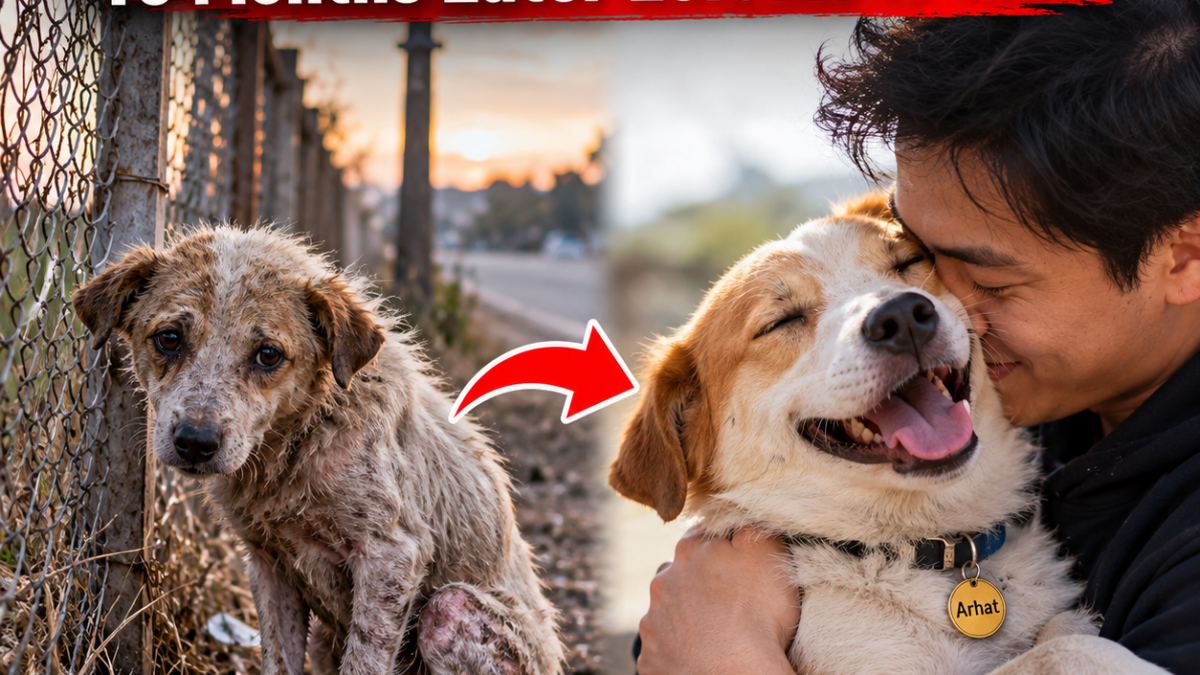
For three weeks, an old dog lay beside a metal fence under a strip of shade so narrow that he had to press his body against the ground just to escape the brutal summer sun.
When I knelt beside him with a bowl of water and watched tears gather beneath those exhausted eyes, I realized that hunger was only one of the things slowly breaking him.
I thought I had come to save a forgotten dog, but I had no idea that the journey beginning beside that fence would eventually force everyone who had given up on him to face something they never expected.
The day I first heard about him, the heat was almost unbearable.
The kind of heat that emptied sidewalks, pushed people into air-conditioned stores, and made even healthy dogs search desperately for shade.
I had stopped at a small neighborhood shop to buy water when I overheard two people talking near the counter.
“There’s still that big dog by the fence,” one woman said.
The cashier shook her head.
“Still there?”
“Three weeks now.”
I turned toward them.
“What dog?”
The woman looked at me as though she wasn’t sure whether she should say more.
“A large dog a few streets over. He barely moves.”
“Is he homeless?”
She hesitated.
“Not exactly.”
That answer immediately bothered me.
“What does that mean?”
She sighed.
“Someone owns him. Or at least someone says they do. Every once in a while, the owner comes by, leaves a little food, then disappears again.”
I remember staring at her for a few seconds.
“Three weeks?”
She nodded.
“And he hasn’t left?”
“No.”
“Why?”
“We don’t know. Maybe he can’t.”
That was enough.
I bought several bottles of water, some soft food, and asked her to show me where he was.
A few minutes later, I saw him.
Even from a distance, something about the scene felt wrong.
He was lying beside a rusty metal fence, his enormous body stretched along the only shadow available. The earth around him was dry and dusty. He didn’t bark when we approached.
He didn’t try to stand.
He barely lifted his head.
I slowed down.
“Hey, buddy.”
One ear moved.
That was all.
Up close, I could see how exhausted he was. His coat had lost its healthy shine. His body looked thinner than a dog of his size should have been, and there were ticks clinging to him.
But what stayed with me most were his eyes.
They weren’t aggressive.
They weren’t even frightened.
They looked tired.
Not the kind of tired that disappears after one good night of sleep.
This was something deeper.
It was the expression of an animal who seemed to have stopped expecting anything better.
I put the food down several feet away.
He watched it.
Then he looked at me.
“You can have it,” I whispered.
He tried to move.
That was when I realized something was seriously wrong.
His front legs pulled forward, but the rest of his body barely followed.
I felt my stomach tighten.
The woman beside me covered her mouth.
“Oh no.”
I moved the bowl closer.
Arhat—although he didn’t have that name yet—lowered his head and began eating.
He ate so quickly that I had to slow him down, giving him smaller portions and water between them.
Then something happened that I will never forget.
Moisture gathered beneath his eyes and rolled down the fur of his face.
Maybe it was irritation from dust.
Maybe it was exhaustion.
Maybe I was placing human emotion onto something I desperately wanted to understand.
But sitting beside him in that heat, watching him eat as though he had been afraid the food might disappear, it looked exactly like crying.
I touched the ground beside his paw.
“You’ve been waiting here all this time?”
He looked at me.
I knew right then that I couldn’t walk away.
People sometimes imagine rescue as one dramatic moment.
You find an animal.
You put him in a vehicle.
You take him to a doctor.
Everything gets better.
Real rescue rarely works that way.
Sometimes the moment you decide to help is simply the moment you agree to enter someone else’s uncertainty.
You don’t know what the diagnosis will be.
You don’t know what it will cost.
You don’t know whether the animal will trust you.
You don’t even know whether the ending will be happy.
You only know what will happen if everyone keeps walking past.
I looked again at the dog beside that fence.
Three weeks.
Three weeks of heat.
Three weeks of waiting.
Three weeks in which someone occasionally brought food but apparently never solved the reason he could not get up and leave.
Another few days might have changed everything.
I wasn’t willing to find out how.
“We’re taking him,” I said.
Getting such a large dog safely into our vehicle wasn’t easy. He was nervous when we lifted him, and for a moment his eyes widened as if he thought we were carrying him somewhere worse.
“It’s okay,” I kept telling him.
“You’re not staying here.”
Once he was settled inside, he turned his head toward the window.
He looked back at the fence.
For several seconds, he simply stared.
I wondered what that place meant to him.
Was he waiting for the person he knew?
Did he still believe someone was coming back?
That is one of the hardest things about dogs.
People can fail them again and again, and still they remember the person they loved.
They don’t calculate loyalty the way we do.
They simply give it.
As we drove away, I looked at him in the rearview mirror.
I didn’t know whether he would ever walk normally.
I didn’t know what the doctors would find.
I didn’t even know how old he really was.
But I knew one thing.
That fence would not be the last place where his story was allowed to end.
PART 2
We called him Arhat.
The name came later, after the first chaotic hours of trying to understand what was wrong with him, but somehow it fit almost immediately.
He had arrived in our lives through pure coincidence.
If I had entered that shop ten minutes earlier, maybe those women wouldn’t have been talking.
If I had gone somewhere else for water, perhaps I never would have heard about him.
That thought bothered me for a long time.
People often call moments like that fate.
I don’t know exactly what word I would use.
I only know that sometimes life seems to place two paths together at precisely the moment one of them is about to disappear.
Arhat’s path crossed ours.
And once it did, turning away was no longer possible.
The first medical examination gave us more questions than answers.
He was dehydrated, underweight for his size, covered in ticks, and badly weakened from lying down for so long.
But those were problems we could understand.
Food could be given carefully.
Fluids could be replaced.
Parasites could be treated.
Strength could return.
The real mystery was his inability to stand.
The veterinarian moved slowly around him, touching his legs and watching his reactions.
“Does he feel this?”
“Yes.”
“Here?”
Arhat moved his paw.
The veterinarian nodded.
“That’s encouraging.”
I held onto that word.
Encouraging.
When you are frightened, one positive word from a doctor can become something you carry for days.
“So he can walk again?”
The veterinarian didn’t answer immediately.
And that pause told me more than I wanted to know.
“We need imaging.”
“How serious could it be?”
“We don’t know yet.”
“An injury?”
“Possibly. Or a neurological problem. Maybe something involving the spine.”
I looked down at Arhat.
He was watching us.
I have always wondered how much dogs understand in veterinary rooms.
They may not know medical language, but they understand faces.
They understand voices.
They understand when everyone around them suddenly becomes quiet.
I crouched beside him.
“We’re going to figure it out.”
He rested his chin against the blanket.
That night, Arhat slept more deeply than I had seen him sleep beside the fence.
For the first time in weeks, he was indoors.
There was clean water beside him.
There was food waiting for morning.
There were no insects crawling across the dirt around his body.
There was no burning sunlight chasing the shrinking line of shade.
Still, I barely slept.
Every few hours I got up and checked him.
Sometimes his eyes were open.
The first time it happened, I whispered, “You okay?”
His tail moved once.
Just once.
It was the smallest movement.
It felt enormous.
Over the following days, his general condition improved enough for us to plan the next stage.
We needed a specialist.
After talking with several veterinarians, we arranged to take him to Moscow.
The journey would be difficult.
He was a large dog who couldn’t stand properly, and long travel could exhaust him.
But without a clearer diagnosis, we were guessing.
And guessing was not enough.
The morning before we left, I sat beside him while packing supplies.
Food.
Water.
Blankets.
Medical documents.
Absorbent pads.
Medication.
A harness.
Everything that might make the road easier.
Arhat watched every movement.
“You’re wondering what I’m doing, aren’t you?”
He lifted his head.
“We’re going on a trip.”
His ears shifted.
“Not exactly a vacation.”
That earned me a slow blink.
I smiled.
It was one of the first times since finding him that I had laughed.
“You’re going to have to trust me.”
Trust, I would learn, was not Arhat’s problem.
Motivation was.
The next morning we started for Moscow.
At first he was nervous.
Every sound made him look toward the window.
Passing trucks.
Car horns.
Doors opening at fuel stations.
People walking by.
When we stopped to offer him water, he constantly looked around.
It felt as though he expected to recognize someone.
Part of me wondered whether he was still searching for the person who had left him beside that fence.
That thought made me angry.
Not because Arhat remembered.
Because he had every reason not to.
Yet he did.
Old dogs are especially difficult to understand in situations like that.
They have years of memories.
A younger dog can sometimes adapt quickly to a completely new world.
An older dog may still wake up expecting the same footsteps.
The same voice.
The same door.
The same person.
Arhat had no idea why his life had changed.
He only knew that it had.
During the drive, I rested my hand near his shoulder.
“You don’t owe anyone your loyalty anymore,” I told him quietly.
Of course, he didn’t understand those exact words.
But I needed to say them.
“You can start again.”
He breathed out and closed his eyes.
The next day we met the surgeon.
There are moments during a medical journey when your entire future seems to depend on the expression of a stranger studying a screen.
That was one of them.
Blood tests were taken.
Then X-rays.
Additional examinations followed.
I stood in the hallway while the doctors discussed what they were seeing.
Every time the door opened, I looked up.
Finally, the surgeon asked me to come inside.
He placed the images where I could see them.
I stared at the shapes without understanding.
“What am I looking at?”
He pointed.
“The vertebrae.”
My heart sank.
“Is there an injury?”
“Not the kind we expected.”
“What does that mean?”
He leaned back.
“His spinal development is abnormal.”
I looked at Arhat, then back at the doctor.
“From lying beside the fence?”
“No.”
“From an accident?”
“Probably not.”
He pointed again.
“This appears to be developmental. Likely congenital.”
The word landed heavily.
Congenital.
Something that had begun long before the fence.
Long before the heat.
Long before we found him.
“So he was born with this?”
“With a predisposition, yes. The way his body developed placed unusual stress on the spine.”
I remembered what we had learned about his background.
Arhat had been bred to become a very large dog.
Size had mattered.
Appearance had mattered.
A powerful frame had mattered.
But somewhere along the line, health had not mattered enough.
The surgeon explained that selective breeding focused too heavily on size could contribute to developmental problems.
Arhat’s vertebrae had not developed evenly.
His body had grown large.
His support structure had paid the price.
I felt anger rise in my chest.
“So we operate?”
The surgeon shook his head.
“No.”
I stared at him.
“No?”
“Surgery would not solve this the way you are imagining.”
“There has to be something.”
“There is.”
“What?”
“Rehabilitation.”
I almost laughed, not because it was funny, but because the answer sounded too small.
“Exercise?”
“Very controlled exercise. Strengthening. Neuromuscular training. Support work.”
“He can barely stand.”
“I know.”
“How long?”
“I can’t tell you.”
“Will he walk?”
The surgeon paused.
And again came that silence I had already learned to fear.
“He may.”
“May?”
“There are no guarantees.”
“What are his chances?”
“His general health is improving. He has sensation. He has some movement. Those are good signs.”
“But?”
“But rehabilitation only works if the dog participates.”
I looked at Arhat.
“What does that mean?”
“It means we can support his body. We can guide his legs. We can strengthen muscles. But at some point, he has to want to move.”
I thought about the dog I had found beside the fence.
The way he had pulled himself a few inches toward a bowl of food.
The emptiness in his eyes.
The surgeon must have seen something on my face.
“Physical weakness is only part of recovery,” he said.
“What’s the other part?”
“The reason to try.”
That sentence followed me for months.
At the time, I thought strength was our biggest problem.
I was wrong.
Arhat’s body improved surprisingly fast once he received proper care.
His appetite returned.
His coat started looking healthier.
The ticks were gone.
His hydration improved.
His bloodwork stabilized.
He rested comfortably.
On paper, several things were getting better.
But when rehabilitation began, another problem appeared.
Arhat didn’t want to participate.
At first, I blamed pain.
We adjusted everything.
Positions.
Timing.
Support.
Duration.
The therapists were gentle.
Nothing was forced beyond what his doctors considered appropriate.
Still, whenever we tried to encourage him to move forward, he would simply lower himself again.
“Come on, Arhat.”
Nothing.
“One step.”
He looked away.
“Just one.”
He remained still.
I tried food.
I tried praise.
I tried toys.
I tried sitting several feet away and calling him.
He would watch me.
Sometimes his paws moved.
Then he stopped.
The therapist looked at me one afternoon.
“He’s capable of more than he’s showing.”
“Then why won’t he do it?”
She crouched beside him.
“Maybe because he doesn’t believe there’s a reason.”
I hated hearing that.
Not because I thought she was wrong.
Because I thought she might be right.
For years, Arhat had apparently trusted people.
Then, when his body began failing him, he ended up beside a fence.
Whether his previous owner understood the seriousness of his condition or not, Arhat had still spent weeks there without the help he needed.
To a dog, reasons don’t matter.
He did not understand money.
He did not understand inconvenience.
He did not understand medical uncertainty.
He understood presence.
And absence.
For three weeks, absence had won.
Maybe now we were asking him to invest in a future he no longer believed existed.
I sat beside him after therapy one evening.
He was lying on a blanket, watching sunlight move across the floor.
“Are you tired?”
His eyes shifted toward me.
“Or are you done?”
His expression didn’t change.
I rubbed behind his ear.
“I wish you could tell me.”
He closed his eyes.
Days became a week.
A week became several.
We continued.
Slowly.
Patiently.
There were tiny improvements, but nothing that felt like the breakthrough I had imagined.
Then Tagir arrived.
At the time, none of us understood how important that meeting would become.
Tagir was another dog connected to our rehabilitation community.
Unlike Arhat, he could walk.
He moved confidently, interested in everything around him.
When Tagir first entered the room, Arhat barely reacted.
Then Tagir walked past his enclosure.
Arhat’s head rose.
Tagir stopped.
The two dogs stared at each other.
“Look at that,” I whispered.
Tagir stepped closer.
Arhat shifted forward.
Not much.
Maybe two inches.
But I noticed.
“So did you,” the therapist said.
For several minutes, they studied each other.
Tagir wagged his tail.
Arhat’s tail moved in response.
Then Tagir walked away.
Arhat watched him.
Not casually.
Intensely.
Tagir crossed the room.
Arhat’s eyes followed.
Tagir turned.
Arhat pushed against the floor.
“Easy,” I said.
He pushed again.
He was trying to get out.
The therapist looked at me.
“This is new.”
Arhat made a low sound.
Not anger.
Frustration.
He wanted to go after Tagir.
For weeks we had offered treats.
Encouragement.
Comfort.
Praise.
None of it had created the expression I saw in his eyes at that moment.
Tagir had something Arhat wanted.
Freedom of movement.
The ability to stand, walk across the room, turn around, investigate a smell, choose a direction.
Arhat stared at him like a dog looking through a window at the life he remembered.
Something changed that day.
Not in his spine.
Not in his muscles.
In his mind.
The next time we brought out the mobility cart, Arhat looked at it differently.
His first wheelchair session was awkward.
That would be the polite way to describe it.
His body was supported, but his legs still had to understand what we were asking.
At first, he froze.
The therapist stood near his side.
I crouched several feet ahead.
“Arhat.”
He looked at me.
“Come here.”
Nothing.
Tagir stood farther away.
Arhat noticed him.
One paw moved.
Then another.
The wheels rolled several inches.
I stopped breathing.
“Good.”
Arhat froze.
“Again.”
His front legs pushed.
The cart moved.
Six inches.
Maybe eight.
It didn’t matter.
To me, it looked like a mile.
“That’s it,” I said.
He pushed again.
The movement was clumsy.
Uneven.
Exhausting.
But it was movement.
For the first time since we began rehabilitation, Arhat wasn’t simply tolerating therapy.
He was chasing something.
Tagir walked ahead.
Arhat followed.
Slowly.
Awkwardly.
But voluntarily.
I had to turn my face away because my eyes filled with tears.
Not sadness this time.
Hope.
Hope can be dangerous during rehabilitation.
It can make you expect progress to move in a straight line.
It doesn’t.
The next day, Arhat struggled.
The day after that, he did better.
Then worse.
Then better again.
Some mornings he worked with determination.
Other mornings he seemed exhausted before we even started.
There were moments when I questioned everything.
Was I asking too much?
Were we pushing him because we needed a happy ending?
Would kindness mean accepting that this was as far as he could go?
I asked the surgeon that directly.
“Tell me when hope becomes selfish.”
He looked at Arhat before answering.
“When you stop listening to the patient.”
“And are we?”
“No.”
“So we continue?”
“As long as he is comfortable, medically stable, and still choosing to participate.”
That last word mattered.
Choosing.
We were not trying to force Arhat into becoming the dog we wanted.
We were trying to give him every possible chance to become the dog he wanted to be.
And after meeting Tagir, Arhat had made something clear.
He wanted movement.
So we built his world around that goal.
At first, the exercises were simple.
Short supported sessions.
Weight shifting.
Careful stretches.
Encouraging his paws to find the floor.
Controlled movements to strengthen muscle groups weakened by inactivity.
Then we added distance.
Not much.
A few feet.
Then several more.
Food became part of the training.
I would place his bowl farther away.
Never far enough to frustrate him completely.
Just far enough that he had to decide whether the reward was worth the effort.
The first time I did it, he looked at the bowl.
Then at me.
Then back at the bowl.
I smiled.
“Yes, I know exactly what I’m doing.”
He remained still.
“Come get it.”
His expression seemed almost offended.
“You can hate me after breakfast.”
He pushed forward.
The cart rolled.
One movement.
Another.
His breathing became heavier.
I almost moved the bowl closer.
The therapist stopped me.
“Wait.”
“He’s tired.”
“Watch him.”
Arhat paused.
Then continued.
My throat tightened.
Every instinct told me to help.
But sometimes help means not removing the challenge someone is finally willing to face.
He reached the bowl.
I dropped to my knees beside him.
“You did it.”
Arhat immediately began eating.
He didn’t care about the emotional significance.
That was probably healthy.
But I did.
I turned away and cried.
There would be many tears during those ten months.
Not all of them happy.
Rehabilitation is repetitive by nature.
The same movements.
The same rooms.
The same equipment.
The same measurements.
Progress that can disappear overnight because of fatigue.
One strong session followed by two weak ones.
A small improvement no one outside the rehabilitation team would even notice.
And beneath all of it, the question.
Will this be enough?
Month one taught Arhat that movement was possible.
Month two taught us how much strength he had lost.
Month three taught me patience.
By then, the excitement of the rescue itself was long gone.
There were no dramatic arrivals.
No emergency drive.
No first bowl of food.
Just work.
Every day.
Work.
Rest.
Food.
Medication when needed.
Massage.
Training.
Sleep.
Repeat.
That is the part of rescue stories people rarely see.
The middle.
The long, quiet stretch between “we found him” and “look at him now.”
The middle is where promises are tested.
Anyone can feel compassion for five minutes.
Arhat needed commitment for months.
Some days I failed emotionally.
I remember one afternoon particularly clearly.
Arhat had been training longer than usual and was exhausted.
We had reduced the session, but even then he struggled.
His paws slipped.
His body leaned against the support.
He tried to correct himself.
Failed.
Tried again.
Failed again.
He turned his head toward me.
Something about the expression on his face broke me.
“Enough,” I said.
The therapist nodded.
“We’re done for today.”
“No. I mean enough.”
She looked at me.
“What do you mean?”
“I can’t keep asking him to do this.”
“You’re upset.”
“Look at him.”
“I am.”
“He’s exhausted.”
“Yes. That’s why we stopped.”
“What if this never works?”
She was silent.
I continued before she could answer.
“What if ten months from now we’re in exactly the same place?”
“We might be.”
That made me angry.
“Then what are we doing?”
“Giving him the chance to find out.”
I stared at her.
She took off one of the support straps and adjusted Arhat’s blanket.
“You’re thinking the goal is walking.”
“Isn’t it?”
“No.”
“What’s the goal?”
“Giving him the best life his body can support.”
I said nothing.
“If that becomes walking, wonderful. If it becomes comfortable wheelchair mobility, that matters too. If it becomes something else, we adapt.”
I looked at Arhat.
He was already relaxing.
“So I’m pushing him for myself.”
“I didn’t say that.”
“It feels like it.”
“You’re tired.”
That was true.
“I don’t want to fail him.”
She looked directly at me.
“Then don’t decide his future on his worst day.”
That sentence stayed with me.
Don’t decide his future on his worst day.
I thought about the fence.
What if someone had looked at Arhat during those three weeks and decided his worst condition was his final condition?
What if we had?
I sat beside him.
“I’m sorry.”
Arhat licked my hand.
Just once.
The next morning, he was ready to train again.
Dogs are strange that way.
They forgive yesterday quickly.
The fourth month brought a small breakthrough.
During a supported session outside the cart, Arhat placed one hind paw correctly beneath his body.
The therapist noticed first.
“Don’t move.”
I froze.
“What?”
“Look.”
I looked down.
His paw was flat.
Not folded.
Not dragging.
Flat.
“Did you do that?”
Of course Arhat did not answer.
He shifted.
The position disappeared.
I almost laughed.
“Again.”
We reset.
It took several attempts.
Then it happened again.
One paw.
Proper placement.
A tiny neurological conversation between brain, spine, muscle, and ground.
To anyone walking past, it would have looked like nothing.
To us, it was evidence.
The body was listening.
After that, we became almost obsessed with small details.
Toe placement.
Weight distribution.
How long he could hold position.
Whether he corrected a paw without assistance.
How quickly he tired.
We filmed sessions, not for social media, but to compare.
Week by week.
Month by month.
When you see a dog every day, improvement can become invisible.
Video showed us what memory could not.
In the earliest recordings, Arhat seemed almost disconnected from his lower body.
Later, there were movements.
Small.
Then intentional.
Then stronger.
“You see that?” I asked the therapist one night.
“I see it.”
“He’s faster.”
“A little.”
“A little is enough.”
She smiled.
“You’re learning.”
Month five was when Arhat began trying to stand before we asked him.
The first time it happened, I was carrying his food.
He saw the bowl.
His front legs braced.
His body shifted.
Then, instead of waiting for support, he tried to push himself upward.
He failed.
But I dropped the food on the counter and ran toward him as though he had just won a race.
“What was that?”
He looked at the bowl.
“You were trying to stand.”
The bowl remained his main concern.
I laughed.
“Fine. Apparently this historic moment can wait until after dinner.”
But I understood what had changed.
Before, we had been initiating everything.
Now Arhat was.
Wanting to stand and being able to stand are very different things.
But desire had become action.
The dog who once lay beside a fence waiting for the world to happen around him was making decisions again.
That mattered more than people realize.
Trauma is not always loud.
Sometimes trauma looks like stillness.
No resistance.
No protest.
No expectation.
Arhat’s greatest transformation was not that his legs became stronger.
It was that he began expecting tomorrow.
He learned our routine.
He knew when training time approached.
If we were late, he became restless.
When Tagir visited, Arhat became competitive.
Tagir would walk through the rehabilitation area like a completely unaware motivational coach.
Arhat would stare after him.
“Your friend is showing off again,” I would say.
Tagir’s handler laughed.
“He knows.”
“I’m blaming him when Arhat starts demanding longer sessions.”
“Deal.”
The two dogs developed their own quiet relationship.
They didn’t need dramatic interaction.
Sometimes they simply lay near each other.
Other times Tagir walked while Arhat worked in the cart.
It was enough.
Dogs learn from one another in ways humans often underestimate.
Tagir represented normal movement.
Not as a medical diagram.
Not as an exercise.
As life.
Walk over there.
Smell that.
Turn around.
Follow a person.
Go outside.
Come back.
Simple things.
Arhat wanted them.
By month six, his strength had improved significantly.
But progress brought new dangers.
Once an animal begins feeling better, enthusiasm can outrun physical capacity.
Arhat wanted to do more than his body was ready to handle.
We had to stop him sometimes.
That was almost funny considering where we had started.
“Slow down,” I told him during one session.
He pulled forward.
“Arhat.”
He kept going.
The therapist laughed.
“Remember when you worried he had no motivation?”
“I’d like some of that unmotivated dog back.”
Another step.
“Seriously.”
Arhat glanced at Tagir and accelerated.
“Traitor,” I muttered toward Tagir.
For the first time, the room filled with laughter instead of worry.
Those moments mattered.
Recovery cannot survive on fear alone.
You need normal life.
Humor.
Sunlight.
Routine.
Friends.
Good meals.
Quiet afternoons.
Arhat began spending more time outside in comfortable areas where he could watch people and other dogs.
One afternoon, I found him lying in the grass.
The sun was warm but gentle.
His head was raised.
Birds moved in the trees.
People passed at a distance.
For a moment, the image transported me back to the first day.
A large dog lying outside.
Unable to walk.
But everything was different.
There was water beside him.
Shade nearby.
A mobility cart within reach.
People checking on him.
A medical plan.
A future.
Same dog.
Different world.
I sat in the grass.
“You know something?”
He looked at me.
“If I had seen only this moment, I might think you were always this peaceful.”
He rested his head against my leg.
“I remember the fence.”
His ear moved.
“I think you do too.”
I had tried not to think too much about his previous owner.
Anger can become consuming in rescue work.
It can make you focus so much on the person who failed the animal that you stop giving enough attention to the animal in front of you.
Arhat didn’t need my anger.
He needed my consistency.
Still, there were nights when I remembered the things the neighbors had said.
“He comes sometimes.”
“Leaves food.”
“Goes away.”
Three weeks.
I wondered how many times Arhat had heard familiar footsteps approaching and believed this time he was going home.
How many times he had watched those footsteps leave again.
I wondered whether anyone had looked carefully enough into his eyes.
Then I would remind myself that revenge would not make Arhat walk.
Treatment might.
Love might.
Time might.
So I put the anger aside.
For a while.
Month seven brought another change.
We began reducing support for extremely short periods.
Seconds at first.
Nothing dramatic.
Hands remained close.
The therapist positioned him carefully.
“Ready?”
I nodded.
She loosened the support.
Arhat stood.
Not perfectly.
Not independently in the way we dreamed.
But his body carried more of its own weight than it had in months.
“One.”
I whispered the count.
“Two.”
His legs trembled.
“Three.”
He leaned.
Support returned.
I exhaled.
Three seconds.
That was all.
I hugged his neck.
“You stood.”
The therapist smiled.
“Three seconds.”
“Three more than we had.”
The next week it became four.
Then six.
Then eight.
Sometimes back to three.
Sometimes none.
Recovery refuses to respect a calendar.
There was no moment where every day became better than the one before.
There were setbacks.
Muscle soreness.
Fatigue.
Periods where progress seemed to stop completely.
Each plateau created new doubt.
Each improvement revived hope.
By month eight, Arhat could take several supported steps without the cart.
They were uneven.
Slow.
Sometimes his paws needed correction.
But they were steps.
I began to imagine something I had been afraid to imagine before.
A leash.
A normal leash.
Not a support harness.
Not wheels.
Not rehabilitation equipment.
Just Arhat beside me, walking.
The image felt almost dangerous.
I mentioned it to the surgeon during a follow-up.
“Don’t rush.”
“I know.”
“You’re thinking too far ahead.”
“I know.”
He smiled.
“You’re going to anyway.”
“Yes.”
The surgeon reviewed Arhat’s latest progress.
“He has exceeded what I expected from him.”
I looked at him.
“Really?”
“Yes.”
“Then he’ll walk?”
The surgeon laughed softly.
“You have asked me that every time.”
“And you keep refusing to answer.”
“Because medicine is not a promise.”
I sighed.
“But?”
“But I would not bet against him.”
That was the closest thing to confidence the surgeon had ever given me.
I walked out of the clinic feeling as though someone had opened a window.
Month nine was the hardest.
Not because Arhat declined.
Because we could see the finish line.
And when you can see something you want, patience becomes harder.
Arhat could stand with less assistance.
He could take supported steps.
His coordination was improving.
His muscles were stronger.
But independent walking remained just beyond reach.
Again and again, he would rise.
Take a step.
Then need help.
Two steps.
Help.
Three.
Help.
One afternoon he made it four steps before sinking onto the mat.
I knelt beside him.
“Four.”
His tongue hung slightly from his mouth.
“Do you understand? Four.”
He looked satisfied with himself.
I think dogs know when humans are proud.
Not because they understand numbers.
Because pride has a sound.
A touch.
A face.
Arhat had learned mine.
A few days later, he managed six.
Then five.
Then seven.
Then three.
And then, for nearly two weeks, nothing improved.
That plateau crushed me more than earlier setbacks.
We were so close.
I became impatient.
Not with Arhat.
With time.
Every day felt as if the universe was asking one more question before giving us the answer.
During that period, Tagir visited again.
Arhat saw him from across the room.
Tagir walked toward the door leading outside.
Arhat pushed up.
No one had asked him.
No food waited ahead.
No therapist was positioning his paws.
He simply saw his friend moving away.
And he did not want to be left behind.
He stood.
One step.
Two.
I froze.
The therapist lifted a hand.
“Don’t touch him.”
Three.
His hind legs trembled.
Four.
Arhat stopped.
He looked at Tagir.
Tagir turned around.
Five.
Arhat lost balance.
We caught him gently.
For several seconds nobody said anything.
Then I laughed.
And cried.
At the same time.
“You stubborn old man.”
Arhat was panting.
I pressed my forehead against his.
“You are really going to do this, aren’t you?”
Month ten began.
By then, nearly everything about Arhat looked different from the dog beside the fence.
His coat was healthier.
His body had filled out.
His eyes were brighter.
His reactions were quicker.
He demanded attention.
He recognized routines.
He loved meals.
He had opinions about training.
He had friends.
He had a home.
Only one question remained.
Would he walk on his own?
The answer came on a morning that began like hundreds of other rehabilitation mornings.
Nothing dramatic.
No crowd.
No special announcement.
No indication that the day would become one of the most important of my life.
I arrived with Arhat’s breakfast.
He was awake.
“Morning.”
His tail hit the blanket.
“You hungry?”
That was a ridiculous question.
Arhat was always hungry.
I prepared the training area.
The therapist joined us.
We started with familiar movements.
Warm-up.
Weight shifting.
Supported standing.
He looked good.
Strong.
Focused.
After several minutes, we positioned him at one end of the mat.
I moved several feet away.
His bowl was in my hands.
“Ready?”
Arhat stared at breakfast.
The therapist smiled.
“I think that’s a yes.”
I set the bowl down.
She loosened her support.
Arhat stood.
One second.
Two.
Three.
Then he moved.
One step.
Two.
Three.
Four.
I stopped counting aloud.
Five.
Six.
His body swayed.
He corrected himself.
Seven.
Eight.
I covered my mouth.
Nine.
He kept coming.
There was no cart.
No harness holding his weight.
No one moving his legs.
Arhat was walking.
Not perfectly.
Not quickly.
But completely under his own determination.
“Come on,” I whispered.
Ten.
Eleven.
The therapist started crying.
Twelve.
Arhat reached me.
He stopped beside the bowl.
For a moment he simply stood there.
Then, completely unimpressed with the miracle he had just performed, he lowered his head and started eating breakfast.
I dropped to the floor.
Ten months.
Ten months of wondering.
Ten months of lifting.
Supporting.
Training.
Driving.
Cleaning.
Feeding.
Waiting.
Hoping.
Doubting.
Trying again.
Ten months since a dog lying beside a fence had struggled to drag himself toward food.
And now he had walked across the room to reach it.
I cried harder than I expected.
The therapist sat beside me.
“He did it.”
I nodded because I couldn’t speak.
Arhat continued eating.
Eventually I managed to say, “He really did it.”
That was not the end of rehabilitation.
Walking once did not mean he was suddenly cured.
His congenital condition had not disappeared.
His body would always need thoughtful care.
His exercise would always matter.
His weight would need monitoring.
He might face difficulties as he aged.
But something fundamental had changed.
Arhat had reclaimed movement.
Over the next several weeks, his walks became more reliable.
A few steps became several yards.
The awkwardness improved.
Confidence replaced hesitation.
We still used support when necessary.
We still respected his limitations.
But now when Arhat saw an open space, he no longer assumed it belonged only to other dogs.
He moved into it.
The first time I clipped a normal leash onto his collar and walked outside beside him, I could barely keep my emotions under control.
“Slow.”
Arhat ignored me.
“Of course.”
He moved ahead.
Not fast.
But proudly.
I looked down at his back.
At the steady movement of his legs.
At the dog who had once watched the world from the ground.
People passed us without knowing.
To them, he was simply an older large dog taking a walk.
They did not know they were looking at ten months of work.
They did not know how many times we had questioned whether this moment would happen.
They did not know about the fence.
I did.
And maybe that was enough.
But life had one more chapter for us.
The quiet kind of revenge.
Not the kind involving threats.
Not the kind that destroys someone else.
The kind that comes when the person you abandoned becomes everything you assumed he never could.
Word about Arhat had traveled through the neighborhood where we originally found him.
People had asked about him during the months after his rescue.
The shopkeeper who first told me where he was regularly checked for updates.
“How is the big dog?”
“Getting stronger.”
“Walking yet?”
“Not yet.”
Later:
“Any progress?”
“Yes.”
Then:
“He stood.”
Finally, one day I walked into the same shop.
The cashier recognized me immediately.
“Arhat?”
I smiled.
“He’s walking.”
Her hands flew to her face.
“No.”
“Yes.”
“On his own?”
“On his own.”
She came around the counter and hugged me.
That news moved through the neighborhood quickly.
Eventually, it reached people connected to his old life.
I did not go looking for them.
I had no interest in confrontation.
Arhat’s recovery was not a performance for anyone who had failed him.
But sometimes consequences arrive without being invited.
One afternoon, I took Arhat near the area where he had originally been found.
Not directly to the fence.
I wasn’t sure I wanted to.
But we had business nearby, and after finishing, I decided to walk him for a few minutes.
Arhat moved beside me.
Slow.
Steady.
Confident.
When we turned onto a familiar street, his pace changed.
He stopped.
I looked down.
“What is it?”
His nose lifted.
He smelled the air.
Ahead of us, several yards away, stood the fence.
The same fence.
For ten months I had remembered it as larger than it really was.
In my mind, it had become a symbol.
Heat.
Dust.
Abandonment.
Helplessness.
Now it was simply metal.
Old.
Rusting.
Ordinary.
Arhat stared.
I wondered what he remembered.
“Do you want to go?”
He remained still.
I gave him time.
Then footsteps sounded from across the street.
A man stopped.
He looked at Arhat.
Then at me.
Something in his expression changed.
“You’re the people who took that dog.”
His voice was not angry.
Mostly surprised.
I recognized enough from the information we had gathered to know he was connected to Arhat’s old home.
I kept my voice calm.
“Yes.”
He stared at Arhat.
“That’s him?”
“Yes.”
“He can walk?”
I looked down at my dog.
Arhat was standing on all four legs.
“He learned.”
The man shook his head.
“They said something was wrong with his spine.”
“There is.”
“So how?”
“Ten months of rehabilitation.”
His expression tightened.
“Ten months?”
“Yes.”
“That must have cost…”
I interrupted.
“A lot of work.”
He looked uncomfortable.
“I gave him food.”
I felt the old anger return.
For a second, I saw Arhat on the ground again.
The bowl.
The ticks.
Those tired eyes.
I could have said many things.
I could have listed every night.
Every appointment.
Every exhausted training session.
Every time we had lifted Arhat because his legs couldn’t hold him.
Every mile traveled for treatment.
Every moment he looked toward a door as if expecting someone from his previous life to appear.
But standing there with Arhat beside me, I realized I didn’t need any of that.
The answer was already standing on four legs.
“I know,” I said.
The man looked confused by my calmness.
“You’re not angry?”
I thought about it.
“I was.”
“And now?”
I looked at Arhat.
“Now I’m busy giving him the life he should have had.”
The man lowered his eyes.
Arhat looked at him.
For one terrible second, I worried he might recognize the scent and move toward him.
Maybe he did recognize something.
His ears shifted.
His head tilted.
Then Arhat turned away.
He walked toward me.
Not quickly.
Not dramatically.
Just one step.
Then another.
And another.
I felt something inside me settle.
That was the revenge.
Not suffering.
Not punishment.
Choice.
Arhat had once lain beside that fence waiting for a life that kept walking away from him.
Now the fence was behind him.
And when given the chance to decide where to go, he came toward us.
I placed my hand on his neck.
“Ready?”
His tail moved.
We walked away together.
I never needed a more satisfying ending than that.
Back at home, Arhat received dinner and immediately fell asleep afterward, completely unaware that I had spent the entire drive thinking about what had happened.
Dogs rarely understand the symbolic moments humans assign to their lives.
Maybe that is part of what makes them remarkable.
Arhat did not need revenge.
He needed safety.
Food.
Medical care.
Exercise.
Patience.
Companionship.
A reason to get up in the morning.
He needed people who would still be there when progress was slow.
People who would celebrate one step without demanding twenty.
People who understood that loving an animal means more than enjoying them when they are young, beautiful, healthy, and easy.
Love becomes most visible when staying is difficult.
I sometimes think about the breeder too.
About the desire to produce a bigger dog.
A more impressive dog.
A dog whose size would make people stare.
Arhat had become large.
But size had come with a cost.
His body had developed unevenly, leaving him with a condition no responsible person should dismiss as an inconvenience.
The surgeon never promised that rehabilitation would erase the problem.
It didn’t.
We learned to manage it.
To work with Arhat’s body rather than pretend his limitations didn’t exist.
That difference matters.
A miracle is not always a body becoming perfect.
Sometimes a miracle is an imperfect body discovering how much life it can still hold.
Arhat taught me that.
Months after he began walking independently, I watched him in the yard one evening.
Tagir was visiting.
The two dogs were older now.
Neither moved with the reckless speed of puppies.
Tagir walked ahead.
Arhat followed.
For a few seconds, I saw the old rehabilitation room again.
Tagir crossing the floor.
Arhat staring from his enclosure.
That first desperate desire to follow.
Now there were no wheels beneath Arhat.
No therapist holding a harness.
No bowl placed strategically across the room.
Just two dogs walking through grass.
Tagir stopped beside a tree.
Arhat caught up.
They stood shoulder to shoulder, investigating the same smell as if the previous ten months had never happened.
I laughed.
“All that work for this?”
Neither dog looked at me.
“A tree?”
Tagir moved on.
Arhat followed.
I sat down.
Sunlight stretched across the yard.
I thought about the sentence the surgeon had told me.
Rehabilitation only works if the dog participates.
He had been right.
We gave Arhat treatment.
We gave him equipment.
We gave him food.
We gave him opportunities.
But Arhat did the hardest part.
He decided to try.
That decision did not happen because of one inspirational speech.
Dogs don’t work that way.
It happened through a collection of small experiences.
A safe place to sleep.
A meal that arrived every day.
Hands that supported rather than abandoned.
Tagir walking across a room.
A bowl placed slightly farther away.
Praise after one difficult movement.
The realization that tomorrow would contain the same people as today.
Trust returned before strength did.
And once trust returned, effort followed.
There are photographs of Arhat from the beginning.
I still struggle to look at some of them.
Not because they are graphic.
Because I remember his expression.
His body lying beside the fence.
His eyes following us cautiously.
The first bowl.
The first drink.
Then there are photographs from later.
Arhat in his mobility cart.
Arhat beside Tagir.
Arhat standing with support.
Arhat taking his first independent steps.
Arhat outside.
Healthy.
Alert.
Older, yes.
But present.
Fully present.
If you placed the first and last photographs beside each other, some people might think they were looking at different dogs.
They would be wrong.
It was always Arhat.
The dog beside the fence had never disappeared.
He had simply been buried beneath hunger, exhaustion, disappointment, and a body that no longer knew how to carry itself.
Recovery revealed him.
His stubbornness.
His curiosity.
His appetite.
His jealousy when another dog received attention.
His impatience before meals.
His determination.
His ridiculous habit of stopping exactly where people needed to walk.
His love of lying outside when the weather was comfortable.
His loyalty, despite everything.
Especially his loyalty.
That remained one of the things I found hardest to accept.
Even after people disappointed him, Arhat never became cruel.
He did not approach the world looking for someone to blame.
He remained capable of trust.
There is something humbling about that.
Humans often talk about dogs as if loyalty means obedience.
Arhat taught me something different.
Loyalty is vulnerability.
It means placing part of your life in another being’s hands.
When that trust is mishandled, the damage can be enormous.
But with patience, sometimes trust returns.
Not because the past disappears.
Because the present becomes stronger.
A year after his rescue, we visited the clinic again.
The surgeon watched Arhat walk down the hallway.
He folded his arms.
“Well.”
I smiled.
“Well what?”
“You finally got your answer.”
“To which question?”
He raised an eyebrow.
“You asked me about fifty times whether he would walk.”
“More than fifty.”
“Probably.”
I looked at Arhat.
“He walks.”
“Yes.”
“Say it again.”
The surgeon laughed.
“He walks.”
“That sounds good.”
“He still needs care.”
“I know.”
“His condition didn’t vanish.”
“I know.”
“Maintain his weight. Keep the exercise appropriate. Watch for discomfort. Avoid unnecessary strain.”
“I know.”
He glanced at me.
“You’ve become annoying.”
“I learned from Arhat.”
The surgeon crouched to greet him.
“You caused everyone a lot of trouble.”
Arhat wagged his tail.
“He has no regrets,” I said.
“Obviously.”
Then the surgeon became serious.
“You know, most people wouldn’t have continued this long.”
The words bothered me.
“Don’t say that.”
“Why?”
“Because it makes it sound heroic.”
“It was commitment.”
“That’s different.”
He nodded.
“Fair.”
I watched Arhat investigate the room.
“We were just the people who happened to hear about him.”
“And then stayed.”
That stopped me.
Yes.
We stayed.
Maybe that was the whole story.
Not that we found him.
That part was chance.
Staying was a decision.
People often ask what saved Arhat.
The surgeon?
Rehabilitation?
The wheelchair?
Tagir?
Food?
Medical care?
The answer is all of them.
But if I had to choose one thing, I would say consistency.
Nothing worked immediately.
There was no single treatment that transformed him overnight.
There was only the accumulation of ordinary days in which nobody gave up.
Day after day after day.
That is how ten months passed.
That is how a dog moved from a fence to a rehabilitation room.
From a rehabilitation room into a wheelchair.
From wheels to supported standing.
From supported standing to steps.
From steps to walking.
People like dramatic miracles because dramatic miracles are easy to tell.
Arhat’s miracle was built slowly.
One meal.
One exercise.
One visit from Tagir.
One correctly placed paw.
One extra second standing.
One more step.
Ten months later, those tiny victories had become a life.
The old fence remained where it had always been.
Sometimes I imagined it still holding the shadow of the dog we found there.
But that shadow no longer belonged to Arhat.
He had left it behind.
The most satisfying moment was not watching someone from his old life realize what had happened.
It was not hearing that people in the neighborhood now talked about him as the dog who learned to walk again.
It was not even the first twelve independent steps across the rehabilitation room, though I will remember them forever.
The best moment came much later.
A quiet morning.
No cameras.
No doctors.
No audience.
I opened the door to the yard.
Arhat was resting several feet away.
For years, movement had been something life either gave him or took from him.
For months, movement had been a medical goal.
That morning it was simply his.
I stepped outside.
Arhat looked at me.
I didn’t call him.
I didn’t show him food.
I didn’t encourage him.
I wanted the decision to be completely his.
He stood.
Slowly.
Carefully.
Then he walked past me into the morning sun.
He stopped in the grass.
Lifted his head.
Breathed in.
And kept walking.
I remained near the doorway watching him.
There was no fence trapping him inside a line of shade.
No empty road beside him.
No need to wait for someone who might or might not return.
He could choose where to lie down.
Where to walk.
Who to follow.
When to rest.
That was freedom.
Not perfect legs.
Choice.
Tagir arrived later that afternoon.
When Arhat saw him, he stood immediately.
Tagir moved toward the far side of the yard.
Arhat followed.
I smiled.
Ten months earlier, the same sight had started his rehabilitation journey.
Arhat had watched Tagir walk and seemed to realize there was still something in this world worth chasing.
Now they disappeared behind a row of bushes together.
A few seconds later Arhat reappeared, moving steadily.
I thought about the dog at the fence.
About how close we had come to arriving too late.
About all the possibilities that can disappear while people keep saying, “Maybe tomorrow.”
There is a dangerous comfort in tomorrow.
Tomorrow we’ll call the doctor.
Tomorrow we’ll stop.
Tomorrow we’ll help.
Tomorrow we’ll make time.
Arhat had spent three weeks waiting inside other people’s tomorrows.
His second life began because one day someone finally chose today.
I no longer feel much anger when I think about the people who failed him.
Anger served a purpose at the beginning.
It pushed us to act.
But eventually anger becomes weight.
Arhat had enough weight to carry.
I did not want to add mine.
The best answer to his past was not rage.
It was the life in front of him.
Every comfortable bed.
Every full bowl.
Every medical checkup.
Every slow walk.
Every afternoon with Tagir.
Every time Arhat stood up because he wanted to follow someone he trusted.
Those things said more than anger ever could.
And somewhere, the people who once looked at him and decided that lying beside a fence was acceptable now knew something too.
They had been wrong.
Wrong about his value.
Wrong about what his body could still do.
Wrong about how much life remained inside him.
They had seen a burden.
We had seen a question.
Arhat answered it himself.
He walked.
He lived.
He loved again.
And he did it without becoming anything other than the dog he had always been.
That is why, when people call his recovery a miracle, I sometimes smile.
Yes, there was something miraculous about it.
But miracles are often misunderstood.
People imagine bright flashes.
Impossible things happening instantly.
Arhat’s miracle wore wheels for a while.
It arrived at scheduled therapy sessions.
It ate measured meals.
It slept after exhausting exercises.
It failed repeatedly.
It got frustrated.
It rested.
It started again.
His miracle took ten months.
And I witnessed almost every day of it.
Years from now, if someone asks me what I remember most about Arhat, I don’t think I will tell them about the fence first.
I won’t tell them about the X-rays.
Or the surgeon.
Or even his first independent walk.
I will tell them about his eyes.
The eyes I saw on that first scorching afternoon looked as if they had stopped asking the world for anything.
Later, those same eyes changed.
They became curious.
Demanding.
Playful.
Sometimes stubborn.
When dinner was late, accusing.
When Tagir appeared, excited.
When I picked up the leash, bright.
That transformation meant more to me than perfect movement ever could.
Because walking was only part of Arhat’s recovery.
The greater victory was that he wanted to go somewhere again.
One evening, long after the hardest rehabilitation days were behind us, Arhat fell asleep beside my chair.
His legs were stretched comfortably across the floor.
I looked down at them.
Those legs had frightened me.
Frustrated me.
Made me cry.
Made me hope.
Made me question everything.
Now they were simply resting.
I reached down and touched his shoulder.
He opened one eye.
“You know what you did, right?”
No response.
“You made everyone look foolish.”
His tail tapped the floor.
I laughed.
“The doctors wouldn’t promise me anything.”
Another tail tap.
“The people who left you there probably thought you were finished.”
Arhat sighed.
“And you were just waiting to prove everyone wrong.”
He closed his eye again.
I smiled.
Maybe that was the closest Arhat ever came to revenge.
He did not hurt the people who failed him.
He outlived their expectations.
He stood when they believed he would remain down.
He walked away from the place where they had left him.
And he built a life so full that the fence became only the first page of a much better story.
I think that is the kind of revenge worth remembering.
Not destruction.
Transformation.
Not making someone else suffer.
Refusing to let what they did define the rest of your life.
Arhat never understood those words.
He didn’t need to.
He lived them.
Today, when I watch him move across the yard, I still sometimes see flashes of the old dog beneath the summer sun.
The comparison catches me unexpectedly.
There he was then—thin, tired, almost motionless.
And here he is now—older but stronger, surrounded by people who know his routines, his personality, his limitations, and the exact look he gives when he believes dinner should have arrived five minutes earlier.
He is not a different dog.
He is a dog who finally received a different life.
And perhaps that is the part of his story that matters most.
We did not rescue Arhat by turning him into something extraordinary.
He was already worthy when he couldn’t stand.
Already worthy when he was dirty.
Already worthy when treatment was uncertain.
Already worthy when rehabilitation became exhausting.
Walking did not make him valuable.
Walking simply gave the world a dramatic way to see what had been valuable all along.
The dog beside the fence deserved help even if he never took another independent step.
That understanding changed me.
We celebrate the ending because it is beautiful.
But compassion cannot depend on beautiful endings.
When I lifted Arhat into our vehicle that first afternoon, there was no promise.
No guarantee.
No final scene waiting for us.
There was only a dog who needed someone to choose him.
So we did.
Ten months later, Arhat chose himself.
He stood.
He stepped forward.
He kept going.
And once he understood that the people beside him were not going to disappear, he never looked back for very long.
The last time I passed the old fence without Arhat, I stopped for a moment.
The day was warm, though nothing like the unbearable afternoon when we found him.
The same narrow shadow stretched across the ground.
I stood where Arhat had once lain.
For a few seconds, I could almost see him there.
Then I pictured what he was doing at home.
Probably sleeping.
Possibly waiting for food.
Maybe watching the door for me.
I smiled.
The fence looked smaller now.
So did the past.
Then I turned away.
There was nothing left for us there.
Arhat’s life was waiting somewhere else.
And this time, when he waited for someone he loved to come home, he never had to wonder whether they would return.

