PART 2: They Left an Old Blind Dog at a Dump—He Wagged at Every Footstep, Certain His Owner Was Coming Back
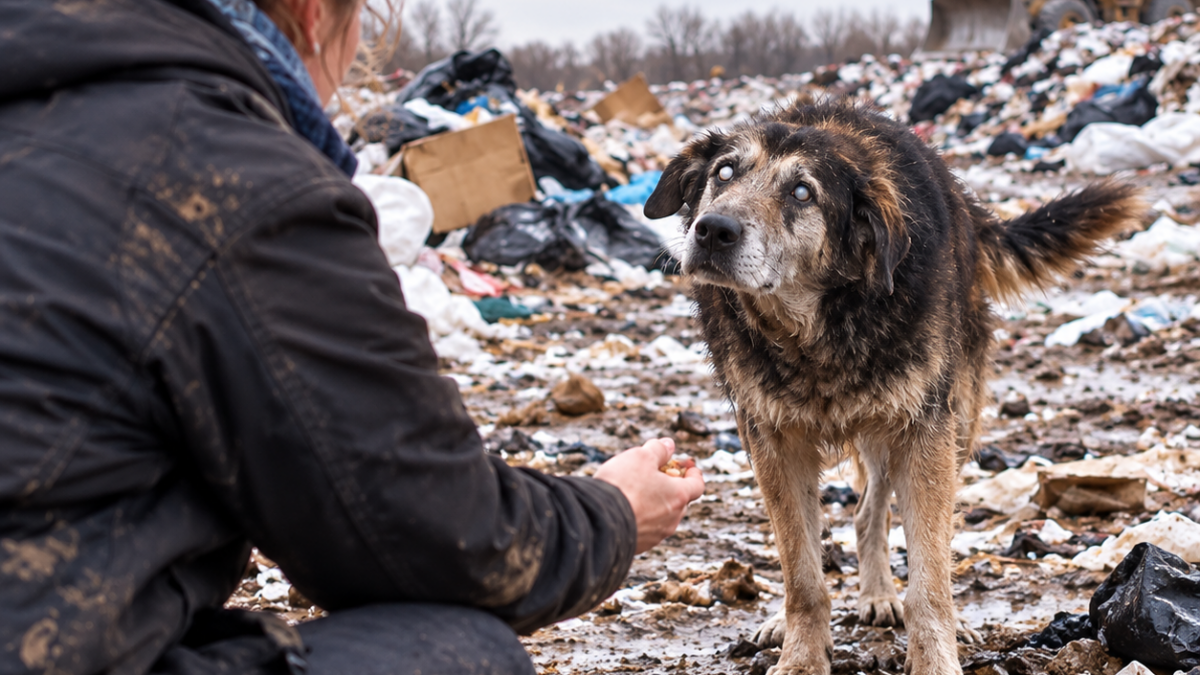
PART 2
The engine belonged to a white van leaving the loading area.
The second it started, the old dog’s head snapped upward.
His ears came forward.
His entire body changed.
Until then, he had looked exhausted.
Almost defeated.
Now he pushed himself onto his feet so fast that his back legs slipped slightly beneath him.
“Easy.”
He ignored me.
The van began rolling toward the exit.
The dog stepped after it.
One step.
Two.
Then faster.
“Hey!”
I reached for him.
He jerked away from my hand.
Not aggressively.
Panic.
He could not see the van.
He could hear an engine moving away.
And in his mind, there seemed to be only one possibility.
The person who had left him was leaving again.
He started toward the roadway.
I moved in front of him.
He tried to go around me.
“Stop the van!” I shouted.
The employee behind me waved both arms.
The driver braked.
The old dog kept moving.
His paws searched the ground carefully, but desperation pushed him faster than his blindness could safely handle.
He struck a low piece of broken plastic.
Stumbled.
Recovered.
My heart jumped.
I crouched directly in front of him.
“Buddy.”
He turned toward my voice.
The van’s engine idled.
His breathing was fast.
“You can’t follow that.”
The dog pushed toward the sound.
I placed one hand gently against his chest.
He froze.
For a second, I expected him to growl.
Instead, he leaned into my palm.
Not affection.
Confusion.
His body trembled.
The employee killed the van engine.
Silence returned.
The dog listened.
Nothing.
His legs seemed to lose strength.
He sat.
Then slowly lowered himself onto the concrete.
That was when I knew we could not simply clip a leash on him and walk him to my vehicle.
He didn’t know us.
He didn’t know where he was.
He couldn’t see.
Every engine sounded like possibility.
Every footstep might belong to the person he was still waiting for.
And every movement away from that exact patch of ground might feel like giving up the only chance of being found.
I sat beside him again.
The landfill employee crouched a few feet away.
His name was Luc.
“He didn’t do that earlier,” he said.
“Do what?”
“Try to follow vehicles.”
“How many have left?”
“A few.”
“Maybe this one sounded similar.”
“Similar to what?”
“The car.”
Luc looked toward the gate.
“The one that brought him.”
My stomach tightened.
“You remember it?”
“A little.”
“Make?”
“No.”
“Color?”
“Dark blue. Maybe gray. Small SUV or wagon. I only noticed because it stopped where customers aren’t supposed to unload.”
“Did you see who was driving?”
“Not clearly.”
“Plate?”
“Maybe part of it.”
I looked at him.
“You remember part of the plate?”
“I’d have to think.”
My rescue brain immediately split into two directions.
One part stayed with the dog.
The other began building questions.
Security cameras?
Entry logs?
Receipts?
Vehicle footage?
But none of that mattered if the old dog collapsed in front of us.
First:
Get him safe.
I opened my rescue bag.
Food.
Water.
Slip lead.
Blanket.
Treats.
The dog’s nose reacted before his body did.
His head turned toward the food.
“Good.”
I placed a small dish near him.
He smelled it.
Then turned away.
Not hungry?
Impossible.
He looked underweight.
Maybe nausea.
Stress.
Or maybe food was less important than waiting.
I moved the water closer.
This time he drank.
Long.
Slow.
Then more.
His tongue moved carefully around the bowl as though even finding the edge required concentration.
I watched.
Blindness changes ordinary actions.
A bowl is not simply there.
A doorway is not simply there.
Space becomes memory, sound, scent, and trust.
This place gave him none of those.
I touched the side of his neck.
No collar.
But there was a faint flattened line in the fur where one had probably been.
That bothered me.
Whoever left him had removed identification.
Or he had lost it earlier.
I did not know.
I refused to decide the story before evidence did.
“Can we scan him here?” Luc asked.
“I have one in the vehicle.”
I retrieved the microchip scanner.
The old dog tolerated it with tired patience.
Shoulders.
Neck.
Back.
Again.
Nothing.
“No chip?”
“Nothing showing.”
Luc swore quietly.
I understood.
A microchip would have made the next step easier.
Instead, we had an anonymous senior dog at a landfill.
Blind.
Possibly abandoned.
Possibly missing.
We still had to consider every possibility.
Maybe the driver had found him elsewhere and dumped him.
Maybe someone else owned him.
Maybe he wandered and got transported accidentally.
The evidence did not yet tell us.
But Luc had seen a vehicle leave him.
That mattered.
I prepared the slip lead.
The dog flinched when it touched his neck.
I stopped.
“Okay.”
I let him smell it.
He did.
Then my hand.
Then the lead again.
I moved slowly.
Loop over the head.
No resistance.
I loosened it enough to stay comfortable.
Then I stood.
The old dog remained seated.
“Come on.”
Nothing.
I took one step.
The lead tightened gently.
He planted himself.
Luc said, “He really doesn’t want to leave.”
“No.”
I crouched again.
“He thinks this is where they’ll come back.”
“How do you convince a dog they won’t?”
“You don’t.”
Luc looked at me.
“Then what?”
“You give him something safer to follow.”
I sat beside him for almost twenty minutes.
Talking.
Nothing important.
I told him my name.
Told him he was old enough to know better than to sit in a dump.
Told him I had a vehicle that smelled like twelve different dogs and probably three years of stale treats.
Luc eventually returned to work.
Every few minutes, another sound echoed.
Metal.
Engines.
Voices.
Each time, the dog lifted his head.
Each time, hope briefly entered his body.
Each time, it disappeared.
That cycle hurt to watch.
I tried food again.
A small piece of cooked chicken.
His nose moved.
He took it.
Then another.
Good.
I placed the third piece a few inches ahead.
He stood to get it.
The fourth farther.
One step.
Another.
I hated using hunger to move him.
But I was not tricking him toward danger.
I was asking him to choose something he could understand.
Scent.
Voice.
Food.
Step by step.
We crossed maybe fifteen feet.
Then an engine started.
The dog spun.
The leash tightened.
He tried to go back.
I stopped.
“Not that one.”
He pulled once.
Then froze.
I held the leash without dragging.
Eventually the engine faded.
The dog stood trembling.
I said:
“You waited long enough.”
He couldn’t understand.
Still, I repeated it.
“You waited long enough.”
Another piece of chicken.
One step.
Another.
Eventually we reached my vehicle.
The open rear door created a new problem.
The dog smelled it.
Then stopped.
Vehicles meant something.
Maybe rides.
Maybe home.
Maybe abandonment.
He backed away.
“No forcing.”
I placed a blanket on the floor near the open door.
Sat beside it.
The dog smelled the bumper.
The tires.
My shoes.
Then the blanket.
Ten minutes.
Fifteen.
I called the veterinary clinic.
“I have a blind senior.”
“Urgent?”
“Not collapsing. But I want him seen.”
“Bring him.”
“I’m working on that part.”
The receptionist knew me well enough not to ask.
Eventually I placed food just inside the vehicle.
The dog stretched his neck.
Took it.
Next piece farther in.
He put one front paw onto the floorboard.
Stopped.
Another.
Then he froze again.
I supported his chest.
“Easy.”
With some assistance, he climbed in.
The moment all four paws were inside, he turned around.
Fast.
Panicked.
I thought he might jump out.
I blocked the exit gently with my body.
He pressed forward.
Then stopped.
I sat inside with him.
For almost five minutes.
The door stayed open.
I wanted him to understand he was not trapped.
His breathing slowed.
He smelled the blanket.
Then me.
Finally he lowered himself.
I stroked the top of his head.
“You’re not being thrown out of this one.”
I closed the door.
Before leaving, I found Luc.
“Cameras?”
He nodded.
“Manager’s checking.”
“Save everything from this morning.”
“We will.”
“And don’t post the dog’s picture publicly yet.”
“Why?”
“If someone comes claiming him, I want them to prove they know him.”
Luc understood immediately.
“What should they know?”
“Things we haven’t posted.”
Scars.
Teeth.
Medical details.
Behavior.
Anything.
People sometimes claim animals for the wrong reasons.
Or because they resemble another dog.
We needed certainty.
The drive to the clinic was quiet.
The old dog lay behind me.
Every time the car slowed, I checked the mirror.
At red lights, his head lifted.
Engine vibration seemed familiar.
I wondered how many years he had spent riding beside someone.
I wondered what his name was.
I tried several common ones.
“Max?”
Nothing.
“Rex?”
Ear movement, but probably tone.
“Buddy?”
Nothing.
“Shadow?”
Nothing.
I stopped.
Names matter.
Throwing random ones at him felt wrong.
At the clinic, we moved slowly again.
He hesitated leaving the vehicle.
Once on the ground, he followed my voice better.
The technician led us into a quiet room.
The veterinarian, Dr. Morel, had treated many of our rescues.
She knelt.
“Hello, old man.”
The dog smelled her hand.
She examined his eyes first.
“Advanced cataracts.”
“Completely blind?”
“Functionally, probably very close.”
“Pain?”
“Cataracts themselves don’t necessarily hurt, but we’ll check eye pressure.”
She moved through the rest of the exam.
Heart murmur.
Mild.
Arthritis.
Significant.
Dental disease.
Moderate to severe.
Several old scars.
Muscle wasting around the hindquarters.
Overgrown nails.
Ear inflammation.
He had been cared for at some point.
That became clear.
He knew handling.
Didn’t panic at the stethoscope.
Allowed paws to be touched.
Knew how to sit when the veterinarian’s hand moved near his shoulders.
A dog does not become this accustomed to people by living wild his entire life.
“How old?”
“Twelve? Thirteen? Maybe older.”
Dr. Morel ran her hand down his back.
“He’s thin, but not terminally emaciated.”
“So he hasn’t been neglected for years.”
“Not necessarily. Poor dental health and age can also contribute.”
Bloodwork.
Urine.
Eye pressure.
X-rays later if needed.
We photographed scars.
One distinctive feature was a missing lower premolar.
Another: a small crescent scar behind his left ear.
I wrote everything down.
Then Dr. Morel asked:
“What are you calling him?”
“No idea.”
A technician said, “He looks like an Oscar.”
The dog’s head lifted.
We all froze.
“Say it again,” I said.
“Oscar?”
His ears moved.
I looked at the technician.
“Again.”
“Oscar.”
Tail.
One small movement.
Dr. Morel smiled.
“Well.”
I crouched.
“Oscar?”
His head turned directly toward my voice.
There.
Not proof.
But something.
“Maybe that’s his name.”
We used it.
Oscar.
The next challenge was placement.
Blind senior dogs can thrive.
But they need predictability.
Stable furniture.
Safe stairs.
Consistent voices.
Gentle handling.
A noisy kennel environment would be hard.
I called three fosters.
Full.
Two others had young dogs too chaotic for him.
Then I called Marianne.
She lived alone outside a small town.
Retired nurse.
Had fostered hospice dogs before.
She answered:
“How blind?”
“Very.”
“How old?”
“Very.”
“How difficult?”
“Emotionally or practically?”
“Both.”
I told her.
She became quiet.
“Bring him.”
“That was easy.”
“I haven’t met him yet.”
“True.”
“Also, I’m weak.”
“Also true.”
Oscar rode with me to Marianne’s house after the clinic.
By then, he seemed exhausted.
Marianne had prepared one room.
No clutter.
Bed.
Water.
Non-slip rugs.
Baby gate at the stairs.
Wind chimes near the back door.
“Why the chimes?” I asked.
“Sound landmark.”
Of course.
Retired nurse brain.
Oscar stepped inside.
Slowly.
Nose working.
One paw.
Pause.
Wall.
Turn.
Rug.
Water.
Marianne never touched him until he touched her.
That impressed me.
He eventually found her shoes.
Smelled them.
Then her hand.
His tail moved once.
“Hello, Oscar.”
Head lift.
Again.
The name seemed real.
That night, he slept near the front door.
Not on the bed Marianne prepared.
On the rug beside the door.
Waiting.
She sent me a photograph at 11:18 p.m.
“He won’t move.”
I called.
“Don’t force him.”
“I won’t.”
“He might expect someone to come through.”
“I know.”
“Can you put the bed closer?”
“I already did.”
She moved it.
Oscar remained on the floor.
At 2:00 a.m., she covered him with a blanket.
He stayed.
At 5:40, she texted:
“He finally put his head on the bed.”
By morning, half his body was inside it.
Good enough.
Meanwhile, the landfill footage came through.
Luc called.
“You need to see this.”
I drove back after leaving Oscar with Marianne.
The manager showed me the recording.
Timestamp 7:16 a.m.
Dark blue station wagon.
Older model.
Entered the facility.
Moved toward an area customers were not authorized to use.
Stopped.
Passenger door opened.
A dog appeared.
Slowly.
Oscar.
Even from grainy footage, the clouded eyes and gray muzzle were visible.
A person exited.
Held his collar.
Walked him several feet.
Then returned to the vehicle.
Oscar followed.
The person pushed him back gently.
Not violently.
That somehow made it worse.
The door shut.
The car started.
Oscar stood beside it.
The vehicle drove away.
Oscar followed three steps.
Stopped.
Turned.
Then sat.
The video continued.
Nothing happened.
For seven minutes.
Ten.
Twenty.
Oscar stayed.
At one point he stood when a truck came near.
Tail wagged.
Truck passed.
He sat again.
I stopped watching.
Luc said, “Plate is visible when they leave.”
“Full?”
“Almost.”
The police and animal welfare officer were contacted.
This was now more than suspicion.
Someone had deliberately removed a blind senior dog from a vehicle and left.
We still needed to identify them.
The next day, I posted Oscar through the rescue network.
But not the landfill details.
FOUND SENIOR BLIND DOG.
Approximate area.
Date.
Contact us with proof of ownership.
Photographs avoided the scar side.
Within twenty-four hours, we received twelve messages.
Most were well-meaning.
One woman thought he might be her dog missing for six months.
Different teeth.
Different size.
Another man insisted Oscar looked like his father’s dog.
That dog was female.
No.
Then a message arrived:
“His name is Oscar.”
I stopped.
No one outside the clinic and foster circle knew we were using that name.
The public post called him “senior male.”
I answered:
“Can you provide more information?”
The sender replied:
“He’s about 14. Blind. Missing tooth on lower left. Scar behind left ear from a fence accident years ago.”
My stomach turned.
Correct.
Every detail.
I asked for photographs.
Several arrived.
Oscar younger.
Dark coat.
Clear eyes.
Standing beside a couch.
Oscar wearing a red collar.
Oscar beside a Christmas tree.
Oscar asleep with his head on someone’s knee.
Then the sender wrote:
“He belonged to my father.”
Belonged.
Past tense.
“Where is your father?”
“He died last year.”
That changed the story instantly.
I called.
A woman named Elise answered.
She sounded shaken.
“My father had Oscar since he was a puppy.”
“What happened after your father died?”
“My brother took him.”
I went quiet.
“Your brother?”
“Yes.”
“Did you know he no longer had him?”
“No.”
Her voice changed.
“I thought Oscar was living with him.”
I told her only that Oscar had been found.
Not yet how.
She started crying.
“Is he okay?”
“Medically stable.”
“Can I see him?”
“Yes, but we need to verify everything.”
“I understand.”
The photographs already did much of that.
Veterinary records came next.
Same missing tooth.
Same age.
Cataracts diagnosed eighteen months earlier.
Arthritis medication.
Oscar.
Real name.
Real life.
His original owner, Elise’s father, had died after a short illness.
Oscar had been deeply attached to him.
Afterward, the family discussed placement.
Elise lived in an apartment where large dogs were prohibited under her lease.
Their brother, Julien, had a house and agreed to take Oscar.
At first, he sent updates.
Then less often.
Elise assumed Oscar was fine.
I asked the question carefully.
“When did you last see him?”
“Eight months ago.”
“How did he look?”
“Older. But okay.”
“Blind?”
“Mostly. He knew my brother’s house.”
I thought of the landfill.
A blind dog removed from the familiar map he had built inside his mind.
Elise continued:
“He slept by my father’s chair for weeks after Dad died.”
That explained the waiting.
Perhaps not all of it.
But something.
Oscar had already lost one person.
Then adjusted to another home.
Then been driven away again.
“How soon can I see him?” Elise asked.
I told Marianne.
She agreed.
The meeting happened the next afternoon.
Oscar was sleeping near the front door.
Elise entered quietly.
She did not call his name immediately.
She started crying the moment she saw him.
I whispered:
“Let him smell you.”
She crouched.
“Oscar.”
His head lifted.
Tail.
One movement.
Then faster.
“Oscar, baby.”
He stood.
Walked toward the voice.
No hesitation.
When he reached her, he smelled her hands.
Her coat.
Then pressed his face against her chest.
Elise broke down.
“Oh, Dad.”
That one word nearly destroyed me.
She wrapped both arms around Oscar.
He wagged.
Harder than I had seen since we found him.
Not the desperate hopeful wag at landfill footsteps.
Recognition.
Real recognition.
Marianne turned away to wipe her face.
Elise kissed the top of Oscar’s head.
“I’m sorry.”
Oscar leaned closer.
“I thought you were safe.”
Again.
That sentence.
Animals suffer from human assumptions more often than cruelty alone.
I thought you were safe.
Sometimes someone believes another person is caring.
Another person believes an animal can adjust.
A responsibility gets passed.
Then passed again.
Until nobody is really looking.
But in Oscar’s case, the footage told us responsibility had not simply drifted away.
Somebody had driven him there.
Elise asked:
“How did you find him?”
I looked at her.
“We need to talk.”
We sat at Marianne’s kitchen table.
Oscar lay beside Elise’s feet.
I explained the landfill.
The employees.
The waiting.
Then the footage.
Her face changed.
“What vehicle?”
I described it.
Elise went completely still.
“My brother drives a blue Peugeot wagon.”
There it was.
She covered her mouth.
“No.”
I said nothing.
“No.”
She stood.
Oscar lifted his head.
Elise sat immediately again so she wouldn’t upset him.
“He wouldn’t.”
I did not answer.
Because maybe he had.
We sent the registration details to investigators.
The plate matched.
Not perfectly visible in every frame.
Enough.
The vehicle was registered to Julien.
When contacted, his first claim was that Oscar had run away.
The video made that impossible.
Then he claimed he had taken Oscar to the landfill because someone there was supposed to meet him.
No evidence.
No phone records supporting an arrangement.
No rescue appointment.
Nothing.
Then, according to the investigating officer, the story changed again.
Oscar had become “too difficult.”
He urinated indoors.
Got confused.
Bumped into things.
Needed medication.
Woke at night.
Julien said he was overwhelmed.
That part I could believe.
Senior care is hard.
Blindness is hard.
Grief is hard.
What I could not accept was the next choice.
There were shelters.
Veterinarians.
Rescues.
Elise.
Phone calls.
Options.
Even surrendering Oscar directly to us would have been better.
Instead, he drove a blind dog to a landfill, removed his collar, left him where heavy vehicles moved all day, and drove away.
I did not need to invent a villain.
The decision spoke for itself.
Elise was furious.
Then devastated.
Then furious again.
“I would have found a way.”
“I know.”
“I would have moved.”
“I know.”
“I would have paid for boarding until I figured something out.”
“I know.”
“Why didn’t he call me?”
I had no answer.
Sometimes people choose what is easiest for them in one awful moment.
That does not make the consequences smaller.
Elise wanted to take Oscar immediately.
But her housing situation remained a problem.
She still lived in the same apartment.
“Give me a week.”
Marianne said:
“He can stay here.”
Elise looked at her.
“You don’t know me.”
“I know him.”
Oscar was sleeping near her feet.
Marianne continued:
“And I know what it looks like when somebody needs time.”
Elise cried again.
The legal investigation moved separately.
That mattered.
We did not want Oscar’s future held hostage by punishment.
First, housing.
Elise called her landlord.
Explained.
Sent documentation.
Asked for a temporary exception.
Denied.
She searched.
Called friends.
Considered moving.
Then her aunt offered something.
A small cottage behind her house.
Vacant.
Fenced garden.
Ground floor.
Elise could stay there temporarily with Oscar.
Within four days, she moved enough furniture to make it safe.
Rugs.
No sharp obstacles.
Bed.
Water.
A sound marker near the back door.
She asked Marianne for advice.
Marianne gave her a list.
“Don’t rearrange furniture once he learns it.”
“Okay.”
“Use consistent words.”
“Okay.”
“Touch him gently before moving him if he’s asleep.”
“Okay.”
“Don’t pity him.”
Elise paused.
“What?”
“He’s blind. Not helpless.”
That changed her expression.
“Right.”
Oscar moved in on a Sunday.
I came.
Marianne came.
Elise knelt at the entrance.
“Come on, Oscar.”
He followed her voice.
Slowly.
Inside, he began mapping.
Wall.
Rug.
Chair.
Water bowl.
Bed.
Door.
Back.
Again.
Dogs can learn spaces astonishingly well without sight.
By evening, Oscar knew where the water was.
By the next morning, he could move from bed to back door.
By day three, he found Elise’s chair.
Then refused to give it up.
She sent me a photograph.
Oscar asleep on the cushion.
Caption:
“Dad’s dog, apparently still believes every chair belongs to him.”
Good.
The waiting behavior continued for a while.
Every vehicle outside made Oscar lift his head.
Sometimes he walked toward the door.
Elise worried.
“Is he waiting for my brother?”
“Maybe.”
The question hurt her.
I added:
“Or your father. Or simply responding to a lifetime of familiar sounds.”
She sat with that.
“Will he stop?”
“Probably some of it.”
“What do I do?”
“Give him a new pattern.”
So she did.
Morning.
Food.
Medication.
Short walk.
Nap.
Afternoon garden.
Dinner.
Same voice.
Same doors.
Same furniture.
No surprises.
Blind dogs thrive on reliable geography.
Emotionally, perhaps old dogs do too.
Week by week, Oscar stopped sleeping directly against the front door.
First three feet away.
Then on his bed.
One month after moving in, Elise sent a photograph.
Oscar asleep on his back.
Legs open.
Completely ridiculous.
Caption:
“Apparently he no longer expects to be abandoned tonight.”
I cried.
There is no dignity in rescue work.
We cry over sleeping positions.
But a dog sleeping deeply is vulnerable.
A blind dog who sleeps belly-up is saying something with his body.
This place will still exist when I wake up.
That mattered.
The investigation moved forward.
Julien was formally cited and eventually prosecuted under applicable abandonment and animal welfare provisions.
Elise struggled with it.
“He’s my brother.”
I understood.
“Do I have to hate him?”
“No.”
“Do I have to forgive him?”
“No.”
“Then what am I supposed to feel?”
“Whatever you feel.”
She looked at Oscar.
“I’m so angry.”
“That makes sense.”
“But he helped Dad for years. He wasn’t always—”
She stopped.
People are complicated.
That does not erase actions.
A person can be kind in one year and cruel in another moment.
Accountability does not require turning someone into a cartoon monster.
The court process remained factual.
Footage.
Vehicle registration.
Veterinary records.
Witness statements.
Julien’s changing explanations.
Oscar’s condition.
The employee’s testimony.
The judge asked the obvious question.
“Why did you not surrender the animal to a shelter?”
Julien had no good answer.
He said he was ashamed.
Overwhelmed.
That he thought Oscar might be taken quickly because people often came through the facility.
The magistrate looked at him.
“He was blind.”
Silence.
“You left a blind senior dog in an industrial waste facility and expected someone else to solve the problem.”
That sentence mattered more to me than any dramatic punishment.
Because it named the decision clearly.
Consequences followed.
Fine.
Animal-ownership restrictions for a period.
Costs.
Official record.
Elise sat beside me afterward.
When it ended, she did not look triumphant.
Just exhausted.
“Is that justice?”
I thought about Oscar sleeping in her cottage.
“Part of it.”
“What’s the rest?”
“You’ll see.”
The rest arrived slowly.
Oscar gained weight.
His coat improved.
Medication reduced joint pain.
Dental treatment removed several diseased teeth once he was stable enough.
After recovery, he ate better.
Elise bought him an orthopedic bed.
He ignored it and slept on her rug.
She complained to me.
“It cost ninety euros.”
“He can’t read the price tag.”
“He should respect craftsmanship.”
“He spent hours at a landfill.”
“Fine.”
Two weeks later, Oscar adopted the bed.
Elise sent proof.
“Victory.”
The biggest change came in his tail.
At the landfill, the wag had been hopeful and then disappointed.
At Elise’s home, it became predictable.
Her keys in the door.
Wag.
Her voice.
Wag.
Food bowl.
Wag.
Leash.
Wag.
Sometimes, for no reason, she would call his name from across the room.
“Oscar.”
Tail.
Every time.
I asked her why she kept doing it.
“To remind him I’m still here.”
Maybe she was reminding herself too.
One afternoon, Elise brought out a box from her father’s house.
She had delayed opening it for months.
Inside were old dog things.
Leash.
Brush.
Photographs.
A worn blanket.
And a dark green jacket that had belonged to her father.
She placed the jacket on the floor.
Oscar was sleeping.
Then his nose moved.
He lifted his head.
Stood.
Walked toward the jacket.
The moment he smelled it, he froze.
Elise stopped breathing.
Oscar pushed his nose into the fabric.
Long.
Again.
Then he lay down with his head on it.
Elise called me crying.
“I shouldn’t have done that.”
“Why?”
“He looks sad.”
“Maybe.”
“Should I take it away?”
“No.”
“Why?”
“Because memory isn’t always injury.”
She became quiet.
“He misses Dad.”
“I think he probably always will.”
“So do I.”
There it was.
Oscar and Elise shared something deeper than family.
They had both lost the same person.
Maybe that was part of why they needed each other.
The jacket stayed.
Oscar slept near it often.
Eventually it became simply another familiar smell in the house.
Not a crisis.
A connection.
Months became a year.
Oscar reached fifteen, according to veterinary records.
Fifteen.
Blind.
Arthritic.
Still stubborn.
He learned the garden perfectly.
Three steps from porch to grass.
Fence line.
Tree.
Water bowl.
Back door.
One day Elise moved a planter.
Oscar bumped into it.
She felt horrible.
He barked once.
At the planter.
Then went around.
She called me laughing.
“He yelled at a flowerpot.”
“Good.”
“He looked offended.”
“Also good.”
Old Oscar had opinions.
That was beautiful.
He began accompanying Elise to a quiet café with an outdoor terrace.
Always the same table.
She chose one near a wall so Oscar could orient himself.
The owner brought water.
Soon staff knew him.
“Blind dog?”
No.
Oscar.
That distinction mattered.
He was no longer a case.
He was a regular.
The landfill employee Luc visited once.
Oscar smelled him.
Tail moved politely.
Luc crouched.
“You look better.”
Oscar leaned forward.
Luc laughed.
“You remember me?”
Maybe.
Maybe not.
We sat in Elise’s garden.
Luc told her more details about the day Oscar arrived.
Elise listened.
Then asked:
“Did he really wait in exactly the same place?”
“Yes.”
“For hours?”
“Yes.”
Luc became quiet.
“I’m sorry.”
“For what?”
“I should’ve gone to him sooner.”
“You called.”
“I watched him for almost an hour because I thought the owner might come back.”
Elise looked down.
“So did Oscar.”
Nobody spoke.
That sentence stayed.
So did Oscar.
Humans and animals both gave Julien the benefit of the doubt longer than he deserved.
Maybe that is what trust does.
It delays the moment we accept abandonment.
But afterward, trust can be rebuilt somewhere else.
Oscar proved that too.
The anniversary of his rescue came.
Elise did not celebrate the landfill date.
She called it “home day.”
She cooked him chicken.
Bought a ridiculous soft blanket.
Invited Marianne and me.
Luc came too.
Oscar spent most of the gathering asleep.
Perfect.
At one point, Elise looked around.
“Do you think Dad would be angry at me?”
“For what?”
“For not knowing.”
I answered immediately.
“No.”
“How can you know?”
“I can’t.”
She smiled sadly.
“Then why say it?”
“Because guilt is making you ask the wrong question.”
“What’s the right one?”
“What are you doing now?”
She looked at Oscar.
“Taking care of him.”
“There.”
She nodded.
The same thing I had learned with other rescue cases returned.
We cannot redo the moment we failed to know.
We can decide what happens after we learn.
Elise did.
Every day.
The legal case ended.
Julien eventually sent her a letter.
She did not open it for weeks.
When she finally did, she called me.
“He apologized.”
“How do you feel?”
“I don’t know.”
“What did he say?”
“That he panicked. Oscar started having accidents. Needed help at night. He was exhausted. His wife was threatening to leave if the dog stayed.”
I listened.
“He said he drove around intending to take Oscar to a shelter.”
“What changed?”
“He was embarrassed.”
There it was.
Shame.
Pride.
Avoidance.
Sometimes cruelty is not fueled by hatred.
Sometimes by cowardice.
Elise continued:
“He said when he saw the landfill, he convinced himself someone would find him.”
“They did.”
“That doesn’t excuse it.”
“No.”
“He knows.”
“What are you going to do?”
“I don’t know.”
“You don’t have to decide today.”
She eventually wrote back.
Not forgiveness.
Not rejection.
A boundary.
She told him:
“I understand that you were overwhelmed. I do not accept what you did. Oscar survived because strangers were kinder to him than you were that morning.”
Strong.
Clear.
No theatrics.
No revenge fantasy.
Truth.
Julien did not respond.
That became enough.
Oscar’s life continued.
That was the revenge.
Every additional morning made the landfill smaller.
At fifteen and a half, Oscar started slowing dramatically.
Longer sleep.
Shorter walks.
More joint stiffness.
The veterinarian adjusted medication.
Bloodwork showed age-related kidney changes.
Early.
Manageable.
Diet changed.
Elise followed every instruction.
Sometimes obsessively.
I had to remind her:
“He’s fifteen.”
“I know.”
“You’re not going to make him twelve.”
“I know.”
“You’re allowed to enjoy him.”
“I know.”
She didn’t know.
Not emotionally.
Neither did I.
When you rescue an old animal after abandonment, there is a temptation to compensate.
Give enough years to balance the wrong.
But time does not negotiate that way.
You get what biology allows.
The goal cannot be more.
It has to be good.
Oscar’s days were good.
He liked sun.
Chicken.
Elise’s father’s jacket.
His orthopedic bed.
Slow garden walks.
Hearing Elise come home.
He disliked rain.
Nail trims.
Being moved when asleep.
One particular neighbor’s motorcycle.
Normal opinions.
Normal old age.
One winter morning, snow covered the garden.
Oscar stepped outside.
Stopped.
Lifted one paw.
Put it down.
Lifted another.
Elise laughed.
“You hate this?”
Oscar sneezed.
Then walked forward carefully.
Snow changed scent and texture.
He moved slowly.
At the center of the garden, he stopped.
Raised his nose.
Snow touched his gray muzzle.
Elise took a photograph.
It became my favorite.
Blind dog.
Face raised to weather he could not see.
Still experiencing it completely.
That is something I learned from Oscar.
Seeing is not the only way to know the world.
He knew Elise by voice.
A room by echoes.
A path by texture.
Home by scent.
Safety by repetition.
Love by presence.
Humans tend to measure loss by what remains unavailable.
Oscar seemed to measure life by what still worked.
Nose.
Ears.
Tail.
Appetite.
Memory.
Trust.
That was enough for him.
Another six months.
Kidney values worsened.
Still manageable.
Then heart murmur increased.
Age stacked problems.
Elise called more often.
“What if he’s suffering and I’m missing it?”
“Ask your vet.”
“I do.”
“What do they say?”
“Good quality of life.”
“Then believe them.”
“But blind dogs hide pain.”
“Dogs in general can.”
“I’m scared.”
“I know.”
She had gone from not knowing Oscar needed her to knowing him so closely that every change frightened her.
There is no comfortable middle when you love an old dog.
Either you fear losing them or you have already lost them.
The best you can do is live between those truths.
One summer evening, Oscar collapsed in the garden.
Not unconscious.
His back legs gave out.
Elise helped him.
He recovered.
The vet found progression in arthritis and general weakness.
Support harness.
Shorter outings.
No crisis.
But a threshold had been crossed.
Oscar could no longer pretend he was simply old but independent.
He needed help.
Elise gave it.
Morning:
Harness.
Outside.
Food.
Medication.
Water.
Nap.
Evening:
Same.
She never complained.
Once I said:
“This is a lot.”
She answered:
“He waited for somebody at a landfill for hours.”
That sentence ended any argument.
Oscar had waited.
Now she would stay.
One afternoon, Julien asked through another relative if he could see Oscar.
Elise called me.
“I don’t know what to do.”
“What do you want?”
“I don’t know.”
“What does Oscar need?”
That simplified it.
Oscar did not need confrontation.
Did not need apology.
Did not need closure in the human sense.
He needed calm.
Consistency.
No stress.
Elise decided no visit.
She told Julien:
“Oscar is old and medically fragile. I am not disrupting his routine so you can feel better.”
Harsh?
Maybe.
Necessary?
Possibly.
Julien accepted it.
That was the end of their involvement.
No dramatic doorstep scene.
No yelling.
No revenge.
A boundary.
Sometimes accountability is not making someone suffer.
It is refusing to let them disturb the peace they once destroyed.
Oscar deserved peace.
The following spring, he turned sixteen.
Sixteen.
We celebrated quietly.
Chicken.
Small cake.
Marianne.
Me.
Luc could not come but sent a message.
Elise placed the plate down.
Oscar smelled it.
His tail started.
“Still motivated,” I said.
“Food survives all.”
He ate slowly.
Then slept for two hours.
Perfect birthday.
I watched him.
Sixteen-year-old blind dog.
One and a half years after abandonment.
Maybe more than anyone expected.
I remembered the landfill.
The tail stopping when he realized I was not the person he wanted.
Now he knew my voice.
When I said:
“Oscar.”
Tail.
Different meaning.
He had expanded his circle.
His father.
Gone.
Elise.
Home.
Marianne.
Safety.
Me.
Chicken provider.
Luc.
Familiar.
Loss had not stopped him from adding new people.
That became one of his quiet miracles.
Then autumn came.
Oscar began refusing breakfast.
Not every day.
Enough.
Kidney disease had progressed.
Medication helped nausea.
Fluids occasionally.
Elise learned to administer them at home.
“I hate doing this.”
“Does he tolerate it?”
“Better than I do.”
Oscar stood while she worked.
Then got chicken.
Fair trade.
By winter, the veterinarian began discussing end-of-life planning.
Not because Oscar was actively dying.
Because waiting until crisis would be unfair.
Elise cried through the entire appointment.
So did I when she told me.
“What am I supposed to watch for?”
The veterinarian gave concrete markers.
Pain.
Appetite.
Hydration.
Mobility.
Interest.
Sleep quality.
Good days versus difficult ones.
Elise made a calendar.
Green.
Yellow.
Red.
For weeks, mostly green.
Then more yellow.
Occasional red.
Still green.
That matters.
People sometimes think deciding when to let an animal go comes from one dramatic sign.
Often it is arithmetic made of ordinary things.
Did he eat?
Did he want the garden?
Did he seek touch?
Could he rest?
Was pain controlled?
Oscar kept answering yes enough.
Then one week, the answers changed.
Monday:
Barely ate.
Tuesday:
Needed full support to stand.
Wednesday:
Would not go farther than porch.
Thursday:
Vomited.
Friday:
Slept almost all day.
Saturday morning, Elise called.
“I think he’s done.”
Her voice was calm.
That frightened me more than crying would have.
I drove over.
Oscar lay on his bed.
Father’s green jacket beneath his head.
Elise sat beside him.
He lifted his head when I entered.
Tail.
Once.
“Hey, old man.”
I crouched.
He smelled my hand.
Then rested again.
Elise touched his ear.
“He didn’t eat chicken.”
That was serious.
Oscar always ate chicken.
The veterinarian arrived that afternoon.
Examined him gently.
Kidneys failing.
Weakness severe.
Could hospitalize.
IV fluids.
Testing.
Maybe buy a little time.
Elise asked:
“Good time?”
The vet hesitated.
“Maybe a little.”
“Good?”
Another pause.
“That’s harder to promise.”
Elise looked at Oscar.
That was the answer.
She chose home.
Comfort.
No hospital.
We had one final day.
Not because we scheduled a dramatic goodbye.
Because the vet helped keep him comfortable.
Oscar spent that evening near the front door.
For months he had stopped sleeping there.
Now, unexpectedly, he moved toward it.
Elise helped him.
He lay on the rug.
She started crying.
“What?”
“He used to wait here when he first came.”
I sat beside her.
Maybe memory.
Maybe cooler floor.
Maybe coincidence.
We did not need to decide.
We sat with him.
At one point, a car passed outside.
Oscar’s ears moved.
No attempt to stand.
No hopeful scramble.
He remained.
Then Elise said his name.
“Oscar.”
Tail.
One small movement.
That told me everything.
He was no longer waiting for the wrong person.
He knew who was there.
The next morning, rain fell.
Soft.
Steady.
The veterinarian returned.
Oscar lay on his bed.
Elise had placed her father’s jacket beside him.
Marianne came.
Luc came briefly before work.
He crouched.
“Goodbye, buddy.”
Oscar smelled his hand.
Tail.
Even now.
I sat near his front paws.
Elise lay beside him.
She whispered:
“Dad loved you.”
Oscar breathed slowly.
“I love you.”
Her voice broke.
“You don’t have to wait anymore.”
That sentence hit me so hard I looked away.
You don’t have to wait anymore.
The landfill.
The front door.
The father who never returned because death had taken him.
The brother who did return to his car without him.
The vehicles Oscar listened for.
The footsteps he hoped belonged to somebody familiar.
Waiting had shaped too much of his old age.
Now Elise released him from it.
“I’m here.”
His tail moved.
“I’m not leaving.”
She rested her forehead against his.
The veterinarian gave sedation first.
Oscar relaxed.
The stiffness left his face.
His breathing deepened.
Elise stroked the gray muzzle.
“Good boy.”
Marianne cried silently.
I held one paw.
Then the final medication.
No fear.
No landfill.
No engines.
No strange concrete.
No waiting.
Oscar died at sixteen years old inside a quiet home, surrounded by people who knew his name.
Afterward, Elise stayed beside him for almost an hour.
Nobody rushed.
Finally she said:
“The last person he waited for came.”
I looked at her.
“Who?”
“Me.”
She smiled through tears.
“He waited for me to figure it out.”
Maybe.
Or maybe that was simply the story she needed.
Either way, she came.
That mattered.
Weeks after Oscar died, Elise gave us permission to share his story locally.
Not to shame her family.
Not to produce outrage.
To remind people that surrender exists.
Call.
Ask.
Tell someone you are overwhelmed.
There are options before abandonment.
The landfill placed a small sign near the staff entrance.
Not dramatic.
Just:
ANIMALS ARE NOT WASTE. IF YOU NEED HELP, CALL.
Our rescue number beneath it.
Luc sent me a picture.
“That’s Oscar’s revenge,” he wrote.
I smiled.
Maybe.
Not punishment.
Prevention.
If one person saw that sign and called instead of leaving another animal, Oscar’s worst day would produce something useful.
Months later, the first call came.
A man with an elderly cat.
Could no longer afford treatment.
Embarrassed.
Overwhelmed.
He had considered “leaving her somewhere.”
Instead, he saw the sign.
Called.
We connected him with assistance.
The cat stayed with him.
I thought about Oscar.
Then another call.
A dog owner facing eviction.
Needed temporary foster.
We arranged one.
Another animal not abandoned.
Then another.
Oscar’s story became part of training for waste-facility staff across several municipalities.
What to do.
Who to call.
How to preserve footage.
How to approach frightened animals.
Nothing glamorous.
Practical.
Useful.
I liked that ending.
The old dog had spent hours waiting in a place where people discarded what they no longer wanted.
His story made that place slightly less dangerous for the next living thing.
That is the closest thing to revenge I care about.
Change.
I still remember his first tail wag.
That is what hurts most.
People sometimes assume the heartbreaking moment was when his tail stopped after smelling me.
It was.
But the wag before that was worse.
Hope can be more painful to witness than despair.
He heard footsteps.
Thought:
You came back.
He wagged.
Then smelled a stranger.
Oh.
Not you.
That sequence revealed everything.
Oscar had not yet learned abandonment.
Not fully.
He still believed departure was temporary.
Still believed familiar people returned.
What a terrible thing to prove wrong.
But what a beautiful thing to teach him again somewhere else.
People do return.
Elise returned from work.
Every day.
Marianne returned to visit.
I returned.
Luc returned.
The veterinarian returned.
Oscar’s world gradually filled with footsteps that actually meant what he hoped they meant.
Someone is coming.
Someone who knows me.
Someone who will stay.
That became the repair.
Not making him forget.
Giving him new evidence.
Again.
Again.
Again.
I used to think trust was an emotion.
Oscar taught me it is also pattern recognition.
A door opens.
The same person enters.
Food appears.
Medicine appears.
A hand touches gently.
Night comes.
Morning comes.
The person remains.
Eventually the body stops preparing for disappearance.
Oscar’s body did.
Slowly.
He stopped sleeping at the door.
Started sleeping deeply.
Started taking space.
Started barking at flowerpots.
Started expecting chicken.
Those were not cute details added to a rescue story.
They were proof that his nervous system had rewritten the ending.
He no longer expected to be left.
That is what safety looks like.
Years later, when people ask me about the hardest rescues, I rarely mention the bloodiest.
The blind senior at the landfill always comes back.
There was no dramatic injury.
No visible attack.
Just waiting.
That was enough.
An old dog who could not see sat between dumpsters because the last person he knew had walked away from that exact place.
He had every reason to move.
Noise.
Smells.
Cold concrete.
Heavy vehicles.
But moving meant risking the possibility that the person would return to an empty spot.
So Oscar stayed.
That is what loyalty becomes when it is given to someone who does not deserve it.
A trap.
But loyalty itself was not the problem.
Oscar later gave that same loyalty to Elise.
Then it became beautiful again.
The trait did not need to be removed.
It needed a safer recipient.
That is true of many rescued animals.
We say:
Too trusting.
Too attached.
Too fearful.
Too dependent.
Sometimes the behavior is not broken.
The environment was.
Change the environment long enough and the same trait becomes something else.
Attachment becomes devotion.
Caution becomes wisdom.
Waiting becomes routine.
Old age becomes rest.
Oscar did not need a new personality.
He needed a home worthy of the one he already had.
Elise gave him that.
Not perfectly.
She made mistakes.
Moved a planter.
Gave medication late once.
Bought an expensive bed he ignored.
Cried every time bloodwork worsened.
But perfection is not what animals ask from us.
Presence.
Predictability.
Kindness.
Enough.
That is what Oscar finally got.
Sometimes I picture his father.
A man I never met.
I wonder what he would have thought if he knew where Oscar ended up after his death.
I cannot answer.
But I like to think the final part would matter most.
His daughter lying beside Oscar.
Father’s jacket beneath the dog’s head.
Sixteen years old.
Not alone.
If there was a promise the father once made simply by raising that puppy, maybe Elise completed it.
You belong to us.
Even when us changes.
Even after death.
Even after mistakes.
Even after somebody fails.
There can still be another person who steps in and says:
You’re mine too.
That is family at its best.
Not absence of failure.
Refusal to let failure be final.
Oscar’s brother story—human brother, not dog—remained complicated.
Elise and Julien eventually spoke again.
Long after Oscar died.
Not about reconciliation at first.
About their father.
Then Oscar.
Julien cried.
Elise later told me.
“He says he thinks about the landfill every day.”
I did not know how to respond.
“Do you feel sorry for him?” she asked.
“Some.”
“Me too.”
That surprised her.
I explained:
“Regret can be a consequence too.”
“It doesn’t bring Oscar back.”
“No.”
“It doesn’t undo it.”
“No.”
“But I don’t want to spend my life hating him.”
“You don’t have to.”
She eventually forgave part of what happened.
Not the act.
The human behind it enough to continue being family.
That was her decision.
Not mine.
Oscar did not need it.
His life had already reached its conclusion.
But Elise did.
Another lesson animals teach:
Sometimes justice and forgiveness can coexist without canceling each other.
There was a charge.
A record.
Restrictions.
A boundary.
There was also later remorse.
No simple villain.
No perfect ending.
Real life.
What mattered to me remained Oscar.
The old dog between dumpsters.
Then the same dog in snow.
Same dog on an orthopedic bed.
Same dog smelling a dead man’s jacket.
Same dog barking at a planter.
Same dog turning his head when Elise said his name.
That is the full story.
Not only what was done to him.
Everything afterward.
Whenever we share rescue stories, I try to resist ending on the worst image.
Suffering attracts attention.
But animals deserve more than being remembered as evidence.
Oscar was not “the blind dog dumped at a landfill.”
He became that in headlines.
To Elise he was Oscar.
Her father’s dog.
The dog who stole chairs.
The dog who hated rain.
The dog who knew the garden.
The dog whose tail betrayed every emotion.
The dog who slept with his head on an old jacket.
The dog who lived to sixteen.
Those details were the victory.
The landfill was one morning.
A terrible one.
But one morning.
Oscar got hundreds after it.
Coffee smells.
Garden grass.
Snow.
Chicken.
Naps.
Medication.
Visitors.
Sun.
Elise’s keys in the door.
Each one made the abandonment day a smaller percentage of his life.
That is how a satisfying ending often works.
You do not erase the bad day.
You overwhelm it with better ones.
Oscar’s better days won.
When I drive past that waste facility now, I sometimes slow down.
The area where Oscar sat looks completely ordinary.
Trucks.
Bins.
Concrete.
Nothing marks the exact place.
Good.
I don’t want a monument to abandonment.
The sign near the entrance is enough.
ANIMALS ARE NOT WASTE.
Sometimes a new employee asks Luc about it.
He tells them.
An old blind dog.
A blue car.
Hours of waiting.
A rescuer.
A sister.
A home.
Then he says:
“If you see an animal, call immediately.”
That is legacy.
Not a statue.
A changed procedure.
A faster phone call.
Another animal waiting fewer hours.
Oscar’s story became useful after his death.
I think that is one of the best things stories can do.
Not exploit pain.
Translate it into prevention.
There are still animals abandoned.
We did not fix humanity.
But one place became more alert.
One network got stronger.
One rescue number stayed taped near a desk.
One employee knows what to preserve on camera.
One owner might choose surrender instead.
Small.
Real.
Enough.
I kept one photograph of Oscar on my desk.
Not the landfill image.
Not the first rescue picture.
The snow photograph.
He stands in the garden.
Gray muzzle lifted.
Clouded eyes facing nothing visible.
Snowflakes on his face.
He looks peaceful.
People who see it sometimes ask:
“Was he blind?”
“Yes.”
“Could he see anything?”
“Probably very little.”
“Then what was he looking at?”
I always answer:
“The world.”
Because vision was only one way he had ever known it.
He knew the world by sound.
Scent.
Cold.
Warmth.
Footsteps.
Voices.
The feel of grass.
The vibration of a car.
The pressure of a familiar hand.
And maybe that is why the abandonment hurt so much.
The person who left him may have thought Oscar would not understand where he was.
Because he could not see.
But blind does not mean unaware.
He knew the car stopped.
Knew a familiar person took him out.
Knew the familiar scent moved away.
Knew the engine left.
Knew he was alone.
He understood enough.
Then later, at Elise’s house, he understood enough again.
Her footsteps.
Her voice.
The same door opening every evening.
No engine disappearing without him.
No long wait.
He learned the new pattern.
I am here.
You are here.
Tomorrow, again.
That may be all home ever is.
A place where tomorrow has enough evidence to be trusted.
Oscar finally had that.
And on his last morning, he did not have to listen for a car that might return.
He did not have to sit upright when footsteps approached.
He did not have to wonder if the next engine meant another abandonment.
He lay on his bed.
His family around him.
A familiar jacket beneath his head.
Elise’s hand against his face.
And the last words he heard were not:
Stay here.
They were:
“I’m here.”
For a dog who had spent hours waiting at a dump for someone who never returned, I cannot imagine a better ending.
Oscar stopped waiting.
Because finally, everyone who mattered had already arrived.

