PART 2: They Left a Mother Dog and Her Puppies to Die in the Jungle—Then the Forest Gave Us the Evidence They Never Expected
PART 2
Nobody touched the metal object at first.
The wildlife officer, Mason, crouched close enough to see it without disturbing the mud around it.
I stood several feet behind him.
“What is it?”
“Key tag.”
“A car key?”
“Maybe.”
He pointed.
It was a small rectangular tag attached to a broken metal ring.
The rain had exposed only part of it.
Numbers were stamped into one side.
Mason looked toward the second officer.
“Photograph it before we move anything.”
The animal-control responder, Rachel, was already focused on the dogs.
“We can deal with that after these animals are safe.”
Mason nodded.
“Agreed.”
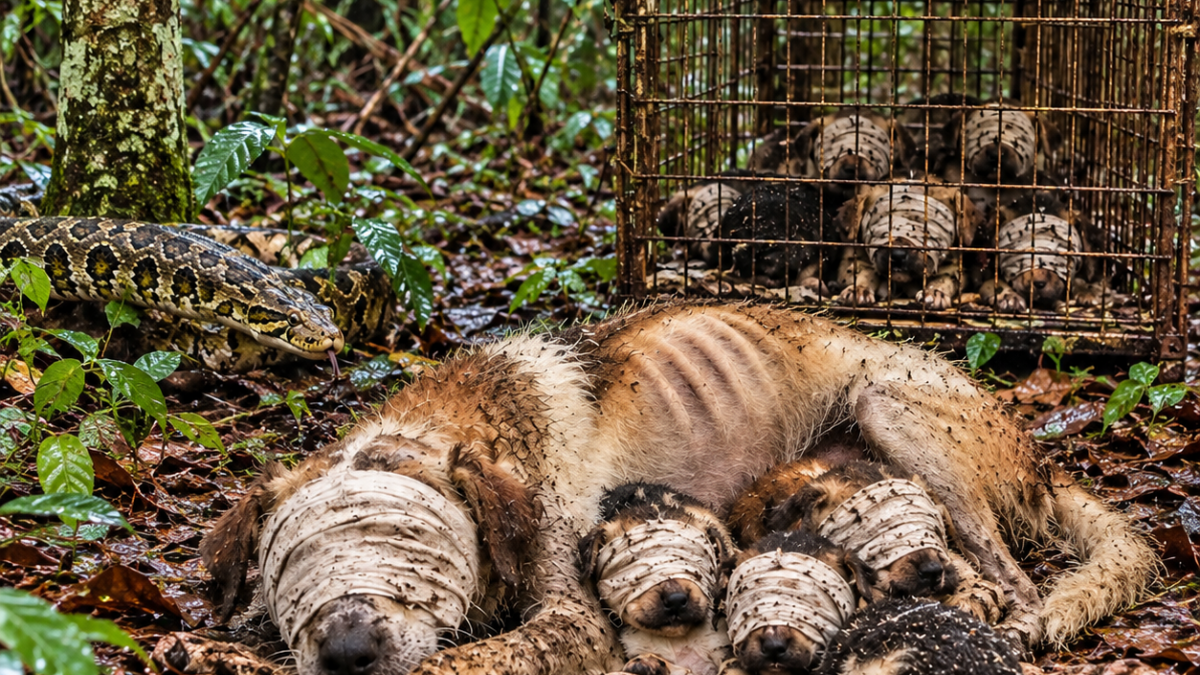
The snake on top of the cage moved.
Everyone froze.
The wildlife officer beside Mason slowly raised a capture tool.
“Stay back.”
The snake slid along the rusty frame and disappeared into vegetation on the opposite side.
Nobody chased it.
The forest was its home.
The dogs were the ones who had been placed where they didn’t belong.
Rachel crouched several feet from the mother.
“Hey, Mama.”
The dog lifted her head.
The dirty cloth shifted.
I could finally see one eye.
Brown.
Terrified.
Rachel spoke quietly.
“I’m going to help your babies.”
The mother tried to stand.
Her legs shook so badly she collapsed again.
Rachel looked at me.
“How long has she been like that?”
“I have no idea.”
“Did she walk when you arrived?”
“No.”
“What about the puppies?”
“Only crying and moving around inside.”
Rachel nodded.
“We’ll get Mom secured first.”
One of the officers checked the area around the cage while another watched the brush.
The snakes concerned us, but there was another danger.
Whoever had dragged the cage this far into the forest might have left wire, broken glass, bait, traps, or other debris.
Mason circled behind the tree.
“Clear back here.”
Rachel approached the mother slowly.
The dog’s breathing became faster.
“Easy.”
Rachel placed a looped lead on the ground instead of reaching over her.
The mother sniffed it.
Then one puppy cried.
Her head turned immediately.
Rachel glanced at me.
“She’s going to keep worrying about those puppies until we get them out.”
“Can we open the cage?”
“Soon.”
The lock was rusted.
A length of wire had been twisted through the latch.
That detail made my anger rise.
This hadn’t been a kennel somebody lost.
It had been deliberately closed.
Someone had put the puppies inside.
Someone had secured the door.
Then someone had brought them far enough into the forest that they were unlikely to be found by accident.
Rachel cut the wire.
The metallic snap made the mother flinch.
“It’s okay.”
The cage door opened.
The puppies did not rush out.
They moved deeper into the corner.
There were five.
I had thought four from where I was standing.
The fifth had been underneath the others.
Rachel reached in slowly.
The mother tried to rise again.
I moved closer but stopped outside her reach.
“Your babies are okay.”
She looked at me.
I had no idea whether my voice helped.
I kept talking anyway.
Rachel lifted the first puppy.
Tiny.
Mud covered its paws and belly.
Its body felt so light in her hands that her face changed.
“Underweight.”
She placed it into a clean transport crate lined with towels.
The second puppy followed.
Then the third.
Each time one cried, the mother struggled to follow.
By the fifth, she was whining.
Not loudly.
It was almost a breath.
Rachel finished and closed the crate.
Then she carried it to the mother and placed it near her nose.
“Here.”
The mother sniffed through the openings.
The puppies answered.
Her body relaxed.
Only slightly.
But enough.
Now it was her turn.
Rachel and I spread a blanket beside her.
Mason helped lift.
When I put my hands beneath the dog’s chest, I could feel every rib.
She was cold.
“Easy.”
She didn’t resist.
That was worse than resistance.
A healthy frightened dog might struggle.
She simply allowed us to move her.
The cloth across her face came loose as we lifted.
I finally saw why she had been struggling to see.
The fabric had been tied around her head.
Not tightly enough to stop her breathing.
But enough to partially cover her eyes.
Rachel stared at it.
“What the hell?”
Mason’s voice sharpened.
“Don’t cut it yet.”
Rachel looked at him.
“Evidence?”
“Photograph it exactly as found.”
She clenched her jaw.
“Fine. Fast.”
Two photographs.
Then Rachel cut the knot.
The fabric fell away.
The mother blinked.
Once.
Twice.
She looked around.
The world must have seemed painfully bright even under the gray forest canopy.
Then she turned toward the puppy crate.
Her tail moved.
Barely.
One small movement in the mud.
That was the moment I stopped thinking of her only as a victim.
She was still in there.
Under the exhaustion.
Under the fear.
Under everything somebody had done to her.
She was still there.
We carried her uphill on the blanket.
It took nearly forty minutes to reach the vehicles.
Rachel put the puppy crate beside their mother in the animal-control van.
The dog pressed her nose to it.
“I need a name for intake,” Rachel said.
“You want me to name her?”
“You found her.”
I looked at the forest behind us.
Rain still clung to every leaf.
The dog had survived long enough to hear one stranger coming through that darkness.
“Hope.”
Rachel smiled.
“Hope it is.”
I didn’t know then how much that name would come to mean.
At the emergency veterinary clinic, Hope was carried directly into an examination room.
The puppies went with her.
I stayed in the lobby because I had no legal claim to them and nothing useful to contribute.
For forty-five minutes, I stared at the floor.
Rachel eventually came through the doors.
“Well?”
“She’s dehydrated. Severely underweight. She has skin infections, parasites, several pressure sores, and inflammation around her eyes from that cloth.”
“Anything broken?”
“Not obviously.”
“The puppies?”
“All alive.”
I exhaled.
Rachel wasn’t finished.
“One is anemic. Two are significantly underweight. All have parasites. We’re watching one for respiratory symptoms.”
“But they’ll make it?”
She looked at me carefully.
“We’re optimistic.”
That was enough.
For that hour.
“What about Hope?”
“She’s producing milk, but her body’s been sacrificing everything for them.”
I knew what she meant.
Whatever nutrition Hope received had gone first to keeping five puppies alive.
“What happens now?”
“Food in controlled amounts. Fluids. Treatment. Rest. We let her see the puppies as much as medically safe.”
I nodded.
Then remembered the object in the mud.
“The key tag.”
Rachel’s expression changed.
“The officers collected it.”
“Could it identify someone?”
“Maybe.”
“Would someone really be stupid enough to drop something with their name on it?”
“People leave strange things behind.”
That turned out to be true.
The tag did not contain a name.
But it contained a dealership service number.
Mason called me two days later.
“You remember that tag?”
“Of course.”
“It belongs to a spare key issued by a used truck dealer.”
My heart started beating faster.
“They know who?”
“We’re working on it.”
“Can the dealer tell you?”
“If the records line up.”
He paused.
“There’s more.”
“What?”
“The tire tracks.”
I waited.
“Distinctive rear tread. One tire was worn unevenly.”
“Can that help?”
“Maybe not alone.”
“Then why tell me?”
“Because a trail camera half a mile from where you found the dogs recorded a pickup entering an unauthorized service road the night before.”
I stood up from my kitchen chair.
“You have video?”
“Images.”
“Can you see the plate?”
“Partially.”
“How partially?”
“Enough that we’re interested.”
The forest had done what the people responsible probably never considered.
It had watched them come in.
The camera had been placed months earlier to monitor illegal dumping and wildlife movement.
Most photographs showed deer.
Raccoons.
Wild pigs.
Occasionally hikers.
But at 11:43 the previous night, it captured a dark pickup moving slowly along the closed service road.
At 12:18, the same truck came back out.
The rear plate was smeared with mud.
Still, several characters were visible.
The left rear tire had a distinctive worn pattern.
And hanging near the bumper was a damaged reflector.
The officers compared those details with registration records associated with the dealership key number.
Two days later, they had an address.
I wanted to go.
Mason refused.
“This is an investigation.”
“I found them.”
“That doesn’t make you law enforcement.”
“I just want to know.”
“You’ll know what we can tell you.”
I hated waiting.
So I focused on Hope.
That was healthier anyway.
On the fourth day, the clinic allowed me into her recovery room.
Hope was lying on clean blankets.
The puppies were beside her in a heated enclosure with a low opening so she could reach them when supervised.
She lifted her head when I entered.
“Hey.”
Her ears moved.
I sat on the floor.
No cage between us.
No mud.
No snakes.
No rain.
Just white walls and the quiet hum of medical equipment.
Hope watched me for a long time.
Then she lowered her head.
I placed my hand on the floor halfway between us.
Not closer.
Five minutes passed.
One puppy woke.
It crawled toward her.
Hope licked its face.
Another began moving.
Then another.
Within seconds, all five were awake.
Hope looked exhausted.
I laughed softly.
“Yeah. I know.”
One puppy climbed across her front leg.
Hope sighed.
For the first time, I saw something almost normal.
Not a heroic mother battling danger.
Not a helpless animal abandoned in a forest.
Just a tired mom being climbed on by five demanding babies.
It was beautiful.
Rachel entered carrying a bowl.
“She’s eating better.”
“How much?”
“Enough that the vet is happy.”
Hope saw the bowl.
Her head lifted immediately.
Rachel grinned.
“That’s new.”
She placed it down.
Hope looked toward me.
Then toward Rachel.
Then ate.
Slowly at first.
Then faster.
I looked away.
I didn’t know why watching a dog eat could make a person emotional.
Maybe because three days earlier I had wondered whether she would survive.
The puppies received temporary names.
River.
Fern.
Moss.
Cedar.
And Poppy.
Poppy was the smallest.
She was also the loudest.
When the veterinarian tried to examine her, she screamed as though something terrible were happening.
Hope attempted to stand from across the room.
The vet laughed.
“Your daughter has opinions.”
Hope stared.
The puppies began gaining weight.
The anemic puppy responded to treatment.
The respiratory symptoms improved.
Hope’s eyes healed.
Her coat was cleaned gradually because the veterinary team didn’t want to stress her with a full bath too soon.
Under the mud, she was tan and white.
Beautiful.
But fear remained.
That was slower.
If someone carried a dark cloth, Hope froze.
If metal rattled, she flattened herself against the ground.
The first time a kennel door clicked behind her at the clinic, she panicked.
She threw herself toward the opening so hard that Rachel immediately opened it again.
“Okay. No closed doors.”
For several days, her recovery pen remained arranged so she could see the exit.
Hope needed to know she was not trapped.
That was when I understood something.
Rescue is not only taking an animal out of a bad place.
Sometimes the body leaves first.
The mind needs longer.
About a week after the rescue, Mason called.
“We found the truck.”
My stomach tightened.
“Who owns it?”
“A man named Travis Cole.”
I had never heard the name.
“He admit anything?”
“Not yet.”
“Did you search the truck?”
“I can’t discuss everything.”
“Was it the same truck?”
“It matches several documented features.”
“Does he own dogs?”
Another pause.
“We’re investigating.”
I knew enough to stop asking.
But Mason added one more thing.
“Neighbor says there used to be a female dog and puppies behind his property.”
Used to be.
I sat quietly after the call.
Hope had not wandered into that forest.
The puppies had not somehow crawled into a cage.
Someone had owned them.
Someone had loaded them into a truck.
Someone had driven past the last houses.
Past the legal dumping area.
Past the main trail.
Down an unauthorized service road.
Then carried or dragged that cage into the trees.
And left.
That detail changed my anger.
Abandonment is terrible anywhere.
But this had required effort.
The forest wasn’t convenient.
It had been selected because it was hidden.
The person who left Hope had done work to make sure she wasn’t easily found.
Yet the same distance meant something else now.
He had driven past many possible places to ask for help.
A shelter.
A clinic.
Animal control.
Even a police station.
Every mile deeper into the forest had been another chance to turn around.
He hadn’t.
Two weeks later, Hope moved to foster care.
Her foster mother was named Elena.
She lived outside town with a fenced yard and two calm senior dogs.
The puppies went too.
The first evening was difficult.
Hope refused to enter the house.
Elena stood inside the open door.
Hope stood outside.
No leash tension.
No pressure.
“Elena?” I said quietly.
“Give her time.”
For twenty minutes, Hope stared through the doorway.
The puppies were already inside a pen.
She could hear them.
That finally made the difference.
One puppy cried.
Hope stepped forward.
One paw crossed the threshold.
She stopped.
Nothing happened.
Second paw.
Then her whole body.
Elena didn’t celebrate loudly.
She simply backed away and gave Hope room.
Hope walked straight to the puppies.
Checked them.
Then looked around the house.
Warm floor.
Soft bedding.
Water.
No cage.
No rope.
No wet leaves.
She spent the first night beside the puppy pen.
Not on the bed Elena had prepared.
On the floor.
“Elena slept beside her,” Rachel told me the next morning.
“On the floor?”
“All night.”
I called Elena.
“You didn’t have to do that.”
“I know.”
“Your back okay?”
“No.”
I laughed.
“How’s Hope?”
“Asleep.”
“On the floor?”
“No. She stole the dog bed around four in the morning.”
That felt like progress.
Within three weeks, Hope started following Elena from room to room.
At first, it looked like anxiety.
Then it became companionship.
Hope discovered the kitchen.
More specifically, she discovered that the kitchen sometimes contained chicken.
That discovery transformed her.
The dog who once needed coaxing to eat became a professional negotiator.
Elena sent me a photograph of Hope sitting beside the refrigerator.
Caption:
She has been here for eleven minutes.
I replied:
Did you give her chicken?
Elena:
That is not the point.
Another message followed.
Yes.
The puppies became chaos.
River liked shoes.
Fern liked shoelaces.
Moss slept upside down.
Cedar barked at the washing machine.
Poppy remained furious about everything.
Hope tolerated them with saintly exhaustion.
One afternoon I visited while all five attacked a cardboard box.
Hope watched from the couch.
“You’re letting them destroy Elena’s house.”
Hope blinked.
Poppy ran past carrying a piece of cardboard twice her size.
Hope put her head down.
I nodded.
“I understand.”
That was the first time I saw Hope sleep deeply.
Her body went completely loose.
One paw twitched.
She dreamed.
I watched her for several minutes.
In the forest, she had been unable to lower her guard even while exhausted.
Every sound mattered.
Every cry from the puppies pulled her upright.
Now she could sleep through them destroying a box three feet away.
That was not laziness.
That was trust.
The investigation continued quietly.
Then Mason called again.
“We got a statement.”
“From Cole?”
“Yes.”
“What did he say?”
“He says he took the dogs into the forest.”
For a second, I couldn’t speak.
“He admitted it?”
“He admitted transporting them.”
“Why?”
“He says he was overwhelmed.”
I looked toward Hope sleeping in Elena’s living room.
“Overwhelmed?”
“He claims the dog had puppies unexpectedly. Said he couldn’t afford them.”
“There are shelters.”
“I know.”
“He could’ve called.”
“I know.”
“He covered her face.”
“That part is disputed.”
“What does that mean?”
“He denies tying the cloth.”
“Then how did it get there?”
“That’s part of what investigators are documenting.”
I breathed slowly.
“Did he lock the puppies in the cage?”
“He acknowledges placing them in the cage for transport.”
“And leaving it?”
“Yes.”
The simplicity of that yes hit harder than I expected.
“Did he know there were snakes?”
“He says he didn’t see any.”
“That doesn’t matter.”
“I agree.”
The snake was never the crime.
The forest itself was enough.
Cold.
Rain.
Parasites.
Predators.
No food.
No clean water.
No practical chance of escaping.
The danger did not need fangs.
The danger was being left there.
The local prosecutor accepted the case.
Charges included abandonment and cruelty-related counts based on the conditions documented by investigators and veterinarians.
I was warned not to discuss details publicly.
I didn’t care about publicity.
I wanted one thing.
I wanted Hope safe permanently.
Because until the ownership case was resolved, Cole could potentially attempt to reclaim her.
He did.
That was the moment my anger became something colder.
His attorney filed a challenge to the seizure.
Elena called me.
“He wants her back?”
“He’s challenging custody.”
“He left her in a forest.”
“I know.”
“With puppies.”
“I know.”
“In a cage.”
“I know.”
Elena’s voice shook.
“Look at her.”
Hope was lying on the kitchen floor beside Poppy.
“She trusts this house now.”
“I know.”
“What happens if the court says she goes back?”
I had no comforting answer.
“We show them the evidence.”
The hearing came almost two months after the rescue.
Hope’s puppies were old enough by then to spend more time away from her.
All five were healthy.
Hope had gained weight.
Her coat shone.
She still startled at cages.
Still hated dark fabric.
Still became anxious if all the puppies were removed from the room at once.
But she was changing.
I attended court as a witness.
Cole sat with his attorney.
He looked ordinary.
That bothered me.
I don’t know what I expected.
Someone who leaves a nursing mother and five puppies in a jungle does not walk into court with the word “villain” written across his face.
He looked like a man you might stand behind at a hardware store.
That is one reason neglect is so difficult for people to understand.
Terrible decisions are often made by completely ordinary people.
The prosecutor began with photographs.
The cage.
The forest.
The muddy ground.
Hope.
The puppies.
The cloth.
The wire around the cage latch.
Then came the trail-camera image.
Cole’s attorney objected to some of the prosecutor’s interpretation, but the basic facts remained.
A pickup matching Cole’s vehicle entered the restricted road late at night.
It left less than an hour later.
The key tag found in the mud was connected through dealership records to a spare key issued with his truck.
The unusual tire wear matched.
And eventually, Cole himself had acknowledged transporting the dogs.
The veterinarian testified about Hope’s condition.
“Was this dog healthy when she arrived?”
“No.”
“What did you observe?”
“Significant underweight body condition, dehydration, parasitic infection, skin inflammation, pressure lesions, irritation around the eyes, and general weakness consistent with inadequate care.”
“Could she adequately care for five nursing puppies in that condition?”
“She was trying. Her body was severely depleted.”
That sentence hurt.
She was trying.
Of course she was.
Even half-blind in the rain, she had tried.
The veterinarian described the puppies next.
Underweight.
Parasites.
Anemia in one.
Respiratory disease beginning in another.
The defense attorney asked a question.
“Doctor, did any of these animals die?”
The veterinarian looked at him.
“No.”
“So they survived.”
“Yes.”
“Would you agree that means their condition was not necessarily fatal?”
The veterinarian paused.
“Survival does not make the conditions humane.”
Silence.
I looked toward Cole.
He stared down at the table.
Then Mason testified.
Then Rachel.
Then me.
The prosecutor asked why I had left the trail.
“I heard puppies crying.”
“What did you find?”
“A mother dog beside a cage containing five puppies.”
“Describe the mother.”
“Weak. Wet. Very thin. Part of her face was covered with dirty cloth.”
“Did you observe wildlife nearby?”
“Yes.”
“What?”
“Snakes.”
“Did the mother attempt to flee?”
“No.”
“Why?”
“She could barely stand.”
Cole’s attorney questioned me next.
“You’re not a veterinarian?”
“No.”
“You’re not an animal-control officer?”
“No.”
“You’re not a wildlife biologist?”
“No.”
“So your conclusions about the animals’ health are personal impressions.”
“The medical conclusions came from the veterinarian.”
He paused.
“And the snakes? You cannot say they were going to attack these animals, can you?”
“No.”
That answer surprised him.
I continued.
“I never said they were.”
“So their presence is irrelevant?”
“No.”
“Why?”
“Because Hope and the puppies were placed in an environment where they had no way to protect themselves or leave. The snakes didn’t have to attack them for abandoning them there to be wrong.”
The attorney looked toward the judge.
“No further questions.”
I sat down.
The hearing continued.
Cole’s attorney argued that his client had panicked.
That financial stress had overwhelmed him.
That he had not intended for the dogs to suffer.
That he believed someone might eventually find them.
The judge interrupted.
“In a remote forest?”
The attorney paused.
“That was his statement.”
The judge looked toward Cole.
“You believed someone would find six dogs you left off a restricted service road?”
Cole shifted in his seat.
“I didn’t know what else to do.”
The judge’s voice remained calm.
“You could have called animal control.”
No answer.
“A shelter.”
Silence.
“A veterinary clinic.”
Cole looked down.
The judge continued.
“You found transportation.”
Cole raised his eyes.
“You found a cage.”
Silence.
“You found the time to drive into the forest.”
Nobody moved.
“But you did not find the time to make a telephone call.”
That was the entire case in four sentences.
The custody ruling came first.
Hope and the puppies would not be returned.
Elena began crying beside me.
I closed my eyes.
For the first time since I saw that rusted cage, I felt the muscles in my shoulders relax.
The criminal case continued separately.
But Hope was safe.
That night, I went to Elena’s house.
She had cooked dinner.
Not for us.
For herself.
Hope had already eaten.
She simply believed everyone else’s dinner was also potentially hers.
I sat on the floor.
“Good news, girl.”
Hope came over.
I touched the side of her face.
“No one is taking you back.”
She licked my hand.
Poppy attacked my shoelace.
I laughed.
“I’m trying to have a moment.”
Poppy didn’t care.
Hope walked away and climbed onto the couch.
Elena stared.
“That dog was terrified to enter my house two months ago.”
“And now?”
“She believes she owns the mortgage.”
Good.
That was exactly what I wanted.
The puppies began leaving for permanent homes over the following month.
River went to a retired couple with a fenced yard.
Fern went to a veterinary technician.
Moss joined a family with another rescue dog.
Cedar went home with a firefighter who had met him during a shelter event.
Poppy stayed longest.
Every departure was hard for Hope.
When River left, Hope searched the room.
She checked behind the couch.
Then the yard.
Then the puppy pen.
Elena sat with her.
“He’s safe.”
Hope paced.
“He’s safe.”
Eventually Hope lay beside Elena.
A week later, River came back for a short visit.
Hope recognized him immediately.
She ran across the yard.
River ran too.
They met in the middle.
Hope checked every inch of him.
Then she looked toward his new family.
River’s adopter knelt.
“He’s doing great, Mama.”
Hope sniffed her hands.
Something changed after that.
When Fern left, Hope still watched.
But she didn’t search for hours.
When Moss left, she stood at the gate until the car disappeared.
Then she went inside.
By Cedar’s adoption, she seemed to understand.
Puppies left.
But leaving was not always abandonment.
That lesson mattered.
Poppy’s adoption was different.
Elena had been avoiding the subject.
I knew it.
Rachel knew it.
Probably Poppy knew it.
Finally I asked.
“When are you posting Poppy?”
Elena pretended not to hear.
“Elena.”
“I’m considering options.”
“What options?”
“Various options.”
“You’re keeping her.”
“I didn’t say that.”
Poppy climbed onto Elena’s foot.
Hope was asleep beside them.
I folded my arms.
“Elena.”
She sighed.
“Fine.”
“So Hope gets to keep one?”
“She doesn’t get to keep her.”
“Who does?”
“I do.”
“Sure.”
Poppy wagged.
Hope opened one eye.
I laughed.
“Family decision?”
“Apparently.”
Poppy was adopted by Elena.
Two weeks later, Elena asked another question.
“What about Hope?”
“What about her?”
“Are we seriously pretending she’s going somewhere else?”
I smiled.
“You want to adopt Hope too.”
“I want to stop calling what’s happening here ‘foster care.’”
Hope walked in from the yard carrying a stolen gardening glove.
Elena pointed.
“This is permanent behavior.”
I laughed.
The adoption was scheduled after the criminal case reached resolution.
Cole eventually entered a plea on several counts.
The final sentence included fines, restitution toward animal-care costs, probation, mandatory compliance checks, and a prohibition on owning or possessing animals for a period imposed by the court.
Some people thought the punishment should have been harsher.
Others thought it was too harsh.
I stopped caring about arguments.
The part that mattered to me was simple.
He could not reclaim Hope.
He could not reclaim the puppies.
And there was an official record showing that what happened in that forest had consequences.
After court, I expected satisfaction.
Instead, I felt tired.
Rachel met me outside.
“You okay?”
“I wanted this for months.”
“And?”
“It doesn’t feel like revenge.”
She looked at me.
“Good.”
I raised an eyebrow.
She nodded toward the parking lot.
“Revenge wouldn’t help Hope.”
“What does?”
“You already know.”
I did.
We drove to Elena’s house.
Hope greeted us at the door.
Poppy was directly behind her.
Both were wearing new collars.
Elena had prepared adoption forms.
Rachel laughed.
“You couldn’t wait one day?”
“No.”
Hope pushed her nose into my hand.
Elena sat at the table.
“Sign as witness.”
I did.
When it was finished, Elena held the paperwork against her chest.
Hope stared at the kitchen.
Poppy chewed a toy.
Nobody except the humans understood that anything important had happened.
“Hope,” Elena said.
The dog looked at her.
“You’re home.”
Hope walked over.
Elena wrapped her arms around her.
Poppy joined.
The three of them ended up in a ridiculous pile on the kitchen floor.
I watched from the table.
That was the revenge.
Not Cole’s fine.
Not the court order.
Not the embarrassment of seeing photographs shown in court.
This.
A dog who had been taken into a jungle to disappear now had an address.
A bed.
A person.
One of her babies.
A veterinarian.
Neighbors who knew her name.
A future.
The person who had tried to make her invisible failed.
Completely.
Months passed.
Hope became almost unrecognizable.
She gained healthy weight.
Her coat became thick.
Her eyes changed most.
The frightened, distant stare disappeared.
She started making demands.
Breakfast too late?
Stare at Elena.
Walk too short?
Sit by the leash.
Closed bathroom door?
Unacceptable.
Poppy grew into a chaotic young dog who seemed determined to undo every quiet moment Hope earned.
One afternoon I visited and found Poppy dragging a blanket across the living room.
“What is she doing?”
Elena shrugged.
“Interior design.”
Hope was lying on the couch.
“You’re her mother. Stop her.”
Hope looked away.
Elena laughed.
“She has retired.”
Maybe she had.
She deserved to.
The first heavy storm of the next rainy season frightened her.
Thunder rolled across the house.
Hope immediately stood.
Her body became stiff.
She looked toward the windows.
Then toward Poppy.
Poppy was asleep.
Hope walked over.
Sniffed her.
Another thunderclap.
Hope started pacing.
Elena sat on the floor.
“Come here.”
Hope hesitated.
Rain hit the roof harder.
For a second, I could see the forest returning in her mind.
The wet ground.
The cage.
The crying puppies.
The cloth.
Maybe she remembered none of it the way humans remember.
Maybe she remembered only sensations.
Darkness.
Rain.
Fear.
Being unable to leave.
Elena patted the floor.
“Hope.”
Hope crossed the room.
She lay beside her.
Poppy woke and climbed across Hope’s back.
Hope sighed.
Elena smiled.
“Everybody’s here.”
Eventually, Hope lowered her head.
The storm continued.
She slept.
That was healing.
Not forgetting the storm.
Learning that the storm no longer meant she was trapped in it.
A year after the rescue, all five puppies returned for a reunion.
River arrived first.
Then Fern.
Moss.
Cedar.
Poppy already lived there.
When Hope saw them together, something remarkable happened.
She became playful.
Not protective.
Not anxious.
Playful.
The dogs ran across the yard.
Hope chased them.
River chased Hope.
Cedar stole a ball.
Poppy tackled Moss.
Fern jumped into a plastic kiddie pool.
Everyone shouted at once.
Elena stood near the porch laughing.
I stepped back.
For a moment, I closed my eyes.
I could hear puppies.
But not crying.
Playing.
I opened my eyes again.
Six dogs ran through sunlight.
No cage.
No rust.
No snakes.
No darkness.
I thought about the forest.
The strange thing about that place was that I had hated it afterward.
For months, whenever someone mentioned the trail, I pictured Hope in the mud.
Eventually Mason changed that.
He invited me back to check the old camera.
“I don’t want to go.”
“Why?”
“You know why.”
“That place didn’t hurt them.”
I looked at him.
“He’s the one who took them there. The forest didn’t.”
I knew he was right.
So I went.
The trail looked different in sunlight.
Green.
Alive.
Birds everywhere.
We found the old location.
The cage was long gone.
Evidence technicians had removed it.
Vegetation had begun reclaiming the mud.
There was no sign that six dogs had nearly disappeared there.
Mason stood beside the tree.
“Camera was over there.”
I looked uphill.
“That tiny thing?”
“Yep.”
“That’s what caught the truck?”
“Enough of it.”
I smiled.
“The forest told on him.”
Mason laughed.
“In a way.”
The phrase stayed with me.
Whoever abandoned Hope had chosen the forest because he believed it would hide what he had done.
Instead, tire tracks remained.
The key tag remained.
The trail camera remained.
The dogs remained alive.
Every part of his plan depended on nobody looking closely.
Then one person heard a puppy cry.
That was all.
We walked back toward the trail.
Halfway out, leaves moved near my boot.
I stopped.
A snake slid across the path.
Mason smiled.
“You okay?”
I watched it disappear into vegetation.
“Yeah.”
I was.
The snake had never been the villain.
It was simply living where it belonged.
Hope had been put there by a human.
That distinction mattered.
By the second anniversary of her rescue, Hope had become the unofficial welcome dog for Elena’s foster animals.
Elena started fostering frightened mothers.
Not intentionally at first.
Then word spread.
“She’s good with them,” Rachel told me.
Hope was.
A new dog would arrive nervous.
Hope would keep her distance.
She never rushed.
Never crowded.
She simply existed nearby.
Eat.
Sleep.
Walk.
Come back.
Trust Elena.
New dogs watched her.
Sometimes I wondered whether they understood each other in ways we couldn’t.
Hope had learned safety from repetition.
Now she became part of someone else’s repetition.
One mother dog named June refused to enter the house.
For three nights, Elena fed her near the doorway.
Hope began lying just inside.
On the fourth evening, June stepped over the threshold.
She walked directly to Hope.
Lay down beside her.
Elena called me crying.
“Hope brought her in.”
Maybe.
Or maybe June simply saw another dog sleeping peacefully and decided the room could not be entirely dangerous.
Either way, Hope had gone from needing rescue to helping create it.
That transformation meant more to me than any courtroom scene.
I stopped thinking of her former owner.
At first, that surprised me.
For months, I had imagined him whenever I looked at Hope.
Then less often.
Then barely at all.
The court order existed.
Consequences existed.
He no longer had any authority over her.
Continuing to center him in Hope’s story would have given him importance he no longer deserved.
Justice had already taken away his control.
Life did the rest.
Hope’s days belonged to Hope now.
One evening, almost three years after the rescue, I sat on Elena’s porch.
Hope lay beside me.
Poppy was digging in the yard.
“Elena.”
“I see her.”
“That hole is getting large.”
“I see it.”
“Aren’t you going to stop her?”
Elena sighed.
“Poppy!”
Poppy looked up.
Mud covered her nose.
Hope opened one eye.
I started laughing.
“What?”
“Nothing.”
“No. What?”
I thought about all the things someone once used as reasons to give up on animals.
Too expensive.
Too difficult.
Too many puppies.
Too much work.
Now Poppy was destroying landscaping and Elena’s only reaction was mild exhaustion.
“She’s inconvenient,” I said.
Elena stared at me.
“Extremely.”
“And?”
“And I’m going to fill the hole.”
That was it.
No abandonment.
No cage.
No forest.
A dog could be difficult and still belong.
That was one of the greatest things Hope’s family learned.
Love was not conditional on convenience.
Later, the sky darkened.
Rain began.
Hope lifted her head.
Poppy ran onto the porch shaking water everywhere.
Elena shouted.
“Not on me!”
Too late.
Poppy sprayed us all.
I laughed.
Hope stood.
For a moment she looked toward the rain.
I remembered her body in the mud.
Her face partly covered.
Her puppies trapped behind rusty bars.
Then Hope turned away from the storm.
She walked through the open door.
Inside.
By choice.
That detail still mattered to me.
Nobody carried her.
Nobody dragged her.
Nobody closed a cage.
She walked into a warm house because she knew it was hers.
Poppy followed.
Elena closed the door.
Rain tapped against the windows.
Hope went to her bed.
Poppy climbed beside her.
Too big now.
Hope tolerated it.
I sat nearby.
“She still mothers her.”
“She always will.”
Hope licked Poppy’s ear.
Poppy fell asleep.
I asked Elena something.
“Do you think Hope remembers all five of them?”
“Yes.”
“How can you be sure?”
“You should see her when they visit.”
I smiled.
She was right.
Whenever one of the grown puppies arrived, Hope performed the same inspection.
Face.
Ears.
Body.
Then their family.
As if asking:
Did you feed my baby?
Did you keep my baby warm?
Did you bring my baby home?
Every family passed.
The final reunion happened on a bright fall afternoon.
River’s family brought a blue ball.
Fern arrived wearing a ridiculous sweater.
Moss had gained too much weight and was officially on a diet.
Cedar had become obsessed with fetching sticks.
Poppy remained Poppy.
Hope stood in the middle of them.
Older now.
Some gray around her face.
Slower.
But healthy.
One by one, the puppies settled near her.
Not because anyone arranged them.
They simply did.
Five grown dogs around their mother.
I took a photograph.
Later, I compared it with the first photograph from the rescue file.
I nearly couldn’t breathe.
First photo:
Mud.
Rust.
Darkness.
Five tiny bodies.
Hope lying beside the cage.
Second photo:
Grass.
Sunlight.
Five healthy adult dogs.
Hope in the center.
Same family.
Different world.
Elena looked over my shoulder.
“Delete the first one.”
“What?”
“Not literally.”
She pointed at the rescue photograph.
“I mean stop looking at that one every time you look at this one.”
I understood.
“But it matters.”
“It does.”
She touched the new photograph.
“This matters too.”
Maybe more.
We need records of suffering because accountability depends on truth.
But suffering should not become the only image an animal is allowed to carry forever.
Hope’s story began for me in a dark forest.
It did not end there.
Her ending was ordinary.
That was why it was perfect.
Dinner at six.
A bed near Elena’s room.
Poppy stealing her blanket.
Storms outside windows.
Vet appointments.
Walks.
Gray hair.
Reunions.
A name tag that carried a phone number and an address.
Home.
Years after finding her, I returned to Elena’s house one morning.
Hope was older.
She walked more slowly.
Her muzzle had become almost white.
But when I called her name, her tail began moving.
“Hey, girl.”
She came toward me.
I crouched.
Hope placed her head against my chest.
For several seconds, I held her.
Then she pulled away because apparently greeting me was less important than checking the grocery bag I had brought.
I laughed.
“You haven’t changed that much.”
Elena walked out.
“She thinks you brought chicken.”
“I did.”
“Then she knows you better than I do.”
We sat outside while Hope ate a few pieces.
Poppy lay in the sun.
Birds moved through the trees.
Nothing dramatic happened.
And I realized that was exactly what I had wanted for Hope from the first moment.
Not heroism.
Not constant survival.
Peace.
The kind of life where nothing dramatic needs to happen.
Where a dog can spend an afternoon sleeping.
Where rain is just rain.
Where leaves moving in the grass don’t mean danger.
Where puppies grow up and come back.
Where nobody is trying to disappear you.
I once thought Hope’s greatest victory was surviving the jungle.
I was wrong.
Her greatest victory was reaching a point where survival stopped being the main thing she did.
She lived.
Fully.
Ordinarily.
Happily.
The person who left her in that forest had intended the trees to hide her.
Instead, those same trees held the evidence that helped us find the truth.
He thought distance would make her invisible.
Instead, one cry carried far enough for me to hear.
He thought a rusted cage would hold her family until nobody cared anymore.
Instead, every puppy left that cage and grew up loved.
He thought that night in the forest was the end of their story.
It became the beginning.
That was the revenge.
Not violence.
Not humiliation.
Not returning cruelty for cruelty.
The most complete revenge was that everything his actions were supposed to take from Hope eventually came back to her in another form.
He left her without shelter.
She got a home.
He left her without food.
She became the dog who demanded chicken from the refrigerator.
He left her surrounded by danger.
She learned to sleep through thunderstorms.
He trapped her babies.
They grew up running freely through yards of their own.
He took her somewhere he believed nobody would find her.
She became known and loved by an entire network of people.
And most importantly, he lost the right to decide what happened next.
Hope walked away from his choices.
One step at a time.
Years later, she stood at Elena’s doorway while rain fell outside.
I was there again.
So was Poppy.
Hope looked toward the yard.
Then toward Elena.
Elena held the door open.
“You want out?”
Hope considered it.
Rain fell harder.
She turned around.
Walked back to her bed.
Elena laughed.
“Good choice.”
I watched Hope curl beside Poppy.
Her eyes closed.
No cloth covered her face.
No metal surrounded her.
No puppies cried from behind bars.
No danger moved closer through wet leaves.
Only rain.
Only home.
Only the quiet breathing of two dogs who knew morning would find them in the same safe place.
I sat beside her and ran my hand gently over the gray fur around her face.
The first time I met Hope, she had almost nothing left except the instinct to stay beside her babies.
Now those babies were grown.
She no longer had to protect them from the world.
The world had finally given something back.
Warmth.
Safety.
Food.
Freedom.
Family.
Time.
Hope opened her eyes.
I whispered, “You stayed for them.”
Her tail moved once.
“And somebody finally stayed for you.”
Across the room, Elena heard me.
She smiled.
“She never has to wonder about that again.”
Hope closed her eyes.
Outside, the forest beyond the house was dark with rain.
But Hope was no longer trapped inside it.
She was exactly where she had chosen to be.
Home.
The years after Hope’s rescue did something I never expected.
They made the forest smaller.
Not physically, of course.
The trees were still there.
The old service road still disappeared between them.
Rain still collected in the ruts where trucks had once passed.
Snakes still moved beneath the leaves because that had always been their home.
But in my mind, that forest had once seemed enormous.
For months after finding Hope and her puppies there, I couldn’t think about those trees without remembering the cage.
The mud.
The dirty cloth covering part of Hope’s face.
Five puppies crying behind rusty metal.
Hope’s body shaking as she tried to stand between them and danger.
That image had become bigger than everything else.
Then life began replacing it.
One ordinary day at a time.
Three years after the rescue, I was standing in Elena’s kitchen when Hope came walking toward me with a stolen dish towel hanging from her mouth.
I stared at her.
“Seriously?”
Hope stopped.
The towel remained clamped between her teeth.
Elena looked over from the sink.
“She’s been doing that all week.”
“Why?”
“You’re asking the wrong person.”
Hope turned and walked toward the living room.
I followed.
“Hope.”
She walked faster.
“Give me the towel.”
Her tail began wagging.
Elena started laughing.
“She thinks you’re playing.”
“I’m not playing.”
Hope trotted around the couch.
I went the other way.
She reversed direction.
“Unbelievable.”
Three years earlier, that dog had barely possessed enough strength to lift herself from the mud.
Now I was chasing her around furniture because she had stolen kitchen linen.
And somehow that ridiculous moment made me happier than nearly anything the rescue had given me.
Hope eventually dropped the towel on her bed and sat on it.
I looked at Elena.
“She knows exactly what she’s doing.”
“Oh, absolutely.”
Poppy walked into the room carrying one of Elena’s slippers.
I pointed.
“There’s another criminal.”
Elena sighed.
“I should’ve adopted cats.”
Hope lay down.
Poppy curled beside her.
Within minutes, both were asleep.
The house became quiet again.
I sat on the couch and watched them breathe.
Poppy had grown into a beautiful adult dog, although she seemed permanently convinced that she was still small enough to fit entirely on top of her mother.
Hope tolerated this with the patience of someone who had accepted years earlier that motherhood did not end when puppies became full-sized dogs.
Sometimes Poppy would stretch across Hope’s bed and leave her mother only six inches of space.
Hope would stand nearby looking at Elena.
Elena would say, “You raised her.”
Hope’s expression seemed to answer, “That does not make this my fault.”
Eventually Hope squeezed onto the bed anyway.
They always found room.
That became one of my favorite things about them.
The beginning of Hope’s story had been about not having enough.
Not enough food.
Not enough water.
Not enough shelter.
Not enough safety.
Not enough space.
Now even when a bed was too small, somehow there was enough.
Enough warmth.
Enough trust.
Enough belonging.
A few months later, the first of Hope’s puppies turned four.
River’s family invited all of us to a little birthday gathering.
I laughed when Elena told me.
“You’re attending a dog birthday party?”
“You’re invited too.”
“That was not an answer.”
“Yes, I’m attending a dog birthday party.”
“Will there be cake?”
“For the humans.”
“Then I’m coming.”
Hope rode in the back seat beside Poppy.
Car rides had once frightened her.
Now she knew the sound of Elena picking up the keys.
If Elena said, “Want to go?”
Hope was already at the door.
On the drive, she stood secured behind the seat and watched the world pass through the window.
Fields.
Mailboxes.
Houses.
People.
Nothing trapped her.
Nothing covered her eyes.
I sometimes wondered if she remembered the truck ride into the forest.
Maybe she did.
Maybe she didn’t.
But she had taken enough good rides afterward that a car no longer belonged only to fear.
That was what healing seemed to do for Hope.
It did not always erase the old association.
It simply built something larger beside it.
When we reached River’s house, he was waiting behind the gate.
The moment Hope stepped out, River began barking.
Hope’s ears rose.
Then she ran.
River met her halfway across the yard.
He was much larger than his mother now.
Broad shoulders.
Strong legs.
A glossy coat.
Hope inspected him exactly as she always did.
Face.
Ears.
Chest.
Back.
Then she smelled his mouth.
River stood patiently.
His adopter, Mark, laughed.
“Still checking whether I feed him?”
Hope looked at him.
“Yes, ma’am. He gets dinner every night.”
Hope returned to River.
Inspection completed.
Within half an hour, the other puppies arrived.
Fern.
Moss.
Cedar.
Poppy was already there.
Five adult dogs surrounded their mother.
I had seen reunions before.
But there was something different that day.
Maybe because enough time had passed.
The puppies no longer looked remotely like the tiny animals I had carried out of that forest.
They were adults now.
They had personalities shaped by lives Hope had never been able to imagine while lying beside that cage.
River loved children.
Fern slept every night beside the veterinary technician who had adopted her.
Moss had become obsessed with tennis balls.
Cedar went camping with his firefighter owner.
Poppy lived with Hope and believed Elena’s home had been built specifically for her convenience.
Five lives.
Five futures.
All of them had once fit behind the same rusted door.
At one point, the dogs stopped playing and gathered near the porch.
Hope sat in the middle.
River lay beside her.
Fern rested her head across Hope’s back.
Cedar chewed a stick.
Moss stretched in the grass.
Poppy pressed against her mother’s side.
Nobody arranged them.
It simply happened.
I lifted my phone.
Then paused.
Elena noticed.
“You’re not taking a picture?”
“I am.”
I took one.
Only one.
Then I put the phone away.
Some moments don’t improve by being viewed through a screen.
I wanted to remember the sound.
Five dogs breathing.
People laughing in the background.
Leaves moving overhead.
Hope’s collar jingling when she turned her head.
No crying.
That was what mattered.
Later, Mark brought out the first photograph he had ever seen of River.
The shelter intake image.
River as a tiny puppy.
Mud on his face.
Eyes barely open.
Mark looked at Hope.
“Hard to believe.”
Elena nodded.
“I try not to look at those pictures too often anymore.”
“Why?”
She glanced toward me.
I knew the answer.
Because there comes a point when surviving cruelty cannot remain the only lens through which you see an animal.
Hope deserved to become more than the dog from the forest.
River deserved to become more than the puppy from the cage.
They were allowed to outgrow the worst thing that happened to them.
That evening, when the party ended, the puppies left one at a time.
Hope watched each departure.
Fern first.
Then Moss.
Then Cedar.
River stayed because it was his home.
Years earlier, watching a puppy disappear through a door had thrown Hope into panic.
Now she simply observed.
Poppy climbed into Elena’s car.
Hope followed.
No searching.
No crying.
She knew her children had homes.
She had learned one of the hardest lessons of her life.
Leaving did not always mean loss.
Sometimes leaving meant going somewhere safe.
That lesson changed Hope beyond her puppies.
It changed the way she responded to Elena too.
During her first months in foster care, if Elena walked out the front door, Hope would wait beside it.
Ten minutes.
Twenty.
An hour.
She listened for the car.
Listened for footsteps.
Sometimes refused to sleep until Elena returned.
By her third year, Elena could leave for groceries and come home to find Hope upside down on the couch.
The first time it happened, Elena sent me a picture.
Hope’s front paws were in the air.
Her mouth hung slightly open.
Poppy was asleep across her belly.
The message said:
Apparently nobody missed me.
I replied:
That means she trusts you.
Elena later told me she cried after reading it.
Because I was right.
Hope no longer needed to remain awake to make sure love returned.
She expected it.
There was another change too.
Hope began choosing solitude.
That might sound insignificant.
For a dog who had once stayed glued to her puppies because danger surrounded them, choosing to lie alone in another room was enormous.
She discovered a patch of afternoon sunlight near Elena’s bedroom window.
Every day around two, Hope went there.
Poppy sometimes followed.
Hope would stand up and move.
“She wants five minutes alone,” Elena said.
“Mothers everywhere understand.”
Eventually Poppy learned to leave her there.
Hope would sleep in the sunlight.
Alone.
Safe enough not to guard anyone.
Safe enough not to be guarded.
By the fourth anniversary of the rescue, gray had started spreading across Hope’s muzzle.
We did not know exactly how old she was.
The veterinarian estimated she had already been an adult when she gave birth.
Time was beginning to show.
Her morning walks shortened.
She preferred softer beds.
She took longer to stand after sleeping.
Elena added joint supplements and placed rugs across the slickest floors.
When Hope hesitated at the porch steps, Elena built a shallow ramp.
One afternoon I watched Hope use it.
“Looks familiar,” I said.
“What?”
“The accommodations.”
Elena smiled.
“We’re aging together.”
There was no sadness in the way she said it.
Only acceptance.
That mattered because Hope’s first owner had apparently treated difficulty as a reason to get rid of her.
Elena treated change as a reason to change the house.
If Hope couldn’t use the steps, build a ramp.
If she needed a softer bed, buy one.
If her walks became shorter, walk shorter.
Love adjusted.
It did not leave.
One rainy November evening, I arrived while a thunderstorm was moving in.
Years earlier, Hope would have started pacing before the first loud crack.
This time she was asleep beside Elena.
Thunder rolled.
One ear moved.
That was all.
Poppy lifted her head.
Hope didn’t.
I sat down.
“She doesn’t care anymore.”
Elena shook her head.
“She notices.”
Another rumble.
Hope’s eyes opened.
She looked toward the window.
Then at Elena.
Then closed them again.
“She knows where she is,” Elena said.
There was the difference.
Fear had not vanished completely.
But fear no longer outranked safety.
A storm was happening outside.
Hope knew she was inside.
The past was somewhere behind her.
The present was stronger.
When I found her in the forest, I had wished for a rescue.
Then I wished for recovery.
Then justice.
Then adoption.
Eventually, I realized I had one final wish.
I wanted Hope to grow old somewhere safe.
Not simply survive long enough to become an inspirational story.
Grow old.
Have ordinary aches.
Become gray.
Move slowly.
Need help.
Become inconvenient again.
And discover that inconvenience would not cost her home.
That became the last test of everything Elena had promised.
Hope passed it simply by aging.
One morning, Elena called.
Her voice was worried.
“Hope doesn’t want breakfast.”
I was at her house within an hour.
The veterinarian had already scheduled an examination.
Hope lay on her bed.
Her head lifted when I came inside.
“Hey, girl.”
Her tail moved.
Not much.
Enough.
Poppy lay beside her.
Elena sat on the floor.
“I know dogs skip meals sometimes,” she said.
“But Hope doesn’t.”
“No.”
Hope considered missing breakfast a violation of natural law.
The veterinarian found an infection.
Treatable.
Medication.
Fluids.
Rest.
Nothing catastrophic.
Still, watching Elena during those two days changed me.
She slept downstairs beside Hope.
Carried water closer.
Warmed food.
Called the clinic every time she worried.
Hope became work.
Real work.
For the first time in years, caring for her was difficult.
And Elena never once behaved as if Hope owed her an easier life.
On the third morning, Hope walked into the kitchen.
Elena was making coffee.
Hope sat beside the refrigerator.
Elena froze.
“You hungry?”
Hope stared.
Elena laughed and cried at the same time.
“Okay. You’re back.”
She opened a container of chicken.
Hope ate.
I received the video twenty minutes later.
I watched it three times.
Not because eating chicken was remarkable.
Because of what it represented.
Years before, somebody had apparently looked at an animal who needed more than he wanted to give and decided disappearance was easier.
Now Hope needed more again.
And somebody stayed.
That was the promise finally completed.
Months later, the animal welfare office asked Elena whether Hope could appear in an educational program about responsible pet surrender and abandonment.
Elena hesitated.
She called me.
“What do you think?”
“Does Hope care?”
“Hope cares about snacks.”
“Then bring snacks.”
The event was small.
No dramatic stage.
No exploitation of her suffering.
Hope walked into a community center beside Elena wearing her red collar.
Rachel spoke about available shelters.
Low-cost veterinary programs.
Emergency surrender options.
Temporary foster assistance.
She explained something I wished every overwhelmed pet owner understood:
Asking for help is not abandonment.
Surrendering an animal safely can be painful, but it is different from leaving an animal to die.
Hope lay beneath Elena’s chair during the talk.
At one point, a young man raised his hand.
“What if somebody really can’t afford their dog anymore?”
Rachel answered without judgment.
“Call before it becomes a crisis.”
She listed local resources.
Hope slept.
I watched her.
Maybe that was another form of justice.
The dog somebody had hidden because he thought he had no option was now helping people learn there had been options all along.
At the end, a woman approached Elena.
“My mother has three dogs and she’s going into assisted living.”
Her eyes filled.
“I’ve been scared to call because I thought the shelter would judge us.”
Rachel heard her.
She came over.
“Call tomorrow.”
The woman nodded.
Hope woke and leaned against her leg.
The woman bent down.
“Is this the dog from the forest?”
Elena smiled.
“This is Hope.”
The woman scratched her neck.
“She’s beautiful.”
Hope’s tail moved.
On the drive home, Elena said, “Maybe that was worth doing.”
I looked back at Hope asleep beside Poppy.
“Yeah.”
Because Hope’s story had become bigger than revenge.
Punishment had mattered.
Accountability had mattered.
But prevention mattered more.
If one person asked for help instead of abandoning an animal because they heard what happened to Hope, then something useful had grown from the worst part of her life.
The fifth anniversary arrived quietly.
No big event.
No reporters.
No courtroom.
Just all five puppies returning to Elena’s house.
They were older too.
River had gray near his nose.
Moss had finally lost the extra weight.
Fern moved with the confidence of a dog who had spent years inside a veterinary clinic.
Cedar remained obsessed with sticks.
Poppy still stole things.
Hope walked into the yard to greet them.
Slowly now.
The puppies did something I had never seen before.
They ran toward her.
Then slowed.
As if somehow they understood.
River reached her first and gently touched noses.
Fern stood beside her.
Moss leaned against her shoulder.
Cedar dropped a stick at her feet.
Poppy pressed herself against Hope’s other side.
Hope stood surrounded by the babies she had once been unable to save alone.
She had saved them long enough.
Then strangers helped finish the job.
Elena’s eyes filled with tears.
I said nothing.
We simply watched.
That afternoon, Hope lay beneath a tree while her grown puppies scattered around the yard.
I sat beside her.
“You did pretty well.”
Her eyes opened.
I scratched behind her ear.
“You know that?”
Her tail moved once.
Years had passed since I first heard a puppy crying through rain.
The rusted cage was long gone.
The criminal case had been closed.
The trail camera had been replaced.
Vegetation had swallowed the tire tracks.
Most people who once followed the story had moved on to something else.
That was fine.
Hope had moved on too.
That became the ending I wanted most.
Not to remain permanently famous for suffering.
To become an old dog sleeping under a tree.
Later, when everyone left, Hope walked back toward the house.
Her pace was slow.
Elena opened the door.
Poppy went through first.
Hope reached the threshold.
Stopped.
Looked back at the yard.
Five years earlier, I had watched her hesitate at another opening.
The cage door.
Back then, freedom had terrified her because she did not know what waited outside.
Now she stood in an open doorway for an entirely different reason.
She was simply deciding whether she wanted to stay outside a little longer.
Elena waited.
No command.
No pressure.
Hope turned toward the yard.
Walked back into the grass.
Elena laughed.
“Apparently we’re not done.”
We sat on the porch.
Hope found a patch of evening sunlight and lay down.
The sky slowly changed color.
Poppy joined her.
I thought about the line I once used when people asked me what Hope’s revenge had been.
I used to say she survived.
Then I said she got a home.
Later I said the man who abandoned her lost every right to control her future.
All were true.
But sitting there, I finally understood the complete answer.
Hope’s revenge was choice.
The cage had taken choice away.
The forest had been chosen for her.
The darkness.
The isolation.
The puppies trapped behind bars.
All of it was somebody else deciding what her life was worth.
Now Hope made decisions all day long.
Inside or outside.
Bed or couch.
Chicken or regular food.
Walk now or later.
Stay beside Poppy or find the sunny room alone.
Come when called or pretend not to hear.
Dig a hole until Elena complained.
Climb into the car because she expected a park at the other end.
Sleep during rain.
Wake when she wanted.
Return home because she chose to.
That was freedom.
Not running endlessly away from something.
Having somewhere safe enough that you could leave and still want to come back.
Darkness eventually settled over the yard.
Elena stood.
“Okay, old lady. Inside.”
Hope lifted her head.
She took her time standing.
Poppy waited beside her.
Together they walked toward the porch.
At the doorway, Hope stopped beside me.
I touched the white fur around her muzzle.
“You know I heard your babies before I saw you?”
Hope looked at me.
“I thought I was rescuing six dogs.”
Her tail moved.
“I didn’t know I was going to watch an entire family grow up.”
Elena stood inside.
“Come on, Hope.”
Hope turned toward her.
There was no hesitation.
She walked in.
Poppy followed.
I entered last and closed the door.
Rain began sometime after midnight.
Soft at first.
Then heavier.
I slept in Elena’s guest room because the roads had become slick.
When I woke early the next morning, I heard movement in the kitchen.
Hope was standing there.
Waiting for breakfast.
Of course.
Elena opened the refrigerator.
“Chicken?”
Hope’s tail moved.
“You are spoiled.”
I leaned against the doorway.
“She earned it.”
Elena put chicken into the bowl.
Hope ate.
Poppy tried to steal some.
Hope gave her one look.
Poppy backed away.
I laughed.
“She’s still a mother.”
“Always.”
When Hope finished, she walked toward the back door.
Elena opened it.
The storm had passed.
Water shone on the grass.
Hope stepped outside.
She stood in the wet morning air.
No fear.
No urgency.
No puppies crying for her.
No metal door waiting to close.
She walked into the yard.
Poppy followed.
Sunlight began breaking through the clouds.
I watched Hope move slowly through the grass until she reached her favorite tree.
Then she stopped.
Lifted her face.
And simply stood there.
Years ago, someone had taken her into a forest because he believed nobody would notice whether she lived or died.
He was wrong.
But by then, being wrong was the least important thing about him.
Hope had something far greater than revenge.
She had outgrown him.
She had outgrown the cage.
She had outgrown the darkest part of her story.
Her puppies were safe.
Her home was warm.
Her body was older.
Her life was full.
And when Hope finally turned back toward the house, she did not come because somebody called her.
She came because she knew breakfast was finished, the rain was over, Poppy was waiting, Elena was inside, and this was where she belonged.
Nobody had to trap her to keep her there.
Nobody had to tie her.
Nobody had to close a door.
Hope was free.
And she chose home.



