PART 2: They Found Him Unconscious in a Pile of Garbage—Then the Dog Everyone Said Was Dying Did Something No One Expected
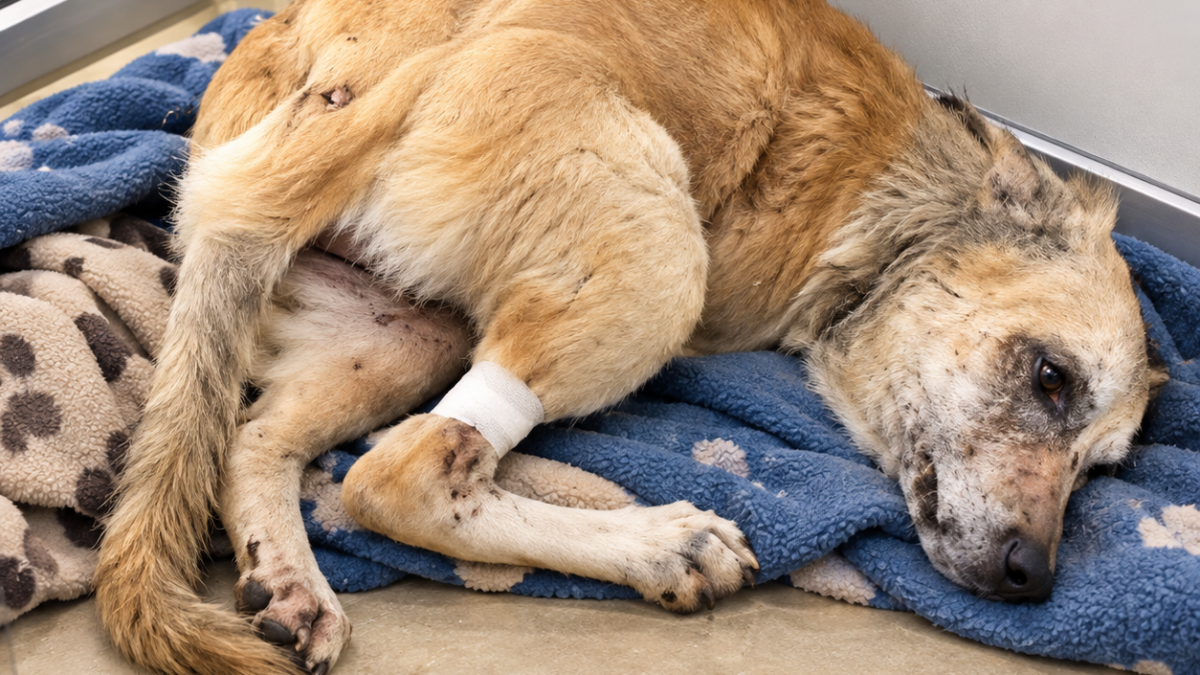
The first time I saw King, he was lying unconscious in a pile of garbage, his twisted legs buried beneath torn plastic bags as though someone had decided he belonged with everything else they no longer wanted. I had been called to difficult rescues before, but nothing prepared me for the moment the stranger who found him whispered, “Please tell me I didn’t get here too late.” A few days later, after more than one shelter had already decided his condition was hopeless, one tiny movement made the veterinarians stop talking and gather around his bed.
My name is Daniel Mercer, and the call came late on a humid Saturday afternoon.
A man named Thomas had been walking behind a row of small businesses when he saw what he first thought was a discarded blanket beside an overflowing trash pile.
Then the blanket breathed.
By the time I arrived, Thomas was sitting on the pavement with the dog cradled partly against his legs.
“He hasn’t moved,” he said.
His voice shook.
“How long have you been here?”
“Maybe twenty minutes.”
“You touched him?”
“I checked if he was breathing.”
“Anything else?”
“No. I was scared I’d hurt him.”
I knelt.
The dog was young, although his body made age almost impossible to judge. His coat was filthy and damp. His ribs pressed visibly beneath his skin. His legs were badly deformed, bending at angles that made my stomach tighten.
His breathing was shallow.
“Hey, buddy.”
Nothing.
I touched his gums.
Pale.
Too pale.
“We need to move.”
Thomas immediately stood.
“I’m coming.”
“You don’t have to.”
“Yes, I do.”
We wrapped the dog in a clean blanket and lifted him carefully.
He weighed almost nothing.
His head rolled against my forearm.
Thomas opened the back of the rescue van.
“Does he have a chance?”
I looked at the dog.
“I don’t know.”
At the clinic, the team moved fast.
Bloodwork.
Fluids.
Temperature.
Neurological examination.
X-rays.
More bloodwork.
I stood outside the treatment room watching strangers work on a dog who had been invisible to the world an hour earlier.
Thomas remained beside me.
“What’s his name?” he asked.
“He doesn’t have one yet.”
The dog’s head moved slightly when a technician adjusted his blanket.
Thomas whispered, “King.”
I looked at him.
“Why King?”
“Because nobody should die thinking he was trash.”
That was how he got his name.
Hours later, Dr. Elena Brooks called us into a consultation room.
Her expression told me the news before she spoke.
“King has an extreme calcium deficiency. His bones have developed abnormally, which explains much of the deformity in his legs.”
“Can that be fixed?” Thomas asked.
“Some of the damage may be permanent.”
He swallowed.
“And the rest?”
Dr. Brooks took a breath.
“He is also showing significant neurological abnormalities.”
The room became very quiet.
“What does that mean?” I asked.
“We don’t have one clean answer yet. There may be infection, nutritional damage, congenital disease, or more than one problem happening at the same time.”
“But you can treat him.”
“We can support him.”
Thomas leaned forward.
“That isn’t what I asked.”
Dr. Brooks looked at him.
“We are going to treat what we can. But I need both of you to understand how critical he is.”
Over the next twenty-four hours, we contacted multiple shelters and specialty rescues about longer-term placement.
One after another, they declined.
Too medically complicated.
Too unstable.
Too expensive.
Poor prognosis.
One coordinator apologized before saying, “If he continues deteriorating, you may need to consider whether keeping him alive is fair.”
Thomas heard the conversation.
Afterward, he walked into King’s treatment room and sat beside the bed.
I followed.
King was still barely conscious.
Thomas put his hand close enough for King to smell without touching his face.
“I don’t know who left you there,” he whispered. “But I’m making you one promise.”
King’s ear moved.
“You don’t get abandoned again.”
Thomas stayed.
Morning became afternoon.
Afternoon became another night.
And on the third day, Dr. Brooks came running toward me in the hallway.
“Daniel.”
I stood.
“What happened?”
“Come here.”
Her voice was different.
Not frightened.
Not exactly hopeful either.
Something between the two.
I followed her into King’s room.
Three technicians were standing around his bed.
Thomas was already there.
Nobody spoke.
Then I looked down.
King’s front paw moved.
Not a seizure.
Not a reflex.
He moved it again.
And this time, he was trying to reach Thomas.
PART 2
Thomas froze.
“Did he just—”
“Yes,” Dr. Brooks whispered.
King’s paw moved another inch across the blanket.
Thomas lowered his hand.
The paw touched his fingers.
Nobody in that room celebrated loudly.
We were too afraid.
Hope can be frightening when you have already prepared yourself for the possibility that an animal may not survive.
Thomas bent closer.
“Hey, King.”
King’s eyes opened.
Not fully.
Only a narrow slit.
But they opened.
His gaze did not focus immediately.
His head shifted weakly toward Thomas’s voice.
Then stopped.
Thomas laughed once.
It came out broken.
“You hear me?”
King’s paw pressed against one of his fingers.
Dr. Brooks moved closer.
“Thomas, let him rest.”
“I’m not doing anything.”
“I know. I’m telling you because I need you not to ask more from him just because he gave us something.”
Thomas nodded quickly.
“Okay.”
King’s eyes closed again.
But the room had changed.
For two days, almost everything we had done had been directed at keeping his body from failing.
Now he had participated.
Even if only a little.
Later that afternoon, his neurological examination showed another tiny improvement.
When a technician touched one paw, King attempted to withdraw it.
Not normally.
Not strongly.
But intentionally enough that Dr. Brooks repeated the test.
Then again.
“You’re smiling,” I told her.
“I’m not.”
“You are.”
“I’m professionally encouraged.”
“That sounds like veterinarian language for smiling.”
She ignored me.
Thomas did not.
“She’s smiling.”
Dr. Brooks finally looked at us.
“This is good. It is not a miracle.”
Thomas nodded.
“Good is enough.”
That became the phrase we used for weeks.
Good is enough.
King was not cured on day three.
He did not stand the next morning and run across the room.
He did not suddenly grow straight legs.
Recovery was slower than that.
Harder.
More uncertain.
The calcium deficiency had affected his developing bones severely.
His front legs bowed.
His hind legs struggled to support him.
The neurological condition complicated everything.
His balance was poor.
His head sometimes trembled when he became tired.
There were moments when his muscles stiffened unexpectedly.
Dr. Brooks explained that even with aggressive nutritional correction, physical therapy, medication, and supportive care, nobody could promise what kind of mobility he would eventually have.
Thomas listened.
Then asked, “Will he hurt?”
“That is what we monitor.”
“Can he have a life?”
“We don’t know yet.”
“When will you know?”
Dr. Brooks smiled faintly.
“When King tells us.”
Thomas looked at him.
“Okay.”
That answer bothered me less than I expected.
In rescue, we often want certainty before life is willing to give it.
Will he walk?
Will she survive?
Will they be adoptable?
Will the cancer return?
Will the seizures stop?
We ask because uncertainty is exhausting.
Animals usually do not care about the questions.
They care about whether something hurts now.
Whether there is food now.
Whether the hand touching them is gentle now.
Whether they are alone.
King was no different.
On the fourth day, he became interested in food.
Not much.
A technician opened a small container of softened puppy food near his bed.
King’s nose moved.
That alone made Thomas grin.
“You smelled that.”
The technician placed a tiny amount near his mouth.
King licked.
Paused.
Licked again.
Then attempted to raise his head.
“Easy.”
He tried anyway.
Food had apparently given him ambition.
Thomas supported the bowl while King ate a few small bites.
He tired quickly.
But when the bowl moved away, King’s eyes followed it.
Dr. Brooks laughed.
“That might be the healthiest thing he’s done.”
“What?”
“Complain about portion control.”
Thomas looked down.
“You heard the doctor. You’re officially difficult.”
King licked his lips.
Over the next several days, eating became his favorite activity.
Medication was easier when hidden in food.
Physical therapy was easier if a treat waited afterward.
Blood draws were still blood draws.
But King gradually began associating people with something other than pain or neglect.
Food.
Warmth.
Voices.
Touch.
Thomas came every day.
That surprised everyone except me.
He was not part of a rescue organization.
He had no previous experience with severely disabled animals.
He worked maintenance at an apartment complex and lived in a small rental.
He had found King by accident.
Most finders call.
Wait.
Then go home.
There is nothing wrong with that.
Thomas stayed.
The first week, he showed up before work at six thirty.
Then again after five.
He brought King soft food only after asking the veterinarian what was allowed.
He sat on the floor and talked.
About nothing.
His job.
Traffic.
How expensive coffee had become.
A woman at work who kept putting fish in the office microwave.
King had no idea what any of it meant.
But he listened.
Or at least remained awake longer when Thomas spoke.
One evening, I asked Thomas why he kept coming.
He shrugged.
“I said I would.”
“You also have a life.”
“So does he.”
“That isn’t what I meant.”
Thomas looked through the glass.
King was sleeping.
“My brother died three years ago.”
I had not expected that.
“I’m sorry.”
“He lived on the street for a while.”
Thomas kept looking at King.
“Addiction. Mental illness. We fought. I stopped answering his calls.”
I said nothing.
“When police found him, he’d been dead almost two days.”
His voice stayed flat.
That made the grief feel heavier.
“I spent a long time telling myself there was nothing I could’ve done.”
“Maybe there wasn’t.”
“Maybe.”
He looked at me.
“But when I saw King in the garbage, I knew exactly what it felt like to think someone else would handle it.”
That explained more than I wanted to ask.
“So you stayed.”
“Yes.”
“Because of your brother?”
“No.”
He looked back at King.
“Because of King.”
I respected that answer.
People sometimes try to turn animals into replacements for human grief.
They are not.
King was not Thomas’s brother.
Thomas simply recognized a moment when leaving would become something he might regret forever.
Two weeks after rescue, King attempted to sit without help.
It was ugly.
He pushed with both front legs, lost balance, rolled slightly, then tried again.
Thomas reached instinctively.
Dr. Brooks stopped him.
“Wait.”
“He’s falling.”
“He’s figuring it out.”
King pushed again.
His legs trembled.
His body rose halfway.
Then he collapsed onto his side.
Thomas winced.
“Can I help now?”
“Yes.”
He repositioned King gently.
“You’re stubborn.”
King licked his wrist.
The next day he succeeded.
For approximately four seconds.
Everyone took a picture.
Thomas sent it to half the people he knew.
By the third week, physical therapy became more structured.
A rehabilitation veterinarian named Dr. Mei Lawson evaluated him.
She watched his movement.
Tested range of motion.
Placed his paws correctly when he knuckled them under.
Measured muscle tone.
King disliked her immediately because she made him work.
“He has personality,” Dr. Lawson said.
Thomas smiled.
“That’s good?”
“It’s annoying.”
“Same thing.”
She designed a program.
Supported standing.
Short assisted steps.
Gentle strengthening.
Stretching.
Balance work.
Later, hydrotherapy if King tolerated it.
“What’s the goal?” Thomas asked.
Dr. Lawson answered carefully.
“Function.”
“Walking?”
“Maybe.”
“Running?”
“Let’s start with standing.”
Thomas looked at King.
“You heard her. Low expectations.”
King tried to chew the therapy strap.
“Good attitude.”
The first supported steps were painful to watch emotionally, although the team kept him within comfort limits.
King’s legs did not move the way healthy puppy legs moved.
His joints had developed under nutritional stress.
His feet turned awkwardly.
His hindquarters lagged behind.
He took one step.
Then another.
Collapsed into the support sling.
Rested.
Tried again.
Thomas stood several feet ahead holding one tiny piece of chicken.
“You want this?”
King absolutely wanted it.
“Come get it.”
Dr. Lawson said, “Don’t pull him emotionally.”
“I’m motivating.”
“You’re bribing.”
“That is motivation.”
King took another step.
Then another.
He reached Thomas.
Chicken disappeared.
Thomas looked like King had crossed a marathon finish line.
Dr. Lawson pointed at him.
“Do not turn every four-foot walk into a national holiday.”
“No promises.”
By week four, King could sit with less support.
His calcium level had improved.
His body condition improved.
His coat looked healthier.
His neurological episodes became less frequent, although not gone.
The specialists still would not promise long-term recovery.
But one thing had become clear.
King was not steadily deteriorating toward death.
He was improving.
Slowly.
That changed the conversation.
Shelters that had initially declined placement began calling back after photographs of King’s progress circulated through rescue networks.
One coordinator said, “If he reaches medical stability, we might be able to consider foster placement.”
Thomas heard.
“No.”
I looked at him.
“No what?”
“He’s not going there.”
“Thomas.”
“He knows me.”
“That doesn’t automatically make you his adopter.”
“I didn’t say adopter.”
“You are saying something.”
Thomas crossed his arms.
“He comes home with me.”
I nearly laughed.
“You live in a second-floor apartment.”
“First floor.”
“You said apartment.”
“First floor apartment.”
“Pets allowed?”
He hesitated.
“One.”
“You already have a cat.”
“Temporary cat.”
“Your cat is twelve.”
“She’s temporarily twelve.”
“Thomas.”
“I’m moving.”
I stared.
“What?”
“The maintenance company has a ground-floor unit opening next month. Small patio. No stairs.”
“You’re moving because of King?”
“I’ve been planning to move.”
“Since when?”
“Yesterday.”
I rubbed my forehead.
“You do understand this dog may need expensive long-term medical care.”
“Yes.”
“Mobility equipment.”
“Yes.”
“Medication.”
“Yes.”
“Neurological follow-up.”
“Yes.”
“He might never walk normally.”
Thomas looked offended.
“Have you seen me walk?”
I laughed despite myself.
“I’m serious.”
“So am I.”
“What if he loses mobility later?”
“Then we deal with later.”
“What if he becomes incontinent?”
“We clean.”
“What if he needs a cart?”
“We buy one.”
“What if—”
“Daniel.”
He stopped me.
“I found him in garbage.”
His voice became quiet.
“Everything after that is already better.”
That ended the argument.
Not because I was convinced.
Because I knew convincing him out of it was going to require more energy than evaluating whether he could actually provide a safe home.
So we evaluated.
Income.
Housing.
Veterinary plan.
Backup care.
Accessibility.
His cat.
Especially his cat.
Her name was Olive.
She hated everyone.
When we eventually conducted a controlled introduction weeks later, Olive saw King from across the room, hissed, and walked away.
King stared.
Then attempted to follow.
Olive turned.
Hissed again.
King stopped.
Thomas said, “Healthy boundaries.”
I said, “Your cat threatened him.”
“She communicated.”
“Violently.”
“No contact was made.”
Olive remained.
King eventually learned that the house had one constitutional monarch and it was not the dog named King.
Before any discharge could happen, though, King had another setback.
Six weeks after rescue, he developed a sudden fever.
His neurological tremors increased.
He stopped eating.
Thomas called me at 5:12 in the morning from the hospital.
I was there by six.
King lay on his side.
The same image from the garbage pile returned so violently that I had to stop walking for a second.
Thomas noticed.
“No.”
“What?”
“Don’t do that.”
“Do what?”
“Look like we’re back at the beginning.”
I looked at King.
“We’re not.”
Thomas sat beside him.
“He’s not in garbage.”
True.
“He’s not alone.”
True.
“He’s got doctors.”
Also true.
“So stop looking at him like the last six weeks disappeared.”
I took a breath.
Thomas was right.
Recovery does not erase the possibility of crisis.
Crisis does not erase recovery.
Tests suggested infection had triggered the setback.
Antibiotics were adjusted.
Fluids restarted.
Neurological medications changed.
For two days, King barely participated in therapy.
On the third, he ate.
Again.
Thomas held the bowl.
King finished half.
Thomas looked at me.
“Good is enough.”
I smiled.
“Good is enough.”
He recovered.
But the incident changed Thomas.
Until then, he had acted as though commitment could defeat uncertainty.
After the fever, he understood commitment simply meant staying through uncertainty.
Those are different things.
One assumes love guarantees an outcome.
The other knows better.
King was discharged from continuous hospitalization after almost two months.
Not “cured.”
Not normal.
Stable enough to continue rehabilitation in foster care.
Thomas’s new apartment was ready.
He had bought rugs to create traction.
A low orthopedic bed.
A washable mat.
Raised food dishes.
A baby gate to separate King from Olive when unsupervised.
He had also purchased approximately fourteen dog toys.
King ignored thirteen.
He liked an empty plastic bottle inside a sock.
Thomas stared at the pile of expensive toys.
“Of course.”
King crunched the bottle.
“I spent eighty dollars.”
Crunch.
“You were happier in garbage.”
I pointed at him.
“Bad wording.”
Thomas winced.
“Right.”
Then sat beside King.
“Sorry.”
King climbed partly into his lap.
For the first week, Thomas barely slept.
King had accidents.
He needed assistance standing after long naps.
He became restless at night.
Sometimes his legs stiffened.
Sometimes he woke crying.
Not from acute pain, according to his doctors, but likely disorientation and neurological discomfort.
Thomas called me the first night.
“What do I do?”
“What did the discharge instructions say?”
“I know the instructions.”
“Then why are you calling?”
“Because he sounds sad.”
I smiled in the dark.
“Sit with him.”
“I am.”
“Then keep sitting.”
The next morning, Thomas sent a photograph.
King asleep with his head on Thomas’s foot.
Caption:
Your medical advice worked.
By the third week at home, King had a routine.
Morning medication.
Food.
Assisted walk outside.
Rest.
Short therapy.
More rest.
Evening exercises.
Thomas returned to work on reduced hours at first.
A neighbor named Mrs. Alvarez helped midday.
She was seventy-one and approximately five feet tall.
King adored her.
Thomas warned her that King needed careful handling.
Mrs. Alvarez told him, “I raised four sons. I can handle one bent dog.”
King soon began waiting for her.
She brought him approved treats.
Mostly.
Thomas caught her feeding him a piece of cheese once.
“You can’t just feed him random food.”
“He looked hungry.”
“He always looks hungry.”
“Then you should feed him more.”
“I feed him exactly what the veterinarian says.”
She looked at King.
“Your father is strict.”
Thomas nearly fell over.
“What did you call me?”
Mrs. Alvarez walked away.
King wagged.
That was the first time anyone called Thomas King’s father.
He complained about it for three days.
Then began using the term himself when speaking to the clinic.
“I’m his dad.”
I noticed.
I said nothing.
King’s first major milestone at home came one morning when Thomas forgot the support sling.
Not because King did not need it.
Because Thomas was carrying laundry.
King saw his food bowl.
He stood.
Alone.
Three seconds.
Then six.
Thomas froze.
King took one step.
No sling.
Then another.
His legs shook violently.
Thomas dropped the laundry.
“King!”
King looked toward him.
Took another step.
Then collapsed gently onto a rug.
Thomas called everyone.
Me.
Dr. Lawson.
Dr. Brooks.
Mrs. Alvarez.
Possibly his mail carrier.
He sent the video.
I watched it twelve times.
King’s gait was abnormal.
His legs remained deformed.
But he had moved under his own power.
That afternoon Dr. Lawson reviewed the video.
“Good.”
Thomas stared.
“Good?”
“Yes.”
“That’s all?”
“Very good.”
“Better.”
“He is still unsafe without support for longer distances.”
“I know.”
“He may always need assistance.”
“I know.”
“Do not push because you are excited.”
Thomas looked at me.
“She ruins everything.”
“Her job.”
The next six months built on that moment.
King gained strength.
Not straight legs.
Strength.
That distinction became important.
Some people online, after seeing his progress, wrote messages like:
Can surgery straighten him?
Can braces fix everything?
Will he ever look normal?
I hated that word.
Normal.
King’s doctors focused on comfort, joint protection, mobility, and function.
Cosmetic normality did not matter.
His bones had developed abnormally.
Some deformation would remain.
He eventually used custom supports during certain activities.
On longer outings, Thomas used a wheeled cart designed with the rehabilitation team.
The first time King tried it, he froze.
Then realized his hindquarters were supported.
He moved.
Stopped.
Moved again.
Then suddenly accelerated.
Thomas had to run.
“Slow down!”
King did not.
Dr. Lawson shouted, “Don’t let him turn sharply!”
Thomas chased.
I stood laughing so hard I could barely record.
King reached the end of the therapy hallway.
Stopped.
Looked back.
His mouth was open.
Tongue out.
He looked like a completely different animal from the unconscious body in the trash.
Dr. Lawson took the cart handle.
“That is enough.”
King tried to continue.
“Your patient disagrees,” Thomas said.
“Your patient has terrible judgment.”
That video eventually became one of the rescue’s most shared updates.
I was careful about how we told the story.
I did not call it a miracle.
The veterinarians had treated him.
Thomas had worked daily.
Donors had paid bills.
King had responded.
Calling it a miracle felt like erasing labor.
Still, I understood why people used the word.
Months earlier, experienced professionals had prepared us for decline.
Now King was racing badly down a hallway in a mobility cart.
It felt impossible even when you knew every step that made it possible.
The mystery of how King ended up in the garbage pile remained.
At first, we assumed there would be no answer.
No microchip.
No collar.
No identifying information.
Thomas returned to the location several times.
He spoke with business owners.
Nothing.
Then one small detail changed the case.
A warehouse across the alley had a security camera pointed toward part of the dumping area.
The owner initially believed footage from the day King was found had been overwritten.
But another camera system used cloud backup.
Animal welfare investigators obtained a warrant for the relevant files after Thomas filed a formal abandonment report.
The footage was grainy.
Nighttime.
A small pickup truck stopped near the trash.
Someone got out.
Opened the back.
Lifted something wrapped in a blanket.
Left it.
Drove away.
The object moved slightly after the truck left.
King.
Thomas could not watch the full video.
He walked out of the room.
I followed.
“Thomas.”
He stood outside with both hands over his face.
“He was awake.”
“Maybe.”
“He moved.”
“Yes.”
“They put him there alive.”
“Yes.”
Thomas kicked the wall.
Not hard.
Enough to hurt his foot.
“Damn it.”
I waited.
“I keep thinking maybe he crawled into the trash looking for food.”
“We know more now.”
“That’s worse.”
“Yes.”
Investigators enhanced the plate.
Partial number.
Vehicle make.
Color.
A month later, they identified the registered owner.
A man named Calvin Reed.
He lived twenty-five miles away.
King had belonged to his household.
The story that came out was ugly but not theatrical.
No underground fighting.
No elaborate conspiracy.
Just neglect.
Calvin had acquired King as a young puppy from an unregistered litter.
King’s legs began bending as he grew.
Instead of seeking consistent veterinary care, Calvin assumed the dog was “born wrong.”
King struggled.
Then developed neurological symptoms.
Tremors.
Episodes of stiffness.
Falls.
Calvin told investigators he could not afford specialists.
That could have been the beginning of a responsible surrender.
It wasn’t.
He kept King outside.
Fed him inconsistently.
When King’s condition worsened, Calvin contacted two local shelters.
This part was true.
Both said they were full.
One offered other rescue contacts.
He did not call them.
Instead, one night, after King collapsed, Calvin believed the dog was dying.
So he put him in the truck.
Drove to the commercial area.
And left him beside the garbage.
Thomas learned these details from the investigator.
His face went white.
“He thought King was dying?”
“Yes.”
“And his solution was trash?”
“Yes.”
“Why not a clinic?”
“He said he had no money.”
“Why not animal control?”
“No answer I can give you that will satisfy you.”
“Why not stay?”
The investigator, Officer Greene, looked at Thomas.
“I don’t know.”
That question haunted Thomas more than anything.
Why not stay?
He had found King because Calvin did not.
The legal case moved slowly.
Abandonment.
Neglect.
Failure to provide necessary care.
Charges varied under local law, and the attorneys argued over which conduct could be proved.
Calvin’s defense emphasized financial hardship.
The shelters that declined intake.
The complexity of King’s medical condition.
No one disputed poverty can create impossible situations.
But Dr. Brooks wrote a detailed statement.
Unable to afford specialty care did not mean unable to seek any humane option.
Surrender attempts can continue.
Animal control exists.
Rescue networks exist.
Emergency clinics can discuss options.
Humane euthanasia, if suffering truly cannot be relieved, is not the same as leaving an unconscious animal in garbage.
The video mattered.
So did Calvin’s own interview.
He admitted King was alive when left.
That removed ambiguity.
Thomas wanted the harshest possible punishment.
At first.
He told me so.
“I want him to sit somewhere helpless and have people walk past.”
I looked at him.
“You don’t.”
“Yes, I do.”
“No. You’re angry.”
“He deserves—”
“King deserved care. That’s different.”
Thomas stood.
“I’m allowed to hate him.”
“Yes.”
“Then let me.”
I did.
For a while.
Anger has its own timetable.
But I watched Thomas become more exhausted every time the case progressed.
He read every document.
Every hearing notice.
Every statement.
He searched Calvin online.
He started building his days around what punishment might happen.
Meanwhile King wanted to go outside.
One afternoon, Thomas canceled a therapy outing because he was waiting for a call from the prosecutor.
King sat beside the cart.
Whined.
Thomas ignored him.
I said, “You’re doing it.”
“What?”
“Making Calvin bigger than King.”
He looked at me.
“That’s not fair.”
“Maybe.”
“King is why I care.”
“Then care about King.”
“He needs justice.”
“Yes.”
“And?”
“He also needs his therapy walk.”
Thomas stared.
King barked once.
I pointed.
“Your client has spoken.”
Thomas laughed despite himself.
That changed something.
Not immediately.
But enough.
The case ended through a plea agreement.
Calvin admitted to animal abandonment and neglect-related violations.
There were fines.
Probation.
Community service unrelated to animal care.
A prohibition on owning animals during the court-ordered period.
Permanent surrender of any legal claim to King.
The judge also required compliance with mental health and social-service recommendations documented in the case.
Some online commenters wanted prison.
Some wanted public humiliation.
One person wrote that Calvin should be left in a dumpster.
Thomas saw the comment.
Months earlier he might have agreed.
Now he closed the page.
“You okay?” I asked.
“Yes.”
“You don’t sound angry.”
“I am.”
He looked at King sleeping beside his feet.
“I’m just busy.”
“With?”
“His hydrotherapy appointment.”
That was progress.
King became legally available for adoption shortly after.
Technically.
Thomas had fostered him for almost nine months.
The rescue director called.
“The ownership case is closed.”
Thomas said, “Good.”
“We can process an adoption.”
“Good.”
“Do you know anyone interested?”
Thomas went silent.
The director laughed.
“Thomas.”
“What?”
“Say it.”
“No.”
“Say you’re adopting him.”
“I thought that was obvious.”
“Paperwork is not based on vibes.”
Thomas signed everything three days later.
Mrs. Alvarez brought a cake.
For humans.
She also brought cheese.
For King.
Against instructions.
Olive the cat sat on the back of the couch watching with contempt.
The adoption form was placed on the table.
Thomas signed.
Then looked at King.
“That’s it.”
King sniffed the paper.
“You are officially stuck with me.”
King attempted to chew the corner.
“Please don’t destroy your legal status.”
I took a photograph.
King eventually became stronger than anyone predicted.
Not normal.
Not cured.
Stronger.
He used his front legs efficiently.
His hind legs remained weak.
The cart became part of his life.
Inside the apartment, he often moved short distances on his own.
Outside, he used support depending on the day.
He learned ramps.
He learned how to position himself before lying down.
He learned where Thomas kept treats.
He learned Mrs. Alvarez was an easier target.
Most importantly, he learned that disability did not mean isolation.
Thomas took him places.
Quiet parks.
Outdoor cafés that allowed dogs.
A lake path with smooth pavement.
Not for inspiration.
Not so strangers could praise them.
Because King liked smelling things.
King became famous locally anyway.
People recognized the cart.
Children asked questions.
Thomas always answered directly.
“His legs developed differently.”
“Does it hurt?”
“Not when we manage things correctly.”
“Can he run?”
“In that cart? Faster than me.”
One child asked, “Is he broken?”
Thomas paused.
Then crouched.
“No.”
The child looked at King.
“Then why does he need wheels?”
Thomas smiled.
“Same reason some people use wheelchairs. Moving differently doesn’t mean broken.”
The child accepted that immediately.
Adults often needed more explanation.
King’s health remained complicated.
At two years after rescue, he had a significant neurological relapse.
Tremors.
Loss of balance.
Appetite changes.
He spent four days hospitalized.
Thomas slept in his car outside one night because visiting hours had ended.
I found him at six in the morning.
“You’re ridiculous.”
“Yes.”
“You know King is asleep.”
“Yes.”
“You know they’ll call.”
“Yes.”
“So why are you here?”
Thomas looked at the hospital doors.
“Because I said I wouldn’t leave.”
That promise remained literal for him.
King recovered again.
Not completely.
Enough.
Good is enough.
By three years after rescue, he had become an adult dog.
That surprised me emotionally.
The King in my head remained the thin puppy pulled from garbage.
Then one morning Thomas sent a photograph.
Broad chest.
Thicker coat.
Confident face.
Custom cart.
Olive sitting behind him looking annoyed.
Caption:
He has become management.
I showed Dr. Brooks.
She stared.
“That’s King?”
“You’ve seen him recently.”
“Not for six months.”
“He’s huge.”
“He was always going to grow.”
“Apparently.”
She smiled.
“Remember what we told you?”
“That he might decline.”
“We were preparing you.”
“I know.”
“You know medicine isn’t fortune-telling.”
“I know.”
She looked at the picture again.
“I’m glad we were wrong about the direction.”
That mattered.
Veterinarians sometimes carry the cases that surprise them too.
King eventually became a kind of unofficial ambassador for the rescue’s special-needs program.
Again, we were careful.
We did not want to turn him into an object lesson.
King did not exist to inspire people.
But his story helped donors understand what long-term care actually required.
Supplements.
Rehabilitation.
Imaging.
Neurology appointments.
Mobility equipment.
Replacement wheels.
Orthopedic bedding.
Medication.
Transportation.
Time.
Special-needs rescue was not one dramatic intervention.
It was maintenance.
One donor once asked Thomas, “Isn’t it exhausting?”
Thomas looked at King.
“Yes.”
The donor laughed.
Thomas didn’t.
“I mean it. Sometimes it’s exhausting.”
The woman looked surprised.
“I thought you were going to say love makes it easy.”
“No.”
He adjusted King’s harness.
“Love makes it worth doing. That’s different.”
I wrote that down.
Years passed.
King outlived every early expectation.
At five, he developed arthritis on top of the existing deformities.
We adjusted his therapy.
At six, he needed more assistance transferring into his cart.
At seven, his neurological medication changed again.
At eight, he became gray around the muzzle.
Thomas hated the gray.
He sent me a photograph of three white hairs.
Emergency.
I replied:
Age.
He wrote:
Unacceptable diagnosis.
Dr. Brooks agreed with me.
King aged anyway.
Olive, who had been twelve when King moved in, died at nineteen.
She had tolerated King for seven years without ever admitting affection.
Her final month, she began sleeping against his side.
Thomas photographed them every time.
“She thinks he’s furniture.”
Maybe.
After Olive died, King searched the couch for three days.
Then started sleeping where she had slept.
Thomas put her blanket there.
King rested his head on it.
Loss had entered his life.
But not abandonment.
That distinction became central to everything.
People he loved could die.
Thomas could leave for work.
Visitors could go home.
But King had learned departures did not automatically mean being discarded.
At first, Thomas had promised:
Never abandoned again.
Over the years, he proved it thousands of small ways.
Returning from work.
Showing up at the hospital.
Replacing worn wheels.
Cleaning accidents.
Waking for medication.
Changing sheets.
Waiting during slow bathroom trips.
Lifting King when age took more strength.
Rescue became repetition.
King’s tenth birthday was approximate.
Nobody knew his exact birth date.
Thomas chose the anniversary of the day he was found.
“That’s not his birthday,” I said.
“It’s the day he got a future.”
Hard to argue with that.
Mrs. Alvarez was still alive but moving slowly herself.
She attended.
So did Dr. Brooks.
Dr. Lawson.
Officer Greene.
Marcus.
Half the rescue team.
King wore a crown for approximately eleven seconds before eating part of it.
Thomas laughed.
“Appropriate.”
We took a photograph.
King in front.
Thomas behind him.
A banner.
Ten years.
I looked at the image afterward.
The garbage-pile photograph existed in our archives.
I placed them side by side.
Unconscious puppy.
Old dog surrounded by people.
Same face.
Different eyes.
That contrast always made people emotional.
What affected me more was everything photographs could not show.
Ten years of ordinary days.
That was the real transformation.
King had not simply gone from dying to alive.
He had gone from abandoned to expected.
People expected him at appointments.
Mrs. Alvarez expected his nose at her door.
Thomas expected to step over his bed every morning.
The rescue expected birthday pictures.
Being expected somewhere may be one of the quietest forms of belonging.
At eleven, King’s neurological disease worsened significantly.
The episodes lasted longer.
Recovery took more time.
He slept more.
His appetite remained strong, which reassured Thomas until one morning it didn’t.
King ignored breakfast.
Thomas called me before calling the veterinarian.
“He won’t eat.”
“When did it start?”
“Now.”
“One meal?”
“He has never ignored breakfast.”
That was true.
We went to the hospital.
Bloodwork.
Neurological exam.
Imaging.
Age had accumulated.
Kidney changes.
Liver changes.
Neurological degeneration.
Nothing immediately catastrophic.
Everything together.
Dr. Brooks had retired from full-time practice but came when she heard King was there.
Thomas looked at her.
“Tell me we fix it.”
She sat beside him.
“We treat what is treatable.”
“That is doctor language.”
“Yes.”
“How much time?”
“No.”
“What?”
“I am not answering that.”
“You always answered.”
“I always said I didn’t know.”
“That’s still an answer.”
She put her hand on King.
“Ask better questions.”
Thomas looked angry.
Then tired.
“What should I ask?”
“Does he still enjoy food when nausea is controlled?”
“Yes.”
“Does he want to see you?”
“Yes.”
“Does he enjoy going outside?”
“Some days.”
“Can his discomfort be managed?”
“Yes.”
“Then today is still his day.”
Thomas looked down.
“And tomorrow?”
“Ask tomorrow.”
That became our final-year philosophy.
Ask tomorrow.
Some days King ate breakfast enthusiastically.
Some days he needed medication first.
Some days he wanted the cart.
Other days he preferred the patio.
He became an expert sunbather.
Thomas placed an orthopedic mat outside.
King would lie there watching people.
Children in the apartment complex knew him.
One little girl named Avery brought him drawings.
Mostly terrible drawings.
Thomas displayed all of them.
One showed King with eight legs and wings.
“What is that?” I asked.
“Avery says that’s his final form.”
“Powerful.”
King sniffed it.
At eleven and a half, he stopped using the cart regularly.
The effort exhausted him.
Thomas worried this meant he was giving up.
Dr. Lawson corrected him.
“He’s choosing another way to spend energy.”
“Which is?”
“Sleeping.”
Thomas looked at King.
“Good hobby.”
We built a low rolling support platform for longer outings.
King could lie comfortably while still seeing and smelling outside.
Thomas hated it at first.
“It looks like a wagon.”
“It is basically a wagon.”
“He used to run.”
“He also used to be unconscious in garbage.”
Thomas looked at me.
“That’s manipulative.”
“Accurate.”
The first outing changed his mind.
King lay on the platform at the park.
Nose moving constantly.
Wind in his face.
He watched ducks.
Ignored other dogs.
Accepted one treat from a child.
On the way home, Thomas said, “Okay.”
“Okay what?”
“The wagon stays.”
Good is enough.
King reached twelve.
Nobody had predicted twelve.
His birthday celebration was smaller.
He tired easily.
Mrs. Alvarez had died earlier that year.
Her daughter brought King one of her scarves.
“She wanted him to have this.”
Thomas cried.
King smelled it for a long time.
Then rested his head on it.
That night he slept with the scarf beneath his cheek.
People sometimes say animals do not know memories.
Maybe.
But scent carries something.
And King knew that scent mattered.
The final crisis came in winter.
Cold rain outside.
Thomas called at 2:14 a.m.
“He had another seizure.”
“How long?”
“Seven minutes.”
Too long.
We met at the emergency hospital.
King was conscious but disoriented.
His breathing was irregular.
His temperature unstable.
The neurologist came in before dawn.
Tests.
Medication.
Waiting.
Thomas sat on the floor.
Exactly where he had sat years earlier.
I looked at him.
Same man.
Older.
More gray.
King older too.
So much life between those two hospital nights.
The neurologist finally spoke.
“We can admit him and attempt aggressive stabilization.”
Thomas nodded automatically.
Then stopped.
“What does that buy him?”
“We don’t know.”
“Could he return to his previous baseline?”
“Possibly.”
“That’s not what you think.”
The doctor hesitated.
“No.”
Thomas closed his eyes.
“What do you think?”
“I think his neurological disease has progressed substantially. Combined with his age and organ changes, his ability to recover from repeated crises is lower.”
“Is he suffering?”
“He is uncomfortable and confused. We can treat that.”
Thomas’s hands shook.
“Can we take him home?”
The doctor looked at him.
“If your goal is comfort, yes.”
That was the decision.
Years earlier, Thomas had spent everything trying to prevent King from dying.
Now loving him meant something opposite.
Not forcing his body to continue because Thomas was afraid of being the one left behind.
We drove King home.
Rain followed us.
Of course it did.
The apartment had changed many times over twelve years.
New couch.
Different rugs.
Olive gone.
Mrs. Alvarez gone.
But King’s bed remained near the same window.
Larger now.
Thicker.
Thomas lowered him onto it.
King exhaled.
Relaxed.
Home.
Dr. Brooks came.
Not as King’s primary veterinarian anymore.
As someone who had known him from the beginning.
Dr. Lawson came later.
Officer Greene sent a message.
Marcus stopped by.
People rotated.
Nobody crowded King.
Avery, now a teenager, left a new drawing outside the door.
King with wings again.
This time only four legs.
“Improved anatomy,” I said.
Thomas laughed once.
Then cried.
King slept most of the day.
In the afternoon he woke.
Thomas offered food.
Chicken.
King ate one piece.
Then another.
Stopped.
Thomas smiled.
“Still greedy.”
Tail movement.
One tiny thump.
Night came.
Rain against the window.
Thomas lay beside him.
I sat on the other side.
King’s breathing had become slower.
Thomas rubbed his chest.
“I found you in trash.”
I looked at him.
“You did.”
“I promised.”
“You kept it.”
He shook his head.
“Not yet.”
“Thomas.”
“I promised until the end.”
I understood.
Dr. Brooks had arranged for a veterinarian to come if King declined further.
By ten, it was clear.
He could not stand even with support.
His neurological tremors were increasing.
His breathing became effortful.
The home-euthanasia veterinarian arrived quietly.
Thomas met her at the door.
For years, he had feared this moment.
Now his face looked strangely calm.
Not because he was ready.
Nobody is ready.
Because the choice had become clear enough that love outweighed panic.
King rested on the bed.
The same man who once found him unconscious beside trash now placed a hand under his head.
I remembered King’s first day.
Limp body.
Twisted legs.
Pale gums.
Shelters declining.
Doctors warning us.
Thomas saying:
You don’t get abandoned again.
Twelve years later, he leaned close.
“You know what?”
King’s eyes moved toward him.
“They were wrong about one thing.”
I whispered, “What?”
Thomas smiled through tears.
“They said you might deteriorate until the end.”
He rubbed King’s ear.
“You took forever.”
I laughed and cried at once.
King’s tail moved.
Thomas lowered his forehead.
“You were worth every bill.”
Breath.
“Every ruined rug.”
Breath.
“Every wheel.”
Breath.
“Every night.”
King’s eyes stayed half-open.
“And I meant what I said.”
Thomas’s voice broke.
“You were never alone again.”
The veterinarian administered the sedative.
King relaxed.
His deformed legs, the legs everyone had once looked at as proof his future would be impossible, rested softly against the blanket.
Thomas held one paw.
I held the other.
Dr. Brooks touched his shoulder.
No garbage.
No cold pavement.
No anonymous pile where somebody hoped death would solve a problem.
A bed.
A home.
A person who had spent twelve years returning.
Thomas whispered, “You can go.”
King took one slow breath.
Then another.
Then a smaller one.
And stopped.
Thomas did not move his hand.
Neither did I.
The room remained quiet except for rain.
After a long time, Thomas said, “I thought this would feel like failing.”
“It doesn’t?”
He looked at King.
“No.”
Then he began crying harder than I had ever seen him cry.
“It feels like keeping the promise.”
That was exactly what it was.
King’s memorial happened a month later.
Thomas did not want a public event.
The rescue convinced him to let us hold a small fundraiser for medically complex dogs.
King had become one of the reasons our special-needs program expanded over the years.
We created the King Never Left Behind Fund.
Thomas hated the name initially.
“Too dramatic.”
I said, “You named him King beside a dumpster.”
“Fair.”
The fund covered mobility equipment, rehabilitation, neurological consultations, long-term medication, and foster support for animals that shelters might otherwise consider too difficult.
The first recipient was a young dog with deformed front legs.
A shelter had labeled him “poor adoption prospect.”
We took him.
Thomas saw the photograph.
“What’s his name?”
“Not yet.”
“Don’t call him Prince.”
“I wasn’t planning to.”
“Good.”
The dog received treatment.
Not a miracle cure.
Support.
Rehabilitation.
A foster home.
Eventually adoption.
A family sent us a photograph of him asleep on a couch.
Thomas framed it.
More animals came.
A cat with cerebellar problems.
A senior dog requiring a mobility cart.
A puppy born with malformed legs.
One by one, the fund paid for things King once needed.
People began donating wheelchairs after their own animals died.
Harnesses.
Ramps.
Orthopedic beds.
Sometimes grief became equipment for the next animal.
Thomas volunteered.
At first only occasionally.
Then every week.
He became especially good with people receiving devastating diagnoses.
When an adopter cried because her new dog might never walk normally, Thomas sat beside her.
“Normal is overrated.”
She looked at him.
“I’m scared.”
“Good.”
She blinked.
“That means you understand it matters.”
“What if I can’t do everything?”
“You won’t.”
“That’s not comforting.”
“You don’t need to do everything. You need to do the next thing.”
He had learned that from King.
One meal.
One treatment.
One supported step.
One day.
Good is enough.
Years after King died, Calvin’s probation ended.
The animal ownership restriction expired according to the original order.
I found out through a routine case review.
For a moment, old anger returned.
Then I learned something unexpected.
Calvin had not acquired another animal.
He had completed his required services.
He had also begun working with a housing assistance program after losing his own residence.
Not rescue.
People.
The irony was impossible to miss.
Thomas heard.
He became quiet.
“You okay?”
“Yes.”
“Angry?”
“Some.”
“He’s helping homeless people.”
“So I heard.”
“Does that bother you?”
Thomas thought.
“No.”
“Surprised?”
“Yes.”
He looked toward a photograph of King on the rescue wall.
“Maybe people should be allowed to become better after being awful.”
“That sounds almost forgiving.”
“Don’t push it.”
I didn’t.
Calvin never contacted Thomas.
Never asked for King.
Never tried to rewrite what happened.
Years later, a donation arrived anonymously to the King fund.
We could not prove it was Calvin.
The envelope contained cash and one sentence:
For the animals people think are too hard to save.
Thomas read it.
Set it down.
“What do you want to do?”
“Deposit it.”
“Anything else?”
“No.”
“Why?”
“Because King doesn’t need me to protect him from money.”
I laughed.
That was Thomas.
Still angry.
Less interested in carrying it.
The original garbage site changed.
The old dumpster disappeared when the businesses renovated.
A small grocery store expanded into the lot.
Most people who shopped there had no idea a dog once nearly died behind the building.
Thomas went back once after King’s death.
I went with him.
He stood near where he thought the trash pile had been.
“There?”
“Approximately.”
He looked around.
Cars.
Shopping carts.
People.
Ordinary life.
Thomas put both hands in his pockets.
“I expected something.”
“What?”
“I don’t know.”
A feeling.
A sign.
Closure.
Places rarely cooperate with our need for symbolism.
The sidewalk did not remember.
The building did not care.
That was okay.
King’s life had moved far beyond the location where it almost ended.
Thomas pulled something from his pocket.
A small metal identification tag.
King’s.
He held it.
“Should I leave it?”
“No.”
“Why?”
“Because this isn’t where he belongs.”
Thomas looked at me.
Then smiled.
“Good.”
He put it back.
We left.
That mattered more than any monument.
King had been taken out of the garbage once.
There was no reason to return any part of him there.
At the rescue center, we eventually hung two photographs side by side.
The first was difficult.
King on the day he arrived.
Unconscious.
Thin.
Legs deformed.
We debated whether to display it.
Thomas agreed under one condition.
The second photograph had to be larger.
It showed King at ten years old in his mobility cart, mouth open, ears up, Thomas running behind him.
Under the photographs was one sentence:
A prognosis describes what we know today. It does not decide whether a life deserves tomorrow.
New volunteers always stopped.
Some asked, “Was that really him?”
Thomas would answer if nearby.
“Unfortunately.”
“How long did he live?”
“Twelve years after rescue.”
Their eyes widened.
That became his favorite answer.
Not:
He was saved.
Not:
He was special.
Twelve years.
A measurable amount of life.
More than four thousand mornings.
More than four thousand nights.
Thousands of meals.
Hundreds of therapy sessions.
Multiple wheel replacements.
One tyrannical cat.
One elderly neighbor who smuggled cheese.
One apartment that became home.
One man who found a dog by accident and then chose him every day.
People sometimes asked Thomas if rescuing King had healed the guilt he carried about his brother.
He always said no.
I respected that.
Lives are not transactions.
King did not erase Thomas’s grief.
Thomas’s grief did not create King’s value.
But loving King changed what Thomas did with regret.
Before, regret made him withdraw.
After, it made him show up.
That difference became visible in everything.
When a neighbor needed help.
He showed up.
When a rescue foster panicked.
He showed up.
When a special-needs dog needed transport.
He showed up.
Once, years after King’s death, I watched Thomas carry a trembling puppy into the clinic.
Different dog.
Different case.
He placed the puppy gently on the table.
The veterinarian asked, “Who found him?”
Thomas said, “I did.”
I laughed.
“What?”
“You have a pattern.”
He looked at me.
“Apparently garbage attracts me.”
“Terrible sentence.”
“Right.”
The puppy recovered.
Went to a foster.
Got adopted.
No dramatic story.
That was perfect.
Not every rescue should become a legend.
Most should simply become safe.
King’s fund grew.
We helped establish a small equipment library.
Mobility carts could be borrowed while custom ones were being made.
Harnesses could be resized.
Ramps loaned.
Owners could receive basic training in supporting disabled dogs.
Dr. Lawson volunteered twice a month after retirement.
“Retirement is going poorly,” I told her.
“Quiet.”
A new volunteer once asked why the library mattered so much.
Thomas pointed at a cart.
“Because people surrender animals when they think care is impossible.”
“Sometimes it is.”
“Sometimes.”
He nodded.
“But sometimes impossible just means nobody showed them the equipment yet.”
That was King’s larger revenge against the labels placed on him.
Too critical.
Too expensive.
Too complicated.
Hopeless.
King did not prove those concerns were foolish.
His care really was difficult.
Expensive.
Complicated.
What he proved was that difficulty and worth are different questions.
That became part of our rescue culture.
We stopped asking only:
Can this animal become normal?
We asked:
Can this animal be comfortable?
Can they experience joy?
Can someone realistically provide the care?
Can we build support?
King changed the questions.
That mattered long after he was gone.
Thomas kept King’s first mobility cart in his storage unit for years.
I finally confronted him.
“You know it doesn’t fit any current dog.”
“I know.”
“It’s damaged.”
“I know.”
“The wheels are worn.”
“I know.”
“Why are you keeping it?”
He looked offended.
“Why do you keep old photographs?”
“That is different.”
“How?”
“Photographs take no space.”
He closed the storage door.
The cart stayed.
Then one winter, a rescue in another county called.
They had a dog roughly King’s old size awaiting a custom cart.
Could we loan anything temporary?
Thomas disappeared.
Returned with King’s old cart.
I stared.
“You sure?”
“No.”
He loaded it anyway.
The new dog used it for three weeks.
The rescue sent video.
The dog rolling down a hallway.
Awkwardly.
Excited.
Thomas watched without speaking.
Then said, “King would’ve hated sharing.”
I laughed.
“He shared with Olive.”
“Olive took things.”
“Fair.”
The cart came back scratched.
Thomas repaired it.
Then donated it permanently to the equipment library.
That was one of the last King objects he released.
The tag stayed.
A blanket stayed.
A photograph stayed.
Everything else moved forward.
That is what grief eventually asked from him.
Not forgetting.
Redistribution.
King had used the things.
Then another animal could.
One anniversary, twelve years after King’s death, we held a small event for the special-needs program.
Thomas was older.
So was I.
Dr. Brooks attended with a cane.
Dr. Lawson complained about her knees.
Time is rude to everyone eventually.
A family arrived with a dog in a mobility cart.
A young girl pushed beside him.
She looked at King’s photograph.
“Mom, that dog had wheels too.”
“Yes.”
The girl looked at Thomas.
“Was he happy?”
Thomas smiled.
“Very.”
“Even with bad legs?”
“Yes.”
She considered that.
Then looked at her own dog.
“He’s happy too.”
“That’s what matters.”
She nodded.
Children understand essential things quickly.
After the event, Thomas and I remained in the empty room.
King’s photograph was still on the wall.
I asked, “Would you do it again?”
Thomas didn’t even pause.
“Yes.”
“All the money?”
“Yes.”
“The hospital nights?”
“Yes.”
“The cleanup?”
“Less enthusiastic yes.”
“The seizures?”
His expression changed.
“Yes.”
“The ending?”
He looked at me.
“That’s part of the deal.”
I nodded.
“Even knowing?”
“I’d still pick him up.”
That became the sentence that stays with me.
I’d still pick him up.
Because the first time we saw King, picking him up was all we had.
No diagnosis.
No prognosis.
No guarantee.
No shelter willing to promise him a place.
No idea whether he would survive the night.
There was only a dog in garbage.
A stranger who refused to walk away.
And two arms lifting him.
Everything else came afterward.
The diagnosis.
The calcium.
The neurological disease.
The refusals.
The warnings.
The unexpected movement.
The first meal.
The first supported step.
The cart.
Home.
Olive.
Mrs. Alvarez.
Birthdays.
Old age.
The last breath.
More than a decade of life hidden inside a moment when most people would have seen only a hopeless body.
That is why I am careful when people describe King as a miracle.
Miracles are passive.
They sound like something magical happened while everyone watched.
King’s life was built.
Dose by dose.
Meal by meal.
Dollar by dollar.
Step by supported step.
Thomas kept the promise through repetition.
You will not be abandoned again.
He proved it on boring days.
Those count more than dramatic ones.
He proved it when King had diarrhea at three in the morning.
When the cart needed repairs.
When medication increased.
When the landlord complained about the ramp.
When money was tight.
When King had a setback.
When Olive died.
When King got old.
When staying became emotionally harder than leaving.
The promise survived all of that.
That is why King’s final night does not feel tragic to me anymore.
Sad?
Always.
Tragic?
No.
Tragedy would have been the garbage pile being the last place anyone knew him.
Instead, the garbage pile became the first page of the life that mattered.
His final page was home.
When I think of him now, I do not see the unconscious puppy first.
I see him in the cart.
Thomas running behind.
King moving too fast.
Ears bouncing.
Mouth open.
Completely unaware that years earlier professionals had once quietly discussed whether he might have only days.
I see Mrs. Alvarez sneaking cheese.
Olive glaring.
Thomas carrying him after a neurological episode.
King sleeping in sunlight.
I see the old dog resting his head on a scarf that smelled like someone he loved.
And sometimes I see the very first moment.
Thomas sitting in garbage beside him.
Not yet knowing King.
Not knowing his name.
Not knowing whether there would be a tomorrow.
Just waiting.
That was rescue before anyone called it rescue.
Presence.
One person deciding an unconscious dog would not wake up alone if he woke at all.
King did wake.
He moved one paw.
Then another.
He took a bite.
A step.
Then hundreds.
Then thousands, some on his own legs and some with wheels beneath him.
He grew up.
He grew old.
He became difficult.
Funny.
Expensive.
Loved.
Expected.
He became family.
And in the end, that is the revenge King got against the person who left him beside garbage.
Calvin tried to make him disappear.
King became unforgettable.
Calvin treated his broken body as something disposable.
Thomas spent twelve years proving that a body can be complicated and still be precious.
The shelters that could not take him were not villains. They had limits.
But King’s story helped us build better options so the next difficult animal might find one more open door.
The doctors who warned us did not give up. They were honest.
And King answered honesty not with a miracle, but with time.
A lot of it.
More than anyone expected.
Sometimes that is the most beautiful thing medicine can give.
Not perfection.
Time.
Time to become somebody’s dog.
Time to annoy a cat.
Time to learn wheels.
Time to lose friends.
Time to grow gray.
Time to be loved so long that the place where you were abandoned becomes almost irrelevant compared with everything that came afterward.
Thomas still keeps King’s identification tag.
Sometimes when he volunteers, he carries it in his pocket.
I once asked why.
He said, “Because he started with no name.”
I understood.
The dog found in garbage had become King.
Not because he was powerful.
Not because he overcame everything.
Not because suffering made him noble.
Because one man looked at a body someone else had discarded and decided that body still deserved a name.
A name became treatment.
Treatment became time.
Time became home.
And home became twelve years.
That is how King’s story ends for me.
Not with the neurologist saying his disease had progressed.
Not with the final medication.
Not with grief.
It ends with a promise spoken beside a nearly unconscious puppy:
You don’t get abandoned again.
Thomas kept it.
Every day.
All the way to the end.
And for a dog who began life lying unconscious in someone else’s garbage, there could not have been a better ending.

