PART 2: They Found Her Crying Under the Brush—Then the Vet Revealed What Years in a Tiny Cage Had Done to Her
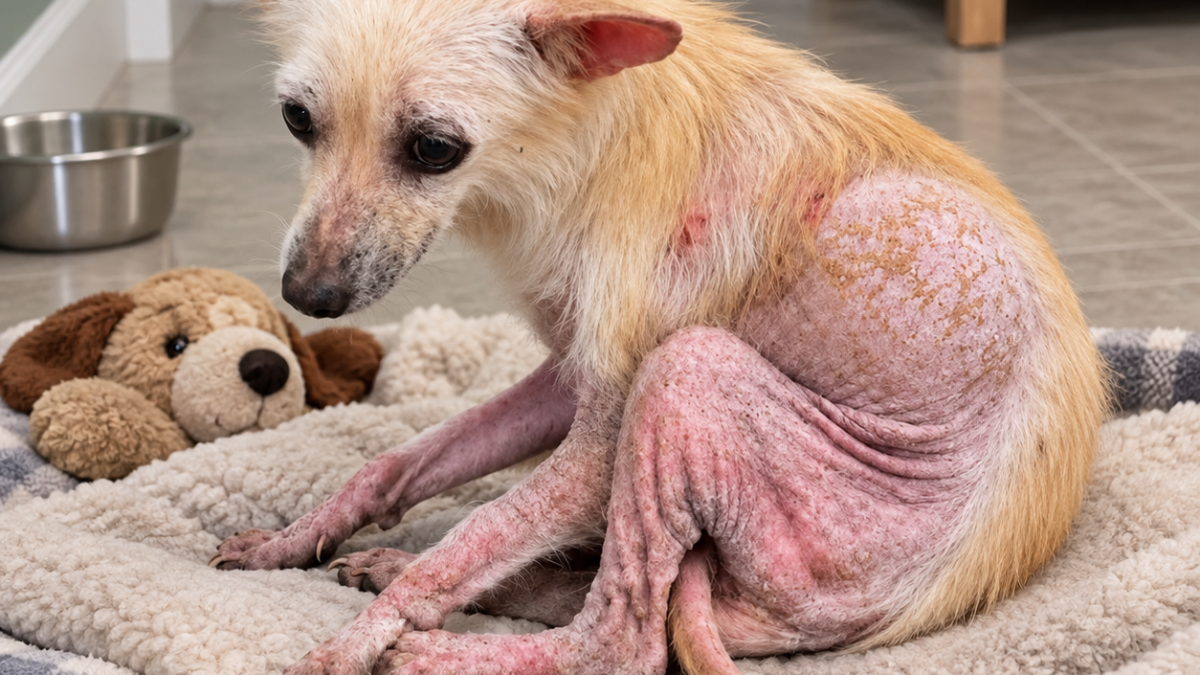
The forester said he heard crying somewhere deep inside the brush, but when I pushed the branches apart, the dog underneath them was too terrified even to look at me.
Most of her fur was gone, her skin was raw and red, ticks covered her body, and her nails had grown so long that simply standing seemed painful.
I thought finding her alive was the shocking part, but the veterinarian would soon show me that the real story had been written into her bones years before she ever reached those woods.
My name is Rachel Carter, and at the time I volunteered with a small animal rescue outside Asheville, North Carolina.
The call came shortly after seven on a cold Tuesday morning.
A forestry worker named Daniel had been checking a service trail when he heard a strange sound coming from a wall of tangled brush.
Not barking.
Not howling.
Crying.
He followed it until he found a dog folded beneath the branches.
When I arrived with another rescuer, Melissa, Daniel was still standing several yards away.
“I didn’t want to scare her,” he whispered.
I knelt.
At first, I could barely tell what color she was supposed to be.
Her skin was exposed across most of her back and sides, angry and inflamed beneath patches of dirty hair.
Ticks clustered behind her ears.
Her ribs showed.
Her nails curled sideways into the dirt.
But the thing that stayed with me was how desperately she tried to disappear.
Whenever I moved closer, she pulled her legs under herself.
When Melissa raised one hand, the dog flinched before she was even touched.
“She thinks we’re going to hurt her,” Melissa said.
So we stopped.
For nearly twenty minutes, I sat in the dirt and talked quietly.
“I’m not going to rush you.”
The dog kept her face turned away.
I placed soft food several feet in front of her.
She stared at it.
Then slowly crawled forward.
She didn’t stand to eat.
She lay flat on her stomach and took one bite at a time, barely lifting her head.
That scared me more than frantic hunger would have.
This dog was starving, yet even food seemed like something she was afraid she might lose.
When we finally wrapped her in a blanket, she began shaking so hard I felt it through both layers of fabric.
She never snapped.
Never growled.
Never fought us.
She simply went limp in my arms.
Back at the rescue house, we gave her water, food, a soft bed, and a quiet room.
She ignored the bed.
Instead, she pushed herself against the wall and curled into the tightest shape her body could manage.
Every time someone entered, her eyes closed.
Not because she was sleeping.
Because she was bracing herself.
The next morning, we took her to our veterinarian.
We named her Hope before we knew anything else about her.
She was only about four years old.
But the X-rays looked like they belonged to an animal who had spent a lifetime fighting her own body.
Dr. Martin pointed toward her spine.
“Scoliosis.”
Then lower.
“A herniated disc.”
He shifted the image.
“And her pelvis is deformed.”
I stared at the screen.
“What causes that?”
He hesitated.
“Several things can contribute. But chronic confinement in a space too small to stand or move normally would be one possibility.”
Melissa looked at me.
“A cage?”
“A very small one.”
He examined Hope again.
Then his expression changed.
“She’s probably had puppies.”
The room went silent.
Hope was four years old.
If he was right, someone may have kept her confined, bred her repeatedly, and let her body deteriorate until she was no longer useful.
We couldn’t prove any of that yet.
All we could prove was what remained.
A damaged spine.
A deformed pelvis.
Skin disease.
Weak muscles.
And a dog so afraid of people that kindness frightened her.
For three weeks, Hope received fluids, medication, medicated baths, careful nutrition, and physical support.
Some days the victories were almost invisible.
She lifted her head.
She ate sitting up.
She allowed me to clean one paw.
Then one morning, I opened the recovery-room door and froze.
Hope was standing.
Her legs trembled.
Her back curved.
But she was standing on her own.
“Hope?”
She turned toward me.
For the first time since I had met her, she looked directly into my eyes.
Then she took one uncertain step toward me instead of away.
I covered my mouth and started crying.
What I didn’t know was that while Hope was learning to stand, someone else was finally looking closely at the few things we had recovered from beneath those bushes.
And one tiny piece of plastic was about to lead us back toward the place where Hope’s suffering had begun.
PART 2
The piece of plastic was sitting in an evidence bag on the shelf above my desk.
I had passed it dozens of times.
It looked useless.
A broken blue buckle no larger than two fingers, scratched and caked with dirt.
When we found Hope beneath the brush, Melissa had gathered everything around her in case animal control later needed it.
A length of frayed nylon.
A strip of filthy fabric.
Several clumps of pale fur.
And that buckle.
No collar.
No tag.
No name.
No microchip.
Nothing that appeared capable of telling us where Hope had come from.
For nearly three weeks, I cared more about whether she could stand than where that little piece of plastic had been made.
Then Melissa picked it up one afternoon.
“Rachel.”
I was measuring Hope’s medication.
“What?”
“Come look at this.”
She held the evidence bag under the desk lamp.
“There’s a number.”
I leaned closer.
Eight tiny digits had been molded into the back.
I shrugged.
“Manufacturing code?”
“Maybe.”
She photographed it.
I looked through the recovery-room window.
Hope was lying on a padded mat, watching us.
Three weeks earlier she would have turned her face away.
Now she watched.
That was progress.
It wasn’t recovery.
Dr. Martin reminded me of that almost every day.
The fact that Hope had managed to stand did not mean her body had suddenly forgotten years of damage.
Her muscles were weak.
Her back legs lacked coordination.
Sometimes one foot folded beneath her without her noticing.
If she tried to move too quickly, her hindquarters drifted sideways.
And emotionally, she was still living inside a world we could not see.
The first time I reached toward her after she fell, she slammed herself backward so hard she struck the wall.
I stopped immediately.
“All right.”
Her eyes were enormous.
“No touching.”
I sat on the floor several feet away.
That became one of the hardest lessons Hope taught me.
Wanting to help did not give me permission to force help on her.
If she was not in immediate danger, I waited.
She had spent too much of her life having decisions made for her.
Now even something as simple as standing had to become her choice.
We adjusted everything.
Low bowls.
Non-slip mats.
A thick bed.
A shallow ramp instead of a step.
Medication for pain and inflammation.
Gentle exercises to rebuild muscle.
And medicated baths for the raw skin covering most of her body.
The first bath went badly.
The second I turned on the faucet, Hope panicked.
She flattened herself against the tub, scrambling on weak legs, desperate to escape the sound of running water.
I shut it off.
Melissa stared at me.
“We have to clean her.”
“I know.”
“So what do we do?”
“We stop doing it this way.”
We filled buckets outside the room.
Used warm water from pitchers.
No running faucet.
No hose.
No sudden spray.
I sat beside Hope while Melissa slowly wet her back.
Hope shook the entire time.
But she stayed.
The next bath, she shook less.
By the sixth, she accepted chicken from my hand while Melissa rinsed shampoo from her shoulders.
Tiny victories.
That was how Hope recovered.
Not dramatically.
One ordinary thing at a time.
As her skin healed, something beautiful happened.
Her fur started returning.
First around her ears.
Then along her neck.
Then across her shoulders.
It came in pale gold.
Under all the dirt and scabs, Hope had once been a beautiful cream-colored retriever mix.
The healthier she became, the more obvious the cruelty looked.
That may sound strange.
When we found her nearly hairless and starving, everything about her looked broken.
As her coat returned and her face filled out, I could suddenly imagine what she might have looked like before.
Then my eyes would fall to her crooked spine.
Her uneven hips.
The awkward swing of her rear leg.
And I would wonder who had watched a young dog gradually become that damaged without helping her.
Hope was terrified of men.
Daniel, the forester who found her, came to visit after two weeks.
He brought treats.
He stood in the doorway and said quietly, “Hey, girl.”
Hope vanished beneath the table.
Daniel immediately backed away.
His face fell.
“She remembers me?”
“I don’t think this is about you.”
He put the treats on the floor.
“I’ll stay out here.”
He sat in the hallway.
He did not call her.
Did not reach toward her.
Did not try to prove he was safe.
That mattered.
Daniel came back the next week.
And the next.
Sometimes he sat on the floor reading his phone while Hope watched him.
A month passed.
One afternoon, Hope walked halfway toward him.
Daniel didn’t move.
She sniffed the toe of his boot.
Then retreated.
Daniel looked at me with tears in his eyes.
“I’ll take it.”
“So would I.”
Her fear told us something.
But fear was not evidence.
Her spine was not evidence of one particular person.
Neither were the overgrown nails.
The reproductive changes.
The skin disease.
We needed something solid.
The broken buckle became that beginning.
Melissa sent the number to an animal-control investigator named Karen Wells.
Karen was not warm.
At least not at first.
The first time she came to interview us, she spent almost no time looking at Hope.
Instead, she looked at records.
Dates.
Coordinates.
Photographs.
Veterinary reports.
The buckle.
“You think she was dumped?” Karen asked.
“Yes.”
“That’s not enough.”
“I know.”
“Could she have wandered into the woods?”
“Possibly.”
“Could the buckle have belonged to another animal?”
“Yes.”
“Can Dr. Martin prove somebody confined her?”
Dr. Martin answered.
“I can prove the medical findings are consistent with chronic confinement.”
“Can you prove where?”
“No.”
Karen wrote something down.
I disliked her immediately.
Then, fifteen minutes later, I understood what she was doing.
She wasn’t doubting Hope.
She was preparing for someone else to doubt Hope.
Because if we ever found the person responsible, emotion would not be enough.
We would need evidence that could survive a courtroom.
The buckle went nowhere for nearly a month.
Then Karen called.
“Rachel, do you have a minute?”
“Yes.”
“We may have found something.”
My heart started pounding.
“What?”
“The numbered buckle resembles collars used at a breeding property that was inspected three years ago.”
I sat down.
“What breeding property?”
“A place outside Rutherford County. Owner’s name is Vernon Pike.”
The name meant nothing to me.
Not then.
Within hours, it meant everything.
Vernon Pike was fifty-six.
He had operated a small commercial breeding business for almost twelve years.
Golden mixes.
Labrador mixes.
Doodles.
“Family dogs.”
“Raised with love.”
“Healthy puppies.”
That was what his advertisements said.
Melissa found old listings online.
Puppies sitting in baskets.
Puppies on blankets.
Puppies with bows around their necks.
A little girl holding one beside flowers.
The photographs were bright.
Clean.
Perfect.
Nothing in them showed adult females.
Nothing showed the back buildings.
Nothing showed cages.
Three years earlier, someone had reported concerns about the property.
Animal control visited.
Pike had apparently been warned in advance.
The front runs were clean.
The dogs visible during inspection had water.
No obvious criminal violation was established.
The complaint died.
But photographs remained in the old file.
One showed a line of adult females wearing blue numbered collars.
The buckle design matched the fragment found beneath Hope.
Not proof.
But enough to keep looking.
Karen began contacting former puppy buyers.
At first, nothing.
Then a woman named Lauren Mitchell returned her call.
Lauren had purchased a cream-colored puppy from Pike two years earlier.
Karen asked whether she had seen the mother.
Lauren hesitated.
“Kind of.”
“What does that mean?”
“She was behind a gate.”
“Where?”
“Inside a barn.”
“Did you get a good look?”
“No.”
“Anything unusual?”
Lauren was silent.
Then she said:
“Her back looked strange.”
My fingers tightened around the phone when Karen later told me.
Lauren still had photographs from the day she picked up her puppy.
Most were of the puppy.
But in one picture, behind a wire divider, an adult cream-colored female stood in shadow.
Thin body.
Patchy coat.
Curved back.
The same white marking beneath the throat Hope now had.
Dr. Martin examined the picture.
“Consistent.”
Karen stayed careful.
“Consistent is not identification.”
Then another buyer came forward.
He had taken a short video while his children played with puppies.
For two seconds, the camera swung toward the barn.
A female dog walked behind wire.
Blue collar.
Uneven hindquarters.
Pale coat.
A digital specialist enhanced several frames.
The final four digits visible on the collar matched the broken buckle.
That was enough for a deeper investigation.
A search warrant followed.
I was not allowed on the property.
Thank God.
Karen told me later what they found.
Twenty-seven dogs.
Nine adult females.
Four males.
Fourteen puppies.
The front kennels were acceptable.
The building behind them was not.
A false plywood wall divided the barn.
Behind it were narrow cages.
Some dogs could stand.
Others could not fully raise their heads.
Females lived there between litters.
Several had pressure sores.
Overgrown nails.
Untreated ear infections.
One dog had a front leg twisted from an old injury.
Another female moved with the same sideways gait Hope had.
On the wall hung a row of blue numbered collars.
In a filing cabinet, investigators found breeding notebooks.
Hope’s number was there.
Female 08-417263.
Cream retriever mix.
Born four years earlier.
First litter.
Second litter.
Third litter.
Then:
BACK BAD.
Below that:
SKIN.
And one final word.
REMOVE.
Karen showed me a photocopy two days later.
I stared at it.
“Remove?”
“That’s what it says.”
“What does that mean?”
“We’re going to find out.”
Hope was lying six feet away.
Her head rested on her paws.
She had no idea that somewhere, on a page in a barn, a human being had reduced her entire life to a number and one final instruction.
Remove.
Not treat.
Not retire.
Not find a home.
Remove.
I felt something inside me change.
Until then, I had wanted Hope to recover.
Now I wanted accountability.
Not violence.
Not revenge in the movie sense.
I wanted Vernon Pike to lose the ability to put another dog in a cage.
I wanted every locked building opened.
Every female removed.
Every puppy traced.
I wanted him forced to look at what he had called worthless.
Pike’s first story was that Hope had been sold.
To whom?
He could not remember.
Paperwork?
None.
When?
Months earlier.
Then Karen showed him the buyer photograph.
His story changed.
Maybe Hope had run away.
When?
He gave a date.
Unfortunately for him, Hope appeared in another buyer’s video after that date.
The story changed again.
An employee must have let her out.
He had been sick.
Financial pressures had caused temporary lapses.
The narrow enclosures were recovery crates.
The females were only kept there briefly.
Hope’s spinal problems were genetic.
Her skin condition could have developed after she escaped.
Her nails could have grown while she wandered.
Every explanation pushed responsibility somewhere else.
Then Karen started looking at the road between Pike’s property and the forest.
Hope could not have walked that distance.
Dr. Martin was certain.
It was more than thirty miles.
When we found her, she could barely cross a room.
A gas station’s security footage had already been overwritten.
So had cameras at a hardware store.
Then a retired engineer named Tom Bradley contacted animal control.
Tom lived near the access road leading into the forest.
He had several trail cameras because deer kept eating his garden.
One camera faced the lane.
Tom kept footage for months.
A white cargo van passed his property one rainy evening.
Twenty-one minutes later, the same van returned.
Investigators matched the license plate.
Vernon Pike.
That placed him near the forest.
Still not enough.
Then Tom remembered seeing a dog the following morning.
“Almost no hair,” he said.
“Where?” Karen asked.
“Near the ditch.”
“Could you approach her?”
“No. She ran into the woods.”
Hope.
Karen asked why he hadn’t called anyone.
Tom looked ashamed.
“I thought she belonged to somebody around there.”
Another almost.
Another person who nearly looked away.
But Daniel eventually heard her cry.
And Daniel did not.
Phone-location records became the next piece.
Pike’s attorney fought access.
The court allowed investigators to examine data relevant to the night in question.
Pike’s phone left his property.
Traveled toward the forest.
Stopped near the access road for nine minutes.
Then returned home.
Nine minutes.
For weeks, I imagined those nine minutes.
Did Hope refuse to leave the van?
Did he drag her?
Carry her?
Did she look after him when he drove away?
Did she follow until pain stopped her?
Those questions made me furious.
Eventually, Dr. Martin told me something I needed to hear.
“Stop inventing the missing pieces.”
I looked at him.
“I’m not inventing anything.”
“You are.”
He sat across from me.
“You know enough to be angry. You don’t need to torture yourself with scenes you cannot know happened.”
I looked through the window at Hope.
She was sleeping.
“You’re right.”
“I usually am.”
“That ruins the moment.”
“Occupational hazard.”
The case expanded.
Every dog on Pike’s property was examined.
Seven females showed reproductive overuse.
Five had chronic orthopedic problems.
Several required dental work.
Two had untreated infections.
Three were severely underweight.
The hidden kennel became the center of the investigation.
Former customers began speaking.
One had asked to see the mother of her puppy and was told she had already gone home with “a family member.”
Another remembered hearing dogs scratching behind the barn wall.
A third said Pike insisted on meeting buyers in the driveway.
Then a former employee contacted Karen.
His name was Jason Reed.
Thirty years old.
He had worked for Pike for sixteen months.
At first, he refused an interview.
Then Karen showed him photographs of the seized females.
He agreed.
Jason described the operation.
The females were bred repeatedly.
If they produced healthy litters, they stayed.
Veterinary care was minimal unless something affected puppy sales.
Females that became difficult to breed, sick, or expensive were “moved out.”
Karen asked what that meant.
Jason stared at his hands.
“Sometimes he sold them cheap.”
“And sometimes?”
“Dropped them.”
“Where?”
“Roads.”
My stomach turned when I heard that.
“Shelters?”
“No.”
“Rescues?”
“No.”
“Where?”
“Back roads. Farms. Woods.”
Hope was not an accident.
She was disposal.
The day Karen told me, I went into Hope’s room and sat beside her.
She walked toward me.
That still amazed me.
Months earlier, my presence made her shrink.
Now she came.
Her head rested on my knee.
I put one hand gently on her shoulder.
“You weren’t lost.”
My voice broke.
“You were thrown away.”
Hope sighed and closed her eyes.
She did not know the difference.
Maybe that was mercy.
Jason admitted he had seen Hope in Pike’s van.
“Was she alive?” Karen asked him.
“Yes.”
“Could she walk?”
“A little.”
“Where was Pike going?”
Jason hesitated.
“He said he was taking care of a problem.”
“What problem?”
Jason looked down.
“Her.”
That became one of the darkest moments of the case.
But Jason had more.
He described Hope crying at night.
Not barking.
A low, repetitive sound from the back of the barn.
He sometimes gave the females extra food after Pike left.
Once, he let Hope out of the cage.
She could barely straighten.
“She just stood there,” he told Karen.
“Wouldn’t walk?”
“She didn’t know what to do.”
“How long had she been confined?”
“I don’t know. Most of the time I worked there.”
“Did she receive veterinary care?”
“Not that I saw.”
“Why?”
Jason swallowed.
“Pike said she wasn’t worth spending money on.”
I learned that sentence before the trial.
I wish I hadn’t.
For days, every time I looked at Hope, I heard it.
Not worth spending money on.
This dog who had learned to trust my hands.
Who now waited every morning for chicken.
Who had started wagging her tail when Daniel visited.
Who sometimes stole towels from the laundry basket and carried them proudly into the hallway.
Not worth it.
That was when revenge changed shape for me.
I didn’t want Pike hurt.
I wanted him erased from Hope’s future.
I wanted every part of the life he had planned for her replaced.
He had intended for her to disappear.
I wanted her to become impossible to ignore.
While the case moved slowly, Hope kept recovering.
Physical therapy became hydrotherapy.
The first time we placed her in the warm rehabilitation pool, she froze.
Water meant medicated baths.
Fear.
Being held.
Her body stiffened.
“I’ve got you,” I whispered.
The therapist supported her hindquarters.
Hope looked at me.
One paw moved.
Then another.
Her body floated.
For once, her deformed pelvis did not have to carry her full weight.
Hope paddled.
Three strokes.
Then five.
The therapist smiled.
“There you go.”
By her fourth session, Hope stopped shaking.
By the eighth, she pulled toward the pool when we entered.
Her spine would never straighten completely.
Her pelvis would never become normal.
But the muscles around the damage strengthened.
And something unexpected happened.
Hope started moving faster.
At first, only a few hurried steps.
Then a trot.
The first time she ran, it happened because another rescued female stole a toy.
We had named the younger dog Daisy.
She came from Pike’s property too.
Daisy grabbed a cloth fox and bolted across the yard.
Hope watched.
Her ears lifted.
Then she followed.
One awkward step.
Two.
Three.
Suddenly she was trotting.
Then running.
Crooked.
Uneven.
Beautiful.
“Hope!”
I shouted without thinking.
She stopped.
I covered my mouth.
“Sorry.”
Daisy circled back.
Bumped Hope’s shoulder.
Then ran again.
Hope chased her.
This time nobody made a sound.
We stood along the fence watching a dog who had once eaten lying down because standing hurt too much run across grass.
Dr. Martin happened to arrive during the second lap.
He stopped.
“That’s probably not wise.”
I looked at him.
“Are you going to stop her?”
He watched Hope.
“No.”
“Then hush.”
He smiled.
“I’ll note my professional objection.”
Hope ran past us.
Tail up.
Mouth open.
I laughed until I cried.
Her emotional recovery remained less predictable.
Metal chains terrified her.
So did brooms.
The sound of a latch snapping shut.
Men in heavy work boots.
And white cargo vans.
We discovered that one afternoon when a delivery driver pulled into the parking lot.
Hope saw the van through the window.
Her legs folded.
She crawled beneath a chair.
Not walked.
Crawled.
I sat outside the room.
Forty minutes passed.
The van left.
Hope stayed hidden.
That reaction told us something the evidence never could.
She remembered.
Maybe not the forest.
Maybe not Pike’s face.
But somewhere inside her nervous system was a memory of a white van and what happened afterward.
So we changed the meaning.
My car became part of rehabilitation.
Engine off.
Doors open.
Treats near it.
Hope refused to approach for days.
Daisy did.
Hope watched.
Eventually, she placed one paw on the bumper.
Then backed away.
The next week, two paws.
Then all four.
She entered.
Immediately exited.
Good.
The door always opened again.
Later, we closed it for one second.
Opened.
Five seconds.
Opened.
Thirty.
Opened.
Then the engine.
Then one loop around the parking lot.
Hope shook.
When we returned, I opened the door.
She stepped down.
Nothing bad happened.
The next ride went to a quiet park.
The ride after that ended at hydrotherapy.
Soon the car meant new places instead of abandonment.
That mattered more to me than I can explain.
The trial began almost nine months after Hope was found.
By then, her coat had nearly returned.
Cream-colored.
Soft.
Only a few thin areas remained where the skin damage had been worst.
She had gained weight.
She walked every day.
She still limped.
She still tired quickly.
But when strangers saw her now, they saw a dog.
Not a wound.
I attended the first day of court.
Vernon Pike looked ordinary.
That bothered me.
Gray hair.
Glasses.
Clean shirt.
Blue jacket.
I had imagined someone whose face would explain everything.
It didn’t.
People who do terrible things rarely look the way stories teach us they should.
His lawyer described him as a hardworking breeder overwhelmed by business problems.
Staff shortages.
Personal illness.
Rising veterinary costs.
Unexpected financial pressure.
No intent to cause suffering.
That phrase again.
No intent.
Hope’s spine didn’t care about his intent.
Her pelvis didn’t care.
Her fear didn’t care.
The prosecutor did not argue emotionally.
She used paper.
Photos.
Dates.
Medical findings.
Breeding records.
Then Hope’s notebook entry appeared on a screen.
08-417263.
Three litters.
BACK BAD.
SKIN.
REMOVE.
The prosecutor asked Pike:
“What does remove mean?”
“I don’t remember writing that.”
“Is this your breeding notebook?”
“People wrote in it.”
“Who?”
“Employees.”
She named the dates.
One employee had already quit.
Another had never handled breeding records.
Pike shifted.
The prosecutor showed the location history from his phone.
Then the trail-camera image of the van.
Then the medical report.
Pike claimed he had driven to the forest to dump yard debris.
“Where is the debris?” the prosecutor asked.
“I don’t remember.”
“Why was the dog marked for removal that same week?”
“I don’t know that she is the same dog.”
The buyer photograph appeared.
Then the video.
Then Hope’s intake photograph.
Then the numbered buckle.
The courtroom stayed very quiet.
Dr. Martin testified next.
The defense tried to isolate each condition.
Could scoliosis be congenital?
“Yes.”
Could pelvic deformity have other causes?
“Yes.”
Could skin disease develop rapidly?
“Yes.”
The lawyer smiled slightly.
Then Dr. Martin added:
“But medicine is not practiced by pretending every finding exists alone.”
The smile disappeared.
“What do you mean?”
“Hope presented with chronic muscle wasting, severely overgrown nails, multiple skin conditions, restricted joint mobility, spinal abnormality, pelvic deformity, reproductive changes, and inability to stand normally.”
“Can you prove a cage caused that?”
“I can say prolonged restriction is medically consistent with the combination.”
“For how long?”
“Months. Possibly years.”
“Could she have walked from Mr. Pike’s property to the forest?”
“No.”
“Why not?”
“She could barely cross an examination room.”
That answer mattered.
Then Jason testified.
Pike stared at him.
Jason looked terrified.
The defense attorney attacked his credibility.
“You worked there willingly?”
“Yes.”
“You accepted wages?”
“Yes.”
“You cared for the dogs?”
“Yes.”
“You never reported my client during your employment?”
“No.”
“So either the conditions were not as terrible as you now claim, or you participated in allowing animals to suffer.”
Jason’s face went pale.
“Yes.”
The attorney paused.
That answer wasn’t expected.
Jason looked toward the judge.
“I did allow it.”
Silence.
“I needed the paycheck, and I kept telling myself it wasn’t my responsibility. Then I started avoiding the back building because I didn’t want to see what was happening.”
His voice broke.
“Hope used to cry at night.”
My hands clenched.
The lawyer objected.
The judge limited the testimony.
Later, the prosecutor asked the question properly.
“Did you personally observe Hope vocalizing while confined?”
“Yes.”
“How?”
“A low crying sound.”
“Did you ever see her released from the cage?”
“Once.”
“What happened?”
“She stood outside it and didn’t move.”
“Why?”
“I don’t think she understood she could.”
I had to look down.
The prosecutor continued.
“Did Mr. Pike seek veterinary care for Hope while you worked there?”
“Not that I saw.”
“Did you discuss it?”
“Yes.”
“What did he say?”
The courtroom went still.
Jason swallowed.
“He said she wasn’t worth the bill.”
I closed my eyes.
There it was.
Spoken aloud.
Not hidden in a report.
Not told to me privately.
In a courtroom.
Hope’s value, according to the man who owned her, had ended when her body stopped producing money.
That sentence probably influenced me more than the eventual verdict.
Because from that moment forward, I knew exactly what justice looked like.
Hope did not need him to suffer the way she had suffered.
She needed his judgment to be proven wrong.
The trial lasted more than a week.
Not every allegation survived.
Some older complaints were impossible to prove.
Some evidence was too indirect.
But enough remained.
Pike was found responsible for multiple animal-welfare violations, failure to provide necessary care, improper confinement, commercial breeding violations, and Hope’s abandonment.
The seized dogs were permanently forfeited.
His breeding operation closed.
His ability to own or commercially handle animals was restricted under the court’s order and subject to future oversight.
Fines followed.
Licensing consequences followed.
The barn emptied.
The cages emptied.
His advertisements disappeared.
There was no cheering in court.
No dramatic speech.
Just paperwork.
Orders.
Consequences.
And a door closing on the business that had kept Hope inside a cage.
When the forfeiture order became final, Melissa found me in the hallway.
“Hope can be adopted.”
I nodded.
“You heard me?”
“Yes.”
“So?”
“So what?”
She stared at me.
“You are the most irritating woman I know.”
“That seems unrelated.”
“You’ve spent nine months rebuilding your entire life around that dog.”
“I volunteer here.”
“You built a ramp at your house.”
“For accessibility.”
“You bought three orthopedic dog beds.”
“They were on sale.”
“You know exactly which brand of chicken she likes.”
“She has preferences.”
Melissa folded her arms.
“Adopt her.”
I looked through the glass.
Hope was sleeping beside Daisy.
“I work long hours.”
“She comes with you.”
“My house isn’t huge.”
“She spent years in a cage. She does not require a ranch.”
“She might deserve more space.”
Melissa’s voice softened.
“She deserves choice.”
Hope opened her eyes.
Saw me.
Stood.
Walked across the room.
Then sat beside my leg.
Melissa raised one eyebrow.
“Looks like she chose.”
The paperwork was finalized on a Thursday.
Hope officially became mine.
Or, more accurately, I became hers.
Our first night at home was quiet.
I had prepared a bed against the wall.
Hope ignored it.
She walked through the living room.
Kitchen.
Bedroom.
Then returned to the center of the living-room rug.
She lowered herself there.
Not against furniture.
Not in a corner.
In the middle.
I stood in the doorway for several minutes.
Months earlier, Hope had compressed herself into the smallest shape possible whenever anyone entered.
Now she slept where she could be seen.
I did not understand how emotional that would make me.
At two in the morning, I woke to soft footsteps.
Hope stood beside my bed.
I lowered my hand.
She pressed her nose into my palm.
Then lay beside the mattress.
That became our routine.
Recovery continued.
So did the surprises.
Hope loved grass after rain.
Hated umbrellas.
Loved scrambled eggs.
Refused carrots with personal offense.
Barked at one particular garden statue every single time we passed it.
She adored elderly women.
Distrusted bicycles.
And discovered that running, despite everything her X-rays suggested, was apparently one of her favorite things.
Not long distances.
Not fast.
But enough.
There was a field near my house.
On good mornings, I unclipped her long training leash.
Hope would look at me.
Then trot.
Her crooked back shifted strangely.
One rear leg swung outward.
Her ears bounced.
Sometimes Daisy came with her adoptive family, and the two former breeding dogs chased each other in slow circles until both collapsed in the grass.
The first time I watched them, I remembered the cages behind Pike’s barn.
Two dogs who had once been measured in litters now wasting energy purely because it felt good.
That was revenge.
Not anger.
Not punishment.
Joy he had never intended them to have.
Hope learned to explore.
Forests first.
Quiet trails.
Then lakes.
On our first trip to a lake, she stood at the shoreline for almost ten minutes.
Water moved around her paws.
She stepped backward.
Then forward again.
Hydrotherapy had taught her water could support her.
Now she discovered water could also be enormous.
Wind moved across the surface.
Ducks called from the reeds.
Hope stared.
I wondered whether she had ever seen a lake.
Probably not.
After that, I began taking her somewhere new whenever her health allowed.
A farm owned by friends.
A mountain overlook.
A small town street during a quiet morning.
A bakery with outdoor tables where the owner gave her plain chicken.
A field of wildflowers.
Each place mattered.
Not because Hope understood travel the way humans do.
Because her whole early life had been defined by restriction.
A cage.
A barn.
A van.
A forest.
Now she got to choose where her feet went.
The ocean came almost two years after we found her.
Dr. Martin approved the trip with instructions.
No deep sand for long periods.
Frequent rest.
Medication on schedule.
Harness available.
“Do not let her chase birds for three miles.”
“I have never let her chase birds for three miles.”
“You have the face of someone who might.”
“That is insulting.”
“It is preventive medicine.”
The Atlantic was four hours away.
Hope slept through most of the drive.
When we arrived, she smelled the water before she saw it.
Her nose lifted.
She pulled gently toward the dune path.
I followed.
Then we reached the top.
The world opened.
Ocean.
Sky.
Sand.
Nothing blocking the horizon.
Hope stopped.
I stopped behind her.
For nearly a minute, she did nothing.
A dog who once lived in a space too small to stand properly was looking at more open space than she could possibly cross.
Wind lifted the fur along her neck.
Her fur.
That still struck me.
When I first touched her, there had been almost none.
Now it shone pale gold in the sun.
Hope started forward.
Slowly at first.
Then faster.
We reached the wet sand.
A wave slid toward her.
Touched her paws.
Hope jumped sideways.
I laughed.
She looked offended.
Another wave arrived.
This time she stayed.
Water moved around her ankles.
Hope looked toward the horizon.
I crouched beside her.
“You made it.”
The sentence was for me.
Not her.
I thought about the bushes.
The red skin.
Ticks.
Curled nails.
The X-rays.
The cages.
Pike’s notebook.
REMOVE.
And now Hope stood beside an ocean.
A gull landed farther down the beach.
Hope saw it.
Her ears lifted.
“No.”
She pulled.
“Absolutely not.”
Hope broke into her crooked run.
I followed.
“Hope!”
She accelerated.
“My veterinarian is going to murder me!”
She had no sympathy.
I finally slowed her after maybe thirty yards.
Hope turned back toward me.
Mouth open.
Tongue hanging sideways.
Eyes bright.
Happy.
There was no other honest word for it.
That afternoon, she slept on a blanket near the dunes.
Not curled.
Stretched completely on one side.
Her legs extended.
Belly exposed.
Open space in every direction.
I took a photograph.
It became my favorite picture of her.
Not the running one.
Not the first day her fur grew back.
Not even the photograph from adoption day.
That one.
Hope asleep with nothing around her.
Years passed.
The legal case faded from local news.
Pike’s property was eventually sold.
The old breeding barn was demolished.
Karen sent me a photograph.
Only flattened dirt remained where the hidden cages had been.
I expected to feel triumph.
Instead, I felt quiet.
“Good,” I said.
That was all.
By then, Hope’s revenge was happening every morning.
Breakfast.
Walk.
Nap.
Car ride.
Sunlight.
A life so ordinary it would have bored the man who once measured her value in puppies.
That ordinariness was the victory.
Hope became part of our rescue’s training program.
Not because we wanted to display her trauma.
We never forced her to interact.
But her case changed how we worked.
We trained volunteers not to assume silence meant calm.
Not to drag frightened animals into open rooms just because “more space is better.”
Not to remove comfort objects without reason.
Not to force eye contact.
Not to confuse rescue with recovery.
A cage can be opened in seconds.
Teaching a dog that the cage is not coming back can take years.
Hope grew especially gentle around frightened females.
When a new dog arrived and hid beneath furniture, Hope sometimes lay nearby.
No pressure.
No barking.
Just presence.
One young spaniel refused to leave a transport crate for two days.
We placed Hope in the room.
She lay six feet away.
The spaniel watched.
Eventually Hope stood.
Walked to the water bowl.
Drank.
Lay down again.
Twenty minutes later, the spaniel stepped out.
Melissa whispered:
“She’s doing our job now.”
“Better than us.”
Hope’s body aged faster than it should have.
Her early years had taken a price.
Cold weather worsened her back.
Her rear leg occasionally dragged.
At eight, she needed more pain medication.
At nine, our hikes shortened.
At ten, the ramp became permanent.
She still ran.
Sometimes.
A few ridiculous steps toward a squirrel.
A crooked dash when Daisy visited.
But mostly she walked.
And that was enough.
Daniel remained part of her life.
The forester who heard her cry never stopped visiting.
Once, years later, he admitted something.
We were sitting in my yard while Hope slept in the sun.
“I almost kept walking.”
I looked at him.
“What?”
“The morning I found her.”
He stared toward Hope.
“I heard the sound once and thought it was a bird. I was behind schedule. I walked maybe fifty yards.”
“You never told me that.”
“I heard her again.”
“And turned around.”
“Yes.”
He looked sick with guilt.
“What if I hadn’t?”
“You did.”
“But—”
“No.”
I shook my head.
“You did.”
Hope lifted her head.
Daniel smiled faintly.
“I still think about those fifty yards.”
“Then think about the fact that you walked back.”
Hope stood.
Slowly crossed the yard.
Placed her head on Daniel’s knee.
He stroked her neck.
“You were worth turning around for,” he whispered.
Of all the things people ever said about Hope, that may have been my favorite.
Her final ocean trip happened when she was almost eleven.
The drive took longer because we stopped often.
Dr. Martin wanted me to skip it.
Not because Hope was dying.
Because her arthritis had worsened.
“Short beach walk,” he warned.
“Very short.”
“I understand.”
“No running.”
“She barely runs.”
He stared at me.
“She will see a gull.”
“That is a fair concern.”
Hope recognized the dune path.
I swear she did.
The moment she smelled salt, she pulled forward.
Not hard.
But with purpose.
At the top of the path, she stopped again.
Same ocean.
Same horizon.
Different dog.
Her muzzle was white now.
Her back had become more pronounced.
She wore a support harness.
But when the first wave touched her paws, Hope lifted her head.
Wind hit her face.
For several minutes, she simply stood.
Then she lay beside me on the sand.
I sat with one arm around her.
No dramatic revelation.
No miracle.
Just an old dog looking at water.
That was what I loved most.
Hope’s life had become ordinary enough that nothing had to happen.
She had survived long enough to have boring afternoons.
Her decline began the following spring.
She stopped finishing breakfast.
At first, we blamed medication.
Then blood tests showed kidney disease.
Treatment helped.
For months, Hope rallied.
She ate again.
Walked in the yard.
Stole a piece of bread from the counter.
Barked at the mail carrier.
I celebrated every annoying behavior.
Then her spine worsened.
One morning, her rear legs failed.
She tried to stand.
Couldn’t.
I slipped the support harness beneath her.
Hope looked at me.
“You’re allowed,” I whispered.
“You don’t have to do everything yourself anymore.”
She leaned against my leg.
We managed several more good months.
Daisy visited.
Daniel visited.
Melissa came constantly.
Dr. Martin adjusted medications.
One Saturday, Hope lay in the garden beside Daisy.
Two former breeding dogs.
Both gray.
Both crooked in different ways.
Both sleeping in sunlight.
I took a photograph.
It sits beside the ocean picture now.
Hope’s final decline came quickly.
She refused chicken.
That was how I knew.
Hope never refused chicken.
Dr. Martin examined her at home.
I watched his face.
He didn’t have to say it.
“Is she hurting?”
“Yes.”
“Can we fix it?”
“Not this time.”
I sat on the floor.
Hope rested against me.
There are decisions that feel like betrayal even when they are the final form of love.
I wanted another week.
Another month.
Another ocean trip.
Hope needed me not to want those things more than she needed peace.
So we chose that evening.
Melissa came.
Daniel came.
Daisy and her family came for a short visit.
Hope lay on her bed near the open patio door.
Years earlier, she pressed herself into corners whenever a door opened.
Now she wanted the door open.
Warm spring air moved through the room.
Birds called outside.
Daisy approached.
Sniffed Hope’s face.
Then lay beside her.
For several minutes, the two old dogs rested together.
No cages.
No numbers.
No breeding records.
Just Hope and Daisy.
Names.
Lives.
When Daisy left, Daniel sat several feet away.
He still never assumed he could touch Hope.
Even after all those years.
Eventually, Hope looked toward him.
Daniel extended one hand.
She pushed her nose beneath it.
He began crying.
“You were worth turning around for,” he said again.
Hope licked his fingers.
Dr. Martin arrived near sunset.
He knelt beside her.
“Still causing trouble?”
Hope’s tail moved once.
He smiled.
“Good.”
We gave her tiny pieces of chicken.
She ate three.
Refused the fourth.
Then she put her head in my lap.
I stroked the thick golden fur along her neck.
I remembered the first time I touched that place.
Bare skin.
Scabs.
Ticks.
Now soft hair moved beneath my fingers.
I thought of Pike’s notebook.
REMOVE.
One word meant to erase her.
He had believed Hope’s value ended when she stopped producing puppies.
He had been wrong in ways he would never understand.
Hope had changed how our rescue worked.
Changed how investigators looked at commercial breeding cases.
Changed Daniel.
Changed Melissa.
Changed me.
She helped frightened dogs leave crates.
She taught volunteers patience.
She showed children that disability and happiness could exist in the same life.
She spent years proving that a damaged body was not a wasted one.
That was the revenge.
Not making Pike hurt.
Making his judgment meaningless.
Dr. Martin prepared the medication.
Hope’s breathing slowed.
I leaned close.
“You don’t have to make yourself small anymore.”
Her eyes opened slightly.
“You can take up all the space you want.”
The sedative relaxed her body.
Her head grew heavier in my lap.
Outside, wind moved through the leaves.
A dog barked somewhere down the road.
Hope did not flinch.
I rested my forehead against hers.
“You were never worthless.”
Melissa’s hand rested against Hope’s paw.
Daniel sat quietly.
Dr. Martin gave the final medication.
Hope exhaled.
And did not breathe again.
For a long time, nobody moved.
Her body lay stretched across the center of the bed.
Not curled.
Not pressed against a wall.
Not hiding.
Taking up space.
Exactly where she belonged.
We had her cremated.
I kept some of the ashes beneath a tree in my yard.
The rest went with me to the Atlantic.
Daniel came.
Melissa came.
Daisy’s family came.
We returned to the same beach where Hope had first seen the ocean.
Wind moved hard off the water.
I carried the small container toward the shoreline.
For a moment, I couldn’t open it.
Melissa touched my shoulder.
“No rush.”
I looked toward the horizon.
The first time Hope stood here, she had stared at it as if she could not understand that the world could be that large.
I opened the container.
The wind took her ashes.
A pale stream scattered over the water.
Some fell on wet sand.
Then a wave came.
And another.
Daniel stood beside me.
“She finally got all the space.”
I laughed through tears.
“Yes.”
Years have passed.
Our rescue still tells Hope’s story.
Not with the photograph from the forest.
I never wanted that to become the image that defined her.
Instead, one photograph hangs in our training room.
Hope at the ocean.
Golden fur blowing sideways.
Water around her paws.
Crooked back.
Head lifted.
Horizon in front of her.
Beneath it are three sentences:
She was found hiding because the world had taught her to be afraid.
She recovered because people finally gave her choices.
She lived long enough to discover how big the world really was.
New volunteers sometimes ask why we named her Hope.
The truth is simple.
We named her before we knew whether she would survive.
At the time, hope was all we had.
Later, the name became something else.
Hope did not mean believing everything would become perfect.
Her spine never became normal.
Her pelvis never healed completely.
Some fear stayed with her.
Some pain stayed too.
Hope meant those things could remain true without becoming the whole truth.
She stood.
She walked.
She grew fur.
She trusted.
She played.
She ran.
She saw the ocean.
Vernon Pike once looked at the same dog and wrote one word beside her identification number.
REMOVE.
But Hope was never a number.
He gave her a cage.
We gave her doors.
He decided when she bred.
She learned to choose where she slept.
He hid her behind a wall.
She stood beneath open skies.
He measured her by what her body could produce.
We measured her life differently.
One tail wag when Daniel entered the room.
One crooked run after Daisy.
One morning sleeping in the middle of the floor instead of against the wall.
One car ride she chose to take.
One wave touching her paws.
One ordinary day after another.
That was enough.
More than enough.
And whenever I walk through the woods now, I still think about the sound Daniel heard beneath those branches.
Small.
Weak.
Easy to ignore.
Hope’s entire second life existed because one man heard it twice and decided to turn around.
Sometimes rescue begins with courage.
Sometimes it begins with medicine.
Sometimes with law.
And sometimes it begins with something much smaller.
Someone hears crying in the brush.
Someone stops.
Someone looks.
And one forgotten dog discovers that the world she thought had ended at the walls of a cage was bigger than she had ever been allowed to imagine.
By the time Hope turned eleven, I had stopped measuring her life by the things she could no longer do.
I measured it by what she still chose.
She still chose the sunny patch beside the kitchen window every morning.
She still chose chicken over every other food on earth.
She still chose to bark at the mail carrier, even though the same man had been bringing mail to my house for years.
And whenever Daniel visited, she still chose him.
The forester who had once heard her crying beneath the brush had become one of the people she trusted most.
He never took that trust for granted.
Even after all those years, Daniel never walked straight toward her.
He would enter quietly, sit in the same chair near the patio door, and wait.
Sometimes Hope approached him immediately.
Sometimes she made him wait five minutes.
Sometimes twenty.
Daniel always smiled.
“She’s checking whether I still remember the rules.”
I think he was right.
Hope had spent the beginning of her life without choices.
The least we could do was honor every choice she made afterward.
Her final ocean trip happened in early fall.
Dr. Martin almost talked me out of it.
Hope’s arthritis had become worse during the previous winter, and the degeneration around her damaged spine was progressing.
She could still walk, but slowly.
Some mornings, her left hind foot dragged.
We had added another medication and replaced the small ramp at my back door with a wider one covered in rubber matting.
“Four hours in a car is a lot for her,” Dr. Martin warned.
“She sleeps in the car.”
“That isn’t the part I’m worried about.”
“I’ll stop every hour.”
“Rachel.”
“I’ll carry her if I have to.”
He looked at me for a long moment.
Then he sighed.
“Short walks.”
“Yes.”
“No running.”
“She barely runs anymore.”
His eyebrows went up.
“She sees one gull and suddenly she’s three years old.”
“That happened once.”
“Three times.”
I smiled.
“Fine. No gull chasing.”
“And if she looks tired, you stop.”
“I promise.”
The truth was, I already knew it might be our last trip.
Maybe that was why I needed to go.
Hope seemed to know the route before we reached the coast.
About twenty minutes from the beach, she raised her head from the blanket in the back seat.
Her nose started working.
Slowly at first.
Then faster.
When I cracked the window, salty air filled the car.
Hope stood.
Her legs trembled slightly, but she stood.
“You remember, don’t you?”
Her tail tapped once against the seat.
I laughed.
“Of course you do.”
At the rental cottage, she refused to rest.
She walked to the front door and stared at me.
“We just drove four hours.”
Hope stared.
“You are supposed to be old.”
Another stare.
“You have a terrible back.”
Her tail moved.
I picked up her harness.
“All right.”
The path over the dunes was harder than it had been on our earlier visits.
I let Hope set the pace.
Ten steps.
Pause.
Fifteen more.
Pause.
When we reached the top, the ocean appeared.
Hope stopped.
Every time she had seen it, she had stopped.
That enormous horizon seemed to do something to her.
The first time, I had imagined she was shocked by so much space after years in confinement.
By then, I knew better than to pretend I understood exactly what she thought.
But I knew what I felt.
I remembered the dog under the brush.
The dog who ate lying down.
The dog who pressed her body against walls because walls felt safer than open rooms.
And beside me stood an old golden dog facing an entire ocean without trying to hide from it.
Wind lifted the white hairs around her muzzle.
“Take your time,” I whispered.
She did.
Then Hope began down the path.
At the waterline, the first wave touched her front paws.
She didn’t jump anymore.
She simply stood there.
Another wave came farther up.
Water surrounded all four legs.
Hope lifted her head into the wind.
For several minutes, neither of us moved.
Then I sat on the wet sand.
Hope lowered herself carefully beside me.
Her shoulder leaned against my leg.
I rested one hand across her chest.
“You’ve come a long way.”
She looked toward the water.
“I know. Humans say that too much.”
Her ear twitched.
“But you really have.”
A gull landed maybe fifty feet away.
Hope noticed.
Her ears came forward.
“No.”
She looked at me.
“Absolutely not.”
The gull hopped.
Hope shifted her weight.
“You promised Dr. Martin.”
Of course, Hope had promised nothing.
She stood and managed four surprisingly quick steps before I caught her harness.
“Nice try.”
She looked offended.
I started laughing.
Soon I was laughing so hard that tears came.
Hope turned back toward the water as if I were embarrassing her.
That afternoon, she slept for almost three hours on a blanket near the cottage window.
I took a photograph.
In it, Hope’s body looked old.
Her back curved sharply.
Her muzzle was white.
One hind leg rested at an awkward angle.
But sunlight covered her face.
There was no wall beside her.
No cage.
No corner.
That became the last photograph of Hope at the ocean.
We came home two days later.
For a while, life returned to normal.
Then winter arrived.
Cold weather had always been difficult for her.
That year was worse.
Some mornings, I had to slide my hands beneath her chest and hips to help her stand.
Hope hated being assisted.
She would glance at me as if the whole situation offended her dignity.
“You let me carry you out of the woods once.”
She looked away.
“Yes, I know. You were unconscious for most of it.”
Once she was standing, she still wanted to do things herself.
So we compromised.
I helped her up.
She decided where to go.
Usually the kitchen.
Always the kitchen.
By spring, her appetite changed.
Hope had never been a difficult eater after she recovered.
Food had become one of the great pleasures of her second life.
Chicken.
Eggs.
Cheese.
A tiny piece of hamburger on her birthday.
She could hear a refrigerator door from two rooms away.
Then one Tuesday morning, she left half her breakfast.
I stared at the bowl.
“You feeling okay?”
Hope drank some water and walked away.
The next morning, she ate even less.
Dr. Martin ran bloodwork.
Kidney disease.
Not unexpected in an older dog with Hope’s medical history.
Still, the words felt like a door closing.
“We can treat the symptoms,” he said.
“For how long?”
“I can’t tell you.”
“Months?”
“Possibly.”
“A year?”
“Maybe.”
He saw my face.
“Rachel, don’t turn this into a countdown.”
“That’s easy for you to say.”
“No, it isn’t.”
I looked at him.
He had treated Hope since the beginning.
He had watched her arrive nearly hairless, unable to stand properly.
Watched her walk.
Run.
Recover.
He loved her too.
“I’m sorry.”
“You don’t have to apologize.”
We started treatment.
Hope rallied.
For several months, she surprised all of us.
She ate again.
She walked through the garden every morning.
She barked at squirrels.
One afternoon, she stole an entire slice of bread from the kitchen counter.
I found her chewing it under the table.
“You are supposed to be sick.”
Hope swallowed quickly.
“Apparently not that sick.”
Her tail thumped.
I sat on the floor and laughed.
Those months became a gift.
Daniel visited more often.
Melissa brought Daisy whenever Daisy felt well enough.
Daisy had aged too.
The two dogs no longer chased each other.
Instead, they wandered slowly through the garden, sniffing the same patches of grass before settling in the sun.
One afternoon, I found them lying side by side.
Hope’s golden coat had faded.
Daisy’s face had turned nearly white.
I remembered the first time they met through the rescue fence.
Two frightened females from the same breeding property.
Neither knowing what their lives were about to become.
Now they slept so deeply that neither woke when I stepped outside.
I took a picture.
No dramatic background.
No ocean.
No perfect light.
Just two old dogs asleep in a backyard.
It became one of the photographs I loved most.
Because survival had finally become ordinary.
Hope’s real decline began in late May.
One evening, her hind legs collapsed in the kitchen.
She tried to rise.
Failed.
Tried again.
I rushed toward her, then stopped myself.
Even after all those years, I remembered.
Choice.
“Can I help?”
Hope looked at me.
I slipped the support harness beneath her belly.
“Okay. On three.”
I lifted.
Her legs found the floor.
She leaned against me.
“You’re allowed to need help,” I whispered.
Her head rested briefly against my thigh.
“You spent enough years doing everything alone.”
She stayed there longer than usual.
That scared me.
The next morning, she refused breakfast completely.
Not even chicken.
I called Dr. Martin.
He came to the house because I didn’t want to put Hope through another clinic visit unless necessary.
He examined her on the living-room rug.
Hope tolerated everything.
Too easily.
That frightened me more.
When he finished, he sat back on his heels.
I knew from his face.
“Tell me.”
“Her kidneys have worsened considerably.”
“Can we change medication?”
“We can make her comfortable.”
“That wasn’t my question.”
He was quiet.
I stared at Hope.
She had laid her head on my shoe.
“Can we make her better?”
Dr. Martin shook his head.
“No.”
One word.
I had spent years wanting honesty from veterinarians.
That afternoon I hated him for giving it to me.
“How much pain?”
“More than she’s showing.”
“Dogs hide it.”
“Yes.”
“Can she have another good week?”
“Maybe.”
“Another month?”
“I wouldn’t ask that of her.”
That was the sentence that broke me.
I walked into the kitchen.
Put both hands on the counter.
Then cried.
Not quietly.
Not gracefully.
I cried because I wanted to bargain.
One more summer.
One more trip to the lake.
One more Christmas.
One more morning with Hope staring at the refrigerator.
One more year.
But love does not give us permission to demand suffering in exchange for time.
Hope had already spent too much of her life enduring what other people wanted from her.
I would not make the end about what I wanted.
When I returned, Hope was still lying beside Dr. Martin.
He scratched gently beneath her chin.
“When?” I asked.
He looked at her.
“Soon.”
“Today?”
“If you’re ready.”
I shook my head.
“I’ll never be ready.”
“I know.”
I called Melissa.
Then Daniel.
Then Daisy’s family.
I did not want a crowd.
Hope had never liked crowds.
But there were people who deserved a goodbye.
Daisy came first.
Her family carried her from the car because her arthritis had become severe too.
We placed the two dogs in the garden.
Hope lifted her head.
Daisy walked slowly toward her.
They touched noses.
Then Daisy lay down.
Hope shifted until their shoulders touched.
Nobody spoke.
For fifteen minutes, the two old dogs rested in sunlight.
I thought about Pike’s barn.
The hidden cages.
Blue numbered collars.
Breeding charts.
The word REMOVE.
Those dogs had once been treated as equipment.
Now four adults were standing in my yard crying because two of them were simply lying beside each other.
When Daisy left, Hope watched the gate for a while.
Then Daniel arrived.
He sat in his usual chair.
Didn’t approach.
Even now.
Even at the end.
That was Daniel.
Hope stared at him.
After several minutes, she tried to stand.
I reached for the harness.
She managed two steps toward him.
Daniel immediately slid to the floor.
Hope rested her head on his knee.
He covered his mouth.
“Oh, girl.”
His voice cracked.
Hope closed her eyes.
Daniel ran his fingers lightly over her ear.
“I almost didn’t hear you.”
I knew the story.
He had told me years earlier.
The first cry.
The fifty steps down the trail.
The second cry.
Turning around.
He still carried guilt over those fifty steps.
He bent closer.
“You were worth turning around for.”
Hope opened her eyes.
Then licked his hand.
Daniel started sobbing.
I had seen this man help carry injured deer.
Work storms.
Walk through wildfire-damaged land.
I had never seen him cry like that.
“You saved her,” I said.
He shook his head.
“No.”
“Yes.”
“I found her.”
“That was enough.”
Sometimes finding someone is the rescue.
Sometimes it is only the beginning.
That day, it had been both.
Melissa arrived before sunset.
Dr. Martin returned with his bag.
Hope lay on her bed beside the open patio door.
Warm air moved through the room.
I had deliberately placed her away from every wall.
She was in the center.
Years earlier, she would have hated that.
Now she chose it.
I cooked chicken.
Hope ate three tiny pieces.
When I offered the fourth, she turned her head.
“Okay.”
I placed it aside.
“No more.”
I sat beside her.
Hope lowered her head into my lap.
My hand moved through the thick fur along her neck.
I remembered that same skin when there had been almost no fur at all.
Red.
Raw.
Tick-covered.
Now soft gold lay beneath my fingers.
Melissa sat near Hope’s rear paws.
Daniel remained by the door.
Dr. Martin waited.
Nobody hurried.
At some point, I looked toward the shelf in my living room.
Hope’s adoption photograph was there.
Beside it was the photocopy I had once kept from the court case.
I hadn’t looked at it in years.
08-417263.
BACK BAD.
SKIN.
REMOVE.
I had kept it because I thought I needed to remember what had been done to her.
Suddenly, I understood I didn’t.
I stood.
Took the photocopy down.
Melissa watched me.
“What are you doing?”
I tore it in half.
Then again.
And again.
I threw the pieces into the trash.
Hope watched from the rug.
“You don’t need that number anymore,” I told her.
Daniel wiped his eyes.
I sat back down.
Dr. Martin came closer.
“Rachel.”
“I know.”
“Are you sure?”
“No.”
It was the truth.
“But she is.”
Hope was tired.
That was clear now.
Not frightened.
Not fighting.
Just tired.
I leaned over her.
“You don’t have to make yourself small anymore.”
Her eyes opened.
For years, those had been the words that mattered most.
Space.
Choice.
Permission.
“You can take up all the room you want.”
Dr. Martin administered the sedative.
Hope’s muscles relaxed.
Her head became heavier in my lap.
I kept stroking her.
“You were never useless.”
Her breathing slowed.
“You were never disposable.”
Another breath.
“You were never just a dog in a cage.”
Melissa placed one hand against Hope’s paw.
Daniel stared out through the open door.
I pressed my forehead to Hope’s.
“You were my girl.”
Dr. Martin gave the final medication.
Hope exhaled.
And then she was still.
For several seconds, I waited for another breath.
It never came.
I don’t remember how long I sat there.
Minutes.
Maybe an hour.
Eventually, I looked at her body.
Hope was stretched across the middle of the bed.
One front leg extended.
Her head turned toward the open patio door.
Not curled.
Not hidden.
Not against a wall.
Taking up space.
Exactly where she belonged.
We had her cremated three days later.
I kept part of her ashes beneath the maple tree in my garden.
For the rest, I knew exactly where we were going.
The ocean.
That fall, Melissa, Daniel, and I drove back to the same beach.
Daisy had died two months after Hope.
Her family gave us a small handful of her ashes too.
They asked if we would take both dogs together.
So we did.
The beach was almost empty.
Strong wind came off the Atlantic.
I carried Hope.
Melissa carried Daisy.
At the waterline, I stopped.
For some reason, I couldn’t open the container.
Daniel stood beside me.
“No rush.”
I looked toward the horizon.
I remembered Hope seeing it for the first time.
A dog once kept in a cage too small for her body staring at something without walls.
I finally opened my hands.
The wind caught Hope’s ashes.
They lifted.
Swirled.
Moved out across the water.
Melissa released Daisy beside her.
For a few seconds, the two pale streams mixed in the air.
Then they disappeared.
A wave rolled over the wet sand.
Then another.
Daniel whispered:
“She finally got all the space.”
I laughed through tears.
“Yes.”
All of it.
The rescue still tells Hope’s story.
But we do not use the photograph from the forest.
I never wanted her worst day to become the image that defined her.
Instead, there is one photograph in our training room.
Hope standing at the ocean.
Golden fur blowing in the wind.
Her crooked spine visible.
Water around her paws.
Head raised toward the horizon.
Beneath it are three sentences:
She was found hiding because the world had taught her to be afraid.
She recovered because people finally gave her choices.
She lived long enough to discover how big the world really was.
New volunteers sometimes ask why we named her Hope.
The truth is simple.
We gave her that name before we knew whether she would survive.
At the time, hope was all we had.
Years later, I finally understood what the name meant.
Hope was never the belief that everything would become perfect.
Her spine never straightened.
Her pelvis never healed.
Some fear stayed with her.
Some pain did too.
Hope meant those things could remain true without becoming the whole truth.
She stood.
She walked.
She grew fur.
She trusted.
She played.
She ran.
She chose people.
She saw the ocean.
Vernon Pike once looked at that dog and wrote one word beside her number.
REMOVE.
He thought he was writing the end of her story.
He wasn’t.
He was only leaving the page.
Hope wrote the rest herself.
One crooked step at a time.
One open door at a time.
One ordinary morning after another.
And whenever I walk through the woods now, I still think about Daniel hearing that weak cry beneath the brush.
A tiny sound.
Easy to miss.
Easy to dismiss.
Hope’s entire second life existed because one person heard it twice and chose to turn around.
Sometimes rescue begins with medicine.
Sometimes with courage.
Sometimes with law.
And sometimes it begins with something smaller than all of those.
Someone hears crying.
Someone stops.
Someone looks.
And one forgotten dog gets the chance to discover that the world does not end at the walls of a cage.
Sometimes, it stretches all the way to the ocean.


