PART 2: They Called Bruno a Monster Because of His Scarred Face—Then the Truth About What Happened to Him Came Out
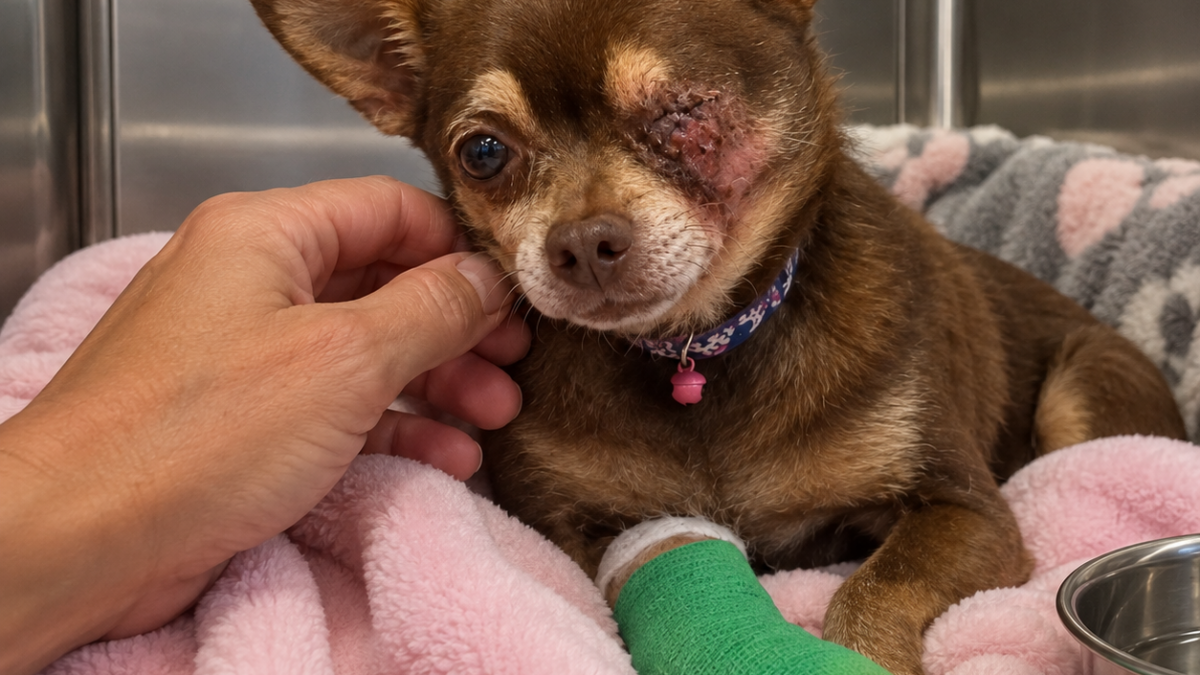
The first time I saw Bruno, half his face was crushed, one rear leg was bent beneath him, and rainwater was carrying blood into the ditch where a speeding driver had left him to die. I thought the hardest part would be keeping him alive, but months later I watched strangers cross the street because the surgeries that saved him had also left scars they were afraid to look at. Then a traffic investigator walked into our rescue carrying a photograph, and suddenly the accident that nearly killed Bruno stopped looking like an accident someone could simply drive away from.
My name is Rachel Morgan, and I had worked with emergency animal rescue in western Pennsylvania for nearly nine years when the call came in shortly after 10:00 on a cold October night.
A truck driver had stopped along a rural highway after noticing something pale in a drainage ditch.
“At first I thought it was a dead deer,” he told dispatch. “Then I saw the chest move.”
By the time our van arrived, rain was coming down hard enough to turn the shoulder into mud.
The truck driver, a man named Carl, stood twenty feet from the ditch holding a flashlight.
“He’s alive,” he said. “Barely.”
I climbed down.
That was when I saw Bruno.
He was a huge brindle mixed-breed dog, maybe ninety pounds when healthy, lying twisted among wet grass and runoff.
His face had taken the worst of the impact.
The left side of his muzzle was grotesquely swollen. Blood covered his nose. One eye was almost sealed by swelling. Deep wounds crossed his shoulder and chest.
His right rear leg was positioned wrong.
Very wrong.
“Easy,” I whispered.
Bruno’s visible eye moved toward me.
He didn’t growl.
He didn’t attempt to rise.
I touched his neck.
His pulse was fast and weak.
“We need the stretcher.”
My partner, Luis, climbed down beside me.
When we slid the board beneath Bruno, a low cry came from his throat.
Carl turned away.
I nearly did too.
“Sorry, baby,” I whispered. “I know.”
Bruno looked straight at me.
Not angry.
Just exhausted.
At the emergency hospital, the team took him immediately.
X-rays and CT images began producing a list that seemed to get worse every time Dr. Sarah Bennett returned.
Shattered jaw.
Multiple facial fractures.
Three broken ribs.
Pelvic fracture.
Severe damage to the rear leg.
Internal bruising.
I stared at the images.
“Can you fix him?”
Dr. Bennett didn’t answer immediately.
“That depends on what you mean by fix.”
“Keep him alive.”
“We’re going to try.”
Luis asked the question I couldn’t.
“Should we?”
I turned.
He looked sick saying it.
Dr. Bennett understood.
“If his injuries are beyond what we can reasonably manage without prolonged uncontrolled suffering, we have to consider that.”
My chest tightened.
Bruno was lying behind the glass doors with oxygen support and pain medication running through an IV.
He had survived the highway.
Now we were discussing whether asking him to survive treatment would be cruel.
Then one of the technicians walked past his kennel.
Bruno’s eye followed her.
She stopped.
Walked back.
His eye followed again.
“He’s tracking me,” she said.
Dr. Bennett watched.
“So he is.”
I went to the kennel and crouched.
“Bruno.”
We had chosen the name only minutes earlier because the intake form needed something.
His eye shifted toward me.
I placed my hand near the bars.
He lifted his head less than an inch.
Then let it fall.
That was all.
But it changed the room.
Dr. Bennett exhaled.
“All right.”
“What?”
“We stabilize tonight. Surgical team starts at first light.”
I looked at Bruno.
“You hear that?”
No movement.
“We’re not done.”
The first surgery lasted almost seven hours.
Then came another.
And another.
Weeks later, when Bruno finally stood on trembling legs for the first time, half the rehabilitation team cried.
Months later, when he chased a tennis ball across the floor, the entire room cheered.
But surviving the crash turned out to be only one battle.
Because once Bruno began going outside again, I discovered that some people could look directly at a survivor and see only the scars.
And the worst moment came one Saturday morning when a little boy pointed at Bruno’s face and shouted a word I still remember perfectly.
“Monster.”
PART 2
Bruno heard the boy before I had time to react.
His head lifted.
He had been standing beside me outside the rehabilitation center, wearing the padded support harness we still used on longer walks. His rear leg had healed enough to bear weight, but fatigue came quickly, and one side of his pelvis remained stiff.
The scars across his muzzle were impossible to hide.
Surgeons had rebuilt the shattered bones as well as medicine allowed, but the left side of his face would never look exactly like the right. His lip pulled slightly upward where scar tissue had contracted. One eye appeared narrower. The fur over his cheek grew in uneven patches.
To me, he looked like Bruno.
To the boy, apparently, he looked frightening.
“Monster!”
The boy couldn’t have been more than six.
His mother grabbed his hand.
“Ethan!”
She looked at us.
Then at Bruno.
Her expression changed.
Not disgust exactly.
Fear.
“I’m sorry.”
“It’s okay,” I said automatically.
It wasn’t.
The boy stared.
“Why does he look like that?”
His mother pulled him away.
“Don’t stare.”
“I was going to answer.”
She hesitated.
People often tell children not to stare at scars when what they really mean is:
Pretend you don’t see them.
Sometimes that only teaches children that difference is shameful.
I crouched beside Bruno.
“He was badly hurt,” I told the boy. “Doctors fixed him.”
Ethan stopped pulling against his mother’s hand.
“Does it hurt?”
“Not like it did.”
“Did someone hurt him?”
“A car hit him.”
Ethan looked at Bruno.
Bruno looked back.
“Can I pet him?”
His mother stiffened.
I saw it.
So did Bruno.
“Only if Bruno wants to.”
I held out my hand toward the boy first.
“Let him smell you.”
Ethan copied me.
Bruno sniffed his fingers.
Then leaned slightly forward.
“Scratch his shoulder, not his face.”
The boy touched him.
Bruno’s tail moved.
Ethan smiled.
“He’s nice.”
“Very.”
The mother’s shoulders relaxed.
For thirty seconds, the entire moment changed.
Then an older man walking past muttered, “I wouldn’t trust a face like that.”
I turned.
“Excuse me?”
He kept going.
The mother looked embarrassed for him.
Ethan continued petting Bruno.
I told myself that was what mattered.
Still, the comment stayed with me.
It was not the first.
It would not be the last.
Bruno’s first month after the crash had been about whether he would live.
The second had been about whether he would walk.
The third became about whether the world would let him exist without treating survival itself as something ugly.
I hated that battle most because no surgery could fix it.
To understand how far he had come, you have to understand those first weeks.
The first operation began at 6:18 the morning after we found him.
Dr. Bennett had brought in an orthopedic surgeon, Dr. Michael Grant, and a veterinary dental specialist because Bruno’s jaw was too badly damaged for one team.
I sat in the waiting room with Luis.
Carl, the truck driver who found him, came back too.
“You didn’t have to return,” I told him.
“I know.”
He held two coffees.
“I figured somebody should bring caffeine.”
Luis accepted one.
I couldn’t.
My stomach felt too tight.
The surgery clock seemed broken.
An hour passed.
Then two.
Then four.
At five hours, I stood.
“I’m going to ask.”
Luis stopped me.
“You asked twenty minutes ago.”
“Things change in twenty minutes.”
“The receptionist will tell us if something changes.”
“I know.”
“You’re pacing.”
“I know.”
Carl said quietly, “Let her.”
Thank you, Carl.
At 1:04 p.m., Dr. Bennett came through the doors.
Her surgical cap was still on.
I stood.
“Well?”
“He’s alive.”
Those words never get old.
No matter how many times you hear them in rescue work.
“He’s alive” can become the entire world.
“And?”
“The jaw repair went better than expected.”
Luis exhaled.
“Pelvis?”
“Stabilized.”
“Leg?”
Dr. Bennett’s expression changed.
“We saved it for now.”
“For now?”
“The tissue damage is significant. We need to watch circulation and infection closely.”
“Will he walk?”
“Rachel.”
“I know.”
“No promises.”
I hated that phrase.
She continued.
“He lost a lot of blood. He’s going to need intensive monitoring.”
“Can I see him?”
“Briefly.”
The Bruno I saw after surgery barely looked alive.
Bandages.
Tubes.
Swelling.
Machines.
His head was supported carefully because of the jaw reconstruction.
I stood beside him.
“Hey.”
Nothing.
I placed my hand near his paw.
“Carl came back.”
Nothing.
“Luis drank your coffee.”
Luis, behind me, whispered, “That’s not what happened.”
“I’m trying to give him reasons to wake up.”
“By slandering me?”
Bruno’s toe moved.
Both of us froze.
“Did you see that?”
Luis leaned closer.
“Probably reflex.”
“I don’t care.”
That became the theme of Bruno’s recovery.
People telling us not to overinterpret tiny things.
We did anyway.
First head lift.
First swallow.
First time he tolerated liquid nutrition without becoming nauseated.
First time he sat.
First time he put weight on the injured rear leg.
First tail wag.
Especially the tail wag.
It happened twenty-six days after the crash.
A nurse named Abby entered his room.
Bruno had become attached to her because she spent long hours feeding him through the difficult early period.
His jaw remained fragile.
Every feeding took patience.
Tiny amounts.
Slowly.
Abby sat beside him.
“Morning, handsome.”
The tail moved.
Once.
She stopped.
“What?”
Again.
A little thump against the blanket.
Abby shouted.
Not screamed.
Shouted.
“Rachel!”
I was down the hall.
I ran.
“What happened?”
“He wagged.”
I stared.
“Bruno?”
Abby spoke again.
“Who’s handsome?”
Tail.
Thump.
I covered my mouth.
Abby was already crying.
Dr. Bennett entered.
“Why is everyone—”
Tail.
She stopped.
“Oh.”
That tiny movement mattered because until then, Bruno had tolerated life.
That morning, for one second, he responded to it.
After the jaw healed enough, feeding became easier.
The orthopedic team focused on the pelvis and leg.
Physical therapy began with movements so small they barely looked like exercise.
Flex.
Extend.
Support.
Shift weight.
Rest.
Again.
Bruno never snapped.
Not once.
He sometimes cried.
Sometimes tried to pull away.
Sometimes trembled.
But he never directed aggression at the people touching the most painful parts of his body.
That became important later when strangers assumed scars meant violence.
The truth was almost absurdly opposite.
Bruno was gentle to a fault.
He loved ear scratches.
He fell asleep when Abby read treatment notes aloud.
If I sat on the floor, he eventually leaned against me.
As he grew stronger, the leaning became comical.
Ninety pounds of dog apparently believed personal space was a human invention.
One afternoon I was answering emails while sitting beside his exercise mat.
Bruno shifted.
Then leaned.
Then continued leaning until my shoulder hit the wall.
“Sir.”
Nothing.
“You are crushing me.”
Tail thump.
“This is workplace harassment.”
Dr. Grant walked past.
“Document it.”
“I will.”
Bruno pressed harder.
“See?”
The first independent stand happened during week seven.
Dr. Lawson, the rehabilitation specialist, had him in a support harness.
She reduced assistance gradually.
Bruno’s legs shook.
“Hold.”
He stood.
Three seconds.
Four.
Six.
Dr. Lawson slowly released more support.
Bruno remained upright.
I whispered, “Oh my God.”
Luis was filming.
Abby stood in the doorway.
Bruno’s front paws adjusted.
His rear leg trembled.
He stayed standing.
Eight seconds.
Ten.
Then sat heavily.
The entire room clapped.
Bruno looked confused.
Dr. Lawson said, “Please don’t teach him he gets applause for basic orthopedic function.”
“He absolutely gets applause,” Abby said.
The first independent walk came two weeks later.
Four steps.
Then six.
Then across the room.
Ungainly.
Stiff.
But his.
The tennis ball happened during month four.
A volunteer named Jenna brought a bucket of donated toys.
One yellow tennis ball rolled across the rehabilitation floor.
Bruno saw it.
His ears lifted.
The ball bounced once.
Twice.
Bruno stepped toward it.
Then faster.
Not running.
Not exactly.
But definitely chasing.
Everyone stopped.
Jenna whispered, “Is he allowed?”
Dr. Lawson watched.
“Let him.”
Bruno reached the ball.
Put one paw over it.
Then tried to pick it up.
His reconstructed jaw made the angle awkward.
He adjusted.
Got it.
Tail wagging.
I cried harder than I had after surgery.
Because surgery saved his life.
The tennis ball returned his childhood.
For a few seconds, Bruno was not a medical case.
Not a hit-and-run victim.
Not a scarred dog.
Just a dog with a ball.
That was the moment I knew survival would not be enough.
We had to give him a life worth having.
The investigation began quietly.
The highway where Bruno had been struck had no obvious cameras.
No houses nearby.
Carl had not seen the collision.
He arrived afterward.
Police initially treated it as an animal collision with an unknown driver.
Then Officer Elena Ruiz from county traffic enforcement called me.
“Are you the rescue contact for Bruno?”
“Yes.”
“I’m reviewing a hit-and-run property case from the same corridor.”
My attention sharpened.
“What does that have to do with Bruno?”
“Maybe nothing.”
“What property?”
“Mailbox cluster. Fence damage. Same night.”
“What time?”
“Approximately 9:40.”
Carl found Bruno around 10:05.
My stomach tightened.
“What happened?”
“A vehicle left the road, struck multiple objects, then returned to the roadway.”
“Near where Bruno was found?”
“About three quarters of a mile north.”
“Could it be the same driver?”
“That’s what I’m checking.”
We met two days later.
Officer Ruiz brought photographs.
A broken rural mailbox post.
Fence debris.
Black plastic vehicle fragments.
One piece had a manufacturer stamp.
Investigators narrowed it to several model years of a dark-colored SUV.
A gas station four miles away had exterior cameras.
At 9:31, a black SUV entered.
At 9:53, the same vehicle returned from the opposite direction.
The front corner was damaged.
My pulse increased.
“Plate?”
“Partially visible.”
“Can you identify it?”
“We’re working.”
“Could Bruno have been hit between those times?”
“Yes.”
“Do you think they knew?”
“Rachel.”
I knew the answer.
Don’t jump ahead.
Evidence first.
Bruno did not care about evidence.
He cared about the tennis ball.
He cared about food.
He cared about whether Abby arrived.
As weeks became months, the medical crisis receded.
Then came the social one.
We started taking Bruno outside the facility.
Short walks.
Quiet times.
Controlled environments.
The first person who crossed the street because of him was a woman with a small dog.
I tried not to take it personally.
Maybe her dog was reactive.
Maybe she crossed for another reason.
Then it happened again.
A man saw Bruno.
Stopped.
Moved to the opposite sidewalk.
Another person asked if he was dangerous.
A woman pulled her dog behind her.
One teenager said, “What happened to his face?”
That question was fine.
Questions were fine.
Fear without curiosity was harder.
Abby told me to stop watching strangers.
“I can’t.”
“Yes, you can.”
“They look at him.”
“So?”
“They think—”
“Bruno does not need you fighting imaginary conversations.”
“Some are not imaginary.”
“He also doesn’t need you turning every walk into a referendum on humanity.”
She was right.
Annoyingly.
So I focused on Bruno.
Could he walk comfortably?
Was he tiring?
Was the scar tissue irritated?
Did he enjoy the outing?
Mostly, yes.
The first few months, Bruno ignored strangers.
Then he began seeking them.
That was almost worse.
He wanted people.
He had become deeply social in the hospital.
Visitors were interesting.
New hands meant scratches.
New voices meant attention.
But some people stepped away.
Bruno would stop.
Look at them.
Then look at me.
I wanted to tell him it wasn’t him.
Dogs probably don’t interpret human social rejection exactly the way we do.
Still.
I felt it for him.
Then came Ethan.
Monster.
The word stayed.
A week later, another child said, “Zombie dog.”
Their father laughed.
I did not.
“Please don’t call him that.”
The father looked surprised.
“He’s joking.”
“He’s pointing at a living animal.”
“It’s a dog.”
“Yes.”
He shrugged.
I walked away before anger became useless.
That evening, I sat with Bruno in his kennel.
“You know you’re handsome?”
Tail.
“Objectively.”
Tail.
“Some people are idiots.”
Bruno put his head in my lap.
“Excellent point.”
The rescue posted new adoption photos after month five.
Our photographer, Maya, refused to hide his scars.
“Do you want me to angle him from the right?”
“No.”
“Good.”
We photographed both sides.
Full face.
Scarred side.
Healthy side.
Running after the tennis ball.
Leaning against me.
Sleeping upside down.
The adoption description said:
Bruno survived extensive facial reconstruction after being struck by a vehicle. His scars are permanent. His temperament is gentle, social, and affectionate. He loves tennis balls, ear scratches, and leaning his entire body against people who underestimate how heavy he is.
Applications came.
Then disappeared.
One family wrote that they loved his story but worried their children might be frightened.
Another wanted a “normal-looking” dog.
They actually wrote that.
I closed my laptop.
Abby saw my face.
“What?”
I showed her.
She read.
Then closed the screen.
“Not Bruno’s family.”
“I know.”
“Then good.”
“Good?”
“They identified themselves early.”
Fair.
Another couple applied.
They had experience with large dogs.
Good yard.
Stable vet history.
Then they visited.
Bruno walked toward them.
The woman froze.
His scarred side was facing her.
“Oh.”
That one sound.
I knew.
She tried.
She really did.
She sat.
Bruno approached.
She pet him.
But her body remained stiff.
Her husband asked questions.
Eventually they left.
The next day they withdrew.
Reason:
We realized the extent of his facial difference may be more than we are comfortable managing socially.
Socially.
I read it twice.
“What does that even mean?”
Luis took the paper.
“They’re worried people will stare.”
“So Bruno has to live in a shelter because they don’t like being stared at?”
“Rachel.”
“No.”
“You’re angry.”
“Yes.”
“Correct target?”
I looked at him.
He pointed toward Bruno.
“He needs the next application, not your rage at the last one.”
Everyone around me became annoyingly wise that year.
Officer Ruiz called in March.
“I have an identification.”
I sat down.
“The driver?”
“Registered owner of the likely vehicle. We’ve also obtained repair records.”
“Who?”
“Derek Walsh.”
The name meant nothing.
“Age?”
“Thirty-eight.”
“What happened?”
“The SUV was repaired privately two days after the crash.”
“For what damage?”
“Front bumper. Left headlight. Lower grille.”
“Animal hair?”
“Not available now.”
“So how do you prove it?”
“Repair photographs.”
My skin went cold.
The body shop had photographed the vehicle at intake.
There was visible damage.
Mud.
Vegetation.
And what appeared to be dried blood on the bumper.
DNA testing from old photographs is not magic.
The physical vehicle had been repaired.
But the timeline, phone location data, property damage, witness evidence, and Derek’s eventual statement built the case.
He admitted leaving a bar.
He admitted driving too fast.
He admitted hitting “something.”
“What did he think it was?” I asked Officer Ruiz.
“He says he thought deer.”
“Did he stop?”
“No.”
“Why?”
“He had been drinking.”
I closed my eyes.
“Was he drunk?”
“We can’t prove his blood-alcohol level months later.”
“But he admitted drinking.”
“Yes.”
“Did he know he hit Bruno?”
“He says he did not know it was a dog.”
“Do you believe him?”
“That’s not my job.”
I hated that answer because it was the correct one.
Derek had also damaged the mailbox cluster and fence.
After the first impact, he continued.
He later told investigators he panicked.
He feared a DUI arrest.
So he drove home.
Fixed the SUV.
Said nothing.
I wanted to meet him.
Officer Ruiz advised against it.
“No benefit.”
“I want him to see Bruno.”
“Why?”
“Because Bruno has a face because of him.”
“Rachel.”
“He should have to look.”
“Court may give you an opportunity to provide a statement.”
“That’s not the same.”
“No.”
I wanted something emotional.
She wanted procedure.
Procedure won.
Charges related to leaving the scene, property damage, reckless driving evidence, and animal injury were pursued within what the law supported.
It was less dramatic than people imagine.
No detective bursting into a house.
No confession under bright lights.
Paperwork.
Interviews.
Records.
Attorneys.
Dates.
The body shop owner testified that Derek specifically asked whether the repairs could be completed without insurance.
That mattered.
Not because it proved he knew he hit Bruno.
Because it showed concealment after the property collisions.
Derek’s attorney argued panic.
Shame.
Fear.
He had no prior criminal history.
Steady employment.
A family.
He looked ordinary.
That disturbed me.
I wanted the person who nearly killed Bruno to look like someone capable of cruelty.
Instead, he looked like a middle-aged man wearing a badly fitted suit.
Reality does not always cooperate with moral theater.
At the first hearing I attended, Derek glanced toward me.
Then away.
Bruno was not there.
Obviously.
But I carried a photograph.
His intake photograph.
The crushed face.
The bent leg.
The blood.
I kept it in the folder.
When the prosecutor later asked for a victim-impact statement connected to rescue costs and animal suffering, I wrote for three nights.
The first version was furious.
I deleted half.
The second sounded like a speech.
Deleted again.
The third was simple.
You did not cause one moment of pain. You caused months of surgeries, feeding assistance, physical rehabilitation, and fear. Bruno survived, but survival does not erase what happened. If Carl had not stopped, Bruno would likely have died alone in that ditch. You were not required to fix him on the highway. You were required to stop.
That was the sentence I cared about.
You were required to stop.
Carl had stopped.
Derek had not.
The whole story could be reduced to those two decisions.
One man struck something and drove away.
Another saw something and stopped.
One nearly ended Bruno’s life.
The other began saving it.
Derek eventually entered a plea agreement related to the provable offenses.
His driver’s license was suspended for a period.
He paid restitution connected to property damage and part of Bruno’s emergency care through the legal process and insurance-related recovery.
He received probation, community service, and required substance-use education.
There were additional conditions tied to reckless driving conduct.
Some people wanted more.
I did too at first.
I wanted him imprisoned long enough to understand seven-hour surgeries.
Wanted him forced to see every feeding.
Every painful therapy session.
Every person crossing the street because of Bruno’s scarred face.
But sentencing cannot recreate experience.
And suffering does not become justice just because it changes bodies.
The most important thing happened outside the courtroom.
Derek asked through his attorney if he could send a letter to the rescue.
I said no.
Then changed my mind.
I don’t know why.
Curiosity.
Anger.
Maybe I wanted to know whether he would make excuses.
The letter was three pages.
He wrote:
I knew I had hit something alive.
I stopped.
Read it again.
Not deer.
Not uncertainty.
Alive.
He continued.
He had seen movement in the mirror.
He considered stopping.
Then saw headlights approaching and panicked.
He had been drinking.
He feared arrest.
So he left.
Carl’s truck was probably those headlights.
The timing fit.
My hands started shaking.
Derek wrote that he learned from the prosecutor months later that Bruno survived.
Then saw a public rescue post.
Saw the scars.
“I had to close my computer,” he wrote.
I felt no sympathy.
Not then.
He wrote:
There is nothing I can say that makes leaving acceptable. I was afraid of what would happen to me, so I made the animal I hit carry everything instead.
That sentence stopped my anger for one second.
Because it was accurate.
He did not ask forgiveness.
He offered additional voluntary restitution for Bruno’s future medical care beyond what the legal settlement required.
I wanted to refuse.
Luis said, “Why?”
“Because I don’t want his money making him feel better.”
“Who cares how it makes him feel?”
I looked at him.
“Bruno can use it.”
That was irritatingly practical.
The money went into Bruno’s medical account.
Later, when Bruno no longer needed as much follow-up care, the remaining amount helped another hit-by-car dog.
That became important to me.
Derek’s guilt did not buy forgiveness.
It bought orthopedic imaging for a dog who needed it.
That was useful.
Bruno’s adoption wait continued.
Month six.
Seven.
Eight.
Physically, he was doing beautifully.
His gait would never be perfect.
His face would always be scarred.
But he played.
Ate.
Ran in short bursts.
Loved visitors.
And waited.
We began taking him to adoption events.
The first was terrible.
Too crowded.
Too many dogs.
Bruno became overwhelmed.
Not aggressive.
Just shut down.
We left after twenty minutes.
The second was smaller.
He did better.
Three people asked about him.
No applications.
At the third, a teenage girl sat with him for almost an hour.
Her mother loved him.
Her father did not.
“I’m worried what neighbors will think,” he said.
I stared.
“About?”
His face.
He did not say it.
He didn’t have to.
They left.
That evening, I sat beside Bruno.
“You have terrible taste in potential adopters.”
He put one paw on my shoe.
“Agreed.”
Then, on a Tuesday afternoon in late June, a couple named Mark and Helen Davis walked into the rescue.
They had not come for Bruno.
They were looking for an older Labrador mix they had seen online.
That dog had been adopted that morning.
I apologized.
Helen looked around.
“Can we meet anyone else?”
“Of course.”
Bruno was lying behind the reception desk because he had graduated from kennel living during staff hours.
He lifted his head.
Mark saw him.
“What happened to that guy?”
The question was direct.
Not disgusted.
Not whispered.
“A car hit him.”
Mark crouched.
Bruno stood.
Walked toward him.
Scarred side fully visible.
Mark did not move away.
He held out a hand.
Bruno sniffed.
Then leaned.
Hard.
Mark nearly fell.
“Oh.”
Helen laughed.
“He does that.”
“You know him?”
“No.”
“He just looks like a leaner.”
Bruno moved from Mark to Helen.
She touched his face.
Not avoiding the scars.
Not staring either.
Just touching him where he allowed.
“How old?”
“Maybe five or six.”
“Good with dogs?”
“With appropriate introductions.”
“Cats?”
“Unknown.”
“Children?”
“Gentle, but because of his size and orthopedic history, we’d want respectful older kids.”
Mark scratched Bruno’s chest.
“Does he still need treatment?”
“Routine orthopedic monitoring. Scar care occasionally. His jaw is stable. He may develop arthritis earlier because of the injuries.”
Mark nodded.
“What does he like?”
“Tennis balls.”
Bruno’s ears lifted at the word.
Helen noticed.
“Tennis?”
Tail wag.
I said it again.
“Tennis ball?”
Bruno spun.
Not gracefully.
Enthusiastically.
Mark laughed.
“That answered it.”
They spent two hours with him.
Then left.
I tried not to hope.
People often had good visits and disappeared.
The next morning, an application arrived.
Both names.
Mark and Helen Davis.
Homeowners.
Fenced yard.
No current pets.
Previous dog died of cancer at thirteen.
Excellent veterinary references.
Under the question:
Why Bruno?
Helen wrote:
Because when we met him, he didn’t seem to know there was anything wrong with his face, and I don’t think we should be the people who teach him there is.
I read that line three times.
Then sent it to Abby.
She called immediately.
“Do not mess this up.”
“Thank you for your confidence.”
“I mean it.”
Home check.
Perfect.
Second visit.
Even better.
They brought a tennis ball.
Bruno saw Mark.
Tail.
Saw Helen.
Whole-body wag.
Then he walked to her.
Rested his head against her thigh.
Stayed.
Helen stroked the scarred side of his face.
Mark looked at me.
“I think he’s decided.”
I swallowed.
“Maybe.”
“No,” Helen said quietly. “He has.”
The adoption papers were signed four days later.
The entire hospital staff somehow heard.
Abby arrived.
Dr. Bennett arrived between appointments.
Dr. Lawson came.
Carl, the truck driver, was invited.
He had visited Bruno occasionally during recovery.
When Bruno saw him, he walked over.
Carl started crying.
“Look at you.”
Bruno leaned.
Carl laughed through tears.
“Still heavy.”
We took a photograph.
Bruno between Mark and Helen.
Carl on one side.
Me on the other.
Too many people.
Bruno looked delighted.
Then came the moment I had dreaded.
Leaving.
I had spent nearly nine months helping him.
Part of me had become convinced that no one else would understand him correctly.
Classic foster/rescue arrogance.
Helen clipped on his leash.
Bruno looked at me.
My chest tightened.
“Go.”
He stayed.
Mark opened the door.
Bruno looked toward him.
Then back at me.
I crouched.
“You got a home.”
Tail movement.
“A real one.”
He came close.
Pressed his head against my shoulder.
I wrapped my arms around him.
“You are not a monster.”
My voice broke.
“You never were.”
He licked my cheek.
Then turned.
Walked out beside Helen.
No fear.
That mattered.
Months earlier, he had entered buildings on stretchers.
Now he left under his own power.
Toward home.
Mark and Helen sent updates constantly.
The first night, Bruno slept on the floor beside their bed instead of the expensive dog bed.
The second night, he used the bed.
Third night, he climbed onto theirs.
Helen texted:
We have lost control.
I replied:
Correct.
He discovered their backyard.
Tennis balls.
A neighbor named Mr. Brooks who handed out treats.
A screened porch.
A couch he was absolutely not supposed to use.
Within two weeks, photographic evidence proved the couch rule had collapsed.
He followed Helen while she gardened.
Followed Mark into the garage.
Waited outside the bathroom.
Napped under the kitchen table.
Home entered him slowly.
Then something happened that made Helen call me furious.
A neighbor walking past their fence said:
“That scarred dog is creepy.”
Helen replied:
“He can hear you.”
The neighbor laughed.
“It’s a dog.”
Helen said, “Exactly. So be kinder.”
I loved her immediately all over again.
But the social comments did not stop.
Bruno’s appearance drew attention.
At the park, one woman pulled her Labrador away.
A man asked whether Bruno had been used for fighting.
Someone else assumed he was aggressive because of the facial injuries.
Helen became frustrated.
Mark was calmer.
“Let them ask.”
“I don’t mind questions.”
“You mind conclusions.”
“Yes.”
“So answer the questions.”
They developed a simple script.
“He was hit by a car. Doctors reconstructed his face. He’s friendly. Ask before touching.”
That was it.
No defensive speech.
No shame.
No hiding.
Bruno’s confidence grew.
If someone stepped away, he moved on.
If someone approached kindly, he leaned.
His world became less about being accepted by everyone and more about recognizing his people.
That is something humans could learn from dogs.
At one park, Ethan appeared again.
The same little boy who once called him a monster.
I wasn’t there.
Helen told me later.
Ethan had grown.
Maybe a year older.
He recognized Bruno.
“Mom! It’s that dog.”
His mother remembered too.
She looked embarrassed.
Ethan ran closer, then stopped as instructed.
“Can I pet him?”
Helen said yes.
Ethan scratched his shoulder.
“You’re still nice.”
Bruno wagged.
His mother asked Helen, “Is he yours now?”
“Yes.”
“He looks good.”
“He is.”
Ethan said, “He looks like a superhero.”
His mother smiled.
Helen cried after they walked away.
She called me from the car.
“He changed the word.”
“What?”
“Monster became superhero.”
I smiled.
“Kids learn.”
“So do adults, sometimes.”
Derek’s restitution helped fund Bruno’s annual orthopedic imaging for the first two years after adoption.
Mark knew where some of the money came from.
He never liked it.
But he accepted the practical benefit.
One afternoon he asked me, “Did the driver ever meet Bruno?”
“No.”
“Good.”
“Why?”
“I don’t want Bruno turned into a forgiveness ceremony for someone.”
I understood.
Derek’s accountability did not require Bruno’s participation.
Dogs do not exist to absolve humans.
That boundary mattered.
Years passed.
Bruno turned approximately seven.
Then eight.
His muzzle grayed.
The scars remained.
Some softened.
Others stayed pronounced.
Children still occasionally asked.
Mark answered.
One girl said, “He has a crooked smile.”
Helen said, “Yes.”
“I like it.”
“Me too.”
Bruno became known around the neighborhood.
Not feared.
Known.
The mail carrier kept biscuits.
The school-crossing guard recognized him.
Mr. Brooks next door bought tennis balls in bulk.
When a new family moved in, their children initially stared.
Two weeks later, Bruno was lying in their driveway receiving belly scratches.
That was the slowest revenge against prejudice.
Familiarity.
Once people knew him, the face stopped being the first thing.
Then came arthritis.
We expected it.
His pelvis and rear leg had suffered too much trauma not to develop changes.
At nine, he became stiff after long naps.
At ten, stairs became less appealing.
Mark built a ramp to the back porch.
Bruno ignored it and used the stairs.
Mark stood in the yard.
“I built that for you.”
Bruno looked at him.
Used the stairs again.
Helen laughed.
“Rejected.”
Two months later, on a cold morning, Bruno used the ramp.
Mark photographed it.
Sent me:
VICTORY.
I replied:
He was waiting until you stopped watching.
Physical therapy restarted.
Swimming.
Gentle strengthening.
Pain control.
Joint support.
Bruno loved the underwater treadmill because treats appeared afterward.
He became a senior dog slowly.
That was another miracle without magic.
The dog we once wondered whether we should keep alive became old.
People forget what a privilege age is.
Gray hairs.
Slower walks.
Longer naps.
Medication bottles.
Ramps.
These can feel sad when you look forward.
When you look backward from a ditch beside a highway, they feel extraordinary.
On the tenth anniversary of the crash, we held a small gathering at the rehabilitation center.
Not public.
Just people.
Dr. Bennett.
Abby.
Dr. Lawson.
Carl.
Luis.
Me.
Mark and Helen.
Bruno.
He walked in slower than before.
But when Abby said, “Who’s handsome?” his tail moved exactly as it had the first time.
She cried.
“Don’t.”
“What?”
“You’re old.”
Bruno leaned into her.
“You’re still handsome.”
Carl knelt.
“I almost didn’t stop that night.”
Everyone became quiet.
I looked at him.
“What?”
He rubbed Bruno’s neck.
“I was tired. Had a delivery deadline.”
His voice cracked.
“I saw something in the ditch. Drove another hundred yards.”
He had never told me this.
“Then what?”
“I thought about my dog at home.”
He swallowed.
“I backed up.”
Bruno pressed his head against Carl’s chest.
Carl cried.
“I think about those hundred yards all the time.”
I sat beside him.
“But you backed up.”
“Yeah.”
“That is the part that counts.”
He nodded.
That became another lesson in Bruno’s story.
Good people do not always react perfectly in the first second.
Sometimes goodness is the U-turn.
The second thought.
The decision to go back.
Carl went back.
Derek didn’t.
That difference changed everything.
At eleven, Bruno developed a small lump near his shoulder.
Everyone panicked because rescue people apparently never learn calm.
Biopsy.
Benign.
Helen sent a group message:
THIS DOG OWES US MONEY FOR EMOTIONAL DAMAGES.
At twelve, his hearing decreased.
At thirteen, his vision became cloudy.
But he remained social.
His favorite part of every day was sitting on the front lawn around five when neighbors returned from work.
People stopped.
“Hey, Bruno.”
Tail.
“How you doing, buddy?”
Tail.
The dog people once crossed streets to avoid had become the reason people crossed the street toward him.
I saw it myself one evening.
A teenager on the opposite sidewalk spotted Bruno.
Crossed.
Knelt.
“Hey, old man.”
Bruno leaned.
No fear.
No whispering.
No monster.
Just Bruno.
I stood beside Helen.
“Do you remember?”
“Yes.”
We both did.
The first outings.
People moving away.
The comments.
The applications withdrawn.
Now Bruno had become neighborhood furniture.
Loved furniture.
At fourteen, his rear leg weakened significantly.
The old fractures had done their work.
Dr. Lawson was semi-retired but still saw him.
She watched Bruno walk.
“Shorter outings.”
Mark frowned.
“He loves walks.”
“He can still walk.”
“How short?”
“Let him tell you.”
Bruno’s life became slower.
Front lawn.
Backyard.
Couch.
Porch.
Tennis balls rolled only a few feet.
He still chased them sometimes.
Not because he forgot his age.
Because joy does not always adjust responsibly.
Helen bought soft indoor balls.
Bruno rejected them.
He wanted tennis balls.
“Old men have preferences,” Mark said.
One winter afternoon, Bruno carried a tennis ball to his bed and fell asleep with it beneath his chin.
Helen sent the photograph.
I saved it immediately.
That became one of my favorite pictures.
Not the dramatic crash image.
Not the scar comparison.
An old dog sleeping with a dirty ball.
Life after tragedy should be allowed to become boring.
That is victory.
Derek completed probation years earlier.
His driving privileges had long been restored.
I assumed I would never hear his name again.
Then, almost eleven years after the crash, the rescue received a letter.
Not from Derek.
From a nonprofit road-safety organization.
Derek had begun speaking in court-mandated educational programs during probation and continued afterward.
The organization wanted permission to reference Bruno’s case in a presentation about leaving collision scenes.
I felt strange.
“Why is he still talking about it?” I asked Officer Ruiz, who had remained loosely in touch.
“He says it’s the worst thing he ever did.”
“Does he use Bruno’s photo?”
“Not without permission.”
“Does he say Bruno survived?”
“Yes.”
“What does he tell people?”
She sent me a recording from a public event.
Derek stood at a podium.
Older.
More gray.
He said:
“I didn’t stop because I was afraid of consequences. Driving away created consequences far worse than the ones I was trying to avoid. I left a living animal on the road because I cared more about protecting myself for ten minutes than about the suffering I had caused.”
He did not ask sympathy.
Did not call himself a victim.
Did not blame alcohol alone.
He said:
“If you hit something, stop. Call for help. Fear is not an emergency plan.”
I watched twice.
Then closed it.
Helen asked, “How do you feel?”
“I don’t know.”
“Do you forgive him?”
“No idea.”
“Does it matter?”
I looked at Bruno asleep on her floor.
“No.”
That surprised me.
Years earlier, I thought forgiveness would be the climax.
Either give it or refuse it.
Turns out, some stories do not need that scene.
Derek’s accountability was his.
Bruno’s life was ours.
They did not have to meet again.
His mistake became prevention work.
Good.
Useful.
Enough.
Bruno’s final year was gentle.
He slept more.
Ate well until the last few weeks.
Needed help standing on slippery surfaces.
Mark bought nonslip runners for almost every room.
Their house looked like an obstacle course designed by a very cautious interior decorator.
Helen joked, “We have no floors anymore. Only traction.”
Bruno approved.
One morning he could not rise without help.
Mark called.
“Today feels different.”
I drove over.
Bruno was on his oversized bed near the living-room window.
Gray muzzle.
Scarred face.
Cloudy eyes.
Tennis ball beside him.
Helen sat on the floor.
Mark was making coffee he did not drink.
I knelt.
“Hey, handsome.”
His tail moved.
Still.
After all those years.
“Who taught you that?”
He breathed slowly.
Their veterinarian, Dr. Patel, came to the house.
Not our Dr. Bennett.
A local vet who had cared for Bruno through his senior years.
He examined him gently.
Heart.
Lungs.
Joints.
Abdomen.
Neurological responses.
Then we had the conversation everyone eventually has if they are lucky enough to love an animal long enough.
Quality of life.
Pain.
Appetite.
Mobility.
Joy.
Helen asked, “Is this the day?”
Dr. Patel did not answer quickly.
“I think you’re very close.”
Mark’s voice broke.
“How close?”
“Today. Tomorrow. Maybe a few days.”
“Would more medication help?”
“Some.”
“Would he feel good?”
“Probably not much better than this.”
Bruno raised his head.
Then lowered it again.
Helen touched the scarred side of his face.
“I don’t want his last memory to be a hospital.”
“It doesn’t have to be.”
We scheduled home euthanasia for that evening unless Bruno improved unexpectedly.
He didn’t.
Instead, the afternoon became something beautiful.
People came quietly.
Abby, now working at another hospital.
Luis.
Carl.
Dr. Bennett, retired but still nearby.
Dr. Lawson.
Me.
Not all at once.
We respected Bruno’s energy.
Each sat beside him.
Each said goodbye.
Carl brought a tennis ball.
Of course.
He placed it beside Bruno.
“Remember these?”
Bruno smelled it.
Tail movement.
Carl cried.
“You got old.”
The sentence broke everyone.
Because that was the miracle.
Not surviving one night.
Getting old.
Dr. Bennett sat beside him.
“You made me look very dramatic in that first prognosis.”
I smiled.
“What did you say?”
“That he might not survive.”
Bruno looked at her.
“Well, technically everyone eventually proves that statement correct.”
“Sarah.”
“What? I’m retired.”
We laughed.
Bruno sighed.
His eyes closed.
The room felt warm.
Safe.
Nothing like that ditch.
Mark asked everyone to step outside for a few minutes before the vet returned.
Only Helen, Mark, and I remained.
Bruno lay between them.
Helen rubbed his ear.
“I remember the first time I saw you.”
Mark said, “You knocked me over.”
“He still would.”
“Not today.”
Silence.
I looked at the scars.
They seemed smaller now.
Not physically.
Meaningfully.
For years strangers had treated those marks like the whole story.
Now I could barely separate them from his face.
That is what familiarity does.
A scar stops being an event and becomes part of someone you love.
Helen touched the edge of his muzzle.
“You know people used to be scared of this face?”
Bruno breathed.
“They were stupid.”
Mark whispered, “Helen.”
“They were.”
I laughed.
Bruno’s tail moved.
She smiled through tears.
“You agree.”
When Dr. Patel returned, Bruno was calm.
The veterinarian explained every step.
Mark nodded.
Helen kept one hand under Bruno’s head.
I held one front paw.
The scarred side of his face rested toward us.
No one looked away.
The sedative entered.
Bruno relaxed.
His breathing deepened.
His jaw softened.
Helen whispered, “Good boy.”
Mark leaned close.
“You’re safe.”
I remembered that first night.
Mud.
Blood.
A shattered jaw.
His exhausted eye following every person who moved.
I whispered:
“You don’t have to fight anymore.”
For years, people had called him a fighter.
Survivor.
Warrior.
Strong.
Those words are useful until they become obligations.
At the end, Bruno deserved permission to be tired.
His eyes closed.
The final medication followed.
One breath.
Another.
Then a quiet exhale.
Stillness.
Mark buried his face in Bruno’s neck.
Helen cried against his scarred cheek.
I kept holding his paw.
The face strangers had once called monstrous was being kissed goodbye by the people who had built their lives around it.
That was revenge enough.
No.
More than revenge.
It was correction.
The world had once looked at Bruno and seen damage.
His family looked at him and saw history.
Years.
Trust.
A crooked smile.
Tennis balls.
Couch hair.
Leaning.
Love.
After he died, Helen kept one tennis ball on the mantle.
Mark thought this was ridiculous.
Then he bought a small wooden stand for it.
“Hypocrite,” she said.
“Presentation matters.”
Bruno’s ashes stayed in a simple wooden box beside a framed photograph.
Not the crash photograph.
The one with the tennis ball under his chin.
Old.
Gray.
Peaceful.
The rescue established something small in Bruno’s name.
Not a giant foundation.
A medical support fund for hit-by-car animals and facial reconstruction cases.
We called it the Bruno Second Look Fund.
Because that was what people had failed to give him for years.
A second look.
Not at the scars.
At the dog.
The fund’s first case was a young pit bull mix with severe facial injuries from an accident.
Her jaw required surgery.
One eye had to be removed.
When her adoption photos went online, several comments called her “scary.”
I felt the old anger rise.
Then a family applied.
Their ten-year-old daughter wrote on the form:
Her face looks like she has been through something. That makes me want to be nice to her, not scared of her.
I printed that sentence.
Hung it in the office.
Abby saw it.
“Bruno would approve.”
“He couldn’t read.”
“He had excellent instincts.”
The dog was adopted.
Another came.
Then another.
Some required surgery.
Some only needed time.
The fund grew slowly.
Derek learned about it somehow.
A donation arrived.
His name was attached.
I almost returned it.
Then remembered Luis.
Who cares if it makes him feel better?
Use it.
We did.
The money paid for postoperative care for a dog with a fractured jaw.
That dog later went home to a retired teacher.
Useful.
That became my test for complicated forgiveness.
Not:
Does this absolve someone?
But:
Can something better be built from what remains?
Sometimes yes.
Years after Bruno’s death, Ethan—the boy who once called him a monster—sent the rescue an email.
He was in high school.
His mother had kept one of our old posts.
He wrote:
I don’t know if you remember me. I was the kid who called Bruno a monster outside the rehab center. You let me pet him anyway. I’ve thought about that a lot. I’m volunteering at our county shelter now. I wanted you to know I’m sorry.
I did remember.
Of course I did.
I replied:
Bruno didn’t hold grudges. Keep helping dogs. That’s enough.
Two weeks later, Ethan came in.
Taller.
Awkward.
Carrying donated tennis balls.
A whole bag.
“For him,” he said.
I looked at the balls.
“He’s been gone a while.”
“I know.”
“So who gets these?”
He smiled.
“The dogs who are still here.”
Exactly.
That was Bruno’s story continuing.
Not through memory alone.
Through changed behavior.
Carl kept stopping when he saw animals near roads.
Maybe too often.
He once called me about a “stray dog” that turned out to be a coyote.
“Carl.”
“It was dark.”
“It was very clearly a coyote.”
“It had dog energy.”
“No.”
Another time he stopped for an injured hawk and correctly called wildlife rescue.
“You’ve become dangerous,” I told him.
“I back up now.”
That sentence mattered.
Derek’s road-safety work continued too.
I never met him.
Never wanted to.
But eventually I stopped being angry that he used Bruno’s story.
Because he used it correctly.
Not:
Look how guilty I feel.
But:
Stop.
Call.
Do not run.
If one frightened driver heard him and made a different choice, good.
Bruno would never know.
That was fine.
Animals do not need credit.
People do.
Sometimes too much.
The rehabilitation center kept Bruno’s old support harness for years.
Eventually the straps wore out.
Dr. Lawson wanted to discard it.
Abby protested.
“Historical artifact.”
“It smells.”
“History smells.”
“That is not a legitimate preservation standard.”
We compromised.
One small tag from the harness was saved.
Everything else went.
Objects have limits.
Stories don’t.
New technicians heard about Bruno.
Most assumed the scary part was the crash.
It wasn’t.
The crash was horrible.
But the part I told them about was what came later.
The child saying monster.
The adults crossing streets.
The family withdrawing because they could not handle “socially” having a scarred dog.
Then Mark and Helen.
The application line:
I don’t think we should be the people who teach him there is something wrong with his face.
That became part of our adoption training.
When evaluating special-needs adopters, we asked:
Are they comfortable with the animal’s reality?
Not just the medical needs.
The social reality.
Wheelchairs.
Missing limbs.
Facial differences.
Scars.
Blindness.
Public questions.
Stares.
If an adopter felt ashamed of being seen with the animal, love would struggle under that pressure.
Bruno taught us to screen for pride.
Not pride in the sense of showing off rescue.
The opposite.
A quiet willingness to stand beside an animal exactly as they are.
Years after his death, Helen adopted another dog.
Not because she was ready to replace Bruno.
No replacement existed.
The dog was a female shepherd mix with one missing eye.
Mark saw her picture.
“You have a type now.”
Helen said, “Apparently.”
They named her Nora.
When Nora came home, she found Bruno’s old sun spot by the window.
Lay there.
Helen sent me the photograph.
He left instructions.
I smiled for an hour.
Grief becomes strange with time.
At first, every new animal feels like betrayal.
Later, it can feel like inheritance.
Not replacing.
Continuing.
Nora never liked tennis balls.
That annoyed Mark.
“How can she live here?”
“She likes ropes.”
“Bruno would judge.”
“No, he wouldn’t.”
Mark looked at the tennis ball on the mantle.
“He might.”
One evening, years later, I visited.
Nora slept beside Helen.
Bruno’s photograph remained on the shelf.
Scarred face.
Gray muzzle.
Ball under chin.
I realized something.
The scars no longer looked dramatic even in the photograph.
I had seen them too many times.
Loved the dog too long.
That is what the world failed to understand when they first saw him.
A face changes meaning when you know the story.
To a stranger, the scar can be the loudest thing.
To someone who loves you, it eventually becomes background.
I asked Helen, “Do you remember the first time you met him?”
“Every second.”
“Were you shocked by his face?”
She thought.
“Yes.”
That surprised me.
“Really?”
“Of course.”
“You didn’t act like it.”
“That was the point.”
I looked at her.
She continued.
“Being surprised by difference isn’t the problem. What you do next is.”
That sentence belonged beside Carl’s U-turn.
Goodness is often the second response.
The choice after instinct.
Look again.
Stay.
Ask.
Touch.
Learn.
Bruno’s entire life after the highway was built on second responses.
Carl saw something and went back.
The surgeons saw damage and chose to repair.
The hospital saw weakness and kept feeding.
Bruno saw humans after trauma and trusted anyway.
Mark and Helen saw scars and stayed.
Ethan saw fear, then learned tenderness.
Even Derek eventually faced what he had done instead of hiding forever.
Second responses do not erase first mistakes.
They decide what happens next.
That became the final lesson Bruno left me.
For nearly six years, people had used ugly words about his face.
Monster.
Scary.
Broken.
Damaged.
Then those words slowly disappeared.
Not because the scars did.
They remained.
The world around him changed.
More precisely, the people who mattered changed the meaning of them.
The same crooked muzzle that frightened strangers became the face Helen kissed every morning.
The same scarred cheek children pointed at became the place Ethan eventually remembered touching gently.
The same reconstructed jaw that surgeons doubted would function well enough became capable of carrying hundreds of tennis balls.
The same dog people stepped away from became the old neighborhood dog people crossed the street to greet.
That was Bruno’s revenge.
Not against one driver.
Not against one rude stranger.
Against the judgment itself.
They called him a monster.
He answered by being gentle.
They called him frightening.
He leaned into children.
They called him broken.
He chased tennis balls.
They said his face would be hard to live with.
Mark and Helen looked at it every day until it became home.
And when Bruno finally died, nobody in the room saw scars.
We saw him.
That is the part I still think about.
Not the highway.
Not the surgeries.
Not the courtroom.
The last room.
Helen’s hand on his scarred face.
Mark telling him he was safe.
My hand around his paw.
Dr. Patel waiting until everyone was ready.
No one looking away.
That was the opposite of every sidewalk where people crossed to avoid him.
Every whisper.
Every stare.
Every cruel word.
His final moment was surrounded by people who had looked long enough to understand.
Bruno never needed a perfect face.
He needed people willing to see past the first glance.
He found them.
And in the end, the dog everyone once feared became the dog nobody who truly knew him could ever forget.

