PART 2: They Burned Him, Starved Him, and Left Him to Die—But Eliseu Survived 450 Days to Find His Way Home
PART 2
“Tell me what we do next.”
That was all I could manage.
The veterinarian glanced toward Eliseu’s treatment area.
“He needs blood.”
“A transfusion?”
“Yes.”
“Then do it.”
She didn’t immediately move.
Instead, she looked directly at me.
“Marilucy, I want to make sure you understand how critical he is.”
“I understand.”
“I don’t think you do.”
Her voice wasn’t harsh.
It was careful.
The kind of voice doctors use when they know hope can hurt almost as badly as grief.
“His body has been through prolonged starvation, trauma, exposure and untreated injury. He is extremely weak. The transfusion can help stabilize the anemia, but it doesn’t erase everything else happening to him.”
I looked through the glass.
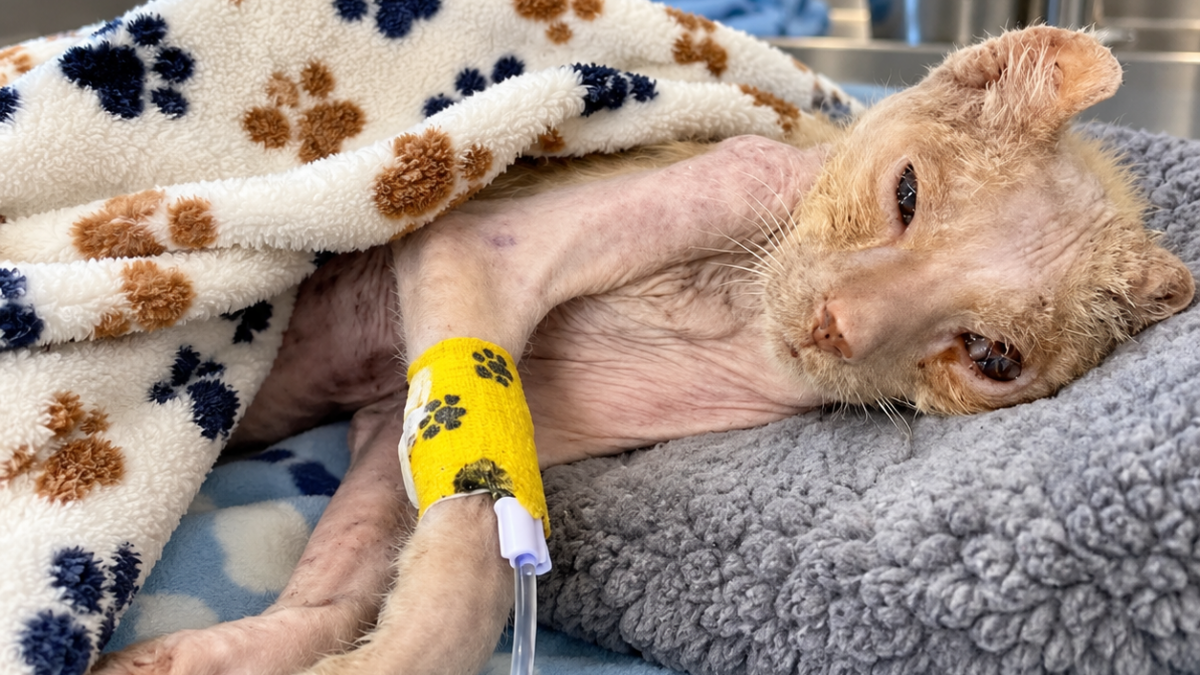
Eliseu was lying almost completely still.
A little blanket covered part of his body.
He looked smaller than he had in the cage.
“How bad?”
She paused.
“Very.”
“How long?”
“We don’t know.”
“Hours?”
“It’s possible.”
I looked down.
My hands were shaking.
For a moment, anger hit me so hard I almost couldn’t breathe.
Somebody had looked at this cat before I ever knew his name.
Somebody had known he was injured.
Somebody had seen burns on his body and damage to his eyes.
Somebody had made a decision.
Not to rush him to a clinic.
Not to ask for help.
Not even to surrender him.
They had put him behind the house.
Inside a cage.
Then they had moved away.
I looked at the veterinarian again.
“Give him the blood.”
“We will.”
“And whatever else he needs.”
“We will.”
I went back to him.
“Eliseu.”
His ear barely twitched.
“You heard her.”
Nothing.
“You’re making this difficult.”
Still nothing.
I tried to smile.
“You don’t know me yet, but apparently I’m stubborn.”
I placed two fingers gently against an area of his head that wasn’t injured.
“So you picked the wrong person to give up in front of.”
The transfusion began.
The clinic became strangely quiet around me.
Machines made soft sounds.
Staff moved in and out.
Doors opened.
Phones rang.
Other animals cried.
But I heard almost none of it.
I watched the line carrying blood into Eliseu’s body.
Blood from another animal.
A stranger, in a way, helping save a cat it would never meet.
That thought broke me.
One animal had given something Eliseu’s own people had refused to give him.
A chance.
The first hour passed.
Then another.
The veterinary team kept checking him.
Every few minutes I asked the same question.
“How is he?”
“Stable.”
I started to understand that stable was one of the most beautiful words in medicine.
It did not mean safe.
It did not mean recovering.
It did not mean the danger was over.
It simply meant he had not become worse.
That night, that was enough.
At some point after midnight, one of the technicians brought me a chair.
“You should rest.”
“I’m fine.”
“You’ve been standing for hours.”
“I’m fine.”
She looked at me.
“You won’t help him by collapsing.”
I sat.
But I didn’t sleep.
I kept staring through the glass.
Sometimes I imagined Eliseu opening his eyes and looking toward me.
But his eyes were too damaged.
I wondered what he could actually see.
Light?
Shadows?
Nothing?
The thought made my stomach tighten.
He had been alone behind that house, possibly unable to see properly, unable to understand where anyone had gone.
I pictured darkness.
Cold metal.
Thirst.
Hunger.
Pain.
I hated the images forming in my mind.
So I replaced them.
I imagined him walking.
Eating from a full bowl.
Sleeping somewhere warm.
Feeling grass.
Being annoyed about something ordinary.
I didn’t know then how important those images would become.
Morning arrived slowly.
I knew it was morning only because the light outside the clinic windows changed.
The veterinarian came to see me.
“He made it through the transfusion.”
I stood so quickly the chair scraped against the floor.
“He made it?”
“Through the transfusion, yes.”
I laughed and cried at the same time.
Then I saw her expression.
“But?”
“We still have a very sick cat.”
I nodded.
Hope had to learn discipline.
With Eliseu, every good sentence seemed to come with a warning attached.
His anemia had improved, but his body remained dangerously fragile.
His infection markers worried the team.
The burns required careful treatment.
His nutrition had to be increased slowly.
Too much food too quickly could overwhelm a body starved for too long.
Even saving him had to be done carefully.
That afternoon, Eliseu licked more liquid food.
I leaned close.
“That’s right.”
Another lick.
“Come on.”
A pause.
Then another.
I felt ridiculous cheering for a tongue.
But I cheered anyway.
One technician smiled.
“You’re going to turn every meal into a sporting event.”
“If he keeps eating, yes.”
Eliseu stopped.
I looked at him.
“Don’t make me a liar.”
The technician laughed.
For the first time since I found him, laughter happened near Eliseu.
I remember that because it felt almost disrespectful at first.
How could anyone laugh while he was still fighting for his life?
Then I realized something.
Maybe this was exactly what he needed his new life to contain.
Not just medicine.
Not just pity.
Normal human sounds.
Laughter.
Conversation.
Warmth.
People expecting tomorrow.
The following hours were not easy.
Eliseu’s condition swung unpredictably.
At one point his temperature improved.
Later it dropped again.
He ate.
Then refused food.
His body seemed to take one step toward us and another away.
The antibiotics weren’t producing the response the team hoped for.
The veterinarian changed them.
Then we waited again.
Waiting became part of caring for him.
There are moments in rescue when action feels powerful.
You drive.
You lift.
You sign forms.
You buy medication.
You say yes to treatment.
You make phone calls.
Then there are moments when there is nothing left for you to do except sit beside an animal and wait for its body to decide whether it can keep going.
Those were the hardest moments.
On one particularly bad evening, the veterinarian came into the room where I was sitting.
She closed the door.
That frightened me immediately.
Doctors do not close doors to tell you everything is fine.
I stood.
“What happened?”
“His numbers are going in the wrong direction again.”
“How wrong?”
She took a breath.
“Very wrong.”
I looked at her.
“Are we losing him?”
“We might.”
The room felt smaller.
“What else can you do?”
“We’re doing it.”
“Another transfusion?”
“Not yet. We’re managing several things at once. But I need you to prepare yourself.”
“No.”
“Marilucy—”
“No.”
She stopped.
I knew how childish I sounded.
But something inside me refused the sentence she was about to finish.
“I found him in that cage because someone else had already decided he wasn’t worth the trouble,” I said. “I’m not going to stand here and decide the same thing.”
“That isn’t what I’m asking you to do.”
“I know.”
My voice broke.
“I know. I’m sorry.”
She softened.
“We aren’t giving up on him.”
I wiped my face.
“Then I’m not preparing for goodbye yet.”
She nodded.
“That’s fair.”
I went to Eliseu.
He was lying on his side.
His breathing was shallow.
I sat beside him.
For a while, I didn’t speak.
Then I said, “I need you to understand something.”
His ear moved.
“You don’t owe anybody a miracle.”
My throat tightened.
“You don’t owe me one.”
I touched his head.
“But if there’s any part of you still fighting, I’m here.”
His breathing continued.
“I’m staying.”
That night, I thought several times that the next breath might be his last.
I counted them.
One.
Two.
Three.
Pause.
Four.
Five.
Another pause.
“Come on.”
Six.
At some point I stopped counting because fear was making every second unbearable.
I simply kept my hand near him.
Morning came.
He was alive.
The next morning came.
Alive.
Days passed.
Alive.
Then came the moment that changed the atmosphere around his entire recovery.
I was talking with a technician when she suddenly stopped looking at me.
Her eyes went toward the recovery enclosure.
“Marilucy.”
I turned.
Eliseu was moving.
Not a seizure.
Not an involuntary twitch.
Movement with purpose.
He pulled one front leg underneath himself.
Then the other.
His body trembled.
“Eliseu?”
The veterinarian stepped closer.
“Don’t touch him.”
I froze.
“Let him try.”
He pushed.
His chest lifted.
His head wobbled.
His back legs shifted.
And somehow, that impossibly weak cat sat up.
I covered my mouth.
“Oh my God.”
Nobody moved.
Five seconds.
His body trembled.
Ten.
I wanted to catch him, but the veterinarian shook her head.
“Let him find his balance.”
Fifteen.
His head lifted slightly.
Twenty.
Then he slowly lowered himself back onto the blanket.
The room exhaled.
A technician started crying.
I realized I was crying too.
“He sat.”
The veterinarian smiled.
“He did.”
“He actually sat.”
“Yes.”
I laughed.
Twenty seconds.
It sounds ridiculous when you say it to someone who never watched a cat nearly die.
Twenty seconds sitting upright.
But those twenty seconds changed everything.
Until then, we had been keeping Eliseu alive.
For the first time, I felt as though Eliseu had joined us in the effort.
He had done something his body had not been able to do.
Something voluntary.
Something strong.
Later, he ate a little more.
Not much.
But enough to keep the hope alive.
From that day forward, we started measuring his recovery differently.
Not by dramatic breakthroughs.
By tiny victories.
A stronger swallow.
A steadier temperature.
A longer period awake.
A better blood result.
A paw moving with more control.
An irritated sound when someone disturbed him.
That last one made me laugh.
The first time Eliseu showed real annoyance during treatment, a technician apologized.
I said, “Don’t apologize.”
She looked at me.
“He’s angry.”
“Exactly.”
I leaned toward him.
“Be angry, Eliseu.”
A weak sound came from his throat.
“That’s right.”
The technician smiled.
“You want him difficult?”
“I want him alive enough to be difficult.”
By day 20, Eliseu remained fragile.
There was still no guarantee.
His medical needs were constant.
His body seemed to have forgotten what normal strength felt like.
His muscles had wasted.
His wounds still required treatment.
His eyes remained badly damaged.
But we were no longer talking about hours.
That alone felt enormous.
I began to understand his routines.
He relaxed when touched a certain way.
He responded to familiar voices.
He preferred warmth.
He hated being handled more than necessary.
And he seemed to recognize me.
At first I thought I was imagining it.
Then one afternoon I entered the room and spoke before touching him.
“Eliseu.”
His head moved toward my voice.
I stopped.
“Did you hear me?”
His head moved again.
I called a technician.
“Watch.”
She came over.
I stepped a little to the side.
“Eliseu.”
His ears turned.
Then his head followed.
The technician smiled.
“He knows you.”
Those four words hit me harder than I expected.
He knows you.
A cat who had every reason to fear people had begun identifying one human voice as something safe.
I went closer.
“It’s me.”
His nose moved.
“I’m still here.”
Around day 27 came another milestone.
Weight.
Before Eliseu, I never imagined I could become emotionally invested in grams.
The technician placed him carefully on the scale.
I leaned forward.
“What does it say?”
She checked.
Then checked again.
“Well?”
“He gained.”
My heart jumped.
“How much?”
“Two grams.”
I stared at her.
“Two?”
She laughed.
“Two.”
For half a second, I almost laughed at the absurdity.
Then I did laugh.
I laughed until I cried.
“Two grams.”
“It counts.”
“It absolutely counts.”
Eliseu weighed approximately 2.86 kilograms.
Still desperately thin.
Still far from healthy.
But heavier than before.
Two grams heavier.
I looked at him on the scale.
“You hear that?”
He looked unimpressed.
“You’re growing.”
Nothing.
“Try to contain your excitement.”
That became our rhythm.
Fear.
Tiny victory.
Fear.
Tiny victory.
There was no cinematic recovery montage where every day was better than the last.
Some days were terrible.
One morning Eliseu would eat well.
That evening he might refuse everything.
One day he would lift his head and respond to us.
The next he would sleep for hours, leaving me frightened all over again.
I learned not to let one bad afternoon erase three good days.
The veterinary team reminded me that healing after severe neglect was not a straight road.
His body had been damaged slowly.
It would repair slowly.
We had to respect that.
At the same time, I began thinking more about where Eliseu had come from.
I had photographed the cage when I found him.
At first, the photographs were simply proof to myself that the scene had been real.
Now I looked at them differently.
The cage.
The filthy surroundings.
The lack of proper food.
The lack of clean water.
The abandoned property.
The condition of Eliseu’s body.
I started documenting everything I could.
Not because I wanted revenge in the sense of hurting anyone.
I wanted accountability.
There is a difference.
Pain creates a powerful temptation.
When you see an innocent animal suffer, part of you wants the person responsible to feel exactly what that animal felt.
Cold.
Hunger.
Fear.
Helplessness.
But Eliseu taught me something before he was even strong enough to walk.
Cruelty does not become justice because you point it in the opposite direction.
Justice meant evidence.
Veterinary records.
Photographs.
Dates.
Witnesses.
Consequences that could protect another animal.
So I reported what I knew.
I gave the information I had.
I showed the photographs.
I described the moment I found him.
The cage.
The burns.
His weakness.
His eyes.
The lack of care.
The family having moved away.
A veterinarian documented his medical condition thoroughly.
Every diagnosis told part of the story his voice could not.
Severe malnutrition.
Hypothermia.
Hypoglycemia.
Anemia.
Trauma.
Eye damage.
Burn injuries.
Seizures.
The list looked cold on paper.
Clinical.
Detached.
But I had watched that list breathe.
I had held it.
I had watched it lick liquid food.
I had sat beside it through the night.
Each medical word represented suffering someone had ignored.
Whenever anger became too heavy, I returned my attention to Eliseu.
He was the reason.
Not the person who hurt him.
Eliseu.
That distinction saved me from letting rage become the center of his story.
By day 40, the team believed he was ready to attempt more deliberate movement.
Walking.
The word felt too ambitious at first.
He could sit.
He could shift.
But walking meant trusting legs that had not supported him properly in a long time.
His muscles were weak.
His balance uncertain.
His body had been reduced to survival.
Now we were asking it to remember life.
A rehabilitation specialist supported him.
I stood a few feet away.
“Eliseu.”
His head turned toward me.
“Come on.”
One front paw moved.
It landed awkwardly.
Then another.
His rear legs trembled.
“Easy.”
He paused.
The therapist kept a hand close to his body without forcing him.
Another step.
Then his body sagged.
She supported him before he fell.
“That’s enough.”
“Already?”
“That was work.”
I looked at Eliseu.
He was breathing faster.
He had taken only a few steps.
But to him it was probably the equivalent of climbing a mountain.
I crouched.
“You did good.”
He lowered himself.
Within minutes, he was sleeping.
The next session was similar.
Then another.
Some days he refused.
Some days he surprised us.
We adjusted.
We waited.
We encouraged without forcing.
Around day 50, something changed.
It happened so quietly that at first I almost missed it.
Eliseu was standing with less support than usual.
The therapist loosened her hands.
“He’s holding himself.”
I moved closer.
“Eliseu.”
His ears turned.
He stepped toward me.
One.
Then another.
Then another.
My hands rose to my mouth.
Nobody spoke.
He kept coming.
His movements were clumsy.
His back legs wobbled.
His paws didn’t always land where he intended.
But he was walking.
“Eliseu!”
The therapist smiled.
“Let him work.”
I dropped to my knees.
“Come here.”
Another step.
Another.
He reached me.
His head touched my hand.
I broke down.
I pressed my forehead gently near his.
“You walked.”
The same cat I had carried from the cage because he could not stand had just crossed a room toward me.
There are victories you celebrate because they are impressive.
And there are victories you celebrate because they once seemed impossible.
That was one.
The medical staff had seen countless animals.
Professional people learn how to manage emotion.
Even they were smiling differently that day.
One technician who had been there during Eliseu’s transfusion wiped her eyes.
“I remember when we thought we had hours.”
“So do I.”
She looked at him.
“Look at him now.”
I did.
I kept looking.
On day 60, we carried Eliseu outside.
The morning was gentle.
Warm without being hot.
The air smelled clean.
I chose a quiet patch of grass.
When I lowered him, he froze.
His paws touched something unfamiliar.
His nose moved.
His whiskers pushed forward.
I held my breath.
One paw lifted.
It came down again.
Grass pressed between his toes.
He lifted the other paw.
Then he took a cautious step.
I thought of the cage floor.
Hard.
Dirty.
Confined.
Then I looked at the grass.
Soft.
Alive.
Open.
I swallowed.
“This is yours now.”
Of course, Eliseu didn’t know what I meant.
But I did.
The world had been reduced to metal bars for him.
Now we were giving pieces of it back.
A clinic floor.
A hallway.
A patch of grass.
Sunlight.
Voices.
Safety.
He took another step.
I followed beside him.
“You can go slow.”
He stopped.
The sun touched his face.
For several seconds, he simply stood there.
Then he lowered himself into the grass.
I sat beside him.
Neither of us moved.
That moment stays with me as strongly as the medical emergencies.
Perhaps more strongly.
Because rescue is not complete when an animal stops dying.
Rescue becomes real when the animal starts experiencing life again.
By day 71, physical therapy became more structured.
His muscles needed rebuilding.
His coordination needed work.
We guided him through exercises.
Supported standing.
Short walks.
Careful weight shifting.
Rest.
Lots of rest.
Eliseu began developing a personality large enough to fill every treatment room.
He complained.
Loudly.
The first strong meow shocked me.
I turned toward him.
“What was that?”
He meowed again.
A rough, irritated sound.
The therapist laughed.
“He has opinions.”
I bent toward him.
“You found your voice.”
Another meow.
“You don’t like therapy?”
Meow.
“Too bad.”
He answered louder.
Everyone laughed.
There he was.
Not a victim.
Not a medical case.
Eliseu.
Stubborn.
Impatient.
Grumpy.
Funny.
Alive.
By day 75, he weighed 4.19 kilograms.
When the number appeared on the scale, I stared at it.
“Again.”
The technician smiled.
“You don’t trust me?”
“I trust you. I don’t trust the scale.”
She weighed him again.
Same result.
Four point one nine.
I touched his back.
His bones were no longer cutting through my palm the way they had when I first lifted him.
He felt like a cat.
A real, solid cat.
“You’re getting heavy.”
He meowed.
“I know. Very offensive.”
His coat improved.
His energy improved.
His appetite improved.
His strength returned.
But there was one area where improvement refused to come.
His eyes.
From the beginning, the injuries had been severe.
The team treated them.
We consulted specialists.
We monitored him.
We hoped.
Hope had become almost a habit by then.
His body had survived everything we were told it might not survive.
So part of me believed his eyes might become another miracle.
Maybe not perfect vision.
Maybe shadows.
Light.
Movement.
Something.
I was afraid to ask the question directly.
Eventually, I had to.
“How much can he see?”
The veterinarian was quiet.
“Very little, if anything useful.”
“Could it improve?”
“We’re still evaluating.”
I held on to those words.
Still evaluating.
For weeks, they gave me room to imagine.
By day 90, Eliseu weighed around 5.1 kilograms.
Five point one.
I remember looking at him and thinking about the little body I carried from behind that empty house.
If someone had shown me the healthy weight on that scale during our first night, I would have thought it was fantasy.
Eliseu had changed visibly.
He had strength.
He moved.
He ate.
He meowed.
People began hearing more about his recovery.
Some wanted to meet him.
He began making carefully managed appearances.
Students learned his story.
At one visit, a child sat cross-legged several feet away.
The child whispered, “Can he see me?”
I looked at Eliseu.
“Probably not clearly.”
The child lowered his voice even more.
“Does he know I’m here?”
“Yes.”
“How?”
“He hears you. He can smell you. He can feel movement around him.”
The child held out a hand.
I guided him.
“Let Eliseu choose.”
The boy waited.
Eliseu moved his nose.
Sniffed.
Then leaned forward.
The boy smiled.
“He touched me.”
I nodded.
“He decided you were okay.”
The boy looked amazed.
Watching Eliseu with children changed something in me.
He had been treated as though his life had no value.
Now people rearranged their day just to meet him.
They spoke quietly around him.
They waited for his trust.
They celebrated his presence.
That became a kind of justice too.
Not punishment.
Restoration.
The world had once taught Eliseu that humans could hurt him and leave.
Now, one person at a time, we were teaching him something different.
But his eyes remained a source of concern.
The specialists continued monitoring them.
There were signs of chronic pain.
Pressure.
Damage that could not be reversed.
Eventually, I was called into a consultation.
The veterinarian had Eliseu’s records open.
I sat across from her.
I knew something was wrong before she began.
“Tell me.”
She folded her hands.
“We’ve reached a point where keeping the eyes is no longer helping Eliseu.”
I stared at her.
“What does that mean?”
“It means we need to discuss removal.”
Both words seemed impossible together.
“Removal?”
“Yes.”
“Both eyes?”
She nodded.
My chest tightened.
“No.”
It came out automatically.
She waited.
“I’m sorry,” I said. “I know that’s not rational. Just… no.”
“I understand.”
“He survived.”
“I know.”
“He survived everything.”
“Yes.”
“And now you’re telling me after all that, he loses his eyes?”
“They’re already severely damaged.”
“But they’re still there.”
“Marilucy.”
Her voice was gentle.
“Keeping an organ that no longer functions and causes pain is not saving it.”
I looked away.
That sentence stayed with me.
Keeping something that causes pain is not saving it.
I had spent months thinking success meant preserving as much of Eliseu as possible.
But the purpose of medicine was not to make him look whole.
It was to make him feel whole.
“Is he hurting?”
“Yes.”
“How much?”
“It’s difficult to measure exactly, but enough that we’re concerned about his quality of life.”
“Will removing them stop that pain?”
“It should relieve the ocular pain once he heals from surgery.”
“Will he manage without them?”
“He’s already relying heavily on his other senses. Cats adapt remarkably well when their environment is stable.”
I touched Eliseu.
He turned toward my hand.
“He’ll never see again.”
“No.”
Those words finally broke me.
I cried.
Not quietly.
Not gracefully.
I cried for every piece of him that cruelty had taken before I ever arrived.
I cried because survival had not restored everything.
I cried because life sometimes gives you the miracle and the scar at the same time.
The veterinarian let me cry.
Then she said, “This is not the end of his recovery.”
I wiped my face.
“It feels like one.”
“It’s another stage.”
I looked at Eliseu.
He meowed softly.
I laughed through tears.
“What?”
Another meow.
“You have no idea what we’re talking about, do you?”
He pushed his head into my fingers.
Maybe he didn’t need to know.
Maybe animals are spared some of our suffering because they don’t spend hours imagining futures that haven’t happened.
They live inside sensation.
Pain.
Comfort.
Hunger.
Fullness.
Fear.
Safety.
If his eyes hurt, then our job was to stop the hurt.
That was the decision.
We scheduled surgery.
The morning I brought him in, my hands felt like they did the first day.
Cold.
Unsteady.
The clinic was familiar now.
Eliseu knew the smells.
He knew the staff.
He complained from his carrier.
One technician smiled.
“Good morning, Eliseu.”
Meow.
“Yes, we missed you too.”
I opened the carrier.
He came out reluctantly.
I held him.
The veterinarian approached.
“Ready?”
“No.”
She smiled sadly.
“Neither is anyone.”
I pressed my face near Eliseu.
“You’ve done harder things.”
His ear touched my cheek.
“You survived the cage.”
I kissed his head.
“You survived the seizures.”
Another kiss.
“The transfusion.”
I swallowed.
“You learned to walk.”
My voice broke.
“You can do this.”
When they took him from me, the empty carrier felt heavier than he did.
I sat in the waiting area.
I knew the surgery was medically necessary.
Knowing does not stop fear.
Every time a door opened, I looked up.
I remembered our first night.
It felt cruel that after all these months, I was once again counting time in a waiting room.
Eventually, the veterinarian came out.
I stood.
“It’s done.”
“How is he?”
“He did well.”
My knees nearly gave out.
“Can I see him?”
“Soon.”
When I finally did, Eliseu was groggy.
His face was bandaged.
There were no eyes beneath those bandages now.
I thought I was prepared.
I wasn’t.
I sat beside him.
“Oh, Eliseu.”
My hand hovered because I was afraid to touch him incorrectly.
The technician showed me where it was safe.
I stroked his head.
“I’m sorry.”
A voice behind me said, “Don’t apologize to him for removing his pain.”
I turned.
The veterinarian stood there.
I nodded.
But tears kept falling.
“He’s been through enough.”
“Yes.”
“That’s the problem.”
She stepped closer.
“No. That’s why this matters.”
I looked at her.
“He went through enough before anyone helped him. Everything after that has been about giving something back.”
I looked at Eliseu.
“What did we give back today?”
“Comfort.”
That answer changed the way I saw the surgery.
Eliseu hadn’t lost his eyes that day.
The damage had taken his sight long before.
The surgery removed pain.
And once the recovery period passed, we began seeing exactly how capable he was.
At first, he moved cautiously.
We kept everything consistent.
Food always in the same area.
Water in the same place.
Beds along predictable routes.
No random furniture moved into his path.
We spoke before touching him.
“Eliseu, it’s me.”
He learned.
Fast.
He followed walls with his whiskers.
Mapped spaces with his paws.
Recognized changes in flooring.
Turned toward voices.
Located people by smell.
Within weeks, he moved with more confidence than I expected.
The first time he crossed an entire room without hesitation, I stared at him.
“How did you do that?”
He meowed.
“Right. Secret.”
He became astonishingly good at locating food.
One afternoon, I opened a package quietly.
Eliseu had been sleeping.
His head came up immediately.
“You cannot see, but apparently you have supernatural hearing.”
He stood.
Walked toward me.
Stopped almost exactly beside the food.
I laughed.
“That is unbelievable.”
Meow.
“You’re not getting extra.”
Louder meow.
“No.”
Even louder.
I gave him extra.
His victory was complete.
Those ordinary moments became everything.
Recovery had been filled with clinical milestones.
Temperature.
Blood glucose.
Hemoglobin.
Weight.
Medication.
Wound healing.
Physical therapy.
But life was measured differently.
How fast he found his favorite bed.
Which staff member he preferred.
How loudly he complained.
Where the morning sunlight reached the floor.
Whether he chose to sit beside someone.
Whether he slept deeply.
Deep sleep meant trust.
An animal that expects danger does not fully relax.
Eliseu began relaxing.
That mattered more to me than any number on a chart.
As the months passed, his story spread farther.
People wanted updates.
Students invited him to educational events.
People who had never met him cared about his progress.
Some cried when they saw him.
Eliseu usually reacted to emotional strangers by acting mildly annoyed.
I loved that about him.
He did not know he was supposed to be inspirational.
He knew he wanted comfort.
Food.
Familiar voices.
Warmth.
A quiet place.
Human beings turned him into a symbol because we needed the symbol.
Eliseu was simply living.
The question of accountability continued in the background.
Reports had been made.
Records existed.
People involved had information.
I cannot pretend that process was emotionally satisfying every day.
It wasn’t.
Justice moves slower than anger.
Much slower.
Anger wants an answer tonight.
Paperwork wants dates.
Documentation.
Statements.
Verification.
Patience.
There were moments I hated that.
I would look at Eliseu’s missing eyes and think, How much more evidence could anyone possibly need?
Then I reminded myself that real accountability had to be built carefully.
Otherwise, it could disappear under excuses.
I gave everything requested.
Photographs.
Details.
Medical information.
A timeline.
I told the story exactly as I knew it.
I did not exaggerate.
I didn’t need to.
The truth was already terrible enough.
The family had moved away.
Eliseu had remained.
He had been found in devastating condition.
Veterinary professionals had documented what prolonged neglect had done to his body.
Facts did not need decoration.
For a while, I imagined dramatic revenge.
I am not proud of every thought I had.
There were nights after Eliseu’s eye surgery when anger made me imagine confronting the person who abandoned him.
I wanted to put Eliseu in front of them.
I wanted them to hear his paws searching for the floor.
I wanted them to see the scars.
I wanted them to understand the blood transfusion.
The seizures.
The first twenty seconds sitting.
The fifty days before those first real steps.
The surgery.
All of it.
Then one morning, I was sitting near Eliseu when he walked toward me.
No hesitation.
He followed my breathing or my smell.
Maybe both.
He reached my leg and pressed his head against me.
I touched him.
And suddenly the revenge I had imagined felt small.
Because what could I do to someone that would be more powerful than this?
They had left him as if he were nothing.
Eliseu had become deeply loved.
They had shut him inside a cage.
He moved through rooms freely.
They had denied him treatment.
An entire veterinary team knew his habits by heart.
They had left him hungry.
Now people worried if he skipped one meal.
They had denied him affection.
Now he complained when petting stopped.
That was the revenge.
Not violence.
Not cruelty returned for cruelty.
Life.
A stubborn, loud, demanding life.
The kind they had almost taken.
Around the one-year mark, I found myself thinking about the first photographs again.
I put one beside a newer image.
In the first, Eliseu looked barely present.
His body was skeletal.
His injuries dominated everything.
In the new image, he looked solid.
His eyes were gone, yes.
But his body was strong.
His coat was healthier.
His posture had changed.
There was personality in every line of him.
I stared at both for a long time.
A friend looked over my shoulder.
“That doesn’t look like the same cat.”
“It is.”
“I know.”
She pointed to the newer photograph.
“But look at him.”
I smiled.
“I do. Every day.”
By then Eliseu knew the clinic so well that some staff members joked he behaved like management.
He would arrive.
Complain.
Receive attention.
Complain again.
Demand food.
Then settle as though he had approved the day’s operations.
One veterinarian crouched beside him during a checkup.
“You gave us trouble.”
Eliseu meowed.
The veterinarian laughed.
“I know. You disagree.”
I said, “He thinks you gave him trouble.”
“That’s probably more accurate.”
The checkup went well.
His weight was stable.
His general condition strong.
His adaptation to blindness impressed everyone.
Still, I remained overprotective.
If Eliseu hesitated for two seconds, I worried.
If he slept longer than usual, I watched his breathing.
If he left a little food, I wanted to call someone.
One technician finally said, “Marilucy, he is allowed to be a normal cat now.”
I looked at her.
“What does that mean?”
“It means sometimes he doesn’t finish breakfast.”
“That sounds dangerous.”
She laughed.
“It means sometimes he sleeps because he’s sleepy.”
“Suspicious.”
“It means sometimes he ignores you because he’s a cat.”
“That part I believe.”
She put a hand on my shoulder.
“You kept him alive through the crisis. Now let him live outside the crisis.”
That sentence stayed with me.
Let him live outside the crisis.
I had been so afraid of losing him that part of me had kept us both trapped in the first night.
Always counting breaths.
Always waiting for the next terrible number.
Always preparing for a veterinarian to walk toward me with a certain expression.
Eliseu had moved forward.
I needed to do the same.
So I started trusting his strength.
I let him explore safe spaces more independently.
I stopped hovering over every meal.
I let him find me instead of constantly reaching for him.
He surprised me.
Again and again.
Blindness did not make his world empty.
It made his world different.
He noticed things I missed.
Footsteps.
Doors.
Air moving.
Smells carried from another room.
The vibration of someone sitting down.
The tiny sound of a food lid opening.
Especially that.
He knew the people he loved without needing to see their faces.
That humbled me.
We place so much importance on being seen.
Eliseu taught me that sometimes being known is deeper.
He knew who arrived by the way they walked.
He knew who held him safely.
He knew who rushed.
Who moved gently.
Who smelled familiar.
Who brought medicine.
Who brought food.
Who stayed.
I wondered sometimes whether he remembered the cage.
Animals do not tell us their memories.
Maybe certain sounds frightened him because of it.
Maybe certain smells.
Maybe some part of his body remembered before his mind did.
But I knew one thing.
The cage was no longer the place where his life was happening.
That mattered.
Days continued passing.
Three hundred.
Three hundred fifty.
Four hundred.
Each milestone amazed me.
Then came day 450.
Four hundred and fifty days.
If you had told me on the first night that I would one day say that number, I would not have believed you.
On day one, I wanted one more hour.
On day 450, we were talking about home.
The veterinarian sat with me after examining Eliseu.
I noticed she was smiling.
“What?”
“Nothing.”
“That is not a nothing face.”
She closed the record.
“He’s ready.”
“For what?”
“To go home.”
I stared.
“He goes home all the time.”
She shook her head.
“No.”
Then I understood.
Not a visit.
Not temporary.
Not leaving under a cloud of another appointment or crisis.
Home.
His long period of treatment and rehabilitation had reached the point where home could become the center of his life.
“You mean…”
“I mean he doesn’t need this place to define his days anymore.”
I looked at Eliseu.
He was grooming himself.
Completely uninterested in the fact that a sentence I had waited 450 days to hear had just been spoken.
“You’re serious?”
“Yes.”
“He’s ready?”
“Yes.”
“What if—”
The veterinarian raised her hand.
“There will still be care. There will still be checkups. He is still a blind cat with a significant medical history.”
“I knew there was a but.”
“But he is stable. Strong. Adapted. And ready.”
I cried.
Of course I cried.
At that point, the clinic staff expected it.
One technician walked in, saw my face and said, “What happened?”
“He can go home.”
She froze.
Then she smiled.
“Finally.”
That word carried 450 days inside it.
Finally.
I knelt beside Eliseu.
“You’re going home.”
He continued grooming.
“Eliseu.”
Nothing.
“I am trying to have an emotional moment.”
He stopped.
Meowed once.
Then resumed.
The technician laughed.
“That’s his speech.”
We prepared carefully.
Because Eliseu was blind, the home had to be predictable.
I thought through every route.
Food.
Water.
Litter.
Beds.
Safe furniture.
No dangerous edges.
No clutter in places he would travel.
I walked through the space imagining I had no sight.
I closed my eyes.
Touched the wall.
Counted steps.
Listened.
It changed how I understood what Eliseu experienced.
A room I thought was simple suddenly became a landscape of hard corners and unexpected obstacles.
I adjusted things.
Then adjusted them again.
The day he came home permanently, I carried his carrier through the door and set it down.
I opened it.
Then I waited.
I did not pull him out.
The first choice in his new home would belong to him.
“Eliseu.”
His nose appeared.
He sniffed.
One paw reached out.
Touched the floor.
Pulled back.
I smiled.
“It’s okay.”
The paw returned.
Then the other.
He stood at the carrier entrance listening.
I stayed quiet.
He stepped out.
Pause.
Another step.
His whiskers reached ahead.
He found the edge of a rug.
Turned.
Moved along it.
Stopped.
Sniffed.
Walked again.
I followed several feet behind, fighting the urge to guide him.
He needed to build the map himself.
He reached a wall.
Turned.
Found a doorway.
Paused.
I whispered, “Good.”
His ears moved toward me.
He changed direction.
Walked toward my voice.
When his head touched my leg, I cried again.
“You found me.”
He leaned against me.
“Of course you did.”
I sat on the floor.
Eliseu climbed partly into my lap.
I put my hand on his back.
Warm.
Strong.
Breathing steadily.
For several minutes I could not speak.
I saw the cage again.
Not because I wanted to.
Because the contrast was too enormous.
Metal bars.
Now my lap.
Cold.
Now warmth.
Empty bowl.
Now food waiting.
Abandonment.
Now a person sitting on the floor because she did not want to move while he leaned against her.
That first evening at home, Eliseu explored.
Slowly.
He found water.
That felt like another victory.
He found food even faster.
Of course.
He discovered one bed.
Ignored it.
Discovered another.
Ignored that too.
Then chose a blanket I had not intended to be his.
I laughed.
“Fine.”
That became his blanket.
Later, I went to bed.
I left his sleeping area prepared nearby.
For the first hour, everything was quiet.
Then I heard paws.
Tap.
Tap.
Pause.
Tap.
I sat up.
“Eliseu?”
His ears turned toward me.
He walked closer.
I lowered my hand.
He found the bed.
Then somehow climbed up.
“You are not supposed to—”
He pushed against my side.
I stopped talking.
He turned twice.
Curled into a ball.
And went to sleep.
I lay there staring into the darkness.
Eliseu had no eyes.
Yet for once, I was the one who felt unable to see clearly because tears filled mine.
I touched his back.
He made a grumpy sound.
“Sorry.”
He relaxed again.
That night, I understood something I had missed during all those months.
The opposite of abandonment is not rescue.
Rescue is the first step.
The opposite of abandonment is belonging.
Eliseu finally belonged somewhere.
Morning revealed another side of him.
He wanted breakfast early.
Very early.
A meow woke me.
I opened my eyes.
“Eliseu?”
Meow.
“What time is it?”
Meow.
I checked.
“You are joking.”
Louder meow.
“No.”
He moved closer.
“You have food.”
Meow.
“You had food last night.”
Meow.
“You nearly died 450 days ago, and this is what you choose to do with your second chance?”
He meowed directly at my face.
I laughed so hard I had to sit up.
“All right.”
That was our first normal argument.
I treasured it.
Soon, life became filled with them.
Eliseu wanted the warmer blanket.
Eliseu wanted food sooner.
Eliseu did not approve of a closed door.
Eliseu wanted someone to continue petting him.
Eliseu objected to medication.
Eliseu occasionally acted as though the entire household had been created for his convenience.
I encouraged this more than I should have.
Someone once said, “You spoil him.”
I answered, “Correct.”
They laughed.
I didn’t.
Not completely.
There are animals who should learn boundaries.
Eliseu had already learned too many boundaries made of metal.
I wanted his remaining life to contain abundance.
Not irresponsibility.
Not unhealthy indulgence.
But abundance of comfort.
Safety.
Choice.
Attention.
The right to complain.
The right to walk away.
The right to come closer.
The right to sleep without listening for danger.
Visitors learned his rules.
Speak before touching him.
Let him smell your hand.
Do not move suddenly.
Do not pick him up unless necessary.
Let him decide.
Most people respected that.
When they did, Eliseu often rewarded them.
He would move closer.
Lean against a hand.
Settle nearby.
Occasionally climb onto a lap.
People treated each small gesture as an honor.
Maybe it was.
A creature who had been failed by humans was choosing humans again.
That trust should never be treated casually.
At one educational event, a teenager asked me, “How can he still trust anybody?”
I looked at Eliseu.
“I don’t know that he trusts everybody.”
The student waited.
“I think he trusts people individually.”
“What’s the difference?”
“It means one person hurt him, but he doesn’t automatically make every person pay for it.”
The teenager became quiet.
I realized the lesson was bigger than cats.
Eliseu had not forgiven humanity.
Animals don’t think in those legal or moral terms.
He had simply learned, one interaction at a time, that some hands were safe.
That was enough.
People continued remembering his story because it contained extremes.
Burns.
Starvation.
Blindness.
A cage.
A transfusion.
Seizures.
Surgery.
Four hundred and fifty days.
But I began telling people to look beyond the dramatic parts.
Look at the two grams.
Look at twenty seconds sitting upright.
Look at one paw in grass.
Look at the first grumpy meow.
Look at him sleeping.
Recovery is built more often from small things than miracles.
A miracle is sometimes simply hundreds of tiny things refusing to stop.
Eliseu’s body did that.
So did the veterinary team.
So did everyone who cared.
There was no single heroic moment that saved him.
There were hundreds.
Someone found him.
Someone drove.
Someone checked his temperature.
Someone warmed him.
Someone tested his glucose.
Someone prepared food.
Someone found blood for a transfusion.
Someone changed antibiotics.
Someone cleaned his wounds.
Someone watched through the night.
Someone helped him sit.
Someone supported his first steps.
Someone carried him to grass.
Someone guided physical therapy.
Someone examined his eyes.
Someone made the painful decision to remove them.
Someone taught him to navigate.
Someone made a home safe.
Rescue looks dramatic from far away.
Up close, it is repetition.
Care.
Again.
And again.
And again.
That is why abandonment hurt me so deeply.
Because abandoning an animal is not one missing act of kindness.
It is refusing all those small acts.
Food.
Water.
Warmth.
Treatment.
Attention.
Presence.
Eliseu had been denied the ordinary things.
We gave them back until ordinary became his life.
Months after he settled at home, I had another moment I will never forget.
I was sitting quietly with coffee.
The house was still.
Eliseu was in another room.
Then I heard him coming.
Tap.
Tap.
Tap.
His pace was confident.
No cautious testing.
No fear.
He entered the room.
Stopped.
His ears moved.
I stayed silent.
He listened.
Then walked directly toward me.
Not the wall.
Not the chair.
Me.
He reached my leg and meowed.
“How did you know?”
Another meow.
I lifted him.
He turned once in my lap.
Curled against my stomach.
And fell asleep.
I looked down at him.
The absence of his eyes was obvious.
It always would be.
His scars would always exist.
The past could not be erased.
But neither could this.
His weight on my lap.
His warm body.
His complete relaxation.
The little sound he made while sleeping.
I thought about the person who had locked him away.
For a long time, I had imagined what I would say if I stood face to face with them.
I thought I would have a speech.
Something angry.
Something devastating.
Something that would make them understand.
But sitting there with Eliseu asleep against me, I realized I needed no speech.
This was the answer.
They had treated him as disposable.
He became irreplaceable.
They had left him where they thought no one would care.
People everywhere cared.
They had shut him behind bars.
His world became bigger than that cage could ever contain.
They had watched suffering and walked away.
Others watched suffering and moved closer.
That was the revenge I could live with.
Not revenge that created more pain.
Revenge that erased their final decision.
They had decided Eliseu’s story ended behind that house.
It didn’t.
They were wrong.
Every meal proved it.
Every step proved it.
Every meow proved it.
Every person he trusted proved it.
Every morning he woke warm proved it.
Every night he slept safely proved it.
Years may pass, and one day Eliseu’s body will grow old.
That is the bargain we make whenever we love an animal.
We save them knowing we cannot save them forever.
But there is a difference between losing an animal after a life and losing one because no one gave it a chance to live.
Eliseu got his chance.
He fought for it.
We fought beside him.
And eventually the fight changed.
It stopped being a fight against death.
It became a fight for quality.
Then independence.
Then comfort.
Then normalcy.
Finally, it stopped feeling like a fight at all.
It became life.
One evening, I sat on the floor beside him while sunlight faded from the room.
Eliseu lay near my leg.
His paws were stretched out.
He had eaten.
He had complained.
He had walked around the house as if he owned it.
A normal day.
I stroked his back.
“Do you know how far you came?”
His ear moved.
I smiled.
“Day one, you couldn’t stand.”
Nothing.
“Day twenty, we were still afraid.”
He shifted.
“Day twenty-seven, two grams.”
I laughed softly.
“Two grams, Eliseu. We celebrated two grams.”
Meow.
“Day forty, a few supported steps.”
He lifted his head.
“Day fifty, you walked.”
I touched his paw.
“Day sixty, grass.”
His paw moved beneath my fingers.
“Day seventy-one, therapy.”
Meow.
“Yes, I know you hated that.”
I scratched under his chin.
“Day seventy-five, 4.19 kilograms.”
He leaned toward my hand.
“Day ninety, 5.1.”
I swallowed.
“And then your eyes.”
The room became quiet.
I kept petting him.
“Four hundred and fifty days.”
Eliseu settled again.
“And home.”
That was the word that mattered most.
Home.
Not hospital.
Not treatment.
Not cage.
Home.
Sometimes people ask which moment made me realize Eliseu had truly recovered.
I could choose many.
The first time he ate.
The transfusion.
The twenty seconds sitting.
The first steps.
The grass.
The weight gain.
Surviving surgery.
Coming home.
But the moment I return to is smaller.
One afternoon, Eliseu was asleep.
Someone unfamiliar entered the room quietly.
Eliseu woke.
For a second, his body tensed.
The visitor spoke softly.
I spoke too.
“It’s okay.”
Eliseu listened.
Then he relaxed again.
He trusted my voice enough to stop being afraid.
That was recovery.
Not the absence of scars.
Not perfect health.
Not restored vision.
Trust.
Safety.
The ability to believe danger was not always coming.
I think that is what every abused animal deserves.
Not simply survival.
The right to stop surviving.
The right to live.
Eliseu earned that right every day he stayed alive.
We simply helped make room for it.
There were still occasional difficult moments.
A sudden loud sound could startle him.
A piece of furniture moved unexpectedly could confuse him.
A medical checkup could bring back his resistance.
But those moments became exceptions.
His life was no longer organized around suffering.
One night, a storm rolled through.
Thunder shook the windows.
I worried he would panic.
Instead, Eliseu found me.
He climbed onto the couch.
Pressed against my leg.
And remained there.
I put a blanket over him.
Thunder sounded again.
His ears moved.
But he didn’t run.
“You’re okay.”
He leaned harder against me.
That scene would have been unimaginable on the first day.
A frightening sound.
A vulnerable animal.
And instead of hiding alone, he sought a person.
I stayed still until the storm passed.
Maybe that was our entire story compressed into one hour.
Fear came.
Eliseu found someone.
Someone stayed.
That is all rescue sometimes needs to mean.
Stay.
Stay while treatment is hard.
Stay when progress is slow.
Stay when hope is embarrassing.
Stay when recovery becomes expensive.
Stay when the animal changes permanently.
Stay when blindness means adjusting the house.
Stay when the scars are visible.
Stay after the dramatic part ends.
Stay long enough for the animal to believe staying is real.
I had whispered to Eliseu during his worst night, “If you can stay, I’ll stay too.”
At the time, I meant one night.
Then another.
Then another.
Four hundred and fifty days later, I understood the promise had become much bigger.
He stayed.
So did I.
And if there is one image of Eliseu I wish the person who abandoned him could see, it is not the medical photographs.
Not the burns.
Not the damaged eyes.
Not the blood transfusion.
Not the surgery.
I would show them a quiet morning.
Eliseu stretched across a patch of sunlight.
His body relaxed.
Food nearby.
Water clean.
A familiar voice in the room.
No cage.
No fear.
He hears someone approach.
His ears turn.
He recognizes the footsteps.
Then he rolls slightly onto his side because he knows the hand coming toward him will be gentle.
That is the image.
Because it proves something cruelty always forgets.
Cruelty can damage a life.
Sometimes permanently.
But cruelty does not always get to decide what that life becomes.
Eliseu became loved.
He became stubborn.
He became funny.
He became demanding.
He became strong.
He became a cat students wanted to meet.
He became proof of what sustained veterinary care can accomplish.
He became proof that blindness does not erase quality of life.
He became proof that slow recovery is still recovery.
Most importantly, he became himself again.
Not “the burned cat.”
Not “the abandoned cat.”
Not “the blind cat.”
Eliseu.
One morning, much later, I overslept.
I woke to silence.
That should have worried me.
Instead, I immediately knew something was wrong for a different reason.
Eliseu had not complained about breakfast.
I sat up.
“Eliseu?”
No answer.
My heart jumped.
I got out of bed.
“Eliseu?”
Then I heard a faint sound from the living room.
I rushed in.
There he was.
Curled on the sofa.
Sleeping.
Deeply.
I stood there, feeling ridiculous.
His head lifted.
Meow.
“You scared me.”
He stretched.
Meow.
“You’re fine.”
Another meow.
“And now you want breakfast.”
He climbed down and walked toward the kitchen.
I followed.
Halfway there, I started laughing.
What a strange gift ordinary fear can be.
Once, I had feared Eliseu would die because his body was collapsing.
Now I feared because he slept through breakfast.
That is the kind of change I wanted for him.
The kind where emergencies become inconveniences.
Where survival becomes routine.
Where a cat once unable to lift himself can become late for breakfast.
I filled his bowl.
He began eating.
I watched him for a moment.
Then I looked away.
That was important too.
I could look away.
In the clinic, I had been afraid to take my eyes off him because death felt so close.
Now I could put food down and walk across the room because life had become dependable.
That might be the most satisfying ending rescue can offer.
Not a dramatic final scene.
Dependability.
Tomorrow expected.
Breakfast assumed.
Warmth ordinary.
Love boring.
Safety so consistent the animal stops noticing it.
Eliseu deserved boring.
He had lived through enough drama for ten lifetimes.
So when people ask me whether his story has a happy ending, I say yes.
Not because every injury was repaired.
His eyes were gone.
His scars remained.
Nothing could rewrite the time he spent suffering.
A happy ending does not mean pretending the beginning never happened.
It means the beginning no longer controls the rest.
Eliseu lost his sight.
But he found safety.
He lost the home that abandoned him.
But he found people who stayed.
He lost months of strength.
But he gained it back step by step.
He came close to losing his life.
Instead, he got another one.
Sometimes at night, when he curls against me, I think about how little separated these two versions of his story.
A sound behind a house.
Someone deciding to investigate.
A car ride to the clinic.
A little liquid food.
A blood donor.
A team unwilling to stop.
Twenty seconds upright.
Two grams.
One step.
Then another.
Lives turn on tiny hinges.
Eliseu’s did.
I wish I could say every animal left behind is found in time.
They aren’t.
That truth is painful.
But Eliseu was.
And because he was, we had a responsibility to make the second half of his life louder than the first.
I think we did.
His early story was filled with silence.
No one coming.
No one helping.
No one answering.
His new life was noisy.
Veterinarians calling his name.
Technicians laughing at his complaints.
Students asking questions.
People greeting him.
Food containers opening.
Doors welcoming him.
My voice saying, “I’m here.”
And Eliseu answering with the same cranky little meow that once felt like a miracle.
I still remember the first time that meow returned.
It was weak.
Raspy.
Almost irritated.
I laughed because it sounded like defiance.
Now he uses it constantly.
Sometimes I tease him.
“You realize there was a time we begged you to make that sound.”
Meow.
“And now you never stop.”
Meow.
“I created a monster.”
Louder meow.
Then I pick him up.
He settles against me.
I feel his body.
Solid.
Warm.
Alive.
And I think, No.
Not a monster.
A miracle with an attitude.
The best kind.
If I could return to the first night for one minute, I would sit beside the version of myself who was counting Eliseu’s breaths.
I would not tell her everything.
I would not tell her about the eye surgery.
She could not handle that yet.
I would not tell her how long 450 days would feel.
I would simply whisper one sentence.
“He is going to complain about breakfast one day.”
She probably wouldn’t understand.
But I would.
Because that sentence contains the whole future.
Weight.
Strength.
Home.
Trust.
Routine.
Life.
Eliseu never received his old life back.
He received something different.
A life built after cruelty.
A life shaped around what remained rather than what was lost.
Perhaps that is why his story stays with people.
We all understand, in some form, that not everything broken can be restored exactly as it was.
Sometimes the victory is not going backward.
Sometimes the victory is building forward.
Eliseu built forward without eyes.
Without certainty.
Without understanding why any of this had happened.
He followed voices.
He followed warmth.
He followed care.
And slowly, those things led him home.
The last time I looked at the photograph of the cage, I expected anger.
I still felt some.
I probably always will.
But another feeling was stronger.
Distance.
That cage no longer felt like Eliseu’s definition.
It looked small.
Temporary.
Powerful once.
Powerless now.
The door that had trapped him became just one door in a much longer story.
Other doors opened afterward.
Clinic doors.
Treatment room doors.
Rehabilitation rooms.
Event spaces.
Finally, my front door.
The cage closed.
The world opened.
That is how I choose to remember his journey.
Not as a story about what was done to him.
As a story about what happened after someone finally said, “Enough.”
Enough neglect.
Enough pain.
Enough being invisible.
Enough being left behind.
From that moment forward, every person around Eliseu gave him something the cage never could.
A next step.
And when his body could not take that step alone, we carried him until he could.
Then one day, he carried himself.
Across the floor.
Across the grass.
Across my home.
Straight toward my voice.
People sometimes say Eliseu is lucky.
I understand why.
He was found.
He received care.
He survived.
But I hesitate to use that word.
Luck did not burn him.
Luck did not abandon him.
Luck did not perform the transfusion.
Luck did not clean his wounds every day.
Luck did not guide his legs through rehabilitation.
Luck did not make the decision to remove painful eyes.
Luck did not rearrange a house so a blind cat could navigate safely.
People did those things.
Care did.
Commitment did.
Medical skill did.
Persistence did.
Eliseu himself did.
That matters because calling survival “luck” can hide the labor behind it.
His second life was built.
Day after day.
By hands that chose to stay.
And maybe that is the final answer to the person who left him.
You chose abandonment.
We chose commitment.
Your choice almost killed him.
Ours gave him 450 days to come home.
And after those 450 days, Eliseu did something beautifully ordinary.
He lived.
He woke up hungry.
He walked toward voices he knew.
He found sunlight.
He complained.
He slept.
He trusted.
He loved in whatever way cats choose to love us.
He became safe enough to be difficult.
Safe enough to be lazy.
Safe enough to ignore people.
Safe enough to demand affection.
Safe enough to expect tomorrow.
One evening, I sat beside him while he slept.
I ran my hand slowly along his back.
He stretched.
His paws extended.
His body relaxed again.
I remembered the first time I lifted him.
How light he had been.
How cold.
How frighteningly still.
I whispered, “You made it.”
His ear moved.
I smiled.
“We made it.”
He opened his mouth.
Meow.
I laughed.
“Yes. Dinner.”
He stood.
Walked confidently toward the kitchen.
I followed.
And that was exactly how I wanted his story to end.
Not with the cage.
Not with the person who hurt him.
Not with revenge.
Not even with the surgery.
With Eliseu walking through his own home, complaining because dinner was late.
Because once, he had been left hungry and alone.
Now someone was always listening.
Once, he had been trapped behind bars.
Now there was no cage around him.
Once, his body had been so weak he could not stand.
Now his paws knew every corner of the house.
Once, the people responsible for him walked away.
Now he could walk toward someone who never would.
They burned him.
They starved him.
They abandoned him.
They damaged his eyes and almost took his life.
But they did not get the ending.
Eliseu did.
Four hundred and fifty days after I carried that nearly lifeless cat out of a cage, he finally had what should have been his from the beginning.
Food when he was hungry.
Warmth when he was cold.
Treatment when he was sick.
Hands that were gentle.
A place where he belonged.
And a person who would still be there when he woke up.
Eliseu could no longer see the home he had fought so hard to reach.
But every morning, when he heard my footsteps and came walking toward me without fear, I knew something more important.
He knew exactly where home was.

