PART 2: They Adopted One Labrador Puppy and Left His Brother Behind—What Happened the Next Morning Stopped the Entire Shelter
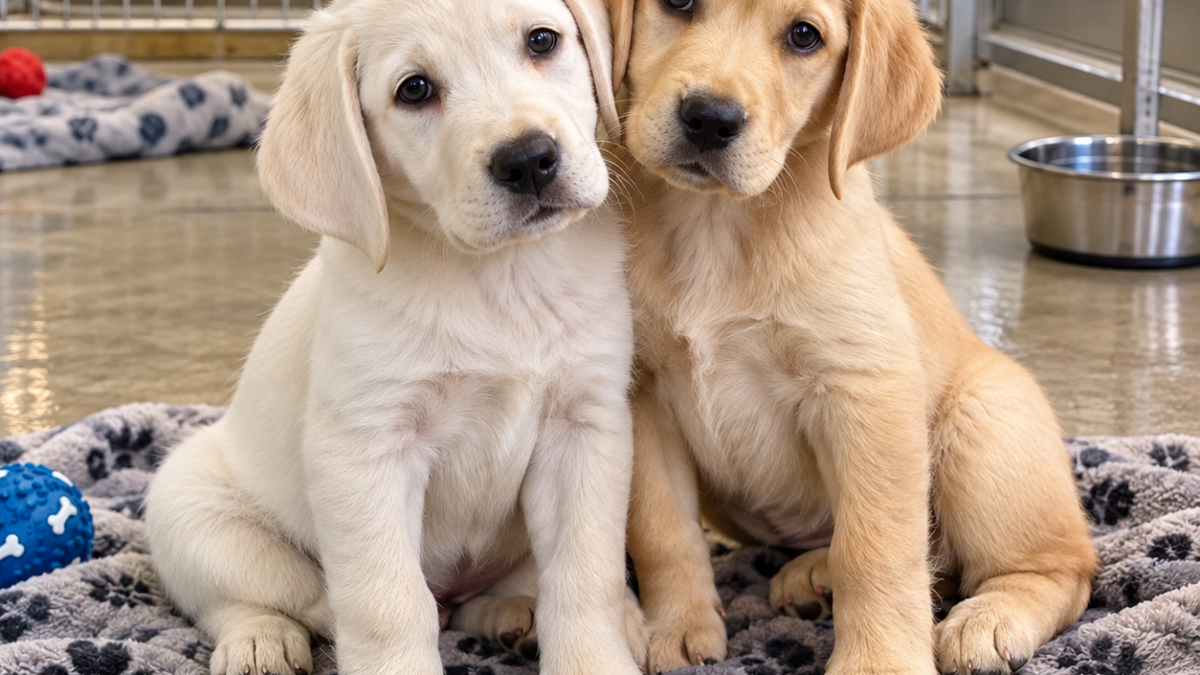
The white Labrador puppy kept staring at the kennel door long after his brother disappeared through it, as if he believed waiting hard enough could bring him back. He was only eleven weeks old, too young to understand adoption papers, closed doors, or why the one warm body he had slept beside every night was suddenly gone. By the time I came in the next morning, something was happening outside that kennel that none of us had expected.
My name is Hannah Carter, and at the time I had been volunteering at a county animal shelter outside Tacoma, Washington, for almost four years. I had watched hundreds of animals arrive frightened, confused, angry, sick, or simply exhausted, but the two Labrador puppies brought in that rainy Tuesday afternoon stayed in my mind from the moment I saw them.
One was white with a soft pink nose and oversized paws. The other was cream-colored, slightly smaller, with dark brown eyes that made him look permanently thoughtful.
They were brothers.
The intake form said they were eleven weeks old.
Their owner, a man named Daniel, stood in the doorway longer than most people did.
He had recently lost his apartment and was sleeping wherever friends could make room for him. The puppies had belonged to a litter from his mother’s dog, and he had kept these two because he thought he could manage them together.
Then his life fell apart faster than he expected.
“I tried,” he told our intake coordinator, rubbing both puppies behind the ears. “I really did.”
The white puppy bounced against his leg.
The cream puppy leaned against his shoe.
Daniel swallowed.
“Please don’t split them if you don’t have to.”
We never promised things we couldn’t guarantee, but Linda, the intake coordinator, softened.
“We’ll do what we can.”
Daniel nodded, crouched one last time, and kissed both puppies on the head.
Then he left.
The white puppy ran to the kennel gate immediately.
The cream puppy stayed where Daniel had been standing.
A few seconds later, the white one began whining.
That was how we named them temporarily.
Milo, the white one.
Finn, the cream one.
From that day forward, they did almost everything together. They slept pressed against each other so tightly they looked like one pile of fur. They ignored the second food bowl and ate side by side from the same one. If Milo grabbed a toy, Finn followed him. If Finn startled at a metal door slamming, Milo rushed over and leaned against him.
Everyone noticed.
“They’re bonded already,” I told Linda.
“They’re babies,” she said. “Everything feels safer when you’ve got your brother beside you.”
Then, four mornings later, the Henderson family came in.
They had two children, a fenced yard, and another older Labrador at home. They spent nearly forty minutes meeting both puppies.
But they fell in love with Finn.
“He’s so calm,” Mrs. Henderson said as Finn curled against her daughter’s lap.
Milo bounced around them, carrying a rope toy and trying to involve everyone.
The family laughed at him, but I could see their attention returning to Finn.
When the paperwork began, I asked quietly, “Would you consider both?”
Mr. Henderson hesitated.
“Two puppies would be a lot.”
I knew he was right.
I also knew what would happen when Finn left.
Still, shelter work teaches you that love does not always arrive in the arrangement you want.
The kennel door opened.
Finn was lifted into the staff member’s arms.
Milo wagged his tail and jumped beside him, trying to grab his brother’s ear.
He thought it was a game.
Then Finn was carried through the hallway.
The door closed.
Milo waited.
At first he stood.
Then he sat.
Then he pressed his nose against the bottom of the gate.
An hour passed.
He didn’t touch his toys.
He refused lunch.
Every time footsteps came down the hallway, his head snapped up.
I sat inside the kennel with him.
“Come here, buddy.”
He let me touch him, but he never stopped watching the door.
That evening, I found him sleeping directly against it.
Exactly where he had last seen Finn.
I went home telling myself he would adjust.
Puppies do.
Dogs adapt.
That was what I kept repeating.
But at 7:12 the next morning, when I walked into the shelter and heard Linda call my name from the lobby, I knew something had changed.
“Hannah,” she said. “You need to see who just came back.”
I turned toward the front entrance.
And then I saw them.
PART 2
Mrs. Henderson was standing just inside the shelter doors.
Her hair was pulled into a loose ponytail, and she was wearing the same blue raincoat she had worn the day before. Her husband stood behind her holding their youngest daughter’s hand.
But none of them were what made me stop.
Finn was in Mrs. Henderson’s arms.
The cream-colored puppy was awake, alert, and completely unharmed.
But he looked miserable.
His ears were flattened against his head, and the moment he saw the kennel hallway behind me, he began twisting in her arms.
“Finn?” I said.
His entire body changed at the sound of his name.
He started whining.
Mrs. Henderson’s face crumpled with relief.
“Oh, thank God.”
I walked toward them.
“What happened?”
She looked exhausted.
“He didn’t sleep.”
My first thought was illness.
“Vomiting? Diarrhea? Anything like that?”
“No. Nothing medical.”
She adjusted him against her chest as he struggled harder.
“He cried almost all night.”
Her husband nodded.
“We thought he’d settle down after a few hours. We put his bed beside our older dog. We sat with him. We tried toys, food, everything.”
Mrs. Henderson looked at me.
“He kept going to the front door.”
I understood before she said the rest.
“He was looking for Milo.”
Her eyes filled.
“Yes.”
Finn let out a sharp little cry.
From the kennel wing came another sound.
Milo.
A high, frantic whine.
Finn froze.
For half a second, nobody moved.
Then Milo barked.
One bark.
Finn nearly launched himself out of Mrs. Henderson’s arms.
“Oh my goodness,” she whispered.
Linda opened the hallway door.
“Let’s do this carefully.”
There was no doing it carefully.
The instant Finn’s paws touched the floor, he pulled forward on the leash with all the strength an eleven-week-old Labrador could produce.
Milo was standing against his kennel gate.
When he saw his brother coming down the hallway, he made a sound I had never heard from a puppy before.
Half cry.
Half bark.
Pure relief.
I opened the kennel door.
Finn ran inside.
Milo hit him so hard they both rolled into the bedding.
Then they were climbing over each other, biting ears, licking faces, whining, wagging so violently their whole bodies bent from side to side.
Mrs. Henderson covered her mouth.
Her daughter started crying.
Even Linda turned away for a second.
Yesterday, Milo had spent hours staring at the door.
Now he couldn’t stop touching Finn.
Every few seconds he pushed his nose into Finn’s neck as if checking that his brother was real.
Finn did the same.
“They really do need each other,” Mrs. Henderson whispered.
Her husband exhaled.
“Looks that way.”
I waited.
Part of me hoped they were about to say what I wanted them to say.
We’ll take them both.
Instead, Mr. Henderson looked at his wife.
“We can’t do two puppies.”
Her eyes closed.
“I know.”
The happiness in the kennel suddenly felt fragile.
Linda guided the family into the consultation room.
I stayed with the puppies.
Milo and Finn had stopped wrestling.
They were asleep now.
Finn’s head rested across Milo’s back.
I sat beside them.
“What am I supposed to do with you two?”
Milo opened one eye.
“You’re not helpful.”
He went back to sleep.
Twenty minutes later, Linda came back.
“They’re returning Finn.”
I wasn’t surprised.
“Did they say why?”
“They think separating them again would be cruel.”
“What about adoption fees?”
“Refunded.”
I looked toward the consultation room.
“That family did the right thing.”
“Yes.”
“They could’ve just kept him and waited for him to adjust.”
“Yes.”
I watched Finn breathe against his brother’s side.
“Thank God they didn’t.”
Linda leaned against the gate.
“We’re marking them as a bonded pair.”
That sounded simple.
It wasn’t.
Bonded adult dogs are difficult enough to place together.
Bonded puppies create a different problem.
Everyone wants puppies.
Not everyone wants two.
Within three days, we had twelve applications.
Eleven wanted only one dog.
One application was from a college student living in an apartment that didn’t allow animals over thirty pounds.
We rejected all of them.
People complained.
One woman stood at the front desk and said, “They’re puppies. They’ll forget each other.”
Linda answered calmly.
“Maybe.”
“Then why won’t you separate them?”
“Because we don’t need to test that theory when we already know they’re distressed apart.”
The woman rolled her eyes.
“You’re making this emotional.”
Linda smiled politely.
“We’re an animal shelter. Emotion tends to be involved.”
After she left, I laughed.
“You’ve been saving that line.”
“For years.”
Milo and Finn didn’t know any of this.
They were happy simply because they were together again.
Their personalities began showing more clearly.
Milo was fearless about almost everything except being alone.
He attacked squeaky toys like they had personally insulted him.
He loved people.
He loved food.
He loved shoes.
He once managed to pull a volunteer’s shoelace completely out while she was sitting in the kennel.
Finn was quieter.
He watched before joining.
If Milo ran into a room, Finn stood at the doorway and studied it first.
But if Milo disappeared around a corner, Finn followed immediately.
Two weeks passed.
Then three.
The puppies grew.
Fast.
Their paws became larger.
Their legs longer.
Their coats thicker.
Their adoption photo was shared hundreds of times online.
BONDED LAB BROTHERS SEEKING HOME TOGETHER.
People loved the story.
They reacted.
They shared.
They wrote things like:
Someone please adopt these babies!
But sharing a post and bringing home two Labrador puppies are very different commitments.
Families came.
Families left.
One couple loved them but already had three dogs.
Another family had a landlord who approved one puppy but not two.
A retired woman wanted both until she learned how large Labradors could become.
One man offered to adopt Milo if we gave Finn to his brother who lived two streets away.
Linda refused.
“The goal isn’t for them to occasionally have playdates.”
The man became angry.
“You’d rather keep them in a shelter?”
“I’d rather find the right placement.”
“You don’t know if that exists.”
“No,” Linda said. “But they deserve a reasonable chance.”
That sentence became more difficult to believe as the weeks passed.
Shelters live inside an uncomfortable reality.
Space is limited.
Money is limited.
Time is limited.
Every kennel occupied by one animal means another animal might not have that kennel.
Milo and Finn were healthy, adoptable puppies taking up space together.
The pressure began quietly.
Our shelter director, Mark Ellison, called Linda into his office.
She came out forty minutes later with her jaw tight.
“What happened?” I asked.
“Nothing.”
“Linda.”
She looked toward the puppy wing.
“He wants us to reconsider the bonded restriction.”
My stomach dropped.
“Why?”
“Why do you think?”
“Space?”
“Space. Cost. They’ve been here almost six weeks.”
“They’re puppies.”
“Which is his argument.”
I understood immediately.
Separate them now while they were still young and highly adoptable.
Two puppies might leave within twenty-four hours.
Together, they could stay weeks longer.
“What did you say?”
“No.”
“Can he override you?”
Linda looked tired.
“He’s the director.”
That night, I sat inside the kennel while Milo chewed a rubber bone and Finn slept against my thigh.
I imagined them in different homes.
Maybe they would adjust.
Maybe Mark was right.
Dogs are resilient.
Puppies especially.
But then Milo stood and walked to the water bowl.
Finn woke immediately and looked for him.
The second he saw Milo, he relaxed.
I stopped trying to convince myself.
The next morning, Mark posted a staff memo.
Effective Monday, Milo and Finn will become individually adoptable unless a qualified joint adopter is approved before that date.
Monday was four days away.
Linda showed me the memo.
“We have until Sunday.”
“What can we do?”
“Share them again.”
“We’ve shared them.”
“Share harder.”
So we did.
A photographer volunteered to take new pictures.
Not staged puppy portraits.
Real ones.
Milo sleeping with one paw across Finn’s shoulders.
Finn sitting while Milo leaned against him.
Both drinking from the same bowl.
One photograph showed Milo looking directly at the camera while Finn’s nose was tucked beneath his chin.
The caption Linda wrote was simple:
They have already lost one home. We don’t want them to lose each other too.
The post spread farther than anything our shelter had shared that year.
Twenty thousand people saw it.
Applications came in from Oregon.
Idaho.
California.
Even Montana.
But distance wasn’t the only issue.
We needed a safe home.
Financially stable.
Space for two large dogs.
Time for training.
No breeding intentions.
A landlord who approved both, if renting.
Willingness to handle two adolescent Labradors at once.
By Saturday afternoon, we had narrowed the list to three families.
One withdrew after discussing veterinary costs.
Another failed the landlord check.
The third family never answered the phone.
Sunday arrived.
I went to the shelter even though I wasn’t scheduled.
Mark saw me.
“You know you don’t get paid, right?”
“I’m a volunteer. I never get paid.”
“That explains your financial strategy.”
Normally I would have laughed.
I didn’t.
“Are you really separating them tomorrow?”
Mark sighed.
“Hannah.”
“Are you?”
“Yes.”
“Why?”
“You know why.”
“Say it.”
“We have fourteen dogs on intake waiting lists. Three kennels under quarantine. Two owner surrenders scheduled tomorrow. These puppies have had six weeks.”
“They’re bonded.”
“They’re also highly adoptable individually.”
“You saw what happened when Finn left.”
“That was one night.”
“One night was enough.”
Mark rubbed his forehead.
“You think I enjoy this?”
“I think you’re treating them like kennel numbers.”
His expression changed.
“That’s unfair.”
“Is it?”
“Yes.”
He stepped closer.
“You know what happens here every week. You know the calls we turn away. You know the dogs sitting in cars because their owners say they’ll dump them if we don’t take them. You know what one occupied kennel can mean.”
I did.
That was what made it worse.
“You’re asking me to choose between them and dogs we haven’t met.”
“I’m asking you to understand that shelter decisions are not fairy tales.”
I looked through the window toward Milo and Finn.
“No. They’re not.”
Mark softened slightly.
“If we separate them, both will probably be adopted this week.”
“And if they suffer?”
“Then their adopters work through it.”
“That’s easy to say when you’re not the one waiting at the door.”
Mark looked at me for a long moment.
Then he said quietly, “You have until we open tomorrow morning.”
I hated him for that sentence.
Later, I realized it was more kindness than policy required.
That afternoon, something happened that none of us planned.
Daniel came back.
Their original owner.
I was cleaning bowls when I saw him standing in the lobby.
He looked different.
Thinner.
Tired.
But cleaner than the day he surrendered the puppies.
Linda recognized him immediately.
“Daniel?”
He nodded.
“Are they still here?”
Nobody spoke for a second.
Then I said, “Yes.”
His face changed.
“Both?”
“Yes.”
He closed his eyes.
“Can I see them?”
Legally, the puppies belonged to the shelter now.
But there was no reason he couldn’t visit.
We brought him into the meet-and-greet room.
Milo recognized him first.
Or maybe he simply loved everyone.
He rushed forward.
Finn followed.
Then Finn stopped.
He stared.
Daniel crouched.
“Hey, boys.”
Finn walked toward him.
Slowly.
Then faster.
Within seconds both puppies were climbing into his lap.
Daniel buried his face in their fur.
I turned away.
He cried.
Not quietly.
Not politely.
The kind of crying people do when they have been holding something inside too long.
“I’m sorry,” he kept saying.
Milo licked his chin.
Finn pressed against his chest.
After a while, Daniel sat against the wall with both puppies asleep across his legs.
“I saw the post,” he said.
Linda sat opposite him.
“The one about separating them?”
He nodded.
“I’ve been following the shelter page.”
“Why didn’t you contact us sooner?”
“Because I gave them up.”
His voice cracked.
“I thought showing up would make things harder.”
“For who?”
“All of us.”
I understood that.
“What’s your situation now?” Linda asked.
Daniel looked embarrassed.
“I got a job.”
“That’s good.”
“Warehouse. Night shift.”
“Housing?”
“I’m renting a room from my cousin.”
“Pets allowed?”
“One.”
The word hung there.
He looked at the puppies.
“I can’t take them back.”
I saw Linda’s disappointment.
Mine too.
“Then why are you here?” I asked more sharply than I meant to.
Daniel looked at me.
“Because I know someone who might.”
We all stared at him.
“My mother.”
Linda straightened.
“Their grandmother dog belongs to your mother?”
“Yes.”
“She still has their mother?”
“Lucy.”
“Where does she live?”
“About forty-five minutes south. Five acres outside Eatonville.”
I almost stopped breathing.
“Why didn’t she take them originally?”
Daniel looked down.
“She didn’t know I surrendered them.”
Linda’s eyebrows rose.
“What?”
“I was ashamed.”
Again that word.
Shame.
It causes more damage than people realize.
Daniel continued.
“My mom and I weren’t speaking much after my dad died. I’d borrowed money from her. I hadn’t paid it back. We fought. When I lost the apartment, I didn’t tell her.”
“So she learned from the post?”
“Yesterday.”
I covered my mouth.
Daniel gave a tired laugh.
“She called me at two in the morning screaming.”
“What did she say?”
“That if I let those puppies get separated after everything else, she’d drive up here and separate me from my common sense.”
Linda smiled despite herself.
“I like your mother.”
“She’s terrifying.”
“Is she interested in adopting both?”
“She said she wants to meet them.”
“When?”
A voice behind us answered.
“Right now.”
An older woman stood in the doorway.
Maybe sixty.
Gray hair twisted into a bun.
Work jacket.
Mud on her boots.
Behind her was a shelter employee who looked as though she had tried and failed to stop a force of nature.
Daniel stood.
“Mom.”
She looked at him.
“We’ll discuss you later.”
“Yes, ma’am.”
Then she saw the puppies.
Everything about her softened.
“Oh.”
Milo ran toward her.
She crouched.
Finn followed.
The woman began crying before either puppy reached her.
“Look at you.”
Milo jumped against her chest.
Finn sniffed her hands.
She laughed.
“You smell your mama, don’t you?”
That got my attention.
She had probably been with Lucy that morning.
Linda moved carefully.
“Mrs.—”
“Rose Carter.”
“Mrs. Carter, we still need to go through the adoption process.”
“Good.”
“Home check.”
“Do it.”
“Veterinary references.”
“I’ve used the same clinic for seventeen years.”
“Two puppies will become two large dogs.”
“I raised their mother.”
“Training two at once can be difficult.”
Rose looked at Milo, who was chewing her shoelace.
“I noticed.”
I almost laughed.
Mark came into the room.
I didn’t know who had called him.
Probably Linda.
He stood in the doorway.
“What’s happening?”
I looked at him.
“We may have a joint adopter.”
He looked at the clock.
Then at Rose.
“We close in forty minutes.”
Rose stood.
“Then you’ve got thirty-nine.”
Mark blinked.
Linda coughed to hide a laugh.
The paperwork began.
It should have been simple.
It wasn’t.
Nothing important ever is.
Rose owned five acres, yes.
But her property had sections of damaged fencing.
She planned to keep the puppies indoors and supervise outside, but our policy required secure containment before placement.
The home-check volunteer called from the property.
“Most of the fence is good, but there’s a twenty-foot section near the back pasture that’s down.”
Rose looked furious.
“At the fence, not at us.”
“A tree came through during the last storm.”
Mark folded his arms.
“That’s a problem.”
“I’ll repair it.”
“When?”
“Tonight.”
“It’ll be dark.”
“I own floodlights.”
Mark looked at me.
I tried not to smile.
Rose pointed at him.
“You. Director.”
Mark raised an eyebrow.
“Yes?”
“You said these boys are being separated tomorrow.”
“Yes.”
“Then somebody better bring me fence wire.”
At 5:18 p.m., four shelter volunteers, Daniel, Rose, and Mark Ellison drove south toward Eatonville.
I went too.
Of course I did.
We brought posts.
Wire.
Tools.
The rain returned halfway there.
Washington seemed determined to supervise.
Rose’s property was exactly what I had hoped.
A weathered farmhouse.
A red barn.
Five acres of pasture edged by Douglas fir trees.
And standing behind the mudroom glass was a yellow Labrador with a graying muzzle.
Lucy.
The puppies’ mother.
When we brought Milo and Finn into the house for the supervised introduction, Lucy went completely still.
Her nose worked furiously.
Milo pulled forward.
Finn made a tiny sound.
Rose removed Lucy’s leash once we were sure everyone was calm.
Milo approached first.
Lucy sniffed him from nose to tail.
Then Finn.
For several seconds, nothing dramatic happened.
No magical recognition.
No cinematic music.
Just dogs smelling each other.
Then Lucy began licking Finn’s face.
Milo pushed between them.
Lucy licked him too.
Rose started crying.
Daniel did too.
Mark pretended the ceiling was extremely interesting.
“Don’t you dare get emotional,” I whispered.
“I have allergies.”
“To Labradors?”
“To situations.”
We repaired the fence in the rain.
All of us.
Even Mark.
Especially Mark.
At one point he was waist-deep in blackberry vines swearing while Daniel held a flashlight.
I said, “Shelter decisions aren’t fairy tales.”
Mark pointed the wire cutters at me.
“I can still ban volunteers.”
By nine thirty, the fence was secure enough to pass inspection.
The puppies could not officially leave that night because final veterinary authorization had to be completed in the morning.
So we drove back.
Milo and Finn slept pressed together in the kennel.
But that night felt different.
I sat outside their gate.
“You boys have no idea, do you?”
Milo snored.
Finn twitched in his sleep.
The next morning, Rose arrived twenty minutes before opening.
So did Daniel.
So did I.
Mark came in carrying coffee.
“You people need hobbies.”
“This is my hobby.”
“That explains a lot.”
Dr. Patel signed the final health certificates.
Linda reviewed the contract.
Rose signed both adoption forms.
Then came the moment I had been waiting for since Finn returned.
The kennel door opened.
Milo and Finn came out together.
Not one carried away while the other waited behind bars.
Together.
Rose clipped a blue leash onto Milo.
A green one onto Finn.
Daniel knelt.
Both puppies ran to him.
He held them for a long time.
“I’m not disappearing again,” he whispered.
Rose heard.
“So don’t.”
He nodded.
“I’m trying, Mom.”
“I know.”
Those two words seemed to hurt him more than anger would have.
Then he looked at me.
“Thank you.”
“For what?”
“For not giving up on keeping them together.”
I looked toward Mark.
“Thank him too.”
Mark nearly choked on his coffee.
Daniel smiled.
“I heard about the fence.”
Mark muttered something.
Rose opened the front door.
Milo charged toward the parking lot.
Finn followed.
Halfway out, Finn stopped.
He turned around.
For one second he looked down the shelter hallway.
The same hallway where he had disappeared from Milo weeks earlier.
Milo tugged the leash.
Finn looked at his brother.
Then walked outside.
I watched Rose load them into the back seat.
Lucy was waiting at home.
Five acres.
Warm beds.
A woman who clearly planned to spoil them beyond repair.
It should have been the end.
It wasn’t.
Three months later, I received a phone call from Rose.
“Hannah?”
“Yes?”
“I need you to come down here.”
My heart dropped.
“What happened?”
“The boys are fine.”
I exhaled.
“You cannot begin a phone call like that.”
“Sorry.”
“What’s wrong?”
“Daniel.”
That brought the fear back.
“What happened to him?”
“He disappeared.”
I stood from my desk at work.
“What do you mean disappeared?”
“He didn’t show up for work last night. His cousin says he didn’t come home.”
“Have you called police?”
“Yes.”
“How long?”
“Almost twenty-four hours.”
My mind went immediately to the puppies, even though she had said they were safe.
“Do you know where he might go?”
Rose was quiet.
“That’s why I called you.”
An hour later, I was driving toward Eatonville.
Rain streaked across my windshield.
When I arrived, Milo and Finn were seven months old and almost unrecognizable from the tiny puppies at the shelter.
Milo was tall, white, and ridiculous.
Finn had become a broad cream-colored adolescent with the same thoughtful eyes.
Both nearly knocked me over at the door.
“Hi. Yes. I missed you too.”
Lucy watched from the kitchen with the patience of a mother who had already accepted that her children were fools.
Rose sat at the table.
Her face looked drawn.
“What do police know?”
“His truck was found.”
“Where?”
She looked at me.
“Near his old apartment.”
I sat.
The building where Daniel had lost his home had been partially renovated.
His truck was parked two blocks away.
Keys inside.
Phone under the driver’s seat.
No Daniel.
“Was he depressed?” I asked.
Rose looked at her hands.
“Yes.”
That one word changed the room.
“How bad?”
“I don’t know.”
“Rose.”
“I don’t know because he wouldn’t tell me.”
The anger in her voice was mostly fear.
“He’s been doing better. Working. Paying me back. Visiting the dogs every Sunday. But his father’s birthday was yesterday.”
I remembered Daniel had said his father died.
“How long ago?”
“Fourteen months.”
“Did he take it hard?”
“He took everything hard.”
She stood and walked to the sink.
“My husband died of a heart attack. Daniel was the one who found him.”
I said nothing.
“He stopped sleeping. Lost jobs. Stopped answering calls. Then lost the apartment.”
Suddenly the puppy surrender looked different.
Not excused.
Different.
Rose turned.
“I spent months angry at him for not asking for help.”
“Have you checked places he went with his dad?”
“Most.”
“Most?”
“There’s one.”
“Where?”
“Old logging road near Alder Lake. They used to fish there.”
“Did you tell police?”
“Yes. Search team’s heading there.”
I stood.
“Then why did you ask me to come?”
Rose looked toward the back door.
Milo and Finn were staring at us.
“Because Daniel comes here every Sunday.”
“Yes.”
“And every Sunday he takes those two with him for an hour.”
I understood.
“You think they might know where he goes.”
“Maybe.”
Police didn’t like the idea initially.
Dogs are not tracking animals simply because they love someone.
But when Deputy Mason arrived and heard us out, he agreed we could bring them to the search staging area as long as we stayed with volunteers and did not interfere.
The logging road was muddy and cold.
Searchers had found Daniel’s footprints near an old trail entrance but lost them where runoff crossed the path.
Milo and Finn were excited at first.
New smells.
People.
Woods.
Then Rose held out one of Daniel’s work shirts.
Both dogs changed.
Finn buried his nose in it.
Milo sniffed.
Then pulled toward the trail.
I looked at Deputy Mason.
He said, “Don’t read too much into it.”
We followed anyway.
Not as a formal K-9 team.
Just a family searching.
Milo pulled hard for the first quarter mile.
Finn moved more slowly, nose low.
At a fork, Milo went left.
Finn stopped.
He turned right.
Rose hesitated.
“They usually follow each other.”
Finn refused to move left.
Deputy Mason looked toward the right path.
“Where does that go?”
Rose checked the old map.
“Creek.”
We went right.
Ten minutes later, Finn began whining.
Milo heard him and pulled ahead.
“Milo!”
The leash slipped through Daniel’s cousin’s hand.
Milo ran.
We followed.
Then we heard barking.
Not playful.
Sharp.
Repeated.
We found Daniel forty yards off the trail.
He was sitting against a fallen cedar.
Alive.
Cold.
Confused.
One ankle badly swollen.
He had fallen the previous evening and hit his head.
He had tried to stand.
Couldn’t.
His phone was in the truck because, according to him later, he had gone out there intending only to sit near the creek for a while.
Whether that was the whole truth, I never asked.
Milo reached him first.
Then Finn.
Daniel began crying the moment they touched him.
“You found me.”
Finn pressed against his chest.
Milo licked his face.
Daniel laughed weakly.
“You two again.”
Paramedics carried him out.
Milo and Finn walked beside the stretcher as far as they were allowed.
At the hospital, Daniel was diagnosed with a concussion, severe dehydration, hypothermia, and a fractured ankle.
He recovered.
But that incident forced the Carter family to say things they had avoided for years.
Daniel began therapy.
Real therapy.
Not two appointments followed by silence.
Rose attended some sessions with him.
They talked about his father.
Money.
Shame.
The puppies.
The day he surrendered them.
The months he spent believing that asking for help meant admitting failure.
One Sunday, about six months later, I visited Rose.
Daniel was there.
He walked without crutches now.
Milo and Finn chased each other across the field.
Lucy slept on the porch.
Daniel handed me coffee.
“I owe you an apology.”
“For what?”
“You told me at the shelter I should’ve called someone before surrendering them.”
“I don’t remember saying that.”
“You thought it.”
“That sounds possible.”
He smiled.
“I was angry at everyone then.”
“Mostly yourself?”
“Mostly.”
We watched Milo steal a stick from Finn.
Finn tackled him.
“I used to think losing them proved I’d ruined everything,” Daniel said.
“You didn’t lose them.”
“I did.”
“They still know you.”
“That’s not what I mean.”
I waited.
“I mean I wasn’t ready to be responsible for them. Mom was. You guys found that.”
He looked toward Rose, who was trimming herbs beside the porch.
“I kept thinking the right ending was me getting everything back.”
“And now?”
“Now I think the right ending is everybody being where they’re safe.”
That was one of the wisest things Daniel ever said.
Years passed.
Milo and Finn grew into enormous Labradors.
Milo remained chaos in white fur.
Finn remained quieter, though he learned to participate in most of Milo’s bad ideas.
They dug one hole beneath Rose’s porch large enough for her to threaten to charge them rent.
They destroyed three garden hoses.
They once dragged an entire bag of potting soil through the kitchen.
Rose called me afterward.
“I saved them from being separated so they could unite against me.”
“That sounds accurate.”
“They’re criminals.”
“Bonded criminals.”
“Worse.”
But she adored them.
Everyone did.
Daniel eventually moved into his own apartment again.
This time, when he struggled financially, he told his mother before things collapsed.
He paid bills.
Built savings.
Found a better job.
He visited the dogs every weekend.
Then, almost three years after surrendering the puppies, he called me.
“I’ve got something to show you.”
“What?”
“You’ll see.”
He picked me up and drove south.
We stopped in front of a small blue house on half an acre.
“Daniel.”
He smiled.
“Rental.”
“Still.”
“Landlord allows dogs.”
I turned slowly.
“You’re not taking Milo and Finn from Rose.”
He laughed.
“I value my life.”
“Good.”
He walked around the side of the house.
There was a fenced yard.
Inside sat an old black Labrador mix.
Gray muzzle.
Floppy ears.
I looked at Daniel.
“Who is that?”
“Shelter dog.”
I stared at him.
“How old?”
“Ten.”
“Name?”
“Walter.”
“Daniel.”
“What?”
“You adopted a senior dog?”
He nodded.
“I thought somebody should choose the one people kept walking past.”
That hit me harder than I expected.
Walter approached the fence.
Daniel opened the gate.
The old dog walked directly to him and leaned against his leg.
“He’s not much for puppies,” Daniel said.
“Smart dog.”
“Milo irritates him.”
“Milo irritates everyone.”
Daniel smiled.
“He likes Finn.”
“Of course he does.”
I crouched and scratched Walter beneath the chin.
“You did good.”
Daniel looked embarrassed.
“I’m trying.”
That became the real answer to his story.
Not perfection.
Trying.
Again and again.
The shelter changed too.
Mark never admitted Milo and Finn had changed his mind.
He would rather have eaten one of their destroyed garden hoses.
But the following year, he approved a new bonded-animal assessment protocol.
Instead of automatically treating bonded status as temporary or permanent, veterinary and behavior staff documented specific indicators of separation distress and attachment.
If two animals showed severe distress apart, they received additional placement time and targeted joint-adoption promotion before separation could even be considered.
Linda framed the policy memo.
She hung it inside her office.
Mark saw it.
“That’s unnecessary.”
“It’s beautiful.”
“It’s paperwork.”
“It’s justice.”
He rolled his eyes.
But he left it hanging.
The Henderson family—the people who had adopted Finn for one night—came back into our lives too.
Almost a year after the puppies left, Mrs. Henderson visited the shelter.
Her daughter carried a photograph.
Their older Labrador stood beside a newly adopted mixed-breed dog.
“We wanted you to know we adopted from another rescue,” Mrs. Henderson said.
I smiled.
“That’s wonderful.”
She looked embarrassed.
“I still feel bad about Finn.”
“You shouldn’t.”
“We separated them.”
“You brought him back when you realized he needed his brother.”
“I worried people thought we were horrible.”
I shook my head.
“You listened to the dog in front of you instead of forcing him to fit the decision you’d already made. That’s not horrible.”
Her daughter handed me the picture.
“We named our new dog Pickles.”
I looked at the awkward-looking shepherd mix in the photograph.
“He does look like a Pickles.”
Mrs. Henderson laughed.
Before leaving, she made a donation toward bonded-pair adoption fees.
She did it every year after that.
The first donation covered half the adoption fee for two elderly terriers surrendered when their owner died.
The next year, it helped two bonded cats.
What looked like failure on the day Finn came back became something good too.
That was a lesson I kept encountering.
A bad decision does not have to become your permanent identity if you have the courage to correct it.
Daniel learned that.
The Hendersons learned that.
Even Mark, reluctantly, learned it.
The only ones who never worried about lessons were Milo and Finn.
They simply lived.
On their fifth birthday, Rose invited half the shelter staff to her house.
She baked a dog-safe cake.
Milo stole part of it before the candles were even placed.
Finn helped.
“Brothers,” Rose said bitterly.
I laughed.
Lucy was older now.
Much older.
She lay beneath the porch table watching her sons behave like idiots.
Later that afternoon, I sat beside her.
Her muzzle had gone almost completely white.
Finn came over and lay on one side of her.
Milo dropped onto the other.
For a while, all three slept there.
Rose stood beside me.
“You know,” she said, “Daniel never told me how bad things were.”
“I know.”
“I was angry for a long time.”
“At him?”
“At myself.”
“Why?”
“Because I kept thinking a mother should know.”
I looked at her.
“Adult children can hide a lot.”
“I know that now.”
She watched Daniel across the yard.
He was talking to Mark.
Walter lay at his feet.
Rose smiled.
“My husband would’ve liked that old dog.”
“Walter?”
“He always preferred ugly dogs.”
Walter was not ugly.
He was simply shaped like several unrelated dogs had been assembled from memory.
“I’m going to tell Walter you said that.”
“He knows.”
Milo woke suddenly and placed one paw across Finn’s neck.
Finn didn’t move.
That old gesture.
The same one from their shelter photograph.
Rose saw it too.
“They still do that.”
“Every night?”
“Most.”
“After all these years?”
She nodded.
“They have separate beds.”
“Of course they do.”
“They use one.”
“Of course they do.”
Eventually Lucy’s health declined.
She was nearly thirteen.
Her hips failed first.
Then her appetite.
Rose called me the week before Christmas.
“It’s time.”
I drove down.
Daniel came.
Milo and Finn stayed near Lucy’s bed all morning.
Dr. Patel from our shelter clinic made a house call.
She believed in allowing companion animals to be present afterward when appropriate.
Lucy died quietly in Rose’s living room.
Milo sniffed her.
Finn lay beside her for several minutes.
Then something happened that brought me back to the shelter.
Milo began searching.
He checked the hallway.
The kitchen.
The back door.
Finn followed him at first.
Then Finn stopped.
He returned to Lucy’s blanket.
Milo came back.
Finn pressed against him.
Milo lay down.
They stayed together.
Rose sat beside them and cried.
“So this is why.”
“What?”
She touched Milo’s back.
“This is why you fought so hard.”
I knew what she meant.
“They would have survived apart.”
Probably.
Dogs survive many things.
But survival is a low standard for love.
“Yes,” I said. “This is why.”
After Lucy’s death, Milo and Finn became even closer.
Not anxious.
Just connected.
If Finn wandered to the back pasture, Milo eventually found him.
If Milo fell asleep in the sun, Finn lay nearby.
At night, they shared the same oversized orthopedic bed despite Rose buying two identical ones.
Years slipped past.
Five became seven.
Seven became nine.
Their faces began graying around the muzzle.
Milo developed arthritis first.
Finn developed a thyroid condition controlled with medication.
They slowed down.
Not much at first.
Then noticeably.
The wild chases across the pasture became shorter.
Milo stopped jumping into Daniel’s truck and waited for help.
Finn slept more.
But they remained inseparable.
On their tenth birthday, I brought an old photograph.
The picture Linda had used in the adoption post.
Milo looking at the camera.
Finn tucked beneath his chin.
Rose placed it beside the two dogs sleeping on the porch.
“Same idiots.”
“Older idiots.”
“Expensive idiots.”
Daniel smiled.
“Worth it.”
Rose looked at him.
“Most days.”
That evening, after everyone left, I remained behind.
The sun was dropping behind the evergreens.
Washington summer evenings can stretch forever, the light lingering through the trees as if the day isn’t ready to leave.
Milo slept with his head across Finn’s paws.
I thought about that first shelter night.
Milo against the kennel door.
Waiting.
He had no idea where Finn had gone.
No understanding of adoption.
No promise his brother was coming back.
Then morning came.
Finn returned.
And from that point forward, almost every important person in their story had made the same decision.
Keep them together.
Years later, that decision became harder again.
Finn got sick first.
He was eleven.
At first, Rose thought he was simply slowing down.
Then he began losing weight.
Tests found cancer in his spleen.
Surgery bought time.
Chemotherapy was considered but, given his age and the cancer type, the prognosis remained uncertain.
Rose called me after the appointment.
“I don’t know what to do.”
“What did the vet say?”
“That we could treat aggressively.”
“And?”
“Or focus on comfort.”
I drove to her house.
Finn was lying on the porch.
Milo beside him.
Daniel sat on the steps.
Rose held the paperwork.
“We fought so hard to keep them together,” she said. “How am I supposed to decide when to stop fighting?”
Daniel looked at his mother.
“The same way you decided everything else.”
“How?”
“What’s best for Finn.”
She cried.
“That sounds easy when you say it.”
“No,” he said. “It sounds horrible.”
He sat beside her.
“But he shouldn’t have to stay because we’re afraid Milo will be alone.”
That sentence silenced everyone.
Milo.
The puppy who once refused food because Finn left.
The dog who had spent his first night alone pressed against a kennel door.
What would happen when Finn died?
Nobody knew.
There it was again.
The phrase from so many years before.
We don’t know yet.
Rose chose comfort care.
For several months, Finn remained happy.
He ate.
Walked.
Slept in the sun.
Followed Milo.
Then one morning he didn’t get up for breakfast.
Milo stood beside him.
Waiting.
Rose called Daniel.
Daniel called me.
By the time I arrived, Finn was lying on his bed near the fireplace.
Milo lay against him.
Dr. Patel came that afternoon.
Finn’s breathing had become difficult.
There was no reasonable treatment left that would give him meaningful comfort.
Rose sat on the floor.
Daniel held Finn’s face.
I sat beside Milo.
“You’ve always had him,” I whispered.
Milo looked at me.
“I’m sorry.”
Dr. Patel gave Finn the sedative.
His body relaxed.
Milo sniffed his ear.
Then rested his chin across Finn’s shoulder.
Exactly as he had when they were puppies.
Nobody moved him.
Finn died with his brother touching him.
Afterward, Milo stayed beside the body for several minutes.
Then he stood.
He smelled Finn carefully.
He walked around the room.
Came back.
Smelled him again.
Then Milo did something that surprised me.
He walked to Rose.
He leaned against her.
She wrapped both arms around him.
“I know,” she whispered.
For the first week, Milo searched.
Not constantly.
But enough.
He checked the porch.
Finn’s bed.
The back pasture.
Sometimes he stood at the mudroom door at the hour when Finn used to return from medications or veterinary appointments.
He ate, but less.
Slept, but badly.
Everyone worried.
Especially me.
I saw the eleven-week-old puppy again.
Waiting against the gate.
But Milo was not eleven weeks old anymore.
He had Rose.
Daniel.
Walter had died years before, but Daniel now had another senior rescue named June.
He brought June over.
Milo tolerated her.
Then began sleeping near her.
Not touching.
Near.
One afternoon Rose called.
“You need to see something.”
I arrived to find Milo asleep on the porch.
June lay beside him.
Their backs touched.
Rose smiled.
“He’s not replacing Finn.”
“No.”
“He never could.”
“No.”
“But he’s letting somebody sit beside him.”
That was enough.
Milo lived fourteen months after Finn died.
He slowed significantly during that final year.
His arthritis worsened.
His hearing faded.
Daniel visited almost every day.
One morning, Rose found Milo lying in the old shared bed.
Finn’s collar rested beside him.
Rose had kept it in a drawer, but Daniel had taken it out the night before while looking through photographs and accidentally left it on the coffee table.
Somehow Milo had picked it up.
Rose called me crying.
“I know people will say I’m making meaning out of nothing.”
“Let them.”
“He has Finn’s collar.”
“I’m coming.”
By afternoon, Milo’s breathing was shallow.
Dr. Patel examined him.
His heart was failing.
There was fluid accumulating.
Medication might buy days.
Maybe a week.
Rose looked at Daniel.
Daniel looked at Milo.
This time there was no long debate.
Milo was tired.
We knew.
Rose sat beside him.
“You spent your whole life following your brother.”
Milo’s tail moved faintly.
She smiled through tears.
“You were always the noisy one.”
Daniel laughed.
“Definitely.”
I touched the white fur between Milo’s ears.
He was almost entirely gray now.
I remembered him as a puppy pressing his nose against kennel bars.
I remembered the empty food bowl.
I remembered opening the kennel when Finn returned.
I remembered the two of them tumbling together as though the world had repaired itself in one second.
Milo rested his head on Finn’s collar.
And there, in the same house where the brothers had lived nearly their entire lives, surrounded by Rose, Daniel, June, and the people who had once fought to keep him from being separated, Milo died peacefully.
Afterward, Rose placed both collars together.
Blue and green.
The leashes she had clipped onto them the morning they left the shelter were long gone.
Chewed through, replaced, worn out.
But the collars remained.
A week later, we buried Milo’s ashes beside Finn’s beneath a cedar tree at the edge of the pasture.
Lucy’s ashes were already there.
Daniel placed a small stone marker.
It didn’t say anything dramatic.
Just:
MILO & FINN
BROTHERS
TOGETHER, ALWAYS
Rose touched the stone.
“You know what’s strange?”
“What?”
“If the Hendersons hadn’t brought Finn back that morning, none of this happens.”
I looked toward Daniel.
“If Daniel hadn’t surrendered them, none of this happens either.”
Daniel nodded.
“That one I could’ve done without.”
Rose smiled.
“You know what I mean.”
I did.
Stories are made of decisions.
Some terrible.
Some loving.
Some corrected just in time.
Daniel surrendered two puppies because he believed he had run out of options.
The Hendersons adopted one and realized within hours that the choice was hurting him.
They brought him back.
Our shelter nearly separated them again because practical pressure said two puppies were easier to place apart.
Rose repaired a fence in the dark because she refused to let a deadline decide their future.
Daniel rebuilt his life.
Then adopted an old dog nobody wanted.
The shelter changed its policy.
The Hendersons began helping bonded animals.
And Milo and Finn got more than eleven years together.
People sometimes called that a miracle.
I never did.
Miracle makes it sound accidental.
It wasn’t.
It was work.
It was inconvenient.
It cost money.
It required paperwork, patience, fence wire, long drives, second chances, and people admitting when they were wrong.
Love often does.
Years after Milo died, I was still volunteering at the same shelter.
Linda eventually retired.
Mark finally admitted he had emotions, though only under extreme pressure and never in writing.
I became the volunteer coordinator.
One rainy Friday, an intake worker called me.
“Hannah?”
“Yes?”
“We’ve got two owner surrenders coming in.”
“Okay.”
“Same household.”
“Dogs?”
“Two.”
“Bonded?”
“Owner says yes.”
I walked toward intake.
In the doorway stood a young woman holding two leashes.
At the ends were two elderly beagles.
One male.
One female.
Both gray-faced.
Both trembling.
The woman was crying.
“I’m going into treatment,” she said. “I don’t know how long I’ll be gone.”
One beagle leaned into the other.
I crouched.
“What are their names?”
“Penny and George.”
“How long have they been together?”
“Eleven years.”
I looked through the intake-room window.
On my office wall hung an old framed photograph.
Two Labrador puppies.
One white.
One cream.
Milo looking at the camera.
Finn tucked beneath his chin.
Below it was a copy of the bonded-pair policy Mark once called unnecessary paperwork.
I stood.
“We’ll do everything we reasonably can to keep them together.”
The woman covered her mouth.
“Really?”
I knew better than to promise outcomes I could not control.
But I also knew promises matter.
“We’ll try.”
She knelt and kissed both beagles.
After she left, Penny stood at the gate.
George leaned against her.
For one second, I was back decades earlier.
Milo was waiting for Finn.
The bowl was untouched.
The kennel door was closed.
And I remembered how close we had come to deciding that adjustment was good enough.
Dogs do adjust.
People do too.
But there are times when adaptation should not be demanded simply because compassion is inconvenient.
That lesson had stayed with me longer than any shelter training manual.
Penny and George were adopted together nineteen days later by a retired couple from Olympia.
The day they left, I clipped two leashes onto them.
Blue and green.
I didn’t plan it.
Those happened to be the colors in the supply bin.
But when I looked down, I had to stop.
Linda, visiting the shelter that day, noticed.
“You okay?”
I laughed.
“Look at the leashes.”
She looked.
Then understood.
“Oh.”
For a moment neither of us spoke.
“You think they’d approve?” I asked.
“Milo would probably eat them.”
“That’s true.”
“Finn would watch.”
“That’s also true.”
We laughed.
And that is how I prefer to remember the two Labrador brothers.
Not sick.
Not old.
Not even as the dogs sleeping beneath Rose’s cedar tree.
I remember them at eleven weeks old.
Two ridiculous puppies in one shelter kennel.
Milo bouncing off the walls.
Finn watching him.
One loud.
One quiet.
Both convinced that wherever the other was must be the safest place in the world.
The day Finn was adopted alone, Milo didn’t understand why the door closed.
He simply waited.
He waited through lunch.
Through toys.
Through evening.
Then slept beside the gate where his brother had disappeared.
Everyone told ourselves he would adjust.
Maybe he would have.
But the next morning, the shelter doors opened.
Finn came back.
And when those brothers saw each other again, they taught every person standing in that hallway something I carried with me for the rest of my life.
Sometimes doing the right thing means admitting the first decision was wrong.
Sometimes love means returning.
Sometimes it means repairing a fence in the dark.
Sometimes it means giving up convenience.
Sometimes it means letting go when holding on would only cause pain.
And sometimes, if you are very lucky, the one you waited for really does come back through the door.
Milo waited one night for Finn.
Then they were given a lifetime together.
And in the end, that was all any of us had ever been fighting for.
Years slipped past more quickly than any of us expected.
Milo and Finn stopped being the tiny Labrador puppies everyone remembered from the shelter photograph. Their paws grew into their bodies, their soft puppy coats became thick and glossy, and eventually the dark fur around their eyes began to fade into gray.
But some things never changed.
They still slept together.
Rose had bought them separate beds from the beginning, partly because she thought two full-grown Labradors would eventually want their own space and partly because the beds had been on sale.
They ignored one.
For years, one expensive orthopedic bed remained almost perfectly clean while the other held nearly one hundred and fifty pounds of dog every night.
Finn usually curled first.
Milo climbed in afterward, turned three or four unnecessary circles, stepped directly on Finn at least once, and finally dropped his head across his brother’s back.
Finn always sighed.
Rose called it his “I have accepted my fate” sigh.
“They could have twice the room,” she once told me.
“They don’t want twice the room.”
“They complain about each other.”
“They’re brothers.”
“That explains everything.”
Even as old dogs, they remained themselves.
Milo was louder, bolder, and convinced every visitor had arrived specifically to see him.
Finn still studied new people before approaching.
If Milo rushed into something foolish, Finn usually followed after a few seconds, not because he agreed with the decision, but because apparently allowing Milo to be stupid alone felt irresponsible.
Then Finn became sick.
He was eleven.
At first, nobody recognized it as illness.
He was sleeping more, but old dogs sleep more.
He left some food in his bowl one morning, but the afternoon was unusually warm.
Then Rose noticed his waist looked narrower.
She called me after the veterinary appointment.
I knew from the silence before she spoke that the news wasn’t good.
“They found a mass.”
I sat down.
“Where?”
“Spleen.”
“Do they know?”
“Not yet. They want surgery.”
The surgery confirmed cancer.
The tumor had already begun to spread.
There were treatment options, but none came with promises, and Rose had to make the decision every person who loves an aging animal eventually dreads.
How much treatment is hope?
And when does hope become something you are asking the animal to carry for you?
Daniel came to every appointment.
He had changed enormously from the frightened, ashamed man who had surrendered two puppies years earlier.
He had steady work now.
His own small house.
A senior rescue dog named June.
He could talk about his father without shutting down.
He could talk about the period when he lost his apartment.
He could even talk about the day he brought Milo and Finn into our shelter.
But when he heard Finn’s diagnosis, he became that young man again for a moment.
“I already left him once,” he said quietly. “I’m not giving up on him now.”
Rose took his hand.
“This isn’t the same thing.”
“It feels like it.”
“No.”
She turned toward him.
“You gave them up because you couldn’t care for them then. This is about whether we put Finn through treatment for us or for him.”
Daniel looked away.
That distinction hurt.
Because it was true.
Finn recovered from surgery better than expected.
For several months, he still had good days.
Really good days.
He walked the edge of the pasture with Milo.
He stole half a hamburger from Daniel’s plate.
He barked at a delivery truck for the first time in years.
One afternoon he even joined Milo in digging beneath the fence, though both of them quit after approximately thirty seconds and lay panting beside the shallow hole they had created.
Rose took a picture.
The caption she sent me said:
Criminal careers officially over. Lack of stamina.
We laughed.
Those months were not tragic months.
That mattered.
People sometimes look backward after loss and turn the entire period before death into sadness.
It wasn’t.
Finn was sick.
But he was also alive.
There were still mornings when the sun fell across the porch and the brothers slept side by side.
There were evenings when Daniel sat on the steps with both dogs leaning against him.
There were still treats.
Car rides.
Bad behavior.
Tail wags.
Life continued right beside the knowledge that it would not continue forever.
Then one cold morning, Rose called.
“Hannah.”
Just my name.
I knew.
“I’m coming.”
When I arrived, Finn was lying beside the fireplace.
Milo was pressed against him.
Rose sat on the floor.
Daniel was kneeling nearby.
Finn’s breathing had changed.
It was shallow and too fast.
Dr. Patel arrived not long after I did.
She listened to his chest.
Checked his gums.
Felt his abdomen.
Then she sat back.
Rose asked the question anyway.
“Can we fix this?”
Dr. Patel’s face softened.
“No.”
One word.
That was all it took.
Rose bowed her head.
Daniel reached for Finn.
Milo lifted his chin.
For years, everyone had worried about what would happen if one brother died before the other.
We had talked about it privately.
Never around Rose at first.
Then eventually with her.
Milo had reacted so strongly to losing Finn for one night as a puppy.
Would grief destroy him?
Would he stop eating again?
Would he wait at doors?
Nobody knew.
And suddenly we were about to find out.
Finn was given a sedative first.
His muscles relaxed.
His breathing became easier.
Milo sniffed his face.
Then Milo did what he had done thousands of times in his life.
He laid his head across Finn’s shoulder.
The room went completely silent.
Daniel covered his mouth.
Rose whispered, “Of course.”
Finn died with Milo touching him.
No kennel door between them.
No stranger carrying one brother away.
No confusion.
No waiting for someone who might or might not return.
Together.
Exactly the way we had fought for them to live.
Afterward, Dr. Patel encouraged us not to move Finn immediately.
Milo stood.
He smelled his brother carefully.
His nose moved from Finn’s ears to his paws.
He nudged him once.
Waited.
Then nudged him again.
Finn did not respond.
Milo looked at Rose.
That look nearly broke all of us.
Rose knelt.
“I know, baby.”
Milo returned to Finn.
He lay beside him for several minutes.
Then he stood and walked to Rose.
He pressed his entire body against her chest.
She wrapped both arms around him.
Daniel sat beside them.
And for the first time in Milo’s life, Finn was gone and Milo did not sit alone beside a closed door.
He had people.
That did not mean he didn’t grieve.
He did.
For several weeks, Milo searched.
Every morning he walked toward the bed he and Finn had shared.
Sometimes he stopped at the mudroom around the time Finn used to receive his medication.
Once Rose found him standing at the pasture gate looking toward the trail where the brothers had walked together for years.
He stayed there nearly ten minutes.
He ate less.
Not enough to frighten the veterinarian, but enough that Rose noticed every bite.
The first night after Finn died, Milo refused to sleep in their bed.
He lay beside Rose’s bedroom door instead.
She brought a blanket into the hallway.
Then changed her mind.
She brought Milo into her room.
“He spent one night waiting at a door when he was eleven weeks old,” she told me. “He’s not doing it again.”
So Milo slept beside her bed.
A few days later, Daniel brought June over.
June was another older rescue, quieter than Milo and wise enough not to demand friendship.
The first afternoon Milo ignored her.
The second, he allowed her to sleep six feet away.
By the end of the week, the distance had become three feet.
Then one afternoon Rose sent me a photograph.
Milo and June were asleep on the porch.
Their backs were touching.
Her message said:
He finally let someone sit beside him.
I stared at that photograph for a long time.
Because that was what healing often looked like.
Not replacing Finn.
Never that.
Milo did not need another brother.
He needed to learn that losing the most important relationship of his life did not mean every future day had to be empty.
He lived fourteen more months.
At first, I worried that those months would feel like an epilogue.
They didn’t.
Milo had his own final chapter.
He became strangely attached to June.
He developed a habit of sleeping in the kitchen during thunderstorms.
He learned that Daniel’s truck usually contained snacks and began inspecting it every visit.
He became more affectionate with Rose than he had ever been when Finn was alive.
Maybe Finn had been his first point of security for so long that Milo had never needed to ask humans for as much.
Now he did.
And Rose gave it to him.
Every bit.
When Milo’s arthritis worsened, Daniel built another ramp.
The first one was too steep.
Rose said so immediately.
Daniel said, “He can manage it.”
Milo stood at the bottom and refused.
Rose pointed at him.
“The client disagrees.”
Daniel rebuilt the entire thing.
The second ramp was so gentle it looked like a wheelchair entrance to a government building.
Milo approved.
His final winter was unusually wet.
One evening, I sat with Rose on the porch while Milo slept beneath a blanket.
“You know what I used to think?” she asked.
“What?”
“That I rescued them.”
I smiled.
“You did.”
“No. We gave them a place to live.”
“That qualifies.”
She looked toward Milo.
“They changed Daniel.”
I didn’t answer.
“They changed me too.”
She rubbed her hands together against the cold.
“After my husband died, I was angry all the time. At Daniel. At myself. At the world. Those dogs gave me somewhere to put all the care that had nowhere to go.”
She laughed quietly.
“And then they destroyed my irrigation system.”
“Therapeutic.”
“Very.”
We sat silently.
After a while, Milo woke.
He looked around.
Then at the empty space beside him.
Even fourteen months later, sometimes I wondered whether he still expected Finn to be there.
Rose saw me looking.
“He remembers.”
“You think so?”
“I know so.”
“How?”
She smiled.
“Because so do I.”
Milo’s final decline was gentler than Finn’s.
His heart became weak.
He tired easily.
Medication helped for a while.
Then one morning Rose found him in the brothers’ old bed.
Finn’s green collar was under his chin.
Rose had kept it in a drawer.
The night before, Daniel had been looking through old photographs and had taken the collar out.
He left it accidentally on the coffee table.
Nobody knew whether Milo understood exactly what it was.
Maybe it smelled like Finn.
Maybe not after so much time.
Maybe he simply picked up something familiar.
But Rose didn’t care about scientific certainty in that moment.
Neither did I.
When I arrived, Milo was still lying there.
The green collar rested between his paws.
His breathing was heavy.
Daniel was already sitting beside him.
June lay several feet away.
Dr. Patel came.
She listened to Milo’s heart.
The look on her face told us enough.
“We might buy a few days,” she said.
Daniel asked, “Good days?”
Dr. Patel paused.
“Probably not.”
Rose nodded immediately.
That surprised me.
After Finn, I expected hesitation.
There was none.
“I won’t ask him to hurt because I’m afraid of losing both of them.”
Daniel took his mother’s hand.
Milo lifted his head.
Rose smiled through tears.
“You always had terrible timing.”
His tail tapped once.
“You know where your brother is?”
Daniel looked down sharply.
“Mom.”
“What?”
“You’re going to make everyone cry.”
“We were already crying.”
Fair point.
We moved Milo’s bed near the wide living-room window.
It was afternoon.
The pasture beyond the glass was wet and green.
The cedar tree where Lucy’s ashes rested moved gently in the wind.
Rose held Milo’s face.
Daniel kept one hand on his back.
I stroked the white fur between his ears.
By then, Milo’s coat had faded almost completely around his muzzle.
But when I closed my eyes, I could still see the puppy.
Eleven weeks old.
Nose against the kennel gate.
Waiting for Finn.
I remembered the bowl he wouldn’t touch.
The toys ignored.
The little body pressed against the door.
Then I remembered the next morning.
Finn coming down the hallway.
Milo’s first cry.
The two of them colliding.
Rolling through the bedding.
Touching each other over and over as though one reunion had to compensate for an entire night apart.
I whispered, “You got him back, buddy.”
Milo’s ear moved.
“You got a whole lifetime.”
Dr. Patel administered the sedative.
Milo relaxed.
His head settled onto Finn’s collar.
Rose broke then.
Not loudly.
She leaned forward until her forehead touched his.
“You were supposed to be temporary trouble.”
Daniel laughed through tears.
“He was never temporary anything.”
The final medication went in.
Milo breathed slowly.
Then more slowly.
And finally stopped.
For the first time in nearly twelve years, both brothers were gone.
But nobody in that room thought of them as separated.
Not anymore.
Rose had their ashes placed beneath the same cedar.
Lucy was there too.
Daniel chose the stone.
It was simple.
No long quotation.
No dramatic story.
Just:
MILO & FINN
BROTHERS
TOGETHER, ALWAYS
At the small memorial, Mark came.
So did Linda.
The Henderson family came too.
Their daughter was nearly grown by then.
She stood in front of the stone for a long time.
“I remember bringing Finn back,” she said.
Mrs. Henderson put an arm around her.
“You were little.”
“I remember Milo screaming.”
I remembered too.
Mr. Henderson looked toward me.
“I used to feel like we failed.”
“You didn’t.”
“We adopted him and returned him the next morning.”
“You listened.”
He looked at the marker.
“If we hadn’t…”
I knew what he meant.
If they had decided to wait another week.
If they had assumed Finn would eventually stop crying.
If pride had kept them from admitting the adoption wasn’t right.
Milo and Finn might have spent their entire lives apart.
“You corrected the decision,” I said. “That matters.”
Mrs. Henderson wiped her eyes.
She had continued donating each year toward bonded-pair adoption fees.
After Milo died, she increased the donation.
“From Finn,” she wrote on the check.
Daniel changed too.
Years earlier, he had believed surrendering the puppies proved he was a failure.
Now he understood something more complicated.
Sometimes loving an animal means admitting you are not the safest place for them at that moment.
And sometimes redemption is not taking back what you lost.
It is becoming the kind of person who handles the next responsibility differently.
Walter, Daniel’s first senior rescue, had died years earlier.
After a while, Daniel adopted June.
Then, much later, another elderly dog nobody wanted because he required daily medication.
When I teased him about becoming the senior-dog guy, he shrugged.
“I owe a lot of old dogs some good years.”
“You don’t owe them.”
“I know.”
He scratched June behind the ears.
“That’s why it feels better.”
The shelter itself changed permanently because of Milo and Finn.
Our bonded-pair policy became more detailed.
We stopped using the word “bonded” casually.
We assessed behavior.
Could the animals eat apart?
Sleep apart?
Function normally when separated?
Did they panic?
Refuse food?
Search compulsively?
Could their welfare realistically be protected in separate homes?
Sometimes the answer was yes.
Sometimes two animals people assumed were inseparable were simply familiar.
Other times the attachment was profound.
When it was, we fought harder.
Not forever.
Shelters still have limits.
Space still matters.
Resources still matter.
But we stopped treating convenience as evidence that separation was harmless.
Years after Milo and Finn were gone, Linda retired.
Mark pretended not to cry at her farewell party.
Nobody believed him.
I became the volunteer coordinator.
The old framed photograph of Milo and Finn moved from Linda’s office into mine.
White puppy looking directly at the camera.
Cream puppy tucked under his chin.
Below it hung the bonded-animal protocol.
One rainy Friday afternoon, an intake worker called me.
“Hannah, we have two owner surrenders coming in.”
“Dogs?”
“Beagles.”
“How old?”
“Eleven.”
“Together?”
“All their lives.”
A young woman arrived twenty minutes later.
She was crying before she entered the building.
Two gray-faced beagles followed her.
Penny and George.
She had been diagnosed with a serious illness and was entering long-term treatment.
Family couldn’t take them.
She had tried private rehoming.
No success.
“They’ve never slept apart,” she whispered.
George leaned into Penny.
Penny pressed her shoulder against him.
I looked through the window at the photograph hanging in my office.
For one second, Milo was alive again.
Eleven weeks old.
Waiting.
I crouched in front of the beagles.
“Hi, guys.”
Penny sniffed my hand.
George stayed behind her.
Their owner wiped her face.
“Are you going to separate them?”
I had learned enough over the years not to make promises I couldn’t control.
I said, “We’re going to assess them properly, and if they truly need each other the way you’re describing, we’ll do everything reasonably possible to place them together.”
She cried harder.
“Thank you.”
Nineteen days later, Penny and George were adopted by a retired couple from Olympia.
The morning they left, I reached into the leash bin without looking.
One leash was blue.
The other green.
I froze.
Linda happened to be visiting.
She looked down.
“Oh.”
“You see it?”
“Of course.”
I laughed.
“What are the odds?”
“In this shelter? Pretty good. We buy everything in six colors.”
“You ruined the moment.”
“That was my job for twenty years.”
We walked the beagles outside.
Penny entered the car first.
George followed.
No closed kennel door between them.
No one left behind.
The couple drove away.
I stood in the parking lot until the car disappeared.
Linda touched my arm.
“You’re thinking about them.”
“Yes.”
“Milo and Finn?”
“Always.”
Years had passed since the day I stood in front of two eleven-week-old Labradors who did not understand why their first owner had walked away.
At the time, I believed the most painful moment in their story was Daniel leaving.
It wasn’t.
It was the moment Finn left without Milo.
Because Daniel’s surrender had taken away their home.
But Finn’s adoption took away the only piece of home Milo still understood.
His brother.
That night Milo sat beside the kennel door and waited.
He didn’t know paperwork had been signed.
He didn’t know Finn had a new family.
He didn’t know everyone around him believed puppies adapted quickly.
All he knew was that the body he had slept beside since birth was gone.
Then morning came.
The front doors opened.
Finn returned.
And Milo learned something that would define the rest of his life.
Sometimes the one who disappears comes back.
He never had to learn the opposite again until they were both old.
By then, Milo had a home.
A family.
Rose.
Daniel.
Years of memory.
When Finn finally left him for the last time, Milo was not an eleven-week-old puppy sitting alone against a metal door.
He was an old dog surrounded by people who understood exactly what loss meant to him.
They did not tell him to get over it.
They did not replace Finn.
They stayed beside him while he learned how to carry the absence.
Fourteen months later, Milo followed.
Not because grief killed him.
Because he had become old too.
Because he had been given enough years for both of them to grow gray.
That was the victory.
Not that they were never separated for a night.
Not that nobody made mistakes.
Plenty of people did.
Daniel hid his crisis until he lost his home.
The Hendersons adopted one puppy before understanding what the separation meant.
Our shelter nearly chose efficiency over attachment.
Rose had a broken fence.
Mark had a deadline.
Nothing about their story was perfect.
What made it beautiful was how many people were willing to change course.
Daniel asked for help eventually.
The Hendersons returned Finn.
Mark gave us one more night.
Rose repaired a fence in the dark.
The shelter changed a policy.
And Milo and Finn got a lifetime because enough people decided that being wrong once did not mean they had to keep being wrong.
That became the lesson I carried into every difficult shelter decision afterward.
Doing the right thing is not always getting it right immediately.
Sometimes doing the right thing is recognizing the moment you got it wrong and turning around.
Sometimes it is bringing a puppy back the next morning.
Sometimes it is telling your son he can ask for help.
Sometimes it is rebuilding a fence after sunset.
Sometimes it is keeping two bowls even though the dogs insist on sharing one.
Sometimes it is sitting beside an old dog while his brother takes his last breath.
And sometimes it is understanding that love is not measured only by how tightly you hold on.
It is also measured by whether you know when holding on has become something you are doing for yourself.
I still keep Milo and Finn’s photograph in my office.
New volunteers ask about them.
I tell the story.
Not every detail.
Usually just enough.
Two brothers.
One adopted.
One left waiting.
One returned the next morning.
A shelter nearly separated them again.
A family repaired a fence.
Two puppies left together.
Then I point to the photograph.
“They grew old together.”
That is the sentence that matters most.
Not:
They were abandoned.
Not:
They suffered.
Not:
They almost lost each other.
They grew old together.
They got years.
Milo got to become gray beside Finn.
Finn got to fall asleep thousands of nights with Milo pressed against him.
They annoyed each other.
Comforted each other.
Mourned their mother together.
Shared food they didn’t need to share.
Ignored separate beds.
Destroyed Rose’s yard.
And when one brother finally had to go, the other was there.
For all the drama people attach to rescue stories, that is what success often looks like.
Ordinary years.
A safe house.
A familiar body beside you at night.
The right person opening the door.
And nobody asking you to lose the one thing that makes the world feel like home simply because separating you would be easier.
Milo waited one night for Finn.
Only one.
Then the shelter door opened.
His brother came back.
And because a handful of people were willing to admit that love sometimes creates inconvenient obligations, those two puppies were given almost twelve more years side by side.
In the end, that was the only revenge they ever needed against everything life had taken from them.
They stayed together.
They became old.
They were loved.
And the little white puppy who once slept beside a kennel door waiting for his brother never had to spend another night wondering whether Finn was coming home.



