PART 2: They Adopted One Dachshund Sister and Left the Other Screaming—Then a Widower Discovered What the Shelter Had Hidden
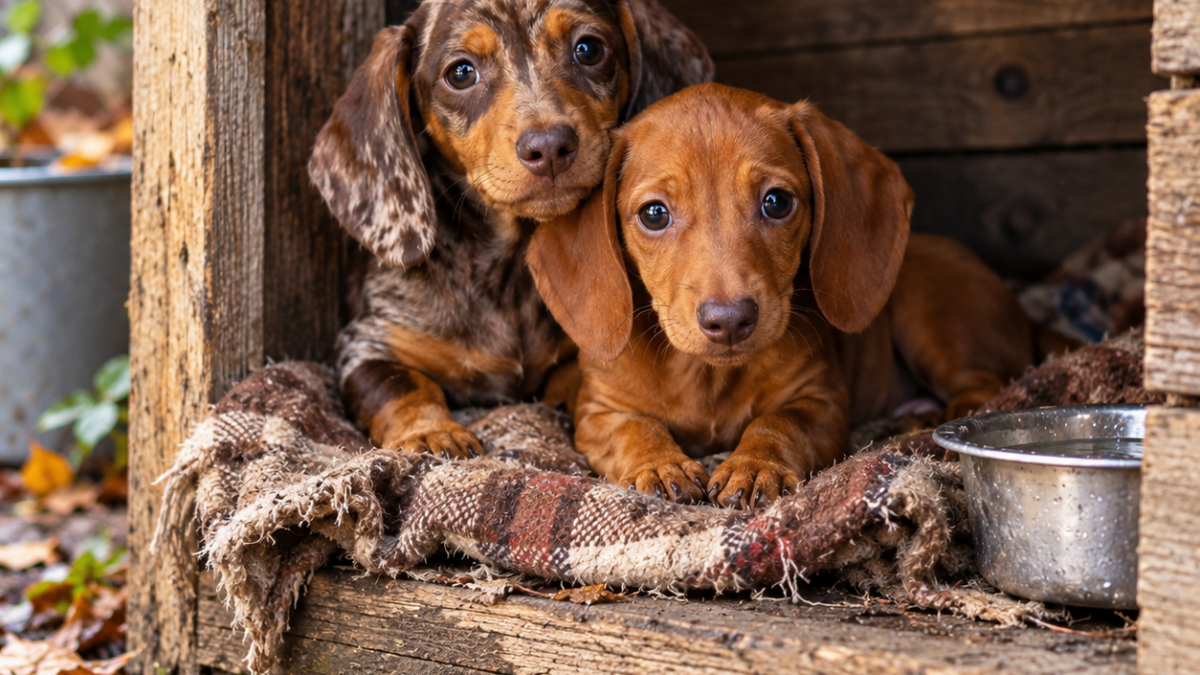
PART 2
Arthur didn’t ask me anything else right away.
He just sat there.
Patches remained in the far corner with her chin resting on her paws.
People usually tried too hard with frightened dogs.
They crouched.
Whistled.
Called.
Offered treats.
Moved their hands toward the kennel bars.
Arthur did none of that.
He simply sat.
Five minutes.
Ten.
Fifteen.
Eventually, Patches lifted her head.
Arthur looked at the floor instead of directly at her.
“Take your time,” he said softly.
Patches stood.
One careful step.
Then another.
She stopped halfway across the kennel.
Arthur stayed still.
I watched from a few feet away.
Twenty minutes later, Patches was close enough to sniff his shoe.
Arthur didn’t move.
Her nose traveled slowly along the leather.
Then she backed away.
“That’s progress,” I whispered.
Arthur smiled.
“I’ve been married forty-six years. I’m familiar with slow negotiations.”
I laughed.
It was the first time I’d laughed around Patches in weeks.
She looked toward me.
Then toward Arthur.
Something about that moment felt different.
—
Arthur came back the next day.
And the day after that.
He never asked to take Patches out immediately.
He simply sat near her.
Sometimes he brought a book.
Sometimes he brought coffee.
Once he fell asleep on the bench.
Patches approached him while he was asleep.
She sniffed his pant leg.
Then sat three feet away.
I didn’t wake him.
The next visit, she came close enough to accept a piece of chicken from his fingers.
Arthur looked at me as though we’d won a championship.
“Did you see that?”
“I saw.”
“She took it.”
“Yes.”
He smiled for the rest of the afternoon.
—
At the end of his fourth visit, Arthur asked me about Rusty.
“What family took her?”
“We don’t normally give out adopter information.”
“Understandable.”
He looked at Patches.
“But do you know if she’s doing well?”
I hesitated.
I realized I hadn’t heard anything.
That bothered me.
Normally, our shelter sent a follow-up email after a week.
Then thirty days.
Some families sent pictures.
Some didn’t.
But I remembered seeing nothing about Rusty.
“I’ll check.”
That was the beginning.
—
The adoption file was in Diane’s office.
I pulled it up the next morning.
Ryan Collins and Melissa Grant.
Local address.
Phone numbers.
Email.
The first follow-up email had gone unanswered.
Second email?
None.
I frowned.
We always sent a thirty-day check.
I searched the notes.
Nothing.
Then I noticed something else.
The original behavior sheet was missing.
Not physically.
Digitally.
The document I’d written with another volunteer had been replaced by a shorter version.
The line—
**Strong separation distress observed. Prefer placement together.**
—was gone.
Instead, the note read:
**Friendly female dachshund mix. Can be shy without sister but expected to adjust.**
Expected to adjust.
I stared at the screen.
I hadn’t written that.
I knew exactly who had.
Diane.
—
I printed both versions.
The old version still existed in the backup archive because one of our volunteers regularly exported shelter records.
I took them to Diane.
“Why was Rusty’s file changed?”
She barely looked up from her computer.
“What?”
“The behavior notes.”
She sighed.
“Emily, we were overcrowded.”
“That’s not an answer.”
“We had thirty-one dogs and twenty-two kennels.”
“So?”
“So two dogs adopted separately are better than two dogs sitting here for six months.”
“They were bonded.”
“They were puppies.”
“Patches stopped eating.”
“She recovered.”
“She lost weight.”
“She eats now.”
“Barely.”
Diane finally looked at me.
“What do you want me to say?”
“That we made a mistake.”
“We placed a dog in a home.”
“Half of a bonded pair.”
“Bonded pair is not a legal diagnosis.”
I stared at her.
“No. It’s just something everyone watching them could see.”
She leaned back.
“Emily, shelters make hard choices.”
I knew that.
We did.
Every day.
But this wasn’t a hard choice made because there was no alternative.
We had simply wanted a prettier adoption statistic.
“What happened to the follow-up?”
“Which follow-up?”
“Rusty’s thirty-day check.”
“Probably missed.”
“Probably?”
“People are busy.”
“So are shelters.”
She turned back to her screen.
“Exactly.”
Conversation over.
At least to her.
Not to me.
—
That afternoon, Arthur arrived.
Patches met him halfway across the kennel.
That was new.
Her tail didn’t wag.
Not yet.
But she came.
Arthur sat.
Patches lowered herself beside his shoe.
He looked at me.
“Something happened.”
“How do you know?”
“You look angry.”
“I am.”
“At me?”
“No.”
“Good. I was about to apologize for something I hadn’t done.”
I sat beside him.
I couldn’t give him private adopter information.
But I could tell him the truth about Patches.
“We had documented that they shouldn’t be separated if we could avoid it.”
Arthur’s hand stopped halfway toward his coffee.
“And you separated them.”
“Yes.”
“Why?”
“Management decision.”
He stared at Patches.
“Did anyone object?”
“Yes.”
“You?”
“Yes.”
“Did it matter?”
“No.”
Arthur nodded slowly.
Not angry.
Just disappointed.
That somehow felt worse.
“People get very good at explaining harm after they’ve already decided to do it,” he said.
I looked at him.
“What did you do before retirement?”
“High school principal.”
That explained the tone.
—
Arthur adopted Patches two weeks later.
Diane tried to act pleased.
“Wonderful match.”
I said nothing.
Patches walked out of the shelter wearing a red harness and looking as if she expected somebody to stop her.
Arthur opened the passenger door.
She froze.
For one terrifying second, I remembered Rusty leaving.
Patches began trembling.
Arthur noticed immediately.
He closed the door.
Didn’t force her.
Instead, he sat on the curb.
“Okay.”
Patches stared at the car.
Arthur waited.
Ten minutes.
Then fifteen.
Eventually, Patches climbed onto his lap.
He stood carefully.
Carried her.
Placed her on the passenger seat.
Before closing the door, he looked at me.
“She comes back if she isn’t happy.”
“Absolutely.”
“No arguments?”
“None.”
“Good.”
Patches stared through the windshield.
I touched the glass.
“Be brave.”
She didn’t wag.
But she didn’t cry.
That was something.
—
Arthur’s house was a small ranch-style home at the end of a quiet street.
His wife, Margaret, had loved gardening.
After she died, the flower beds kept growing without her.
Arthur told me he hadn’t touched them.
“I don’t know which things are weeds.”
“Neither do I.”
“Margaret did.”
Patches spent her first day beneath the kitchen table.
The second day, behind the couch.
The third, Arthur sent me a photograph.
She was sleeping beside his recliner.
Not touching him.
Close.
Caption:
**Negotiations continue.**
—
A week later:
Patches on the couch.
Caption:
**Terms improving.**
Two weeks:
Patches asleep with her head on Arthur’s ankle.
Caption:
**Hostile takeover.**
I laughed every time.
But something remained wrong.
Patches improved around Arthur.
She ate.
Walked.
Accepted touch.
Even wagged occasionally.
But certain things triggered her.
A car door closing.
Another dachshund on television.
The jingle of two tags at once.
And every night around six, she walked to Arthur’s front window.
Sat.
Waited.
Arthur called me after noticing the pattern.
“Was that when Rusty usually came back from walks?”
“Maybe.”
I didn’t know.
He sighed.
“She still thinks someone’s coming.”
—
Then, three months after Patches’ adoption, Arthur found Rusty.
Not physically.
Online.
He called me at 8:10 on a Sunday morning.
“You awake?”
“I am now.”
“There’s a dog on the county lost-pet page.”
My heart began racing before he finished.
“What dog?”
“A dachshund.”
I sat up.
“Send it.”
The photograph arrived.
Blurry.
Taken near a gas station.
A reddish-brown dachshund.
Thin.
No collar.
Found running beside Route 8.
The post read:
**FOUND FEMALE DACHSHUND MIX. NO CHIP REGISTERED TO CURRENT OWNER. VERY ANXIOUS. COUNTY HOLD.**
I stared at the face.
Long muzzle.
Dark eyes.
White line under the chin.
“Rusty.”
Arthur’s voice came through the phone.
“You think so too?”
“Yes.”
“Then why is she at county?”
I didn’t know.
But I was already getting dressed.
—
County Animal Services opened at ten.
Arthur arrived at 9:12.
I got there at 9:20.
He had Patches in the car.
“Should she come inside?”
“Not yet.”
We needed confirmation.
The animal-control officer led us to the kennel.
Rusty was curled beneath a raised bed.
She looked nothing like the confident puppy who had rushed toward strangers.
Her coat was dirty.
Several ribs visible.
Her nails overgrown.
There was a raw patch around her neck where a collar had rubbed.
I crouched.
“Rusty.”
Her head lifted.
Ears forward.
I tried again.
“Rusty girl.”
She came out.
Slowly.
When she reached the bars, she pressed her nose against my fingers.
I started crying.
“That’s her.”
The officer looked at the file.
“You’re certain?”
“I was there when she was adopted.”
“Do you have proof?”
“Oh, yes.”
I had everything.
Or thought I did.
—
The microchip complicated things.
The shelter had chipped Rusty before adoption.
But the adopter registration had never been completed.
The chip still traced back to our shelter.
Good.
Then the officer read the intake report.
Rusty had been found approximately forty miles from Ryan and Melissa’s original address.
No identification.
No current contact information.
The phone numbers in our adoption file were disconnected.
Emails bounced.
Arthur stood beside me.
“Where did they go?”
“I don’t know.”
“Can you find out?”
“We’re going to.”
—
I called Diane.
No answer.
Then I emailed.
**Rusty has been located at county animal services. She appears to have been loose for an extended period. Her adopters cannot be reached. We need all post-adoption correspondence and any surrender/rehome communications immediately.**
Ten minutes later, Diane called.
“Why are you involved?”
I nearly laughed.
“What?”
“County should contact us.”
“Rusty is our dog.”
“She was adopted.”
“And now she’s stray.”
“That happens.”
My anger sharpened.
“Did Ryan or Melissa ever contact the shelter?”
Silence.
There.
I knew.
“Diane.”
“They emailed once.”
My whole body went cold.
“When?”
“Months ago.”
“What did they say?”
“Rusty was having behavioral problems.”
“What kind?”
“Separation anxiety.”
I closed my eyes.
Of course.
“What happened?”
“I suggested a trainer.”
“And?”
“They said they couldn’t afford one.”
“Did they ask to return her?”
Long silence.
“Diane.”
“They asked about options.”
“What options?”
“I told them we were full.”
My mouth went dry.
“Did you tell them they could bring her back?”
“We didn’t have kennel space.”
“Our contract says adopted dogs must be returned to us if they can’t be kept.”
“Emily—”
“Did you tell them that?”
Silence.
“No.”
Arthur was watching my face.
He already knew the answer.
“What did you tell them?”
“That they could find another home privately.”
I wanted to throw the phone.
“To whom?”
“I don’t know.”
“You didn’t ask?”
“No.”
“Did they tell you who took her?”
“No.”
“Did you follow up?”
“I had sixty animals in care.”
“And Rusty was one of ours.”
“Not anymore.”
That sentence ended whatever respect I had left.
—
Arthur heard enough.
He said:
“Put it on speaker.”
I did.
“This is Arthur Bell.”
Diane hesitated.
“Who?”
“Patches’ adopter.”
“Oh.”
“You separated them?”
“Sir, that was—”
“And when the other dog began falling apart, you told the adopters to give her to strangers.”
“That’s not accurate.”
“Then correct it.”
Silence.
Arthur’s voice stayed calm.
“Did they ask your shelter for help?”
“Yes.”
“Did you tell them to rehome the dog privately?”
“I said it was an option.”
“Did your contract require return?”
Diane didn’t answer.
Arthur had been a principal for thirty-one years.
He knew silence.
“Thank you,” he said.
Then hung up.
I stared at him.
“That was rude.”
“No.”
“It felt good.”
“That’s different.”
—
We couldn’t immediately release Rusty.
County law required a stray hold.
So we introduced Patches through a secure fence.
I was terrified.
Months had passed.
Dogs change.
Smells change.
Maybe they wouldn’t recognize each other.
Arthur brought Patches into the quiet meeting yard.
She sniffed everything nervously.
Then Rusty appeared on the other side of the chain-link divider.
Both dogs froze.
No sound.
Patches’ body became perfectly still.
Rusty stared.
One second.
Two.
Three.
Then Rusty screamed.
Not in fear.
Recognition.
Patches launched toward the fence.
Both dogs hit it at the same time.
Tails frantic.
Crying.
Scratching.
Trying to push noses through the links.
Arthur covered his mouth.
I couldn’t move.
The county officer whispered:
“Wow.”
Patches whined so hard her entire body shook.
Rusty pawed the fence.
We opened the connecting gate carefully.
They collided.
There is no elegant word.
They climbed over each other.
Licked faces.
Cried.
Rusty rolled onto her side.
Patches pressed her chest across Rusty’s neck.
Then Rusty stood and ran three circles.
Patches followed.
Exactly as they had as puppies.
Arthur was openly crying.
So was I.
The officer looked away and pretended to check paperwork.
No one had to ask whether they remembered.
They did.
—
After five minutes, Patches lay down.
Rusty curled against her.
Same position from the wet cardboard box months earlier.
Patches’ head over Rusty’s shoulders.
Rusty’s paws tucked beneath Patches.
Arthur sat on the grass.
“They’re going home together.”
I looked at him.
“Arthur—”
“Don’t.”
“It’s two dogs.”
“I can count.”
“Vet bills.”
“I have a pension.”
“Training.”
“I’m retired.”
“Two dachshunds.”
He looked at me.
“I’m old, Emily. Not stupid.”
Fair.
—
The legal ownership issue had to be resolved.
Ryan and Melissa had technically adopted Rusty.
But they’d disappeared from the address.
Animal control finally reached Melissa through a relative.
She called me.
Crying.
I expected excuses.
What I got was more complicated.
“We didn’t abandon her.”
“Then what happened?”
“Rusty was destroying the apartment.”
“Why?”
“Every time we left.”
She described it.
Scratching doors.
Crying.
Chewing drywall.
Refusing food when alone.
Panic whenever one of them walked out.
Separation distress.
Everything we’d documented before adoption.
Everything Diane removed.
“We called the shelter,” Melissa said.
“I know.”
“They told us there was no room.”
“I know.”
“They gave us numbers for trainers.”
“Did you call?”
“Yes. One wanted six hundred dollars.”
“And then?”
“Ryan’s cousin said his neighbor wanted a small dog.”
My stomach tightened.
“Name?”
“Gary Walters.”
“Where?”
She gave an address forty miles away.
Exactly near where Rusty had been found.
“What was he like?”
“I don’t know.”
“You gave your dog to a man you didn’t know?”
Melissa started crying harder.
“I know how it sounds.”
“It sounds exactly like what happened.”
“We thought he was good.”
“Did you visit?”
“No.”
“Did you check references?”
“No.”
“Did you ever follow up?”
“Twice.”
“And?”
“Gary said she was fine.”
“Did he send pictures?”
“No.”
“Then you stopped asking.”
Silence.
“I thought she was okay.”
I looked through the kennel glass.
Rusty was asleep beside Patches.
Thinking an animal is okay is easier than checking.
That became another lesson.
—
Gary Walters was not difficult to find.
Animal control visited his property the next morning.
Rusty’s old collar was hanging from a nail in a shed.
There was a broken dog run behind the house.
No Rusty.
Gary initially said she’d run away two days earlier.
Then a neighbor corrected the timeline.
Rusty had been seen loose near the property for weeks.
According to the neighbor, Gary rarely allowed her inside.
She cried constantly.
Dug beneath the fence.
Tried to follow cars.
He got tired of dealing with her.
Sound familiar?
Everyone kept getting tired.
Rusty paid every time.
—
When the officer asked Gary why he hadn’t reported her missing, he shrugged.
“She was more trouble than she was worth.”
That phrase made its way into the official report.
Arthur read it later.
He didn’t speak for almost a minute.
Then:
“People use worth when they mean convenience.”
I wrote that down.
—
Gary was cited for neglect, failure to provide appropriate shelter, and failure to report the stray/lost animal according to local ordinance.
Nothing dramatic.
No prison.
But the county removed two other dogs from his property after discovering inadequate shelter and water.
That mattered.
Rusty’s case protected animals we’d never known existed.
—
Ryan and Melissa formally relinquished any remaining claim to Rusty.
Melissa apologized.
Ryan didn’t call.
I didn’t chase him.
I was too busy with the shelter.
Because a larger problem had started.
—
I filed a formal report with our shelter’s board.
Not about Rusty’s adopters.
About us.
About Diane.
I included:
The original bonded-pair note.
The altered note.
The adoption timeline.
Patches’ documented refusal to eat.
The missing thirty-day follow-up.
Ryan and Melissa’s email requesting help.
Diane’s response encouraging private rehoming despite our return contract.
The absence of any follow-up afterward.
I expected a quiet internal meeting.
Instead, one board member forwarded the issue to the county nonprofit oversight office because our shelter received municipal funding.
Suddenly, it wasn’t just Diane and me arguing in an office.
Records were requested.
Emails.
Adoption statistics.
Return rates.
Intake numbers.
Behavior notes.
Everything.
—
What they found went beyond Rusty.
Diane had been under pressure to improve the shelter’s “live outcome” statistics.
Adoptions looked good.
Returns looked bad.
So, in several cases, when adopters called struggling, staff were encouraged to help them rehome animals privately rather than formally returning them.
Most cases ended fine.
Some didn’t.
One dog had been passed through three homes.
Another ended up at a county pound two states away.
A cat disappeared entirely from our records after its adopter asked to return it.
Diane hadn’t hurt animals directly.
But she had built a system where protecting numbers sometimes mattered more than protecting them.
That distinction mattered legally.
It mattered less emotionally.
—
Diane confronted me in the kennel hallway.
“You did this.”
I was cleaning Patches’ former kennel.
“What?”
“The board investigation.”
“I submitted records.”
“You know what this could do to the shelter?”
“I know what not submitting them did to Rusty.”
“Don’t be dramatic.”
I turned around.
“She was found half-starved forty miles away.”
“Because her adopters made bad choices.”
“After we made one.”
Diane’s face hardened.
“You think you’re morally superior because you spend all day getting emotionally attached?”
“No.”
“Then what do you want?”
I looked at the empty kennel where Patches had cried for months.
“I want us to stop pretending placement is the same thing as rescue.”
She said nothing.
—
The board placed Diane on administrative leave.
Then terminated her.
Not because of one separated pair.
Because she’d altered records, failed to follow return policy, and discouraged documented returns in ways that created liability and risk.
People online turned it into a scandal.
I hated that part.
Shelter work is already hard.
Most employees weren’t responsible.
Donations briefly dropped.
Volunteers got angry messages.
Diane received threats.
I publicly condemned those.
Consequences are not permission for cruelty.
That’s another thing people forget.
—
Arthur didn’t care about the scandal.
His entire world had become two dachshunds.
He finalized Rusty’s adoption as soon as county hold and relinquishment paperwork cleared.
I went with him.
The adoption coordinator looked at the sisters.
“Which one are you taking?”
Arthur stared.
“Both.”
She smiled.
“I meant which one is the new adoption.”
“Rusty.”
Patches began whining when Rusty stepped behind the desk for her microchip update.
Arthur immediately said:
“Do it where she can see her.”
The technician complied.
Patches watched.
No panic.
Rusty returned.
Everything fine.
People learn.
—
The first night together at Arthur’s house, he sent me a video.
Patches and Rusty asleep on Margaret’s old couch.
Pressed together.
Rusty’s head beneath Patches’ chin.
Caption:
**Negotiations concluded. They own the house.**
I cried so hard I had to stop watching.
—
Recovery wasn’t instant.
That’s important.
Rusty had learned panic too.
If Arthur opened the front door, she sometimes bolted toward it as though terrified of being left behind.
If he went outside alone, both dogs cried.
So Arthur worked with a certified trainer.
Slow departures.
Five seconds.
Return.
Ten seconds.
Return.
Thirty.
One minute.
No dramatic goodbyes.
No punishment.
Predictability.
The sisters had survived by clinging to each other.
Now they had to learn that attachment didn’t always end in disappearance.
—
Arthur learned too.
He had his own separation problems.
After Margaret died, he had stopped visiting friends.
Stopped going to church.
Stopped eating proper dinners.
He’d sit in the kitchen and listen to the refrigerator.
Patches and Rusty changed that.
Morning walks.
Medication schedules.
Training sessions.
Vet appointments.
Food.
Laundry.
Dachshund hair everywhere.
One afternoon, Arthur told me:
“I thought I adopted Patches because she was lonely.”
He looked at both dogs asleep near his feet.
“Turns out we had the same problem.”
—
He began taking them to the cemetery.
Not every week.
Sometimes.
Margaret’s grave was beneath a maple tree.
Arthur sat on a bench.
Patches and Rusty lay beside him.
The first time, Arthur said:
“Margaret would’ve hated these dogs.”
I stared.
“What?”
“She liked big dogs.”
I laughed.
He smiled.
“Would’ve spoiled them anyway.”
That sounded true.
—
The investigation changed shelter policy.
Bonded animals were no longer separated without documented behavioral evaluation and approval from two senior staff members.
Adopters received clearer counseling.
Return contracts were enforced.
Most importantly, struggling adopters were told:
**Calling for help is not failure. Returning an animal safely is better than quietly passing it along.**
We created a small temporary foster fund for adoption crises.
If someone needed two weeks to handle a move, hospitalization, training problem, or housing issue, we tried to help before they reached desperation.
Rusty and Patches’ file became one of our training examples.
Names removed.
Lesson retained.
—
Arthur came to the first staff training session.
I hadn’t invited him.
He appeared anyway.
“Why are you here?”
“I brought coffee.”
“You can’t bribe your way into policy meetings.”
“I was a principal. Of course I can.”
Fair.
He sat in the back.
When we discussed bonded pairs, one new employee asked:
“How do you know when two dogs are truly bonded versus just friendly?”
Arthur raised his hand.
I sighed.
“Yes, Arthur?”
“If one screams like it’s dying when the other leaves, that’s a clue.”
Everyone laughed.
Then he became serious.
“Don’t wait until you can prove heartbreak scientifically before respecting what is obvious.”
The room got quiet.
That stayed with us.
—
Melissa visited the shelter months later.
Alone.
She asked to speak with me.
I almost refused.
Then I remembered that if we only talk to people after they make good choices, we never learn how bad ones happen.
She looked tired.
“I’m sorry.”
I nodded.
“For Rusty?”
“For all of it.”
“Why did you come?”
“I saw the news about the shelter.”
I waited.
“I didn’t know you had written they should stay together.”
“No.”
“Diane told us Patches would adjust.”
“I know.”
“Ryan wanted only one dog.”
“Why?”
“Our lease allowed one.”
There it was.
Convenience again.
“We should’ve walked away.”
“Yes.”
She looked surprised by my answer.
I continued.
“Or waited for a different dog.”
She nodded.
“Rusty cried every night.”
My anger softened despite myself.
Not disappeared.
Softened.
“For how long?”
“Months.”
“Why didn’t you bring her back?”
“We tried.”
“I know.”
Melissa cried.
“When Diane said you were full, I thought returning her meant we’d failed.”
“Sometimes returning is responsible.”
“I know that now.”
“Good.”
She wiped her face.
“Can I see her?”
I thought about it.
Then:
“No.”
She nodded.
“I understand.”
Rusty’s safety wasn’t a tool for Melissa’s closure.
That mattered.
—
Later, Melissa began donating to our crisis-foster program.
Anonymously at first.
Then openly.
She volunteered at adoption counseling events, telling prospective owners:
“If your housing allows one dog, don’t adopt half of a bonded pair because you feel sorry for one.”
Her mistake didn’t disappear.
But it became useful.
I respected that.
—
Ryan never came back.
According to Melissa, they eventually separated.
I knew almost nothing else.
That was fine.
Not everyone needs a redemption chapter inside the story.
—
Gary Walters fought his citations.
Then made everything worse.
County officers discovered one of his other dogs had untreated heartworm and another had a chain embedded in its collar.
Those cases were stronger.
He lost possession of both dogs.
Received probation, fines, veterinary restitution, and a temporary animal-ownership ban.
His neighbors later told animal control that for years they’d assumed someone else had reported him.
Again.
That phrase.
Someone else.
So much suffering fits inside those two words.
—
Arthur called Gary’s outcome “administrative revenge.”
I laughed.
“What does that mean?”
“It means nobody punched him.”
“Good.”
“But forms kept arriving.”
“Also good.”
Arthur grinned.
“I taught high school. Never underestimate paperwork.”
—
Rusty gained weight.
Her coat became glossy again.
Patches changed too.
The transformation was slower.
One afternoon, Arthur sent me a video with no caption.
I opened it.
Patches was running.
Not walking.
Running across the backyard.
Rusty chased her.
They circled a garden bed.
Patches barked.
A full, ridiculous dachshund bark.
I replayed it.
Then again.
Then again.
The dog who had spent months staring from the back of a shelter kennel was barking because her sister couldn’t catch her.
That was justice.
—
Arthur repaired Margaret’s garden.
Mostly because Rusty kept digging in it.
“You ruined your mother’s roses,” he told her one morning.
I said:
“Margaret wasn’t her mother.”
Arthur looked offended.
“You don’t know our family structure.”
Fair.
He fenced the roses.
Rusty dug beneath the fence.
He gave up.
Margaret’s roses became fewer.
Arthur’s laughter became more frequent.
I think she would’ve approved the trade.
—
A year after the reunion, we held a shelter fundraiser.
Arthur refused to speak publicly.
Then changed his mind when he learned the topic was bonded animals.
He walked onto a small stage with Patches and Rusty.
The sisters wore matching blue harnesses.
Arthur looked at the audience.
“I don’t know anything about dog psychology.”
I whispered from the side:
“Excellent opening.”
He ignored me.
“But I know grief.”
The room quieted.
“I know what it’s like when the person you expect to be there suddenly isn’t.”
Patches sat against his shoe.
“So when people told me this little dog would eventually forget her sister, I didn’t believe them.”
Arthur looked down.
“Because people told me things like that too.”
His voice tightened.
“Move on. Get out more. Stay busy.”
He paused.
“Grief doesn’t work because someone finds it inconvenient.”
No one moved.
“Neither does attachment.”
Rusty leaned against Patches.
Arthur smiled.
“Sometimes healing means learning to live with absence.”
He looked at the sisters.
“And sometimes, if you’re very lucky, you get to correct a mistake.”
I cried backstage.
Again.
Apparently that was my job.
—
The shelter raised enough money that night to create six emergency foster spots.
We named the program **Together Until Safe**.
Arthur vetoed **Rusty & Patches Fund**.
“Too sentimental.”
This from the man who bought matching Christmas sweaters.
Hypocrite.
—
At Christmas, he sent me a photograph.
Rusty and Patches asleep beneath the tree.
Matching sweaters.
Arthur in the background wearing one too.
I texted:
**Too sentimental?**
He replied:
**Blackmail material. Delete immediately.**
I saved it.
Obviously.
—
Years passed.
The sisters became local shelter legends.
Not famous.
Better.
Useful.
Whenever a bonded pair arrived, volunteers remembered.
Sometimes keeping animals together meant waiting longer.
Sometimes it meant finding a foster instead of a kennel.
Sometimes separation was necessary for safety or medical reasons.
We didn’t become irrational.
We became careful.
There’s a difference.
—
One case involved two senior beagles whose owner died.
Everyone wanted the smaller one.
No one wanted both.
They waited four months.
Under the old pressure, we might have separated them.
We didn’t.
A retired nurse eventually adopted both.
She sent a picture of them sleeping in one bed.
I forwarded it to Arthur.
He replied:
**See? Paperwork works.**
I had no idea what that meant.
Neither did he.
—
Patches became more independent with age.
That surprised us.
At four, she could tolerate Rusty leaving for veterinary appointments without panic.
At five, she sometimes chose another room.
Arthur called me the first time it happened.
“I think they’re fighting.”
“Why?”
“Patches is in the bedroom.”
“And Rusty?”
“Kitchen.”
“Arthur.”
“They’ve never done that.”
“They’re becoming secure.”
Silence.
“That’s good?”
“Very.”
He sounded almost disappointed.
“Interesting.”
Attachment had stopped being fear.
That’s what we wanted.
They could love each other without believing every separation was permanent.
—
Rusty remained the troublemaker.
At six, she stole an entire roast from Arthur’s kitchen counter.
We still don’t know how.
Dachshund.
Short legs.
Counter three feet high.
Physics failed.
Arthur sent a photograph of the empty pan.
**Suspect refuses cooperation.**
Rusty was visible in the background.
Asleep.
Unrepentant.
—
At seven, Patches developed a back problem.
Common in dachshunds.
One morning, she cried when climbing the porch step.
Arthur panicked.
The veterinarian diagnosed an early disc issue.
Strict rest.
Medication.
No jumping.
Arthur transformed his house overnight.
Ramps everywhere.
Furniture blocked.
Baby gates.
Orthopedic beds.
He slept on the floor beside Patches for three nights because she cried in the recovery pen.
Rusty slept outside the pen.
Nose against the bars.
Full circle.
—
Patches recovered without surgery.
The first day she walked normally again, Rusty tried to wrestle.
Arthur shouted:
“NO.”
Both dogs froze.
I laughed for five minutes when he told me.
“They looked offended.”
“You ruined their reunion.”
“I preserved her spine.”
Reasonable.
—
When Arthur turned seventy-eight, he made me promise something.
“If I die first—”
“No.”
“Emily.”
“Absolutely not.”
“I’m seventy-eight.”
“You were a principal. You’re immortal through spite.”
He laughed.
Then serious:
“If I die before them, they stay together.”
“Yes.”
“Not ‘we’ll try.'”
“They stay together.”
He handed me paperwork.
A pet trust.
Money set aside for veterinary care.
Two backup caregivers.
Then me as final emergency contact.
I stared.
“You planned all this?”
“I learned.”
That was all he said.
I learned.
The opposite of Diane’s mistake.
The opposite of Ryan and Melissa.
The opposite of Gary.
He planned for what happened if he couldn’t be there.
Because love without planning can still leave animals stranded.
—
Arthur’s health remained good for years.
Then, at eighty, he had a mild heart attack.
Not fatal.
But enough for three nights in the hospital.
The emergency plan worked.
I received a call.
Picked up Patches and Rusty.
Brought them to an approved foster.
They stayed together.
No confusion.
No private rehoming.
No lost records.
No one disappeared.
Arthur called from his hospital bed.
“How are my girls?”
“Annoying.”
“Good.”
“Rusty stole a bagel.”
“Excellent.”
“Patches is sleeping.”
“Perfect.”
Then he was quiet.
“Thank you.”
I understood what he meant.
The system had finally done what it should.
—
Arthur came home.
Both dogs nearly knocked him over.
A seventy-pound reunion compressed into two dachshunds.
He sat on the floor laughing while they climbed all over him.
I stood in the doorway and thought about the first separation.
Patches screaming.
Car leaving.
No plan.
No accountability.
We couldn’t erase that day.
But we had built something different around it.
—
Diane contacted me almost seven years after leaving the shelter.
I hadn’t heard from her.
Her email was short.
**I owe you an apology.**
I stared at it for a day before answering.
We met for coffee.
She looked older.
So did I.
Shelter work does that.
She didn’t defend herself.
That surprised me.
“I was obsessed with numbers,” she said.
“Yes.”
“We were drowning.”
“I know.”
“I convinced myself every adoption was a win.”
“Even if it wasn’t safe.”
She nodded.
“I thought if we slowed down, more animals would die waiting.”
There was truth in that.
Hard truth.
“And sometimes?”
“Sometimes I was right.”
I appreciated her saying it.
Sheltering isn’t simple.
But then she continued:
“And sometimes I used that truth to excuse things I knew weren’t right.”
There it was.
“Rusty and Patches?”
“Yes.”
“You changed my notes.”
“I did.”
“Why?”
“Because if they were officially marked bonded, we might wait months.”
“You should’ve told the adopters.”
“I know.”
“You should’ve accepted Rusty back.”
“I know.”
“You should’ve followed up.”
“I know.”
I looked at her.
“Why now?”
She took a breath.
“I work for a veterinary nonprofit.”
That surprised me.
“I train municipal shelters on retention and return prevention.”
I almost laughed.
“You’re serious?”
“Yes.”
“And you use this case?”
“With names removed.”
I stared.
“That’s bold.”
“Humiliating.”
“Good.”
She smiled faintly.
“I thought you might say that.”
—
Did I forgive Diane?
Eventually.
Mostly.
Not because the consequences disappeared.
Because she took responsibility and changed what she did afterward.
Forgiveness wasn’t the important part.
Learning was.
That became a theme in this story whether I wanted it or not.
—
At nine, Rusty began slowing.
Patches too.
Gray appeared around their muzzles.
Arthur complained.
“No.”
I said:
“They’re nine.”
“Fake records.”
“Arthur.”
“Government conspiracy.”
He was eighty-two.
Still impossible.
—
Their favorite activity became sitting in the garden.
Margaret’s roses had mostly surrendered.
In their place were lavender, daisies, and several mysterious plants Arthur could not identify.
Patches slept in the sun.
Rusty dug.
Always Rusty.
Arthur would shout through the window.
“Stop landscaping!”
Rusty ignored him.
—
Then came the day we always knew would come.
Rusty stopped using one back leg.
Emergency exam.
Imaging.
Not a disc problem.
A mass.
Bone cancer.
The word changed the room.
Arthur sat completely still.
Patches sniffed Rusty’s face.
The veterinarian explained options.
Surgery might buy time.
Chemotherapy.
Pain management.
Age.
Quality of life.
Arthur listened.
Then asked:
“Can she still be with her sister?”
“Yes.”
That was his first question.
Of course it was.
—
We chose treatment.
Not because Arthur couldn’t let go.
Because Rusty still wanted breakfast.
Still barked at squirrels.
Still tried to steal food.
Still had life.
She eventually lost the leg.
The first day home, Patches stared at her.
Rusty tried to stand.
Fell.
Patches walked closer.
Sniffed the bandage.
Then lay beside her.
No fear.
No confusion.
Just there.
—
Rusty learned three-legged walking faster than Arthur learned to stop worrying.
Within weeks, she moved through the house.
Slower.
Still herself.
She even dug one shallow hole.
Arthur nearly cried with pride.
“She’s vandalizing again.”
“Beautiful.”
“Absolutely.”
—
Cancer gave them eleven more months.
Good months.
Not perfect.
Enough.
Then scans showed spread to the lungs.
This time, there wasn’t another meaningful treatment.
Arthur called me.
“Come over.”
I knew.
—
Rusty was on the couch.
Patches curled against her.
Arthur sat beside them.
He held the original blanket from the shelter.
I recognized it immediately.
Faded.
Repaired twice.
“You kept that?”
“Of course.”
I sat.
Rusty’s breathing was slightly faster than normal.
She still wagged when I touched her.
“Hey, troublemaker.”
Tail.
Patches watched me.
Arthur whispered:
“How do we do this without breaking her?”
He meant Patches.
I didn’t know.
There are questions no amount of experience solves.
“We let her be there.”
Arthur nodded.
“No disappearing.”
“No.”
That was important.
Rusty would not vanish behind a closed door the way she had as a puppy.
Patches would see.
Smell.
Understand in whatever way dogs understand.
No mystery.
—
The veterinarian came to Arthur’s house.
Rusty ate chicken.
Of course.
She stole one piece from Patches.
Of course.
Arthur laughed.
“Until the end.”
Then he cried.
—
Before the sedative, Arthur lifted Rusty carefully and placed her beside Patches on the blanket.
The sisters pressed together.
Same as the bus-stop box.
Same as the shelter.
Same as the reunion yard.
Their entire lives seemed to fit inside that position.
Patches groomed Rusty’s ear.
Arthur leaned down.
“You two were supposed to stay together.”
His voice broke.
“I’m sorry people didn’t understand that soon enough.”
Rusty’s tail moved.
I touched Arthur’s shoulder.
“She got back.”
“I know.”
He looked at Patches.
“They both did.”
—
The sedative made Rusty sleepy.
Patches remained pressed against her.
Arthur kissed Rusty’s forehead.
“You were a pain in the ass.”
I laughed through tears.
“Arthur.”
“She knows.”
Rusty’s breathing slowed.
“You ate my roast.”
Tail movement.
“Destroyed the roses.”
Another.
“Ruined three rugs.”
Arthur’s voice broke.
“And saved my house from being empty.”
Silence.
“Thank you.”
The final medication went in.
Rusty took one slow breath.
Then another.
Then none.
—
Patches didn’t move.
For several minutes, she stayed against her sister.
Then she stood.
Sniffed Rusty’s face.
Her paws.
Her chest.
She nudged her once.
No response.
Patches sat.
Arthur cried quietly.
We let her take as long as she needed.
Eventually, Patches walked to Arthur.
Climbed into his lap.
Not something she normally did.
Arthur held her.
“Now it’s us.”
That sentence destroyed me.
Because once, Patches had lost Rusty without understanding.
This time, she had Arthur.
And Arthur had her.
Grief still hurt.
But there was no abandonment inside it.
That’s different.
—
Patches searched for several days.
Not frantically.
She checked Rusty’s bed.
The garden.
The kitchen.
Then gradually stopped.
She slept more.
Followed Arthur everywhere.
Their bond changed.
Not replacement.
Never replacement.
Something new.
—
Arthur kept Rusty’s ashes beside Margaret’s.
I found that out accidentally.
“That’s crowded,” I said.
Arthur shrugged.
“They can argue.”
I laughed.
He smiled.
“Margaret would’ve liked Rusty.”
“I thought she hated small dogs.”
“Changed my mind.”
Convenient.
—
Patches lived almost three more years.
Three quiet years.
She became Arthur’s shadow.
At eleven, she still went on short walks.
At twelve, mostly the garden.
At thirteen, the couch.
Arthur aged beside her.
Their movements synchronized.
Slow rise.
Careful steps.
Long naps.
—
One autumn afternoon, Arthur called.
“Patches didn’t eat.”
I drove over.
She was curled in her bed.
Small.
Gray.
Very old.
The veterinarian found advanced kidney failure.
We could support her for a short while.
Maybe weeks.
Arthur chose comfort.
“He had eleven months,” he said, meaning Rusty.
“Patches?”
He looked down.
“She tells us.”
—
Patches gave us six days.
On the final morning, Arthur carried her into the garden.
He sat beneath the maple tree.
Placed the old shelter blanket across his knees.
Patches rested there.
Sun warmed her coat.
I sat nearby.
Arthur was quiet.
Then:
“I came to the shelter because I couldn’t live in an empty house.”
Patches’ eyes opened.
“Turns out the house wasn’t the problem.”
I looked at him.
“What was?”
“Nobody was waiting for me.”
His hand moved gently over Patches’ head.
“These two always waited.”
—
The veterinarian arrived near noon.
Arthur asked me to bring something from his bedroom.
A small wooden box.
Inside were Rusty’s ashes.
He placed the box beside Patches.
“Together enough?”
I nodded.
“Together enough.”
—
Patches died in Arthur’s lap.
No panic.
No screaming.
No empty kennel.
No car leaving.
Arthur held her while I held his shoulder.
Her final breath was so soft I barely noticed.
Then stillness.
Arthur kissed her forehead.
“Go find your sister.”
I don’t know whether I believe animals meet again somewhere.
That day, I wanted to.
—
We buried part of both sisters’ ashes beneath the garden maple.
Arthur kept the rest inside.
A small stone beneath the tree read:
**RUSTY & PATCHES**
**FOUND TOGETHER.**
**SEPARATED ONCE.**
**TOGETHER AGAIN.**
Arthur thought the wording was too sentimental.
He chose it.
Again:
Hypocrite.
—
A year later, Arthur died peacefully in his sleep.
Eighty-six.
Emily—his niece, not me—called the shelter because she’d found instructions in his papers.
His ashes were to be buried beside Margaret.
And beneath the garden maple, one small portion beside the dogs.
The instructions ended with:
**They were family too. Don’t let anyone tell you otherwise.**
We didn’t.
—
Arthur left money to the shelter.
Not enough to build a wing.
Enough to permanently fund the emergency foster program for several years.
The board renamed it despite knowing he would’ve complained.
**The Arthur Bell Together Fund.**
The plaque beneath the name showed two dachshund silhouettes.
One solid red.
One spotted.
I stood in front of it for a long time.
—
By then, dozens of bonded animals had been kept together because of the policy created after Rusty and Patches.
Two senior cats.
Three pairs of dogs.
A mother and disabled adult daughter dog.
Two rabbits that panicked when separated.
Not every pair remained together.
Sometimes behavior evaluations showed separation was healthy.
Sometimes medical needs required temporary division.
We became better not by making one absolute rule.
We became better by paying attention.
That’s what we’d failed to do at the beginning.
We saw Patches screaming.
We heard it.
Then told ourselves she’d adjust because that was easier than changing the plan.
That mistake followed us for years.
Good.
Some mistakes should.
Not as punishment.
As memory.
—
People still ask me whether Diane “got what she deserved.”
She lost her job.
Her reputation took a hit.
She had to rebuild professionally.
Gary lost his dogs and faced court.
Ryan and Melissa’s adoption failed.
Rusty nearly died because adults made one convenient decision after another.
If you want a revenge story, those are the facts.
But the part that satisfied me most was never watching anyone lose.
It was watching Patches run beside Rusty again.
It was watching Arthur’s empty house become loud.
It was seeing policies change.
Seeing adopters receive help before desperation.
Seeing people choose patience over statistics.
That is the kind of revenge I can live with.
The mistake didn’t get the last word.
—
The shelter still has the original photograph of Rusty and Patches.
Two tiny dachshund puppies inside a wet cardboard box.
Pressed together.
Terrified.
If you saw only that photograph, you’d think their story was about abandonment.
It wasn’t.
Not really.
It was about attachment.
About what happens when people underestimate it.
About what happens when we mistake quiet grief for adjustment.
About the difference between finding a home and finding the right home.
And about an old man who understood a frightened dog because he, too, knew what it meant to wake up and realize the person who had always been beside you wasn’t there anymore.
—
Arthur once told me something I wrote down.
I found the note years later in my desk.
**”You don’t cure loneliness by telling someone they should be over it.”**
He’d been talking about Patches.
Probably himself too.
Rusty came back.
Margaret didn’t.
Life doesn’t always give us the reunion we want.
But Arthur understood both kinds of grief.
Maybe that’s why Patches trusted him.
He never demanded that she forget.
He simply gave her somewhere safe to wait.
And eventually, against every reasonable expectation, the one she was waiting for came back.
—
I sometimes think about the day Rusty was adopted alone.
If I could go back, I would stop the car.
I would say no.
I would risk the argument.
I would put both dogs back in the kennel and wait for a family willing to take two.
But time doesn’t work that way.
We don’t get to fix yesterday by rewriting it.
We fix it by refusing to repeat it.
That’s what we did.
—
Years later, a young couple came to our shelter looking for one small dog.
They stopped in front of two terrified terrier mixes curled together.
The woman smiled.
“That one’s adorable.”
She pointed at the braver dog.
The quieter one hid behind him.
I felt the past move through me.
The adoption counselor opened the file.
“They’re strongly bonded.”
The couple looked at each other.
“We can only have one.”
The counselor nodded.
“Then these two aren’t your dogs.”
No hesitation.
No pressure.
No statistic.
The couple moved on.
A month later, a family adopted both terriers.
Together.
I sent a picture to Arthur’s niece.
She replied with one sentence:
**He would’ve liked that.**
Yes.
He would have.
—
That is how Rusty and Patches changed our shelter.
Not because their story was perfect.
Because it wasn’t.
We failed them once.
Then we had a choice.
Defend the failure.
Hide it.
Blame other people.
Or learn.
We learned.
Slowly.
Painfully.
But we did.
—
The two sisters had entered the world together.
They survived a freezing bus stop together.
They slept in one shelter bed.
Then humans separated them because one adoption looked easier than waiting for the right one.
Patches broke.
Rusty broke differently.
Both paid for our convenience.
Then an old widower asked one simple question:
**If her sister isn’t dead, why isn’t she with her?**
Everything changed after that.
The question exposed what we’d been avoiding.
And months later, when that gate opened at county animal services and the two dachshunds ran into each other, no one in the yard needed a behavior chart to tell us what we had gotten wrong.
They remembered.
They chose each other.
Immediately.
—
In the end, Rusty died first.
Patches followed years later.
Arthur followed after her.
But I don’t remember them as a sad story.
I remember Rusty stealing a roast.
Patches learning to run.
Arthur arguing with a dachshund over flower beds.
Matching Christmas sweaters he claimed were humiliating.
Ramps across the house.
The sisters sleeping nose-to-tail on Margaret’s couch.
Arthur calling me because Patches had voluntarily slept in another room and he thought the dogs were having a marital crisis.
Ordinary things.
That’s what rescue is supposed to protect.
Not just survival.
Ordinary life.
—
The most important photograph isn’t the wet box.
It isn’t Patches alone in the kennel.
It isn’t Rusty at county animal services.
It’s one Arthur sent me about six months after their reunion.
No dramatic pose.
No beautiful background.
Just his living room.
Patches asleep on one side of the couch.
Rusty asleep on the other.
Arthur’s slipper visible at the bottom of the frame.
For the first time, the sisters weren’t touching.
They didn’t have to.
They finally knew separation didn’t always mean abandonment.
They had become secure enough to rest apart.
And somehow, to me, that was the happiest ending of all.
They began their lives clinging together because they were terrified of losing each other.
They ended them knowing love could survive a little distance.
The world had finally become safe enough for both.



