PART 2: They Abandoned Their Three-Legged Cat Outside the Vet—Then Came Back When They Saw What He Became
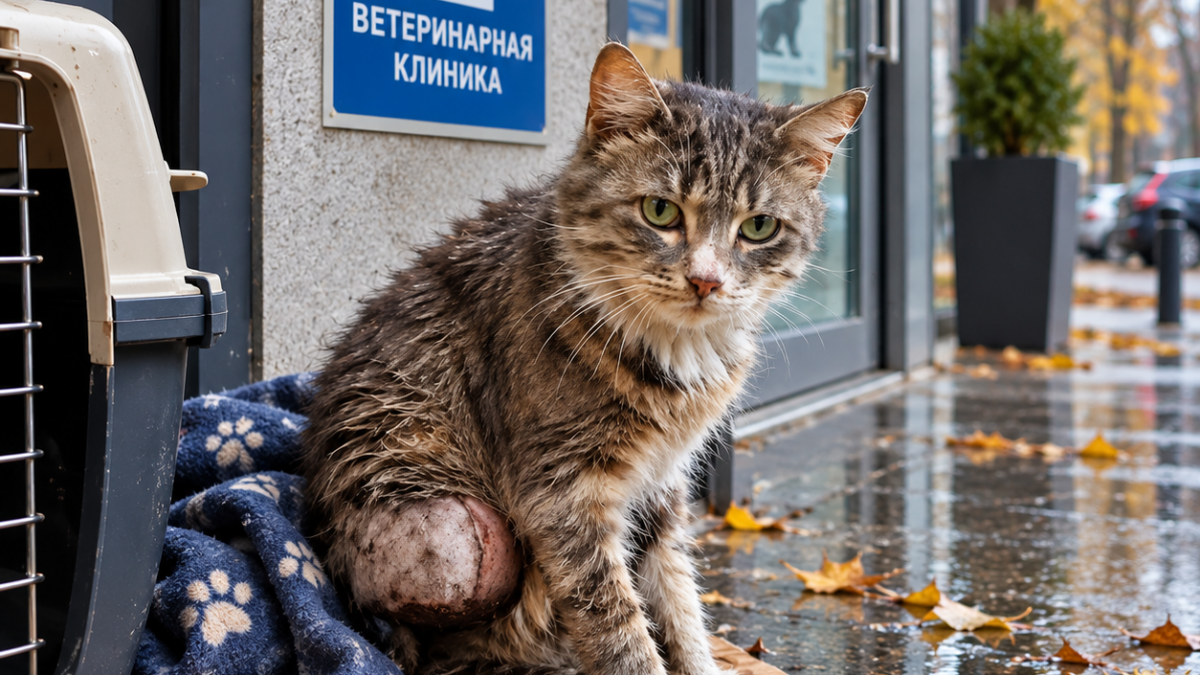
He had already lost a leg, but that wasn’t the cruelest thing that happened to him.
The cruelest part came afterward, when the people he had trusted most decided that the version of him who survived was no longer the version they wanted.
And on the cold October morning I found him staring at a veterinary clinic door, I had no idea how many lives that little gray cat was about to change.
I first saw him just after seven in the morning.
The sky was the dull gray of early fall, and a thin drizzle had been falling since before sunrise. I had stopped at the veterinary clinic to pick up medication for an elderly rescue cat I was fostering. I was already late for work, already thinking about traffic, emails, and all the small things that seem important until something truly important appears in front of you.
He was pressed against the brick wall beside the clinic entrance.
At first I thought he was a bundle of wet cloth.
Then he lifted his head.
He was a small gray cat with dirty, clumped fur and enormous green eyes. His whiskers trembled from the cold. Beneath him was a flattened piece of cardboard that had soaked through so completely it offered almost no protection from the wet pavement.
People passed within a few feet of him.
Some didn’t notice.
Some looked down and kept walking.
The cat didn’t cry.
He didn’t beg for food.
He didn’t try to follow anyone.
He simply stared at the glass door of the clinic.
That was what stopped me.
There was something about the way he watched that door.
Not like a stray hoping someone might feed him.
Like someone waiting to be collected.
I crouched several feet away.
“Hey, little guy.”
His ears moved toward my voice.
“Who are you waiting for?”
For several seconds, he didn’t move.
Then he slowly raised himself.
That was when I realized something was wrong.
He tried to step toward me, lost his balance, caught himself, and froze.
One of his back legs was gone.
The fur around the healed surgical area was still shorter than the rest of his coat. He was clearly recovering from a recent amputation.
My chest tightened.
He looked at me, uncertain.
I held out my hand.
“You don’t have to come closer.”
He surprised me.
He took one awkward step.
Then another.
Finally he stretched one front paw toward my fingers and rested it there.
It was such a small gesture that I almost missed what it meant.
He was freezing.
He was frightened.
And somehow, he was still willing to trust somebody.
I took off my jacket and wrapped it around him.
He didn’t resist.
The second I lifted him, his body seemed to collapse against me.
Inside the clinic, the receptionist looked up.
Her face changed immediately.
“Oh no.”
I stopped.
“You know him?”
She stood so quickly her chair rolled backward.
“That’s Marsik.”
A veterinarian appeared from the hallway a moment later.
When he saw the cat in my arms, he closed his eyes briefly.
“I was afraid this might happen.”
“What happened?”
The veterinarian touched Marsik’s head.
Marsik leaned into his hand.
Three weeks earlier, he explained, Marsik had been a perfectly ordinary house cat.
He had a warm apartment.
A bed.
Food.
People he reportedly waited for every evening by the door.
Then one afternoon, Marsik slipped outside.
A car struck him.
Strangers found him injured and rushed him to the clinic.
The veterinary team managed to save his life, but one back leg was too badly damaged. Amputation became the only reasonable way to give him a future.
Marsik survived surgery.
He began eating again.
He even started purring for the technicians.
The clinic called his family.
At first, they said they were coming.
Then they postponed.
Then they stopped answering.
Finally, the veterinarian said quietly, someone brought Marsik to the clinic after hours.
They left him outside.
Beside him were a small carrier and an old towel.
No proper goodbye.
No attempt to speak with the staff.
Nothing.
I looked down at the cat in my arms.
“Why?”
The veterinarian hesitated.
Then he answered.
“They said they weren’t prepared to care for a disabled animal.”
I stared at him.
“They wanted a healthy cat.”
Marsik shifted beneath my jacket and pressed his face against my chest.
That was the moment something inside me changed.
Because I couldn’t stop thinking about what this little animal must have understood.
One day he had belonged somewhere.
He had known familiar voices, familiar hands, familiar rooms.
Then he woke up from surgery missing a leg.
And just when he needed his family more than ever, they disappeared.
I looked at the veterinarian.
“What happens to him now?”
He gave me the kind of tired expression people in rescue work know too well.
“We find someone willing to give him another chance.”
I looked down at Marsik.
His eyes were already beginning to close.
For the first time that morning, he seemed warm.
I heard myself ask a question I had not planned to ask.
“Can he come home with me?”
PART 2
The veterinarian studied me for a moment.
“Are you asking to foster him?”
I looked at Marsik.
At the damp fur along his neck.
At the missing leg.
At the tiny scar visible beneath the thin coat growing back over his hip.
“I think I am.”
The receptionist gave a quiet laugh that sounded suspiciously like relief.
“Then let’s get you some paperwork.”
I should probably explain that I was not the sort of person who brought home every animal I saw.
At least, that’s what I told myself.
I already had two cats.
Mabel was eleven, round, suspicious of strangers, and convinced every blanket in my house had been purchased for her personal use.
Theo was five and had been found as a kitten inside the wheel well of a delivery truck. He approached life as though every closed cabinet contained treasure and every glass of water had been poured specifically for him to knock over.
My spare bedroom had temporarily become a recovery room for an older foster cat named Benny.
In other words, my house was not exactly empty.
But as the clinic staff prepared Marsik’s discharge information, I couldn’t imagine putting him back outside.
I also couldn’t stop imagining him waiting beside that door.
The veterinarian, Dr. Harris, sat with me in an examination room.
“Marsik’s incision looks good,” he explained. “Physically, he’s healing. The bigger adjustment will be balance, confidence, and rebuilding muscle.”
“Will he be able to live normally?”
“Most three-legged cats adapt remarkably well.”
“Can he jump?”
“Eventually, probably.”
“Run?”
“Most likely.”
“Climb?”
Dr. Harris smiled.
“If he’s determined enough, you’ll probably wish he couldn’t.”
I looked down at Marsik.
For the first time, I noticed the faintest vibration against my arm.
He was purring.
“Why was he outside instead of inside the clinic?”
Dr. Harris’s smile faded.
“He wasn’t supposed to be.”
He explained that a member of staff had checked the entrance before leaving the night before. Marsik had not been there. The clinic didn’t operate overnight, so someone must have placed him outside sometime after closing.
“We found the carrier this morning,” the receptionist added from the doorway. “But we didn’t realize he’d crawled behind the planter.”
Marsik must have spent at least part of the night outside.
The thought made me angry in a way I wasn’t prepared for.
Not theatrical anger.
Not the kind that makes a person shout.
The quieter kind.
The kind that settles somewhere deep and stays.
“Do you know who brought him?”
Dr. Harris’s expression became careful.
“We have reason to believe it was his previous owners.”
“Reason?”
He glanced toward the hallway.
“The clinic has exterior cameras.”
That sentence would matter much more later.
At the time, I barely registered it.
My only concern was getting Marsik somewhere safe.
The clinic gave me pain medication, food recommendations, instructions for monitoring the incision, and several printed pages about caring for an amputee cat.
I carried him to my car in his old carrier.
I had replaced the towel inside with a clean fleece blanket.
When I started the engine, he pressed himself into the far corner.
“It’s okay,” I whispered.
He stared at me through the little metal door.
“I’m not taking you away from anyone.”
That sentence caught in my throat.
Because somebody already had.
The drive home took sixteen minutes.
Marsik didn’t make a sound.
When we arrived, I carried him into the spare bathroom rather than introducing him immediately to the other cats.
I put down a low-sided litter box.
Food.
Water.
A soft bed.
A cardboard box turned sideways so he could hide.
Then I opened the carrier.
Marsik remained inside.
I sat on the floor.
Five minutes passed.
Then ten.
I answered emails on my phone.
Twenty minutes.
Finally, a gray nose appeared.
Marsik looked at me.
Then at the room.
Then back at me.
“Take your time.”
He stepped out.
His movement was awkward.
He placed his front paws carefully, pushed forward with his remaining back leg, and shifted his body to compensate for the missing limb.
Three steps.
Pause.
Two more.
Pause.
He made it to the water dish.
Then he turned toward me as if he expected applause.
I smiled.
“Look at you.”
His ears lifted.
That evening, he ate half a bowl of food.
He slept under the sink.
At two in the morning, I woke up because I thought I heard something.
I walked down the hallway.
The bathroom door was open just enough for me to see inside.
Marsik was sitting beside it.
Waiting.
When I stepped closer, he retreated immediately into the box.
That became our routine.
For three days, he watched me.
He watched me replace his water.
He watched me clean the litter box.
He watched me sit on the floor and read.
He watched me place food near his hiding place and move away.
He never hissed.
Never scratched.
Never tried to bite.
But he remained ready to retreat.
It took me longer than I expected to understand that Marsik wasn’t afraid of pain.
He was afraid of being left.
On the fourth morning, I walked into the bathroom and found him sleeping outside the cardboard box.
His head was resting on the edge of the bed.
I sat beside him.
He opened one eye.
“Morning.”
He closed it again.
Progress.
That afternoon, I called Dr. Harris.
“He’s eating. Using the litter box. The incision looks good.”
“Excellent.”
“But he keeps staring at the front door.”
There was a pause.
“That may take time.”
“You think he’s waiting for them?”
“I think animals understand routines more than we sometimes give them credit for.”
The words stayed with me.
Every sound from the hallway made Marsik lift his head.
Every car door outside made his ears twitch.
Every time someone walked past the front window, he tried to stand.
He was waiting.
Not constantly.
Not dramatically.
But enough that I noticed.
Enough that it hurt.
A week passed.
I introduced him to Mabel first.
Mabel entered the room with the expression of a landlord inspecting a questionable tenant.
Marsik froze.
Mabel sniffed him.
Marsik lowered his head.
Mabel sniffed his food bowl.
Then she walked away.
That was apparently approval.
Theo’s introduction went differently.
Theo saw Marsik and immediately attempted to initiate a game.
He bounced sideways.
Marsik stared.
Theo ran toward the hallway.
Stopped.
Looked back.
Ran again.
Marsik remained motionless.
Theo returned.
This happened four times.
On the fifth attempt, Marsik took one hopping step forward.
Theo exploded into motion.
Marsik startled so badly he fell sideways.
I rushed toward him.
But before I reached him, Marsik pushed himself upright.
Theo had stopped several feet away.
The two cats stared at each other.
Then Theo slowly crouched.
Marsik stepped forward.
That was the first time I saw him play.
It lasted maybe twenty seconds.
Theo chased a soft ball.
Marsik followed.
Not quickly.
Not gracefully.
But he followed.
That night, Marsik slept outside the bathroom.
Two weeks later, he climbed onto the couch.
It took three attempts.
The first time, his front paws caught the cushion, but his back leg couldn’t generate enough force.
He slid down.
I reached to help.
He walked away.
The second attempt ended the same way.
On the third attempt, he backed up.
I watched him calculate the distance.
He ran.
Two quick front steps.
A hard push from his remaining back leg.
His front paws landed on the cushion.
His body swung sideways.
For a terrible second, I thought he would fall.
Then he pulled himself up.
He stood on the couch.
Theo was asleep beside me.
Mabel was on the armrest.
Marsik looked at all of us as though he had just conquered a mountain.
I laughed.
“You did it.”
He walked directly across my lap, turned in a circle, and sat down.
That was the first night he slept beside me.
By November, the hair had grown over his scar.
His balance improved.
His shoulders became stronger.
He learned how to run through the hallway so quickly that from certain angles, you almost forgot one leg was missing.
But there were still moments when the past appeared.
A carrier placed on the floor made him hide.
The sound of a car horn sent him under the couch.
And once, when I returned home later than usual because of a storm, I found him sitting directly inside the front door.
Waiting.
The second I stepped inside, he made a sound I had never heard from him.
Not a normal meow.
A short, breathless cry.
Then he climbed my jeans.
I dropped my bag.
“Hey. Hey, I’m here.”
He pushed his face beneath my chin.
“I’m here.”
That night, I made a decision.
The next morning, I called the clinic.
“I don’t want to foster him anymore.”
Dr. Harris went silent.
Then he asked carefully, “Is something wrong?”
“Yes.”
“What happened?”
“I want to adopt him.”
There was a pause.
Then I heard him laugh.
“I was wondering how long that would take.”
The adoption paperwork was simple.
Emotionally, it wasn’t.
There was a line labeled:
**Reason for permanent placement.**
I stared at it.
Finally I wrote:
**Because he already lost one home. He deserves to know the next one is permanent.**
I signed my name.
Marsik officially became mine.
I thought that would be the end of his old story.
I was wrong.
Three days later, Dr. Harris called.
His voice sounded different.
“Do you have a minute?”
“What happened?”
“Someone came asking about Marsik.”
I already knew.
“His former owners?”
“Yes.”
My hand tightened around the phone.
“What did they want?”
“They say they want him back.”
For several seconds, I couldn’t speak.
Then I laughed once because the alternative was saying something I would regret.
“They abandoned him outside your clinic.”
“I know.”
“They stopped answering your calls.”
“I know.”
“They left him overnight in October.”
“I know.”
“And now they want him back?”
“Yes.”
“Why?”
Dr. Harris exhaled.
“That part is complicated.”
It turned out Marsik’s story had begun circulating locally.
Not because I posted it.
One of the clinic technicians had written a short piece for the veterinary practice’s community page about caring for three-legged pets.
She didn’t include the former owners’ names.
She didn’t include accusations.
The post focused entirely on Marsik’s recovery.
There was a photo of him standing on three legs beside a toy mouse.
Another showed him curled against my arm during a follow-up visit.
The caption described him as an example of how quickly animals can adapt when given patience, proper veterinary care, and a safe environment.
People responded warmly.
Some shared photos of their own disabled pets.
A local rescue organization reposted it.
Then a small community newspaper contacted the clinic about doing a feature on special-needs animal adoption.
That was apparently when Marsik’s former owners resurfaced.
“They said they never permanently surrendered him,” Dr. Harris explained.
“Did they explain leaving him outside?”
“They said they panicked.”
“Did they explain not answering for days?”
“They said they needed time.”
“Did they explain the carrier?”
Another pause.
“No.”
I walked to the living room.
Marsik was asleep upside down on the couch with one front paw stretched over his face.
“They’re not getting him.”
“Legally, they may try.”
I stopped.
“What?”
“The paperwork is messy.”
My stomach dropped.
When Marsik had first arrived injured, the clinic had been able to contact the owners using his microchip information.
They had authorized emergency treatment verbally.
They had later told the clinic they couldn’t manage his recovery.
But they never signed a formal surrender document.
When they left Marsik outside, there had been no note transferring ownership.
The clinic had treated the abandonment itself as evidence that they had relinquished him.
The rescue organization had approved my adoption based on the information available.
But now the former owners were claiming that they had only intended to leave Marsik temporarily.
“Temporarily?” I repeated. “Outside? After business hours?”
“I know how it sounds.”
“It doesn’t sound like anything. We have cameras.”
“Yes.”
That word again.
Cameras.
This time I paid attention.
“What exactly is on the footage?”
Dr. Harris hesitated.
“I can’t send it to you without going through the proper process.”
“That’s not what I asked.”
He was quiet.
Then he said, “It shows enough.”
I sat down.
Marsik opened his eyes.
He saw me and immediately began purring.
“What happens now?”
“The rescue’s legal adviser is reviewing the file.”
“Legal adviser?”
“We’ve had ownership disputes before.”
“I don’t care what it costs.”
“Don’t get ahead of yourself.”
“I’m serious.”
“So am I. Don’t contact the former owners. Don’t post about them. Don’t threaten them. Don’t argue with them. Let the records speak.”
That turned out to be the best advice anyone gave me.
Because I wanted to react.
I wanted to ask them where they had been when Marsik woke from surgery.
I wanted to ask whether they had imagined him outside in the rain.
I wanted to ask what changed.
Had they suddenly learned compassion?
Or had they simply discovered that the cat they discarded had become valuable to other people?
But anger can make people careless.
Documentation makes them patient.
So I did exactly what Dr. Harris told me.
I saved every record.
The adoption agreement.
The clinic discharge paperwork.
The medical notes.
Receipts.
Messages.
Dates.
Photographs of Marsik’s recovery.
I wrote down when I had found him.
What the weather had been like.
Who had been inside the clinic.
Where the carrier was sitting.
I didn’t exaggerate anything.
I didn’t need to.
The truth was strong enough.
Two days later, the former owners contacted me directly.
I don’t know how they got my number.
The message arrived at 6:43 p.m.
**We understand you have our cat. We’d like to arrange a time to pick him up.**
I read it twice.
Then a third time.
Marsik was beside me chasing the drawstring of my sweatshirt.
I took a screenshot.
I sent it to the rescue’s adviser.
Then I put my phone down.
Another message arrived.
**His name is Marsik and he belongs to our family. This has been a misunderstanding.**
I did not respond.
A third message came twenty minutes later.
**Our daughter is devastated. Please do the right thing.**
That one got to me.
Not because it changed my mind.
Because I wondered whether there really was a child somewhere who loved him.
Until then, I had pictured his former home only in abstract terms.
People.
An apartment.
A family.
Now there was a daughter.
Had she known what happened?
Had she asked where Marsik went?
Had she been told the truth?
I called Dr. Harris.
“Did they have a child?”
“Yes.”
“Did she ever come to the clinic?”
“Not while he was hospitalized.”
That didn’t answer anything.
I told myself it didn’t matter.
But of course it mattered.
Because real situations are rarely as clean as the stories we create afterward.
People can make terrible choices and still love someone.
Children can be hurt by decisions they didn’t make.
And a cat can remember people who failed him.
The question wasn’t whether anyone had ever loved Marsik.
The question was whether love without responsibility was enough.
Three days later, the former owners’ representative sent a letter.
They were formally requesting Marsik’s return.
The letter described him as a “beloved family pet.”
It claimed that the owners had experienced emotional distress following the accident.
It said they had believed the clinic would temporarily house him while they “made appropriate arrangements.”
It did not mention the night he was left outdoors.
It did not mention the unanswered calls.
It did not mention the wet cardboard.
It did not mention the old towel.
I read the letter at my kitchen table.
Marsik sat on the chair beside me.
“Beloved family pet,” I whispered.
He blinked.
I scratched under his chin.
“That’s true, you know.”
He leaned harder into my hand.
“You are one.”
I looked back at the letter.
“Just not theirs anymore.”
The rescue’s adviser was a woman named Elena.
She had spent years handling animal welfare cases.
She met me at the clinic the following Monday.
“Before we do anything,” she said, “I need you to understand something.”
“I’m listening.”
“This is not about punishing people.”
I frowned.
“They abandoned him.”
“I know.”
“They left him outside.”
“I know.”
“Then why shouldn’t there be consequences?”
“There may be. But consequences are not the same thing as revenge.”
I didn’t answer.
Elena folded her hands.
“If your goal is to hurt them, you will make emotional decisions. If your goal is to protect Marsik, you will make good decisions.”
I looked through the examination-room window.
Marsik was in the hallway with a technician.
He was batting at the end of her stethoscope.
“Protect Marsik,” I said.
“Exactly.”
Then Elena showed me the timeline.
It was worse than I had realized.
After the accident, the clinic called the owners six times over four days.
There were voicemail records.
Two text messages had been read.
One response had come back:
**We need to discuss options.**
The clinic replied:
**Marsik is stable and can recover well after amputation. Please call us to discuss discharge and home care.**
No answer.
The next day:
**We can connect you with support if cost or mobility care is a concern. Marsik is doing well.**
No answer.
Two days later, someone called from a number matching the owners’ file.
According to the employee’s written note, the caller said:
**We can’t handle a cat like this.**
The employee had asked whether they intended to surrender him.
The caller said:
**We’ll figure something out.**
Then, after closing that evening, the exterior camera recorded a vehicle pulling into the clinic parking lot.
A person stepped out.
They removed a carrier.
They set it near the entrance.
They took out Marsik.
He stayed beside the carrier.
The person placed a towel on the pavement.
Then they returned to the vehicle.
Marsik tried to follow.
That detail broke me.
I had imagined him being left.
I had not imagined him trying to follow.
Elena stopped the video.
I turned away.
“Did he run after the car?”
“No.”
“Why not?”
“He couldn’t.”
I closed my eyes.
Of course he couldn’t.
He had just lost a leg.
On the video, Marsik managed several unsteady steps.
He fell.
He stood again.
The vehicle drove away.
He remained facing the parking lot.
Elena closed the laptop.
Nobody spoke.
Finally I asked, “Do they know you have this?”
“They know cameras exist.”
“Have they seen the footage?”
“Not yet.”
“When will they?”
“If this progresses formally, their representative will receive relevant evidence.”
I looked at the blank laptop screen.
“So that’s it?”
“Not quite.”
There was another problem.
The clinic had never contacted animal control about the abandonment because Marsik had already been placed with rescue care by the time staff reviewed the footage.
Elena believed they should make a report now.
“Will that help me keep him?”
“It may help establish the factual record.”
“Will they be arrested?”
“I’m not going to predict that.”
“Could they be?”
“That’s not the outcome you should focus on.”
Protect Marsik.
I repeated it silently.
Protect Marsik.
Not punish them.
Not embarrass them.
Not make them hurt.
Protect him.
I agreed to cooperate.
The next few weeks were the strangest of my life.
At home, everything was normal.
Marsik chased Theo.
He learned to jump onto the bed.
He discovered that if he sat beside the refrigerator and stared at me long enough, there was a reasonable chance cheese would appear.
He became obsessed with a blue stuffed bird.
He carried it through the house at night while making a muffled sound that was apparently meant to announce an important hunt.
At the same time, there were phone calls.
Statements.
Documents.
Questions.
A local animal welfare officer reviewed the footage.
The rescue submitted records.
The clinic provided treatment notes.
The former owners continued insisting that Marsik had never been abandoned.
Then they made a mistake.
They changed their story.
Originally, they claimed they had left him at the clinic because they expected staff to find him and care for him.
Later, they claimed someone else had left him without their knowledge.
Then they said they had been under such severe stress that they couldn’t remember the exact sequence of events.
Elena didn’t argue.
She simply kept copies.
“You see why we don’t fight online?” she asked me one afternoon.
I nodded.
“People reveal more when you let them talk.”
A week later, I received another message.
This one was from the former owner’s adult sister.
I almost deleted it.
Then I read it.
**I know you probably don’t want to hear from our family. I just need you to know the child wasn’t told the truth. She was told Marsik died after surgery.**
I stared at the screen.
Another message followed.
**She saw his photo online and realized he was alive. That’s why this started.**
Suddenly the entire situation looked different.
Not better.
Different.
The child had not asked her parents to abandon Marsik.
She had been grieving him.
Then she saw a picture of him alive, in someone else’s home.
No wonder she was devastated.
I showed the message to Elena.
“Don’t respond yet.”
“What if it’s true?”
“It may be.”
“Then she deserves to know he’s okay.”
“Maybe. But communication needs to be handled carefully.”
I hated how reasonable she was.
That evening, I sat beside Marsik on the couch.
“You had a kid?”
His tail tapped the cushion.
“Did she love you?”
He rolled onto his side.
I rubbed his chest.
“I bet you loved her.”
That was the hardest moment.
Because part of me wanted the old family to be entirely heartless.
It would have made everything easier.
Good person.
Bad person.
Victim.
Villain.
But life doesn’t usually cooperate with that kind of simplicity.
The child might have loved him deeply.
The adults might even have loved him in the easy years.
When he was healthy.
When care required a food bowl and a litter box.
When he looked pretty sleeping on the windowsill.
But love is tested by inconvenience.
By fear.
By bills.
By interrupted sleep.
By medication schedules.
By an animal who comes home from the hospital different from the one you remember.
That’s when affection either becomes responsibility or reveals itself as something much thinner.
Marsik had needed them.
They chose not to be there.
Whatever affection had existed before that didn’t erase what happened afterward.
A few days later, Elena arranged something I hadn’t expected.
A letter.
Not from the owners.
From their daughter.
She was fourteen.
The letter had been reviewed by adults before it reached me.
It was handwritten.
The first line said:
**Please don’t think I left him.**
I had to stop reading.
I got up.
Walked around the kitchen.
Came back.
Then I continued.
She wrote that Marsik had slept on her bed since she was nine.
He sat on her backpack when he didn’t want her to leave for school.
He waited outside the bathroom door.
He hated bananas.
He loved the sound of crinkling paper.
He once stole an entire piece of chicken from her father’s plate and hid it behind a curtain.
She wrote that after the accident, her parents told her Marsik’s injuries were too severe.
A few days later, they told her he hadn’t made it.
She cried for a week.
Then, almost a month later, a classmate showed her the clinic’s community post.
Marsik was alive.
Three-legged.
But alive.
She confronted her parents.
That was when they decided they wanted him back.
At the bottom of the letter, she wrote:
**If he is happy with you, I don’t want to take him away. I just want to know he doesn’t think I stopped loving him.**
I cried.
Not dramatically.
I just sat at the table while tears ran down my face.
Marsik came into the kitchen.
He jumped onto the chair beside me.
Then onto my lap.
I held him.
“I’m sorry,” I whispered.
He purred.
“I’m so sorry.”
The next day, I called Elena.
“I want the girl to see him.”
There was silence.
“Are you sure?”
“No. But I think it’s right.”
“We would need boundaries.”
“Of course.”
“No ownership discussions.”
“Fine.”
“No parents present if that creates conflict.”
“Fine.”
“And you understand this could be emotional for Marsik too.”
“I know.”
The meeting took place at the veterinary clinic.
Neutral ground.
A quiet room.
Dr. Harris stayed nearby.
I arrived early.
Marsik knew the building.
The moment I set his carrier down, he became tense.
I opened the door.
He stayed inside.
“It’s okay.”
Then the girl arrived.
She looked younger than fourteen.
Her eyes were red before she entered the room.
She saw the carrier.
Stopped.
“Marsik?”
The cat froze.
I will remember what happened next for the rest of my life.
He made a sound.
A tiny chirp.
The girl covered her mouth.
Marsik came out of the carrier.
He moved cautiously at first.
Then faster.
Three-legged, uneven, determined.
He crossed the room.
She dropped to her knees.
He reached her and pushed his head against her hands.
She started crying.
Not loud.
Not uncontrolled.
Just the kind of crying that comes from holding something inside too long.
“I’m sorry,” she whispered.
Marsik climbed partly into her lap.
“I’m sorry.”
I looked away because the moment didn’t belong to me.
For several minutes, there was no conflict.
No ownership dispute.
No letters.
No arguments.
Just a girl and the cat she thought had died.
She buried her face in his fur.
“I didn’t leave you.”
Marsik purred.
“I didn’t.”
I don’t know what animals understand about explanations.
Maybe nothing.
Maybe more than we think.
But I know Marsik relaxed.
His eyes closed.
When she finally looked at me, she said, “Thank you for taking care of him.”
“You don’t have to thank me.”
“I do.”
I sat across from her.
“He remembered you.”
She cried harder.
I waited.
After a while, she asked the question I knew was coming.
“Are you keeping him?”
“Yes.”
She nodded.
No argument.
No anger.
Just a sad, slow nod.
“Okay.”
“Are you angry with me?”
“No.”
“Are you sure?”
She looked at Marsik.
“I think he’d be scared if he had to move again.”
That sentence told me everything I needed to know about who in that family was thinking about the cat instead of themselves.
We arranged that, if everyone involved agreed and it remained healthy for Marsik, she could receive occasional photographs through the clinic.
Not direct contact.
Not unsupervised visits.
Not promises.
Just a way for a child who had done nothing wrong to know that an animal she loved was safe.
When she left, Marsik watched the door.
For perhaps thirty seconds.
Then he turned toward me.
He walked across the room.
And climbed into my lap.
That was the moment I stopped wondering whether I had stolen someone else’s cat.
I hadn’t.
Marsik could remember his past and still choose his present.
The ownership dispute should have ended after that.
It didn’t.
The adults escalated.
Two days after the meeting, their representative sent another demand.
This one accused the clinic and rescue organization of “exploiting a private family matter.”
It demanded that all photographs of Marsik be removed.
It demanded that the adoption be reversed.
And it hinted at legal action.
Elena read the letter.
Then she smiled.
It was the first time I had ever seen her smile while reading something serious.
“What?”
She slid the paper across the table.
“They’ve opened the door.”
“To what?”
“Documentation.”
I frowned.
She explained.
If they intended to formally challenge the adoption, then the factual timeline, veterinary records, communications, and abandonment footage would all become relevant.
They could no longer rely on vague claims about a misunderstanding.
They would have to explain specific actions.
Under dates.
Against records.
With evidence.
“What happens now?”
“We answer.”
Her response was nine pages long.
Mine would have been nine words.
Hers was better.
The clinic detailed every attempt to contact the owners.
It included treatment authorization.
Discharge discussions.
Messages.
Read receipts.
The statement that they were unable to care for “a cat like this.”
The time the clinic closed.
The exterior footage.
The time Marsik was left.
The overnight weather conditions.
The time I found him.
The rescue’s intake documentation.
His subsequent care.
His adoption.
Then came a final section.
Because the owners had repeatedly alleged improper conduct by the clinic and rescue, Elena noted that the matter had already been referred to the appropriate animal welfare authority for independent review.
In other words:
If they wanted scrutiny, they were going to get scrutiny.
All of it.
The letter was sent on a Thursday.
By Monday, the demand for Marsik’s immediate return had disappeared.
But the welfare investigation did not.
That was the part they couldn’t simply withdraw.
An officer interviewed clinic staff.
Reviewed the footage.
Collected copies of the messages.
Confirmed the weather conditions.
Reviewed the timeline.
I gave a statement.
I kept it simple.
“I found him outside the clinic.”
“Was he contained?”
“No.”
“Was the clinic open?”
“No.”
“What condition was he in?”
“Cold, wet, recently recovering from surgery.”
“Did you know his owners at the time?”
“No.”
“Did anyone tell you to take him?”
“The clinic staff brought him inside and then arranged foster placement after examining him.”
“Did you pay the former owners?”
“No.”
“Did they contact you before the adoption?”
“No.”
“Did you conceal Marsik?”
“No.”
“Did you prevent them from retrieving him?”
“No. They did not contact me until after the adoption.”
The officer closed his notebook.
“Thank you.”
“Is that all?”
“That’s all I need.”
“What happens to them?”
He gave me a neutral look.
“That’s not something I can discuss yet.”
I remembered Elena’s advice.
Protect Marsik.
I nodded.
“Okay.”
Winter arrived.
The dispute moved slowly.
Marsik did not care.
He had discovered snow.
The first time he saw it falling outside the living room window, he spent nearly an hour trying to catch flakes through the glass.
Theo joined him.
Mabel observed from a heated bed and clearly considered both of them idiots.
By December, Marsik no longer waited every time he heard a car.
He still disliked the carrier.
He still occasionally woke from sleep and cried until I touched him.
But more often, he slept stretched across the center of my bed like an animal who had never once doubted he belonged there.
His physical progress astonished me.
Dr. Harris had been right.
Marsik adapted.
He learned to turn without falling.
He learned exactly how much force his remaining back leg needed for a jump.
He learned to climb the cat tree using speed instead of symmetry.
The first time he reached the top platform, I nearly had a heart attack.
“Marsik!”
He looked down at me.
“What are you doing?”
His expression clearly suggested the answer was obvious.
Being a cat.
I moved the cat tree away from the bookshelf.
The next day he found a different route.
Three-legged did not mean fragile.
That lesson took me longer to learn than it took him.
One afternoon, the clinic asked whether I would allow Marsik to participate in a small educational event for families considering adopting disabled animals.
I hesitated.
Not because I didn’t want people to see him.
Because I didn’t want his story turned into spectacle.
“Will you talk about the abandonment?”
“Only generally,” Dr. Harris said. “The focus would be adaptation and care.”
“No names.”
“Absolutely not.”
“No footage.”
“Of course.”
“No making him look helpless.”
Dr. Harris smiled.
“I don’t think Marsik would permit that.”
I agreed.
The event was held at a local community center.
There were maybe thirty people.
Nothing huge.
Nothing dramatic.
Marsik wore a soft harness.
At first he stayed beneath my chair.
Then a little boy sat several feet away and rolled a fabric ball toward him.
Marsik stared.
The boy waited.
Marsik stepped forward.
Tapped the ball.
The boy smiled.
Ten minutes later, Marsik was moving around the room as though he owned it.
A woman approached me afterward.
She had tears in her eyes.
“We’ve been considering a dog with only three legs.”
“What stopped you?”
“Fear.”
“Of what?”
“That we’d be taking on a tragedy.”
I looked at Marsik.
He had managed to steal someone’s paper napkin and was shredding it beneath a chair.
“Does that look tragic?”
The woman laughed.
“No.”
“That’s the point.”
A month later, she sent the rescue a photograph.
Her family had adopted the dog.
That was when I understood something.
Marsik’s story did not have to be about what had been taken from him.
It could be about what his survival gave other animals.
That mattered.
It mattered even more when the investigation concluded.
The former owners were not sent to prison.
There was no dramatic courtroom scene where a judge shouted at them.
Real life is rarely that cinematic.
But there were consequences.
The welfare authority concluded that Marsik had been left without an appropriate transfer of care while recovering from major surgery.
The adults responsible received penalties under local animal welfare rules.
They were also required to reimburse part of the costs associated with Marsik’s emergency post-abandonment care.
Most importantly, the official finding supported the rescue’s position that the previous owners had relinquished responsibility for him.
Their ownership challenge ended.
Permanently.
Marsik was mine.
The day Elena called with the news, I was standing in the grocery store.
“Say it again.”
“The challenge is over.”
“They can’t take him?”
“No.”
“There’s no appeal?”
“They could continue spending money arguing, but based on the record, they have no practical path to recover Marsik.”
I leaned against the shopping cart.
A woman beside me was comparing cereal boxes.
I started crying in aisle six.
“Thank you.”
“You did the right thing by staying quiet.”
“I didn’t always want to.”
“I know.”
“I wanted them to hurt.”
Elena paused.
“And now?”
I thought about the girl at the clinic.
About Marsik trying to follow the departing car.
About the woman who had adopted the three-legged dog.
About the little boy rolling a ball across the community-center floor.
“Now I just want them to understand what they threw away.”
Elena was silent for a moment.
“That may be the consequence they remember longest.”
She was right.
But the story still wasn’t finished.
Because two months later, I saw one of Marsik’s former owners.
Not at court.
Not at the clinic.
At a fundraiser.
The rescue organization held a spring adoption event every year.
I volunteered to help.
Marsik was not supposed to attend because large crowds could overwhelm him.
Then one of the organizers asked whether I would bring him for the final hour, after most families had gone home.
I agreed.
He had become something of an unofficial mascot for special-needs adoption.
Not famous.
That word felt silly.
Just known.
People recognized him.
Some had followed his recovery through the rescue’s educational updates.
That afternoon, Marsik sat on a blanket beside me while I spoke with a couple considering an older cat.
Then I looked across the room.
A man was standing near the entrance.
I recognized him from the clinic footage.
Marsik’s former owner.
My stomach tightened immediately.
He saw me.
For a moment neither of us moved.
Then he looked at Marsik.
Marsik was sitting beside my foot.
The man took one step forward.
I stood.
A rescue volunteer noticed and moved closer.
The man stopped several feet away.
“I don’t want trouble.”
“Good.”
He looked older than he had in the video.
Tired.
“I just wanted to see him.”
I said nothing.
He looked down.
Marsik looked back.
No dramatic reaction.
No running into his arms.
No hissing either.
Just observation.
The man swallowed.
“He looks good.”
“He is.”
“I heard he’s doing well.”
“He is.”
Another silence.
Then he said, “My daughter still asks about him.”
“She gets pictures through the clinic.”
“I know.”
He stared at Marsik.
“We made a mistake.”
That sentence should have satisfied me.
For months, I had imagined hearing it.
I had imagined anger draining out of me.
It didn’t.
Because some mistakes can be corrected.
You send an apology.
You replace what you damaged.
You return what you borrowed.
But there are choices that cannot be undone simply because you finally admit they were wrong.
“You left him outside.”
His jaw tightened.
“I know.”
“After surgery.”
“I know.”
“He tried to follow your car.”
The man’s eyes closed.
So he had seen the footage.
Good.
For one ugly second, I was glad.
Then I remembered the girl.
I lowered my voice.
“Why?”
He looked around the room.
Nobody else was close enough to hear.
“I panicked.”
“That’s not an answer.”
“We had bills. My wife was overwhelmed. Marsik couldn’t walk right. He was having accidents. Our daughter was crying constantly. Everything felt impossible.”
“So you left him.”
“I told myself the clinic would find him.”
“In the morning.”
He looked at the floor.
“Yes.”
“It was cold.”
“I know.”
“He was recovering from surgery.”
“I know.”
“He could barely stand.”
“I know.”
Each answer came quieter than the last.
I expected to feel powerful.
Instead I felt exhausted.
The man rubbed his face.
“You probably think we’re monsters.”
“I think you made a choice that nearly convinced him people disappear when he needs them.”
His eyes moved to Marsik.
“I loved that cat.”
“Then you should understand why he isn’t going home with you.”
He nodded.
“I do.”
That surprised me.
He crouched slightly.
Not close enough to touch Marsik.
Just low enough to look at him.
“Hey, buddy.”
Marsik’s ears moved.
The man gave a sad smile.
“You always did have those ridiculous ears.”
Marsik blinked.
The man stood.
“Take care of him.”
“I will.”
He started to walk away.
I could have let him go.
Instead I called after him.
“Wait.”
He turned.
There was one thing I needed him to hear.
“Your daughter didn’t abandon him.”
His face changed.
“I know.”
“Make sure she knows that too.”
He nodded.
Then he left.
That was my revenge.
Not humiliation.
Not destruction.
Not screaming.
He had to stand in the same room with the cat he discarded and see that Marsik was thriving without him.
He had to look at the animal he once considered too difficult and see strangers lining up to ask how to help animals like him.
He had to know that the daughter he tried to protect with a lie had shown more courage and compassion than the adults around her.
And he had to walk away knowing that Marsik was loved, safe, and permanently beyond the reach of the decision that had almost destroyed him.
There are consequences louder than punishment.
Sometimes the strongest one is being forced to witness what you failed to value.
I thought that meeting would finally close the door on the past.
Then Marsik surprised me again.
About six months after I adopted him, his former family’s daughter sent a message through the clinic.
She wanted to donate something.
A box arrived a week later.
Inside was a faded blue blanket.
A stuffed mouse missing one ear.
And a photograph.
Marsik was younger in the picture.
He was sitting on a windowsill beside a little girl, all four legs tucked beneath him.
On the back she had written:
**This was his favorite blanket. If it doesn’t upset him, maybe he can have it.**
I sat on the floor with the box.
Marsik approached.
He sniffed the blanket.
Then stopped.
His entire posture changed.
He smelled it again.
For nearly a minute, he simply stood there.
Then he stepped onto it.
Turned in a circle.
And lay down.
I cried so hard I had to laugh at myself.
“Seriously?”
Marsik began kneading the blanket with his front paws.
“You’re going to make me do this again?”
He purred.
That blanket stayed on his favorite chair for years.
I kept the photograph too.
Not because I wanted to remember the people who abandoned him.
Because I wanted to remember that his life had not begun with me.
Marsik had been loved before.
Imperfectly.
Conditionally, perhaps.
But there had been good days.
Warm windows.
A child’s bed.
A stolen piece of chicken.
You don’t honor an animal by pretending every part of his past was misery.
You honor him by accepting the whole story.
The love.
The failure.
The fear.
The survival.
And the second chance.
Marsik became fully comfortable in my home by the following summer.
I knew because he started breaking rules.
A frightened cat doesn’t usually knock pens off desks for entertainment.
A cat worried about abandonment doesn’t sleep so deeply that vacuuming fails to wake him.
A cat still trying to prove he belongs doesn’t steal half your pillow and glare when you move him.
Marsik did all three.
He learned to race Theo down the hallway.
He usually lost.
He cheated by cutting through the kitchen.
He learned that Mabel’s bed was technically available whenever Mabel was in another room.
Mabel disagreed.
Their arguments involved long stares and occasional dramatic paw gestures.
No actual fights.
Marsik also became an expert at exploiting sympathy.
Visitors saw three legs.
Marsik saw opportunity.
“Oh, poor baby,” someone would say.
I would shake my head.
“Don’t.”
Too late.
Treat.
Another visitor.
“Oh, sweetheart.”
Treat.
By the end of an afternoon, Marsik would have collected enough snacks to feed a small zoo.
“You’re manipulating them.”
He would lick his paw.
“You know exactly what you’re doing.”
He did.
The missing leg became less and less important.
That sounds strange.
It was physically obvious.
Anyone looking at him noticed it immediately.
But once you knew Marsik, the missing leg stopped being the most interesting thing about him.
He loved warm laundry.
He hated closed doors.
He preferred turkey to chicken.
He slept with his head hanging off the edge of furniture.
He could recognize the sound of the treat drawer opening from two rooms away.
He made a strange clicking noise at birds.
He liked children more than adults.
He had no respect for personal space.
And if I was sick, sad, or simply having a bad day, he somehow knew.
He would climb beside me.
Press his forehead against my arm.
And stay.
People called him resilient.
I understood why.
But I sometimes wondered whether we use that word too easily.
Resilience can sound beautiful from the outside.
It can make suffering seem almost useful.
As though pain is acceptable because someone eventually becomes strong.
I didn’t want Marsik’s suffering to be romanticized.
He should never have been abandoned.
He should never have spent that night outside.
He should never have had to prove that a disabled animal could still be worthy of love.
He was worthy before he adapted.
Before he learned to jump.
Before his fur grew back.
Before he became a cheerful little ambassador for rescue animals.
He was worthy while he was scared, wet, confused, and unable to balance.
That mattered.
A year after I found him, the clinic invited us back on the anniversary of his surgery.
Dr. Harris examined him.
“Weight is good.”
Marsik tried to climb into a cabinet.
“Mobility excellent.”
Marsik knocked over a box of gauze.
“Confidence unfortunately also excellent.”
I laughed.
Dr. Harris picked him up.
“Do you remember this guy?”
Marsik head-butted his chin.
“I’ll take that as a yes.”
The receptionist who had been there the morning I found Marsik came into the room.
She stopped.
“Oh my goodness.”
Marsik looked at her.
“Look at you.”
She crouched.
Marsik walked over.
She scratched his cheek.
“I remember when you wouldn’t even come out of the carrier.”
I watched them.
One year.
It didn’t seem possible.
The receptionist glanced at me.
“Do you ever think about what would have happened if you hadn’t stopped?”
I had.
Too many times.
“I try not to.”
“He probably would have been found when we opened.”
“I know.”
“He still would have been helped.”
“I know.”
But that wasn’t the part that haunted me.
What haunted me was the image of Marsik sitting beside the wall while people passed him.
Not because the clinic wouldn’t have helped.
Because it reminded me how easily suffering becomes background scenery.
A wet cat.
A tired dog.
An elderly neighbor.
A frightened child.
A person sitting alone.
We become so busy moving toward our own doors that we stop noticing who is waiting outside them.
I had almost done the same.
That morning, I had been late.
I had been thinking about work.
I could easily have looked at Marsik and thought:
Someone else will handle it.
Instead, for reasons I still can’t explain, I stopped.
And that small decision altered the course of both our lives.
The anniversary became a tradition.
Every October, the clinic took a photograph of Marsik.
Year one: standing awkwardly on the exam table.
Year two: wearing a ridiculous orange bow tie.
Year three: trying to steal a pen from Dr. Harris.
Year four: asleep in the sink.
The photos were displayed near the clinic entrance beside a small sign:
**Different doesn’t mean less.**
People sometimes asked about him.
New employees heard the story.
Families with newly amputated pets called me through the rescue.
At first I thought I would be giving practical advice.
Use rugs on slippery floors.
Provide low entry litter boxes.
Keep weight under control.
Move furniture strategically.
Give them time.
But most people asked emotional questions.
“Will she be happy again?”
“Will he understand what happened?”
“Will the other animals reject her?”
“Am I selfish for agreeing to the surgery?”
“Is his life going to be smaller now?”
I always gave the same answer.
“Don’t decide their limits before they get a chance to show you.”
Marsik taught me that.
One afternoon, I spoke with a man whose cat had just undergone an amputation after cancer treatment.
He sounded devastated.
“I can’t look at him without feeling guilty.”
“Why?”
“Because every time I see the missing leg, I remember what happened.”
I looked across my living room.
Marsik was chasing Theo around a cardboard box.
“Give it time.”
“Does that feeling go away?”
“It changes.”
“How?”
“Eventually you stop seeing what they lost first.”
There was a pause.
“What do you see?”
I smiled.
“Mostly a thief.”
He laughed.
Marsik had just stolen one of my socks.
“Seriously,” I said. “He’s currently committing a crime.”
The man laughed again.
Good.
Sometimes hope sounds like laughter returning to someone’s voice.
Years passed.
Marsik’s former family disappeared from my life.
The daughter occasionally received photos through the clinic.
Once, she sent a holiday card.
Another year, she donated to the rescue in Marsik’s name.
When she graduated from high school, she sent one final letter.
She wrote that she planned to study veterinary nursing.
At the end she said:
**I think what happened to Marsik taught me that loving animals isn’t only about the easy parts.**
I read that sentence several times.
Then I put the letter beside the old photograph.
That was another consequence of what had happened.
Pain had traveled through that family.
But it had not stopped as pain.
In one person, at least, it had become compassion.
I hoped that would be Marsik’s longest legacy.
Not anger.
Not punishment.
Compassion with responsibility.
Because compassion without responsibility is mostly a feeling.
And feelings are easy.
Responsibility is getting up at two in the morning to give medication.
It’s cleaning a wound you are afraid to look at.
It’s rearranging your house.
It’s paying a bill you didn’t expect.
It’s sitting quietly beside an animal who no longer trusts the world.
It’s accepting that the creature you love may return from the hospital changed.
It’s loving the changed version too.
Marsik lived with me for many years.
Enough years that the morning outside the clinic eventually felt like a different lifetime.
His face became rounder.
A little white appeared around his muzzle.
He stopped racing Theo as often.
He preferred sunny windows to high shelves.
His missing leg caused some arthritis in the others as he aged, so we added ramps around the house.
I placed one beside the couch.
He refused to use it for three months.
Then one night I caught him walking up it when he thought I wasn’t watching.
“Unbelievable.”
He froze.
I pointed.
“You do know what that’s for.”
He stepped off the ramp and jumped directly onto the couch.
Pure stubbornness.
I loved him for it.
When he was older, we returned to Dr. Harris more often.
Blood work.
Joint checks.
Dental care.
The ordinary maintenance of an aging animal.
One afternoon, as Marsik slept on the examination table, Dr. Harris looked at me.
“Do you remember what you asked the first day?”
“I asked a lot of things.”
“You asked if he could have a normal life.”
I looked at Marsik.
His gray fur had silvered around his eyes.
“Turns out normal was aiming too low.”
Dr. Harris smiled.
“Apparently.”
Marsik woke.
He stretched.
Three legs.
One enormous yawn.
Then he demanded to go home.
The end of his life came much later than anyone would have predicted on that cold October morning.
There was no sudden catastrophe.
Age simply began collecting its debts.
His kidneys weakened.
His joints became sore.
He slept more.
A cat who had once climbed every piece of furniture eventually needed help getting onto the bed.
I gave it.
Gladly.
No resentment.
No inconvenience.
No thought that he had become too difficult.
Sometimes I would lift him and remember the people who had once decided that caring for a changed animal was more than they wanted.
I don’t say that to make myself sound noble.
I wasn’t.
I got frustrated.
I got tired.
There were vet bills that made me stare at my bank account.
There were accidents on the floor.
There were nights when Marsik cried at 3 a.m. and I had to get up for work four hours later.
Love did not make those things disappear.
It simply answered the question of whether they were worth doing.
They were.
Every time.
During his final winter, Marsik stopped sleeping in the living room.
He wanted my bed.
I placed a heated blanket near my pillow.
He curled there every night.
Sometimes I would wake and find one paw resting on my wrist.
The same kind of quiet touch he had offered me outside the clinic years before.
One February morning, he didn’t want breakfast.
That frightened me more than anything.
Marsik had never rejected breakfast voluntarily in his life.
I called the clinic.
Dr. Harris saw us immediately.
The tests confirmed what I already suspected.
Marsik was declining.
We could support him.
Keep him comfortable.
Monitor.
But time had become limited.
I drove home with him beside me.
At a red light, I placed my fingers through the carrier.
He pushed his face against them.
“You know,” I said, “you’ve caused me a lot of trouble.”
He purred.
“Legal trouble.”
Purr.
“Financial trouble.”
Purr.
“You stole food.”
Purr.
“Destroyed furniture.”
Purr.
“Terrorized multiple houseplants.”
Purr.
I wiped my eyes.
“Worth every second.”
Marsik lived another six weeks.
Good weeks.
Mostly.
He ate tuna.
Sat in the sun.
Slept beside me.
One afternoon, the former family’s daughter—now an adult—sent a final message through the clinic after hearing his health had declined.
She asked whether she could see him.
I said yes.
Years had passed since the first meeting.
She walked into my home carrying no expectations.
Marsik was asleep on his blanket.
The old blue one.
She saw it.
Her hand covered her mouth.
“You kept it.”
“He kept it.”
She sat on the floor.
Marsik woke.
His eyesight wasn’t what it had been.
But his nose worked.
He sniffed.
Lifted his head.
Then made that same tiny chirp.
She cried.
So did I.
She touched his face.
“Hi, old man.”
Marsik leaned toward her.
For half an hour, she told me stories I had never heard.
How he used to sit inside her dollhouse.
How he once knocked a birthday cake onto the floor.
How he slept beneath the Christmas tree.
How he used to wait beside the door for her school bus.
I told her stories too.
About the blue bird.
The stolen socks.
The cheese negotiations.
The ramp he pretended not to use.
For one afternoon, Marsik’s life was whole.
Not divided into before and after.
Not former family and new family.
Just one long life containing everyone who had ever loved him well.
Before she left, she kissed his head.
“Thank you,” she whispered.
I wasn’t sure whether she meant me or him.
Maybe both.
Two weeks later, on a quiet morning, I knew.
Marsik didn’t eat.
He didn’t stand.
When I lifted him, he rested his head beneath my chin.
The position was almost identical to the first morning I held him inside my jacket.
I called Dr. Harris.
The clinic made room for us.
I brought the blue blanket.
Marsik lay on it while I sat beside him.
Dr. Harris examined him gently.
Then he looked at me.
No one needed to say much.
I had promised Marsik something years earlier.
I had never said it aloud.
But every meal, every appointment, every night he slept beside me carried the same promise.
I will not abandon you when caring for you becomes difficult.
Now keeping that promise meant making one final difficult decision.
I held him.
“You don’t have to be brave anymore.”
He looked at me.
His eyes were still green.
Older.
Cloudier.
But unmistakably his.
“You already proved everything.”
His paw rested against my hand.
“I’ve got you.”
That was the last promise I made him.
And I kept it.
Marsik left this world warm.
On his blanket.
In familiar arms.
Hearing the voice of someone who loved him.
He was not outside.
He was not alone.
He was not waiting for anyone to come back.
He was home.
For weeks afterward, I expected to hear him.
The clicking sound at birds.
The uneven rhythm of three paws moving quickly down the hallway.
The midnight announcement that he had captured his stuffed bird.
Nothing prepares you for how loud a quiet house can become after an animal is gone.
Theo searched for him.
Mabel had already passed away the year before, and losing Marsik seemed to age Theo overnight.
I left the blue blanket on the chair.
I couldn’t move it.
One morning, I found Theo asleep on it.
I sat beside him.
“Yeah,” I whispered. “I miss him too.”
The clinic sent me a package.
Inside was Marsik’s final paw print.
Three small paw prints.
Not four.
Not incomplete.
Three.
Exactly as he had been.
There was also a card signed by the entire staff.
Dr. Harris wrote:
**He arrived here as a patient. He left as proof that a changed life can still be a full life.**
I framed the paw print.
Then I did something I had been thinking about for years.
I contacted the rescue.
“I want to start a small fund.”
“For what?”
“Animals recovering from amputations. Or families who want to keep them but need help with the initial care.”
The director went quiet.
“Are you sure?”
“Yes.”
“What do you want to call it?”
I already knew.
“The Marsik Fund.”
We started small.
Very small.
Enough to help with a ramp.
Medication.
A follow-up appointment.
A mobility assessment.
Then donations came in.
People who remembered Marsik contributed.
Families he had indirectly inspired sent money.
The woman who adopted the three-legged dog donated every year.
The girl from Marsik’s first family—now working at a veterinary practice—contributed too.
Over time, the fund helped dozens of animals remain with families who loved them but were frightened by the cost or uncertainty of a disability.
That distinction mattered to me.
Not everyone who feels overwhelmed is cruel.
Fear can be addressed.
People can be taught.
Support can change an outcome.
The fund existed so that when someone said, “I don’t know if I can do this,” there would be another voice answering:
“Let us show you how.”
Years after Marsik was gone, I visited the clinic and noticed something near the entrance.
A photograph.
It was the picture from the community event.
Marsik was standing on three legs, looking directly at the camera.
Beneath it was a small plaque.
I read the words twice.
**MARSIK**
**He lost a leg.**
**He found a home.**
**Then he helped others keep theirs.**
I stood there for a long time.
The receptionist—different now, much younger—noticed me.
“Did you know him?”
I smiled.
“Yeah.”
She looked at the photograph.
“They tell everyone here about him.”
“What do they say?”
“That he was abandoned after surgery and became the reason the clinic started doing more support work for special-needs pets.”
I looked at Marsik’s face in the picture.
“That sounds like him.”
The receptionist smiled.
“Apparently he was kind of famous.”
I laughed.
“He would have abused that terribly.”
She looked confused.
“He’d have demanded snacks from everyone.”
“Oh.”
“Trust me.”
I left the clinic and stepped outside.
It was October.
Cold.
Gray.
Almost the same weather as the morning I first saw him.
For a second, I could picture everything exactly as it had been.
The wet cardboard.
The brick wall.
The small gray body.
The green eyes fixed on the door.
A cat waiting for someone who wasn’t coming.
I wished I could walk back into that morning.
I wished I could kneel beside him again.
Not to change anything.
Just to tell him what he couldn’t possibly know yet.
I would tell him:
You’re going to be okay.
You’re going to learn to run again.
You’re going to steal food.
You’re going to climb furniture you’re not supposed to climb.
You’re going to sleep in warm beds.
A child who loved you will discover that you survived.
People who underestimated you will have to watch you thrive.
Families will adopt animals because they saw what you became.
Other pets will stay in their homes because your story taught frightened people that disability is not the end.
You’re going to grow old.
Really old.
Old enough to become stubborn about ramps.
Old enough for gray fur around your eyes.
Old enough that the worst day of your life becomes only one chapter in a much bigger story.
And when the end finally comes, nobody will leave you outside.
Nobody will disappear.
Nobody will decide you’re too difficult.
Someone will be holding you.
I couldn’t tell him any of that that morning.
All I could do was take off my jacket.
All I could do was crouch beside him.
All I could do was hold out my hand.
Sometimes that’s how a life changes.
Not through a grand rescue.
Not through a dramatic speech.
Through one person stopping when everyone else keeps walking.
Through one door opening after another has closed.
Through one frightened animal deciding, against every reason he has not to, to place his paw in somebody’s hand again.
Marsik lost a leg.
For a while, he lost his family too.
But he never lost the part of himself that could trust.
And in the end, the people who had abandoned him were forced to face a truth far more powerful than any punishment I could have imagined:
The cat they decided was no longer worth the trouble became deeply loved without them.
He became safe without them.
He became happy without them.
He became the reason other animals were given chances they might never have received.
Their decision to leave him outside did not become the ending of Marsik’s story.
It became the moment the rest of his life began.
And every time I look at those three paw prints hanging on my wall, I remember the most important thing he ever taught me.
Losing part of your body does not make you less whole.
Being rejected does not make you less worthy.
And sometimes, after the people you trusted close the door behind them, the life waiting on the other side can still be more beautiful than anything you lost.

