PART 2: The Silent Dog Waited by the Same Door Every Night—When We Opened It, We Learned Who He Was Waiting For
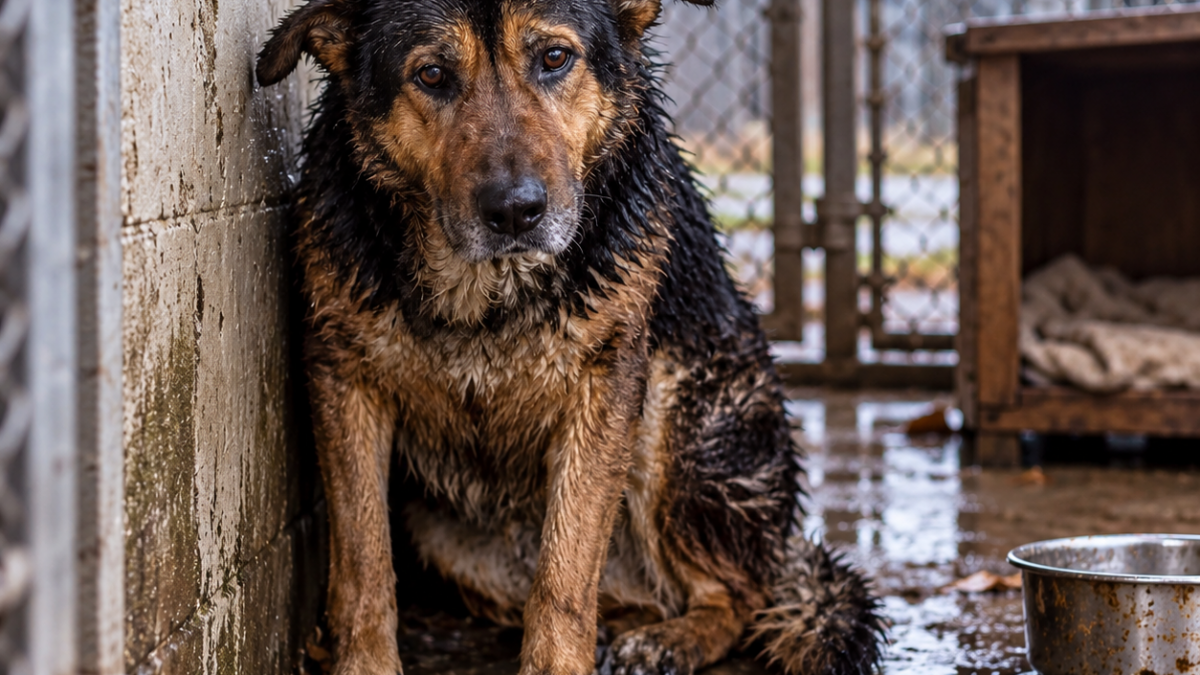
For seven nights, the silent German Shepherd mix refused every bite of food we offered and sat in front of the same locked storage-room door ten minutes before closing.
He never scratched, never barked, and never begged us to open it—he simply waited as if someone on the other side had promised to come back.
When I finally turned the handle, he walked past shelves of food and medicine and stopped at one object that made our entire shelter go silent.
My name is Irina, and the dog arrived at our shelter on a cold, rainy Tuesday night.
Animal control brought him in less than twenty minutes before closing.
They didn’t know his name.
He had no identification tag.
No microchip.
No missing-dog report matched his description.
The officer who delivered him told us he’d been found beside a shuttered warehouse at the edge of town.
Apparently, he’d been sitting near the loading dock for several days.
People from neighboring businesses had seen him in almost the exact same place every morning.
He wasn’t wandering.
He wasn’t searching garbage cans.
He wasn’t chasing cars.
He was simply waiting.
He was a big dog, probably a German Shepherd mixed with something heavier through the chest. His coat was black and reddish brown, soaked flat from the rain. Gray had begun spreading around his muzzle, and the tip of his right ear was torn from what looked like an old injury.
Our veterinarian, Pavel, estimated him at eight or nine years old.
Physically, he wasn’t in terrible condition.
A little thin.
Mild arthritis.
Several worn teeth.
Nothing that explained his behavior.
Because from the moment he entered the shelter, he became almost unnaturally quiet.
He didn’t bark when the other dogs erupted around him.
He didn’t growl when Pavel examined his ears.
He didn’t resist when we led him into a kennel.
He simply watched.
That was the strange part.
His eyes didn’t look frightened.
They didn’t look angry either.
They looked expectant.
As though every time footsteps came down the hallway, he thought the right person had finally arrived.
The next morning, I gave him a bowl of kibble.
He didn’t touch it.
I tried canned food.
Nothing.
Pavel brought cooked chicken from his lunch.
The dog sniffed it once and turned his head away.
He drank water.
That was all.
By the second day, we were worried.
By the third, we were frustrated.
By the fourth, we were frightened.
“He can’t keep doing this,” Pavel said.
“I know.”
“If he refuses another day, we’ll start fluids and assisted feeding.”
I sat on the floor outside the kennel.
The dog looked at me.
“Who are you waiting for?”
His ears lifted.
I tried names.
“Max?”
Nothing.
“Rocky?”
Nothing.
“Bear?”
He blinked.
“Rex?”
Nothing.
No matter what I called him, that same patient expression remained.
Then, on the first evening, something happened that we thought was coincidence.
Ten minutes before closing, he stood.
He walked out of his open kennel and down the hallway.
He stopped in front of our storage-room door.
Then sat.
The room held bags of food, old leashes, donated blankets, cleaning supplies, medications, and boxes animal control occasionally brought in with rescued animals.
The dog stared at the door until we turned off the lights.
Then he quietly returned to his kennel.
The next evening, he did exactly the same thing.
And the evening after that.
Always ten minutes before closing.
Always the storage-room door.
Always waiting until the shelter went dark.
“Was that room ever used for dogs?” I asked Pavel.
“Never.”
“Anything alive in there?”
“Unless a bag of kibble has developed a personality, no.”
By the seventh day, the dog’s ribs had become more visible.
We had already started fluids.
Pavel was discussing placing a feeding tube if we couldn’t break through whatever was stopping him from eating.
That evening, I stayed late.
At 6:50, the dog stood.
He walked down the hallway.
Sat in front of the door.
I followed.
Pavel came behind me.
Neither of us spoke.
The dog didn’t look at us.
He stared at the handle.
A thought came to me that was almost embarrassingly simple.
“What if we open it?”
Pavel shrugged.
“At this point, try anything.”
I reached for the handle.
The latch clicked.
For the first time in seven days, the dog moved before I did.
He rose so quickly his paws slipped on the floor.
I opened the door.
He walked inside.
Past the food.
Past the blankets.
Past an open box of treats.
Then he stopped in front of a black plastic bag that animal control had dropped off the night he’d arrived.
I had forgotten it was there.
Pavel frowned.
“What’s in that?”
“I don’t know.”
The dog lowered his nose to the bag.
His entire body began to shake.
Then, for the first time since entering our shelter, he made a sound.
A low, broken whine.
I knelt and opened the bag.
Inside was an old brown work jacket.
The dog pushed past my hands, buried his face in the fabric, and collapsed on top of it.
Pavel whispered:
“Dear God.”
I lifted one sleeve.
There was a faded company patch on the chest.
And beneath it, stitched into the fabric, was a name.
**WALTER HAYES.**
PART 2
For several seconds, neither Pavel nor I moved.
The dog pressed his entire face into the jacket and breathed deeply, as though the faded smell inside it was more important than air.
Then he did something that broke me.
He pulled one sleeve between his front paws and rested his chin on it.
The gesture was so familiar, so practiced, that I suddenly understood this wasn’t the first time he’d slept against that jacket.
“Pavel.”
“I know.”
“He knows it.”
“I know.”
I touched the patch.
**WALTER HAYES.**
Beneath the name was the logo of the warehouse where animal control had found him.
Northline Distribution.
The warehouse had closed three weeks earlier after the company sold the property.
I remembered seeing something about it in the local newspaper.
Staff layoffs.
Asset liquidation.
Building sale.
Nothing about a dog.
“Why was this in the bag?” Pavel asked.
I tried to remember the intake.
“Animal control brought the bag with him.”
“Did they say where they found it?”
“No.”
I pulled out my phone.
It was after seven, but I called the after-hours number anyway.
Officer Maria Delgado answered.
“Irina?”
“Do you remember the shepherd mix you brought us last week?”
“The one from Northline?”
“Yes.”
“Is he okay?”
“Not exactly. Why did you bring a bag of clothes with him?”
Silence.
“What bag?”
“Black trash bag. Brown work jacket inside.”
“Oh.”
She thought for a moment.
“One of my guys found it beside the loading dock. There were a couple blankets and some personal stuff in a pile near the dumpster. The dog wouldn’t leave the jacket alone, so they brought it with him.”
My grip tightened around the phone.
“Nobody told us.”
“They should have.”
“There’s a name on it.”
“What name?”
“Walter Hayes.”
Another pause.
Then Maria said:
“I know that name.”
My heart jumped.
“Who is he?”
“I’m not sure. Let me check something.”
I could hear typing.
The dog remained pressed against the jacket.
Pavel crouched beside him.
“Easy, buddy.”
The dog ignored him.
Maria came back.
“Walter Hayes made two animal-control calls last year.”
“About this dog?”
“Maybe. Both were routine vaccination questions.”
“Address?”
She read it.
The address was the warehouse.
Not nearby.
The actual warehouse.
“Could he have lived there?”
“Maybe a caretaker apartment.”
“Can you find a phone number?”
“I have one.”
We called.
Disconnected.
Another number.
Disconnected.
Emergency contact.
A woman named Emily Hayes.
We called.
Straight to voicemail.
I left a message.
“My name is Irina. I work with Second Chance Shelter. We have a dog who may belong to Walter Hayes. Please call me as soon as possible.”
I hung up.
Then I looked down at the dog.
He had finally closed his eyes.
For the first time since he’d arrived, he looked almost peaceful.
I whispered:
“Walter.”
His eyes opened.
His head lifted.
Pavel and I stared at each other.
I tried again.
“Walter.”
The dog’s tail moved once.
Not because that was his name.
Because it meant something.
Someone.
I pointed to the jacket.
“Walter?”
His tail moved again.
Pavel stood.
“We’ve got the right man.”
“Now we need to find him.”
—
We let the dog sleep with the jacket that night.
Technically, everything brought in with an animal should be cleaned first.
I didn’t care.
There are rules.
Then there are moments when following the emotional truth matters more than laundry protocol.
We placed the jacket on his bed.
Before I left, I tried one more thing.
I held a small piece of chicken near his mouth.
He turned away.
Then I wrapped the chicken in the jacket sleeve for a moment.
Held it out again.
His nose moved.
He hesitated.
Then ate.
One bite.
I almost shouted.
Pavel grabbed another piece.
“Slowly.”
The dog ate three small pieces.
Then stopped.
That was enough.
“He associates Walter with food,” I whispered.
“Or safety.”
Probably both.
We gave him a new temporary name for the chart.
Scout.
It felt right.
A dog who had spent days watching a warehouse and nights waiting at a door seemed like a Scout.
But every time I said “Walter,” his ears rose.
Somewhere out there was a man this dog still believed would come back.
—
Emily Hayes returned my call the next morning.
I had just arrived at the shelter.
“Is this Irina?”
“Yes.”
“My name is Emily Hayes. You called about my uncle.”
“Yes. Do you know Walter?”
She laughed nervously.
“He’s my father’s brother. What’s this about?”
“We have a dog.”
Silence.
“A German Shepherd mix?”
My heart began pounding.
“Black and brown? Torn right ear?”
Another silence.
Then she whispered:
“Scout.”
I closed my eyes.
Scout.
We had accidentally chosen his real name.
“That’s his name?”
“Yes.”
“Oh my God.”
“Where did you find him?”
“At Northline Distribution.”
Emily inhaled sharply.
“No.”
“What?”
“My uncle thinks Scout is dead.”
The room seemed to tilt.
“What do you mean?”
Emily started talking fast.
“Walter had a stroke about six weeks ago. He worked nights at that warehouse. He lived in a small apartment attached to the office because he was the night security supervisor.”
“Where is he now?”
“St. Matthew Rehabilitation Center.”
My hand tightened around the phone.
“He’s alive.”
“Yes.”
“Conscious?”
“Yes. He’s recovering. His speech is still difficult, but he’s improving.”
I looked through the window into Scout’s kennel.
He was lying on Walter’s jacket.
“Emily, who told him Scout was dead?”
A long pause.
“The warehouse manager.”
The answer came quietly.
“His name is Derek Sloan.”
—
I called Pavel.
Then Maria.
Then I called Emily back and asked her to start from the beginning.
Walter Hayes was sixty-seven.
Widowed.
No children.
He had worked security jobs most of his adult life.
For the last twelve years, he’d been the night watchman at Northline Distribution.
Scout had belonged to him for nearly nine years.
Walter found him as a young stray near the warehouse.
No chip.
No collar.
Skinny.
Terrified.
Walter fed him behind the loading dock for almost a month before Scout finally allowed himself to be touched.
After that, they were almost never apart.
Northline’s previous owner allowed Walter to keep Scout in the caretaker apartment.
Scout walked the property with him at night.
Employees knew him.
Truck drivers knew him.
Even the delivery companies knew the big quiet dog who followed Walter from dock to dock.
“He was never really a guard dog,” Emily said.
“Too friendly?”
“With Walter? Yes. With strangers? He’d watch them. Mostly he just followed my uncle around.”
I understood that immediately.
Waiting was Scout’s language.
He had spent years waiting beside Walter during night shifts.
“Tell me about the stroke.”
“It happened at work.”
“When?”
“Six weeks ago. Around four in the morning.”
“Was Scout there?”
“Yes.”
“A truck driver found my uncle on the floor near the security office. Called 911.”
“And the dog?”
“Scout wouldn’t let the paramedics near at first.”
That sounded like him.
Quiet.
Protective.
“Then what?”
“Derek Sloan arrived.”
“The warehouse manager.”
“Yes. He told the paramedics he would take care of Scout.”
My stomach tightened.
“Did he?”
Emily was silent.
“No.”
“How do you know?”
“Because three days later, when Uncle Walter finally woke up enough to communicate, the first thing he tried to ask about was Scout.”
“What did Derek tell him?”
“That Scout had gotten loose during the ambulance call.”
I closed my eyes.
Emily continued.
“He said they searched. Said somebody later found a dead dog on the highway that matched Scout’s description.”
I stopped breathing.
“Did anyone verify that?”
“No.”
“Did Walter see the dog?”
“No.”
“Was there a body?”
“No.”
“Then why did everyone accept that?”
“Because Walter couldn’t speak well. He was confused after the stroke. Derek sounded certain.”
I looked at Scout.
His head was on the jacket sleeve.
“He lied.”
“I think so.”
“Why?”
“I don’t know.”
But I had a feeling we were going to find out.
—
Emily arrived at the shelter that afternoon.
Scout recognized her before she reached the kennel.
He stood.
Not quickly.
His arthritis made that difficult.
But the transformation was immediate.
His ears rose.
His eyes changed.
Emily stopped in the hallway.
“Scout.”
His tail moved.
Once.
Twice.
Then harder.
She covered her mouth.
“Oh, Scout.”
I opened the kennel.
He walked toward her.
Stopped.
Sniffed.
Then pressed his forehead against her stomach.
Emily broke down.
She knelt and wrapped both arms around him.
“I thought you were dead.”
Scout didn’t make a sound.
He just leaned.
After several seconds, he looked past her.
Down the hallway.
Toward the entrance.
Still waiting.
Emily saw it.
Her face collapsed.
“He’s looking for Walter.”
“Yes.”
“We have to take him.”
“To the rehab center?”
“Now.”
Pavel stepped closer.
“Not immediately.”
We both looked at him.
“Scout hasn’t been eating properly. He’s stressed. Walter is recovering from a stroke. We need permission from the facility and Walter’s medical team.”
Emily nodded quickly.
“Fine.”
“But yes.”
Pavel looked at Scout.
“We should reunite them.”
—
St. Matthew Rehabilitation Center called us back within two hours.
The social worker listened to the story and went quiet.
Then she said:
“Walter talks about Scout every day.”
My throat tightened.
“Does he believe he’s dead?”
“Yes.”
“How is Walter emotionally?”
“Depressed.”
“Could seeing Scout be medically risky?”
“I’ll speak with his physician.”
Twenty minutes later, she called again.
“Bring the dog tomorrow afternoon.”
I barely slept.
—
Before we left the shelter the next day, Scout ate half a bowl of chicken from my hand.
I think Emily’s visit had changed something.
Or maybe he knew.
Dogs notice patterns we miss.
Leash.
Jacket.
Car.
People behaving differently.
He rode in the back seat beside Emily.
Walter’s jacket lay beneath him.
Scout kept one paw on it the entire drive.
—
Walter’s room was on the third floor.
We entered through a private service entrance so Scout wouldn’t have to cross the busy lobby.
The social worker met us downstairs.
“He’s in the therapy room.”
“Does he know?”
“No.”
Emily looked nervous.
“Maybe we should tell him first.”
The social worker shook her head.
“He’ll understand better when he sees.”
Scout walked slowly down the corridor.
Hospital smells surrounded us.
Disinfectant.
Food.
Laundry.
Medication.
His nose worked constantly.
At one intersection, he stopped.
Turned left.
The therapist blinked.
“Walter’s that way.”
Nobody had told Scout.
He pulled gently on the leash.
Not hard.
Just enough.
I followed.
At the end of the corridor, a door stood open.
Inside, Walter sat in a wheelchair beside a therapy table.
Gray hair.
Thin shoulders.
One hand resting in his lap.
His face had the slight unevenness common after a stroke.
He was looking down at a puzzle board.
Scout stopped outside the room.
His whole body froze.
Walter looked up.
For one second, neither moved.
Then Walter’s mouth opened.
No sound came.
His good hand began shaking.
Scout took one step.
Walter made a broken noise.
Not quite a word.
“Sc…”
Scout’s ears rose.
Walter tried again.
“Scout.”
The dog exploded.
There is no other word for it.
He lunged forward so suddenly I nearly lost the leash.
Not aggressive.
Desperate.
He reached Walter and pressed himself against the wheelchair.
His front legs shook.
His entire body shook.
Then the silent dog who hadn’t barked once in more than a week made a sound I will never forget.
It was half howl.
Half cry.
Deep.
Broken.
Human enough that every person in that room started crying.
Walter bent over him.
His weak arm slid around Scout’s neck.
“Boy.”
The word came out slurred.
Scout pushed his face beneath Walter’s chin.
Walter kissed his head.
Again.
Again.
Again.
“You… came.”
Scout whined.
Walter cried.
Emily turned away.
I couldn’t.
I watched because some moments deserve witnesses.
Walter touched the torn ear.
“Good… boy.”
Scout climbed as far into his lap as a sixty-five-pound dog could manage.
The therapist started laughing through tears.
“He shouldn’t be doing that.”
Nobody moved him.
For almost ten minutes, Walter and Scout stayed that way.
Then something even more remarkable happened.
The nurse brought Walter’s lunch.
Scout smelled the chicken.
Walter picked up a tiny piece with his good hand.
Held it out.
Scout ate.
Immediately.
No hesitation.
Another.
Scout ate again.
Pavel, who had come with us, whispered:
“There it is.”
“What?”
“The person he was waiting for.”
—
Walter’s appetite improved too.
The staff later told us that.
Until that day, he’d been eating poorly.
After Scout’s visit, he finished almost half his dinner.
The next morning, he asked for breakfast.
The therapist said his speech exercises improved because he had a word he was determined to say clearly.
Scout.
Again and again.
Scout.
Within a week, Walter could say it almost perfectly.
—
But the reunion also gave us something else.
The truth.
Walter had not believed Derek Sloan’s story completely.
He had been too weak to challenge it.
Now, with Scout alive in front of him, anger sharpened him.
The first time I asked what happened after his stroke, Walter tapped the communication tablet beside his bed.
Slowly, he typed.
**DEREK LIED.**
Then:
**SCOUT WAS INSIDE OFFICE WHEN AMBULANCE CAME.**
Emily looked at me.
“How do you know?”
Walter typed again.
**I LOCKED HIM THERE BEFORE I FELL.**
That mattered.
If Scout had been locked inside the security office, he couldn’t have “run away during the ambulance call.”
Someone had let him out later.
I called Maria immediately.
—
The warehouse sale had closed only days earlier.
The building was empty but not yet renovated.
Maria obtained permission from the new owner to inspect the old security office.
I went only because Walter asked me to.
The room was small.
Desk.
Old monitors.
Metal locker.
A narrow cot.
Dog bed in the corner.
Two stainless bowls.
One still had “SCOUT” written on the bottom in black marker.
I touched it.
Scout had lived here.
This had been home.
The apartment attached to the office had been cleared.
Almost everything Walter owned was gone.
Furniture.
Clothes.
Photographs.
Boxes.
Maria frowned.
“Who authorized this?”
“Derek, probably.”
The new owner gave us the liquidation paperwork.
Northline’s corporate office had ordered equipment removed.
But personal employee property was supposed to be cataloged separately.
Walter’s things weren’t on the list.
Then we found something important.
The old camera server.
The system had been disconnected.
Not destroyed.
Hard drives still inside.
—
Retrieving footage required a warrant because Northline’s corporate office owned the system.
That took time.
While Maria worked on it, Emily found former employees.
Most remembered Scout.
One warehouse worker named Luis Ortega remembered the morning of Walter’s stroke.
“I came in around seven.”
“Derek was there?”
“Yeah.”
“Scout?”
Luis hesitated.
“In the office.”
“Alive?”
“Of course.”
My heart accelerated.
“Did you see him?”
“Through the glass. He was barking and scratching the door.”
That explained nothing yet.
“What happened afterward?”
“Derek told me to take Scout outside.”
“Where?”
“He said the county shelter.”
My eyes narrowed.
“Did you?”
Luis looked ashamed.
“No.”
“Why?”
“I tried.”
He rubbed his hands together.
“Scout wouldn’t get in my truck.”
“Then what?”
“I told Derek.”
“What did he say?”
Luis looked at Maria.
Then at me.
“He said, ‘Then get rid of him however you have to.'”
Silence.
“What did that mean to you?”
“I don’t know.”
“You do.”
Luis looked down.
“I thought he meant dump him somewhere.”
My stomach tightened.
“What did you do?”
“I refused.”
“Then?”
“Derek said he’d handle it.”
“Did you see Scout again?”
“That afternoon.”
“Where?”
“Behind the warehouse.”
“Loose?”
“Yes.”
“So Derek let him out.”
“I guess.”
“Did Scout leave?”
Luis shook his head.
“He kept sitting by the employee entrance.”
Exactly.
Waiting.
—
Luis left for another job two days later.
Northline’s closure had already begun.
He assumed someone took Scout.
Nobody did.
For almost five weeks, Scout remained near that property.
Employees came and went.
Movers.
Liquidators.
Contractors.
Then nobody.
Somebody occasionally fed him.
Nobody took responsibility.
Finally, animal control came.
—
Maria found Derek Sloan in another county.
He had already started a new job managing a logistics company.
When she interviewed him, his first version matched what he told Walter.
Scout escaped.
Then Maria mentioned Luis.
The story changed.
Derek claimed Walter had been keeping Scout at the warehouse against company policy and that after Walter’s hospitalization, no one was responsible for the animal.
Maria asked:
“Why didn’t you call animal control?”
Derek answered:
“I assumed someone else did.”
“Who?”
Silence.
“Why did you tell Walter the dog was dead?”
“I didn’t.”
“His niece says you did.”
“She misunderstood.”
“Did you tell Walter a dead dog had been found on the highway?”
Derek paused.
“I might have said something like that.”
“Was it true?”
“I heard there was a dog.”
“From whom?”
“I don’t remember.”
Every answer made the situation worse.
—
Then the security footage was recovered.
The old server held thirty days.
The day of Walter’s stroke was still there.
At 4:12 a.m., Walter collapsed near the security desk.
Scout immediately ran to him.
For almost three minutes, the dog circled Walter.
Licked his face.
Ran to the office door.
Back to Walter.
Door.
Walter.
Then a truck driver entered.
Scout barked.
The driver called emergency services.
At 4:29, paramedics arrived.
Scout stayed near Walter.
When they attempted to load him onto a stretcher, Scout became protective.
Walter, barely conscious, pointed toward the security office.
One paramedic opened the door.
Scout entered.
They closed him inside.
Exactly as Walter remembered.
Derek arrived at 5:03.
He watched the ambulance leave.
Then entered the office.
Scout was still inside.
At 5:17, Derek opened the door.
Scout ran out.
Not toward the property exit.
Toward where the ambulance had been.
He circled.
Returned.
Derek tried to catch him.
Couldn’t.
At 5:24, he went inside.
Scout stayed at the loading dock.
The next several days showed him waiting.
The cameras captured almost everything.
Not enough food.
Occasional employees leaving scraps.
Scout returning to the security door at night.
Waiting.
Always waiting.
And then the footage showed something Maria hadn’t expected.
Three days after the stroke, Derek carried black trash bags out of Walter’s apartment.
One after another.
He threw several into the dumpster.
Others went into a liquidation truck.
The brown jacket Scout loved went into a pile near the loading dock.
Scout dragged it out.
That was why animal control found him with it weeks later.
The jacket wasn’t random.
Scout had rescued it from the garbage.
—
Walter watched only a short section of the footage.
Emily stopped it.
He didn’t need more.
His face turned red.
His good hand clenched.
He typed on the tablet:
**HE THREW AWAY MY LIFE.**
That sentence changed the case.
Because this was no longer only about a dog.
Walter’s personal belongings had been disposed of while he was hospitalized.
Family photographs.
Documents.
Clothing.
Tools.
Items belonging to his late wife.
His lease agreement for the caretaker apartment had not yet legally ended.
Derek had cleared the space anyway.
—
Northline’s former corporate owner suddenly became very interested.
Their lawyer contacted Emily.
Then Walter.
Then Maria.
Apparently, Derek did not have authority to dispose of Walter’s property.
He had reported internally that Walter had “vacated due to medical incapacity.”
That was false.
He had also submitted a form claiming the apartment contained “abandoned personal effects of no material value.”
Also false.
Why?
Because Northline was trying to close the property quickly.
Walter’s belongings complicated the liquidation schedule.
Scout complicated it more.
Derek chose convenience.
Again.
The same reason people make so many ugly decisions.
Convenience.
—
Derek’s attorney approached Walter with a settlement offer.
Walter refused the first one.
Not because it was small.
Because it included confidentiality language.
Emily read it aloud.
Walter shook his head.
Then typed:
**NO.**
The attorney increased the amount.
Walter typed:
**NO SILENCE.**
I smiled.
The man who was relearning speech refused to be silenced.
—
The company eventually settled the civil claim without requiring confidentiality.
Walter received compensation for the destroyed belongings, housing disruption, and employment-related issues.
Northline publicly acknowledged that its former manager had violated company procedures.
Derek was fired from his new logistics job when the animal-abandonment investigation became public.
He blamed us.
Naturally.
He sent an angry email to the shelter.
I never responded.
It said:
**You people are destroying a man’s career over a dog.**
I printed it.
Not because I needed evidence.
Because I wanted to remember how people reveal themselves.
Over a dog.
As though Scout’s loyalty counted less because he had four legs.
As though Walter’s grief counted less because the thing he loved was an animal.
—
Animal cruelty laws in our county were imperfect.
Derek wasn’t charged with the dramatic felony I wanted.
The prosecutor filed animal abandonment and neglect-related charges supported by the footage and witness statements.
There were also civil issues surrounding Walter’s property.
Derek’s attorney argued that Scout had never been formally registered to Walter.
That was technically true.
The microchip appointment Walter had scheduled months earlier never happened.
But veterinary records solved that.
Walter had paid for Scout’s vaccinations for eight years.
His name.
Scout’s name.
Same address.
Dozens of records.
Ownership wasn’t really questionable.
Only convenient to question.
—
Derek tried one final tactic.
He claimed Scout belonged to Northline because the dog had lived on company property.
That argument lasted less than a day.
One former executive produced an email from years earlier.
**Walter can keep his dog in the caretaker unit as long as he maintains responsibility for him.**
Signed by the company president.
Case closed.
—
While lawyers argued, Scout recovered.
His appetite returned after the first reunion.
Not instantly.
But enough.
At the shelter, we placed Walter’s jacket near his food bowl.
Scout ate.
Then we moved it farther away.
He still ate.
Within two weeks, he was finishing meals normally.
He gained four pounds.
Then six.
His coat improved.
He started making sounds too.
Not much.
Scout remained naturally quiet.
But when Emily arrived, he whined.
When I was late with dinner, he gave one low bark.
The first time it happened, I almost dropped the bowl.
“Excuse me?”
Scout stared.
“Bark again.”
Nothing.
Pavel laughed.
“He’s realized he has staff.”
Apparently.
—
The rehabilitation center allowed Scout to visit Walter three times a week.
Those visits became part of Walter’s therapy.
Walking practice was especially interesting.
Walter had resisted using a walker.
He hated it.
Then the physical therapist clipped Scout’s leash to a belt around her own waist and positioned the dog beside Walter.
“Walk with him.”
Walter stood.
Scout stood.
One step.
Walter’s right leg dragged slightly.
Scout slowed.
Another step.
Scout matched him.
Five feet.
Ten.
Walter’s face tightened with effort.
Scout never pulled.
Never rushed.
He simply walked.
Twenty feet.
The therapists applauded.
Walter glared at them.
Scout wagged.
The next day, Walter walked twenty-six feet.
Then thirty.
Then the hallway.
A month later, he could walk short distances with a cane.
“Scout’s doing more than we are,” one therapist joked.
She wasn’t entirely joking.
—
Finding permanent housing became the next challenge.
Walter’s company apartment was gone.
The warehouse belonged to someone else.
His savings were limited.
Emily lived in a small upstairs apartment that didn’t allow large dogs.
The civil settlement would help eventually, but paperwork took time.
For a while, Walter was terrified that recovery would end with him losing Scout anyway.
He typed:
**SHELTER KEEP HIM?**
I answered:
“As long as necessary.”
Then he typed:
**NOT FAIR TO HIM.**
I crouched beside Scout.
“He waited five weeks at a warehouse and seven nights outside our storage room.”
Walter’s eyes filled.
“I think he’ll wait a little longer.”
Scout placed his head on Walter’s knee.
—
Then Victor entered the story.
Not the factory owner from another case.
A different Victor—Victor Ramos, one of our longtime adopters.
He owned a small duplex.
One unit had recently become vacant.
Ground floor.
Small fenced yard.
Dogs allowed.
When he heard about Walter, he called.
“Irina, I have a place.”
“Rent?”
“Below market.”
“Victor.”
“I own it outright.”
“Still.”
“Look, my wife says if I charge the old man full rent after hearing that story, she’ll divorce me.”
I laughed.
“Smart wife.”
“Terrifying wife.”
Walter visited.
Scout inspected the yard.
Then the kitchen.
Then lay beside the front door.
Walter typed one word:
**HOME.**
—
The settlement eventually covered accessibility modifications.
Handrails.
Small ramp.
Bathroom adjustments.
Emily moved to a nearby apartment.
She promised Walter she’d help with shopping and appointments.
Our rescue arranged a volunteer dog walker for the days Walter felt weak.
Everything came together slowly.
Not magically.
Paperwork.
People.
Calls.
Donations.
Carpentry.
Patience.
That is what happy endings usually look like from the inside.
Work.
—
The day Scout left the shelter, I expected celebration.
Instead, I cried before breakfast.
Pavel found me sitting in Scout’s empty kennel.
“He’s not dead.”
“I know.”
“He’s going home.”
“I know.”
“This is literally the goal.”
“I know.”
“Then why are you crying?”
“Go away.”
He laughed and did.
—
Walter arrived with Emily.
He walked with a cane.
Slowly.
Scout saw him from the hallway.
Tail.
Immediately.
Walter opened his arms.
Scout went to him.
No dramatic howl this time.
No collapse.
Just certainty.
He stood against Walter’s leg as if they’d been apart for hours instead of weeks.
I handed Walter the leash.
Then the jacket.
Cleaned now.
Repaired where one sleeve had torn.
Walter pressed it to his face.
His eyes filled.
“Thank… you.”
His speech had improved dramatically.
I smiled.
“Scout did most of the work.”
Walter looked down.
“Always… does.”
—
Before they left, Walter asked me to walk with them to the storage-room door.
I didn’t understand.
Scout did.
He stopped in front of it.
Same place.
Same door.
Walter looked at me.
“Open.”
I opened it.
Scout walked inside.
He sniffed the empty spot where the black bag had been.
Looked around.
Then walked back out.
No waiting.
No sitting.
He returned to Walter’s side.
Walter smiled.
“Done.”
I almost lost it.
That room had been a question.
Now it was only a room.
—
Derek’s criminal hearing happened several months later.
Walter insisted on attending.
Scout did not.
We agreed court belonged to the human consequence, not the dog’s recovery.
Derek wore a gray suit.
He looked irritated.
Not ashamed.
His attorney described the situation as a misunderstanding created during a chaotic corporate closure.
The prosecutor played footage.
Walter collapsing.
Scout being locked safely inside.
Derek arriving.
Scout later wandering the warehouse.
Derek throwing Walter’s belongings outside.
Then witness testimony.
Luis.
Emily.
Maria.
Veterinary records.
Company emails.
The story became impossible to shrink.
—
When Derek spoke, he made the worst choice possible.
He said:
“I had a warehouse to close. Hundreds of thousands of dollars in inventory. Employees being laid off. Contracts ending. I couldn’t stop everything because one employee had a dog.”
Walter’s cane struck the floor once.
Hard.
The judge looked toward him.
Walter stayed silent.
The judge turned back to Derek.
“Did you call animal control?”
“No.”
“Did you call Mr. Hayes’s listed emergency contact?”
“I don’t remember.”
Emily whispered:
“He didn’t.”
“Did you contact a shelter?”
“No.”
“Did you tell Mr. Hayes his dog was likely dead?”
Derek shifted.
“I was trying to give him closure.”
The courtroom went still.
Even his own lawyer looked unhappy.
The judge repeated:
“Closure.”
“He was in rehabilitation. He kept asking about the animal.”
“So you lied.”
“I thought the dog had disappeared.”
“Your own security footage shows the dog remaining on the property.”
Derek said nothing.
The judge continued.
“You had options.”
Silence.
“You chose the one requiring the least effort from you.”
That was it.
That was the entire story.
—
Derek received probation, fines, restitution related to the animal case, and an animal-ownership restriction for the period allowed under the agreement.
The civil settlement with Northline had already cost far more.
His management career was effectively over, at least for the time being.
The prosecutor later told me Derek had applied for several operations jobs.
Background checks repeatedly raised questions.
I should not have enjoyed that.
I did a little.
Not because I wanted him homeless.
Because consequences had finally become inconvenient.
He had built the entire disaster around avoiding inconvenience.
Now he had to carry some.
—
Outside court, a reporter asked Walter:
“Do you feel vindicated?”
Walter’s speech was still slower than before the stroke.
He looked at the microphone.
Then at me.
Then answered:
“Scout… home.”
The reporter waited.
Walter smiled.
“Enough.”
That was all.
No revenge speech.
No anger.
Scout home.
Enough.
Walter understood something before I did.
—
I had spent months imagining Derek losing everything.
Job.
Money.
Reputation.
I wanted symmetry.
He had thrown Walter’s life into garbage bags.
I wanted his life scattered too.
But Scout didn’t care about Derek.
He never once waited for him.
Never looked for him.
Never needed an apology.
Scout’s entire emotional world had always pointed toward Walter.
That made revenge feel smaller.
Not meaningless.
Consequences were necessary.
But smaller.
—
Walter and Scout settled into the duplex.
At first, Scout slept against the front door.
Old habit.
Waiting.
Then gradually, he moved.
First beside Walter’s recliner.
Then on a dog bed Emily bought.
Then, despite a strict “no dogs on furniture” rule Walter announced with great authority, onto the couch.
I visited one afternoon and found Scout stretched across three cushions.
Walter was squeezed into the fourth.
I pointed.
“Rules going well?”
Walter looked at Scout.
“Temporary.”
Scout snored.
“Very temporary.”
—
Their routine returned.
Morning walk.
Breakfast.
Walter’s medication.
Scout’s joint supplement.
Afternoon nap.
Short evening walk.
Scout waited beside the bathroom when Walter showered.
Waited outside the bedroom if the door closed.
Waited by the front window whenever Walter went to therapy.
But now waiting had an ending.
Every time Walter returned, Scout stood.
Tail wagging.
Door opened.
Person came home.
That repetition repaired something neither medicine nor court could.
—
Walter’s speech continued improving.
One day he called the shelter himself.
No Emily.
No therapist.
Just Walter.
“Irina.”
I almost cried hearing my name clearly.
“Hi, Walter.”
“Scout… stole chicken.”
I laughed.
“What do you want me to do about it?”
“Return policy?”
“Absolutely not.”
Scout barked in the background.
Walter laughed.
That sound mattered.
Months earlier, we weren’t sure Walter would walk independently or speak clearly again.
Now he was calling to complain that his dog had stolen dinner.
Ordinary problems.
The best problems.
—
Northline’s former corporate office funded a small shelter grant as part of repairing its public reputation.
I was skeptical.
Money is money.
We accepted it.
But I insisted on one condition.
No company branding.
No press release.
The grant paid for microchips and emergency boarding for pets whose owners were unexpectedly hospitalized.
We called it the **Stay Together Fund**.
Walter chose the name.
The program existed because of one obvious lesson:
When a person has a medical emergency, somebody needs to ask what happens to the animal waiting at home.
Hospitals began keeping our contact information.
Social workers called.
Paramedics added a simple question when possible:
**Is there a pet depending on you?**
Scout’s story changed procedure.
That mattered more than Derek’s fine.
—
The first animal helped by the fund was a fourteen-year-old cat named Lucy.
Her owner had emergency heart surgery.
A neighbor fed Lucy for one day but couldn’t keep her.
Instead of the cat disappearing into a chaotic system, the hospital social worker called us.
Lucy stayed with a foster family for three weeks.
Then went home.
Her owner cried.
I cried.
Pavel said I needed a hobby that involved fewer fluids.
He was probably right.
—
Walter eventually volunteered at the shelter.
Not immediately.
It took almost a year after the stroke.
He couldn’t handle heavy work.
So he sat at the front desk two mornings a week.
Answered simple questions.
Folded towels.
Prepared adoption folders.
Scout lay beside his chair.
New volunteers always asked:
“Is that the storage-room dog?”
Walter would smile.
“Scout.”
He insisted on the name.
Not “the storage-room dog.”
Not “the warehouse dog.”
Scout.
Just Scout.
I understood.
Trauma nicknames become cages if you’re not careful.
—
One rainy afternoon, a frightened shepherd arrived.
Female.
Young.
Wouldn’t enter the kennel.
The staff tried treats.
Leash pressure.
Nothing.
Walter watched.
Then he stood slowly.
Took his cane.
Walked toward the dog.
He didn’t touch her.
He sat on a chair nearby.
Scout lay at his feet.
The young dog stared.
Scout stared back.
Five minutes.
Ten.
Then she walked closer.
Sniffed Scout.
Scout remained calm.
She took another step.
Walter placed a treat on the floor.
She ate.
I watched from the hallway.
The man and dog who had once needed us were now helping someone else.
That is the part of rescue nobody can predict.
—
Scout turned ten.
We estimated.
Walter insisted on a birthday.
Chicken.
Dog-safe cake.
A ridiculous paper hat.
Scout tolerated the hat for four seconds.
Walter laughed so hard he had to sit down.
Emily took photographs.
One became my favorite.
Walter smiling.
Scout looking deeply offended.
Both alive.
Both home.
—
Derek disappeared from our daily lives.
That surprised me.
For months, he’d occupied so much space in my mind.
Every phone call.
Every court update.
Every new piece of evidence.
Then the case ended.
And one day I realized I hadn’t thought about him in weeks.
That felt like freedom.
Hatred requires maintenance.
Scout had better things to teach me.
—
Two years after the reunion, Walter received a letter.
Derek.
He almost threw it away.
Instead, he brought it to the shelter.
“Read?”
He handed it to me.
I hesitated.
“Are you sure?”
“Yes.”
The letter wasn’t long.
Derek wrote that he had made decisions during the warehouse closure he now regretted.
He said he had been overwhelmed.
He said he had convinced himself Scout would “find somewhere to go.”
He admitted lying to Walter about the highway because he didn’t want to keep answering questions he couldn’t resolve.
The sentence that mattered most was:
**I treated what mattered most to you as if it were an obstacle in my schedule. I understand now that this was cruel.**
I looked at Walter.
“What do you want to do?”
He took the letter.
Folded it.
Then placed it on the table.
“Nothing.”
“Do you forgive him?”
Walter looked toward Scout.
The old dog was asleep beneath the desk.
Walter shrugged.
“Don’t… need.”
That answer stayed with me.
Forgiveness is not always required for healing.
Sometimes distance is enough.
—
Walter kept the letter for a week.
Then threw it away.
Not dramatically.
Kitchen trash.
Coffee grounds on top.
Perfect.
—
Scout aged.
Gray spread across his muzzle.
His hips stiffened.
He couldn’t walk the long evening route anymore.
Walter’s own pace had slowed too.
They matched.
Old man.
Old dog.
Cane.
Leash.
Neighbors knew them.
Children waved.
Scout tolerated gentle petting but remained most interested in Walter.
Always Walter.
—
One winter, Scout slipped on ice.
No fracture.
But his arthritis worsened.
We started anti-inflammatory medication.
Walter bought rugs for every slippery floor.
The duplex looked ridiculous.
Long mismatched runners everywhere.
Emily teased him.
Walter pointed at Scout.
“Needs.”
That ended discussion.
—
At eleven, Scout developed a heart murmur.
Mild.
Manageable.
Pavel monitored it.
Walter listened carefully during every appointment.
He wrote medication times on a whiteboard.
Never missed one.
The man once accused, indirectly, of being irresponsible for keeping a dog at work became the most obsessive senior-dog owner I had ever seen.
At 7:00 a.m.
Pill.
At 7:00 p.m.
Pill.
Joint supplement.
Measured food.
Weekly weight.
He kept records.
Probably more detailed than our clinic.
—
Scout kept one habit from the shelter.
Ten minutes before bedtime, he would sit near Walter’s bedroom door.
Not because it was closed.
Because that was when Walter usually went to bed.
Scout waited.
Walter would stand.
“Ready?”
Scout rose.
Together, they went inside.
Waiting had become routine instead of grief.
I loved that.
—
The Stay Together Fund grew.
Other donors contributed.
A local hospital added a pet-care question to its emergency intake forms.
Two veterinary clinics offered discounted boarding for medical emergencies.
A domestic violence shelter partnered with us for temporary pet placement.
None of that happened because Scout was famous.
He wasn’t.
It happened because his case exposed a gap.
An animal can become invisible when the human responsible for it suddenly can’t speak.
We fixed a little piece of that.
—
Walter spoke at the program’s second anniversary.
Public speaking was difficult after his stroke.
He prepared for weeks.
Scout sat beside him onstage.
Walter gripped the podium.
“My name… Walter Hayes.”
Pause.
“This… Scout.”
Scout looked at the audience.
“Six years ago?”
He stopped.
I whispered from the side:
“Three.”
He laughed.
Audience laughed too.
“Three years ago… I had stroke.”
He continued slowly.
“Scout waited.”
Another pause.
“I could not… tell people.”
His voice shook.
“He could not… tell people.”
The room went silent.
“So both… waited.”
He placed one hand on Scout’s head.
“Someone finally listened.”
That was the entire program in one sentence.
Someone listened.
—
Afterward, a nurse approached Walter.
She had heard the speech.
Two months later, she called us about a patient whose two cats were alone in an apartment.
The cats were retrieved.
Safe.
Returned after recovery.
The chain continued.
One story preventing another.
—
Scout reached twelve.
Maybe thirteen.
We couldn’t be sure.
His heart disease progressed.
Medication increased.
Walks shortened.
Walter knew.
I knew.
Emily knew.
Nobody said much.
People who have lost enough stop pretending time can be negotiated.
They just use it carefully.
—
Scout still came to the shelter sometimes.
He would walk down the old hallway.
Past kennels.
Past the office.
Then past the storage-room door.
For years, I watched to see whether he’d stop.
He never did.
Not once.
That door had lost its power completely.
—
On his final visit, he paused.
Not at storage.
At my desk.
He placed his head on my knee.
I scratched behind the torn ear.
“You’re getting sentimental.”
Scout closed his eyes.
Walter sat nearby.
“Likes you.”
“Only because I fed him.”
Walter smiled.
“Still counts.”
—
The end came in early spring.
Scout stopped eating breakfast.
Walter called immediately.
Pavel went to the duplex.
Heart failure had advanced.
His breathing was harder.
He was tired.
We could adjust medication.
Maybe gain days.
Maybe a week.
Not good days.
Walter understood.
He sat beside Scout’s bed.
His speech, almost fully recovered by then, became very clear.
“No more waiting.”
Pavel looked at him.
“Are you sure?”
Walter nodded.
“He’s done enough.”
I had to leave the room for a minute.
—
We scheduled euthanasia for that evening at home.
Walter didn’t want Scout returning to the clinic.
He didn’t want a car ride.
No fluorescent lights.
No strange room.
Home.
Emily came.
Pavel came.
I came.
Maria, retired from animal control by then, came too.
She had been the one who brought Scout to us.
Full circle.
—
Scout lay on Walter’s jacket.
The same brown work jacket.
Old now.
Patched twice.
Still there.
Walter had kept it all these years.
Of course he had.
Scout rested his head on the sleeve exactly as he had in our storage room.
I couldn’t breathe for a second.
Walter noticed.
“Remember?”
“Yeah.”
He stroked Scout’s face.
“I almost threw this jacket away after the company closed.”
“Don’t say that.”
He smiled.
“Scout wouldn’t allow.”
Probably true.
—
Walter leaned closer.
“You waited for me.”
Scout’s eyes opened.
Walter’s hand shook.
“I came back.”
Tail.
One weak movement.
That was enough.
Walter laughed through tears.
“Good boy.”
Pavel gave the sedative.
Scout relaxed.
His breathing eased.
Walter kept talking.
“You don’t need to watch the door.”
Another slow breath.
“No warehouse.”
Scout’s eyes softened.
“No shelter.”
Walter kissed his forehead.
“No waiting.”
My tears fell before I could stop them.
Walter whispered:
“I’m here.”
The final medication went in.
Scout’s chest rose.
Fell.
Rose once more.
Then stopped.
Walter kept one hand on him.
No one spoke.
After a long time, Walter said:
“He knew.”
I nodded.
“Yes.”
Scout had spent the worst weeks of his life not knowing whether Walter would return.
He spent the final years knowing exactly where he belonged.
That was enough.
—
We cremated Scout.
Walter kept most of the ashes.
A small portion went beneath a tree outside the shelter.
The plaque didn’t mention the warehouse.
Or Derek.
Or the storage room.
Walter chose the words.
**SCOUT**
**HE WAITED.**
**WE CAME BACK.**
That was all.
—
Walter continued volunteering after Scout died.
Not immediately.
He stayed home for almost a month.
Then one Tuesday morning, I looked up and saw him at the front desk.
No Scout.
Empty space beside the chair.
My chest hurt.
Walter placed his cane against the wall.
“Need help?”
I nodded.
“Always.”
He sat.
For a while, neither of us mentioned the empty space.
Then a volunteer brought in adoption folders.
Walter started sorting.
Life continued.
—
Six months later, a senior shepherd mix arrived.
Gray muzzle.
Arthritis.
Quiet.
Her owner had gone into hospice.
The family couldn’t keep her.
Her name was Molly.
Walter pretended not to notice her.
For three days.
On day four, I found him sitting beside her kennel.
“Don’t.”
He looked at me.
“Don’t what?”
“You know.”
“I am sitting.”
“That’s how it starts.”
Molly put one paw through the bars.
Walter looked at it.
Then at me.
“No.”
“Good.”
He stayed another hour.
—
Two weeks later, Molly went home with Walter.
Temporary foster.
Obviously.
Three months later, adoption paperwork.
Obviously.
I said nothing.
Walter signed.
Then looked at me.
“Not replacing.”
“I know.”
“Different.”
“I know.”
Molly leaned against his leg.
Walter smiled.
“Different good.”
Exactly.
—
The Stay Together Fund eventually helped more than four hundred animals.
Four hundred dogs and cats whose owners were hospitalized, injured, displaced, or temporarily unable to care for them.
Every year, we told Scout’s story to new volunteers.
Not the dramatic version.
The practical one.
A dog waited at a warehouse.
A man couldn’t speak.
A manager lied.
A jacket carried a scent through a closed door.
Someone opened it.
Then people started asking better questions.
—
Derek Sloan became irrelevant.
That was the final punishment, in a way.
For months, he had been the antagonist in every conversation.
Eventually, his name disappeared.
The policy remained.
The fund remained.
Walter remained.
Scout’s plaque remained.
Derek became a file in a cabinet.
That’s where people who harm others belong in the end.
Not at the center.
In the paperwork.
—
Years later, a journalism student interviewed Walter for a local story about the fund.
She asked:
“Do you still think about the man who abandoned Scout?”
Walter considered.
“Sometimes.”
“Are you angry?”
“Less.”
“Did justice happen?”
Walter looked toward Molly sleeping beside him.
Then answered:
“Justice?”
He paused.
“Scout got home.”
The student waited.
Walter smiled.
“Everything else… paperwork.”
I laughed when I read the article.
That was Walter.
—
He was right.
The courtroom mattered.
The fines mattered.
The settlement mattered.
Animal laws matter.
Accountability matters.
But none of those things were what Scout had been waiting for.
He had not sat outside Northline Distribution because he wanted Derek punished.
He had not refused food because he wanted the company embarrassed.
He had not sat outside our storage room because he wanted a judge.
He wanted one man.
One smell.
One voice.
One familiar hand.
Walter.
Everything else was secondary.
—
I still work at the shelter.
The storage room has been reorganized three times.
New shelves.
New floor.
Different door.
The old brown jacket is gone.
Walter keeps it folded in a cedar chest.
But sometimes, ten minutes before closing, I still look down that hallway.
I see Scout in my memory.
Big dog.
Gray muzzle.
Torn ear.
Sitting perfectly still.
Waiting in front of a door none of us understood.
For seven nights, we thought he was interested in something inside.
Food.
A blanket.
A smell.
We were partly right.
But what he really recognized was proof.
Proof that his old life had been real.
That Walter had been real.
That he hadn’t imagined being loved.
The jacket was not what Scout wanted.
It was a thread.
He pulled it.
We followed.
And at the other end was the person he had never stopped waiting for.
—
Sometimes a rescue doesn’t begin when you find the animal.
Sometimes it begins when you finally understand what the animal is trying to tell you.
Scout never barked.
He never scratched the door.
He never dragged us toward it.
He simply sat.
Night after night.
Quiet.
Patient.
Certain.
As if he knew humans could be slow.
He was right.
But eventually, we opened the door.
And once we did, the rest of his life finally opened with it.



