PART 2: The Shelter Said I Could Take the Tiny Chihuahua—Then She Screamed When They Tried to Leave the Old Pit Bull Behind
PART 2
The way Dave said it made every hopeful feeling inside me disappear.
“What do you mean?”
He glanced toward the office again.
The kennel corridor was long and narrow, lined on both sides with dogs that had been barking when I first entered.
Now even they seemed quieter.
“I probably shouldn’t be telling you this.”
“That sentence has never made anyone feel better, Dave.”
He gave a nervous laugh, but there was no humor in it.
Then he lowered his voice.
“Brooklyn’s status changed this morning.”
“To what?”
He looked at the old dog.
“Transfer pending.”
I didn’t understand.
“Transfer where?”
“A contracted facility east of the county.”
“When?”
“Monday.”
It was Friday.
I stared at him.
“And what happens there?”
Dave didn’t answer immediately.
He didn’t have to.
I had lived long enough to recognize silence when someone was trying not to tell you something cruel.
“Dave.”
“They evaluate incoming dogs.”
“For adoption?”
“Sometimes.”
Sometimes.
The word landed harder than it should have.
I looked at Brooklyn.
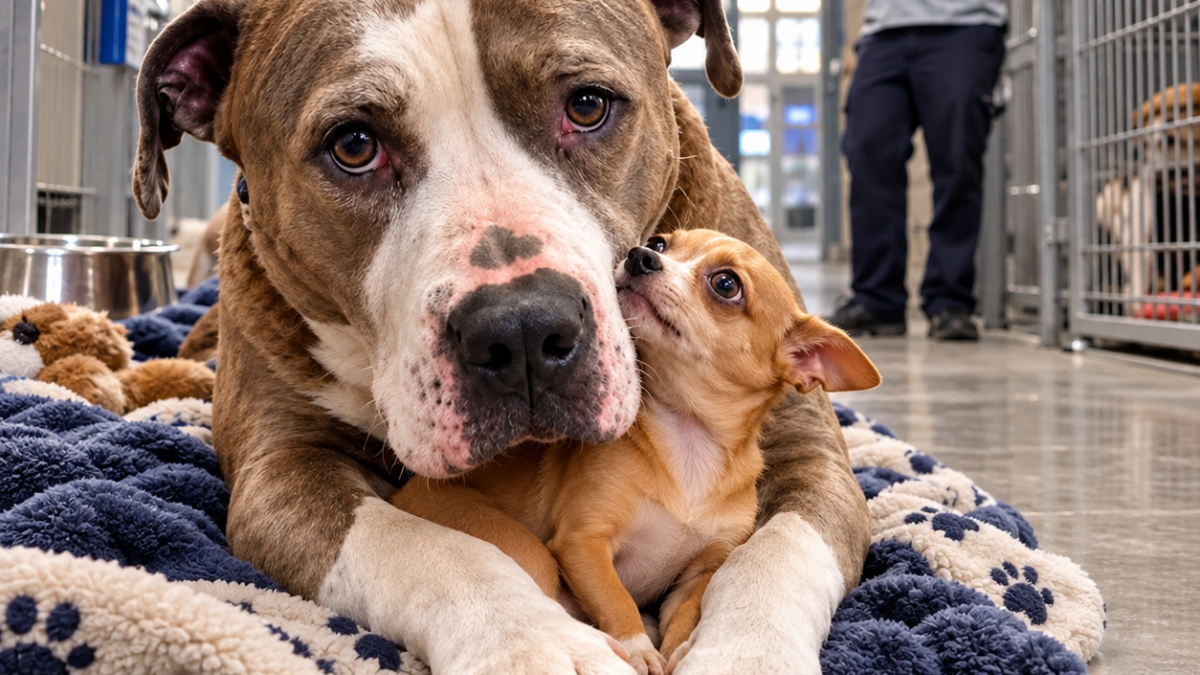
He had settled again, but Pippa was practically lying across his front legs now.
“What happens if he doesn’t pass?”
Dave’s jaw tightened.
“Mrs. Parker, I really can’t—”
“What happens?”
He finally met my eyes.
“Older dogs with medical concerns don’t always have many options.”
I felt cold.
Brooklyn had spent eleven months in this shelter.
Eleven months watching people stop at other kennels.
Eleven months watching younger dogs leave through the front door.
And now, three days before he might be sent somewhere from which he might never return, a six-pound Chihuahua had decided he was her whole world.
“Then there is no problem,” I said.
Dave blinked.
“What?”
“You said he was being transferred because no one adopted him.”
“Yes.”
“I am adopting him.”
“Mrs. Parker—”
“Joyce.”
He swallowed.
“Joyce, Brooklyn’s file has already been placed under administrative review. I can’t release him without authorization.”
“Then get authorization.”
“It isn’t that simple.”
I looked down at myself.
I was wearing sensible gray slacks, orthopedic sneakers, and a blue cardigan Daniel had given me for Christmas.
I probably looked like the least threatening revolutionary in Washington State.
But something about being widowed had changed my relationship with the phrase it isn’t that simple.
I had heard it from hospitals.
Insurance companies.
Banks.
The funeral home.
People said it when what they really meant was there are rules, and you’re too tired to challenge them.
I wasn’t tired anymore.
“Who can authorize him?”
Dave sighed.
“The shelter director.”
“Then I’d like to meet the shelter director.”
Ten minutes later, I was sitting in a small office across from a woman named Lena Ortiz.
She was in her early fifties, dark hair streaked with silver, reading glasses hanging from a cord around her neck.
She looked exhausted rather than unfriendly.
That mattered to me.
There are people who enjoy telling you no.
Lena didn’t look like one of them.
“I understand you want to adopt both dogs,” she said.
“Yes.”
“Pippa has already been cleared. Brooklyn is more complicated.”
“Because he’s old?”
“Partly.”
“Because he’s a pit bull?”
“Partly.”
“Because someone decided to send him away on Monday?”
Her eyes moved toward Dave.
Dave looked at the floor.
Lena exhaled.
“I would have preferred to explain that myself.”
“You can explain it now.”
She folded her hands.
“Our shelter has been over capacity for nearly seven months. Brooklyn has been available for adoption for most of the time he’s been here. We’ve promoted him online twice. We’ve waived his adoption fee. We’ve contacted senior-dog rescues.”
“And nobody came.”
“No.”
“I came.”
Her expression softened.
“I understand that.”
“Then why are we still talking?”
“Because I have to make sure you’re prepared for what you’re asking.”
She pulled Brooklyn’s file toward her.
“He weighs seventy-two pounds.”
“I can see that.”
“He has arthritis in both hips.”
“I have arthritis in both knees. Maybe we’ll start a club.”
Dave coughed into his fist.
Lena almost smiled.
“He may need medication.”
“I can afford medication.”
“He needs a secure yard.”
“I have a fenced backyard.”
“Your homeowners insurance may have breed restrictions.”
“I’ll call them.”
“He may have limited time.”
That one stopped me.
Lena’s voice gentled.
“I don’t mean days. His bloodwork is decent for his age. But he’s at least ten, possibly eleven or twelve.”
I looked through the office window toward the kennel corridor.
Pippa was curled against him.
“None of us have unlimited time.”
Lena stayed silent.
I thought of Richard.
The last doctor had given us six to eight months.
We got nineteen days.
Time had stopped feeling like something anyone could promise.
“What else?” I asked.
Lena looked down at Brooklyn’s file.
“There is one more problem.”
Of course there was.
“A member of our oversight board reviewed the long-term population this morning. Brooklyn was among six dogs approved for transfer.”
“Can that decision be reversed?”
“Normally, yes.”
“Normally?”
She hesitated.
Then the office door opened.
A woman walked in without knocking.
She was probably in her early sixties, perfectly styled silver-blond hair, cream-colored coat, expensive leather handbag.
She looked at Lena.
“Why is kennel twelve still showing a hold?”
Lena’s face tightened almost imperceptibly.
“Carol, I’m with a prospective adopter.”
The woman looked at me.
Then through the window.
Her eyes rested on Brooklyn.
“Oh.”
There was something about the way she said it that I disliked immediately.
Not anger.
Not fear.
Dismissal.
“This is Joyce Parker,” Lena said. “She wants to adopt Pippa and Brooklyn together.”
The woman gave me a polite smile.
“That’s generous.”
“I wasn’t asking for a compliment.”
Her smile faded half an inch.
Lena said, “Joyce, this is Carol Wexler. She chairs the shelter advisory board.”
Carol set her handbag on the desk.
“Mrs. Parker, I’m sure your intentions are wonderful. But Brooklyn has been here nearly a year. We’ve reached the end of what we can reasonably do.”
“I just told you I want him.”
“Yes. Today.”
I frowned.
“What does that mean?”
“Emotional shelter decisions often feel different once people get home.”
Her eyes moved over me.
“He’s a large, elderly dog. You’re…”
She stopped.
“I’m what?”
“Living alone, I understand.”
There it was.
Not quite an insult.
Just polished enough to hide one.
“I lived with my husband for thirty-eight years,” I said. “He weighed one hundred eighty-seven pounds and snored louder than any pit bull. I managed him.”
Dave looked away quickly.
Lena pressed her lips together.
Carol didn’t laugh.
“Brooklyn requires an experienced adopter.”
“Does his file say he’s aggressive?”
“No.”
“Has he bitten anyone?”
“No.”
“Failed a behavior test?”
“No.”
“Then what experience am I missing?”
Carol’s jaw tightened.
“This isn’t personal.”
“That usually means it is.”
She opened Brooklyn’s folder.
“The transfer paperwork has been approved.”
“By whom?”
“The board.”
“All of them?”
“My committee.”
“How many people are on your committee?”
She stared at me.
I had spent thirty-eight years married to a man who worked as a building inspector.
Richard had taught me something valuable.
Whenever someone uses an official-sounding phrase, ask how many signatures are actually on the paper.
Carol closed the file.
“The decision is final.”
Pippa barked from the kennel corridor.
One sharp sound.
Then another.
Brooklyn remained quiet.
I stood.
“Then I’ll take Pippa today.”
Dave stared at me.
Carol gave a satisfied nod.
And then I finished.
“After Brooklyn’s adoption is approved.”
Carol’s face hardened.
“You’re refusing the Chihuahua?”
“I’m refusing to break up a bonded pair because your paperwork moves faster than your compassion.”
“Joyce,” Lena said carefully.
But I wasn’t finished.
“If they have slept together every night, if she panics when she’s separated from him, and if he puts his body between her and anyone trying to take her away, I’m not going to carry that little dog out the door while he watches.”
Carol picked up her purse.
“Then perhaps neither dog is appropriate for you.”
I felt the words like a slap.
Dave did too.
His head came up.
Lena’s chair moved backward.
“Carol.”
But Carol was already leaving.
She stopped in the doorway.
“The transfer truck arrives at eight Monday morning.”
Then she walked out.
For several seconds nobody spoke.
I looked at Lena.
“Is she always that pleasant?”
Lena rubbed her forehead.
“No.”
Dave muttered, “Yes.”
“Dave.”
“Sorry.”
I almost laughed.
Instead, I looked through the glass at Brooklyn and Pippa.
“What do I have to do?”
Lena leaned forward.
“For me to approve an adoption, I need your insurance confirmation, veterinary reference if you have one, proof of fencing, and a basic handling evaluation.”
“I haven’t owned a dog in twelve years.”
“A previous veterinarian is enough.”
“I can get that.”
“If your insurer won’t cover him, you’ll need an alternative policy.”
“I can get that too.”
Lena studied me.
“You’re serious.”
“I haven’t been this serious about anything since my husband’s oncologist told me to take him to the emergency room.”
Her face softened.
Then she reached for a blank form.
“Let’s start.”
I spent the next three hours making telephone calls.
My insurance company did not prohibit pit bulls, but it required notification and additional liability coverage.
Fine.
I bought it.
My old veterinarian, Dr. Samuel Rhodes, still remembered our beagle, Molly, who had died at sixteen.
He faxed a reference within twenty minutes.
I sent Daniel photographs of my backyard fence.
He called immediately.
“Mom, why are you sending me pictures of the fence?”
“I need you to tell me if the gate looks secure.”
“For what?”
“A dog.”
There was silence.
Then excitement.
“You found one?”
“Two.”
Another silence.
“Two?”
“One is six pounds.”
“And the other?”
“Seventy-two.”
“Mom.”
“He’s old.”
“That doesn’t make him lighter.”
“Daniel.”
“What breed?”
I hesitated.
“A pit bull.”
My son inhaled so deeply I could hear it through the phone.
“Mom.”
“Don’t start.”
“I’m not starting. I’m processing.”
“He’s gentle.”
“You’ve known him three hours.”
“I knew your father eleven days before I agreed to marry him.”
“And Grandma reminded you that was reckless until the day she died.”
“She was wrong.”
“She liked Dad.”
“Eventually.”
Daniel sighed.
“Tell me what’s happening.”
So I did.
I told him about Pippa’s scream.
Brooklyn standing up.
The transfer.
Carol.
When I finished, my son was quiet.
Then he asked one question.
“Do you want them?”
“Yes.”
“Both?”
“Yes.”
“Then what do you need?”
I closed my eyes.
That was Daniel.
He worried first.
Then he showed up.
“The shelter wants someone to inspect my fence.”
“I can be there tomorrow morning.”
“You live four hours away.”
“Then I’ll leave early.”
“You have work.”
“It’s Saturday.”
“Oh.”
“Mom?”
“Yes?”
“I haven’t heard you sound this alive in two years.”
That silenced me.
I looked toward the kennel.
Brooklyn was asleep.
Pippa had curled into the hollow between his front legs.
“I’ll see you tomorrow,” Daniel said.
He arrived at eight-thirty the next morning carrying a toolbox, coffee, and the expression of a man who had prepared himself for disaster.
When I showed him a photograph of Brooklyn, he stopped halfway through taking off his jacket.
“That is not a dog.”
“Yes, it is.”
“That is a sofa with teeth.”
“He doesn’t show his teeth.”
“I hope he keeps that policy.”
“Daniel.”
He smiled.
“I’m kidding.”
Mostly.
We spent the morning checking every fence board.
Daniel replaced two loose screws, reinforced the latch, and installed a second bolt higher on the gate.
At noon, Lena came to inspect the property.
She walked the yard.
Checked the fence.
Looked at the dog beds I had bought that morning.
One tiny.
One enormous.
“You work fast,” she said.
“When you’ve spent two years putting things off, sometimes it’s nice to do something immediately.”
She nodded.
Then she looked through the sliding doors into my living room.
Her eyes stopped on Richard’s chair.
“Your husband?”
“Yes.”
“I’m sorry.”
“So am I.”
She looked back at me.
“My husband left twelve years ago.”
I wasn’t sure what to say.
She smiled faintly.
“Sometimes people assume grief only belongs to death.”
That sentence changed something between us.
Lena wasn’t just the woman standing between me and Brooklyn anymore.
She was someone who understood an empty place.
We returned to the shelter for the handling evaluation at three.
Daniel came with me.
Dave brought Brooklyn into a fenced outdoor yard.
For the first time, I saw the old dog in sunlight.
He was more beautiful than he had looked beneath fluorescent kennel lights.
His coat was dark charcoal with a white patch on his chest.
He moved stiffly.
Carefully.
He sniffed the grass.
Then he saw Pippa on the other side of the gate with another employee.
Brooklyn’s entire body changed.
His ears lifted.
His tail began moving.
Pippa practically screamed with excitement.
The gate opened.
She ran beneath him.
Actually beneath him.
Then spun around his legs so fast that Daniel laughed.
“Oh, my God.”
Brooklyn looked at him.
Daniel stopped laughing.
The old dog walked toward him.
Slowly.
Daniel stayed still.
Brooklyn sniffed his hand.
Then leaned his enormous head against my son’s thigh.
Daniel looked at me.
“Oh, no.”
“What?”
“Now I like him.”
I smiled for the first time that day.
The evaluation went perfectly.
Brooklyn allowed me to touch his ears, paws, collar, back, and muzzle.
He walked beside me on a leash.
When another dog barked aggressively from across the yard, Brooklyn looked once and then continued walking.
When Pippa disappeared behind the building for part of the separation test, however, he stopped.
He didn’t panic.
He simply stared at the gate through which she had vanished.
And waited.
When she returned, he touched his nose to the top of her head.
Lena wrote something on her clipboard.
“What?” I asked.
She hesitated.
“Bonded behavior.”
“So you agree.”
“I agree they’re attached.”
“That’s not the same thing.”
“No.”
“What would convince you?”
Lena lowered the clipboard.
“Joyce, I am trying to help you.”
“Then help me understand.”
She glanced toward the building.
“Carol believes keeping bonded animals together makes them harder to place.”
“Sometimes it probably does.”
“Yes.”
“So?”
“So six months ago, she stopped allowing the designation unless the animals entered the shelter together.”
I stared at her.
“Did Brooklyn and Pippa enter together?”
“No.”
“When did Pippa arrive?”
“Thirty-four days ago.”
“And she bonded to him here?”
“Yes.”
“So because the friendship happened after they became homeless, it doesn’t count?”
Lena looked ashamed.
“That’s the policy.”
“That’s ridiculous.”
“I didn’t say I agreed with it.”
“Then why follow it?”
Her eyes flashed.
“Because this shelter took in 2,418 animals last year with a budget built for 1,600. Because three kennel technicians quit. Because our heating system failed in January. Because the county delayed our funding vote twice. Because every day I decide which emergency gets handled first while people on Facebook call us monsters from their couches.”
I said nothing.
Lena took a breath.
“I’m sorry.”
“No. I am.”
She rubbed her temple.
“I’m tired.”
“I can see that.”
“So is Dave.”
“I can see that too.”
She looked toward Brooklyn.
“And he’s tired.”
That was when I realized Carol might be the person blocking this adoption, but the shelter itself wasn’t my enemy.
Most of the people inside it were drowning.
“What happens now?” I asked.
Lena checked her clipboard.
“From my perspective, you passed.”
Daniel smiled.
“So she can take them?”
Lena looked toward the administrative wing.
“I need one more signature.”
Carol’s.
Of course.
Carol arrived at four-fifteen.
She barely looked at the evaluation report.
“No.”
Lena’s jaw tightened.
“She passed every requirement.”
“Brooklyn has already been assigned for transfer.”
“A transfer can be canceled.”
“Not after manifest approval.”
“I’m the shelter director.”
“And I’m chair of the advisory board.”
Daniel stepped forward.
“I’m sorry. Who actually has legal authority over adoptions?”
Carol looked at him.
“And you are?”
“Her son.”
“That doesn’t answer my question.”
“My mother owns the home, has the insurance, passed your inspection, and passed your evaluation. I’m asking what legal rule prevents this adoption.”
Carol’s eyes narrowed.
“Are you an attorney?”
“No.”
“What do you do?”
“I manage commercial claims.”
I looked at him.
“You never told me you were going to use the scary voice.”
He almost smiled.
Carol didn’t.
“There is no legal dispute here,” she said. “The animal belongs to the county.”
“For now,” Daniel replied.
“Daniel.”
He looked at me.
“Sorry.”
Carol handed the clipboard back to Lena.
“Brooklyn leaves Monday.”
Pippa began barking from inside the kennel.
Carol walked away.
I watched her leave.
Then I said something I would later realize changed everything.
“I want a copy of every policy you just used to deny me.”
Lena turned.
“What?”
“I want the written transfer policy, adoption policy, bonded-animal policy, and whatever document gives Mrs. Wexler the authority to override your approval.”
Carol stopped walking.
Just for a second.
Then continued.
Daniel looked at me with sudden interest.
“Mom.”
“What?”
“That was Dad.”
I knew exactly what he meant.
Richard Parker had never raised his voice at a contractor in thirty-three years as a building inspector.
He didn’t need to.
He simply asked people to show him the rule.
And if the rule didn’t exist, he waited.
Silence did the rest.
Lena said, “Some of those are public documents.”
“Good.”
“I can print the adoption policy.”
“I want all of them.”
Carol turned around from halfway down the corridor.
“You can submit a records request Monday.”
“Brooklyn leaves Monday.”
“Then I suggest you submit it early.”
That was the first moment I stopped seeing Carol as merely cold.
She was enjoying this.
I smiled.
“Thank you.”
Her forehead creased.
“For what?”
“For reminding me that Monday morning works both ways.”
Daniel looked at me as we walked to the car.
“What are you doing?”
“I have no idea.”
“Excellent.”
“But your father kept every county form he ever used.”
“Dad retired eight years ago.”
“He also had friends.”
“Mom.”
I opened the passenger door.
“I spent thirty-eight years married to a man who considered the county code website recreational reading.”
Daniel stared at me.
“That might be the least romantic description of Dad I’ve ever heard.”
“He also danced with me in the kitchen every anniversary.”
“Better.”
“And he taught me never to trust anyone who says something is a rule but gets angry when you ask to see it.”
Daniel leaned against the car.
“So what’s the plan?”
“Coffee.”
“That I understand.”
“Then paperwork.”
That evening, my dining table disappeared beneath documents.
County animal ordinances.
Shelter operating procedures.
Board minutes.
Transfer agreements.
Daniel searched online while I went through old binders from Richard’s office.
At nine-thirty, Daniel suddenly said, “Mom.”
I looked up.
“What?”
“Come here.”
He turned his laptop toward me.
It was a scanned county resolution from four years earlier.
The shelter advisory board had authority to recommend policies.
Recommend.
Not enforce individual adoption decisions.
“Read paragraph six,” Daniel said.
I did.
Operational authority for disposition, adoption, medical treatment, and transfer of individual animals remained with the shelter director or designated county animal services officer.
Lena.
Not Carol.
My pulse quickened.
“So Carol can’t stop the adoption.”
“Not according to this.”
“Then why does Lena act like she can?”
“Politics.”
I hated that answer because I knew it was probably true.
Daniel kept reading.
Then he stopped again.
“This is interesting.”
“What now?”
“A restricted donation.”
The document concerned a $240,000 gift from a couple named Harold and June Mercer.
Their estate had given the shelter money to maintain a senior-animal adoption program.
One section required that dogs over eight years old remain eligible for local adoption whenever medically and behaviorally suitable.
Brooklyn was over ten.
Medically stable.
Behaviorally suitable.
Yet he had been removed from local adoption and assigned for transfer.
“Could the transfer still be legal?” I asked.
“Probably. This isn’t my field. But somebody should at least explain why they’re ignoring the program conditions.”
I looked at the page.
Richard used to say good questions were more dangerous than accusations.
Accusations make people defensive.
Questions make them explain themselves.
At ten-fourteen, I sent Lena an email.
I attached the county resolution.
I attached the senior program document.
I asked three questions.
Who had authority to deny Brooklyn’s adoption?
Why had a medically and behaviorally suitable senior dog been removed from local adoption?
And why was a board chair overruling the shelter director?
I copied the county animal services administrator.
I copied the county clerk.
Then Daniel found the email address for the county commissioner responsible for animal services.
“Mom.”
“What?”
“Are we doing this?”
I looked toward Richard’s empty chair.
For two years, I had walked past that chair trying not to feel anything.
Now I imagined what he would say.
Don’t threaten.
Don’t exaggerate.
Just document.
“Copy him.”
Daniel clicked the mouse.
Sent.
For the first time in a long while, I slept badly for a reason that wasn’t grief.
At 6:42 Sunday morning, my phone rang.
Lena.
“Joyce?”
“Yes.”
“I read your email.”
“So did everyone else, apparently.”
She exhaled.
“I need to ask you something.”
“All right.”
“Where did you get the Mercer document?”
“County website.”
Silence.
“Lena?”
“I’ve been director for fourteen months.”
“Okay.”
“I have never seen the full donation agreement.”
Now I sat up.
“What?”
“I knew there was a senior program. Carol told me the restrictions expired when the original renovation grant closed.”
“Did they?”
“Not according to what you sent.”
I swung my feet onto the floor.
“What does that mean for Brooklyn?”
“I don’t know yet.”
“That’s not good enough.”
“I know.”
I could hear papers moving.
“I’m going into the shelter now.”
“It’s Sunday.”
“Animals don’t know what weekends are.”
There was that exhausted humor again.
Then her voice changed.
“Joyce, if you’re willing, don’t contact the press.”
“I wasn’t planning to.”
“Carol is going to assume you are.”
“Why?”
Another pause.
“I think there is more going on than Brooklyn.”
At ten that morning, Lena called again.
This time she was angry.
Not at me.
“Brooklyn isn’t the only senior dog on tomorrow’s transfer.”
“How many?”
“Six.”
“You mentioned six yesterday.”
“Four qualify under the Mercer program.”
My stomach tightened.
“Were they all denied adopters?”
“Two had applications.”
“What?”
“One was incomplete.”
“And the other?”
Silence.
“What about the other, Lena?”
“Approved last Thursday.”
“Then why is that dog leaving?”
“I am trying to find out.”
That afternoon, Carol called me.
I almost didn’t answer.
“Mrs. Parker.”
“Yes.”
“I understand you’ve been contacting county officials.”
“I sent an email.”
“You’ve created unnecessary confusion.”
“Then clear it up.”
“You are not familiar with animal services management.”
“No.”
“Our shelter faces difficult decisions every day.”
“I believe that.”
“Then perhaps leave those decisions to professionals.”
“I tried. One professional approved me.”
“You are making this personal.”
“Brooklyn is a living animal. It became personal when you told me he was leaving three days after someone offered him a home.”
Her voice went colder.
“The transfer will proceed tomorrow.”
“Lena seems less certain.”
“Lena works for the county.”
“So do you?”
“I am an appointed board chair.”
“That’s not what I asked.”
Silence.
Carol said, “You should take the Chihuahua while she’s still available.”
My hand tightened around the phone.
“You really don’t understand her at all.”
“Excuse me?”
“Pippa isn’t merchandise.”
“Nobody said she was.”
“You talk as if I should substitute one dog for another because she’s easier.”
“Mrs. Parker—”
“She loves him.”
“They have known each other one month.”
I closed my eyes.
Richard and I had known each other eleven days when he proposed.
Everyone told us it was too soon.
Thirty-eight years later, I held his hand while he died.
“Sometimes one month is enough.”
Carol hung up.
At seven-thirty Monday morning, Daniel and I were standing outside the shelter.
So were two county officials.
Lena had called the animal services administrator.
The commissioner had sent his deputy.
The transfer truck was already backed toward the loading area.
Carol arrived at seven forty-eight.
She took one look at us and stopped.
“What is this?”
The deputy county administrator, a man named Paul Jenkins, held up a folder.
“A temporary administrative hold.”
Carol’s face changed.
“On what authority?”
“Mine.”
“The transfer was approved.”
“It is being reviewed.”
“You can’t disrupt contracted transport based on a complaint from one adopter.”
Paul looked at her.
“This isn’t based on one adopter.”
He opened the folder.
“It concerns four senior animals covered by a restricted county donation, two adoption applications, and questions about who authorized their removal from the public adoption pool.”
Carol turned to Lena.
“You called him?”
“Yes.”
“I told you not to create a panic.”
“You told me the Mercer restrictions had expired.”
“They had.”
Paul said quietly, “They did not.”
Nobody spoke.
A dog barked inside.
Then another.
Carol looked at me.
“This is because of you.”
I surprised myself by answering calmly.
“No.”
I pointed toward the shelter.
“This is because of them.”
Paul ordered the truck unloaded.
Brooklyn never got on it.
Neither did the other five dogs.
But he wasn’t mine yet.
That afternoon, Lena called me into her office.
She placed a completed adoption agreement on the desk.
Her signature was already at the bottom.
I stared at it.
“Is this real?”
“Yes.”
“What about Carol?”
“Carol never had operational authority to deny the adoption.”
“Then why did she?”
Lena looked toward her closed door.
“Because I let her.”
I said nothing.
“She helped secure my appointment,” Lena continued. “When I became director, the shelter was in chaos. She knew the board. She knew the commissioners. She knew which grants mattered. At first, I was grateful.”
“What changed?”
“She started making operational decisions.”
“And you didn’t stop her.”
“No.”
I appreciated the fact that she didn’t make an excuse.
“Why Brooklyn?”
Lena’s eyes became tired.
“Statistics.”
“What statistics?”
“Length of stay. Adoption turnover. Cost per animal. Carol is preparing a grant application. She believes long-term senior dogs make the shelter look inefficient.”
My stomach turned.
“So she was moving them somewhere else so your numbers looked better.”
“Our numbers.”
“You don’t sound proud of that word.”
“I’m not.”
“Did you know?”
“I knew she wanted the transfer.”
“That isn’t what I asked.”
Lena’s eyes met mine.
“I did not know approved adopters were being overridden.”
I believed her.
Maybe because guilt looked different from deception.
She slid the contract toward me.
“Brooklyn is yours if you still want him.”
I laughed.
It came out halfway between a laugh and a sob.
“If?”
Lena smiled.
“Both dogs.”
I signed Pippa’s papers first.
Then Brooklyn’s.
My hand shook on the second signature.
I hadn’t expected that.
Dave brought them out.
Pippa wore a pink harness somebody had donated.
Brooklyn wore a thick blue collar.
The moment Pippa saw me, she bounced.
The moment Brooklyn saw Pippa bounce, his tail started moving.
Dave knelt beside him.
“You finally got your person, old man.”
His voice broke on the last two words.
Brooklyn licked his chin.
Dave stood quickly and pretended to inspect the leash clip.
I pretended not to notice his eyes.
Daniel took Pippa.
I took Brooklyn.
Or tried to.
Brooklyn walked three steps toward the lobby.
Then stopped.
He stared at the glass front doors.
I wondered if he had forgotten what they meant.
Eleven months.
Nearly a year.
Dogs had gone through those doors.
Families had gone through those doors.
Brooklyn had watched.
And watched.
And stayed.
“Come on,” I whispered.
He looked at me.
“You’re leaving this time.”
Pippa pulled toward him from Daniel’s arms.
Brooklyn took one step.
Then another.
When the automatic doors opened, he flinched.
Pippa jumped down.
Daniel still had her leash.
She trotted ahead.
Brooklyn followed her into the sunlight.
Dave stood behind the glass.
Lena beside him.
Three kennel technicians appeared.
Then a volunteer.
Nobody said anything.
Brooklyn stopped on the sidewalk.
Lifted his gray muzzle.
And smelled the air.
His tail moved.
Slowly at first.
Then faster.
I cried so hard Daniel had to take both leashes while I found tissues.
“Mom.”
“Don’t.”
“I wasn’t going to say anything.”
“Your face was.”
We loaded them into the back seat.
Pippa immediately climbed onto Brooklyn.
Brooklyn sighed.
Then put his head down.
Forty minutes later, he walked into my house.
He stopped just inside the living room.
Pippa ran forward like she owned the place.
Brooklyn didn’t.
He looked around carefully.
The couch.
The fireplace.
The hallway.
The framed photographs.
Then he walked toward Richard’s chair.
I froze.
Brooklyn sniffed it.
Once.
Twice.
Then he lowered himself onto the rug beside it.
My knees nearly gave out.
Daniel came up behind me.
“Mom?”
I covered my mouth.
Brooklyn rested his gray head on his paws.
Exactly where Molly, our old beagle, used to sleep years earlier.
“I didn’t show him that spot.”
“I know.”
That evening, Daniel cooked spaghetti while I sat on the floor beside Brooklyn.
Pippa slept in my lap.
For the first time in two years, there were sounds in my house I hadn’t created.
Toenails clicking against hardwood.
Water splashing from a bowl.
A collar tag tapping ceramic.
A tiny dog sneezing from inside a blanket.
Brooklyn snoring.
It was a terrible snore.
Deep.
Rattling.
Magnificent.
I started laughing.
I laughed until tears came.
Daniel came around the corner holding a wooden spoon.
“What?”
“Listen.”
Brooklyn snored again.
Daniel smiled.
“Dad has competition.”
That night I went upstairs.
Pippa followed immediately.
Brooklyn stood at the bottom.
“Come on.”
He looked at the steps.
Arthritis.
Of course.
I felt foolish.
“Wait.”
I brought my blanket downstairs.
I slept on the couch.
Pippa curled against my stomach.
Brooklyn slept on the rug beside Richard’s chair.
At two-thirteen in the morning, I woke because something touched my hand.
Brooklyn’s nose.
I opened my eyes.
He was standing beside the couch.
I reached toward him.
He hesitated.
Then lowered his head beneath my palm.
I scratched behind his ears.
“You’re safe,” I whispered.
His eyes closed.
I don’t know whether dogs understand sentences.
But they understand voices.
And I think some old animals understand promises.
The next few weeks changed the rhythm of my life.
I woke at six because Pippa believed sunrise was a personal emergency.
Brooklyn believed six was offensive.
Pippa ran circles around the kitchen while breakfast was prepared.
Brooklyn sat beside the refrigerator and watched with the patience of a retired banker.
Pippa barked at squirrels.
Brooklyn ignored squirrels.
Pippa hated rain.
Brooklyn loved standing in it.
Pippa stole socks.
Brooklyn collected them from wherever she dropped them and placed them beside his bed.
I began walking every morning.
Short distances because of Brooklyn’s hips.
Then slightly longer ones.
Neighbors I had barely spoken to since Richard died began stopping me.
“Is that your dog?”
“Both of them.”
“The little one too?”
“They’re a package.”
People who might have crossed the street when they saw a pit bull began noticing the old gray face and slow tail.
Children asked to pet him.
I always supervised.
Brooklyn always sat.
Pippa usually tried to climb whoever was petting him because attention given to Brooklyn apparently belonged to her too.
My doctor told me my blood pressure had improved.
Daniel said my voice sounded different.
I knew what he meant.
I was still grieving Richard.
That didn’t disappear.
Some mornings I still reached toward his side of the bed before remembering.
Sometimes a song played in the grocery store and I had to leave my cart in the aisle.
Grief doesn’t end because you adopt dogs.
But grief had stopped being the only thing waiting for me at home.
Then, three weeks after the adoption, a certified letter arrived.
I recognized the shelter’s return address.
My stomach dropped.
The first paragraph said Brooklyn’s adoption had been entered during an administrative review.
The second said questions had been raised about whether proper procedures had been followed.
The third requested that I contact the county regarding “temporary surrender pending final disposition.”
Temporary surrender.
I read the sentence four times.
Then I called Lena.
She answered immediately.
“Tell me you didn’t send this.”
Silence.
“Lena.”
“I didn’t.”
“Whose name is on it?”
I looked.
Carol Wexler.
Of course.
“She has no authority.”
“I know.”
“So why does the letter have county letterhead?”
Another silence.
“I’m coming over,” Lena said.
“You don’t need to—”
“Yes. I do.”
She arrived forty minutes later with Paul Jenkins.
I made coffee.
Pippa barked at Paul for exactly fifteen seconds before accepting him.
Brooklyn sniffed Lena, remembered her, and leaned against her legs.
She sat on my couch holding the letter.
“This was not approved by my office.”
Paul looked furious.
“It wasn’t approved by mine either.”
“Can Carol use county letterhead?”
“She can for official advisory board correspondence.”
“Is this official?”
“No.”
“Then why does it say I should surrender my dog?”
Paul removed his glasses.
“That is one of several questions we’re now asking.”
I looked down.
Brooklyn had placed his chin across my slipper.
“I am not sending him back.”
“No one is asking you to,” Paul said.
“She is.”
“She does not have legal authority to do that.”
“Then put it in writing.”
He looked at me.
“Excuse me?”
“My husband taught me that.”
I held up the letter.
“If paper frightens me, paper can reassure me.”
Paul almost smiled.
“I’ll have something emailed within the hour.”
He did.
Brooklyn was legally adopted.
The county had no basis to seize or request his return.
The earlier letter was unauthorized.
The next morning, Carol called.
I did not answer.
She called again.
Then again.
Finally she left a voicemail.
“Mrs. Parker, this situation has been unnecessarily escalated. I was attempting to preserve the county’s legal position. I would appreciate the opportunity to discuss this privately before the next board meeting.”
Privately.
That word told me everything.
I saved the message.
Then I sent it to Paul.
The investigation expanded.
A week later, Dave called me from his personal phone.
“I need to tell you something.”
“What?”
“I might lose my job.”
My stomach dropped.
“Why?”
“Carol says I disclosed confidential transfer information.”
“You told an adopter what was happening to an animal she wanted to adopt.”
“That’s how Lena sees it.”
“And the county?”
“Still investigating.”
“What can I do?”
“Nothing.”
“Dave.”
“Seriously, Joyce. Don’t make it worse.”
I understood why he was frightened.
He was twenty-six.
He had rent.
Student loans.
A fiancée.
He didn’t have the luxury of becoming a symbol.
“Did you do anything wrong?”
“I don’t think so.”
“That’s not an answer.”
He sighed.
“The transfer manifest wasn’t confidential.”
“Then what exactly did you disclose?”
“That Brooklyn was leaving Monday.”
“Which was true.”
“Yes.”
“Did you give me private information?”
“No.”
“Medical records?”
“No.”
“Names of other adopters?”
“No.”
“Then what is she accusing you of?”
“Embarrassing her.”
There it was.
The most honest sentence anyone had spoken about the whole mess.
“Dave,” I said, “your job matters. I won’t drag you into anything.”
“Thank you.”
“But if they ask me what happened, I won’t lie.”
“I wouldn’t want you to.”
“Good.”
After we hung up, I walked into the living room.
Brooklyn was asleep.
Pippa was sprawled upside down across his stomach.
I took a photograph.
Not because I planned to use it.
Just because I wanted proof that sometimes the right outcome could look this ordinary.
Two dogs sleeping in afternoon sunlight.
Then the county scheduled a public shelter board meeting.
Carol would be there.
Lena would be there.
Paul would be there.
So would I.
Daniel insisted on coming.
“You don’t have to.”
“Mom, you accidentally started a government investigation over a Chihuahua.”
“And a pit bull.”
“Exactly. I’m not missing the ending.”
The meeting room was almost full when we arrived.
I expected maybe fifteen people.
There were more than seventy.
Shelter volunteers.
Rescue groups.
Former adopters.
County employees.
People I had never met.
Someone had apparently posted about the senior-dog transfer issue online after the county published the agenda.
Not my name.
Not Brooklyn’s.
Just the facts.
Four senior dogs covered by restricted funds had been scheduled for transfer despite local placement options.
Two approved or pending applications had been affected.
The room was angry.
I was suddenly uncomfortable.
I didn’t want a mob.
I wanted answers.
Lena sat at a long table beside Paul.
Carol sat at the center.
Perfect hair.
Perfect jacket.
Perfect expression.
The meeting began with routine business.
Food contracts.
Veterinary supplies.
Volunteer hours.
Then Paul cleared his throat.
“Item seven. Review of senior-animal placement procedures and advisory authority.”
The room changed.
Carol spoke first.
She described the transfer as a routine capacity-management decision.
She said senior dogs often require specialized placements.
She said administrative confusion had been caused by incomplete documentation.
She never said Brooklyn’s name.
She never said she personally blocked my application.
Then Paul presented the records.
The Mercer agreement.
The county resolution.
The two adoption applications.
The unauthorized surrender letter.
The room became quieter with every page.
Finally, public comment opened.
A woman from a senior-dog rescue spoke first.
Then a former volunteer.
Then a man whose twelve-year-old shepherd had been adopted from the shelter.
Then my name was called.
I walked to the microphone.
My hands were shaking.
I hadn’t spoken before a room that large since Richard’s funeral.
I looked at Daniel.
He nodded.
So I began.
“My name is Joyce Parker. I’m sixty-nine years old, and three weeks ago I came to this shelter because I wanted a Chihuahua.”
Several people smiled.
“I thought I wanted something easy.”
More smiles.
“I had been widowed for two years. My house was quiet. My life was quiet. I thought a six-pound dog might make it less quiet.”
I glanced at Carol.
“Then I met Brooklyn.”
I told them about the kennel.
Pippa’s scream.
Brooklyn standing between her and the door.
I told them I applied.
Passed the home inspection.
Bought insurance.
Passed the handling evaluation.
Then I told them what Carol said.
The transfer was final.
I shouldn’t take on a large dog.
I should take the Chihuahua while she was still available.
“I am not here because I think every dog can be saved,” I said. “I know shelters have limits. I know money has limits. I know space has limits.”
Lena looked at me.
“But when someone offers a safe home to a dog who has been waiting eleven months, I don’t understand why a statistic should matter more than that home.”
Nobody moved.
“And when the little dog who loves him is screaming because you’re separating them, I think the least we can do is stop pretending the paperwork knows more than the animals.”
Carol leaned toward her microphone.
“With respect, Mrs. Parker, emotional anecdotes do not constitute shelter policy.”
There was murmuring.
I turned toward her.
“No.”
Then I reached into my purse.
“This does.”
I held up the county resolution.
A few people laughed.
Even Paul looked amused.
Carol didn’t.
I continued.
“My husband was a county building inspector for thirty-three years. He taught me that when someone says something is policy, ask to see the policy.”
I placed the document on the table.
“This policy says the shelter director has authority over individual adoptions.”
Then the Mercer agreement.
“This says senior dogs should remain available locally when medically and behaviorally suitable.”
Then Carol’s letter.
“And this asked me to surrender a legally adopted dog even though your own county later said you had no authority to request that.”
The room went silent again.
Carol’s face had turned red.
“You are mischaracterizing—”
Paul interrupted.
“She is not.”
That was the moment.
Not shouting.
Not applause.
Just four words.
She is not.
Carol stopped.
Paul opened another folder.
“The administrative review has concluded.”
I hadn’t known that.
Neither had Lena.
You could see it in her face.
Paul continued.
“The review found that Chair Wexler repeatedly communicated operational directives to shelter employees despite holding an advisory role.”
Carol shifted.
“It found that three animals were removed from active adoption listings without written authorization from the shelter director.”
Someone behind me whispered, “Jesus.”
“It found that an adoption application for a senior dog other than Brooklyn had been marked inactive despite prior staff approval.”
Carol’s face drained.
“And it found that restricted-program requirements relating to senior animals had not been consistently followed.”
Carol reached for her microphone.
“This is absurd. I was trying to improve adoption metrics so this shelter could remain competitive for funding.”
Paul nodded.
“That explanation appears multiple times in the interview record.”
The room erupted.
The board chair called for order.
Carol looked around as though she couldn’t understand why people were angry.
“We save more animals when we demonstrate efficiency.”
Lena spoke then.
For the first time.
“Not if efficiency means moving adoptable animals out after families ask for them.”
Carol turned toward her.
“I protected your shelter.”
“No.”
Lena’s voice shook.
“You protected numbers.”
That ended their partnership.
The county board removed Carol from the advisory chair position that night pending a formal appointment review.
Two weeks later, she resigned from the board completely.
The county also issued a finding that the surrender letter sent to me had been improper.
Dave kept his job.
More than that, the county adopted a whistleblower-style reporting procedure allowing shelter employees to raise concerns about animal-placement decisions without going through the advisory board.
Lena remained director.
She almost resigned.
I know because she told me.
“You should stay,” I said.
“After all this?”
“Especially after all this.”
“I let it happen.”
“You also helped stop it.”
“Late.”
“Late still counts.”
She looked at Brooklyn, who had accompanied me to the shelter’s outdoor adoption fair that afternoon.
“You really believe that?”
I thought of Richard.
Nineteen days.
All the things we didn’t get to do.
All the words I wished I’d said sooner.
“Yes,” I whispered. “I have to.”
Three months later, the shelter officially changed its bonded-animal policy.
Dogs no longer needed to arrive together to be recognized as a bonded pair.
Behavior could establish the bond.
Staff observation mattered.
Separation distress mattered.
History built inside the shelter mattered.
The new policy wasn’t named after Pippa and Brooklyn.
Official policies don’t work that way.
But every employee knew.
Dave called it the Brooklyn Rule.
Lena called it “the Parker headache.”
I considered both names an honor.
And something else happened.
People heard about the senior dogs.
Not because of me alone.
Because rescue groups shared their profiles.
Because the county began promoting the Mercer program again.
Because staff were finally allowed to describe older animals as something other than difficult inventory.
The eleven-year-old hound who had almost been transferred went home with a retired schoolteacher.
A twelve-year-old shepherd went to a couple whose previous dog had died six months earlier.
An elderly terrier with diabetes was adopted by a veterinary technician.
Within six weeks, every senior dog from that Monday transfer list had a home.
That felt better than watching Carol resign.
Much better.
If there was revenge in any of it, it wasn’t humiliation.
It was empty kennels.
It was old dogs sleeping on couches.
It was seeing the animals someone had dismissed become exactly what families had been looking for.
At home, Brooklyn changed too.
His coat became shinier.
He gained five pounds.
Medication helped his hips.
A thick orthopedic bed helped even more, although he preferred Richard’s rug.
Pippa remained convinced Brooklyn was hers.
If I took him to the veterinarian without her, she sat beside the front door and produced noises normally associated with emergency sirens.
So eventually Dr. Rhodes told me, “Bring them both.”
“I only have an appointment for one.”
“I value my hearing.”
On Brooklyn’s fourth visit, Dr. Rhodes listened to his heart.
Then smiled.
“He’s doing well.”
“How well?”
“For an old man?”
Brooklyn looked offended.
Dr. Rhodes scratched his chest.
“Very well.”
I drove home crying.
Happy tears this time.
I had forgotten they existed.
Christmas arrived.
Daniel came for four days.
He brought gifts for the dogs despite repeatedly claiming he was “not becoming one of those people.”
Pippa received a red sweater.
Brooklyn received a memory-foam bed larger than my coffee table.
“You spent more on that than you spent on my present,” I said.
Daniel looked offended.
“Your present doesn’t have arthritis.”
On Christmas Eve, snow began falling.
Not much.
Just enough to cover the lawn.
I made Richard’s favorite beef stew.
For the first time since he died, I used his old Dutch oven.
That had been one of those strange grief boundaries.
I could use any pot except that one.
Richard had always made stew in it.
Opening the cabinet and touching its handle had been enough to make me close the door again.
But that evening I took it out.
Washed it.
Put it on the stove.
Daniel noticed.
He didn’t say anything.
He didn’t need to.
After dinner, we sat in the living room.
Pippa slept in Daniel’s lap wearing her ridiculous sweater.
Brooklyn lay beside Richard’s chair.
The Christmas tree lights reflected in the window.
For a moment, I could almost feel Richard there.
Not as a ghost.
Not literally.
More like the room finally contained the whole shape of my life again.
What I had lost.
What remained.
What had unexpectedly arrived.
Daniel looked at the chair.
Then at me.
“You okay?”
“Yes.”
“You sure?”
I nodded.
“I miss him.”
“So do I.”
“But I’m okay.”
Those words surprised both of us.
I had spent two years believing saying I was okay somehow betrayed Richard.
As though grief were proof of love.
As though healing meant forgetting.
Brooklyn shifted in his sleep.
Pippa snored.
I reached for Daniel’s hand.
“I think your father would have liked them.”
“He would’ve pretended not to.”
I laughed.
“He would’ve said Brooklyn shed too much.”
“And then fed him steak.”
“Absolutely.”
The following spring, I volunteered at the shelter.
One afternoon a week.
No lifting.
No cleaning kennels.
Lena put me at the front desk talking to older adopters.
Apparently I had become good at persuading people not to overlook senior animals.
I never told anyone what dog to choose.
I simply asked them to walk slowly.
Look twice.
Spend five minutes with the animal nobody else had asked to meet.
One Tuesday, a widower named Frank came in looking for “something young.”
He was seventy-three.
His wife had died eight months earlier.
He kept talking too quickly.
I recognized it.
People who are afraid of silence fill every gap.
He stopped at a kennel containing a nine-year-old black Labrador named Amos.
“Too old,” Frank said.
“Maybe.”
“Probably won’t have many years.”
“Probably not.”
He looked at me.
“You’re not a very good salesperson.”
“I’m not selling anything.”
Amos placed one paw against the kennel gate.
Frank stared at him.
I waited.
Five minutes later, he asked for a leash.
Two days later, Amos went home.
I cried in the staff bathroom.
Dave found me.
“Are you okay?”
“Apparently this job is terrible for my mascara.”
He laughed.
“Frank called.”
“What?”
“Said Amos slept beside his bed all night.”
I wiped my face.
“Good.”
Dave leaned against the wall.
“You know, Brooklyn started something.”
“No.”
“What do you mean?”
“He didn’t start it.”
“Who did?”
“Pippa.”
Dave thought about that.
“You’re right.”
“She screamed.”
“And you listened.”
That stayed with me.
People often say rescue begins when someone saves an animal.
I don’t think that’s true.
Sometimes rescue begins when somebody listens.
To a bark.
A cry.
A frightened shelter employee.
A tired director.
A widow who unexpectedly finds enough courage to ask one more question.
Almost a year after I brought them home, I woke to silence.
Complete silence.
My heart stopped.
“Brooklyn?”
Nothing.
I rushed downstairs.
He wasn’t beside Richard’s chair.
“Brooklyn!”
Pippa appeared from the hallway.
Then ran toward the kitchen.
I followed.
The back door was open three inches.
I must not have latched it after letting them out earlier.
I pushed through.
Brooklyn was lying beneath Richard’s old apple tree.
Pippa sat beside him.
For one terrible second, I thought he had died.
I dropped beside him.
“Brooklyn.”
His eyes opened.
His tail thumped.
Once.
Twice.
I nearly collapsed from relief.
“You horrible old man.”
He yawned.
Pippa licked his face.
I sat beside them in wet grass wearing slippers and a bathrobe.
The morning sun was coming through the branches.
Brooklyn placed his head on my leg.
I looked at the gray in his muzzle.
More than when I’d met him.
Time was still moving.
That frightened me.
I knew the promise hidden inside loving an old dog.
You don’t get forever.
You may not even get long.
But Richard taught me something else.
Length isn’t the only measurement that matters.
We got thirty-eight years.
Someone else might get three.
Brooklyn might get one.
Or two.
Or five months.
Love does not become foolish because its ending is visible.
Sometimes that is exactly what makes choosing it brave.
That summer, the shelter held an anniversary event celebrating the renewed senior program.
Lena asked whether I would bring Brooklyn and Pippa.
I said yes.
Brooklyn wore a blue bandanna.
Pippa wore nothing because she had discovered how to remove clothing and regarded fabric as tyranny.
More than a hundred people came.
Several senior dogs found homes.
At one point I noticed a woman standing beyond the crowd.
Carol.
I hadn’t seen her since the board meeting.
For a moment, anger returned.
Not the wild kind.
The cold kind.
She had tried to separate these dogs.
She had sent that letter.
She had risked Dave’s job.
I could have walked toward her.
I could have told her what I thought.
A year earlier, perhaps I would have.
Instead, Brooklyn noticed her.
He stood.
His tail moved.
Because he didn’t know he was supposed to hate her.
He simply saw a person.
Carol watched him.
Then looked at me.
For several seconds neither of us moved.
Finally, she approached.
“Mrs. Parker.”
“Carol.”
She looked older.
Or maybe just less polished.
“I heard he’s doing well.”
“He is.”
“And the Chihuahua?”
I looked down.
Pippa was trying to steal a piece of hot dog from a child’s paper plate.
“She remains a criminal.”
Carol almost smiled.
Then looked at Brooklyn again.
“I made mistakes.”
I waited.
“I thought if we improved the shelter numbers, funding would increase. If funding increased, we could save more animals.”
“Maybe.”
“I still believe some of my reasoning was sound.”
“Maybe.”
“But I stopped seeing individual animals.”
There it was.
Not a perfect apology.
Not dramatic.
But honest enough.
“And people,” I said.
She nodded.
“And people.”
Brooklyn walked toward her.
Carol froze.
“Can I?”
“You can pet him.”
She knelt carefully.
Brooklyn sniffed her hand.
Then pushed his enormous gray head beneath it.
Carol’s face crumpled.
Completely.
She stroked his ears.
“I almost sent you away.”
Brooklyn licked her wrist.
Carol cried.
I expected to feel victorious.
I didn’t.
Revenge is strange when you finally get close enough to the person you blamed.
Sometimes the thing you wanted wasn’t their pain.
It was proof that they finally understood yours.
I put my hand on her shoulder.
“Help the next one.”
She looked up.
“What?”
“You can’t change what happened.”
“No.”
“But you can help the next one.”
Carol later began donating anonymously to the senior veterinary fund.
I only learned because Lena accidentally mentioned it.
I never asked how much.
It wasn’t my business.
People are allowed to become better without being forced to perform it publicly.
Two years after I walked into the shelter looking for one tiny Chihuahua, Brooklyn was still with me.
Slower.
Grayer.
More spoiled.
Pippa remained exactly six pounds of dictatorship.
Every morning she climbed over him to reach my pillow.
Every evening Brooklyn rested beside Richard’s chair.
And every Sunday Daniel called.
Except now the first thing he asked was usually:
“How are my dogs?”
“Your dogs?”
“Yes.”
“You mocked Brooklyn.”
“I was uninformed.”
“You called him a sofa.”
“He is a beautiful sofa.”
One Sunday Daniel drove down unexpectedly.
He walked through the front door carrying groceries.
Brooklyn struggled to his feet.
Daniel immediately knelt.
“There he is.”
Brooklyn leaned into him.
Pippa launched herself at his chest.
I stood in the kitchen watching them.
Something inside me became very still.
This.
This was what I had wanted without knowing how to name it.
Noise.
Movement.
Responsibility.
Someone arriving.
Someone waiting.
Someone needing to be fed.
Someone stealing socks.
Someone taking up too much space on the couch.
Life.
Not a replacement for Richard.
Nothing could replace him.
That had been my mistake at the beginning.
I thought I needed a dog to fill the empty place my husband left.
But love doesn’t work like furniture.
You don’t fill one space with something the same size.
You build another room inside yourself.
Later that evening, Daniel found me standing beside Richard’s chair.
“You know,” he said, “Dad would be proud of you.”
“For adopting dogs?”
“For fighting city hall.”
I laughed.
“It was county government.”
“There she is.”
I touched the back of the chair.
“I wasn’t trying to fight anyone.”
“I know.”
“I just couldn’t leave him there.”
Daniel looked at Brooklyn.
“He couldn’t leave her either.”
Pippa was asleep beneath Brooklyn’s chin.
Exactly as she had been in the shelter.
I suddenly remembered the first day.
The fluorescent lights.
The concrete floor.
Dave opening the gate.
Pippa screaming.
Brooklyn forcing those aching hips beneath him so he could stand between her and the person coming to take her.
That was the moment I thought I had rescued them.
I was wrong about that too.
Brooklyn protected Pippa.
Pippa refused to abandon Brooklyn.
Dave risked trouble to tell me the truth.
Lena eventually risked her career to correct what she had allowed.
Daniel showed up with a toolbox before he knew whether I was making the biggest mistake of my life.
And those two dogs dragged a grieving woman out of a silent house and back into the world.
Nobody rescued anybody alone.
One October morning, nearly three years after the adoption, I sat outside with coffee.
Pippa was chasing leaves.
Brooklyn lay beneath the apple tree.
His face had become almost entirely white.
He couldn’t walk far anymore.
We used a ramp for the porch.
Medication kept him comfortable.
Dr. Rhodes said his heart was still strong.
I walked over and lowered myself beside him.
“Three years,” I whispered.
His tail moved.
Three years.
The dog who had supposedly become too old to wait had given me three years I almost missed.
Three birthdays.
Three Christmases.
Hundreds of walks.
Thousands of mornings.
One ridiculous incident involving an entire Thanksgiving turkey.
A friendship with a seventy-three-year-old widower and his Labrador.
Volunteer shifts.
Shelter fundraisers.
New neighbors.
A reason to leave the house.
A reason to come home.
Pippa ran toward us and climbed halfway onto Brooklyn’s back.
He sighed dramatically.
I laughed.
Then I looked through the kitchen window.
Richard’s photograph sat on the shelf.
For years, seeing it had felt like being stabbed by memory.
That morning I smiled.
“I think I finally understand,” I told Brooklyn.
He opened one eye.
“I spent so long thinking moving forward meant leaving Richard behind.”
Brooklyn breathed slowly beneath my hand.
“But that’s not how it works, is it?”
His tail touched the grass.
Once.
Twice.
I smiled.
“No. I guess not.”
That afternoon, I drove both dogs back to the shelter.
Not because anything was wrong.
Because Lena had invited us.
A new kennel wing was opening.
The county had expanded the senior program after donations increased.
Above the entrance was a small plaque honoring Harold and June Mercer, whose forgotten gift had helped change everything.
Inside were heated floors.
Quiet kennels.
Larger beds.
And a dedicated room where families could spend time with older dogs away from the noise.
Lena handed me a pair of scissors.
“You’re cutting the ribbon.”
“No.”
“Yes.”
“Absolutely not.”
“You started this.”
“I complained.”
“You complained effectively.”
Dave laughed from behind her.
“That’s basically government reform.”
I finally agreed.
Before the ceremony, I walked Brooklyn down the new corridor.
Pippa trotted beside him.
We stopped outside one kennel.
Inside lay an old brown dog with a white muzzle.
Eleven years old.
He didn’t bark.
He simply watched people pass.
I knew that look.
A woman around my age stood several feet away.
She had been staring at him.
“Is he friendly?” she asked me.
“I don’t know. You’ll have to ask staff.”
She nodded toward Brooklyn.
“Is that your dog?”
“Yes.”
“Was he from here?”
“Yes.”
“How old?”
“At least thirteen now.”
Her eyebrows lifted.
“You adopted him that old?”
“I adopted him when everyone kept telling me how old he was.”
She looked back at the dog inside the kennel.
“My husband passed last year.”
There it was again.
The sentence that contains an entire house afterward.
“I’m sorry,” I said.
“Thank you.”
She looked embarrassed.
“My daughter thinks I need company.”
I smiled.
“My son said the same thing.”
“I was thinking something small.”
I glanced down at Pippa.
Then Brooklyn.
“That’s how they get you.”
The woman laughed.
The old brown dog stood.
Slowly.
He walked toward the kennel door.
She moved closer.
And I stepped away.
Some moments don’t need witnesses.
Outside, Lena was waiting.
“You ready?”
I looked down at Brooklyn.
Then at Pippa.
“Yes.”
The ribbon-cutting photograph appeared in the county newsletter the following week.
I hated how I looked in it.
My hair was blowing across my face.
My eyes were half closed.
Pippa was trying to escape my arms.
Brooklyn was staring in completely the wrong direction.
Daniel framed it anyway.
He placed it on the shelf beside Richard’s photograph.
“You look happy,” he said.
That was why I kept it there.
Because he was right.
Not healed.
Not finished grieving.
Not returned to the woman I had been before cancer entered our lives.
Happy.
Those are different things.
And perhaps that is the part nobody tells you after loss.
You don’t go back.
You don’t replace.
You don’t fill the hole.
You keep walking until your life grows around it.
Sometimes that growth looks like friendship.
Sometimes a son arriving with a toolbox.
Sometimes a shelter employee whispering information he isn’t sure he’s allowed to share.
And sometimes it looks like a six-pound Chihuahua screaming because she refuses to abandon a seventy-two-pound old pit bull.
I had walked into that shelter believing I was there to rescue one small dog.
Instead, Pippa showed me what loyalty looked like.
Brooklyn showed me that being unwanted by everyone else doesn’t mean you are unworthy of being chosen.
And together they taught me something Richard had spent thirty-eight years trying to teach me.
Love is not valuable because it lasts forever.
It is valuable because, while it is here, you choose it completely.
That evening, after the shelter ceremony, I drove home with both dogs asleep in the back seat.
When we reached the house, Pippa woke first.
She bounced at the door.
Brooklyn took longer.
I opened his side and waited.
“Take your time, old man.”
He climbed carefully down the ramp.
Pippa waited at the bottom.
She never ran inside without him anymore.
Brooklyn reached the porch.
Pippa touched her nose to his.
Then they entered together.
I stood outside for another moment.
The porch light glowed above me.
Through the window I could see Richard’s chair.
Brooklyn walked to his usual place beside it.
Pippa climbed into the blanket on the couch.
The house was no longer silent.
It would never be the same house it had been when Richard was alive.
I finally understood that it wasn’t supposed to be.
I stepped inside and closed the door.
Brooklyn lifted his head.
His tail moved twice against the floor.
Pippa sneezed from beneath the blanket.
And I laughed.
Three years earlier, the shelter had told me I could take the tiny Chihuahua home that afternoon.
They said the old pit bull beside her would have to stay behind.
But Pippa refused to leave her family.
So I refused too.
I thought I was choosing two unwanted dogs that day.
What I didn’t understand was that they were choosing me right back.
And for the first time since losing my husband, I wasn’t simply living in the house where my old life had ended.
I was home.

