PART 2: The Injured White Cat Kept Returning to One House—Then We Saw What He Was Guarding Inside
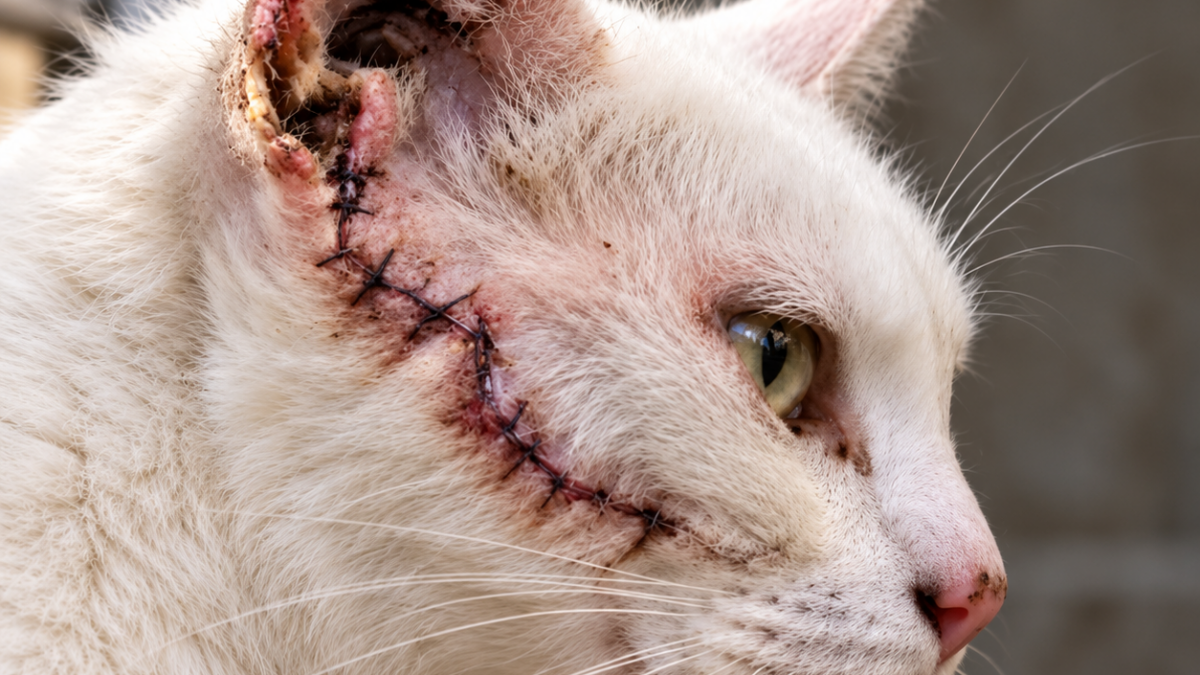
The first time I saw the injured white cat, fresh stitches ran down the side of his face, one ear was badly damaged, and yet the bowl of food beside him was almost untouched.
Every morning before sunrise, he returned to the same back steps, sat beneath the kitchen window, and stared at one particular door as though pain, hunger, and exhaustion mattered less than whatever was waiting on the other side.
We thought we were rescuing a wounded stray until we finally let him into the house—and watched him walk straight toward a room nobody had told him existed.
My name is Rachel Morgan, and I had been volunteering with a local animal rescue for nearly nine years when Sarah Bennett called me.
“There’s a cat outside our house,” she said. “But something’s wrong.”
“How wrong?”
“He has stitches.”
That got my attention.
“Recent?”
“They look recent. And his ear—Rachel, I don’t know what happened to him.”
Twenty minutes later, I pulled into a quiet neighborhood just as the sky was beginning to lighten.
The cat was exactly where Sarah said he would be.
White.
Thin.
Dirty.
Sitting beside the back steps.
One ear had been damaged so badly that only part of it remained. Along the left side of his face, a clean line of surgical stitches curved from below the ear toward his cheek.
Someone had treated him.
That was immediately obvious.
Which made everything else confusing.
He wasn’t feral in the usual sense.
He didn’t bolt when I approached.
He simply moved six feet away, watched me, then returned to the steps when I backed off.
Sarah pointed to a bowl.
“He hardly eats.”
“What about water?”
“A little.”
“How long has he been coming?”
“Four mornings.”
“Only mornings?”
“He disappears sometimes, but he always comes back.”
I crouched.
“Hey, buddy.”
The cat stared at me with tired yellow eyes.
I offered chicken.
He sniffed it.
Ate one small piece.
Then looked past me.
Toward the door.
Sarah noticed.
“That’s what he does.”
The kitchen door opened behind us when Sarah’s husband, Mark, stepped outside.
The cat’s entire body changed.
His shoulders lowered.
His tail loosened.
His eyes fixed on the hallway beyond Mark.
“He knows the house,” I whispered.
Mark frowned.
“That’s impossible.”
“You’ve never seen him?”
“Never.”
“Previous owners?”
“We’ve lived here six years.”
I looked at Sarah.
“Can we let him inside?”
Mark hesitated.
“We have a baby.”
“Then we control the introduction. No contact. I just want to see what he does.”
We opened the door.
The cat approached.
One step.
Then another.
He crossed the threshold.
He didn’t stop at the food Sarah had placed near the kitchen.
Didn’t inspect the cabinets.
Didn’t hide.
He walked through the hallway like he had a destination.
Slowly.
Carefully.
Stopping every few feet.
Then continuing.
My skin prickled.
The hallway turned.
The cat turned with it.
At the far end were three doors.
He ignored the bathroom.
Ignored the guest room.
Stopped outside the nursery.
Sarah inhaled sharply.
Inside, her four-month-old son, Noah, was asleep in his crib.
The cat sat.
His damaged ear twitched when the baby made a tiny sound.
Mark stepped toward him.
The cat shifted immediately.
Not toward Mark.
Toward the doorway.
Positioning himself between the hallway and the crib.
Nobody spoke.
A minute later, Noah stirred.
The cat lifted his head.
Then relaxed when the baby became quiet again.
I looked at Sarah.
“Has he ever been inside this house?”
“Not that I know of.”
“Could someone have brought him here while you were away?”
“No.”
We still had no proof of what his behavior meant.
I refused to invent one.
But something was clear.
Outside, he had been tense.
Inside this hallway, he finally allowed himself to breathe.
Eventually exhaustion won.
He curled beside the nursery door and lowered his stitched cheek carefully onto his paws.
The food remained untouched in the kitchen.
For the first time since I arrived, the cat closed his eyes.
Then Sarah’s phone rang.
She looked at the screen.
Her face changed.
“It’s the veterinary clinic.”
“What clinic?”
She stared at the sleeping cat.
“The one two neighborhoods over.”
I felt my stomach tighten.
“Why are they calling you?”
Sarah answered.
The conversation lasted less than a minute.
When she hung up, she was pale.
“They think they know who he is.”
PART 2
“What did they say?”
Sarah was still staring at her phone.
“The receptionist saw the neighborhood post I made last night.”
“What post?”
“The picture of him.”
I hadn’t known Sarah had posted one.
She showed me.
A simple neighborhood-group message:
Does anyone recognize this injured white cat? He has surgical stitches and keeps returning to our house. We want to make sure somebody isn’t looking for him.
The picture showed the cat sitting beneath their kitchen window.
His damaged ear visible.
The stitches impossible to miss.
“The clinic says a cat matching him was treated there eleven days ago,” Sarah said.
My eyes returned to the hallway.
The cat was asleep beside the nursery.
“What name?”
“They wouldn’t tell me over the phone. They asked if we could bring him in to scan his microchip and confirm.”
“That makes sense.”
Mark crossed his arms.
“Then we should take him.”
The cat opened one eye when Mark moved.
“Not yet,” I said.
Mark looked at me.
“Why?”
“He finally slept.”
The room became quiet.
I checked the stitches from several feet away.
No obvious bleeding.
No discharge that I could see.
No immediate crisis.
He needed veterinary assessment, absolutely.
But after days of returning to a house and apparently refusing to rest anywhere else, another twenty minutes would not change that.
“We let him sleep,” I said.
Sarah looked toward her baby’s room.
“And Noah?”
“The cat stays outside the nursery. Door stays partly closed. No unsupervised contact.”
She nodded.
For forty-three minutes, the white cat slept.
I know because I watched the clock.
He barely moved.
Not when Mark made coffee.
Not when a garbage truck passed outside.
Not when Sarah walked down the hallway.
Only when Noah began crying did the cat wake instantly.
His head came up.
He stood.
Moved closer to the nursery door.
Then sat.
No scratching.
No attempt to enter.
Just listening.
Sarah picked up Noah.
The baby quieted.
The cat lay back down.
Something about it unsettled me.
Not because I thought he was dangerous.
The opposite.
His behavior was too focused.
Too specific.
“This isn’t random,” Sarah whispered.
“I don’t think so.”
“What does he want?”
“I don’t know.”
She looked at him.
“He keeps coming for Noah.”
I corrected her gently.
“He keeps coming to this room.”
She understood why I made the distinction.
We knew what we saw.
We did not know what he believed.
That line mattered.
Stories can become lies when people fill emotional gaps with whatever makes the best ending.
I wasn’t going to do that to this cat.
When he woke fully, I placed an open carrier near the hallway.
No forcing.
No grabbing.
A little chicken inside.
This time he ate.
One piece.
Then another.
Eventually he stepped into the carrier.
We closed the door.
Sarah came with me.
Mark stayed home with Noah.
The veterinary clinic was seven minutes away.
The receptionist was already waiting.
The second we entered, she looked through the carrier door.
“Oh my God.”
“You recognize him?”
“I think so.”
A veterinary nurse named Emily joined us.
She crouched.
“Snow?”
The cat’s head moved.
Not dramatically.
But enough.
Emily covered her mouth.
“That’s him.”
My chest tightened.
“His name is Snow?”
“Snowy.”
She scanned his microchip.
The number matched the clinic record.
There was no longer any doubt.
His name was Snowy.
He was six years old.
Neutered.
Microchipped.
And according to the clinic, somebody had brought him in eleven days earlier after he was found with a severe facial injury.
“Found where?” I asked.
Emily opened the medical notes.
“Pine Avenue.”
Sarah’s face changed.
“That’s two blocks from our house.”
I looked at Snowy.
“What happened to him?”
The veterinarian who treated him, Dr. Melissa Grant, came into the room.
She remembered him immediately.
“He had a significant laceration along the left side of his face and extensive trauma to the ear.”
“Car?”
“Possibly. Dog attack was another possibility. We couldn’t determine the exact cause.”
“Who brought him?”
“A man named Eric Dawson.”
“Owner?”
“He said he wasn’t.”
“Then who is?”
Melissa looked toward the computer.
“That’s the problem.”
The microchip registration was outdated.
The listed owner was a woman named Claire Sullivan.
Phone disconnected.
Address no longer current.
“Eric found him injured?”
“That was his story.”
“Where is Eric?”
“We don’t know. He paid for emergency stabilization and surgery, then said he would foster the cat temporarily while we tried to locate the owner.”
Sarah frowned.
“So how did Snowy end up outside?”
Melissa’s expression hardened.
“That’s what I’d like to know.”
“When was he discharged?”
“Eight days ago.”
“And?”
“Eric picked him up.”
“Follow-up?”
“He missed it three days later.”
“Did you call?”
“Repeatedly.”
“No answer?”
“Voicemail full.”
I looked into the carrier.
Snowy stared through the door.
The stitches were clean enough that someone had at least prevented immediate infection.
But he had been outside for days.
“Could those stitches have been removed already?”
“Not yet. We scheduled removal for tomorrow.”
“He needs checking now.”
“Absolutely.”
Melissa examined him.
His temperature was normal.
Mild dehydration.
Some weight loss.
The surgical site looked surprisingly good.
The damaged ear was healing.
No fever.
No obvious new injuries.
“Physically,” she said, “he’s doing better than I feared.”
“Emotionally?”
She looked at me.
“You know I don’t diagnose cats with heartbreak.”
“I know.”
“But this is not a relaxed cat.”
Snowy sat stiffly on the table.
Until Sarah spoke.
“Snowy.”
His eyes turned toward her.
Then toward the door.
The hallway.
Always the doorway.
Sarah whispered:
“He wants to go back.”
Melissa looked confused.
“Back where?”
“To my house.”
I explained everything.
The steps.
The food.
The nursery.
Sleeping outside the room.
Melissa listened without interrupting.
When I finished, she asked the question I had been avoiding.
“Does Claire Sullivan mean anything to you?”
Sarah shook her head.
“No.”
Melissa turned the monitor slightly.
“I can’t give you private identifying information beyond what is necessary for animal custody without permission. But the chip registration includes an old address.”
“Near Sarah?”
“Very near.”
“How near?”
Melissa hesitated.
“Same street.”
Sarah went still.
“What number?”
Melissa looked at her.
“We need to handle that carefully.”
“Was it my house?”
“No.”
Sarah exhaled.
“Then where?”
The old address belonged to a small blue house four doors away.
I knew exactly which one.
I had passed it that morning.
“For sale” sign.
Empty driveway.
Curtains removed.
Sarah frowned.
“That house has been vacant for months.”
“Do you know who lived there?”
“An older woman. I didn’t know her well.”
“Name?”
Sarah’s eyes widened.
“Oh.”
“What?”
“Claire.”
The room went silent.
“You knew her name?”
“Claire Sullivan. Yes. I never connected it.”
She looked at Snowy.
“She moved away last year.”
There it was.
A possible connection.
Snowy had lived four houses away.
He knew the street.
Maybe he had wandered onto Sarah’s property before.
Maybe there was something about the house he remembered.
But that still did not explain the nursery.
Then Sarah whispered:
“Wait.”
She grabbed her phone.
“What?”
“I have pictures.”
“Of what?”
“Before Noah was born.”
She scrolled.
Months back.
Farther.
Then stopped.
She turned the screen toward us.
A photograph of Sarah’s backyard during a summer barbecue.
People around a table.
Mark by the grill.
And beneath a chair near the back steps—
a white cat.
Snowy.
No damaged ear.
No stitches.
Healthy.
Watching.
Sarah stared.
“That was almost a year ago.”
Melissa leaned closer.
“He visited your house.”
“I never noticed.”
“You took the picture.”
“I was photographing Mark.”
Another image.
Snowy sitting on the fence.
Another.
The cat beneath the kitchen window.
“He already knew this place,” I said.
Sarah’s eyes filled with tears.
“But why Noah’s room?”
No one answered.
Then another memory surfaced.
Sarah sat down.
“Claire used to come over.”
“When?”
“Before she moved.”
“Frequently?”
“Not frequently. Sometimes.”
“Did she bring Snowy?”
“I don’t remember.”
She pressed her hand to her mouth.
Then suddenly:
“The room.”
“What?”
“Before it was Noah’s nursery, it was my home office.”
“Yes?”
“Claire helped me in there once.”
“With what?”
Sarah laughed nervously.
“She was a retired seamstress. I was making curtains and destroying them.”
She looked at Snowy.
“She spent almost an entire afternoon helping me.”
“Snowy could have been with her?”
“Maybe.”
Still thin.
Still speculative.
But at least the house was no longer mysterious.
Snowy had been nearby before.
He had likely known Sarah’s yard.
Perhaps the room smelled familiar.
Perhaps he associated the hallway with Claire.
Perhaps something else entirely.
I refused to decide.
We needed Claire.
The clinic tried the old contact information again.
Nothing.
I searched public records only through appropriate channels.
Sarah asked neighbors.
The woman across the street knew more.
Mrs. Alvarez was seventy-four and possessed the neighborhood knowledge of a small intelligence agency.
“Claire moved to Oregon,” she said.
“Oregon?”
“Her daughter.”
“Do you have a number?”
“No.”
“Full daughter’s name?”
“Jennifer something.”
Helpful.
Then Mrs. Alvarez looked at Snowy’s photo.
Her expression changed.
“That’s Claire’s cat.”
“We know.”
“She loved that animal.”
“Do you know what happened when she moved?”
Mrs. Alvarez frowned.
“She took him.”
My heart sank.
“She definitely took him?”
“I saw the carrier in the car.”
“When?”
“Last October.”
Snowy had supposedly left the state with Claire almost a year earlier.
Yet now he was back.
Injured.
Two blocks from his former home.
That created an entirely new question.
How?
We returned Snowy to Sarah’s house temporarily under the clinic’s guidance while official ownership contact was attempted.
He had medication.
A soft cone if needed.
Instructions.
Fresh food.
Water.
And one restriction:
No direct access to Noah.
Not until his health, vaccinations, parasite status, and behavior were fully evaluated.
Snowy seemed satisfied with the compromise.
He returned to the hallway.
Sat outside the nursery.
Then slept.
Over the next twenty-four hours, Sarah learned his habits.
He ate when the house became quiet.
Used a litter box immediately.
Accepted medication hidden in wet food.
Allowed gentle petting after several minutes.
Never tried to enter the crib.
Never jumped onto nursery furniture.
He simply preferred the hallway outside the room.
At night, Sarah put a bed there.
Snowy ignored it.
Slept beside it.
Cats.
The next morning, I arrived to find Mark standing in the kitchen.
He looked exhausted.
“Where is he?”
“Guess.”
Hallway.
Of course.
“Noah cried at two,” Mark said.
“And?”
“Snowy got up before I did.”
I smiled.
Mark did not.
“This is weird.”
“Yes.”
“I don’t like not understanding it.”
“You don’t have to understand every behavior to manage it safely.”
“He watches my son.”
“He watches the doorway.”
“You keep saying that.”
“Because we know that. We don’t know the rest.”
Mark lowered his voice.
“What if he thinks Noah is someone else?”
That possibility had crossed my mind.
Scent association.
Sounds.
Old experiences.
Cats form associations we cannot fully reconstruct.
But assigning a human-like story—Snowy thinks Noah is Claire, Snowy is protecting the baby because of some past trauma—would have been fiction.
“I don’t know.”
Mark rubbed his face.
“I hate that answer.”
“It’s still the correct one.”
Around noon, the clinic called.
They had reached Claire.
Not directly.
Her daughter Jennifer had contacted them after receiving a forwarded message from someone still associated with the microchip company.
Claire was alive.
Living in Oregon.
And when Jennifer told her Snowy had been found, Claire reportedly began crying so hard they had to stop the conversation.
We arranged a video call.
Claire appeared on Sarah’s tablet that evening.
Silver hair.
Thin face.
Oxygen tubing beneath her nose.
That explained some things immediately.
“Snowy?”
Her voice shook.
Sarah aimed the camera.
Snowy was lying outside the nursery.
“Snowy, baby.”
His head lifted.
He stared at the tablet.
Claire said his name again.
Snowy stood.
Walked toward the sound.
Sarah lowered the tablet.
Snowy sniffed the screen.
Then made a sound I had not heard from him.
A deep, broken trill.
Claire covered her mouth.
“Oh, my God.”
Snowy rubbed his face carefully against the tablet edge.
Claire cried.
“I thought he was dead.”
Nobody in Sarah’s kitchen moved.
Jennifer appeared beside her mother.
“We lost him during the trip.”
“What happened?” I asked.
Their story came slowly.
Claire had developed serious pulmonary disease.
Jennifer convinced her to move west to live nearby.
They drove.
Snowy traveled in a secure carrier.
At a motel nearly five hundred miles from our town, a door malfunctioned while they were transferring luggage.
Snowy escaped.
They searched for three days.
Posters.
Local shelters.
Veterinary clinics.
Online groups.
Nothing.
Claire delayed her move.
Then her health worsened.
She was hospitalized.
Jennifer continued searching remotely.
Weeks became months.
No confirmed sightings.
“I thought a coyote got him,” Claire whispered.
I looked at Snowy.
Somehow, almost a year later, he had returned to his old neighborhood.
Hundreds of miles.
That sounded impossible.
Which meant we needed to be careful.
“Do you have proof Snowy was lost at that motel?”
Jennifer nodded.
“Reports. Posts. Microchip lost-pet notice.”
The chip company later confirmed the dates.
Snowy had indeed been reported missing hundreds of miles away.
How he traveled back remained unknown.
Maybe he had been picked up.
Transported.
Passed between people.
Escaped again.
Maybe someone intentionally returned him near his former home.
We had no evidence.
I refused to turn uncertainty into mythology about a cat walking five hundred miles.
The truth was already extraordinary enough.
He disappeared far away.
Nearly a year later, he was back within blocks of the house where he had once lived.
Injured.
Then another question.
“Who is Eric Dawson?”
Claire and Jennifer exchanged a look.
Neither recognized the name.
That bothered me.
Eric said he had found Snowy injured.
Maybe true.
But why had he then disappeared after agreeing to foster him?
We needed answers.
Animal control became involved because of the uncertain custody and the possibility that a recently treated animal had been abandoned.
Officer Marcus Reed contacted Eric.
At first, no response.
Then he found an address.
Eric lived twenty minutes away.
Marcus interviewed him.
The story he told was messy.
He had found Snowy near a gas station on Pine Avenue after hearing cats fighting behind a dumpster.
Snowy emerged bleeding.
Eric brought him to the clinic.
That part aligned with medical records.
He paid several hundred dollars toward treatment.
Also true.
He agreed to temporary foster because no owner could immediately be reached.
Also documented.
Then, after three days at his apartment, Snowy escaped.
“How?” I asked Marcus.
“Screen door.”
“Did Eric report him missing?”
“No.”
“Why?”
Marcus looked irritated.
“Said he figured the cat would survive.”
There it was.
Again.
That phrase.
He’ll survive.
Cats survive.
Someone will find him.
As if survival were a substitute for responsibility.
“Did he call the clinic?”
“No.”
“Microchip company?”
“No.”
“Shelter?”
“No.”
“Nothing?”
“Nothing.”
I felt my anger rise.
“He took custody of a cat fresh from surgery and when the cat escaped, he told nobody?”
“Yes.”
“He missed the follow-up and ignored clinic calls.”
“Yes.”
“Why?”
“He owed money from the treatment balance and was embarrassed.”
I stared.
“So embarrassment mattered more than telling someone an injured cat was loose.”
“That’s one way to phrase it.”
“It’s the accurate way.”
Marcus did not disagree.
Eric was not accused of causing Snowy’s original injury.
There was no evidence of that.
In fact, he had likely saved Snowy by taking him to the clinic.
But then he made a second decision.
And a third.
He let shame turn into silence.
The cat escaped.
Eric avoided the clinic.
Snowy wandered.
And because nobody knew to search, the injured animal had to find safety on his own.
That made my feelings toward Eric complicated.
He was both part of the rescue and part of the failure.
Human beings are inconvenient that way.
Claire remained the legal owner.
When we told her Snowy was safe, her relief collided with reality.
She could not take him back.
Her respiratory disease had advanced.
She lived in assisted housing close to Jennifer.
Pets were technically allowed, but Claire could no longer reliably manage medication, litter care, transport, and veterinary appointments.
Jennifer offered to take Snowy.
But she had two cats, one medically fragile and highly territorial.
Moving Snowy across the country again, into a complicated multi-cat home, might not be best for him.
Claire knew it.
That realization broke her.
“He waited for me,” she said during our second video call.
I hated the sentence.
Not because it was necessarily wrong emotionally.
Because it threatened to make Claire believe she owed him a reunion she could no longer sustain.
“We don’t know what Snowy was waiting for.”
She looked at me.
“He went to the house.”
“Yes.”
“My old street.”
“Yes.”
“Sarah’s house.”
“Yes.”
“And that room.”
Claire’s eyes changed.
“What?”
I leaned closer.
“You remember the room?”
Claire smiled through tears.
“I do.”
Sarah was beside me.
“You helped me make curtains.”
“I ruined curtains.”
“You saved them.”
Claire laughed.
Then she became quiet.
“I brought Snowy.”
Sarah froze.
“You did?”
“He hated being alone after my husband died. I took him everywhere I could.”
There.
A confirmed piece.
Snowy had been in that room.
Probably for hours.
“What did he do?”
“Mostly slept in the window.”
Sarah looked toward the nursery.
The window.
Now beside the crib.
Claire continued.
“You were pregnant then.”
Sarah’s eyes widened.
“I didn’t know yet.”
“I did.”
“What?”
“You told me you suspected.”
Sarah began laughing.
“I forgot.”
Claire smiled.
“I didn’t.”
Snowy had known the room before it was a nursery.
He had known Sarah.
Known Claire sitting there.
Known safety there.
That was enough to explain why the space might draw him back without inventing anything more supernatural.
It wasn’t Noah he necessarily recognized.
It was a place.
A scent map.
A memory.
A room associated with people he trusted.
After injury and wandering, Snowy returned to one of the few safe places in his old territory that still smelled alive.
That was the most grounded explanation we had.
And somehow it was more moving than any fantasy.
He did not need to be a magical guardian.
He was a hurt animal seeking remembered safety.
Sarah cried when Claire explained.
“You can have him back.”
Claire closed her eyes.
“I can’t.”
“We can work something out.”
“No.”
Her answer was firm.
“Sarah, don’t make me choose what I want over what he needs.”
The room went quiet.
Claire looked at Snowy through the screen.
“I already lost him once because life became too complicated.”
“That wasn’t your fault,” Jennifer said.
Claire continued.
“He found somewhere safe. If he’s comfortable there…”
Sarah looked at me.
I did not answer.
This was becoming an adoption decision.
And adoption decisions needed more than emotion.
Mark entered the conversation.
“We need to think.”
Claire nodded immediately.
“Please.”
That mattered.
No guilt.
No pressure.
No “he chose you, so you have to keep him.”
We took several days.
Snowy stayed under rescue supervision while living temporarily with Sarah’s family.
Medical check.
Vaccinations updated.
Parasite screening.
Bloodwork.
Stitch removal.
Behavior assessment.
He tolerated everything.
Except the cone.
He hated the cone with the concentrated fury of an animal who had survived serious trauma but considered plastic around his head the final insult.
When Hannah removed the last stitch, Snowy shook himself.
His damaged ear gave him a permanently uneven silhouette.
His facial scar remained.
But the wound had healed.
Now we had to decide where the rest of him would heal.
Sarah and Mark had never owned a cat.
That mattered.
They had a four-month-old baby.
That mattered more.
They needed education about safe cat-infant management.
No unsupervised access.
Crib always off-limits.
Separate sleep areas.
Gradual adjustment.
Veterinary care.
Litter hygiene.
Scratching.
Enrichment.
Costs.
All the boring things.
Mark asked questions.
Lots.
That was good.
“What if he jumps into the crib?”
“Prevent access.”
“What if Noah grabs him when he’s older?”
“You teach both sides and supervise.”
“What if Snowy scratches?”
“Cats have boundaries. You manage the environment and teach your child.”
“What if he hates being indoors?”
“He doesn’t seem to.”
Snowy was asleep on their couch at the time.
“What if Claire changes her mind?”
Legal transfer would be documented.
Open communication could continue if everyone agreed.
Claire did not want ownership retained.
She wanted updates.
If Sarah and Mark adopted Snowy, she wanted them to become his family without feeling like temporary caretakers.
One evening, Mark sat beside Snowy.
“I don’t know if I’m ready for fifteen years.”
Snowy was six.
“Potentially another ten or more,” I said.
“That’s what I mean.”
Sarah looked disappointed.
But I appreciated Mark’s honesty.
“Then don’t adopt him because the story makes you feel guilty.”
“I don’t.”
“Good.”
“I like him.”
Snowy opened one eye.
Mark scratched beneath his chin.
“I just didn’t wake up planning to become a cat person.”
“No one does.”
“That sounds like propaganda.”
“It is.”
He smiled.
Then asked:
“What happens if we say no?”
“We find him another appropriate home.”
“And will he keep coming back here?”
“If he remains nearby and has outdoor access, possibly. Which is another reason I would prefer an indoor home.”
Mark looked at the cat.
Snowy stretched.
His front paw touched Mark’s leg.
Mark sighed.
“This is manipulative.”
“Extremely.”
Three days later, Mark installed a tall baby gate that allowed controlled separation between the main hallway and nursery area.
I raised an eyebrow.
“What’s that?”
“Research.”
“You researched cats.”
“No.”
“You installed cat infrastructure.”
“Temporary foster infrastructure.”
Sarah laughed.
Snowy rubbed against Mark’s ankle.
Mark looked betrayed.
It was already over.
The legal transfer from Claire happened two weeks later.
We arranged one final video call before the adoption paperwork was completed.
Claire wore a blue sweater.
Snowy sat on Sarah’s lap.
For the first time, he looked fully relaxed during a call.
Claire spoke to him.
“Snow.”
His ears moved.
He watched the screen.
“You’re okay.”
Snowy blinked slowly.
Claire’s face crumpled.
Jennifer put a hand on her shoulder.
“I’m sorry,” Sarah whispered.
Claire shook her head.
“Don’t be.”
She leaned toward the camera.
“Listen to me, Sarah.”
“Yes?”
“He doesn’t need me to get him home again.”
Sarah cried.
Neither of them tried to hide it.
“He needs somebody to make sure he never has to search for home again.”
That became the line I remembered.
Not because it was theatrical.
Because it was responsibility without possession.
Claire loved Snowy enough not to demand his return simply to repair her own grief.
Sarah loved him enough to accept that his past would always include another woman.
No competition.
No replacing.
Just chapters.
Claire signed the transfer.
Sarah and Mark adopted Snowy.
The first night after everything became official, Sarah sent me a photograph.
Snowy was asleep outside the nursery.
His new cat bed sat beside him.
Unused.
Of course.
Caption:
STILL GUARDING THE HALLWAY.
I replied:
HE MAY JUST HATE THE BED.
She wrote:
LET ME HAVE THIS.
Fair.
Over the next months, Snowy changed.
The first thing that disappeared was the constant tension in his shoulders.
Then the habit of checking the back door.
Then the long periods staring toward windows.
He began eating normally.
More than normally.
Mark accused him of fraud.
“This cat ignored tuna when he showed up.”
“He was stressed.”
“Now he steals turkey.”
“Recovery.”
“He took it out of my sandwich.”
“Advanced recovery.”
Snowy gained healthy weight.
His coat became bright white again.
The scar softened but never disappeared.
His missing ear gave him character.
Noah grew.
The two were never left unsupervised.
That mattered.
People online love photographs of babies and animals pressed together.
Real safety is less photogenic.
Distance.
Supervision.
Teaching.
Baby gates.
Closed doors.
Adults paying attention.
Snowy developed his own relationship with Noah gradually.
At first, he remained outside the nursery.
When Noah began spending time on a floor mat in the living room, Snowy watched from the couch.
No contact.
Then one day, Snowy moved to the floor several feet away.
Noah kicked his legs.
Snowy left.
Reasonable.
A week later, he stayed.
At eight months old, Noah laughed whenever Snowy walked past.
The cat ignored him.
At ten months, Noah began crawling.
Snowy discovered elevation.
At eleven months, Noah reached toward his tail.
Sarah intercepted immediately.
“No.”
Snowy walked away.
Training humans is part of cat ownership.
When Noah began understanding simple directions, Sarah taught:
“Gentle.”
One finger.
Touch shoulder.
No grabbing.
Snowy could leave whenever he wanted.
He often did.
That freedom was why trust grew.
One afternoon, when Noah was around eighteen months old, Sarah sent me a video.
He sat on the rug.
Snowy walked past.
Noah held out an open hand.
Didn’t grab.
Snowy stopped.
Sniffed.
Then rubbed his cheek against the toddler’s knuckles.
Noah laughed.
Snowy continued walking.
Two seconds.
Perfect.
No forced cuddle.
No staged friendship.
Choice.
That was enough.
Claire received the videos too.
She watched Noah grow alongside the cat she once thought she had lost forever.
At first, Sarah worried updates might hurt her.
Claire insisted otherwise.
“They help.”
“How?”
“I spent months imagining Snowy dead somewhere.”
She paused.
“Seeing him steal a child’s stuffed animals is better.”
Snowy did, in fact, steal Noah’s stuffed rabbit.
Repeatedly.
He would drag it into the hallway.
Mark started calling the rabbit his “search-and-rescue assignment.”
Snowy had no known working history and deserved none of this nonsense.
Still, the joke stayed.
His fixation on the nursery doorway gradually changed.
When Noah moved from crib to toddler bed, Snowy began sleeping elsewhere more often.
Kitchen chair.
Couch.
Sarah and Mark’s bed when allowed.
The hallway was no longer his only safe place.
That mattered.
One night Sarah texted:
HE’S NOT OUTSIDE NOAH’S ROOM.
I replied:
IS HE MISSING?
NO. HE’S ASLEEP ON MARK’S CHEST.
Then:
MARK CLAIMS HE CANNOT MOVE.
Mark later admitted he could have moved.
He did not want to.
Another person converted.
Snowy’s history with Eric remained unresolved emotionally.
Legally, Eric had not intentionally abandoned Snowy at the warehouse or injured him.
He had taken an injured cat for emergency treatment.
That saved Snowy.
But he had accepted responsibility after discharge.
Then when Snowy escaped, he failed to notify anyone.
Marcus documented the incident.
Depending on the applicable local rules and evidence, there were limited enforcement options because the cat escaped rather than being deliberately dumped.
The clinic pursued the unpaid portion of the bill separately.
What mattered most to me was understanding why Eric disappeared.
Eventually he agreed to speak with me.
At a coffee shop.
Public place.
Marcus knew.
I expected somebody careless and defensive.
Eric looked embarrassed before I even sat down.
“I know what you think.”
“No, you don’t.”
“That I abandoned him.”
“You failed to report a recently operated cat missing.”
He nodded.
“Yes.”
“Why?”
He stared into his coffee.
“I didn’t have the money.”
“That explains the clinic bill.”
“I thought if I called, they’d make me pay everything.”
“You had already agreed to foster.”
“I know.”
“You could have said he escaped.”
“I know.”
“Instead the clinic believed he was with you.”
“Yes.”
“And we had no reason to search.”
“Yes.”
“Snowy was outside with stitches.”
Eric’s eyes watered.
“I know.”
I waited.
He rubbed his forehead.
“I thought I was helping.”
“You were.”
He looked up.
“What?”
“You brought him to the veterinarian. That helped.”
His expression changed.
“Then you stopped helping.”
He looked down again.
“I was ashamed.”
“Shame is expensive.”
He nodded.
“For the cat.”
“Yes.”
That distinction mattered.
Guilt is about how badly we feel.
Responsibility is about what the vulnerable being needs next.
Eric had allowed the first to interfere with the second.
“I saw the post,” he said.
“Sarah’s?”
“Yes.”
“Why didn’t you respond?”
“I panicked.”
“Again.”
“Yes.”
“Do you understand the pattern?”
He nodded.
“I do now.”
I believed him.
Maybe because he did not ask for forgiveness.
Did not ask to see Snowy.
Did not claim good intentions erased the consequences.
He simply said:
“I should’ve called.”
“Yes.”
“If it happens again, I will.”
“I hope nothing like that happens again.”
He managed a sad smile.
“Right.”
Months later, Melissa told me Eric had set up a payment plan for the remaining veterinary bill.
Small installments.
He completed it.
Later he donated twice to the clinic’s emergency-care fund.
I never told Sarah until years later.
Not because it was secret.
Because Snowy’s life did not need to revolve around Eric’s repentance.
Accountability happened.
Then everyone moved forward.
The deeper conflict came from somewhere else.
A year after Snowy’s adoption, Sarah received a message from a woman named Diane.
She claimed Snowy belonged to her.
My stomach dropped when Sarah called.
“What?”
“She has photos.”
“Recent?”
“She says she had him for six months.”
“When?”
“Before Eric found him.”
That potentially explained the missing year.
We met with Diane through the rescue and checked everything.
She had photographs of Snowy living in a house about seventy miles away.
Same partial facial markings before injury.
Same microchip number confirmed through veterinary records.
Diane had found Snowy wandering near a campground eight months after Claire lost him.
She had him scanned.
The chip company attempted contact using Claire’s outdated number.
No response.
Diane says she reported him found, then eventually kept him informally.
“Why didn’t ownership transfer officially?”
“I thought it did.”
It hadn’t.
Then Snowy disappeared from Diane’s home after a contractor left a side gate open.
Again.
A cat moving through gaps in human systems.
Claire lost him.
Diane found him.
Diane lost him.
Eric found him injured.
Eric lost him.
Snowy returned to his original street.
By the time he reached Sarah, he had moved through at least four separate chapters.
Diane wanted him back.
That created a real problem.
Claire remained the registered legal owner at the time of Snowy’s latest recovery and had formally transferred ownership to Sarah under the rescue process.
Diane’s informal possession complicated the emotional situation, but the paperwork was clearer.
Still, legal clarity was not the only concern.
What was best for Snowy?
We arranged a meeting without forcing direct contact initially.
Diane came to Sarah’s house.
Snowy was in another room.
Diane brought photographs.
In them, he looked healthy.
Relaxed.
Sleeping on her couch.
She was not lying about loving him.
“He slept beside my daughter every night,” Diane said.
“How old?”
“She’s sixteen now.”
“Does she know you’re here?”
“She begged me to bring him back.”
Sarah sat rigidly across from her.
“I’m sorry.”
Diane’s eyes filled.
“So am I.”
Nobody was the villain in that room.
That made it harder.
Diane had cared for him.
Sarah had cared for him.
Claire loved him.
Snowy had apparently built several homes because humans kept losing track of the legal chain.
We let Diane see him from a distance first.
When she entered the living room, Snowy froze.
Then approached.
He sniffed her.
Diane whispered:
“Snow.”
He rubbed against her leg.
Sarah looked devastated.
I felt it too.
Recognition.
Real.
Then Snowy walked away.
Jumped onto Mark’s chair.
Sat.
Diane cried.
“He remembers.”
“Yes.”
Sarah’s voice broke.
“Do you want him?”
Diane stared at the cat.
“Yes.”
The room became unbearable.
Then Diane asked me:
“What’s best for him?”
Not:
What am I entitled to?
Not:
Who wins?
What’s best for him?
I respected her immediately.
We evaluated.
Snowy had now been with Sarah’s family for over a year.
Established routine.
Stable medical care.
Bonded to the household.
Comfortable indoors.
Diane lived seventy miles away with three cats, including one Snowy had reportedly tolerated but never bonded with.
Her daughter was preparing to leave for college.
Diane worked long shifts.
None of that made her bad.
It simply mattered.
Snowy had already endured repeated displacement.
Moving again to repair human grief would introduce another unnecessary upheaval.
After speaking with behavior professionals and reviewing the legal history, the conclusion was clear.
Stability favored remaining with Sarah.
Diane heard it.
Cried.
Then did something I will always respect.
She agreed.
“I don’t like it,” she said.
“You don’t have to.”
“I want him.”
“I know.”
“But he looks…”
She looked toward Snowy.
He was sitting beside Mark now.
“…finished.”
I understood.
Finished searching.
Finished transferring.
Finished adapting.
Diane crouched.
Snowy approached again.
She scratched under his chin.
“I’m sorry we lost you.”
He leaned into her hand.
“You always did run toward open doors.”
Sarah wiped her eyes.
Diane stood.
“Take care of him.”
“We will.”
“No.”
She looked directly at Sarah.
“Promise me you’ll put his microchip information everywhere.”
Despite everything, we all laughed.
“We already did.”
Primary number.
Secondary number.
Rescue backup contact.
Veterinary contact.
Claire even remained listed as historical contact where possible.
Snowy was not going to disappear inside paperwork again.
That became the accountability arc of his story.
No one person had intentionally created every problem.
But human systems had failed him repeatedly.
Outdated microchip.
Incomplete found-pet transfer.
Informal ownership.
Escapes not reported properly.
A foster too ashamed to call.
One open gate.
One broken screen.
Snowy survived all of it.
We responded by making his future boringly redundant.
Tags.
Chip.
Backup contacts.
Indoor life.
Secure screens.
Doors checked.
Photographs.
Records.
No ambiguity.
That was our revenge on chaos.
Make him impossible to lose.
Diane remained part of the wider circle.
Occasional updates.
Claire too.
At first, Sarah joked that Snowy had more relatives than Noah.
She wasn’t wrong.
Three women had loved the same cat at different times.
Instead of fighting over ownership forever, they eventually formed a strange little group chat.
Claire in Oregon.
Diane seventy miles away.
Sarah with Snowy.
Pictures.
Vet updates.
Birthday jokes.
The first time Sarah sent a photograph of Snowy asleep on Mark’s chest, Diane replied:
HE USED TO PRETEND HE HATED MEN.
Claire answered:
HE USED TO PRETEND HE HATED EVERYONE EXCEPT ME.
Sarah wrote:
APPARENTLY WE WERE ALL LIED TO.
Snowy, meanwhile, cared about none of their narratives.
He wanted dinner.
Years passed.
Noah became a little boy.
Snowy became an older cat.
Their relationship remained gentle because the adults protected it from becoming a performance.
No costumes.
No forced hugs.
No putting Noah’s face against the cat.
They shared space.
That was enough.
At three, Noah learned to fill Snowy’s water bowl with help.
At four, he learned not to chase.
At five, he began sitting on the hallway floor reading picture books aloud.
Snowy sometimes lay beside him.
Sarah sent me a video.
Noah was struggling through a sentence about a dinosaur.
Snowy’s eyes were closed.
“He’s not listening,” Noah complained.
Sarah said:
“He stayed.”
Noah thought.
Then kept reading.
That line hit me.
He stayed.
Snowy’s entire story had been people losing him.
Now a child measured love by staying.
At six, Noah asked why Snowy’s ear looked different.
Sarah told him carefully.
“He got hurt before he came to us.”
“Who hurt him?”
“We don’t know.”
“Did someone fix him?”
“A veterinarian helped his injury heal.”
“Did you fix him?”
“No.”
“Rachel?”
“No.”
Noah frowned.
“Then who fixed him?”
Sarah told me later that she answered:
“Snowy wasn’t broken.”
I liked that.
He had been injured.
Lost.
Stressed.
But not an object requiring a human hero to make him whole.
He needed care.
Safety.
Time.
At eight, Noah did a school project called “My Family.”
He drew Sarah.
Mark.
Himself.
Snowy.
And, for reasons no teacher understood, three speech bubbles on the side labeled Claire, Diane, and Rachel.
Snowy’s complicated family tree had become normal to him.
At the bottom he wrote:
SNOWY HAD LOTS OF HOMES BUT THIS IS HIS LAST ONE.
Sarah sent me the picture.
I stared at that sentence for a long time.
His last one.
Not because the others had not mattered.
Because permanence mattered too.
Snowy aged slowly.
At ten, kidney values began shifting.
Early disease.
Caught on routine senior bloodwork.
Diet.
Hydration support.
More frequent exams.
Nothing dramatic.
At eleven, arthritis.
Low-sided litter box.
Steps near the couch.
At twelve, his remaining good ear hearing declined.
The damaged ear had always functioned less effectively.
Now both were aging.
He startled more easily.
They adapted.
Touch the floor lightly before approaching.
Let him see people coming.
Night lights.
Predictability.
At thirteen, he stopped sleeping outside Noah’s door entirely.
He preferred Noah’s bed.
Noah was nine by then.
Old enough to understand boundaries.
Snowy slept near his feet.
Not every night.
Just when he wanted.
One winter morning, Sarah found them both asleep.
Noah sideways.
Snowy curled near his knees.
She took one photograph.
No flash.
Then left.
She later said:
“I thought about the first time he sat outside the crib.”
“What did you feel?”
“That he made it.”
Not from injury.
Not merely survival.
He made it from doorway to belonging.
At fourteen, Claire’s health declined sharply.
Jennifer called Sarah.
“If she’s going to see Snowy again, it needs to be soon.”
Flying Claire was impossible.
Transporting Snowy across the country at fourteen with kidney disease and arthritis was unwise.
So they did the only safe thing left.
Video.
It felt inadequate.
Until Claire spoke.
“Snowy.”
The old cat was asleep.
His remaining ear moved.
He opened his eyes.
Sarah brought the tablet closer.
Claire looked much older.
Oxygen.
Blanket.
Jennifer beside her.
“Hi, baby.”
Snowy stared.
Then slowly walked toward the screen.
He sniffed.
Sat.
Claire cried.
“I wish I could touch you.”
Nobody spoke.
Snowy lay down beside the tablet.
Not on it.
Beside.
For twenty minutes, Claire talked.
About their old house.
Her husband.
Snowy sleeping in sewing baskets.
The drive west.
Losing him.
The years she imagined him gone.
Then she said:
“I’m sorry I couldn’t come back for you.”
Snowy closed his eyes.
Claire smiled through tears.
“You found somebody.”
She looked at Sarah through the screen.
“Thank you.”
Sarah shook her head.
“He found us.”
Claire laughed.
“That sounds like him.”
Two weeks later, Claire died.
Jennifer called.
Snowy was sleeping when Sarah received the news.
They did not wake him.
Good.
He did not need to carry human grief ceremonially.
But that evening, Sarah sat beside him.
“She loved you.”
Snowy purred because Sarah scratched the right spot.
That was enough.
Diane remained.
She visited once when Snowy was fifteen.
He recognized her scent or presence enough to approach immediately.
She sat on the floor.
He climbed halfway into her lap.
“I’m glad I didn’t take you back.”
Sarah’s eyes filled.
Diane continued.
“I hated saying that for years.”
Snowy settled.
“But this was right.”
Sometimes loving an animal means accepting you were an important home but not the final one.
That is not failure.
Lives have chapters.
At sixteen, Snowy’s kidneys worsened.
His appetite became inconsistent.
Sarah responded to every change quickly.
Vet.
Fluids.
Medication.
Anti-nausea treatment.
Appetite support when appropriate.
Weight tracking.
No waiting until he looked dramatically ill.
That was another quiet victory.
On the morning he refused breakfast entirely, Mark called the clinic before eight.
I happened to hear about it because Sarah called me next.
“He wouldn’t eat.”
“How long?”
“Since last night.”
“Appointment?”
“Ten-thirty.”
Good.
No excuses.
No “cats are weird.”
No “maybe tomorrow.”
Attention.
Snowy improved after fluids.
For months, good days outnumbered bad.
He sat in sunny windows.
Slept near Noah.
Stole warm chicken.
Complained about medication.
Then the balance changed.
At seventeen, Snowy stopped recovering fully between kidney episodes.
Arthritis limited movement.
He slept more.
Lost weight.
Still sought affection.
Still ate treats.
But the life in front of him was narrowing.
Sarah kept a quality-of-life calendar.
Good day.
Good day.
Mixed.
Good.
Bad.
Mixed.
Bad.
We had learned enough over decades of rescue not to wait for agony.
One evening Sarah called.
“I think we’re close.”
I knew.
“What did the vet say?”
“Maybe days. Maybe a couple of weeks if we keep doing fluids.”
“Comfort?”
“Some.”
“Enough?”
She began crying.
“I don’t know.”
That is the hardest answer.
Not zero comfort.
Not obvious agony.
The gray territory.
We discussed what Snowy still enjoyed.
Food?
Less.
Window?
Sometimes.
Noah?
Always.
Touch?
Yes.
Walking?
Difficult.
Nausea?
Increasing.
Sleep?
More restless.
The next morning, Snowy tried to walk toward Noah’s bedroom.
His back legs slipped.
Noah, now thirteen, saw him.
He did not panic.
He knelt.
Snowy tried again.
Noah placed one hand nearby but did not force him.
Snowy reached the doorway.
Then lay down.
The same doorway.
Almost seventeen years old.
White coat thinner.
Scar faded beneath age.
One ear damaged.
The boy who had once slept in the crib now sitting beside him.
Sarah found them.
Noah whispered:
“He wanted to come here.”
Maybe.
Maybe it was familiar.
Maybe habit.
Maybe the rug was comfortable.
They did not need to decide.
Noah lay on the floor.
Snowy placed one paw against his arm.
Sarah called the veterinarian.
They scheduled a home visit for the next afternoon.
That night, nobody forced Snowy to sleep somewhere else.
They placed blankets near the bedroom doorway.
Water.
Litter box nearby.
Noah slept on a mattress on the floor.
Snowy remained outside the door.
At 2:00 a.m., Sarah checked.
Same place.
Just like the first night.
Only everything was different.
Back then, injured and lost, he lay there because it was the only safe place he could remember.
Now he lay there because it belonged to him.
His hallway.
His child.
His house.
His choice.
The next afternoon, I came.
Diane joined by video.
Jennifer too, representing Claire in a way nobody said aloud.
Eric was not contacted.
This ending belonged to Snowy’s family.
He lay on a soft blanket.
Noah beside him.
Mark sat against the wall.
Sarah stroked his chest.
The veterinarian listened to his heart.
Snowy was tired.
No crisis.
No panic.
Exactly the moment we had hoped to give him.
Before suffering became the whole story.
Noah asked:
“Will he know what’s happening?”
The veterinarian answered carefully.
“He’ll feel sleepy. He’ll know you’re here.”
Noah nodded.
That mattered more.
Sarah brought Snowy’s original collar.
The one purchased after adoption.
Inside the tag were three phone numbers.
Sarah.
Mark.
Rescue backup.
Impossible to lose.
She placed it beside him.
Diane appeared on the tablet.
“Hey, Snow.”
Snowy’s ear moved.
Jennifer said:
“My mom would be happy he made it this far.”
Sarah cried.
Mark put an arm around her.
Noah touched Snowy’s shoulder.
“Do you remember my crib?”
I had to look away.
Of course we could not know.
Noah continued.
“You used to sleep outside my door.”
Snowy blinked.
“You can sleep now.”
There it was.
Different animal.
Same truth every rescue seems to arrive at eventually.
You don’t have to keep watch.
You don’t have to wait.
You don’t have to search.
Everyone who matters knows where you are.
The sedative relaxed him.
His breathing slowed.
Snowy shifted once.
Then placed his head on Noah’s hand.
That ruined all of us.
Noah didn’t move.
Not until Snowy was fully asleep.
Then the veterinarian administered the final medication.
Snowy died beside the doorway he had chosen almost seventeen years earlier when he came to Sarah’s house injured and exhausted.
Not protecting a mysterious baby.
Not fulfilling some supernatural promise.
Something more believable.
He had once found a place his body remembered as safe.
Then people turned that place into home.
That was enough.
After he died, Noah stayed beside him.
Sarah cried into Mark’s shoulder.
Diane ended the call only after whispering goodbye.
Jennifer later sent one message:
Claire spent her last years knowing he was safe. Thank you for that.
Snowy’s ashes came home two weeks later.
Sarah did not put them beside the nursery door.
Noah’s room had changed too much.
Instead, they placed the urn on a shelf near the kitchen window overlooking the back steps.
Where Snowy first appeared.
The circle without pretending it was destiny.
His old tag hung beside it.
One afternoon, Noah sat with me outside.
“He had four homes?”
“Depending on how you count.”
“Claire.”
“Yes.”
“Diane.”
“Yes.”
“Eric?”
“Temporary foster.”
“And us.”
“Yes.”
Noah looked at the steps.
“Which one was real?”
I understood the question.
“All of them were real.”
He frowned.
“Even Eric?”
“Real does not mean equally good. Real means it happened.”
He thought.
“Which one was his home?”
I looked through the window.
At Snowy’s favorite chair.
His bowl still waiting to be donated.
The hallway.
The boy beside me.
“This one was the one where he stopped having to leave.”
Noah nodded.
That answer satisfied him.
Years later, that answer satisfied me too.
People want animals to have one true home.
One true person.
Life is sometimes messier.
Snowy loved Claire.
He apparently lived happily with Diane.
Eric helped him before failing him.
Sarah’s family became permanent.
One chapter does not invalidate another.
The satisfying ending was not proving who Snowy loved most.
It was finally ending the sequence of loss.
No more open gate.
No lost carrier.
No broken screen.
No outdated phone number.
No person too ashamed to call.
No stitches outside.
No searching.
The revenge in Snowy’s story was almost bureaucratic.
And beautiful.
Updated microchips.
Backup contacts.
Secure doors.
Indoor safety.
People who answered phones.
A family who noticed one missed meal.
A child taught to respect boundaries.
Records clear enough that nobody could lose his history again.
Chaos had passed Snowy from hand to hand.
Love made him boringly traceable.
Years after his death, Sarah volunteered occasionally with our rescue.
Her specialty became lost-pet reunification.
Of course.
She checked chips.
Called secondary contacts.
Cross-referenced old registrations.
Asked clinics to dig through outdated files.
Whenever someone said:
“The phone number doesn’t work,”
Sarah answered:
“Try another way.”
Because another way had found Claire.
Another way had found Diane.
Another way had reconstructed Snowy’s story.
One winter, an elderly tabby came in with a chip registered twelve years earlier.
Disconnected phone.
Old apartment.
No obvious owner.
A younger volunteer shrugged.
“Probably abandoned.”
Sarah looked at her.
“Probably is not evidence.”
I smiled from across the room.
Snowy’s lesson.
They searched.
The original owner had died.
But the emergency contact, a nephew, was still alive.
He explained the cat had gone to a neighbor after his aunt’s death.
Neighbor entered assisted living.
Cat slipped out during the move.
The nephew took him.
Without Sarah checking again, another senior cat might have become anonymous.
That was Snowy continuing without anyone turning him into a saint.
Just changed behavior.
Noah grew up.
At eighteen, he left for college.
Before leaving, he stood near Snowy’s urn.
Sarah later told me he touched the tag.
“Guess I’m leaving the hallway now.”
She cried.
He rolled his eyes.
Children grow.
Cats die.
Homes change.
Still, the lessons remain.
Noah eventually studied nursing.
Not because of Snowy.
I refuse to make every life decision symbolic.
But during one conversation, he told me something I remembered.
“In pediatrics, scared kids watch doors too.”
I looked at him.
“They watch whether their parents are coming back.”
“Yes.”
“So?”
He shrugged.
“I think I notice it because of him.”
Maybe that was enough.
Attention travels.
Years after the white cat with stitches sat silently on the Bennett family’s back steps, another person noticed someone watching a doorway.
And stayed nearby.
That is how influence often works.
Small.
Unprovable.
Still real.
If you asked me today why Snowy kept returning to Sarah’s house, I would give you the only answer I can defend.
He knew the property.
He had visited before.
He had spent time in the room that later became Noah’s nursery.
He was injured, displaced, and likely searching for a familiar place.
Sarah’s house was one.
Anything beyond that would be a story we invented for him.
And his real story never needed exaggeration.
A cat lost hundreds of miles from home somehow returned to his old neighborhood after passing through another household and a temporary foster.
He survived a serious injury.
He found a familiar door.
He stayed.
His original owner learned he was alive.
Another former caretaker got closure.
A family gave him permanence.
A child grew from a baby in a crib to a teenager saying goodbye beside the same doorway.
That is enough.
More than enough.
My favorite photograph of Snowy was not from the day he arrived.
Sarah took it when he was around twelve.
No stitches.
Scar barely visible.
One ear permanently uneven.
He was lying in sunlight across the hallway floor.
Noah’s bedroom door open behind him.
Snowy’s eyes closed.
Completely asleep.
I loved that photograph for the same reason I love certain rescue endings.
At the beginning, Snowy stared at the door because he needed something from the place beyond it.
At the end, he could sleep with the door open because he knew nothing important was going to disappear.
He had food.
Water.
Medical care.
A registered chip.
A family.
Claire knew where he was.
Diane knew where he was.
The rescue knew where he was.
The clinic knew where he was.
For once in his complicated life, everybody knew where Snowy was.
Nobody had to search.
Nobody had to wonder.
That was his revenge against every open door, broken record, missed phone call, and human mistake that had sent him wandering.
He became impossible to lose.
And when he finally left that house for the last time, it was not because someone forgot to close a gate.
Not because a carrier opened.
Not because an injured cat slipped through a screen.
Not because responsibility passed to somebody who disappeared.
He left because he was seventeen years old.
Because his kidneys were tired.
Because his body had reached the end of a long life.
And because the people around him loved him enough not to make him suffer just so they could postpone grief.
Snowy spent too much of his life finding his way back from human mistakes.
So his family made sure his final journey required no searching at all.
He was already home.
And when his eyes closed beside that doorway, everyone who had ever loved him finally knew exactly where he was.


