PART 2: The Injured Dog Wouldn’t Eat—Then He Rested His Chin in My Hand and I Finally Understood Why
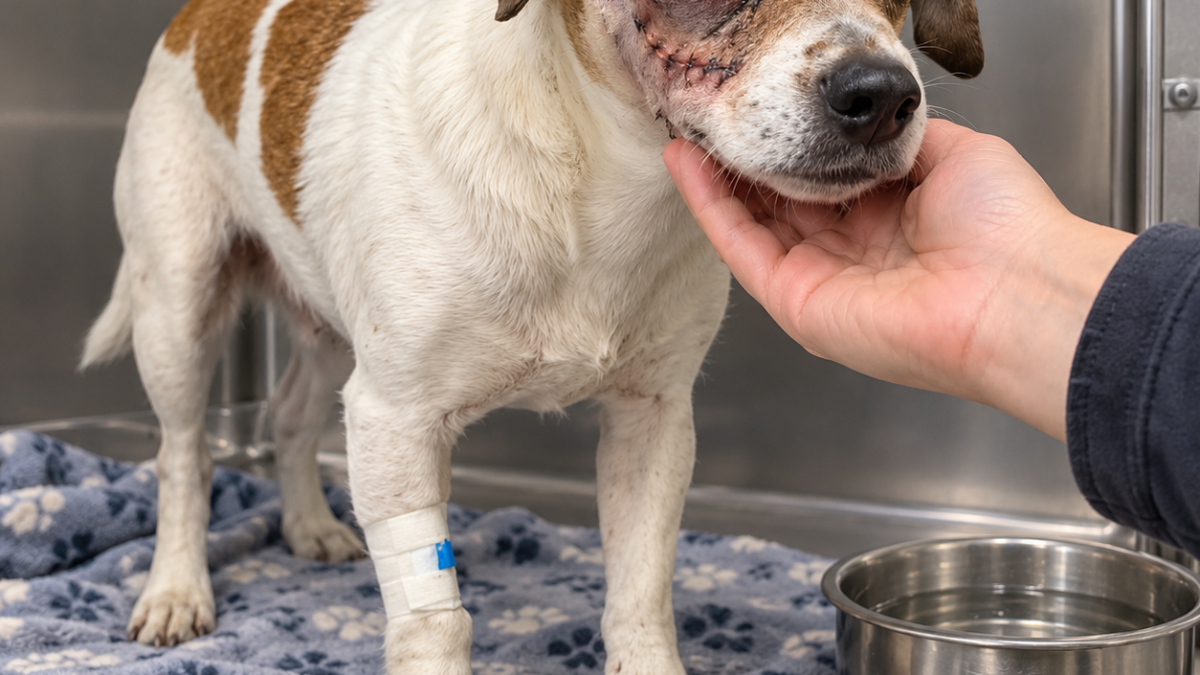
The little dog had survived the stitches, the swelling, and the pain—but the thing that frightened me most was that he had stopped trying to eat.
Every time I moved the bowl toward him, he lifted his injured face toward my hand instead, as if he was asking for something I still didn’t understand.
Then, in the quietest moment of that night, I noticed one small movement that made the entire room go still.
My name is Rachel Mercer, and I had been a veterinary nurse for eleven years by the night he came through our emergency doors.
I had seen dogs hit by cars, dogs pulled from freezing rivers, dogs found under porches after storms, and dogs so frightened they pressed themselves flat against the backs of their kennels.
But there was something about this little brown-and-white terrier mix that stayed with me from the first moment I saw him.
He arrived wrapped in a gray blanket shortly after 6:00 p.m.
His face was badly swollen on one side. Fresh stitches ran beneath his left eye, which was cloudy, red, and painfully inflamed. His right front leg had already been bandaged after treatment, and bruising disappeared beneath the fur along his jaw.
He never barked.
He never fought us.
He only trembled.
Dr. Levin finished the examination, adjusted his pain medication, and asked us to watch him closely through the evening.
“Try to get something into his stomach,” she told me. “Even a little.”
That sounded simple.
It wasn’t.
I warmed a small portion of soft food first.
He turned away.
I tried kibble mixed with warm water.
Nothing.
Finally, I added plain white rice because sometimes the smell and warmth will tempt a frightened dog when almost nothing else does.
I placed the bowl just beneath his nose.
He stared at it for a second, then looked toward the kennel door.
“You’ve got to give me something, buddy,” I whispered.
His ears moved at my voice, but his body stayed rigid.
I backed away.
Ten minutes passed.
Then twenty.
Nearly an hour after I had first offered the food, the bowl still looked untouched.
I began to worry that pain was overwhelming him.
When I opened the kennel again, I reached toward the dish to move it closer.
That was when he lifted his chin and placed it near my hand.
I stopped.
He didn’t growl.
He didn’t flinch.
He simply held his head there.
I thought he wanted comfort, so I turned my palm upward and gently rested it beneath his jaw.
His entire body softened.
Not much.
Just enough for me to feel it.
A tiny release of tension.
A tiny surrender.
I stayed still.
Then I noticed his eyes move toward the bowl.
I moved my hand away.
His head came back up immediately.
I put my palm beneath his chin again.
He relaxed.
That was the moment I understood.
He wasn’t refusing food because he had given up.
Lowering his face hurt too much.
“Emily,” I called softly to the technician across the room. “Bring the bowl closer. Slowly.”
She crouched beside me.
Neither of us said another word.
With my hand supporting his jaw, Emily slid the food beneath his mouth.
For several seconds, he only smelled it.
Then his tongue touched the rice.
Once.
Twice.
A tiny piece of kibble disappeared between his teeth.
The sound of that first faint crunch was so small I almost missed it.
Emily covered her mouth.
I felt my own throat tighten.
He chewed slowly, then stopped and lifted his head back into my hand.
“I’m here,” I whispered.
He tried again.
Another bite.
Then another.
Every few seconds, he paused as though he needed to make sure my hand had not disappeared.
I kept it there.
By the time he had eaten only a few spoonfuls, my knees were aching from crouching on the floor, but I could not bring myself to move.
This dog had endured examinations, needles, stitches, bright lights, strange voices, and pain he could not possibly understand.
And somehow, in a room full of people trying to save him, the thing he needed most was not another procedure.
It was one steady hand beneath his chin.
Then I heard Dr. Levin behind me.
“Rachel,” she said quietly, “you need to come see what animal control just found.”
I looked down at the little dog leaning into my palm.
And I had no idea that what waited outside that kennel door was about to change his case—and mine—completely.
PART 2
I didn’t move right away.
The little dog was still resting his chin in my palm.
His breathing had finally slowed, and for the first time since he had arrived, the muscles along his shoulders weren’t pulled tight beneath his coat.
“Can it wait thirty seconds?” I asked.
Dr. Levin looked at him and nodded.
“Thirty seconds.”
Emily took my place carefully.
“Same pressure?” she whispered.
“Just support him. Don’t lift.”
She slid her palm beneath his jaw.
The dog tensed when my hand disappeared.
“It’s okay,” I told him. “She’s got you.”
He looked at me with his good eye.
Then, slowly, he allowed his weight to settle into Emily’s hand.
I stood.
My knees cracked loudly enough that Emily almost smiled.
I followed Dr. Levin through the treatment area and into the small consultation room beside reception.
Animal Control Officer Maria Cole was standing beside the table.
I knew Maria well. We had worked together on neglect cases for years. She was in her forties, calm under pressure, and almost impossible to surprise.
That night, she looked angry.
Not loud angry.
Not dramatic angry.
The kind of angry that made her voice become quieter.
On the table was a clear evidence bag containing a blue nylon collar.
Beside it sat a printed photograph.
“What is that?” I asked.
Maria turned the photograph toward me.
It showed the same little dog.
Healthy.
Bright-eyed.
Standing on a front porch beside a woman wearing jeans and a red sweater.
A blue collar circled his neck.
I looked from the picture to the evidence bag.
“Where did you get this?”
“The collar was found about two hundred yards from where he was picked up.”
I stared at her.
“Picked up?”
That was the first time I realized how little I knew about his arrival.
The couple who had brought him in had found him beside an access road behind a strip of warehouses on the north side of town. They had seen him stumbling near a drainage ditch and stopped.
They hadn’t witnessed what happened.
They had simply wrapped him in a blanket, put him in their car, and driven straight to us.
Maria tapped the photograph.
“He’s microchipped.”
My heart jumped.
“You found the owner?”
“We found a registered owner.”
Something in her tone stopped me from celebrating.
“What’s the difference?”
“The owner says her dog disappeared from a boarding facility three days ago.”
Dr. Levin folded her arms.
“What boarding facility?”
Maria looked at both of us.
“North Ridge Canine Lodge.”
I knew the name.
Almost everyone in the county did.
North Ridge was a private boarding and training operation about fifteen miles outside town. They advertised climate-controlled runs, supervised exercise, individualized attention, and what their website called “country care with professional standards.”
They weren’t cheap.
Their owner, Wade Harlan, appeared in local commercials holding golden retrievers and talking about treating every pet like family.
I had never met him.
But I had met two dogs that had come through our clinic after boarding there.
Both had been minor cases.
One had kennel cough.
The other had torn a toenail.
Nothing that had raised alarms.
“Who owns this dog?” I asked.
“Sarah Whitaker,” Maria said. “She teaches fourth grade at Lincoln Elementary.”
“Does she know he’s here?”
Maria nodded.
“She’s on her way.”
I looked through the consultation-room window toward the treatment area.
The little dog was still with Emily.
“What’s his name?”
Maria looked at the photograph.
“Toby.”
I don’t know why hearing his name hit me as hard as it did.
Until then, he had been “buddy,” “little guy,” “sweet boy.”
Names change things.
A name means somebody has called you home.
A name means there is a bowl somewhere with your name painted on it.
A bed with your smell in it.
A person who knows which sound makes your ears lift.
“Toby,” I repeated.
Maria nodded.
“Sarah dropped him at North Ridge five days ago. She had to leave town because her father was having emergency heart surgery in Indianapolis. She was supposed to pick Toby up tomorrow.”
Dr. Levin’s expression tightened.
“And the facility says?”
“That he escaped.”
“When?”
“Three nights ago.”
“And they notified her?”
Maria paused.
“Not immediately.”
That sentence made the room colder.
“What does ‘not immediately’ mean?” I asked.
“They called her the following afternoon.”
Nearly a full day.
I thought about Toby lying beside that drainage ditch.
His injured eye.
His swollen jaw.
The bandaged leg.
The way he had trembled at every metallic sound.
Dr. Levin spoke carefully.
“Maria, I can document injuries. I cannot tell you from an examination alone exactly how each one happened.”
“I know.”
“Some could be consistent with being struck by a vehicle.”
“I know.”
“Some could also have other causes.”
“I know that too.”
Maria slid a second photograph across the table.
It was a still image from a security camera.
A dark pickup truck was stopped behind the warehouses.
The image was grainy.
But the rear passenger door was open.
A man-shaped figure stood beside it.
The timestamp read 2:13 a.m.
“That camera belongs to a plumbing supply company,” Maria said. “Their night manager is pulling the full footage now.”
I felt the hair rise along my arms.
“You think somebody dumped him.”
“I think I’m going to watch the footage before I think anything.”
That was Maria.
Careful.
Precise.
Never saying what evidence had not yet earned.
Dr. Levin pointed toward the collar.
“Any blood?”
“It’s been bagged for processing. I’m not touching that question yet.”
A car door slammed outside.
Then another.
Thirty seconds later, the clinic’s front door opened so hard the bell above it struck twice.
A woman rushed inside.
She was maybe thirty-five, still wearing hospital visitor stickers on the front of her sweatshirt.
Her hair was pulled into a loose knot, and she looked like she hadn’t slept in days.
“I’m Sarah Whitaker.”
Maria stepped into the lobby.
Sarah didn’t even look at her.
“Where is he?”
Her voice broke on the last word.
I walked toward her.
“He’s stable.”
Her hands went to her mouth.
“Is he alive?”
“Yes.”
“Can I see him?”
“Yes.”
She followed me so closely that I could hear her breath catching behind me.
Before we entered the treatment room, I stopped her.
“Sarah, his face looks frightening right now.”
She closed her eyes.
“I don’t care.”
“He has stitches beneath his left eye. There’s significant swelling. One leg is bandaged. We’re controlling his pain, but he’s scared.”
“I don’t care what he looks like.”
“I know. I just want you prepared.”
She looked directly at me.
“I have spent three days imagining him dead beside a highway. There is nothing behind that door I would rather see than my dog breathing.”
I opened the door.
Emily moved away from the kennel.
Sarah saw him.
The sound she made wasn’t a scream.
It was softer than that.
Worse, somehow.
“Oh, Toby.”
His ears moved.
His whole body froze.
“Toby?”
His good eye widened.
Sarah dropped to her knees.
“Oh, baby. Mom’s here.”
For the first time that night, his tail moved.
Once.
A tiny tap against the newspaper.
Sarah covered her face and began crying.
Toby tried to step toward her but stumbled.
We opened the kennel.
She didn’t grab him.
That mattered.
People often want to gather an injured animal into their arms immediately because their own fear needs somewhere to go.
Sarah waited.
She held both hands out.
Toby took one unsteady step.
Then another.
He pressed his forehead against her chest.
Sarah bent around him without squeezing.
“I’m sorry,” she whispered over and over. “I’m so sorry. I’m so sorry.”
Toby’s tail moved again.
I looked away for a second because suddenly I needed to.
After a few minutes, Sarah sat on the floor beside the kennel while Dr. Levin explained the injuries.
The eye was our greatest concern.
There was extensive inflammation, and we could not yet tell how much vision would return.
The wound beneath it had been cleaned and sutured.
His jaw was bruised but did not appear fractured.
His leg had a deep soft-tissue injury but no obvious break.
He was dehydrated.
Exhausted.
Underfed for at least the previous day or two.
But he was alive.
“Will he keep the eye?” Sarah asked.
“We’re going to do everything we can,” Dr. Levin said. “I don’t want to promise what I can’t know yet.”
Sarah nodded.
She stroked Toby between his ears.
Then she noticed the food.
“He hasn’t eaten?”
“A little.”
“How?”
I showed her.
I placed my palm beneath Toby’s chin and moved the raised bowl closer.
Sarah watched his head settle into my hand.
Her expression changed.
“What is he doing?”
“We think lowering his face is painful.”
Her mouth opened, but no words came.
“He figured out that a hand under his jaw lets him eat without putting as much pressure on the sore area.”
Sarah turned away and wiped her cheek.
“He always eats like he’s been starving for a week.”
I smiled faintly.
“I think that version of Toby is still in there.”
She took my place.
The moment her palm touched his chin, Toby smelled her wrist.
Then he leaned into it.
Sarah laughed through tears.
“There you are.”
He ate three more bites.
Then five.
By the time he stopped, he had eaten almost half the serving.
Nobody in the room cared that it had taken nearly forty minutes.
Afterward, Sarah remained beside him while Maria took her statement.
That was when we learned the rest.
Sarah had used North Ridge twice before.
Both experiences had seemed normal.
Toby came home tired but healthy.
This time, she dropped him off Friday morning before driving to Indianapolis.
Wade Harlan himself had checked Toby in.
“He told me not to worry about anything,” Sarah said. “He said they’d take pictures for me.”
“Did they?” Maria asked.
Sarah pulled out her phone.
“The first day.”
She opened a photograph.
Toby was standing inside a fenced exercise yard.
No swelling.
No visible injury.
Blue collar.
Bright eyes.
Timestamp: Friday, 2:41 p.m.
“Anything after that?”
“One picture Saturday morning.”
She found it.
Toby sitting near a wooden fence.
Again, normal.
“And then?”
“Nothing. Sunday I texted twice. Nobody answered. Sunday night I called and got voicemail.”
“When did they tell you he was missing?”
“Monday at eleven twenty in the morning.”
Maria wrote it down.
“What did Harlan say?”
“That Toby slipped through a gate during a shift change Sunday evening.”
“Did he say what time?”
“Around six.”
“And the facility didn’t call you until Monday at eleven twenty?”
Sarah’s jaw tightened.
“He said they wanted to search first so they wouldn’t scare me unnecessarily.”
Maria’s pen stopped.
Sarah stared at Toby.
“I was three hundred miles away, sitting beside my father after heart surgery, and they waited seventeen hours to tell me my dog was gone.”
“Did they report him missing to animal control?”
“They told me they had.”
Maria looked at me.
I understood the look.
They hadn’t.
If North Ridge had filed a missing-animal report, Maria would have known before Toby ever arrived at our clinic.
“Did Mr. Harlan give you any reason for not reporting the escape?” Maria asked.
Sarah looked confused.
“He said they did.”
Maria wrote something else.
Then her phone buzzed.
She checked the screen.
Her eyes sharpened.
“I need to step outside.”
She was gone five minutes.
When she returned, she had stopped looking angry.
Now she looked focused.
“Dr. Levin, is there any medical reason Toby can’t remain here tonight?”
“No. In fact, I’d prefer it.”
“Good.”
Sarah stood.
“What happened?”
Maria looked at her.
“We have the full security video from the warehouse.”
The room became silent.
“And?”
“I haven’t watched all of it.”
“Maria.”
“I’m not going to tell you what I haven’t verified.”
Sarah stared at her.
“Does it show who left him there?”
Maria hesitated.
“It shows a vehicle.”
“What vehicle?”
“A pickup.”
“What kind?”
“A dark Ford.”
Sarah’s face emptied.
“No.”
Maria didn’t respond.
Sarah stood.
“No.”
“Sarah—”
“Wade drives a dark Ford.”
“That doesn’t establish who was driving.”
“He drives a black F-150 with a silver toolbox behind the cab.”
Maria’s expression told me enough.
Sarah saw it too.
“Oh, God.”
Toby lifted his head at the change in her voice.
She immediately lowered herself beside him.
“Sorry, baby.”
Maria’s phone rang again.
She answered in the hallway.
Less than a minute later, she came back through the door.
“The plumbing company gave me a second camera angle.”
Sarah looked up.
Maria’s voice was steady.
“The license plate is visible.”
Nobody spoke.
“It’s registered to North Ridge Canine Lodge.”
Sarah went completely still.
Then she whispered one word.
“Why?”
That question became the center of everything that followed.
Why would a boarding kennel hide an injured dog?
Why would someone drive him miles away in the middle of the night?
Why claim he had escaped?
Why leave him behind warehouses instead of taking him to a veterinarian?
We didn’t have those answers that night.
But we were going to get them.
And Wade Harlan made his first mistake before sunrise.
At 5:42 the next morning, he walked into our clinic and demanded his dog back.
I was still there.
I had worked through most of the night because Toby’s pain medication needed monitoring and because, if I’m being truthful, I didn’t want to leave.
Sarah had gone home for two hours to shower and get clean clothes. She planned to return at seven.
Maria had instructed us clearly: Toby belonged to Sarah Whitaker. North Ridge had no authority to remove him.
Wade Harlan arrived wearing work boots, a quilted jacket, and an expression that suggested he expected everyone to step aside.
He was around fifty.
Broad-shouldered.
Gray at the temples.
He came to the counter and said, “I’m here for the terrier.”
Our receptionist, Jasmine, looked at me.
I stepped forward.
“Which terrier?”
“The one brought in last night.”
“Are you the owner?”
“I’m responsible for him.”
“That isn’t what I asked.”
His eyes narrowed.
“I own North Ridge.”
“I know.”
“He escaped from my facility. I’ve been looking everywhere.”
“We have the registered owner’s information.”
“I’ll handle it with her.”
“Sarah has already been notified.”
Something passed across his face.
Very quickly.
But I saw it.
He hadn’t expected that.
“Then she can meet me here.”
“She already has.”
His jaw tightened.
“I need to see the dog.”
“No.”
He leaned over the counter.
“You’re refusing access to the person who brought that animal into your care?”
“You didn’t bring him here.”
Silence.
His eyes locked on mine.
I continued.
“A couple found him beside North Mill Road.”
“I know where he was found.”
The words came out too quickly.
He realized it.
So did I.
Jasmine stopped typing.
I said, “How do you know?”
He stepped back.
“Because Sarah told me.”
“No, she didn’t.”
His face changed.
Only a little.
But enough.
“I spoke to her.”
“When?”
“Last night.”
“That’s interesting.”
“Why?”
“Because she asked us not to give her phone number to anyone associated with North Ridge, and she said she hadn’t spoken to you since Monday afternoon.”
He stared at me.
“You a cop?”
“No.”
“Then stop acting like one.”
“I’m a veterinary nurse. And I’m telling you that you are not taking Toby anywhere.”
The use of Toby’s name bothered him.
His eyes flicked toward the treatment-room door.
“Look, I don’t know what that woman told you, but the dog got loose. We searched. Apparently he was hit by something. It’s unfortunate, but things happen.”
Behind me, I heard a door open.
Dr. Levin stepped into the hall.
“Mr. Harlan?”
“Yes.”
“I’m Dr. Levin. I treated Toby.”
“Good. Then you understand this is a boarding accident.”
“I understand that Toby is a patient.”
“I’ll pay the bill.”
“You are not authorized to make decisions for him.”
His voice hardened.
“Do you have any idea what one social media post about this could do to my business?”
Dr. Levin’s face remained expressionless.
“We haven’t posted anything.”
“I’m telling you this needs to be handled correctly.”
“So am I.”
He lowered his voice.
“The owner is emotional.”
I felt anger rise in me.
Dr. Levin did not.
“She has a right to be.”
“He escaped.”
Dr. Levin looked directly at him.
“That is a matter for animal control.”
For the first time, Wade seemed uncertain.
“Why would animal control be involved?”
I watched him carefully.
Dr. Levin said, “You should ask them.”
He left six minutes later.
He did not ask to pay the bill again.
At 7:08, Sarah returned.
At 7:19, Maria arrived with a warrant application already in motion.
By noon, animal control and sheriff’s deputies were at North Ridge.
What they found changed the case from one injured dog to something much larger.
The public-facing part of North Ridge looked exactly as advertised.
Clean lobby.
Framed certificates.
Bright kennels.
Fresh water.
Color-coded feeding charts.
But behind a locked interior door was an older wing of the property that customers never saw.
Nine kennels.
No exterior windows.
Poor ventilation.
Stacks of crates.
Expired medication.
Incomplete treatment records.
Three dogs had minor untreated injuries.
One elderly Labrador had a skin infection severe enough to require veterinary attention.
None of the animals were in the condition Toby had been in, but the records raised immediate questions.
The bigger discovery was in the office.
A handwritten incident log.
Not the polished computerized records shown to customers.
A spiral-bound notebook kept beneath a drawer.
Maria later told me it contained entries written by several employees.
Vomiting.
Diarrhea.
Dog fights.
Escape attempts.
Medication mistakes.
Injuries.
And on Sunday, beside Toby’s kennel number, somebody had written:
**4:35 PM — facial injury in back run. W.H. notified.**
Below it, in different handwriting:
**5:10 — bleeding stopped. Eye swelling. Asked if vet needed. W.H. said monitor.**
Then:
**8:40 — worse. Won’t eat.**
There was no entry after that.
Until someone had drawn a single line through Toby’s entire section.
Sarah read a copy of those notes two days later.
She sat in our consultation room with Toby sleeping beside her.
She reached the line that said **won’t eat**.
Her hand began shaking.
“They knew.”
Maria nodded.
“They knew he was hurt.”
“They knew he couldn’t eat.”
“Yes.”
“And they left him like that?”
“We’re still establishing exactly what happened.”
Sarah looked at me.
I knew what she was remembering.
My palm beneath his chin.
The first bite.
“They knew,” she repeated.
Then her face hardened.
That was the moment Sarah stopped blaming herself.
Until then, she had carried guilt like a stone.
She had chosen the facility.
She had driven away.
She had trusted them.
People who love animals often do this after something terrible happens. They search backward through their own decisions until they find a place where they can punish themselves.
If I had chosen somewhere else.
If I had canceled my trip.
If I had called sooner.
If I had known.
But Sarah hadn’t injured Toby.
Sarah hadn’t hidden what happened.
Sarah hadn’t driven him into the dark.
And once she understood that, grief became something else.
Determination.
“What do you need from me?” she asked Maria.
“Every text. Every email. Every photograph they sent. The boarding agreement. Payment records. Everything.”
“You’ll have it today.”
“And don’t contact Harlan.”
“Why?”
“Because right now he doesn’t know exactly what we have.”
Sarah looked at her for several seconds.
Then nodded.
“Good.”
That afternoon, Toby underwent another examination.
The swelling had decreased slightly.
He still would not lower his head all the way to a bowl.
So we improvised.
We raised his food dish on folded towels.
Sarah supported his chin.
I fed him tiny portions.
By the third day, he was eating enough that we stopped discussing feeding support.
By the fifth, he could manage a raised dish without a hand beneath his jaw.
But something else had become obvious.
Hands had become important to him.
Whenever he became frightened, he searched for one.
During eye drops, he pressed his chin into Sarah’s palm.
During bandage changes, he leaned into mine.
If a metal pan fell in the treatment room and startled him, he would raise his face until someone touched his jaw.
It became his signal.
I need you here.
Not restraint.
Not control.
Just contact.
The eye improved slowly.
Dr. Levin was cautiously optimistic that we could save it.
His vision might remain limited.
But the pressure was normalizing.
The wound beneath it was healing cleanly.
His leg was improving.
Physically, Toby was moving forward.
The investigation was moving too.
And then, six days after Toby arrived, someone called the clinic from a blocked number.
Jasmine answered.
“Pine Valley Veterinary Center.”
A woman asked to speak with whoever was treating the terrier found on North Mill Road.
Jasmine transferred the call to me.
“This is Rachel.”
The woman did not give her name.
“Is he alive?”
I straightened.
“Who is this?”
“Is Toby alive?”
Because of privacy rules and the active investigation, I didn’t answer.
“You need to speak with animal control.”
There was silence.
Then the woman began crying.
“I told him to take Toby to a vet.”
My stomach tightened.
“Who?”
“Wade.”
I grabbed a pen.
“What is your name?”
“I can’t.”
“If you witnessed something involving Toby, you need to call Officer Maria Cole.”
“I’ll lose my job.”
“You work at North Ridge?”
Silence.
That was answer enough.
“Listen to me,” I said. “If you know what happened to that dog, protecting the person responsible will not protect you.”
“I didn’t hurt him.”
“I didn’t say you did.”
“He told us Toby escaped.”
“Did he?”
Another silence.
“No.”
I closed my eyes.
“What happened?”
“I can’t tell you over the phone.”
“Then tell Maria.”
“He’ll ruin me.”
“You called because you don’t want to live with this.”
She started crying harder.
I softened my voice.
“What’s your name?”
“Kayla.”
“Kayla, call animal control.”
“What if he finds out?”
“He probably will.”
That might not have been comforting, but it was true.
“And then?”
“Then you tell the truth anyway.”
She hung up.
Twenty minutes later, I called Maria.
She already knew.
Kayla had phoned her after speaking to me.
That evening, she gave a formal statement.
Kayla Mendoza was twenty-three years old.
She had worked at North Ridge for seven months.
According to her, Toby’s injury had not happened during an escape.
It had happened inside the facility.
Sunday afternoon, several dogs were being moved between the indoor kennel area and outdoor runs.
Toby had become frightened by a larger dog barking behind a gate.
He backed away.
Wade Harlan was helping because they were short-staffed.
He ordered Toby forward.
Toby refused.
Wade pulled on the lead.
Toby slipped his collar.
He tried to squeeze behind a plastic storage bin near the gate.
What happened next would later become the central dispute in the case.
Kayla said Wade lost his temper.
She heard him shout.
She saw him grab Toby.
She saw Toby strike the edge of a metal gate while Wade was handling him.
Whether Wade intentionally struck the dog’s face or caused the injury through reckless handling would be argued for months.
But what happened afterward was not disputed.
Toby’s face began swelling.
Kayla asked permission to call the emergency veterinarian.
Wade refused.
He told her it was superficial.
Later, when Toby would not eat and his eye worsened, she asked again.
Wade told her the dog was “dramatic” and would be fine by morning.
Around 10:00 p.m., Kayla finished her shift.
Toby was still there.
At 2:13 a.m., the warehouse camera recorded North Ridge’s truck stopping behind the industrial buildings.
At 2:16, a man carried something from the passenger side toward the drainage area.
At 2:19, the truck left.
Maria had enhanced footage from the second camera.
It did not show a face clearly enough for identification.
But it showed the North Ridge logo on the driver’s door.
And the plate was readable.
The following morning, Wade told his employees Toby had slipped out through a damaged gate.
He ordered them to call shelters.
He called Sarah later that morning.
By then, Toby was miles away.
Alone.
Injured.
Without his collar.
The collar was found beside the access road.
When Sarah heard Kayla’s statement, she didn’t cry.
She sat perfectly still.
Then she said, “I want him to know exactly what he did.”
Maria looked at her carefully.
“He knows.”
“No. He knows he hurt a dog. I want him to understand that Toby wasn’t disposable.”
“He’ll have an opportunity to answer the evidence.”
Sarah shook her head.
“You know what I mean.”
I did.
When someone hurts an animal you love, there is a primitive part of you that wants to return the pain.
But Sarah never threatened Wade.
Never drove to his property.
Never posted his address.
Never did anything that could become a distraction from the case.
Her revenge became documentation.
Every veterinary invoice.
Every photograph.
Every medication.
Every night Toby woke shaking.
Every meal he could not eat normally.
Every missed day of work.
Every follow-up visit.
Sarah kept all of it.
And Wade kept making mistakes.
His biggest came two weeks later.
He called Sarah.
She didn’t answer.
He left a voicemail.
At first, his tone was smooth.
“Sarah, this has gotten out of hand. I understand you’re upset, but there’s misinformation going around. Toby escaped from our property, and anything that happened after that is not something we could control.”
Then his voice changed.
“I’ve been advised that public accusations could expose everyone involved to legal action. I’d prefer to resolve this privately.”
Sarah forwarded the message to Maria.
Two hours later, Wade emailed her a proposed agreement.
North Ridge would pay Toby’s veterinary expenses.
Sarah would receive a full refund for the boarding stay.
An additional $5,000 would be paid for “inconvenience.”
In return, she would agree not to make public statements about North Ridge and would acknowledge that the cause of Toby’s injuries was unknown.
Sarah printed the email.
She brought it to the clinic.
She laid it on the table in front of me.
“Five thousand dollars.”
I read it.
“What are you going to do?”
She looked down at Toby.
His stitches had been removed that morning.
The fur beneath his eye was beginning to grow back.
“I’m going to make a copy for my attorney.”
Then she folded the letter.
“And I’m going to let him keep his money.”
The story reached local news after the county suspended North Ridge’s boarding license pending investigation.
We did not release Toby’s medical information.
Sarah did not give interviews immediately.
But former customers began talking.
One family said their beagle had returned from North Ridge with an unexplained limp.
Another said their dog came home severely dehydrated.
A third produced emails showing North Ridge had delayed telling them about a kennel injury.
Not every complaint was evidence of abuse.
Animals can become sick or injured even in responsible facilities.
That distinction mattered.
Maria repeated it often.
The case had to be about what could be proved.
Not rumor.
Not anger.
Proof.
Then another former employee came forward.
His name was Daniel Reed.
He had worked at North Ridge for almost three years.
He left six months before Toby’s injury.
Daniel had saved photographs of the handwritten incident notebook because he believed Wade was deleting serious incidents from customer records.
He had more than forty images.
Some matched the notebook seized by animal control.
Others showed pages that were no longer there.
One involved a husky that had required stitches after a kennel fight.
The owner’s official report said the dog had developed “minor skin irritation.”
Another involved a senior spaniel that had collapsed during outdoor exercise on a hot afternoon.
The internal note said the dog had been outside thirty-eight minutes.
The owner was told six.
Daniel had complained.
Wade cut his hours.
Then fired him for “attitude problems.”
Daniel never went to authorities.
“I should have,” he told Maria.
That guilt would stay with him for a long time.
But eventually he did come forward.
Sometimes courage arrives late.
Late is still better than never.
The county prosecutor reviewed the evidence.
Animal cruelty charges were filed.
So were charges relating to false business records and obstruction connected to the alleged attempt to conceal what happened to Toby.
The exact legal battle became complicated.
Wade’s attorney argued there was no proof Wade intentionally injured Toby.
They conceded an accident happened but said panic and poor judgment afterward had been misinterpreted as criminal intent.
They argued the late-night drive was Wade attempting to search an area where he believed Toby might be found.
Then prosecutors obtained cell-location records placing Wade’s phone near the warehouse access road during the same window recorded by the cameras.
His attorney said coincidence.
Prosecutors said otherwise.
The first court hearing was scheduled for January.
By then, Toby looked almost like the dog in Sarah’s old photographs.
Almost.
The swelling was gone.
The stitches had left a thin scar beneath the eye.
He had limited vision on that side, but he had kept the eye.
His leg healed.
His appetite returned with enthusiasm.
He had gained three pounds.
And he no longer needed anyone to hold his chin while he ate.
But he still asked sometimes.
Sarah brought him to the clinic one Friday for a follow-up.
I knelt.
“Toby.”
His ears lifted.
His tail began swinging.
He trotted toward me.
Then stopped directly in front of my knees.
Without hesitation, he raised his chin.
I put my hand beneath it.
He closed his eyes.
Sarah laughed.
“He does that every night.”
“Still?”
“Every single night.”
She had bought him an elevated bowl, but he no longer needed it.
The ritual had changed meaning.
It wasn’t about pain anymore.
It was about memory.
My hand had once made eating possible.
Now a hand beneath his chin meant the world was safe.
The January hearing drew more people than anyone expected.
I was subpoenaed.
So was Dr. Levin.
So were Kayla and Daniel.
Sarah sat behind the prosecutor with Toby’s blue collar in her purse.
The real one.
Animal control had returned it after processing.
She had cleaned it but never put it back on him.
“He gets a new collar,” she told me.
The courthouse hallway was packed.
Wade arrived in a dark suit.
For the first time, I saw him without the confidence he had carried into our clinic.
He looked smaller.
Not physically.
Something else.
He glanced toward Sarah.
She did not look away.
Neither of them spoke.
Inside, the prosecutor laid out the timeline.
Friday: Toby checked into North Ridge healthy.
Saturday: photographs showed him healthy.
Sunday afternoon: injury documented internally.
Sunday evening: worsening swelling and refusal to eat.
Emergency care discussed and rejected.
Early Monday: North Ridge truck recorded near the place Toby was later found.
Monday morning: employees told Toby escaped.
Monday afternoon: Sarah notified.
Tuesday evening: Toby found and brought to our clinic.
That timeline was devastating because it was simple.
Wade’s attorney attacked each piece separately.
Internal notes could be mistaken.
Employees could be disgruntled.
A company truck could be driven by different people.
Cell-phone location could be imprecise.
Toby could have been injured after leaving North Ridge.
The prosecutor did not argue with possibilities.
She returned to sequence.
Again.
And again.
Then Kayla testified.
Her hands shook so badly that she had to grip the edge of the witness stand.
Wade’s attorney asked whether she disliked her employer.
“Yes,” she said.
“Did you dislike him before this incident?”
“Sometimes.”
“Were you unhappy with your schedule?”
“Yes.”
“Had you been disciplined?”
“Yes.”
“So you have personal reasons to resent Mr. Harlan.”
Kayla swallowed.
“Yes.”
The attorney paused, perhaps expecting that answer to damage her.
Then Kayla continued.
“But none of those reasons put that dog in the back kennel with a swollen face.”
The courtroom went silent.
The attorney tried again.
“You cannot say exactly how Toby’s face struck the gate.”
“No.”
“You cannot say my client intentionally injured him.”
“No.”
“You cannot even say Toby did not cause part of his own injury while struggling.”
“No.”
“Then what exactly are you claiming to know?”
Kayla looked toward Sarah.
Then at the judge.
“I know Toby was hurt before I left. I know I asked Mr. Harlan twice to let me call a vet. I know Toby’s eye was swelling. I know he wouldn’t eat. I know the next morning Toby was gone. And I know Mr. Harlan told us to say he escaped.”
No one moved.
Then it was my turn.
I testified only to what I knew.
Toby’s condition upon arrival.
His injuries.
His behavior.
His inability or unwillingness to lower his head comfortably toward food.
The way he accepted food when his jaw was supported.
Wade’s attorney stood.
“Ms. Mercer, you’re a veterinary nurse, correct?”
“Yes.”
“Not a veterinarian.”
“Correct.”
“You cannot determine from behavior alone exactly what happened to an animal before arrival.”
“No.”
“You cannot testify that my client caused these injuries.”
“No.”
“So when Toby placed his chin in your hand, you do not actually know what he was thinking.”
“No.”
“Dogs don’t speak English.”
A few people shifted.
I said nothing.
He continued.
“So the emotional interpretation of that moment is yours.”
“Yes.”
He nodded.
“Thank you.”
I thought he was finished.
Then the prosecutor stood for one final question.
“Ms. Mercer, regardless of what Toby was thinking, did supporting his jaw allow him to eat?”
“Yes.”
“How quickly?”
“Almost immediately.”
“And before that?”
“He had refused food for nearly an hour.”
“Thank you.”
Dr. Levin testified next.
She was clinical.
Precise.
She described bruising, swelling, dehydration, ocular trauma, and pain.
She refused to speculate beyond the evidence.
That made her testimony stronger.
When Wade’s attorney asked whether Toby could have been hit by a car, she said yes.
When asked whether his injuries proved deliberate abuse, she said no.
Then the prosecutor asked one question.
“If an animal under professional boarding care develops significant facial swelling, eye trauma, and refuses food, what is the appropriate response?”
Dr. Levin answered without hesitation.
“Veterinary evaluation.”
“How soon?”
“As soon as reasonably possible.”
“Is abandoning the animal beside an industrial access road an appropriate medical response?”
Wade’s attorney objected.
Sustained.
But the question had already landed.
The most damaging evidence came last.
Not the security video.
Not the notebook.
Not even Kayla.
It was Wade’s own voicemail.
The prosecutor played it.
His voice filled the courtroom.
He talked about misinformation.
Legal action.
Resolving the matter privately.
Then came the email offering money in exchange for Sarah acknowledging that the cause of Toby’s injuries was unknown.
The defense argued settlement offers were not admissions of wrongdoing and fought over how the material could be used.
The legal details were messy.
The emotional meaning was not.
Sarah sat still through all of it.
When the hearing ended, reporters gathered outside.
Wade left through a side door.
Sarah walked down the courthouse steps.
A local reporter called her name.
She stopped.
It was the first time she agreed to speak publicly.
The reporter asked, “What outcome do you want?”
Sarah thought for a moment.
“I want people to understand this isn’t about getting even.”
I watched her.
“It’s about what happens when someone thinks a frightened animal can’t tell anybody what was done to him.”
The reporter asked, “Do you want Mr. Harlan imprisoned?”
Sarah’s eyes moved toward the courthouse doors.
“I want the court to decide the sentence.”
Then she added, “What I want is for him never to be responsible for another animal again.”
That became the line every station used that night.
But the case still wasn’t over.
Wade refused an early plea agreement.
His business remained closed.
He sold two company vehicles.
North Ridge’s website disappeared.
Then his attorney began challenging the search of the property.
Months passed.
Toby healed while the legal system moved at the speed legal systems move.
Spring arrived.
Then summer.
By June, Toby’s scar was barely visible unless you knew where to look.
His vision in the injured eye never returned completely.
But he adapted so well that strangers rarely noticed.
Sarah sent us photographs.
Toby sleeping upside down on the couch.
Toby carrying a tennis ball through the yard.
Toby standing in the kitchen beside his elevated bowl, looking offended because dinner was three minutes late.
Then one photograph made me stop.
Sarah was sitting on her porch.
Toby sat beside her.
His chin rested in her open palm.
Under the photograph, Sarah had written:
**He doesn’t need help eating anymore. He just likes knowing somebody’s there.**
I printed it.
I kept it inside my locker.
In August, the case changed again.
Maria called me.
“They found the original gate video.”
“What gate video?”
“North Ridge had outdoor cameras.”
I stood up.
“I thought Wade said they weren’t recording.”
“He did.”
The system’s hard drive had been removed before the search.
Investigators assumed the footage was gone.
But the company that installed North Ridge’s cameras maintained temporary cloud backups for thirty days.
Nobody had known to ask until Daniel Reed mentioned that the cameras had once been accessible from Wade’s phone.
The backup window should have expired months earlier.
But after receiving a preservation request connected to the initial investigation, the provider had retained archived data.
Technicians recovered part of Sunday afternoon.
The video had no audio.
It did not show the entire incident.
But it showed enough.
Toby backed away from the gate.
Wade pulled the leash.
Toby twisted.
Wade reached down abruptly.
There was a struggle lasting only seconds.
Toby’s face struck the metal gate.
He collapsed.
Then stood again.
Wade looked around.
Kayla approached.
The video ended less than a minute later.
It did not prove Wade deliberately slammed Toby into the gate.
But it destroyed the claim that Toby had been injured after escaping North Ridge.
Wade changed his plea three weeks later.
The agreement included criminal penalties for animal cruelty and evidence-related offenses, probation following a period of incarceration, restitution for Toby’s veterinary expenses, and a court order prohibiting Wade from owning, boarding, training, or commercially caring for animals during the prohibition period set by the court.
His business license was gone.
North Ridge was gone.
The county also strengthened inspection requirements for commercial boarding facilities.
For Sarah, the money barely mattered.
She used the restitution check to cover what insurance hadn’t.
Then she donated the remaining portion to an emergency veterinary fund administered through a local rescue organization.
She named it Toby’s Fund.
The fund had one purpose.
When an animal arrived injured and nobody could immediately pay, treatment could start while ownership and financing were sorted out.
The first dog it helped was a shepherd mix struck by a car.
The second was a kitten found with an infected wound.
The third was an elderly Chihuahua whose owner was living on Social Security and could not afford emergency diagnostics.
Sarah never put her own name on the fund.
Only Toby’s.
I once asked her why.
She looked at me like the answer was obvious.
“He’s the reason it exists.”
A year after the night Toby arrived, Sarah scheduled his annual examination on the same date.
“Accident?” I asked when she came through the door.
“Nope.”
Toby walked beside her wearing a green collar.
He was heavier.
His coat was glossy.
His bad eye remained slightly cloudy.
And he entered the clinic like he owned it.
Jasmine leaned over the counter.
“Is that my boyfriend?”
Toby wagged his tail.
“You say that about every dog,” I told her.
“Not true.”
“It is absolutely true.”
Sarah laughed.
Toby recognized the hallway.
Halfway toward the treatment room, he slowed.
His ears lowered.
I saw the old memory pass through him.
Clinics smell like antiseptic, medicine, fear, and hundreds of animals who came before.
Dogs remember with their noses in ways we will never fully understand.
I crouched.
“Toby.”
He looked at me.
Then walked forward.
One step.
Two.
He stopped in front of me.
And raised his chin.
My eyes burned immediately.
“Oh, come on,” I whispered. “You can’t still be doing this to me.”
I placed my palm beneath his jaw.
He leaned his full weight into it.
Not the tiny uncertain pressure from that first night.
This time he leaned like he knew exactly where he belonged.
Sarah smiled.
“He remembered you.”
“I think he remembers hands.”
Dr. Levin came through the doorway.
“Toby Whitaker.”
His tail exploded into motion.
The examination went perfectly.
His weight was ideal.
His leg was strong.
The damaged eye was stable.
No pain.
No infection.
No new concerns.
When we finished, Sarah opened a small container.
“I brought something.”
Inside was white rice mixed with kibble.
I laughed.
“You did not.”
“I absolutely did.”
She placed the bowl on the floor.
Toby looked at it.
Then at us.
Then began eating without assistance.
Sarah and I stood silently watching him.
A year earlier, one bite had taken everything he had.
Now he inhaled half the bowl before looking up as if offended by our staring.
“He’s still a pig,” Sarah said.
“There’s the dog you promised me.”
He finished eating.
Then he walked past Sarah.
Past Dr. Levin.
Straight to me.
He sat.
Raised his chin.
I put my hand beneath it one more time.
Sarah took a photograph.
I still have it.
People sometimes ask how veterinary workers keep doing the job.
They imagine the hardest part is blood.
It isn’t.
They imagine it’s euthanasia.
Sometimes it is.
They imagine it’s aggressive animals, long shifts, frightened owners, emergencies at two in the morning.
All of those things can be hard.
But one of the hardest things is accepting that you cannot explain kindness to an animal before you give it.
You cannot tell a frightened dog, “This needle will help.”
You cannot say, “These stitches are closing the wound.”
You cannot explain that the bright light shining into an injured eye is there because someone wants to save it.
You cannot promise them the pain will make sense tomorrow.
All you can do is prove, moment by moment, that your hands are different from the hands that frightened them.
That night, Toby didn’t know who I was.
He didn’t know what a veterinary nurse was.
He didn’t know Sarah was driving through the dark trying to reach him.
He didn’t know animal control was already looking for answers.
He didn’t know that cameras had recorded a truck.
He didn’t know that employees would eventually find the courage to speak.
He didn’t know there would be investigators, lawyers, hearings, testimony, restitution, or a court order.
He knew one thing.
His face hurt.
The bowl was below him.
And lowering his head felt impossible.
So when my hand came near, he did the only thing he could think to do.
He rested his chin in it.
For a few seconds, I misunderstood.
Then I listened to what he was telling me without words.
I supported his jaw.
Someone moved the bowl closer.
He smelled the food.
He licked the rice.
Then came that tiny crunch.
One piece of kibble.
One bite.
That was all.
But that one bite told us Toby had not surrendered.
Months later, after the court case ended, I attended a small event for the emergency fund Sarah had created.
There were maybe forty people there.
No cameras.
No reporters.
Just clinic workers, rescue volunteers, several families whose animals had been helped, Maria, Dr. Levin, Kayla, Daniel, Sarah, and Toby.
Kayla had left animal boarding work after the investigation.
For a while she believed she didn’t belong around animals anymore because she had failed to stop what happened.
Sarah disagreed.
So did I.
Eventually Kayla enrolled in a veterinary assistant program.
She completed her clinical placement at another hospital across the county.
At the fundraiser, she saw Toby for the first time since the day he was injured.
She stopped twenty feet away.
Toby didn’t recognize her.
Or if he did, he gave no sign.
Kayla began crying.
“I’m sorry,” she whispered.
Sarah heard.
She walked Toby toward her.
Kayla crouched but didn’t touch him.
“I should’ve taken you myself.”
Sarah knelt beside her.
“You tried to get him help.”
“Not hard enough.”
“You told the truth when it mattered.”
“After he got hurt.”
Sarah was silent for a moment.
Then she said something I’ve never forgotten.
“You don’t get to change Sunday.”
Kayla looked at her.
“None of us do. You only get to decide what you do with Monday.”
Kayla wiped her face.
Toby sniffed her knee.
Then her hand.
Very slowly, he raised his chin.
Kayla looked at Sarah.
Sarah nodded.
Kayla placed her palm beneath his jaw.
Toby leaned.
The same way he had leaned into mine.
Kayla broke completely.
She bowed her head over him and cried while Toby stood there patiently, his tail moving back and forth.
That was the closest thing to revenge I ever needed to see.
Not Wade suffering.
Not a business sign coming down.
Not courtroom doors closing behind him.
Those things mattered because consequences matter.
But the real victory was standing in a room filled with people helping animals because Toby had survived what someone tried to hide.
Wade had left him beside an industrial road believing darkness would erase the problem.
Instead, Toby became the reason people started looking more carefully.
Customers asked boarding facilities harder questions.
The county inspected records more closely.
Employees learned that reporting neglect could matter.
An emergency fund began paying veterinary bills.
Kayla entered veterinary medicine.
And Toby went home every night with Sarah.
That is the strange thing about cruelty.
The person who causes it often believes the pain is the final word.
It doesn’t have to be.
Sometimes the final word is a courtroom.
Sometimes it is a closed business.
Sometimes it is a frightened employee deciding to speak.
Sometimes it is an owner refusing hush money.
And sometimes it is something much smaller.
A dog standing over a bowl.
A hand opening beneath his jaw.
A single bite of food.
Years have passed since Toby first came through our doors.
I have treated hundreds of animals since then.
Some stories ended beautifully.
Some did not.
That is the truth of veterinary medicine.
You do not get to choose every ending.
But on difficult nights, when the clinic is loud and the phone won’t stop ringing and another terrified animal is looking at me like I am one more stranger it cannot trust, I remember Toby.
I remember how close I came to misunderstanding him.
I thought he was refusing food.
He was asking for help reaching it.
I thought he was pulling away from treatment.
He was searching for one safe place to put the weight of his head.
There is a difference.
And sometimes that difference is everything.
The last time I saw Toby, he was older.
Gray had begun appearing around his muzzle.
Sarah brought him in on a cool October morning for routine bloodwork.
His bad eye had become more opaque with age, but it was comfortable.
His hearing wasn’t quite as sharp.
He moved more slowly.
But the moment he saw me, his tail started.
I knelt.
“Well, look who finally decided to visit.”
Sarah smiled.
“He heard your name in the parking lot.”
“Impossible.”
“He knows.”
Toby walked over.
He did not raise his chin immediately.
Instead, he sniffed my shoes.
My pants.
My hands.
Then he looked toward the treatment room.
For a second, I saw the younger dog again.
The frightened one.
The one standing on newspaper with stitches beneath his eye.
I opened my hand.
Toby stepped closer.
And rested his chin there.
Sarah laughed softly.
“He still does it.”
I rubbed my thumb beneath his jaw.
“Good.”
We stood like that for a long time.
There was no pain forcing him to seek support anymore.
No bowl he was afraid to reach.
No swollen face.
No bandaged leg.
No stranger outside the door.
He could have moved away whenever he wanted.
He simply chose not to.
And perhaps that is why the memory means so much to me.
On the worst night of Toby’s life, he placed his injured head in a stranger’s hand because he had no other choice.
Years later, healthy, loved, and completely free to walk away, he placed it there again.
This time because he remembered.
This time because he trusted me.
And this time, when I held his chin in my palm, neither of us needed the bowl anymore.
I just stayed.
A little longer.
Years passed, but Toby never completely disappeared from my life.
I didn’t see him every week anymore. Sometimes months went by between visits. Sarah would send photographs instead—Toby asleep with all four paws in the air, Toby sitting beside the refrigerator waiting for cheese, Toby staring through the living-room window at squirrels with the grave concentration of a detective working a major case.
He aged the way lucky dogs are supposed to age.
Slowly.
Safely.
Surrounded by ordinary things.
His muzzle turned silver. His steps became more careful. The damaged eye grew cloudier, although it never caused him significant pain. Eventually Sarah put small rugs across the hardwood floors because he sometimes slipped when he stood too quickly.
But he remained Toby.
Dinner still had to arrive on time.
He still hated rain.
He still carried one ridiculous stuffed duck from room to room even after half the stuffing had disappeared.
And whenever something frightened him, he still searched for a hand.
Not because he needed someone to hold his head up anymore.
Because somewhere inside him, a hand beneath his chin still meant one thing.
Safe.
The consequences of what happened to him lasted too.
North Ridge never reopened.
The old sign eventually came down, leaving two pale rectangles on the building where the bolts had been. Another company bought the property years later and converted it into a storage facility.
Wade Harlan completed the sentence imposed by the court and remained prohibited from operating an animal-care business for the period ordered by the judge.
I never saw him again.
I didn’t need to.
For a long time, I had imagined that seeing him punished would bring some huge moment of satisfaction.
It didn’t happen that way.
Real consequences are quieter.
His business disappeared.
His reputation disappeared.
His ability to hide behind polished advertisements disappeared.
And every time Toby’s Fund paid for another injured animal to receive treatment, something Wade had tried to bury became impossible to erase.
That felt more permanent than anger.
By the fifth anniversary of the fund, more than a hundred animals had received some form of emergency assistance.
A shepherd with a fractured pelvis.
A cat found beneath a porch after a winter storm.
A senior beagle whose elderly owner could afford groceries or emergency surgery, but not both.
A puppy with pneumonia.
A stray hound with a deep infected wound.
Every case was different.
But sometimes, while I was reviewing paperwork or walking through the treatment room, I would notice the small plaque Sarah had eventually allowed us to place near reception.
It didn’t describe what happened to Toby.
It simply said:
TOBY’S FUND
Because help should arrive before hope runs out.
Sarah cried the first time she saw it.
So did I.
The final time I saw Toby was on a cool October morning several years after his case ended.
Sarah called ahead.
“He’s slowing down,” she said.
My stomach tightened immediately.
“How much?”
“Enough that I want Dr. Levin to check him.”
When they arrived, Toby stepped through the clinic door carefully.
The years were visible now.
His face was almost completely gray. His back had developed the slight dip old dogs sometimes get. One ear no longer stood the way it once had.
But when he recognized my voice, his tail began moving.
Slowly.
Deliberately.
Still Toby.
“Well,” I said, kneeling in front of him, “look who finally decided to come see me.”
Sarah smiled.
“He heard your voice from the parking lot.”
“That is medically impossible.”
“He doesn’t care.”
Toby came toward me.
I expected him to lift his chin immediately.
He didn’t.
First he sniffed my shoes.
Then my scrub pants.
Then my fingers.
After that, he turned his cloudy eye toward the treatment-room doorway.
He stopped.
His body became still.
For one second, I could almost see the young dog who had arrived years earlier.
The stitches.
The swollen face.
The untouched bowl.
The trembling legs.
That frightened little animal was still somewhere inside this old dog.
Memory doesn’t always disappear just because pain does.
So I opened my palm.
I didn’t call him.
I didn’t reach for him.
I simply waited.
Toby looked at my hand.
Then he stepped closer.
Slowly, he lowered his jaw into my palm.
The weight of his head surprised me.
Not because it was heavy.
Because I remembered how little weight he had trusted me with the first time.
That night, years ago, he had barely leaned against me.
He had been ready to pull away.
Now he gave me all of it.
Sarah’s eyes filled.
“He still remembers.”
I rubbed my thumb beneath his jaw.
“I think so.”
“No,” she whispered. “I know he does.”
Dr. Levin examined him.
There was no dramatic diagnosis.
No terrible emergency.
Just age.
Arthritis.
Declining hearing.
Changes in his kidneys that would need watching.
The quiet accumulation of years.
Sarah listened carefully to every instruction.
When the examination ended, she sat on the floor beside him.
“You know,” she said, “I used to think the worst day of his life would always be the thing I remembered first.”
I looked at her.
“It isn’t?”
She shook her head.
“Not anymore.”
“What do you remember?”
She looked down at Toby.
“The first night he slept through without waking up scared.”
Her hand moved along his back.
“The first time he barked at the mailman again.”
She smiled.
“The first time he stole food off my plate after everything happened.”
I laughed.
“He did?”
“A whole piece of chicken.”
“That sounds like recovery.”
“That’s what I realized.”
She looked at me.
“Recovery wasn’t one big moment. It was a hundred little things coming back.”
That stayed with me.
Because she was right.
People like dramatic endings.
Courtroom verdicts.
Business closures.
Handcuffs.
Sentences.
Those things matter.
Consequences matter.
But Toby’s real victory had never been inside a courtroom.
It was eating without pain.
Sleeping without fear.
Stealing chicken.
Chasing squirrels.
Growing old.
The person who abandoned him beside that industrial road had treated him like a problem that could be removed.
Toby answered by surviving long enough to become someone’s entire world.
Before Sarah left that morning, I brought out a small bowl.
Inside was kibble mixed with a spoonful of white rice.
She stared at me.
“You kept doing this?”
“Special occasions.”
She laughed.
I put the bowl down.
Toby smelled it.
Then he looked at me.
For a terrible second, the years folded together.
Metal kennel.
Newspaper.
Swollen eye.
My hand.
That first tiny crunch.
But Toby didn’t need me now.
He lowered his head by himself.
He ate.
Slowly, because he was old.
Messily, because he was Toby.
When he finished, he licked one grain of rice from the edge of the bowl.
Then he walked toward me.
He sat down.
And he raised his chin.
I placed my palm beneath it.
His eyes closed.
Sarah took out her phone but stopped before taking the photograph.
“Actually,” she said, lowering it, “I think I just want to remember this one.”
So we stood there quietly.
No camera.
No reporters.
No evidence bags.
No investigators.
No courtroom.
Just Sarah, me, and an old dog who once believed lowering his head might hurt too much.
I thought about the first night again.
Back then, Toby had placed his chin in my hand because he needed help reaching his food.
He had no way to understand who I was.
He couldn’t know whether I would help him or hurt him.
He simply took one last small chance on a stranger.
Years later, nothing was forcing him to stay.
He wasn’t trapped inside a kennel.
He wasn’t injured.
He wasn’t hungry.
He could walk away whenever he wanted.
But he rested his chin in my palm anyway.
That was the ending I wanted for him.
Not revenge.
Not fear.
Choice.
Wade Harlan had taken choice away from Toby on the worst night of his life.
He had decided the dog’s pain was inconvenient.
He had decided Toby was something to hide.
He had decided darkness would silence what happened.
He was wrong.
Toby lived.
People spoke.
Evidence survived.
The truth reached a courtroom.
And the dog someone left beside a drainage ditch grew old beside the woman who loved him.
When Sarah finally clipped on his leash, Toby walked toward the front door.
Halfway there, he looked back.
His tail moved once.
Then they stepped outside into the October sunlight.
I watched through the glass until Sarah’s car disappeared.
My palm still felt warm where his chin had rested.
And even now, whenever a frightened animal refuses food, pulls away from me, or looks into my face as if trying to say something I cannot understand, I remember Toby.
I remember that sometimes fear looks like stubbornness.
Sometimes pain looks like refusal.
Sometimes an animal isn’t rejecting what you are offering.
Sometimes they are simply asking you to offer it differently.
Years ago, I thought I was helping Toby eat one bite of kibble.
I understand now that something much bigger happened in that kennel.
He trusted a human hand again.
And for the rest of his life, whenever the world felt uncertain, he remembered exactly where he could place his head.
So did I.



