PART 2: The HOA Tried to Turn My Classic Mustang Into Easy Money—Then Their Own Records Exposed Everything
PART 2
I filed an appeal that afternoon.
Ridgeline’s governing documents gave homeowners ten days to challenge a violation, and for once in my life, I was early.
I printed the registration.
Insurance card.
Recent inspection paperwork.
Photographs of the Mustang.
Then I drove to the HOA office.
The woman behind the desk was named Brenda Sims.
Quiet.
Early fifties.
Hair pulled back.
She took my appeal, stamped it with the date and time, and handed me a receipt.
As I turned to leave, she said something so quietly I almost missed it.
“She usually doesn’t read these.”
I stopped.
“What?”
Brenda kept her eyes on the stapler.
“Nothing.”
“You said something.”
She finally looked at me.
“Keep your receipt.”
That was all.
Three days later, at six in the morning, my phone buzzed.
Email from the HOA.
**APPEAL DENIED — FINAL DECISION**
I opened it standing in my kitchen.
Three sentences.
My appeal had supposedly been reviewed.
The violation had been confirmed.
The fine would remain.
Lorraine’s name appeared at the bottom in the curly signature font she used for everything.
I read it again.
Then I pulled the HOA documents from the drawer beside my refrigerator.
The appeal section was clear.
There was supposed to be a hearing.
Not an email.
Not one person’s decision.
A hearing.
I called the office.
Lorraine answered.
“This is Travis Coleman.”
“I know.”
“I received the denial.”
“Good.”
“When was my hearing?”
Pause.
“There was no need for one.”
“The rules say there is.”
“The board reviewed the matter.”
“Which board members?”
“The board.”
“Names?”
Her tone changed.
“Mr. Coleman, your car violates community standards.”
“My car is registered.”
“That doesn’t make it aesthetically appropriate.”
“What standard am I violating?”
“The vehicle provision.”
“Which section?”
Another pause.
“I suggest you read your documents.”
“I did. That’s why I’m calling.”
She hung up.
I remember standing there holding the phone and feeling almost amused.
Not yet angry.
I still believed paperwork was probably being handled sloppily.
Maybe Lorraine was arrogant.
Maybe the HOA was disorganized.
Maybe somebody would straighten it out.
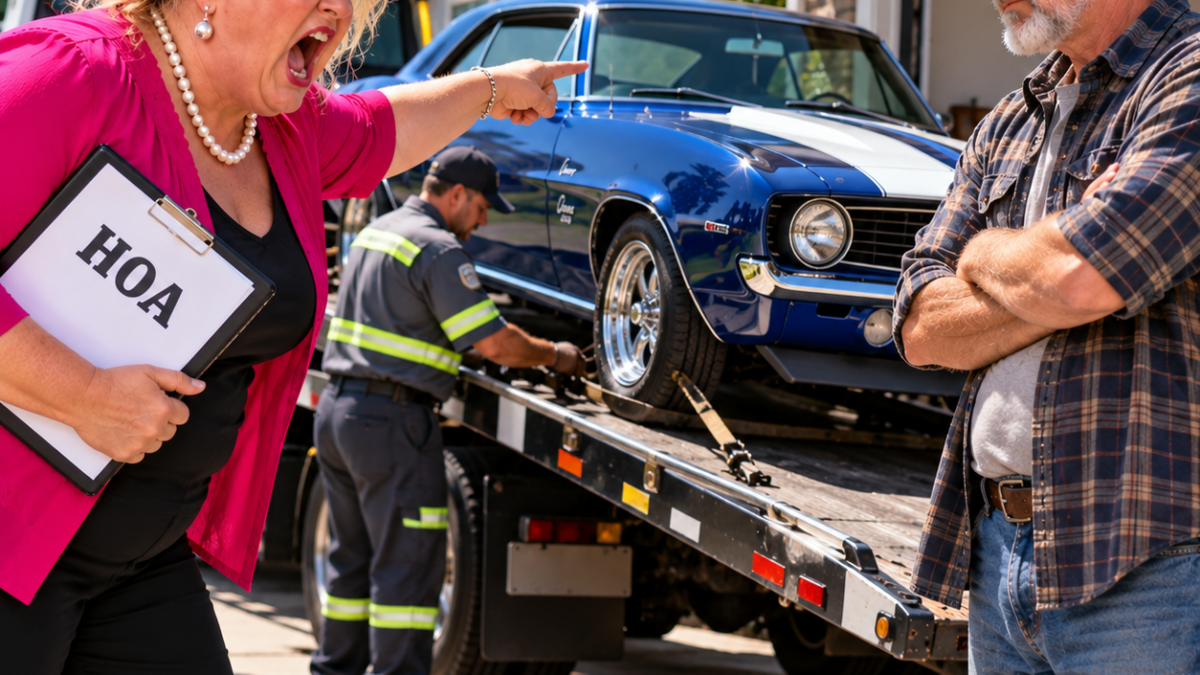
Eight days later, Gerald Hadley brought a flatbed truck to my house before sunrise.
That was when the situation stopped being funny.
I stepped outside around 6:15 wearing sweatpants, no shoes, and a T-shirt that had seen better decades.
The streetlights were still on.
Cold concrete under my feet.
And there was Gerald’s tow truck backed toward my Mustang.
The flatbed was angled down.
One strap had already been run near the front suspension.
Gerald stood beside it holding a clipboard.
Orange vest.
Baseball cap.
No greeting.
“What are you doing?”
He didn’t look up.
“Authorized removal.”
“By who?”
“HOA.”
“You’re towing my car?”
“That’s the plan.”
“From my driveway?”
Now he looked at me.
“Vehicle’s in violation.”
I unlocked my phone.
Pulled up the digital registration.
Insurance.
Held the screen toward him.
“Registered.”
He glanced.
“Doesn’t change the HOA order.”
“Do you have a court order?”
“No.”
“Then don’t touch the car.”
Gerald’s jaw tightened.
“Your wife has already denied the appeal.”
He corrected himself immediately.
“Lorraine.”
That little slip interested me.
Not because it proved anything yet.
Because it showed how blurred the line between the HOA and the Hadley household had become.
I said:
“I’m calling the non-emergency line.”
He looked at the car again.
Then at me.
For five seconds neither of us said anything.
Finally, he bent down, released the strap, threw it onto the flatbed, climbed into the cab, and drove away.
I didn’t cheer.
I didn’t wave.
I didn’t say a word.
I stood there barefoot watching the truck’s taillights disappear.
My hands shook for almost an hour afterward.
Not because Gerald had threatened me.
He hadn’t.
Because I understood how close the Mustang had come to disappearing while I was asleep.
A car I had spent five years restoring.
A car tied to the last easy years I had with my son.
And one woman had apparently decided she could send her husband’s truck to take it.
That afternoon, Lorraine emailed the entire neighborhood.
Every household.
The message said a resident was violating community vehicle standards and had “threatened HOA enforcement personnel during an authorized removal.”
I stared at that sentence.
Threatened.
My threat had been:
*I’m calling the non-emergency line.*
That was it.
But the rest of the neighborhood didn’t know.
Three residents replied to Lorraine’s email supporting the board.
One thanked her for “protecting property values.”
Another said rules should apply equally.
A third said people needed to stop turning driveways into repair shops.
Nobody named me directly.
They didn’t have to.
Everyone on Ridgeline knew who owned the red Mustang.
Then Lorraine increased the daily fine.
From $100.
To $250.
Two hundred fifty dollars every day.
I did the math on the back of a gas receipt while sitting in my plumbing van between jobs.
Seven thousand five hundred dollars every thirty days.
Ninety-one thousand two hundred fifty dollars a year.
For parking a registered, insured, restored classic car in my own driveway.
I wrote the number down.
Then taped the receipt to my refrigerator.
Not because I needed the math.
Because I wanted to remember the feeling.
Sometimes numbers help you understand when something has stopped being about compliance.
Day twenty-two brought the lien notice.
The letter came from a law firm.
Thick paper.
Professional formatting.
No curly Lorraine signature.
**RIDGELINE ESTATES HOMEOWNERS ASSOCIATION v. TRAVIS COLEMAN**
Outstanding fines:
$4,150.
Lien filed against property.
I read the word three times.
Lien.
My house was the one stable thing I had left after the divorce.
The savings were gone.
My son lived two thousand miles away.
The business had good months and bad months.
But the house was mine.
I drove straight to the county clerk.
A woman behind the counter pulled up the filing.
She wore reading glasses on a chain.
She printed a certified copy.
Then she looked at my subdivision name.
“Ridgeline Estates?”
“Yes.”
Her expression changed slightly.
“You’re the third one this year.”
I stopped.
“Third what?”
“Third homeowner from Ridgeline pulling a lien filing.”
That sentence followed me all the way home.
Third.
Not first.
Third.
A pattern.
I spread the certified lien across my kitchen table.
Fresh toner smell.
Official stamp.
Lorraine’s signature.
At first glance, it looked intimidating.
Then I started reading.
Really reading.
The legal property description listed my address correctly.
But the lot number was wrong.
I was Lot 34.
The lien identified Lot 43.
I checked the county map online.
Lot 43 was a vacant parcel of scrub ground on the opposite side of the subdivision.
Lorraine had filed a lien against dirt.
I laughed once.
Short.
Disbelieving.
Then I kept reading.
Signature section.
The governing documents required approval by three board members for a lien.
The filed document had one signature.
Lorraine Hadley.
I called Howard Finn.
Howard was another board member.
Retired postal worker.
Quiet.
The kind of guy whose lawn always looked professionally maintained even though I had watched him do all the work himself.
He answered after four rings.
“Howard, it’s Travis Coleman.”
“I figured you’d call eventually.”
That surprised me.
“You know about the lien?”
Long pause.
“Lorraine said she was sending you a warning.”
“Did you approve a lien?”
“No.”
“Did you sign one?”
“No.”
“Did you vote on one?”
Another pause.
“No.”
I wrote every answer down.
Then called Tammy Greer.
Third board member.
Worked reception at a dentist’s office.
Friendly.
Nervous.
Conflict made her voice speed up.
“Tammy, did the board vote to lien my property?”
“I don’t remember anything like that.”
“Did you sign a filing?”
“No.”
“Did Lorraine ask you?”
“No.”
“When was the last HOA document you signed?”
“Budget vote. January.”
I looked at the lien again.
Lorraine’s signature suddenly looked less powerful.
The first crack had appeared.
Then she gave me another.
Three days later, a fresh violation notice was clipped to my screen door.
**OIL DISCHARGE / ENVIRONMENTAL HAZARD**
Additional penalty:
$500.
I walked to the driveway.
There was a dark stain beneath where the Mustang had been parked.
About the size of a dinner plate.
I crouched.
Touched it.
Sticky.
Not oily.
A red oak leaned over that side of the driveway.
I grabbed a putty knife from the garage, scraped a sample into a plastic sandwich bag, and drove it to an independent lab that handled basic material testing.
Thirty-five dollars.
Four days later, results.
Tree sap mixed with dirt.
Not oil.
Not automotive fluid.
Not an environmental hazard.
A tree.
The mighty enforcement machinery of Ridgeline Estates had discovered that trees sometimes drip.
I put the lab report in my growing kitchen drawer.
Wrong lot number.
Missing signatures.
Appeal denied without a hearing.
Tow attempt.
False claim about hazardous fluid.
Every time Lorraine produced a document, there was something wrong with it.
I just didn’t know yet whether those mistakes were random.
Or whether they were part of something bigger.
Then the foreclosure letter arrived.
Thirty-five days into the dispute.
Another law firm envelope.
Two pages.
Single-spaced.
Outstanding balance:
$5,850.
Thirty days to pay.
Failure to remit could result in foreclosure proceedings.
I read the word and felt the room tilt.
People say that metaphorically.
For me, it was physical.
The kitchen suddenly felt slightly off-level.
That house represented twenty-three years of getting up before sunrise.
Thousands of clogged drains.
Frozen pipes.
Emergency calls.
Bad backs.
Burned fingers.
Jobs nobody wanted.
The marriage hadn’t survived.
My savings hadn’t survived.
But the house had.
And now a dispute over a Mustang was threatening that too.
That night, I went into the garage.
I opened the big door halfway.
Cold air moved across the floor.
The Mustang sat under the work light.
Red paint.
Chrome.
Black stripes.
The car looked almost finished.
I sat on an overturned bucket.
Then I opened the glove box.
Inside was a photograph.
Me and Ethan at the auction.
He was fourteen.
Skinny.
Gap in his teeth.
Holding the auction paddle.
Grinning.
I stared at it.
The car was worth enough now that I could sell it.
Maybe eighty-five thousand.
Maybe more.
Pay the HOA demand.
Hire an attorney.
Fix whatever was left over.
Put money away.
End the fight.
I imagined telling Ethan.
*Remember the Mustang? Sold it because the HOA wouldn’t stop fining me.*
I sat there for almost an hour.
Then I put the photograph back into the glove box.
Closed it.
Went inside.
Pulled out the CC&Rs.
Forty-one pages.
The next morning, I drove to a copy center.
Made two complete sets.
Bought colored tabs.
Highlighters.
Sticky notes.
Then I started reading.
Not skimming.
Reading.
Every word.
Night one:
Fines.
Appeals.
Hearings.
Night two:
Liens.
Board authority.
Voting.
Night three:
Vendor contracts.
Special meetings.
Removal procedures.
My neighbor Roy Daniels saw my kitchen light on after midnight and texted:
**You alive?**
I replied:
**Page 29. Section 14.3.**
He wrote:
**That bad?**
I didn’t answer.
Because Section 14.3 had just changed everything.
**No single board member may authorize penalties exceeding $500 without a recorded majority vote of the full board.**
I read it once.
Again.
Third time.
Lorraine had assessed thousands against me.
Every notice bore only her authorization.
Howard hadn’t voted.
Tammy hadn’t voted.
No recorded majority existed.
I highlighted the section in yellow.
Added an orange tab.
My hands were steady.
My heart wasn’t.
Because for the first time, I wasn’t looking at sloppiness.
I was looking at a process that apparently depended on people never reading the rules.
Still, I needed more.
I needed to understand whether I was just the person Lorraine happened to dislike that month.
The answer came from Connie Aldridge.
Connie was sixty-eight and lived three doors from me.
Her husband, Virgil, had died two years earlier.
I knew her enough to wave.
Not enough to know the story.
I knocked on her door while gathering signatures for an audit request.
She listened quietly.
Then said:
“Come inside.”
Her kitchen smelled like cinnamon toast.
On the counter was a framed photograph of Virgil standing beside an old pickup.
Dark blue.
Faded paint.
Connie disappeared into a hallway and returned carrying a shoebox.
She set it on the table.
“I keep everything.”
Inside were years of HOA letters.
Violation notices.
Receipts.
Certified mail slips.
Fine statements.
I started sorting.
Then I found a notice involving Virgil’s truck.
Old vehicle.
Aesthetic violation.
$2,400 in accumulated penalties.
Gerald’s company had towed it.
Connie never got it back.
She watched me read.
“That truck was his.”
“I figured.”
“No. I mean *his.*”
Her voice became very flat.
“He drove it thirty-one years. Washed it every Saturday. Even when he got sick.”
She looked toward the photograph.
“Lorraine called it junk.”
I didn’t know what to say.
Then I noticed the date.
March 12.
Signed:
**Lorraine Hadley, Board President**
Something tugged at my memory.
I pulled out my phone.
I had copied HOA board minutes earlier.
Lorraine’s election.
March 18.
I compared them.
March 12.
March 18.
Six days.
I looked at Connie.
“Lorraine issued this before she was president.”
Connie frowned.
“What?”
I turned both documents toward her.
“This notice says she was board president March twelfth.”
“Yes.”
“The board minutes show she wasn’t elected until March eighteenth.”
She stared.
The kitchen went quiet.
That date was small.
Six days.
But it changed the question.
If Lorraine had been acting under authority she didn’t yet have, how much else had been done outside proper approval?
I scanned everything that night.
Three backups.
One thumb drive.
One cloud copy.
One copy with Howard.
Then I made a formal records request.
Financial statements.
Bank records.
Vendor payments.
Fine history.
Board authorization.
Under the association rules and applicable records requirements, homeowners had access to financial information.
I mailed the request certified.
Ten business days passed.
Nothing.
Day eleven brought a one-line email.
**Your request is under legal review.**
Then Brenda Sims quit.
And two days later, she appeared at my front door.
She looked exhausted.
Held a manila envelope.
“I wasn’t here.”
“Brenda?”
“You didn’t get this from me.”
She held out the envelope.
I didn’t take it immediately.
“What is it?”
“Three years of financial records.”
My stomach tightened.
“Why?”
She looked toward the street.
Then back at me.
“Because I’ve watched enough.”
I took it.
“Are you sure?”
“No.”
That answer told me everything.
Inside were printed statements.
Invoices.
Authorization forms.
Vendor checks.
Fine ledgers.
I spread them across my kitchen table.
Started matching dates.
Amounts.
Names.
By midnight, a pattern had emerged.
Over three years, nine homeowners had paid a total of roughly $38,400 in HOA fines connected to Lorraine’s enforcement.
More than $31,000 in HOA payments had gone to one towing vendor.
Gerald’s Towing.
Her husband’s company.
Six of the nine homeowners had been targeted over vehicle-related complaints.
Old trucks.
Street parking.
Unwashed vehicles.
Supposedly inoperable cars.
Each case produced fines.
Many produced towing charges.
The HOA collected money.
Then paid Gerald.
No competitive bids I could find.
No recorded vendor approval.
No alternate quotes.
No board vote.
I sat at the table staring at the amounts.
The room was silent except for the refrigerator.
Thirty-one thousand dollars.
Same household.
Same enforcement pipeline.
Lorraine wrote the violations.
Gerald performed the towing.
Association funds paid Gerald.
My Mustang was worth more than anything they had targeted before.
And suddenly the attempt to tow it before sunrise felt very different.
Maybe the car wasn’t a nuisance.
Maybe it was valuable.
Maybe I hadn’t been chosen because the Mustang looked bad.
Maybe I’d been chosen because somebody thought I would either pay enough money to stop the pressure or lose the car trying.
I didn’t sleep.
But I didn’t spend the night fantasizing about confronting Lorraine either.
I made a list.
Howard.
Tammy.
Connie.
Brenda.
Other homeowners.
Records.
Statements.
Dates.
What I needed wasn’t outrage.
I needed people willing to stand up and say one specific fact each.
Howard went first.
I showed him the financials.
He stared at Gerald’s payments.
“I always wondered why she never gave us complete vendor reports.”
“Did you approve any of these?”
“No.”
“Any fines over five hundred?”
“No.”
“Any tow contract?”
“No.”
“Will you put that in writing?”
He looked at me.
Then the papers.
“Yes.”
Tammy was harder.
She was nervous.
“I still have to live here.”
“So do I.”
“I don’t want a war.”
“I don’t either.”
Then I showed her the $31,200.
She stopped talking.
“She told us towing was handled through the management company.”
“Do you have that in writing?”
Tammy thought.
Then opened her email.
She found four messages.
Lorraine had used phrases such as:
**Board approved unanimously.**
Tammy had never voted.
Howard hadn’t either.
“Can I have copies?”
She hesitated.
Then forwarded them.
Connie didn’t hesitate at all.
“I’ll speak.”
“You don’t have to.”
“I know.”
She looked at Virgil’s photograph.
“That’s why I’m doing it.”
Now I had evidence.
What I needed was a legal path.
The CC&Rs gave me three.
First:
Challenge the lien.
Wrong lot number.
Missing signatures.
Second:
Demand an independent audit.
Ten percent of homeowners could require one.
One hundred twenty-six households.
I needed thirteen.
Third:
Call a special meeting to remove Lorraine.
Twenty percent.
I needed twenty-six signatures.
I created a one-page summary.
No insults.
No accusations.
No dramatic language.
Front side:
Fine totals.
Vendor payments.
Dates.
Back side:
Lorraine’s first violation notice date.
Her election date.
Lien requirements.
Board approval requirements.
Then I started knocking on doors.
After work.
Six to eight p.m.
Tuesday.
Wednesday.
Thursday.
Some people listened.
Some closed the door.
One woman thought I was selling solar panels.
Another said:
“I don’t get involved in HOA politics.”
I answered:
“Neither did I.”
By Thursday night, I had sixteen signatures.
Enough for the audit.
Not enough for the special meeting.
Roy Daniels became number seventeen.
He read the summary standing on his porch.
Then signed.
“Been waiting three years to put my name on something that annoys Lorraine.”
“What did she do to you?”
“Christmas lights.”
“How bad?”
“January second.”
I laughed.
He didn’t.
“She fined me January second.”
“Okay. Fair enough.”
Then Lorraine learned about the petition.
And the real pressure started.
Saturday morning.
Eight o’clock.
Mass email.
**FALSE AND DEFAMATORY MATERIALS**
She accused me of harassing the board.
Added another $1,000 fine.
Then warned that homeowners assisting my “campaign” could be “subject to review.”
Vague.
But effective.
By Sunday night, four people withdrew their names.
One came to my door.
Wouldn’t look directly at me.
“I can’t deal with this, Travis.”
“You haven’t done anything.”
“I know.”
“So why withdraw?”
“Because I’ve got kids. Mortgage. I don’t need her looking at my property.”
I wanted to tell him that was exactly why he should stay.
I didn’t.
People have limits.
I understood.
My signature count dropped to thirteen.
Barely enough for the audit.
Nowhere near twenty-six.
Monday evening, I came home from work.
Gerald’s tow truck sat across the street.
Empty.
Engine off.
Parked where I could see it through my living-room window.
Nothing illegal.
Nothing explicit.
Just a flatbed truck.
There Tuesday.
Wednesday.
Three days.
Same spot.
I photographed it every morning.
Timestamp.
Emailed the pictures to myself.
Then left for work.
I hated that truck.
Not because it moved.
Because it didn’t.
Its entire purpose was to be seen.
Then city code enforcement came.
Complaint:
Vehicle leaking hazardous fluids.
The inspector looked at the Mustang.
Looked at my driveway.
I handed him the lab report.
Tree sap.
He read it.
Walked around the car.
Then wrote:
**NO VIOLATION.**
As he left, he said:
“Third call from the same neighborhood this month.”
He didn’t tell me who called.
Didn’t need to.
That night, I closed the garage door.
Sat beside the Mustang.
And almost quit.
That’s important.
Stories like this get cleaned up afterward.
People remember the meeting.
The documents.
The vote.
They forget the night the person in the middle of it almost gives in.
Lorraine had attorneys.
HOA money.
An email list.
The title of president.
Her husband’s tow company.
I had thirteen signatures and a drawer full of paperwork.
Maybe selling the car was easier.
Maybe paying something was easier.
Maybe letting the house go and starting over somewhere without an HOA was easier.
I stared at the Mustang.
Then at the photograph of Ethan.
Five years of work.
Four years of divorce.
Hundreds of Saturdays.
I wasn’t defending metal.
I was defending the idea that somebody else didn’t get to assign a price to my memories and then pressure me until I surrendered them.
The next morning, I went to a legal-aid clinic.
Forty-five-minute consultation.
Patricia Doyle.
Reading glasses.
No smile.
I laid out everything.
She read silently.
Financial statements.
Lien.
Bylaws.
Lab report.
Emails.
Tow invoices.
Finally she took off her glasses.
“You have enough to challenge the lien.”
“I know.”
“You probably have enough to support board removal.”
“If I can get the meeting.”
“Yes.”
“Civil case?”
“Potentially.”
I waited.
“But?”
“You’re trying to solve six problems at once. Don’t.”
“What do I solve first?”
“The meeting.”
“Why?”
“Because right now she controls the association’s resources. Remove that control, and the rest gets easier.”
I nodded.
“How do I get thirteen more signatures when people are scared?”
Patricia handed my file back.
“You stop asking only the people already close enough to be afraid of her.”
That made sense.
So I went wider.
Other side of the subdivision.
Creek lots.
Back cul-de-sacs.
People I’d never met.
And something had changed.
Gerald’s truck had been too visible.
Too obvious.
One woman opened her door and said:
“Is that tow truck still sitting across from your house?”
“Yes.”
“My husband noticed.”
She signed.
Another homeowner said:
“If they can park a tow truck outside your place for days, what are they going to do to the rest of us?”
He signed.
By the following Tuesday:
Twenty-eight signatures.
Two more than required.
I filed the petition.
Certified copies to all three board members.
Special meeting.
October 12.
7:00 p.m.
Clubhouse.
Ten days’ notice.
Exactly as required.
Lorraine responded four days later.
Mass email.
**SPECIAL MEETING CANCELLED DUE TO PROCEDURAL IRREGULARITIES.**
Postponed until November.
Six weeks.
Six more weeks of daily fines.
I calculated it on a diner napkin.
More than ten thousand additional dollars.
She was running the clock.
Except I’d read the documents.
Section 5.6.
Petitioned special meetings could not be cancelled, postponed, or modified by a board officer once properly called.
I read it again.
Then smiled.
Not because it was funny.
Because Lorraine had just sent 126 households written proof that she was claiming authority the governing documents specifically denied her.
I sent my own notice.
Three lines.
**The October 12 special meeting remains valid and will proceed as scheduled pursuant to Section 5.6. Attached is the governing provision.**
No argument.
Just the rule.
The night before the meeting, Lorraine made her last procedural move.
Or tried to.
October 12.
Six in the morning.
I drove to the clubhouse.
New lock.
Brand-new brass.
My key didn’t fit.
I pulled the handle twice.
Nothing.
I stood in the parking lot watching my breath in the cold air.
Then called Roy.
“She locked the clubhouse.”
He didn’t even pause.
“I have folding chairs.”
“How many?”
“Eighty.”
“Why do you own eighty folding chairs?”
“Church yard sale.”
“Of course.”
“My garage is empty enough.”
I looked at the locked clubhouse.
“Let’s do it.”
Roy’s garage was three bays.
Concrete floor.
Fluorescent lights.
Boat trailer shoved outside.
We set up eighty chairs.
Borrowed a projector from the public library.
Pinned a white bedsheet to the wall.
Printed forty handouts.
Brenda agreed to attend.
Howard.
Tammy.
Connie.
Then I called Nora Wells, a reporter for the local Ridgeline Gazette.
She had responded to an anonymous tip I’d sent the week before.
“Are the towing payments real?” she asked.
“Yes.”
“Can you document them?”
“Yes.”
“Public or association records?”
“Both.”
“What time?”
“Seven.”
“I’ll be there.”
At five-thirty, before leaving, I went into my garage.
The Mustang gleamed under the work light.
I ran a chamois across the hood.
Didn’t need cleaning.
It was something I did when I needed my hands occupied.
I thought about Ethan.
I hadn’t told him how bad things had become.
He knew there was an HOA dispute.
Not foreclosure threats.
Not the lien.
Not the tow attempt.
I didn’t want to turn him into another person worrying from far away.
I folded the cloth.
Hung it back on its hook.
Then I said out loud:
“All right.”
To the car.
To myself.
Maybe to the memory of fourteen-year-old Ethan holding that auction paddle.
Then I drove to Roy’s garage.
By 6:45, chairs were filling.
People I’d never met.
People who had withdrawn signatures.
Couples.
Older residents.
One mother with a sleeping toddler.
An elderly man brought his own lawn chair because he said he didn’t trust folding chairs.
Sixty-eight people.
More than half the subdivision.
Nora Wells arrived at 6:50.
Notebook.
Recorder.
Sat in the back.
At 6:58, a black sedan pulled into Roy’s driveway.
Lorraine stepped out.
Gray blazer.
Leather folder.
Gerald behind her.
Then the lawyer from Keller and Moore.
Lorraine walked into the garage like she owned the concrete.
She stopped at the front.
“This gathering is unauthorized.”
Roy leaned against the garage-door control.
“Ma’am, you’re in my garage.”
She glared.
“I will assess every homeowner participating in this illegal meeting.”
Roy nodded.
“Fine my lawn mower too.”
A laugh moved through the room.
Not loud.
But enough.
Lorraine didn’t like that.
I walked forward.
No podium.
No microphone.
Just a remote control and the records.
“I don’t want to argue.”
Lorraine folded her arms.
“Then stop.”
I continued.
“I want to show everyone what’s in the HOA’s own records. If anything is inaccurate, Lorraine can correct it.”
She smiled slightly.
“Go ahead.”
Then she said:
“I have nothing to hide.”
The projector clicked.
Slide one.
Two documents side by side.
Connie’s violation notice.
March 12.
Signed:
**Lorraine Hadley, President.**
Next to it:
Board minutes.
Election date:
March 18.
I didn’t editorialize.
I pointed.
“This notice was issued six days before the records show Lorraine became president.”
Nobody moved.
Slide two.
Financials.
Total fines:
$38,400.
Payments to Gerald’s Towing:
$31,200.
I let the number sit there.
Then said:
“More than eighty cents of every dollar collected in these fines was followed by payments to the president’s husband’s towing company.”
Gerald stopped looking at me.
Stared at the concrete.
“No competitive bid records are included in the files provided.”
Lorraine stood.
“That company provides services at market rates.”
Howard spoke from the third row.
“I never voted on the contract.”
Heads turned.
Lorraine said:
“Sit down, Howard.”
He didn’t.
“I am a board member. I never saw a contract.”
Tammy stood next.
“Neither did I.”
Lorraine’s attorney leaned closer to her.
Whispered.
She ignored him.
Slide three.
My lien.
Six feet wide on the bedsheet.
Lot 43 circled.
“My home is Lot 34.”
A few people laughed.
I pointed toward the county map.
“Lot 43 is vacant land.”
Then the signature section.
One name.
“The governing documents require three board approvals.”
Howard:
“I didn’t approve it.”
Tammy:
“I didn’t either.”
Slide four.
Email.
Subject:
**RE: Coleman Lien**
Message from Lorraine to Brenda:
**Just process it. I’ll get their signatures later.**
The room changed.
You could feel it.
Brenda Sims raised her hand.
“That’s real.”
Everyone looked at her.
She swallowed.
“She sent it to me.”
Lorraine stood so quickly her leather folder fell onto the concrete.
“You illegally accessed association records.”
I held up the records request.
“And this is the stamped request.”
Her attorney whispered to her again.
She pushed his arm away.
He whispered a second time.
Then something happened I hadn’t planned.
He closed his briefcase.
Stood.
Walked to the back of the garage.
Lorraine watched him.
“What are you doing?”
He spoke quietly.
But the room was so silent everyone heard.
“I advised you before tonight.”
Then he left.
Her own attorney walked out.
That mattered more than any slide.
Then Connie stood.
Blue cardigan.
Photograph held against her chest.
She didn’t come forward.
She spoke from where she stood.
“Lorraine.”
Lorraine looked at her.
“You had Gerald take Virgil’s truck.”
No one moved.
Connie held up the picture.
Her husband beside the old pickup.
“He drove that truck thirty-one years.”
Lorraine started:
“Connie, that vehicle—”
“No.”
The single word stopped her.
Connie’s voice didn’t rise.
“That truck was the last thing my husband washed before he got sick enough that he couldn’t stand in the driveway anymore.”
The room went completely still.
“You called it junk.”
Her hand trembled around the photograph.
“Your husband charged me four hundred fifty dollars to tow it.”
Lorraine opened her mouth.
Connie continued.
“I never got it back.”
The silence became uncomfortable.
Not for Connie.
For everyone who had ever looked away.
I looked toward Nora.
The reporter had stopped writing.
Just watching.
Connie lowered the photograph.
“I don’t care about Travis’s Mustang.”
She looked at me.
“No offense.”
“None taken.”
A few people smiled weakly.
She looked back at Lorraine.
“I care that you decided things people loved were worthless because you could put a fine on them.”
That was the emotional center of the entire night.
Not the $31,200.
Not the wrong lot number.
Not even the meeting.
It was Connie.
Because suddenly my Mustang wasn’t one man’s complaint.
It was part of a pattern of people being told that what mattered to them didn’t matter because someone with a title had decided otherwise.
The vote took eight minutes.
Paper ballots.
Howard and Tammy counted.
Sixty-two votes to remove Lorraine.
Four against.
Two abstentions.
Howard announced the result.
Lorraine Hadley was no longer president of the Ridgeline Estates HOA.
For five seconds, nobody spoke.
Lorraine picked up her folder.
Gerald followed.
They walked out.
No speech.
No confrontation.
No dramatic threat.
Just footsteps fading into the dark.
Then Roy started clapping.
Slow.
One clap.
Then another.
The room joined.
I didn’t.
Not at first.
I sat down.
My knees felt weak.
Connie sat beside me.
“You okay?”
“I think so.”
“You don’t look okay.”
“I think I forgot how tired I was.”
She nodded.
“I know that feeling.”
Three weeks later, I went to county court.
No crowd.
No projector.
No applause.
Just a manila folder and a filing fee.
The judge reviewed the lien.
Lot 43 versus Lot 34.
Missing signatures.
Board requirements.
She didn’t need long.
**Improperly executed. Released.**
Four words.
That was it.
Four months of wondering whether I might lose my home.
Ended in minutes.
I walked outside.
Sat in my plumbing van.
Hands on the steering wheel.
And didn’t start the engine for ten minutes.
The cracked vinyl was warm from the sun.
People passed through the parking lot.
Nobody knew what had just happened.
That felt strangely appropriate.
The biggest relief of my life happened quietly.
Then other homeowners started filing.
Six liens associated with Lorraine’s enforcement were challenged.
One after another, they failed.
Howard later told me the clerk said she’d never seen so many defective filings tied to one neighborhood.
The county began asking questions about the towing arrangement.
Vendor payments.
Authorization.
Contracts.
Gerald’s company lost the ability to operate under the same arrangements locally.
The Hadleys faced civil claims from multiple homeowners.
Eventually, the affected residents reached a settlement.
The original fine totals were returned.
Connie got her $2,400 back.
She told me she didn’t care about the money.
Then cashed the check that afternoon.
I laughed when she admitted that.
“Virgil would’ve cashed it.”
“Virgil would’ve driven to the bank before breakfast.”
The new HOA board moved quickly.
Howard became interim president.
Tammy took over as treasurer.
First rule:
No individual board officer could impose significant fines without a recorded vote.
Second:
Homeowners received real hearings before penalties.
Third:
Major vendor contracts required competitive bids and written approval.
Simple procedures.
Transparent records.
The kind of things everyone assumed were already happening until they discovered they weren’t.
A new towing provider was selected through bidding.
The cost was dramatically lower.
For the first time in years, homeowners could see exactly where the dues went.
Pool maintenance.
Landscaping.
Insurance.
Repairs.
Actual neighborhood expenses.
Funny how much money appears when it stops disappearing into arrangements nobody examines.
Connie used part of her settlement to buy a pickup.
2004 Ford F-150.
Dark blue.
Rust on the tailgate.
Dent in the passenger door.
It looked nothing like Virgil’s truck if you studied the details.
But somehow exactly like it when Connie stood beside it.
One Saturday morning, I drove by.
She was washing it.
Bucket.
Hose.
Chamois.
Same spot in the driveway.
I pulled over.
“You’ve washed that truck three times this month.”
“Mind your business.”
“Looks clean.”
“Keep driving.”
I smiled.
As for the Mustang, I finished it that spring.
Weather stripping.
Interior carpet.
Final chrome polish.
A few small things I’d postponed because I kept telling myself restoration projects are never actually finished.
Ethan flew in from Oregon that summer.
First visit since the divorce.
I was in the garage when his rental car stopped outside.
He walked in.
Then froze.
The Mustang sat under the work lights.
Red paint flawless.
Black stripes straight.
Interior finished.
He walked around it without speaking.
Then ran a hand along the fender.
“You actually finished it.”
“Almost.”
He laughed.
“Dad, you have been saying almost for six years.”
“Cars are never finished.”
He opened the driver’s door.
Then looked at me.
“You still have the picture?”
I opened the glove compartment.
Pulled it out.
Fourteen-year-old Ethan.
Auction paddle.
Gap-toothed grin.
He laughed.
“I looked ridiculous.”
“You looked happy.”
“I was.”
He stared at the photograph.
Then the car.
“Mom told me some HOA lady tried to have it towed.”
“She gave you the short version.”
“What was the long version?”
“Very long.”
He looked at me.
“You almost lose the house?”
I didn’t answer quickly enough.
His face changed.
“Dad.”
“It’s handled.”
“You didn’t tell me.”
“You were in college.”
“So?”
“You didn’t need another problem.”
His voice tightened.
“I would’ve wanted to know.”
That hurt because he was right.
The divorce had trained me to protect him from anything involving his mother, money, or the house.
Sometimes protecting people becomes another way of keeping them outside your life.
I leaned against the workbench.
“I thought about selling the Mustang.”
He stared.
“When?”
“When the foreclosure letter came.”
He looked back at the car.
“For the fines?”
“And a lawyer.”
Long silence.
“Why didn’t you?”
I reached into the glove box.
Tapped the old photograph.
“Because I couldn’t figure out how to explain selling five years of Saturdays.”
His eyes lowered.
Then he smiled a little.
“You would’ve said it was just a car.”
“I probably would’ve.”
“And I would’ve known you were lying.”
“Probably.”
He looked around the garage.
“You know what I remember most?”
“What?”
“Dropping your ten-millimeter socket.”
I groaned.
“Of course.”
“You were so mad.”
“I looked for it for forty minutes.”
“It was on the frame rail.”
“You knew?”
He started laughing.
“I found it after ten.”
“You let me keep looking?”
“I was fourteen.”
I pointed toward the driveway.
“Your hotel is outside.”
He laughed harder.
That evening, Ethan and I drove the Mustang through Ridgeline.
Slow.
Windows down.
Engine running perfectly.
Connie stood in her driveway beside the blue F-150 and waved.
Roy was grilling.
Howard raised a coffee mug like a salute.
Nobody complained about the car.
Nobody measured anything.
Nobody sent a violation notice.
We parked at the block party.
Someone had hung a hand-painted sign:
**LORRAINE-FREE SINCE OCTOBER**
I told Roy to take it down.
“No.”
“It’s petty.”
“Yes.”
“You’re HOA leadership now.”
“Interim leadership.”
“Take it down.”
“I’ll put it to a vote.”
I walked away.
Ethan laughed.
“This place is weird.”
“You have no idea.”
We took a photograph beside the Mustang.
Then Ethan held up the old auction photo.
Fourteen versus twenty.
Same grin.
Different car.
Same father.
Different life.
I looked at the two pictures later that night.
For years I’d thought the Mustang mattered because of what I had built.
I realized it mattered because it stored evidence that parts of my life hadn’t disappeared.
My marriage ended.
My son moved away.
Business changed.
I aged.
But those Saturdays still existed.
The car carried them.
That’s why Lorraine could never understand what she had threatened.
To her, it was an object.
An expensive object.
A possible fine.
A possible tow.
To me, it was time.
That fall, Roy and I started a small neighborhood restoration workshop.
Every other Saturday.
Free.
Anyone under twenty-five could come learn basic automotive work.
Nothing complicated.
Safety.
Oil changes.
Brakes.
Electrical basics.
Carburetor theory.
How not to round off a bolt.
Why you never put tools away dirty if you want to find them again.
The Mustang became the teaching car.
First session:
Six kids.
By Christmas:
Eleven.
One teenager named Marcus had never held a ratchet.
He was seventeen.
Quiet.
His father worked nights.
The kid showed up because his grandmother told him he needed something to do besides sit in his room.
I handed him a socket set.
“Ever changed a spark plug?”
“No.”
“Perfect.”
“Why perfect?”
“Means I don’t have to unteach anything.”
He smiled.
Two months later, Marcus was helping younger kids.
That might be my favorite consequence of the entire mess.
Lorraine tried to make the Mustang disappear from the neighborhood.
Instead, the car became the thing bringing people into my garage.
Nora Wells ran her article the week after Lorraine’s removal.
The headline was measured.
Professional.
Something about HOA leadership, towing payments, and homeowner records.
Online, people shared it thousands of times.
I kept the printed clipping.
Where?
Same kitchen drawer that once held forty-one pages of evidence.
The drawer changed purpose.
That mattered.
For months, opening it meant stress.
Lien.
Fines.
Copies.
Receipts.
Now it held a newspaper clipping.
Ethan’s newer Mustang photograph.
A note from Connie.
And the old gas receipt where I had calculated what $250 a day meant.
Sometimes I pull that receipt out.
Seven thousand five hundred per month.
Ninety thousand a year.
It looks ridiculous now.
Back then, it terrified me.
That is what power looks like when you think you’re alone.
A number on paper can feel bigger than you.
A title can feel bigger.
A law firm letter can feel bigger.
A tow truck across the street can feel bigger.
Then other people compare notes.
Suddenly the thing that looked enormous shrinks back to its actual size.
Lorraine had not been powerful because every action she took was proper.
She had been powerful because homeowners handled each problem privately.
Connie thought she was the only one.
I thought I was the only one.
Roy thought his Christmas-light fine was just his problem.
Howard assumed Lorraine was handling paperwork because nobody wanted to spend evenings reviewing liens.
Tammy trusted whatever appeared in the meeting packet.
Brenda Sims followed instructions until she couldn’t anymore.
The system worked for Lorraine as long as every person saw one piece.
The moment we put the pieces on the same table, it stopped working.
That is what I remember more than the vote.
Sixty-eight people sitting inside Roy’s garage.
Fluorescent lights buzzing.
A bedsheet on the wall.
Milk crates holding a borrowed projector.
No fancy courtroom.
No television cameras.
Just homeowners finally seeing the same records at the same time.
Sometimes accountability doesn’t arrive in a grand building.
Sometimes it arrives in a garage that smells like lawn fertilizer.
A year after the meeting, Ridgeline held another board election.
Howard didn’t want the presidency.
Which made everyone want him to keep it.
“You people have strange logic,” he said.
Roy answered:
“People who enjoy HOA power worry me now.”
Hard to argue.
Howard agreed to another term.
Tammy remained treasurer.
Every financial report was posted.
Every vendor bid listed.
Meetings got shorter.
Fines became rare.
Most violations were handled with a conversation first.
Funny thing:
The neighborhood didn’t collapse.
Property values didn’t disappear.
Lawns didn’t turn into jungles.
Nobody started storing buses in their driveways.
The absence of constant punishment did not create chaos.
It mostly created neighbors who stopped dreading their mailboxes.
One spring morning, I saw Lorraine.
First time in months.
She and Gerald had stayed in the neighborhood for a while after the settlement.
I was washing the Mustang.
She was walking on the opposite sidewalk.
No clipboard.
No board folder.
Just exercise clothes.
She slowed.
I expected her to say something.
She didn’t.
Neither did I.
We looked at each other for maybe two seconds.
Then she kept walking.
Years earlier, I might have imagined that moment differently.
Maybe some perfect line.
Some devastating comeback.
Something I could repeat later and feel clever.
I didn’t need it.
The car was in my driveway.
The house was still mine.
The lien was gone.
Connie had another truck.
The board was transparent.
The workshop had kids coming every other Saturday.
What was I supposed to say that improved any of that?
Sometimes victory is boring.
Someone walks past.
You keep washing your car.
That afternoon, Ethan called.
“How’s the Mustang?”
“Fine.”
“You ever drive it?”
“Sometimes.”
“Dad.”
“What?”
“You restored a Boss 302 so you could polish it in the driveway?”
“I drive it.”
“When?”
“Block party.”
“That was nine months ago.”
I sighed.
He laughed.
“Take the car out.”
So I did.
I drove west out of town.
No destination.
Just road.
The V8 settled into that deep steady sound old engines make when everything is finally working the way it should.
Sun through the windshield.
Hands on the wheel.
For years, the car had been a project.
Then evidence.
Then a symbol.
That afternoon it became a car again.
I think that was when the fight truly ended.
Not when Lorraine lost the vote.
Not when the lien disappeared.
Not when the restitution checks arrived.
When I stopped looking at the Mustang and seeing the HOA.
I saw Ethan.
The auction.
Saturdays.
Sockets.
Paint.
Arguments about music in the garage.
My life.
Mine again.
Connie understood that feeling too.
One morning I found her standing beside her F-150.
She had the hood open.
“Trouble?”
“Won’t start.”
“Battery?”
“I don’t know. You’re the car guy.”
“I’m a plumber.”
“You have a Mustang.”
“That qualification system is dangerous.”
She handed me the keys.
Battery terminal.
Loose.
Five-minute fix.
She turned the ignition.
Truck started.
Connie smiled.
For a second, the years fell away from her face.
“Virgil used to fix everything.”
“I heard.”
“He wasn’t actually good at it.”
I laughed.
“Don’t tell him I said that.”
“I’ll keep it confidential.”
She shut the hood.
Then rested her hand on the metal.
“It’s not his truck.”
“No.”
“But sometimes it feels close enough.”
I knew exactly what she meant.
Things don’t replace people.
They hold echoes.
That was the part Lorraine never understood.
A neighborhood is full of objects that look trivial to the wrong person.
An old truck.
A classic car.
A Christmas display.
A garden.
A porch swing.
Maybe the rulebook gives the HOA some authority over appearances.
But authority without perspective can turn ordinary enforcement into something deeply personal.
That doesn’t mean rules don’t matter.
It means people matter too.
Our new board eventually added a policy I liked.
Before any vehicle complaint escalated, the homeowner got an informal meeting.
Not a hearing.
A conversation.
Explain the issue.
Show the rule.
Let the homeowner explain the vehicle.
Most disputes ended there.
A kid rebuilding his first Camaro?
Work out reasonable timelines.
Older resident with a sentimental truck?
Find a solution.
Actual abandoned vehicle leaking fluid?
Address it properly.
Same neighborhood.
Same basic rules.
Different attitude.
Nobody needed a tow truck sitting across the street like a warning.
The biggest surprise came two years later.
Marcus, the teenager from our workshop, showed up with an envelope.
He was nineteen.
Community college.
Automotive program.
“What is this?”
“Open it.”
Inside was a photograph.
He had bought an old pickup.
Ugly.
Faded green.
One mismatched fender.
“You bought that?”
“Eight hundred bucks.”
“You overpaid.”
He grinned.
“Roy said you’d say that.”
“What are you doing with it?”
“Rebuilding it.”
“Why?”
He shrugged.
“Saturday mornings.”
I looked at him.
He pointed toward the Mustang.
“You said projects give you somewhere to put your time.”
I had forgotten saying that.
Maybe I said it while teaching brakes.
Maybe when somebody asked why I’d spent five years on one car.
Kids remember the sentences adults forget.
I handed the photograph back.
“Bring it Saturday.”
“You’ll help?”
“I’ll supervise.”
“That’s not helping.”
“That’s what people say when they want free labor.”
He laughed.
The following Saturday, his ugly green pickup sat in my driveway beside the Mustang.
No violation notice appeared.
No tow truck came.
No one complained about visual blight.
Howard walked past.
Looked at the truck.
“That’s rough.”
Marcus smiled.
“It’s a project.”
Howard nodded.
“Carry on.”
That two-word exchange would have been impossible under Lorraine.
Now it was ordinary.
And ordinary had become one of my favorite things.
Years after the original dispute, I finally replaced my plumbing van.
The old white one had 280,000 miles and a transmission that shifted only because I asked politely.
I bought a newer van.
Clean lettering.
Proper logo.
Roy stared at it.
“You becoming respectable?”
“Don’t spread rumors.”
Business was good.
The house was still too big for one person, but Ethan visited more.
He eventually brought his girlfriend.
Then his wife.
One Christmas they stayed in the room that had been his before the divorce.
At breakfast, he brought up the auction photo.
“You still have it?”
“Kitchen drawer.”
He retrieved it.
His wife stared.
“You were tiny.”
“I was fourteen.”
“You had that haircut voluntarily?”
“Dad did it.”
“I absolutely did not.”
Ethan smiled.
Then he told her the whole Mustang story.
Not the HOA story.
Our story.
How we bought it.
What broke first.
How long the carburetor rebuild took.
The missing socket.
The rust.
When he got to the HOA part, he summarized it in about thirty seconds.
“Some HOA president tried to fine Dad until he got rid of it. Turned out she had bigger problems.”
That was all.
I liked his version better.
Because Lorraine had become a footnote.
The car was still the story.
That night, after everyone went to bed, I sat at the kitchen table.
Opened the drawer.
Forty-one pages used to fill it.
Now:
Photographs.
Newspaper clipping.
Workshop sign-up sheets.
Old gas receipt.
Court order releasing the lien.
I kept that too.
Not because I worried the lien would return.
Because I’d learned the value of paper.
My father used to keep receipts in cigar boxes.
I thought it was ridiculous.
Now I had backups of everything.
Ethan made fun of me.
“You’ve become the paperwork guy.”
“I’ve become someone who enjoys owning his house.”
“Fair.”
One afternoon, Nora Wells interviewed me again.
Anniversary story.
Five years since the board change.
She asked:
“What would you say was the turning point?”
I expected myself to say the financial records.
Or the meeting.
Or Lorraine’s pre-election fine.
Instead I said:
“Connie.”
She looked surprised.
“Why?”
“Because numbers showed the system was wrong. Connie showed everyone what it had cost.”
Nora nodded.
I continued.
“People can ignore $31,200. It’s a number. They couldn’t ignore her holding a photograph of Virgil.”
“Do you think Lorraine understood what she had done?”
I thought about that.
“I think she understood rules. I don’t know if she understood people.”
Nora wrote it down.
I wasn’t trying to sound profound.
It was simply true.
Lorraine knew how to issue notices.
Schedule meetings.
Quote rules.
Send emails.
Hire vendors.
But governance without empathy becomes mechanical.
A neighborhood isn’t a spreadsheet.
The spreadsheet matters.
So do the people in it.
Nora asked one last question.
“Do you still think the Mustang was targeted because it was valuable?”
“Yes.”
“Can you prove that?”
“No.”
That mattered.
I had evidence for the process.
The money.
The conflicts.
The irregularities.
But motive?
That was inference.
And after everything I’d learned about documentation, I wasn’t going to pretend certainty where I didn’t have it.
“What I can prove,” I told her, “is that the enforcement around my car didn’t follow the HOA’s own procedures, that Gerald’s company received a huge share of towing-related payments, and that homeowners were pressured without proper oversight.”
She smiled.
“You’ve gotten annoyingly careful.”
“I read forty-one pages twice.”
“That’ll do it.”
The anniversary article ran the next week.
I clipped it too.
Kitchen drawer.
Of course.
By then, the Mustang’s value had climbed.
People occasionally asked if I wanted to sell.
I always said no.
One collector offered enough money that I didn’t answer immediately.
Ethan was visiting.
He heard the offer.
After the man left, Ethan looked at me.
“You thinking about it?”
“No.”
“That pause looked like thinking.”
“That’s because he offered a lot.”
“So?”
I opened the garage.
The Mustang sat inside.
“You want it someday?”
He went quiet.
“Dad.”
“I’m serious.”
“I don’t want you talking like that.”
“I’m fifty-eight, not dying.”
“Good.”
“So answer.”
He looked at the car.
“Yeah.”
That was enough.
I signed the title paperwork years later to make sure the transfer would be simple when the time came.
More paperwork.
Funny.
The thing I once hated became something I respected.
Documents aren’t cold when they protect what matters.
They’re promises written clearly enough that other people have to honor them.
That’s the lesson Lorraine accidentally taught me.
Keep the receipt.
Read the rule.
Ask for the vote.
Check the date.
Compare the signatures.
Save the email.
Don’t assume letterhead equals authority.
And never assume you’re the only person being pressured until you talk to your neighbors.
The HOA thought my Mustang was easy money.
Maybe.
Maybe Lorraine simply wanted the car gone.
Maybe Gerald saw towing work.
Maybe both.
But the part I don’t have to speculate about is what followed.
Her own records contradicted her actions.
Her own dates exposed the timeline.
Her own financial statements showed where the money went.
Her own email admitted signatures were missing.
Her own cancellation notice contradicted the bylaws.
The paperwork did not need me to shout.
It simply needed someone to read it aloud.
That is why the special meeting remains the clearest memory.
I can still see the garage.
Bedsheet.
Projector.
People fanning themselves with handouts.
Roy by the door.
Nora in back.
Connie holding Virgil’s photo.
Lorraine at the front saying she had nothing to hide.
Maybe that’s the danger of believing nobody will ever look.
You start treating records as decoration.
Until someone puts them on a wall.
Five years after the conflict, we held another block party.
The restoration workshop kids had become young adults.
Marcus brought his green pickup.
Now restored.
Not perfect.
Beautiful anyway.
Connie brought the F-150.
Roy brought brisket.
Howard brought the new HOA budget.
Nobody asked him to.
“Howard.”
“What?”
“Put the budget away.”
“Transparency.”
“It’s a barbecue.”
“People should know reserve-fund status.”
Roy took the folder from him.
“We are saving the neighborhood from you now.”
Everybody laughed.
Ethan came too.
He had a toddler by then.
My granddaughter, Lily.
Three years old.
She walked into the garage and immediately pointed at the Mustang.
“Red car.”
“That’s right.”
“Mine?”
Ethan laughed.
I crouched.
“Someday maybe.”
Ethan stared at me.
“Dad.”
“What? Estate planning.”
Lily touched the fender with one tiny finger.
I almost told her not to.
Then stopped.
Cars are meant to hold fingerprints too.
I looked at Ethan.
At Lily.
At the Mustang.
Auction paddle.
Fourteen-year-old son.
Divorce.
Five years of restoration.
HOA notices.
Tow truck.
Kitchen drawer.
Court order.
Workshop.
Now my granddaughter.
That car had survived more versions of my life than I expected.
Lorraine thought she was dealing with a vehicle.
I finally understood why the fight had cut so deep.
She had reduced something meaningful to a line item.
**Visual blight.**
**Inoperable vehicle.**
**$100 per day.**
Then:
**$250 per day.**
Paper can erase meaning if you let the wrong person define everything.
But paper can preserve meaning too.
Title.
Registration.
Receipt.
Photograph.
Rules.
Minutes.
Evidence.
Same tool.
Different purpose.
One summer evening, I sat outside with Connie.
We were older.
She complained about her knees.
I complained about my back.
Virgil’s photograph was still on her kitchen counter.
The blue pickup was still running.
“Did you ever forgive Lorraine?” she asked.
I looked at her.
“Did you?”
“No.”
I laughed.
“At least you’re honest.”
She took a sip of iced tea.
“I don’t think about her much anymore.”
“Same.”
“Maybe that’s close enough.”
I thought about it.
Maybe it was.
Forgiveness isn’t always a dramatic emotional transformation.
Sometimes the person simply stops occupying space in your daily life.
Their name stops changing your heartbeat.
Their old emails become irrelevant.
You can see them across a store and keep shopping.
That’s what happened.
Lorraine became smaller.
The people who helped me became bigger.
Howard.
Tammy.
Brenda.
Roy.
Connie.
Patricia.
Nora.
Ethan.
Even the homeowners who withdrew their signatures and later apologized.
The neighborhood became less about the woman who had controlled it and more about everyone who had finally taken responsibility for it.
One of those homeowners, Daniel Harper, had withdrawn his petition signature after Lorraine’s warning email.
A year later, he joined the finance committee.
He came to my house one evening.
“I still feel bad.”
“For what?”
“You know.”
“Pulling your name?”
“Yes.”
“You signed later.”
“After other people made it safer.”
I didn’t answer immediately.
He was right.
Then I said:
“Good.”
He looked surprised.
“Good?”
“Remember that feeling.”
“Why?”
“So when somebody else is standing alone next time, you don’t wait.”
He nodded.
That’s all accountability needs sometimes.
Not permanent shame.
Memory.
The new board made mistakes too.
Of course they did.
One year, they approved the wrong landscaping vendor.
Another time, Howard accidentally sent the entire neighborhood an email meant for Tammy complaining about the pool company.
His exact words:
**If these people clean pools the way I deliver mail, we’d all be getting letters from Arizona.**
He was retired postal service.
No one understood the metaphor.
But everyone enjoyed it.
The difference was that mistakes were visible.
Corrected.
Discussed.
No one pretended authority made them infallible.
That changed everything.
The day I finally retired from plumbing, my van pulled into the driveway one last time.
I shut off the engine.
Sat there.
Thirty years.
My hands were scarred.
Back hurt.
Knees complained.
I walked into the garage.
The Mustang was covered.
I pulled the cover off.
Red paint.
Still deep.
Still shining.
Then I opened the glove compartment.
The auction photograph.
Edges worn now.
Ethan at fourteen.
Me younger.
Car still rusty behind us.
I took it inside.
Put it in a frame.
Hung it beside the newer photograph of us at the block party.
Before.
After.
That’s how people often see restoration.
Rust.
Then shine.
They don’t see everything between.
Broken bolts.
Wrong parts.
Money wasted.
Nights when you want to quit.
Primer.
Sanding.
Redoing work you thought was finished.
Life is similar.
People saw the HOA vote.
Then the final result.
They didn’t see me sitting alone considering selling.
They didn’t see Connie keeping letters because Virgil told her to.
They didn’t see Brenda Sims deciding whether to bring that envelope to my house.
They didn’t see Tammy’s fear.
Howard’s embarrassment.
Roy storing eighty folding chairs for no logical reason.
All those small things created the outcome.
Nothing changed because one hero walked into a meeting and defeated a villain.
Things changed because enough people finally did one uncomfortable thing each.
That matters to me.
Because it means people don’t need to be fearless.
Connie wasn’t fearless.
Tammy wasn’t.
Brenda certainly wasn’t.
I wasn’t.
You can be afraid and still keep the receipt.
Still sign the statement.
Still show up.
Still vote.
Still read the document out loud.
Courage is often administrative.
Not cinematic.
One afternoon, years later, Lily was nine.
She stood in the garage looking at the Mustang.
“Grandpa?”
“Yeah?”
“Dad says this car almost got taken.”
“Dad exaggerates.”
“He says an HOA lady wanted it.”
“That’s closer.”
“Why?”
“Long story.”
She rolled her eyes.
“Adults always say that when they’re going to tell the story anyway.”
She had me there.
So I explained.
Not everything.
No legal details.
Just enough.
Someone said the car violated rules.
The rules weren’t being followed correctly.
Neighbors compared records.
Problem got fixed.
Lily looked disappointed.
“That’s it?”
“What were you expecting?”
“A chase.”
“No chase.”
“Police?”
“Not really.”
“Explosion?”
“Absolutely not.”
She frowned.
“Dad makes it sound cooler.”
I laughed.
Then she looked at the framed auction photograph.
“That’s Dad?”
“Yep.”
“He looks weird.”
“You should tell him.”
“I will.”
Then she asked:
“Why didn’t you just sell the car?”
The exact question.
I leaned against the workbench.
“Because sometimes keeping something isn’t about how much it’s worth.”
She thought.
“Like my stuffed rabbit?”
“Exactly.”
“It’s missing one eye.”
“Still yours.”
“Mom says it’s gross.”
“Your mother isn’t wrong.”
She hugged me.
Then went inside.
A nine-year-old understood the whole conflict better than half the HOA had at the beginning.
Value isn’t always financial.
Ownership isn’t always about resale.
Rules are supposed to organize shared life, not erase personal meaning.
That was the real lesson.
When Ethan eventually took possession of the Mustang, I made him promise one thing.
“Drive it.”
“I will.”
“Not store it.”
“I won’t.”
“Cars rot sitting still.”
“So do people.”
I stared at him.
“When did you get philosophical?”
“Probably when you became sentimental.”
Fair.
He loaded some tools.
Then found the old ten-millimeter socket in a small magnetic tray.
He held it up.
“No way.”
“What?”
“The socket.”
I looked.
Same brand.
Maybe same one.
“That’s not the missing one.”
“How do you know?”
“Because I bought twelve replacements.”
He laughed.
“You bought twelve?”
“Trauma response.”
We stood there laughing in the garage.
Then he grew serious.
“You really want me to take it?”
“Yes.”
“You sure?”
I looked at the car.
For decades, I had thought letting it go would mean losing something.
It didn’t.
Not to him.
He was part of what made it matter.
“Take it.”
He hugged me.
Harder than usual.
The Mustang rolled down Ridgeline Drive that afternoon.
I stood in the driveway.
Watched the taillights.
Very different from watching Gerald’s tow truck leave all those years earlier.
Same street.
Another vehicle disappearing around the same corner.
But this time the car left because I chose it.
Choice.
That was the whole story.
Not control.
Not revenge.
Choice.
Lorraine had tried to decide what happened to my property.
The satisfying ending was not that bad things happened to her.
It was that she failed to make that choice for me.
I kept the Mustang until I wanted to pass it on.
Connie chose her own truck.
Homeowners chose their own board.
The neighborhood chose transparency.
My son chose to keep the car.
My granddaughter will someday choose what it means to her.
That’s why I stopped thinking of the whole episode as revenge.
Revenge is letting the other person remain the center of the story.
Lorraine isn’t.
The Mustang is.
Ethan is.
Connie is.
The workshop kids are.
Ridgeline is.
The day my HOA first clipped that $100-per-day notice to my screen door, Lorraine probably expected one of two outcomes.
I would pay.
Or I would get rid of the car.
She didn’t expect me to read forty-one pages.
She didn’t expect Connie to keep a shoebox.
She didn’t expect Howard to admit he’d never voted.
She didn’t expect Tammy to produce emails.
She didn’t expect Brenda to leave with records.
She didn’t expect Roy to own eighty folding chairs.
She didn’t expect sixty-eight homeowners to sit inside a garage and compare dates.
Most importantly, she didn’t expect the paperwork to matter more than her title.
But it did.
Titles change.
Records remain.
The final clipping from Nora’s newspaper still sits in my drawer.
Beside it is the old lien release.
And beside that, the gas-station receipt.
The one where I calculated ninety thousand dollars a year in fines.
Sometimes Lily asks why I keep “trash.”
I tell her:
“Because some trash reminds you what you survived.”
She doesn’t like that answer.
She says it sounds like something old people say.
She’s probably right.
But I keep it anyway.
Not because I expect another HOA fight.
Because it reminds me of one simple truth.
When somebody makes you feel powerless, start by checking whether the power they’re claiming actually exists.
Read the page.
Check the date.
Look at the signatures.
Ask who voted.
Follow the money.
Talk to the neighbor who thinks they’re the only one.
And don’t confuse a confident voice with a correct one.
Lorraine Hadley thought my classic Mustang was easy money.
Maybe she thought I’d panic.
Maybe she thought I’d pay.
Maybe she thought I’d sell.
Maybe she thought the tow truck would settle the matter before sunrise.
Instead, her own paperwork told a different story.
It told the story of fines issued without proper votes.
A lien that named the wrong lot.
Approvals that didn’t exist.
Payments flowing repeatedly to her husband’s company.
An enforcement timeline that began before her recorded election.
An appeal process ignored because she assumed nobody would check.
She wasn’t undone by somebody louder.
She was undone by people finally reading.
And in the end, the Mustang stayed exactly where I wanted it until the day I chose to give it to my son.
That was enough for me.
More than enough.

