PART 2: The HOA Seized My Garage and Called It Community Property—Then One Forgotten Detail Exposed Everything
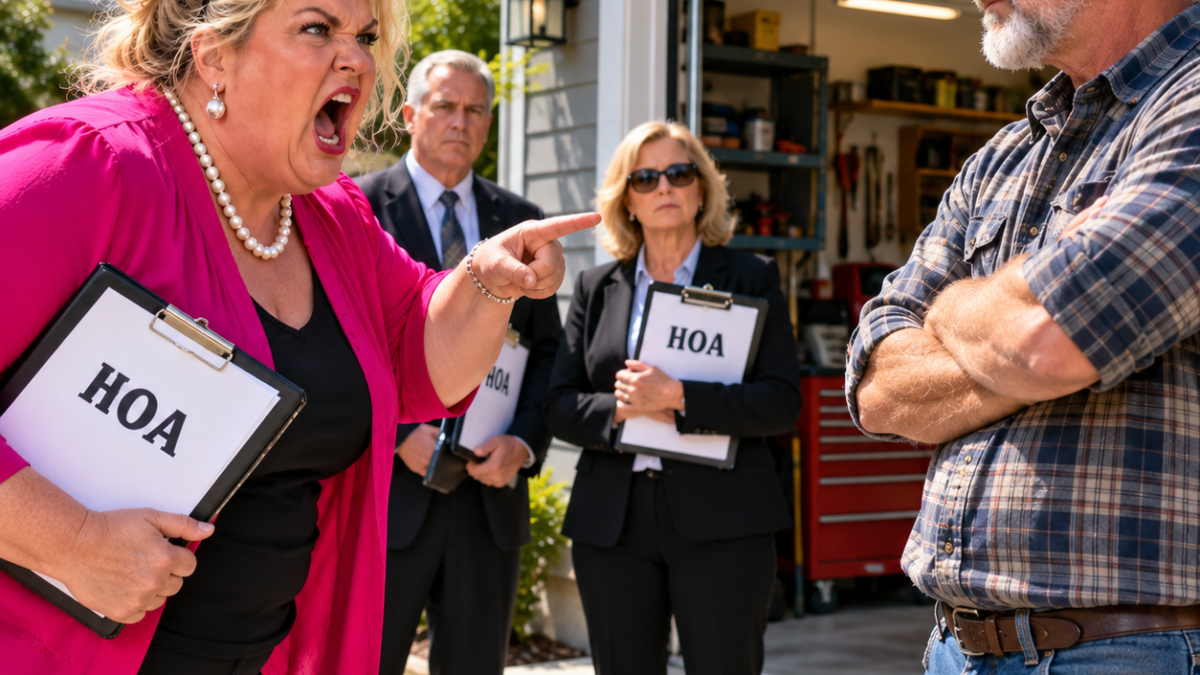
The morning I found a new lock on my own garage, I honestly thought someone had made a mistake.
Then I saw the HOA sign bolted beside the door and realized the “mistake” had my address, my property, and a five-to-one board vote behind it.
What I didn’t know yet was that one forgotten detail inside that garage was about to turn their confidence into the most expensive lesson our neighborhood had ever learned.
My name is Derek Grant, and I bought the house at the end of Briarfield Court in the spring of 2018.
The house itself wasn’t anything extraordinary.
Two stories.
Faded blue siding.
A backyard that always seemed to need mowing three days before I had time to mow it.
My wife, Pam, loved the kitchen.
I loved the garage.
It was an attached two-car space with a poured concrete floor, high ceiling, heavy ceiling beam, deep workbench, decent ventilation, and enough room for me to repair the machinery that had paid our bills for most of my adult life.
I was forty-six then, a freelance diesel mechanic who had spent nearly thirty years learning how to make stubborn engines run again.
Farm generators.
Irrigation pumps.
Old trucks.
Compact tractors.
Machines that were rarely beautiful but always important to the people who owned them.
Most of my customers were farmers.
If an irrigation pump stopped during a dry week, they didn’t have time to wait ten days for a dealership appointment.
They called me.
My phone sometimes rang before sunrise.
I liked it that way.
The garage smelled faintly of oil, metal, rubber, and the cleaning solvent I used on old parts.
My tools were arranged on pegboard above the workbench.
Every wrench had its place.
My air compressor sat in the corner, humming whenever its timer kicked on.
Pam joked that I treated that garage better than some people treated their living rooms.
She wasn’t wrong.
Our children were grown and living on their own, so the house had become quiet.
Sometimes too quiet.
The garage was where I still felt useful.
Pinewood Estates had forty-four homes, a small clubhouse, an aging swimming pool, and an HOA president named Colleen Prescott.
Colleen had been president for several years.
Nobody seemed particularly enthusiastic about her leadership.
They simply weren’t enthusiastic enough about replacing her to volunteer for the job themselves.
That was how she accumulated influence.
Not because everybody loved her.
Because everybody else was tired.
She had opinions about mailbox posts, holiday decorations, garbage containers, lawn height, visitor parking, exterior paint, and apparently anything else visible from a public sidewalk.
Six months after we moved in, I received my first letter.
**Excessive industrial odor emanating from residential structure.**
Fine threatened: $150 per day.
I stared at it over breakfast.
Pam read it over my shoulder.
“Industrial odor?”
“Apparently.”
“You repaired one generator yesterday.”
“I know.”
She looked toward the garage.
“Should we apologize to the neighborhood for the smell of employment?”
I laughed.
At that point, we still thought the entire thing was ridiculous.
I called county code enforcement.
An inspector came out.
He looked at the garage, checked what I was doing, reviewed the zoning, asked whether I had employees working there, and confirmed I was operating on a small scale within the rules that applied to the property.
No violation.
I kept the letter.
Sent a copy to the HOA.
That should have been the end of it.
Instead, Colleen sent another notice.
This one called my garage an “aesthetic nonconformity.”
I sent the county clearance again.
Then another letter arrived accusing me of unauthorized commercial use.
Same garage.
Same work.
Different accusation.
I began saving everything.
Pam bought a folder and wrote **HOA** across the tab.
Neither of us understood yet how important that folder would become.
Then one Thursday, a cream-colored envelope arrived announcing a special HOA meeting.
The agenda contained something called **Resolution 22-09**.
I read the description once.
Then again.
Then I called Pam into the room.
The board intended to reclassify the attached garages along our section of Briarfield Court as “limited common elements” subject to HOA oversight and scheduled community use.
Pam stared at the page.
“They’re trying to take the garage?”
“They’re trying to vote themselves control of it.”
“They can’t do that.”
“I wouldn’t think so.”
She looked at me.
“Go to the meeting.”
So I did.
And that was the night I learned how dangerous a bad idea can become when enough people raise their hands without asking what the words actually mean.
PART 2
The clubhouse smelled like old carpet, burnt coffee, and whatever cleaning chemical the maintenance company used to disguise both.
About twenty homeowners were scattered among folding chairs.
Colleen sat at the front behind a plastic table.
Four board members sat beside her.
My next-door neighbor, Hank Ellison, was two seats from the end.
Hank was a retired electrician in his early seventies. He had worked construction most of his life, had a bad knee, thick reading glasses, and an almost supernatural intolerance for nonsense.
He caught my eye when I entered.
His expression told me he’d already read the resolution.
And he didn’t like it.
Colleen tapped the microphone even though the room was small enough for everyone to hear her without one.
“Next item. Resolution 22-09.”
A slide appeared on the wall.
**RECLASSIFICATION OF GARAGE STRUCTURES, UNITS 40–52.**
Colleen began reading from prepared notes.
She said the garages on our cul-de-sac created “shared infrastructure considerations.”
She talked about neighborhood efficiency.
Storage access.
Community use.
Insurance.
Uniform standards.
She used enough polished phrases that, for a moment, the proposal almost sounded reasonable.
Then she reached the sentence that mattered.
The HOA would classify the garages as limited common elements under board supervision.
I raised my hand.
Colleen looked at me.
“Mr. Grant?”
“Does that mean the HOA believes it can decide who uses my garage?”
“It means certain attached structures serve broader community purposes.”
“My garage is attached to my house.”
“I’m aware.”
“My mortgage includes it.”
“That isn’t the issue.”
“It seems like the issue.”
A few people shifted in their chairs.
Colleen gave me the smile she used whenever she wanted to appear patient while making it clear she wasn’t interested in discussion.
“The board has reviewed the governing documents.”
“Which section?”
“Article Fourteen, Section Three.”
Hank’s head came up immediately.
“Article Fourteen?”
Colleen turned.
“Yes, Hank.”
He opened a stapled copy of the neighborhood’s covenants.
“My copy ends at Article Twelve.”
A couple of homeowners glanced at each other.
Colleen didn’t hesitate.
“You’re using an outdated version.”
“This came with my closing documents.”
“The documents have been amended.”
“When?”
“The board has records.”
“Was there a homeowner vote?”
“Hank, we’re not conducting a legal seminar.”
“No. We’re conducting a vote about whether Derek owns his garage.”
A few people laughed nervously.
Colleen ignored it.
She continued reading.
Community access scheduling.
Board oversight.
Maintenance authority.
I felt like I was listening to someone describe another person’s property.
Except the other person was me.
When she finished, she called the vote.
Five hands went up.
Hank’s did not.
“Five to one,” Colleen announced. “Resolution passes.”
Hank leaned forward.
“You cannot vote away somebody else’s deed.”
Colleen closed her folder.
“We didn’t.”
“You just reclassified his garage.”
“As permitted under Article Fourteen.”
Hank shook his head.
“There is no Article Fourteen in the documents I signed.”
Colleen smiled.
“Then you should check again.”
Meeting adjourned.
I sat in my truck afterward with the engine off.
Through the windshield, I could see my house at the end of the street.
More specifically, I could see the garage door.
Something about Colleen’s confidence bothered me more than the vote itself.
Article Fourteen, Section Three.
Pam was still awake when I came home.
“Well?”
“Five to one.”
Her face fell.
“They voted for it?”
“They did.”
“Can they actually do it?”
“I don’t know.”
That answer bothered me.
I didn’t like not knowing what governed my own property.
Pam went to the filing cabinet.
She pulled out the thick envelope from our title company.
Original deed.
Closing statement.
Property disclosures.
HOA documents.
We spread everything across the kitchen table.
I found the CC&Rs.
Article One.
Two.
Three.
I kept turning pages.
Ten.
Eleven.
Twelve.
**Dispute Resolution.**
Then the signature page.
Then the notary.
Nothing else.
I flipped backward.
Then forward.
“Pam.”
She looked over.
“Article Twelve is the end.”
She pulled the pages toward herself.
“Maybe there’s another document?”
We searched.
Nothing.
The copy provided when we bought our house contained no Article Thirteen.
No Article Fourteen.
The rule Colleen had cited didn’t exist in the documents we had signed.
Pam sat back.
“Could they have amended them after we moved in?”
“Maybe.”
“Wouldn’t we know?”
“You’d think.”
Neither of us slept particularly well that night.
I told myself there had to be an explanation.
Maybe a valid amendment had been recorded somewhere and we’d missed the notice.
Maybe the board had authority I didn’t understand.
Maybe this was irritating but not sinister.
Three weeks later, I stopped giving them the benefit of the doubt.
It was early Tuesday morning.
The streetlights were still on.
I had a thermos in one hand and a fuel injector in the other.
I walked to the garage, reached for the lock—
and stopped.
The lock wasn’t mine.
Someone had removed my deadbolt hardware and installed a heavy combination padlock.
Beside it was a laminated sign.
**HOA PROPERTY — UNIT 46
AUTHORIZED ACCESS ONLY**
For several seconds, I just stared.
There are moments when anger doesn’t arrive immediately.
First comes disbelief.
Your brain tries to fit what you’re seeing into some ordinary explanation.
Wrong door.
Prank.
Contractor mistake.
Then reality catches up.
I set my thermos on the driveway.
I pulled the lock once.
Nothing.
Again.
Nothing.
I called Pam.
She came outside in slippers and a sweatshirt.
“What happened?”
I pointed.
She read the sign.
Then she looked at me.
“They changed your lock?”
“Looks that way.”
“Who gave them permission?”
“Nobody.”
She touched the laminated sign as if she expected it to disappear.
“This is our house.”
“I know.”
“This is our garage.”
“I know.”
“You have customers coming today.”
“I know.”
Her voice lowered.
“Derek, call the police.”
I did.
An officer arrived about twenty minutes later.
Young guy.
Professional.
Clearly uncomfortable the moment he saw the HOA sign.
He asked for identification.
I showed him my driver’s license and deed paperwork.
He examined the lock.
“Sir, the association says this is community property?”
“They say a lot of things.”
“There’s a resolution number here.”
“My deed says I own the property.”
He rubbed the back of his neck.
“This may need to be resolved through civil court.”
“Someone came onto my property and changed the lock.”
“I understand.”
“My tools are inside.”
“I understand.”
“My business equipment is inside.”
“I understand.”
I stared at him.
“Then help me understand what part I’m missing.”
He sighed.
“The problem is that they’re claiming legal authority under the association documents. I’m not saying they’re correct. I’m saying I can’t adjudicate ownership here in the driveway.”
That was the first time I heard the phrase that would follow me for months.
**Civil matter.**
He left.
The lock stayed.
I could hear my air compressor through the garage door.
That bothered me more than I expected.
My tools were less than twenty feet away.
I could hear the space I had worked in for years.
And I couldn’t enter it.
Hank walked across the lawn.
He stared at the lock.
Then at the sign.
Then at me.
“They really did it.”
“Apparently.”
He read the sign carefully.
“HOA property.”
“Yep.”
“On your garage.”
“Yep.”
He pushed his glasses up.
“That’s impressive.”
“Impressive?”
“In the sense that I’ve never watched someone create this much evidence against herself before breakfast.”
Despite everything, I smiled.
“Police called it civil.”
“Police don’t want to referee an HOA dispute.”
“So what do I do?”
Hank looked at the lock.
“Start by remembering that a piece of laminated paper does not rewrite a deed.”
That afternoon I called a licensed locksmith.
I showed him my identification and property documents.
He examined the lock.
“You want this removed?”
“Yes.”
Eleven seconds later, it was lying on the driveway.
Forty-five dollars.
I kept the lock.
I kept the receipt.
And when the locksmith asked whether I wanted the HOA sign removed too, I shook my head.
“Leave it.”
“Why?”
“I think I’m going to need pictures.”
That turned out to be one of the better decisions I made.
I photographed everything.
The new holes.
The padlock.
The sign.
The doorframe.
Time and date.
Then I opened the garage.
And discovered Colleen hadn’t only locked me out.
She had moved in.
Three metal shelving units stood against the right wall.
They hadn’t been there before.
A new leaf blower sat on one shelf.
Road salt.
A string trimmer.
Several plastic bins.
Above them was a sign.
**PINEWOOD ESTATES COMMUNITY TOOL LIBRARY**
I stopped in the doorway.
Pam came up behind me.
“Oh, you’ve got to be kidding.”
Hank stepped inside.
He walked to one of the shelves.
Didn’t touch it.
Just crouched and looked.
“These are lag-bolted into your studs.”
I felt my jaw tighten.
“She drilled them into the wall?”
“Looks like it.”
Pam whispered, “She was inside our garage.”
That was the sentence that changed how the whole situation felt.
Until then, the fight had been documents.
Meetings.
Letters.
Bad policy.
Now someone had entered part of our home, altered it, installed property inside it, and announced to forty-three other households that the space no longer belonged exclusively to us.
I photographed every shelf.
Every bolt.
Every object.
Then I closed the garage door.
That night, Pam created a new folder on her computer.
She called it:
**COLLEEN — EVIDENCE**
I thought the name was dramatic.
Two months later, I would be grateful for every file inside it.
***
Three days after I regained access, an email went to the entire neighborhood.
Hank forwarded it.
Subject:
**COMMUNITY TOOL LIBRARY — THANK YOU, DEREK**
I read the first paragraph twice.
According to Colleen, I had “generously made a portion of my garage available for shared community use.”
There was a photograph attached.
It showed me standing near my open garage talking with Colleen.
I remembered the day.
She had come over to complain about diesel odor.
I had been explaining that county code enforcement had already cleared the issue.
The photograph made it look as if we were having a friendly conversation.
Pam leaned over my shoulder.
“Who took that?”
“I don’t know.”
“She planned this.”
That thought landed heavily.
This wasn’t improvisation.
Someone had photographed an earlier interaction.
Later, the image was used to suggest consent.
I felt my anger sharpen.
But I didn’t respond to the neighborhood.
I didn’t post online.
I didn’t march to Colleen’s house.
Hank suggested I tell everyone what really happened.
Pam wanted to.
I almost did.
Then I looked at the growing stack of papers on our kitchen table and realized something.
Colleen was strongest when the argument was emotional.
She controlled meetings.
She controlled HOA letterhead.
She controlled the email list.
If I got angry publicly, she could make the argument about my attitude instead of my property.
So I stayed quiet.
That silence cost me.
Because Colleen wasn’t finished.
A certified letter arrived the following week.
**Effective immediately, all commercial activity within common-area structures is prohibited.**
The letter ordered me to stop mechanical work in my garage.
Daily fine:
$250.
I called the county again.
“Has anything changed with my property status?”
The same code office pulled my file.
No.
Still cleared.
No active enforcement case.
No new violation.
I asked for written confirmation.
They emailed it.
I printed three copies.
Then another sign appeared near the entrance to Briarfield Court.
**NO COMMERCIAL VEHICLES BEYOND THIS POINT
HOA ENFORCED**
That wasn’t an abstract rule to me.
My customers drove work trucks.
Flatbeds.
Farm pickups.
Some pulled trailers.
The first person stopped was Carl, a dairy farmer I’d known for years.
He called me from the entrance.
“Derek, there’s a woman taking pictures of my truck.”
I closed my eyes.
“Blonde?”
“Yeah.”
“Clipboard?”
“Yeah.”
“That’s Colleen.”
“She says I can’t come down your street.”
“I’ll come out.”
When I arrived, Colleen was standing near Carl’s F-350.
Phone raised.
Photographing his license plate.
“Stop photographing my customer.”
She lowered the phone.
“This vehicle violates community rules.”
“It isn’t staying here.”
“Commercial vehicles aren’t permitted.”
“This is a public street.”
“Pinewood has enforcement authority.”
Carl looked at me.
“I don’t need trouble, Derek.”
“You’re not causing any.”
Colleen said, “Sir, you may want to reconsider doing business with an illegal operation.”
My stomach dropped.
“Illegal?”
She looked straight at Carl.
“The county is investigating.”
That was false.
I knew it.
She knew I knew it.
But Carl didn’t.
I stepped closer.
“County code enforcement cleared me.”
Colleen shrugged.
“That’s not what I’ve been told.”
“By whom?”
She turned away.
Carl eventually drove to my house.
But the damage had started.
Colleen began photographing other customers.
Then calling some of the businesses whose names were printed on their trucks.
I learned about that when Dale, a sweet potato farmer who had brought me equipment for years, called one evening.
His voice was uncomfortable.
“Derek, I hate to do this.”
“Do what?”
“I’m going to use another mechanic for a while.”
I knew immediately.
“She called you.”
Long pause.
“Someone from your HOA did.”
“What did she say?”
“That you’re operating without approval and the county’s looking into it.”
“The county isn’t investigating me.”
“I know you’re telling me that.”
“You’ve known me five years.”
“I know.”
“Then what’s the problem?”
He sighed.
“My farm insurance is up for renewal. I can’t afford to be part of some property dispute.”
I looked at the wall above my workbench.
“Nothing personal?”
“Nothing personal.”
I wanted to argue.
Instead I said, “I understand.”
After the call, I sat alone in the garage.
The compressor clicked on.
Then off.
Machines are wonderfully uncomplicated.
If something fails, there is usually a cause.
Fuel.
Air.
Compression.
Electrical.
You work through the system until you find what isn’t doing its job.
People aren’t like that.
Two weeks later, another regular customer stopped coming.
Then another job canceled.
Pam calculated the numbers.
We had lost close to forty percent of my normal income.
I found her at the kitchen table one night after two in the morning.
Calculator.
Bank statements.
Mortgage.
Utilities.
Insurance.
She didn’t notice me at first.
“Pam.”
She looked up.
Her eyes were tired.
“What are you doing?”
“Nothing.”
“That’s clearly not nothing.”
She turned the calculator around.
Numbers.
Too many expenses.
Not enough income.
“We’re okay right now,” she said.
“Right now?”
“If this keeps going…”
She stopped.
I sat across from her.
For the first time since the dispute started, I felt afraid.
Not of Colleen.
Of what a prolonged fight could do to us.
We had spent decades building a stable life.
Nothing luxurious.
Just stable.
Mortgage mostly paid down.
Some savings.
No dramatic debt.
Now a neighborhood board was threatening both my workspace and my customer base.
Pam reached across the table.
“Don’t do anything stupid.”
“I wasn’t planning to.”
“You have that look.”
“What look?”
“The one you get when a bolt won’t come loose.”
I smiled faintly.
“I don’t hit bolts.”
“You have definitely hit bolts.”
“Only professionally.”
That got a small laugh out of her.
Then she squeezed my hand.
“We need to beat this with paperwork.”
Dad used to say Pam was the calmest person he’d ever met.
He wasn’t wrong.
So paperwork it was.
The next breakthrough came from Hank.
We were standing in his garage one afternoon.
Hank had spent most of retirement collecting tools he no longer needed and refusing to throw away any of them.
He handed me a beer.
“I think I know why she’s doing it.”
“Because she hates diesel?”
“No.”
“Because she enjoys meetings?”
“Possible. But no.”
He leaned against his workbench.
“Storage.”
“What about it?”
“She’s been talking about renting garage space.”
I stared at him.
“To who?”
“Residents. Maybe outsiders eventually.”
“My garage?”
“All the garages she reclassified.”
He explained what he’d heard.
Roughly two hundred dollars per month per garage.
Several garages on the cul-de-sac.
Potentially more later.
Enough to create a meaningful annual revenue stream.
I felt something cold settle into my stomach.
For months, Colleen had framed the dispute as health.
Aesthetics.
Property values.
Safety.
Community benefit.
But if Hank was right, there was money behind it.
“Do we know where the money would go?”
Hank took a drink.
“Nope.”
“HOA account?”
“No idea.”
“Board-controlled account?”
“No idea.”
I rubbed my face.
“I need original records.”
Hank nodded.
“Now you’re thinking like an electrician.”
“How is that thinking like an electrician?”
“When the wall is smoking, stop arguing about paint color and find the circuit.”
The next morning, I drove to the county recorder’s office.
***
The building was exactly what I expected.
Fluorescent lights.
Old carpet.
Counters worn smooth by decades of people leaning on them while waiting for copies of documents they didn’t understand until they suddenly mattered.
I gave the clerk my address.
Subdivision name.
Lot number.
“I want the original plat.”
“How far back?”
“Beginning.”
She disappeared.
A little while later, she returned carrying a rolled sheet large enough to qualify as sporting equipment.
Original Pinewood Estates subdivision plat.
Filed in the early 1990s.
Developer’s name.
Surveyor’s seal.
Recording stamp.
Notarized signatures.
I unrolled it across a large table.
Found Briarfield Court.
Found my lot.
Lot 46.
I traced the boundary with my finger.
House.
Driveway.
Garage.
Then I saw the words.
**PRIVATE EXCLUSIVE USE AREA.**
I leaned closer.
Maybe I was misunderstanding.
I checked the legend.
Checked the boundary.
Checked the notes.
Every garage in that section was marked as private exclusive-use space attached to its corresponding lot.
Not community property.
Not a limited common element.
Private.
Exclusive.
I called the clerk over.
“Can you tell me what this means?”
She looked.
“It means what it says.”
“So the HOA can’t just reclassify it with a board vote?”
She gave me the careful look government employees give when they don’t want to become someone’s unpaid attorney.
“I can tell you what’s recorded. I can’t give legal advice.”
“Fair.”
She pointed to the recording stamp.
“This is the filed plat.”
“I need a certified copy.”
She nodded.
A little while later, I walked outside carrying one.
I sat in my truck and read the same words again.
Private exclusive use.
For the first time in months, I felt like the ground beneath me had stopped moving.
But there was more.
When I got home, I opened the garage door.
I wasn’t looking at the tools.
Or Colleen’s shelving.
I was looking at the back of the door.
There it was.
An old aluminum builder’s plate.
I had seen it a thousand times without really seeing it.
Four screws.
Dust around the edges.
Stamped lettering.
I wiped it clean with my thumb.
**PRIVATE EXCLUSIVE USE
LOT 46
PINEWOOD ESTATES
RECORDED PLAT**
And beneath that, the recording reference.
I just stood there.
That plate had been attached to the garage since the house was built.
Three decades.
HOA presidents had changed.
Homeowners had come and gone.
Rules had been revised.
Paint had faded.
Roofs had been replaced.
And the little aluminum plate had stayed exactly where the builder put it.
Colleen had entered the garage.
Installed shelving.
Moved equipment inside.
She had stood within feet of that plate.
Apparently she’d never bothered to look at it.
I took photographs.
High-resolution.
Wide shot.
Close shot.
Recording number.
Mounting screws.
Everything.
Then I carried the certified plat into the kitchen.
Pam was making coffee.
“What’s that?”
“County record.”
She dried her hands.
I placed the plat on the table.
Then my phone beside it with the plate photograph open.
She read the plat.
Read the plate.
Looked at me.
“Private exclusive use.”
“Yep.”
“How long has that plate been there?”
“Since the house was built.”
Pam slowly sat down.
“Call Nora.”
Nora Caldwell had been Pam’s friend since college.
She was a real-estate attorney two towns away.
I’d met her plenty of times socially, but until that day, I’d never needed her professionally.
She came over that Saturday morning carrying a legal pad and a box of donuts.
The donuts sat untouched for an hour.
She read everything.
Original CC&Rs from our closing.
Current version from the HOA website.
The plat.
Resolution 22-09.
Photographs.
Letters.
County clearance.
She placed both versions of the CC&Rs side by side.
“Your version ends at Article Twelve.”
“Yes.”
“The website version has Articles Thirteen and Fourteen.”
“Yes.”
“Do you have any notice of amendments?”
“No.”
“Ballot?”
“No.”
“Meeting notice?”
“No.”
“Recorded homeowner vote?”
“Not that we’ve found.”
She leaned back.
“Okay.”
I waited.
“Okay good or okay terrible?”
“Good for the facts. Potentially terrible for your wallet.”
Pam crossed her arms.
“Explain.”
Nora tapped the plat.
“On paper, this is strong. The recorded plat identifies the garage as private exclusive-use space. The original documents Derek received at closing don’t contain the sections Colleen is relying on. If the amendments weren’t adopted properly, her resolution is built on nothing.”
“So we win?”
Nora looked at me.
“That is not how litigation works.”
I hated that answer immediately.
“What does it cost?”
“If they back down after a demand letter? Manageable.”
“And if they don’t?”
“Several thousand dollars.”
“How several?”
“Potentially eight to twelve. More if they decide to fight every point.”
Pam went quiet.
I thought about the calculator on our kitchen table.
Forty percent income gone.
Bills still arriving.
HOA fines increasing.
Legal fees potentially coming.
“What happens if we don’t fight?”
Nora answered before Pam could.
“They keep acting as if they control the garage.”
“And the fines?”
“They continue unless challenged.”
“And if they put a lien on the house?”
“That becomes much more serious.”
Pam finally reached for a donut.
She took one bite.
Chewed.
Then said:
“Do it.”
I looked at her.
“You sure?”
“No.”
That answer surprised me.
She continued.
“I’m not sure about spending the money. I’m not sure how long this takes. I’m not sure how ugly it gets.”
She pointed toward the garage.
“But I’m very sure I don’t want to spend the rest of our lives wondering why we let someone vote herself ownership of part of our house.”
Nora smiled.
“That’s enough for me.”
She laid out the plan.
Formal demand letter.
Challenge the amendments.
Demand rescission of Resolution 22-09.
Demand withdrawal of fines.
Demand compensation for documented losses.
Then, if necessary, seek a court declaration confirming what the recorded documents already showed.
Hank came over later.
He and I measured every dimension of the garage.
Length.
Width.
Ceiling.
Door.
Walls.
Everything matched the original plat.
Nora took notes.
Pam scanned documents.
I saved copies to multiple drives.
When Nora left, she gave me one instruction.
“Don’t argue with Colleen.”
“That’s your legal advice?”
“That’s my survival advice.”
“What if she comes over?”
“Document it.”
“What if she emails?”
“Forward it.”
“What if she threatens another fine?”
“Send it to me.”
“What if she calls me a criminal in front of the whole neighborhood?”
Nora picked up her bag.
“Smile politely and let her keep generating exhibits.”
Hank watched her walk to the car.
Then looked at me.
“I like her.”
“So do I.”
“She talks like someone who gets paid by the hour.”
“She does.”
“Then we better make Colleen quit fast.”
That would have been nice.
Colleen had other plans.
***
Nora mailed the demand letters on Monday.
One to every board member.
Certified.
Return receipt requested.
Five envelopes.
Five signatures.
Five opportunities for someone to say:
We made a mistake.
Let’s stop.
Instead, Colleen called an emergency homeowner meeting.
I wasn’t formally invited.
Hank went anyway.
He sat in the back with his hearing aids turned up.
Later, he described the whole thing to me.
Colleen had made a presentation.
Twelve slides.
Title:
**PROTECTING OUR PROPERTY VALUES — THE LOT 46 SITUATION**
My garage appeared in several photographs.
Door open.
Parts on the workbench.
Oil marks on the concrete.
An old generator partially disassembled.
If you knew mechanical work, it looked like a normal workspace.
If you didn’t, Colleen’s captions made it look like an industrial facility had appeared between two hydrangea bushes.
According to Hank, she told everyone I wanted to expand into a full commercial repair operation.
False.
She said I was suing the entire neighborhood.
False.
She claimed property values might fall dramatically if the board didn’t stop me.
Unsupported.
Then she announced she’d contacted the HOA’s insurance provider about “liability exposure.”
A letter went to homeowners afterward.
The language was cautious.
Insurance language always is.
But the implication was obvious:
This dispute might cost everyone money.
It was clever.
She didn’t need the neighborhood to believe she owned my garage.
She needed them to fear that I was expensive.
Three homeowners signed a petition asking me to stop “disruptive activities.”
One of them was a woman whose snowblower I’d repaired free the previous winter.
That one hurt.
More than it should have.
Pam saw the signature too.
“You fixed that thing in a snowstorm.”
“I remember.”
“She brought you cookies.”
“I remember.”
“People forget fast.”
I folded the petition.
“People get scared fast.”
I was beginning to understand Colleen’s real talent.
She could take a private dispute and distribute the fear.
Make everyone believe they had something to lose unless they stood with her.
For a little while, it worked.
Then she made the mistake that changed everything.
Pam was home alone one Tuesday afternoon.
I was repairing a pump thirty miles away.
She heard the garage door move.
Not the electric opener.
The manual release.
Someone was pulling it from inside.
Pam walked through the mudroom and opened the back door.
Colleen was standing in my garage.
She had a cordless drill.
Four screws were in her hand.
And the builder’s plate was gone from the door.
It was inside a clear plastic bag under her arm.
Pam froze.
“What are you doing?”
Colleen turned.
“This is common property.”
“Get out of my garage.”
“I’m removing unauthorized signage.”
“That plate was installed by the builder.”
“It’s scrap metal.”
“Put it back.”
Colleen tucked the bag closer to her side.
“This conversation is over.”
“No, it isn’t. You’re in our property without permission.”
Colleen walked past her.
Heels clicking against the concrete.
Pam did not touch her.
Did not block her.
Did not shout.
She pulled out her phone and photographed Colleen walking toward her SUV with the bag.
Then she called me.
I was under the hood of an irrigation pump when my phone rang.
“You need to come home.”
Something in Pam’s voice made me stand up immediately.
“What happened?”
“She took the plate.”
“What plate?”
“The builder plate.”
For half a second, my stomach dropped.
Then I remembered.
Photographs.
Certified plat.
Nora’s copies.
Hank’s measurements.
The recording number.
Everything already documented.
I almost laughed.
Not because it was funny.
Because after months of feeling like every move surprised me, Colleen had finally made one I had prepared for.
“Did you photograph her?”
“Yes.”
“Did you argue?”
“No.”
“Did you touch her?”
“No.”
“Good.”
“I wanted to.”
“I know.”
I called Nora.
Her response was immediate.
“Excellent.”
I blinked.
“She took evidence out of my garage.”
“I know.”
“And you’re calling that excellent?”
“Because we already preserved it.”
I looked around the job site to make sure I’d heard correctly.
“So losing the plate doesn’t hurt us?”
“We have the certified plat. We have high-resolution photographs. We have the recording number. We have measurements. We have your wife’s account of what happened.”
Nora paused.
“Derek, she didn’t erase the evidence. She demonstrated why the evidence matters.”
When I got home, Pam was still angry.
Not loud.
Pam almost never got loud.
She was wiping the kitchen counter harder than necessary.
“She walked into our garage like she belonged there.”
“I know.”
“She looked me in the face and called a thirty-year-old builder plate unauthorized signage.”
“I know.”
“She thinks we’re stupid.”
That was the sentence.
Not weak.
Not powerless.
Stupid.
Colleen believed we would be overwhelmed by official-looking paper long enough to surrender.
I opened the drawer where Pam kept envelopes.
“Let’s show the neighbors something.”
That night, we prepared twenty-two envelopes.
Inside each:
A copy of the original recorded plat.
A photograph of the builder plate.
And a simple question:
**Check Articles 13 and 14 in the CC&Rs you received when you bought your home. Then ask yourself when you voted on them.**
No accusations.
No insults.
No long explanation.
Just documents.
Hank volunteered to deliver half.
I took the other half.
The first few doors were awkward.
People opened them expecting an argument.
I simply handed over the envelope.
“What’s this?”
“Public records and a question.”
“Is this about the garage?”
“Read it.”
“What are you saying Colleen did?”
“I’m asking you to read your own paperwork.”
Then I left.
The effect wasn’t immediate.
It spread slowly.
The next afternoon, a neighbor named Mike called.
“Derek?”
“Yeah.”
“I pulled my closing documents.”
“Okay.”
“Mine stop at Article Twelve.”
“So do mine.”
“But the HOA website has Fourteen.”
“I know.”
“Did we vote?”
“That’s the question.”
Two days later, another homeowner called.
Then another.
Someone’s wife had kept their original binder.
Article Twelve.
End.
Someone else called their title company.
No recorded copy of the later articles in the file they had received at closing.
Within a week, more than half the households that checked had found the same discrepancy.
The mood changed.
Not dramatically.
Not yet.
But questions replaced assumptions.
And authoritarian leadership survives much better on obedience than questions.
Hank took advantage of the moment.
He started talking about HOA finances.
Dues had risen.
The pool was deteriorating.
Landscaping contracts kept changing.
The clubhouse needed work.
Where was the money going?
Nobody had paid much attention when the increases were small.
But now homeowners were actually opening their files.
Reading statements.
Comparing numbers.
Colleen had spent years training everyone to assume she understood the paperwork better than they did.
The moment they started reading it themselves, her greatest advantage disappeared.
She responded the way she always did when losing control.
With another letter.
This one was the worst yet.
**SPECIAL ASSESSMENT — LOT 46
$15,000
DUE WITHIN 30 DAYS**
The stated reason:
Unauthorized use of common-area property causing structural wear and administrative expense.
Failure to pay could result in a lien.
Pam read the letter standing at the kitchen counter.
She didn’t speak for a long time.
Then she sat down.
“Fifteen thousand.”
“I see it.”
“We don’t have fifteen thousand to throw at this.”
“We’re not paying it.”
“What if they record the lien?”
“Nora will challenge it.”
“What if that takes months?”
“We’ll handle it.”
“What if—”
Her voice broke.
That was the first time I saw her cry over the dispute.
Not dramatically.
She just covered her face.
And sat there.
I moved beside her.
“Hey.”
“I am so tired.”
“I know.”
“I don’t care about winning anymore.”
I didn’t answer.
“I just want our life back.”
That hit harder than anything Colleen had mailed me.
Because I wanted the same thing.
I wanted customers arriving without being photographed.
I wanted Pam sleeping through the night.
I wanted to open my garage without wondering whether another HOA sign would be attached to it.
For the first time, I considered paying.
Not because they were right.
Because fighting wrong people can become more expensive than surrender.
I said that to Pam.
She lowered her hands.
“You want to pay?”
“I want this over.”
“If we pay, is it over?”
I didn’t answer.
She looked at me.
“Derek.”
“No.”
“Exactly.”
My phone rang.
Nora.
I answered.
“Please tell me you have good news.”
“I do.”
I put her on speaker.
Pam leaned closer.
Nora said the state complaint regarding the HOA records had moved forward and investigators were looking at the disputed amendments and the way they had been adopted and filed.
“What about the fifteen thousand?” I asked.
“Do not pay it.”
“Can they put a lien on the house?”
“They can try to file paperwork. We will challenge it immediately. I’m also filing for declaratory relief on the garage and the resolutions.”
“How long?”
“Court calendar is roughly six weeks.”
Six weeks.
At that point, six weeks felt like another year.
Then Colleen hired counsel.
Her attorney sent Nora a letter arguing that because the HOA had exercised control over my garage for several months—changing locks, installing shelves, scheduling access—it had established certain ongoing rights through use.
When Nora explained the argument, I stared at her across the kitchen table.
“So their argument is that because they kept entering property after I told them to stop, they should get more rights?”
“In simplified terms, they’re trying to turn time and use into leverage.”
“How long has this been going on?”
“Months.”
“How long has the plat been recorded?”
“About three decades.”
I rubbed my forehead.
“Can that argument work?”
“It’s weak.”
“That’s not the same as impossible.”
“No.”
Pam looked worried.
Nora continued.
“Delay is their best strategy. The longer this runs, the more it costs you. They know your income is affected.”
That night I couldn’t sleep.
Around one in the morning, I went into the garage.
The builder plate was gone.
Four small holes remained where it had been mounted.
I ran a finger over one.
Thirty years of proof, removed in a few minutes.
Except not really.
The plate wasn’t the proof.
The record was.
That’s when I thought about the annual meeting.
Four weeks away.
Every homeowner would be there.
Every homeowner had a right to speak.
I called Nora the next morning.
“I don’t want to wait six weeks to change the neighborhood’s mind.”
“What are you thinking?”
“Annual meeting.”
“You’ll get three minutes.”
“I only need three.”
There was a pause.
Then I heard her smile through the phone.
“All right.”
***
The Pinewood Estates annual meeting was held on a Thursday evening in October.
Twenty-one homeowners attended.
Nearly everyone who could reasonably be there.
Hank sat beside Pam and me in the back.
I had a thick manila folder on my lap.
Pam kept her phone in her purse with the voice recorder running.
Nora attended as a friend.
Not speaking.
Not making a show of being my attorney.
Colleen opened the meeting.
Budget.
Landscaping.
Pool maintenance.
Routine business.
She spoke confidently.
Maybe she still believed the majority supported her.
Maybe she thought the assessment had frightened us.
Maybe she believed we couldn’t afford to keep fighting.
Then came the final agenda item.
**Lot 46 Compliance Update.**
A photograph of my garage appeared on the projector.
Colleen stood.
“As previously discussed, Mr. Grant continues unauthorized activity within an association-controlled structure.”
My heart started beating harder.
I could feel it in my neck.
She continued.
“A special assessment of fifteen thousand dollars has been imposed.”
Nobody reacted.
A month earlier, people would have nodded.
Now they stared.
Colleen continued.
“If Mr. Grant refuses compliance, the association will proceed with all remedies available under the governing documents, including a property lien.”
Silence.
I raised my hand.
Colleen looked irritated.
“This isn’t the open forum.”
Hank stood before I could say anything.
His bad knee made him lean slightly to one side.
“Article Eight, Section Two.”
Colleen stared at him.
“What?”
“Annual meeting. Homeowner comment. Three minutes.”
She tightened her jaw.
“Hank—”
“You wrote the procedure.”
A few people laughed.
Colleen looked around the room.
She knew refusing would look terrible.
“Fine. Three minutes.”
I stood.
My legs felt heavier than I expected.
I walked to the front.
Set the folder on the table.
The sound was small.
But in that quiet room, everybody heard it.
I looked at the homeowners.
Not Colleen.
Them.
“I’ll keep this simple.”
I pulled out an enlarged copy of the original subdivision plat.
“This is the original Pinewood Estates plat recorded with the county when this neighborhood was created.”
I held it where everyone could see.
“Lot 46 is here.”
I pointed.
“My garage is here.”
Then I read the designation.
“Private exclusive-use area.”
Murmurs.
I continued.
“This document isn’t mine. It isn’t Colleen’s. It isn’t the board’s. It’s the recorded subdivision plat. Anyone can obtain a certified copy.”
I placed it on the table.
Then pulled out the photograph.
“This was attached to the inside of my garage door for roughly thirty years.”
The builder plate filled the page.
“Private exclusive use. Lot 46. Recorded plat reference.”
I turned the photograph toward the room.
Several people leaned forward.
“This plate was removed from my garage without my permission while my wife was home.”
Heads turned toward Colleen.
I still didn’t look at her.
Then I pulled out my original CC&Rs.
“I have one question.”
I held them up.
“Who here remembers voting to add Articles Thirteen and Fourteen to the governing documents?”
Silence.
“Raise your hand.”
Nothing.
No hands.
Not one.
A woman in the third row opened her binder.
A man near the wall whispered to his wife.
I waited.
Then said:
“My closing copy ends at Article Twelve.”
A homeowner spoke from the middle.
“So does mine.”
Another:
“Mine too.”
Someone else:
“What year were the new ones supposedly added?”
Colleen stood.
“This is not the appropriate forum—”
Hank said, “Seems pretty appropriate.”
I continued.
“Resolution 22-09, the garage reclassification, the daily fines, and the fifteen-thousand-dollar assessment all rely on provisions that do not appear in the governing documents many of us received when we purchased our homes.”
The room changed.
You can feel the exact second a crowd stops being an audience and starts becoming a group of individuals thinking for themselves.
A woman near the front raised her hand.
“I got fined under Article Thirteen.”
Another man spoke.
“So did I.”
“How much?”
“Four hundred.”
“I paid almost nine hundred last year.”
Questions began overlapping.
Colleen hit the microphone.
“Order.”
Nobody cared.
One homeowner held up his binder.
“When did we approve these amendments?”
Colleen said, “The board acted pursuant to its authority.”
“That isn’t what he asked.”
Another voice:
“Where are the ballots?”
Another:
“Where’s the notice?”
The noise rose.
I hadn’t shouted.
I hadn’t accused anyone of a crime.
I hadn’t insulted Colleen.
I’d shown them the paper.
And paper was doing what anger never could.
I raised my hand.
The room gradually quieted.
“One more thing.”
Colleen stared at me.
Her face had lost some color.
I continued.
“A formal complaint regarding the disputed amendments and board governance is under review.”
That was all I needed to say.
Colleen stood.
“This is defamatory.”
I looked at her for the first time.
“Everything I’ve shown tonight can be checked.”
“You are attacking this association.”
“No.”
I gestured toward the plat.
“I’m asking the association to follow its own records.”
“You’ve disrupted this neighborhood for months.”
“My garage was locked by the board.”
“Because it was reclassified.”
“Under an article nobody here remembers approving.”
She opened her mouth.
Nothing came out immediately.
That silence was more powerful than any argument.
Then one of the board members stood.
His name was Earl Foster.
He had voted for almost everything Colleen proposed.
He looked uncomfortable.
“I didn’t know the articles hadn’t been voted on.”
Colleen turned sharply.
“Earl.”
He shook his head.
“I didn’t.”
He looked at the room.
“Effective tonight, I’m resigning from the board.”
The woman beside him stood.
She gathered her papers.
“I am too.”
Another board member followed.
Three resignations.
Within less than two minutes.
Colleen was left at the front beside a projector displaying a photograph of my garage.
Nobody applauded.
That made it better.
It wasn’t a performance.
It was collapse.
A structure built on automatic agreement had finally run out of people willing to agree automatically.
Colleen closed her laptop.
Unplugged the projector.
Her hands were steady.
I’ll give her that.
Then she walked out.
Her heels clicked across the clubhouse floor.
The same sound Pam had heard when Colleen walked out of our garage carrying the builder’s plate.
The door closed.
Hank leaned toward me.
“Three minutes.”
I looked at him.
“I think I went over.”
“Worth every second.”
Pam took my hand.
For the first time in months, she was smiling.
Not because the case was over.
It wasn’t.
But because the neighborhood finally understood the fight.
We weren’t trying to take anything from anyone.
We were trying to keep someone from taking something from us.
***
The court hearing came several weeks later.
I wore a dark suit that had been hanging in our closet since our daughter’s wedding.
Pam told me the tie was crooked.
I told her crooked ties had never lost property cases.
She fixed it anyway.
Nora met us outside the courtroom.
“You nervous?”
“Yes.”
“Good.”
“Good?”
“Means you understand it matters.”
Inside, the room smelled like polished wood and stale coffee.
Colleen sat with her attorney.
She didn’t look at us.
The judge reviewed the filings.
The original plat.
The HOA resolution.
Our closing documents.
The disputed amendments.
The builder-plate photograph.
The timeline.
Letters.
Assessment.
Lock change.
Shelving installation.
Everything.
Colleen’s attorney made his argument.
He emphasized the HOA’s recent management of the garage.
Board authority.
Community expectations.
Continuity of use.
When he finished, the judge looked down at his notes.
“How long did the association exercise this claimed control?”
The attorney hesitated.
“Several months, Your Honor.”
“Approximately?”
“Five.”
The judge looked at Nora.
“How long has the recorded subdivision plat designated this area as private exclusive-use property?”
Nora answered.
“More than thirty years, Your Honor.”
The judge looked back at Colleen’s attorney.
“So your position is that several months of disputed conduct overrides decades of recorded property designation?”
The attorney started explaining.
The judge listened.
Then said:
“I understand the theory.”
That sentence did not sound encouraging.
He reviewed the plat again.
Then the closing documents.
Then the HOA amendment history.
Finally, he ruled.
The garage attached to Lot 46 was private exclusive-use property belonging to the homeowner of record.
It had always been.
Resolution 22-09 could not convert it into community property.
The special assessment against me was void.
The threatened lien based on that assessment had no foundation.
The disputed fines tied to the same invalid provisions could not stand against me.
I heard every word.
But one sentence stayed with me.
**The property designation did not change simply because the board treated it as though it had.**
That was the entire story.
Colleen had acted like the garage belonged to the association.
She had written letters like it did.
Voted like it did.
Installed shelves like it did.
Changed the lock like it did.
Threatened me like it did.
But confidence does not change a property line.
I looked at Pam.
Her eyes were wet.
I squeezed her hand.
Outside the courtroom, Nora handed me a copy of the order.
“How does it feel?”
I looked at the paper.
“Quiet.”
She smiled.
“That’s usually what winning feels like after a long property case.”
“I expected fireworks.”
“You get stamped copies.”
Pam laughed.
I hadn’t heard her laugh like that in months.
The financial consequences continued after our ruling.
The broader review of HOA records found that the disputed provisions had been used for more than just my garage.
Other homeowners had paid fines.
Assessments.
Fees.
Charges connected to those sections.
The amounts added up.
A lot.
Eventually, Pinewood Estates had to unwind years of improper charges.
Total refunds and reversals reached approximately $214,000.
When I heard the number, I thought Nora was joking.
“Two hundred fourteen thousand?”
“Across affected homeowners and charges.”
I sat back.
All of this had started with a garage.
But the garage wasn’t the real problem.
It was simply the place where Colleen had finally pushed too far.
Once everyone looked closely, they found years of decisions nobody had properly questioned.
The old board was dismantled.
Colleen lost her position and faced serious consequences connected to the governance problems and legal costs.
I never celebrated that part.
People expected me to.
Some neighbors seemed disappointed that I didn’t throw a party.
But by then, revenge wasn’t what I wanted.
I’d seen Pam crying over a calculator.
I’d watched customers disappear.
I’d spent nights wondering whether we’d have to borrow money to defend a garage that had been part of our deed the entire time.
I didn’t need Colleen humiliated.
I needed the problem ended.
There is a difference.
A few weeks after the ruling, Pinewood held another election.
Hank Ellison became HOA president.
When I heard, I laughed.
“You said you never wanted the job.”
He shrugged.
“I still don’t.”
“That’s supposed to reassure me?”
“Absolutely. People who desperately want authority are the ones you should worry about.”
His first actions were painfully ordinary.
Cancel notices tied to the disputed rules.
Hire a proper accountant.
Audit the books.
Review contracts.
Publish clearer financial reports.
Fix the pool.
Replace the clubhouse carpet.
And, according to Hank, most importantly:
Buy a coffee maker that didn’t produce something resembling warm roofing tar.
“Government reform,” he told me, holding up the new machine.
“One cup at a time.”
The neighborhood slowly became normal again.
My customers returned.
Not all immediately.
Trust doesn’t reverse direction as quickly as fear.
But one Monday morning, I heard a familiar diesel engine in the driveway.
Dale.
The sweet potato farmer.
He climbed out carrying a case of beer.
His irrigation pump was strapped in the truck bed.
He stood there awkwardly.
“Morning.”
“Morning.”
He pointed toward the pump.
“Making a noise.”
“Everything you own makes a noise.”
“This one’s new.”
I looked at the beer.
“Bribe?”
“Apology.”
I crossed my arms.
“For what?”
He rubbed the back of his neck.
“For disappearing when things got complicated.”
I let him sit in the discomfort for a second.
Then took the beer.
“Nothing personal?”
His face changed.
He recognized his own words.
“Yeah.”
I nodded toward the garage.
“Bring the pump in.”
He smiled.
Business came back.
The bank account stabilized.
Pam stopped doing midnight calculations.
One night, months after the ruling, I woke around two and reached across the bed.
She was there.
Sleeping.
No kitchen light glowing down the hallway.
I lay there for a minute listening to her breathe.
That moment meant more to me than the courtroom decision.
The fight had finally stopped living inside our house.
***
The builder’s plate was never recovered.
Colleen claimed it had been discarded.
Maybe it was.
For a while, I was angry about that.
Not because we needed it legally anymore.
Because it had been part of the house for decades.
A small piece of history.
Then Hank came over one Saturday carrying a rectangle of aluminum.
“What is that?”
“Turn around.”
I flipped it.
He had made a replacement.
Same dimensions.
Same layout.
Same property designation.
Same recorded plat reference.
I stared at it.
“You did this?”
“I know a guy.”
“You are the guy.”
“I know myself.”
Pam came outside.
When she saw the plate, she smiled.
Hank handed me four screws.
We mounted it exactly where the old one had been.
Pam disappeared into the house.
She returned with a strip of masking tape and a marker.
“What are you doing?”
“Improving it.”
She wrote two words on the tape.
Then stuck it beneath the plate.
**STILL PRIVATE.**
I laughed so hard I had to sit down.
The tape stayed there for years.
Not because I thought anyone would challenge us again.
Because it reminded me not to take ordinary rights for granted.
You shouldn’t have to think about who owns your garage.
Most people never do.
You turn the key.
Open the door.
Park your car.
Build a workbench.
Store Christmas decorations.
Fix an engine.
Live your life.
That’s what property rights are supposed to feel like.
Boring.
The moment they stop being boring, you understand how valuable boring was.
A month after Hank installed the new plate, Pam surprised me.
“I’m inviting people over Saturday.”
“For what?”
“Garage day.”
“What is garage day?”
“You fix things.”
“I already fix things.”
“For money.”
“Usually.”
She smiled.
“This time, for neighbors.”
I stared at her.
“You want to invite the neighborhood into the garage we just spent months proving isn’t community property?”
“Exactly.”
“Why?”
“Because there’s a difference between somebody taking something and you choosing to share it.”
That stopped me.
She was right.
The entire fight had never been about preventing neighbors from entering my garage.
I’d fixed lawn equipment for half of them over the years.
The issue was consent.
Choice.
Ownership.
A board had tried to convert generosity into entitlement.
Pam wanted to take the garage back emotionally, not just legally.
So on the first Saturday of November, I raised the door.
A folding table went on the driveway.
Pam made coffee.
Hank brought electrical tools.
We taped a handwritten sign to the door.
**PINEWOOD FIX-IT SATURDAY
BRING SOMETHING BROKEN**
Four people came.
A lawn mower.
A snowblower.
A lamp.
A leaf blower that sounded, as Hank described it, “like a raccoon trapped in a vacuum cleaner.”
We fixed three.
The mower needed a part.
Nobody paid.
The following month, seven people came.
Then eleven.
By spring, people from another subdivision heard about it.
I set rules.
One item per household.
No dangerous equipment.
No major vehicle repairs.
Coffee mandatory.
Advice free.
Hank handled electrical problems.
I handled mechanical.
Pam ran the sign-up sheet like she had been born to manage a repair shop.
The garage became a neighborhood space.
But not because anyone voted.
Because I opened the door.
That distinction mattered more than I could explain.
One Saturday, Earl Foster came by.
He had been one of the board members who resigned during the annual meeting.
He didn’t bring anything broken.
He stood at the edge of the driveway with his hands in his jacket pockets.
“Got a minute?”
“Sure.”
He waited until the other people were busy.
Then said:
“I owe you an apology.”
“You resigned.”
“Eventually.”
“You stood up.”
“Eventually.”
He looked toward the garage.
“I voted for that resolution.”
“I remember.”
“I didn’t read everything.”
“Most people didn’t.”
“I trusted Colleen.”
I didn’t say anything.
He continued.
“When Hank questioned Article Fourteen, I should’ve stopped the vote.”
“Probably.”
“I should’ve asked for the amendment record.”
“Probably.”
His face tightened.
“I keep thinking about that.”
I put down the wrench in my hand.
“Earl.”
He looked at me.
“You stood up when you understood what happened.”
“Late.”
“Still counts.”
He extended his hand.
I shook it.
Not every person who enables a bad decision is a bad person.
Sometimes they’re tired.
Distracted.
Trusting.
Conflict-averse.
Sometimes the lesson they need isn’t punishment.
It’s the uncomfortable realization that they should have asked one more question.
Earl became one of Hank’s most careful board volunteers after that.
He read everything.
Sometimes twice.
Especially anything with my lot number on it.
***
A year after the first lock appeared on my garage, I walked outside before sunrise.
The neighborhood was silent.
A thin layer of frost covered the lawns.
I opened the garage.
Same smell.
Oil.
Metal.
Cold concrete.
Coffee.
The compressor clicked on in the corner.
I looked at the replacement plate on the back of the door.
**PRIVATE EXCLUSIVE USE.**
Pam’s masking tape was curling at one corner.
**STILL PRIVATE.**
I pressed it flat.
Then I thought about how close we’d come to giving up.
That part rarely gets included when people retell a story like this.
They remember the courtroom.
The neighborhood meeting.
The $214,000.
The board collapsing.
Those are clean moments.
Easy to understand.
What they don’t see are the nights before them.
Pam with a calculator.
Me sitting alone in the garage wondering whether principle was worth draining our savings.
Customers avoiding the house.
Certified envelopes in the mailbox.
The sick feeling whenever I heard a knock at the door.
The temptation to pay money we didn’t owe simply because exhaustion makes surrender look peaceful.
That’s the real danger when somebody abuses authority.
They don’t always need to prove they’re right.
Sometimes they only need to make being right too expensive for you.
We were fortunate.
We had closing documents.
A recorded plat.
Photographs.
A neighbor willing to ask questions.
An attorney we trusted.
A wife who remembered paperwork better than I did.
Most importantly, we stopped arguing about opinions and started looking for records.
Colleen kept saying the garage was community property.
We found the plat.
She cited Article Fourteen.
We found our original CC&Rs.
She removed the builder plate.
We had photographs.
She threatened a lien.
We preserved the notices.
She controlled the microphone.
We used three minutes.
Every time the argument became louder, we answered by becoming more precise.
That was the lesson I kept.
Not revenge.
Precision.
Because loud people often depend on everyone else being too intimidated or too tired to check.
A fancy letterhead can look official.
A laminated sign can look official.
A five-to-one vote can look official.
A fifteen-thousand-dollar assessment can look terrifyingly official.
But official-looking isn’t the same as lawful.
One afternoon, months after everything ended, Hank and I were sitting in lawn chairs outside the garage.
Fix-It Saturday was over.
Pam was carrying empty coffee cups inside.
Hank looked toward the house.
“Funny thing.”
“What?”
“Colleen almost got what she claimed she wanted.”
“How do you figure?”
“She said the garage should benefit the neighborhood.”
I looked at the open door.
Tools.
Repair bench.
A neighbor’s mower waiting for a replacement belt.
“Yeah.”
“She just forgot the part where it was supposed to be your choice.”
I smiled.
“That was a pretty big part.”
“Usually is.”
We sat quietly.
A kid rode a bicycle past and waved.
Hank waved back.
I thought about the tool-library shelves Colleen had installed without permission.
They were long gone.
I had filled the screw holes myself.
But one faint mark remained in the drywall.
I could have patched it perfectly.
I never did.
Sometimes I liked seeing it.
A small scar from a bad idea.
Nothing dramatic.
Just enough to remember.
Pam came back outside.
“You two planning to sit there until dinner?”
Hank looked at me.
“Depends what’s for dinner.”
She rolled her eyes.
“Your wife know where you are?”
“She appreciates the break.”
Pam laughed.
I stood.
As I reached for the garage door, I saw the plate again.
Three decades earlier, a builder had screwed that piece of identification onto the original door because someone thought future owners might need to know exactly what that space was.
Private.
Exclusive.
Part of Lot 46.
For thirty years, nobody cared.
Then suddenly those words mattered enough to save our home from a lie.
That’s the strange thing about important details.
Most of the time, they sit quietly in the background.
A sentence in a deed.
A line on a survey.
A recording number.
Four screws holding an aluminum plate.
You don’t notice them until somebody tells you the truth is something else.
Then you learn to look.
Colleen had looked at my garage and seen an opportunity.
I looked at it and saw thirty years of work ahead of and behind me.
The place where I taught my son to change brake pads.
The place where my daughter painted a school project on the floor and left a blue mark that never came completely out.
The place where Pam sat on a stool drinking coffee while I rebuilt an engine during a snowstorm.
The place where farmers arrived worried and left relieved because their equipment worked again.
It wasn’t beautiful.
But it was ours.
The HOA could hold a meeting.
It could vote five to one.
It could print a sign.
It could send a threatening letter.
What it couldn’t do was turn ownership into a popularity contest.
I pulled the garage door down.
Just before it closed, Pam’s little strip of masking tape disappeared from view.
**STILL PRIVATE.**
And for once, there was nothing left to prove.
***
Several years later, people in Pinewood still talked about “the garage meeting.”
Not the court hearing.
Not the refunds.
The annual meeting.
Three minutes.
A plat.
A photograph.
A question nobody could answer.
Hank stayed HOA president longer than he intended.
Mostly because people trusted someone who complained about having authority more than someone who had enjoyed it.
He instituted a simple rule for board meetings.
Any homeowner could ask to see the source document behind a proposed enforcement action.
Not a summary.
Not a slide.
The source.
If a rule came from the CC&Rs, show the section.
If a property boundary mattered, show the plat.
If money was being spent, show the invoice.
Hank called it the “show your work” rule.
The lawyers probably had a more professional name.
Nobody cared.
It worked.
Fines dropped.
Arguments dropped.
Meeting attendance actually increased because homeowners stopped feeling that board decisions were being made behind a curtain.
The pool stayed clean.
The landscaping contract lasted more than one season.
Nobody tried to turn a private garage into a public storage unit.
Progress.
One summer evening, Pam and I sat on the front porch while several neighborhood kids played in the cul-de-sac.
A little boy stopped his bicycle in front of our house.
“Mr. Grant?”
“Yeah?”
“My dad says you beat the HOA.”
Pam looked at me and tried not to laugh.
“I wouldn’t put it that way.”
“He said they tried to take your garage.”
“They tried to control it.”
“Why?”
I thought about how to explain years of ego, paperwork, money, and authority to an eight-year-old.
“They thought voting made something theirs.”
He frowned.
“That’s dumb.”
Pam failed to hold back her laugh.
I nodded.
“That’s one way to summarize it.”
The boy pointed toward the garage.
“Can I see the sign?”
“What sign?”
“The one that says it’s yours.”
I stood.
“Come on.”
I opened the door and showed him the aluminum plate.
He read it slowly.
“Private… exclusive… use.”
“Correct.”
He pointed at Pam’s tape.
“What’s ‘still private’ mean?”
“That,” Pam said from the doorway, “is the important part.”
He nodded as if this made complete sense.
Then he rode away.
I looked at Pam.
“Think we oversimplified?”
“No.”
She leaned against the doorframe.
“Sometimes eight-year-olds understand boundaries better than adults.”
I couldn’t argue with that.
The sun dropped behind the houses.
I switched off the garage lights.
For years, I had thought my workbench was the most valuable thing in that room.
Then my tools.
Then my equipment.
I was wrong.
The most valuable thing was the right to decide what happened behind that door.
I could lock it.
Open it.
Work.
Rest.
Invite neighbors.
Tell someone no.
That freedom was what Colleen had tried to reclassify.
And that was what the documents had protected.
The financial outcome was satisfying.
The board changes were satisfying.
Seeing my customers return was satisfying.
But the best part came quietly.
No more letters.
No more threats.
No more photographs of trucks.
No more wondering whether somebody had entered our garage while we were gone.
Ordinary life returned.
And after everything we’d been through, ordinary life felt luxurious.
One Saturday morning, Dale’s truck rolled into the driveway again.
He climbed out.
“Got something ugly for you.”
“That’s usually what you bring me.”
He lowered the tailgate.
Old irrigation pump.
Rusty.
Heavy.
Covered in dried mud.
I smiled.
“Perfect.”
We carried it inside.
Hank appeared ten minutes later holding coffee.
Pam set out the sign-up sheet.
Neighbors started arriving.
Someone brought a broken hedge trimmer.
Someone else brought a lamp.
A teenager brought an old lawn mower he was trying to restore with his grandfather.
The garage filled with conversation.
Nobody asked permission from an HOA board.
They asked me.
And I said yes.
That was the ending I hadn’t expected.
Colleen tried to make my garage public property.
Instead, the fight taught me something about community.
Community isn’t created when a committee declares your property belongs to everyone.
It’s created when people respect what belongs to each other enough that sharing becomes possible.
A locked door can protect ownership.
An open door can build trust.
But the person who owns the door gets to choose.
I still work in that garage.
The tools have changed a little.
My knees complain more than they used to.
The compressor has been replaced.
The blue paint mark from my daughter’s school project is still on the concrete.
So are a few old oil stains.
The replacement builder plate remains on the door.
And beneath it, somehow, Pam’s masking tape has survived far longer than masking tape has any right to survive.
The edges are yellow now.
The ink has faded.
But the words remain readable.
**STILL PRIVATE.**
Whenever somebody asks why I never replace it with something nicer, I tell them the truth.
Because the cheap tape says something the expensive paperwork took months to prove.
A board can vote on many things.
It can set pool hours.
Approve landscaping contracts.
Schedule meetings.
Manage genuine common property.
But it cannot make your deed disappear because five people raised their hands.
It cannot turn thirty years of recorded ownership into community property with a PowerPoint slide.
And it cannot make a false claim true simply by repeating it more confidently than everyone else.
That was the detail Colleen forgot.
Not the plate.
Not really.
She forgot that ownership existed before her resolution.
The plate merely reminded everyone where to look.
And once they looked, the whole story changed.
My garage stayed mine.
My customers came back.
My marriage survived the stress.
My neighbors learned to read before voting.
And a room that had nearly torn our community apart eventually became the place where people met on Saturday mornings to help each other fix broken things.
Sometimes the most satisfying payback isn’t watching another person lose.
It’s watching everything they tried to take become stronger afterward.
That’s what happened to us.
A stronger board.
A better neighborhood.
A healthier respect for boundaries.
A garage that remained exactly where it had always been.
Private when I wanted privacy.
Open when I chose to open it.
Mine to protect.
Mine to share.
And, finally, mine without argument.

