PART 2: The Ghost Bride of Vallecito Stage Station: She Died Before Her Wedding—But Travelers Still Say She Never Left
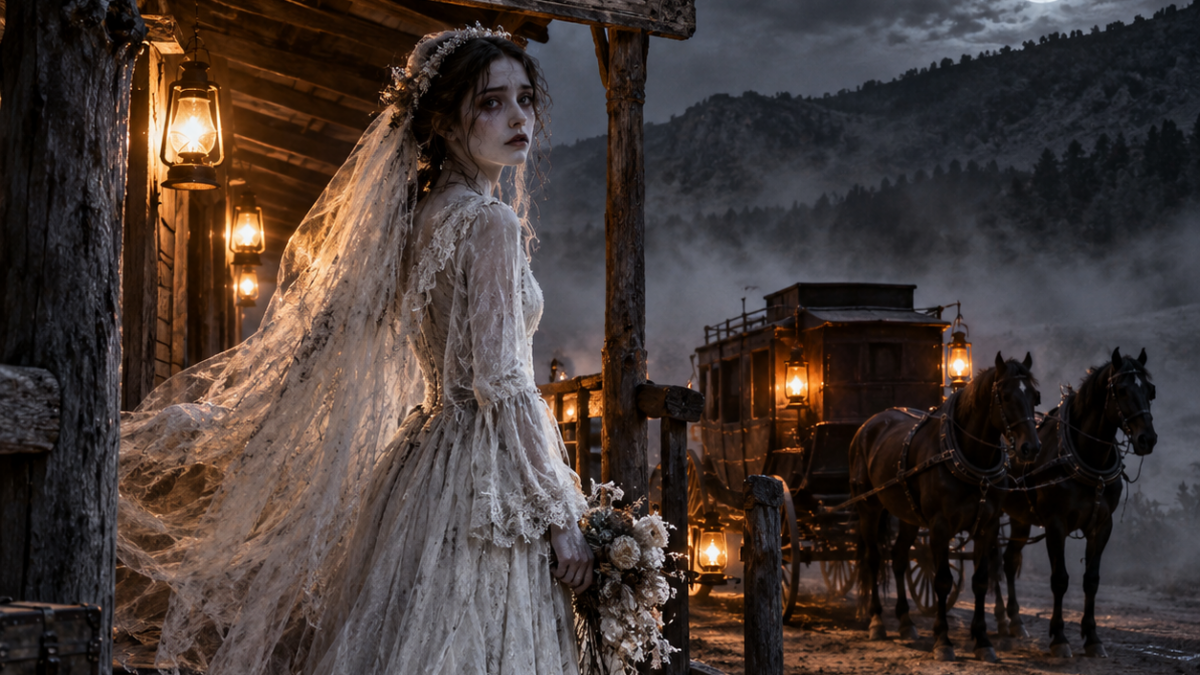
I was standing beside an unmarked grave in the California desert when I realized the most unsettling part of the Ghost Bride legend was not that a young woman supposedly died here in her wedding dress—it was that generations of strangers claimed they had seen her still waiting for a stagecoach that would never come. She had crossed most of the country to marry a man waiting for her in California, only to become desperately ill within reach of the life she had risked everything to begin, and the people who buried her apparently left no name on the stone above her. What pulled me deeper into the mystery was a detail I found afterward, because the stories surrounding that nameless grave became stranger the farther back I followed them.
The wind was sweeping across Shelter Valley hard enough to press my shirt against my back as I climbed the small rise toward the cemetery.
Behind me stood Vallecito Stage Station, an adobe building surrounded by desert, brush, and a route that once carried thousands of travelers into Southern California.
Today, the place felt almost impossibly quiet.
In the 1850s, it would have been anything but.
Horses would have stamped in the dirt. Drivers would have shouted for fresh teams. Passengers would have stepped from coaches stiff from days of traveling on rough roads, grateful for food, water, and a few minutes when the world was not shaking beneath them.
Now there were only three graves on the hill.
Two had names.
The third did not.
I crouched beside the anonymous marker and brushed dust from its weathered surface.
Nothing.
No name.
No date.
No clue telling me who had been placed beneath it.
Yet local tradition said this was the grave of a young woman who had never intended to stop at Vallecito for more than a brief rest.
Her destination was Sacramento.
Her fiancé was waiting there.
According to the legend, he had gone west during the Gold Rush and done well enough that he could finally send for the woman he planned to marry.
She began the long journey carrying something precious in her luggage.
A white wedding dress.
That detail was what made the story difficult for me to shake.
Travel in the 1850s demanded compromise. Space mattered. Weight mattered. Every item had to justify its place.
Yet this woman, if the legend was true, had carried a wedding dress across thousands of miles because she believed that when the road ended, her new life would begin.
Instead, somewhere during the journey, she became sick.
The cause changes depending on which version of the story you hear. Some blame contaminated water. Some say poor food and exhaustion weakened her. Others simply say that after weeks of brutal travel, her body could not take any more.
By the time the coach reached Vallecito, she was reportedly too ill to continue.
People carried her into the station.
They tried to help.
But this was the desert in the late 1850s.
There was no hospital nearby. No ambulance. No antibiotics. No emergency room waiting over the next ridge.
According to the story, she died inside the station.
When the people caring for her went through her belongings, they found the gown.
Someone made the decision to dress her in it.
The dress meant for Sacramento became the dress she was buried in.
I stood and looked from the grave toward the station.
For a moment, I forgot about ghosts entirely.
I thought about the fiancé.
Had he known she was sick?
Had he expected her coach on a certain date?
Had he watched arriving passengers step down one after another until he realized she was not among them?
Nobody seems to know.
That was the first problem with the legend.
Some versions identify the bride as Eileen O’Connor.
Others claim her identity was never known.
And although the cemetery exists, I could find no surviving contemporary document proving that a young bride named Eileen O’Connor had died here and been buried in that specific grave.
That uncertainty should have weakened the story.
Instead, it made me more curious.
Because anonymous graves create room for stories.
And stories repeated for more than a century have a habit of changing.
I walked around the marker and checked the other side.
Still nothing.
Then I remembered one of the strangest versions of the Vallecito haunting, an account connected not to a woman quietly waiting beside the road but to workers rebuilding the station decades later.
They claimed they saw the bride.
But she was not walking.
She was riding something.
And what they described beneath her made me turn back toward the old station and wonder exactly how long people had been seeing impossible things in this valley.
PART 2
The story said the bride was riding a headless horse.
I remember staring at that line when I first came across it and thinking that somewhere along the way, the Vallecito legend had wandered completely out of the realm of tragic frontier history and straight into campfire folklore.
A headless horse was not a subtle detail.
It was the kind of image people remembered.
A dead bride in white moving through a moonlit desert on an animal with no head sounded less like a historical account and more like something designed to frighten children.
But the report was supposedly associated with workers involved in rebuilding the station in 1934.
That interested me.
Not because I immediately believed them.
I didn’t.
But because the ghost stories here were older than the reconstruction.
Much older.
I walked downhill toward the adobe building again, the gravel crunching under my boots.
The station standing at Vallecito today is not the original structure. The earlier building deteriorated over the decades, and the present station was reconstructed in 1934.
That distinction mattered.
If someone wanted to claim every strange event here had started because workers created a tourist attraction around an old legend, the timeline would not cooperate.
Stories of unexplained things around Vallecito apparently went back into the stagecoach era itself.
One account dated to 1858 involved a Butterfield driver reporting strange glowing lights.
Another tale, from the 1890s, described a prospector seeing a phantom stagecoach drawn by four ghostly mules.
Those accounts were not proof.
Folklore is not laboratory evidence.
A story surviving for a long time does not make it true.
But it does tell you something.
People had been associating this valley with the unexplained for generations.
And that raised a question I kept coming back to.
Why here?
I stopped beside the reconstructed station and looked across the desert.
The answer might have had nothing to do with ghosts.
Vallecito was a place where exhausted people stopped after crossing one of the hardest sections of an already punishing journey.
Before highways, before railroads connected the country, before cars could cover hundreds of miles in a day, reaching California overland meant accepting risk.
The Butterfield Overland Mail began operating in 1858.
Its route stretched thousands of miles.
The trip between Missouri and San Francisco took roughly twenty-five days under ideal conditions.
The coaches kept moving day and night.
Passengers slept sitting upright when they could sleep at all.
They ate whatever food was available.
They breathed dust.
They crossed deserts where reliable water was not a convenience but the difference between continuing and dying.
Vallecito existed because water existed here.
That simple fact determined almost everything.
Stage stations were normally spaced at intervals where teams could be changed, but in the desert, geography dictated the route.
Animals had to drink.
Travelers had to drink.
A station without water was useless.
So when a small green valley appeared after miles of harsh terrain, it must have felt almost miraculous.
Waterman Ormsby, a journalist who rode the first east-to-west Butterfield Overland Mail journey in 1858, described Vallecito after crossing roughly 120 miles of desert from Fort Yuma.
To him, it was an oasis.
Standing there more than a century and a half later, I could understand why.
Even with modern roads nearby, the surrounding country looked severe.
Now imagine arriving after days in a coach.
Imagine your back aching.
Your throat dry.
Your clothes covered in dust.
Someone beside you has been coughing for two days.
Another passenger is sick to their stomach.
The driver says you’ll stop only long enough to change teams and eat.
Then you see green vegetation in the valley.
Water.
Shade.
A roof.
For most passengers, Vallecito would have represented relief.
For the bride in the legend, it became the end of the road.
I walked closer to the station wall.
The adobe was scarred by weather and insects. Small holes dotted parts of the surface where creatures had burrowed into the material.
Stacks of adobe bricks sat nearby for repairs.
The building had been closed for some time, so I couldn’t go inside.
That bothered me more than I expected.
I wanted to stand in the room where the woman was supposedly cared for.
Not because I expected to feel a supernatural presence.
I wanted to understand scale.
How large would the room have been?
How far was it from the entrance?
Could she have heard coaches arriving outside?
Could she have watched people leave while knowing she was too weak to travel?
Those questions made the story feel more human.
The ghost was easy to romanticize.
The dying traveler was not.
I pictured a woman lying beneath a rough blanket in an adobe room, surrounded by strangers.
Maybe someone cooled her forehead with damp cloth.
Maybe another traveler sat beside her for a while.
Maybe the station keeper tried whatever remedies were available.
Maybe she kept asking the same question.
“How far to Sacramento?”
That sentence existed only in my imagination.
There is no record proving she said it.
I had to remind myself of that.
The more emotional a story becomes, the easier it is to start treating possibility as fact.
I did not want to do that.
The real history of places like Vallecito was dramatic enough without pretending we knew things we didn’t.
So I kept two versions of the story in my mind.
One was documented.
The other was legendary.
Documented: thousands of travelers crossed these routes during the nineteenth century.
Documented: Vallecito was an important stopping place because of its water supply.
Documented: the station served military and civilian travelers and later stage lines.
Documented: three graves remained nearby, including one without a name.
Legend: the unmarked grave belonged to a bride traveling to Sacramento.
Legend: she carried a white wedding dress.
Legend: she died at the station and was buried wearing it.
Legend: her spirit still wandered nearby.
That separation mattered.
But standing between the station and cemetery, the boundary felt less clean emotionally than it did on paper.
Because whoever occupied the anonymous grave had been a real person.
Even if the Ghost Bride story had attached itself to the wrong burial, someone had died.
Someone had been buried in this lonely valley.
Someone’s name had been lost.
I looked toward the road.
The Butterfield route had not appeared from nowhere.
Long before American stage lines operated here, Indigenous people knew these water sources and travel corridors.
Later military expeditions moved through the region during the 1840s, often following older trails.
Then the Gold Rush transformed migration.
After word of gold in California spread, thousands of people headed west.
Some traveled in wagon trains.
Some came by ship.
Others used organized stage and mail routes as transportation infrastructure improved.
By the late 1850s, the Butterfield system connected distant parts of the country in a way that must have seemed remarkable.
But “connected” did not mean safe.
The coach might keep moving.
A passenger’s body might not.
That reality sat underneath the bride story.
People got sick.
People were injured.
People died far from home.
Families waited for letters that arrived months late—or never arrived at all.
And records from isolated frontier locations were not always complete.
So when I failed to find a neat death certificate naming Eileen O’Connor, I couldn’t conclude that no woman had died here.
I could only conclude that I had not found documentation proving the story as told.
That distinction left the mystery open.
I walked away from the station and followed the grounds toward the old route.
Dark clouds were moving over the hills.
The weather made the desert look more dramatic than it probably did on most days.
My wife had stayed closer to our campsite while I explored.
I looked back toward the building.
Even during daylight, Vallecito had the kind of landscape filmmakers would use when they wanted an audience to feel isolated.
Low mountains.
Open desert.
Gray-green plants twisted by heat and wind.
An old adobe station.
A tiny cemetery.
And miles of road leading toward somewhere you couldn’t see.
I thought about ghost stories as a kind of historical echo.
Sometimes they preserve a fear.
Sometimes a tragedy.
Sometimes nothing more than a good tale.
But they often form around places where people experienced uncertainty.
Battlefields.
Old hospitals.
Abandoned mines.
Shipwrecks.
Frontier roads.
Places where many people passed through, and some did not come back.
Vallecito fit that pattern perfectly.
The first supernatural account I had read from the area involved mysterious lights.
Lights in darkness are among the oldest ingredients in ghost stories because people hate seeing something they cannot explain.
A lantern far away can appear to float.
Atmospheric conditions can distort distance.
Moonlight can reflect from unexpected surfaces.
Fatigue can turn ordinary visual effects into something memorable.
A stagecoach driver after hours on the road would have been tired.
Maybe he saw something natural.
Maybe the later version of the story had exaggerated what he reported.
Or maybe he really did see something that he could not explain.
“I don’t know” is not a very exciting conclusion.
But sometimes it is the only honest one.
The phantom coach story from the 1890s was even more dramatic.
A prospector supposedly saw a coach pulled by four ghostly mules.
I imagined the scene.
A lone man in the desert.
Night coming down.
Then the sound of harness.
Hooves.
Wheels.
A coach appearing where no coach should be.
It was easy to understand how stories like that grew.
You tell the story once around a fire.
Someone asks how pale the animals were.
Next time, they are nearly transparent.
Someone asks if the driver had a face.
Next time, the driver has none.
Twenty years later, nobody remembers which details belonged to the original account.
That is how legends breathe.
They change while remaining recognizable.
The Ghost Bride had changed too.
In one version, she walked in white.
In another, she waited beside the road.
In another, she haunted the station.
And then there was the headless horse.
I laughed quietly when I thought about it.
If ghosts existed and had transportation options, apparently they were not limited to walking.
The humor helped.
Because the emotional core of the story was becoming heavier the longer I stayed.
I had originally approached Vallecito as an old-road history trip with a ghost story attached.
But the anonymous grave kept pulling me back.
I wanted a name.
Names matter.
A name turns a legend into a person.
Eileen O’Connor.
Was that really her?
Where had the name first appeared?
Was it attached to an old family account?
A newspaper?
A local historian?
Or had someone added it decades later because “the ghost bride” felt incomplete without one?
I had not found a reliable source that answered that.
I stood beside the grave again and tried saying it quietly.
“Eileen.”
The desert gave me nothing back.
The marker remained blank.
Maybe her name had never been Eileen.
That possibility felt strangely sad.
A legend can preserve someone while simultaneously replacing them.
People may remember the white dress and forget the actual woman.
I looked at the two other graves.
One was associated with John Hart, who operated the station during the 1860s and died in 1867.
Another belonged to James Mason, who owned property in the area long after the peak stagecoach years.
Their names survived.
The third person became a story.
Which form of remembrance was better?
I wasn’t sure.
A name on stone is specific.
A legend is durable.
Generations of visitors might walk past an ordinary marker without stopping.
But tell them an unnamed bride lies beneath one stone and suddenly they lean closer.
They imagine her journey.
They ask questions.
They remember.
Maybe folklore is sometimes what happens when facts disappear but people refuse to let the emotional shape of the past vanish with them.
I headed back toward the station.
That was when I remembered the ghost detector.
Calling it a ghost detector was generous.
It was essentially an EMF meter, a device that reads electromagnetic fields.
Paranormal investigators sometimes use them because of a theory that spirits may influence electromagnetic energy.
The obvious problem is that many ordinary things also create electromagnetic fields.
Wiring.
Electrical equipment.
Power lines.
Phones.
Appliances.
If you walk around waving one of these meters everywhere, eventually it will react.
That does not mean a dead bride is standing beside you.
I had previously bought a cheap detector for other ghost-related adventures.
People joked in the comments that no self-respecting spirit would show up for a thirteen-dollar device.
So I upgraded.
Forty dollars.
Premium ghosts.
I took the meter out and switched it on.
The numbers jumped.
“Well,” I said, “that’s convenient.”
I moved a few feet.
The reading remained elevated.
For someone determined to believe, this would have been enough.
Old haunted station.
Anonymous grave.
Ghost legend.
EMF spike.
Case closed.
But there were power lines directly overhead.
There was also equipment in the area that could have influenced the readings.
So instead of announcing that the bride had arrived, I walked toward the lines.
The meter responded strongly.
I moved away.
It changed.
I moved closer again.
The readings climbed.
“Maybe the power line is haunted.”
I laughed.
That experiment was important because it established a rule for the rest of the night.
If something happened, I wanted to look for the boring explanation first.
That might sound like the wrong attitude for ghost hunting.
I thought it was the only useful one.
If every noise becomes a spirit, you’re not investigating.
You’re performing.
I wanted to know what the place actually felt like after dark.
If I saw something white, I would move toward it.
If I heard horses, I would record the sound.
If the meter spiked, I would check for electrical sources.
The goal was not to prove the legend.
It was to experience the location where the legend had survived for generations.
The afternoon slipped toward evening.
Clouds thickened.
The temperature dropped.
Then my phone buzzed.
My wife had sent a message.
She was not worried about the ghost bride.
She was worried about something with eight legs.
I found her staring toward the road.
“There,” she said.
A tarantula was crossing the dirt.
It moved slowly, completely indifferent to the fact that it had just become the most terrifying thing at a supposedly haunted station.
My wife took several steps back.
“You can have your ghost,” she said. “I’m sleeping in the car.”
“It’s not going to bother you.”
“That’s what people say before spiders bother them.”
I watched the tarantula continue across the road.
The ghost detector was back at camp, otherwise I might have tested whether the spider was supernatural.
It disappeared into the vegetation.
My wife did not look reassured.
The moment made us laugh, but it also reminded me how quickly fear changes attention.
If you are afraid of spiders, every shadow on the ground starts moving.
If you are afraid of ghosts, every pale shape becomes a person.
Expectation trains the brain.
That night I would be walking through a place where I expected to see a woman in white.
That meant I had to be careful.
The sun lowered.
The station changed color.
Warm brown adobe became gray.
The openings darkened.
The cemetery became a silhouette against the sky.
A full moon was rising behind clouds.
I could not have designed better weather for a ghost story.
We made camp.
For a while, I sat and watched darkness settle over the valley.
A couple of other groups appeared in the campground, but nobody was close enough to disturb the feeling of isolation.
The nearest town felt far away.
Car headlights occasionally moved along the distant road, then disappeared.
Once those lights were gone, the old stage route seemed to return.
Modern California faded.
The nineteenth century did not exactly reappear, but the distance between the two felt smaller.
I imagined traveling here before electricity.
Your world after sunset would shrink to whatever your lantern illuminated.
Beyond that circle of light, almost anything could exist.
Coyotes.
Snakes.
Strangers.
A horse that had broken loose.
A rider approaching.
Or something your exhausted mind invented.
I checked the camera.
The low-light mode made the sky look brighter on the monitor than it appeared to my eyes.
That itself was a reminder that technology could distort perception.
On-screen, the desert looked eerie but visible.
In reality, I could barely see beyond the path.
I started toward the cemetery.
My boots made more noise than I expected.
Crunch.
Crunch.
Crunch.
Every few steps I stopped.
Not because I had heard a ghost.
Because I did not want to step on a tarantula.
I swept the ground with my light.
Nothing.
Then I raised the camera.
The graveyard waited ahead.
I had read that some visitors claimed to hear horses around the station when there were no horses nearby.
That interested me more than vague sightings.
Sound can be deceptive, especially in open country.
A vehicle far away might produce a rhythmic noise.
Wind could move something loose against a building.
Campers could make sounds you misinterpret.
Still, hoofbeats were specific.
I stopped and listened.
Wind.
A faint noise from somewhere in the campground.
My own breathing.
Nothing that sounded like horses.
I walked another thirty feet and listened again.
Still nothing.
The cemetery came into view.
Moonlight reached part of the hill.
The three markers stood quietly.
I approached the anonymous grave.
At night, the stone felt different.
Not supernatural.
Just more personal.
During the day, I had analyzed it.
At night, I imagined someone under it.
I put the camera on the marker.
“No name,” I said quietly.
The words sounded louder than they should have.
I turned toward the station.
If the woman in the legend had been buried here, the building associated with her death was visible from the grave.
The replica stood where the earlier station had existed.
I thought about the story that her ghost waited for a coach.
Waiting implies expectation.
That was what made the legend tragic rather than merely scary.
A monster chases you.
A ghost bride waits.
One creates fear.
The other creates grief.
I switched on the EMF meter.
The readings were lower than they had been during the afternoon.
I moved it near the marker.
Nothing unusual.
I walked around.
The numbers changed slightly but stayed unremarkable.
No dramatic spike.
No electronic scream.
Nothing that would make good paranormal television.
I looked up.
“Maybe she took the night off.”
The joke disappeared into the wind.
I started toward the station.
Halfway there, I stopped because I thought I heard something.
A faint rhythm.
I froze.
There it was again.
Two sounds close together.
Then silence.
My first thought was horses.
That thought arrived before reason.
I waited.
The noise repeated.
Not hoofbeats.
Something metallic clicking in the distance.
Possibly camping equipment moving in the wind.
I recorded for another minute.
Nothing followed.
That tiny incident taught me more about ghost stories than the EMF meter had.
I wanted to hear horses.
Therefore, for approximately two seconds, I did.
The brain filled in the missing information.
Once I concentrated, the illusion collapsed.
I wondered how many legendary sightings began exactly like that.
A tired traveler hears a rhythm.
“Did you hear horses?”
Another traveler listens.
Now they hear horses too.
Someone checks outside.
Nothing there.
By morning, the story becomes a phantom team crossing the desert.
By the next generation, the mules glow.
Memory is not a camera.
It is a storyteller.
The station loomed ahead.
I approached the adobe wall.
The meter showed almost nothing.
I checked again.
No significant electromagnetic reading.
“The station is ghost-free,” I said.
I was about to move around the corner when I imagined someone stepping out directly in front of me.
The thought alone accelerated my pulse.
That annoyed me.
I knew no one was there.
Probably.
I leaned forward and looked.
Empty.
I laughed under my breath.
This was the contradiction of the entire trip.
I did not believe I was going to see a ghost.
Yet I did not want a ghost to suddenly appear.
Skepticism does not make your nervous system skeptical.
A dark corner is still a dark corner.
I moved slowly along the wall.
Wind whispered through vegetation.
The moon appeared from behind clouds, brightening the open ground.
For a few seconds, shadows stretched sharply across the station.
Then clouds covered the moon again.
The effect made the building appear to change shape.
I understood the appeal of nighttime ghost stories immediately.
During daylight, everything demands explanation.
At night, uncertainty arrives first.
I scanned the grounds through the camera.
No woman.
No white dress.
No stagecoach.
Then I remembered the 1934 story again.
The bride riding the headless horse.
What had those workers actually seen?
Did one person report it?
Several?
Was the account recorded at the time or years later?
I did not know.
That was another gap.
And gaps are where legends grow.
Maybe somebody glimpsed a rider through dust.
Maybe an animal’s head was hidden by darkness.
Maybe the entire account was invented afterward.
Or maybe workers standing here nearly a century ago experienced something they could not explain.
I was not going to settle it tonight.
That realization should have disappointed me.
Instead, it made the place more interesting.
Mysteries become boring when people pretend uncertainty is proof.
The unknown deserves better than that.
I stepped away from the building and looked across the desert.
The old route vanished into darkness.
For the first time that night, I tried to imagine the bride not as a ghost but as a passenger.
She had probably spent weeks surrounded by strangers.
Stage travel was intimate in the worst possible way.
People were packed together.
Privacy was limited.
Every cough became everyone else’s concern.
Every illness became a potential danger.
If she grew sick gradually, the other passengers would have noticed.
Maybe someone offered her water.
Maybe someone complained that they could not delay the coach.
Maybe the driver faced a decision.
Continue with a passenger who might die on the road?
Or leave her at the station where she had shelter?
If the legend was true, Vallecito might have been considered her best chance.
That makes the story more painful.
Nobody necessarily abandoned her cruelly.
They may have believed they were saving her.
I imagined the coach preparing to leave.
She was inside.
Her luggage remained nearby.
Someone told her, “Rest. Another coach will come.”
Would she have believed them?
Would she have been afraid?
Would she have asked one of the departing passengers to tell her fiancé?
Again, I had no evidence.
But these were the practical questions underneath the romantic legend.
If a bride died at a station, somebody would have had to deal with her belongings.
Somebody would have had to bury her.
Somebody would have known where she was headed.
Unless she had already become too ill to communicate.
What happened to the luggage?
What happened to the dress if she was buried wearing it?
What happened to letters she might have carried?
Those objects could have contained names.
Addresses.
Family connections.
Yet the grave remained anonymous.
That inconsistency bothered me.
Maybe the identity had been known and later lost.
Stone markers erode.
Wooden markers disappear.
Paper records burn.
Names vanish faster than people assume.
Or perhaps the anonymous grave belonged to someone else entirely, and the bride legend attached itself later.
I returned to the cemetery.
The full moon came out again.
This time the anonymous grave was illuminated clearly.
I stood beside it without speaking.
No ghosts appeared.
Nothing moved.
Then I heard my wife call from a distance.
She had seen a small animal near our site.
I walked back toward her.
“Where?”
“Over there.”
She pointed.
Something moved low to the ground near the brush.
Possibly a raccoon.
Possibly another animal.
I took out the meter.
The numbers jumped.
I looked at the display and laughed.
“Ghost raccoon.”
She did not laugh.
“I’d rather have a ghost raccoon than another tarantula.”
Fair.
The animal vanished.
We spent more time outside, but eventually it became obvious that the Ghost Bride had no intention of cooperating.
No white figure crossed the road.
No invisible horses stopped at the station.
No phantom coach arrived to take anyone to Sacramento.
The only dramatic EMF activity had occurred near obvious electrical sources.
From a paranormal standpoint, the night was unsuccessful.
From a historical standpoint, it had been surprisingly powerful.
Standing in darkness forced me to understand the route differently.
During daylight, I could see roads, signs, equipment, campground facilities, and modern infrastructure.
At night, those details disappeared.
The desert returned to scale.
Distance mattered again.
A few miles felt like a lot.
The mountains looked farther away.
The darkness between settlements became real.
I thought about a stagecoach moving through this landscape with nothing but lamps.
The driver could not call roadside assistance.
Passengers could not check a weather app.
If a storm arrived, they endured it.
If an axle broke, they repaired it.
If someone became sick, options were limited.
A place like Vallecito was not quaint.
It was essential.
And sometimes essential places became burial grounds.
I returned to camp.
For a while, sleep did not come.
Not because I feared the ghost bride.
My mind was stuck on the fiancé.
He was the invisible person in every version of the legend.
The bride received the tragedy.
The station received the haunting.
The grave received the mystery.
But somewhere ahead on the road was a man who might have expected a wedding.
I imagined Sacramento in the late 1850s.
He might have had lodging prepared.
Maybe friends knew his bride was coming.
Maybe a minister had been contacted.
Maybe he had purchased a ring.
How would news have reached him?
A letter?
A stage driver?
Another passenger?
How long?
Days?
Weeks?
Did somebody hand him her belongings?
Did he ever come to Vallecito?
I had no sources answering those questions.
That absence made me realize how much of the story had probably been built around the woman because she was physically connected to the place.
The fiancé existed only in the destination.
He disappeared from the legend the moment she died.
But real grief would have continued beyond Vallecito.
That thought stayed with me until I finally slept.
Morning transformed the valley.
The supernatural atmosphere disappeared almost immediately.
Sunlight touched the hills.
The road looked ordinary.
The station became a historic building again.
Even the cemetery seemed smaller.
I walked out with coffee and stood quietly for a while.
We had not seen a ghost.
I wasn’t surprised.
But part of me had hoped for something difficult to explain.
Not a full apparition.
I didn’t need a bride floating through the campground.
A strange sound would have been enough.
A light moving against the wind.
Anything.
Instead, Vallecito had given me what old places usually give.
Questions.
I decided to walk the route once more before leaving.
As I moved away from the campsite, I thought about James Lassator and the early station history.
The building had not originally existed solely as a stage stop.
The Army had established a supply depot in the area in the early 1850s to support military operations farther east near the Colorado River.
After the military left, Lassator and his family expanded the site and served travelers.
That transition interested me.
A government supply point became a home and commercial stopping place.
Then organized stage services used it.
Later, transportation technology changed and the station declined.
A place that once mattered because everyone passing through needed it eventually became a historical site visited by people because nobody needed it anymore.
That pattern is common.
Transportation kills its own landmarks.
A road creates a town.
A railroad bypasses it.
A highway replaces the old road.
Traffic disappears.
What remains becomes history.
Vallecito survived physically because people recognized that history.
The 1934 reconstruction preserved the stage-station story.
And with the building came the bride.
I walked along the outside wall again.
In daylight, the holes made by insects were obvious.
Nothing supernatural about them.
Adobe requires maintenance.
The desert erodes everything slowly.
Wind.
Heat.
Rain.
Animals.
Time.
Even graves.
Especially graves.
What would an 1850s burial marker have been made from?
Perhaps wood.
Perhaps a simple stone.
If a name had once existed, it could easily have disappeared.
That was one explanation for the anonymity.
I climbed the cemetery hill again.
This time I studied the ground around the third grave.
There was nothing to discover.
No hidden inscription.
No clue waiting for me because I had spent the night.
Just dirt and stone.
I thought about the name Eileen O’Connor again.
If that name was wrong, repeating it carelessly would replace uncertainty with false confidence.
So I decided I would not call her Eileen as though the identification were established.
She was the Ghost Bride.
The unnamed woman.
Maybe Eileen.
Maybe not.
There was something respectful about allowing the uncertainty to remain.
People have a tendency to hate blank spaces in history.
We fill them.
Sometimes carefully.
Sometimes recklessly.
A name sounds better than “unknown.”
A cause of death sounds better than “uncertain.”
A haunting sounds better than “a story evolved.”
But uncertainty is part of history.
You do not honor the past by pretending to know it.
I put my hand lightly against the top of the marker.
The stone was warming in the morning sun.
“If you were real,” I said softly, “I hope somebody knew where you ended up.”
That was the closest I came to speaking to a ghost.
I walked back down.
Before we packed up, I wanted one final look at the landscape the bride would have crossed.
The desert route east of Vallecito had been brutal.
Travelers arriving from Fort Yuma crossed long stretches of arid country.
The Anza-Borrego region could punish people who underestimated it even today.
In the nineteenth century, water dictated movement.
Heat could become lethal.
Mechanical problems could strand travelers.
Animals could fail.
And passengers were already weakened from days of poor sleep.
If the bride had been traveling from the eastern United States, the final desert crossing came after an enormous amount of travel.
That may explain why illness struck near the end.
The body can endure until it cannot.
Sometimes people survive the worst part only to collapse when safety appears.
I wondered if seeing Vallecito had given her hope.
Maybe she thought she would recover there.
Maybe everyone did.
That would make the outcome more cruel.
She was not lost alone in the desert.
She reached shelter.
She reached water.
She reached people.
And still she died.
That detail is probably why the legend endured.
Had she simply disappeared somewhere along the trail, the story would have been different.
Vallecito gave the tragedy a stage.
A building.
Witnesses.
A grave.
A destination interrupted.
And eventually, a ghost.
We began packing.
The full moon that had seemed so dramatic during the night was fading into the brightening sky.
I looked once more toward the station.
No woman in white stood there.
Part of me was relieved.
Another part understood why visitors kept searching.
Ghost hunting is often less about wanting proof of death than wanting proof that something survives it.
A haunting suggests unfinished emotion has weight.
Love strong enough to wait.
Grief strong enough to remain.
A promise strong enough to cross generations.
The romantic version of the bride legend says she is still waiting for the coach that will carry her to Sacramento.
But I never quite understood that.
If she died while traveling west, why would she wait at Vallecito for another coach?
Maybe because, in the logic of folklore, she does not know she is dead.
Or perhaps she understands but cannot accept the unfinished journey.
Either possibility makes the ghost less frightening.
She’s not hunting anyone.
She’s trying to leave.
That interpretation changed the way I looked at the station.
Instead of imagining a woman lurking in shadows, I imagined someone standing beside the road whenever wheels approached.
Watching.
Hoping.
Then disappearing when the vehicle passed.
What would a ghost from 1858 make of modern traffic?
Would headlights resemble impossible lanterns?
Would cars matter to her if she waited specifically for horses?
The absurd questions made me smile.
Then another thought replaced them.
Maybe the story had lasted because travelers recognized themselves in it.
Every journey contains a fear that you will not arrive.
Most of us suppress that thought.
We buy tickets.
Fill the tank.
Set the GPS.
We assume the destination exists in our future.
The bride reminds people that sometimes it doesn’t.
That is a deeply uncomfortable idea.
Maybe ghosts exist because stories need a way to keep the unfinished person moving.
I sat in the car but did not start the engine yet.
My wife looked at me.
“Still thinking about her?”
“Yeah.”
“You didn’t find your ghost.”
“No.”
“Disappointed?”
I considered the question.
“Not really.”
She gave me a look that said she didn’t believe me completely.
“Maybe a little.”
I laughed.
“A little.”
She glanced toward the cemetery.
“Would you want to see her?”
That question was different.
I thought about standing alone beside the station at midnight and seeing a woman in a nineteenth-century white dress appear twenty feet away.
“No.”
She smiled.
“That’s what I thought.”
I started the engine.
But before we left, I pulled over near the old road.
I wanted one last photograph.
I stepped out and looked west.
The route stretched ahead through the valley.
Somewhere beyond the desert, beyond mountains and settlements, Sacramento existed.
Today, I could reach it without much difficulty.
For the woman in the legend, it had been the promise at the end of a dangerous continent.
I imagined the wedding dress packed carefully in a trunk.
I imagined her checking it during stops.
Protecting the fabric from dust.
Thinking about the moment she would finally put it on.
Then I pictured strangers unfolding that same dress after her death.
Did they hesitate?
Did someone say, “She should wear it”?
Was that act meant as kindness?
A way of giving her the wedding she would never have?
Or was that detail added later because every ghost bride needs a white dress?
I couldn’t know.
But the image had power because it transformed an object of hope into an object of mourning.
That is probably why people remembered it.
I drove away from Vallecito, but I kept thinking about the story.
Over the following days, I returned to my notes.
I wanted to see whether anything I had observed changed my understanding.
It had.
Before visiting, I had approached the Ghost Bride mainly as folklore attached to a historical site.
After spending the night there, I saw three separate stories layered together.
The first was transportation history.
The second was an unidentified death.
The third was a legend that evolved around both.
Those layers should not be confused.
But they also cannot be completely separated.
Without the stage route, there is no stranded bride.
Without the grave, the legend loses its physical anchor.
Without the legend, thousands of modern visitors might never think about the anonymous travelers who died along roads like this.
I started reading the story differently.
Instead of asking, “Is the ghost real?” I asked, “What does the ghost preserve?”
A white dress.
A destination.
A failed journey.
An unknown grave.
Those details remained.
Everything else shifted.
I compared versions.
Some gave her a name.
Some didn’t.
Some emphasized illness.
Some focused on sightings.
Some made the fiancé wealthy.
Others merely said he had gone west during the Gold Rush.
The more versions I encountered, the clearer it became that there was no single stable Ghost Bride narrative.
That is normal for folklore.
Stories survive by adapting.
People keep what works.
They discard what doesn’t.
A storyteller emphasizes romance.
Another emphasizes horror.
Another adds the headless horse.
Someone else says the bride appears only at night.
Another says people hear stagecoach wheels.
Each person inherits a skeleton and dresses it differently.
That realization made me think again about the wedding gown.
Perhaps the dress itself was the most successful piece of storytelling in the entire legend.
Remove it and you have an unidentified woman who became ill and died at a stage station.
Tragic, yes.
But not unforgettable.
Add a wedding dress and suddenly her entire lost future becomes visible.
She was not merely traveling.
She was going toward something.
A ceremony.
A marriage.
A home.
The dress turns absence into imagery.
You can see what was supposed to happen.
That’s why the story hurts.
I wondered whether the original legend began with the gown or whether the gown appeared later.
I had no answer.
The same uncertainty applied to the Sacramento destination.
Why Sacramento?
Was that detail preserved from an actual traveler’s plans?
Or was Sacramento simply a believable California destination for a Gold Rush-era fiancé?
The city had become a major center during the Gold Rush.
A man who went west and succeeded could plausibly have been there.
Again, plausible was not the same as proven.
I kept coming back to that distinction.
It would have been easy to write the story as fact.
“Eileen O’Connor left home to marry her wealthy fiancé in Sacramento.”
Clean.
Specific.
Memorable.
Possibly wrong.
History deserves messiness when the evidence is messy.
So my conclusion remained cautious.
There is an anonymous grave at Vallecito.
Local tradition associates it with the Ghost Bride.
The legend says she died at the station while traveling to marry her fiancé.
Some versions call her Eileen O’Connor.
I could not verify that identity from a contemporary record.
Visitors have reported strange sights and sounds over the years.
I saw nothing supernatural.
That should have been the end of it.
But one thing bothered me.
Why did I still care?
I had visited countless historical places.
Some had better documentation.
Some had more dramatic events.
Some involved famous people.
Yet the anonymous bride stayed in my head.
The reason came to me a few nights later.
There was no resolution.
Human beings crave endings.
A journey should end with arrival.
An engagement should end with a wedding.
A name should end up on a grave.
The Ghost Bride story denied all three.
She did not arrive.
She did not marry.
Her name disappeared.
So the legend gave her movement.
If she couldn’t complete the journey in life, people imagined her continuing it after death.
That may be the most human part of the entire story.
We hate unfinished things.
We finish them with stories.
Weeks later, I looked again at footage from the night.
I slowed sections where shadows moved.
Nothing.
I listened to audio.
Wind.
Distant campground noises.
My footsteps.
No horses.
No unexplained voice.
No phantom wheels.
I checked the moment when I thought I heard a rhythm.
The recording captured something faint, but there was not enough information to identify it confidently.
It could have been ordinary equipment.
It could have been something farther away.
It certainly wasn’t proof of a ghost coach.
The EMF readings also matched what I had expected around power sources.
Nothing there.
From the standpoint of evidence, the investigation produced zero reason to believe the station was haunted.
And yet I still hesitated to call the legend meaningless.
Evidence and meaning are not the same thing.
A story can be historically uncertain and still reveal something true about the people who tell it.
The bride represented the danger of the old overland routes.
She represented people who vanished from records.
She represented the emotional cost of migration.
And she represented the fear of almost reaching happiness.
Almost is sometimes worse than never.
If she had died at the beginning of her journey, the tragedy would have been terrible.
But dying near the final part of the route, with California already around her, creates a particular kind of pain.
The destination existed.
She simply could not reach it.
I imagined her fiancé again.
This time, I tried not to invent dramatic scenes.
Instead, I considered practical reality.
If a passenger died at Vallecito, a stage employee or station operator might notify the line.
Information might move along the same transportation network.
Eventually someone in Sacramento could hear.
Maybe the fiancé came south.
Maybe not.
Travel itself was expensive and difficult.
There could have been no grave visit.
No final goodbye.
Maybe all he received was a message.
She died at Vallecito.
Those four words could end an entire future.
I thought about old letters people preserved because they were the last communication from someone.
Did the bride have letters?
Did her fiancé?
If those documents existed, perhaps they had been lost in an attic, discarded by descendants, destroyed by fire, or never recognized as historically significant.
Most personal history disappears.
That’s another uncomfortable truth.
We imagine the past as a complete archive with missing folders.
It isn’t.
It is more like scattered pieces rescued from an enormous fire.
The remarkable thing is that anything survives.
Perhaps the Ghost Bride survived because facts did not.
The story carried what paper couldn’t.
I found myself increasingly less interested in proving whether Eileen O’Connor existed and more interested in respecting the possibility that an unknown woman had died here.
I did not want to erase her simply because documentation was weak.
But I also did not want to replace her with a fictional identity.
So in my mind, she remained unnamed.
A traveler.
A bride, perhaps.
A young woman in a difficult place.
I thought back to the cemetery at night.
If I ever returned, that would be the reason.
Not to wave a meter around.
Not to hunt for apparitions.
To stand beside the grave again.
Some places gain power after you leave them.
During the visit, you’re busy filming, checking equipment, reading signs, watching where you step.
Later, memory removes the logistics.
What remains is the emotional shape.
For Vallecito, that shape was an empty road.
A small station.
Three graves.
One without a name.
And a white dress that might or might not have existed.
Months could pass, and I knew I would still remember it.
That is the success of a legend.
Not that it convinces you.
That it follows you.
I began to understand why workers in 1934 might have embraced the bride story while rebuilding the station.
Reconstruction is an act of imagination even when guided by evidence.
You rebuild walls because you want modern people to see what earlier travelers saw.
You restore a place because otherwise it disappears.
Perhaps the ghost story functioned the same way.
It restored a person emotionally.
Not accurately, perhaps.
But vividly.
The anonymous dead woman became visible again.
She gained a gown.
A purpose.
A longing.
A movement through the night.
History gave her a grave.
Folklore gave her a face.
I still didn’t believe I’d meet her.
But I no longer dismissed the people who felt something at Vallecito.
Feeling is not evidence of ghosts.
It is evidence of feeling.
And old places can produce powerful feelings because we know what happened around them.
You stand in a battlefield and imagine fear.
You enter a ruined house and imagine a family.
You see a grave and imagine a life.
The mind populates absence.
That is not supernatural.
It is empathy.
One evening, while organizing photographs, I found an image of the road west from the station.
Nothing dramatic appeared in it.
Just desert.
Clouds.
The route.
But I stared at it for a long time.
The photograph looked like waiting.
That was the word.
Waiting.
Everything in the Ghost Bride story waited.
The woman waited to recover.
The fiancé waited for her arrival.
The grave waited for a name.
The ghost waited for a stagecoach.
Visitors waited for an apparition.
I had waited in the dark for proof.
Nobody got what they were waiting for.
That thought became the real ending of the trip for me.
Not the morning when we drove away.
Not the failed ghost hunt.
The realization that the legend was built around expectation.
That was why a woman in white made sense.
Wedding clothes are clothes of expectation.
A stage station is a place of temporary waiting.
A road is a promise of arrival.
A grave is the final contradiction.
You aren’t going anywhere.
Unless, of course, people tell stories in which you do.
I remembered one more detail from the trip.
When I stood near the power lines and the ghost detector screamed with activity, the explanation had been obvious.
Electricity.
When I stood beside the station at night, the detector barely moved.
If I wanted to believe, I could invent reasons.
Maybe the ghost didn’t produce EMF.
Maybe she had moved.
Maybe she only appeared under certain conditions.
You can always protect a belief from contrary evidence if you are willing to create enough excuses.
I didn’t want to.
The honest story was better.
I looked for the Ghost Bride.
I didn’t find her.
I found her history uncertain.
I found her name unverified.
I found ordinary explanations for the device readings.
And I found that none of those things destroyed the legend’s emotional power.
In fact, they strengthened it.
Certainty would have reduced her.
If a complete record existed—name, age, birthplace, cause of death, fiancé, burial details—the mystery would become biography.
Biography is valuable.
But mystery creates participation.
Every visitor asks the missing questions.
Who were you?
Where were you from?
Who waited for you?
Did you know you were dying?
Did anyone tell him?
Did he ever come?
The grave answers none of them.
That silence invites imagination.
I sometimes wondered whether that was unfair to the dead.
Do we have the right to turn an anonymous person into a ghost story?
Maybe not.
But folklore rarely asks permission.
People create meaning around remains because death without story feels unbearable.
We do it with photographs.
Family tales.
Memorials.
Headstones.
Myths.
The Ghost Bride was simply a more dramatic version.
If the woman beneath that grave was not a bride, the legend still demonstrates that strangers wanted her to have a life before the stone.
They gave her love.
They gave her a destination.
They gave her someone waiting.
And when those things were taken away, they gave her a way to keep moving.
There is something compassionate inside that, even if the history is wrong.
I would never claim it as fact.
But I could understand it.
Years from now, visitors will probably continue climbing the hill at Vallecito.
They will photograph the grave.
Someone will tell the story.
“She was traveling to Sacramento to marry her fiancé.”
Another person will ask, “What was her name?”
Maybe the guide will say, “Some people call her Eileen O’Connor.”
Someone else will ask, “Is that true?”
And the honest answer will still be, “We don’t know.”
Then the story will continue.
They may wait until dark.
They may bring expensive equipment.
Someone may hear a sound.
Someone may see a pale shape.
Someone may leave convinced.
Someone else will laugh.
The bride will survive both reactions.
Belief and skepticism are equally useful to a legend.
Believers repeat it because they think it happened.
Skeptics repeat it because they think it’s interesting that anyone believes it.
Either way, the story moves forward.
Like a stagecoach.
I sometimes pictured the route itself as the real ghost.
A transportation system once alive with people, animals, mail, commerce, fear, exhaustion, arguments, meals, and emergencies now survives as traces.
A road sign.
An adobe station.
Historical records.
Old graves.
Modern travelers drive sections of it without realizing what came before.
That is haunting in the most literal sense.
The past remains present.
Not because spirits walk beside us.
Because our landscape is layered with lives.
The Butterfield passengers are gone.
Their route remains.
The station workers are gone.
The walls have been rebuilt.
The unidentified dead are gone.
The graves remain.
The bride may never have existed exactly as people describe her.
Yet I can still see her when I think about Vallecito.
Not as a transparent figure.
As a young woman sitting inside a coach.
Dust on her clothes.
Hands folded over a bag.
A wedding dress packed somewhere nearby.
Maybe she watches the landscape through an opening.
Maybe she is tired but excited.
Maybe another passenger asks where she’s going.
“Sacramento.”
“Family there?”
“My fiancé.”
“You’re getting married?”
She smiles.
“Soon.”
That scene is invented.
I know that.
But it captures why the legend survives.
Everyone understands hope spoken too early.
Everyone understands plans that feel guaranteed until suddenly they aren’t.
The desert does not care about plans.
Illness does not care.
History does not care.
That is why people create stories afterward.
Stories care.
I thought again about the reconstructed station being closed for repairs.
Even buildings need preservation.
Without maintenance, the adobe would eventually return to earth.
The same is true of stories.
Without repetition, they disappear.
Every generation repairs them.
Sometimes with accurate bricks.
Sometimes with inventions.
The structure remains recognizable, but parts are new.
The Ghost Bride legend is an adobe building made from memory.
The oldest pieces may be real.
Others were replaced.
You can still stand inside the shape of it.
You just shouldn’t pretend every brick is original.
That metaphor stayed with me.
I wished I had thought of it while standing at Vallecito.
But trips often make sense later.
At the time, you’re looking for the obvious thing.
A ghost.
Afterward, you discover what you actually found.
I found a story about transportation becoming a story about loss.
I found a cemetery becoming a question about identity.
I found a ghost hunt becoming a lesson in uncertainty.
And I found one of the quietest places I’d visited becoming one of the hardest to forget.
If I returned at night, would I be less nervous?
Probably not.
I would still check dark corners.
I would still listen if I heard a rhythm.
I would still look twice at any white shape near the cemetery.
Knowing how perception works does not prevent perception from working.
Fear is older than skepticism.
If a woman in a white nineteenth-century dress stepped into the moonlight, my first reaction would not be a calm scientific analysis.
I would run.
Then, assuming I survived the embarrassment, I would come back looking for footprints.
That is probably the correct order.
Human first.
Investigator second.
I laughed when I admitted that to myself.
The Ghost Bride didn’t need to exist to make me nervous.
The idea was enough.
And ideas are the ghosts we know for certain exist.
They enter people.
They travel.
They survive bodies.
They appear unexpectedly decades later.
A worker in 1934 hears a story from someone older.
A visitor hears it from a ranger.
A child hears it around a campfire.
A video introduces it to someone thousands of miles away.
The woman keeps traveling.
Not to Sacramento.
Through memory.
Maybe that is the only journey she ever completed.
Eventually, I stopped trying to find a definitive conclusion.
There wasn’t one.
I could not prove the grave belonged to the bride.
I could not prove the bride was named Eileen O’Connor.
I could not prove anyone saw a ghost.
I could not prove they didn’t see something strange.
What I could say was simpler.
Vallecito was real.
The hardships of the overland journey were real.
The anonymous grave was real.
The folklore was real as folklore.
And the night I spent there was real.
Sometimes that’s enough.
Months after the trip, I came across the photograph of the anonymous grave again.
I zoomed in on the stone.
Blank.
I had checked both sides in person.
No hidden inscription had revealed itself.
For a second, I felt the same frustration.
Then I realized the blankness was the reason the story still breathed.
Put a name there and questions narrow.
Leave it empty and the desert keeps its secret.
That doesn’t mean I preferred the woman nameless.
Quite the opposite.
If someday a researcher finds convincing evidence identifying the person in that grave, I hope the marker is updated.
A real name deserves priority over a legend.
Truth should win when truth becomes available.
Until then, uncertainty deserves honesty.
That position satisfied me more than either extreme.
I didn’t need to declare the Ghost Bride real.
I didn’t need to declare the entire story nonsense.
History often lives between those positions.
An event may have occurred.
Details may have shifted.
Names may have been added.
Sightings may have grown around it.
The final legend may contain both fact and fiction fused so tightly that separating them is impossible.
Vallecito was that kind of place.
I thought of the station keeper who might have watched the burial.
If the legend began with a real death, perhaps someone there knew exactly who she was.
To him, there was no mystery.
He might have known her name, destination, illness, and the people traveling with her.
Then he died.
Others died.
Records disappeared.
Decades passed.
Certainty became memory.
Memory became story.
Story became legend.
Legend became haunting.
That progression happens more often than we realize.
We stand at the end and call it folklore.
The people at the beginning called it Tuesday.
That idea made me smile.
Perhaps the most extraordinary thing about the Ghost Bride is not that people claim to see her.
It’s that anyone remembers an unknown traveler at all.
Thousands passed through Vallecito.
Most names are gone from public memory.
One woman—real, composite, or legendary—became the human symbol of them.
She stands for the travelers who got sick.
The ones who ran out of money.
The ones whose families waited.
The ones buried beside roads.
The ones whose letters never arrived.
The ones whose dreams ended somewhere between where they came from and where they hoped to go.
That’s a larger story than a haunting.
It is the cost hidden inside migration history.
We often celebrate movement westward in maps and statistics.
Routes.
Dates.
Population growth.
Mail schedules.
Gold discoveries.
But those lines on maps were experienced by bodies.
Bodies got hungry.
Bodies hurt.
Bodies feared heat.
Bodies became ill.
Bodies sometimes stopped.
The Ghost Bride brings the body back into the story.
A young woman could be only days from marriage and still lose everything because she drank bad water or developed an infection nobody could treat.
That was the world.
We romanticize stagecoaches because we no longer have to ride them.
Twenty-five days in one would probably cure that romance quickly.
I thought about Ormsby describing Vallecito as beautiful after the desert crossing.
His reaction made more sense after I had seen the landscape.
An oasis is not defined only by beauty.
It is defined by what surrounds it.
A little water becomes paradise after thirst.
A rough bed becomes luxury after days in a coach.
A simple adobe station becomes safety.
For the bride, safety may have arrived too late.
That single possibility gave the valley an emotional weight I had not expected.
One afternoon, I mentioned the story to a friend.
He immediately asked the obvious question.
“So do you think she’s really buried there?”
I paused.
“I think somebody is.”
“That’s not what I asked.”
“I know.”
He laughed.
“You spent the night at a haunted stage station and came back with a lawyer’s answer.”
“Pretty much.”
“But if you had to guess?”
That word mattered.
Guess.
“I think it’s possible that the legend grew from a real death.”
“Do you think she was a bride?”
“Possible.”
“Eileen O’Connor?”
“That I’m less comfortable with.”
“Ghost?”
“No evidence.”
He leaned back.
“You’re terrible at ghost stories.”
“Maybe.”
Then I told him about the headless horse.
Suddenly he was interested.
That’s folklore.
The most absurd detail often becomes the hook.
But afterward I told him about the dress.
His expression changed.
“That’s actually sad.”
Exactly.
The horse was memorable.
The dress mattered.
That difference captured the entire legend.
Horror gets attention.
Grief gives it staying power.
If people only wanted to be scared, Vallecito had plenty of options.
Dark desert.
Tarantulas.
Strange noises.
Old graves.
But the bride survived because she made people feel something besides fear.
I returned once more to the photograph of the road west.
I imagined a stagecoach leaving the station without her.
The driver snaps the reins.
The wheels start turning.
Dust rises.
Inside the station, she is too weak to stand.
Perhaps she hears it.
Perhaps she doesn’t.
The coach grows smaller.
Then disappears.
That image, more than any ghost, stayed with me.
It represented the moment her future physically moved away.
If there was a real event behind the legend, that might have been the cruelest part.
Not death itself.
Watching—or hearing—the journey continue without you.
I wondered whether the legend of her waiting beside the road developed from that emotional truth.
She had been left behind.
So in the story, she remains where she was left.
That makes narrative sense even if nothing supernatural happened.
Stories often organize grief into symbols.
The road becomes departure.
The station becomes interruption.
The grave becomes permanence.
The ghost becomes refusal.
The dress becomes everything she lost.
Once I saw that structure, I understood why embellishments never destroyed the legend.
You could add glowing lights.
A phantom coach.
A headless horse.
They were decorations.
The emotional architecture stayed the same.
She was supposed to leave.
She didn’t.
She was supposed to marry.
She didn’t.
She was supposed to have a name.
We lost it.
That is the ghost.
The last time I thought seriously about Vallecito, I imagined returning many years later.
Maybe the station repairs would be finished.
Maybe visitors could go inside again.
Maybe I could stand in whatever room local tradition associates with the bride’s death.
I would probably bring the EMF meter.
Not because I suddenly believed in it.
Tradition.
I’d check the power lines first.
Then the station.
Then the grave.
My wife would search the ground for tarantulas.
We’d wait for sunset.
The moon might not be full.
Nothing might happen.
And that would be fine.
Before leaving, I would climb the little cemetery hill one more time.
I would stand beside the anonymous grave.
Not Eileen’s grave.
Not definitively.
The unnamed grave.
I would look west.
Then I would probably say the same thing I had felt after the first trip.
I hope somebody knew where you ended up.
Because that, more than ghosts, is what bothers me.
Being lost from the people who expected you.
A human being can survive in memory without a headstone.
But someone has to remember.
Maybe Vallecito’s legend is inaccurate.
Maybe deeply inaccurate.
But for more than a century, it has made strangers stop at that grave.
They look.
They ask.
They wonder.
They imagine a woman who wanted to get married.
The anonymous person beneath the stone may have been someone entirely different.
Still, for a moment, visitors acknowledge that somebody lies there.
That matters.
When I finally left Vallecito that morning, I watched the station disappear in the rearview mirror.
The cemetery became too small to distinguish.
Then the valley itself began to disappear behind us.
Modern pavement carried us away quickly.
No twenty-five-day journey.
No changing horse teams.
No fear that the next water source might be dry.
Within minutes, the stagecoach world felt impossibly distant again.
But the bride did not.
I understood then why people said she never left.
They may have meant a ghost.
I think the truth was simpler.
Her story stays.
The road that should have carried her toward Sacramento instead became the place where people still imagine her standing.
She never reaches the city.
She never walks down an aisle.
She never steps out of a coach into the arms of the man who had been waiting for her.
The story freezes her before all of that.
Always traveling.
Always almost there.
Always wearing white.
That is a cruel kind of immortality.
But it is immortality.
The following morning, long after we had driven away, I found desert dust still packed into the seams of my shoes.
I knocked them together outside.
A small cloud fell to the ground.
For some reason, I thought about the passengers again.
They would have carried that dust with them for days.
Into rooms.
Onto clothes.
Maybe onto the wedding dress itself.
That image felt more real to me than the spotless white gown usually imagined in ghost stories.
If the bride really crossed the desert, her luggage would have been exposed to heat and dirt.
Her dress might have been wrinkled.
The box scratched.
The fabric less perfect than when she packed it.
But she would have protected it.
Because the dress wasn’t merely clothing.
It was proof to herself that this terrible journey had a purpose.
I realized then that if the story had been invented, whoever created the wedding dress detail understood people very well.
We carry objects that represent the future.
A house key.
A plane ticket.
A baby blanket.
A ring.
A signed contract.
A wedding dress.
The object becomes emotionally larger than itself because it belongs to a life that has not happened yet.
When that future disappears, the object becomes painful.
That was what the dress did for the Ghost Bride legend.
It made the lost future tangible.
No apparition could improve on that.
I had gone to Vallecito looking for the supernatural and found something much older.
The fear that hope can end suddenly.
The fear that people can disappear between destinations.
The fear that a name can be lost.
And the stubborn human need to tell a story so loss does not become complete silence.
Maybe that is why, on certain nights, people say they see white near the old station.
Maybe it’s moonlight.
Maybe dust.
Maybe imagination.
Maybe another camper moving between sites.
Maybe somebody truly sees something they cannot explain.
I wasn’t there to dismiss their experience.
I could only report mine.
I spent the night.
I walked the cemetery.
I tested the meter.
I listened for horses.
I searched the station grounds.
I saw no bride.
Yet when I close my eyes and think about Vallecito, I can still picture her.
Not because I believe I photographed a spirit.
Because the legend did what legends are designed to do.
It gave uncertainty a human shape.
A woman in white beside an old desert road.
Waiting.
The final image I carry from Vallecito is not nighttime.
It’s morning.
The sky had cleared enough that sunlight reached the station.
The road was visible.
Everything looked ordinary again.
I stood near the old route and faced west.
There was no sound of horses.
No ghost detector in my hand.
No camera between me and the landscape.
Just the valley.
I imagined the road continuing beyond what I could see.
Somewhere far ahead was Sacramento.
Somewhere behind me was an unmarked grave.
And between those two points lay the entire legend.
A journey that almost succeeded.
A wedding that almost happened.
A name that almost survived.
I stood there for a long time.
Then I turned toward the car.
As I walked away, I glanced back once.
For one brief second, the sunlight caught a pale patch of desert near the station.
My eyes went straight to it.
White.
My body reacted before my mind did.
I stopped.
Looked again.
Nothing.
Just light on stone.
I laughed quietly.
Of course.
That was Vallecito.
A place where history gives you enough truth to stand on and enough uncertainty to make you look twice.
I got into the car.
We drove west.
The station disappeared behind us.
The bride stayed exactly where she had always been.
Somewhere between history and legend, between the old road and the nameless grave, still waiting in the story for the journey she never got to finish.
[END OF STORY]

