PART 2: The Dying White Dog Kept Staring Into the Ditch—What I Found There Exposed the Man Who Left Her to Di3
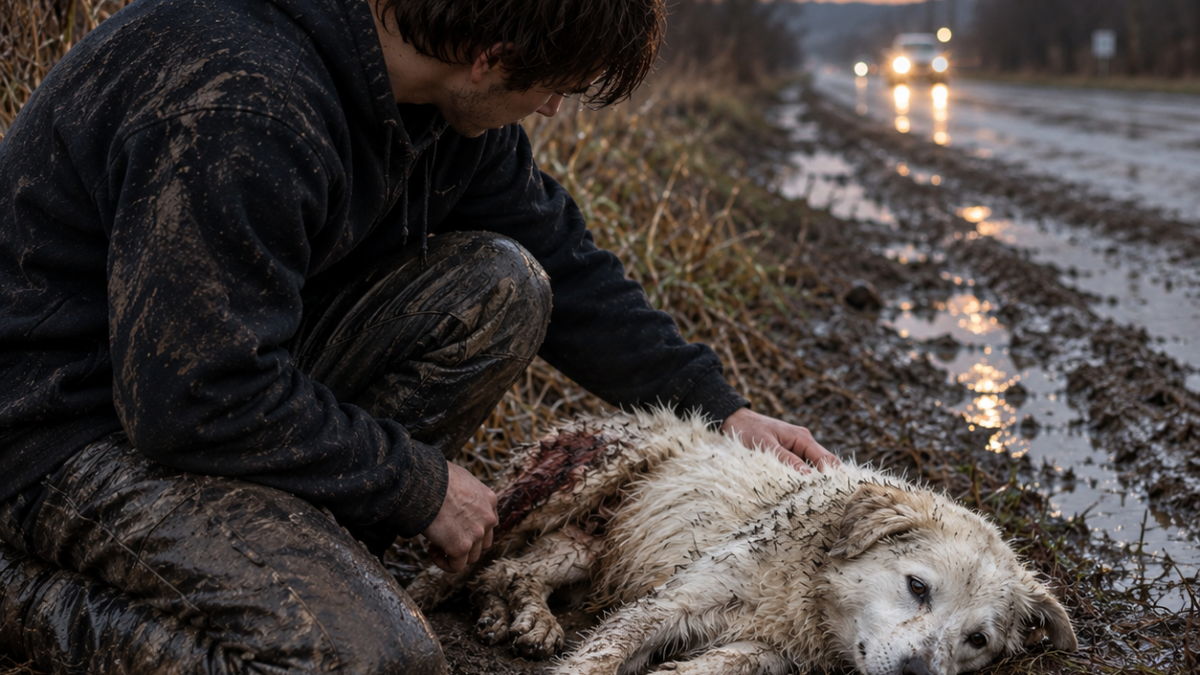
Every time I reached toward the dying white dog beside the bridge, she forced her head off the mud and looked past me toward the flooded ditch as if something hidden there mattered more than the blood soaking through her fur.
I thought she was afraid of me until I followed her eyes and found a tiny white puppy half-submerged beneath an old jacket, too cold even to cry.
What happened after I lifted that puppy into my arms began with one exhausted mother touching her nose to her baby’s face—and ended with a truth none of us were prepared to uncover.
I was sixteen years old when it happened, and if the rain hadn’t forced me to miss the school bus that afternoon, I probably never would have found them.
My name is Jake Miller. I lived with my father in a small farming town where the main road crossed an old concrete bridge before splitting toward the highway and the neighboring county. That afternoon, I’d stayed late at school finishing an auto-shop project, and because Dad was working a double shift at the mill, I started walking the three miles home.
It had been raining for almost three hours.
By the time I reached the bridge, my jeans were soaked from the knees down, my backpack felt twice its normal weight, and the unpaved shoulder had turned into thick brown mud. I was looking at the ground, trying not to slip, when I saw something large and white near the guardrail.
At first I thought it was a discarded tarp.
Then it breathed.
I stopped.
A dog was lying on her side less than twenty feet from me.
She was huge, probably a Great Pyrenees mix, with thick white fur that should have looked beautiful but was plastered with mud and dark streaks of blood. One back leg rested at an unnatural angle. Her chest rose too fast, then paused too long between breaths.
“Hey.”
Her eyes opened.
I moved one step closer.
The dog lifted her head suddenly.
I froze.
“I’m not going to hurt you.”
She wasn’t looking at me.
Her eyes went past my shoulder.
Toward the ditch beside the bridge.
Her head fell back into the mud.
I pulled out my phone.
No signal.
Of course.
I crouched several feet away.
“Easy, girl.”
She tried to rise.
Her front legs pushed once.
Nothing.
Then she made a weak sound and turned her head toward the ditch again.
That was when I realized she was trying to tell me something.
I followed her gaze.
At first there was only rainwater, branches, flattened grass, and trash caught against the concrete culvert.
Then something moved beneath an old brown jacket.
Tiny.
Barely visible.
I climbed down.
Mud filled one shoe immediately.
I didn’t care.
Under the jacket was a puppy.
White.
Almost exactly the same color as the injured dog.
He was lying in several inches of rainwater with his body pressed against a clump of grass. His eyes were barely open. He didn’t bark or whine when I touched him.
He only trembled.
“Oh, buddy.”
I picked him up.
His body felt frighteningly cold.
When I climbed back toward the road, the mother saw him.
Everything about her changed.
Her ears moved forward.
Her eyes focused.
She tried once more to lift herself.
“He’s here.”
I knelt beside her.
The puppy made the faintest squeak.
The dog stretched her neck toward him with what looked like the last strength she had.
Their noses touched.
She licked his face once.
Then again.
The puppy pushed against her muzzle.
And the mother finally stopped struggling.
Not because she was getting better.
Because she’d seen what she needed to see.
Her head lowered into the mud.
Her eyes closed.
“No.”
I put the puppy inside my jacket and reached for her.
“Come on.”
Nothing.
“Hey.”
Her chest moved once.
Then stopped.
For one terrifying second, I thought she had died beside me.
I pressed my hand against her ribs.
There.
A heartbeat.
Weak.
But there.
I stood in the rain and started screaming toward the road.
“HELP!”
No cars.
“PLEASE!”
Then, beyond the bridge, headlights appeared through the rain.
A pickup slowed.
I stepped directly into the shoulder and waved both arms.
The truck stopped.
A woman jumped out.
“What happened?”
“Dog. She’s dying.”
The woman ran toward us.
She took one look at the mother and pulled out her phone.
“I have service here.”
She called emergency animal rescue while I stayed kneeling beside the dog.
The puppy inside my jacket began moving.
The mother heard him.
Her eyes opened one final time.
I put my hand beside her face.
“They’re coming.”
She didn’t know what that meant.
But her eyes stayed on me.
And then, just before the rescue vehicle reached the bridge, I saw something tangled around her neck beneath all that white fur.
A torn strip of bright red nylon.
Attached to it was half of a plastic tag.
Only three words were still readable.
**HOLLOW CREEK KENNELS.**
At the time, the name meant nothing to me.
Within three weeks, it would mean everything.
PART 2
The rescue van arrived seven minutes later, although it felt like an hour.
Two people jumped out before the engine had fully stopped. One was a wildlife-sized man with a shaved head named Marcus Reed, the other a veterinary technician named Claire Owens. They worked with County Animal Rescue, and both moved with the controlled speed of people who had learned that panic wastes time.
“Hit by a car?” Marcus asked.
“I don’t know.”
Claire was already beside the dog.
“Female. Large breed. Possible pelvic injury. Poor perfusion.”
She lifted the dog’s lip.
“Pale gums.”
The puppy moved inside my jacket.
Claire looked at me.
“There’s another?”
“Her puppy.”
“How old?”
“I don’t know.”
She reached out.
The mother opened her eyes.
Even half-conscious, she tried to lift her head toward Claire’s hand.
“Easy,” Claire whispered.
Then she saw the puppy.
“Okay. Keep him where he is for another second.”
The mother relaxed only after Claire allowed her to sniff him again.
Marcus noticed.
“Definitely hers.”
I remember thinking that was obvious.
Then I realized rescuers see animals abandoned together all the time without being related.
This wasn’t assumption to them.
It was evidence.
—
They slid the mother onto a rigid stretcher.
She cried once when her hips moved.
That sound still bothers me.
Not loud.
Just one sharp breath of pain.
I backed away.
“I hurt her.”
“No,” Claire said immediately. “We did what we had to do.”
“Is she going to live?”
Claire didn’t answer.
That scared me more than if she had said no.
“Can I come?”
Marcus glanced toward me.
“How old are you?”
“Sixteen.”
“Parent?”
“At work.”
“Call him.”
“No signal.”
“I’ve got one bar.”
I borrowed his phone.
Dad answered on the fourth ring.
“Jake?”
“It’s me.”
“Whose number is this?”
“I found a dog.”
Silence.
With my father, context was always important.
“A dog.”
“She’s hurt. Really bad.”
“Are you hurt?”
“No.”
“Where are you?”
“Bridge on County Nine.”
Another silence.
Then:
“Stay there.”
“They’re taking her to Riverbend Animal Hospital.”
“I’ll meet you.”
That was Dad.
No speech.
No panic.
Just action.
—
Marcus let me ride in the back.
The puppy stayed wrapped against my chest.
Claire monitored the mother.
She placed an oxygen mask near her muzzle, started an IV, covered her with thermal blankets, and spoke into a radio to the veterinary hospital.
“Adult female, approximately seventy-five pounds, possible motor-vehicle trauma, hypotensive, suspected pelvic or femoral fracture, possible thoracic injury, severe dehydration, lactating.”
That word caught me.
“Lactating?”
Claire looked at the puppy.
“She’s nursing.”
“So he’s really young?”
“Probably four or five weeks.”
“Shouldn’t there be more?”
Claire’s eyes met mine.
“Maybe.”
I didn’t like the way she said it.
“More puppies?”
“Large dogs rarely have one-puppy litters.”
I looked down at the little white head under my jacket.
Until then I’d been grateful we had found him.
Suddenly one puppy felt frightening.
“Where are the others?”
“We don’t know.”
—
The mother stopped breathing three minutes before we reached the hospital.
Claire said her name—I don’t remember what it was, something clinical—and immediately began working.
I moved toward the corner of the van.
The puppy started crying.
For the first time.
A thin, desperate sound.
The mother’s chest didn’t move.
Claire compressed.
Marcus drove faster.
“Come on.”
Nothing.
“Come on, girl.”
Another compression.
Then the mother gasped.
I didn’t realize I was crying until Marcus glanced at me in the rearview mirror.
“She’s fighting.”
I nodded even though he wasn’t really talking to me.
—
Riverbend’s emergency staff were waiting at the door.
The mother disappeared through double doors almost immediately.
Someone took the puppy from me.
That was harder than it should have been.
“Wait.”
A young technician stopped.
“We need to warm him.”
“I know.”
My hands stayed on the towel.
“He needs to be examined.”
“I know.”
“Jake.”
I didn’t know how she knew my name.
Then I saw Claire behind her.
The technician softened.
“You can come with him.”
I let go.
—
The puppy’s temperature was dangerously low.
Blood sugar too.
He had no major visible injuries, but his abdomen was slightly distended from worms, and his body condition was poor for his age.
They placed him in a warm incubator.
He looked impossibly small beneath the lights.
“Is he going to be okay?”
The veterinarian examining him was Dr. Rebecca Shaw, a woman in her forties with dark hair tied back and the calmest voice I’d ever heard.
“I think his chances are good.”
“And the mother?”
Her expression changed.
“She’s in surgery.”
“Surgery for what?”
“Internal bleeding.”
My stomach dropped.
“From being hit?”
“Probably.”
“Probably?”
“We’ll know more soon.”
She touched my shoulder.
“We’re also worried about her left hip and two ribs.”
I looked through the glass at the operating room door.
“Can you save her?”
“We’re trying.”
—
Dad arrived twenty minutes later wearing his mill uniform and steel-toed boots.
He smelled like machine oil and rain.
He didn’t ask why I was covered in mud.
He saw the puppy.
Then the bloody towel on the chair.
Then my face.
“You okay?”
I nodded.
He sat beside me.
For a while neither of us spoke.
Dad had never been good with emotional conversations, especially after Mom died. She’d been gone four years by then, and sometimes I thought the two of us had turned grief into a set of household chores.
Trash Wednesday.
Laundry Sunday.
Don’t mention what hurts.
Dad eventually looked toward the incubator.
“That’s the puppy?”
“Yeah.”
“Cute.”
It was the first absurd thing anyone had said all afternoon.
I laughed.
Then, because I’d been holding everything too tightly, I started crying.
Dad put one arm around my shoulders.
He didn’t say stop.
—
Dr. Shaw came out almost two hours later.
I stood so quickly my chair slid backward.
“She’s alive.”
I didn’t realize how badly I needed those two words until they arrived.
“Really?”
“Yes.”
“She’s okay?”
“I didn’t say that.”
Of course.
Adults always ruin good news with accuracy.
“She had a ruptured spleen and significant internal bleeding. We removed the spleen. She also has a fractured pelvis, two cracked ribs, deep bruising over the left side of her body, and several older injuries.”
“Older?”
Dr. Shaw nodded.
“Scarring around the neck. Pressure sores on both elbows. One old rib fracture. She’s underweight beneath the coat.”
Dad frowned.
“How long?”
“Hard to say.”
“Neglect?”
“Possibly.”
That word again.
Possibly.
Maybe.
Probably.
I was beginning to hate medicine.
—
Then Dr. Shaw mentioned the detail that changed everything.
“There’s another concern.”
“What?”
“She’s producing enough milk that I would expect a litter larger than one.”
I already knew.
Claire had said the same.
“Could the other puppies have died?”
“Yes.”
“Or be somewhere?”
“Yes.”
“Can we search?”
Dr. Shaw looked at Dad.
Dad looked at me.
“We can call animal control,” she said.
I pulled the broken red collar tag from my pocket.
I’d forgotten it was there.
Claire must have removed it at the bridge and given it back to me without my noticing.
“Hollow Creek Kennels.”
Dr. Shaw’s face changed.
Not dramatically.
Just enough.
“You know it?”
She took the tag.
“I know the name.”
Dad leaned forward.
“From where?”
She hesitated.
“Let me make a call.”
—
Hollow Creek Kennels sat thirty-two miles north of us.
It advertised livestock guardian dogs, Great Pyrenees, Anatolian shepherd crosses, and “working farm companions.”
The website looked clean.
Beautiful white dogs on green grass.
Healthy puppies inside barns.
Testimonials.
Families smiling.
A slogan:
**Raised With Purpose. Bred With Care.**
When Officer Maria Santos from county animal control arrived at the clinic, she already had the website open on her tablet.
“Registered owner is Gavin Mercer.”
Dad asked:
“Any complaints?”
Maria didn’t answer immediately.
That meant yes.
“Three in the last two years.”
“About?”
“Barking, dogs loose, one welfare concern.”
“What happened?”
“First two were resolved. Third visit found no immediate violation.”
“Immediate?”
Maria looked tired.
“Food. Water. Shelter. Dogs were thin but not below seizure threshold.”
I hated that phrase.
“Seizure threshold.”
Adults have ways of turning suffering into measurements.
Maria continued.
“They’re licensed for a limited number of breeding dogs. If this female came from Hollow Creek, we’ll determine whether she belongs to him.”
“Can’t you just go there?”
“We can ask.”
“Ask?”
“We need probable cause for more.”
I pointed toward the hospital room.
“She’s almost dead.”
Maria stayed calm.
“And I need evidence connecting her current condition to that property.”
I wanted to argue.
Dad put a hand on my shoulder.
“Let her work.”
—
The mother had no collar beyond the torn nylon.
But she did have a microchip.
Dr. Shaw found it during the exam.
Registered to:
**Hollow Creek Working Dogs LLC.**
Dog name:
**Pearl.**
Female Great Pyrenees.
Age six.
My chest tightened.
Pearl.
At least she had a name.
—
Maria called Gavin Mercer that evening.
I wasn’t supposed to hear the conversation.
But the clinic hallway was small.
“Mr. Mercer, this is Officer Santos with County Animal Control.”
Pause.
“I’m calling about a Great Pyrenees registered to your kennel. Female. Name Pearl.”
Longer pause.
“When did you last see her?”
Maria listened.
“Two months?”
She looked at Dr. Shaw.
“You’re saying she escaped two months ago.”
Another pause.
“Did you report her missing?”
Silence.
“Why not?”
Then:
“No, sir. I’m not accusing you of anything. I’m asking a question.”
He talked for almost a minute.
Maria wrote something.
“Did Pearl recently have a litter?”
Her pen stopped.
“What date?”
More writing.
“How many puppies?”
She looked at us.
Then:
“Six.”
I felt cold.
One puppy was in an incubator.
Five were missing.
—
Gavin claimed Pearl had delivered six puppies six weeks earlier.
Four had been sold.
One died shortly after birth.
The sixth, a male, supposedly disappeared with Pearl when she “escaped.”
The dates roughly matched the puppy we’d found.
Could be true.
But Maria asked the obvious question.
“Why didn’t you report a breeding female and a five-week-old puppy missing?”
Gavin said farm dogs wandered.
Pearl had done it before.
He assumed she’d return.
She hadn’t.
He moved on.
That was his story.
—
He wanted Pearl back.
That part came quickly.
“She’s mine,” he told Maria.
The clinic went quiet.
Maria answered:
“She’s currently being treated as an injured stray pending investigation.”
“I want my dog.”
“She’s not medically stable.”
“I’ll pay.”
I looked at Dad.
Maybe that meant something good.
Maybe he cared.
Then Gavin asked:
“What about the male pup?”
Not:
How is Pearl?
Not:
Will she survive?
The puppy.
“Also in protective care.”
“I want him too.”
Maria ended the call shortly afterward.
—
The next morning, Gavin arrived at Riverbend Animal Hospital.
I was there before school.
Dad had finally forced me to go home for four hours, shower, and sleep, then I’d returned at six.
Gavin walked in wearing a tan work jacket and boots almost clean enough to be deliberate.
He was about fifty.
Broad shoulders.
Gray at the temples.
He looked like every man you’d expect to own land and shake hands confidently.
He approached the desk.
“I’m here for Pearl.”
The receptionist looked toward the back.
Maria had warned them.
“I’m sorry, sir. The animal is under hold.”
“I own her.”
“Officer Santos can discuss that.”
“I’ve already discussed it.”
Then he saw me.
Mud wasn’t covering me anymore, but I think he recognized me from something Maria had told him.
“You’re the kid.”
I stood.
Dad wasn’t there yet.
“Which kid?”
“The one who found her.”
His face arranged itself into concern.
“Thank you.”
I said nothing.
“You saved my dog.”
Still nothing.
“Where’s the pup?”
I looked at him.
“Why?”
He frowned.
“What?”
“Why do you care about the puppy more than her?”
His expression hardened slightly.
“He’s valuable.”
There it was.
One word.
He realized too late how it sounded.
“I mean he’s from a good line.”
I stared.
Behind the clinic door, Pearl was recovering from emergency surgery after nearly bleeding to death.
“She’s valuable too.”
“Of course.”
He said it automatically.
Then:
“When can I take them?”
I had never disliked someone faster.
—
Maria arrived fifteen minutes later and escorted Gavin outside.
He left angry.
Not devastated.
Angry.
That difference mattered.
—
Pearl woke fully that morning.
They let me see her for two minutes.
She was connected to monitors.
A bandage covered her abdomen.
One leg was supported.
She looked smaller without the mud and rain.
I stood beside the kennel.
“Hey.”
Her eyes opened.
I didn’t touch her immediately.
“Remember me?”
Probably not.
Then Dr. Shaw brought the puppy.
Pearl’s whole expression changed.
She tried to rise.
“Easy.”
They placed the pup beside her chest.
He crawled toward her.
Pearl began licking his face.
Weak.
Slow.
But determined.
The puppy found a nipple and started nursing.
Dr. Shaw smiled.
“That’s good.”
“What do we call him?”
“We?”
I looked at her.
“Fine. What are you calling him?”
“No name yet.”
I looked at the tiny white puppy.
He had been nearly invisible under that brown jacket in the ditch.
One little thing hidden in a storm.
“Finn.”
Dr. Shaw smiled.
“Finn?”
“Don’t know.”
“Works for me.”
Pearl and Finn.
The names stuck.
—
Pearl refused food that day.
Then the next morning.
Dr. Shaw worried.
Pain.
Shock.
Stress.
We tried chicken.
Canned food.
Warm broth.
Nothing.
Then someone placed Finn close to the bowl.
Pearl sniffed him.
Then ate.
Three bites.
Paused.
Ate again.
Dr. Shaw looked at me.
“Apparently she has conditions.”
“Mother first.”
“Seems so.”
—
The story should have ended there.
Injured mother survives.
Puppy survives.
Owner identified.
Questions answered.
But one piece still bothered Maria.
The road.
Hollow Creek Kennels was twenty-six miles from the bridge.
Pearl had a shattered pelvis.
Dr. Shaw estimated she’d been struck shortly before I found her, probably within hours.
Could Pearl have walked twenty-six miles with a five-week-old puppy?
Before the injury, yes.
Possible.
But why?
And why was Finn wrapped beneath an old jacket?
Dogs don’t wrap puppies in jackets.
A person had been there.
—
The jacket became evidence.
Brown canvas.
Men’s work jacket.
No wallet.
No name.
But inside one pocket was a crumpled receipt.
Fuel station.
Time:
5:18 a.m.
Location:
Two miles from the bridge.
The purchase:
Diesel fuel.
Coffee.
Chewing tobacco.
Paid with a business debit card.
The last four digits were visible.
Maria got a warrant for payment information.
Account holder:
**Hollow Creek Working Dogs LLC.**
—
Gavin changed his story.
He had driven that road that morning.
Yes.
But not with Pearl.
He was checking fencing at a leased pasture.
The jacket?
Not his.
The debit card?
Employee could have used it.
Which employee?
He couldn’t remember.
—
Then the gas station provided video.
At 5:17 a.m., a dark blue Ford pickup entered.
Gavin got out.
Same face.
Same truck registered to him.
In the truck bed was a large white dog.
And beside her—
a plastic transport crate.
Maria showed me one still image.
Through the rain, Pearl’s head was visible over the truck-bed wall.
I felt sick.
“He had her.”
“Yes.”
“And Finn?”
“We can’t see inside the crate.”
“Why lie?”
Maria didn’t answer.
Because we were about to find out.
—
The bridge didn’t have cameras.
But a farmhouse half a mile away did.
The owner had installed a security system after fuel theft.
One camera pointed toward the road.
5:43 a.m.
Gavin’s truck.
It stopped near the bridge.
For four minutes.
Then drove away.
Thirty seconds later, Pearl appeared on the camera.
Running after it.
Finn wasn’t visible.
Pearl ran down the center of the road.
Then another vehicle approached from the opposite direction.
Brakes.
Pearl disappeared from frame.
The vehicle stopped.
The driver got out.
A man ran backward toward her.
The footage had no sound.
The driver stayed almost five minutes.
Then another car came.
He appeared to wave for help.
Eventually he drove away.
Pearl remained beside the bridge.
—
Maria found the driver.
His name was Harold Benton.
He was sixty-eight.
He had been carrying his wife to an oncology appointment.
Pearl ran directly in front of him.
He hit the brakes.
Too late.
He struck her.
He called the non-emergency sheriff line, but with no patrol immediately available and his wife becoming ill in the car, the dispatcher told him animal control would be notified.
That report had somehow not reached the right officer until hours later.
Harold cried when he learned Pearl survived.
“I thought I killed her.”
“You didn’t,” I told him when we met.
His hands shook.
“I should’ve stayed.”
“You had your wife.”
“I should’ve stayed.”
I knew there was no sentence that would fix his guilt.
So I said:
“She wasn’t alone for long.”
That helped a little.
—
What mattered more was what Harold had seen before the collision.
“The truck.”
Maria leaned forward.
“What about it?”
“It was ahead of me.”
“Gavin’s?”
He identified the photograph.
“Yeah.”
“What did you see?”
“He pulled away fast.”
“Did you see the dog?”
“She was running after him.”
“Anything else?”
Harold thought.
“There was something down by the ditch.”
“What?”
“Couldn’t tell.”
“Person?”
“No.”
He shook his head.
“Like he’d thrown something.”
Finn.
The jacket.
Maybe the puppy had been placed there before Gavin left.
Pearl had stayed near him.
Then when the truck drove away, she chased.
That was what a loyal dog did.
Even after someone abandoned her.
—
Maria obtained a search warrant for Hollow Creek.
Gavin’s attorney fought it.
Lost.
Three animal-control vehicles, sheriff’s deputies, a veterinary team, and investigators entered the property six days after I found Pearl.
Dad wouldn’t let me go.
Good.
I later saw enough photographs.
Twenty-one dogs.
Not the twelve Gavin’s license allowed.
Seven adult females.
Three males.
Eleven puppies of different ages.
Outdoor runs.
Mud.
Improvised shelters.
Several dogs thin.
Two with untreated ear infections.
One with a severe skin condition.
An older female with a swollen mammary gland that needed immediate care.
A male with a collar so tight the hair beneath it was gone.
Not a horror-movie puppy mill.
That almost made it worse.
It was close enough to looking normal that people had been willing to look away.
Food existed.
Water existed.
But care stopped wherever profit stopped.
—
Inside Gavin’s office, investigators found breeding records.
Pearl’s page was easy to identify.
**PEARL — F — GP — 6Y**
Litters:
Five.
Five litters by age six.
The most recent:
Six puppies.
Four listed as sold.
One listed:
**DOA**
One listed:
**M — undersized / no deposit**
Finn.
No deposit.
No buyer.
Beside Pearl’s name, written three days before I found her:
**Retire. Cost > value.**
I stared at the photograph of that note until the words blurred.
Retire.
Cost greater than value.
How do you write that beside a living animal you’ve owned six years?
—
Then another document appeared.
Text messages between Gavin and his kennel assistant, Mark Ellis.
Mark:
**What do you want me to do with Pearl and the little male?**
Gavin:
**I’ll handle them.**
Mark:
**Shelter?**
Gavin:
**They’ll charge and ask why she’s so thin.**
Mark:
**Rescue?**
Gavin:
**Same problem.**
Then, early morning:
**Taking them out.**
Mark:
**Where?**
Gavin:
**Doesn’t matter.**
That was enough for a cruelty investigation.
But it wasn’t the worst message.
Later, after Gavin had seen Pearl on social media recovering at Riverbend:
**Can’t believe that kid found them.**
Then:
**Male might be worth something now with all the attention.**
I read that one only once.
—
The four puppies already sold from Pearl’s litter were traced.
All alive.
Thank God.
But two buyers had problems.
One puppy had heavy parasites.
Another had been sold at only five weeks despite paperwork saying eight.
One family produced text messages where Gavin told them Pearl was “retired to a farm family.”
Another buyer had been told Pearl died after giving birth.
Different stories for different people.
Whatever made the sale easier.
—
Mark Ellis cooperated.
He wasn’t innocent.
He had worked there almost two years.
Fed dogs.
Cleaned runs.
Helped with breeding.
Watched things deteriorate.
Didn’t report.
But when investigators showed him the road footage, he broke.
“I told him to take them somewhere.”
Maria asked:
“Did you know he’d abandon them?”
“No.”
“Did you know he didn’t want the shelter seeing Pearl?”
“Yes.”
“So what did you think ‘handle them’ meant?”
Mark stared at the table.
“I didn’t let myself think about it.”
That sentence stayed with me.
People use ignorance like a blanket.
Sometimes they know exactly what’s underneath.
—
Gavin was charged with animal abandonment, cruelty-related offenses, licensing violations, and falsification of some health records connected to puppy sales.
His attorney immediately attacked the case.
Pearl was alive.
Finn was alive.
Gavin had not personally struck Pearl.
The road was public.
Maybe he intended someone to find them.
Maybe he’d changed his mind after setting them down.
Maybe Pearl escaped the truck.
Maybe the jacket fell accidentally.
Maybe.
Maybe.
Maybe.
I hated that word again.
—
Then Gavin made a mistake.
He came to Riverbend.
Again.
Pearl had been moved from critical care to a rehabilitation kennel by then.
Finn was nearly seven weeks old and becoming ridiculously energetic.
I was visiting after school.
Gavin walked through the lobby with his attorney behind him.
Maria had told him repeatedly that he could not reclaim the animals while the case was open.
He came anyway.
“I want to see my dog.”
The receptionist said no.
He raised his voice.
Pearl heard him.
She was behind a closed interior door.
Her reaction was immediate.
She started barking.
Not happy.
Hard.
Panicked.
Finn began crying.
I stood.
“Leave.”
Gavin looked at me.
“You.”
“Yeah.”
“You caused enough trouble.”
His attorney said:
“Gavin.”
He ignored her.
“If you’d stayed out of it, none of this would’ve happened.”
I stared.
“She would’ve died.”
He shrugged.
One small movement.
That was the moment something in me changed.
Not anger.
Clarity.
He wasn’t misunderstood.
He wasn’t overwhelmed.
He had simply decided certain lives stopped mattering when they stopped earning him money.
I pulled out my phone.
Recording.
“You dumped them.”
His attorney saw the phone.
“Gavin, stop talking.”
Too late.
He pointed toward the back.
“That bitch was done producing, and the little male wasn’t worth feeding.”
The lobby went silent.
His attorney closed her eyes.
I barely breathed.
Gavin realized.
“What?”
I held up the phone.
“Say it again.”
He moved toward me.
Not far.
His attorney grabbed his sleeve.
Security came out.
Then Maria, who happened to be meeting Dr. Shaw in the back office.
Perfect timing.
“Mr. Mercer.”
Gavin stopped.
Maria’s face was calm.
“You’re done here.”
—
That recording became evidence.
His lawyer tried to exclude it.
Couldn’t.
Public lobby.
No reasonable expectation of privacy under our state’s law.
I learned a lot about law that year.
More than I wanted.
—
Pearl’s recovery took months.
Her pelvis didn’t require surgical fixation, but she needed strict rest and physical therapy.
The spleen surgery healed.
Ribs healed.
Weight came back slowly.
The first time she stood without assistance, Finn was beside her.
She took three steps.
He attacked her tail.
Pearl nearly fell.
I grabbed him.
“You idiot.”
Finn was delighted.
Dr. Shaw laughed.
“Good sign.”
“Which part?”
“That you’re yelling at the puppy instead of crying over him.”
Fair.
—
Pearl trusted women first.
Then me.
Men were harder.
Dad took weeks.
He never pushed.
He’d sit outside her rehab pen reading the newspaper.
No reaching.
No calling.
Eventually Pearl approached.
Sniffed his boot.
Walked away.
Dad acted like nothing happened.
A week later she took chicken from his fingers.
Dad came home and said:
“Dog likes me.”
I laughed.
“She accepted food.”
“Same thing.”
—
Finn had none of Pearl’s caution.
Finn believed every person existed for his benefit.
He chewed shoelaces.
Stole towels.
Barked at his reflection.
Tried to climb into the dishwasher at the clinic.
Dr. Shaw called him “the reason maternal patience has limits.”
Pearl adored him anyway.
If he disappeared around a corner, she looked.
If someone carried him away, she watched until he returned.
She had nearly died staring toward a ditch because she would not leave him unseen.
That never changed.
—
The rescue posted Pearl and Finn’s recovery updates without naming Gavin until charges became public.
People responded.
Donations covered surgery.
Then exceeded surgery costs.
Riverbend directed extra funds toward other cruelty cases.
Gavin’s attorney called it prejudicial publicity.
Our attorney replied that veterinary bills were not defamation.
I enjoyed that.
—
Gavin attempted to surrender ownership of several dogs voluntarily before trial.
The prosecutor accepted surrender but not dismissal.
The remaining dogs were distributed among rescue organizations after veterinary clearance.
Pearl and Finn stayed under protective custody.
That meant I couldn’t adopt them yet.
I hadn’t admitted I wanted to.
Dad knew.
Dr. Shaw knew.
Maria knew.
Probably Finn knew.
Everyone except me.
—
“You’re not bringing home two Great Pyrenees,” Dad said one night.
“I didn’t ask.”
“You have the face.”
“What face?”
“The dog face.”
“I don’t have a dog face.”
“You had the same face when you were nine and wanted that stray cat.”
“We kept the cat.”
“Exactly.”
I smiled.
Dad sighed.
“One.”
“What?”
“If it comes to it, one.”
I looked at him.
“They’re mother and son.”
“No.”
“Pearl almost died for him.”
“Jake.”
“They’ve already been separated once.”
“One.”
Two months later, we had both.
But Dad deserved the illusion of authority while it lasted.
—
The criminal case dragged on.
Gavin pleaded not guilty.
His kennel closed because his breeding license was suspended and the animals had been removed.
He posted online that government overreach had destroyed a legitimate family business.
People argued.
Some defended him.
Said farmers handle animals differently.
Said rescues exaggerate.
Said dogs are property.
That last word made me furious.
Property.
As though ownership cancels obligation.
—
Maria told me something important.
“Don’t read comments.”
“I don’t.”
“You absolutely do.”
“Sometimes.”
“Stop.”
“I want to know what people think.”
“No, you want to fight strangers.”
She was right.
Annoying woman.
—
The civil side moved faster.
Several puppy buyers sued over falsified age and health documentation.
One family had veterinary bills exceeding what they’d paid for the dog.
Another discovered the vaccine certificate Gavin provided listed a clinic that had never seen the puppy.
That opened another investigation.
Paperwork.
Always paperwork.
People imagine justice as sirens.
Often it’s records.
Dates.
Receipts.
Signatures.
—
The preliminary hearing happened four months after the bridge.
I testified.
My first time in court.
Dad sat behind me.
Gavin sat across the room.
I described the rain.
Pearl.
The ditch.
Finn.
The collar tag.
His attorney asked:
“You never personally saw my client place these dogs at the bridge, correct?”
“No.”
“You never saw him strike Pearl.”
“No.”
“You don’t know what happened before you arrived.”
“No.”
“So your testimony cannot establish Mr. Mercer’s intent.”
The prosecutor stood.
“Objection.”
Sustained.
I looked at Gavin.
His attorney continued.
“You became emotionally attached to these animals, didn’t you?”
“Yes.”
“Very attached.”
“Yes.”
“So you want someone punished.”
I thought.
Then answered:
“I want the person who dumped them stopped from doing it again.”
His attorney paused.
“That’s not what I asked.”
“It’s my answer.”
The judge almost smiled.
Dad definitely did.
—
Harold Benton testified too.
He cried when describing the collision.
Gavin’s lawyer tried to shift blame.
“You’re the one who struck the dog.”
Harold nodded.
“Yes.”
“You left her.”
“I called.”
“But you left.”
“My wife had cancer and was vomiting in the passenger seat.”
The courtroom went silent.
Harold continued:
“I have hated myself for driving away every day since.”
I wanted to stand up and tell him not to.
He looked toward me.
I nodded once.
He nodded back.
—
Then the gas station video.
The farmhouse camera.
The messages.
The kennel records.
The clinic recording.
**That bitch was done producing, and the little male wasn’t worth feeding.**
Gavin stared at the table.
His lawyer couldn’t explain that sentence away.
—
Two weeks before trial, Gavin changed his plea.
Not to everything.
A negotiated agreement.
Multiple animal neglect and abandonment counts.
Licensing violations.
Falsified health documentation.
Restitution.
Forfeiture of the remaining breeding operation.
A substantial prohibition on breeding or commercially selling dogs.
Animal-ownership restrictions.
Probation after jail.
And several months in county custody.
Some people said not enough.
Others said too much.
I didn’t care about satisfying strangers.
I cared that Hollow Creek Kennels was finished.
—
At sentencing, Gavin spoke.
“I made a poor decision.”
The judge looked at him.
“Which one?”
He hesitated.
“Leaving Pearl.”
“And the puppy?”
“Yes.”
“Why?”
He looked toward his attorney.
Then:
“I had financial problems.”
The judge reviewed a paper.
“Your kennel grossed more than one hundred and forty thousand dollars the previous year.”
Gavin said nothing.
“You declined to surrender Pearl to a shelter because you feared questions about her condition.”
Silence.
“You then drove a recently nursing dog and her unsold puppy twenty-six miles from your property, placed them beside a rural bridge during a storm, and left.”
Gavin shifted.
The judge continued.
“Pearl ran after your truck and was struck by another vehicle.”
His lawyer started to stand.
The judge lifted one hand.
“I am not saying you caused the collision intentionally. I am saying your choices placed her there.”
Exactly.
“Then, after learning she survived, you attempted to reclaim the puppy because you believed publicity might increase his financial value.”
Gavin’s face tightened.
The judge looked straight at him.
“Your problem was not that you stopped caring for animals.”
Pause.
“Your problem was that you appear to have cared for them only while they remained profitable.”
No one spoke.
—
Hollow Creek’s property went into foreclosure months later.
The legal fees, kennel shutdown, lost sales, restitution, and other debts finished what the criminal case started.
I didn’t cheer.
Employees lost work too.
Mark had to find another job.
Consequences spread.
Life isn’t clean.
—
Then something happened I didn’t expect.
A regional Great Pyrenees rescue and a veterinary nonprofit bought the property after foreclosure.
Not immediately.
Almost two years later.
The old kennel buildings were renovated.
Mud runs became grassy yards.
Breeding stalls became quarantine rooms.
The main barn became a rehabilitation center for large dogs seized from neglect cases.
They named it:
**Pearl Haven.**
I laughed when I saw the sign.
Dad said:
“Little dramatic.”
“You cried.”
“I had dust in my eye.”
“Outside?”
“Wind.”
Sure.
—
The first dog housed at Pearl Haven was a nine-year-old Great Pyrenees female removed from a hoarding case.
White.
Thin.
Terrified.
Her name was Daisy.
Pearl visited after the facility opened.
Not because she understood symbolism.
Because I wanted to see.
She walked into the property cautiously.
Sniffed.
Stopped near one of the old runs.
Her body stiffened.
I immediately regretted bringing her.
“Let’s go.”
Then Finn ran toward a volunteer holding treats.
Pearl followed him.
Five minutes later, she was lying in the grass.
The same land where she’d been bred again and again.
Now dogs recovered there.
I didn’t need revenge after that.
Nothing could top it.
—
By then, Pearl and Finn were legally ours.
Yes.
Both.
Dad lasted nine minutes after the protective hold ended.
Dr. Shaw brought up adoption.
Dad said:
“One.”
Finn put both front paws on his lap.
Dad said:
“Get down.”
Pearl rested her head on his knee.
Dad sighed.
“Fine.”
Dr. Shaw had the paperwork ready.
Suspiciously ready.
—
Our house was not designed for two Great Pyrenees.
We learned.
White fur became weather.
There was hair on furniture, clothes, food, occasionally inside closed cabinets through mechanisms unknown to science.
Finn grew to one hundred and three pounds.
Pearl stabilized around eighty-two.
Dad bought a stronger vacuum.
It lasted four months.
He bought another.
“These dogs are an economic attack.”
Pearl leaned against him.
Dad scratched her ears.
Traitor.
—
Finn grew into a ridiculous animal.
Huge body.
Tiny understanding of personal space.
He barked at cardboard boxes.
Feared the vacuum.
Loved snow.
Tried to sit in chairs like a person.
Pearl remained calmer.
Watchful.
She liked the porch.
Liked Dad’s boots.
Liked me near enough to see but not always touching.
She had spent years being used.
I think freedom for her meant being allowed to choose distance.
We respected that.
—
I graduated high school.
Pearl and Finn attended the backyard party.
Finn stole a hamburger directly from my uncle’s plate.
Pearl looked innocent.
Dad blamed both.
—
When I left for community college twenty minutes away, I commuted because I told everyone it saved money.
The real reason was dogs.
Dad knew.
He said nothing.
Some fathers learn emotional subtlety eventually.
—
Pearl helped me through more than I expected.
I had been twelve when Mom died from a brain aneurysm.
Sudden.
No warning.
For years, I thought grief meant something had been taken from me.
Pearl changed that.
Watching her with Finn taught me another version.
Grief can also be the terror of losing something you almost failed to protect.
Pearl had stared toward that ditch while bleeding because Finn was still there.
She did not ask someone to save her first.
She needed to know he was safe.
That kind of devotion changes how you understand love.
—
Pearl didn’t become a therapy dog.
People sometimes expect rescued animals to turn into public saints.
She didn’t owe anyone that.
She liked her family.
Tolerated visitors.
Distrusted men in tan work jackets for years.
Hated pickup trucks that idled too long near the house.
Some trauma stayed.
Healing didn’t erase memory.
It made memory manageable.
—
Finn had fewer scars emotionally.
Or maybe his were different.
He became confident because his life after the ditch was mostly safe.
He was proof that early intervention matters.
People sometimes said:
“He’s so lucky he doesn’t remember.”
I didn’t know if that was true.
Dogs remember in bodies.
Sounds.
Smells.
Reactions.
But Finn didn’t live as though the bridge owned him.
That’s enough.
—
Mark Ellis contacted me about three years after the case.
The kennel assistant.
He had completed his own probationary requirements for minor licensing involvement and had cooperated with investigators.
He asked if he could visit Pearl.
I almost said no.
Then I asked why.
His answer:
“Because I want to apologize.”
“She doesn’t need your apology.”
“I know.”
That saved him.
People who say animals need their apology usually mean they need forgiveness.
Mark didn’t.
He said:
“I want to see that she’s okay.”
I thought about it.
Then allowed one visit at Pearl Haven, neutral ground.
—
Pearl recognized him.
That surprised me.
The moment Mark entered the yard, she froze.
Tail down.
Body stiff.
Finn stepped in front of her.
Mark stopped twenty feet away.
He didn’t call her.
Didn’t crouch.
Didn’t hold out food.
He simply stood there.
“I’m sorry, Pearl.”
She watched.
Mark cried.
“I should’ve called someone.”
Pearl turned away.
Walked toward me.
That was all.
Mark nodded.
“Fair.”
I respected him more for that than I would have if he’d expected a dramatic reconciliation.
—
He started volunteering at Pearl Haven.
Not because Pearl forgave him.
Because he wanted his next choice to be different.
Cleaning.
Repairs.
Laundry.
Eventually transport work.
He became the person staff called when they needed someone to drive three hours for a neglected livestock guardian dog at midnight.
Years later, he told me:
“I spent too long telling myself I wasn’t the one hurting them.”
I remembered his first interview.
**I didn’t let myself think about it.**
Now he did.
Growth doesn’t erase failure.
It gives failure somewhere useful to go.
—
Harold Benton visited Pearl too.
The man whose truck hit her.
That reunion was different.
He stood in our yard shaking.
Pearl approached.
Sniffed.
No fear.
Of course.
Harold had not abandoned her.
He had just been the unlucky driver on the road she was forced to chase.
Pearl accepted a biscuit.
Harold cried harder than Mark.
“I am so sorry.”
I told him:
“You didn’t put her there.”
He finally believed me.
A little.
—
His wife survived her cancer.
Five years later, they adopted a senior dog from Pearl Haven.
A twelve-year-old Pyrenees mix with arthritis.
Harold sent me a photograph.
Caption:
**Figured we owed the universe one.**
I replied:
**You don’t owe the universe. Just love the dog.**
He did.
—
Pearl aged.
At nine, arthritis became noticeable.
At ten, cataracts began.
At eleven, her hearing softened.
Finn adapted instinctively.
When she moved slowly, he slowed.
If she struggled at steps, he stood nearby.
He stopped crashing into her during play.
Mostly.
Sometimes he forgot he weighed a hundred pounds and remained mentally six weeks old.
Pearl corrected him with one look.
Motherhood.
—
Dad aged too, though he hated comparisons.
One morning I found Pearl and Dad both struggling to stand from the living-room floor after he had sat beside her.
“Need help?”
“No.”
Pearl stood.
Dad didn’t.
I raised an eyebrow.
“Shut up.”
I helped him.
Finn supervised.
—
At twelve, Pearl developed a mammary mass.
Dr. Shaw’s face told me before the biopsy did.
Cancer.
Localized initially.
Surgery possible.
Risk reasonable.
We chose surgery.
The mass came out with clean margins.
Pearl recovered.
Dad slept on the living-room floor beside her for two nights.
The man who once said one dog maximum.
I took photographs.
Blackmail matters in families.
—
We got almost two more good years.
Real years.
Not borrowed in the sad way people describe time after illness.
Snow.
Walks.
Porch naps.
Finn stealing bread.
Pearl ignoring delivery drivers.
Dad cursing the vacuum.
Ordinary.
That’s the point.
Rescue doesn’t promise extraordinary life.
It fights for ordinary life.
—
Pearl was almost fourteen when the cancer returned.
Different place.
Lungs this time.
Surgery wasn’t realistic.
Chemotherapy might slow it.
Not cure.
We considered everything.
Dr. Shaw said:
“Ask what Pearl wants.”
I laughed bitterly.
“She doesn’t speak.”
“No. But she tells you things every day.”
Eating?
Yes.
Walking?
Short.
Interest?
Yes.
Comfort?
Mostly.
Then we had time.
So we used it.
—
Pearl Haven held an anniversary event that spring.
I almost didn’t bring her.
Too tiring.
Then the director offered a quiet private visit before crowds arrived.
We went early.
Pearl walked slowly through the grass.
Finn beside her.
The place looked nothing like Hollow Creek.
Clean yards.
Shade.
Fresh water.
Dogs recovering.
Volunteers.
No breeding schedule.
No profit ledger.
One young white female was lying beneath a tree with seven puppies nursing.
Not breeding stock.
A rescued mother found pregnant after abandonment.
Her puppies would be altered and adopted when ready.
Pearl saw them.
Stopped.
Watched.
Then continued walking.
I don’t know what that meant.
Maybe nothing.
Humans love symbolism.
Dogs prefer smells.
Still, I cried.
—
Gavin had been released by then.
Probation.
Animal restrictions.
No breeding.
He moved out of county.
Once, someone sent me a screenshot claiming he was selling dogs again under another person’s name.
Maria—retired but still terrifying—forwarded it to authorities.
They investigated.
The dogs belonged legally to another breeder and evidence wasn’t enough to prove Gavin controlled the operation.
I was furious.
Maria told me:
“We enforce evidence, not suspicion.”
Still annoying.
Still right.
The breeder was warned that Gavin could not exercise ownership or control contrary to his restrictions.
The listings disappeared shortly after.
Good enough.
—
People sometimes asked if I wanted to confront him again.
No.
The opposite of love isn’t always hatred.
Sometimes it’s irrelevance.
Gavin had occupied enough of Pearl’s story.
He didn’t deserve the ending.
—
Pearl’s final summer was hot.
We kept her inside during afternoons.
She preferred tile floors.
Finn preferred blocking air-conditioning vents with his entire body.
Dad called him “a furry utility bill.”
—
One morning Pearl stopped eating.
Chicken.
No.
Cheese.
No.
That was serious.
We went to Dr. Shaw.
X-rays.
Cancer progression.
Fluid around lungs.
Options narrowed.
Drain fluid.
Maybe days.
Maybe a couple weeks.
But the disease would return.
Pearl looked tired.
Not scared.
Tired.
Dr. Shaw sat on the floor with us.
“You don’t have to choose this second.”
I looked at Pearl.
Then Finn.
He stood against her shoulder.
I remembered the bridge.
Rain.
Blood.
Her eyes toward the ditch.
She had once used nearly her last breath to make sure Finn was safe before letting herself stop fighting.
She had spent her whole life choosing him.
It felt cruel to make her keep fighting because I couldn’t choose her.
“Home,” I said.
Dr. Shaw nodded.
“Tomorrow morning?”
“No.”
I looked at Pearl.
“Tonight.”
—
Dad drove.
I sat in the back with Pearl and Finn.
The same way I’d ridden in the rescue van fourteen years earlier, except now there was no panic.
No rain.
No blood.
Pearl rested her head on my leg.
Finn pressed against her.
I kept one hand on both.
—
At home, Pearl lay on the porch.
Her favorite place.
Sunset.
Cool breeze.
Dad cooked hamburger patties.
“Vet said feed anything.”
Pearl ate half of one.
Of course.
After refusing expensive prescription food for years, she chose hamburger at the end.
Finn ate the other half before anyone invited him.
Normal.
Perfect.
—
Mark came.
Harold came with his wife.
Maria.
Dr. Shaw.
The Pearl Haven director.
I hadn’t planned a gathering, but these were people whose lives had tangled around hers.
No crowd.
Just family in different forms.
Mark stayed farthest away.
Pearl knew him.
Didn’t panic anymore.
That mattered.
—
When darkness came, everyone left except Dad, Finn, Dr. Shaw, and me.
Pearl moved inside.
She lay on the thick bed beside our living-room window.
Finn lay against her.
Exactly the way he used to sleep as a puppy in the clinic.
Mother and son.
—
Dr. Shaw prepared the medication.
Dad went into the kitchen for a minute.
I heard him crying.
He came back pretending he wasn’t.
I didn’t call him on it.
Pearl deserved better than male pride.
—
I sat on the floor.
My knees hurt.
Didn’t care.
I touched the fur beneath Pearl’s neck.
The scar from the old red collar was barely visible.
“Remember the bridge?”
She looked at me.
Probably heard only part of my voice.
“You kept looking at the ditch.”
Finn lifted his head.
“I thought you were scared of me.”
My throat closed.
“But you were scared for him.”
I touched Finn.
“He made it.”
Pearl’s eyes stayed open.
“Look at him.”
One hundred pounds.
Gray beginning around the muzzle now.
Alive because she would not stop looking.
“You did it.”
Finn licked her face.
Just once.
Like she had licked his tiny nose beside the bridge.
The circle nearly broke me.
—
Dr. Shaw gave the sedative.
Pearl relaxed.
Her breathing slowed.
I pressed my forehead against hers.
“No more roads.”
Breath.
“No more kennels.”
Another.
“No more litters.”
Dad put his hand on her back.
“No more people deciding what you’re worth.”
Finn stayed pressed against her.
I whispered:
“You can stop looking now.”
Her eyes softened.
“He’s safe.”
The final medication went in.
Pearl took one breath.
Then another.
Her chest became still.
Finn remained beside her.
No panic.
No crying.
He sniffed her face.
Then rested his head across her shoulder.
Just stayed.
—
I cried harder than I had since Mom died.
That surprised me.
Then didn’t.
Grief doesn’t compare losses.
It recognizes them.
—
Pearl was cremated.
Part of her ashes came home.
Part went beneath a white dogwood tree at Pearl Haven.
The stone read:
**PEARL**
**SHE SPENT HER LAST STRENGTH LOOKING BACK FOR HER PUPPY.**
**HE WAS SAFE.**
**SO WAS SHE.**
Dad claimed the wording was too sentimental.
He helped choose it.
—
Finn changed after Pearl died.
Quieter.
For several weeks, he checked her bed every morning.
Waited on the porch longer than usual.
Slept beside Dad instead of in my room.
Then slowly, life adjusted around the empty space.
Not replacing.
Adjusting.
—
Finn lived five more years.
Five.
The tiny puppy hidden under a wet jacket became a hundred-pound old man with arthritis and terrible manners around sandwiches.
He came with me when I moved into my first house.
Dad complained.
Then visited three times a week.
For Finn.
Obviously.
—
I became a veterinary technician.
Yes.
I know.
The sixteen-year-old who couldn’t handle blood without shaking ended up working in emergency animal medicine.
Dr. Shaw blamed herself.
I blamed Pearl.
—
I worked part-time at Pearl Haven too.
Mark eventually became operations manager there.
That sentence would have enraged sixteen-year-old me.
Older me understood.
He spent years proving change.
Not asking to be forgiven.
Working.
There is a difference.
—
We rescued dogs from breeding operations.
Neglect.
Abandonment.
Some cases reminded me of Pearl.
Most didn’t.
Every animal gets its own story.
That’s important.
We should never turn rescued animals into symbols so completely that we stop seeing them as individuals.
Pearl hated thunder.
Loved hamburger.
Disliked puddles.
Tolerated baths with deep resentment.
Slept with one paw extended.
Those details mattered more to me than the court case.
—
Finn’s final years were easy.
That’s the word I want.
Easy.
Food.
Beds.
Short walks.
My backyard.
Dad.
No drama.
He’d had enough inherited drama before opening his eyes properly.
—
When Finn was almost nineteen by our estimate, his back legs began failing.
Nineteen was extraordinary for a dog his size.
Dr. Shaw had retired.
I called her anyway.
She came to my house.
Some bonds ignore retirement.
Finn lay beneath the kitchen table.
“Old man,” she said.
Tail.
Slow.
—
His heart was strong enough.
His mind was clear.
His body was finished.
We chose home.
Again.
—
Before the sedative, I carried him outside with Dad helping.
Funny.
The puppy I once held inside my jacket now required two grown men to lift.
We placed him beneath the maple tree.
Cool autumn day.
He smelled the air.
Dad sat beside him.
Dr. Shaw opposite.
I touched the white fur around his face.
Almost entirely gray now.
“Your mom would be impressed.”
Finn blinked.
“Or annoyed.”
Tail.
Maybe.
—
I had kept something all those years.
The old brown jacket from the ditch.
Not the original intact jacket—it had been evidence, then released after trial.
I washed it.
Folded it.
Stored it in a box.
Dad always thought that was strange.
He was right.
That day, I brought it outside.
I placed one corner beneath Finn’s head.
He sniffed.
No reaction.
Of course.
Seventeen years is a long time.
Still, it felt right.
—
I told him the story one final time.
Not because he understood words.
Because I did.
“I found you in water.”
Tail.
“Your mom wouldn’t stop looking.”
Another breath.
“You were freezing.”
His eyes remained on me.
“She thought you mattered more than she did.”
My voice broke.
“She was wrong about one thing.”
Dr. Shaw looked at me.
“You both mattered.”
—
The sedative took effect.
Finn relaxed.
I held his paw.
Dad put his hand on my shoulder.
I whispered:
“Go find her.”
Then laughed through tears.
“And for God’s sake, don’t steal her food immediately.”
Dad laughed.
Dr. Shaw cried.
The final medication went in.
Finn’s breathing stopped gently.
No rain.
No ditch.
No blood.
No fear.
Old age.
That was his ending.
Exactly the one someone had tried to deny him before his life had even started.
—
His ashes went beside Pearl beneath the dogwood at Pearl Haven.
We changed the stone.
Below Pearl’s words we added:
**FINN**
**FOUND COLD AND SILENT IN THE DITCH.**
**LEFT THIS WORLD OLD, LOUD, SPOILED, AND LOVED.**
I wrote “loud.”
Dad insisted on “spoiled.”
Fair.
—
Pearl Haven continued.
Hundreds of dogs passed through.
Some pregnant.
Some old.
Some terrified.
Some so friendly they nearly knocked volunteers down.
The property where Gavin once wrote **Cost > value** became a place where nobody’s value was calculated against whether they could produce a litter.
That remains the most satisfying thing I have ever seen.
—
Years later, a new volunteer asked me why the facility was named Pearl Haven.
I took him to the photograph in the lobby.
Pearl lying in grass.
Finn beside her.
No injuries visible.
No bridge.
No rain.
He read the plaque.
“Was she really found dying?”
“Yes.”
“And she lived fourteen more years?”
“About that.”
He looked impressed.
“That’s crazy.”
“No.”
I smiled.
“Crazy is what almost happened.”
—
The old bridge was replaced eventually.
County project.
Wider road.
New drainage.
Guardrails.
The ditch disappeared beneath a proper culvert.
I went there the day before demolition.
Not because I’m sentimental.
I am absolutely sentimental.
I stood near the place where I had found Pearl.
Nothing looked exact anymore.
Grass changed.
Road patched.
Trees taller.
I closed my eyes.
For a moment I could hear the rain.
The weak breathing.
That tiny puppy under the jacket.
—
I used to think the important moment was finding Finn.
Then I thought it was saving Pearl.
Then exposing Gavin.
Then court.
Then Pearl Haven.
Age changes your answer.
Now I think the important moment was simpler.
Pearl looked.
I paid attention.
That’s it.
A dying dog couldn’t speak.
She had almost no strength.
But she kept turning her head toward the ditch.
Someone had to believe that movement meant something.
—
How often do we miss that?
An animal refuses to walk.
A dog won’t leave a door.
A mother stares at one place.
A frightened creature protects something we can’t see.
People call it stubborn.
Stress.
Bad behavior.
Sometimes it is.
Sometimes it’s information.
Pearl was telling me:
**Not me first. Him.**
I understood just enough.
—
And if you want the revenge part, yes, there was one.
Gavin Mercer dumped a worn-out breeding dog and an unsold puppy because he decided feeding them cost more than they were worth.
He lost the breeding license.
Lost the kennel.
Lost money.
Served time.
Paid restitution.
Saw his carefully branded business disappear.
The property itself became a rescue.
His own records helped convict him.
His own words in the clinic helped end his defense.
The puppy he considered worthless lived almost nineteen years.
The mother he wrote off as a financial loss survived long enough to become the name above the gate of the very property where he had exploited her.
That’s revenge if you need the word.
—
But the better ending is this:
Pearl stopped being livestock.
Finn stopped being an unsold male.
Mark stopped pretending silence made him innocent.
Harold stopped blaming himself for a collision he never chose.
Dad stopped treating grief like something men should hide.
I found a career because one rainy afternoon I knelt in mud instead of walking home.
Hundreds of dogs later slept safely on land where animals once slept on dirt.
And two white dogs who were supposed to disappear beside a bridge grew old enough to become memories for completely ordinary reasons.
That is bigger than punishment.
—
I still have the red piece of Pearl’s collar.
Maria gave it back after the case closed.
**HOLLOW CREEK KENNELS** is barely readable now.
I keep it in a drawer.
Not displayed.
It isn’t Pearl.
It’s evidence of who someone tried to make her.
Beside it is another collar.
Blue.
Soft.
The one she wore at home.
Tag:
**PEARL MILLER**
Dad bought it.
Our last name.
The first time I saw it, I made fun of him.
“She’s a dog.”
“Family dog.”
Different.
He was right.
—
Pearl’s old breeding ledger also survives in court archives.
Five litters.
Numbers.
Prices.
Notes.
**Retire. Cost > value.**
Those words once seemed powerful.
Now they look ridiculous.
How do you calculate value?
Fourteen years of Pearl.
Almost nineteen of Finn.
A rescue center.
A career.
A changed father.
A changed employee.
Hundreds of animals.
You can’t put that into the little column Gavin used for profit.
He never had enough space.
—
Sometimes people ask me whether Pearl knew I saved Finn.
I think she did.
Not as a story.
Not as a debt.
She saw him in my arms.
She touched his nose.
Then she stopped fighting the way she’d been fighting before.
That was enough.
Years later, when she trusted me, I sometimes wondered if part of that trust began in the ditch.
Maybe she remembered:
This is the boy who picked him up.
Maybe not.
Dogs don’t owe us tidy symbolism.
—
What I know for certain is what I saw.
A mother nearly dead from blood loss.
A shattered pelvis.
Rain in her eyes.
And still, every time I approached, she looked away from herself.
Toward Finn.
That image followed me into adulthood.
It changed how I understand courage.
Courage isn’t always fighting for yourself.
Sometimes it’s using your last strength to point someone toward the thing you cannot save alone.
—
Pearl couldn’t climb into that ditch.
She couldn’t carry Finn.
She couldn’t stop her bleeding.
She couldn’t chase Gavin’s truck anymore.
But she could look.
So she did.
Again.
And again.
Until someone understood.
—
The last photograph I keep on my desk was taken years after the bridge.
Pearl is lying beneath the dogwood at Pearl Haven.
Finn is beside her.
I’m sitting behind them.
Dad took the picture.
Pearl isn’t looking at the camera.
She’s looking at Finn.
Of course she is.
But there’s no desperation in it anymore.
Just the quiet habit of a mother checking where her son is.
Finn is asleep.
Safe enough not to know he’s being watched.
That’s the ending I choose.
Not the bridge.
Not the court.
Not the kennel.
That photograph.
A mother looking at her puppy because she wants to.
Not because she is afraid he’ll disappear.
And a puppy sleeping beside her because, after everything, he finally learned he wouldn’t.


