PART 2: The Chain Around His Neck Weighed Almost a Quarter of His Body—But That Wasn’t the Worst Thing I Found
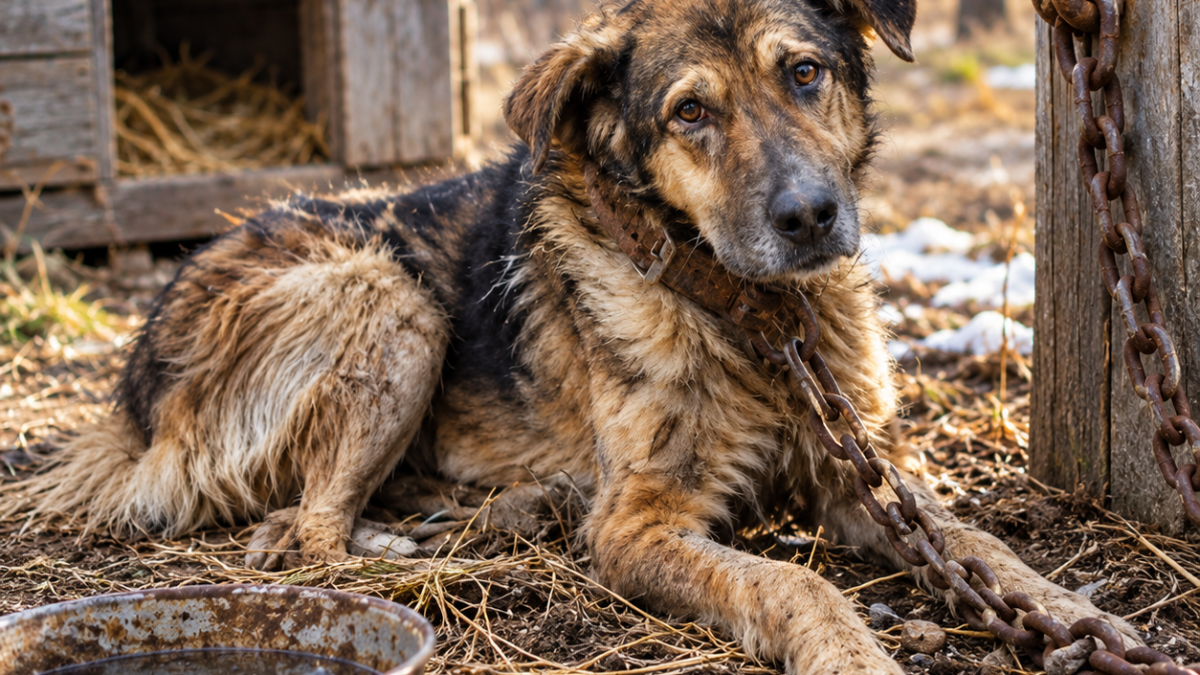
The chain around his neck weighed almost eleven pounds, while the dog himself barely weighed forty-four.
I thought that was the worst thing I would discover that day—until I knelt beside him and realized what frightened him even more than the weight he had been dragging.
What happened after I finally got him away from that concrete post would force me to make a decision I had never expected to face.
I found him on a cold afternoon while driving home along an old road at the edge of an almost abandoned settlement.
I wasn’t looking for a dog.
I wasn’t part of an animal rescue team.
I was simply trying to avoid traffic by taking a route I hadn’t used in years.
Most of the buildings along that road had been empty for a long time. Old workshops stood behind rusted gates. Weeds had swallowed driveways. A few houses remained occupied, but most of the area looked forgotten.
I was almost past a half-collapsed shed when I heard something.
Metal.
A faint scrape followed by a dull clink.
I slowed down.
At first, I assumed loose sheet metal was moving in the wind.
Then I heard it again.
Clink.
Pause.
Clink.
I pulled over.
The sound came from behind the shed.
I walked around the side, pushing through weeds almost as high as my knees.
That’s when I saw him.
A large dog was lying directly on the bare ground beside an old concrete post.
There was an empty bowl nearby.
A plastic bucket lay overturned several feet away.
No kennel.
No proper shelter.
No bedding.
Just the dog, the post, and a heavy chain stretched between them.
For several seconds, I honestly didn’t understand what I was seeing.
The dog looked much smaller than he probably should have because his body had become so thin.
His ribs were visible beneath his coat.
The fur along his sides was patchy and dull.
Mud had dried around his paws.
But what caught my attention most was the way he held himself.
His head stayed low.
His shoulders trembled whenever he tried to move.
“Hey, buddy.”
The dog jerked.
He immediately tried to crawl backward.
The chain tightened.
He stopped.
Not because he wanted to.
Because he had reached the end.
“It’s okay.”
I stepped back.
He watched me.
I had been around frightened stray dogs before.
Some bark.
Some growl.
Some show every tooth they have because fear tells them offense is safer than trust.
This dog did none of that.
He simply stared.
There was something in his expression I still have trouble describing.
It wasn’t aggression.
It wasn’t even panic.
It looked more like resignation.
As though experience had taught him that when a person approached, his opinion about what happened next didn’t matter.
I crouched several feet away.
“I’m not going to touch you.”
His ears flattened.
I placed my hand on the ground, palm up.
“You can stay right there.”
He didn’t move.
Then I noticed the chain properly.
It was far heavier than anything a dog that size should have been dragging.
Thick links.
Old rust.
A large metal lock.
Every time he shifted, he had to pull the entire length across the dirt.
I followed it with my eyes from the concrete post back toward his neck.
And my stomach turned.
The collar beneath the chain was buried under tangled fur.
The skin around it was badly irritated from constant pressure and friction.
Some areas were swollen.
Others had clearly been rubbed for a long time.
That explained the strange posture.
He wasn’t simply weak.
Every step meant dragging weight from a sensitive neck.
“How long have you been here?”
The dog obviously couldn’t answer.
I looked around again.
No fresh tire tracks.
No food.
No clean water.
No sign that anyone had visited recently.
I took out my phone.
The first person I called was a woman named Anna who volunteered with a local rescue group.
“You need to come,” I said.
“What did you find?”
“A dog.”
There was a pause.
“How bad?”
I looked at him.
“Bring bolt cutters.”
Her voice changed immediately.
“Send me your location.”
While I waited, I stayed where the dog could see me.
I didn’t approach again.
I simply talked.
About nothing.
The weather.
The road.
How stupid I had been to forget gloves.
Anything that kept my voice calm.
After about fifteen minutes, something changed.
The dog lifted his nose.
Then he moved one paw forward.
The chain scraped behind him.
He froze.
I stayed still.
Another paw.
Then another.
It took him almost a full minute to cover the few feet between us.
When he finally reached my hand, he didn’t lick it.
He didn’t wag his tail.
He simply rested his nose against my fingers.
The contact lasted maybe two seconds.
Then he pulled away.
But those two seconds changed everything.
I stopped thinking of him as a dog I had found.
I started thinking of him as someone I couldn’t leave.
Anna’s van appeared twenty minutes later with another volunteer and a crate full of supplies.
She walked around the shed, saw the dog, then stopped.
“Oh, Sergei.”
“I know.”
She crouched beside me.
“Has he tried to snap?”
“Not once.”
“Can you get close?”
“A little.”
She looked at the chain.
Then at the dog’s neck.
Her expression hardened.
“We’re not pulling that collar off here.”
“What do we do?”
“We cut the chain, support the weight, and get him straight to the clinic.”
I glanced toward the road.
“What if whoever owns him comes back?”
Anna looked at the empty bowl.
The overturned bucket.
The abandoned shed.
Then at the dog.
“If somebody comes back, they can explain this to the authorities.”
For the first time that afternoon, the dog shifted closer to me on his own.
I put my hand near his face.
He touched my fingers again.
And when Anna lifted the bolt cutters, I realized freeing him from the post might be the easiest part of what was about to happen.
PART 2
The sound of the bolt cutters closing around the first metal link made him panic.
He tried to move backward.
“Easy.”
I kept my voice low.
“Nobody’s hurting you.”
Anna stopped immediately.
“We need to support the chain.”
The other volunteer, Pavel, wrapped a thick towel beneath part of it so its full weight wouldn’t pull against the dog’s neck while they worked.
I stayed in front of him.
“Look at me.”
His eyes moved between my face and the tool.
“You’re okay.”
I wasn’t sure he believed me.
I wasn’t even sure I believed myself.
Every instinct in that dog seemed to tell him that humans carrying tools meant something unpleasant.
But he didn’t fight us.
He trembled.
He lowered himself to the ground.
And he waited.
Anna cut through one link.
The section attached to the post dropped into the dirt.
For the first time in however long he had been there, the dog was no longer physically connected to that concrete pillar.
Nobody celebrated.
Not yet.
Most of the chain was still attached to his collar.
And he was far too weak to simply walk away.
Pavel slowly slid a blanket underneath him.
The dog flinched when our hands moved near his ribs.
“Sorry, buddy.”
He looked at me.
“We have to lift you.”
It took all three of us.
Not because the dog was heavy.
He wasn’t.
Because the chain was.
The moment I picked up part of it, I understood why his legs had trembled so badly.
“This is ridiculous.”
Anna didn’t answer.
Her jaw tightened.
We carried him toward the van.
Halfway there, he made one attempt to stand.
His legs shook.
I lowered him carefully.
“Don’t.”
He looked up.
“You’ve done enough walking for today.”
Inside the van, we placed him on several blankets.
The chain was coiled beside him so its weight no longer pulled against his neck.
I climbed in.
Anna shut the door.
“You riding with him?”
“Yes.”
“Good.”
The clinic was thirty minutes away.
During the drive, I sat on the floor beside the dog.
He didn’t sleep.
He watched me continuously.
Every bump in the road made him tense.
Whenever the chain shifted, his ears went back.
So I held it.
For thirty minutes, I kept that rusted metal from touching him more than necessary.
And somewhere along the way, he put his chin on my shoe.
That was the first time he voluntarily rested against me.
I didn’t move until we arrived.
The veterinary staff were waiting.
Anna had called ahead.
A technician opened the van door.
Then stopped when she saw the chain.
“Is that all attached to him?”
“Yes.”
She looked at me.
“How heavy is it?”
“We haven’t weighed it.”
They wheeled out a stretcher.
The dog tried to stand again.
“Easy, big guy.”
He didn’t seem to understand why suddenly so many people were around him.
I stayed near his head.
The veterinarian, Dr. Volkov, examined him without removing the collar immediately.
That surprised me.
“Aren’t you taking it off?”
“I want him stabilized first.”
He checked the dog’s gums.
Heart rate.
Temperature.
Hydration.
Then he listened to his chest.
“He’s significantly dehydrated.”
“How bad?”
“Bad enough that we’re going slowly.”
“What about his neck?”
“We’ll clean it and remove everything once he’s calmer and we have pain control on board.”
I nodded.
“Can he recover?”
Dr. Volkov looked at the dog.
Then at me.
“I don’t know yet.”
I hated that answer.
But I respected it.
The dog was weighed first.
Twenty kilograms.
About forty-four pounds.
For a male dog with his frame, he should have weighed considerably more.
Then Pavel placed the removed section of chain on the clinic scale.
Four point eight kilograms.
Almost eleven pounds.
Nobody said anything for several seconds.
Anna stared at the number.
“That’s almost a quarter of his body weight.”
Dr. Volkov nodded.
“And he’s likely been dragging it continuously.”
I looked at the chain on the floor.
When it had been attached to the post, it seemed heavy.
On the scale, the number made it obscene.
How many times had he tried to reach water while pulling it?
How many times had he shifted during cold nights?
How many steps had his body paid for?
But Dr. Volkov was right.
The chain wasn’t the entire problem.
It was only the most visible one.
Blood tests showed anemia and severe nutritional deficiency.
His muscles had wasted significantly.
One front shoulder was inflamed from the unusual way he had compensated for the chain’s weight.
His paws were sore.
His skin needed treatment.
And the area beneath the collar required careful cleaning and monitoring.
But there was good news.
His heart was stable.
His kidneys were functioning.
There was no major fracture.
And despite everything, his lungs were clear.
“He’s stronger internally than he looks,” Dr. Volkov said.
“Is that good?”
“Very.”
“When can the collar come off?”
“Now.”
They gave him medication to keep him comfortable.
I stood beside his head while they carefully cut away the old collar.
It came off in pieces.
The dog closed his eyes.
For one terrible moment, I thought he had fainted.
Then he exhaled.
Long.
Slow.
His head lowered onto the blanket.
Dr. Volkov continued working.
Anna touched my arm.
“He’s okay.”
I realized I had been holding my breath.
“Yeah.”
When the last piece was removed, the dog lifted his head.
Nothing pulled it down.
No metal.
No collar pressure.
No heavy lock.
He moved his neck slightly to one side.
Then the other.
And for the first time since I had found him, he held his head up.
Not high.
Only a few inches.
But up.
I had to look away.
That evening, animal services sent an officer to the clinic.
Her name was Irina.
She photographed the chain.
The collar.
The veterinary report.
She asked where I found the dog.
I showed her the location.
“Did you see anyone on the property?”
“No.”
“Vehicles?”
“No.”
“Did the dog have identification?”
“Not that we found.”
She looked at Dr. Volkov.
“Microchip?”
He shook his head.
“Nothing.”
Irina wrote everything down.
“Technically, we need to establish ownership before we can determine whether this is abandonment or neglect.”
Anna folded her arms.
“Look at him.”
“I am.”
Irina’s voice remained calm.
“But if you want consequences that hold up later, we do this correctly.”
That sentence stayed with me.
I was angry.
Anna was angry.
Everyone who saw him was angry.
But anger wasn’t enough.
Evidence mattered.
Procedure mattered.
Because somewhere there might be a person who would eventually say none of this was their responsibility.
And if that happened, I wanted facts waiting.
The dog stayed at the clinic that night.
So did I.
Not officially.
The staff tried to send me home.
“You found him,” Anna said. “You don’t have to sleep in a veterinary hallway.”
“I’m not sleeping.”
“That is not the argument you think it is.”
I ignored her.
The clinic gave me a chair beside his kennel.
At first, the dog stayed pressed against the back wall.
Every time someone walked past, he opened his eyes.
At midnight, a technician brought food.
Soft.
Warm.
Strong-smelling.
He sniffed it.
Turned away.
“He’s too stressed,” she said.
“Can I try?”
She handed me the bowl.
I sat on the floor.
For several minutes, I did nothing.
Then I put a little food on my fingers.
“Come on.”
The dog watched.
“You don’t have to trust me. Just trust the chicken.”
One ear moved.
I held my hand closer.
He leaned forward.
Sniffed.
Then took the smallest piece.
I smiled.
“There you go.”
Another.
Then another.
After five minutes, he ate directly from the bowl.
Not much.
But enough for the technician to write something positive on his chart.
At two in the morning, I finally gave him a name.
Not because I owned him.
I didn’t.
Not yet.
But calling him “the dog” had started to feel wrong.
I looked at him through the kennel door.
“What about Atlas?”
His eyes opened.
“Too dramatic?”
Nothing.
“You were carrying half the world around your neck.”
He blinked.
“Atlas.”
His tail moved.
Barely.
I laughed softly.
“Fine. That’s your name until you object.”
The next morning, Irina called.
“We found someone who remembers the dog.”
I stood outside the clinic.
“Who?”
“An elderly man named Viktor lives two streets from the property. He says the dog has been there for at least a year.”
My stomach dropped.
“A year?”
“Possibly longer.”
“Who owns him?”
“We’re working on that.”
“Did Viktor ever report it?”
There was a pause.
“He says he believed someone came regularly.”
“Did they?”
“He isn’t sure.”
I closed my eyes.
A year.
That didn’t mean Atlas had been without food for a year.
He couldn’t have survived that.
Someone must have come occasionally.
But the thought that he might have been attached to that same post through seasons—summer heat, autumn rain, winter cold—made my chest tighten.
“What else did Viktor say?”
“The property used to belong to a small equipment-repair business. The owner kept a guard dog.”
“Atlas?”
“Likely.”
“Name?”
“I’m not giving you that yet.”
I understood why.
Barely.
“Fine.”
“Sergei.”
“Yes?”
“Do not go back there alone.”
“I wasn’t planning to.”
I was.
Now I wasn’t.
That afternoon, Atlas stood for the first time without the chain.
It lasted three seconds.
Maybe four.
His legs trembled.
I reached toward him.
Dr. Volkov stopped me.
“Let him decide.”
Atlas shifted one paw.
Then another.
The movement looked wrong.
His body had learned to brace against constant weight.
Without it, his balance seemed confused.
He took one step.
Then sat down abruptly.
I smiled.
“That’s okay.”
Atlas looked at me.
“One step is still one step.”
He tried again later.
Two steps.
By the third day, he could walk from one side of the treatment room to the other.
Slowly.
No chain scraping behind him.
No metallic clink.
The first time I heard his nails on the clinic floor, I realized how much I had begun to hate the sound of metal.
Atlas, however, seemed afraid of silence.
That took me longer to understand.
Whenever a metal bowl dropped somewhere in the clinic, he froze.
But he also became anxious when left alone in a quiet room.
He paced.
Whined.
Watched the door.
One night, the staff moved him to a quieter recovery space.
He stopped eating.
When they brought him back where he could hear people, he ate again.
“He doesn’t want isolation,” Dr. Volkov said.
I leaned against the wall.
“After being tied alone outside?”
“Maybe.”
It seemed backward.
But trauma often is.
You assume an animal who has suffered around people will want nothing to do with them.
Atlas wanted people.
He just didn’t know what they would do.
He watched hands.
Shoes.
Doors.
Tools.
He studied us constantly.
But once he decided someone was safe, he stayed near them.
On the fourth day, he fell asleep with his head on my foot.
On the fifth, he accepted a scratch beneath his chin.
On the sixth, his tail wagged when I entered.
That one nearly destroyed me.
“Did you see that?”
Anna looked up.
“See what?”
“He wagged.”
Atlas looked at me.
His tail moved again.
Anna smiled.
“Oh.”
“That’s twice.”
“Congratulations.”
“Don’t mock me.”
“I’m not.”
She crouched.
“That’s a very expensive tail wag.”
She wasn’t wrong.
By then, Atlas had fluids, medication, nutritional support, wound care, blood tests, imaging and round-the-clock monitoring.
The rescue group had opened a medical fund for him.
People donated.
Some gave five dollars.
Some ten.
One retired woman brought an envelope containing cash and said, “I don’t use the internet. Tell him this is for dinner.”
I put the envelope on the clinic counter and walked outside before anyone saw me cry.
Atlas stayed hospitalized nine days.
When Dr. Volkov finally said he could leave, I assumed he meant he would go to a rescue foster home.
Anna looked at me.
“No.”
I looked back.
“No what?”
“You’re taking him.”
“Why?”
“Because he trusts you.”
“I have never fostered a large dog.”
“You have a house.”
“I have a small house.”
“You have a yard.”
“A smaller yard.”
“You work from home three days a week.”
“How do you know that?”
“You complain about your meetings constantly.”
I stared at her.
Atlas was sitting beside us.
He looked between our faces.
“This feels manipulative.”
“It is.”
I looked at Atlas.
He leaned against my leg.
“Fine.”
Anna smiled.
“Congratulations.”
“I’m fostering.”
“Of course.”
“Temporarily.”
“Absolutely.”
“Stop smiling.”
The first night at my house was strange.
Atlas stood in the entryway for almost five minutes.
The front door was open behind him.
He could have walked back outside.
He didn’t.
He sniffed the floor.
Then the wall.
Then looked at me.
“Come on.”
I moved farther inside.
Atlas followed.
Three steps.
Stop.
Four more.
Stop.
When we reached the living room, he saw the dog bed I’d bought.
He walked around it.
Wouldn’t step on it.
I tried putting treats there.
Nothing.
I placed a blanket beside the bed.
Atlas lay on the floor.
“That’s not how this works.”
He closed his eyes.
I sat beside him.
“Fine.”
For the first week, Atlas refused every proper dog bed I offered.
He preferred the rug beside the front door.
That worried me.
Then I realized something.
At the abandoned property, his entire world had been defined by distance.
Post.
Chain.
A circle of reachable ground.
At my house, the front door represented something different.
An exit.
An entrance.
The place where I left.
The place where I returned.
Maybe he needed to understand that part first.
So I let him sleep there.
Every time I came home, I opened the door gently.
“Hey, Atlas.”
At first, he didn’t stand.
Then he started lifting his head.
Then sitting.
Then walking toward me.
Two weeks after he came home, I opened the door and Atlas wagged his tail so hard his entire back end moved.
I dropped my grocery bag.
Apples rolled across the floor.
“I guess we’re doing this now.”
Atlas sniffed an apple.
“You’re happy to see me?”
Tail wag.
“That is extremely inconvenient emotionally.”
He sneezed.
Our routine became simple.
Small meals four times a day.
Short walks.
Medication.
Gentle exercises.
Rest.
His body couldn’t tolerate long activity yet.
The first time we walked beyond the front gate, Atlas stopped.
The leash went tight.
I immediately loosened it.
He looked at the lead.
Then at me.
“Different.”
I held it lightly.
“This isn’t a chain.”
Atlas didn’t move.
I took one step backward.
“Your choice.”
He stared toward the road.
Then stepped forward.
We walked fifteen yards.
That was all.
The next day, twenty.
A week later, we reached the corner.
The first time Atlas saw another dog, he hid behind me.
A forty-four-pound shepherd mix tried to make himself invisible behind my legs.
The other dog was a tiny white spaniel.
Its owner looked confused.
“Is he scared?”
“Apparently of your terrifying monster.”
She laughed.
Atlas didn’t.
But by the end of the month, he could pass dogs calmly from a distance.
He gained weight.
Slowly.
Twenty-two kilograms.
Then twenty-four.
His coat began to change.
The dull patches filled in.
His shoulders strengthened.
His head stayed higher.
One afternoon, he did something I had never seen.
He ran.
Not far.
Maybe ten yards across my yard after a leaf.
But he ran.
His front legs stretched.
His ears lifted.
For two seconds, he looked like a dog who had never known a chain.
Then he stopped.
Turned.
Looked at me.
I was crying.
Atlas came over.
“You saw nothing.”
He licked my hand.
Meanwhile, Irina’s investigation continued.
The business property had belonged to a man named Leonid Markov.
He had operated a small machinery repair yard there.
Business declined.
The workshop closed.
According to neighbors, Atlas had originally been kept as a guard dog.
Not unusual by itself.
The problem was what happened afterward.
“When did the business close?” I asked Irina.
“About eight months ago.”
“And Atlas stayed?”
“That’s what we’re trying to establish.”
“Who fed him?”
“Apparently Markov or one of his employees came irregularly.”
“Irregularly.”
“That’s what witnesses say.”
I felt my jaw tighten.
“Why keep a dog at an empty property?”
Irina was quiet.
“Security.”
I laughed once.
Not because anything was funny.
“Security for what? Broken concrete?”
“I know.”
“Did he admit Atlas was his?”
“Not yet.”
“What does that mean?”
“It means he claims the dog belonged to a former employee.”
“Which employee?”
“He hasn’t provided a full name.”
“Convenient.”
“Sergei.”
“I know. Evidence.”
“Exactly.”
So we waited.
Then something unexpected happened.
A photo of Atlas appeared on the rescue group’s page.
It wasn’t sensational.
Anna had deliberately kept it simple.
Before and after.
One image from the clinic.
One of Atlas standing in my yard three weeks later.
The caption said only that a dog rescued from an abandoned site was recovering and thanked people who had helped with his medical care.
The post spread.
Not wildly.
But enough.
Two days later, Irina called.
“We have a problem.”
“What?”
“Markov saw the post.”
“So?”
“He says the dog is his.”
I stood up.
“Excuse me?”
“He has now changed his statement.”
“Yesterday Atlas belonged to an employee.”
“Apparently now he says there was confusion.”
I laughed.
Again, not because it was funny.
“What does he want?”
“The dog.”
“No.”
“Sergei—”
“No.”
“He doesn’t automatically get him.”
“Good.”
“But do not contact him.”
“I won’t.”
“He may contact the rescue.”
“He can contact the moon.”
“Sergei.”
“I’m listening.”
“Keep Atlas inside your secured property. No public location posts. If anyone appears at your home, call us.”
That changed the atmosphere immediately.
Until then, the investigation had felt distant.
Now the man connected to that chain knew Atlas was alive.
And wanted him.
Why?
I couldn’t understand it.
He had left him attached to a post at a property nobody used.
Now Atlas mattered?
Anna understood before I did.
“Control.”
We were sitting in my kitchen.
Atlas slept beneath the table.
“What?”
“Maybe he doesn’t care about the dog. He cares that people are questioning him.”
I looked down.
Atlas’s paws twitched in sleep.
“What happens if he proves ownership?”
Anna’s expression hardened.
“Ownership doesn’t erase neglect.”
Still, I was afraid.
I hated admitting that.
For the first time since I found Atlas, I understood that saving him wasn’t just about food and medicine.
There was paperwork.
Law.
Ownership.
Evidence.
People.
Things a dog couldn’t understand.
Atlas only knew he’d started sleeping inside.
He knew meals arrived on time.
He knew the leash didn’t hurt.
He knew I came back through the front door.
I couldn’t let human technicalities send him back to a concrete post.
The next morning, Irina called again.
“We found the employee.”
I almost dropped my coffee.
“What employee?”
“The one Markov claimed owned Atlas.”
“And?”
“He never owned him.”
I sat down.
“Are you sure?”
“He worked at the yard for six years. He remembers the dog. Says Markov bought him as a young dog to guard the property.”
“Will he give a statement?”
“Already did.”
I closed my eyes.
“Thank you.”
“Don’t thank me yet.”
“What now?”
“We still need to establish the full timeline.”
The former employee’s name was Anton.
I wasn’t supposed to contact him directly during the investigation.
But later, after authorities cleared it, he agreed to speak with me.
We met outside a café.
He looked uncomfortable.
“I should have done something.”
Those were his first words.
I didn’t know what to say.
He rubbed his hands together.
“When the shop was open, the dog wasn’t like that.”
“Atlas?”
“We called him Graf.”
I stopped.
“Graf?”
“Yes.”
I looked toward my car where Atlas was waiting safely with Anna.
“Was he always chained?”
“Mostly during work hours. At night sometimes he was loose inside the fenced yard.”
“What happened when the business closed?”
Anton stared at the table.
“Most workers left.”
“And Graf?”
“Stayed.”
“Why?”
“Markov said he’d move him later.”
“Did he?”
“You know he didn’t.”
I forced myself to breathe.
“Did anyone feed him?”
“For a while, yes. One of the mechanics lived nearby and brought food. Then he moved.”
“And Markov?”
Anton shrugged.
“He came sometimes.”
“Sometimes.”
“I’m not defending him.”
“I’m trying to understand.”
Anton looked miserable.
“Markov said a guard dog didn’t need much. Said the chain kept him where he belonged.”
I looked away.
“What did the chain look like then?”
“Heavy.”
“That heavy?”
“I don’t remember.”
That answer bothered him too.
“I should have reported it.”
“Why didn’t you?”
He stared at the coffee.
“Because everyone said someone else was handling it.”
There it was.
The sentence that explained too many tragedies.
Someone else.
Someone else fed him.
Someone else checked.
Someone else would report.
Someone else would care.
Until eventually nobody did.
“Did Markov ever say why he didn’t surrender Graf?”
Anton nodded.
“He said shelters ask questions.”
I looked at him.
“What kind of questions?”
Anton met my eyes.
“Exactly.”
His statement became important.
So did Viktor’s.
Another neighbor had photographs from months earlier showing Atlas at the same post.
A delivery driver remembered seeing him there after the workshop closed.
The evidence built slowly.
No single dramatic discovery.
Just facts stacking on top of one another until Markov’s story had less and less room to stand.
Meanwhile, Atlas kept healing.
At six weeks, he reached twenty-seven kilograms.
Dr. Volkov smiled when he stepped on the scale.
“Look at that.”
Atlas looked at the treat jar.
“He doesn’t care.”
“He should.”
“He cares about payment.”
Dr. Volkov handed him a biscuit.
Atlas took it delicately.
Then looked for another.
“See? Capitalist.”
Dr. Volkov laughed.
His neck had healed remarkably well.
There would always be a line where the fur grew differently.
A faint permanent reminder.
But the swelling was gone.
The irritated skin had healed.
He could turn his head normally.
His shoulder had improved.
His bloodwork was nearly normal.
“Medically,” Dr. Volkov said, “he’s becoming boring.”
“Best thing you’ve ever said.”
“Keep him boring.”
I tried.
Atlas had other plans.
The first toy I bought him was a red rubber ball.
He ignored it for two weeks.
Then one night while I was watching television, the ball rolled under my foot.
I looked down.
Atlas stood six feet away.
“What?”
He stared at the ball.
I kicked it lightly.
It rolled toward him.
Atlas jumped backward.
“Great start.”
He approached.
Sniffed.
Touched it with one paw.
The ball moved.
Atlas froze.
Then pounced.
I laughed so loudly he startled.
“Sorry.”
He grabbed the ball.
Ran three feet.
Dropped it.
Looked at me.
We repeated the game.
Ten minutes later, Atlas was exhausted.
He collapsed on the rug with the ball between his paws.
I took a picture.
Not for the rescue page.
For me.
Because sometimes recovery is measured by bloodwork.
Sometimes by body weight.
Sometimes by the moment a dog realizes an object can exist for no reason other than fun.
Two months after I found Atlas, the situation with Markov came to a head.
He went to the rescue office.
Anna called me immediately.
“Do not come here.”
I was already putting on my shoes.
“Why?”
“Because he is standing in reception demanding his dog.”
“Then I’m coming.”
“No.”
“Anna.”
“Authorities are on the way.”
That stopped me.
“Is he causing trouble?”
“He’s angry. Not violent.”
“What is he saying?”
“That we stole a valuable guard dog.”
I looked at Atlas.
He was asleep on his new orthopedic bed.
Valuable.
The word made me furious.
“Valuable?”
“Sergei.”
“He left him tied behind an abandoned shed.”
“I know.”
“And now he’s valuable?”
“I know.”
I paced.
“What does he want?”
“To take him.”
“No.”
“He isn’t taking him.”
“You promise?”
“I promise nothing. I tell you we are following the legal process.”
I hated that answer because it was the right one.
Irina arrived.
Markov was informed that Atlas was being held under protective authority pending the investigation.
He could not simply remove him.
He argued.
He produced an old purchase receipt for a young shepherd mix.
He showed photographs.
He established something he apparently thought would help him.
He had owned Atlas.
The same evidence that proved ownership also connected him directly to the dog.
Anna later told me she had almost laughed when she realized what he had done.
“He spent twenty minutes proving Atlas was his.”
I stared at her.
“After claiming he wasn’t?”
“Yes.”
“That seems unwise.”
“It was.”
“Did Irina say anything?”
“Very little.”
I could imagine her expression.
The case moved faster after that.
Markov’s attorney tried to frame the situation as an unfortunate misunderstanding.
The dog had been fed.
The chain was for security.
The business property was visited.
Atlas had shelter.
That final claim created another problem.
“What shelter?” I asked.
Irina showed me a photograph Markov submitted.
An old wooden doghouse stood near the concrete post.
“That wasn’t there.”
“We know.”
“When was this taken?”
“Three years ago.”
I stared.
“He calls that current shelter?”
“He’s showing that shelter existed.”
“It didn’t exist when I found him.”
“We documented the scene.”
I remembered the weeds.
The overturned bucket.
Bare earth.
No doghouse.
No roof.
Nothing.
The investigation team returned to the property.
Behind the collapsed shed, buried beneath vegetation and rotting boards, they found pieces of the old doghouse.
It had fallen apart long before Atlas was rescued.
The timeline could not be established to the exact day.
But the photograph did not prove what Markov hoped.
It showed the difference between what Atlas once had and what had been left.
Then came the chain.
I didn’t know the chain would matter as much as it did.
Dr. Volkov had documented its weight because he’d been shocked.
Four point eight kilograms.
Nearly twenty-four percent of Atlas’s rescue weight.
A veterinary orthopedic specialist reviewed the case.
Her report explained that forcing an underweight dog to repeatedly move while dragging that mass could significantly increase strain on the neck, shoulders and front limbs.
Atlas’s physical findings were consistent with prolonged abnormal loading.
No dramatic language.
No emotional accusation.
Just medicine.
Numbers.
Weight.
Muscle condition.
Inflammation.
Facts.
When I read the report, I remembered something Irina had said.
If you want consequences that hold up later, we do this correctly.
She had been right.
My anger could be dismissed as emotion.
The scale could not.
Markov’s attorney later argued that the chain was appropriate for a strong guard dog.
Then Dr. Volkov’s photographs of Atlas at forty-four pounds were submitted beside the chain on the scale.
That argument became harder to make.
The hearing was scheduled for early spring.
By then, Atlas had lived with me almost five months.
I still called it fostering.
Anna had stopped correcting me.
“Temporary dog doing well?” she asked one morning.
“Very.”
“Temporary dog sleeping on your couch?”
“He made an independent decision.”
“Temporary dog wearing the custom leather collar with his name engraved?”
“That was medically necessary.”
“For what disease?”
“Identification.”
She laughed.
“You’re hopeless.”
Maybe.
But there was one thing I still refused to do.
I hadn’t officially adopted Atlas.
Not because I didn’t want to.
Because legally, his status remained tied to the case.
I wouldn’t celebrate something that hadn’t been decided.
The night before the hearing, I slept badly.
Atlas seemed to notice.
At three in the morning, I went to the kitchen for water.
He followed.
“You should be sleeping.”
Atlas sat.
I opened the back door.
He went outside.
The yard was covered in a thin layer of snow.
Atlas walked into it.
Then stopped.
The porch light reflected off the white ground.
Five months earlier, I had found him unable to move without dragging metal.
Now he stood in my yard wearing a lightweight collar.
No chain.
No post.
I stepped outside.
Atlas turned.
Then did something ridiculous.
He shoved his nose into the snow.
Sneezed.
Started digging.
I laughed.
“Very dignified.”
He dug faster.
Snow flew everywhere.
I sat on the step.
“You know, tomorrow a bunch of people are going to argue about who you belong to.”
Atlas looked at me.
“Stupid, isn’t it?”
He came over.
Sat beside me.
I put my hand on his shoulder.
“I think you belong to yourself.”
His tail moved.
“But I hope they let you keep living here.”
Atlas leaned into me.
That was our legal strategy.
Apparently.
The hearing itself was quieter than I expected.
No theatrical shouting.
No sudden confession.
Mostly documents.
Statements.
Questions.
Markov attended with counsel.
I sat with Anna and Irina.
Atlas was not there.
I was grateful.
He didn’t need to be.
Markov looked toward me once.
I looked away.
The issue before the authority wasn’t simply whether Markov had once owned the dog.
He clearly had.
It was whether his conduct justified permanent removal and penalties under local animal-welfare provisions.
Viktor’s statement was reviewed.
Anton’s statement.
Photographs.
Veterinary records.
The chain.
The timeline.
Markov insisted he had intended to move Atlas.
He said people had been instructed to feed him.
He said the business closure had been chaotic.
He said he had not realized the dog had lost so much weight.
Then came the question that changed the room.
The official asked, “When did you last personally see the dog before he was removed?”
Markov hesitated.
“A few weeks.”
“How many?”
“I don’t remember.”
“Approximately?”
“Maybe six.”
Six weeks.
The room became very still.
His attorney spoke quietly to him.
The official continued.
“And during those six weeks, you believed someone else was responsible for his daily care?”
“Yes.”
“Who?”
Markov named a man.
That man had already provided a statement.
He had left the region three months earlier.
Irina didn’t smile.
But I saw her pen stop moving.
Markov had finally put a specific person inside his story.
And the dates did not fit.
The decision did not come that day.
That was almost unbearable.
I went home.
Atlas met me at the door with the red ball in his mouth.
I looked at him.
He dropped it.
“Seriously?”
Tail wag.
I threw the ball.
Atlas chased it.
Maybe dogs are smarter than we are.
Humans spend hours arguing about past events.
Atlas wanted the ball.
For three days, I checked my phone constantly.
On the fourth morning, Irina called.
I couldn’t answer immediately.
I stared at her name on the screen.
Then pressed accept.
“Hello?”
“The order came through.”
I sat down.
“And?”
“Permanent surrender.”
I closed my eyes.
“Say it again.”
“Markov will not regain custody of Atlas.”
My hand covered my mouth.
“There are also financial penalties and reimbursement requirements related to the dog’s care. Additional restrictions were imposed regarding future animal keeping.”
I didn’t hear everything after that.
One sentence kept repeating.
He will not regain custody of Atlas.
“Sergei?”
“I’m here.”
“You okay?”
“Yes.”
I wasn’t.
I was crying.
Atlas walked into the room.
He saw me sitting on the floor and immediately came over.
I put both arms around his neck.
He stiffened for half a second.
Then relaxed.
“You’re not going back.”
Atlas licked my chin.
“Never.”
That afternoon, Anna arrived with adoption paperwork.
I opened the door.
She held the folder up.
“No.”
She laughed.
“You haven’t even looked.”
“I know what that is.”
“Your temporary foster arrangement needs updating.”
“You’re enjoying this too much.”
She walked inside.
Atlas greeted her.
“Traitor.”
Anna sat at the kitchen table.
The form was simple.
Name.
Address.
Veterinary agreement.
Adoption conditions.
Dog’s name.
I wrote Atlas.
Anna pointed at the line.
“You know his old name was Graf.”
“I know.”
“Keeping Atlas?”
I looked down at him.
He had curled beneath my chair.
“Yes.”
“Why?”
I thought about the chain.
The post.
The first step.
The first tail wag.
The snow.
“Because Graf was the dog somebody left behind.”
Anna said nothing.
“Atlas is the dog who walked away.”
I signed.
That should have been the end.
It wasn’t.
Six weeks later, Markov appealed part of the decision.
Not custody.
That was no longer realistically in dispute.
He challenged some of the financial findings and restrictions.
I was angry at first.
Then Irina explained.
“People have a right to appeal.”
“I know.”
“Let the process work.”
“I know.”
“And stop reading comments.”
That was harder.
By then, Atlas’s story had become public.
The rescue group shared the legal outcome carefully.
No address.
No calls for harassment.
No inflammatory language.
Just facts.
A dog had been removed from an abandoned commercial property.
He had been underweight.
A chain weighing nearly five kilograms had been documented.
Veterinary care had been provided.
Ownership had been permanently transferred.
People reacted strongly.
Most were supportive.
Some weren’t.
A few wrote that “working dogs are different.”
Others argued that people were becoming too sensitive.
One comment said a real guard dog should be tough enough to handle a chain.
I stared at it.
Then deleted the app from my phone.
Atlas didn’t need strangers debating whether his suffering had been acceptable.
He needed dinner.
So I fed him.
That became one of the most important changes in me.
At first, I wanted everyone to understand.
I wanted outrage.
I wanted judgment.
I wanted the person responsible to feel exactly what I felt when I lifted that chain.
But Atlas didn’t care about any of that.
His revenge, if you want to call it that, was already happening.
The man who had once decided Atlas could spend his life within the radius of a chain lost the right to control where he lived.
Atlas now decided.
He decided which room to sleep in.
Which patch of sun to lie in.
Whether he wanted to play.
Whether he wanted affection.
Which direction we walked.
Those small choices were more powerful than anything I could have said to Markov.
Spring arrived.
Atlas discovered grass.
Not literally.
He had obviously seen grass before.
But my yard turned green, and one morning he walked outside after rain.
He stopped.
Sniffed.
Then rolled.
A seventy-pound dog rolled onto his back in wet grass and kicked all four legs into the air.
I stood on the porch.
“No.”
Atlas rolled harder.
“You just had a bath.”
He sneezed.
“Of course.”
When he stood, one side of his body was green.
I took a picture.
Anna replied immediately.
**Temporary foster looks terrible. Return him.**
I sent back:
**Absolutely. Please collect at 4 a.m.**
She responded with a laughing emoji.
Atlas’s weight stabilized around thirty-one kilograms.
About sixty-eight pounds.
Dr. Volkov said that was healthy for his frame.
The number fascinated me.
The chain had represented almost one quarter of his rescue weight.
At his healthy weight, it would still have been an absurd burden.
I kept thinking about what the chain had done to my understanding of suffering.
Before Atlas, I imagined neglect as absence.
No food.
No shelter.
No care.
But neglect could also be weight.
Something added.
Something an animal was forced to carry every second.
The chain wasn’t merely restraint.
It turned every ordinary movement into work.
Drink water.
Work.
Change position.
Work.
Stand.
Work.
Lie down.
Work.
Nothing had been free.
So I became obsessed with giving Atlas things that required nothing from him.
A bed.
No command.
A treat.
No trick.
A walk where he chose the pace.
A patch of grass where he could lie as long as he wanted.
Sometimes love looks like giving.
Sometimes it looks like removing the price.
The appeal eventually failed on the most significant findings.
Some financial details were adjusted.
The protective restrictions remained.
I didn’t celebrate.
Not publicly.
I was tired of Markov occupying any part of Atlas’s story.
The chain had already taken enough years.
I didn’t want the person attached to the other end taking the future too.
So we moved on.
Almost a year after the rescue, Anna asked whether I would bring Atlas to a shelter education day.
“No.”
She blinked.
“That was fast.”
“He doesn’t like crowds.”
“Fair.”
“I’ll come without him.”
So I did.
The event focused on responsible outdoor dog care.
Appropriate shelter.
Water.
Weight.
Collars.
Tethers.
Daily interaction.
People asked questions.
Some were defensive.
One man told me his farm dog had been tethered for years and was fine.
I didn’t argue.
I showed him a photograph.
Not the worst one.
Just Atlas standing beside the chain on the clinic scale.
“That’s what nearly five kilograms looked like on a twenty-kilogram dog.”
The man stared.
“I don’t use anything like that.”
“Good.”
That was all.
I had learned something from Irina.
If you want to change minds, facts often travel farther than fury.
After the presentation, a woman approached me.
She looked embarrassed.
“My neighbor has a dog tied behind his garage.”
My chest tightened.
“Does the dog have food and shelter?”
“I think so.”
“How heavy is the tether?”
“I don’t know.”
“Does somebody interact with him?”
“Rarely.”
I gave her the proper number to call for a welfare check.
Three weeks later, Anna told me the dog had been evaluated.
The situation wasn’t as severe as Atlas’s.
The owner cooperated.
Changes were required.
A proper enclosure was built.
The dog got regular exercise.
Nobody was charged.
Nobody needed to be.
A dog had a better life.
That mattered more.
Atlas’s story continued working quietly.
Another report.
Another welfare check.
A rescue volunteer told me she’d replaced heavy chains at two rural properties after owners agreed.
A veterinarian started displaying an educational poster showing safe collar fit and tethering risks.
None of it was dramatic.
But none of it would have happened if I had driven past the sound behind that shed.
That thought frightened me sometimes.
What if the radio had been louder?
What if I’d taken the normal road?
What if I’d assumed the metallic sound was wind?
There are questions you cannot answer without making yourself crazy.
So I stopped asking.
The fact was that I heard him.
I stopped.
That’s enough.
Two years after I found Atlas, we returned to the old settlement.
Not intentionally.
A road closure diverted traffic.
The moment I recognized the turn, my hands tightened on the steering wheel.
Atlas was in the back seat.
He loved car rides now.
His head was near the open window.
“Well.”
I could have turned around.
Instead, I drove slowly.
The old workshop was still there.
More collapsed now.
The weeds higher.
The concrete post visible behind the shed.
I stopped across the road.
Atlas stood.
His ears changed.
Not fear exactly.
Recognition.
Maybe smell.
Maybe landscape.
Maybe nothing.
I opened the car door.
Then stopped.
“No.”
I had no reason to make him go back.
This wasn’t a movie.
He didn’t need to confront his past.
He didn’t need to stand beside the post and symbolically defeat it.
Healing doesn’t require reenactment.
I closed the door.
Atlas looked at me.
“We’ve seen enough.”
I drove away.
In the mirror, the concrete post disappeared behind us.
Atlas lay down.
That was all.
I never took him there again.
At home, we walked to the river instead.
Atlas loved water but hated swimming.
He would step in until the water reached his ankles.
Then stop.
One summer afternoon, I threw his red ball too far.
It landed in shallow water.
Atlas stared.
“Go get it.”
He looked at me.
“It’s your ball.”
Nothing.
“You chased that thing across the house at three in the morning.”
Atlas sat.
I took off my shoes and retrieved it.
He wagged his tail.
“You trained me.”
He took the ball.
Walked away.
At the time, he had been with me a little over two years.
People who met him for the first time rarely guessed his history.
That was the greatest compliment.
His coat had become thick and glossy.
His shoulders were strong.
He walked with confidence.
He loved women immediately and took slightly longer with men.
He disliked metal clattering.
He still became nervous if a leash tightened unexpectedly.
But those things were details.
They were not his entire personality.
Atlas loved cheese.
He hated rain.
He slept upside down.
He barked at buses.
He believed the vacuum cleaner was a personal enemy.
He had one stuffed fox he carried everywhere.
He refused to fetch anything unless he felt like it.
He was not a “neglected dog.”
He was Atlas.
That distinction became important to me.
Rescue stories often freeze animals at their worst moment.
The photograph everyone remembers is the frightened one.
The thin one.
The kennel.
The injury.
The chain.
But if rescue works, that becomes the least current version of the animal.
I stopped showing Atlas’s first photograph unless there was a specific educational reason.
People didn’t need to stare at his worst day forever.
He had better days now.
I wanted those to count.
Then, one autumn afternoon, someone knocked on my door.
Atlas barked.
Normal.
I looked through the window.
A man stood at the gate.
I didn’t recognize him.
“Can I help you?”
He raised both hands slightly.
“I’m Anton.”
I opened the door but kept the gate closed.
The former employee.
We had met only once, at the café.
“I know.”
He looked toward Atlas.
Atlas stood behind me.
Anton stared.
“That’s him?”
“Yes.”
“My God.”
Atlas watched him.
No recognition that I could see.
Anton smiled sadly.
“He looks completely different.”
“He is.”
“I wanted to ask if I could see him.”
I hesitated.
Then opened the gate.
“Slowly.”
Anton entered.
He didn’t reach for Atlas.
Good.
He crouched sideways.
Atlas sniffed the air.
Then moved forward.
One step.
Another.
He smelled Anton’s hands.
His pants.
Shoes.
Then looked away.
Anton swallowed.
“He doesn’t remember me.”
“Maybe he does.”
Atlas walked back toward me.
Anton sat on the bench.
“I used to give him sausage when Markov wasn’t looking.”
I smiled despite myself.
“That sounds healthy.”
“He liked it.”
“He still would.”
We sat.
Anton looked at Atlas lying beside my feet.
“I think about him a lot.”
“Why?”
“Because I saw it becoming wrong.”
I didn’t answer.
“I kept telling myself it wasn’t my dog.”
There it was again.
Not my dog.
Someone else.
“Do you hate me?”
The question surprised me.
“No.”
“You should.”
“No.”
“Why?”
“Because that wouldn’t help Atlas.”
Anton stared at the ground.
“I could have called.”
“Yes.”
“I could have taken him.”
“Maybe.”
“I didn’t.”
“No.”
He nodded.
I wasn’t going to comfort him.
That wasn’t my job.
But I wasn’t going to punish him either.
Anton looked at Atlas.
“What do I do with that?”
“With what?”
“The guilt.”
I thought about it.
“Don’t waste it.”
He looked at me.
“If you ever see another animal and think someone else will handle it, remember him.”
Anton nodded slowly.
A month later, he started volunteering twice a month at Anna’s rescue.
I didn’t know until she told me.
“He’s surprisingly good with frightened dogs.”
I smiled.
“Good.”
“You’re not going to make a speech?”
“No.”
“Who are you?”
I looked at Atlas.
“Learning.”
Three years passed.
Atlas began aging.
Not dramatically.
A little gray around the muzzle.
Longer naps.
Slower mornings.
His front shoulder, the one that had once taken so much strain, developed arthritis earlier than expected.
Dr. Volkov wasn’t surprised.
“His body paid a price when he was young.”
I hated hearing that.
“Can we manage it?”
“Absolutely.”
So we did.
Medication when needed.
Joint support.
Shorter walks.
Swimming was suggested.
Atlas rejected that treatment plan on philosophical grounds.
We compromised with underwater treadmill therapy.
The first time he entered the rehabilitation tank, he looked at me with betrayal.
“I know.”
The treadmill started.
Atlas walked.
Water supported his weight.
He took careful steps.
After ten minutes, the therapist gave him cheese.
Atlas reconsidered his objections.
By the third appointment, he entered voluntarily.
“Traitor,” I said.
The therapist laughed.
“He likes me.”
“He likes dairy products.”
Atlas’s mobility improved.
He never became athletic.
He didn’t need to.
We had a routine.
Morning walk.
Breakfast.
Nap.
My work.
Afternoon yard.
Evening walk.
Red ball.
Dinner.
Sleep.
I had once thought dramatic rescue was the important part.
It wasn’t.
The important part was the thousands of ordinary days afterward.
The fact that Atlas could predict breakfast.
The fact that I could leave for two hours and he knew I would return.
The fact that if rain started, he walked to the door because he expected to be let inside.
Expectations are a kind of trust.
Atlas eventually had hundreds of them.
That was healing.
Five years after I found him, the rescue group asked permission to display the chain at an educational exhibit.
It had been released from evidence storage after the case finally closed completely.
Anna called.
“What do you think?”
I was quiet.
“Why?”
“We’re doing an exhibit about long-term tethering.”
I pictured the rusted links.
“Do you still have it?”
“Yes.”
“I thought someone threw it away.”
“No.”
I didn’t know how I felt.
Part of me hated that the object still existed.
Part of me wanted people to see it.
“Use it.”
At the event, the chain sat inside a clear display case.
Beside it was a simple card.
**Weight: 4.8 kg / 10.6 lb**
**Dog’s rescue weight: 20 kg / 44 lb**
No dramatic caption.
No accusation.
The numbers were enough.
A boy around twelve stood staring at it.
“That was on one dog?”
“Yes.”
“All the time?”
“For a long time.”
He looked horrified.
“Why?”
I had no good answer.
“Someone made a bad decision.”
The boy looked at the healthy photo of Atlas beside the case.
“Is that the same dog?”
“Yes.”
“He got big.”
“He got healthy.”
“Where is he?”
“At home.”
The boy smiled.
“Good.”
Good.
Such a small word.
It was exactly right.
Near the end of the event, an older man approached.
He didn’t look at me.
He looked only at the chain.
“I used one like that when I was young.”
I waited.
“Farm dog.”
Still I said nothing.
“We didn’t think about the weight.”
He touched the glass.
“We thought heavy meant secure.”
I nodded.
“People learn.”
He looked at Atlas’s photograph.
“I wish we’d learned sooner.”
So did I.
That evening, I came home.
Atlas was asleep on the couch.
He had become an elderly dog without my permission.
His muzzle was white.
One ear no longer stood as straight as the other.
He heard the door and lifted his head.
His tail moved.
“Hey.”
He stood slowly.
Walked toward me.
I knelt.
“You know your chain is famous?”
Atlas sniffed my jacket.
“People stared at it all day.”
He pushed his forehead against me.
“Nobody cared about my presentation.”
Tail wag.
“Rude.”
I wrapped my arms around him.
The chain was still heavy.
It would always be heavy.
But Atlas no longer carried it.
That distinction became the ending I wanted for his story.
Not that what happened disappeared.
It didn’t.
His shoulder remembered.
His nervous system remembered.
I remembered.
Somebody else probably remembered too.
But memory is not the same as captivity.
Years after being freed, Atlas could hear metal fall in the kitchen and startle.
Then look at me.
Then relax.
The sound no longer decided what happened next.
That mattered.
One winter, Atlas became seriously ill.
He was nearly eleven by then.
He stopped eating.
Not all food.
Just his regular food.
Cheese remained acceptable.
I took him to Dr. Volkov.
Blood tests showed an infection that required treatment.
For three days, Atlas was miserable.
He slept.
Drank little.
Moved slowly.
I panicked more than I admitted.
On the fourth morning, I woke because something hit my bedroom door.
Thump.
I opened my eyes.
Another thump.
I walked into the hallway.
The red ball rolled toward me.
Atlas stood at the other end.
I stared.
“No.”
Tail wag.
“You haven’t eaten breakfast.”
He nudged the ball.
“Blackmail?”
Another nudge.
I threw it gently.
Atlas walked after it.
Not ran.
Walked.
Picked it up.
Brought it halfway back.
Dropped it.
I sat on the floor laughing and crying.
“Fine.”
He recovered.
Not because of the ball.
Because of medicine.
Rest.
Care.
But the ball told me he was himself again.
His final years were quieter.
We stopped attending events.
We stopped long drives.
The river became too far.
Our world shrank.
But unlike the circle around that concrete post, this smaller world wasn’t a prison.
It was comfort.
The yard.
The kitchen.
The couch.
The front porch.
A short path through the trees.
My car for veterinary visits.
Anna’s house sometimes.
Atlas chose within it.
That was the difference.
When he was twelve, he developed worsening arthritis.
I installed a ramp.
He refused it.
Used the stairs.
Slipped once.
I blocked the stairs.
He stared at me.
“We’re using the ramp.”
Atlas stood still.
“Don’t argue.”
Still.
I put cheese halfway up.
Atlas used the ramp.
“Corruption works.”
Anna later visited.
“You’re bribing a senior citizen.”
“He has constitutional rights.”
Atlas accepted another piece.
As he aged, I began thinking more often about the day I found him.
Not because I wanted to.
Because time was making the beginning and end feel closer together.
I had found a dog who looked as though the world had already finished with him.
Then he gave me years.
Not borrowed years.
Not bonus years.
His years.
Full ones.
Muddy ones.
Annoying ones.
Expensive ones.
Beautiful ones.
One spring morning, I found Atlas sitting beside the front gate.
He wasn’t asking to go out.
He was simply looking down the road.
I sat beside him.
“Waiting for somebody?”
His ears moved.
I thought about the early days when he slept beside my front door.
Back then, I had assumed he was waiting for the people who left him.
Maybe he was.
Maybe he was simply keeping an escape route nearby.
I would never know.
Now he looked peaceful.
A bicycle passed.
Atlas watched.
A child waved.
I waved back.
“Do you remember that post?”
Atlas looked at me.
“Probably not the way I do.”
He rested his chin on my knee.
“Good.”
I meant it.
I wanted the past to belong more to me than to him.
Let me carry that.
He had carried enough.
The day I knew we were nearing the end came quietly.
Atlas was thirteen.
He stopped wanting the morning walk.
Not once.
Three days in a row.
He still ate.
Still drank.
Still wanted me nearby.
But getting up had become difficult.
Dr. Volkov examined him.
His arthritis had progressed significantly.
There were other age-related changes.
Nothing catastrophic by itself.
Together, they were telling us something.
“We can adjust medication again,” Dr. Volkov said.
“Will that fix it?”
“No.”
The honesty hurt.
“Will it help?”
“Probably.”
“For how long?”
“I don’t know.”
Atlas lay between us.
Dr. Volkov scratched his ear.
“He still has interest.”
I knew what he meant.
Quality of life.
Good days.
Bad days.
We adjusted medication.
Atlas improved.
For three months, he had more good days.
He went into the yard.
Played with the red ball once or twice.
Demanded cheese.
Barked at a delivery van.
Normal.
Then winter came.
Cold made everything harder.
I covered the floors with rugs.
Moved his bed closer to the heater.
Helped him stand.
One night, snow began falling.
Atlas woke.
Walked to the back door.
I opened it.
He stepped outside.
Slowly.
Snow gathered on his back.
“Don’t go far.”
He walked into the yard.
Stopped beneath the light.
Then pushed his nose into the snow.
I laughed.
Years earlier, he’d done the same thing.
“Still dignified.”
Atlas sneezed.
His tail moved.
I sat on the porch.
He came back and lowered himself beside me.
For a long time, we watched snow fall.
I thought about the concrete post.
A winter there.
No warm floor.
No heater.
No hand on his back.
I hated the image.
So I replaced it.
This.
This was winter now.
My porch.
My hand.
Atlas breathing beside me.
Home.
A week later, he stopped eating.
Even cheese.
That was when I knew.
We went to the clinic.
Dr. Volkov had known Atlas almost as long as I had.
He examined him gently.
Tests showed his body was failing in several ways.
There were treatment options.
But none offered a return to the life Atlas enjoyed.
I sat on the floor.
Atlas put his head in my lap.
“I don’t know how to do this.”
Dr. Volkov sat across from me.
“Yes, you do.”
I looked at him.
“I don’t.”
“You’ve been making decisions for his comfort since the day you found him.”
“That was different.”
“Not really.”
I hated him for being right.
The first decision had been obvious.
Cut the chain.
The last decision was harder because nothing visible held Atlas anymore.
Only time.
I called Anna.
She arrived within twenty minutes.
Atlas wagged when he saw her.
Barely.
She knelt.
“Hey, big man.”
He touched his nose to her hand.
Anna cried.
I had seen her handle hundreds of difficult cases.
She rarely cried in front of me.
That made it real.
“He’s tired,” she whispered.
“I know.”
“You’re staying?”
“Of course.”
Dr. Volkov arranged everything quietly.
No rush.
No strangers crowding around.
I fed Atlas one last tiny piece of cheese.
He ate it.
Of course.
I laughed through tears.
“Fraud.”
His eyes closed briefly.
I put the red ball beside him.
Not because he needed it.
Because I did.
I held his head in my lap.
Anna rested a hand on his back.
Dr. Volkov explained every step.
I heard almost none of it.
I looked at Atlas.
“You know what I remember?”
His eyes moved toward me.
“The first time you touched my hand.”
I rubbed the side of his face.
“You thought I was going to leave.”
My voice broke.
“I didn’t.”
Atlas exhaled.
“I told you that, didn’t I?”
He rested deeper into my lap.
“And I’m not leaving now.”
That mattered.
Years earlier, Atlas had been tied somewhere people stopped coming.
On his final day, nobody left.
We stayed.
When his breathing became quiet, my hand was on him.
When it stopped, my hand was still there.
No chain.
No post.
No empty bowl.
No abandoned shed.
Just people who loved him.
That was the ending he deserved.
Afterward, I sat in the clinic room for a long time.
Anna didn’t rush me.
Dr. Volkov didn’t either.
Eventually, I stood.
The red ball remained beside Atlas.
I picked it up.
Then stopped.
“No.”
I put it back.
It belonged with him.
At home, the silence was unbearable.
I opened the door.
No tail.
No footsteps.
No old dog slowly walking down the hallway.
His bed was still beside the heater.
His water bowl half full.
I sat on the floor.
For the first time since the day I found him, I heard nothing.
No metal.
No breathing.
No nails.
Nothing.
I cried until there was nothing elegant left about grief.
Two days later, Anna came over carrying a small box.
“I don’t want anything.”
“I know.”
She sat beside me.
Inside was Atlas’s collar.
The lightweight one.
His name engraved on the tag.
I ran my thumb across the letters.
ATLAS.
Not Graf.
Not guard dog.
Not evidence.
Atlas.
“There’s something else,” Anna said.
She handed me an envelope.
Inside was a photograph from one of the rescue events.
The display case.
The heavy chain.
Beside it, a large photograph of Atlas lying in green grass.
On the back, someone had written:
**He carried this once. Then he spent the rest of his life carrying nothing he didn’t choose.**
I couldn’t speak.
Anna looked at me.
“One of the volunteers wrote it.”
I put the photograph against my chest.
“That’s the story.”
“What?”
“That’s it.”
For years, people had asked me what happened to the person who owned Atlas.
They wanted consequences.
The fine.
The restrictions.
The failed appeal.
They wanted revenge.
I understood why.
But by the end of Atlas’s life, those details felt small.
The greatest consequence was that Markov lost the authority to decide what Atlas’s life would be.
The greatest revenge was every ordinary day that followed.
Every meal eaten indoors.
Every walk without metal.
Every afternoon in the grass.
Every stupid argument about the ramp.
Every piece of cheese.
Every visitor Atlas learned to trust.
Every time I left and came back.
The chain weighed almost a quarter of his body when I found him.
But eventually, it weighed nothing.
Not because the metal changed.
Because Atlas no longer carried it.
A few months after he died, I returned to the rescue center.
I had avoided it.
Too many memories.
Anna handed me a leash.
“What is this?”
“Walk him.”
At the end was a nervous young dog.
Black coat.
White chest.
Maybe ten months old.
He kept his body low.
“I don’t want another dog.”
“I didn’t ask you to adopt him.”
“You are extremely untrustworthy.”
“Walk.”
So I did.
The young dog pulled at first.
Then stopped.
Looked at me.
I loosened the leash.
“Your choice.”
The words came out automatically.
I froze.
Years earlier, I’d said the same thing to Atlas.
The dog stepped forward.
One step.
Then another.
I smiled.
“Okay.”
We walked around the property.
When we returned, I handed the leash back.
Anna said nothing.
Good.
I wasn’t ready.
But I came back the following week.
Then again.
I began volunteering.
Mostly with fearful dogs.
Anna said I had patience.
I told her Atlas had trained me.
Months later, a man called the rescue.
He had found a dog tied behind an empty building.
Not nearly as bad as Atlas.
But alone.
Heavy tether.
Little shelter.
He had heard metal while walking past.
The sentence stopped me.
Heard metal.
I went with the rescue team.
We found the dog.
We documented everything.
Contacted authorities.
Followed procedure.
No dramatic confrontation.
No reckless action.
The owner cooperated after being located.
The dog was surrendered.
Medical treatment began.
At the clinic, the frightened dog refused food.
I sat on the floor.
Put a little chicken on my fingers.
“Come on.”
The dog watched me.
“You don’t have to trust me.”
I smiled through the ache in my chest.
“Just trust the chicken.”
The dog leaned forward.
Took one piece.
Then another.
Anna stood in the doorway.
She didn’t say anything.
She didn’t have to.
Atlas was gone.
But the things he taught me were still moving through the world.
A dog got help because I knew what to listen for.
A volunteer knew how to hold a heavy tether so it didn’t pull against an injured neck.
A clinic knew to weigh the chain.
A neighbor knew not to assume someone else would handle it.
Anton still volunteered.
Irina later told me welfare reports from that area had increased because people had become more aware.
Not all were violations.
That was fine.
The point was that people looked.
They asked.
They stopped.
Atlas never knew any of this.
Dogs don’t need legacies.
Humans do.
We need to believe suffering can produce something beyond pain.
I don’t think Atlas suffered so others could learn.
I would never romanticize that.
He should never have been tied there.
He should never have needed rescue.
But once it happened, I could choose what I did with the memory.
I could carry it like his chain.
Or I could turn it into something lighter.
Years later, I still have Atlas’s collar.
It hangs beside my front door.
Not the heavy chain.
That belongs to the rescue’s educational collection now.
His collar.
Lightweight.
Blue.
His name scratched from years of wear.
Sometimes people ask why I keep it there.
I tell them because doors mattered to Atlas.
For part of his life, he couldn’t reach one.
Then, for years, he waited beside mine.
Eventually, he learned that doors didn’t always mean abandonment.
Sometimes someone walked through them and came back.
Sometimes they opened into a yard.
Sometimes into a clinic where people helped.
Sometimes into a home.
And sometimes, if you’re lucky, you hear a faint metallic sound behind an abandoned shed, open the wrong door into somebody else’s story, and walk out carrying a responsibility you never expected.
I still think about the first question I asked him.
“How long have you been here?”
I never learned the exact answer.
Maybe that’s for the best.
What matters more is the question I can answer.
How long was he free?
Years.
Beautiful years.
Enough time to gain weight.
Enough to learn toys.
Enough to roll in grass.
Enough to hate rain.
Enough to become old.
Enough to make a front door mean home.
The chain weighed almost five kilograms.
That number was once the headline of Atlas’s life.
It isn’t anymore.
If someone asked me now what the most important number was, I wouldn’t say five kilograms.
Or twenty kilograms.
Or the amount of the fine.
I’d say thirteen.
Approximately thirteen years old when Atlas finally left this world.
An old dog.
That was the miracle.
Not a dog reduced to the condition in which I found him.
An old dog who had lived long enough to become gray.
Long enough to develop opinions.
Long enough to need a ramp.
Long enough to annoy me.
Long enough to be deeply, completely loved.
Markov once thought Atlas’s purpose was to stand at a post and guard an empty property.
He was wrong.
Atlas’s life was bigger than the circle that chain allowed him to walk.
Much bigger.
He walked streets.
Parks.
River paths.
Veterinary hallways.
My kitchen.
My bedroom.
Snow.
Grass.
He walked wherever his legs and curiosity took him.
And on the days his legs couldn’t take him very far, I walked beside him slowly.
That was his real victory.
Nobody ever attached another heavy chain to him.
Nobody ever decided that his discomfort mattered less than convenience.
Nobody ever left him wondering whether someone would return.
His last years belonged entirely to him.
And if there was one thing I wish I could tell the frightened dog lying behind that ruined shed, it would not be that justice was coming.
It would not be that the person responsible would face consequences.
It would not even be that the chain would soon be cut.
I would tell him something far simpler.
One day, you will hear a door open and you won’t be afraid.
You will know the person on the other side.
You will stand up.
Your tail will move.
And you will understand that you are home.
That is how I remember Atlas now.
Not beneath the concrete post.
Not beside the empty bowl.
Not carrying nearly eleven pounds of rusted metal.
I remember him standing inside my front door with a red ball in his mouth, waiting for me to come home.
The chain was part of his story.
It was never the measure of his life.
And in the end, the heaviest thing Atlas carried was not metal at all.
It was my heart.
He carried that with him effortlessly.

