PART 2: Someone Sealed Her and Four Newborn Kittens in a Box—She Escaped, Then Refused to Leave Them
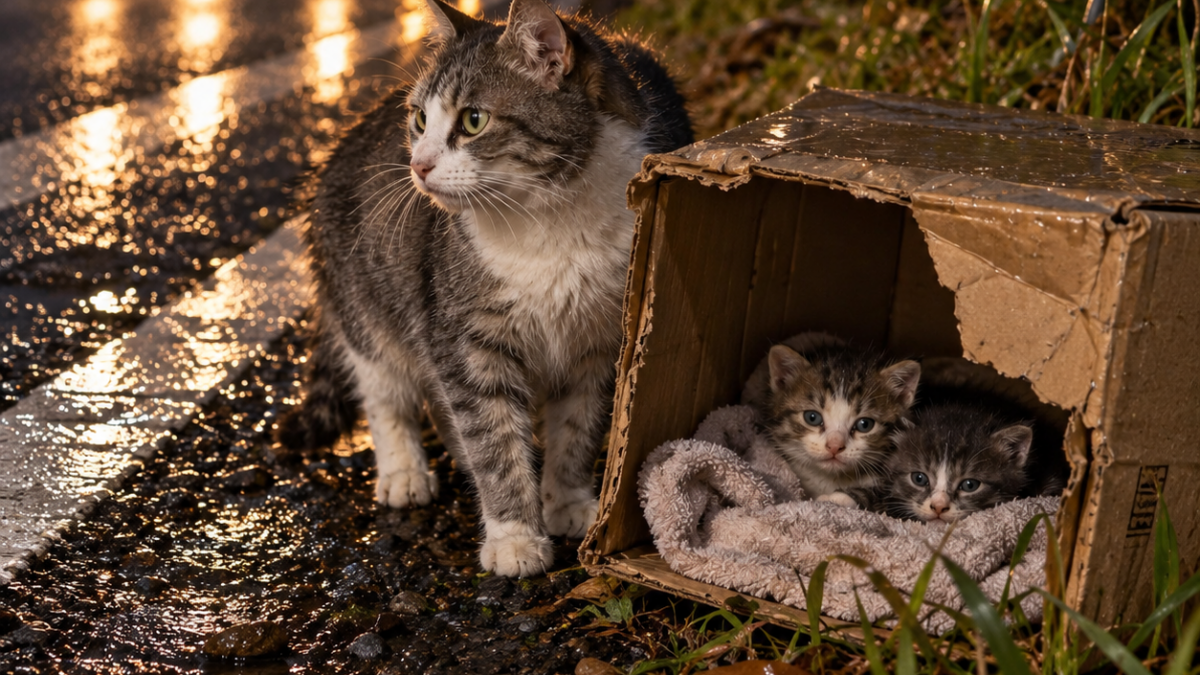
I almost drove away from the torn cardboard box on the shoulder because, at 5:40 in the morning, it looked like nothing more than somebody else’s trash.
Then my headlights caught the eyes of a tiny cat sitting perfectly still beside it, and something about the way she refused to move made me shut off the engine.
What I found when I walked closer would make that freezing November morning impossible for me to forget.
It was late November 2023, and I was running a long-distance route through rural western Pennsylvania.
The temperature on my dashboard read twenty-six degrees.
The county highway was nearly empty.
No businesses.
No houses close to the road.
Just black fields, bare trees, patches of frost, and the white beam of my headlights stretching into darkness.
I had been driving for hours when the steering wheel began giving me that faint vibration every truck driver learns not to ignore.
Probably nothing.
Still, when you’re responsible for that much weight moving at highway speed, “probably” is not good enough.
I eased the rig onto the shoulder.
Hazards on.
Parking brake.
I climbed down and started checking the tires.
That was when my headlights swept across the cardboard box.
Medium-sized shipping carton.
Half sitting on gravel.
Half in dead grass.
One side torn open.
I looked at it once.
Then away.
Roadside trash was not unusual.
People left all kinds of things where they should not.
I finished checking one tire and started walking back toward the cab.
Then something reflected in the headlights.
Two eyes.
Low to the ground.
I stopped.
A cat was sitting beside the box.
She was small.
Brown, black, white—calico markings, though I could not see them clearly from that distance.
She was pressed against the damaged side of the carton.
Not wandering.
Not searching for food.
Not trying to hide.
Just sitting there in the freezing darkness.
Watching me.
“Hey.”
The cat did not move.
That bothered me.
Most outdoor cats would have disappeared the second a six-foot man in work boots walked toward them.
I took out my phone and switched on the flashlight.
“Easy.”
Still nothing.
I moved closer.
Then I saw the tape.
The box had not simply fallen from somebody’s trash.
Heavy packing tape had been wrapped around it several times.
Across the top.
Around the sides.
Tight.
Deliberate.
One side had been torn apart.
From the inside.
The opening was maybe five inches across.
The cardboard around it was shredded into fibers.
Scratch marks covered the edges.
I crouched.
The little cat shifted slightly but did not leave.
That was when I noticed her front paws.
Something had happened to them.
She was holding one oddly.
There were rough places around her claws, and bits of packing tape were still caught in the fur near her neck.
My stomach dropped.
“What were you doing in there?”
Then I heard it.
A sound from inside the box.
So faint I almost thought it was the wind.
I pointed my flashlight through the opening.
And everything in me went cold.
Four tiny kittens were lying together on top of a crumpled grocery bag.
Their eyes were closed.
They were so small they barely looked real.
One moved.
Then another.
Alive.
I stared at the hole.
Then at the mother.
Then back at the kittens.
The opening was big enough for her.
Not for them.
She had gotten herself out.
She could have run.
There was nothing physically keeping her beside that road anymore.
But she had stayed.
I looked down the empty highway.
No houses.
No people.
Cars occasionally moving through the darkness at fifty or sixty miles an hour.
Then back at the cat.
She pressed her body against the open side of the box, blocking part of the cold wind from reaching the kittens inside.
I stopped thinking about my schedule.
Stopped thinking about the delivery window.
Stopped thinking about anything except getting five animals off that shoulder.
“All right, Mama.”
She watched me.
“You stayed.”
I reached carefully for the box.
She did not run.
When I lifted it, she stood immediately.
Not trying to escape.
Following.
That was when I understood.
Wherever those kittens went, she was going too.
And before sunrise on a road where nobody should ever have left them, a mother cat who had already fought her way out of one box made sure I understood the only rule that mattered.
I was not taking her babies without her.
PART 2
I carried the box toward my truck as carefully as I could.
Every step felt too rough.
The kittens were so small that even the vibration of my boots against the gravel made me nervous.
I had no idea how old they were.
A week?
Two?
I knew almost nothing about newborn kittens except that they were fragile and that four of them should not have been sitting beside a county road in twenty-six-degree weather.
The mother followed right beside my legs.
That surprised me.
She had every reason to fear people.
Yet she stayed so close I nearly stepped on her once.
“Careful.”
She looked up.
I opened the passenger-side door and climbed up with the box.
The cab suddenly felt enormous.
Warm air from the heater was still blowing.
I placed the carton on the passenger floor where it would be stable.
The kittens shifted against one another.
One made a tiny squeak.
The mother immediately climbed onto the step.
I reached down.
For half a second, I expected teeth or claws.
Nothing.
She let me place both hands around her.
She weighed almost nothing.
That was the second shock.
Under the winter coat of fur, there was hardly any body.
I could feel the bones along her back.
She was exhausted.
But when I lifted her, something happened that has stayed with me more clearly than almost anything else about that morning.
She relaxed.
Not collapsed.
Not went limp from weakness.
Relaxed.
Her muscles stopped fighting the world for a few seconds.
Her head rested against my wrist.
I remember thinking:
She knows.
Maybe that sounds sentimental.
Maybe she was simply cold and responding to warmth.
But whatever the explanation, the change was immediate.
Outside, she had been guarding.
Inside my arms, she stopped.
“You’re okay.”
I placed her inside beside the box.
She climbed straight through the torn opening.
Her kittens began moving toward her.
I shut the truck door.
Then I just sat there.
Hands on the steering wheel.
Hazards flashing outside.
Five cats in my passenger area.
A delivery schedule disappearing by the second.
“What now?”
The mother had no opinion she cared to share.
I grabbed my phone.
The signal was weak but usable.
I searched for the nearest emergency veterinary clinic.
Fourteen miles.
Open twenty-four hours.
I called.
A sleepy but professional voice answered.
“Emergency veterinary service. What’s happening?”
“I found a cat.”
Pause.
“And four newborn kittens.”
Another pause.
“In a box beside the road.”
The voice became more alert.
“How cold are they?”
“I don’t know.”
“Are the kittens responsive?”
“They’re moving.”
“Mother with them?”
“Yes.”
“Bring all of them. Keep the vehicle warm, not hot. Don’t separate the kittens from Mom unless necessary.”
“I won’t.”
“Drive safely.”
I almost laughed.
Five minutes earlier, I had been checking a tire.
Now someone was reminding me not to separate a mother cat from four kittens I had not known existed.
I called dispatch next.
That conversation was shorter.
“I’m going to be delayed.”
“How delayed?”
“I found animals on the shoulder.”
Silence.
“What kind of animals?”
“A cat and four newborn kittens.”
Longer silence.
“You’re serious.”
“Yes.”
Another pause.
“Go.”
That was it.
No argument.
I ended the call.
Then looked toward the box.
“Apparently you’re my route now.”
The mother was curled around the kittens.
I pulled back onto the highway.
For fourteen miles, I drove slower than I had driven all morning.
Every bump felt personal.
The sun had not risen yet.
The sky was beginning to turn gray behind the hills.
I kept glancing toward the passenger floor.
“You all still there?”
A faint squeak.
“Good.”
I talked because the silence made me nervous.
I told them about the weather.
My route.
The fact that my wife was going to have questions.
Mostly I talked to the mother.
“You know you’re supposed to run away when strangers pick you up, right?”
Nothing.
“You have terrible survival instincts.”
Then I looked at the torn hole.
“No.”
I corrected myself.
“Actually, I take that back.”
Her survival instincts were clearly doing just fine.
The emergency clinic sat near a small town intersection beside a pharmacy and a closed diner.
I pulled the rig into the far side of the parking lot.
The veterinary staff was waiting by the door with towels.
Two technicians came out.
One took the box.
The other reached for the mother.
She immediately twisted toward the kittens.
“Together,” I said.
“She won’t leave them.”
The technician nodded.
“We’ll keep them close.”
The mother settled only when she could see and smell the box.
Inside the clinic, bright lights made everything look harsher.
The torn cardboard.
The tape.
Her paws.
I could finally see what she had done to free herself.
The claws on both front feet had been badly damaged.
Some were split.
A couple had injuries serious enough that the veterinarian later decided they could not be saved normally.
Her paw pads were scraped and irritated from working against cardboard and tape.
The skin around her mouth was tender.
There were small cuts along her gums from biting at the adhesive.
A strip of tape was tangled through the fur around her neck.
I had to look away for a moment.
Not because the injuries were the worst thing I had ever seen.
They were not.
Because I suddenly understood the amount of time and effort behind them.
She had not scratched at that box twice.
She had kept going.
Again.
Again.
Again.
Until cardboard gave way.
A veterinarian named Dr. Harper came into the examination room.
“Truck driver?”
“That’s me.”
“Tell me exactly where you found them.”
I gave him the road, the approximate mile marker, and the time.
“Box already open?”
“One side.”
“From the inside?”
“Looks that way.”
He looked at the mother.
“It definitely looks that way.”
He gently examined her paws.
She pulled back once.
Then looked toward the box.
The kittens were being assessed less than three feet away.
Their eyes were closed.
One technician weighed them individually.
Another warmed towels.
“How old?”
I asked.
“Approximately nine days.”
“Nine?”
“Give or take.”
I stared.
Nine days.
They had not even seen the world yet.
Not literally.
Their eyes were still closed.
Dr. Harper checked the mother again.
“She is significantly underweight.”
“How much?”
“Five-point-two pounds.”
“Is that bad?”
“For an adult nursing mother of her frame, it’s too low.”
He continued the examination.
“She also has a respiratory infection.”
“From last night?”
“Probably not. More likely she’s been living outdoors for a while.”
That made sense.
Her coat.
Her weight.
Her caution.
This had not started with the box.
The box had simply been the worst chapter we knew about.
“How are the kittens?”
A technician looked over.
“Cold, but surprisingly stable.”
“Stable?”
“They’re responsive.”
One of the tiny kittens made another sound.
I exhaled.
Dr. Harper asked:
“Do you know how long the box may have been there?”
“No.”
“We may be able to estimate from temperature exposure, condition, and what you’re describing, but it won’t be exact.”
Later, they told me they believed she could have been outside beside the box for somewhere around three to five hours.
Maybe more.
Maybe less.
We would never know.
What I did know was that someone had sealed that carton before I found it.
The tape had not blown there.
The mother had not accidentally climbed into a moving box and wrapped it shut.
But I tried not to let anger become the center of the room.
The cats needed care.
Not my imagination about whoever had left them.
Dr. Harper showed me the mother’s front paw.
“Two claws are too badly damaged.”
“What does that mean?”
“We may need to remove the damaged portions under appropriate sedation so they can heal cleanly.”
“Will she walk normally?”
“Likely, yes.”
“Claws grow back?”
“Most should. Those two may remain shorter or altered.”
I looked at her.
She was staring toward the kittens.
“She doesn’t care about her feet.”
Dr. Harper smiled sadly.
“No. She seems more interested in them.”
The kittens were warm enough now to begin nursing.
The mother lay on her side.
All four found her.
For the first time since sunrise, the room became quiet.
I sat in a plastic chair.
My jacket still on.
Work boots dirty.
Delivery paperwork folded in my pocket.
I should have been hours down the road.
Instead, I watched four nine-day-old kittens eat.
Dr. Harper came back with a clipboard.
“We need to discuss ownership and surrender.”
I stared at him.
“Ownership?”
“Right now they’re found animals. There are local procedures and reporting requirements. The clinic will coordinate with rescue and animal services.”
“Okay.”
“Are you willing to leave them in our care while that’s handled?”
“Obviously.”
He nodded.
“Do you want to be contacted about outcome?”
That question caught me.
Of course I did.
But wanting updates was different from taking responsibility.
I had a job that kept me away from home.
My wife and I had no cats.
No nursery room.
No litter boxes.
No idea how to care for a nursing mother and four newborns.
I said:
“Yes.”
Then after a second:
“Definitely.”
He wrote my information.
I walked outside.
The sky had finally brightened.
Snow-colored clouds covered the horizon.
My truck sat alone in the far corner of the parking lot.
I climbed into the cab.
The passenger side looked strange without the box.
For the first time since finding them, I had nothing to do.
That was when I called my wife.
She answered on the third ring.
“You okay?”
“Yes.”
“You’re calling early.”
“I found something.”
“What?”
I looked through the windshield at the veterinary clinic.
Then I said the four words she still teases me about.
“We have five cats.”
Silence.
I waited.
“Five?”
“One mother. Four kittens.”
Another silence.
“Where?”
“Emergency clinic.”
“What happened?”
I gave her the shortest version possible.
Roadside.
Sealed box.
Mother tore out.
Kittens inside.
Cold.
Injured paws.
Alive.
My wife listened without interrupting.
Then she asked:
“What happens to them?”
“I don’t know yet.”
“Can they come here?”
I stared at the steering wheel.
“You understand what four kittens means?”
“Yes.”
“And a mother?”
“Yes.”
“And I drive for a living.”
“Yes.”
“We have never owned a cat.”
“I know.”
I waited for the sensible objection.
Instead she said:
“Bring them home.”
That was it.
No dramatic speech.
No debate.
Bring them home.
I laughed.
“What?”
“You heard me.”
“I told the vet I don’t know what happens yet.”
“Then find out.”
“You are making this sound easy.”
“It isn’t easy.”
Pause.
“But that mother stayed on the side of the road for those kittens.”
I looked back toward the clinic.
My wife continued:
“We can at least find out what they need.”
That was how our life changed.
Not because I was heroic.
Not because my wife had always dreamed of five cats.
We simply looked at what had happened and could not imagine being the next people to separate that family.
There were procedures first.
The animals had to be documented as found.
Local authorities were notified.
The rescue network became involved.
There was no identification found on the mother.
No microchip connecting her to an owner.
No legitimate claimant came forward during the required process.
The clinic stabilized her.
She received treatment for the respiratory infection.
Her paws were cleaned and bandaged.
Two badly damaged claws required minor surgical treatment so the tissue could heal properly.
The kittens stayed with her.
That mattered.
Dr. Harper was adamant.
“She is feeding them well.”
“Even this thin?”
“We’re supporting her nutritionally.”
“Will she have enough?”
“We’ll monitor.”
My wife and I visited.
The first time she met the mother, she sat on the floor beside the enclosure.
The cat watched her.
“Hi, Mama.”
I leaned against the wall.
“We need a name.”
My wife looked at me.
“We need five names.”
“That feels irresponsible.”
“You started it.”
“I stopped for a tire.”
“And came back with dependents.”
The mother lifted her head.
One kitten was sleeping half under her front leg.
My wife lowered her hand.
No reaching.
Just available.
The mother sniffed.
Then returned to her babies.
My wife smiled.
“She’ll come around.”
“What do we call her?”
We went through twenty terrible names.
Roadie.
Boxer.
Penn.
November.
Truck Stop.
My wife rejected all of mine.
“You cannot name a mother cat Freightliner.”
“It has presence.”
“It has a diesel engine.”
Eventually we chose **Maggie**.
Not symbolic.
Not dramatic.
She just looked like a Maggie.
Her four kittens became **Milo, June, Pepper, and Scout**.
The names were ours, not part of any official record before then.
Putting names on the intake sheet felt unexpectedly serious.
They had gone from “mother and four neonatal kittens” to five individuals.
Maggie.
Milo.
June.
Pepper.
Scout.
I wrote each carefully.
My wife noticed.
“You’re smiling.”
“No.”
“You are.”
“I don’t smile.”
She laughed.
Maggie remained at the clinic and affiliated foster facility until her paws were safe enough and the kittens stable enough for us to manage at home.
That gave us time.
Not much.
We cat-proofed a spare bedroom.
I had no idea cat-proofing existed at that level.
Cords secured.
Closet closed.
Small spaces blocked.
Low litter box for Maggie.
Washable bedding.
Food station.
Water.
Heating appropriate for the kittens.
A large open nesting area because the veterinarian warned us not to use anything Maggie might perceive as trapping.
That turned out to matter more than we knew.
The first cardboard carrier we placed in the room?
Maggie avoided it.
A covered cat cave?
She would not enter.
A box with one side fully removed?
She approached, sniffed, then backed away.
Open bed?
Fine.
Blanket in the middle of the floor?
Perfect.
Anything with a roof or narrow entrance made her uneasy.
We stopped testing.
Her preference was clear.
Open.
Always open.
The day they came home, I carried the large carrier inside.
It had ventilation on every side and opened completely at the front.
My wife had already opened the spare-room door.
We placed the carrier down.
Opened it.
Maggie did not rush out.
She stayed beside the kittens.
I sat several feet away.
“You can leave whenever you want.”
My wife glanced at me.
“She doesn’t understand English.”
“I know.”
“Then why are you explaining?”
“For me.”
Maggie sniffed the doorway.
One paw forward.
Then back.
A minute.
Two.
Then she stepped out.
She walked three feet.
Stopped.
Turned.
Went straight back to the kittens.
I felt my chest tighten.
“She checked.”
My wife nodded.
Maggie came out again.
This time five feet.
Then back.
Over the first hour, her radius expanded.
Bed.
Food.
Water.
Doorway.
Back to kittens.
Window.
Back to kittens.
She mapped the room the way someone maps emergency exits.
Always knowing where her babies were.
For the first week, we kept the household quiet.
I was home between routes more than usual because my dispatcher, who had somehow become invested in the story, adjusted one stretch of my schedule.
“You owe me,” he said.
“I found four future dispatchers.”
“Then you owe me more.”
My wife handled the hours I was away.
Maggie’s medication schedule went onto the refrigerator.
Her feeding schedule too.
Nursing mothers eat astonishing amounts.
The first time I filled her bowl, she finished it so quickly I thought I had measured wrong.
“She ate all that?”
My wife looked at me.
“She fed four kittens while weighing barely five pounds.”
I refilled part of it per the veterinary plan.
Maggie ate again.
For the first several days, she watched our hands.
Not with aggression.
Attention.
If we changed blankets, she observed.
If we picked up a kitten for a brief weight check, she came close.
Not attacking.
Supervising.
“Management,” my wife called her.
I agreed.
Every kitten was weighed daily.
Milo gained.
June gained.
Pepper gained.
Scout gained a little less one day.
I panicked.
My wife said:
“The vet told us normal variation exists.”
“He’s tiny.”
“They’re all tiny.”
“Maybe we should call.”
“We called yesterday.”
“We can call again.”
“We are becoming those people.”
“We have nine-day-old kittens.”
“They are older than nine days now.”
“Still tiny.”
We called.
Scout was fine.
By the third week, the kittens’ eyes were open.
That changed everything.
Suddenly the warm pile of sleeping potatoes had opinions.
Milo wanted to climb.
June wanted to follow Maggie.
Pepper bit everyone’s ears.
Scout seemed to spend half his life attempting to walk in directions his body could not yet support.
My wife sat on the floor laughing.
“This is a disaster.”
Pepper rolled onto his back.
Milo stepped on him.
June squeaked.
Scout fell sideways.
Maggie closed her eyes as though pretending she had no children.
I looked at her.
“I understand.”
She looked exhausted.
But not the same exhausted.
On the roadside, her exhaustion had been survival.
At home, she was tired because four growing kittens treated her like a combination cafeteria, heating system, transportation network, and pillow.
There was a difference.
A good difference.
Her paws healed slowly.
The bandages came off.
Most claws began growing normally.
Two remained shorter.
You could see the difference if you looked closely.
I looked closely too often.
Sometimes I would watch her kneading a blanket and remember the torn cardboard fibers.
I had kept the box.
That surprises people.
I went back to the clinic after they finished documenting it.
The staff asked whether I wanted it discarded.
“No.”
The veterinarian looked at me.
“You want the box?”
“Yes.”
“Why?”
I did not have a good answer.
Evidence, maybe.
Not legal evidence.
Personal evidence.
The story sounded exaggerated even while living it.
Someone wrapped tape around a box.
A mother cat tore through the side.
Stayed beside four newborns.
A truck driver stopped.
All survived.
It had the shape of something people would embellish online.
The box did not embellish anything.
The torn side was real.
Tape still hung from one edge.
Scratch marks around the opening.
Compressed cardboard.
The shape of effort.
I put it on a high shelf in the garage.
My wife hated it at first.
“That thing is filthy.”
“It has been cleaned enough to store.”
“It is still an ugly cardboard box.”
“I know.”
“Why keep it?”
I looked at the hole.
“Because I want to remember what she did.”
My wife became quiet.
The box stayed.
Maggie wanted nothing to do with cardboard containers.
That became almost comical.
Amazon package on the floor?
Most cats would climb in.
Maggie walked around it.
Open storage bin?
No.
Cat tunnel?
Absolutely not.
Even a paper grocery bag made her cautious.
We did not force it.
People love to talk about helping animals “get over” fear.
I began thinking differently.
Why did Maggie need to get over enclosed spaces?
Our house had open beds.
Open rooms.
Open doors.
She did not have a career requiring box tolerance.
The only necessary confinement was safe transportation for veterinary care, and even that we approached patiently with a carrier that opened wide and was never used for anything punitive.
Otherwise?
She could hate boxes forever.
Healing does not mean becoming comfortable with everything that once frightened you.
Sometimes it means having enough control to avoid what you do not need.
I liked that.
By the time the kittens were five weeks old, the spare room could no longer contain the chaos.
We expanded access.
Supervised at first.
Maggie came out before the kittens.
Hallway.
Living room.
Kitchen.
Every doorway made her pause.
Open door.
Clear exit.
Then she walked through.
The kittens followed with none of her caution.
They had never known a sealed box.
That difference hit me.
Milo saw a cardboard shipping carton one afternoon and jumped straight inside.
I froze.
My wife noticed.
“What?”
I pointed.
Milo’s orange tail stuck out of the box.
Maggie stood six feet away watching.
She did not approach.
Milo rolled around inside.
Pepper joined him.
My chest tightened.
“Should we move it?”
My wife thought.
“Are they in danger?”
“No.”
“Is Maggie distressed?”
I watched.
She was alert but not panicking.
“No.”
“Then let them choose.”
The kittens played.
Maggie left the room.
I followed with my eyes.
It occurred to me that her babies did not inherit her fear.
They got to experience a box as a toy.
That was enormous.
The same object category that had once meant danger to Maggie meant play to her children.
If there was any justice in her story, that was part of it.
Trauma did not become family tradition.
The kittens grew without learning the road.
Without learning cold.
Without learning what packing tape meant.
They learned food bowls.
Laundry baskets.
Shoelaces.
Sunlight.
The sound of my truck pulling into the driveway.
That sound became important.
I was gone for two nights on my first longer route after the family settled.
My wife sent pictures constantly.
Maggie on the couch.
Kittens asleep.
Milo climbing curtains.
Pepper inside my work boot.
When I returned, I opened the front door.
Four kittens came running badly.
Not graceful running.
A chaotic stampede of oversized paws and tails.
Maggie walked behind them.
She stopped.
Looked at me.
I crouched.
“Hi, Mama.”
For months afterward, I would argue this point with my wife.
I say Maggie smiled.
My wife says cats do not smile the way humans do.
Fine.
Maggie softened.
Her eyes narrowed.
Her body relaxed.
Then she walked directly toward me.
She rubbed her face against my knee.
Once.
Then continued past.
I stared.
My wife laughed.
“That’s all you get.”
“I was gone two days.”
“She has standards.”
The kittens climbed my boots.
I sat on the floor.
Within thirty seconds, I had four kittens on or near me.
Maggie sat six feet away.
Supervising.
Home.
That word began arriving in my mind more often.
Not “the cats.”
Family.
We had originally told ourselves we would keep Maggie and foster the kittens until adoption age.
That was the practical plan.
Four kittens could easily find homes.
We had connections through the rescue.
Applications would come.
We could choose carefully.
Then Scout developed a habit of sleeping on my shoulder.
Pepper followed my wife everywhere.
June slept with Maggie.
Milo learned to wait for me near the garage door.
The plan became weaker.
One evening, my wife sat at the kitchen table with adoption paperwork.
“We need to be rational.”
“Yes.”
“We cannot make decisions because kittens are cute.”
“Agreed.”
Pepper was asleep inside her sweatshirt hood.
I looked at him.
My wife ignored that.
“We should consider cost.”
“Yes.”
“Food.”
“Yes.”
“Veterinary care.”
“Yes.”
“Travel.”
“Yes.”
“Five cats is a lot.”
I nodded.
Milo ran across the room carrying one of my socks.
My wife continued.
“If we keep all five, this is a long-term commitment.”
“Yes.”
June climbed onto the chair beside her.
Scout appeared beneath the table.
Maggie sat in the doorway.
My wife looked around.
I looked at her.
She sighed.
“We have five cats.”
I smiled.
“You said that already.”
“No. You said it in the parking lot.”
“And you said bring them home.”
“That was temporary.”
“Sure.”
She laughed.
“Do you want to keep them?”
I looked at Maggie.
Then the kittens.
“Yes.”
“So do I.”
That was it.
No big family meeting.
No heroic declaration.
Five cats became permanent.
The rescue handled the adoption paperwork and follow-up care appropriately.
Maggie was spayed once medically ready and after the kittens were weaned.
The kittens eventually received their own veterinary care, vaccinations, and later sterilization at the proper ages.
We learned more about cats in one year than I had learned in my entire life.
Litter box mathematics.
Food storage.
Cat-proof trash cans.
Why five water bowls somehow become one preferred water bowl.
How four kittens can collectively make a house sound as though furniture is being thrown from the roof.
How an adult cat can sleep through all of it.
Maggie transformed.
That may be the only word.
At 5.2 pounds, she had looked almost delicate enough to disappear.
Over the following months, she gained weight.
Six pounds.
Then seven.
Eventually around eight, which the veterinarian considered healthy for her frame.
Her coat changed too.
Glossy.
Full.
Her face became rounder.
The constant tension in her body eased.
The respiratory infection cleared.
The damaged paws healed.
Most claws grew back.
Two remained noticeably shorter.
Nobody else would have cared.
I noticed every time she stretched.
My wife once found me staring at Maggie’s paw.
“What are you doing?”
“Nothing.”
“You’re doing the thing.”
“What thing?”
“The box thing.”
I knew what she meant.
Remembering.
I sat back.
Maggie was asleep on the couch.
Paws loose.
Claws partly extended in sleep.
“You know what the vet said.”
“I know.”
“She isn’t thinking about that roadside every time she looks at her feet.”
“I know.”
“You don’t have to either.”
That was harder.
Humans carry stories longer than animals sometimes.
At least we carry them differently.
Maggie lived in the present with impressive commitment.
Breakfast.
Sunbeam.
Kittens.
Nap.
Dinner.
Our bed.
Her life did not revolve around what happened at 3:00 in the morning on some November road.
Mine threatened to.
So I learned from her.
Remember without living there.
The kittens reached adolescence.
Chaos entered a new phase.
Milo discovered countertops.
June discovered cabinets.
Pepper discovered toilet paper.
Scout discovered that running full speed through the hallway at 2:00 a.m. was spiritually necessary.
Maggie stopped nursing.
Then began behaving less like a mother and more like a cat with four terrible roommates.
If they climbed on her, she moved.
If they stole food, she objected.
If they chased her tail, she corrected them.
I loved watching that shift.
For weeks after rescue, Maggie had given everything.
Food from her body.
Heat.
Attention.
Protection.
Now her kittens were safe enough for her to have boundaries.
She did not need to sacrifice constantly.
That was healing too.
Motherhood did not have to be endless self-denial.
One day I found Maggie sleeping alone in the guest bedroom.
All four kittens were in the living room.
My wife said:
“She’s on vacation.”
I laughed.
Maggie stretched.
Did not come downstairs for two hours.
Good.
She had earned the right to be unavailable.
By spring, the cats had full run of the house.
Every room was open except where safety required otherwise.
That open-door detail mattered.
Maggie often sat at thresholds.
She seemed to like being able to see more than one direction.
If a door was partly closed, she sometimes pushed it open with her nose.
We learned.
Unless there was a reason to close something, doors stayed open.
My wife once said:
“She runs an open-door policy.”
I laughed.
But it was true.
Enclosed spaces remained one of the only obvious traces of that night.
The kittens?
Opposite.
Milo loved boxes.
Pepper crawled into grocery bags if we did not remove them first.
Scout slept in the laundry hamper.
June once squeezed herself into a cardboard drink carton so small that we had to help her back out.
Maggie would watch from a distance.
Sometimes she left.
Sometimes she stayed.
Eventually, she could be in the same room with open boxes without concern.
She simply chose not to enter them.
That was enough.
A few months after the rescue, the story reached more people.
Someone at the clinic had shared a carefully anonymized version with permission.
No names.
No identifying details about me.
I had asked for that.
I did not want to become “the truck driver who rescued five cats.”
I still had routes.
Bills.
A life.
I had simply stopped.
That was all.
Reporters reached out through the rescue.
I declined.
One local station asked for an interview.
No.
A social media page wanted a photograph beside the truck.
No.
My wife asked why I was so resistant.
“I didn’t do much.”
“You stopped.”
“Anybody should stop.”
“But not everybody does.”
“That doesn’t make me special.”
She nodded.
“Okay.”
I pointed toward Maggie.
“She did the hard part.”
That was how I felt.
I had driven fourteen miles.
Maggie had worked against a sealed box until her paws were damaged.
Then she had stayed.
The comparison embarrassed me whenever people called me heroic.
So I kept my name out of it.
The cats were enough.
My favorite part came later.
The clinic sent us a photograph they had taken the morning of rescue.
I had not seen it.
Maggie was on the exam table.
Paws bandaged.
Four kittens against her.
She looked exhausted.
Then my wife took a new photograph six months later.
Same cat.
Healthy.
Sitting in our kitchen.
Four nearly grown kittens surrounding her.
The difference was so dramatic that at first I did not like looking at the old one.
Then I placed both side by side.
Not for social media.
For us.
Before.
After.
Except “after” was misleading.
Life does not have one after.
There were thousands.
Maggie asleep on our bed.
Maggie yelling at the vacuum.
Maggie refusing a new brand of food.
Maggie sitting in an open doorway.
Maggie chasing Scout away from her favorite blanket.
Maggie gaining weight.
Maggie losing the worried expression I had first seen in the headlights.
Those were the real afters.
The revenge in Maggie’s story, if you want to call it that, was not me finding whoever sealed the box.
I never did.
There was no dramatic confrontation.
No courtroom.
No person publicly punished in our story.
And eventually I realized I did not need one for the ending to feel complete.
The strongest answer to what happened on that roadside was the life that followed.
Someone had closed a box around her.
Maggie spent the rest of her life in a house full of open doors.
Someone had made the world small enough to fit inside taped cardboard.
Maggie’s world became an entire home.
Someone had left four kittens where they depended on one exhausted mother for everything.
Those kittens grew up never wondering whether food would appear.
Someone had treated five lives as disposable.
We built our schedule around them.
That was enough.
Cold lost.
Fear lost.
The sealed box lost.
Every morning Maggie walked freely from room to room, the story moved farther away from that roadside.
I started understanding that justice sometimes looks less like punishment and more like permanence.
Maggie was staying.
The kittens were staying.
Nobody was throwing anything away.
That mattered.
The box remained on the garage shelf.
My friends thought it was strange.
One asked:
“Why do you keep that?”
I gave the usual answer.
“People don’t believe me.”
He laughed.
“I believe you.”
“You haven’t seen it.”
I pulled it down.
The tape still wrapped around sections.
The hole opened through one side.
The edges looked soft and chewed apart.
Claw lines everywhere.
My friend stopped smiling.
“Jesus.”
I set it on the workbench.
“Yeah.”
He leaned closer but did not touch.
“She did that?”
“Yes.”
“From inside?”
“Yes.”
“And then stayed?”
I nodded.
He looked toward the house.
Maggie was sitting behind the glass door watching us.
My friend became quiet.
That was usually what happened.
The box ended arguments.
Not because it proved every detail of timing or intention.
We could never know exactly what happened before I arrived.
But it proved effort.
It showed a small animal had made that opening from inside.
And we knew where she was when I found her.
Beside it.
Not gone.
That was enough.
My wife eventually placed a label on the shelf beneath the box.
I came home from a route and saw it.
**MAGGIE’S EXIT**
I laughed.
“What is this?”
“Organization.”
“We need a label?”
“You keep everything else labeled.”
“That is different.”
She smiled.
I left it.
Maggie’s exit.
Maybe that was better than calling it the box.
Focus on the hole.
Not the walls.
The way out.
Years passed.
The kittens stopped being kittens.
Milo became the largest.
Of course.
The one I once worried I might crush accidentally by breathing too hard became a fourteen-pound orange-and-white menace who stole the warmest spot on the couch.
June remained closest to Maggie.
Pepper became my wife’s shadow.
Scout became mine.
Whenever I returned from long routes, Scout was usually first at the door.
Milo second if he suspected food.
Pepper appeared when my wife did.
June sometimes stayed with Maggie, then came later.
Five cats sounded overwhelming at first.
Eventually, five cats was simply the number of cats in our house.
You adapt.
Buy food in larger quantities.
Own multiple litter boxes.
Vacuum more.
Accept fur as a building material.
Learn which veterinarian receptionist prefers which cat.
Life normalizes the impossible surprisingly quickly.
Sometimes new acquaintances would visit and ask:
“You have five?”
“Yes.”
“All from the same litter?”
“Four.”
I would point.
“That’s Mom.”
Then somebody inevitably asked:
“How did you get five cats?”
My wife would look at me.
I would say:
“It was a tire.”
They would look confused.
Then we told the story.
I learned to tell it without making the injuries the center.
I used to describe Maggie’s paws first.
Then I stopped.
The important part was not what happened to her claws.
The important part was what she chose after she got out.
She stayed.
That was the story.
Everything else supported it.
I also stopped saying she “could have saved herself.”
That phrase began bothering me.
Maggie did save herself.
Escaping the box was self-preservation.
Staying for her kittens did not cancel that.
She did both.
She got herself out.
Then remained connected to the lives still depending on her.
Strength does not require abandoning yourself for others.
Maggie survived too.
That mattered.
People love mothers for sacrifice.
Sometimes so much that we forget mothers also deserve lives.
I wanted Maggie’s story to include what she received afterward.
She was not only the cat who suffered for four kittens.
She was the cat who later gained weight.
Stole pillows.
Ignored expensive beds.
Refused cardboard boxes.
Demanded breakfast.
Slept alone when she wanted.
Played occasionally.
Grew older.
Was loved for being Maggie, not only for being a mother.
That was essential.
One winter, several years after I found them, we had an unusually cold night.
The weather app showed temperatures close to what they had been that November morning.
I stood in the kitchen.
Maggie was lying beside the heating vent.
All four grown kittens scattered through the house.
The memory came back hard.
Headlights.
Road shoulder.
Box.
Tiny eyes.
I walked toward Maggie.
Sat on the floor.
She looked at me.
“You remember?”
Obviously, she did not answer.
I placed my hand near her.
She leaned her cheek against it.
My wife walked in.
“You okay?”
“Yes.”
She looked outside.
Then at Maggie.
“Oh.”
She understood.
I said:
“Twenty-six degrees.”
My wife sat beside me.
Maggie got up and walked away because apparently we were crowding her.
We laughed.
Good.
She was allowed to walk away from us.
That might have been the simplest symbol of all.
On the roadside, leaving the box meant leaving her babies.
At home, she could leave any room and know they were safe.
Choice.
The word became important.
Healing often looks like restored choice.
Maggie could choose where to sleep.
Where to eat.
Which room.
Which person.
Whether to be touched.
Whether to enter a box.
Usually not.
Open door.
Always.
We gave her options.
She used them.
I think that mattered more than trying to teach her that enclosed spaces were harmless.
Some were harmless.
She did not need to believe us.
She was allowed preferences.
My wife eventually bought an expensive open-frame cat bed with no sides.
Maggie claimed it immediately.
“Finally,” my wife said.
“Forty dollars for a flat cushion.”
“Worth it.”
Maggie stretched across the entire thing.
Milo attempted to join.
Maggie looked at him.
Milo changed plans.
Motherhood had ended years earlier.
Management continued.
The cats developed relationships with one another beyond Maggie.
Milo and Scout roughhoused.
Pepper and June slept together.
Maggie chose whoever was calmest.
Sometimes she slept beside none of them.
That made me happy.
Her family had grown independent.
The kittens she once could not leave for five minutes became adults who could be in entirely different parts of the house.
No emergency.
No monitoring.
That was the long-term victory.
The first time all five slept in different rooms, my wife pointed it out.
“Look.”
“What?”
“Maggie in our room.”
“Milo on couch.”
“June upstairs.”
“Pepper office.”
“Scout garage door.”
She smiled.
“They don’t need to stay in a pile.”
That hit me.
The first time I saw them, four kittens survived because they were pressed together inside a box.
Maggie sat against the opening, blocking wind.
Their entire world was one compressed bundle.
Now they could spread through a whole house.
Because warmth no longer depended on being close.
Because safety had expanded.
I walked into the garage later and looked at the old box.
Small.
Much smaller than I remembered.
Had all five really fit in there?
Maggie plus four kittens?
Yes.
But barely.
The house felt enormous by comparison.
That was justice.
Space.
Room to separate.
Room to come back.
Years later, my employer finally learned the full story.
My dispatcher had known from day one.
Others did not.
At a company holiday lunch, someone mentioned seeing a rescue article online.
“Wait. Was that you?”
I tried to dodge.
My dispatcher laughed.
“Yes.”
Everyone started asking questions.
“How did you see them?”
“What made you stop?”
“Was the box actually taped?”
“Did you really keep all five?”
I answered.
Then a younger driver asked:
“Why didn’t you just call animal control and leave?”
The room went quiet.
He immediately looked embarrassed.
“No, I mean—I would’ve called. I don’t mean—”
“I know.”
I thought about the question.
Because it was fair.
Why did I carry them myself?
Why drive fourteen miles?
“I was already there.”
He nodded slowly.
That was the answer.
Sometimes responsibility begins because you’re the person standing closest.
Not because you’re uniquely qualified.
Not because destiny selected you.
You’re there.
You have a warm truck.
Clinic fourteen miles away.
Five cold animals.
Do the next thing.
That philosophy stayed with me.
I did not become an animal rescuer professionally.
I still drove trucks.
Still complained about fuel prices.
Still hated certain distribution centers.
Still wanted coffee at unreasonable hours.
But I noticed more.
Animals near roads.
Boxes where boxes should not be.
Movement in ditches.
One winter I found a dog wandering near an exit ramp.
Called local services.
Stayed until help came.
My dispatcher said:
“Not again.”
I said:
“Could’ve been a tire.”
He groaned.
Maggie’s story changed the way I paid attention.
That was part of her impact.
Attention.
I nearly ignored the box.
That fact still humbles me.
I was seconds from climbing back into the cab.
My tire was fine.
I could have driven away.
The mother might have remained visible to another driver.
Maybe.
Or maybe darkness and traffic would have decided the outcome.
I stopped because headlights reflected in her eyes.
Such a small thing.
An angle.
A glance.
Life sometimes hangs on ordinary attention.
That is frightening.
It is also hopeful.
You cannot control everything.
But you can look.
One Thanksgiving, years after rescue, we had family over.
Our niece was seven.
She adored the cats.
Especially June.
She found the box in the garage.
“Uncle, what’s this?”
I turned.
She was pointing at the shelf.
I had never told her the full story.
Too young before.
I took the box down carefully.
“This is where the cats were when I found them.”
“All of them?”
“The babies.”
She looked at the hole.
“Maggie made that?”
“Yes.”
“With her paws?”
“Yes.”
Our niece traced the air near the torn edge without touching.
“Why?”
“So she could get out.”
Then she asked the question adults always ask.
“Why didn’t she leave?”
I looked through the garage doorway.
Maggie was lying in sunlight near the kitchen.
“Because her babies couldn’t.”
My niece thought for a long time.
Then said:
“She waited for you.”
I swallowed.
“Yeah.”
Maybe not specifically me.
But she waited.
For something.
Help.
Safety.
A chance.
She stayed available to rescue.
That is how I think about it now.
She could not carry four kittens down the road.
Could not open the box enough for them.
Could not call anyone.
So she stayed beside the problem until somebody saw it.
There is intelligence in that.
Persistence.
Our niece looked at the box again.
“Can I see Maggie?”
We went inside.
She sat on the floor.
Maggie approached after a minute.
My niece gently stroked her back.
I watched.
The little girl had no concept of the magnitude.
Maggie was simply a family cat.
That was perfect.
I did not want every child who met her to think of roadside abandonment.
I wanted them to know Maggie.
Old enough now to be calmer.
Still suspicious of closed containers.
Loves chicken.
Prefers my wife when sick.
Prefers me when cold.
Hates having paws examined.
Understands the sound of a tuna can from three rooms away.
Story larger than trauma.
That became one of my rules.
When sharing rescue stories, tell the after.
Always tell the after.
Otherwise, suffering becomes entertainment.
Maggie deserved better.
So:
After the box, Maggie gained weight.
After the box, her paws healed.
After the box, her kittens opened their eyes in a warm room.
After the box, Milo discovered stairs.
After the box, June discovered sunbeams.
After the box, Pepper became obsessed with shoelaces.
After the box, Scout learned to wait for my truck.
After the box, Maggie learned she could sleep with a door open.
After the box, years happened.
That was the real story.
Not one terrible night.
Thousands of ordinary mornings afterward.
When Maggie became a senior cat, the old injuries became more noticeable.
Not severe.
But two claws remained shorter.
One paw seemed more sensitive during nail care.
We never forced unnecessary handling.
The veterinarian understood.
“Easy.”
Always easy.
As she aged, she moved slower.
The kittens—no longer remotely kittens—also matured.
Milo became calmer.
Pepper stopped destroying toilet paper.
Mostly.
Scout still greeted my truck.
June stayed nearest Maggie.
One evening I found June grooming her mother’s head.
Maggie closed her eyes.
The symmetry got me.
Once Maggie had cleaned every inch of them.
Now one daughter cleaned her.
Time reverses roles.
My wife saw me standing in the doorway.
“You’re doing the thing.”
“What thing?”
“Getting emotional while pretending you’re not.”
“I am not emotional.”
June continued grooming Maggie.
My wife handed me a tissue.
I accepted it.
Years of five cats had eliminated dignity.
Maggie’s veterinarian eventually began using the phrase “for her age.”
I hated it.
“For her age, she looks excellent.”
“For her age, her bloodwork is good.”
“For her age…”
Stop.
Maggie did not care about age.
She cared whether the carrier door was open.
Veterinary visits remained her least favorite events because carriers were enclosed.
We developed a system.
Large top-and-front-opening carrier.
Placed in the house days before appointments.
Door secured open.
Familiar blanket.
Never used as punishment.
Treats nearby.
Maggie would approach eventually.
She did not love it.
She tolerated it.
That was enough.
We never tried to make her enjoy confinement.
Respect can look like lowering expectations.
On one appointment, a new technician closed the carrier door before Maggie was fully settled.
She immediately became tense.
I said:
“Please give her a second.”
The technician paused.
I explained briefly.
The door opened.
Maggie relaxed.
Then we tried again.
Slowly.
No problem.
The technician later apologized.
I told her not to.
“You didn’t know.”
That mattered too.
A history can be invisible.
Maggie looked like any other healthy calico by then.
Nobody would look at her and imagine a sealed box.
That was good.
But it meant humans needed to carry the context she could not explain.
Why open doors mattered.
Why reaching toward her paws required care.
Why carrier training moved slower.
Compassion uses information.
Not pity.
I did not pity Maggie.
Not anymore.
I respected her.
Big difference.
Pity looks backward.
Respect sees who stands in front of you now.
Maggie stood.
Walked.
Chose.
Ate.
Loved.
Managed a household.
She had survived.
Now she lived.
When I eventually retired from long-distance driving, everybody assumed I would travel more.
My wife and I joked.
“We have five cats.”
By then, some were senior too.
Travel became shorter.
Pet sitters.
Planning.
I did not resent it.
The weirdest part of retirement was mornings.
For decades, I had woken before sunrise because of work.
Then suddenly, I could sleep.
Maggie disagreed.
5:40 a.m.
Almost the exact time I found her.
Every morning.
She would walk into the bedroom.
Jump onto the bed if she felt capable.
Otherwise vocalize from the floor.
My wife would laugh.
“Your roadside appointment is here.”
I looked at the clock.
5:40.
“Maggie.”
Meow.
“I retired.”
Meow.
“Union rules.”
Another meow.
I got up.
Of course.
Somewhere along the line, 5:40 changed meaning.
It had once been the time my headlights found her beside a box.
Now it was breakfast.
That may be my favorite transformation.
A time associated with fear became routine.
5:40.
Coffee.
Five bowls.
Cats underfoot.
Open kitchen door.
Morning.
Nothing wrong.
Nothing urgent.
Home.
Sometimes healing is repetition at the same hour with a different outcome.
Maggie taught me that too.
The box remained in the garage.
It aged badly.
Cardboard warps.
Tape loses adhesive.
I considered throwing it away once.
I brought it down.
Set it beside the trash.
Walked away.
Came back.
Picked it up.
My wife saw me.
“You can’t.”
“No.”
“Then stop pretending.”
I returned it to the shelf.
Why keep it after all those years?
I finally understood.
Not because people doubted the story.
That had been my original explanation.
I kept it because the box was the only object from their life before us.
Everything else had been provided after.
Beds.
Bowls.
Toys.
Blankets.
Collars.
Veterinary records.
Photographs.
The box marked the border.
Before.
After.
But I stopped thinking of it primarily as proof of cruelty.
I looked at the opening.
Maggie’s exit.
Proof of refusal.
The box said:
Something closed.
Maggie answered:
Not completely.
That mattered.
One evening, our nephew helped me clean the garage.
He held the box.
“You’re keeping this forever?”
“Probably.”
“It isn’t going to last forever.”
He was right.
Cardboard eventually breaks down.
That thought bothered me for a second.
Then I laughed.
Good.
The box did not deserve permanence.
The cats did not need a monument made of trash.
Memories could live elsewhere.
Photos.
Stories.
Habits.
Open doors.
The box could decay.
What happened after was stronger.
I put it back anyway.
Not ready.
Maybe someday.
Maggie aged gently.
There were health scares, as with any senior animal.
Dental work.
Kidney monitoring.
An occasional respiratory flare.
Arthritis later.
We adjusted.
Low steps.
Warm bedding.
Food changes.
Medication when needed.
The same way we had adjusted from day one.
Care is adaptation.
That is what I learned.
You cannot promise an animal nothing will change.
You can promise that when change comes, you will pay attention.
Maggie had done that for her kittens.
Cold?
Block wind.
Dark?
Scratch.
Trapped?
Find weak point.
Kittens cannot follow?
Stay.
Her entire rescue was adaptation.
We carried the principle forward.
One winter, Maggie stopped jumping onto the bed.
Instead, she stood beside it.
My wife bought pet steps.
Maggie refused them.
I built wider ones from wood.
She used those.
“Of course,” my wife said.
“She knows quality.”
“You spent two days building stairs for a cat.”
“Maggie has standards.”
The same cat who once slept beside a cardboard box now had custom furniture.
There.
That was revenge.
Not against anyone.
Against the idea that her comfort did not matter.
Her comfort mattered enough for carpentry.
I loved that.
The grown kittens began caring for her in small ways too.
June slept close.
Scout waited if Maggie was moving slowly through a hallway.
Maybe coincidence.
Maybe not.
Milo stopped stealing from her bowl after years of being corrected.
Pepper remained Pepper.
Every family has one.
Maggie was surrounded.
The mother who once guarded four helpless bodies now aged inside a group she had built.
That became the final emotional arc I never expected.
She had stayed for them.
Later, they stayed around her.
One spring afternoon, all five cats were sleeping in the living room.
Not touching.
Same room.
Sunlight.
My wife and I sat quietly.
“They’re old,” she said.
“Don’t.”
“They are.”
“I know.”
Milo’s face had gray around it.
June moved slower.
Maggie slept deeply.
Time.
The one thing no rescue can stop.
I thought about the kittens at nine days old.
Eyes closed.
A whole lifetime invisible ahead.
Now that lifetime was happening.
That was victory.
Not immortality.
Time used well.
Warm.
Fed.
Known.
I understood then why the box had become less important.
We had decades of combined life after it.
The terrible night had become statistically tiny.
Emotionally huge, yes.
But one night.
Then years.
That is what rescue should do.
Shrink the worst moment by surrounding it with ordinary good ones.
One night against thousands.
One box against a whole house.
One closed space against endless open doors.
Maggie’s revenge was mathematics.
The after became bigger than the before.
When people asked what shocked me most about finding them, they expected:
The taped box.
The injured claws.
The newborn kittens.
But later in life, my answer changed.
“What shocked me most?”
“The fact that she was still there.”
Because the hole explained escape.
The cat beside it explained everything else.
That image never left.
Maggie could have disappeared into darkness.
Maybe she would not have survived long.
Maybe she would.
We cannot know.
But she stayed pressed against the box.
Windbreak.
Guard.
Marker.
The living sign that told a half-awake truck driver:
Look here.
Without Maggie sitting there, would I have stopped?
Probably not.
The box looked like trash.
That truth is difficult.
Her presence saved them again.
First she opened the carton.
Then she made it visible.
Maybe she was not “waiting for rescue” in a human sense.
But functionally, she waited.
That was enough.
One morning, many years later, I woke at 5:40 before Maggie called.
The house was quiet.
I walked to the kitchen.
She was already there.
Sitting in the open doorway.
Older.
Smaller again with age.
Healthy enough.
Comfortable.
The porch light outlined her shape.
For one instant, the pose resembled that morning on the shoulder.
Sitting.
Waiting.
Still.
My chest tightened.
Then she meowed.
The spell broke.
“Yeah.”
I opened the food.
“You win.”
She walked toward her bowl.
No cold.
No box.
No kittens crying behind tape.
Just breakfast.
I stood there smiling like an idiot.
My wife entered.
“What?”
“Nothing.”
She followed my eyes.
“Oh.”
She understood immediately.
We had shared the story too long not to.
Maggie ate.
June arrived.
Then Scout.
Pepper.
Milo last, as usual, because Milo had never believed in urgency unless there was chicken.
Five bowls.
Five bodies.
One kitchen.
Morning.
That was the scene I wanted at the end.
Not the road.
The kitchen.
Because rescue stories often stop too early.
They stop when the animals reach the clinic.
Or when the adoption papers are signed.
But the real ending takes years.
The ending is the thing becoming ordinary.
Maggie had spent one night fighting to get out of a box.
Then she spent the rest of her life never needing to fight for a room again.
The kittens spent their first hours pressed together for heat.
Then spent years choosing whether to sleep together or alone.
We found them nameless.
They became the names written on veterinary files, food containers, Christmas cards, and family texts.
**Milo stole bread again.**
**June sleeping with Maggie.**
**Pepper knocked over plant.**
**Scout waiting by garage.**
**Maggie vet appointment Tuesday.**
Ordinary.
Beautifully ordinary.
If someone asks me now whether I believe animals understand love exactly as humans do, I tell them I do not know.
I am a retired truck driver.
Not a behavior scientist.
I will not pretend to know what thoughts were inside Maggie’s head.
But I know behavior.
I know what I saw.
A hole torn from inside.
Four kittens unable to leave.
One mother outside.
Free enough to walk away.
Still there.
Her body against the opening.
That is enough for me.
Call it maternal instinct if you want.
Call it attachment.
Protection.
Biology.
Love.
The label does not change the outcome.
Four kittens survived the night.
Partly because their mother refused to put distance between herself and them once she escaped.
Facts can be moving without adding anything supernatural.
Maggie did enough.
She never needed mythology.
The veterinary staff estimated the kittens’ combined warmth and Maggie’s position near the opening likely helped them maintain enough warmth to reach morning.
That sentence alone still amazes me.
Enough.
Not comfortable.
Not safe.
Enough.
Sometimes survival is measured in enough.
Enough heat.
Enough time.
Enough strength to scratch one more time.
Enough light from one truck’s headlights.
Then life expands.
Enough becomes abundance.
Five bowls.
Five beds.
Several rooms.
Warm vents.
Veterinary care.
Years.
That is the transformation.
When Maggie eventually reached the deepest part of old age, we made the same promise we had made without words from the beginning.
No unnecessary fear.
Comfort first.
Open space.
Familiar people.
Her family nearby.
Her medical care became more involved.
We monitored.
Adjusted.
Talked with the veterinarian.
She had good days for a long time.
On those days, she still walked to the open doorway.
Still ate.
Still wanted sun.
Still corrected Milo despite him being absurdly larger than she was.
That made us laugh.
Milo could have accidentally flattened her.
He remained psychologically five weeks old around his mother.
One glare.
He moved.
Some hierarchies survive physics.
I loved watching it.
Eventually, Maggie’s world became smaller again.
But this time, by choice and age.
Bedroom.
Kitchen.
Sunny room.
Not because walls trapped her.
Because those were the places she wanted.
Every door remained open.
That detail mattered until the end.
Open.
Always.
When she needed rest, she chose her bed.
When she wanted us, she came.
When she wanted distance, we let her have it.
Choice.
Her final gift.
Her final right.
I sometimes sat in the garage and looked at the box during those months.
The hole.
The tape.
Then went inside.
Maggie asleep on a heated bed.
Contrast.
Before.
After.
There was nothing else to say.
When her own final chapter eventually came years later, we handled it with the same focus on comfort and dignity that had guided everything else.
I will not turn that moment into drama.
Maggie had already given enough drama to the world.
What mattered was that she was home.
Her grown kittens knew the house.
My wife and I were there.
No cold gravel.
No headlights.
No strangers.
No tape.
Open room.
Warm blanket.
Familiar voices.
Safe.
That was the ending she deserved.
Afterward, the house changed.
Five bowls became four.
I hated that arithmetic.
The grown kittens searched in different ways.
June spent more time in Maggie’s favorite room.
Scout sniffed her bed.
Pepper seemed restless for several days.
Milo sat near the kitchen doorway.
We kept routines.
Food.
Sleep.
Sunlight.
The family continued.
Maggie had spent her earliest known night refusing to leave her kittens.
Years later, those same kittens had an entire life because she stayed.
Her absence hurt.
But the evidence of her remained everywhere.
Four adult cats.
There is no stronger legacy.
When people say Maggie saved four lives, I understand.
But I think she created four lives.
Not biologically—that had already happened.
She created the possibility that they would grow into individuals.
Milo could become ridiculous.
June gentle.
Pepper chaotic.
Scout attached to a truck driver.
Those personalities only existed because they got time.
Maggie’s work in the dark bought them time.
Then my headlights bought a little more.
The clinic bought more.
My wife bought more with every feeding and veterinary appointment.
Care accumulates.
That is another lesson.
No one person owns the rescue.
The mother.
Driver.
Clinic.
Rescue staff.
Veterinarian.
Family.
Every layer mattered.
A few months after Maggie was gone, I finally took the box down.
My wife found me in the garage.
“You throwing it out?”
I looked at it.
For years, I had said no.
This time, I was not sure.
The cardboard had softened.
Tape dry.
Dust in the torn fibers.
I placed my hand beside the hole.
The opening seemed impossibly small.
“She fit through that.”
My wife nodded.
“She did.”
I stared.
“I don’t need it anymore.”
My wife said nothing.
That was why I loved her.
No pushing.
No sentimental advice.
I carried the box toward the trash.
Stopped.
Turned around.
My wife laughed.
“Not ready.”
“Apparently.”
Back on the shelf.
Maybe someday.
Maybe not.
Eventually, I stopped thinking that keeping it meant being trapped by the past.
It was simply an object.
I could choose.
Like Maggie.
Open door.
Choice.
The box no longer controlled anything.
That was enough.
Years later, our niece—older now—asked me about the rescue for a school assignment on animal welfare.
She remembered seeing the box as a child.
She asked:
“What was the hardest part?”
I expected to say the injuries.
The cold.
The newborn kittens.
Instead I said:
“Not knowing what would happen.”
She wrote it down.
I explained.
When I found them, I did not know if the kittens would make it.
Did not know if Maggie’s paws would heal.
Did not know whether anyone would claim them.
Did not know if my wife would actually want five cats once reality set in.
Did not know if we were capable.
People want certainty before committing.
Rescue rarely offers it.
You act with incomplete information.
Get them out of danger.
Seek professionals.
Then make the next responsible decision.
That is all.
Our niece asked:
“Were you scared?”
“Yes.”
“What did you do?”
“Drove fourteen miles.”
She laughed.
“No, I mean emotionally.”
“So do I.”
I thought.
“I drove fourteen miles.”
That really was the answer.
When overwhelmed, shrink the problem.
Nearest clinic.
Fourteen miles.
Drive.
Then paperwork.
Then home setup.
Then feeding.
Then next appointment.
You do not need to solve ten years on the roadside.
You need the next safe step.
Maggie had done the same.
Scratch.
Again.
Again.
Hole.
Exit.
Kittens still inside.
Stay.
She did not need a five-year plan.
Neither did I.
Maybe that is why we understood each other.
Truck drivers think in next exits.
Maggie thought in next necessary action.
It got us somewhere.
Today, when I tell the story, I usually end with the garage shelf.
Not because the box is the most important object.
Because it contains the contrast.
Torn cardboard.
Loose tape.
Claw marks.
Then, through the garage door, a house where four grown cats spent years wandering wherever they pleased.
For a long time, Maggie wandered there too.
That is the answer.
Someone closed the box.
Maggie opened it.
Someone left the family beside a road.
They came home.
Someone treated their lives like something that could be discarded.
They became part of a family schedule for years.
No confrontation could have given me a more satisfying ending.
No speech.
No revenge scene.
No public humiliation of whoever had done it.
The life afterward was stronger.
Maggie did not need to watch anyone pay.
She needed a warm room.
She got one.
Her kittens needed milk.
Then food.
Then veterinary care.
Then space to grow.
They got it.
I needed to learn that sometimes being late for a delivery is the most useful thing you do all day.
I learned that too.
My wife still jokes that I left for work with no cats and came home responsible for five.
Technically, she invited them.
I remind her.
She says:
“You called.”
I say:
“You said bring them home.”
She says:
“You already knew I would.”
Maybe.
The truth is, after I described Maggie staying beside the box, there was not much else to discuss.
Some stories make decisions for you.
Not through magic.
Through clarity.
Five animals needed somewhere to go.
We had room.
We had enough resources.
The rescue guided us.
We said yes.
That was it.
Years of life grew from yes.
If there is one image I keep returning to, it is not the damaged paws.
Not the tiny kittens.
Not the tape.
It is Maggie sitting upright beside the carton when my headlights found her.
Still.
Watching.
She could not know who I was.
Could not know whether I would stop.
Could not know whether I was safe.
She simply did not move away from the place her kittens needed her.
That image changed my understanding of courage.
Courage is not always charging forward.
Sometimes courage is staying put.
Remaining beside what matters when every instinct must be screaming that the world is dangerous.
Maggie did that.
Then, when help came, she let herself be carried.
That matters too.
There is courage in accepting help.
People forget that.
She did not keep fighting once she understood the situation had changed.
She relaxed in my arms.
I still remember the exact feeling.
Tension leaving.
Weight settling.
Relief.
Maybe I interpreted more than was there.
But I know my hands stopped feeling resistance.
That was real.
She had done her part.
Now someone else could carry the box.
I think about that often.
We praise resilience so much that sometimes we forget the goal of rescue is to make resilience unnecessary.
Maggie should not have had to claw forever.
Once I arrived, she did not.
Once the clinic took over, I did not have to know veterinary medicine.
Once the rescue guided us, my wife and I did not have to invent every answer.
Care moves from hand to hand.
That is how hard things become survivable.
Maggie carried the family until I arrived.
I carried them fourteen miles.
Veterinary staff carried them medically.
My wife and I carried the years.
Later, the kittens carried parts of Maggie’s presence after she was gone.
Nobody has to carry everything forever.
That may be the deepest lesson she left me.
The kittens—grown cats now—still prefer boxes.
Milo especially.
He sees a shipping carton and believes it was delivered specifically for him.
Sometimes I laugh.
Sometimes the irony catches me.
One afternoon, Milo climbed into a box on the kitchen floor.
June joined him.
They wrestled.
Scout sat on top.
Pepper attacked the flap.
Four adult cats around one open carton.
I stood watching.
Their mother would never have entered.
Yet her children treated cardboard as a playground.
No fear.
No history.
Just fun.
I took a photograph.
That photograph now sits beside the old rescue image.
I think it may be the most satisfying photograph we own.
Four kittens who began life trapped inside a box grew into four adult cats who could climb in and out of one whenever they wished.
Open top.
Open door.
Choice.
Maybe that is the entire story in one image.
The box did not win.
That night did not win.
Maggie’s fear did not become theirs.
They grew up free enough to play with the shape of the thing that once held them.
You cannot ask for a cleaner reversal than that.
When I look at them now, I still see traces of the tiny animals in the clinic.
Milo’s face.
June’s eyes.
Pepper’s markings.
Scout’s white toes.
But their bodies are large.
Their lives full.
The first nine days are barely a fraction.
That is what I wanted.
Let the roadside become a fraction.
Never erased.
Just overwhelmed by everything after.
Thousands of meals.
Thousands of naps.
Vet appointments.
Birthdays estimated from that November morning.
Christmas trees climbed.
Furniture scratched.
Family photos ruined because Pepper turned around at the last second.
Years.
That is the satisfying ending.
Not that bad things never happened.
That one bad night failed to define the whole life.
People sometimes tell me:
“I could never do what Maggie did.”
Maybe.
Maybe not.
We do not know what we will do until something we love depends on us.
Maggie was five-point-two pounds.
Underweight.
Sick.
Nursing four kittens.
Nothing about her body suggested extraordinary reserves.
Yet necessity found strength.
That does not mean suffering is good because it reveals strength.
I reject that idea.
Maggie deserved never to need that strength.
But once she did, she used everything she had.
Then we made sure she never had to use it that way again.
That is the right response to resilience.
Not:
Look how much you can endure.
But:
You have endured enough.
Come inside.
That sentence is what I wish I could have said clearly enough for Maggie to understand that morning.
You’ve endured enough.
Come inside.
Maybe my arms said it.
Maybe the heater did.
Maybe the food at the clinic.
Maybe the open doors at home.
However it was communicated, eventually she seemed to believe it.
That was enough.
Even now, years after that roadside morning, I sometimes wake at 5:40.
Truck-driver body clock.
I lie there for a second.
Remember hazards flashing.
Cold gravel.
Headlights.
Two eyes.
Then I listen to the house.
Sometimes one of the grown cats is moving in the hallway.
Sometimes everything is quiet.
I think of Maggie.
Not beside the box.
In the open doorway of our kitchen.
Healthy.
Heavier.
Annoyed that breakfast was late.
That is where memory should leave her.
Not trapped.
Not injured.
Not waiting.
Free.
The battered carton may still sit on a shelf in my garage, but the real evidence of what happened is not cardboard anymore.
It is Milo.
June.
Pepper.
Scout.
Four adult cats who should never have had a chance to open their eyes, running through a house because their mother refused to leave them behind.
And for years, Maggie was there too.
Walking wherever she wanted.
Sleeping wherever she chose.
Never accepting a closed box again.
Never needing to.
Someone once sealed her world shut.
She tore a hole through it.
Then she stayed beside that hole until help arrived.
After that, we spent the rest of her life making sure every important door opened the other way.
That was her victory.
That was ours.
And if I had to reduce everything I learned from Maggie to one sentence, it would be this:
Sometimes survival is fighting your way out.
But love is remembering who is still inside.

