PART 2: Someone Left One Zipped Bag on My Bus Stop at 4 A.M.—When I Opened It, Nineteen Tiny Faces Looked Back at Me
PART 2
I looked inside again.
“No.”
The answer came out faster than I expected.
“Why not?”
“They’re stacked on top of each other. I don’t want to move the whole thing unless somebody who knows what they’re doing gets here.”
“Animal control is on the way.”
“How long?”
“Estimated thirty to forty minutes.”
I looked down the empty road.
Forty minutes suddenly sounded enormous.
“What about my route?”
“We’ll cover it.”
That meant another driver would have to be pulled.
Passengers would be late.
Supervisors would have paperwork.
Schedules would be changed.
Normally, those things mattered.
That morning, they didn’t.
“Okay.”
“Stay there.”
“I wasn’t leaving.”
I ended the call.
The carrier sat open beside me.
The first thing I wanted to do was pull every kitten out.
Scatter them across the bench.
Give them space.
Air.
But the road was dark.
Cars occasionally passed.
I had no crate.
No blankets except my jacket.
And I had no idea which kittens were sick, injured, or too young to regulate their temperature.
So I did the only thing I knew was safe.
I kept the carrier open.
I spread the sides as far apart as possible.
Then I began carefully shifting the kittens so none remained trapped underneath the others.
That was when I understood how bad the situation really was.
The kittens near the top had looked frightened but active.
Underneath them were bodies flattened into the damp lining.
One tiny black kitten lifted its head when I touched it.
Another didn’t.
I moved two others away.
The kitten’s chest wasn’t moving.
I knew.
I still touched it again.
Nothing.
“No.”
I whispered it even though there was nobody there to hear.
A second kitten lay farther toward the rear.
Same thing.
Still.
Too still.
I had been driving city buses for eleven years.
I had seen people faint.
Seen fights.
Called police.
Called ambulances.
Once helped an elderly passenger who’d fallen stepping off the curb.
I was used to keeping my head when something went wrong.
Two dead kittens in a carrier at 4:20 in the morning nearly broke that habit.
I stared at them.
Then at the others.
Seventeen.
Maybe.
If the remaining ones held on.
I reached toward one of the weakest.
A tiny orange-and-white kitten.
Its mouth opened but almost no sound came out.
The little body felt hot.
Not warm.
Hot.
Another kitten beside it breathed quickly.
I could see the chest moving.
Fast.
Too fast.
The carrier had become an oven.
Nineteen bodies producing heat.
No room.
Zipper closed.
Urine.
No water.
No airflow except whatever came through the mesh panels.
I looked around the bus stop.
There was no note.
No food.
No bowl.
Nothing.
Just the carrier.
Someone had placed it on the bench.
Zipped it.
Walked away.
I felt anger rising.
It wasn’t useful.
So I pushed it down.
“Come on.”
I touched the orange kitten again.
“Stay with me.”
The kitten’s paw moved.
Barely.
Good.
I took my uniform jacket off and folded it beside the carrier.
One active kitten immediately climbed onto it.
Then another.
I let them.
A gray tabby stumbled over the zipper lip and collapsed against my sleeve.
I put my palm beside it so it couldn’t roll toward the curb.
Some of the kittens were much younger than the others.
That part didn’t make sense until later.
Three weeks.
Four weeks.
Maybe six or seven.
One orange kitten had fully upright ears and could climb.
A tiny black-and-white one could barely walk properly.
These weren’t brothers and sisters from a single accidental litter.
Somebody had gathered them.
From where?
One property?
Several cats?
A backyard colony?
Multiple unwanted litters?
We never learned.
That unanswered question bothered me almost as much as the abandonment.
Because it meant this wasn’t one mistake.
Someone had deliberately collected nineteen living animals and packed them into one carrier.
Maybe they thought putting them at a bus stop counted as surrendering them responsibly.
Maybe they told themselves a driver would find them.
Maybe they believed leaving them where people passed was better than leaving them in the woods.
Maybe.
But if that first bus had been late?
If I hadn’t stopped because no passenger was waiting?
If I had treated the carrier as trash?
If the zipper hadn’t held?
If the sun had come up and heated the bag further?
There are decisions people make where they comfort themselves with the idea that someone else will fix the consequences.
That carrier felt like one of those decisions.
The person who left it had made the first bus driver’s morning their emergency plan.
They just hadn’t bothered asking whether that plan would work.
I kept checking the road.
No animal-control truck.
Ten minutes.
Fifteen.
I radioed dispatch.
“They close?”
“Yes.”
“I’ve got at least three really weak.”
“Animal control knows.”
I looked at the tiny orange kitten.
Its breathing had slowed.
“Tell them to hurry.”
The dispatcher paused.
“I already did.”
I could hear something different in her voice now.
She cared too.
That happens.
A crisis spreads.
At first it belonged to whoever left the bag.
Then to me.
Then dispatch.
Soon animal control.
Then a shelter.
Then foster families.
Responsibility spreading outward because one person had walked away from theirs.
The smallest kitten began trying to crawl farther onto my jacket.
Good.
Movement was good.
“That’s it.”
I cupped my hand beside it.
“Come on.”
One of the larger kittens started meowing loudly.
Then several others joined.
Suddenly the quiet bus stop was full of kitten voices.
I almost laughed from relief.
Noise meant lungs.
Energy.
Life.
“Yeah, okay.”
They cried louder.
“I hear you.”
One tabby climbed partly onto my leg.
I looked down.
“You know I’m a bus driver, right?”
The kitten didn’t care.
“I don’t have any idea what I’m doing.”
Also irrelevant.
For the next twenty minutes, my entire professional skill set consisted of keeping kittens from crawling into traffic.
Cars passed occasionally.
Some drivers slowed.
Nobody stopped.
My bus sat with hazard lights flashing.
The route sign still glowed above the windshield as if passengers might appear.
I kept thinking how strange it was.
There I was, technically still working, sitting beside nineteen kittens while a city bus waited empty.
A few minutes before five, headlights approached and turned toward us.
Animal control.
I’ve rarely been happier to see a government vehicle.
An officer stepped out carrying two hard-sided carriers and towels.
“You the driver?”
“Yeah.”
Then she saw the open bag.
“Oh my God.”
“That’s what I said.”
She crouched immediately.
“How many?”
“Nineteen.”
She looked at me.
“You counted?”
“Twice.”
She began checking.
One at a time.
Touch.
Breathing.
Gums.
Temperature by feel.
Quick professional movements.
The two dead kittens were removed first and wrapped separately.
I looked away.
I felt guilty doing that.
As if looking away meant abandoning them too.
But I couldn’t watch.
Then she began transferring the living kittens into larger carriers with towels between groups so they weren’t stacked.
“Fourteen look responsive,” she said.
“And the others?”
“Three are bad.”
The orange-and-white kitten was one.
A tiny gray kitten another.
A black kitten the third.
“What does bad mean?”
“Overheated. Weak. Possibly dehydration. Possibly compression.”
“Will they make it?”
She didn’t answer quickly.
I hated that.
“We’re going straight to the shelter clinic.”
“That’s not an answer.”
“I don’t know yet.”
Fair.
But I hated it anyway.
She reached the final count.
“Nineteen.”
I nodded.
“Told you.”
“Two deceased.”
“I know.”
“Seventeen alive.”
I repeated it silently.
Seventeen.
“That carrier wasn’t meant for anywhere near this many.”
“No.”
She looked inside.
The bottom lining was soaked.
“You said it was zipped?”
“Completely.”
“Any note?”
“Nothing.”
“Did you see a vehicle?”
“No.”
“Any person nearby?”
“No.”
She photographed the carrier.
Bench.
Surrounding area.
Everything.
I asked:
“Can you find whoever did it?”
“Maybe.”
That wasn’t encouraging.
No cameras directly on the stop that I knew of.
Dark hour.
Traffic.
Possible license plates from nearby businesses if cameras existed.
Maybe somebody would recognize the carrier.
Maybe not.
The important thing at that moment was saving the seventeen.
The officer lifted one carrier.
I lifted the other.
It was heavier than expected.
Not because kittens weigh much individually.
Because seventeen small lives add up.
We loaded them.
She took my name and phone number.
“Shelter may call you.”
“Please do.”
I looked at the orange kitten through the bars.
Its eyes were half closed.
“Tell me if they make it.”
“I will.”
Then they left.
The bus stop became quiet.
My jacket remained on the bench.
Wet.
Covered in hair.
Smelling like urine.
I picked it up.
For a second, I stood there looking at the empty spot where the carrier had been.
Forty minutes earlier, I’d nearly kept driving.
That thought hit me harder after the kittens were gone.
Nearly.
There are moments in life when “nearly” becomes terrifying only after you understand what almost happened.
I got back onto the bus.
Dispatch radioed.
“You okay?”
I looked at my hands.
Small scratches.
Hair stuck to the sleeves of my shirt.
“Yeah.”
“Replacement driver covered the first section. You can return to the depot.”
I should’ve felt relieved.
Instead:
“Do they know how the kittens are?”
“Not yet.”
I started the engine.
For eleven years, I had driven away from that stop without thinking about it.
That morning, pulling away felt wrong.
I watched the bench disappear in the mirror.
Empty.
Exactly how somebody had expected it to look eventually.
Leave bag.
Someone finds it.
Problem disappears.
Except problems don’t disappear.
They move.
Those nineteen kittens were now moving toward a shelter whose staff hadn’t planned for them.
Seventeen still needed somewhere to go.
Formula.
Food.
Medication.
Heat control.
Parasite treatment.
Foster homes.
Maybe round-the-clock feeding for the youngest.
Somebody else would have to do all of that because one person had decided a zipper and a bus stop were enough.
I returned to the depot.
My supervisor met me.
He looked at the jacket.
“You smell terrible.”
“Thanks.”
“I saw the dispatch note.”
“Nineteen kittens.”
He shook his head.
“Who puts nineteen kittens in one carrier?”
I didn’t answer.
There was no useful answer.
He asked if I wanted to go home.
“No.”
“You sure?”
“Yeah.”
I needed to drive.
Routine.
Something normal.
I changed jackets and took another assignment later that morning.
Every bus stop looked different afterward.
Bags especially.
A grocery sack beside a bench.
A backpack.
Cardboard box.
I slowed.
Looked.
Nothing.
That habit started immediately.
I didn’t know it would stay with me for years.
Around noon, my phone rang.
Unknown local number.
I answered.
“Hello?”
“Is this the bus driver who found the kittens?”
“Yes.”
“This is the county shelter.”
I sat down in the break room.
“How are they?”
“Seventeen are alive.”
The tension in my shoulders loosened slightly.
“All seventeen?”
“Yes.”
“For now.”
There it was again.
For now.
“The three weak ones?”
“Being treated. Two are improving. One is still concerning.”
“Orange?”
Pause.
“You remember which one?”
“Orange and white.”
“Yes.”
My stomach tightened.
“He’s the weakest.”
He.
I finally knew something about him.
“What’s wrong?”
“Overheating, dehydration, and likely pressure from being trapped underneath other kittens.”
“Can he survive?”
“We’re trying.”
“What can I do?”
The shelter employee paused.
That was not the question she expected.
“We need fosters.”
“I’ve got dogs.”
“Then probably not foster placement.”
“I can donate.”
“We’re putting out an urgent request.”
“Send it to me.”
She did.
The shelter’s message was simple.
Emergency intake.
Seventeen surviving kittens.
Multiple age groups.
Fosters urgently needed.
Supplies.
Kitten formula.
Wet food.
Litter.
Medical support.
I sent it to people I knew.
Coworkers.
My sister.
Neighbors.
I wasn’t some social-media organizer.
I barely posted anything online.
But that afternoon I became annoyingly persistent.
Please share this.
These are the bus-stop kittens.
They need fosters now.
At the depot, another driver stared at me.
“You’re really invested.”
“I opened the bag.”
That was all I had to say.
Once you’ve opened the bag, it’s different.
The story isn’t abstract anymore.
You’ve felt the heat trapped inside.
You’ve seen the kitten at the bottom that couldn’t lift its head.
You’ve counted nineteen and then had to count only seventeen.
Numbers become faces.
I went home that evening.
My two dogs greeted me like I’d been gone for a year.
I sat on the floor between them.
One put his head on my knee.
I kept thinking about the carrier.
How easily people speak about unwanted animals as numbers.
Too many kittens.
Overpopulation.
Unwanted litters.
Shelter capacity.
Important issues.
But inside that bag, there hadn’t been “nineteen excess cats.”
There had been nineteen individual animals fighting for air.
Two had lost.
Seventeen hadn’t.
Yet.
I checked my phone constantly.
No update.
At nine that evening, I finally got a message.
All seventeen stable tonight. Weakest kitten improving.
I read it three times.
Then showed my wife.
She hugged me.
“You saved them.”
“No.”
I shook my head.
“Animal control did.”
“You stopped.”
“The shelter did.”
“You opened the bag.”
I didn’t like hero language.
Still don’t.
The person who does the first obvious decent thing gets called heroic while a dozen people doing the harder work afterward become background.
I stopped.
That’s true.
But animal-control staff transported them.
Shelter workers treated them.
Fosters would lose sleep feeding them.
Veterinary staff would handle illness.
Donors would pay.
People love one hero because one hero is easier to understand than a chain.
Those kittens survived because a chain formed quickly enough.
My link happened to be first.
The next morning, I drove the original route again.
At 4:20, I reached the stop.
Same bench.
Empty.
I slowed anyway.
Then stopped.
Opened the door.
Looked.
Nothing.
The passenger waiting at the next stop complained I was running late.
Normally I might have apologized.
That morning I just nodded.
He had no idea why I’d stopped at an empty bench.
I didn’t explain.
By the time my shift ended, the shelter had posted another update.
Foster response had exploded.
People had seen the photo I’d taken when I first unzipped the carrier.
I had almost forgotten taking it.
At some point, while waiting for animal control, I had pulled out my phone and photographed the inside.
Not because I wanted a dramatic picture.
Because I thought someone might need documentation of how I found them.
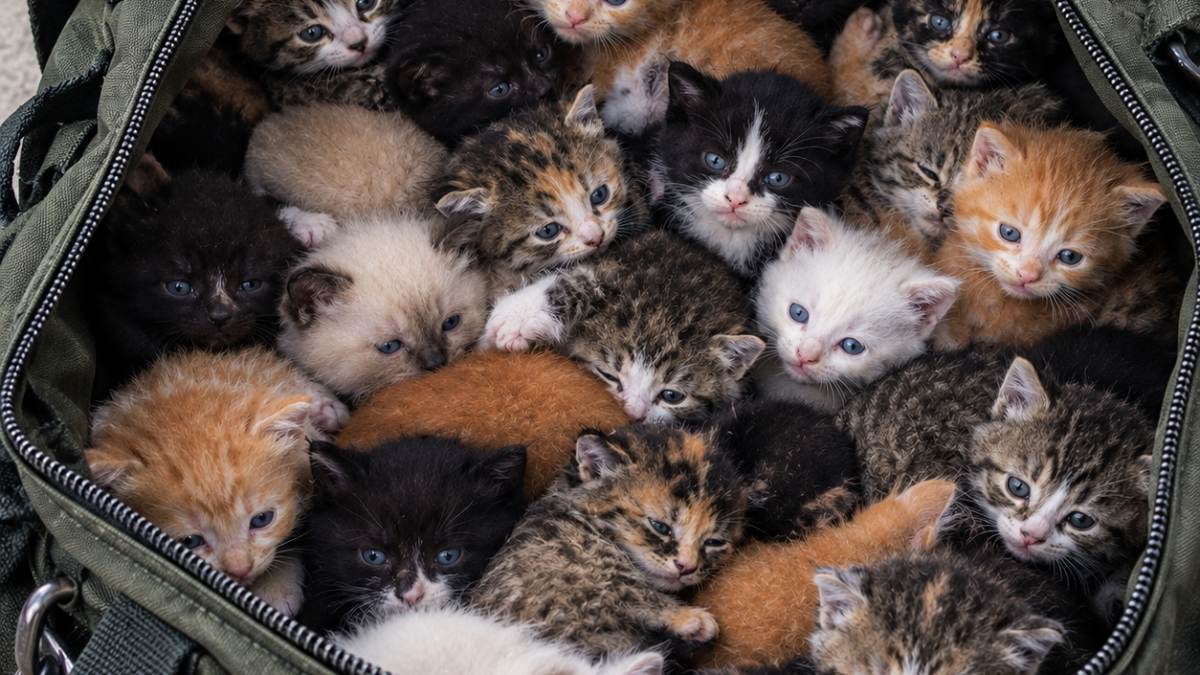
The image was disturbing without being graphic.
A crowded mass of kittens.
Faces.
Ears.
Paws.
Different colors layered beneath the zipper opening.
Some looking toward the light.
Others climbing upward.
One small face partly obscured beneath another body.
That photograph made the story real to people who hadn’t been at the stop.
Nineteen kittens.
One carrier.
One bench.
One zipper.
You didn’t need a long explanation.
The image did it.
By that afternoon, foster applications were flooding in.
People offered bathrooms.
Spare bedrooms.
Nurseries.
Some experienced kitten fosters immediately volunteered for the youngest.
Others could handle older kittens.
The shelter divided them by age, condition, and likely litter group where possible.
Not because anyone knew their exact family relationships.
Because three-week-old kittens and seven-week-old kittens have very different needs.
Some needed bottle or supplemental feeding.
Some could eat wet food.
Some were strong enough to play.
Others needed monitoring.
I asked whether separating them was stressful.
The shelter coordinator told me:
“Less stressful than being crushed together.”
Fair.
Within twenty-four hours, most had placement lined up.
Within forty-eight, every surviving kitten was in foster care.
All seventeen.
That number mattered.
Seventeen.
When animal control first arrived, three had been dangerously weak.
By forty-eight hours later, all three were still alive.
The little orange-and-white male?
He made it.
I asked specifically.
The shelter worker laughed.
“You really remember him.”
“He was barely moving.”
“He’s moving now.”
“How much?”
“He bit a technician.”
I started laughing.
“Good.”
“I’ll tell her you said that.”
“Please don’t.”
For the first time since the bus stop, I felt the story might have an ending other than rage.
Not yet.
But maybe.
The two kittens who died still bothered me.
People kept congratulating me.
Seventeen saved.
I appreciated it.
But nineteen had been in that carrier.
There were two who would never go to a foster home.
I asked what happened to them.
The shelter handled them respectfully.
That mattered more to me than I expected.
Someone had treated them like disposable things.
At minimum, their bodies would not be treated that way again.
I learned something during those days about rescue workers.
They celebrate and grieve at the same time.
Seventeen alive?
Celebrate.
Two dead?
Grieve.
You don’t let one cancel the other.
If you focus only on the deaths, you lose the seventeen.
If you focus only on the survivors, you pretend two lives didn’t matter.
Both are true.
That became part of how I understood that morning.
Two were lost.
Seventeen weren’t.
The community response continued.
Someone donated cases of kitten food.
Another business covered part of the medical cost.
People brought litter.
Formula.
Blankets.
Small toys.
The shelter eventually had to tell people they had enough of certain supplies.
Think about the contrast.
Before sunrise, one person had decided those kittens were too much responsibility.
By the next evening, dozens of strangers were competing for ways to help.
That was the first part of what I came to think of as the kittens’ revenge.
Not revenge against a named person.
We never had one.
Not violence.
Nothing dramatic.
Just contradiction.
Somebody’s action said:
These lives are someone else’s problem.
The community answered:
Fine.
Then they’ll be our responsibility together.
Whoever zipped that carrier may have expected one bus driver to deal with the inconvenience.
Instead, they accidentally introduced seventeen kittens to an entire county determined to keep them alive.
That felt satisfying.
The shelter asked if I wanted to visit.
I hesitated.
Why?
Because I didn’t want to become the bus-driver mascot of the whole thing.
I’d already had local reporters asking questions.
Someone at a television station wanted an interview.
I declined.
A radio host called.
Declined.
I wasn’t interested in standing in front of cameras saying:
“I knew I had to help.”
Of course I had to help.
What was the alternative?
Look inside and zip it closed again?
No.
I agreed to visit the shelter privately.
The original carrier was there.
Cleaned now.
Empty.
I hated seeing it.
It looked normal.
That’s what bothered me.
Soft-sided pet carrier.
Mesh window.
Zipper.
Something you could buy in any store.
There was no visible sign that nineteen kittens had been stacked inside it except a few scratches near the mesh.
I asked:
“How many should fit in there?”
“One adult cat.”
“Maybe two tiny kittens temporarily,” the worker said, “but definitely not nineteen.”
I touched the zipper.
The same one.
I could still remember pulling it open.
I stepped away.
“Where are they?”
“Most are already in foster.”
She showed me photographs.
The difference in one day was shocking.
Kittens sleeping separately on clean fleece.
Food bowls.
Heating pads arranged safely.
One group in a bathroom.
Another in a large playpen.
The orange-and-white kitten was wrapped in a tiny blanket.
Eyes open.
His foster had written:
Finally yelling for food.
I smiled.
“Good.”
The shelter coordinator said:
“That’s your little guy.”
“He’s not mine.”
“You ask about him every call.”
“That’s different.”
She laughed.
We went through the list.
Some had temporary names.
They needed names for records.
One foster called a trio Stop, Bus, and Bench.
I thought that was terrible.
Also funny.
Another called two kittens Dawn and Driver.
I begged them not to name one after me.
They promised.
I didn’t fully trust them.
The very youngest kittens required the most work.
Feeding around the clock.
Stimulating them to eliminate if necessary.
Monitoring weight.
Watching for respiratory infections.
Parasites.
Diarrhea.
Everything that can turn dangerous quickly in a tiny body.
I realized how absurd my first thought had been that morning:
Maybe I could just put them on the bus.
No.
What those kittens needed wasn’t transportation.
They needed an emergency network.
That’s what they got.
A week later, foster updates showed weight gain.
The three weakest stabilized completely.
The older kittens began playing.
One tabby apparently became obsessed with climbing curtains.
Another slept on a foster family’s dog.
I liked that one because I had dogs.
Maybe I’d used them as an excuse too quickly.
My wife noticed.
“You want one.”
“No.”
“You do.”
“I do not.”
“You keep showing me pictures.”
“Because they’re alive.”
“One is sleeping on a dog.”
“Exactly.”
She smiled.
“We could adopt.”
“No.”
“Why?”
“We have two dogs.”
“That kitten likes dogs.”
I almost broke.
Almost.
But I knew my limits.
Our dogs were older.
One had never lived with cats.
The point of rescue isn’t to bring an animal into a home because your heart says yes when the home itself says maybe not.
So we didn’t adopt.
I still got accused of being “the kittens’ bus driver.”
Fine.
A few weeks after the rescue, I met one of the foster families by chance at a grocery store.
The woman recognized me.
“You’re the driver.”
I hate that sentence now.
“Yes.”
She showed me a picture.
One of the gray kittens.
Healthy.
Eyes bright.
Sitting on a child’s lap.
“This is Marvin.”
“Which one was he?”
“Probably one of the middle-age group.”
She laughed.
“Sounds ridiculous talking about kittens like that.”
“Three weeks to seven weeks is a big difference.”
Apparently I had learned shelter language.
She nodded.
“He’s gaining weight.”
“Good.”
“My daughter wants to adopt him.”
“Are you?”
“Probably.”
I looked at the picture again.
Marvin.
He’d been a face in a pile when I first saw him.
Now he had a name.
That progression hit me.
Face.
Medical number.
Foster name.
Home.
Identity expanding as danger shrank.
That is what rescue does at its best.
It takes an animal somebody reduced to excess and keeps adding detail until the animal becomes somebody.
Marvin.
A child.
A couch.
A favorite toy.
An appointment next Tuesday.
A future.
You can’t pack “a future” into one sentence the way you can pack nineteen bodies into a carrier.
Maybe that’s why abandonment is easier psychologically.
It turns individuals back into a mass.
Too many kittens.
Problem.
Bag.
Leave.
Rescue reverses that.
One by one.
Name.
Feed.
Treat.
Know.
The shelters eventually announced that all seventeen were expected to become available for adoption once they reached appropriate ages, weights, and health milestones.
Some foster families had already failed.
Foster failed.
I’d never heard the phrase before.
It means they adopted their foster animals.
Terrible at temporary.
Excellent ending.
The orange-and-white kitten became one.
His foster mother fell in love with him.
She named him Gus.
When I heard that, I laughed.
“Gus?”
“What did you want?”
“I don’t know.”
“Orange Bus?”
“Absolutely not.”
Gus remained in that home.
A woman who had agreed to keep him alive for a few nights decided she wanted to keep him for years.
That is the kind of failure I can support.
Several others went to permanent homes after medical clearance.
Two were adopted together.
Another pair too.
One older tabby went to a retired couple.
A black kitten joined a household with two teenagers.
Silver sisters went together to a young woman in an apartment.
I didn’t meet all the adopters.
Didn’t need to.
The shelter sometimes sent me pictures because someone there understood I cared.
My phone filled with cats I technically did not own.
My wife thought it was hilarious.
“You’re a cat person now.”
“No.”
“Show me your camera roll.”
I refused.
Evidence was overwhelming.
A few months after the abandonment, I finally agreed to one local newspaper interview because the reporter wasn’t interested in making me heroic.
She wanted to talk about what people should do when they find abandoned animals.
Fair.
She asked:
“Why did you stop that morning?”
“Because it’s a bus stop.”
“What do you mean?”
“It’s my job to stop there.”
“There wasn’t a passenger.”
“No.”
“So you could have kept going.”
“Yes.”
“Why didn’t you?”
I thought.
“Something looked wrong.”
Then I corrected myself.
“Actually, at first nothing looked wrong except the carrier was there.”
“What changed?”
“It moved.”
“And if it hadn’t?”
That question sat between us.
“I don’t know.”
I hated the honest answer.
Maybe I would have reported the bag.
Maybe another person would have investigated.
Maybe not soon enough.
The reporter asked:
“Does that bother you?”
“Yes.”
“Why?”
“Because I used to see abandoned bags and assume somebody else’s mess.”
“And now?”
“I check.”
That became the headline.
Not the part about me.
The idea:
BUS DRIVER NOW CHECKS EVERY ABANDONED BAG AFTER FINDING 19 KITTENS
Fine.
True.
I do.
Every morning.
Same route or another.
Bag on bench?
Look.
Box near shelter?
Look.
Carrier?
Definitely look.
Ninety-nine percent of the time:
Trash.
Old clothes.
Food wrappers.
Nothing.
Good.
I like nothing.
Nothing is a successful inspection.
One morning I stopped for a cardboard box.
Passenger groaned.
“We’re late.”
“Thirty seconds.”
I checked.
Empty.
He shook his head.
“What are you expecting?”
I looked at him.
“You don’t want to know.”
Then drove.
My coworkers began doing it too.
Not officially.
No new city policy.
Just people.
Someone would radio:
“Bag at 14th and Pine, already checked. Trash.”
Another:
“Box at the transfer stop. Empty.”
The first time I heard that, I smiled.
No announcement.
No committee.
Behavior changed.
One abandoned carrier had changed the way a handful of bus drivers saw objects on benches.
That mattered.
A year later, another driver found a small dog tied behind a stop.
Different situation.
Healthy enough.
Animal control came.
The driver later told me:
“I checked behind the shelter because of your kittens.”
My kittens.
Again.
Not mine.
But I understood.
The nineteen had become part of institutional memory without anything official being written.
Look twice.
That’s a decent legacy.
The two kittens who died remained part of it too.
I asked the shelter once whether they’d ever identified whoever abandoned them.
No definitive answer was given to me.
Maybe there were leads.
Maybe not.
I stopped asking eventually.
At first, I wanted a person.
A face.
Someone to blame.
I imagined confronting them.
“You zipped nineteen kittens into that thing.”
“What did you think would happen?”
“Did you know two were already dead when you left?”
“Did you even count?”
Anger likes questions.
Questions create an imaginary courtroom where the guilty person finally provides an answer satisfying enough to explain cruelty or irresponsibility.
That answer rarely exists.
Maybe somebody was overwhelmed.
Maybe they were trying, in their own warped way, to leave the kittens somewhere they’d be found.
If so, there were better choices.
Shelters.
Rescue groups.
Animal control.
Phone calls.
Even leaving the carrier open would have changed airflow, though it would have created different dangers.
I could understand desperation without excusing the method.
Nineteen kittens were compressed into a bag.
Two died.
That fact remained.
Intent couldn’t change it.
But I eventually realized that knowing the person’s name wouldn’t improve the ending.
The kittens who survived already had one.
Seventeen names, actually.
That mattered more.
Years later, I could remember only some.
Gus.
Marvin.
Dawn.
A little calico called Pepper.
Two black siblings named Moon and Midnight by a family with young children.
A gray female called Juniper.
Others faded from my memory.
That’s okay.
They became somebody else’s memories.
That’s the point.
A successful rescue eventually stops belonging to the rescuer.
It becomes ordinary life elsewhere.
I don’t need to know where every cat slept every night.
I just needed them to have a night.
And another.
And another.
A foster family once sent me a Christmas card.
On the front was a large tabby sprawled beneath a tree.
Caption:
FORMER BUS-STOP PASSENGER. STILL REFUSES TO PAY FARE.
I laughed for five minutes.
My supervisor put a copy in the break room.
Then everybody started joking about unpaid fares.
Someone printed a fake transit pass:
KITTEN — LIFETIME SERVICE — FARE: $0
Humor matters after ugly things.
It doesn’t disrespect what happened.
It stops the ugliness from owning every memory.
At first, whenever I thought of that morning, I smelled urine.
Felt the carrier heat.
Saw two still bodies.
Later, other images began competing.
Gus biting a technician.
Marvin on a child’s lap.
The Christmas tabby.
A pair of kittens asleep in the same basket after adoption.
That is how recovery happened for me too.
You add better images until the worst one is no longer alone.
The photograph I took at 4:20 remained online.
People continued sharing it periodically.
Every time it resurfaced, strangers argued.
“How could anyone do that?”
“Maybe they were trying to save them.”
“They should have called a rescue.”
“Shelters are full.”
“Still no excuse.”
I learned not to read too many comments.
Internet outrage is easy.
Rescue logistics are hard.
People can type “monster” in three seconds.
A foster parent can spend six weeks feeding a kitten at 2 a.m.
I became more interested in the second person.
Anger has value.
It tells us something violated our sense of right.
But anger without action mostly burns the person holding it.
The community did something better.
They converted anger into:
Formula.
Vet bills.
Laundry.
Foster spaces.
Transportation.
Adoption interviews.
Spay-neuter appointments.
Those aren’t dramatic words.
They’re what actually changed seventeen lives.
That became my version of revenge.
Whoever left the carrier had reduced nineteen living animals to one inconvenient object.
The people who responded reversed the process.
They opened the object.
Separated the lives.
Then treated each life as worth the trouble.
One bag became seventeen futures.
That is a pretty complete answer.
I kept driving.
Years passed.
The stop changed slightly.
The bench was replaced once.
Same location.
New metal design.
The first time I pulled up after the replacement, I felt annoyed.
The old wooden bench had been part of the story.
Then I realized how stupid that was.
The bench wasn’t sacred.
Better to replace broken things.
I still slowed at 4:20.
Habit.
Sometimes passengers noticed.
“Why do you always look at that bench?”
Most mornings I said:
“Just checking.”
Occasionally I’d tell the story.
Their reaction followed a pattern.
“Nineteen?”
“Yes.”
“In one bag?”
“Yes.”
“Did they live?”
“Seventeen did.”
That answer always changed faces.
Not nineteen.
Seventeen.
I never rounded the story into a perfect rescue.
Perfect would have been finding them before anyone died.
We don’t get to revise reality to improve inspiration.
Seventeen is good enough to celebrate.
Two is enough to remember.
A high-school student rode my route for a while.
After hearing the story, she started looking at the bench too.
One morning she got on and said:
“Nothing today.”
I knew what she meant.
“Good.”
A week later:
“There’s a grocery bag farther down.”
“I saw it.”
“You checking?”
“Yes.”
“Good.”
I laughed.
The habit spread again.
Attention is contagious when people understand why it matters.
So is indifference.
The person who abandoned the kittens may have counted on indifference.
Early hour.
Empty road.
Nobody watching.
Zip the carrier.
Leave.
But public places have one advantage.
Sooner or later, somebody arrives.
That somebody happened to be me.
The first bus.
I used to resent that.
Why me?
Why did I have to open it?
Why did those two dead kittens become part of my memory?
Then I realized the opposite question mattered more.
Why not me?
I was there.
Had a radio.
Could call help.
Could wait.
Forty minutes of my life.
That’s all the first part cost me.
The kittens had already paid much more.
So I waited.
There isn’t anything heroic about that.
There is something important, though.
People are often afraid to get involved because involvement creates inconvenience.
You stop, and now it’s yours.
You open the carrier, and now you can’t pretend.
Exactly.
That isn’t always bad.
Sometimes responsibility should transfer to the person capable of doing something until professionals arrive.
Not permanently.
Just long enough.
I couldn’t foster nineteen kittens.
Couldn’t treat dehydration.
Couldn’t investigate abandonment.
But I could sit beside an open zipper for forty minutes.
That was my job in the chain.
Know your piece.
Do it.
Hand the problem forward responsibly.
The shelter taught me that.
Every person had a manageable piece.
Animal control:
Transport.
Shelter clinic:
Triage.
Foster coordinator:
Placement.
Fosters:
Care.
Veterinarians:
Treatment.
Adopters:
Lifetime.
One person looking at the entire problem might say:
Nineteen kittens? Impossible.
Break it into links.
Possible.
That lesson stayed with me outside animal rescue too.
Large problems become excuses when we think we must solve everything ourselves.
Sometimes you only need to be the person who doesn’t drive away.
The orange-and-white kitten, Gus, eventually became the unofficial favorite among my coworkers because I talked about him most.
His adopter sent a picture about a year later.
He was enormous.
Not literally enormous.
Normal cat.
But compared with the limp handful I’d seen in the carrier, he looked impossible.
Broad orange face.
White chest.
Green eyes.
Sitting on a couch like he owned the mortgage.
Caption:
The kitten who was too weak to lift his head now wakes me at 5 a.m. by knocking things off my nightstand.
I showed everyone.
A coworker said:
“Sounds ungrateful.”
I replied:
“Sounds alive.”
Exactly.
Annoying behavior is a luxury sometimes.
A kitten strong enough to destroy household objects is a kitten no longer lying under eighteen others fighting for oxygen.
Gus could knock down everything he wanted as far as I was concerned.
His adopter probably disagreed.
That’s their problem now.
Success.
Marvin became a large gray tabby.
The child in his foster photo became his permanent person.
I saw an update once where he was asleep across homework.
Again:
Normal.
Normal is underrated in rescue stories.
People want dramatic transformations.
The best transformation is often from emergency to inconvenience.
From “Will he survive the night?” to “He keeps getting on the counter.”
That is victory.
Another survivor developed into a shy adult.
Her adopter said she hid from visitors but slept beside her every night.
Maybe personality.
Maybe early trauma.
No way to know.
Not every rescued animal becomes fearless.
That’s okay.
Safety does not require personality transformation.
I thought about how frightened those kittens must have been in the carrier.
Some probably remembered nothing later.
The youngest especially.
Others may have carried associations with confinement.
Again, we don’t know.
People like clean psychological narratives.
Animals don’t give interviews.
We should respect uncertainty.
What we know:
Seventeen survived.
They entered foster homes within forty-eight hours.
They grew.
They were adopted.
That is enough.
The city bus system never formally commemorated what happened.
I’m glad.
No plaque at the bench.
No “KITTEN RESCUE STOP.”
I would’ve hated that.
Bus stops belong to passengers, not my memories.
Still, privately, that bench became a checkpoint.
Every first pass.
Eyes.
Bench.
Ground.
Behind shelter.
Move on.
Most mornings, nothing.
Hundreds of mornings.
Thousands eventually.
That may sound obsessive.
Maybe.
But the cost is seconds.
If the price of never overlooking another living bag is ten seconds of attention, I’ll pay it.
One winter morning, I found an old duffel at the stop.
Closed.
Heavy enough that my stomach tightened.
I got off.
Touched it.
No movement.
Called dispatch.
Police checked because unattended luggage has its own concerns.
Clothes.
Nothing more.
My supervisor joked:
“Disappointed?”
“Very happy.”
Empty problems are my favorite now.
Another morning, there was a taped cardboard box.
I could hear movement.
My pulse jumped.
Turned out to contain someone’s escaped chickens.
Three.
Alive.
A farmer arrived frantic five minutes later.
Long story.
Not abandonment.
I laughed so hard afterward that I had tears.
The chickens did not appreciate city transit.
But again:
Check.
Because you never know.
I became known for it.
Coworkers teased.
“Bag inspector.”
“Bench patrol.”
“Animal express.”
Fine.
I’ve been called worse.
The teasing carried respect underneath.
They checked too.
That’s what mattered.
On the five-year anniversary—though I don’t normally count anniversaries—the shelter contacted me.
They were doing a retrospective on memorable rescues.
They asked whether I wanted to know what happened to the surviving cats.
I said yes.
Records were incomplete in places because fosters and adoptions crossed different systems, but they had updates on most.
Alive.
Indoor homes.
Some with original foster families.
Some moved with their adopters.
One living several states away.
Gus still healthy.
Marvin still with the same family.
A bonded pair still together.
I stared at that information.
Five years.
The carrier had held them for maybe hours.
Their homes had held them for years.
There’s the math I like.
We cannot erase the hours.
We can outnumber them.
That became the second version of revenge.
One abandoned morning versus thousands of safe mornings.
One zipped bag versus seventeen open homes.
One decision to walk away versus years of decisions to stay.
Which side gets the final word?
The longer they lived, the clearer the answer became.
The shelter asked me to come to their event.
I almost refused.
Then my wife said:
“Go.”
“Why?”
“Because you still think stopping didn’t matter.”
“I’ve never said that.”
“You say everyone else did the hard part.”
“They did.”
“And you did the first part.”
I sighed.
She was right in the irritating way spouses often are.
I went.
Small event.
Volunteers.
Foster families.
Donors.
No grand ceremony.
Good.
A photo display included the original carrier picture.
Beside it were adoption photos.
That juxtaposition got me.
Carrier.
Then seventeen separate frames.
One cat sleeping on a bed.
One held by a teenager.
Two together at a window.
One under a Christmas tree.
One sprawled beside a Labrador.
Individual.
Individual.
Individual.
That was the most powerful image I’d seen from the whole story.
The original photo looked like a mass.
The later wall refused to let them remain one.
Seventeen separate lives.
I stood there a long time.
A shelter volunteer came beside me.
“Hard to look at?”
“The first one.”
She nodded.
I pointed to the others.
“Those are easy.”
She smiled.
“That’s why we put them together.”
Smart.
A child at the event asked me:
“Did you save all nineteen?”
Children ask direct questions.
“No.”
Her smile disappeared.
“Two died before we got help.”
“Oh.”
“But seventeen made it.”
She looked at the adoption photos.
“All those?”
“Yes.”
She counted.
Children trust numbers.
Eventually:
“Seventeen.”
“Right.”
She looked back at the carrier.
“Why would somebody put them in there?”
“I don’t know.”
“That’s mean.”
“Yes.”
No need to soften.
Then she asked:
“Are the two dead kittens in heaven?”
That’s beyond my professional expertise as a bus driver.
I said:
“I hope they’re somewhere peaceful.”
She accepted that.
Then ran off.
I stayed beside the photos.
Two absent frames existed in my mind.
Maybe that’s okay too.
The story has space for them.
The shelter director eventually asked whether I wanted to speak.
I hadn’t prepared anything.
I stood in front of a small crowd.
Said:
“I almost drove past.”
Not the opening they expected.
People became quiet.
I continued.
“No passenger was waiting. Just the bag.”
Then explained.
“It moved.”
I looked toward the photo wall.
“If it hadn’t moved, I don’t know exactly what I would’ve done.”
Honesty.
“I’d like to think I would’ve reported it anyway.”
Pause.
“But I don’t know.”
Then I said the only lesson I felt qualified to give.
“So now I look.”
That’s it.
Not:
Be a hero.
Not:
Save nineteen kittens.
Look.
If something seems wrong, give it another second.
Look.
Attention comes before every rescue.
Someone has to notice.
The driver notices a carrier.
The foster notices appetite changing.
The veterinarian notices dehydration.
The adopter notices a cat hiding more than usual.
Care is mostly attention repeated.
I didn’t understand that before.
Now I do.
Afterward, one elderly woman approached.
She had adopted one of the bus-stop kittens.
A black female.
Her name was Lucy.
I had no memory of which face in the carrier had been Lucy.
That pleased me strangely.
The emergency had stopped defining her.
The woman showed me a picture.
Lucy on a pillow.
“She sleeps next to me every night.”
“How old now?”
“About five.”
She stroked the image on her phone.
“My husband died the year before I got her.”
I looked at her.
“She helped?”
The woman smiled.
“Oh, yes.”
There it was again.
A rescue rippling outward.
I stopped kittens from dying alone on a bench.
Eventually one helped a widow sleep in an empty house.
You cannot predict where a saved life will matter.
That’s why the question “Is it worth saving?” has always bothered me.
Worth what?
To whom?
Lucy couldn’t explain her future from inside that carrier.
Gus couldn’t say he’d become somebody’s irritating alarm clock.
Marvin couldn’t promise he’d comfort a child.
They didn’t need future usefulness to deserve rescue.
Life doesn’t earn protection by proving what it will give back.
Still, seeing what they later gave was beautiful.
The person who abandoned them saw a problem.
Their adopters saw companions.
Same animals.
Different imagination.
Maybe cruelty sometimes begins with failure of imagination.
You stop seeing what a life could become.
A carrier full of kittens becomes one burden.
Easy to leave.
Rescue reopens possibility.
The youngest kittens were especially striking in that sense.
Barely open eyes.
Almost no identity visible.
Years later:
Distinct cats.
Different habits.
Different people.
All of that existed invisibly at 4:20 a.m.
Potential packed under other potential.
Whoever abandoned them couldn’t or wouldn’t carry it.
Other people did.
There’s the payoff.
I never learned who zipped the bag.
Eventually I stopped needing to.
If they ever heard the story, maybe they felt shame.
Maybe relief.
Maybe nothing.
I cannot control that.
If they had convinced themselves:
“Someone will find them,”
then yes.
Someone did.
But that doesn’t make the method acceptable.
Two kittens were already dead.
Three more were close.
Their gamble almost killed more.
Still, the ending took their decision away from them.
They had decided:
Leave.
The rest of us answered:
Stay.
Animal control stayed until intake was done.
Shelter staff stayed late.
Fosters stayed awake.
Veterinarians stayed involved.
Adopters stayed for years.
One act of abandonment created a chain of staying.
I like that symmetry.
The abandonment lasted minutes.
The staying lasted lifetimes.
That’s a much better ratio.
As I got closer to retirement, people asked whether I’d miss the early route.
Some parts.
Not waking at three.
Definitely not that.
But I knew I’d miss the quiet.
First run.
Empty roads.
Watching the city wake.
And the bench.
Funny.
A completely ordinary bus-stop bench became one of the few places on the route I could picture with my eyes closed.
Position of the streetlight.
Fence behind it.
Crack in the curb.
Where the carrier sat.
Where I put my jacket.
Where the orange kitten crawled.
Memory mapped it.
My final year, a younger driver rode with me for training.
At 4:20, I slowed.
He looked around.
“No passenger.”
“I know.”
I stopped anyway.
Checked the bench.
Nothing.
He asked:
“Why’d we stop?”
So I told him.
Nineteen.
One carrier.
Seventeen survived.
He stared at the empty bench.
“Seriously?”
“Yeah.”
After that, he looked too.
The next week he drove while I supervised.
Approaching the stop, he slowed before I said anything.
Bench clear.
He accelerated.
I smiled.
“What?”
“Nothing.”
That may be the legacy I value most.
Eventually I won’t drive the route.
Somebody else will.
Maybe the story fades.
Maybe not.
But for at least one more driver, the bench won’t be invisible.
Look.
That is enough.
My retirement day arrived.
Coworkers gave me the usual gifts.
Card.
Cake.
Jokes about not waking at three.
Then my supervisor handed me a framed photograph.
I groaned before seeing it.
“If that’s a bus, I’m leaving.”
“Look.”
It wasn’t the original carrier picture.
Thank God.
It was a collage.
Seventeen adoption photos gathered around a picture of the bus-stop bench.
At the bottom, someone had printed:
ONE STOP. SEVENTEEN DESTINATIONS.
I stared.
Couldn’t speak.
My coworkers became suspiciously interested in cake.
I cleared my throat.
“That’s corny.”
“Yeah.”
“Really corny.”
“Yep.”
I took it home.
It’s still on the wall.
My wife calls it my cat shrine.
I deny this.
There are no cats currently living in our house.
The dogs remained dogs.
But apparently I own more cat photographs than most cat owners.
Life is strange.
The original carrier?
I asked once what happened to it.
Eventually disposed of after documentation.
Good.
I didn’t want it preserved.
Objects that hurt things don’t deserve monuments.
The lives deserve memory.
That’s enough.
People occasionally recognize me even after retirement.
“You’re the kitten bus driver.”
Apparently that’s my obituary title now.
Fine.
They ask:
“Do you still check bags?”
Yes.
Walking through parking lots.
Near benches.
If something moves, absolutely.
My wife once caught me stopping beside a gym bag outside a store.
“Please don’t open random bags.”
“It moved.”
“It belongs to that man.”
The man was standing ten feet away.
Awkward.
We left.
Habits can go too far.
Still, I’m not sorry.
I’d rather look foolish checking one harmless bag than walk past another carrier like that.
A few years after retirement, I received one final update about Gus.
His adopter sent it through the shelter.
He was older.
Still orange.
Still healthy.
The photograph showed him stretched across a bed with one paw covering his eyes.
I zoomed in.
No trace of the kitten I’d held beside the bus stop.
That’s a good thing.
He didn’t look rescued.
He looked owned.
Loved.
Entitled.
Exactly as a house cat should.
The message said:
He still wakes me before sunrise. Apparently 4:20 a.m. stayed in his system.
Probably coincidence.
I laughed anyway.
My wife said:
“Full circle.”
“Don’t make it sentimental.”
“You cried at the retirement collage.”
“I had cake in my eye.”
“Of course.”
I looked at Gus again.
The little animal who had once been too weak to raise his head now had enough energy to harass someone before dawn.
If that’s not a satisfying ending, I don’t know what is.
Sometimes I think back to the two kittens who didn’t make it.
I wish I could change that.
Of course.
I wish I’d arrived earlier.
Impossible.
My schedule was my schedule.
Maybe I wish the carrier had been left later.
No.
I wish it had never been left.
That’s the only honest version.
The happy ending for seventeen does not turn the abandonment into something good.
We shouldn’t do that.
People like stories where suffering becomes necessary because something beautiful happened afterward.
I reject that.
Those kittens didn’t need to suffer to create community.
The community would’ve been better if someone had responsibly surrendered all nineteen alive.
Then maybe we’d have nineteen adoption photos.
Pain doesn’t become worthwhile because people respond beautifully.
The beauty belongs to the response.
Not the harm.
That’s important.
Whoever abandoned the kittens made a terrible decision.
The people afterward made better ones.
That’s the story.
Not destiny.
Choice after choice after choice.
The carrier was zipped.
I opened it.
Dispatch answered.
Animal control came.
Shelter accepted.
Fosters said yes.
Veterinarians treated.
Adopters committed.
Each step could have failed.
Enough didn’t.
Seventeen lives continued.
That’s what collective mercy looks like.
Not one dramatic miracle.
A series of ordinary people refusing to be the next person who walks away.
Maybe that’s why this story still matters to me.
At 4:20 a.m., abandonment had already happened.
I couldn’t undo it.
I could only decide whether it would continue through me.
That’s a hard sentence, but true.
If I drove away, I would become another person leaving the carrier behind.
So I stopped the chain.
Not the whole problem.
Just that action.
No farther.
The bag had reached someone who wouldn’t pass it forward unopened.
Then animal control did the same.
The shelter.
Fosters.
Adopters.
No farther.
Eventually the kittens reached places where abandonment ended completely.
Permanent homes.
That is how you defeat a cruel decision.
Not by pretending it never happened.
By refusing to repeat its logic.
You don’t say:
Not my problem.
You say:
It’s my piece now.
Then do your piece.
The city changed after that morning for me.
Before, bus stops were infrastructure.
Schedules.
Numbers.
Passengers.
After, they became places where stories might be waiting before anyone knew.
Most still held ordinary things.
Workers.
Students.
Nurses ending overnight shifts.
Teenagers going to school.
People carrying groceries.
That’s enough.
But once in a while, I saw someone sitting with a pet carrier.
I always looked.
Cat inside.
Person beside it.
Good.
Owner present.
Normal.
I appreciated normal more after that.
One morning years later, I saw a woman holding a kitten at the same stop.
Gray tabby.
No relation, obviously.
I pulled up.
She boarded.
Paid fare.
Sat.
The kitten poked its face through the carrier mesh.
I had to smile.
The passenger caught me looking.
“His name’s Rocket.”
“Going to the vet?”
“First shots.”
“Good.”
She probably wondered why I sounded so invested.
I didn’t explain.
That was another kind of full circle.
A kitten inside a carrier.
Proper number:
One.
Zipped for safe transportation.
Human beside him.
Destination planned.
The object itself had never been the problem.
Carelessness was.
A carrier can be safe when used with care.
A bus stop can be safe when somebody remains with the animal.
Context makes the difference.
Rocket rode three stops.
When the woman got off, I watched her lift the carrier gently.
Then continued the route.
Simple.
No emergency.
That’s what care should look like most days.
Quiet enough nobody tells a story about it.
The seventeen bus-stop kittens eventually became old enough that the rescue stopped posting updates.
That’s good too.
Organizations move on.
New emergencies.
New litters.
New dogs.
New cats.
The world keeps producing need faster than most rescue workers can answer.
I learned to respect their endurance more than any dramatic rescue.
They don’t get one story.
They get hundreds.
My kittens were extraordinary to me because I found them.
To shelter staff, they were nineteen among many animals requiring care.
Yet they treated them individually anyway.
That’s professionalism with compassion.
One technician once told me:
“You remember Gus because he was your first critical kitten.”
“First?”
She laughed.
“Hopefully last.”
Agreed.
For her, there were more the next week.
And the week after.
That’s why I started donating to the shelter every year.
Not huge amounts.
Enough.
My wife calls it the “bus fare fund.”
Fine.
I write:
FOR EMERGENCY KITTEN CARE.
Maybe formula.
Maybe medicine.
Maybe something else.
I don’t need control.
I know how networks work now.
Do your piece.
There is no dramatic villain in the ending.
Some people may find that less satisfying.
I don’t.
Whoever abandoned the kittens lost control of the story the moment I opened that zipper.
That is enough.
They left one anonymous bag.
The bag became nineteen documented lives.
Seventeen became named pets.
The act that tried to erase responsibility created witnesses instead.
Me.
Dispatch.
Animal control.
Shelter staff.
Fosters.
Adopters.
An entire community.
Abandonment depends partly on invisibility.
Drop something.
Leave.
Don’t look back.
Rescue destroys invisibility.
Open.
Look.
Count.
Name.
Record.
Care.
That was the real retaliation.
The kittens became impossible to dismiss once people saw their faces.
The photograph did not show garbage.
It showed nineteen sets of eyes, ears, and paws.
You could no longer say “bag.”
You had to say “kittens.”
Then later:
Gus.
Marvin.
Lucy.
Juniper.
Individuals.
That is why I think naming can be an act of resistance.
Abandonment says:
Nobody.
Rescue answers:
Somebody.
Seventeen times.
I still sometimes wake early even though I’m retired.
Decades of 3 a.m. alarms don’t disappear easily.
On those mornings, I make coffee.
Sit near the window.
Around 4:20, I occasionally think about the bench.
The bus running now belongs to somebody else.
Maybe it passes exactly then.
I picture headlights sweeping across the stop.
Empty bench.
Good.
I hope it’s empty.
I hope the driver looks anyway.
Even better.
I don’t need another dramatic rescue to justify the lesson.
I want the lesson to exist in a world where nothing else happens.
That is prevention.
Attention without tragedy.
The best outcome.
People ask what I would say to whoever abandoned those kittens if they were standing in front of me.
Years ago, I had angry answers.
Now I’d probably say:
“You should have asked for help.”
That’s it.
Help existed.
Not unlimited.
Not easy.
Shelters can be overwhelmed.
Fosters can be full.
People can tell you no.
Then you call another.
You don’t compress nineteen animals into one carrier and leave them zipped shut.
Ask.
Give others a chance to respond before creating an emergency.
Because the community did respond.
Immediately.
Imagine what might have happened if the person had contacted that same network before sunrise.
Maybe all nineteen would have lived.
That’s the part that should hurt.
Not because shame is the goal.
Because future choices matter.
The story should prevent repetition.
If someone feels overwhelmed by unwanted litters, the lesson isn’t:
Find a bus stop.
The lesson is:
Call early.
Seek rescue resources.
Arrange surrender.
Ask for foster support.
Get adult cats sterilized so the cycle stops.
Don’t wait until nineteen kittens become one desperate bag.
I am a bus driver, not an animal-welfare expert.
But even I understand that now.
I learned the hardest possible way.
Nineteen.
One carrier.
Two dead.
Seventeen alive.
Forty minutes waiting.
Forty-eight hours to foster every survivor.
Numbers again.
People remember numbers.
They help stories travel.
But I hope the number people remember most isn’t nineteen.
It’s seventeen.
Because seventeen tells you what happened after somebody stopped.
Seventeen tells you intervention mattered.
Seventeen tells you a bad beginning does not control every ending.
That is the satisfying part.
At my retirement party, when I saw the seventeen photographs, I counted them.
Of course.
One.
Two.
Three.
All the way around the frame.
Seventeen.
My supervisor noticed.
“You don’t trust us?”
“I counted nineteen twice.”
He understood immediately.
I touched the bottom of the frame.
ONE STOP. SEVENTEEN DESTINATIONS.
Corny.
Still makes me emotional.
Those destinations didn’t exist as far as I knew at 4:20 that morning.
All I saw was a bench.
A bag.
Movement.
Then faces.
The future was invisible.
That’s often true.
When you help somebody—human or animal—you rarely know what you’re preserving.
You don’t need to.
The future isn’t required to justify compassion.
Help because something needs help now.
Let the future explain itself later.
Gus explained it by becoming a menace.
Lucy explained it by sleeping beside a widow.
Marvin explained it by growing up with a child.
Others explained it through ordinary years I never saw.
Enough.
The two who died explained something too.
Don’t wait.
Don’t assume.
Don’t overload.
Don’t abandon.
Their absence mattered.
I won’t turn them into a moral device.
They were kittens.
They should have had names and homes too.
They didn’t.
That loss stays.
Maybe remembering them is another reason I still check benches.
Not guilt.
Responsibility informed by memory.
There is a difference.
The person who left that carrier walked away from nineteen.
I only had to refuse to walk away from the seventeen who still had time.
So I did.
Forty minutes.
People sometimes say:
“You waited forty minutes?”
Yes.
“What about your passengers?”
Another bus covered them.
“What about getting in trouble?”
Didn’t.
“What if you had?”
Worth it.
Schedules recover.
Dead kittens don’t.
Simple priorities.
Transportation systems are built around minutes.
Early.
Late.
On time.
That morning taught me there are moments when twenty minutes matter enormously and schedules don’t.
Three weak kittens.
Another twenty minutes sealed in that heat?
I don’t like imagining it.
So yes.
The bus was late.
Good.
If I had to do it again, it would be later.
I’d wait longer.
I’ve never regretted those forty minutes.
Not once.
The bus stop still exists.
If you passed it today, you wouldn’t know.
No plaque.
No flowers.
No sign.
People sit there checking phones.
Cars pass.
Buses stop.
Ordinary.
That pleases me.
The bench doesn’t need memory.
I carry it.
So do the people who were there afterward.
And somewhere, scattered through different homes, cats carry no story at all.
They don’t know they were abandoned.
Maybe some remember fear.
Probably most don’t in any human narrative sense.
Good.
They don’t need the story.
We do.
Because we’re the ones responsible for learning from it.
The cats only needed homes.
They got them.
That’s enough.
If there is one image I want to replace the original photograph with, it isn’t a specific cat.
It’s seventeen doors.
Different houses.
Different apartments.
Opening.
A carrier arriving.
A foster carrying one kitten inside.
Food bowl.
Blanket.
Safe room.
Then days later, another door.
Permanent home.
Human waiting.
Cat stepping out.
That is the opposite of the bus stop.
At the bus stop, someone put lives down and walked away.
At those doors, people picked them up and said:
Stay.
That’s the answer.
Leave versus stay.
Seventeen times, stay won.
Whoever abandoned them may never know that.
I do.
The shelter does.
The families do.
And now every time I see an unattended bag near a bench, I remember.
I slow down.
I look.
Most days there’s nothing.
I hope there never is again.
But if something moves?
I’m stopping.
Because one Tuesday—or Wednesday, or whatever ordinary morning the next emergency chooses—some living thing may depend on a stranger taking ten more seconds to notice that what looks like garbage isn’t.
That’s what happened to me.
4:20 a.m.
Empty stop.
No passenger.
One carrier.
I nearly drove on.
Then the bag moved.
I opened it.
Nineteen kittens looked up into the first clean air they’d had in who knows how long.
Two had already lost their chance.
Seventeen hadn’t.
So I sat down beside them.
My bus waited.
My route waited.
The city could wait.
For forty minutes, the most important stop on my route wasn’t about picking anyone up or dropping anyone off.
It was about making sure seventeen tiny passengers got one more connection.
Animal control.
Shelter.
Foster homes.
Families.
A route I never could have seen from the driver’s seat.
Years later, that’s the part that stays with me.
Bus drivers spend their careers taking people from one stop to another.
That morning, without planning it, I did the same thing for seventeen kittens.
I didn’t take them far.
Just from invisible to seen.
From zipped shut to open.
From abandoned to somebody’s responsibility.
Others carried them the rest of the way.
That’s how they reached home.
And if the person who left that carrier ever wondered what happened after they drove away, here’s the answer I wish they could see.
The bag was opened.
The kittens were counted.
The weakest were treated.
Fosters answered.
Families came.
Seventeen survived.
Seventeen got names.
Seventeen learned what beds, windows, laps, toys, food bowls, and safe nights felt like.
Seventeen lives became much larger than the carrier that had once held all of them.
You abandoned one bag.
The rest of us found seventeen futures inside it.
And every morning afterward, I checked that bench.
Just in case.



